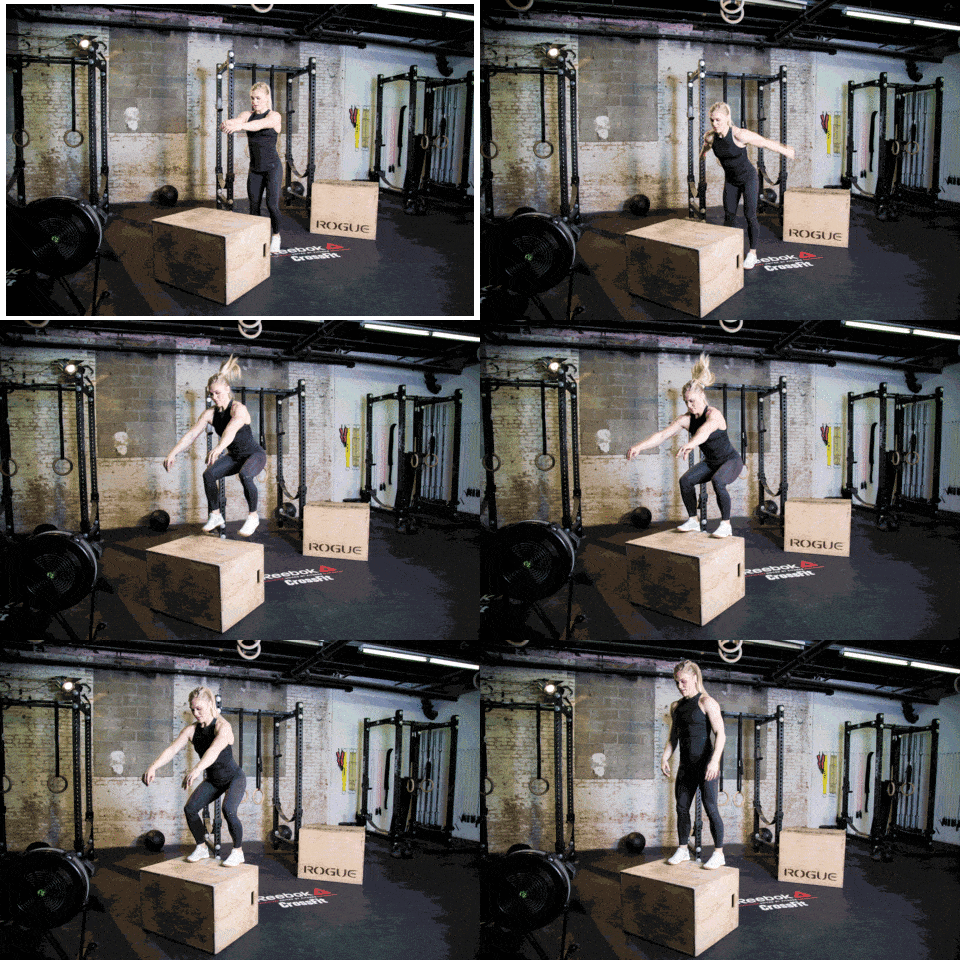
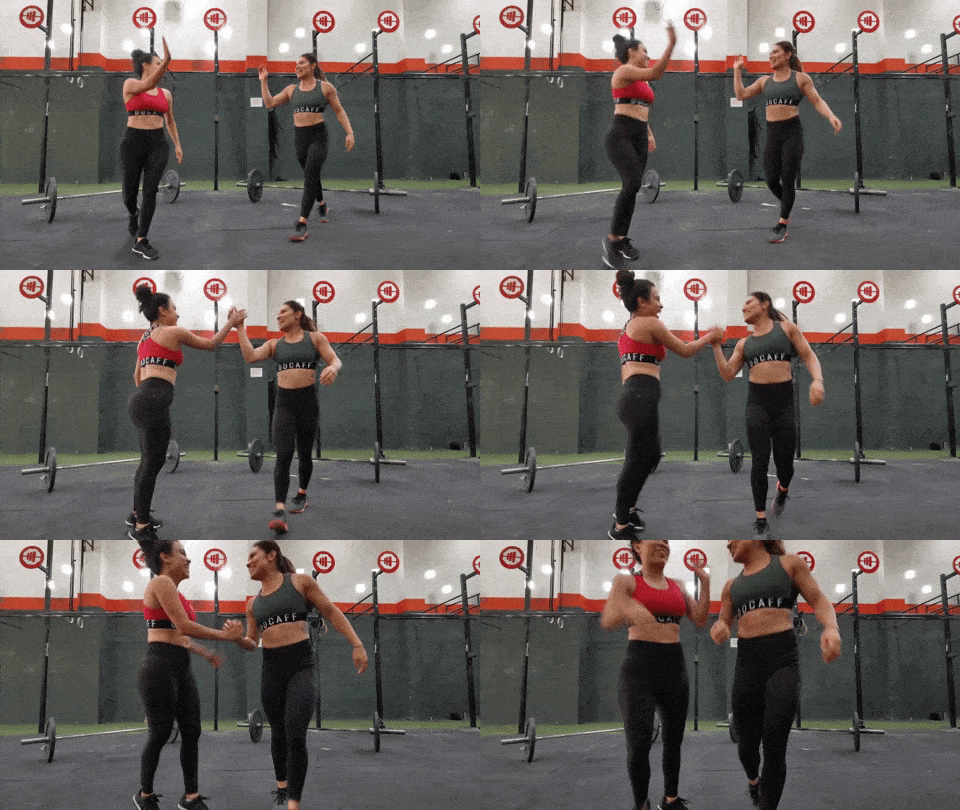
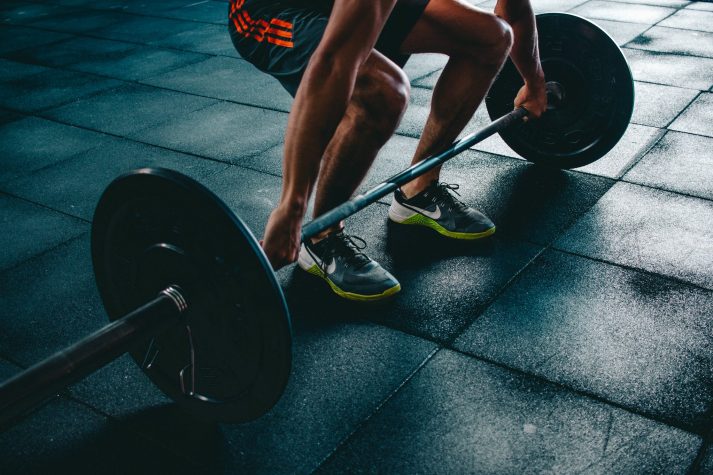
With today’s Advanced Bodyweight Routine, you can burn fat, build muscle, and get a great workout in! All with no gym membership required!
It’s the kind of workout we build through our online coaching program. If you’re in a hurry, sign-up for our free weekly newsletter and we’ll send you PDFs of our “Work Out at Home” guides!
If you’re ready, click the sections below to get right into the action:
Don’t forget to warm up. You can run in place, jump rope, do a few push-ups, pedal on a stationary bike, jog up and down your stairs, etc. Since we are doing advanced movements here, the warm-up becomes even more critical.
If you are following this bodyweight workout plan because you’re trying to get in great shape without needing a gym, download our free-guide: Strength Training 101: Everything You Need to Know. It’ll provide an exact plan to follow for growing strong.
Download our comprehensive guideSTRENGTH TRAINING 101!
Everything you need to know about getting strong.
Workout routines for bodyweight AND weight training.
How to find the right gym and train properly in one.
If you don’t have a resistance band, you can do negative pull-ups instead. Jump and hold yourself above the bar, and then slowly, under control, lower yourself to the ‘starting position’ of a pull-up. Then repeat!
This is a great way to build up enough strength to eventually get your first pull-up.
8) PULL-UP
We have a full guide on proper pull-up form so you can hone in your technique.
9) CHIN-UPS
Much like a pull-up, but with your palms facing toward you.
Here’s a video going over proper pull-up and chin-up form:
If you can’t do pull-ups or chin-ups, you have another option…
10) INVERTED BODYWEIGHT ROW (OVERHAND)
An inverted bodyweight row can be a great “pull” exercise if you can’t do a pull-up yet, or if you don’t have a proper pull-up bar nearby. Because a good sturdy table can be used for inverted rows:
11) INVERTED BODYWEIGHT ROW (UNDERHAND)
12) ASSISTED BODYWEIGHT DIPS
With a resistance band, you can start performing assisted dips. A great exercise while you build up strength for normal dips.
13) BODYWEIGHT DIPS
14) KNEE PUSH-UP
15) ELEVATED PUSH-UP
16) REGULAR PUSH-UP
We have a whole article on how to do a proper push-up, but we also cover it extensively in this 5-minute video:
17) DECLINE PUSH-UPS
18) KNEE PLANK
19) PLANK
20) SIDE PLANK
21) JUMPING JACKS
If you are looking for even MORE bodyweight exercises you can use in your workouts, make sure to check out our mega-resource:
Full guide to the most effective diet and why it works.
Complete and track your first workout today, no gym required.
How to Scale Your Bodyweight Routine
As I said earlier, this whole routine is scalable based on your ability. For example, here is a sample routine for somebody who has conquered the Beginner Bodyweight Workout but can’t do the full routine above:
“HOW OFTEN SHOULD I DO THE ADVANCED BODYWEIGHT WORKOUT?”
Do this routine 2-3 times a week, but never on consecutive days. It’s a message we really strike home in our guide, “How Often Should I Work Out?”
You don’t build muscle when you’re exercising, you build muscle when you’re resting, so try not to do a strength training routine (of the same muscle groups) two days in a row.
If you’re still uneasy about this advanced workout, start with our Beginner Bodyweight Workout instead. You can download a worksheet to get started when you sign-up for our free weekly newsletter:
Grab Your Beginner Bodyweight Routine Worksheet. No Gym Required!
Complete this workout at home, no equipment required
Avoid the common mistakes everybody makes when doing bodyweight exercises
Learn how to finally get your first pull-up
After the Advanced Bodyweight Workout: Next Steps!
This should help you get started with a really powerful bodyweight training routine. But we hear frequently that people want MORE instruction, MORE guidance, and MORE workouts.
If that’s you, we have MULTIPLE options to take the next step. Pick the option below that best aligns with your goals and timeline:
1) If you want step-by-step guidance, a custom bodyweight training program that levels up as you get stronger, and a coach to keep you accountable, check out our killer 1-on-1 coaching program:
2) If you want a daily prompt for doing workouts at home, check out NF Journey. Our fun habit-building app helps you exercise more frequently, eat healthier, and level up your life (literally).
Try your free trial right here:
3) Enlist in the Rebellion! We need good people like you in our community, the Nerd Fitness Rebellion.
Sign up in the box below to enlist and get our guide, Strength Training 101: Everything You Need to Know. It’ll help you start incorporating these advanced bodyweight moves into your training.
Download our comprehensive guideSTRENGTH TRAINING 101!
Everything you need to know about getting strong.
Workout routines for bodyweight AND weight training.
How to find the right gym and train properly in one.
4) Level Up Your Workout! If you’re looking for more workout routines to follow, I got you covered:
How to Do Your First Handstand: now we’re talking! Learn the different progressions that will eventually have you getting your first freestanding handstand!
6 Levels of Gym Workouts: never wonder what to do in the gym again! Follow these 6 levels of workouts to go from Newbie to Gym Hero!
I’d love to hear how this workout was for you.
Leave a comment below with your results or any questions you have on advanced bodyweight training and how else we can help.
For the Rebellion!
-Steve
PS: Where do you go after you’ve crushed the Advanced Bodyweight Workout? Well, have you ever heard of the PLP Progression? There’s really no limit on how challenging that can get.
If you are craving a great reformer workout, but lacking a reformer at home, then you’re going to love this 10-minute workout you can do from home!
This 10-minute Reformer on the Mat workout was inspired by many exercise done on the reformer, but they can be done right on your mat.
In 10 minutes, you’ll get an effective workout that will wake up and strengthen your entire body. You might even discover a new favorite reformer-inspired Pilates exercise!
“Steve, how many calories should I eat every day? I have goals!”
Great question.
Knowledge is power, so today, we are going to make you more powerful by calculating your Total Daily Energy Expenditure (TDEE).
Of course, “knowing is half the battle.” The other half is what you actually DO with your TDEE information!
Fortunately for you, we’ve helped thousands of Online Coaching Clients lose weight and get healthy, and TDEE is just one of many factors we consider when building a specific strategy for somebody’s goals.
Okay FINE, I’ll share the other factors and strategies below too.
Simply click on the section below for quick reading, though I’d recommend you read the whole enchilada to properly apply your TDEE to your life:
Although you can adjust it, I want you to set your “Activity Level” as “Sedentary,” (I’ll explain why in a minute):
Nerd Fitness Total Daily Energy Expenditure Calculator
(Note: we have used The Mifflin-St Jeor Equation to create this calculator! [1])
Hooray! You now know estimates of your BMR and TDEE![2]
You may be thinking, “Ah, Steve, what do either of these mean?”
I got you boo.
Make sure you write down your two numbers, and then move onto the next section.
If you’re already starting to get overwhelmed, have no fear! We help hundreds of men and women calculate their calorie goals, and we’d love to help you too!
WHAT IS BASAL METABOLIC RATE (BMR)?
Basal Metabolic Rate (BMR) is the total amount of calories needed to keep your body functioning.
Breathing, cell production, pumping blood, and keeping your body temperature up all require calories to function.
This means that even when you sit perfectly still, you still use plenty of calories keeping your body in good working order.
“Basal” more or less means “basic,” so you can think of BMR as the number of calories needed for basic daily functions.
Your sex, weight, and height will all affect the number of calories you need, which is why they are variables in our equation above.
The taller you are, or the more you weigh, the higher your BMR will be.
There is simply more of you to fuel: more blood to pump, more cells to produce, more body mass to transport and manage.
Your age will also factor in: the older you get the lower your BMR will be.
Roughly two-thirds of the calories you need each day go into keeping your body running.
The other third?
That goes into powering your motion.
You know, because going from one place to another requires energy. So does lifting stuff.
So let’s talk about Total Daily Energy Expenditure (TDEE) next.
WHAT IS TOTAL DAILY ENERGY EXPENDITURE (TDEE)?
Total Daily Energy Expenditure (TDEE) is an estimate of how many total calories you burn in a day.
Since your BMR calculates the calories you need for a state of rest, to get a true total we need to factor in movement and exercise.
To do this, we’ll take your BMR and multiply it by an “Activity Level” factor.[3]
Activity Levels can be thought of as the following:
Sedentary. You regularly have to tell Netflix you are still watching. You don’t intentionally exercise at all.
Sedentary = BMR x 1.2
Lightly Active. You casually stroll through your neighborhood a few times a week. On average, you walk for exercise about 30 minutes a day. Another way to think about this would be 15 minutes per day of vigorous exercise like running or lifting weights.
Light Active = BMR x 1.375
Moderately Active. If we called the gym on a weeknight looking for you, they’d find you. This averages out to about one hour and 45 minutes of walking (for exercise, not going around your house) a day, or 50 minutes of vigorous exercise a day.
Moderately Active = BMR x 1.55
Very Active. You work in construction during the day and you’re on the company softball team. This averages out to about four hours and 15 minutes of walking (again, for intentional exercise) a day, or two hours of vigorous exercise.
Very Active = BMR x 1.725
If you’re following along at home, you may notice that different Activity Levels can make a big difference in the calories burned.
Let’s use some numbers:
Suppose you’re male, 35 years old, weigh 200 pounds, and are six foot even (72 inches).
You’re also wearing a recently ironed collared shirt and it looks great on you. It really brings out your eyes.
Awesome shirt or no awesome shirt, we know your BMR comes in at 1,882 calories given the variables we identified. Meaning you’ll need roughly 1,900 calories for basic bodily functions.
This is where things get interesting.
If you’re Sedentary, we’ll multiply 1,882 (BMR) by 1.2 to get a TDEE of 2,258, which means you’ll need 2,258 calories to maintain your current weight, support bodily functions, and to walk around your house, to go from your car to your office, from your office back home, etc.
Let’s imagine a scenario where you are not Sedentary. Instead, we’ll calculate that you are Lightly Active, meaning you walk around your neighborhood a few times a week.
We take your BMR of 1,882 and multiply it by 1.375 to get a TDEE of 2,588.
The difference between Lightly Active and Sedentary is 230 calories, about what you’d find in a single glazed donut.
As we mention in our “Lose Weight and Build Muscle” article, strength training requires a lot of energy, not only for the exercise itself, but also for rebuilding muscle in the days following the activity.
In general, we consider strength training to be “vigorous exercise,” which we highlighted above.
If it takes 30 mins of walking a day to be “Lightly Active,” 15 minutes of daily strength training would roughly be equivalent.
If estimating your Activity Level and TDEE is starting to freak you out:
Trying to pick and calculate the right amount of calories to consume can be stressful.
Especially if you’ve had trouble losing weight in the past. And that’s just the math part – we haven’t even got to the psychological part about how delicious pizza and ice cream are.
It’s actually the reason we created our uber-popular 1-on-1 Coaching Program. We sought to take all the guesswork out of getting in shape, by creating a program to tell you exactly what to do.
HOW DO I USE BMR AND TDEE FOR WEIGHT LOSS?
If you’ve read this far into the article, I imagine you are interested in learning your Total Daily Energy Expenditure for weight loss.
I also imagine you support my belief that The Shawshank Redemption is the greatest movie ever made:
The TDEE we calculated above will give us a good estimate of calories you require each day – if your scale is staying constant: congrats!
You found your ‘calorie equilibrium.’
This means your body burns just as many calories as you consume each day.
However, I’m going to guess you’re here because your goal is to see the scale go down!
Think of it this way: if your weight is fairly consistent, your body is currently in equilibrium. You burn the same number of calories that you consume every day.
So, in order for you to lose weight, you need to start reducing your total calorie intake, which then forces your body to start burning the stored fat you have for energy.
You’ve already calculated roughly how many calories you burn (your TDEE) on a daily basis, let’s see roughly how many calories you’re consuming each day too!
(If your weight is staying steady, then these numbers should be relatively close – provided your tracking is accurate!)
It’s this nerd’s humble opinion that the easiest way to track calories consumed is with an app.
We live in the future.
Use a smartphone and download one of the following to track your food intake:
My Fitness Pal. The gold standard of calorie counting apps. It’s also the most popular, supporting the largest food database in the game. Plus it can download recipes from the internet and provide an estimate of calories.
FatSecret.Basic, simple, and free, FatSecret is a great calorie tracker. It’ll allow you to connect with other users, plus it’s got a barcode scanner for caloric content from labels. Super nifty.
Lose it!Another free calorie counting app, focusing more on goal setting. Additionally, the Snap It™ feature lets you use pictures for data input. Double nifty.
You certainly don’t have to track your food forever.
But a solid week’s worth of data will help you get a sense of the food you are consuming, especially if you eat roughly the same food each day.
Not sure if you’re getting your portion sizes correct? Most people don’t. Consider a cheap food scale to educate yourself on actual portion sizes! You can also check out our guide How to Portion Control, which will teach you how to use your hand to estimate calories:
The important thing is to compare your daily calories consumed to your TDEE.
In order to lose weight, you need to have your calories consumed less than your TDEE on average.
(If you’re currently thinking, “But Steve according to my stats I burn way more calories than I consume, but I’m not losing weight!” I would read this.)
Some numbers to think about:
3,500 calories equals roughly one pound of fat.
There are seven days in a week.
Basic math suggests if you want to lose one pound of body fat in a week (a sustainable goal for some), you need to create a caloric deficit of 500 calories a day: either through consuming 500 fewer calories, burning 500 more calories, or a combination of the two.
When you consume fewer calories than you burn consistently, your body will have to start pulling from your stored fat to complete daily functions.
Aka weight loss.
Let’s imagine that your TDEE is 2,500. This means you’d want to consume around 2,000 calories a day to lose around a pound per week.
As we discuss to great detail in “Why Can’t I Lose Weight,” sustained weight loss is largely a result of consistently managing the first half of the equation: “calories in.”
Said another way: it’s much more difficult to sustainably increase your Activity Level than it is to reduce the calories you consume.
After all, what’s more likely to become a lifelong habit? Making a substitution on the food you’re consuming, or suddenly finding the time to vigorously exercise for 90 minutes every single day after being a couch potato?
Food that grew in the ground, on a tree, ran on the land, swam in the sea, or flew through the air.
Meat, fish, eggs, vegetables, fruits, nuts are all great examples of REAL food.
This is what you should be eating more of.
The fine folks at WiseGEEK did an awesome post where they took pictures of what 200 calories of a certain food looks like.
200 calories of broccoli gets you enough broccoli to fill up an entire plate:
Or half a Snickers bar:
Yeah…
By eating REAL food, you have a MUCH higher margin for error to stay under your calorie goal for the day.
If you accidentally overeat broccoli, you might accidentally eat an additional 20-30 calories.
If you accidentally overeat candy or soda or processed foods, you can consume an extra 500-1000+ calories without feeling satiated or full.
Put it all together: If you want to create a caloric deficit consistently, focusing on REAL food gives you the best fighting chance to stay under your daily target of calories.
And yes, I know a Snickers bar is way more delicious than broccoli – it was designed in a lab by scientists to be AMAZING!
I’m not gonna tell you to never eat a Snickers ever again either.
Instead, start being proactive about your food choices.
If you want to eat a Snickers, plan for it by deliberately reducing your calorie intake in the meal before or after (or consider skipping a meal).
Many of our coaching clients found weight loss previously unattainable until one of our trained professionals objectively reviewed their life and provided actionable feedback.
They all follow the same premise: by changing or eliminating certain food groups (or macronutrients), you’re more likely than not to eat a caloric deficit automatically.
All diets will prioritize protein (as should you), but some diets are low fat and others are low carb.
Every person will respond differently and will have more success with some than others.
So yes, any diet can help you lose weight in the short term – just remember that you need to stick with the changes permanently to make the results stick permanently!
After all, temporary changes create temporary results.
I personally follow a mental model diet, that focuses on real food most of the time, and occasionally includes some junk food. I plan my week of eating ahead of time:
#1) Minimize processed food – they’re designed for you to overeat them. Take a look again at that Snickers bar.
Do you really think you’d only eat half of one to stick to 200 calories? Of course not. This argument is more or less the rationale for following a paleo diet.
#2) Eat veggies. Vegetables are nutrient-dense and light on calories. Because of all the fiber, they are also tough to overeat.
Imagine eating all that broccoli.
Are you going for seconds? Probably not. So eat your veggies to help keep you full. Hate vegetables? I once was like you. Read “How to make vegetables taste good“.
#3) Be wary of liquid calories. Cut back on soda, juices, smoothies, and any beverage with calories.
Even most coffee orders (with sugar, cream, etc.) will have a ton of hidden calories.
All these drinks are sugar bombs since there is no fiber to balance out all the carbs you are consuming. Stick to water, and unsweetened tea or coffee. Here are our thoughts on diet soda.
#4) Prioritize protein. When your body heals itself, like after exercise, your body uses protein as the building block of muscle rebuilding.
Outside of repairing your body, protein will also work to keep you full and satiated: 400 calories of chicken will leave you wayyy more full than 400 calories worth of Gatorade.[7]
If you prioritize protein on your plate, you’ll be doing a lot of the heavy lifting on proper nutrition.
As we lay out in our epic “How Much Protein Should I Eat?” guide, some great sources of protein include chicken, eggs, beef, pork, fish, nuts, legumes, quinoa, and most dairy products.
These four points will help you on your journey to create a caloric deficit.
Disclaimer: this is all easier said than done. After all, 70% of the country is overweight. Don’t worry though, because most of them don’t read Nerd Fitness.
You do. This is like a strategy guide for life.
We’ve helped thousands of people like you here at NF, and we really focus on nutrition.
As we said, it’s 90% of the battle!
It’s why we created our own free, fun 10-level nutritional system. Each level gets a bit more challenging and healthier, but you can progress at your own speed to make your changes stick.
You can download our 10-Level Nutrition Guide when you sign up in the box right here:
Download our free weight loss guide
THE NERD FITNESS DIET: 10 Levels to Change Your Life
Follow our 10-level nutrition system at your own pace
What you need to know about weight loss and healthy eating
3 Simple rules we follow every day to stay on target
HERE’S WHAT TO DO TO LOSE WEIGHT WITH YOUR TDEE
Let’s recap this whole guide for you, with some actionable steps:
#1)Determine your BMR and TDEE. This will be critical for computing your caloric deficit. They’re good numbers to keep in mind during the whole experiment. Calculate your TDEE here.
#2) Track everything, as is, for one week.Log everything you eat. No judgment. If you eat five slices of pizza in a night, count every slice.
This step alone has helped many Rebels turn their lives around. Consider a food tracking app or online tracker to educate yourself!
#3) Compare numbers.Where is your current caloric intake at? How does this compare against your TDEE? If your intake is higher than your TDEE, you’re likely gaining body fat. We want to flip the equation.
#4) Create a consistent caloric deficit.The easiest and most sustainable way to do this is to eat REAL food. Mixing in strength training and fun cardio can help too.
#5) Track progress.Continue to track caloric intake to ensure you expend more calories than you consume.
That’s it.
You can do this. I know you can because many of our readers have done it themselves.
Want help taking your next step after calculating your TDEE? I have MULTIPLE options for you. Pick the path below that best aligns with your goals and timeline:
1) If you want step-by-step guidance on how to lose weight, eat better, and get stronger, check out our killer 1-on-1 coaching program:
2) If you want an exact blueprint for how to eat better and get in shape, check out NF Journey. Our fun habit-building app helps you exercise more frequently, eat healthier, and level up your life (literally).
Try your free trial right here:
3) Enlist in the Rebellion! We need good people like you in our community, the Nerd Fitness Rebellion.
Sign up in the box below when you download our free weight loss guide!
Download our free weight loss guide
THE NERD FITNESS DIET: 10 Levels to Change Your Life
Follow our 10-level nutrition system at your own pace
What you need to know about weight loss and healthy eating
3 Simple rules we follow every day to stay on target
You can do this, and we got your back!
-Steve
PS:Seriously, how great is The Shawshank Redemption? I could quote that movie all day long.
“Steve, how many calories should I eat every day? I have goals!”
Great question.
Knowledge is power, so today, we are going to make you more powerful by calculating your Total Daily Energy Expenditure (TDEE).
Of course, “knowing is half the battle.” The other half is what you actually DO with your TDEE information!
Fortunately for you, we’ve helped thousands of Online Coaching Clients lose weight and get healthy, and TDEE is just one of many factors we consider when building a specific strategy for somebody’s goals.
Okay FINE, I’ll share the other factors and strategies below too.
Simply click on the section below for quick reading, though I’d recommend you read the whole enchilada to properly apply your TDEE to your life:
Although you can adjust it, I want you to set your “Activity Level” as “Sedentary,” (I’ll explain why in a minute):
Nerd Fitness Total Daily Energy Expenditure Calculator
(Note: we have used The Mifflin-St Jeor Equation to create this calculator! [1])
Hooray! You now know estimates of your BMR and TDEE![2]
You may be thinking, “Ah, Steve, what do either of these mean?”
I got you boo.
Make sure you write down your two numbers, and then move onto the next section.
If you’re already starting to get overwhelmed, have no fear! We help hundreds of men and women calculate their calorie goals, and we’d love to help you too!
WHAT IS BASAL METABOLIC RATE (BMR)?
Basal Metabolic Rate (BMR) is the total amount of calories needed to keep your body functioning.
Breathing, cell production, pumping blood, and keeping your body temperature up all require calories to function.
This means that even when you sit perfectly still, you still use plenty of calories keeping your body in good working order.
“Basal” more or less means “basic,” so you can think of BMR as the number of calories needed for basic daily functions.
Your sex, weight, and height will all affect the number of calories you need, which is why they are variables in our equation above.
The taller you are, or the more you weigh, the higher your BMR will be.
There is simply more of you to fuel: more blood to pump, more cells to produce, more body mass to transport and manage.
Your age will also factor in: the older you get the lower your BMR will be.
Roughly two-thirds of the calories you need each day go into keeping your body running.
The other third?
That goes into powering your motion.
You know, because going from one place to another requires energy. So does lifting stuff.
So let’s talk about Total Daily Energy Expenditure (TDEE) next.
WHAT IS TOTAL DAILY ENERGY EXPENDITURE (TDEE)?
Total Daily Energy Expenditure (TDEE) is an estimate of how many total calories you burn in a day.
Since your BMR calculates the calories you need for a state of rest, to get a true total we need to factor in movement and exercise.
To do this, we’ll take your BMR and multiply it by an “Activity Level” factor.[3]
Activity Levels can be thought of as the following:
Sedentary. You regularly have to tell Netflix you are still watching. You don’t intentionally exercise at all.
Sedentary = BMR x 1.2
Lightly Active. You casually stroll through your neighborhood a few times a week. On average, you walk for exercise about 30 minutes a day. Another way to think about this would be 15 minutes per day of vigorous exercise like running or lifting weights.
Light Active = BMR x 1.375
Moderately Active. If we called the gym on a weeknight looking for you, they’d find you. This averages out to about one hour and 45 minutes of walking (for exercise, not going around your house) a day, or 50 minutes of vigorous exercise a day.
Moderately Active = BMR x 1.55
Very Active. You work in construction during the day and you’re on the company softball team. This averages out to about four hours and 15 minutes of walking (again, for intentional exercise) a day, or two hours of vigorous exercise.
Very Active = BMR x 1.725
If you’re following along at home, you may notice that different Activity Levels can make a big difference in the calories burned.
Let’s use some numbers:
Suppose you’re male, 35 years old, weigh 200 pounds, and are six foot even (72 inches).
You’re also wearing a recently ironed collared shirt and it looks great on you. It really brings out your eyes.
Awesome shirt or no awesome shirt, we know your BMR comes in at 1,882 calories given the variables we identified. Meaning you’ll need roughly 1,900 calories for basic bodily functions.
This is where things get interesting.
If you’re Sedentary, we’ll multiply 1,882 (BMR) by 1.2 to get a TDEE of 2,258, which means you’ll need 2,258 calories to maintain your current weight, support bodily functions, and to walk around your house, to go from your car to your office, from your office back home, etc.
Let’s imagine a scenario where you are not Sedentary. Instead, we’ll calculate that you are Lightly Active, meaning you walk around your neighborhood a few times a week.
We take your BMR of 1,882 and multiply it by 1.375 to get a TDEE of 2,588.
The difference between Lightly Active and Sedentary is 230 calories, about what you’d find in a single glazed donut.
As we mention in our “Lose Weight and Build Muscle” article, strength training requires a lot of energy, not only for the exercise itself, but also for rebuilding muscle in the days following the activity.
In general, we consider strength training to be “vigorous exercise,” which we highlighted above.
If it takes 30 mins of walking a day to be “Lightly Active,” 15 minutes of daily strength training would roughly be equivalent.
If estimating your Activity Level and TDEE is starting to freak you out:
Trying to pick and calculate the right amount of calories to consume can be stressful.
Especially if you’ve had trouble losing weight in the past. And that’s just the math part – we haven’t even got to the psychological part about how delicious pizza and ice cream are.
It’s actually the reason we created our uber-popular 1-on-1 Coaching Program. We sought to take all the guesswork out of getting in shape, by creating a program to tell you exactly what to do.
HOW DO I USE BMR AND TDEE FOR WEIGHT LOSS?
If you’ve read this far into the article, I imagine you are interested in learning your Total Daily Energy Expenditure for weight loss.
I also imagine you support my belief that The Shawshank Redemption is the greatest movie ever made:
The TDEE we calculated above will give us a good estimate of calories you require each day – if your scale is staying constant: congrats!
You found your ‘calorie equilibrium.’
This means your body burns just as many calories as you consume each day.
However, I’m going to guess you’re here because your goal is to see the scale go down!
Think of it this way: if your weight is fairly consistent, your body is currently in equilibrium. You burn the same number of calories that you consume every day.
So, in order for you to lose weight, you need to start reducing your total calorie intake, which then forces your body to start burning the stored fat you have for energy.
You’ve already calculated roughly how many calories you burn (your TDEE) on a daily basis, let’s see roughly how many calories you’re consuming each day too!
(If your weight is staying steady, then these numbers should be relatively close – provided your tracking is accurate!)
It’s this nerd’s humble opinion that the easiest way to track calories consumed is with an app.
We live in the future.
Use a smartphone and download one of the following to track your food intake:
My Fitness Pal. The gold standard of calorie counting apps. It’s also the most popular, supporting the largest food database in the game. Plus it can download recipes from the internet and provide an estimate of calories.
FatSecret.Basic, simple, and free, FatSecret is a great calorie tracker. It’ll allow you to connect with other users, plus it’s got a barcode scanner for caloric content from labels. Super nifty.
Lose it!Another free calorie counting app, focusing more on goal setting. Additionally, the Snap It™ feature lets you use pictures for data input. Double nifty.
You certainly don’t have to track your food forever.
But a solid week’s worth of data will help you get a sense of the food you are consuming, especially if you eat roughly the same food each day.
Not sure if you’re getting your portion sizes correct? Most people don’t. Consider a cheap food scale to educate yourself on actual portion sizes! You can also check out our guide How to Portion Control, which will teach you how to use your hand to estimate calories:
The important thing is to compare your daily calories consumed to your TDEE.
In order to lose weight, you need to have your calories consumed less than your TDEE on average.
(If you’re currently thinking, “But Steve according to my stats I burn way more calories than I consume, but I’m not losing weight!” I would read this.)
Some numbers to think about:
3,500 calories equals roughly one pound of fat.
There are seven days in a week.
Basic math suggests if you want to lose one pound of body fat in a week (a sustainable goal for some), you need to create a caloric deficit of 500 calories a day: either through consuming 500 fewer calories, burning 500 more calories, or a combination of the two.
When you consume fewer calories than you burn consistently, your body will have to start pulling from your stored fat to complete daily functions.
Aka weight loss.
Let’s imagine that your TDEE is 2,500. This means you’d want to consume around 2,000 calories a day to lose around a pound per week.
As we discuss to great detail in “Why Can’t I Lose Weight,” sustained weight loss is largely a result of consistently managing the first half of the equation: “calories in.”
Said another way: it’s much more difficult to sustainably increase your Activity Level than it is to reduce the calories you consume.
After all, what’s more likely to become a lifelong habit? Making a substitution on the food you’re consuming, or suddenly finding the time to vigorously exercise for 90 minutes every single day after being a couch potato?
Food that grew in the ground, on a tree, ran on the land, swam in the sea, or flew through the air.
Meat, fish, eggs, vegetables, fruits, nuts are all great examples of REAL food.
This is what you should be eating more of.
The fine folks at WiseGEEK did an awesome post where they took pictures of what 200 calories of a certain food looks like.
200 calories of broccoli gets you enough broccoli to fill up an entire plate:
Or half a Snickers bar:
Yeah…
By eating REAL food, you have a MUCH higher margin for error to stay under your calorie goal for the day.
If you accidentally overeat broccoli, you might accidentally eat an additional 20-30 calories.
If you accidentally overeat candy or soda or processed foods, you can consume an extra 500-1000+ calories without feeling satiated or full.
Put it all together: If you want to create a caloric deficit consistently, focusing on REAL food gives you the best fighting chance to stay under your daily target of calories.
And yes, I know a Snickers bar is way more delicious than broccoli – it was designed in a lab by scientists to be AMAZING!
I’m not gonna tell you to never eat a Snickers ever again either.
Instead, start being proactive about your food choices.
If you want to eat a Snickers, plan for it by deliberately reducing your calorie intake in the meal before or after (or consider skipping a meal).
Many of our coaching clients found weight loss previously unattainable until one of our trained professionals objectively reviewed their life and provided actionable feedback.
They all follow the same premise: by changing or eliminating certain food groups (or macronutrients), you’re more likely than not to eat a caloric deficit automatically.
All diets will prioritize protein (as should you), but some diets are low fat and others are low carb.
Every person will respond differently and will have more success with some than others.
So yes, any diet can help you lose weight in the short term – just remember that you need to stick with the changes permanently to make the results stick permanently!
After all, temporary changes create temporary results.
I personally follow a mental model diet, that focuses on real food most of the time, and occasionally includes some junk food. I plan my week of eating ahead of time:
#1) Minimize processed food – they’re designed for you to overeat them. Take a look again at that Snickers bar.
Do you really think you’d only eat half of one to stick to 200 calories? Of course not. This argument is more or less the rationale for following a paleo diet.
#2) Eat veggies. Vegetables are nutrient-dense and light on calories. Because of all the fiber, they are also tough to overeat.
Imagine eating all that broccoli.
Are you going for seconds? Probably not. So eat your veggies to help keep you full. Hate vegetables? I once was like you. Read “How to make vegetables taste good“.
#3) Be wary of liquid calories. Cut back on soda, juices, smoothies, and any beverage with calories.
Even most coffee orders (with sugar, cream, etc.) will have a ton of hidden calories.
All these drinks are sugar bombs since there is no fiber to balance out all the carbs you are consuming. Stick to water, and unsweetened tea or coffee. Here are our thoughts on diet soda.
#4) Prioritize protein. When your body heals itself, like after exercise, your body uses protein as the building block of muscle rebuilding.
Outside of repairing your body, protein will also work to keep you full and satiated: 400 calories of chicken will leave you wayyy more full than 400 calories worth of Gatorade.[7]
If you prioritize protein on your plate, you’ll be doing a lot of the heavy lifting on proper nutrition.
As we lay out in our epic “How Much Protein Should I Eat?” guide, some great sources of protein include chicken, eggs, beef, pork, fish, nuts, legumes, quinoa, and most dairy products.
These four points will help you on your journey to create a caloric deficit.
Disclaimer: this is all easier said than done. After all, 70% of the country is overweight. Don’t worry though, because most of them don’t read Nerd Fitness.
You do. This is like a strategy guide for life.
We’ve helped thousands of people like you here at NF, and we really focus on nutrition.
As we said, it’s 90% of the battle!
It’s why we created our own free, fun 10-level nutritional system. Each level gets a bit more challenging and healthier, but you can progress at your own speed to make your changes stick.
You can download our 10-Level Nutrition Guide when you sign up in the box right here:
Download our free weight loss guide
THE NERD FITNESS DIET: 10 Levels to Change Your Life
Follow our 10-level nutrition system at your own pace
What you need to know about weight loss and healthy eating
3 Simple rules we follow every day to stay on target
HERE’S WHAT TO DO TO LOSE WEIGHT WITH YOUR TDEE
Let’s recap this whole guide for you, with some actionable steps:
#1)Determine your BMR and TDEE. This will be critical for computing your caloric deficit. They’re good numbers to keep in mind during the whole experiment. Calculate your TDEE here.
#2) Track everything, as is, for one week.Log everything you eat. No judgment. If you eat five slices of pizza in a night, count every slice.
This step alone has helped many Rebels turn their lives around. Consider a food tracking app or online tracker to educate yourself!
#3) Compare numbers.Where is your current caloric intake at? How does this compare against your TDEE? If your intake is higher than your TDEE, you’re likely gaining body fat. We want to flip the equation.
#4) Create a consistent caloric deficit.The easiest and most sustainable way to do this is to eat REAL food. Mixing in strength training and fun cardio can help too.
#5) Track progress.Continue to track caloric intake to ensure you expend more calories than you consume.
That’s it.
You can do this. I know you can because many of our readers have done it themselves.
Want help taking your next step after calculating your TDEE? I have MULTIPLE options for you. Pick the path below that best aligns with your goals and timeline:
1) If you want step-by-step guidance on how to lose weight, eat better, and get stronger, check out our killer 1-on-1 coaching program:
2) If you want an exact blueprint for how to eat better and get in shape, check out NF Journey. Our fun habit-building app helps you exercise more frequently, eat healthier, and level up your life (literally).
Try your free trial right here:
3) Enlist in the Rebellion! We need good people like you in our community, the Nerd Fitness Rebellion.
Sign up in the box below when you download our free weight loss guide!
Download our free weight loss guide
THE NERD FITNESS DIET: 10 Levels to Change Your Life
Follow our 10-level nutrition system at your own pace
What you need to know about weight loss and healthy eating
3 Simple rules we follow every day to stay on target
You can do this, and we got your back!
-Steve
PS:Seriously, how great is The Shawshank Redemption? I could quote that movie all day long.
“Steve, how many calories should I eat every day? I have goals!”
Great question.
Knowledge is power, so today, we are going to make you more powerful by calculating your Total Daily Energy Expenditure (TDEE).
Of course, “knowing is half the battle.” The other half is what you actually DO with your TDEE information!
Fortunately for you, we’ve helped thousands of Online Coaching Clients lose weight and get healthy, and TDEE is just one of many factors we consider when building a specific strategy for somebody’s goals.
Okay FINE, I’ll share the other factors and strategies below too.
Simply click on the section below for quick reading, though I’d recommend you read the whole enchilada to properly apply your TDEE to your life:
Although you can adjust it, I want you to set your “Activity Level” as “Sedentary,” (I’ll explain why in a minute):
Nerd Fitness Total Daily Energy Expenditure Calculator
(Note: we have used The Mifflin-St Jeor Equation to create this calculator! [1])
Hooray! You now know estimates of your BMR and TDEE![2]
You may be thinking, “Ah, Steve, what do either of these mean?”
I got you boo.
Make sure you write down your two numbers, and then move onto the next section.
If you’re already starting to get overwhelmed, have no fear! We help hundreds of men and women calculate their calorie goals, and we’d love to help you too!
WHAT IS BASAL METABOLIC RATE (BMR)?
Basal Metabolic Rate (BMR) is the total amount of calories needed to keep your body functioning.
Breathing, cell production, pumping blood, and keeping your body temperature up all require calories to function.
This means that even when you sit perfectly still, you still use plenty of calories keeping your body in good working order.
“Basal” more or less means “basic,” so you can think of BMR as the number of calories needed for basic daily functions.
Your sex, weight, and height will all affect the number of calories you need, which is why they are variables in our equation above.
The taller you are, or the more you weigh, the higher your BMR will be.
There is simply more of you to fuel: more blood to pump, more cells to produce, more body mass to transport and manage.
Your age will also factor in: the older you get the lower your BMR will be.
Roughly two-thirds of the calories you need each day go into keeping your body running.
The other third?
That goes into powering your motion.
You know, because going from one place to another requires energy. So does lifting stuff.
So let’s talk about Total Daily Energy Expenditure (TDEE) next.
WHAT IS TOTAL DAILY ENERGY EXPENDITURE (TDEE)?
Total Daily Energy Expenditure (TDEE) is an estimate of how many total calories you burn in a day.
Since your BMR calculates the calories you need for a state of rest, to get a true total we need to factor in movement and exercise.
To do this, we’ll take your BMR and multiply it by an “Activity Level” factor.[3]
Activity Levels can be thought of as the following:
Sedentary. You regularly have to tell Netflix you are still watching. You don’t intentionally exercise at all.
Sedentary = BMR x 1.2
Lightly Active. You casually stroll through your neighborhood a few times a week. On average, you walk for exercise about 30 minutes a day. Another way to think about this would be 15 minutes per day of vigorous exercise like running or lifting weights.
Light Active = BMR x 1.375
Moderately Active. If we called the gym on a weeknight looking for you, they’d find you. This averages out to about one hour and 45 minutes of walking (for exercise, not going around your house) a day, or 50 minutes of vigorous exercise a day.
Moderately Active = BMR x 1.55
Very Active. You work in construction during the day and you’re on the company softball team. This averages out to about four hours and 15 minutes of walking (again, for intentional exercise) a day, or two hours of vigorous exercise.
Very Active = BMR x 1.725
If you’re following along at home, you may notice that different Activity Levels can make a big difference in the calories burned.
Let’s use some numbers:
Suppose you’re male, 35 years old, weigh 200 pounds, and are six foot even (72 inches).
You’re also wearing a recently ironed collared shirt and it looks great on you. It really brings out your eyes.
Awesome shirt or no awesome shirt, we know your BMR comes in at 1,882 calories given the variables we identified. Meaning you’ll need roughly 1,900 calories for basic bodily functions.
This is where things get interesting.
If you’re Sedentary, we’ll multiply 1,882 (BMR) by 1.2 to get a TDEE of 2,258, which means you’ll need 2,258 calories to maintain your current weight, support bodily functions, and to walk around your house, to go from your car to your office, from your office back home, etc.
Let’s imagine a scenario where you are not Sedentary. Instead, we’ll calculate that you are Lightly Active, meaning you walk around your neighborhood a few times a week.
We take your BMR of 1,882 and multiply it by 1.375 to get a TDEE of 2,588.
The difference between Lightly Active and Sedentary is 230 calories, about what you’d find in a single glazed donut.
As we mention in our “Lose Weight and Build Muscle” article, strength training requires a lot of energy, not only for the exercise itself, but also for rebuilding muscle in the days following the activity.
In general, we consider strength training to be “vigorous exercise,” which we highlighted above.
If it takes 30 mins of walking a day to be “Lightly Active,” 15 minutes of daily strength training would roughly be equivalent.
If estimating your Activity Level and TDEE is starting to freak you out:
Trying to pick and calculate the right amount of calories to consume can be stressful.
Especially if you’ve had trouble losing weight in the past. And that’s just the math part – we haven’t even got to the psychological part about how delicious pizza and ice cream are.
It’s actually the reason we created our uber-popular 1-on-1 Coaching Program. We sought to take all the guesswork out of getting in shape, by creating a program to tell you exactly what to do.
HOW DO I USE BMR AND TDEE FOR WEIGHT LOSS?
If you’ve read this far into the article, I imagine you are interested in learning your Total Daily Energy Expenditure for weight loss.
I also imagine you support my belief that The Shawshank Redemption is the greatest movie ever made:
The TDEE we calculated above will give us a good estimate of calories you require each day – if your scale is staying constant: congrats!
You found your ‘calorie equilibrium.’
This means your body burns just as many calories as you consume each day.
However, I’m going to guess you’re here because your goal is to see the scale go down!
Think of it this way: if your weight is fairly consistent, your body is currently in equilibrium. You burn the same number of calories that you consume every day.
So, in order for you to lose weight, you need to start reducing your total calorie intake, which then forces your body to start burning the stored fat you have for energy.
You’ve already calculated roughly how many calories you burn (your TDEE) on a daily basis, let’s see roughly how many calories you’re consuming each day too!
(If your weight is staying steady, then these numbers should be relatively close – provided your tracking is accurate!)
It’s this nerd’s humble opinion that the easiest way to track calories consumed is with an app.
We live in the future.
Use a smartphone and download one of the following to track your food intake:
My Fitness Pal. The gold standard of calorie counting apps. It’s also the most popular, supporting the largest food database in the game. Plus it can download recipes from the internet and provide an estimate of calories.
FatSecret.Basic, simple, and free, FatSecret is a great calorie tracker. It’ll allow you to connect with other users, plus it’s got a barcode scanner for caloric content from labels. Super nifty.
Lose it!Another free calorie counting app, focusing more on goal setting. Additionally, the Snap It™ feature lets you use pictures for data input. Double nifty.
You certainly don’t have to track your food forever.
But a solid week’s worth of data will help you get a sense of the food you are consuming, especially if you eat roughly the same food each day.
Not sure if you’re getting your portion sizes correct? Most people don’t. Consider a cheap food scale to educate yourself on actual portion sizes! You can also check out our guide How to Portion Control, which will teach you how to use your hand to estimate calories:
The important thing is to compare your daily calories consumed to your TDEE.
In order to lose weight, you need to have your calories consumed less than your TDEE on average.
(If you’re currently thinking, “But Steve according to my stats I burn way more calories than I consume, but I’m not losing weight!” I would read this.)
Some numbers to think about:
3,500 calories equals roughly one pound of fat.
There are seven days in a week.
Basic math suggests if you want to lose one pound of body fat in a week (a sustainable goal for some), you need to create a caloric deficit of 500 calories a day: either through consuming 500 fewer calories, burning 500 more calories, or a combination of the two.
When you consume fewer calories than you burn consistently, your body will have to start pulling from your stored fat to complete daily functions.
Aka weight loss.
Let’s imagine that your TDEE is 2,500. This means you’d want to consume around 2,000 calories a day to lose around a pound per week.
As we discuss to great detail in “Why Can’t I Lose Weight,” sustained weight loss is largely a result of consistently managing the first half of the equation: “calories in.”
Said another way: it’s much more difficult to sustainably increase your Activity Level than it is to reduce the calories you consume.
After all, what’s more likely to become a lifelong habit? Making a substitution on the food you’re consuming, or suddenly finding the time to vigorously exercise for 90 minutes every single day after being a couch potato?
Food that grew in the ground, on a tree, ran on the land, swam in the sea, or flew through the air.
Meat, fish, eggs, vegetables, fruits, nuts are all great examples of REAL food.
This is what you should be eating more of.
The fine folks at WiseGEEK did an awesome post where they took pictures of what 200 calories of a certain food looks like.
200 calories of broccoli gets you enough broccoli to fill up an entire plate:
Or half a Snickers bar:
Yeah…
By eating REAL food, you have a MUCH higher margin for error to stay under your calorie goal for the day.
If you accidentally overeat broccoli, you might accidentally eat an additional 20-30 calories.
If you accidentally overeat candy or soda or processed foods, you can consume an extra 500-1000+ calories without feeling satiated or full.
Put it all together: If you want to create a caloric deficit consistently, focusing on REAL food gives you the best fighting chance to stay under your daily target of calories.
And yes, I know a Snickers bar is way more delicious than broccoli – it was designed in a lab by scientists to be AMAZING!
I’m not gonna tell you to never eat a Snickers ever again either.
Instead, start being proactive about your food choices.
If you want to eat a Snickers, plan for it by deliberately reducing your calorie intake in the meal before or after (or consider skipping a meal).
Many of our coaching clients found weight loss previously unattainable until one of our trained professionals objectively reviewed their life and provided actionable feedback.
They all follow the same premise: by changing or eliminating certain food groups (or macronutrients), you’re more likely than not to eat a caloric deficit automatically.
All diets will prioritize protein (as should you), but some diets are low fat and others are low carb.
Every person will respond differently and will have more success with some than others.
So yes, any diet can help you lose weight in the short term – just remember that you need to stick with the changes permanently to make the results stick permanently!
After all, temporary changes create temporary results.
I personally follow a mental model diet, that focuses on real food most of the time, and occasionally includes some junk food. I plan my week of eating ahead of time:
#1) Minimize processed food – they’re designed for you to overeat them. Take a look again at that Snickers bar.
Do you really think you’d only eat half of one to stick to 200 calories? Of course not. This argument is more or less the rationale for following a paleo diet.
#2) Eat veggies. Vegetables are nutrient-dense and light on calories. Because of all the fiber, they are also tough to overeat.
Imagine eating all that broccoli.
Are you going for seconds? Probably not. So eat your veggies to help keep you full. Hate vegetables? I once was like you. Read “How to make vegetables taste good“.
#3) Be wary of liquid calories. Cut back on soda, juices, smoothies, and any beverage with calories.
Even most coffee orders (with sugar, cream, etc.) will have a ton of hidden calories.
All these drinks are sugar bombs since there is no fiber to balance out all the carbs you are consuming. Stick to water, and unsweetened tea or coffee. Here are our thoughts on diet soda.
#4) Prioritize protein. When your body heals itself, like after exercise, your body uses protein as the building block of muscle rebuilding.
Outside of repairing your body, protein will also work to keep you full and satiated: 400 calories of chicken will leave you wayyy more full than 400 calories worth of Gatorade.[7]
If you prioritize protein on your plate, you’ll be doing a lot of the heavy lifting on proper nutrition.
As we lay out in our epic “How Much Protein Should I Eat?” guide, some great sources of protein include chicken, eggs, beef, pork, fish, nuts, legumes, quinoa, and most dairy products.
These four points will help you on your journey to create a caloric deficit.
Disclaimer: this is all easier said than done. After all, 70% of the country is overweight. Don’t worry though, because most of them don’t read Nerd Fitness.
You do. This is like a strategy guide for life.
We’ve helped thousands of people like you here at NF, and we really focus on nutrition.
As we said, it’s 90% of the battle!
It’s why we created our own free, fun 10-level nutritional system. Each level gets a bit more challenging and healthier, but you can progress at your own speed to make your changes stick.
You can download our 10-Level Nutrition Guide when you sign up in the box right here:
Download our free weight loss guide
THE NERD FITNESS DIET: 10 Levels to Change Your Life
Follow our 10-level nutrition system at your own pace
What you need to know about weight loss and healthy eating
3 Simple rules we follow every day to stay on target
HERE’S WHAT TO DO TO LOSE WEIGHT WITH YOUR TDEE
Let’s recap this whole guide for you, with some actionable steps:
#1)Determine your BMR and TDEE. This will be critical for computing your caloric deficit. They’re good numbers to keep in mind during the whole experiment. Calculate your TDEE here.
#2) Track everything, as is, for one week.Log everything you eat. No judgment. If you eat five slices of pizza in a night, count every slice.
This step alone has helped many Rebels turn their lives around. Consider a food tracking app or online tracker to educate yourself!
#3) Compare numbers.Where is your current caloric intake at? How does this compare against your TDEE? If your intake is higher than your TDEE, you’re likely gaining body fat. We want to flip the equation.
#4) Create a consistent caloric deficit.The easiest and most sustainable way to do this is to eat REAL food. Mixing in strength training and fun cardio can help too.
#5) Track progress.Continue to track caloric intake to ensure you expend more calories than you consume.
That’s it.
You can do this. I know you can because many of our readers have done it themselves.
Want help taking your next step after calculating your TDEE? I have MULTIPLE options for you. Pick the path below that best aligns with your goals and timeline:
1) If you want step-by-step guidance on how to lose weight, eat better, and get stronger, check out our killer 1-on-1 coaching program:
2) If you want an exact blueprint for how to eat better and get in shape, check out NF Journey. Our fun habit-building app helps you exercise more frequently, eat healthier, and level up your life (literally).
Try your free trial right here:
3) Enlist in the Rebellion! We need good people like you in our community, the Nerd Fitness Rebellion.
Sign up in the box below when you download our free weight loss guide!
Download our free weight loss guide
THE NERD FITNESS DIET: 10 Levels to Change Your Life
Follow our 10-level nutrition system at your own pace
What you need to know about weight loss and healthy eating
3 Simple rules we follow every day to stay on target
You can do this, and we got your back!
-Steve
PS:Seriously, how great is The Shawshank Redemption? I could quote that movie all day long.
“Steve, how many calories should I eat every day? I have goals!”
Great question.
Knowledge is power, so today, we are going to make you more powerful by calculating your Total Daily Energy Expenditure (TDEE).
Of course, “knowing is half the battle.” The other half is what you actually DO with your TDEE information!
Fortunately for you, we’ve helped thousands of Online Coaching Clients lose weight and get healthy, and TDEE is just one of many factors we consider when building a specific strategy for somebody’s goals.
Okay FINE, I’ll share the other factors and strategies below too.
Simply click on the section below for quick reading, though I’d recommend you read the whole enchilada to properly apply your TDEE to your life:
Although you can adjust it, I want you to set your “Activity Level” as “Sedentary,” (I’ll explain why in a minute):
Nerd Fitness Total Daily Energy Expenditure Calculator
(Note: we have used The Mifflin-St Jeor Equation to create this calculator! [1])
Hooray! You now know estimates of your BMR and TDEE![2]
You may be thinking, “Ah, Steve, what do either of these mean?”
I got you boo.
Make sure you write down your two numbers, and then move onto the next section.
If you’re already starting to get overwhelmed, have no fear! We help hundreds of men and women calculate their calorie goals, and we’d love to help you too!
WHAT IS BASAL METABOLIC RATE (BMR)?
Basal Metabolic Rate (BMR) is the total amount of calories needed to keep your body functioning.
Breathing, cell production, pumping blood, and keeping your body temperature up all require calories to function.
This means that even when you sit perfectly still, you still use plenty of calories keeping your body in good working order.
“Basal” more or less means “basic,” so you can think of BMR as the number of calories needed for basic daily functions.
Your sex, weight, and height will all affect the number of calories you need, which is why they are variables in our equation above.
The taller you are, or the more you weigh, the higher your BMR will be.
There is simply more of you to fuel: more blood to pump, more cells to produce, more body mass to transport and manage.
Your age will also factor in: the older you get the lower your BMR will be.
Roughly two-thirds of the calories you need each day go into keeping your body running.
The other third?
That goes into powering your motion.
You know, because going from one place to another requires energy. So does lifting stuff.
So let’s talk about Total Daily Energy Expenditure (TDEE) next.
WHAT IS TOTAL DAILY ENERGY EXPENDITURE (TDEE)?
Total Daily Energy Expenditure (TDEE) is an estimate of how many total calories you burn in a day.
Since your BMR calculates the calories you need for a state of rest, to get a true total we need to factor in movement and exercise.
To do this, we’ll take your BMR and multiply it by an “Activity Level” factor.[3]
Activity Levels can be thought of as the following:
Sedentary. You regularly have to tell Netflix you are still watching. You don’t intentionally exercise at all.
Sedentary = BMR x 1.2
Lightly Active. You casually stroll through your neighborhood a few times a week. On average, you walk for exercise about 30 minutes a day. Another way to think about this would be 15 minutes per day of vigorous exercise like running or lifting weights.
Light Active = BMR x 1.375
Moderately Active. If we called the gym on a weeknight looking for you, they’d find you. This averages out to about one hour and 45 minutes of walking (for exercise, not going around your house) a day, or 50 minutes of vigorous exercise a day.
Moderately Active = BMR x 1.55
Very Active. You work in construction during the day and you’re on the company softball team. This averages out to about four hours and 15 minutes of walking (again, for intentional exercise) a day, or two hours of vigorous exercise.
Very Active = BMR x 1.725
If you’re following along at home, you may notice that different Activity Levels can make a big difference in the calories burned.
Let’s use some numbers:
Suppose you’re male, 35 years old, weigh 200 pounds, and are six foot even (72 inches).
You’re also wearing a recently ironed collared shirt and it looks great on you. It really brings out your eyes.
Awesome shirt or no awesome shirt, we know your BMR comes in at 1,882 calories given the variables we identified. Meaning you’ll need roughly 1,900 calories for basic bodily functions.
This is where things get interesting.
If you’re Sedentary, we’ll multiply 1,882 (BMR) by 1.2 to get a TDEE of 2,258, which means you’ll need 2,258 calories to maintain your current weight, support bodily functions, and to walk around your house, to go from your car to your office, from your office back home, etc.
Let’s imagine a scenario where you are not Sedentary. Instead, we’ll calculate that you are Lightly Active, meaning you walk around your neighborhood a few times a week.
We take your BMR of 1,882 and multiply it by 1.375 to get a TDEE of 2,588.
The difference between Lightly Active and Sedentary is 230 calories, about what you’d find in a single glazed donut.
As we mention in our “Lose Weight and Build Muscle” article, strength training requires a lot of energy, not only for the exercise itself, but also for rebuilding muscle in the days following the activity.
In general, we consider strength training to be “vigorous exercise,” which we highlighted above.
If it takes 30 mins of walking a day to be “Lightly Active,” 15 minutes of daily strength training would roughly be equivalent.
If estimating your Activity Level and TDEE is starting to freak you out:
Trying to pick and calculate the right amount of calories to consume can be stressful.
Especially if you’ve had trouble losing weight in the past. And that’s just the math part – we haven’t even got to the psychological part about how delicious pizza and ice cream are.
It’s actually the reason we created our uber-popular 1-on-1 Coaching Program. We sought to take all the guesswork out of getting in shape, by creating a program to tell you exactly what to do.
HOW DO I USE BMR AND TDEE FOR WEIGHT LOSS?
If you’ve read this far into the article, I imagine you are interested in learning your Total Daily Energy Expenditure for weight loss.
I also imagine you support my belief that The Shawshank Redemption is the greatest movie ever made:
The TDEE we calculated above will give us a good estimate of calories you require each day – if your scale is staying constant: congrats!
You found your ‘calorie equilibrium.’
This means your body burns just as many calories as you consume each day.
However, I’m going to guess you’re here because your goal is to see the scale go down!
Think of it this way: if your weight is fairly consistent, your body is currently in equilibrium. You burn the same number of calories that you consume every day.
So, in order for you to lose weight, you need to start reducing your total calorie intake, which then forces your body to start burning the stored fat you have for energy.
You’ve already calculated roughly how many calories you burn (your TDEE) on a daily basis, let’s see roughly how many calories you’re consuming each day too!
(If your weight is staying steady, then these numbers should be relatively close – provided your tracking is accurate!)
It’s this nerd’s humble opinion that the easiest way to track calories consumed is with an app.
We live in the future.
Use a smartphone and download one of the following to track your food intake:
My Fitness Pal. The gold standard of calorie counting apps. It’s also the most popular, supporting the largest food database in the game. Plus it can download recipes from the internet and provide an estimate of calories.
FatSecret.Basic, simple, and free, FatSecret is a great calorie tracker. It’ll allow you to connect with other users, plus it’s got a barcode scanner for caloric content from labels. Super nifty.
Lose it!Another free calorie counting app, focusing more on goal setting. Additionally, the Snap It™ feature lets you use pictures for data input. Double nifty.
You certainly don’t have to track your food forever.
But a solid week’s worth of data will help you get a sense of the food you are consuming, especially if you eat roughly the same food each day.
Not sure if you’re getting your portion sizes correct? Most people don’t. Consider a cheap food scale to educate yourself on actual portion sizes! You can also check out our guide How to Portion Control, which will teach you how to use your hand to estimate calories:
The important thing is to compare your daily calories consumed to your TDEE.
In order to lose weight, you need to have your calories consumed less than your TDEE on average.
(If you’re currently thinking, “But Steve according to my stats I burn way more calories than I consume, but I’m not losing weight!” I would read this.)
Some numbers to think about:
3,500 calories equals roughly one pound of fat.
There are seven days in a week.
Basic math suggests if you want to lose one pound of body fat in a week (a sustainable goal for some), you need to create a caloric deficit of 500 calories a day: either through consuming 500 fewer calories, burning 500 more calories, or a combination of the two.
When you consume fewer calories than you burn consistently, your body will have to start pulling from your stored fat to complete daily functions.
Aka weight loss.
Let’s imagine that your TDEE is 2,500. This means you’d want to consume around 2,000 calories a day to lose around a pound per week.
As we discuss to great detail in “Why Can’t I Lose Weight,” sustained weight loss is largely a result of consistently managing the first half of the equation: “calories in.”
Said another way: it’s much more difficult to sustainably increase your Activity Level than it is to reduce the calories you consume.
After all, what’s more likely to become a lifelong habit? Making a substitution on the food you’re consuming, or suddenly finding the time to vigorously exercise for 90 minutes every single day after being a couch potato?
Food that grew in the ground, on a tree, ran on the land, swam in the sea, or flew through the air.
Meat, fish, eggs, vegetables, fruits, nuts are all great examples of REAL food.
This is what you should be eating more of.
The fine folks at WiseGEEK did an awesome post where they took pictures of what 200 calories of a certain food looks like.
200 calories of broccoli gets you enough broccoli to fill up an entire plate:
Or half a Snickers bar:
Yeah…
By eating REAL food, you have a MUCH higher margin for error to stay under your calorie goal for the day.
If you accidentally overeat broccoli, you might accidentally eat an additional 20-30 calories.
If you accidentally overeat candy or soda or processed foods, you can consume an extra 500-1000+ calories without feeling satiated or full.
Put it all together: If you want to create a caloric deficit consistently, focusing on REAL food gives you the best fighting chance to stay under your daily target of calories.
And yes, I know a Snickers bar is way more delicious than broccoli – it was designed in a lab by scientists to be AMAZING!
I’m not gonna tell you to never eat a Snickers ever again either.
Instead, start being proactive about your food choices.
If you want to eat a Snickers, plan for it by deliberately reducing your calorie intake in the meal before or after (or consider skipping a meal).
Many of our coaching clients found weight loss previously unattainable until one of our trained professionals objectively reviewed their life and provided actionable feedback.
They all follow the same premise: by changing or eliminating certain food groups (or macronutrients), you’re more likely than not to eat a caloric deficit automatically.
All diets will prioritize protein (as should you), but some diets are low fat and others are low carb.
Every person will respond differently and will have more success with some than others.
So yes, any diet can help you lose weight in the short term – just remember that you need to stick with the changes permanently to make the results stick permanently!
After all, temporary changes create temporary results.
I personally follow a mental model diet, that focuses on real food most of the time, and occasionally includes some junk food. I plan my week of eating ahead of time:
#1) Minimize processed food – they’re designed for you to overeat them. Take a look again at that Snickers bar.
Do you really think you’d only eat half of one to stick to 200 calories? Of course not. This argument is more or less the rationale for following a paleo diet.
#2) Eat veggies. Vegetables are nutrient-dense and light on calories. Because of all the fiber, they are also tough to overeat.
Imagine eating all that broccoli.
Are you going for seconds? Probably not. So eat your veggies to help keep you full. Hate vegetables? I once was like you. Read “How to make vegetables taste good“.
#3) Be wary of liquid calories. Cut back on soda, juices, smoothies, and any beverage with calories.
Even most coffee orders (with sugar, cream, etc.) will have a ton of hidden calories.
All these drinks are sugar bombs since there is no fiber to balance out all the carbs you are consuming. Stick to water, and unsweetened tea or coffee. Here are our thoughts on diet soda.
#4) Prioritize protein. When your body heals itself, like after exercise, your body uses protein as the building block of muscle rebuilding.
Outside of repairing your body, protein will also work to keep you full and satiated: 400 calories of chicken will leave you wayyy more full than 400 calories worth of Gatorade.[7]
If you prioritize protein on your plate, you’ll be doing a lot of the heavy lifting on proper nutrition.
As we lay out in our epic “How Much Protein Should I Eat?” guide, some great sources of protein include chicken, eggs, beef, pork, fish, nuts, legumes, quinoa, and most dairy products.
These four points will help you on your journey to create a caloric deficit.
Disclaimer: this is all easier said than done. After all, 70% of the country is overweight. Don’t worry though, because most of them don’t read Nerd Fitness.
You do. This is like a strategy guide for life.
We’ve helped thousands of people like you here at NF, and we really focus on nutrition.
As we said, it’s 90% of the battle!
It’s why we created our own free, fun 10-level nutritional system. Each level gets a bit more challenging and healthier, but you can progress at your own speed to make your changes stick.
You can download our 10-Level Nutrition Guide when you sign up in the box right here:
Download our free weight loss guide
THE NERD FITNESS DIET: 10 Levels to Change Your Life
Follow our 10-level nutrition system at your own pace
What you need to know about weight loss and healthy eating
3 Simple rules we follow every day to stay on target
HERE’S WHAT TO DO TO LOSE WEIGHT WITH YOUR TDEE
Let’s recap this whole guide for you, with some actionable steps:
#1)Determine your BMR and TDEE. This will be critical for computing your caloric deficit. They’re good numbers to keep in mind during the whole experiment. Calculate your TDEE here.
#2) Track everything, as is, for one week.Log everything you eat. No judgment. If you eat five slices of pizza in a night, count every slice.
This step alone has helped many Rebels turn their lives around. Consider a food tracking app or online tracker to educate yourself!
#3) Compare numbers.Where is your current caloric intake at? How does this compare against your TDEE? If your intake is higher than your TDEE, you’re likely gaining body fat. We want to flip the equation.
#4) Create a consistent caloric deficit.The easiest and most sustainable way to do this is to eat REAL food. Mixing in strength training and fun cardio can help too.
#5) Track progress.Continue to track caloric intake to ensure you expend more calories than you consume.
That’s it.
You can do this. I know you can because many of our readers have done it themselves.
Want help taking your next step after calculating your TDEE? I have MULTIPLE options for you. Pick the path below that best aligns with your goals and timeline:
1) If you want step-by-step guidance on how to lose weight, eat better, and get stronger, check out our killer 1-on-1 coaching program:
2) If you want an exact blueprint for how to eat better and get in shape, check out NF Journey. Our fun habit-building app helps you exercise more frequently, eat healthier, and level up your life (literally).
Try your free trial right here:
3) Enlist in the Rebellion! We need good people like you in our community, the Nerd Fitness Rebellion.
Sign up in the box below when you download our free weight loss guide!
Download our free weight loss guide
THE NERD FITNESS DIET: 10 Levels to Change Your Life
Follow our 10-level nutrition system at your own pace
What you need to know about weight loss and healthy eating
3 Simple rules we follow every day to stay on target
You can do this, and we got your back!
-Steve
PS:Seriously, how great is The Shawshank Redemption? I could quote that movie all day long.
I’ve got another mobility class for you! If you missed the last one focused on shoulders, check it out HERE. Today we’ll focus on hip mobility, strengthening through the glutes as we do.
If you love this type of work, you can get access to more mobility classes by becoming a Patreon member. Patreon members not only get additional classes, but a monthly workout calendar. It’s $9.99/month with no commitment.
Hip Mobility + Glutes Class
We’ll pretty much flow from one hip mobility sequence to the next, moving continuously through the class. At the end, however, we’ll hold a few static stretches. If you’re using this class as an extended warm up/start of a longer strength workout, I recommend skipping the static holds at the end.
Mobility work is so important for a body that functions its best and remains injury-free. And as you work on mobility, you’ll notice improved performance in your other workouts as well.
“If you want to gain weight, eat more calories than you burn regularly. Want to put on the right KIND of weight? Exercise and eat the right way too.”
Now, there’s plenty of nuance to this when comparing men and women:
Due to our natural hormones, it’s generally more difficult for people with typical female anatomy to gain muscle than people with typical male anatomy.[1]
We have a lot of factors (such as hormonal birth control) that have been proven to make it even harder as well.[2]
But that doesn’t mean it’s impossible!
It just means we have to work harder for it.
Ugh, I know.
Now, one thing I want to touch on quick: if you see a woman who is absolutely jacked and at an extremely low body fat percentage, I guarantee she has been working her butt off for a very long time with the goal of building muscle.
It’s not something that happens overnight, or by mistake.
In addition, some women with larger amounts of muscle mass choose to take steroids to help assist them in gaining muscle, because we simply don’t have the hormones naturally to get to that size.
So if you’d like to build muscle, but not as much as a professional bodybuilder – don’t worry, it’s not something that happens by accident.
With that out of the way, let’s talk about body fat and body types:
As we point out in that body fat percentage guide, we women can look very different at any weight depending on our body shape and how much muscle we have. It comes down to our own personal goals!
This guide is going to primarily focus on two things:
How to eat to gain weight and build muscle.
How to strength train to build muscle.
We’ve helped thousands of women with our online coaching program, many of whom are trying to gain weight and strength train for the first time in their lives.
Everybody is on their own journey, at their own pace, and everybody will end up with different results too!
Should women build muscle? (7 Reasons Women should Grow Muscle)
If it can be harder for women to gain muscle (compared to men), why go through the trouble?
I’m glad you asked!
Here are the top 7 reasons why women should strength train:
#1) When you’re stronger – everyday life is easier. No need to call for help to get that 50lb bag of dog food off the top shelf, or carrying an air conditioner unit up a flight of stairs. LIFE is easier when you’re stronger.
#2) Less injury risk – when you build strong muscles, you’re also building stronger bones, ligaments, and tendons, making you less prone to injury doing things you love (like playing in a quidditch league).[3]
#3) Helps combat age-related muscle loss,[4] allowing us to remain independent longer as we age:
#4) Muscle is harder to maintain, which means you need to eat more just to hold on to it.[5]
#5) Reduce pain – having a strong body makes living easier on your joints, as well as allows you to hold a better posture, and reduce back / hip pain.[6]
#6) Appearance – this is a personal preference! Some women like to have a lot of muscle, and some don’t. While you can’t spot reduce fat, you can choose to build more muscle in specific areas, changing your body shape. Growing up, I was an extreme pear shape, but due to strength training, I now have more of an hourglass shape.
#7) Live longer – want to spend more time on Earth? Strength training and growing muscle will help you do just that.[7]
How to Eat to Gain Muscle as a Woman
As we said above, gaining weight comes down to thermodynamics and science.
Every day, we burn a certain number of calories just existing, which is called our BMR (basal metabolic rate). We then factor in our daily activity level, and get a number that is called our “total daily energy expenditure.” You can calculate yours below:
(Note: we have used The Mifflin-St Jeor Equation to create this calculator! [8]).
Since we want to gain weight, we want to take our TDEE and add 250 calories to it to get our daily goal. This should result in gaining about half a pound per week.
Now, although eating ANY EXTRA calories from any source will result in weight gain, our goal is to gain the RIGHT kind of weight, in a healthy way.
And thus, we’ll be focusing our efforts on a “healthy muscle building” strategy.
We could easily add more calories each day, and gain weight quicker, however, the slow method gives you the best chances at gaining mostly muscle, with minimal fat. The faster you try to gain weight, the higher the percentage that will likely be fat – so starting off at half a pound per week is a great place to start!
In addition to the number of calories we’ll be adding, we also want to pay attention to the type of foods we’re eating.
As we cover in our “Healthy Eating Guide,” we’re going to build muscle by consuming the three big macros in the correct quantities:
Protein: rebuilds muscle after you break it down.
Carbohydrates: provides your muscle with fuel and body with energy.
Fat: helps your bodily functions and can also be burned as fuel in the absence of carbs.
Let’s look at each of these individually:
PRIORITY #1: PROTEIN
Protein can come from any number of sources, including:
As we cover in our “How much Protein do I need?”, claims for the amount of protein required for muscle growth vary wildly from source to source (and athlete to athlete).
Here is our recommendation:
If you’re of healthy weight, active, and wish to build muscle, aim for 1 g per pound of body weight (2.2 g/kg).
If you’re an experienced lifter on a bulk, intakes up to 1.50 g/lb (3.3 g/kg) may help you minimize fat gain.
Let me simplify it for you:
“To build muscle, target at least 1 gram of protein per pound of body weight (2.2 grams per kg).”
If you’re curious, from our healthy eating article, this is what a portion of protein looks like:
Here’s how much protein is in a serving of food:
4 oz (113 g) of chicken has around 30 g of protein.
Fat is a macronutrient that can help you reach your calorie goals (in the right quantity), as fat can be high in calories. Plus, you can eat lots of it without feeling full. Helpful if you’re trying to put on weight.
Healthy fat can be found in foods like:
Avocado
Almonds
Walnuts
Macadamia nuts
Olive oil
Almond butter
Peanut butter
Science has recently come around on saturated fat too.[10] Once completely vilified, but now considered okay for moderate consumption.
Saturated fats can come from things like:
Whole milk
Full fat dairy
Coconut oil
Grass-fed butter
Fatty cuts of meat
Lard
To help you gauge: a serving size of fat is roughly the size of your thumb!
For reference, this is a single serving of almonds (162 calories):
THIS is a serving of olive oil (119 calories):
As you can see, you can eat an extra 500 calories of “healthy fats” by eating lots of “heart-healthy” fats like nuts or adding more olive oil to your meals.
PRIORITY #4: VEGETABLES!
Last but not least, you need vegetables in your diet.
As you start to eat more food, your stomach, intestines, and other bodily functions will thank you for consuming more high-fiber vegetables!
A serving of veggies is about the size of your fist.
Here’s a quick, non-complete list of high-fiber veggies that can fill your plate:
Consume 1-1.5g per pound (2.2-3.3g per kg) of body weight in protein every day.
Consume the rest of your calories from foods composed of carbs and fats.
Always eat vegetables so that your body can actually PROCESS all this extra food. I like to aim for half of my plate of vegetables.
If you are not gaining weight, (and you’re hitting your protein goals), add more carbs and/or fats to your meal.
It really does come down to the following:
If you are not gaining weight fast enough, you’re not eating enough. Increase your portions of carbs and fats!
Whenever we work with coaching clients who struggle to build muscle, this is the area we target: adding more carbs and fats to each meal.
8 Strength Training Exercises For Women to Build Muscle
Years from now, you’ll look back and thank “Past You” for starting strength training today.
And don’t worry, I’m going to tell you exactly what to do so you can start strength training TODAY!
Here’s why strength training is so important: when you eat a caloric surplus (more calories than your body needs each day), the extra calories have to go somewhere.
If you don’t do any exercise, your body will choose to store the extra calories as fat for later.
However, when you strength train, your muscles are broken down. Then they’ll use the extra calories to rebuild themselves bigger and stronger over the next 48 hours!
“Staci that sounds great, but I’ve never strength trained before, and I don’t know what I’m doing…Halp!” You might be saying into your computer or phone.
Fear not! I’ll help. Strength training doesn’t need to be scary or overly complicated.
Simply put, “strength training” means:
“Movement of any weight against “resistance” (including your body weight) – Doing ANY exercise that pushes your muscles outside of their comfort zone, forcing them to rebuild stronger to prepare for the next challenge.
Progressive overload: doing slightly more than last time (lift a heavier weight or do 1 more rep) consistently. Your muscles will have to constantly adapt and rebuild themselves stronger. This is called “progressive overload.”
This means if you drop down and do ONE push-up or knee push-up right now…
Here’s what you need to know about strength training:
Strength training is one of the BEST things you can do for yourself.
Strength training will help you put on muscle while eating in a surplus.
While you can’t spot reduce fat, you can focus on building more muscle in specific areas, which can help you attain a specific look you’re going for.
If you don’t like the gym, you don’t need to go, ever. But I hope you do. Because that’s the easiest way to start training with weights.
Regardless of your fitness level, body fat percentage, strength level, or biological sex, you have every right to be in the free weights section in the gym, training with heavy weights, with everybody else. The people in the gym who are very strong with a lot of muscle started somewhere, too!
I used to be a CrossFit instructor, and my favorite thing about CrossFit was that it destigmatized barbell training and heavy lifting for many women.
In order for us to strength train and build muscle, we’re going to approach this intelligently.
We’re not going to pick up small dumbbells and do lots of reps.
We’re not going to sit down at various machines and scroll through our phones while doing leg curls.
Instead, we’re going to:
Get very strong with compound movements that recruit LOTS of muscles to work together.
Do our workouts quickly and get out of there. The workout should take no longer than 45-60 minutes.
This is how we efficiently build muscle in the minimum amount of time. What are the exercises that we’re going to target?
1) The Push-Up: The best exercise you could ever do for yourself when it comes to using your bodyweight for push muscles (your chest, shoulders, and triceps):
2) The Bodyweight Squat: This exercise serves a dual purpose: it is the foundation for building strength AND helps build proper mobility. If you are going to ever do barbell squats, you need to work on hitting proper depth with a bodyweight squat first!
3) The Inverted Bodyweight Row: Until you can get your first pull-up or chin-up, these exercises are GREAT to start building your pull-muscle strength (your back, biceps, and forearms).
4) The Pull-Up and Chin-Up: Once you can support your body’s weight above the bar, the world becomes your playground. No strength training routine should be without pull-up or chin-up work! (Click here if you can’t do a pull-up or chin-up yet):
And now we’re into the best weight training exercises:
5) The Barbell Squat: Probably the best exercise when it comes to building strength and muscle throughout your whole body. It also burns crazy calories and makes life better. This is a MUST:
6) The Barbell Deadlift: Maybe the best exercise of all time. Actually no, it IS the best exercise of all time. It’s certainly the most primal: “pick the weight up off the ground. Done.”
7) The Barbell Bench Press. Lie on a bench, squeeze your shoulder blades to keep your back tight, and then lower a barbell until it almost touches your chest. Pause, and then press it back up towards the sky. Repeat! And get strong.
8) Barbell Overhead Press: Stand with your feet about shoulder-width apart and lean back by pushing your hips forward. While keeping your entire body tight, press the bar overhead.
Once the bar passes your forehead, move your body back under the bar by driving your torso forward and back into a standing position. At the top of the lift shrug your shoulders slightly and lock your elbows.
These are some of the best compound exercises you can complete in order to build muscle. Want more muscle? Great! Get stronger at these movements!
One quick note: when I first started lifting, it took a while to build up the strength to be able to bench press or overhead press with the 45-lb bar. If your gym doesn’t have a lighter bar, dumbbells are a great option!
Your mission, should you choose to accept it:
Commit to trying ONE of these movements in the next week. Use 20 seconds of courage, recruit a friend who has lifted or trained before, and try your best.
I have three options for you next:
Select one of the muscle-building routines for women in the next section.
Work with me and our coaching program to follow a custom strength training routine for your goals.
5 Muscle Building Workout Routines For Women
I’m going to walk you through three different levels of strength training, and by the end of today, you’re going to know exactly how to get started.
My advice: do 2-3 strength training routines per week, with 1-2 days off in between. As the saying goes: “muscle isn’t built in the gym, it’s built in the kitchen!”
So your goal should be to do a strength training routine, and then make sure you eat a caloric surplus so that your body has enough calories to rebuild your muscles bigger and stronger!
10 Dumbbell rows (use a milk jug or other weight).
15 Second Plank.
30 Jumping jacks.
We also have a downloadable worksheet of this beginner’s workout that you can print out and hang on your fridge to track your progress! Get it when you sign up below:
Grab Your Beginner Bodyweight Routine Worksheet. No Gym Required!
Complete this workout at home, no equipment required
Avoid the common mistakes everybody makes when doing bodyweight exercises
Learn how to finally get your first pull-up
LEVEL 2: DUMBBELL WORKOUT
If you have dumbbells at home or access to a gym, you can pick our Level 4 workout from our 6-Level Gym Workout Routine.
So your Dumbbell Workout is 3 circuits of the following:
10 goblet squats (holding the dumbbell like a goblet with 2 hands):
If you like this Kettlebell workout and want to follow along on a worksheet, simply print out our Kettlebell Workout and bring it with you:
Grab Your Beginner Kettlebell Routine Worksheet!
Complete this workout at home or gym with 1 kettlebell.
Avoid the common mistakes everybody makes when doing kettlebell exercises.
Build strength, burn fat, level up your life!
LEVEL 3: BARBELL GYM WORKOUT
Here’s a Barbell workout you can follow from our Level 5 Gym Workout Routine.
BARBELL BATALLION WORKOUT A:
3 sets of 10 barbell squats
3 sets of 10 push-ups
3 sets of 10 bodyweight rows:
BARBELL BATALLION WORKOUT B:
3 sets of 5 barbell Romanian deadlifts (video pulled from our courses in Nerd Fitness Prime)
3 sets of 10 bench presses:
3 sets of 5 pull-ups, assisted pull-ups, or negative pull-ups:
PICK A WORKOUT, GET STARTED!
The whole point is to do challenging movements that really make your muscles work, and then try to do ONE more rep, or lift a SLIGHTLY heavier weight next time!
Still overwhelmed? Check out our coaching program. We get to learn your story, and then build a program and strategy around your goals that you CAN do.
10 Tips for building muscle as a Woman
I interviewed multiple other coaches on our team and asked for their best advice on how to build muscle as a woman.
Here’s what they said:
Susy (Coach, BS in Psychology, Certificate III & IV in Fitness, 5+ years of experience)
Tip #1: Food is your friend when you are looking to build muscle and get stronger – your body will need fuel, so you may need to eat more on the days that you work out!
Tip #2: Strength and muscle building requires structure to your workouts – you progress through getting better at specific movements, so make sure that you enjoy the style and structure of your workouts so that you can be as consistent as possible.
Tip #3: Your progress will always be fastest if you avoid injury, so correct form and listening to your body is super important. Your muscles will fatigue and feel sore, but joint pain and sharp, stabby pain means something isn’t moving quite right.
Kerry (Coach, NASM-CPT, 6+ years of experience)
Tip #4: Fall in love with the process. Getting stronger is a journey, one that is both rewarding and challenging. So no matter where you are starting from, take the time to celebrate each small step along the way towards a more badass version of yourself!
Christy (Coach, BS in Applied Health/Fitness, National Personal Training Institute Graduate, Precision Nutrition Certification, 6+ years of experience)
Tip #5: To get strong, you gotta lift weights. When lifting weights to get strong, you gotta be okay with testing your boundaries every now and then.
After exercising with your current weight, for the next training session…stop…and try a few reps with the next weight UP to test it out! It might surprise you how much more weight you can lift!
Here are some other tips to help you build muscle.
Tip #6: Boost your testosterone naturally: Consume enough saturated and monounsaturated fats, keep your sugar intake low, and make sure you’re getting enough Vitamin D and Zinc.
These are items linked with boosting your testosterone naturally.[12]
Speaking of testosterone – I know you may think of this as a “male” hormone, but it plays a huge part in women muscle building,[13] fat loss,[14] increase bone mass,[15] and many other health-related issues[16](remember: estrogen is made from testosterone).
Men make about ten to fifteen times what we make naturally,[17] but it doesn’t mean we don’t need it too.
Another way we can help our testosterone levels is to watch our cortisol levels.
Cortisol is a hormone that is promoted by stress and reduces free testosterone levels (in addition to signaling for your body to store fat).[18]
Steve drinks two smoothies a day to reach his protein goals and you can check out our Guide to Protein Shakes for his personal recipe.
On the go with no blender? I like to keep protein powder with me in a small Ziploc bag – that way I can grab a bottle of water, rip off the corner of the Ziploc bag, and use that as a funnel to get the powder into the water bottle. Then, just replace the cap and shake and you’ve got a protein-filled snack!
Tip #9: Get more sleep! When you build muscle, your body is working overtime, burning extra calories. It’s going to need some time to recover. Remember, muscle is built when you rest, not when you actually lift.
Go to bed!
Tip #10: Start today!
Gaining muscle comes down to eating right and strength training. Let’s get you lifting today!
You’ll work with our certified NF instructors who will get to know you better than you know yourself, check your form, and program your workouts and nutrition for you.
2) If you want an exact blueprint for growing strong, check out NF Journey. Our fun habit-building app helps you exercise more frequently, eat healthier, and level up your life (literally).
Try your free trial right here:
3) Join the Rebellion! We need good people like you in our community, the Nerd Fitness Rebellion.
Sign up in the box below to enlist and get our guide, Strength Training 101: Everything You Need to Know. It’ll help you begin your journey on building muscle.
Download our comprehensive guideSTRENGTH TRAINING 101!
Everything you need to know about getting strong.
Workout routines for bodyweight AND weight training.
How to find the right gym and train properly in one.
Lastly, I’d love to hear from you!
PLEASE leave your questions, eating or strength or otherwise below so we can answer them and become best friends and practice karate kicks in the garage:
How can I help you get bigger and stronger?
What part of this journey are you still struggling the most with?
What are your favorite bulking up foods!?
Share with your friends in the comments so we can all go buy it in bulk at Costco.
-Staci
PS: Make sure you check out the rest of our Strength Building Articles!
“Testosterone in women–the clinical significance” Source; PubMed
Check out this study “Exogenous androgens influence body composition and regional body fat distribution in obese postmenopausal women–a clinical research center study” Source: PubMed
“A concise review of testosterone and bone health” Source: PubMed
Check out this interesting interview with Dr. Stephanie Faubion on testosterone in women. Source: MayoClinic
You can check out this study “Circulating Testosterone as the Hormonal Basis of Sex Differences in Athletic Performance” for more: PubMed.
Check out “Effects of mindfulness meditation on serum cortisol of medical students” for a study on meditation lowering cortisol levels. Source: PubMed.
from Blog – Nerd Fitness https://ift.tt/2NkrXUs
via IFTTT
I’m now a regular powerlifting competitor and a Senior Coach for the NF coaching program, where I help people like you hit their strength training goals.
I’ve written this guide on Deadlifts because it’s the exercise that will change your life too.
So why is the deadlift so great?
Well, when you deadlift you use every single muscle in your body:
Your arms, forearms, and hands hold onto the barbell and make sure the bar stays in the right position and stays stable throughout the lift.
Your shoulders and traps hold the weight and hold it stable.
Your back and core help keep your entire body tight and stable to help keep your spine secure.
Your posterior chain[1] and legs to act as a lever and lift the weight.
Whenever anyone asks me where I got my shoulders/abs/etc, I answer the same: deadlifts.
Why do a million crunches when I can just do deadlifts instead?
On top of that, the deadlift is a basic human movement. Other than the squat, there might not be another movement that is more “functional.”
From the grocery store, to moving a piece of furniture, to picking your child up off the floor – you are deadlifting.
As you build solid form deadlifting in the gym, your form for picking things up in real life will also improve.
This means you’ll be less likely to injure yourself now and later down the line (not only because you are stronger, but because your body knows how to properly handle the weight).
And this goes further than just picking up objects – how you move while shoveling snow, doing yard work, and doing other basic everyday life tasks will all dramatically improve from deadlifting.
Don’t be that guy/gal with back problems from lifting that random object!
Oh, and by the way, the effectiveness of the deadlift isn’t limited to an age or gender – even grandma thinks they’re cool.
The deadlift is awesome – perhaps the purest measure of strength: either you can pick the weight off of the ground, or you can’t.
What Is Proper Deadlift Form? How to Deadlift Safely
When doing a deadlift you’ll be lifting a dead weight off the ground (hence the name, duh).
The deadlift can actually be taught in one sentence:
“Bend your knees and bend over with a flat back to pick up a loaded barbell off the ground.”
Of course, this sentence doesn’t do the awesomeness of this exercise justice.
Here’s how to do a conventional barbell deadlift:
Step up to and under a barbell with your feet angled slightly outward, at hip-width apart.
Bend over and grip the barbell with both hands at shoulder width.
Bend your knees until the bar almost touches your shins.
With a neutral spine, flex your butt and brace your stomach.
Pick the bar up off the ground (It helps to think “press DOWN into the floor with your feet through your heels”).
Continue pressing down with your legs until the barbell passes your knees, then thrust your hips forward until you are standing up.
Reverse your movement until the bar returns to its starting place on the ground.
High five yourself for you doing a deadlift.
(Don’t worry I’ll get more in-depth below.)
Oh, what’s that?
You want even MORE detail on each of those steps!? Sure.
PHASE ONE: The Deadlift Setup.
*NOTE: Always warm up properly, and start with just the bar, even for deadlifts!
Load the bar and secure the plates with collars. If you are just starting out with the movement, begin with 5-10 lb plates, using boxes or blocks to elevate the bar to about where it would be with 45 lb plates attached (if your gym has training plates that are this size, even better!). You may also be able to use your gym’s power rack for this.
Step up to the bar as if you are about to JUMP. Naturally, your feet should end up about hip width (8-12 inches) apart, and your feet slightly angled outwards (5-10 degrees).
Look down – the bar should be over the middle of your feet. If you’re wearing laced shoes, the bar would be approximately over the tied part of your shoelaces.
PHASE TWO: Preparing to lift the bar!
Here are the next steps to take before lifting the bar off the ground (I’ll petition Websters to add the word “deadliftoff” to the dictionary):
Without moving the bar, or your hips, bend over and grab the bar. Your legs should still be straight at this point. Your grip width will be slightly outside of your legs, but not so close they touch. For now, a simple double overhand grip (both palms facing behind you) will work. We will discuss options in grip in more detail later!
Now that you’re holding onto the bar (but not moving it), move your hips down. While you do this, your shins will come forward until they touch the bar Stop moving your hips down when your shins touch the bar.
Press your chest out and flex your pecs like you’re King Kong getting ready to bang on your chest for intimidation. As you do this, your back should flatten, and your spine should go into a neutral spine position.
This is the final starting position of the deadlift: everything is tight and in position and you’re ready to pull.
To Recap we DON’T want your back to round or hyperextend.
If you’re just starting out, getting into a neutral spine might feel like you’ve gone too far (hyperextended), so don’t be afraid to ask a friend for help or to record yourself so you can see what you’re doing.
PHASE THREE: Deadlifting with proper form (THE DEADLIFTOFF!)
If your setup looks and feels good, you’re ready to lift.
Here is the Conventional Deadlift, as demonstrated by me (Staci) and Jim from the NF Coaching Program:
Here are those steps in written form.
Inhale and fill up space deep in your stomach (like a deep belly breath), and while keeping your entire back, butt, and core tight with your chest puffed out, drive down through your heels and the bar should lift off the ground:
All of your weight should be on your heels and midfoot. You should be able to wiggle your toes the entire time (though that is not a part of deadlifting!). Imagine you are pushing the earth world away from the bar with your heels rather than pulling the bar up.
During the movement, your entire body should move upwards at the same speed. This means that your butt should not rise faster than your chest, or vice versa. You may have heard of the term “stripper deadlift” – this is when your butt rises first before your chest.
Your arms should stay straight the entire time. They are just there to hold onto the bar – they are not bending or pulling at all. Your legs and core are doing all the work!
The bar should stay in contact with your body the entire time – you will literally be dragging it up your thighs. This is why you see many powerlifters with chalk or baby powder covering their legs (and why they typically wear socks that cover their shins, to prevent cuts and scrapes). Do not let it come forward. If you were to draw a line that follows the bar’s path from the floor to lockout, it should be a straight, vertical line.
As you are pulling, you should be squeezing your glutes like you’re pinching a penny between your…well, you know. Once the bar passes your knees, think of getting your hips under the bar by squeezing your glutes. So while you’re pulling with your arms, you’re pushing through the floor with your feet, pushing your butt under the bar.
At the top of the movement, you should be standing tall and proud with your chest open, like if you were King Kong getting ready to pound his chest.
At the top, do not hyperextend and lean back. You want to keep your spine neutral and everything tight.
I realize that’s a lot to take in, and that’s okay! You’ve read this far and I’m proud of you.
Many people are so afraid of the deadlift and avoid it at all costs because they’re afraid of splitting themselves in half or getting injured in another way.
That’s why we not only created this awesome guide on deadlifts, but also a way to review technique and proper movement so you have the confidence you’re doing it correctly.
If you want an expert to check your deadlift form and help build a workout program specific to your goals, check out our 1-on-1 Online Coaching Program. Our coaching app lets you record and send a video of your movement directly to your coach who will provide specific feedback:
Setting the Bar Down (Should I drop the bar on a Deadlift?)
Okay! You got the weight off the ground and finished the movement. But now what!?
Your body should descend all at the same time, just as it ascended during the deadlift, only in reverse!
Unlock your hips and slowly move your hips backward until the bar lowers past your knees, then bend your knees and slowly lower the bar to set it down (make sure you unlock them at the same time.
Don’t unlock your knees first, as it will cause a lot of awkward movement, and possibly your lower back to round).
I REPEAT: DO NOT DO THIS:
Don’t lose tightness until you let go of the bar.
This is extremely important – a large amount of deadlift injuries come from people getting super excited about making a lift, losing tightness, and then putting the bar down wrong.
You want this to be a quick movement – lowering the deadlift slow will take a lot out of you and leave you sore for days.
Should you drop the bar during the deadlift?
The eccentric part of the deadlift (lowering it) is actually riskier than the concentric (picking it up) part of the deadlift.
Many coaches will advocate dropping your deadlift (especially with advanced athletes where they can’t afford to sacrifice performance later in the week).
In our opinion, especially if you’re training in a commercial gym, I would recommend putting the bar down (especially if you want to compete in powerlifting competitions – the lift does not count if you drop it).
So, practice putting the bar down properly. It’s just as important as practicing picking it up.
By the way, we have a massive Strength 101 Guide that you can download free when you join the Rebellion (our free community).
Get the guide when you sign up in the box below!
Download our comprehensive guideSTRENGTH TRAINING 101!
Everything you need to know about getting strong.
Workout routines for bodyweight AND weight training.
How to find the right gym and train properly in one.
Proper Deadlift Grip, Straps, and other Equipment
Grip strength is a huge part of the deadlift. If you can’t hold on to the bar, you can’t lift it!
There are two main grips when it comes to the deadlift.
#1) Double overhand grip. Your palms are both facing towards your body. This is the safest grip, and the best grip for beginners to start with.
#2) Mixed Grip: One hand grabs the bar with an overhand grip, and another hand grabs the bar with an underhand grip.
The mixed grip has many disadvantages:
It places uneven stress on your shoulders
It can aggravate problems in the biceps on the side in which your palm is facing outwards
It’s easier for your lift to be uneven as you’re literally gripping the bar it with uneven hands.
So why do a mixed grip?
You can physically lift more.The bar wants to roll out of your hands, so by using a mixed grip you are more likely to not have your grip fail you on a heavy lift.
As you start to lift more than your grip can handle, you can consider doing a mixed grip for your heaviest lifts, but be sure to use the double-overhand throughout your warm-up sets. Consider doing grip strength work as well.
#3) Hook grip: This grip is where you put your thumbs under your fingers.
This type of grip is preferable to the mixed grip due to the fact that it doesn’t introduce any imbalances. However, it does have one major disadvantage:
It hurts like hell!
From personal experience, you get used to it and your thumbs can manage, but prepare for pain when you learn to do the hook grip!
No matter what grip you use, you’re probably going to want to invest in some chalk! It’s absolutely optional and initially won’t be incredibly useful.
However, after you start to put some weight on the bar, chalk will be enormously helpful for hanging on to the bar (I use this kind of lifting chalk). I certainly find this to be a better, smarter, and safer option than either straps or gloves.
Speaking of which…
Here are some common questions on deadlift equipment:
#1) “Should I use straps while doing deadlifts?”
Ehhh, probably not. Straps can help you lift more than your hands can hold with an overhand grip, but relying on straps could cause your grip strength to be undeveloped down the road.
Short answer: consider using straps strategically when doing high volume deadlifts, but don’t rely on regularly them for max lifts: improve your grip strength.
Instead, chalk, stronger grip strength, and a hook grip for max lifts is your friend!
#2) “Should I wear gloves while doing a deadlift, Staci?”
Nope.
Gloves actually create space between your hands and the bar, and it reduces your grip security, increases the diameter of the bar, and makes the bar harder to hold on to.
This means the gloves are doing the exact OPPOSITE of what you think they’re doing.
I don’t recommend using gloves unless you have an injury like a ripped callus.
Speaking of ripped calluses, or if you’re worried about getting rough hands from deadlifting – make sure to take care of your hands and they are less likely to happen!
#3) “Do I need to use a lifting belt?”
When starting out, you don’t have to worry about using a belt.
However, as you get to really heavy weights, it may be something to look into.
Belts need to be worn correctly in order to be effective.
Note: While you may be able to lift more using a mixed grip and a belt, they’re definitely not necessary to lift heavy.
Here’s a video of Anthony Mychal deadlifting 550 lbs at the powerlifting competition at Camp Nerd Fitness – double overhand with no belt:
#4) “What kind of shoes should I wear to deadlift?”
GREAT question. I don’t care what kind of shoes they are, as long as they are flat.
You really have four options for deadlifting shoes:
FLAT SHOES:Chucks work great. I personally prefer to deadlift in either socks or zero drop minimalist shoes. Do NOT wear clunky athletic shoes with thick heels or shoes with those pockets of air bubbles in the heels.
DEADLIFTING SHOES: Getting a bit fancy here, but if you are competing or just want shoes you can deadlift in, consider deadlifting shoes.
GO BAREFOOT: If you don’t want to invest in new shoes, deadlift barefoot. Just don’t go walking around the gym in socks – you might get kicked out or have a weight roll across your feet!
SLIPPERS: No, not fuzzy Snoopy ones. Look into deadlift slippers – they’re just fancy socks approved for competition.
Still here, eh? Amazing!
We want to be part of a community that helps you reach your goals. Whether you want to deadlift for the first time, or you’re trying to hit the 1,000 club, our Nerdy Coaches want to help.
Let us take care of everything so all you have to worry about is following the instructions and picking up the weight!
7 Common Faults and Mistakes while Deadlifting
DON’T DO THESE THINGS:
#1) Rounded Back – not keeping your spine in neutral the entire time. Letting your lower back round at all is a huge no no. [2]
#2) Looking up (with your neck) – Along with keeping a neutral spine, hyper extending your neck to look up is also something we want to stay away from.
#3) Hyperextending at the end of the movement – The spine should still be in neutral even at the top. Hyper extending at the top is actually not something we actually strive for or need to do.
#4) Treating the deadlift like a squat with the bar in your hands. You are not starting in a squat position and standing up – it is a different movement.
#5) Letting the bar come forward – The bar needs to stay over your midline and be dragged up your body the entire lift – any movement forward of your midline should be avoided.
#6) Butt rises faster than your chest (also known as the “stripper deadlift”) – your chest should lead the movement, and your entire body should move upward at the same pace.
#7) Bending your arms – your arms should stay straight. Don’t bend your elbows to try to get the bar up faster.
NOT SURE YOUR FORM IS RIGHT? I hear you – Personally, I deadlifted with bad form for years and I didn’t even realize it.
It wasn’t until I enlisted the help of an online coach who checked my form via video and helped me with the right “mental cues” to get me to start deadlifting correctly.
If you want somebody to check your form – AND build the workout for you – consider our 1-on-1 online coaching program with form check:
What Are the Different Types of Deadlifts?
So far we’ve addressed the conventional/traditional barbell deadlift.
There are MANY different variations of deadlifts, and you can use whichever one floats your boat (if you have a boat to float, that is).
Here are 8 different deadlift variations:
1)Conventional Deadlift – Your hands are just outside your feet, standing at about hip-width apart. Our article has been highlighting this form of deadlift.
2)Sumo Deadlift – Your hands are inside your feet with a wider stance.
3) Hex or Trap Bar Bar Deadlifts – Use a specialty bar made just for deadlifting which changes the biomechanics.
4) Snatch Grip Deadlift – Your hands will use a wide grip like in the Snatch.
5) Romanian Deadlift: Think of this as the top half of a conventional deadlift (imagine you’re a “drinking bird” bending over at the waist).
6) Deficit Deadlift: This movement increases the range of motion of your deadlift, since your feet are elevated compared to the bar.
7) Rack Pulls: Conversely, this decreases your range of motion with the deadlift, since the bar is raised higher.
8) Dumbbell Deadlift Variations: For either accessory work, or if you don’t have access to a barbell and weights.
This guide covered primarily the conventional deadlift, because it’s a great variation for beginners and an exercise you can do every week for the rest of your life.
Once you get comfy with it though, move onto others. Need more tips for strength training moves?
Oh and don’t forget to grab our Strength Training 101: Everything You Need to Know when you sign up in the box below:
Download our comprehensive guideSTRENGTH TRAINING 101!
Everything you need to know about getting strong.
Workout routines for bodyweight AND weight training.
How to find the right gym and train properly in one.
Frequently Asked Questions on the Deadlift
#1) “What do I do if I can’t get into the proper starting position?”
While you are getting the mobility to get into the correct starting position, you can put the bar on blocks to raise it up a few inches to help you get in the right position.
Each workout, start with the bar a little lower, until it is just on the floor.
Each week, your goal should be to lift SLIGHTLY more than last week.
That’s it. By going SLOWLY, you’re giving all of your muscles, joints, tendons, your grip, and your central nervous system a chance to level up together.
So start small. Lift more each week.
#3) “Should I do ‘touch and go’ or ‘dead stop’ if I’m doing a set of multiple reps?”
A dead stop means letting the weight settle completely on the ground before doing the next rep, while “touch and go” reps means you’re essentially bouncing the weight at the bottom of the movement and going RIGHT into the next rep.
Touch and go reps are thus easier:
The stretch reflex where your body quickly rubber bands in the other direction.
Locomotion: the bar is already in motion, so it’s simply easier to lift something that is already moving than it is to lift something that is completely stopped.
Bounce: If you are at a gym that has rubber bumper plates, these plates actually will bounce a little when they hit the floor – helping you lift the weight.
HOWEVER, while “touch and go” reps are easier, they are also more dangerous. It’s easier to mess up your form if you aren’t resetting every rep and easier to get fatigued.
It is also in the eccentric (lowering) part of the “touch and go” deadlifts that most people get hurt. This is one of the most technically demanding, important lifts out there and should be treated with respect.
For that reason, resetting between every rep is preferred for general strength programs. This allows you to reset, get your form right, and get your breathing right on every rep.
Yes, If you are doing a CrossFit WOD, you might be doing touch and go for time. Awesome. You do you, boo.
#4) “Okay, I get it. Deadlifts are great! How often should I deadlift?”
I love your enthusiasm and I would never ask you to curb it, but there are some things we need to take into consideration when adding deadlifts into our program.
Heavy deadlifts are extremely taxing on the central nervous system.
This means your body needs more time to recover. In fact, it’s so taxing that some coaches recommend taking the deadlift out completely for their more advanced, sport specific athletes.
Most good strength programs only deadlift once a week – and it’s lighter volume than with your squats.
Both Starting Strength and StrongLifts only include ONE set of 5 deadlifts. Meanwhile, they program 5 sets of 5 for squats.
In our Coaching Program, we add deadlifts into each person’s workout on a case-by-case basis.
Generally, it’s once per week, and we’d love to help build a program for you that has you deadlifting 400+ pounds in no time!*
*Okay it’ll definitely take longer than “no time,” but it might happen sooner than you think!
Get Out There and Deadlift: Next Steps
I am so excited for you to start deadlifting, because it’s the ultimate physical AND mental exercise.
For people looking for the next step, we’ve built 3 options that might float your boat:
You’ll work with our certified NF instructors who will get to know you better than you know yourself, check your form, and program your workouts and nutrition for you.
2) If you want a snazzy app to teach you exactly how to start crushing deadlifts (using things you might have around the house), check out NF Journey. Our fun habit-building app helps you exercise more frequently, eat healthier, and level up your life (literally).
Try your free trial right here:
3) Download our free Strength 101 Guide, which you can get when you sign up in the box below:
Download our comprehensive guideSTRENGTH TRAINING 101!
Everything you need to know about getting strong.
Workout routines for bodyweight AND weight training.
How to find the right gym and train properly in one.
this is a fancy term for your…”posterior” muscles – your glutes and hamstrings
(Note: there are some powerlifters that purposefully round their upper back to decrease range of motion, but this is a sport specific move, still a fault, and something you should not consider as a beginner.)
This guide will tell you everything you’ve ever wanted to know about CrossFit but were too afraid to ask (Including “Is CrossFit good for losing weight?”).
If you’ve ever questioned why people run around parking lots with sandbags, you’re in the right place.
Many of the coaches in our Online Coaching Program have been CrossFit instructors or gym owners, so this is what we do best: help people start strength training confidently and without injury.
CrossFit can be AMAZING…for the right person, with the right CF coach.
Luckily, this guide is going to help you figure out both of those things!
In this Beginner’s Guide to CrossFit, we’ll cover:
With constantly varied, high-intensity functional movements, CrossFit is a training philosophy that coaches people of all shapes and sizes to improve their physical well-being and cardiovascular fitness in a hardcore yet accepting and encouraging environment.
Here’s the definition of CrossFit from the official site:
CrossFit is the principal strength and conditioning program for many police academies and tactical operations teams, military special operations units, champion martial artists, and hundreds of other elite and professional athletes worldwide.
Our program delivers a fitness that is, by design, broad, general, and inclusive. Our specialty is not specializing.
Combat, survival, many sports, and life reward this kind of fitness and, on average, punish the specialist.
CrossFit contends that a person is as fit as they are proficient in each of ten general physical skills: cardiovascular/respiratory endurance, stamina, strength, flexibility, power, speed, agility, balance, coordination, and accuracy.
Or, in nerd speak – CrossFit is a training program that builds strength and conditioning through extremely varied and challenging workouts.
Each day the workout will test a different part of your functional strength or conditioning, not specializing in one particular thing, but rather with the goal of building a body that’s capable of practically anything and everything.
CrossFit is extremely different from a commercial gym…and not just because you won’t find any ellipticals, weight machines, or Zumba.
Not that there’s anything wrong with some of those things. We work with our coaching clients to find the style of exercise that works best for them.
If you want to mix up strength training with other fun exercises…
Can Beginners Do Crossfit? (8 Things to Consider)
According to the CrossFit site:
This program “is designed for universal scalability, making it the perfect application for any committed individual regardless of experience.
We’ve used our same routines for elderly individuals with heart disease and cage fighters one month out from televised bouts. We scale load and intensity; we don’t change programs.”
What that means is that every day there is a particular workout prescribed (you’ll often see this written as “Rx’d”) for everybody that comes to CrossFit.
Rather than having one workout for older women and another for hardcore athletes – there’s ONE workout each day that is completely scalable based on your skill.
For example, if the workout calls for barbell squats with 135 pounds but you can only do squats with the bar (45 pounds), then that’s where you’ll start.
If you’re injured and can’t do squats at all, a similar movement will be substituted, and if the number of reps is too many for your current ability, that will be reduced.
As you get stronger and more experienced you’ll work your way towards eventually doing the workouts as prescribed.
Now, although CrossFit can be for everybody, it certainly ISN’T for everybody. In this blogger’s humble opinion, CrossFit is perfect for a few types of people:
#1) Beginners to weight training– If you have NEVER weight trained before (or trained only on machines), CrossFit is a great place for you to start (provided you have a great coach, which I’ll cover shortly).
You’ll learn how to do all of the important lifts in a super supportive and nonjudgmental environment. You might even find that…GASP…you love strength training!
#2) People looking for support and community – This is the appeal to CrossFit for me: every CrossFit gym has a really tight-knit community feel to it.
You’re not just a membership payment to them; you’re a person that needs support.
When Nerd Fitness gyms start popping up (don’t think it won’t happen!), I’ll be drawing a lot of inspiration from CF as to how members are so supportive and inclusive of each other.
#3) Fitness fanatics – You know those people that love to work out every day and feel like something is missing if they don’t?
The way CrossFit is structured, you are working out with regular consistency.
The general protocol is 3 days on, 1 day off, but many CrossFitters end up at the gym more frequently. It’s addicting.
#4) Masochists – I mean that in the nicest way possible. CrossFit often rewards people for finishing workouts in the least amount of time possible.
This means that you’ll often be in situations where you are using 100% of your effort to finish a workout, exhausting yourself, and forcing yourself to push through the struggle.
#5) Former athletes – CrossFit has built-in teamwork, camaraderie, and competition.
Almost all workouts have a time component to them, where you either have to finish a certain number of repetitions of exercises in a certain amount of time, or the time is fixed and you need to see how many repetitions you can do of an exercise.
You get to compete with people in your class, and go online to see how you did against the world’s elite CrossFit athletes. There is even an international competition for those that become truly dedicated.
There are a few people for whom I don’t think CrossFit would be as beneficial, but this doesn’t mean they won’t enjoy it:
#1) Specialists – CrossFit prides itself on not specializing, which means that anybody who is looking to specialize (like a powerlifter) will not get the best results following the standard CrossFit workout schedule.
If you want to be good at a specific activity, that’s where your focus should be.
#2) Sport-specific athletes – Like the specialists, if you are an athlete training for a sport, you’d be better off finding a coach that is trained in getting great performances out of athletes in your specific sport.
Every sport has special movements that require certain types of power in specific muscles.
CrossFit prepares you for everything, but won’t improve your specific sport skills unless you are training for those specific sport skills! Many athletes choose to combine CrossFit with sport-specific workouts (see things like CrossFit Football) in their off-season for conditioning, but that’s up to each sport’s coach.
#3) Solo trainers – Some people, myself included, love to work out alone: my training is my meditative time each day. CrossFit is group training, which means you won’t have that opportunity to get your stuff done on your own.
If you are somebody that likes the IDEA of CrossFit, but you like to train on your own and you still want expert guidance and accountability…
I have a great solution for you!
Our 1-on-1 Coaching Program helps people EXACTLY like you! We create custom workouts and nutritional guidance based on your personality, the equipment you have access to, and your busy life. Let us help you get strong.
How Dangerous is CrossFit?
In short, yes, CrossFit can be dangerous.
But that could be said of literally any sport or exercise.
Or driving a car.
Or using a Q-tip.
In the wrong situations, with the wrong coaches, and for a person with the wrong attitude, CrossFit can be dangerous:
1) During a CrossFit workout, you’re often told to complete a number of strength training or endurance exercises as fast as possible, or complete as many repetitions as possible in a certain amount of time.
For that reason, it’s REALLY easy to sacrifice form in exchange for finishing the workout quicker. If you don’t have somebody spotting you or telling you to keep your form correct, then you’re in trouble.
When it comes to strength training, improper form (especially at high speeds with heavy weights) is the FASTEST way to get seriously injured.
If a CrossFit gym is run by inexperienced and unproven coaches – which definitely happens – then things like this happen and they happen frequently.
Due to the nature of competition, the motivating atmosphere, and people’s desire to do well, many people in CrossFit often push themselves beyond their personal limitations (which can be a good thing)…but oftentimes they push themselves too far.
I totally get it.
In my first CrossFit experience three years ago, I almost made myself puke because I wanted so badly to finish with a good time.
Last year, I did another CrossFit workout that I hadn’t properly prepared for and cranked out 100 pull-ups quickly…and I ended up walking around with T-rex arms for a WEEK because I physically could not straighten them.
Not kidding.
3) In some extreme cases with a VERY small portion of CrossFitters (or similar types of workout programs), an incredibly serious medical condition called rhabdomyolysis can take place.
When people push themselves too hard, too much, too fast, their muscle fibers break down and are released into the bloodstream, poisoning the kidneys.
At CrossFit, some coaches refer to this as “Uncle Rahbdo,” though it’s not something funny or enjoyable.
You can read all about the condition and issues it can cause here. This typically occurs with ex-athletes who have not exercised for a while and come back trying to prove something, and end up working at a higher intensity than their body can handle.
So, like with any activity, you can have people that like to push themselves too far, too hard, too fast, and too often.
Unfortunately, due to the nature of CrossFit (where this behavior can be encouraged and endorsed by the wrong coach), you can end up in some serious danger if you don’t know when to stop or have a coach that will tell you when to stop.
Personally, I find these issues to be more with individual people than with the CrossFit system as a whole, but it is the nature of CrossFit that attracts these people and encourages them to behave dangerously.
If you like the idea of strength training, but are a bit worried about starting with CrossFit, I hear ya.
We help people like you with our 1-on-1 Online Coaching Program. We create workout programs that are tailored to your experience, and adjust them based on your progress.
We do video form checks, you can text back and forth any questions with your coach, and more.
We also have our massive Strength Training 101 guide so you know exactly how to get started and even provide you with specific workouts to follow! Get it free when you sign up in the box below and Join the Rebellion!
Download our comprehensive guideSTRENGTH TRAINING 101!
Everything you need to know about getting strong.
Workout routines for bodyweight AND weight training.
How to find the right gym and train properly in one.
What’s a CrossFit Class Like?
Let’s say you’re interested in joining a CrossFit class, but you don’t know what you’re getting into!
Practically every CrossFit gym around the world will let you come in and try out a class for free, so contact your local gyms and find out what dates and time they’re having newbie sessions.
This is how CrossFit classes are usually structured:
Introduction class – For people who have never tried CrossFit before. Usually, there’s a quick overview, and then a basic bodyweight movement workout, and then they talk to you about joining. These are usually free.
On Ramp/Elements – If you’re interested in joining the regular CrossFit workout, you’ll most likely be required to go through the On Ramp/Elements course. The purpose of these is to teach you the nine foundational movements of CrossFit and all about proper form. No matter how experienced you are, these are valuable and worth the time and money. Even if you think you have perfect form on your squats, deadlifts and/or overhead presses:
It’s amazing what can be fixed when you have a trained set of eyes watching you do them.
Regular classes: This is what you’re probably used to seeing or hearing about. A regular CrossFit class takes anywhere from 45 minutes to an hour. Everybody starts at the same time, there are instructors walking around helping out and keeping track, and everybody is supporting each other and probably swearing a lot.
Most CrossFit gyms will split their classes into three or four sections:
Dynamic warm-up – Not jogging on a treadmill for 5 minutes, but jumps, jumping jacks, jump rope, squats, push-ups, lunges, pull-ups. Functional movements, stretches, and mobility work that compliment the movements you’ll be doing in the workout that day.
Skill/Strength work – If it’s a strength day, then you’ll work on a pure strength movement (like squats or deadlifts). If it’s not a strength day, then you’ll work on a skill and try to improve, like one-legged squats or muscle-ups:
WOD – the workout of the day. This is where you’ll be told to do a certain number of reps of particular exercises as quickly as possible, or you’ll have a set time limit to do as many of a certain exercise as possible.
Cooldown and stretching – Either as a group, or you’re allowed to stretch out on your own. This would also be the time for people who pushed too hard to go puke in a trash can and stretch their stomach muscles.
How to Find a CrossFit Gym
So, let’s say you’re interested in trying out a CrossFit class or maybe joining a CrossFit gym.
Other than picking the one that’s closest to you, why not put a bit more thought into it? This isn’t like picking a commercial gym – the community and coach are so freaking important.
First and foremost, you need a gym with competent, experienced coaches.
You should be able to see through that particular CrossFit gym’s website – not the main CF site – who the coaches are and how long they have been teaching, including their certifications.
Here’s a quick breakdown of what you might see from coaches:
CrossFit Level 1 –an ANSI-accredited certification. This means the person went to a weekend-long course and passed the exam. You’re taught the basic movements, how to scale each movement, but not really much more. There are no specifics on how to deal with injuries, anatomy, etc.
CrossFit Level 2– This is the next level up from Level 1, and involves far more in-depth training in coaching.
Certified CrossFit Level 3 Trainer – This is for coaches who have passed both the Level 1 & Level 2 certification courses as well as a CrossFit-specific exam.
Certified CrossFit Level 4 Coach – Given after an assessment/evaluation of a coach’s abilities, and the highest certification level available.
Specialty Seminars – These are one- to two-day courses on specific topics like gymnastics, Olympic lifting, and running.
Other non-CrossFit certifications from personal training organizations, powerlifting programs, kettlebell programs, etc.
There’s big money in CrossFit these days, which is why so many gyms are opening up all over the country. Make sure to do the research on who your coaches are, and if they have actual coaching experience.
The other important thing to check out is PROGRAMMING!
CrossFit programs can be truly random, and an inexperienced coach can accidentally program back-to-back workouts that use the same muscle groups in the same way, not giving you enough time to recover.
On every CrossFit gym’s website, there’s usually a blog where they post the workout of the day.
Look over this for the gym you want to check out and see what they typically do. If they do high-rep cleans three days in a row, they obviously don’t program well.
Or if you see every day for a week with heavy shoulder movements, be wary!
Remember, most CrossFit gyms will let you attend one class for free. If you have a few in your area, try out each of them once before making your decision.
Go to each one and make note of the other members:
Are they supportive of each other?
Did they introduce themselves and welcome you?
Were the coaches nice and hands-on with their advice during the workout?
A good community can be absolutely critical for success, so picking the right gym that fits your personality and situation is super important.
If you’re not sure how to find the right gym, or you want nutritional help and form checks as you’re trying to figure this stuff out…
Can I Do CrossFit at Home?
Every day, CrossFit.com puts out the workout of the day (or WOD), which can be done at home, in a commercial gym, or in a CrossFit gym.
Every CrossFit gym will put out their own WOD as well, which can be different from the CrossFit.com site – if you happen to find a local CrossFit site that you enjoy but don’t attend full-time, it’s more than okay to follow their workouts.
The best news about this is the workouts are posted free of charge to anybody that is interested in doing them.
CrossFit gyms can be prohibitively expensive, so if you love CrossFit but are looking to save money, you can follow along at home or in your office gym provided you have the right equipment.
Many times, you’ll run into situations where you can’t complete a particular workout because you don’t have the right equipment. Do the best you can with what’s available to you, and keep track of how you made your modification for tracking purposes.
Now, there are a few challenges with following CrossFit at home or by yourself in a gym:
Nobody is checking your form – CrossFit requires many incredibly specific movements; if you start by yourself at home, you’ll never know if you’re doing them incorrectly and could severely hurt yourself as you increase the amount of weight with which you work.
Lack of communal camaraderie – A HUGE part of CrossFit is the supportive community aspect that comes with each gym. I guarantee you’d finish a workout a few seconds (or minutes) faster if you had 50 people screaming your name and cheering you toward the finish line.
You probably don’t have all of the equipment – If you’re working out at home, you probably don’t have a full squat rack, bumper plates, kettlebells, medicine balls, and so on….so you’ll often be creating your own workouts that are modified versions of the online versions. You might also not be able to bounce and throw your weights around like CrossFitters tend to do 🙂
You will want to buy all of the equipment – The more you do it, the more you’ll want to do it properly. This might not cost as much as an actual box, but it will cost you.
Even with all of these negatives, it could save you quite a bit of money each a month by not joining a gym, so I don’t blame you – just be smart about it.
If you’re somebody that does want to train at home or doesn’t have access to a CrossFit gym you can trust, there are two things to consider:
Making sure you’re doing your exercises correctly so you don’t develop bad habits.
Personal accountability (somebody to check in on you and cheer you on)
Our coaches work with clients to build workout programs specific to their situation and goals and do form checks on each exercise with their clients via video (to make sure they don’t hurt themselves). Plus, your coach comes with you no matter where you are in the world!
What is a CrossFit Workout I Can Try?
One of my favorite “first time” CrossFit workouts is a benchmark workout named Cindy.
It’s a simple bodyweight circuit (we love workout circuits at NF) and can be done practically anywhere – the only equipment you need is a pull up bar. It’s a favorite for travelling, and shorter versions of it (3 rounds) is often used as a warm up.
Cindy is 20 minute AMRAP (“as many rounds as possible”):
What this means is that you put 20 minutes on the clock and then do as many rounds as possible (AMRAP) of 5 pull-ups, 10 push-ups, and 15 squats before the time runs out. There is no scheduled rest in between rounds – as soon as you finish your 15 squats you start on the pull ups again.
Now, let’s look at each movement and how to scale it down if necessary.
10 push-ups – The standard CrossFit push up is chest to the deck, but if you can’t do that, you can substitute knee push ups or wall push ups.
15 squats – this is a basic air squat, with no weight.
There are also other variations of this workout for beginner athletes. Some examples are:
AMRAP 20min:
3 Pull-ups
6 Push-ups
9 Squats
AMRAP 12min
5 Pull-ups
10 Push-ups
15 Squats
AMRAP 12 min
1 Pull-ups
4 Push-ups
7 Squats
AMRAP 10 min
1 Pull up
4 Push-ups
7 Squats
Sound too easy? Go faster.
While you are getting strength benefits from this workout, the goal of this workout is more metabolic conditioning, so making the movements harder (like switching to divebomber push-ups) isn’t something you would want to do here.
You can find some of the other benchmark workouts here.
And if you want a fun series of workouts you can follow along with at the gym or home, let us create a custom workout solution for you! We’ll even help you start eating better too so you can reach your goals:
Frequently Asked Questions on CrossFit:
#1) “Why is CrossFit so expensive?”
CrossFit has group classes. Think of yoga classes – they are typically $10-20 each. It’s not like a normal gym where there are hundreds of members who come in, use the elliptical for 20 minutes and go home – there is a coach teaching the class.
#2) “Is CrossFit just classes? If I want to workout in addition to my CrossFit classes, would I need a separate gym membership?”
At most CrossFit gyms, yes – it’s just group classes. Some CrossFit gyms have “open gym” hours – but not many are open for use 5am-11pm like your local commercial gym.
#3) “Do I have to eat Paleo Diet if I do CrossFit?”
Absolutely not. Paleo is the diet recommended by CrossFit and a lot of CrossFit gyms have paleo challenges – but you don’t have to (and I’ve never had it pushed on me).
#3) “What is a kipping pull-up? Isn’t that cheating?”
A kipping pull-up is a form of pull-up where you swing your body and use the momentum and a hip drive to get your body to the bar.
It’s not cheating because it’s not meant to be the same exercise as a dead-hang pull-up.
Some workouts call for a dead-hang pull-up – and in those you would not be allowed to kip.
#4) “Will CrossFit make me lose weight?”
If you work hard and change your diet. Diet will be 80% of success or failure, but combine a healthy diet with CrossFit and I’d bet anything you start to look better, get stronger, and feel better within 30 days.
However, if you eat like garbage and do CrossFit, your results will vary. It’s why we preach focusing on your nutrition above all else!
#5) “What’s with the girls’ names for workouts? Why do people say things like ‘We’re doing Mary at CrossFit today!’?”
CrossFit has what are called “benchmark workouts” with female names (they also have “Hero WODs” named for fallen military/police/fire personnel).
CrossFit’s reasoning is this: “…anything that leaves you flat on your back and incapacitated only to lure you back for more at a later date certainly deserves naming.” (CF Journal – Issue 13, September 2003)
GREAT community aspect. Unlike a commercial gym, you actually get to know the people at your box. Most gyms will have outings that a LOT of people show up to. There’s always that feeling of teamwork and camaraderie.
Constant coaching and support – In a commercial gym you have no clue if you’re doing an exercise right or not. While it’s not 1:1 training, you have a coach with you during every workout to help out.
If you don’t show up, not only do people notice, but they call you and ask where you’ve been. The only time that happens in a commercial gym is when you miss a session with your overpaid trainer.
Leveling up – Because you get to keep track of how much you’re lifting, and you know how many reps and sets you’re doing, you get to see constant improvement. You also get to advance at your own pace, slowly working your way up towards doing the workouts as prescribed.
Humbling yet encouraging – Yeah, you might end your workout lying on your back, but you have a sense of accomplishment when you finish a workout faster than last time.
Competition – It’s amazing how much further you’ll push yourself when surrounded by other people cheering you on and competing with you.
It introduces SO MANY people to weight lifting, especially women who would have never ever attempted to get off the treadmill and strength train. It’s like a gateway workout – you learn what you love and can specialize further from there.
It’s a good outlet for former athletes who like to compete. After playing competitive sports through high school and college, all of a sudden there’s nothing left to compete in – CrossFit gives people that outlet.
You get to find out what you’re made of. CrossFit can be miserable, but it can also teach you how to push through mental barriers, build mental toughness and more.
It builds great physiques (look good naked). While so many women say they want that “toned” look and try to get it with hours of cardio, those bodies are being built every day in CrossFit gyms. Seriously, while their goal is performance rather than aesthetics, take a look at any serious CrossFit female athlete and tell me she doesn’t look incredible!
It builds good muscular endurance and all-around fitness – your body is prepared for pretty much any athletic situation through smart CrossFit programming.
The Negatives of CrossFit:
Not great for specialization – You kind of get good at a lot of things, but not great at any one particular thing. If you want to be a great powerlifter or athlete, you’d be better suited finding a sport-specific coach.
Lack of consistency – You rarely do the same workout twice, which makes it incredibly difficult to track your progress. You might go down one week on squat strength and be disappointed, but it’s because you destroyed your legs two days earlier with 150 “wall balls.”
Odd programming – As you’ll read in another critique later in this article, I don’t agree with some of the workouts that are prescribed at some CrossFit gyms. For example, some workouts might call for high reps of snatches; these are an Olympic lift that require perfect form in order to be done successfully. Doing 30 reps of them is a sure-fire way to sacrifice form and dramatically increase the risk for injury.
Price – CrossFit boxes can be two or three times the monthly cost of a commercial gym, and this is just for the group classes, not use of the facilities any time you want.
A bad coach can REALLY cause problems – You’re doing advanced moves that often take months of learning to do right; with heavy weights, this can lead to horrible injuries. Make sure you have a great coach that doesn’t rush you into anything!
Almost everything is for time or most reps possible, which means form starts to slip in order to finish quicker. This can be fixed with a coach…but I still find it to be an issue.
You start to talk a language nobody understands – talking to a CrossFitter is like talking to somebody in a foreign language. CrossFit people oftentimes forget that nobody outside of CF understands what half the stuff they say means, so they shout out achievements or accomplishments and explain how quickly they did specific exercises…but they don’t realize nobody really cares!
You can get addicted! This can go in either Pro or Con depending on how you look at it, but I know many people that started going to a CrossFit and now all they do or talk about is CrossFit. After a month or two, for better or worse, you might find yourself married to your CrossFit gym and community.
Some CrossFitters drink WAYYY too much “kool-aid.” You’ll run into CrossFit people who think CrossFit is the be-all, end-all training solution, and anybody that doesn’t do CrossFit is a wuss. If you can do 20 pull ups, they can do 22, and do them faster than you, after doing 25 handstand push ups and running 400 meters. I tend to dislike elitists no matter what they are elitist about, and CrossFit is no exception.
Depending on where you fit on that Pro vs Con list, you probably are starting to make your mind up about whether CrossFit is for you.
If you like the IDEA of CrossFit but aren’t sure it’s for you, we help people like you through our 1-on-1 Coaching Program. We create custom workout programs, offer video form checks, and provide nutritional guidance to help you reach your goals safely!
Other Critiques and Articles on CrossFit
If you’re new to CrossFit, you might not know that it is an INCREDIBLY polarizing topic.
If you have 15 minutes to kill, a quick look at this anti-Crossfit timeline (created by a person who truly dislikes CrossFit) will explain why so many people are pissed off about it.
We’ve tracked down a few other articles, some biased, some not, that explain a lot of the background and why CrossFit is the way it is.
I LOVED this critique of CrossFit by 70’s Big, which I found to be incredibly fair and very objective. The fact that the author starts with “Note: Read ALL of this before attacking me” goes to show you how hardcore some CrossFitters can be.
Although long, this article does a GREAT job explaining why CrossFit is the way it is, coming from a guy who has a CrossFit II certification and spent a few months following the main site workouts. This paragraph sums up the appeal of CrossFit:
CrossFit can be fun, especially if you’re a person who hasn’t done anything physically challenging since playing sports, or ever.
Athletes enjoy it because it because it provides that difficulty that their training did. Unathletic people like it because it makes them feel athletic.
People who never had good social group experiences like it because, even if they are crazy, CF communities are always positive, supportive, and good-natured.
CF brings people together and makes them compete every day in a society that shies away from competition. The challenge creates a heightened sense of self worth that develops into being an elitist..
…The forum addicts are proud of the fact that they think other populations can’t do what they can do. They revel in the fact that they got injured doing CF. They want to push so hard that they vomit.
This only reflects a certain percentage of the CF population, yet the worst part of any population will create the stereotype.
I have a few problems with CrossFit. The conditioning often doesn’t apply an optimal stress and it’s superfluous.
It doesn’t have any real element of consistent strength training…It has entirely too much frequency at high intensity and almost always results in injury.
It doesn’t follow a logical application of stress to induce adaptation…but CrossFit gets people to do something rather than nothing.
It also gets the exercising population to do something better than 45 minutes on the elliptical.
…It’s a nice gateway into other forms of training and the people are always great.
This T-Nation article also does a solid job of explaining the potential pitfalls of CrossFit and tracks down some big names to give their input:
Alwyn Cosgrove notes that this “all over the place” programming can be dangerous: “A recent CrossFit workout was 30 reps of snatches with 135 pounds.
A snatch is an explosive exercise designed to train power development.
Thirty reps is endurance. You don’t use an explosive exercise to train endurance; there are more effective and safer choices.
Another one was 30 muscle-ups. And if you can’t do muscle-ups, do 120 pull-ups and 120 dips.
It’s just random; it makes no sense.
Two days later the program was five sets of five in the push jerk with max loads. That’s not looking too healthy for the shoulder joint if you just did 120 dips 48 hours ago.”
Mike Boyle adds, “I think high-rep Olympic lifting is dangerous. Be careful with CrossFit.”
Turned off from CrossFit after reading all of that?
I hear you – it really comes down to having a GREAT CrossFit gym being the difference maker.
If you’ve had a bad experience, or you just want to know you’re going to start strength training on the right foot and you like our style here at Nerd Fitness…
First, I’m obviously a fan of CrossFit. I do it on a regular basis and have my CrossFit Level 1 Trainer Certificate, but I didn’t start out with CrossFit and it’s not all I do – so don’t think I’m completely biased here 🙂
I think if you find the right box, CrossFit is an awesome choice for a lot of people.
It’s different every day, so it’s never boring, someone is writing your workouts for you so you don’t have to think about it, and it’s fun.
When I don’t show up, people notice and ask where I was.
It gets you to do things you wouldn’t do on your own. I would never go running or rowing on my own – but if it’s in the WOD, I don’t have a choice.
Also, I’ll go and do things that I would never do before (such as yoga classes, or spending a Saturday afternoon doing hill sprints) because I know it will help me get a better time on a WOD later on.
My biggest issue with CrossFit is that it has no quality control across the boxes – all you need to start an affiliate is to pass the CF-L1 course and pay a $3000 affiliate fee, and once you are affiliated there are no check-ins or anything; you just have to pay the fee every year.
I have now been to 13 CrossFit gyms in my travels and while most of them were great, the quality of a few of them scared me.
I would absolutely love to see CrossFit take some of the money they are making now that it’s becoming more mainstream and invest in a quality control system.
I personally struggle on a regular basis because I’m much more interested in heavy strength training than anything else – and I’m one of those people who really likes seeing very linear graphs and results to my training, and I do want to specialize.
I have a very hard time creating workout plans because with CrossFit, you never know what’s coming next.
I’m lucky enough to have a coach that will work with me and will also let me do my own strength training and work the WODs around that.
Does it work? Well, what’s your goal? If it’s to get in better shape or to lose weight, then yes, it works. However, it’s not some cure-all magic pill – as with any other training program, you will get out of it what you put into it.
So do I think you should try it? Of course, if you want to and aren’t afraid of putting in a little work to get what you want.
And here are my thoughts. I’m just a nerd who happens to love strength training and is the goofball who wrote this article:
I understand the appeal, and I love the community aspect of it…but it’s just not for me.
I like feeling like I just had a great workout, but I don’t enjoy feeling like I want to die at the end of each workout – I know that’s how I’d feel at the end of each CrossFit workout because of my competitiveness.
The biggest reason for me why I’m not a CrossFitter? Well, other than my crazy travel schedule… I LOVE working out alone.
I know at CrossFit I’d be part of a team workout and constantly ripping myself for not being as good as the guy next to me.
From a programming standpoint, I don’t agree with some of the workouts (mostly the high-repetition Olympic lifting), but I understand that there are GREAT CF trainers that create amazing programs.
I love that it gets people started with barbell training and heavy lifting, because nothing makes me happier than watching guys doing proper squats and women doing deadlifts 🙂
Like with anything related to fitness, a good coach can be the difference between a great CrossFit experience and a dangerous one.
I think everybody should try it (your first trip will be free) and decide if it’s for you. If you decide it isn’t for you – that’s okay!
I’ll admit that CrossFit isn’t for me and I have no intentions of ever joining a CrossFit gym, but I don’t have any problems with others doing it if they enjoy it and they’re safe.
However, when the day comes that I open Nerd Fitness gyms (and it’ll happen), I’m going to be taking a LOT from CrossFit on how to build a great, supportive gym environment and community…something you won’t find at any commercial gym.
My final advice: If you’re interested, give it a shot. If you can afford it, and you enjoy it, keep doing it. If you don’t or can’t afford it, don’t. And don’t feel like less of a person because of it 🙂 I’ll still like you.
If you’re somebody that thinks similarly to Staci and I, and you’re looking for a Yoda to help you get strong without needing to join a specific gym or attend classes at certain times, check out our 1-on-1 Coaching Program!
Any More questions about CrossFit?
Good lord that took a while.
Thanks for taking the time to get through it, as it took Staci and I a few weeks of research, hours of writing, and LOTS of back and forth conversations to put this post together.
I’ll throw one final mention in there for our Nerd Fitness Coaching Program, where we pair NF Coaches with busy people like you:
We create your workout programs and adjust the intensity based on your progress.
We provide video form checks to make sure you’re doing each movement correctly.
We help you get your nutrition in order to line up with your goals.
If you have read this far, I commend you.
You just read 6,500 words about CrossFit which means you’re probably serious about taking your physical fitness into your own hands.
Now, you just need to act.
Let’s go! Go do a workout RIGHT NOW, CrossFit gym or no CrossFit gym.
If you don’t know where to start, start here. You can do it right in your living room.


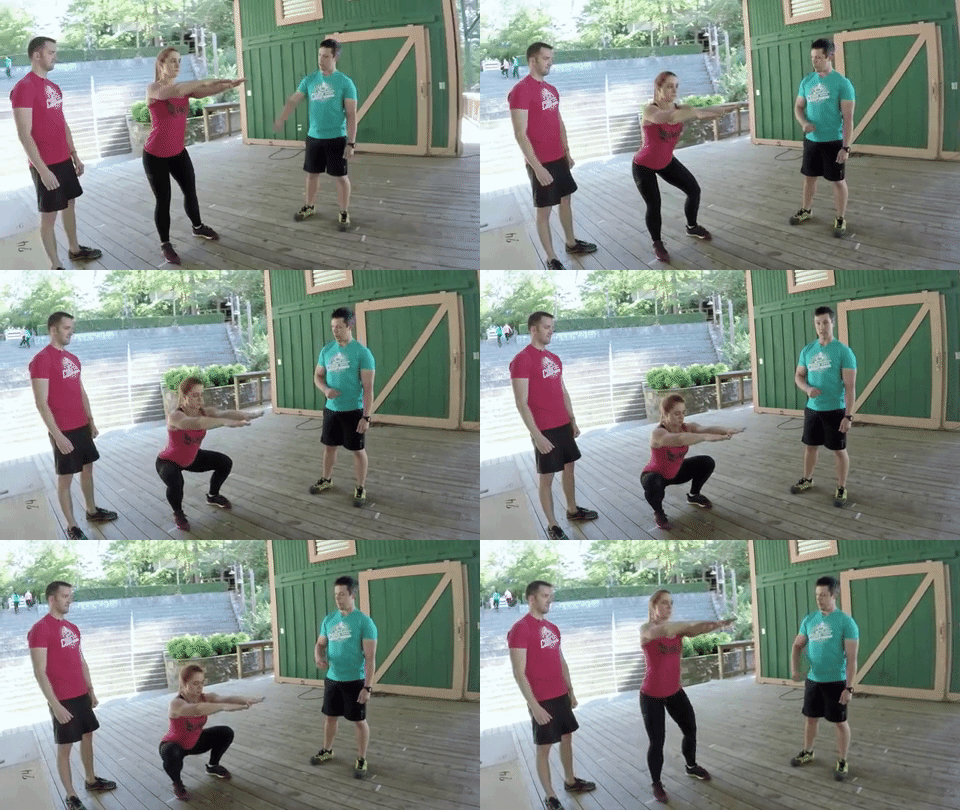
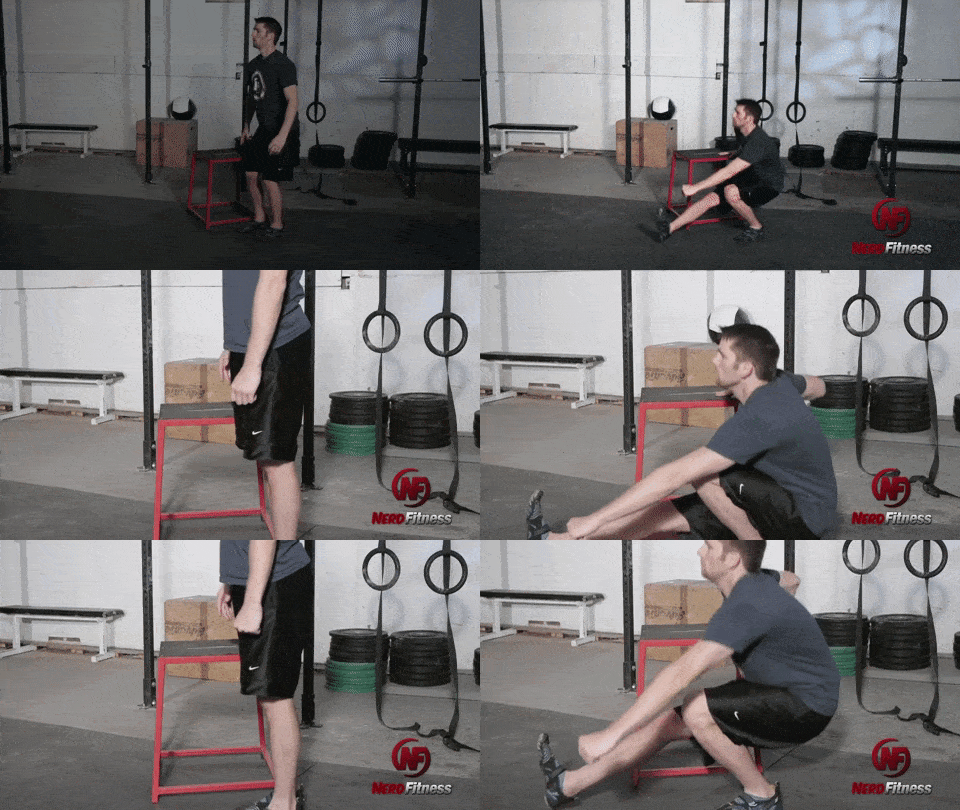
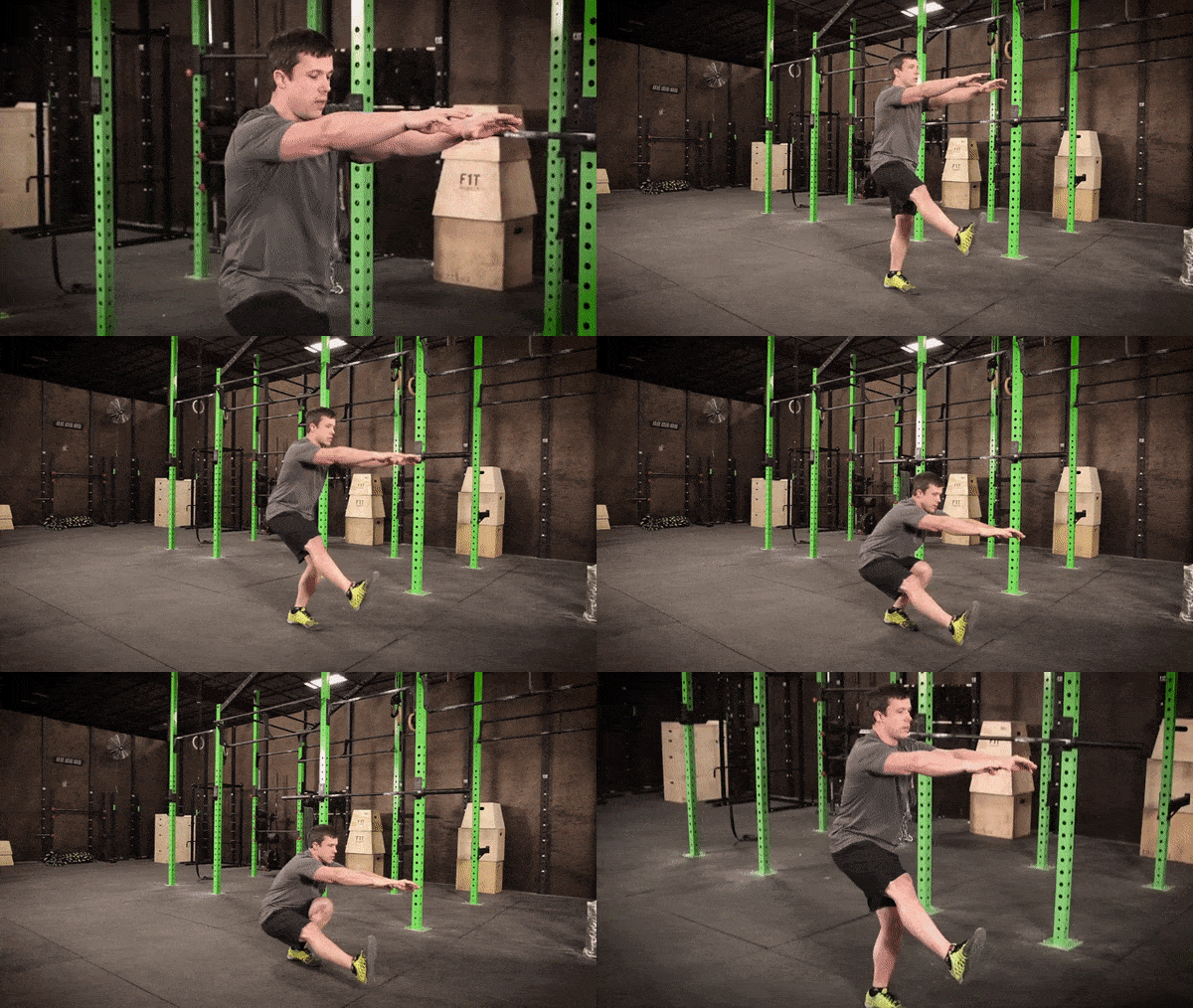
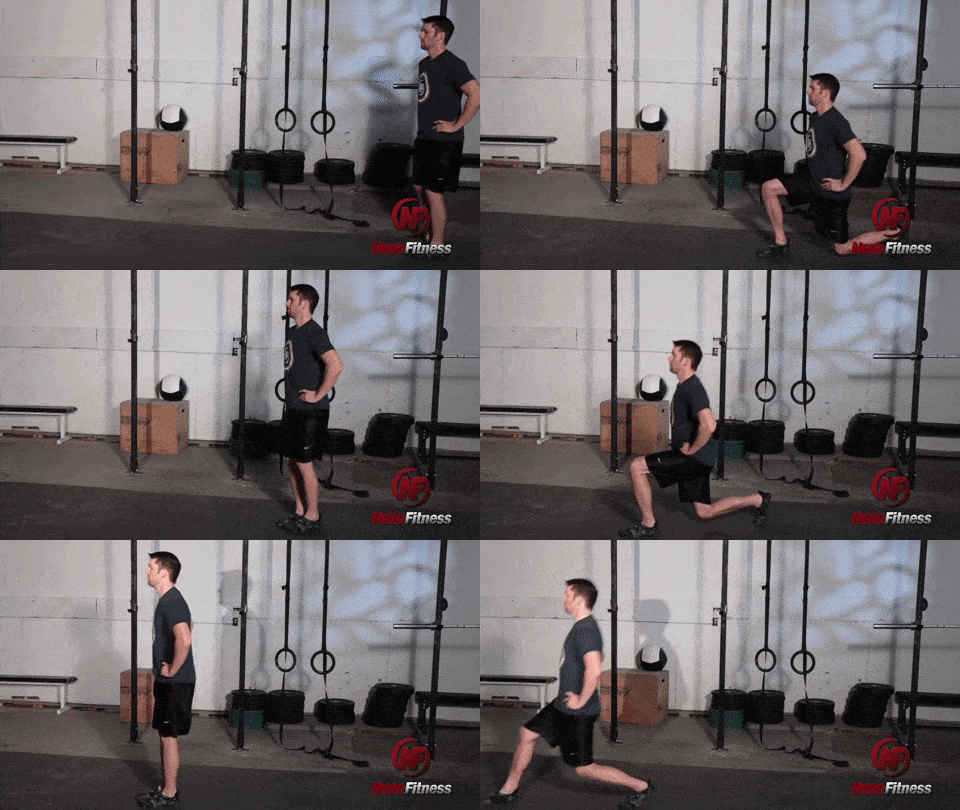
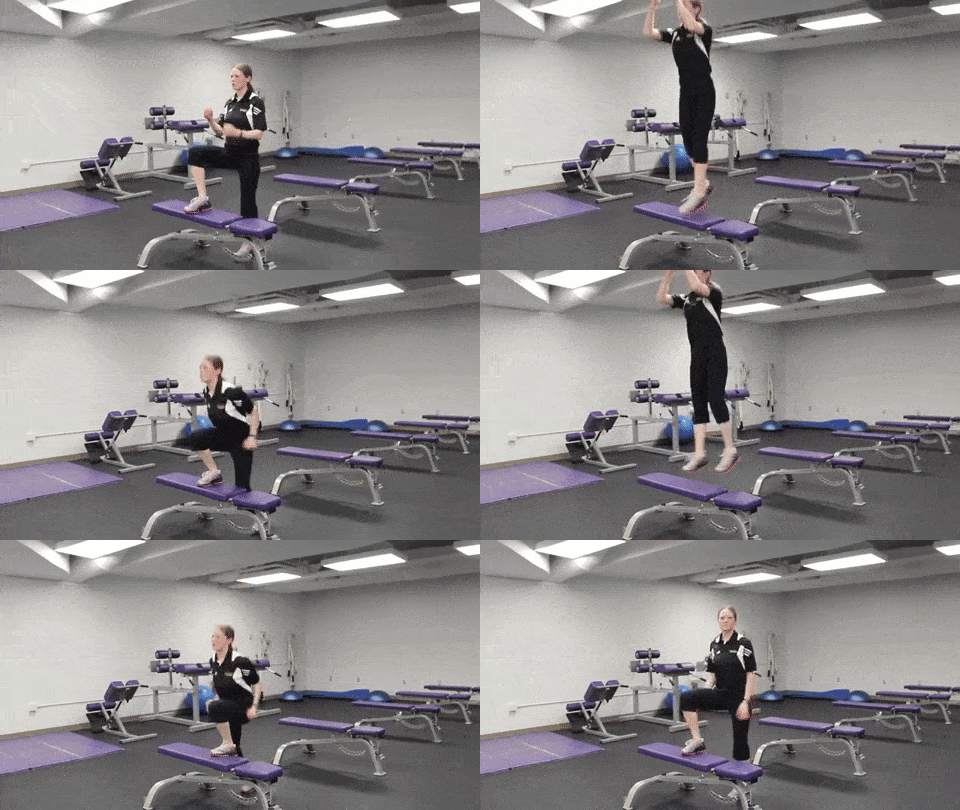
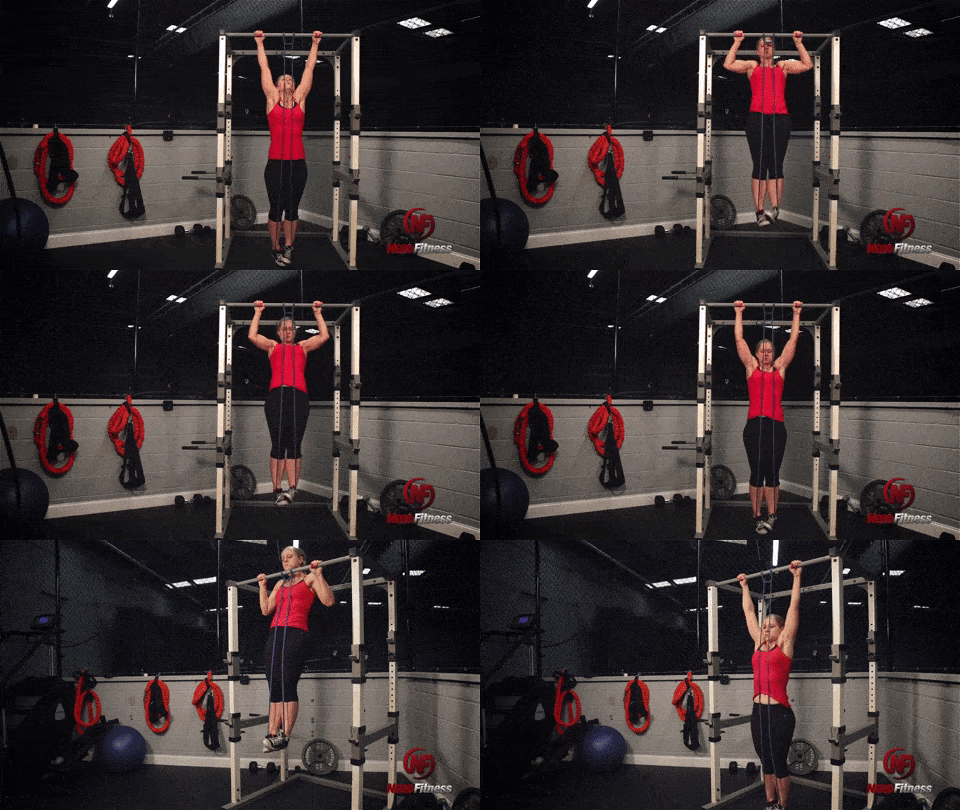
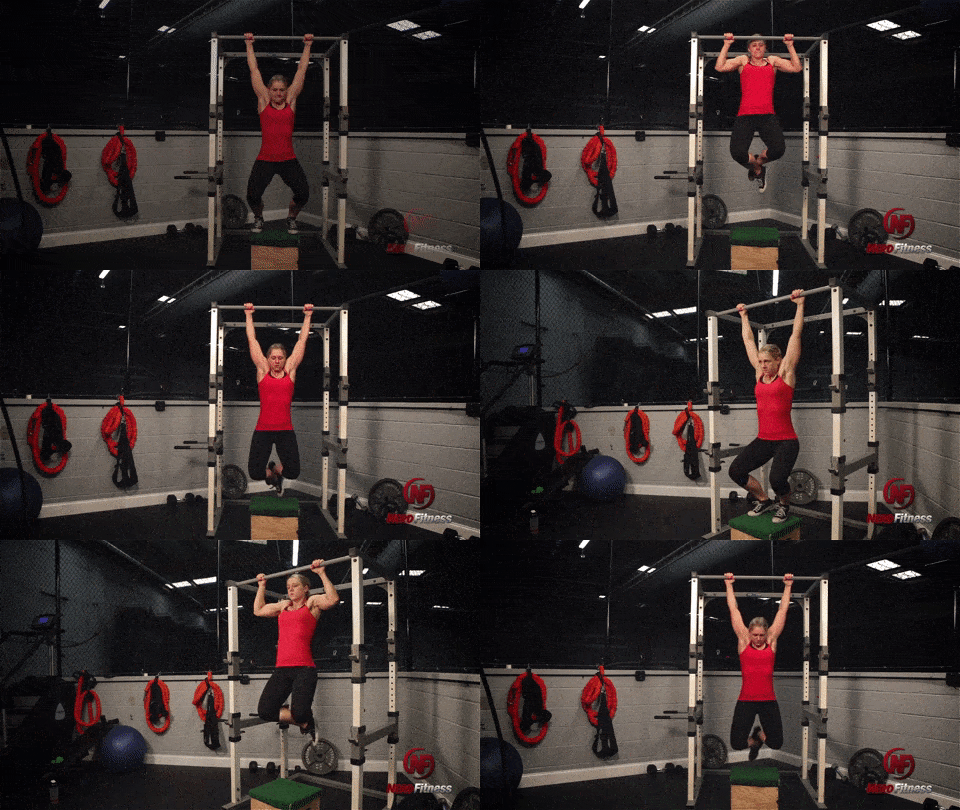
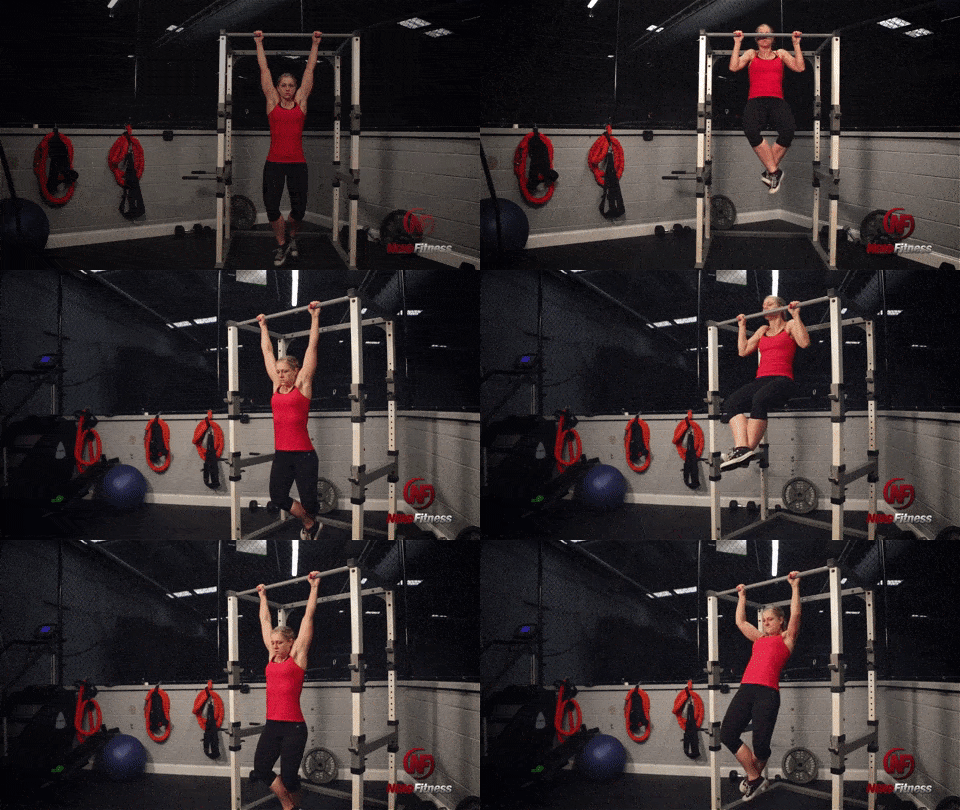
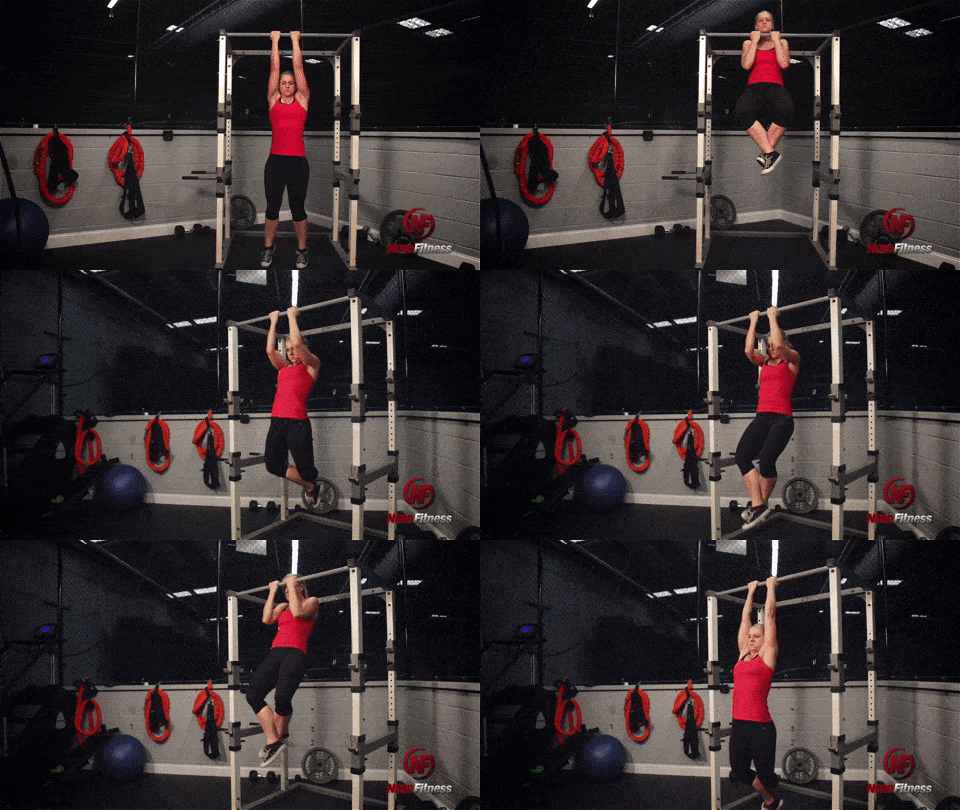


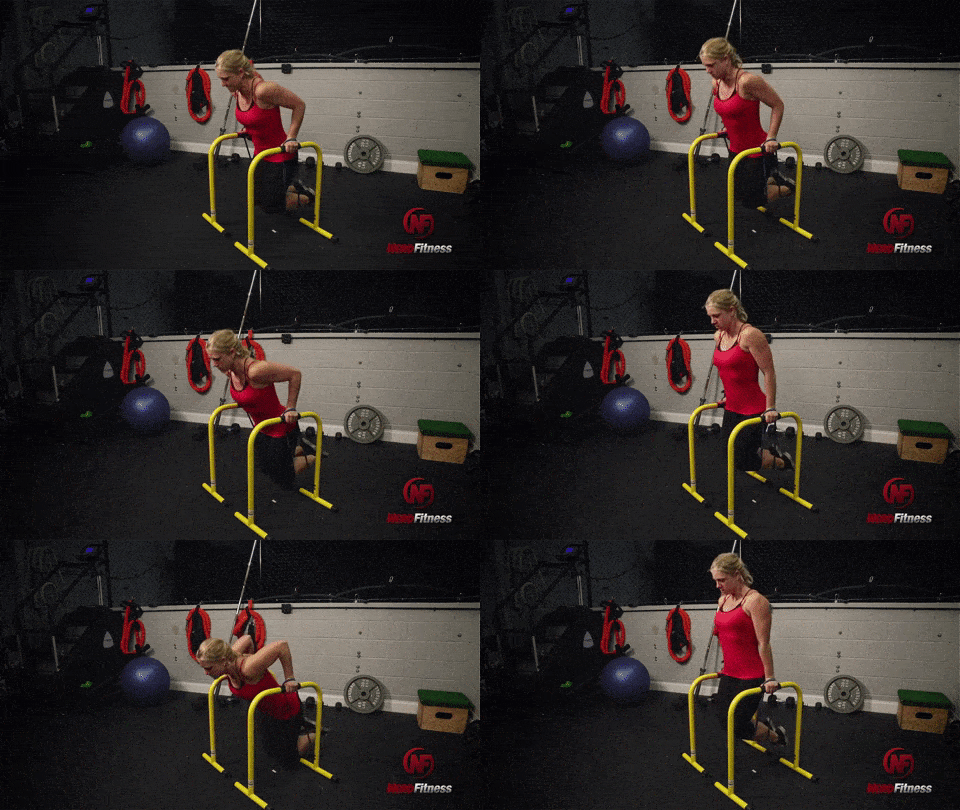

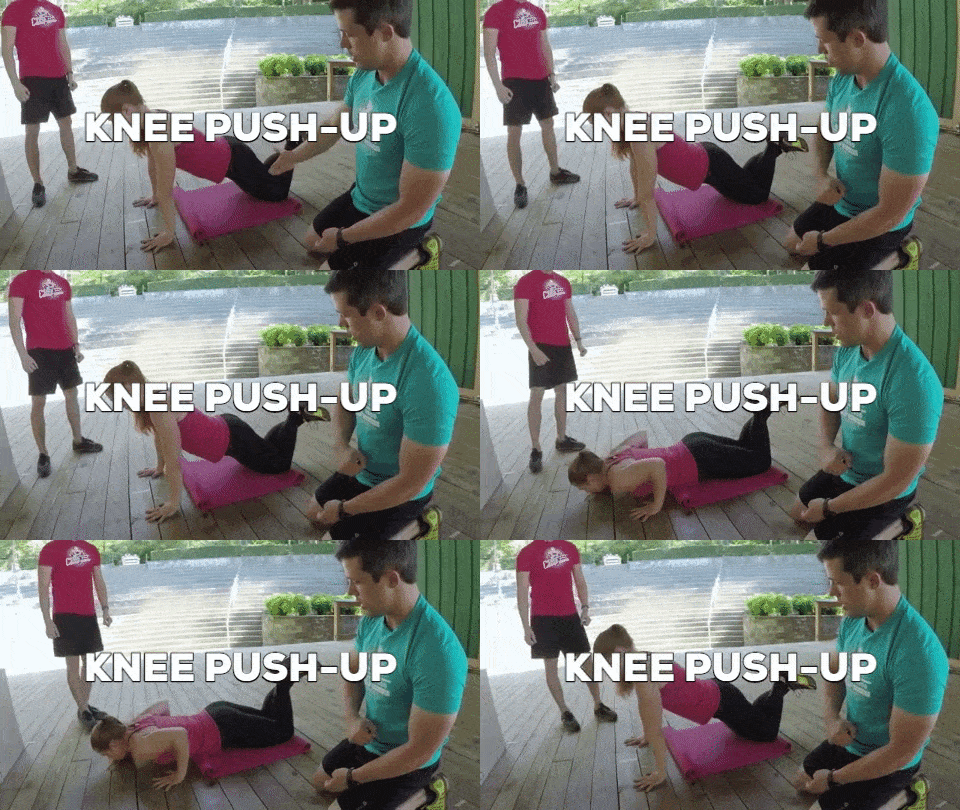
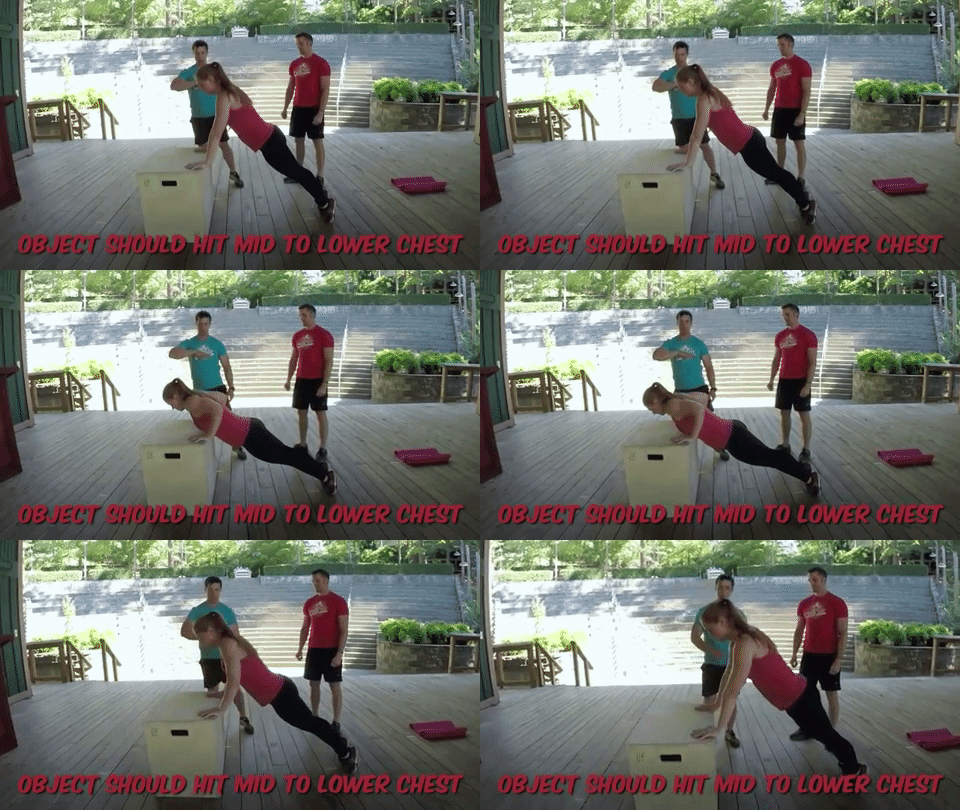
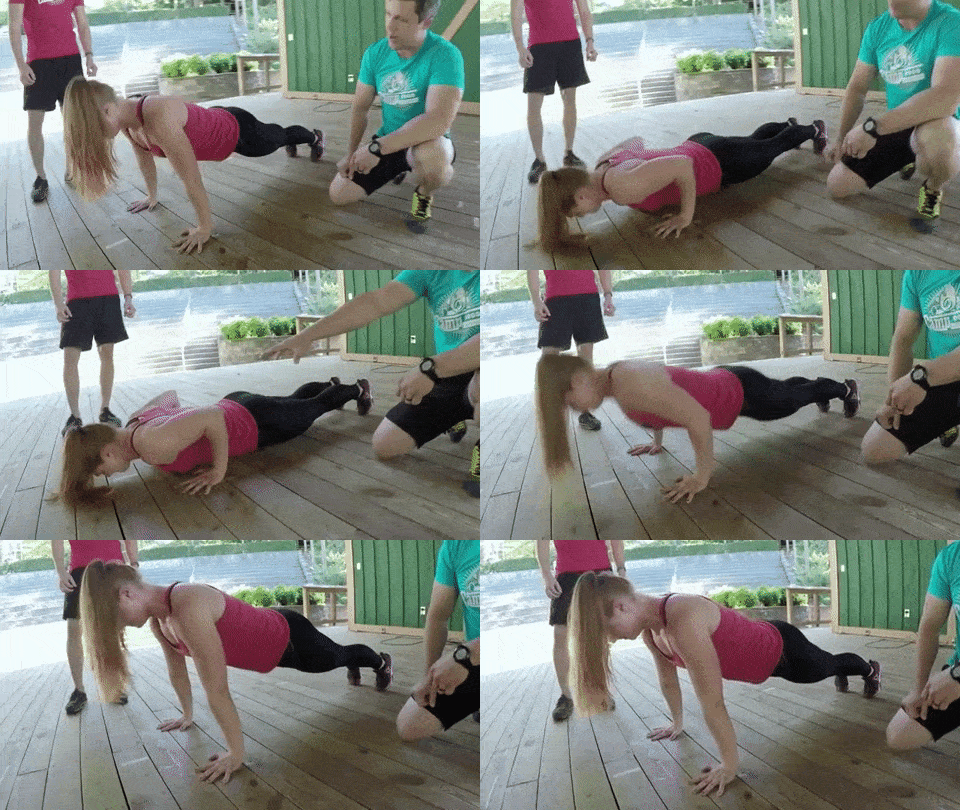
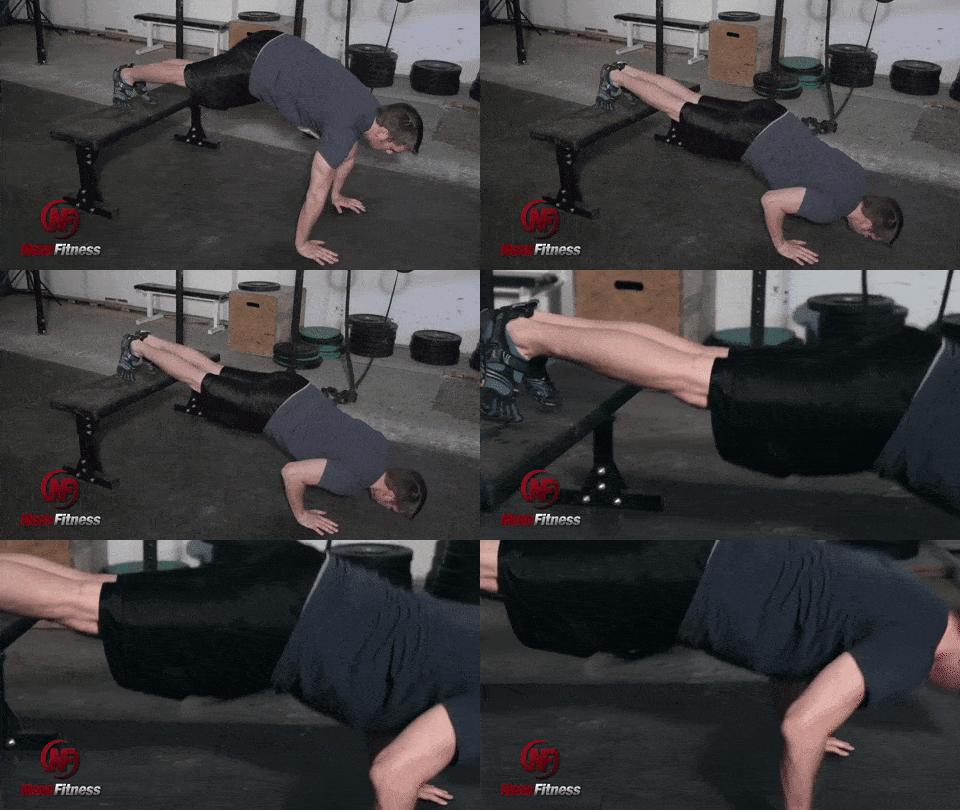
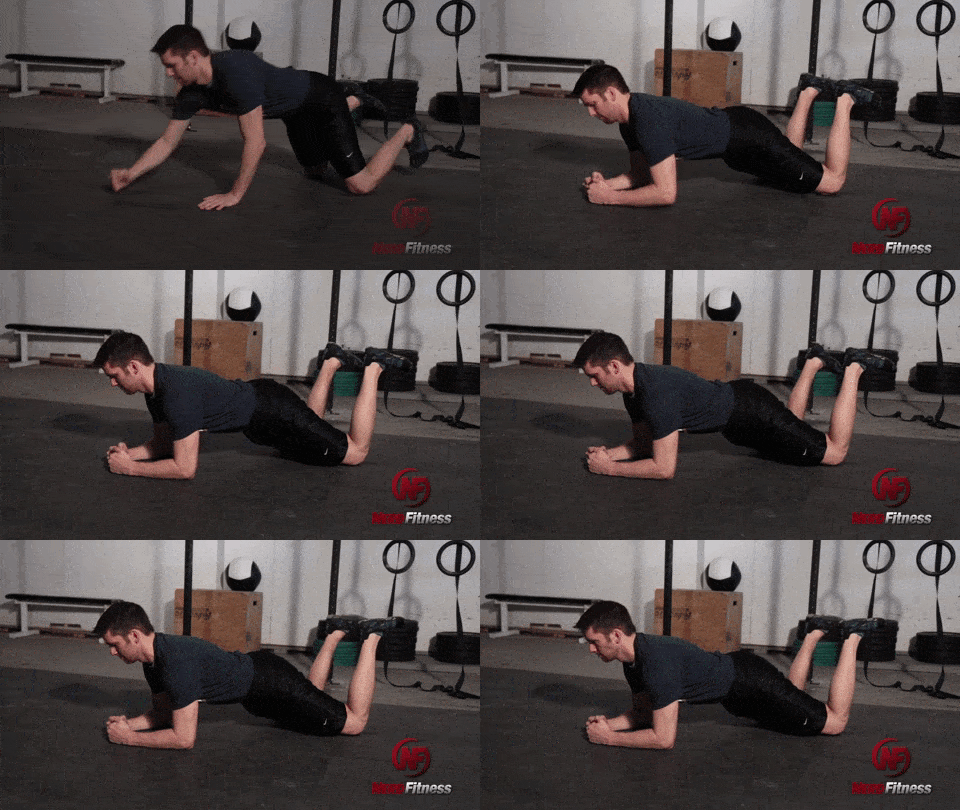
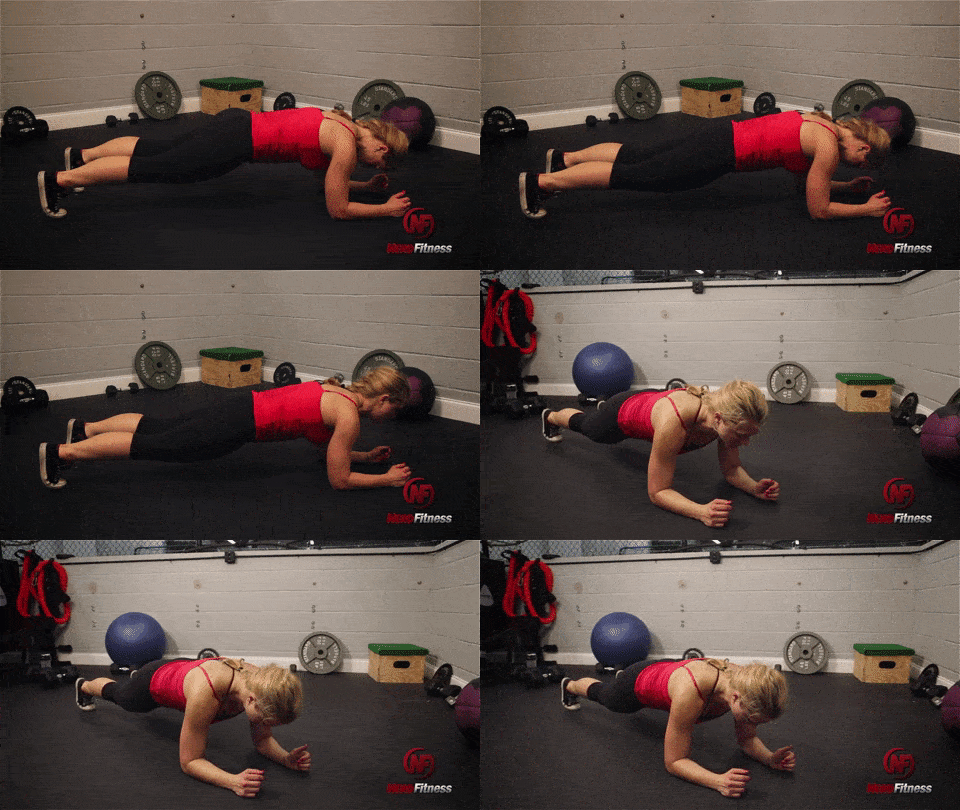
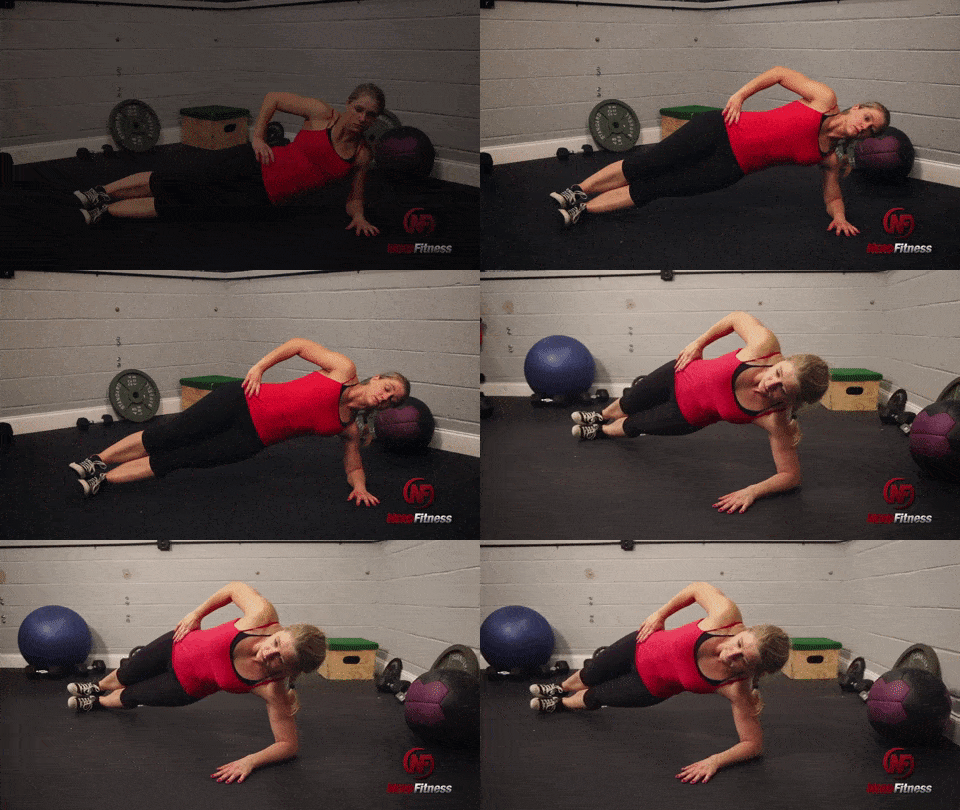
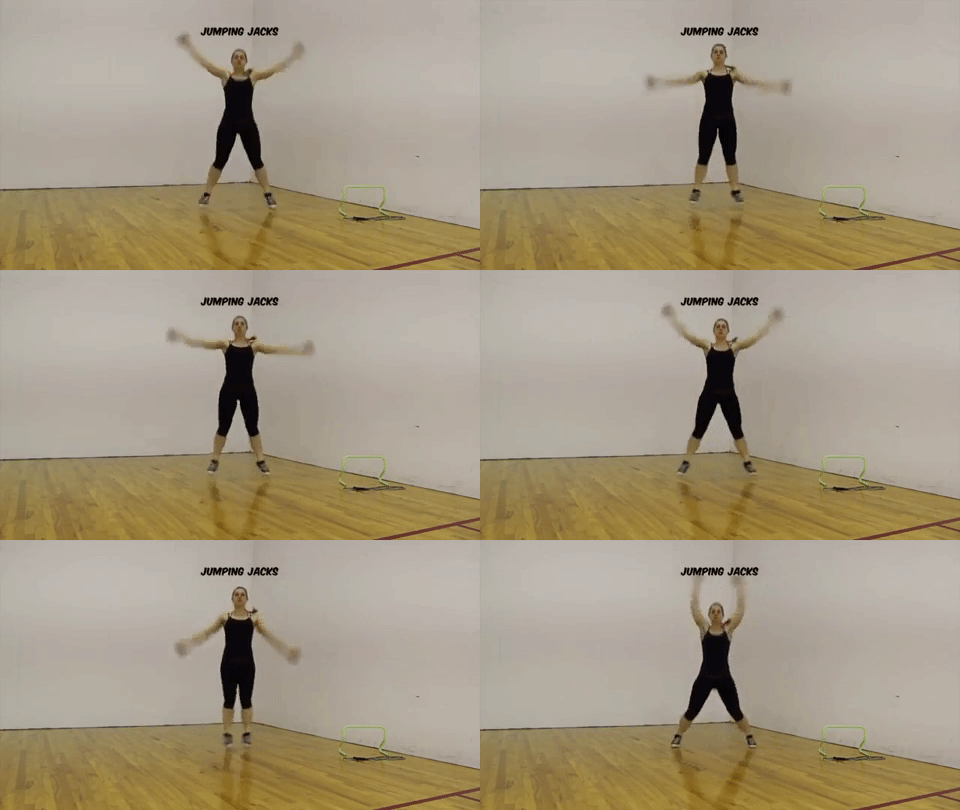








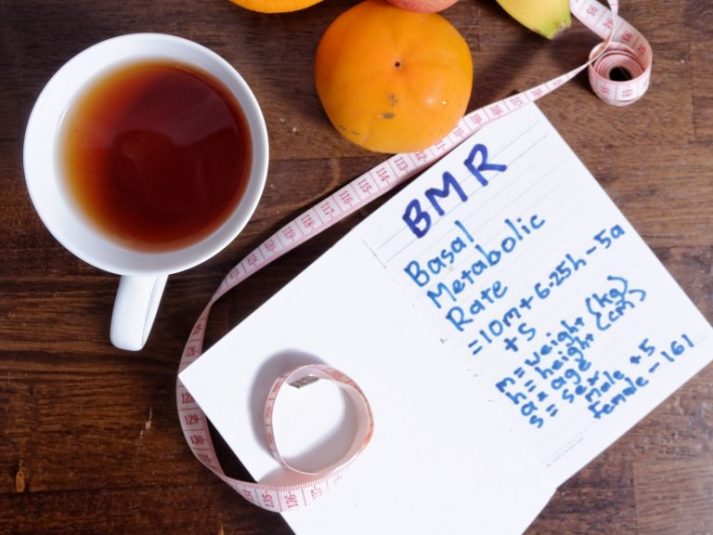




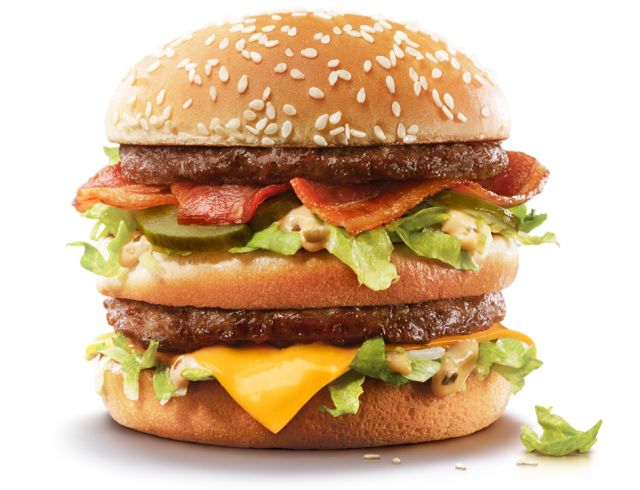







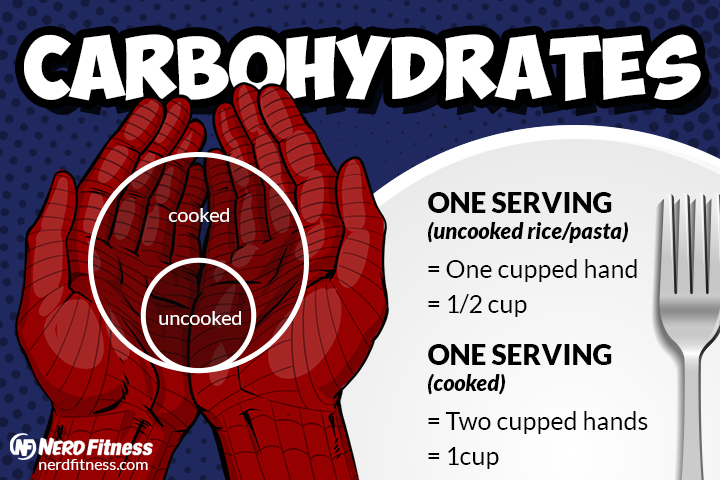



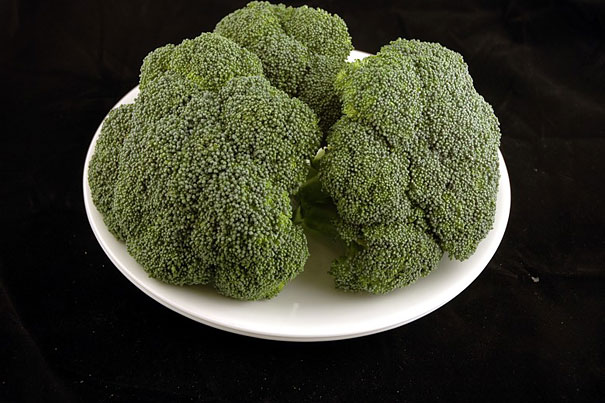
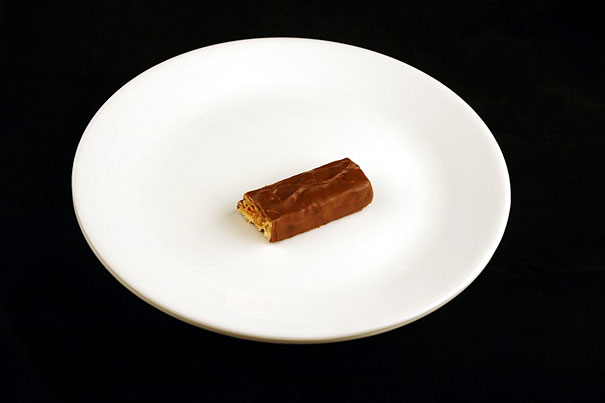






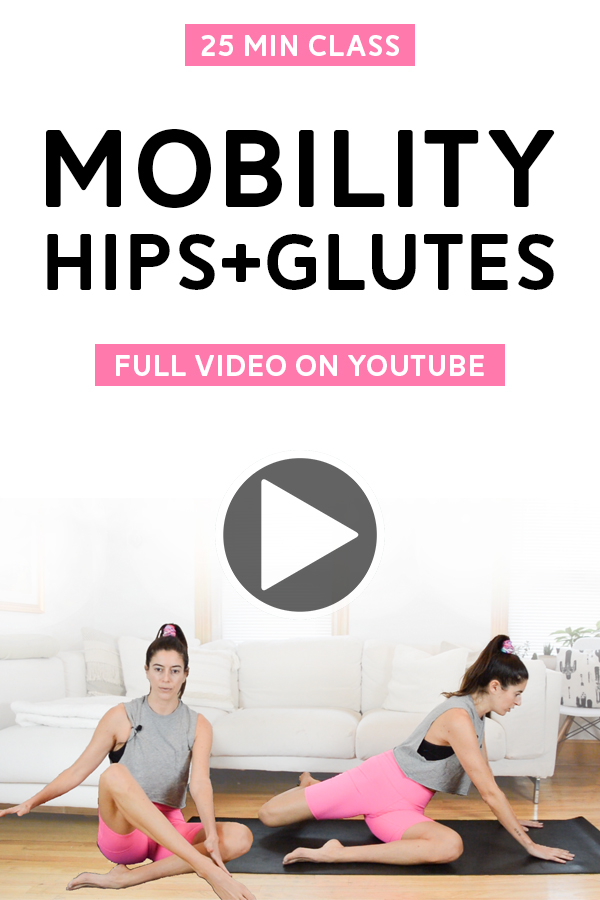

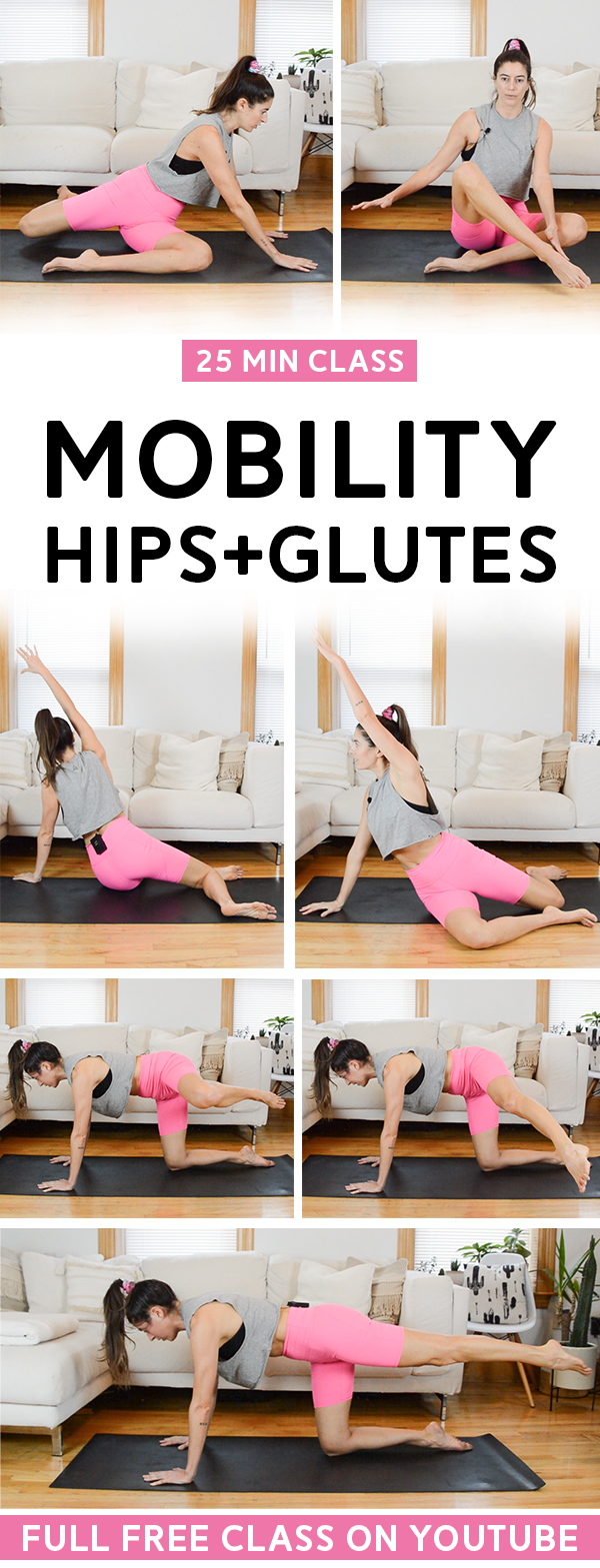
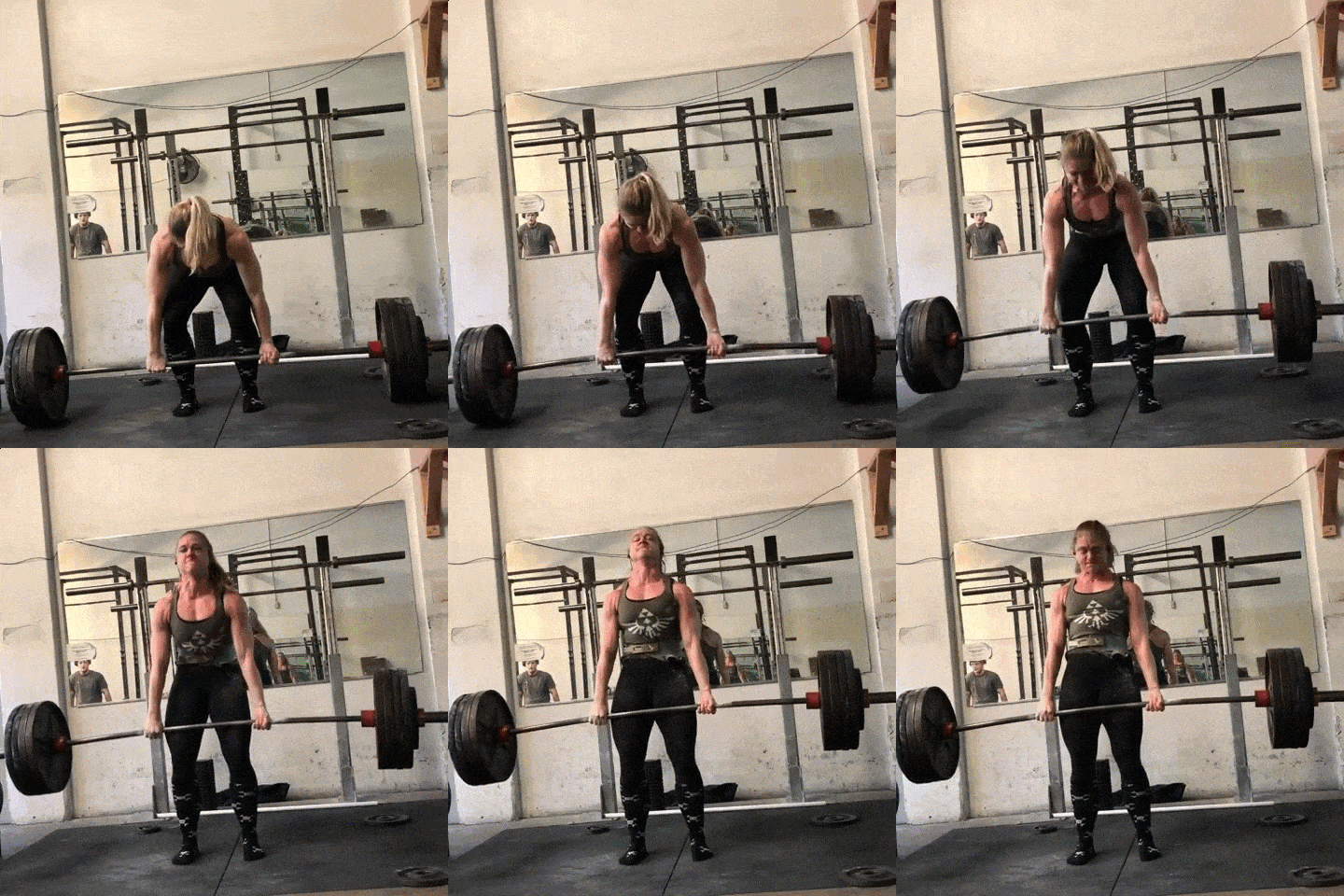


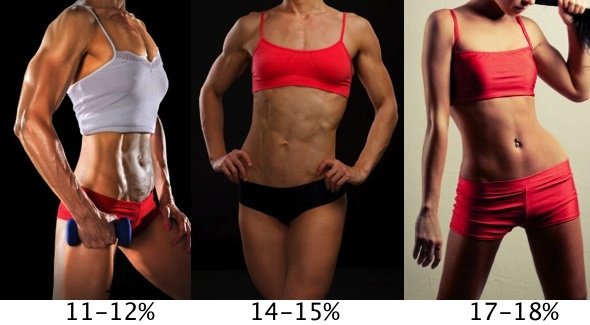
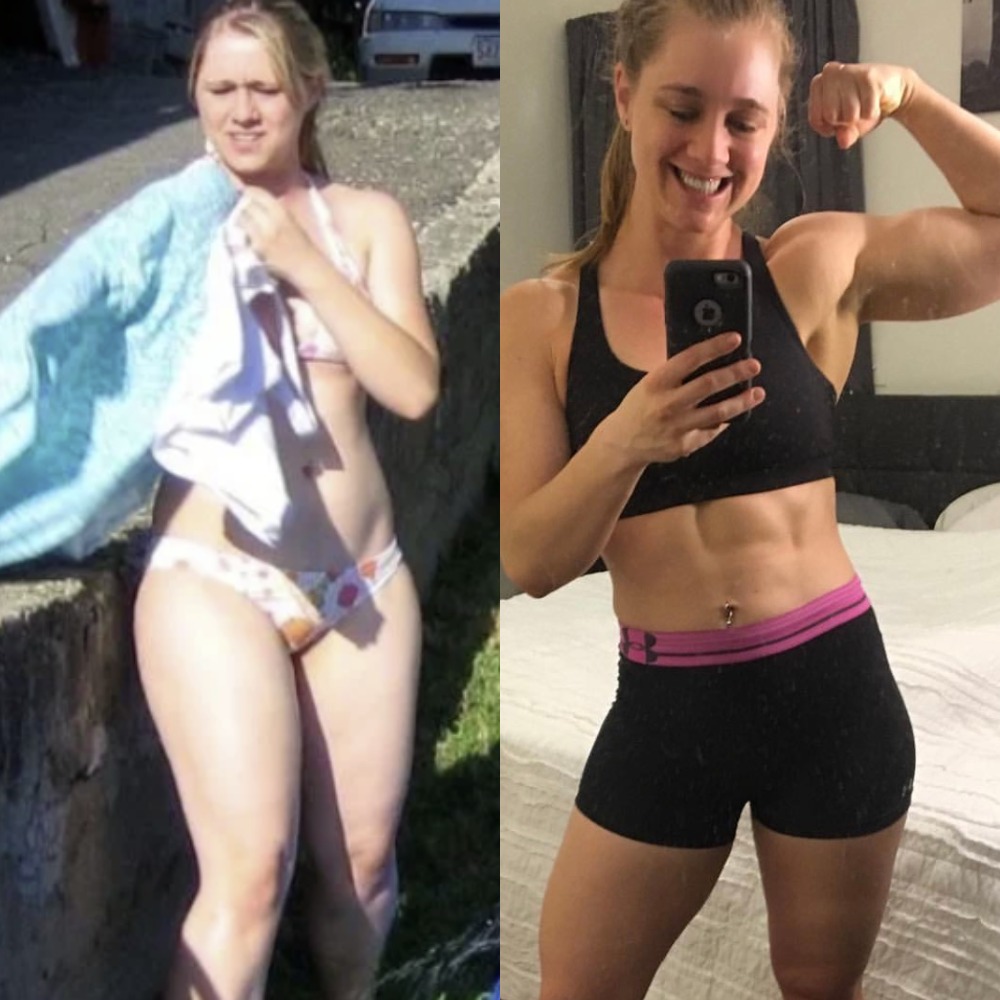


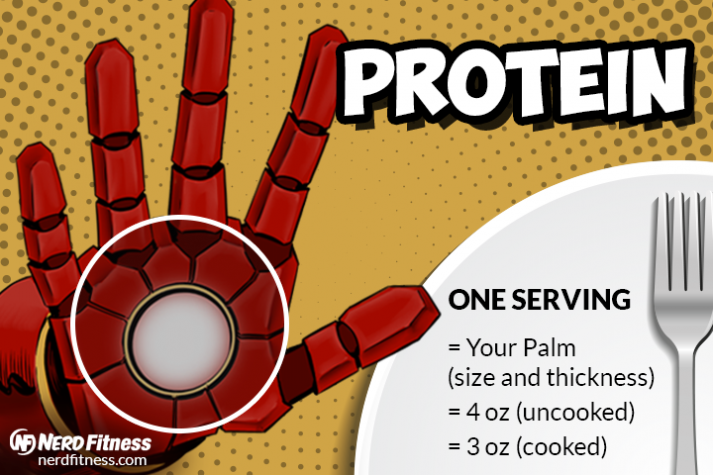
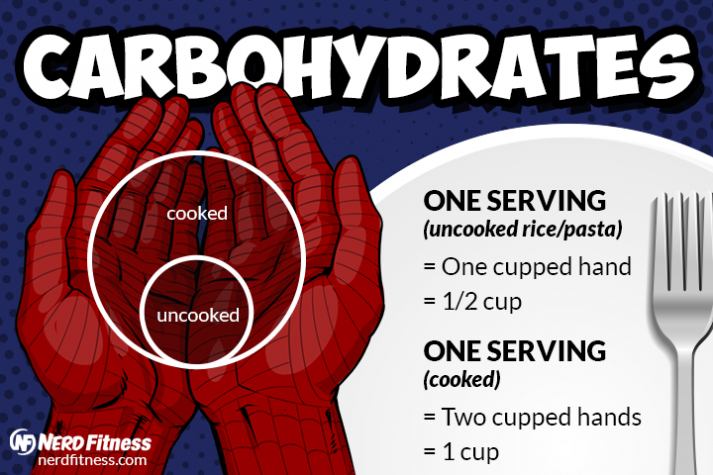
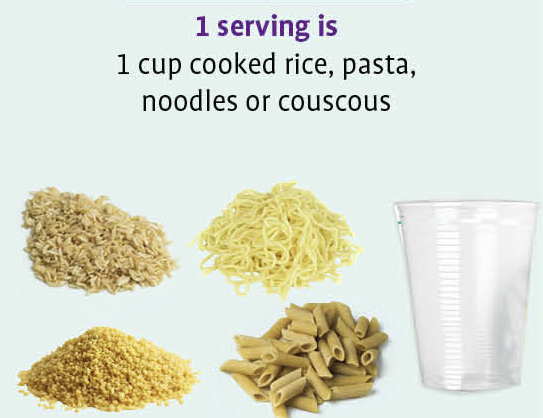
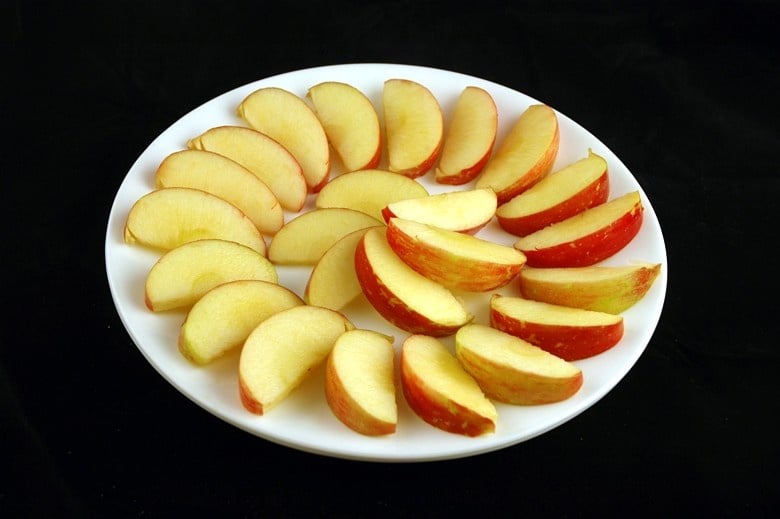
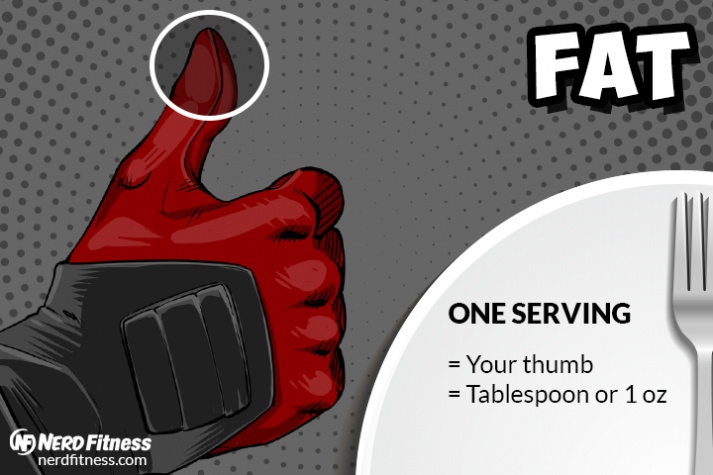

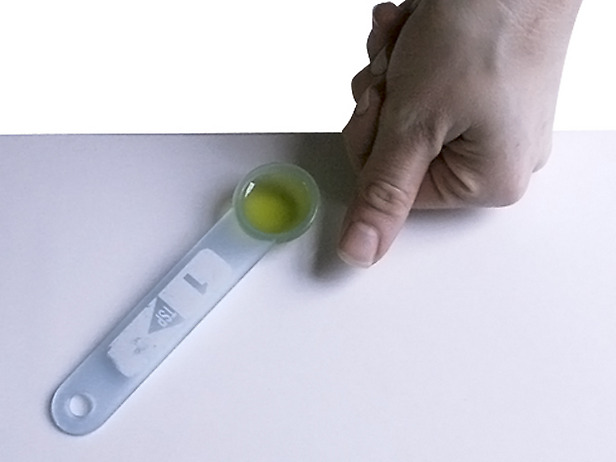
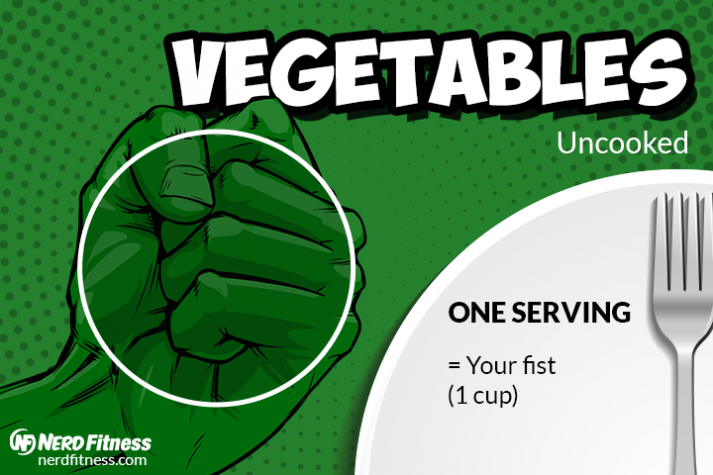
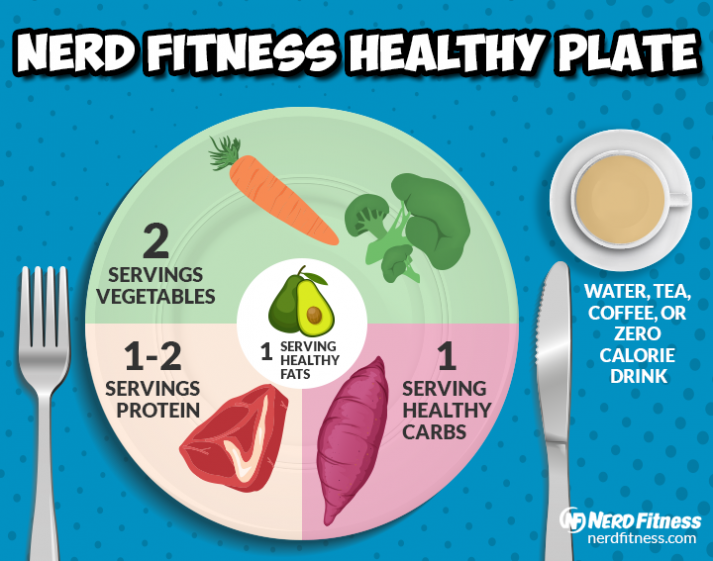






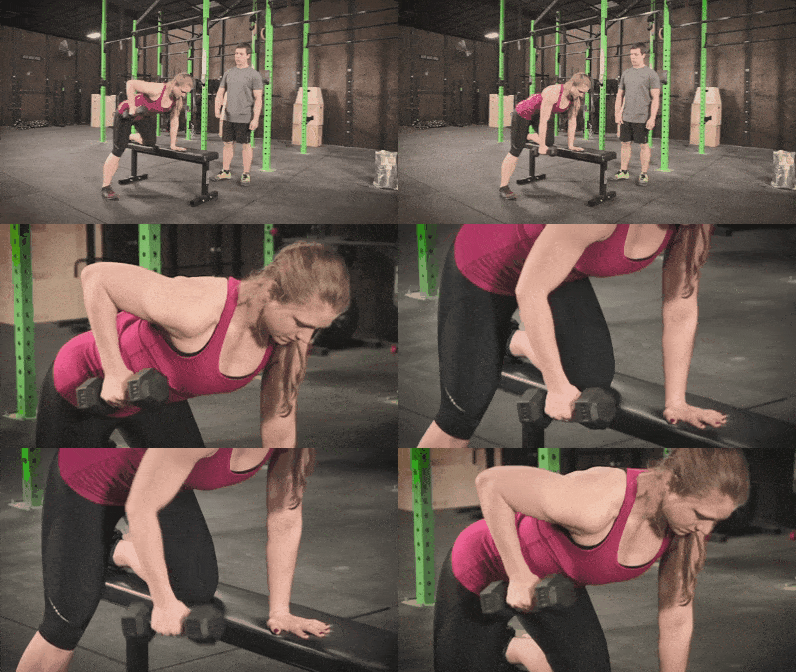
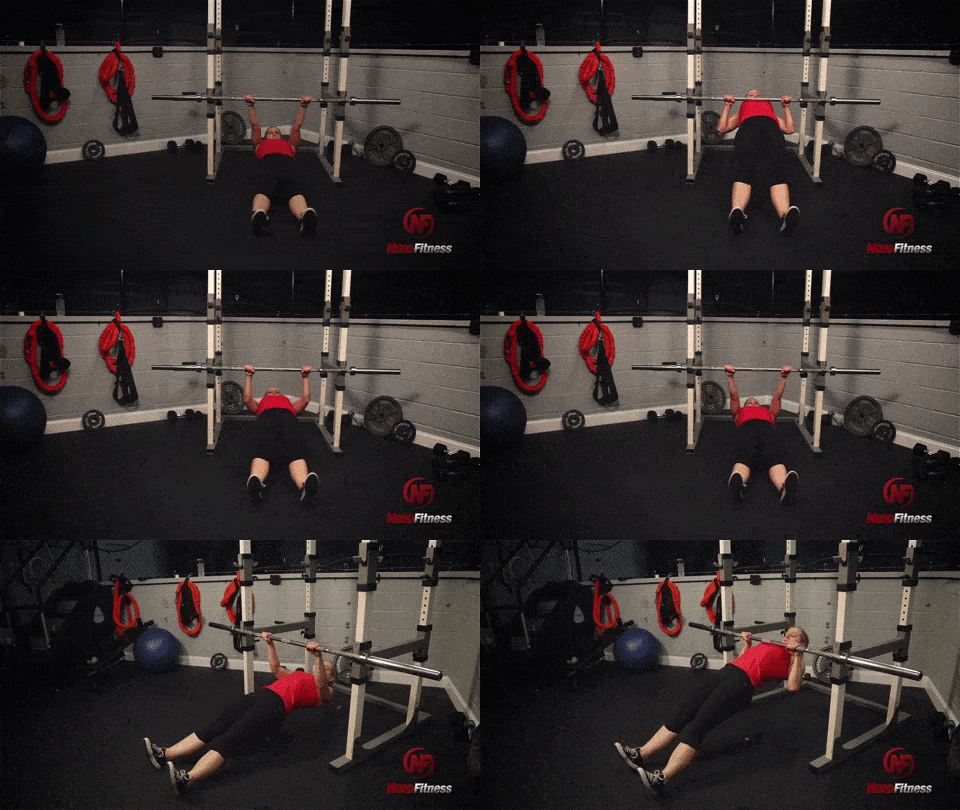
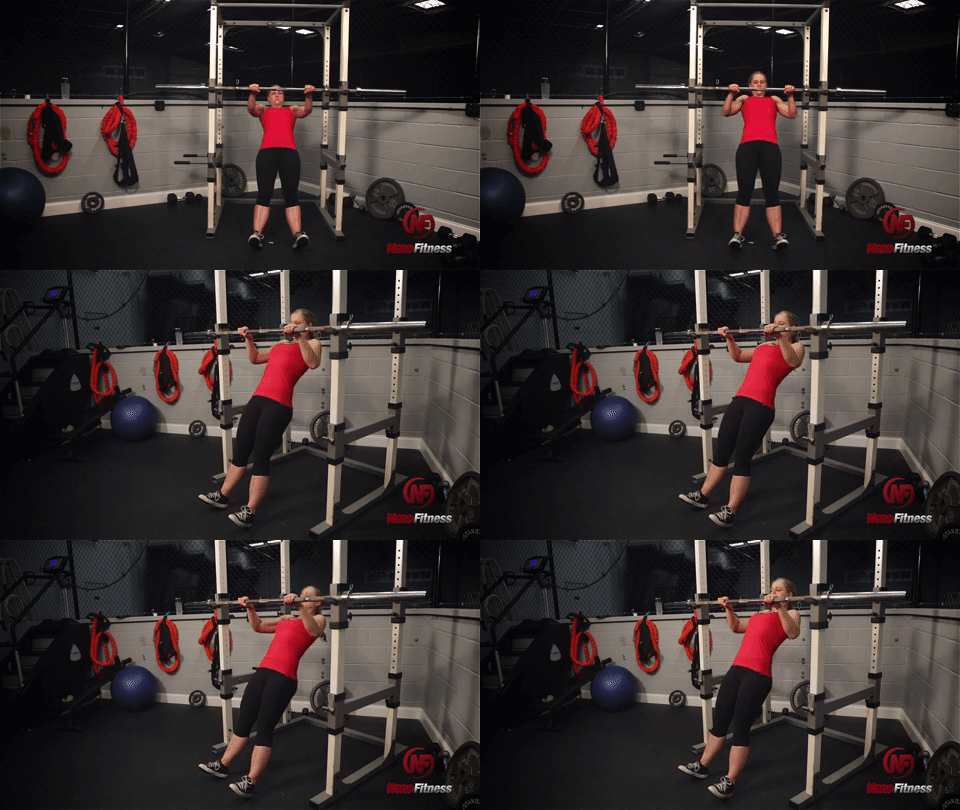
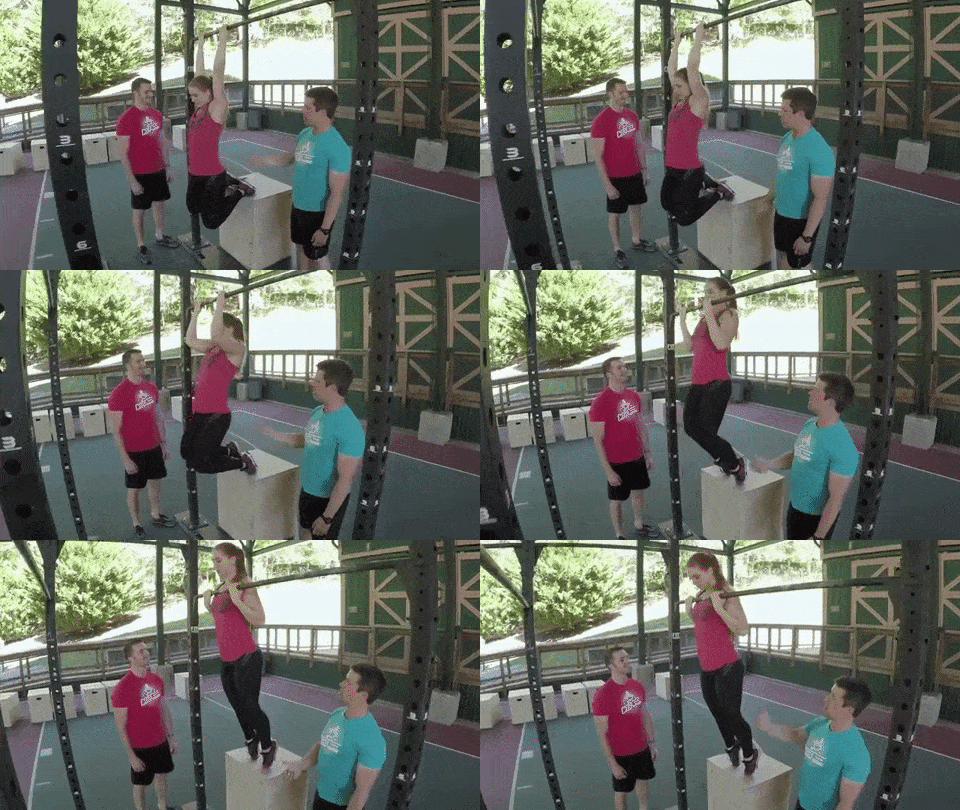
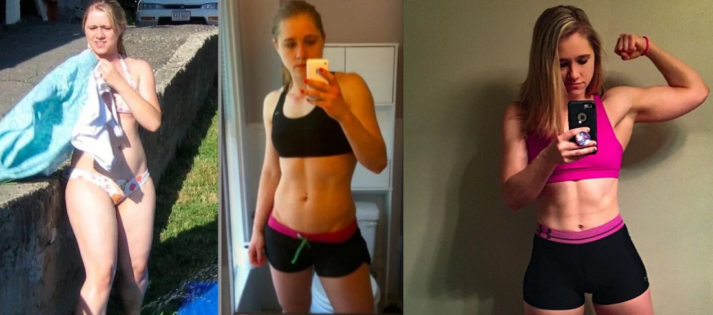










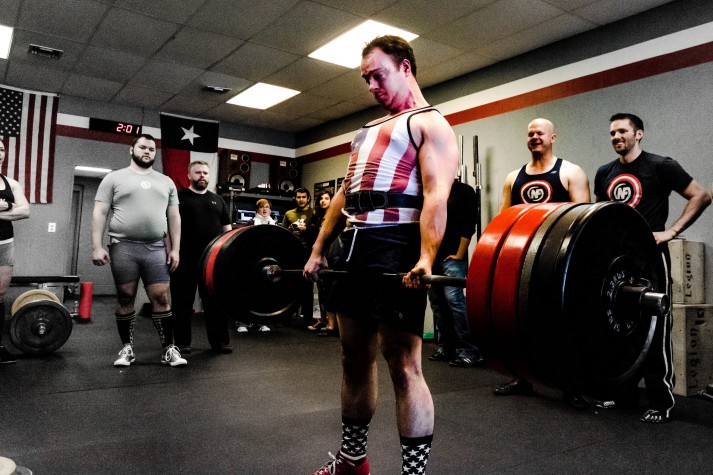
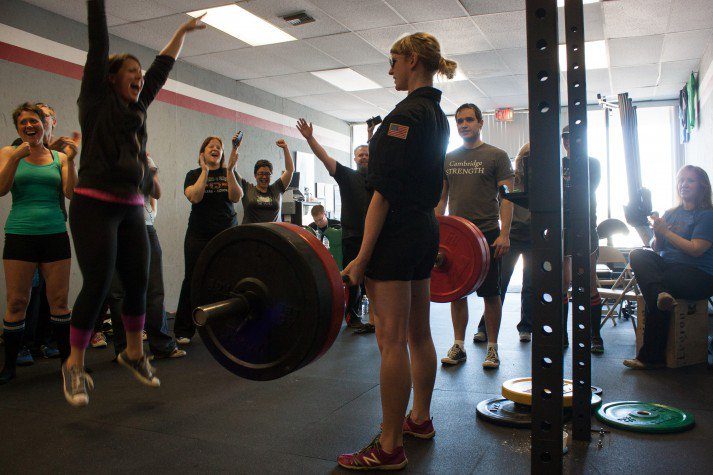
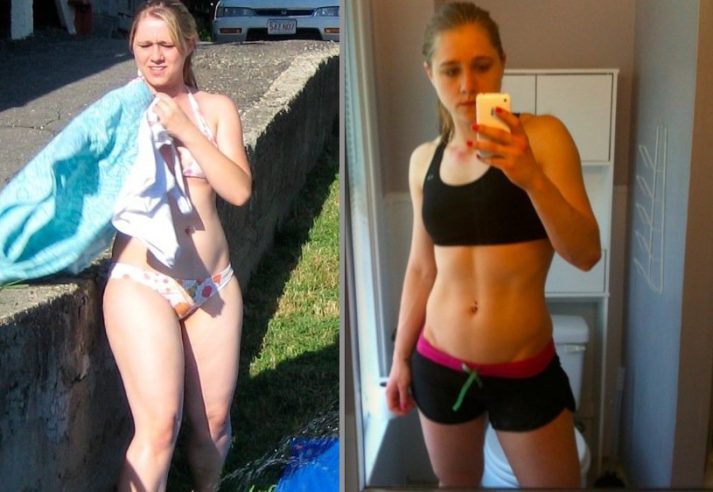
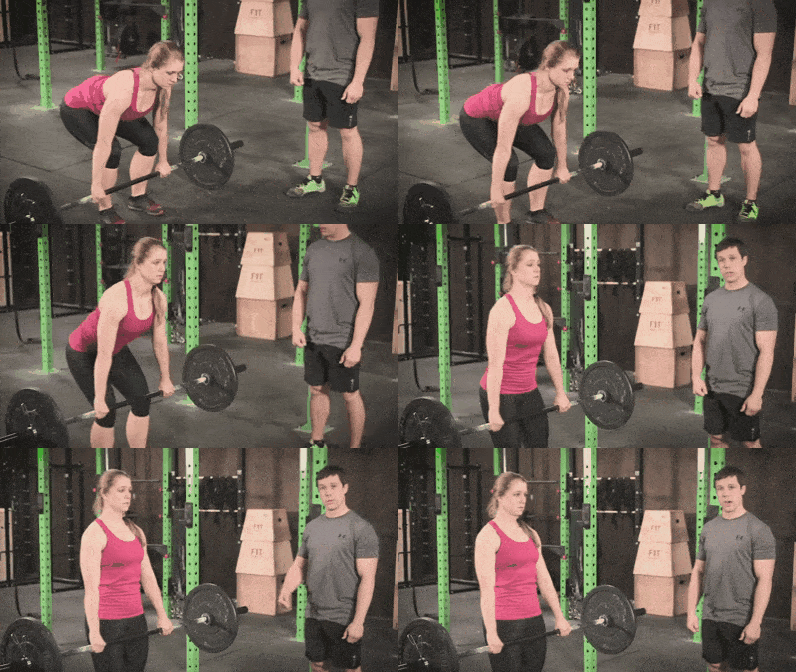
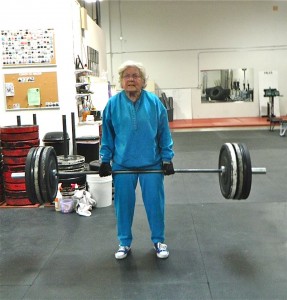
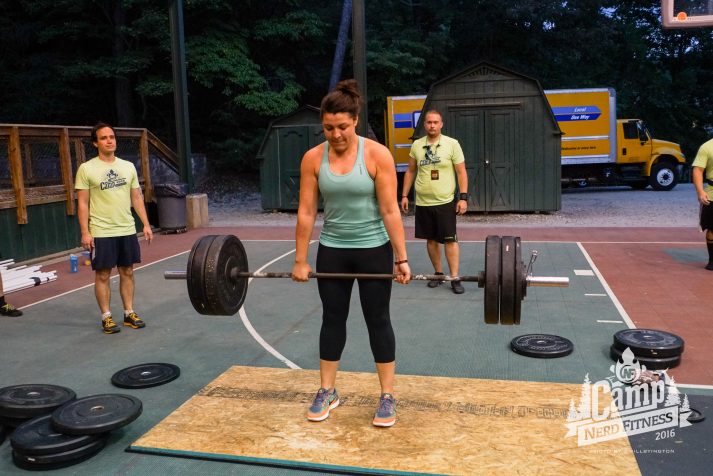
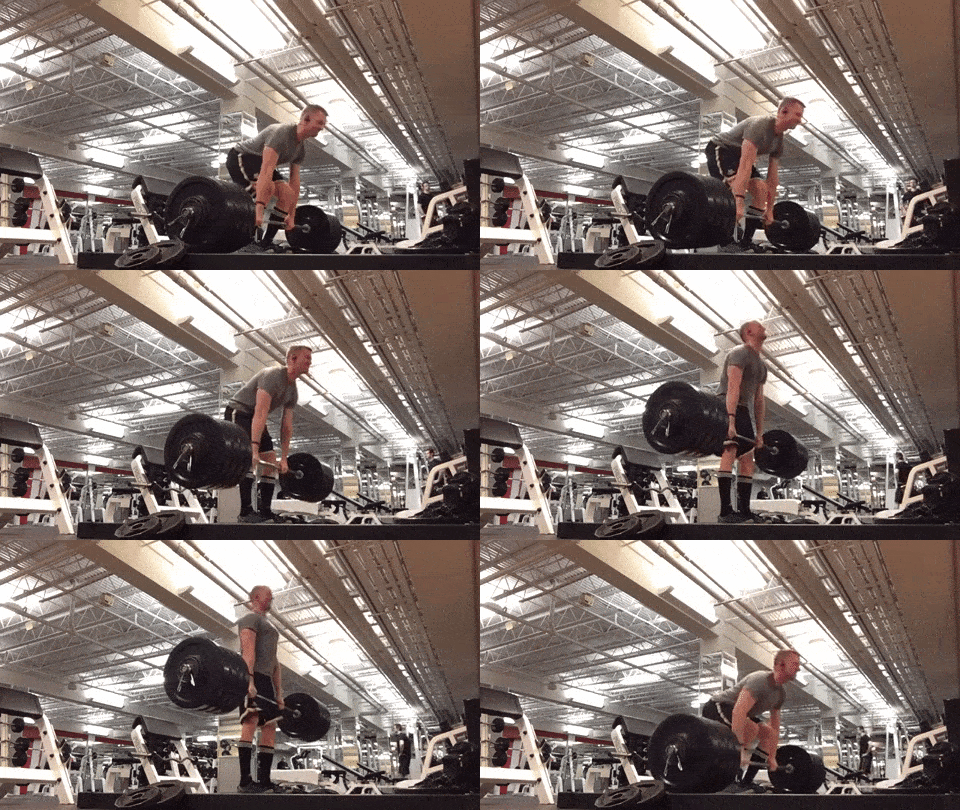
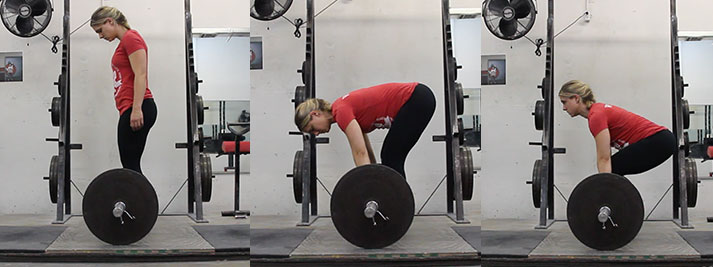
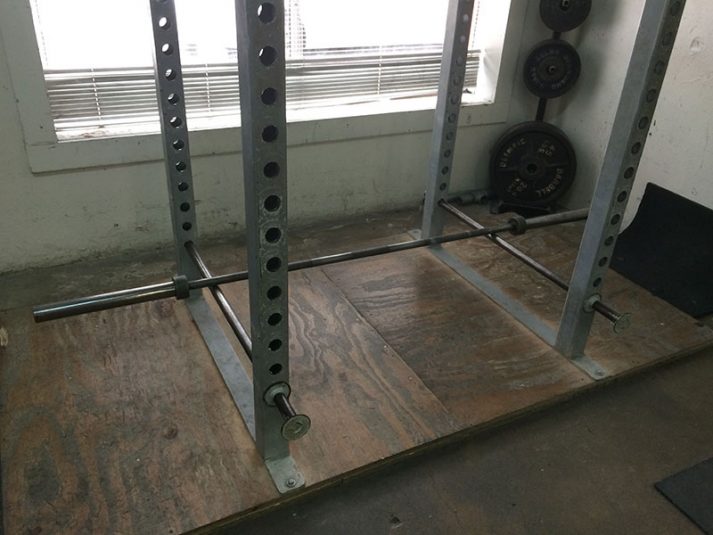
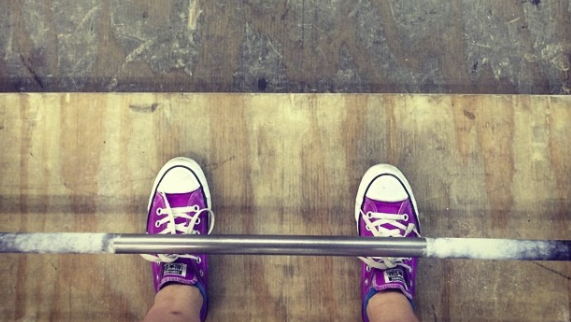
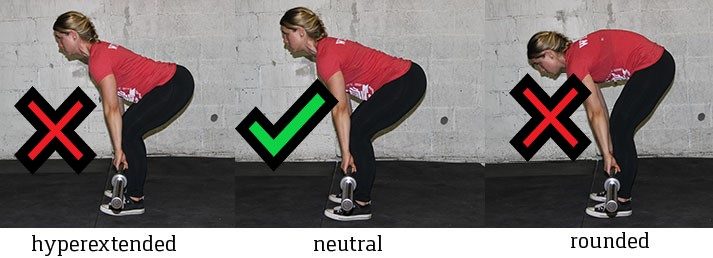
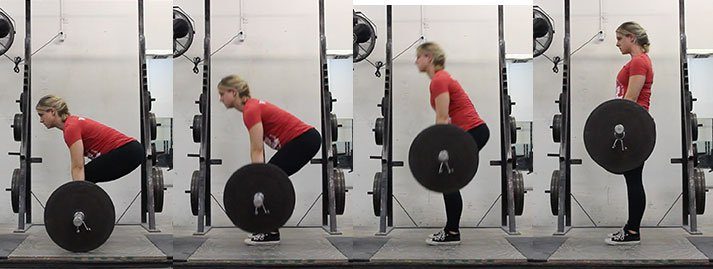

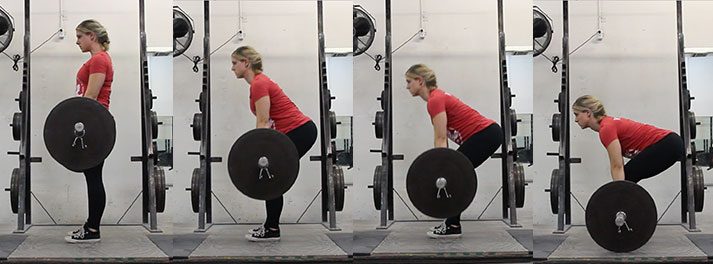
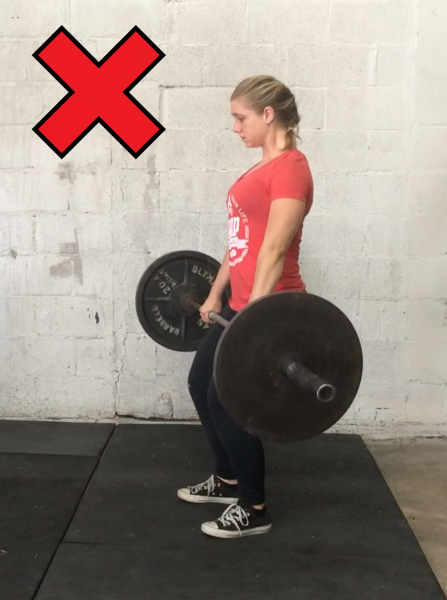
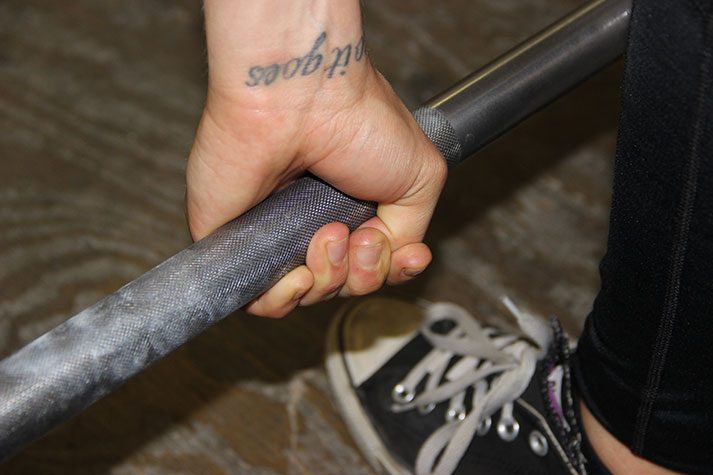
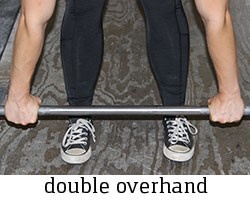
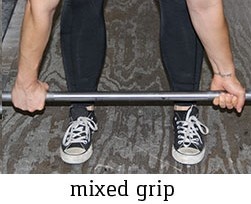
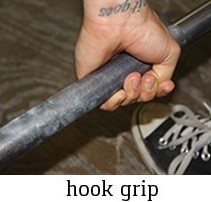
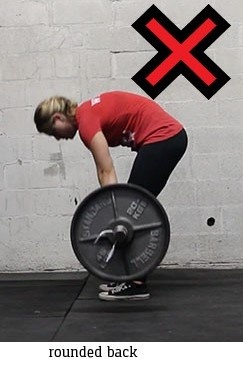
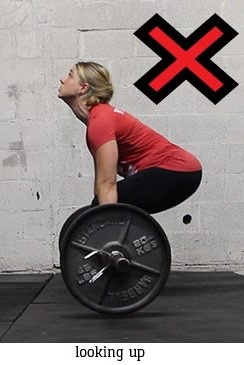
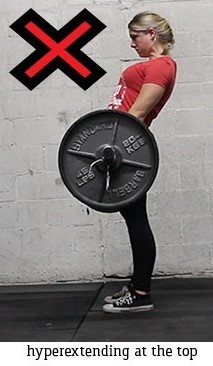
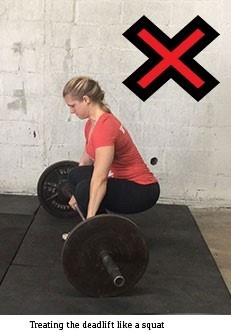
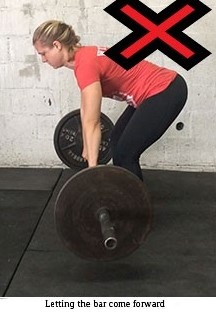
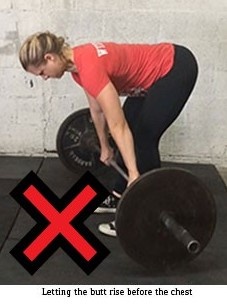
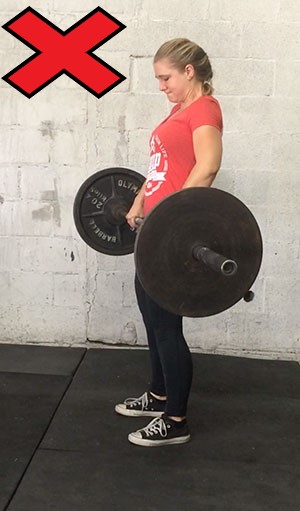
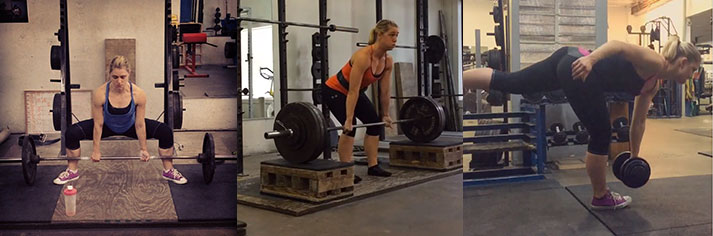
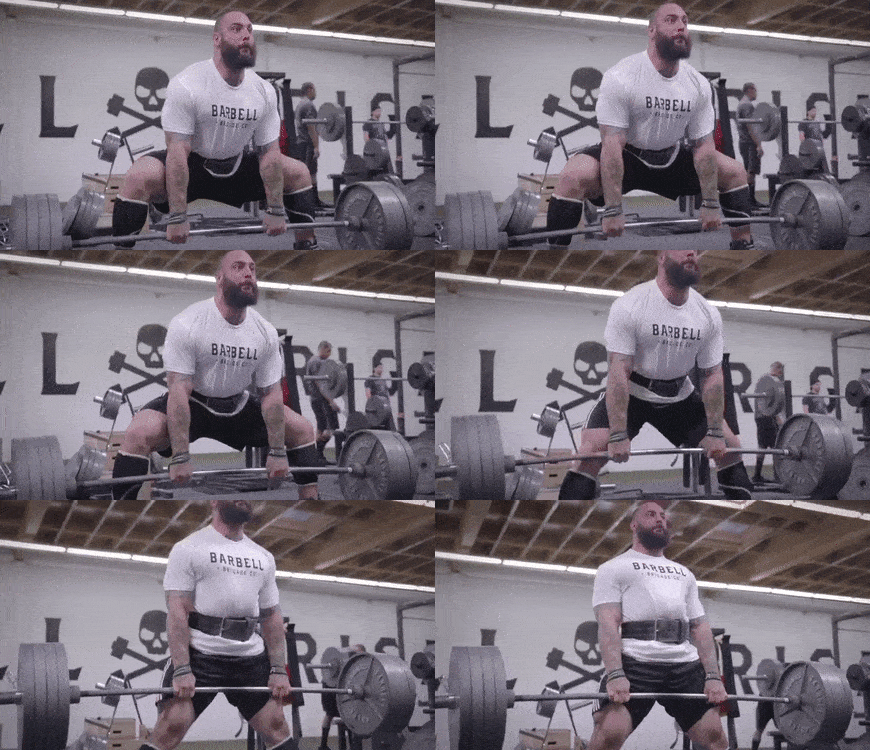

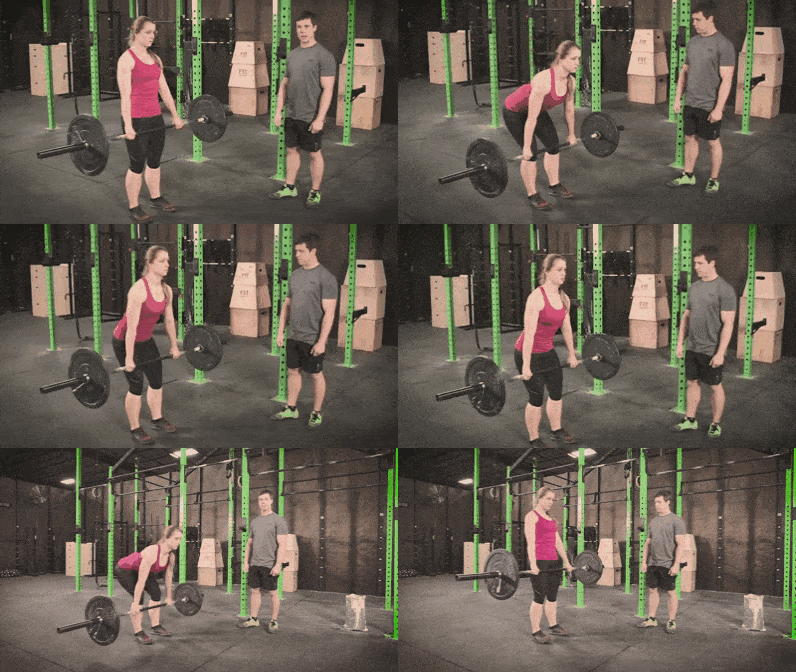
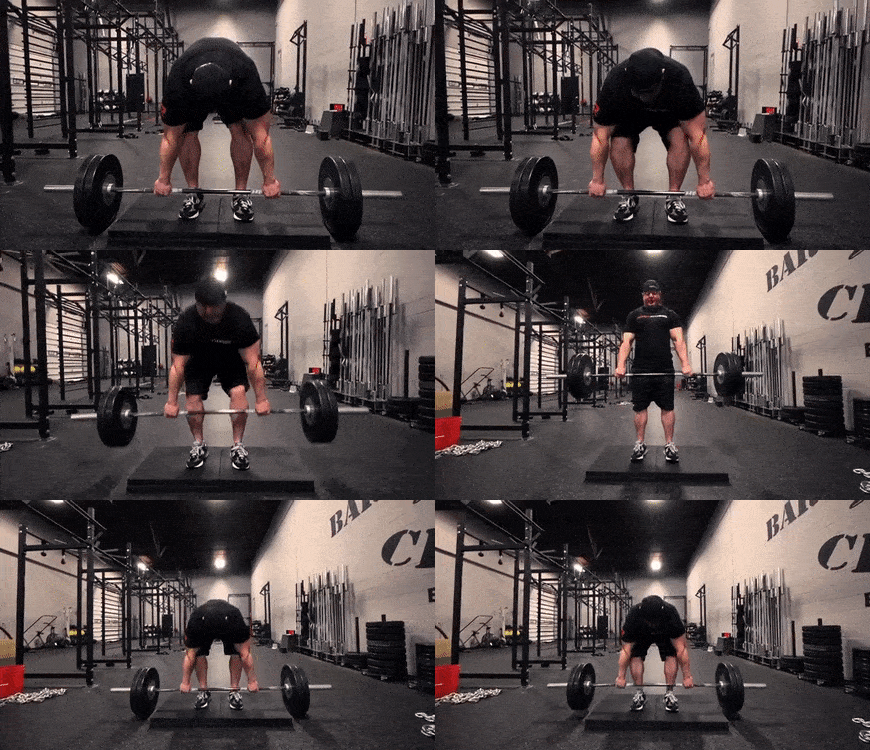
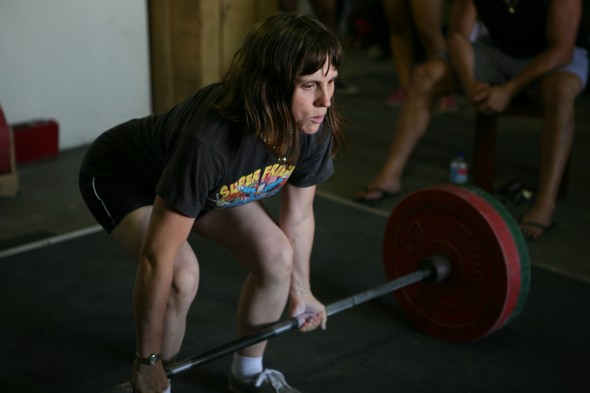
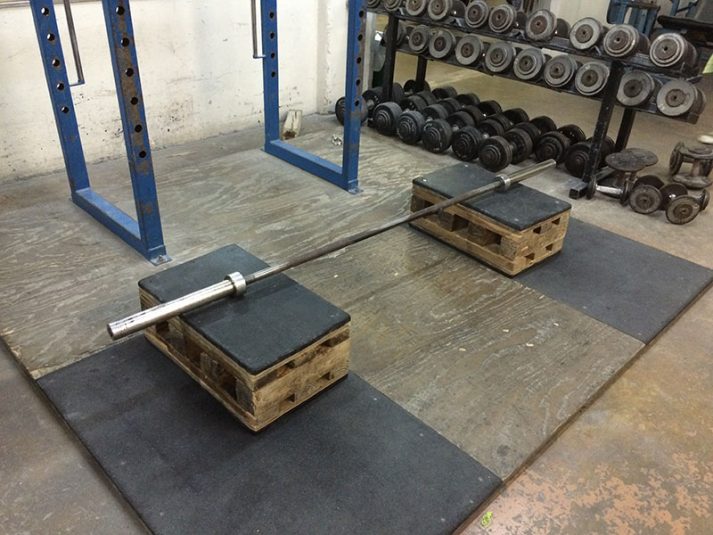
 I am so excited for you to start deadlifting, because it’s the ultimate physical AND mental exercise.
 CrossFit is advertised as “the sport of fitness.”