Categories
Uncategorized

#holistic #getfit #nutrition It happened again.

It happened again.

I came home from coaching my son’s rec soccer game, ran up the stairs, and felt it instantly. My back seized and locked up.

And then that sinking feeling hit right away:

“Not again. I was doing so well.”

And I was doing well. This was about 2 years without a major flare-up, roughly 4x longer than my average through most of my 30s.

If you’ve followed me for a while, you know I’ve dealt with low back pain for over 20 years thanks to congenital spinal stenosis and previous injuries. So I’ve gotten pretty good at reading the warning signs so I know when I’ve pushed a little too hard and need to back off.

This time, I had noticed. I’d been careful. And it still happened.

But here’s what I want to share with you today.

When you’re in pain, or stuck, or feel like you fell off track – especially if it’s happened before – it is so easy to feel like this is how it’s going to be from now on. Forever.

I see it with my coaching clients all the time. Folks dealing with chronic pain or conditions like POTS or RA. But also folks dealing with tendonitis, or a tough week at work that wrecked their workout streak, or a stressful stretch that pulled them off track with food.

The thought sounds like:

“Here we go again. I just can’t keep this up.”

But that’s not true. It just feels true in the moment.

The evidence almost always says something different. And that’s exactly why we need help reframing our internal dialogue sometimes. Because left to its own devices, your brain will happily ignore every piece of evidence that doesn’t match the “I’m doomed” story it’s telling.

Here’s what I keep reminding myself (and what I’d tell you, too):

βœ… You’re more of an expert on your situation than you realize.

By this point, you’ve found some things that help. Or, almost as valuable, you’ve found things that don’t help. Either way, the pool of unknowns is shrinking. That’s progress, even when it doesn’t feel like it.

For example, I know that I need to get short, repeated efforts of gentle movement in throughout the day to help manage my pain and restore function. But that there is no “magic” exercise that does it, and that what my body needs each day will vary, so I have to be patient while I figure out what will feel good today. Before, I would feel lost and overwhelmed by this idea. Now, I know I just need to go through the process.

βœ… Every flare-up has taught me something.

Sometimes it’s physical (a movement to avoid, a movement that helps). Sometimes it’s mental (a story I keep telling myself that isn’t actually serving me). Sometimes, it’s just more empathy for others who deal with chronic pain and challenges. I try to walk away from each one with at least one new piece of the puzzle.

βœ… You can’t rush it. You can’t force it.

This is the hardest one for me. I want a timeline. I think it gives me a sense of certainty and control when I’m feeling most vulnerable. But sometimes the most important step is surrendering to the process and refusing to pile guilt, fear, or anxiety on top of what’s already a tough week.

But “surrender” doesn’t mean “do nothing.”

You can’t rush the process, but you can always find your NAW – your Next Available Win.

Not the giant comeback plan. Not the “I’ll get back to 100% by next Monday” pressure. Just the next small thing you can do right now that interrupts the spiral.

For me, this week, the NAWs looked like:

  • Getting on the heating pad
  • Sending a message to my doctor
  • Spending 5minutes on the floor doing some gentle movements
  • Journaling out the spinning thoughts so they weren’t just rattling around in my head πŸ˜…

That’s it. A few small things. None of them “fixed” anything. But each one shifted me from being acted on by the situation to taking one small action inside it.

Your NAW will look different depending on what you’re navigating:

  • Off track with food after a rough week? Your NAW might be jotting down an idea for your next meal, or falling back on a go-to meal when your time and energy are short.
  • Missed a few workouts? Your NAW might be a 10-minute movement snack, not a full “I’ll do double tomorrow” comeback. (That almost always backfires.)
  • In a mental spiral? Your NAW might be writing it down, talking to someone, or grabbing something simple from your Nourishment Menu.

The flare-up is the flare-up. The story you tell yourself about the flare-up – and the next small thing you choose to do – is where you actually have control.

So if you’re in a hard stretch right now, whether it’s pain, an injury, a derailed routine, or just a season where everything feels harder than it should – I know exactly how it feels.

This isn’t forever. You’ve come back before. You’ll come back again.

What’s your next available win? πŸ’ͺ

You got this.

– Coach Matt

P.S. If you’re navigating a flare-up or an injury, Coach Damien is someone on our team who I trust who works with folks on these things every day. Take our quick Coaching Quiz to see who’d be a good fit for you.

The post It happened again. first appeared on Nerd Fitness.

from Nerd Fitness: Helping You Lose Weight, Get Stronger, Live Better. https://ift.tt/rGjeOiv
via IFTTT

Categories
Uncategorized

#holistic #getfit #nutrition The best newsletters from the past year πŸ™Œ

There’s so much noise in the fitness industry.

So many “Don’t do that” or “You’re doing it wrong if…” So much fear-mongering and finger-pointing. And honestly, it frustrates the heck out of me.

It’s overhyped, overblown, and not all that helpful. Especially for those of us who just want the strength, energy, and health to pour into everything else we’ve got going on.

One year ago today, I took over writing this newsletter from Steve with one goal: bring you practical, real-world lessons from my 15+ years of coaching that you can actually use.

I wanted to show you how fitness can be a part of your life without taking over your life. AND that we can have fun with it, too. 😊

I’m so grateful for the response. For every note and reply telling me about your goals, your struggles, and what resonated most.

So to celebrate one year, here’s a list of my best newsletters. These are the ones worth a refresher or a second look if you missed them the first time around.

πŸ’™ The Ones That Hit Home

​Turns Out, I Needed My Own Advice Last Week (Twice!) Sometimes we need to hear the same advice we give to others. As I often say: “Even coaches need coaches!” If you’ve been holding yourself to an impossible standard, start here.

“Thank you for helping to subtly kick me into gear. Not going to put pressure on myself, just allow myself to take each day as it is and do the best I can. And thank you for being vulnerable. I am learning that vulnerability like this is something beautiful. It is more impactful than any advice because it is real and raw.” -W

​NAWs: The Art of Getting Back on Track If you’re mid-disruption right now – illness, travel, life – this one’s for you.

“This mail came at the perfect timing! For march, I’ve had an entire fitness structure planned out and couldn’t stick to it for medical reasons…Over the past week, I attempted to show up regardless. No PRs, no new exercises. The only win was showing up and trusting the process. Ending the night with this read was such a comfort. Thank you!” -L

​Feeling Drained? Try This. For when your tank is on empty and the answer isn’t “push harder.” Sometimes the most important training decision you make is the one that protects your energy.

“This was truly helpful, a pick-me-up at a difficult time.” -J

​Start Where You Are. Use What You Have. Do What You Can. The post that prompted more “I felt like you were talking directly about me” replies than anything else I wrote. Thanks again to Charlie for sitting down to record this live coaching session with me.

“Matt, you are speaking to my soul with this email today! This is exactly what I need to hear to remind myself that I’m not alone, I haven’t completely failed and there’s still hope! Thank you!” -S

πŸ”§ The Practical Playbook

​How to Get Stronger if You’re Feeling Stuck Another live session with a reader, Rosanne and I unpacked exactly what to do when your progress stalls. If you’ve plateaued, this one’s for you.

“I’m seeing a LOT more progress. I actually think I will need to buy some heavier weights soon to have at home as in a few movements I’m maxing out what I have, which is a great problem to have!” -R

​What Does “Enough” Fitness Look Like?(plus the 5-minute mobility routine) Answering one of the most common questions I get: “How do I know I’m doing enough?” This pair of posts gives you a real answer and a concrete example you can do today.
​
​The Beginner Dumbbell Workout The most-clicked workout of the year – and an awesome partner to our Beginner Bodyweight Workout.

πŸ† Most-Read of the Year

​3 Lessons from Coaching Thousands of Nerds The foundational frameworks I come back to over and over. Worth a re-read anytime you feel off track, just to check in: am I doing these 3 things?

​What if I Fail Again? One of the hardest mental hurdles I see people face. If you’ve struggled to stick with fitness habits before, it can feel almost impossible to believe you’ll succeed this time. You’re not alone in that. This post is the first step I walk people through to break that cycle.

Phew, we covered a lot of ground this past year!
​
Once again, I want to say thank you.

Thank you for the questions. The kind words. The “hey Matt, this one hit different” replies. If you’ve ever written back, you know I read every single one. It genuinely makes my day to hear from you, problem-solve together, and cheer you on from afar.

That’s what this whole thing is about.

Here’s to another year of cutting through the noise together. πŸ₯‚

– Matt

The post The best newsletters from the past year πŸ™Œ first appeared on Nerd Fitness.

from Nerd Fitness: Helping You Lose Weight, Get Stronger, Live Better. https://ift.tt/0NXR6wb
via IFTTT

Categories
Uncategorized

#holistic #getfit #nutrition Am I messing up my workout if… 🧐

​I’ve gotten a bunch of really great questions recently, and I noticed a theme.
​
​A lot of them have this undercurrent of “am I doing this wrong?” 🧐

I get it! There’s so much conflicting information out there on the internet, and it gets a lot more clicks to talk about how “You’re ruining your gains if you…”

That’s why we’re here. To help you sort the helpful advice from the overblown hyperbole so you’re not constantly second guessing yourself. Fitness should be something you can feel good about.

Let’s get into it. πŸ’ͺ

“Is strength training on an empty stomach pointless?”

Haley asks:

I’ve been doing all this reading about best practices and everybody says to eat at least a carb-heavy snack or light meal 30 minutes to an hour before strength training. But my schedule is such that I need to workout first thing in the morning before I can have breakfast. I take a medication that I have to wait for at least 30 minutes (preferably an hour) before I can eat anything, and that is the time I have for my workout.

Is strength training on an empty stomach pointless? I know strength training on an empty stomach is better than not strength training at all, but how much am I hurting my results by not eating first?

Great question, Hayley – and the short answer is: nope. You’re not ruining anything.

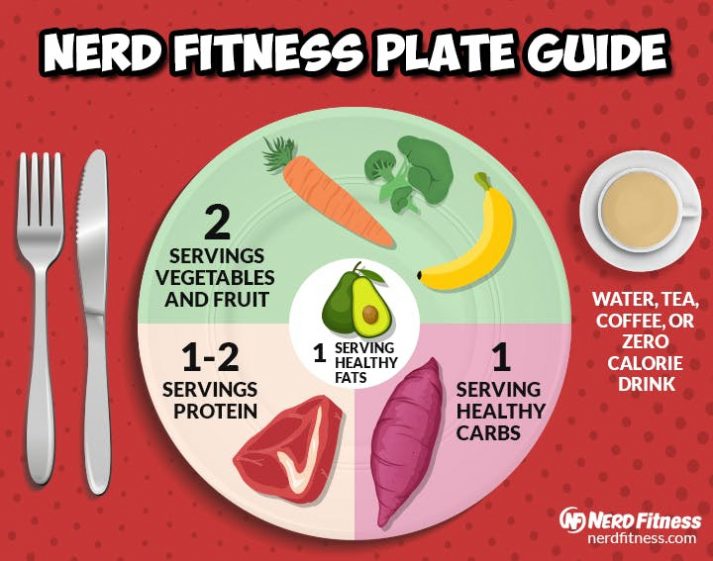
The biggest factor here is what your overall nutrition for the entire day looks like. If you’re getting adequate protein, calories, and fiber, then you’re basically checking off every box already.

A plate that that contains a portion of protein, healthy carb, veggies/fruit, and unsweetened drink.

The idea that you have to eat before a workout is pretty overblown. Your body has glycogen stores from yesterday’s food that it can absolutely use to fuel your A.M. strength training session. For most people, training fasted works just fine!
​
Now, if you feel terrible – low energy, dizzy, super hungry – then yes, let’s problem-solve (maybe some liquid carbs and protein before you head out, or see if we can shuffle the schedule a bit.)

Takeaway: for most people, meal timing around your workouts is a minor factor. Focus on getting solid nutrition in across the day, workout hard when it fits your schedule, and you’re good to go. πŸ’ͺ

“What am I sacrificing by splitting my workout up across the day?”

This was another great question I got from several different folks. The idea being if you don’t have time to do a workout all at once, does it still count if you break it up?

Short answer is: YES!

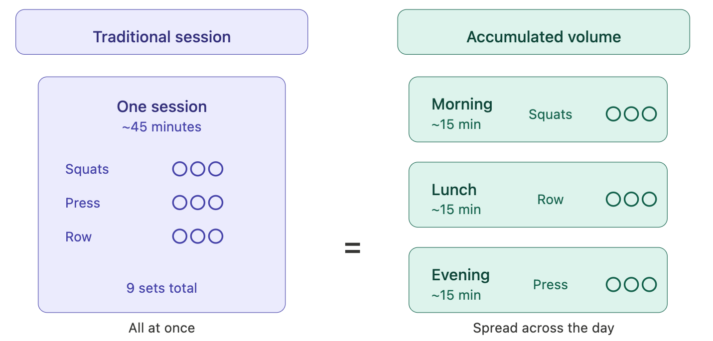
There’s solid research showing that accumulating your training volume throughout the day (a set here, a set there) produces similar strength and muscle-building results compared to a single traditional session, as long as the total volume and intensity are matched. (i.e. you do the same amount of challenging stuff in total.)

The one thing I see trip people up: intensity. It’s hard to go in cold and push yourself hard, safely. Give yourself a minute or two to warm-up before you do your work set so you can challenge yourself and feel good.
​
​Takeaway: Splitting your workout up across the day is absolutely a viable strategy. Heck, we have many clients that squeeze in a single set of pushups, squats or lunges when they can and it makes a HUGE difference. Make sure you still feel warmed up and challenge yourself. Dial those pieces in, and you’ll get great results.

Hopefully, these answers show you that there are many ways to fit strength training in to your life – and they are all great!
​
You’re not doing it wrong. It doesn’t have to look like a traditional 60-minute gym session to work. It just has to work for you. πŸ™Œ
​
You got this,

– Matt

P.S. Ready to make a change in your fitness? Our coaches are here to help. ❀

The post Am I messing up my workout if… 🧐 first appeared on Nerd Fitness.

from Nerd Fitness: Helping You Lose Weight, Get Stronger, Live Better. https://ift.tt/i6w0YaM
via IFTTT

Categories
Uncategorized

#holistic #getfit #nutrition The workout we forgot about (it’s time to bring it back πŸ’ͺ )

Do you remember how you ran and played as a kid?
​
​
Whether it was storming castle walls, avoiding lava pits, or cartwheeling down the sidewalk, we weren’t worried about sets, reps, or time-under-tension. We were just having fun in the moment.
​
When was the last time working out felt like that for you?
​
For those of us that love strength training, exercise DOES feel this way. We love getting in the gym and crunching numbers and focusing on technique. It can be totally absorbing and fun.
​
But for many folks I work with, exercise feels more like a chore than a hobby. More like an obligation than something they look forward to.
​
Here’s one way to change that.

An Alternative To Traditional Training

Years ago, I ran a group class at my local gym called the “Ninja Academy.”
​
Twice a week, a group of adults would show up and we’d spend an hour running around like 10-year-olds. We played tag. We crawled on the floor. We had lightsaber battles with foam swords. We played Zombie Dodgeball (which is a-maz-ing.)

We weren’t focused on reps, heart rate, calories, or weights. And yet – people were genuinely out of breath, laughing too hard to talk, and asking “can we do that again?”

That experience transformed how I look at fitness.

Sure, exercise and strength training and 5k races are all awesome.

But the fitness industry tends to laser-focus on things we can count and track.Β That has naturally led to the idea thatΒ realΒ exercise looks a certain way. And by extension, anything that CAN’T be easily tracked becomes less valuable.

That’s backwards.

When you’re playing, you move because youΒ wantΒ to. You push yourself without thinking about it. You come back the next day not because you’re disciplined, but because it was genuinely fun and you want more.

Play doesn’t have to replace traditional training. It just gives you more options.

And the benefits go beyond just getting sweaty. Play builds community, keeps your brain young, introduces your body to movements it never gets in a gym, and promotes lifelong movement across all ages and generations.

Here’s what Christy – a mom of two teenage girls – said after her first Ninja Academy session:

“I took my twins to a class at my gym last night. Probably the only reason they agreed to go was because it’s called ‘Ninja Academy.’ It’s exercise, yes, but basically it’s structured recess for adults. We did silly stuff, like jump over a ‘creek’ (made out of jump ropes), did tripods or handstands depending on ability, played follow-the-leader (outside in the dark!), and just had a fun time.
​
The girls and I had a blast doing this together. They were still talking about it this morning. I’m on cloud 9 because it was just one of ‘those moments’ that can be hard to find. We just got to PLAY for a change. Not homework, not housework, not some dumb chore, just play. I don’t do that enough with my kids anymore. I’m going to try to fix that.”

Want to try it? A few principles first:

  • Everything is optional.Β Not feeling a game or activity? Try something else!
  • Try your best no matter what.Β You’re not going to be good at these movements and games right away. Especially when stuff is new, it’s easy to get frustrated. We used this mantra in the Ninja Academy to help us focus on doing our best instead ofΒ beingΒ the best.
  • Have fun, but don’t let your head explode.Β When you’re out of practice with playing, it’s easy to go too hard too fast. You try to jump too far and take a spill, you get a bit too aggressive in a game of tag. Ease in.
  • The 70/30 rule.Β If you’re playing with someone else, adjust the rules so one person isn’t winning more than 70% of the time. Stronger player? Make them use their off hand. Taller player? Make them balance on one foot. Keep it competitive for everyone.

Some games to get you started

🎯 Taps: Try to keep a foam ball or balloon in the air. Kick it, hit it, backheel it, whatever it takes. Bluey fans will recognize this as Keepy Uppy. Works solo against a wall or with a whole group. This was our warm up game every session of the Ninja Academy. 😊

βš”Β Samurai Warrior:Β One person stands in front of a group and swipes their arm either up high or down low: high swipe = duck, low swipe = hop over. Note: you don’t LITERALLY hop over their arm. just react to their cues. If you get “hit,” take a step back, do 2 squats, and step back up. Just keep playing.

🏹 Zen Archer: Try to keep your feet planted while your partner slowly sweeps a hand or stick toward you in slow-motion. Move out of the way at the last possible second with as little movement as needed. Harder than it sounds.

πŸͺ„Β Stick Drop:Β Stand a broomstick upright, let it fall, and your partner (or yourself!) tries to catch it right before it hits the ground. Start close. Move farther away as you get better.

πŸ’₯Β Crack-About Dodgeball:Β Free-for-all dodgeball. Best played with those foam Rhino-Skin dodgeballs (one of my favorite tools to facilitate play without someone getting nailed painfully in the face.) When you get hit, sit down. If a ball rolls to you, you can still throw it. When the person who hit you gets hit…you’re back in! No one is ever really out, which creates infinite amounts of fun.

🫳 Reaction Drop: Hold two balls at shoulder height and drop one at random. Your partner tries to catch it before it hits the ground. Deceptively hard. Immediately addictive.

πŸ₯…Β Goalies:Β Roll or toss a ball so it’s just at the edge of your partner’s reach. They try to stop it. The goal is to find that edge so they are successful about 50% of the time. It’s a game for practicing your aim, too, and if you can put it in the perfect spot!

πŸ‘‘Β King of the Log:Β Hold hands with a partner and try to make the other person take a step. That’s it. You can adjust this by having to stand on a crack in the sidewalk, on a small curb or even on an actual log in the woods!

πŸ”₯Β Floor is Lava:Β All-time classic. You know the drill πŸ˜‰.

🧱 Jenga Balance: Stack two Jenga blocks on top of each other and try to hold the bottom one without letting the top one fall. Once you get the hang of that, try adding some slow motion movement. Great focus game, surprisingly challenging.

πŸ‘»Β Mario + Ghosts:Β One person walks around the space. When they turn to look, everyone freezes. The goal is to sneak up and tap them on the shoulder. (I’ve also called this “The Weeping Angels” for all my Doctor Who fans out there.) We even did a version of this at Camp Nerd Fitness where our entire group was ghosts and we picked an unsuspecting coach to be Mario. πŸ˜‚ We got some WILD looks as coaches saw a hoard of people move at them and then all freeze in an instant.
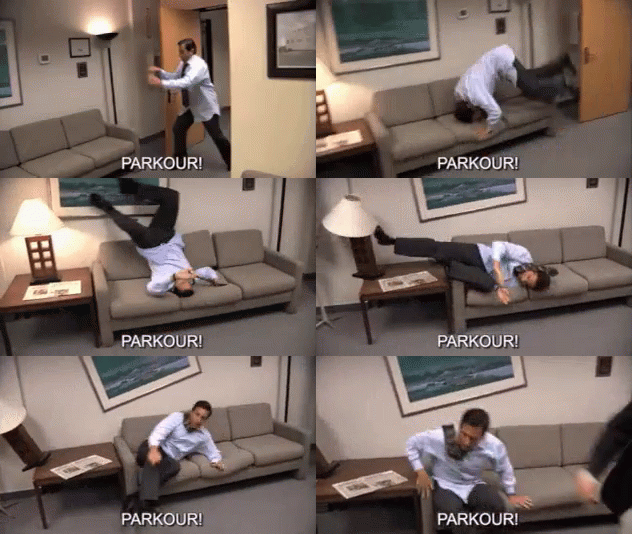

I hope this gave you some inspiration to explore a new game or movement – either for yourself, or with a friend or family member.
​
And more than anything, I hope it gave you permission to rethink what your training “needs” to look like.

I’d love to hear from you – what are some physical games you love to play? I’m always collecting new ideas!

– Matt

P.S. Want to make fitness a sustainable part of your routine?Β That’s exactly what our coaches help with. It’s like having your own personal fitness Yoda in your pocket, except instead of Yoda it’s just a real nerdy human who has your back. Otherwise it’s basically the same thing 😜

The post The workout we forgot about (it’s time to bring it back πŸ’ͺ ) first appeared on Nerd Fitness.

from Nerd Fitness: Helping You Lose Weight, Get Stronger, Live Better. https://ift.tt/Su3UXB9
via IFTTT

Categories
Uncategorized

#holistic #getfit #nutrition The Most Underrated Skill I Wish Everyone Would Learn

Most people go their entire lives never learning how to fall.

Everyone takes a tumble at some point.

Whether it’s a patch of ice, a trail root, a misstep off a curb, or just an unlucky moment, falls happen to all of us. And for a lot of people, especially as they age, a single fall can be genuinely life-altering. Hip fractures alone carry a staggering mortality rate in older adults. Roughly 20-30% don’t survive the following year, not from the fall itself, but from the cascade of complications that follow.

So today, I want to introduce you to something I think belongs in everyone’s physical toolkit: learning how to fall safely. Or at least, learning how to fall in a way that’s “less bad.” πŸ˜…

Let’s bring out your inner ninja.

The Skill Progressions

The goal of these progressions is simple: teach your body to round, absorb, and redirect force.

Start on a soft surface. Carpet is OK, but if you have access to Gymnastics mats or even a soft patch of grass outside (without any hidden rocks or sticks) that’s GREAT.

First rule of thumb: always start low to the ground. The closer you are to the ground when you begin the roll, the lower the forces involved.

You earn height gradually. Just like you learn to bench with the bar first before you add a kajillion pounds, you want to learn the technique before you add more height and intensity to your rolls!

PROGRESSION #1: The Egg Roll​

Points of Performance

  • Keep the knees tucked tight to the chest to create a gentle curve through your low back
  • Slowly rock side to side
  • Transition as smoothly across your back as possible (it’s OK to let the leg open up to lead the way so you don’t get stuck!)

The goal here is just to get you comfortable on the ground in the safest way possible and start to feel what a “smooth transfer of force” feels like.

PROGRESSION #2: The Rocking Horse Roll​

Points of Performance

  • Keep knees tightly tucked to chest to help maintain a gentle curve through your low back
  • Start in a seated position
  • Lean back and smoothly rock along your lower back, avoiding any “skipping” or “hitches” in the movement.
  • The rocks DON’T HAVE TO BE BIG. (If you feel like your “thunking” some part of your tail bone or back, you’re going too big for right now!)

Here, we learn to transfer momentum up and down the spine (rather than across it). This is our final step before we learn to transfer the force diagonally, which is actually the safest option in real world situations!

PROGRESSION #3: The Half Roll​

Points of Performance

  • Start from a seated position
  • Lean towards one side, then roll from that hip towards the opposite shoulder (you want the contact to stop just below the shoulder blade)
  • Reach with your hands forming a triangle over that shoulder
  • Roll smoothly back to the starting position

This is where we really start to see the parkour roll come into shape. You can progress from seated to a standing position, but take your time! There’s no rush, and high quality reps is how we really learn this skill.

PROGRESSION #4: The Forward Roll​

Points of Performance

  • Start from a kneeling position on a soft surface. Make sure to check the area so there’s nothing you will catch yourself on, and give yourself plenty of room.
  • Using the “triangle to back method, reach your hands forward and to the side to guide the back of your shoulder onto the ground, keeping your chin and head tucked down and to the side.
  • Kick over the top to complete the roll and exit on the opposite hip.

This movement can take some time to get comfortable with. If you feel stuck, go back and practice the earlier progressions again. Back to our bench press analogy, once you learn how to bench with heavier weight, you don’t SKIP doing lighter warm up sets!

Let’s be honest about the limits:

While learning and practicing these techniques will definitely make you safer and more resilient, it’s not a silver bullet.

Getting older makes it harder to react in time. Most dangerous falls are surprises, and your window to execute technique may be a fraction of a second or less. Sometimes, you won’t be able to execute a perfect forward roll. Reaction speed decreases with age, and flexibility factors in here as well.

This is also why bone density and muscle mass matter so much and why we sing the praises of strength training for people of all ages. Rolling technique and physical resilience aren’t either/or. They stack.

Eventually, we can start to practice rolling from different angles and different entry points so the skill can be applied more broadly, too.
​
You won’t always have the perfect situation to roll in, but getting more comfortable with distributing force across the ground and protecting your head and neck is something that is still really helpful to learn.

When to practice

Rolling practice fits naturally into a dynamic warm-up, or it can be its own short session. One thing worth noting: learn this when you’re fresh, not at the end of a workout. You’re acquiring a motor skill, and fatigued nervous systems don’t learn well. Give it the attention it deserves. ❀ This is one of those things that may take a few weeks or a few months of practice to get, but once you get it, it doesn’t take much to maintain it.

You got this. πŸ’ͺ

– Matt

P.S. Looking for practical, real-world advice without all the B.S.? That’s exactly what our coaching program is built on. πŸ”₯

The post The Most Underrated Skill I Wish Everyone Would Learn first appeared on Nerd Fitness.

from Nerd Fitness: Helping You Lose Weight, Get Stronger, Live Better. https://ift.tt/Lxg6dHa
via IFTTT

Categories
Uncategorized

#holistic #getfit #nutrition The 50/50 Rule (when training less is exactly the right call)

Ever wonder how to adjust your training when you’re sick? Or what to do if you haven’t worked out in a few weeks and are ready to get back into it? How about after you’ve just had a terrible night of sleep?

These situations come up all the time in our coaching program, so today, I want to walk you through theΒ 50/50 Rule:Β my go-to strategy for helping people train safely and effectively when life throws you a curveball.

Let’s break it down.

The 50/50 Rule

Here’s the premise:Β do 50% of the total reps and 50% of the weight.Β (This nets you 1/4 of the total training load.)

Let’s say your workout calls for 2 sets of 10 reps with 20lb dumbbells. Applying the 50/50 Rule, that becomes 2 sets of 5 reps with 10lb dumbbells.

Another example – a bodyweight exercise like pushups, 4 sets of 6 reps. With the 50/50 Rule, that turns into 2 sets of 3 reps of an easier pushup variation.

Why it works

When your body’s resources are overstretched – from prolonged intense training, illness, or periods of high stress – pushing at the same intensity doesn’t produce the same results. You’re drawing water from a well that’s already depleted.

Coming off an illness or a prolonged break from training, your body is significantly more sensitive to training stimulus than normal. The threshold for “too much” is much lower than you think.

Have you ever jumped right back into your normal workout after being sick, felt great during it, and then been destroyed for days after? That’s exactly what’s happening.

The good news is you also don’tΒ needΒ as much, either. A reduced session still gives you real benefits – practicing technique, maintaining the habit, nudging recovery forward – without digging yourself into a deeper hole.
​
Think of it less as “going easy” and more as training at the right dose for where your body actually is right now.

Practical applications

  • DeloadΒ – If you’ve been training hard for 4-8 weeks without a break, take an entire week using the 50/50 rule. This gives your body extra time for rest and recovery so you come back stronger and ready to train.Β Note: if your training schedule is inconsistent, you’re already getting mini “breaks” built in, so you probably don’t need a dedicated deload week as much.
    ​
  • IllnessΒ – If it’s genuinely mild (no fever, no muscle aches, etc.), the 50/50 Rule can keep you moving while you recover (just don’t do it at the gym and get other people sick!). Coming off being sick, use it to ramp back in. Start at 50/50, then add 10-20% each session as long as you’re feeling good and recovering well.
    ​
  • Terrible Night of SleepΒ – Get in, do a 50/50 day, and go home. No need to white-knuckle your way through a full session. Hopefully you sleep better and return to full reps and weights later in the week.
    ​
  • Prolonged Time OffΒ – Been a while since you worked out? Apply the 50/50 Rule to your first few sessions back. The goal is to get moving and feel good, not obliterate yourself.

The Takeaway

Training isn’t about going hard all the time no matter what.
​
The most effective approach is working out the right amount, in the right way, at the right time – and the 50/50 Rule gives you a simple way to do exactly that across a surprising number of situations.

Simple enough to remember, easy enough to execute, and it’ll serve your training and recovery for the long haul.

You got this. πŸ’ͺ

– Matt

P.S. Looking for practical, real-world advice without all the B.S.? That’s exactly what ourΒ coaching programΒ is built on.Β πŸ”₯

The post The 50/50 Rule (when training less is exactly the right call) first appeared on Nerd Fitness.

from Nerd Fitness: Helping You Lose Weight, Get Stronger, Live Better. https://ift.tt/NyCkV6X
via IFTTT

Categories
Uncategorized

#holistic #getfit #nutrition NAWs: the art of getting back on track

I got a message from a reader, Sabrina, this week – and she pointed out a pattern I think a lot of us know well.

“I allow myself to say sliding into bad habits is alright. After all, I’ve had a bad day. Well, my bad days have a tendency to become hard weeks and then months. It doesn’t take much for me to backpedal.”

I know I’ve been there. πŸ™‹β€β™‚οΈ

Here’s how we work through it.

Know the difference between an off-day and a repeated pattern.

Missing a workout or having a meal that’s not strictly on plan? Totally fine and expected. It’s not going to hurt your progress.

The problem isn’t the slip. It’s when the slip becomes the default.

Give yourself some grace on the hard days. And stay honest with yourself: is this a one-off, or a pattern forming? If it’s a pattern, call it out and reroute.

Rethink what taking care of yourself actually looks like.

Sometimes the perfect recovery from a hard day is to Netflix and chill. Rest absolutely counts as self-care.

But so does the workout you’ve been putting off, a solid meal, or putting down your phone and getting to bed at a reasonable hour.

Sometimes the most caring thing you can do for yourself is the thing you’re avoiding.

A hard day doesn’t have to mean opting out. It might mean doubling down on the things that you know are good for you.

Don’t try to play catch-up.

This is one of the most common traps I see. Someone misses a workout and suddenly feels like they need to do that one PLUS today’s to make up for it. That’s how you end up feeling like you’re pushing a boulder uphill before you’ve even started.

Forget what you missed. Focus on the plan for today. Do that. Then build from there.

Find your NAW (your Next Available Win).

When you realize you’re off track, the instinct is to overcommit.

“I need to work out five times a week.”

“I need to do a giant meal prep and reset the whole kitchen.”

Those things aren’tΒ wrong, but they’re not your first step.

Your first step is theΒ next available win. One thing that interrupts the current pattern.

Maybe it’s five minutes of stretching on the floor while you watch TV tonight. Maybe it’s grabbing some fruit as a quick snack.

Here’s the key: you don’t have to wait until tomorrow, or Monday. Reset the pattern as soon as possible.

I recently had a client come back from vacation feeling completely off track. We didn’t map out an elaborate return plan. We just asked one question: “OK – when’s the next workout?”

The next day she knocked out a short workout and hit a PR on her barbell rows.

That’s all it took. The next available win. (PR not required πŸ€ͺ)

The next time you catch yourself having an off-day, start with grace. These days are normal, expected, and they don’t erase all the hard work you’ve put in.

Then check in with yourself: “Am I falling into a pattern that’s working against me?Β If so:

  • Reframe what self-care looks like
  • Don’t play catch-up
  • Find your NAW

Save this for the next time you need it:

You got this. πŸ’ͺ

– Matt

P.S. If you’re in a backslide right now, we’re here to help. Take ourΒ Coaching QuizΒ to find your own personal fitness Yoda.

The post NAWs: the art of getting back on track first appeared on Nerd Fitness.

from Nerd Fitness: Helping You Lose Weight, Get Stronger, Live Better. https://ift.tt/IW78YUN
via IFTTT

Categories
Uncategorized

#holistic #getfit #nutrition Struggling with nighttime snacking? Try this instead.

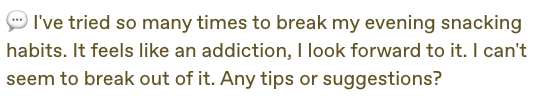
I got a question from a reader named Rick this week:

If this sounds familiar, you’re definitely not alone.

When people join Nerd Fitness Coaching, over 70% tell us they struggle with stress eating, emotional eating, or nighttime snacking.

I recorded a short video explaining why simply “trying to stop snacking” usually backfires – and what tends to work better.

​WATCH: STRUGGLING WITH NIGHTTIME SNACKING? TRY THIS INSTEAD​

If you’d rather read than watch, here’s the short version:

1. Eating at night isn’t the problem.

If you genuinely need more calories or nutrients for the day, eating at night is completely fine! (Contrary to popular belief.)

The challenge most people run into is when they find themselves snacking even when they’re not hungry, often as a way to decompress after a long day.

2. Going cold turkey rarely works.

If nighttime snacking has become your main way to relax or reward yourself at the end of the day, simply removing it often leaves a gap that’s hard to sustain.

3. Build a “decompression menu.”

Instead of trying to eliminate the habit immediately, come up with a few other things you genuinely enjoy that help you relax at the end of the day.

Examples might include:

  • making herbal tea
  • reading
  • stretching
  • listening to music
  • playing a game
  • journaling

Even if you choose one of these alternatives some of the time, that alone can start shifting the habit.

The goal isn’t quit snacking at night, forever!

It’s to understand the habit and expand your choices. πŸ’ͺ

4. Upgrade your Batcave to make the alternative choice easier.

At the end of the day we’re usually tired, and that’s when we tend to default to the easiest and most familiar option.

A few small changes to your environment can make a big difference.

Things like keeping your go-to snack foods out of immediate reach, or setting out your book in a visible and easy to access place.

Heck, you could even try putting your book IN the pantry where the snacks usually are!

The goal is to rely less on willpower and more on an environment that gently nudges you in the direction you want to go.

So Rick, if you’re reading this, that’s where I’d start.

Instead of trying to eliminate the nighttime snacking overnight, experiment with adding a few other ways to decompress and adjust your environment so those choices are the easier ones.

Try it for a week or two and see what you notice.

Then we learn and adjust from there. πŸ”₯

– Matt
​

P.S. If you want to submit a question like Rick, you can!

The post Struggling with nighttime snacking? Try this instead. first appeared on Nerd Fitness.

from Nerd Fitness: Helping You Lose Weight, Get Stronger, Live Better. https://ift.tt/I7XbEFh
via IFTTT

Categories
Uncategorized

#holistic #getfit #nutrition 5 ways to level up your bodyweight workout πŸ™Œ

One of the most popular workouts we’ve ever published at Nerd Fitness is our Beginner Bodyweight Workout.

(Even though Steve filmed ​the original video​ with his shorts inside out and backwards. True story!)

But after a few weeks or months, you may wonder:

“Cool, this works. But what should I do next? Do I just keep doing the same thing?”

Good news: you have lots of options!

If the workout is starting to feel easier, here are five ways to level it up.

Note: these tips work for ANY type of bodyweight workout. πŸ’ͺ

LEVEL 1: Add More Reps

This is the simplest progression.

Try to add 1 rep each week.

Maybe you start with 10 pushups, then you try 11, then 12.

As long as your technique stays solid, gradually increasing reps is a great way to get stronger.

There is no “magic” number of reps.

The reps we suggest in the workout are there to help you find the right level of challenge.

Over time, you’ll be able to do more, and that’s great! πŸ™Œ

LEVEL 2: Slow Things Down (Tempo + Pauses)

This is one of the most underrated progressions.

Slow the movement down.

For example, when doing a squat:

  • Lower yourself for 3 seconds
  • Pause at the bottom for 1-2 seconds
  • Stand back up normally.

The same works for push-ups, rows, lunges, and more.

Slower reps mean your muscles stay under tension longer = more challenge!

LEVEL 3: Choose a Harder Variation

Instead of doing more reps, you can also make the exercise itself harder.

Here are a few examples:

Pushups

​Wall pushups​ -> ​Incline pushups​ -> ​Floor pushups​ -> ​Decline pushups​

Squats

​Bodyweight Squat​ -> ​Split Squat​ -> ​Bulgarian Split Squat​ -> ​Pistol Squat progression​

Rows

​1-Arm Row​ -> ​Doorway Row​ -> ​Corner Tuck​ -> ​Ring Row​

Same movement pattern.

Just a bigger challenge.

Did you know we actually built this for you?

It’s called the Bodyweight Adventures. 21 workouts that incorporate all of these first 3 level ups.

It helps you know when to increase reps, change the tempo, or move to a harder variation.

If you haven’t seen it, just hit reply and I’ll send it your way! πŸ™Œ

LEVEL 4: Add New Exercises

Another option is to keep the original workout the same and add a few extra exercises.

For example:

Want more core strength?

Try adding ​Deadbugs​, ​Hanging Knee Tucks​, etc.

Want more upper body work?

Try adding in ​Pike Push-ups​, ​Bar Hangs​, etc.

Want more lower body work?

Try adding ​Glute Bridges​, ​Step Ups​, etc.

These can add a little bit of fun and variety in your workouts!

Note: if you’re short on time, instead of adding it in, consider subbing a movement out. I.e. replace lunges with step ups, or planks with deadbugs. You get to enjoy more variety without making the workout take too long!

LEVEL 5: Add Resistance

Adding a little outside resistance can also help.

And you don’t need fancy equipment.

You can:

  • Hold a backpack filled with books
  • Fill some gallon jugs with water
  • Or even have a friend manually apply some gentle resistance as you do the movement. (i.e. lightly pressing down on shoulders as you stand up from a squat.)

This is also where many people start exploring strength training with weights.

(If that sounds interesting, our ​Beginner Dumbbell Workout​ and ​Strength Training 101​ guide are great next steps.)

And you don’t have to pick one or the other. Bodyweight exercises are just another form of strength training. It all counts and it’s all great. πŸ˜ƒ

One final tip: don’t change everything, everywhere, all at once!

Pick one of these things to add to your workouts and see how you feel.

Eventually, you may stack all of these together, but you don’t need to be in a rush! Give your body time to adapt. πŸ’ͺ

You got this!

– Matt ​

P.S. Wish you could ask a coach a question? Well, now you can! As an experiment, I set up a Video Ask! It allows you submit a question to be answered by a coach. Check it out​!

The post 5 ways to level up your bodyweight workout πŸ™Œ first appeared on Nerd Fitness.

from Nerd Fitness: Helping You Lose Weight, Get Stronger, Live Better. https://ift.tt/Oo0y5lB
via IFTTT

Categories
Uncategorized

#holistic #getfit #nutrition 4 Simple Cues to Help You Move Better πŸ’ͺ

Here are four simple cues you can use to move better and feel great in your workouts.

If you’ve had a nagging feeling of:

“I’m not sure if this is sketchy, am I doing this right? 🧐

…then this is for you!

Let’s dig in.

​WATCH: 4 CUES TO HELP YOU MOVE BETTER​

CUE #1: “Maintain balance across your foot”

This helps you avoid your knees collapsing inward, especially on squats and lunges.

Focus on maintaining even pressure between your heel, base of your big toe, and base of your pinky toe as your squat or lunge (front-foot only on the lunge).

The goal is to help you externally rotate at the hip, without overdoing it.

CUE #2: “Slam the car door shut”

This helps you keep your spine in a good position as you go into a hinge or deadlift position.

Imagine your arms are full of groceries, and you have to slam the car door shut with the seat of your pants.

The goal is to move the hips back, rather than round your back down.

Note: some flexion/extension of the spine is safe and normal! This is for when we have excessive movement at one point.

CUE #3: “Push your shoes through the floor”

This helps you stay strong through your spine and avoid excessive arching as you stand up from a hinge position.

Imagine you are pushing the soles of your shoes so hard through the floor, they are actually making an imprint.

The goal is to stand up rather than arch back.

CUE #4: “Imagine there are strings attached to your elbows”

This helps you avoid too much pressure on the front of your shoulder and is great for horizontal rows and presses.

Imagine there are two strings attached to your elbows, and someone is standing behind your gently pulling them back and around your torso.

The goal is that your shoulder blades move around your ribcage in sync with the movement.

And there you have it! Four quick cues to help you move with confidence.

And one last point: there is WAY too much fear-mongering about exercise technique on the internet.

Our bodies are all built a little differently, and there are lots of variations of GOOD movement.

You don’t have to move exactly like the person you see on the internet for it to be safe and effective. ❀

Hope this helps give you some ideas and get you moving! πŸ™Œ

– Coach Matt ​

P.S. Wish you could ask a coach a question? Well, now you can! As an experiment, I set up a Video Ask! It allows you submit a question to be answered by a coach. Check it out​!

The post 4 Simple Cues to Help You Move Better πŸ’ͺ first appeared on Nerd Fitness.

from Nerd Fitness: Helping You Lose Weight, Get Stronger, Live Better. https://ift.tt/ZHJhdSt
via IFTTT