As seasons of life shift, so do our morning routines. Maybe you have one, maybe you don’t, maybe you want a more set routine, or maybe you do better going with the flow. Regardless of what season you’re currently in, having habits we integrate into our mornings can help us set ourselves up better for our days.
In today’s episode, Robin shares her current morning routine and the reasons why she prioritizes them in the morning. Whether you’re looking to make a new routine, want to switch yours up a bit, or you’re just getting started, this episode is packed with tangible and rejuvenating ideas.
Show highlights: what you can look forward to in this episode!
How to adapt and create a morning routine that fits for you
Embracing seasons and readjusting your routine
Being proactive throughout your day instead of reactive
Why Robin likes to “get ahead” of the day
Starting off the morning with positive and grateful thoughts
As seasons of life shift, so do our morning routines. Maybe you have one, maybe you don’t, maybe you want a more set routine, or maybe you do better going with the flow. Regardless of what season you’re currently in, having habits we integrate into our mornings can help us set ourselves up better for our days.
In today’s episode, Robin shares her current morning routine and the reasons why she prioritizes them in the morning. Whether you’re looking to make a new routine, want to switch yours up a bit, or you’re just getting started, this episode is packed with tangible and rejuvenating ideas.
Show highlights: what you can look forward to in this episode!
How to adapt and create a morning routine that fits for you
Embracing seasons and readjusting your routine
Being proactive throughout your day instead of reactive
Why Robin likes to “get ahead” of the day
Starting off the morning with positive and grateful thoughts
As seasons of life shift, so do our morning routines. Maybe you have one, maybe you don’t, maybe you want a more set routine, or maybe you do better going with the flow. Regardless of what season you’re currently in, having habits we integrate into our mornings can help us set ourselves up better for our days.
In today’s episode, Robin shares her current morning routine and the reasons why she prioritizes them in the morning. Whether you’re looking to make a new routine, want to switch yours up a bit, or you’re just getting started, this episode is packed with tangible and rejuvenating ideas.
Show highlights: what you can look forward to in this episode!
How to adapt and create a morning routine that fits for you
Embracing seasons and readjusting your routine
Being proactive throughout your day instead of reactive
Why Robin likes to “get ahead” of the day
Starting off the morning with positive and grateful thoughts
No matter which at-home workout you pick, I want you to start with one important thing:
Warm-up!
I cover why you should always warm up in an article found right here. It doesn’t have to be much though, give it about five minutes to get your muscles active and your heart rate up.
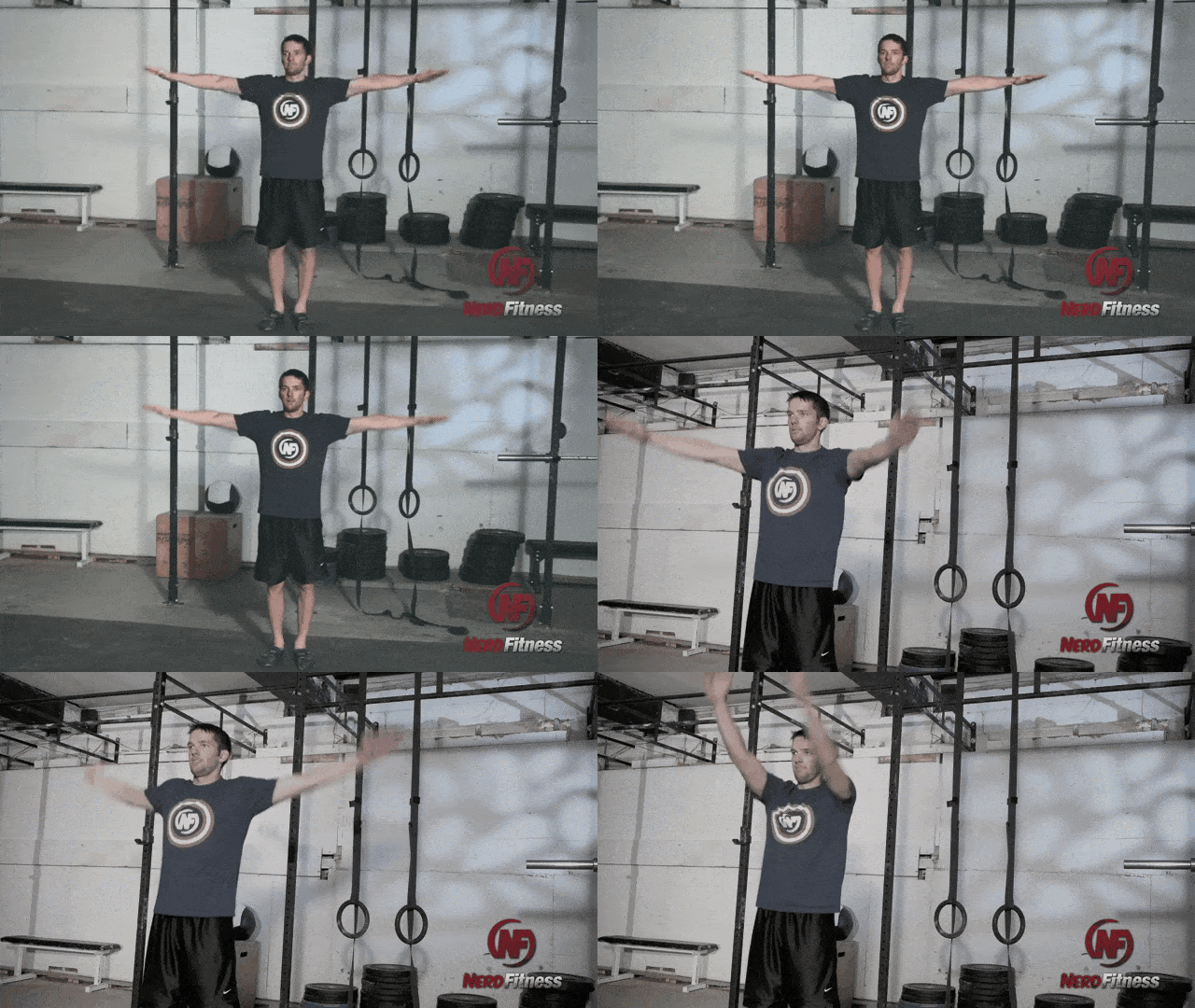
This will help you do exercises properly and help prevent injury. You can run in place, do air punches and kicks, or some jumping jacks.
Here is NF Senior Coach Staci (you might know her incredible story) showing you many beginner options you can use to warm up as well:
If you’re curious, here’s my personal (advanced) warm-up:
Jump rope: 2-3 minutes
Jumping jacks: 25 reps
Bodyweight squats: 20 reps
Lunges: 5 reps each leg.
Hip extensions: 10 reps each side
Hip rotations: 5 each leg
Forward leg swings: 10 each leg
Side leg swings: 10 each leg
Push-ups: 10-20 reps
Spider-man steps: 10 reps
Our goal isn’t to tire you out, instead we want to warm you up.
That’s step one.
Completing your chosen at-home workout would be step two.
Below, you’ll find 8 sequences you can follow along with!
I warn you, the above sequence will hurt… in a good way. You should be proud if you can get through this three times.
Do you want to get as strong as possible so this workout ain’t no thang?
Sign up in the box below to grab our guide, Strength Training 101: Everything You Need to Know. It’ll teach you all of these advanced bodyweight exercises!
Download our comprehensive guideSTRENGTH TRAINING 101!
Everything you need to know about getting strong.
Workout routines for bodyweight AND weight training.
How to find the right gym and train properly in one.
Home Workout #3: The 20-Min Hotel Routine
Sometimes, you just plain find yourself stuck in a hotel room. Maybe you can find the hotel gym, but I bet it’s terrible! It probably has 2 machines, a broken treadmill, and no free weights.
Ugh.
Instead, how about a 20-min workout you can do in the room itself! Utilize the furniture to its full potential.
If you don’t have time to run through the whole sequence, no problem!
Depending on how much time you have during the day, you can do your whole workout at once, or break up your training into four different sessions throughout the day (with each session being ONE of the exercises).
Here’s a sample day for your No-Equipment Workout:
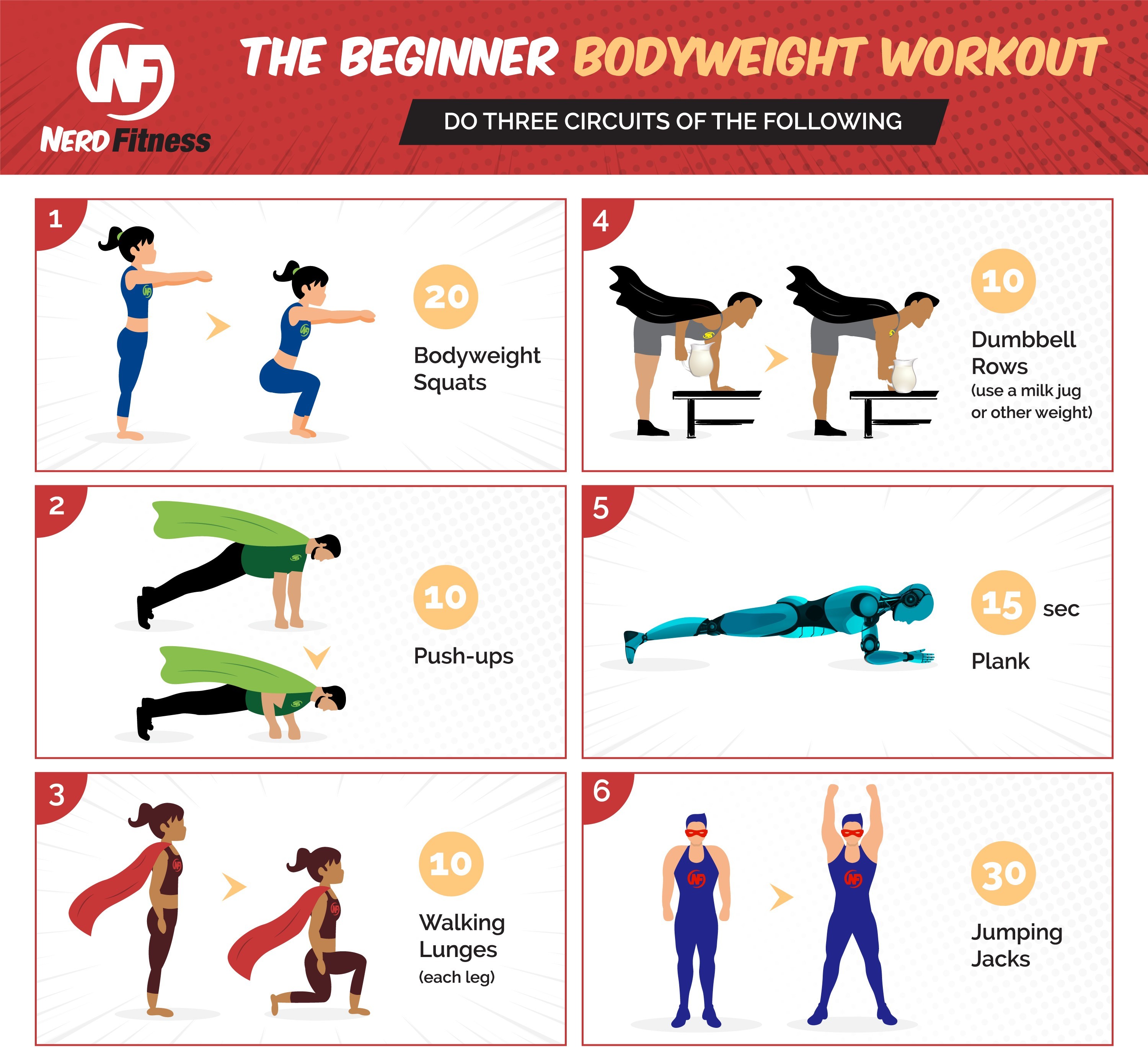
Wake up, do 40 jumping jacks to warm up, and then do bodyweight squats.
At lunch, you grab your suitcase (if you’re at work, milk jug if you’re at home) and do inverted rows.
After work, you do another 50 jumping jacks and then do your push-ups.
After dinner, you do your planks while watching TV.
You could even split it up over two days if needed, but the goal would be to do it the whole sequence at once.
The main Angry Birds Workout article describes in detail Levels 1-6, but here’s Level 3 for you:
Bonus points if you somehow do this no-equipment workout in a cave, as that’s how Bruce Wayne would roll.[1]
This workout is separated into two days for you:
Batman No-Equipment Workout Day 1:
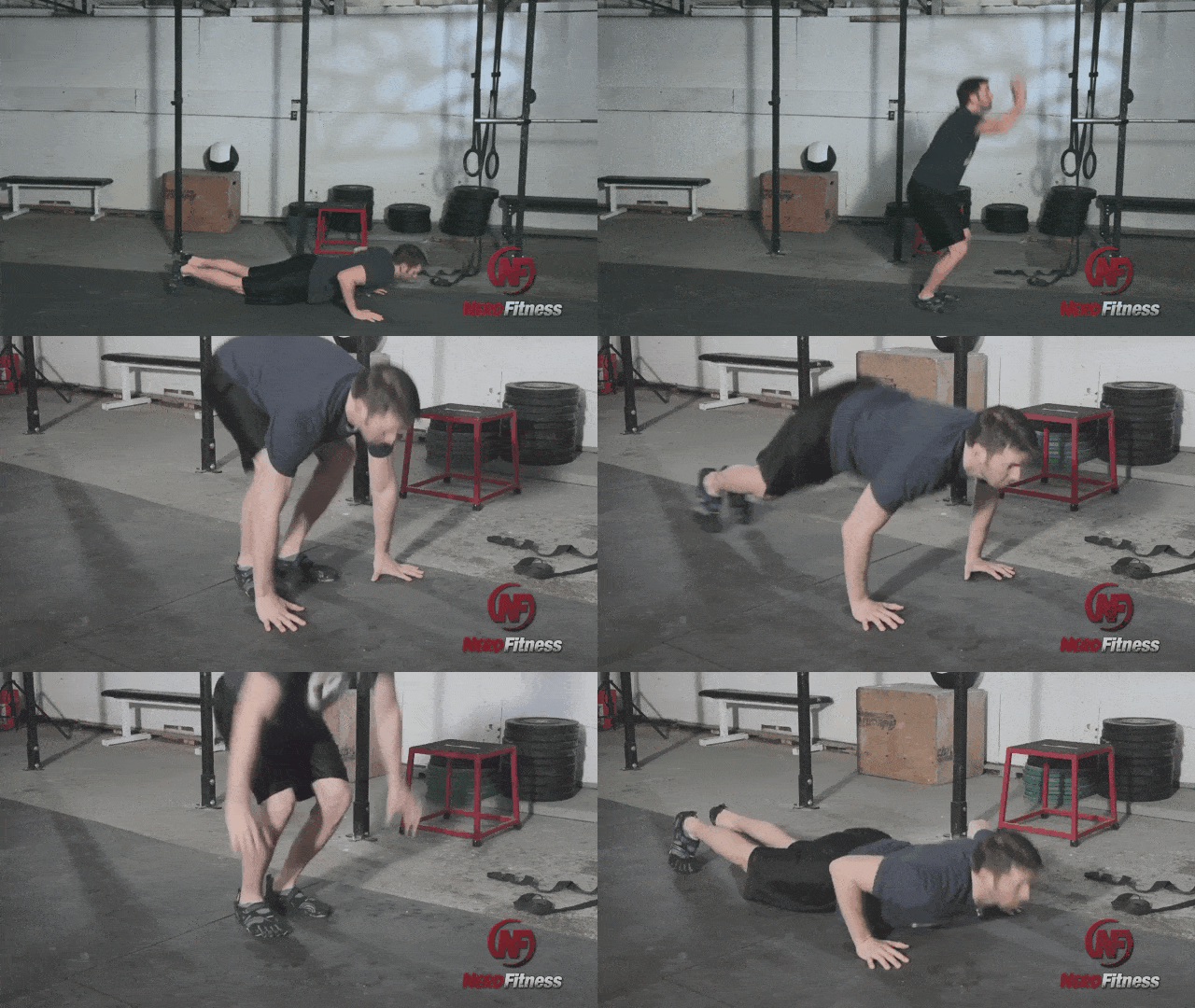
Rolling squat tuck-up jumps: 5 reps
Side to side push-ups: 5 reps
Modified headstand push-ups: 5 reps
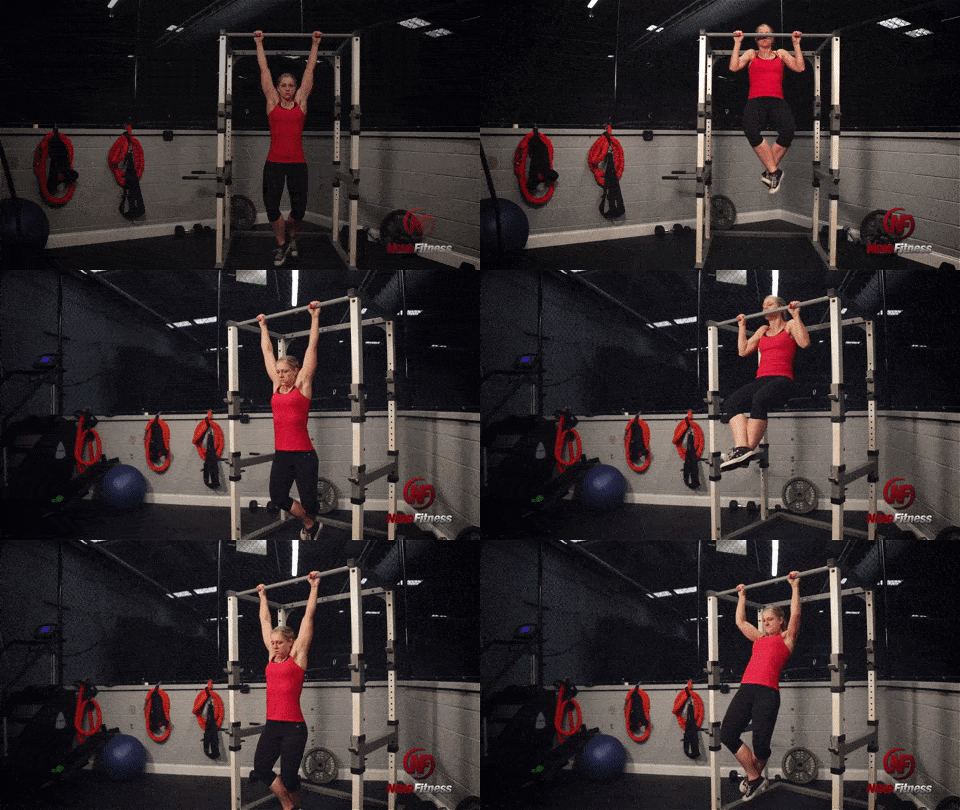
Jump pull-up with tuck / Pull-up with Tuck-up: 5 reps
Handstands against wall: 8 seconds
Batman No-Equipment Workout Day 2:
‘180 Degree’ jump turns: 5 reps
Tuck front lever hold: 8 seconds
Tuck back lever hold: 8 seconds
Low frog hold: 8 seconds
This is a relatively advanced workout already, but if you want to progress to the next level, check out the main Batman Bodyweight Workout for tips on how to do just that.
NOTE: This is NOT a beginner program, and should not be attempted unless you have been training consistently and can do multiple repetitions of pull-ups and push-ups with great form.
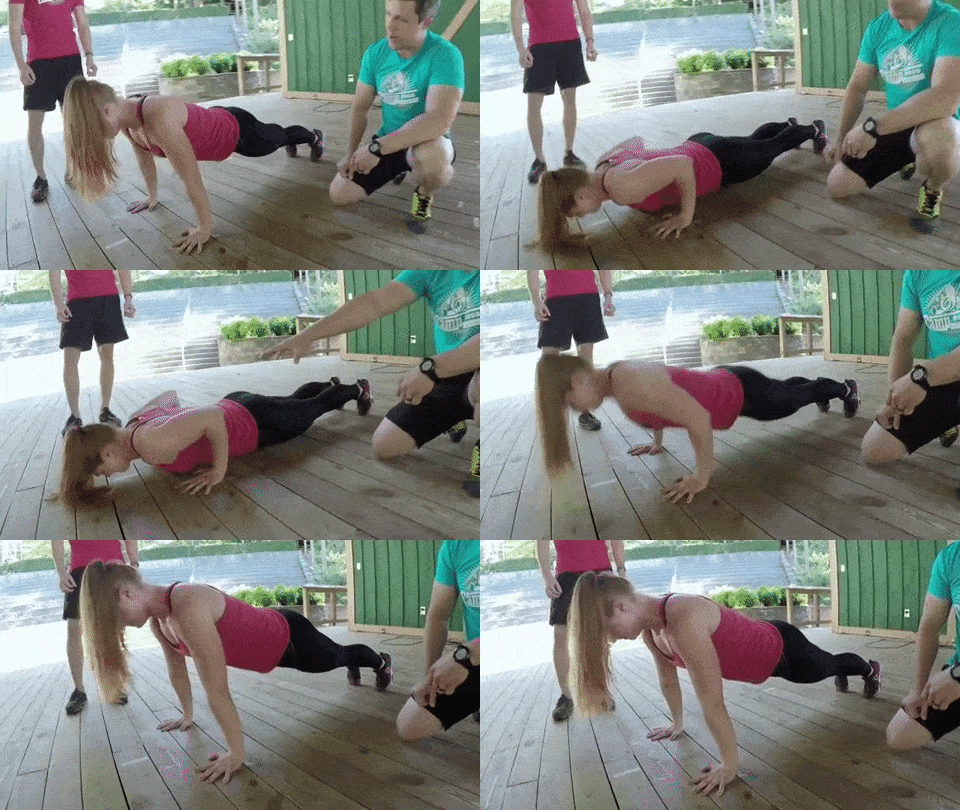
Like this perfect push-up:
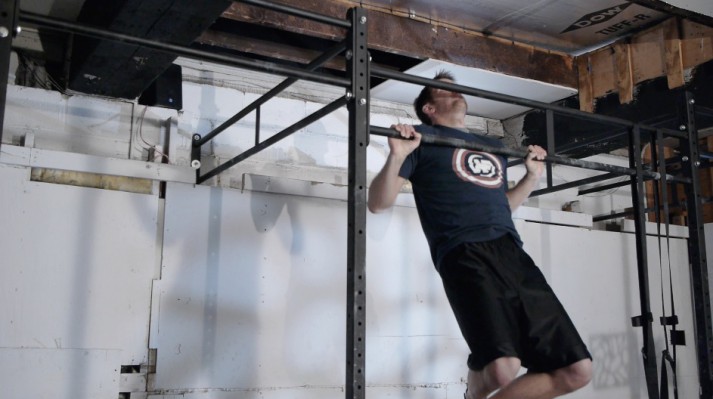
And this perfect pull-up:
Here’s how the PLP Progression works:
Day 1:
Pull-ups: 10 reps
Push-ups: 10 reps
Lunges: 10 reps (each leg)
Day 2:
Pull-ups: 11 reps
Push-ups: 11 reps
Lunges: 11 reps (each leg)
Day 3:
Pull-ups: 12 reps
Push-ups: 12 reps
Lunges: 12 reps (each leg)
How long do you keep doing this?
As originally envisioned by Chad Waterbury, the PLP Workout lasts 60 days.[3]
Yeah…by the end of it you’ll be doing more than 50 pull-ups.
There are two versions:
If you can do 10 straight pull-ups: Start day 1 with 10 reps of each.
If you cannot do 10 straight pull-ups: Start day 1 with 1 rep of each.
Complete your required reps each day in as many sets as you need, whenever you need to. The goal is to do it in as few sets as possible, but enough so that you can complete each rep with proper form.
If you want to advance to the Jedi Knight or Master Levels, check out The Star Wars Workout, which will also offer you a full description of each move.
Bonus No-Equipment Workout: The Playground Circuit
Do you have a nearby playground? Why not work out there! If you have kids, you can do it together. Or let them ignore you.
The trick here is to couple your home workouts with adjustments to your nutrition.
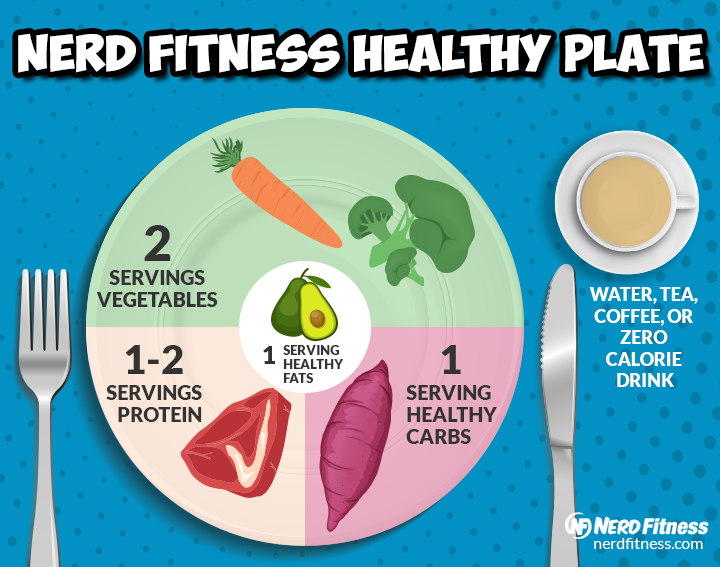
We’re big believers that you can’t outrun your fork, so any successful weight loss plan will include a focus on building a healthy plate.
That will look something like this:
If you want some help on adjusting your nutrition, I’ve got two great resources for you:
The Nerd Fitness Guide to Healthy Eating. This massive resource will help you slowly adjust your nutrition, without forcing you to give up the food you love (yes, you can still eat pizza here and there). No more diets, instead we’ll work on building habits together.
Nerd Fitness Coaching. If you want to take it to the next level, one of our trained professionals can help you adjust your way of eating to help you reach your goals. No shame. No judgment. Just a like-minded nerd who will show you the way.
You don’t have to stick to these though! I have two resources to help you design your own no-equipment workout:
The 42 Best Bodyweight Exercises: This guide will teach you how to perform the best bodyweight exercises – no equipment required! Check it out if you are unfamiliar with any of the movements referenced in today’s guide.
How To Build Your Own Workout Routine: Once you’re comfortable with a handful of bodyweight exercises, use this guide to pull them all together into a full-body workout!
That should get you going on building a workout you can do in the comfort of your own home.
Want more? Alright, eager beaver, I got you.
We built THREE options for people just like you:
1) If you want step-by-step guidance, a custom workout program that levels up as you get stronger, and a coach to keep you accountable, check out our killer 1-on-1 coaching program:
2) If you want a daily prompt for doing workouts at home, check out NF Journey. Our fun habit-building app helps you exercise more frequently, eat healthier, and level up your life (literally).
Try your free trial right here:
3) Join the Rebellion! We need good people like you in our community, the Nerd Fitness Rebellion.
Sign up in the box below to enlist and get our guide, Strength Training 101: Everything You Need to Know. It’ll help you start incorporating these bodyweight moves into your training.
Download our comprehensive guideSTRENGTH TRAINING 101!
Everything you need to know about getting strong.
Workout routines for bodyweight AND weight training.
How to find the right gym and train properly in one.
Alright, your turn: I’d love to hear how your home training is going!
Which workout above did you try? Did you make one of your own?
Leave a comment below with your results or any questions you have on working out at home.
For the Rebellion!
-Steve
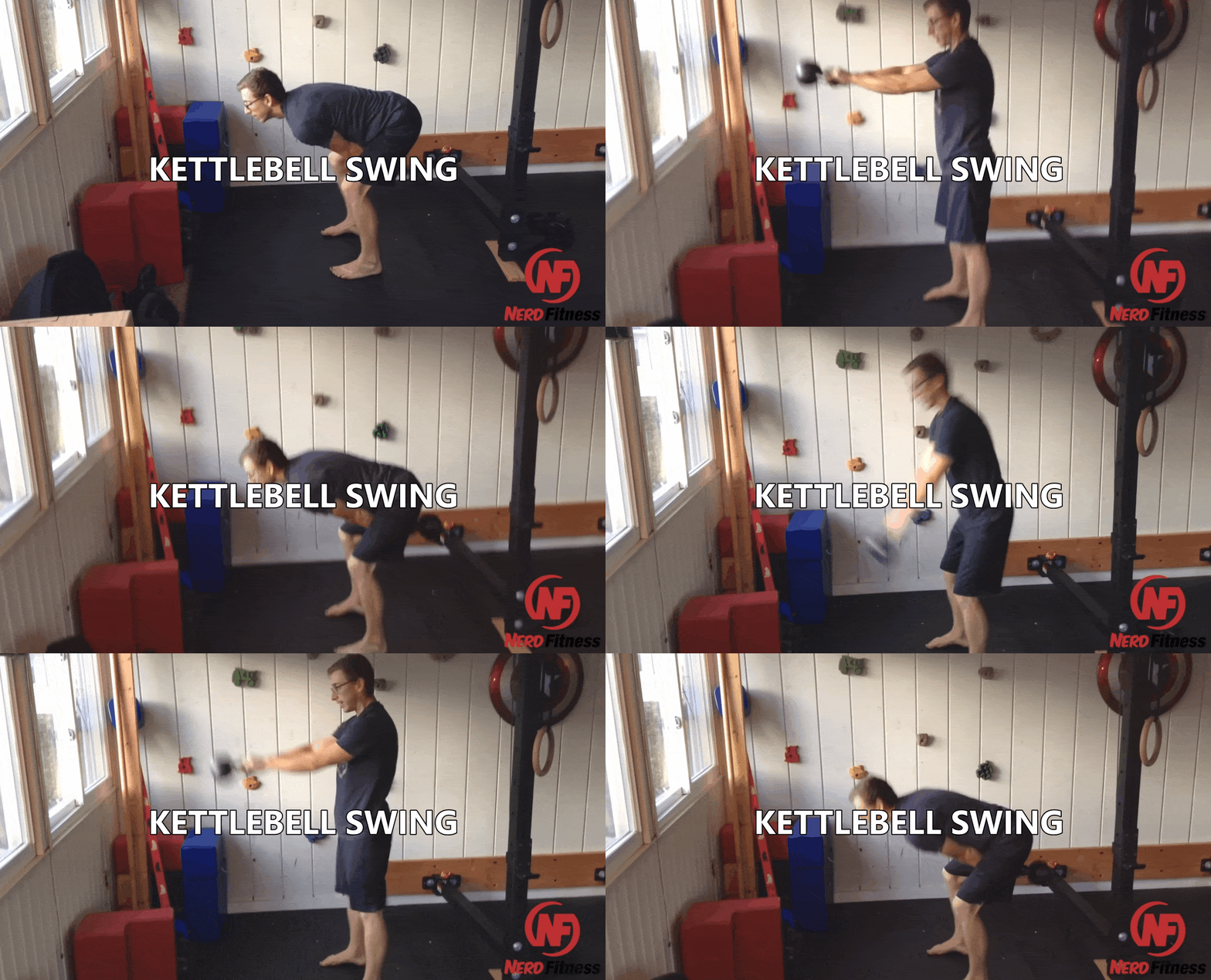
PS: If you were going to buy one piece of equipment to utilize in your home, a kettlebell would offer you a lot of versatility:
No matter which at-home workout you pick, I want you to start with one important thing:
Warm-up!
I cover why you should always warm up in an article found right here. It doesn’t have to be much though, give it about five minutes to get your muscles active and your heart rate up.
This will help you do exercises properly and help prevent injury. You can run in place, do air punches and kicks, or some jumping jacks.
Here is NF Senior Coach Staci (you might know her incredible story) showing you many beginner options you can use to warm up as well:
If you’re curious, here’s my personal (advanced) warm-up:
Jump rope: 2-3 minutes
Jumping jacks: 25 reps
Bodyweight squats: 20 reps
Lunges: 5 reps each leg.
Hip extensions: 10 reps each side
Hip rotations: 5 each leg
Forward leg swings: 10 each leg
Side leg swings: 10 each leg
Push-ups: 10-20 reps
Spider-man steps: 10 reps
Our goal isn’t to tire you out, instead we want to warm you up.
That’s step one.
Completing your chosen at-home workout would be step two.
Below, you’ll find 8 sequences you can follow along with!
I warn you, the above sequence will hurt… in a good way. You should be proud if you can get through this three times.
Do you want to get as strong as possible so this workout ain’t no thang?
Sign up in the box below to grab our guide, Strength Training 101: Everything You Need to Know. It’ll teach you all of these advanced bodyweight exercises!
Download our comprehensive guideSTRENGTH TRAINING 101!
Everything you need to know about getting strong.
Workout routines for bodyweight AND weight training.
How to find the right gym and train properly in one.
Home Workout #3: The 20-Min Hotel Routine
Sometimes, you just plain find yourself stuck in a hotel room. Maybe you can find the hotel gym, but I bet it’s terrible! It probably has 2 machines, a broken treadmill, and no free weights.
Ugh.
Instead, how about a 20-min workout you can do in the room itself! Utilize the furniture to its full potential.
If you don’t have time to run through the whole sequence, no problem!
Depending on how much time you have during the day, you can do your whole workout at once, or break up your training into four different sessions throughout the day (with each session being ONE of the exercises).
Here’s a sample day for your No-Equipment Workout:
Wake up, do 40 jumping jacks to warm up, and then do bodyweight squats.
At lunch, you grab your suitcase (if you’re at work, milk jug if you’re at home) and do inverted rows.
After work, you do another 50 jumping jacks and then do your push-ups.
After dinner, you do your planks while watching TV.
You could even split it up over two days if needed, but the goal would be to do it the whole sequence at once.
The main Angry Birds Workout article describes in detail Levels 1-6, but here’s Level 3 for you:
Bonus points if you somehow do this no-equipment workout in a cave, as that’s how Bruce Wayne would roll.[1]
This workout is separated into two days for you:
Batman No-Equipment Workout Day 1:
Rolling squat tuck-up jumps: 5 reps
Side to side push-ups: 5 reps
Modified headstand push-ups: 5 reps
Jump pull-up with tuck / Pull-up with Tuck-up: 5 reps
Handstands against wall: 8 seconds
Batman No-Equipment Workout Day 2:
‘180 Degree’ jump turns: 5 reps
Tuck front lever hold: 8 seconds
Tuck back lever hold: 8 seconds
Low frog hold: 8 seconds
This is a relatively advanced workout already, but if you want to progress to the next level, check out the main Batman Bodyweight Workout for tips on how to do just that.
NOTE: This is NOT a beginner program, and should not be attempted unless you have been training consistently and can do multiple repetitions of pull-ups and push-ups with great form.
Like this perfect push-up:
And this perfect pull-up:
Here’s how the PLP Progression works:
Day 1:
Pull-ups: 10 reps
Push-ups: 10 reps
Lunges: 10 reps (each leg)
Day 2:
Pull-ups: 11 reps
Push-ups: 11 reps
Lunges: 11 reps (each leg)
Day 3:
Pull-ups: 12 reps
Push-ups: 12 reps
Lunges: 12 reps (each leg)
How long do you keep doing this?
As originally envisioned by Chad Waterbury, the PLP Workout lasts 60 days.[3]
Yeah…by the end of it you’ll be doing more than 50 pull-ups.
There are two versions:
If you can do 10 straight pull-ups: Start day 1 with 10 reps of each.
If you cannot do 10 straight pull-ups: Start day 1 with 1 rep of each.
Complete your required reps each day in as many sets as you need, whenever you need to. The goal is to do it in as few sets as possible, but enough so that you can complete each rep with proper form.
If you want to advance to the Jedi Knight or Master Levels, check out The Star Wars Workout, which will also offer you a full description of each move.
Bonus No-Equipment Workout: The Playground Circuit
Do you have a nearby playground? Why not work out there! If you have kids, you can do it together. Or let them ignore you.
The trick here is to couple your home workouts with adjustments to your nutrition.
We’re big believers that you can’t outrun your fork, so any successful weight loss plan will include a focus on building a healthy plate.
That will look something like this:
If you want some help on adjusting your nutrition, I’ve got two great resources for you:
The Nerd Fitness Guide to Healthy Eating. This massive resource will help you slowly adjust your nutrition, without forcing you to give up the food you love (yes, you can still eat pizza here and there). No more diets, instead we’ll work on building habits together.
Nerd Fitness Coaching. If you want to take it to the next level, one of our trained professionals can help you adjust your way of eating to help you reach your goals. No shame. No judgment. Just a like-minded nerd who will show you the way.
You don’t have to stick to these though! I have two resources to help you design your own no-equipment workout:
The 42 Best Bodyweight Exercises: This guide will teach you how to perform the best bodyweight exercises – no equipment required! Check it out if you are unfamiliar with any of the movements referenced in today’s guide.
How To Build Your Own Workout Routine: Once you’re comfortable with a handful of bodyweight exercises, use this guide to pull them all together into a full-body workout!
That should get you going on building a workout you can do in the comfort of your own home.
Want more? Alright, eager beaver, I got you.
We built THREE options for people just like you:
1) If you want step-by-step guidance, a custom workout program that levels up as you get stronger, and a coach to keep you accountable, check out our killer 1-on-1 coaching program:
2) If you want a daily prompt for doing workouts at home, check out NF Journey. Our fun habit-building app helps you exercise more frequently, eat healthier, and level up your life (literally).
Try your free trial right here:
3) Join the Rebellion! We need good people like you in our community, the Nerd Fitness Rebellion.
Sign up in the box below to enlist and get our guide, Strength Training 101: Everything You Need to Know. It’ll help you start incorporating these bodyweight moves into your training.
Download our comprehensive guideSTRENGTH TRAINING 101!
Everything you need to know about getting strong.
Workout routines for bodyweight AND weight training.
How to find the right gym and train properly in one.
Alright, your turn: I’d love to hear how your home training is going!
Which workout above did you try? Did you make one of your own?
Leave a comment below with your results or any questions you have on working out at home.
For the Rebellion!
-Steve
PS: If you were going to buy one piece of equipment to utilize in your home, a kettlebell would offer you a lot of versatility:
How long do you think you need for a full body workout? An hour? 30 minutes?
How about 15 minutes?
That’s right. In this brand new workout, you’ll build strength, reduce stress, and work your full body in just under 15 minutes.
We keep things simple and realistic at The Balanced Life. And we know that 15 minutes of focused movement today can help us make progress on our goals.
You’ll finish this workout feeling energized, refreshed, accomplished, and ready to tackle the rest of your day.
How long do you think you need for a full body workout? An hour? 30 minutes?
How about 15 minutes?
That’s right. In this brand new workout, you’ll build strength, reduce stress, and work your full body in just under 15 minutes.
We keep things simple and realistic at The Balanced Life. And we know that 15 minutes of focused movement today can help us make progress on our goals.
You’ll finish this workout feeling energized, refreshed, accomplished, and ready to tackle the rest of your day.
How long do you think you need for a full body workout? An hour? 30 minutes?
How about 15 minutes?
That’s right. In this brand new workout, you’ll build strength, reduce stress, and work your full body in just under 15 minutes.
We keep things simple and realistic at The Balanced Life. And we know that 15 minutes of focused movement today can help us make progress on our goals.
You’ll finish this workout feeling energized, refreshed, accomplished, and ready to tackle the rest of your day.
Before you fork out some cash for a personal trainer, read this guide!
It’ll help you spot the difference between a bad personal trainer and an AMAZING trainer.
And trust us, having the right trainer can make ALL the difference in the world.
There’s nothing worse than spending 6+ months in a gym (and thousands of dollars) with a trainer, only to step on the scale and realize that you haven’t made any progress.
It’s the worst.
I’ve worked with good trainers and bad trainers over the past 16 years, have worked with the same online personal trainer since 2014, and we have a team of 15 personal trainers on Team Nerd Fitness.
Long story short, we know our stuff, and we’ll give it to you straight.
Whether or not you want to check out our 1-on-1 Online Training Program, this guide is going to help you with all the details.
In this guide we’ll cover the good, the bad, and the ugly when it comes to personal trainers – both in-person and online:
First and foremost, understand that your diet is 80-90% of the battle.
Even if you worked with a trainer for 60-90 minutes every day, that still leaves you with 22-23 hours per day to screw things up if you don’t eat properly!
Hopefully, your trainer will also help you craft a nutritional strategy in addition to helping you build a workout strategy that aligns with your goals.
Start by picking your goals first and determine if a trainer you’re paired up with is the right fit for you. Like dating, you can meet somebody who’s amazing but not right for you.
If somebody is a competitive marathon runner, they might not be a great powerlifting coach, and vice versa.
So, start with your goals for finding a personal trainer:
These goals will largely determine the type of trainer you’re looking for.
MISTAKE #1: Not making sure your trainer has expertise in the area you want to train in.
Expertise in one area does not necessarily make them a good fit in another!
After that, you’ll want to think about what you NEED from your personal trainer:
Are you looking for a powerlifting coach to show you the basics (squat, deadlift, bench) so your form is right? Just a few sessions up front and a few later down the line to confirm you’re on the right path might suffice.
Are you new to working out or looking to kick start your first 2 months of training with 2 sessions per week to keep you disciplined?
What type of person are you? Do you need more hands-on guidance throughout your workouts, or more space to take ownership and thrive on your own? Do you need somebody who will cheer you on or do you need tough love from somebody to call you on your bullshit?
Once you set proper expectations with what you want and how long you need a trainer for, then you can pick out one that hopefully will work for you.
How to find a good personal trainer
Once you find a trainer you are considering working with, the next step should always be an in-depth conversation.
MISTAKE #2: Blindly accepting what your trainer tells you without making sure you fit together!
They SHOULD be listening to you completely and hear your full story.
They SHOULD ask about any past issues with injuries or experience with exercise. If you’re injured or have any deficiencies, they should know this so they can create a great program for you.
They SHOULD ask you about your nutrition. If they don’t ask about your nutrition, you’re going to be wasting your time.
They SHOULD practice what they preach. They don’t have to be an Olympian, but should have a healthy lifestyle.
They SHOULD tell you about their expertise and how they can help you. They should be able to share past successes of clients with you or point to their credentials and history of success.
They SHOULD set proper expectations. You won’t get ripped in a month, but they can let you know it could take many months to get in shape or build the right kind of habits.
That’s what to look for. These are the things we specifically focus on with our 1-on-1 online coaching program. We love helping people in a way that fits their lifestyle, at a pace that they feel great about, while actually having fun.
What are the Signs of a bad personal trainer?
Beware the “entertainment exercise” trainers with a routine that isn’t catered to your goals.
MISTAKE #3: Thinking a workout is more effective because it’s confusing.
Many trainers just try to confuse you with needlessly complex movements, and put all their clients through roughly the same cookie-cutter plan.
Why? because they know it makes them look knowledgeable without actually needing to do something effectively:
“Now balance on this bosu ball while doing these dumbbell squat lunge curls and standing on one foot with your tongue out! Muscle confusion!
I hope you saved some energy for the row machine.”
Tough workouts are great, but remember that while it’s easy to get someone tired (“go do 100 burpees!”), it’s harder to help someone slowly improve and build momentum.
Sure, it might elevate your heart rate and tire you out, but if it’s not building towards your goals in a way that you couldn’t do at home, what are you paying for?
They might also have just obtained a basic certification and stopped their education there, relying on ‘conventional wisdom’ rather than doing the research and building the experience.
If your trainer says any of the following phrases, run for the high hills:
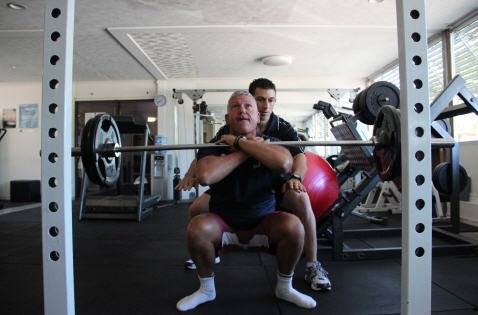
“Yeah you don’t want to squat too low – it’s bad for your knees.”
“Use this machine; it’s safer for you than free weights” (unless you have an injury)
“Yes, you should be using mostly your back. That’s why it’s called the back squat”
I have overheard all of these sound bites from real trainers in real gyms, and it made me weep like the Native American in the 1970s pollution ad:
Your trainer should be results-focused, not focused on scheduling you a new session and keeping you around.
I often see clients working with trainers for months and months and that client never looks any different.
The trainer is just interested in cashing another check.
Remember,your personal trainer works for YOU: Don’t let them build a program that doesn’t actually fit your needs!.
Do they adjust your workout to take care of any pre-existing injuries you may have, or do they just give you a cookie cutter workout?
Are they encouraging or helping you succeed in the way you want to be encouraged, or are they scrolling through Instagram models on their phones while you’re doing your sets?
Are they putting in the time so they can see you get results, or are they putting in the time so they can check the box and collect your money?
You’re paying money for this person’s expertise and attention – it’s not too much to ask to find somebody who takes those things seriously.
What certifications should a personal trainer have?
There are a wide variety of personal trainer certifications and other “credibility indicators.”
The more traditional path – a degree in exercise science or kinesiology may mean the trainer in question is knowledgeable about the human body.
However, that doesn’t speak to any experience they may or may not have coaching in real-world circumstances.
6 of the most popular personal trainer certifications are:
T-Nation provides a rundown of the pros and cons from a trainer’s perspective that we feel is also useful insight from a client’s perspective. Be sure to check them out if you want to learn more about what’s behind your trainer’s certification.
CrossFit certifications are completed in a single weekend. While a CrossFit certification does not make a trainer bad (there are plenty of excellent CrossFit coaches out there!), it does not guarantee excellence either.
A certification from NPTI – the National Personal Training Institute – is a credential gained from going to a full school on personal training (rather than attending a class or taking a test).
While no certification can fully promise excellence, we believe trainers with NPTI certifications are worth your consideration.
CAVEAT TO ALL OF THIS: Plenty of trainers who have NO certification are incredible, and plenty of other trainers have the most elite certifications and are terrible trainers.
MISTAKE #4: Blindly accepting a trainer’s credentials or discounting a trainer without certain credentials.
Certifications can be a starting point, but it shouldn’t be the determining factor.
One of the most important things to look for in your trainer isn’t a credential or certification at all, but real experience and an enthusiasm for helping you reach your goals.
For example:
Looking to powerlift or get into Olympic lifting? Look for someone who has successfully competed in their fields, or someone who actually coaches athletes who do compete!
Need to lose a lot of weight? Ask a trainer to share with you success stories from people who are like you.
In our view, finding a trainer with proven experience and a track record of performing or coaching (or both) in the area of your goals is the most valuable step you can take to ensure quality.
The credential is only a starting point.
Trainers aren’t cheap, but the benefits can be priceless.
Remember, you aren’t paying simply for their time with you. You’re paying for the years and years they’ve spent learning, training, and coaching.
It’s the years behind the certification that makes their time so valuable, so expect the cost of a trainer to be significantly more than the cost of a basic membership at your gym.
How much does a personal trainer cost? Are Personal Trainers Worth it?
The cost of a personal trainer can vary dramatically depending on:
Where you live (in an expensive city, small town, etc.).
The quantity and duration of your training sessions.
What kind of training you are looking for.
But you want specifics.
The average North American trainer charges $55 for an hour session.[1]
That’s an “average” so let’s break it down a little.
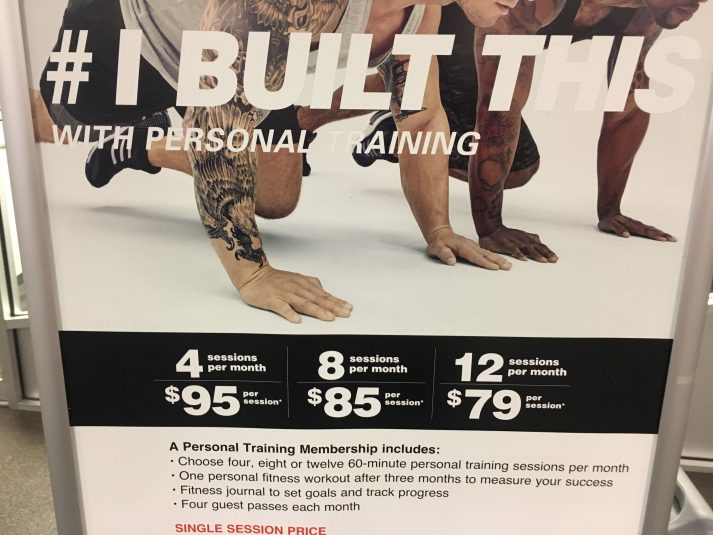
Here are the prices for working with a trainer in various capacities at my generic commercial gym in the NYC area (definitely on the more expensive end):
4 sessions per month: $95 per session = $380/month
8 sessions per month: $85 per session = $680/month
12 sessions per month: $79 per session = $948/month
Is this pricing more or less than you expected?
Here is how much a personal trainer costs at:
Global Gyms: Most big box gyms offer personal training:
LA Fitness: you can expect to pay about $60 per session.
24-Hour Fitness: it’ll be about $80 per session.
Anytime Fitness: as little as $35 a session.
Luxury Gyms: If you go to a more upscale gym like Equinox, expect to pay “luxury” prices of $110+ an hour.
In-Home Personal Training. If you don’t want to head to the gym, you can actually have a personal trainer come to your home. The cost on this could be all over the place, but a rough average would be about $65 for an hour session.
Different trainers will have different qualifications and expertise, leading to vastly different training experiences.
This can be really important.
MISTAKE #5: Thinking “more expensive” automatically means “better results.”
Cost is not the right metric. VALUE is the right metric!
Depending on your goals and the results you’re after:
$30 per session might be overpaying for a crap trainer who gives you a generic workout and doesn’t care about you.
$100 per session might be a STEAL if it’s an amazing trainer that gets to know your life and your personality, motivates you in the way you need to be motivated, and helps you get past a plateau when you stall.
That’s why remembering your “get in shape” goals is critical when buying a personal trainer.
If you’re looking to do 5 sessions to improve your powerlifting technique, that’s different than hiring a trainer to be with you in person 3x a week to get you to the gym.
HOW TO THINK ABOUT HIRING A TRAINER:
You’re not just paying for an hour of somebody’s time.
You’re paying for their years of experience, schooling, training, and expertise.
You’re paying to outsource ALL of your fitness questions to somebody who knows what they’re doing.
Somebody who gives you the confidence you’re training correctly.
So instead of “I am paying this trainer for 1 hour, this is too expensive,” what you’re really paying for is confidence, momentum, and (hopefully) results.
As somebody who has worked with an online trainer since 2014, I would pay any amount of money to my coach (just don’t tell him that) because I love getting results after years of struggle.
Our pricing comes in at a less-expensive price than 4 sessions per month with a trainer.
In addition to building you a workout program for the month, we also help you with your nutrition, mindset, and goals, and answer all the questions you have.
#1) Freedom to fit your schedule. With an online personal coach, you can train when and where you want to fit your schedule – your coach builds the workout program for you ahead of time, so you can fit it in at your convenience.
Compare this to a traditional coach, and you’re at the mercy of their busy schedule. If they only have time Friday morning at 8am, and you’re not a morning person, conflict ensues.
#2) Persistent worldwide accountability. I’m borrowing this phrase from a NF Coaching Client, Jeff (his success story is great). No matter where in the globe you are, your online trainer comes with you.
Which means the accountability never stops. If you travel for work, your coach can plan for that and build you a special travel routine. Getting relocated for work? No problem – your coach will still be there.
#3) Nutritional guidance. With most traditional personal trainers, you engage with them only during your scheduled visits: they help you work out and that’s about it.
With an online personal trainer, you’re connected whenever you have access to the internet. And I would imagine that MOST online coaching programs, work with you on the most important part of the equation: eating healthier!
AKA everything that happens in the 23 hours outside of the gym.
#4) More cost-effective. Most in-person personal trainers are expensive, especially if you work out with them two or three times a week.
That’s because if your trainer is working with you, they can’t work with anybody else at the same time.
When you work with an online coach, because you aren’t training with them 1-on-1 in the gym, they can provide more cost-effective guidance.
When you factor in their availability via chat and their help on habits and your nutrition, you’re looking at a life-changing experience if you find a coach that fits your personality.
When comparing online coaches versus regular coaches, I’m going to share the cons as if you have the option between a GREAT online coach and a GREAT in-person coach.
Neither of those is guaranteed.
Here are the cons of an online coach when compared against a real-life equivalent:
#1) Your coach can’t do the work for you. There’s nothing stopping you from skipping your workout and lying to your online coach that you did it. Nobody wins in this scenario, but I can totally see it happening.
So yeah, an online coach can’t pick up the weight for you, and they can’t yell at you to put down the donut. You have to do the work!
#2) No real-time feedback and instant form check. If you’re learning how to powerlift, or you’re going for a particular heavy lift, having a coach right there is HUGE.
They can tell you to move your squat slightly wider. They can guide you through the movement and consistently remind you – even when tired – to keep great form.
Although we do form check videos, where we have coaches and clients send clips back and forth to each other, it’s not the same as having somebody critique you in real-time.
If you’re looking to nail a particularly challenging lift, or learn a dangerous gymnastics move, working with a trained professional in person is invaluable.
#3) The value of sunk cost. If you pay for a month of online coaching, there’s nothing inherently motivating you to go to the gym when it’s cold and you’re tired – your coach can’t yell at you, and you’re not letting anybody down in the moment when you don’t make it.
Compare this to working with a real coach in person.
You paid $100 for a session, and if you don’t show up, that money is *POOF* gone. So you tell yourself, “I already paid for this, and my coach is gonna be mad, I should probably go.”
And then you go. And you’re so glad that you did.
Although your online coach can notice that you haven’t signed in on your app, and they can ask what’s going on, this is after the fact compared to an in-person coach getting stood up.
I wouldn’t say one format is clearly better than or superior to another. It really depends on what you’re after and the circumstances of your situation.
MY PERSONAL EXPERIENCE: I’ve been working with an online trainer since 2014, and it’s truly been life-changing for me.
I had some goals that had evaded me despite a DECADE of effort, and it took a great coach to coax out the right strategy. It’s how I say (jokingly) that I went from Steve Rogers to Captain America.
And it was my coach’s programming that got me a 420-pound deadlift at a bodyweight of 172 pounds:
I’m not gonna set any powerlifting records, but I’m healthier, happier, and stronger each and every month, and I’m damn proud of that.
For somebody that can’t afford a top-of-the-line professional coach for each session, having an online coach to build your programming and guide your food choices is a verrrrry close second.
How to hire a personal trainer
HERE’S MY ADVICE: Give your new personal trainer 5 sessions before making a decision that things aren’t working out (sessions are often sold at a discount in a package).
The first session is often exploratory, explanatory, and introductory, and the trainer needs to test your limits and movements to build upon that.
This isn’t a “get fit quick” strategy, but rather one that could take months and months for you to find the right person to aid you on your journey.
Don’t expect miracles in a day!
A few words of wisdom if you do hire a trainer:
DO NOT USE YOUR TRAINER AS AN EXCUSE: Too many people will hire up a trainer and give no effort in the gym or the kitchen.
Then, when they fail to see results they can turn to their friends and say “man, my trainer is terrible, THAT’S why I’m not losing weight/getting stronger/etc.”
This happens so much more often than you’d think. A trainer is a guide, like Morpheus.
You have to take the pill and walk through the door yourself.
MAKE CRITICISM CONSTRUCTIVE CRITICISM: Often when the trainer asks them to do something (walk every day, throw away junk food, eat a vegetable), the client/trainee comes back with 1,001 reasons why they can’t do that.
No compromise or discussion of possible solutions. This stinks.
Instead of saying “no,” offer an alternative solution and negotiate a plan: “I don’t really like broccoli, do you have a way to make vegetables taste better?”
In other words, don’t look for problems, look for solutions.
IF YOU ENJOY WORKING WITH YOUR TRAINER: Let them know and continue working with them.
The more information you can give them on your progress, the easier it will be for them to alter your program as you go on.
IF YOU DON’T ENJOY WORKING WITH YOUR TRAINER: That’s okay too. Not all relationships end in marriages.
I think you can be honest with them and let them know that it’s not a good fit and you will not be continuing to work with them.
Good trainers at this point will ask what they could have done better.
Trainers who are simply after your money may guilt trip you or beg you to stick around. Try somebody new and keep the search going.
REMEMBER: this is a lifelong quest, and you’re on the hunt for a great guide to help you on your journey.
They won’t do the work for you, and they can’t work miracles.
Have proper expectations, do what you’re told, and this could be the best investment you’ll make in your entire life!
Trainers in the Rebellion, what did I miss?
Those who have had experience working with Trainers, any wisdom to share from your experience?
One final note: Going to a gym is intimidating, especially if you’re starting out.
If you are in a location where there aren’t any great trainers, you don’t have access to a gym, or you’re just not ready to work with somebody in person, consider checking out our Online Coaching Program!
Schedule a free call to learn more by clicking on the image below:
If you have questions about what you need to look for when it comes to training with a coach in person, or even questions about working with an online trainer, leave them in the comments below so I can chime in!
Today, we’re talking about self-talk and self-compassion – this is something we talk a lot about at The Balanced Life and is so important to our overall health.
Many of us will start a health + fitness journey and focus on all the physical components, but sometimes we fail to address what is going on inside our head, thoughts, and mind. We also fail to look at how that impacts the way we feel and act, our relationships, and our self-worth. All of this is connected. It can be a huge mistake to embark on a health and wellness journey without addressing the mental side of things. That includes mental health, emotional health, and how we talk to ourselves.
How we’re talking to ourselves, and the thoughts we’re thinking, affect the way we feel and affect our ability to be successful and make positive changes in our lives as a whole
Join Robin and her guest, Lilit Lewis, as they address the topic of self-talk and self-compassion. Lilit is a licensed marriage and family therapist and is a proponent of self-compassion. She has a wealth of information to share. This episode is one that everyone needs to hear.
Show highlights: what you can look forward to in this episode!
What self-compassion looks like
How self-compassion speaks to our self-talk
Some tips for becoming more aware of your thoughts and recognizing negative self-talk
Ways to break out of the habit of negative self-talk
The pay-off you get from making the shift to practice more self-compassion
Why you need to step in and practice self-compassion with purpose and intent
What self-compassion looks like when there have been negative consequences to your choices
The best place to start with self-compassion
Some tips for when you’re struggling to have compassion for yourself and find yourself having negative self-talk
The impact on the other relationships in our lives when we change to have a more positive relationship with ourselves