Categories
Uncategorized

#healthyliving #holistic #nutrition Why Meal Plans Don’t Work: The Missing Piece of Lasting Nutrition Change

Let me ask you something: if meal plans really worked, wouldn’t you already be where you want to be?

Think about it. Most women I talk to have tried them all – low-carb, keto, Whole30, clean eating. Many have printed the recipes, followed the shopping lists, meal-prepped on Sunday, and promised themselves this time it will stick. And yet, here they are – still feeling stuck, still wondering why it never seems to last. (I have been there too!)

Here’s the truth: it’s not because you’re lazy. It’s not because you don’t have enough willpower. It’s because meal plans only deal with one part of the picture. They tell you what to eat, but they never address the deeper piece: your identity and mindset.

And until that piece shifts, no plan will ever stick.

Why Meal Plans Alone Don’t Work

You know the cycle: you get a new plan, stock your fridge with the “right” foods, and for a while, you’re all in. But then life happens – work stress, travel, kids’ activities, pure exhaustion. The plan starts slipping. Before you know it, you’re back in the same old habits.

And then comes the self-blame: What’s wrong with me? Why can’t I just stick to it?

But nothing is wrong with you. The problem is the plan. It’s like painting over a wall that has mold underneath. It looks fine for a while, but the foundation is still damaged. 

Unless you shift the foundation – your beliefs, your identity – nothing really changes.

That’s why most programs fail. They focus only on actions (eat this, avoid that), without addressing who you believe yourself to be.

The Missing Piece: Identity and Mindset

We all carry hidden beliefs and stories that shape our choices with food. Maybe you’ve heard yourself think:

  • “I’m just not the type of person who cooks.”
  • “I always fail at diets.”
  • “I don’t have enough willpower.”
  • “I’ll start again Monday.”

If any of those sound familiar, you’re not alone. And here’s the thing: those beliefs quietly drive your choices, no matter how many new meal plans you try.

Inside the Nourished Reset, the very first thing we do is reframe. Because the truth is, most women don’t need more information. You already know the basics – more veggies, less sugar, more water. What you need is a new way to see yourself.

That’s where identity comes in.

Inside the Nourished Reset I teach a framework called Be → Do → Have. Most people flip it: When I lose weight, then I’ll do the right things, and then I’ll finally be healthy. But that never works.

The shift is this: Be first.

  • Be the woman who makes nourishing choices.
  • Be the woman who sees herself as worthy of feeling good.

From there, the do – the habits, the food choices – flows naturally. And eventually, you have the results you’ve been longing for.

When you reframe how you see yourself, everything else becomes easier.

Bringing It Together: Identity + Foundational Nutrition

Now, let’s be clear: mindset alone isn’t enough. It’s essential, yes, but you also need the right nutrition foundation, especially in midlife when your body and hormones start to shift.

That’s what makes the Nourished Reset different. It combines:

  • The mindset and identity shifts that help you stick with changes for the long haul.
  • The metabolism-focused nutrition foundations that actually move the needle for women in midlife—without restriction, guilt, or overwhelm.

It’s like having both the map and the car. Without both, you’ll never get far.

When identity work and foundational nutrition come together, you stop “starting over” every Monday. You stop hopping from plan to plan. You finally have a way of eating (and a way of seeing yourself) that lasts.
Ready to Step Out of the Cycle?

If you’ve been nodding along thinking, Yes, this is what I’ve been missing, I want to invite you to my free class: From Overwhelmed to Nourished: A Simple Nutrition Framework That Finally Works.

In this class, you’ll:

  • Learn the importance of reframing your identity around food and health.
  • Gain clarity on how to navigate the “noise” when it comes to overwhelming nutrition advice.
  • Get a sneak peek into the Nourished Reset to see if it’s your right next step.

Save your spot here.

Take a deep breath – you don’t need to go on another diet. You need a framework that actually supports you. And that starts with how you see yourself and exactly what I’m excited to teach you.

See you in the free class!

xo,

Robin

The post Why Meal Plans Don’t Work: The Missing Piece of Lasting Nutrition Change appeared first on Lindywell.

from Blog – Lindywell https://ift.tt/aNvZgiE
via IFTTT

Categories
Uncategorized

#getfit #holistic #nutrition Iced Blueberry Matcha Latte Recipe (à la Blank Street)

Read this post Iced Blueberry Matcha Latte Recipe (à la Blank Street) on keep it simpElle.

I remember the exact date, time and place that I discovered the Blank Street Iced Blueberry Matcha! I’d just arrived in London, checked into my hotel ready to take on RideLondon 60 the following day and we decided to take a walk in the sunshine and grab a drink. Amy recommended the Blueberry Matcha and…

Read more on keep it simpElle –

from keep it simpElle https://ift.tt/1l920T6
via IFTTT

Categories
Uncategorized

#getfit #holistic #nutrition How Dental Tourism in Antalya Is Changing the Game for Patients

Read this post How Dental Tourism in Antalya Is Changing the Game for Patients on keep it simpElle.

As the world’s smiling capital, dental tourism in Turkey has superseded traditional tourism as the only reason to travel. Antalya, Turkey’s tourism hub, hosts not only sea and history, but also sports, congress, and health tourism events. Dental tourism is the ideal way for Antalya to diversify its tourism industry. It gets interest in dental…

Read more on keep it simpElle –

from keep it simpElle https://ift.tt/aDgI8T4
via IFTTT

Categories
Uncategorized

#holistic #getfit #nutrition 4 Workout Strategies for Busy Parents

I got this message the other week, and it felt so. Freaking. Relatable.

…the biggest challenge right now is that I am a full-time working mother of two young boys and I’m just so freaking exhausted.

I’m on a hamster wheel of life right now, giving of myself to everyone and everything around me.


It’s not just that it’s hard to find the time to work out…it’s hard to find the energy.

It’s also hard to create a routine I can stick to, one that I can just do without thought, given all the variables in my life.”


Parenting young kids is an especially challenging period of time. There’s a ton of variability in your routine, high demand on your time and attention, and not a lot of energy to spare.

Whether you are a parent, a caretaker, or just going through an incredibly busy season of life, trying to add a fitness routine on TOP of everything else can feel like the Jim Gaffigan joke: “You know what it’s like having five kids? Imagine you’re drowning. And then someone hands you a baby.”

We hear this sentiment all the time with clients in our coaching program.

So today, I want to walk you through exactly how I help them navigate this intense period, while still finding time to work on their health and fitness in ways that feel sustainable to them.

And continuing the “Matt stands in front of a white board in his office and records a video” experiment, I’ve got an accompanying video with notes so you can digest this in whatever format works best for you. ❤ (Bonus points to anyone who recognizes where my T-shirt is from!)

And if you are someone who struggles to find consistency with your workouts, reply to this email! I’d love to see how I can help. 💪

The Key Challenges

If you tell me you’re a parent, then I can immediately predict a few things:

  • Highly variable schedule
  • High demands on time and attention
  • Lack of predictable routine.
  • (Periods of) low energy

I still remember talking with Mike (host of The Chasing Scratch Podcast), and how he kept saying: “This week is crazy, but NEXT week, things will finally get back to normal.”

After several weeks of this, I stopped him and said something along the lines of: “I think unpredictability IS the only predictable thing.”

Our mantra became “There is no normal”, and that’s been key to his success in getting 148 workouts in so far this year (and counting!)

The Strategies

Dial Mode

If we know each day is highly variable, then our plan needs to take that into account.

Start by creating a short and simple bodyweight workout you can do in 5-15 minutes. (Like doing 1 round of this workout.) It becomes a key puzzle piece you can fit into a crazy day.

When I worked at Force Fitness, I remember coming in after a long night with the kiddos, feeling absolutely dead to the world. On these days, my boss and I would look at each other and say: “Turkish Get-Ups and Farmer’s Carries?” Two movements to just get us up and moving for a few minutes, and then cash out for the day.

Accumulation

Workouts don’t need to happen all at once. You can break up the workout into mini-sessions across the course of the day or even week!

The more important factor is getting the work done, not in the timing. 💪

This is exactly the strategy I use with new parents. We write out a list of exercises, and a target number of reps to get done across the week. Then, they squeeze them in as they can. If you’d like an example of what this looks like, shoot me and email and I’d be happy to share some!

Me Time

Sometimes, it’s really important to try to carve out time in your schedule to focus on just you. That may mean asking a partner for help, or making some tough decisions about trade-offs. It’s not always possible, but it’s still worth considering.

That’s what we did with my client Michelle. She was having a hard time fitting in workouts, so we walked through some tradeoffs she could make. She asked her partner for support, and was able to carve out 20 minutes after work. She would park outside, and do a workout in the garage. She wasn’t “home” until she walked through the garage door.

I Go, You Go

If you can’t beat them, join them! Invite the kiddos to participate with you.

Switch your focus to more skill-based or play-based training that may be more engaging for them. Instead of optimizing for “results”, optimize for fun and connection.

This is the option that has been most meaningful in my own life. Part of my big why is connecting with others, and modeling healthy behaviors for my own kiddos. While I still like working out alone, too, finding more ways to involve my family has made the journey all the more rewarding. ❤

For more ideas on games you can introduce to your kids, check out this article and this article.

Want to try your hand at Parkour (in a safe and effective way?) I got you! 🙌

And there you have it! If you were my client, I’d walk you through these similar steps

  1. We’d lay out your current schedule and the very real challenges involved.
  2. We’d figure out which strategy fit best for you.
  3. Then I’d write workouts and provide accountability to take the thinking off of your plate and help you stay on track. 💪

Whether you’re a busy parent, or just someone going through a hectic period in life right now, give these strategies a try and let me know how it goes!

– Coach Matt

P.S. Interested in Nerd Fitness Coaching? Book a call this week and mention “Rebellion” for $50 off your first month of coaching. We have no contracts, no hidden fees, and you can cancel at any time. We only want you to stay if it’s ACTUALLY working for you!

The post 4 Workout Strategies for Busy Parents first appeared on Nerd Fitness.

from Nerd Fitness: Helping You Lose Weight, Get Stronger, Live Better. https://ift.tt/WBZ8TjY
via IFTTT

Categories
Uncategorized

#healthyliving #holistic #nutrition From Bloated to Balanced: Simple Gut Health Shifts That Change Everything

If you’ve ever finished a meal and instead of feeling energized, you felt sluggish, foggy, or uncomfortable, you’re not alone. 

Many women, especially in midlife, find themselves dealing with bloating, inconsistent digestion, or that nagging sense of being “off,” even when they’re trying to eat healthy.

Here’s the surprising truth: your gut health could be the missing link.

Your gut is home to about 70% of your immune system and is directly connected to your energy, mood, and even your hormones. In fact, researchers have found that gut bacteria help produce neurotransmitters like serotonin, which plays a key role in mood, sleep, and feelings of well-being. No wonder we can feel anxious or down when digestion is out of balance.

But here’s the good news: supporting your gut doesn’t have to be overwhelming. Small, consistent shifts can create a big difference. 

I’ve navigated gut healing in my own life, as a mom (specifically supporting a few of my kids who have needed extra gut health support) and as a Nutrition Therapy Practitioner. 

Before we dive in, let’s clear up a few common myths first.

Gut Health Myths That Hold You Back

Myth 1: Gut health is just about probiotics.
Probiotics are important, but your gut is an ecosystem. Everything from chewing well to fiber intake to meal timing matters.

Myth 2: Acid reflux means too much stomach acid.
Often, the opposite is true. Low stomach acid (common for women over 40) can cause reflux. Stomach acid actually helps you absorb nutrients like B12 and zinc and is essential for healthy digestion.

Myth 3: Digestion is only about comfort.
Yes, bloating and constipation are uncomfortable, but gut health also impacts your energy, mood, hormones, and immune system. Caring for your gut health goes beyond comfort and is an essential part of your body’s health and vitality.

Myth 4: Medication is always the answer.
While medications can be helpful in certain situations, they’re not the whole picture and not always the best long-term solution. Getting to the root cause or digestive comfort and nourishing your body with gut-friendly foods and improving the diversity of your microbiome through your diet is an essential part of healing. 

A Stanford study found that people who ate a more diverse range of plant foods had healthier gut microbiomes, lower inflammation, and stronger immune function. Food matters. 

Three Simple Shifts to Support Your Gut

Before you think you need to overhaul your diet overnight – pause and consider what small change you can make today.. The most powerful changes often start small. Pick one of these to put into practice this week:

  1. Slow down before you eat. Take a breath. Smell your food. This signals your nervous system to shift into “rest and digest” mode, which primes your body for better digestion.
  2. Chew more than you think you need to. Digestion begins in your mouth. Chewing thoroughly mixes food with enzymes in your saliva that kickstart nutrient absorption.
  3. Feed your gut the good stuff. Processed foods can fuel the “bad” bacteria in your gut, creating inflammation and more cravings. Whole, colorful foods (like veggies, legumes, and healthy fats) help the “good” bacteria thrive. Think of it like tending a garden: the more diverse and nourished the soil, the stronger the harvest.

The Reframe: Less Perfection, More Nourishment

Here’s what I want you to remember: gut health isn’t about perfection. You don’t need to track every bite or follow strict rules to make progress on improving your gut health. Instead, it’s about small, sustainable shifts that help you feel more balanced, energized, and at ease in your body.

When you support your gut, you’re also supporting your hormones, immune system, mood, and energy. It’s a ripple effect – one that has benefits that impact every area of your life. 

Ready to Go Deeper?

If this resonates with you, I’d love to invite you to a free class I’m teaching: From Overwhelmed to Nourished: a Simple Nutrition Framework That Finally Works.

In this class, I’ll share:

  • A clear, practical approach to gut health and nutrition – without the confusion, guilt, or extremes. 
  • What most nutrition programs ignore which makes it hard to be successful
  • A sneak peek into my new program, the Nourished Reset, designed to help you find clarity, consistency, and confidence in nourishing your body.

 Sign up for the free class here.

Take a deep breath – you’re not behind. You’re right on time. And one small shift at a time, you can move from bloated to balanced.

I can’t wait to see you at the free class! 

xo,

Robin

The post From Bloated to Balanced: Simple Gut Health Shifts That Change Everything appeared first on Lindywell.

from Blog – Lindywell https://ift.tt/DQJi7Bv
via IFTTT

Categories
Uncategorized

#holistic #getfit #nutrition What to do when fitness feels like a chore…

For most of my adult life, I’ve been a full-time fitness professional.

But I have a confession to make.

Fitness can feel like a chore.

That’s right, even “professionals” don’t always feel motivated. And neither do my clients.

That’s normal. Nobody feels motivated all the time.

Fitness is kind of like flossing. You don’t always love it, but you know it’s important.

So what do you do when it all just feels like another item on your ‘to-do’ list?

First, give yourself permission to feel this way.

You don’t have to be someone who “falls in love” with fitness for it to matter. Even if you never totally look forward to it, a little consistent effort still pays off.

Second, when possible, it is worth trying to bring more joy to the process.

At its best, fitness isn’t the end goal. It’s the amplifier for everything else you love.

If fitness is feeling like a chore for you right now, here are a few ways to mix things up:

1. Theme it.

Name your workouts after your favorite hobbies or interests. (If you love Star Wars, you aren’t working out, you’re doing Jedi Training.)

You can try a workout specifically built around something you enjoy or even one that levels up after boss battles.

And this doesn’t just go for workouts!

There are tons of themed cookbooks out there too to inspire and bring some fun to your meals.

My son (11) brought home a Minecraft Cookbook from school last week, and decided he wanted to make “Minecraft Steak”. It was literally just steak with salt and pepper on it, but he was so excited and invested in getting the meal juuuuuust right.

You can even add some flavor to how you track your progress.

Bottom line: Whatever the thing you love, whether it’s Gandalf, gardening, or golf – see if you can bring a bit of that into the mix.

2. Tie it back to life outside of fitness.

For most of us, fitness isn’t about being the “best at fitness.” (Though if competing in 5k runs or powerlifting events is what you love, that’s awesome, too!)

It’s about having the energy and health to show up in the things that light you up. For example, one of my clients, Julie, really hated strength training. She knew it was important for muscle retention and bone health and all the rest. But it wasn’t until we were able to tie specific movements in her workouts back to her passion, archery, that the “chore” part of working out became easier to do.

I still remember how she lit up after she came back from an archery session and said something along the lines of: “the bow just felt so easy to pull!” (Archery people, don’t come at me if I butchered that. 😅 )

Bottom line: Highlighting the connection between your fitness goals and all the other cool stuff you love to do is a cheat code.

3. Add games + challenges.

Movement doesn’t always need to be serious.

Try adding some more games and mini-challenges to your session to spice things up!

Finish your warm-up with the Stick Drop Challenge.

In between exercises, add in some low intensity movements like juggling, or walking on a balance beam, etc. to give your brain a challenge even while your body is recovering.

Roll a D20 to determine what your conditioning will look like at the end of your session.

At Camp Nerd Fitness, my ninja class was full of little games and challenges like these, and people left smiling and sweaty. I remember one camper in particular, Emily, coming up to me and giving me a big hug afterwards because this approach made fitness feel fun and accessible in a totally new way.

Bottom line: where possible, tap into the playful side of movement.

4. Keep it simple.

Sometimes, despite all that, fitness will still feel like a grind.

That’s OK.

In those seasons, don’t overcomplicate it. Focus on the basics: a few key movements, eating some protein, moving a little each day.

Action matters more than perfection.

Some of these ideas will click, some won’t, and that’s the point. There is no one size fits all prescription here for everyone.

My hope for you is that you can find ways to make fitness feel additive to your life, without taking it over.

So let me ask you:

What would bring more joy into your fitness right now?

Hit reply and let me know – I’d love to hear it.

–Matt

The post What to do when fitness feels like a chore… first appeared on Nerd Fitness.

from Nerd Fitness: Helping You Lose Weight, Get Stronger, Live Better. https://ift.tt/85vPw4M
via IFTTT

Categories
Uncategorized

#holistic #getfit #nutrition The truth about muscle loss while dieting 💪

There’s a chart I want to show you today.

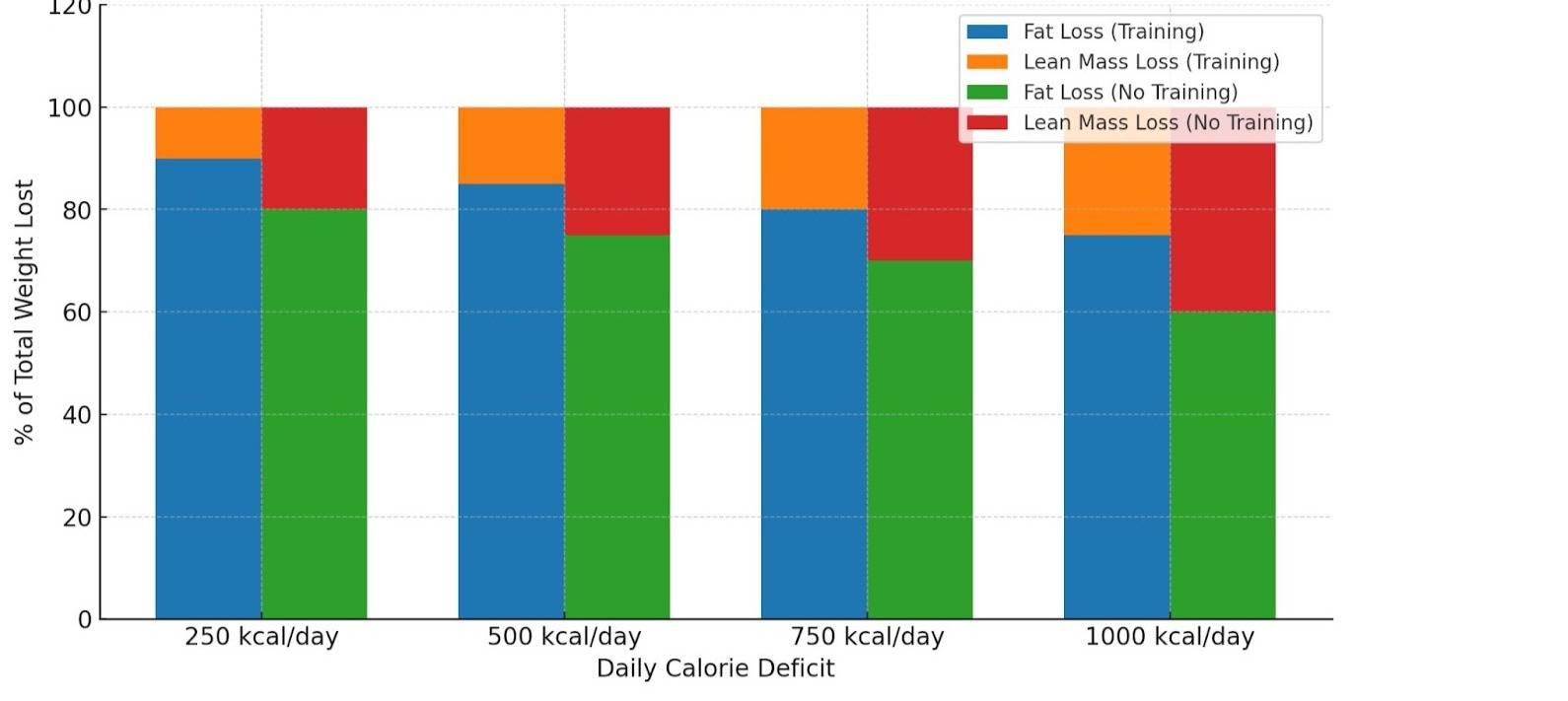
It shows the percentage of fat vs. fat-free mass lost at different levels of calorie deficit, depending on whether you’re strength training or not. (You’ll find it below.)

It also sheds light on one of my LEAST favorite trends I see in the fitness industry today: making sweeping statements without any context.

And with the rise of GLP-1 medications like Ozempic and Wegovy, I see this one popping up all over the place:

“If you don’t eat enough protein and lift weights, you’re just losing all of your muscle.”

We’ll get into it, but extreme statements like this are just wildly unhelpful, and miss so much of the important nuance.

Is strength training useful when you are on these medications or a calorie deficit in general? Yes.

But if you listen to the general chatter on the internet (never really a good idea), it makes it sound like muscle is literally falling off of your body with each step you take. And that’s not only fear-mongering, it’s just not true.

Let’s zoom out:

I want to break down what’s actually happening in your body so we can have some real talk about the different tradeoffs involved.

✅ If you’re in a calorie deficit, you’ll lose weight
✅ Whenever you lose weight, there is always some amount of loss of lean mass. (I.e. stuff other than fat)

✅ Strength training and eating higher amounts of protein can help you preserve more of your muscle mass while in a caloric deficit

✅ The larger your deficit, the more lean mass you tend to lose regardless of what you do.

✅ And GLP-1s don’t change that – they just help people stick to larger deficits than they might otherwise.

So to recap, whenever anyone in the history of forever has lost weight, some of that has come from lean mass.

The larger the caloric deficit you are in (i.e. the faster you are losing weight), the greater the percentage of that weight will come from lean mass. This is totally normal and expected.

Strength training and eating higher amounts of protein can absolutely help you preserve more of your lean mass. But you’re not going from “losing all muscle” to “losing zero muscle.” These changes are degrees, not all-or-nothing.

How much of a difference can training and eating more protein make?

I’m so glad you asked!

Here’s a chart that shows on average where we expect weight loss to come from. (Individual results will vary based on genetics, type of training, diet, etc.)

In general, strength training helps preserve an extra 10-15% of lean body mass.

So, for example, if you lost 10 pounds over the course of 3 months on a 500 kcal/day deficit, you’d expect around 2.5 pounds of that to be from lean mass if you weren’t training, and 1.5 pounds of that to be from lean mass if you were training (I.e. a 1 pound difference.)

Why this matters:

I see so many people get discouraged because they feel like they’re not “doing it right.”

Maybe they’re not strength training yet.

Maybe they haven’t figured out how to hit their protein goals.

Maybe they’re just trying to stay consistent with any part of the process.

And they start hearing things like:

“You’re just losing muscle.”

“You’re ruining all your progress.”

“You’re doing it wrong.”

But in reality? You’re just making a trade-off.

As an example, maybe a slight caloric deficit with no strength training is easier for you to maintain than a much higher deficit with strength training added in. Sure, it may take longer to see the weight loss – but the ratio of fat free and fat mass is essentially the same in each of these scenarios.

Or maybe you consciously go on a larger caloric deficit for a short period of time, and follow that up with a more focused muscle-building phase to rebuild some of that lean mass. That’s another viable strategy.

The point is: if we can cut through the fear mongering and wildly overblown statements, we can have an actual discussion about what’s the best choice for you based on where you’re at currently.

Real talk from a coach:

If you’re just getting started and weight loss is your goal, focusing only on staying in a modest calorie deficit might be the best move.

That alone can help reduce joint pain, improve energy, and boost confidence.

Then once that’s solid? Add in strength training.

Then protein.

Then maybe some walking or sleep habits.

You don’t have to do everything, everywhere, all at once to be successful.

In fact, most of the people we work with find success by building a foundation and then adding to it – one habit at a time.

TL;DR:

  • Yes, eating enough protein and lifting weights will help you keep more muscle.
  • Bigger calorie deficits = more muscle loss, even if you’re doing everything else “right.”
  • But these are degrees, not disasters.
  • Focus on what you can do.

Want to chat about how to apply this to your plan? Just hit reply and let me know.

You’ve got this.

-Matt

The post The truth about muscle loss while dieting 💪 first appeared on Nerd Fitness.

from Nerd Fitness: Helping You Lose Weight, Get Stronger, Live Better. https://ift.tt/3bUWNLT
via IFTTT

Categories
Uncategorized

#holistic #getfit #nutrition The NEW Beginner Dumbbell Workout (Plus my favorite dumbbell exercises 💪)

If you’ve ever picked up a pair of dumbbells, looked around, and thought:

“Uhhh… what do I do with these?”

Or maybe, you just want to know a quick, safe, and effective workout to get stronger, build muscle, and improve body composition.

In either case, I got you! 🙌 Today, in the spirit of our most popular blog post of all time, I’m giving you a Beginner Dumbbell Workout you can do at home or at the gym, plus a list of my favorite dumbbell exercises and answers to the most common questions we get from readers and Nerd Fitness Coaching clients.

Let’s get into it 👇

🏋️‍♀️ Beginner Dumbbell Workout

Do this 2–3x per week with a rest day between each session:

Exercise #1: Goblet Squats – 3 sets of 8–12 reps

Exercise #2: One-Arm Dumbbell Rows – 3 sets of 8–12 reps per arm

Exercise #3: Dumbbell Floor Presses – 3 sets of 8–12 reps

  • Have a bench lying around? Feel free to switch this to a dumbbell chest press!
  • To get a bit more range of motion, try doing this while holding a glute bridge at the same time, or resting your upper back and head on a long foam roller.

…and that’s it. Three exercises that are big “bang for your buck” movements, and you’ve got yourself a workout! 🙌

A couple of other things to keep in mind:

👉 Rest 60–90 seconds between sets. Focus on slow, controlled movement on the way down, and then smooth and athletic movement on the way up.

👉 Warm up with some arm circles, bodyweight squats, and light cardio (marching in place works great), and then do a few reps of each exercise with a lighter weight (if you have one) or just with the weights you have to get your body moving and ready to workout.

👉 Once these start to feel easier? Increase reps, increase the weight, slow down the tempo, or add 1 or 2 more exercises to your circuit.

🎯 My Favorite Dumbbell Exercises

When you’re ready to mix things up or go deeper, here’s your go-to list of awesome dumbbell moves:

🔽 Lower Body

🔼 Upper Body Pull

🔼 Upper Body Push

🧩 Accessory Lifts

⚡ Power Moves (for full-body strength & conditioning)

No machines, no problem.

You can build a complete and effective strength routine with just one or two dumbbells and some floor space.

🤔 Common Dumbbell Questions (answered!)

Q: I only have one set of dumbbells. What do I do?

A: No worries! The key is adjusting your reps and variations.

If you can do 20+ reps with ease, it’s time to:

  • Add a tempo (like 3 seconds down)
  • Do single-leg or staggered-stance versions
  • Reduce your rest between sets
  • Add another 1-2 exercises from the selection to your circuit.

There are tons of ways to make things harder without heavier weights. Just like you can make your bodyweight exercises harder by changing the leverage angle or progressing to a more challenging variation, you can do the same even with a limited weight selection!

Q: Will dumbbells make me bulky?

A: Not unless you’re trying really hard to bulk up.

This concern pops up a lot, but the reality is:

Building visible muscle takes years of consistent training, lots of food, great sleep, and favorable genetics.

What will happen: you’ll build strength, improve joint and tendon health, and help prevent osteoporosis (especially important for women in peri-menopause and beyond).

Q: What weight should I start with?

A: Ultimately, you want a weight where the last 2–3 reps feel challenging, but doable with good form.

As a general rule of thumb, always start with less weight than you think. It’s always easier to progress when something feels too easy than to back off once you’ve overreached. You can use it to warm up and feel out the movement. As you get more experience with dumbbells, you’ll know what weights you used last time and when to push yourself a little harder (though you still want to make sure you do a warm up round!)

Too easy? Go heavier or add reps. Too hard? Go lighter or reduce reps.

Your form is always the priority. Strength gains follow. Still unsure if you are lifting enough weight? Read this.

Q: How long should a dumbbell workout take?

A: 20–30 minutes is plenty when you’re starting out.

If you’re short on time, even one solid set of each exercise is better than nothing. You can always build from there.

Q: Do I need to do cardio too?

A: Dumbbells can be your cardio (or at least, a part of it!)

Moves like thrusters, snatches, and skier swings elevate your heart rate and build muscle. Heck, any dumbbell exercise can elevate your heart rate if you perform the reps on a timer. Try one of these options: Level 1: 30 seconds of work with 60 seconds of rest between each exercise for 3-5 rounds.

Level 1: 30 seconds of work with 30 seconds of rest between each exercise for 3-5 rounds. Level 2: 40 seconds of work with 20 seconds of rest between each exercise for 3-5 rounds. Trust me, you’ll feel your heart rate getting up there. 😬

But if you love walks, bike rides, or dance breaks? That counts too. Just move.

🧠 Final Thought

You don’t need a perfect plan to get started. You just need a plan that’s simple, sustainable, and repeatable.

Dumbbells are one of the best tools for strength training beginners because they’re:

✅ Versatile

✅ Accessible

✅ Scalable

So pick up those dumbbells. Try the beginner workout. Then reply to this email and let me know how it goes!

If you want help building your own plan, our 1-on-1 coaching program does that and so much more: guidance for how to get started, accountability when you aren’t feeling motivated, and a plan built specifically for you, your goals, and your life. See which coach would be a great fit for you with our quick quiz.

You got this!

Coach Matt

P.S. Have other questions about dumbbells, getting started with exercise, or anything else? Shoot them my way!  

The post The NEW Beginner Dumbbell Workout (Plus my favorite dumbbell exercises 💪) first appeared on Nerd Fitness.

from Nerd Fitness: Helping You Lose Weight, Get Stronger, Live Better. https://ift.tt/qC2XO6f
via IFTTT

Categories
Uncategorized

#getfit #holistic #nutrition Life vs Marathon Training With The Garmin Forerunner 165

Read this post Life vs Marathon Training With The Garmin Forerunner 165 on keep it simpElle.

If you’ve ever run a marathon, thinking about running one or are currently training for one, you’ll know that it’s a serious commitment. Not too long ago, I took on my first marathon – London Marathon – and I genuinely…

Read More

Read more on keep it simpElle –

from keep it simpElle https://ift.tt/x1iCV23
via IFTTT

Categories
Uncategorized

#holistic #getfit #nutrition Why falling off track is a GOOD thing

You ever feel like you were finally getting into a good groove with your workouts, only to have life knock you sideways?

Good. That’s how it works.

No, seriously.

In Nerd Fitness Coaching, I tell every new client:

“I don’t know exactly WHEN it will happen, but within the first 3 months, something will knock you off your routine.”

Maybe you get sick. Or slammed with work. Or your kid wakes you up three nights in a row. Maybe your motivation just fades.

Whatever it is, I expect it. And here’s why that’s a good thing:

Consistency is never 100%

Life is unpredictable. Things change.

The sooner we can accept that there is no normal, the sooner we can start practicing two very important skills:

  1. How to shorten the disruption (so we bounce back faster)
  2. How to adjust the dial (so we can still do something)

If you normally workout for 2 weeks, then take 4 weeks off, then try again, progress may look like shortening that time off to 1 or 2 weeks. Over the course of a year, this change results in a massive difference in the number of workouts you do!

If you normally stop working out entirely during a particularly hectic season in life, progress may look like treading water with some shorter workouts. You are able to maintain all the progress you’ve previously built without backsliding, and your fitness will continue to improve as a result.

Let’s talk about how to put these practices into action.

🧠 Recognize the Pattern

Last week, I received an email from a reader saying how they struggle to stay consistent.

“I can keep things going for 1 or 2 weeks consistently, but then I fall off track and it takes me a while to get started again.”

So I asked them:

When you have tried making changes in the past, what is the most likely thing to “knock you off the wagon”? Does life get really busy, or maybe you get frustrated from a lack of results? Do you notice internal dialogue like “I’ve been killing it, it’s OK if I relax for today”, etc. The more we can learn from your previous attempts, the better we can game plan for next time!

If you look back over the last few months, I bet you’ll notice some repeating challenges:

  • Busy work weeks
  • Travel
  • Family stuff
  • A dip in motivation
  • Starting too strong and burning out

Once you know your patterns, we can start recognizing them AS they are happening, and practice adjusting your habits in the moment.

⏱Shrink Your Workouts

I mentioned this in a previous email, but did you know you can maintain your strength with ⅓ of your normal training volume?

That means if you normally do 3 sets of each exercise, 1 set is enough to hold steady.

Here are a few common ways I help clients reorganize their workouts when everything feels like it’s on fire:

A GIF of a dog in a hat sitting in a room on fire.

  • Reduce the number of rounds. If you normally do 3 or 4 rounds, try 1 or 2.
  • Do a timed, bodyweight circuit instead. With a timed circuit, you know the EXACT amount of time you are committing to, and with bodyweight movements, you can do it anywhere.
  • Break it up throughout the day/week. Take little breaks to do a couple of minutes of movement at a time. A few countertop pushups. Some squats after you brush your teeth. It all adds up!

One of my clients, Sean, had a massive work trip coming up and was going to be gone for 2-weeks. In the past, he would put his workouts on hold until he was in a better place to focus on them.

Instead, we planned ahead for 10-minute bodyweight workouts he could do in his hotel room. On a few days, he just did 2 minutes. And it kept his momentum going. He felt noticeably better coming back from his trip, and was able to jump back into workouts without getting overly sore or worn out. #winning

🌯 Create some go-to, low prep meals

What about nutrition?

One of the most useful strategies I’ve found is creating some emergency backup meals for when you’re in a pinch that don’t take a lot of extra effort. Try to prioritize protein, fruits and veggies, and hydration. Then, scan local restaurant menus as well as the closest grocery store for some quick grab and go options that fit your eating preferences.

This could look like:

  • Mexican – grilled chicken/steak (if you eat meat), rice, beans, fajita veggies and all the salsa your heart could desire!
  • American – grilled chicken/steak/fish is often a good bet here. Add a small fry on the side, a fruit cup (if they have one) and a zero calorie beverage of choice
  • Grocery store – greek yogurt with some fresh berries and nuts for crunch
  • Grocery store – rotisserie chicken, a premade salad bag, and a potato you can microwave for a low prep option.
  • Grocery store – keeping some frozen options (Trader Joe’s Tikka Masala is one of my family’s personal favorites) in the freezer that you can just microwave when needed

I put together an entire resource on these low/no-prep meals you can slap together on the fly for some of my coaching clients, but I haven’t shared it with anyone else. If you’d like to take a look, shoot me an email and I’ll send it your way. 👍

🔁 Schedule a reset check-in

Now that we’ve found ways to lower the barrier to entry and get back on track with some quick workouts and low-prep meal ideas, here’s one more key strategy: Schedule a quick “reset” check-in for right after a known disruption. This could look like doing a self-check in. I.e. writing in a journal or even scheduling some time for yourself on your work calendar to pause, assess, and make a plan.

Or it could be a friend or accountability buddy you hop on a quick call with to check-in. This is actually something I do regularly for my Nerd Fitness Coaching Clients! If they are coming back from a vacation or just finishing “crunch” week at work, we hop on a quick call to reset and get back on track the very next week. It helps shorten that feeling of being “in limbo” and get reoriented and reorganized quickly. Here are some helpful questions to ask:

  • What went well? Maybe you were able to complete several short workouts, or prioritize protein at meals, etc.
  • What was a challenge? Maybe you felt so scattered at the end of the day, that you didn’t have the energy for even low-prep meals!
  • What, if anything, would you do differently next time? Sometimes, there are no major adjustments to make. We just need more practice.

💬 Final Thought

Falling off track isn’t failure. It’s feedback.

And when you start expecting it, you can actually plan for it.

The next time life throws a wrench in your plans? You’ll already know what to do:

✅ Look for your repeat patterns

✅ Shorten your workout

✅ Fall back on your go-to, low-prep meal ideas

✅ Schedule a “reset” check-in for yourself

Progress isn’t about perfection. It’s about shortening disruptions, and adjusting the dial as you go.

And if you need help building your bounce-back plan, just hit reply. I’d love to help.

– Coach Matt

The post Why falling off track is a GOOD thing first appeared on Nerd Fitness.

from Nerd Fitness: Helping You Lose Weight, Get Stronger, Live Better. https://ift.tt/ELrCM71
via IFTTT