For disastrous humans like myself, routines are pretty damn important.
I’m easily distracted, impacted by my environment, and strongly influenced bythe people around me. A predictable routine gives me the best chance to still get stuff done while being human.
Unfortunately, while traveling, plenty of things slip by the wayside.
And this past week I found myself traveling and falling behind on my nerd duties.
I needed to catch up on House of the Dragon (Season 2 is a big step-up!), and I was also behind on a few of my favorite nerdy podcasts.
I thought about how I would manage to get caught up while also getting my workouts done. I know that I feel like a better human being after I exercise.
And then I remembered a habit-building technique I had learned about years ago.
Before I started writing about it, I googled the technique…only to realize I had already written about it! Good job, Past Steve!
(I guess when you publish 1000+ articles over 15 years, it’s bound to happen.)
The technique is called “Temptation Bundling.”
It’s when you combine two activities: one you need to do with one you want to do.
Example: listening to your favorite audiobook or podcast ONLY when you’re at the gym or getting your steps in.
As I point out in my updatedarticle on Temptation Bundling, Professor Katy Milkman ran an experiment to test whether or not “audiobooks at the gym only” would influence people’s behaviors:
The people in the study who were told they could listen to addictive audio books only while working out visited the gym 51% more frequently than those who were just told they should exercise more.
Knowing that exercise ismy constant while traveling, I took my own advice:
I told myself I could only watch House of the Dragon while walking.
In addition, the more time I spent at the gym, the more of my podcasts I could get through.
Sure enough, I found myself jumping rope a few extra minutes to finish a podcast episode, I went to the gym an extra day for mobility work, and I walked an extra mile on the treadmill just to see the end of an episode.
At the turn of the 20th century, cities around the world had a crappy problem that was getting worse by the day.
Literally.
Metropolises were rapidly growing in population, and thus so did the number of horse-drawn carriages to transport people from place to place.
The problem? Horses generate a lot of waste.
At this time, New York City had an estimated 130,000-200,000 horses transplanting people and goods around Manhattan, which meant there was upwards of 5+ million pounds of manure being generated every day.
Yeah, that’s a lot of poop.
At this point, with city populations exploding vertically into taller buildings, and more horses being employed daily to serve these people, the future looked pretty dire.
In 1894, The Times of London allegedly predicted that in 50 years, the city would be literally buried in horse poop! And can you blame them? If one looks at the trajectory of people, and horses, and poop, it would be simple to just continue to draw all of those lines up and to the right.
Two years later, in 1896, a battery and internal combustion engine was attached to a horseless carriage, and within two decades the automobile had taken over, and the horse manure problem solved itself.
Simultaneously, while humans were solving the transportation problems on the street, they were still struggling to solve another transportation problem…
Would human beings ever actually fly?
By the late 1800s, after millions of wasted dollars, terrible mishaps, and fatal accidents, humanity’s attempt to fly had largely been abandoned.
Despite widespread interest and plenty of experimental attempts, too many people had died and too much money had been set on fire. There just didn’t seem to be a safe path to success.
The Washington Post soundly declared, “It’s a fact that man can’t fly.”
A particularly pessimistic gentleman predicted that “men would not fly for fifty years.”
That prediction was made in 1901.
We all know what happened next: Less than two years later, Willbur Wright took to the skies in his glider and became the first person in history to fly a manned aircraft.
Who was the idiot that made the comically bad prediction about not flying for 50 years?
Wilbur Wright!
Luckily, he took the fact that his prediction was off by 48 years in stride, and was glad to have proven himself wrong. It’s also one hell of a lesson to have learned: hold those predictions loosely!
We suck at predicting!
Look back at any major development in history, good or bad, and you can find comically bad predictions from noted experts.
1968’s The Population Bomb predicted worldwide famines due to overpopulation within decades…which makes sense. One look at this chart would lead you to the same conclusion:
Of course, this is no longer the problem we’re facing as a planet.
Most experts these days are still raising alarm bells…but they’reterrified about underpopulation, the exact opposite problem compared to a few decades prior.
Predictions are fickle, and we humans are quite bad at them.
Hell, the reason I can send you this essay is due to the fact that one of the most famous predictions ended up being comically wrong. In 1998, Nobel-prize winning Economist Paul Krugman saidthe following about the Internet:
“The growth of the Internet will slow drastically…By 2005 or so, it will become clear that the Internet’s impact on the economy has been no greater than the fax machine’s.”
Yikes.
So, if humans, even experts, have been comically misguided and made terrible predictions about some of the most transformative moments in human history, do we think it’s also possible that we are wrong all the time about the predictions we make about our own lives?
It’s time we start holding our predictions a little less strongly.
My vote? We start to be a bit more like Willbur Wright.
As laid out in David McCullough’sThe Wright Brothers, Wrightthought about the future differently after proving himself wrong:
“This demonstration of my inability as a prophet gave me such a shock that I have ever since distrusted myself and have refrained from all prediction—as my friends of the press, especially, well know.
But it is not really necessary to look too far into the future; we see enough already to be certain that it will be magnificent. Only let us hurry and open the roads.”
This is a pretty good strategy for looking at our own lives.
We can start with acceptance: we’re never going to get better at predicting the future.
We can also hold two conflicting ideas in our head at the same time. As President Dwight. D. Eisenhower once said, “Plans are worthless, but planning is everything.”
I’ve simply accepted this is just how life works. I still make plans, and I still make predictions…but I hold those plans and predictions very loosely.
Looking back five years, I never would have predicted how the world and my life would turn out. I certainly wouldn’t have predicted a worldwide pandemic and life-altering medications like GLP-1.
Hell, if I look back at last week, I can point to a bunch of things that didn’t go according to plan. But, because I expect nothing to ever go according to plan, I’m rarely caught off guard when things turn out differently than expected.
This is our task for today:
If we want to become more resilient and make progress on our goals, we need to accept that our plans will rarely go according to plan!
Here’s what that might look like in practice:
“I plan on working out at 5:30PM on Monday/Wednesday/Friday, but I fully expect one of those dates to get screwed up because of work. So, I have a backup “home workout” plan I can do in my living room on those days.
“I have my “meal plan” for the week, but I expect 30% of my meal plan to get blown up by my kid’s unpredictable after-school schedule, so I know exactly what I’m going to eat if I end up driving through McDonalds and not fall off track.”
“I am trying to reach this goal weight by this date, but I know that everything will always take longer than expected, so I won’t get impatient and instead just keep my focus on what needs to get done that day.”
This is my homework for you today:
Is there a plan or prediction you’re holding onto far too tightly?
Can you make an alternative plan for when things inevitably don’t go how you predicted?
Are you currently assuming some future scenario that will absolutely be true, instead of being open to the possibility that you’re going to be proven wrong?
The sooner we can accept we suck at predicting, the sooner we can get to work on what to do about it!
I recently finished playing Shadow of the Erd Tree, the expansion for 2022’s game of the year, Elden Ring.
In case you’re unfamiliar, Elden Ring is an action-adventure game where you play as an undead warrior tasked with slaying grotesque bosses across a hauntingly beautiful landscape.
Fair warning: I will be making QUITE the analogy between two toxic online discussions I’m seeing these days. Don’t worry, I promise to bring you along for the ride even if you’re not a gamer.
Let me first set the stage, and then we’ll get into the details.
Elden Ring is Incredible and Incredibly Difficult
Most modern big-budget games hold the gamer’s hand, providing a tutorial and guardrails, making sure gamers never feel overly frustrated or confused.
Hidetaka Miyazaki and the team at FromSoftware, the team behind Elden Ring, go hard in the other direction:
They essentially drop you in the middle of a terrifying world full of enemies that can kill you in two hits and essentially say, “Good luck, idiot.”
This has been true for all of FromSoft games: Demon’s Souls,Dark Souls, Bloodborne, and Sekiro.
In the book,Dark Souls: Beyond the Grave, Miyazaki’s game design philosophy is explained in glorious detail, like in this discussion with Game Informer:
“Having the game be difficult was never the goal. What we set out to do was strictly to provide a sense of accomplishment. We understood that difficulty is just one way to offer an intense sense of accomplishment through forming strategies, overcoming obstacles, and discovering new things.”
Years later, he further refined his philosophy when speaking with Playstation Blog about his next game, Dark Souls:
“We are trying to create a game that is spicy. And we want to make it as spicy as possible. But it’s edible and tastes good and leaves you wanting more.”
So, yes, difficulty and dying repeatedly are part of the FromSoftware experience.
But!
These games also have certain built-in systems that help less-experienced or skilled players. Players can find certain weapons that are overpowered, enlist the help of computer-controlled allies, and even recruit other human players to help.
This allows all gamers of all levels to play the same game while experiencing completely different levels of challenges.
Some gamers will use every system available to win.
Other games will voluntarily choose to NOT summon any help.
Other gamers will specifically choose to not level up at ALL to make it extra difficult.
The fact that all of this works in a game with one difficulty level is brilliant game design.
Still with me?
Good.
Now that we know Elden Ring is difficult, but also includes different systems for players of all skill levels to win, we can get to the current toxic discussion around Elden Ring and difficulty!
There’s No “Right Way” to Play Elden Ring
Find any article about the difficulty of Elden Ring (and Shadow of the Erd Tree) and you’ll find comments that say you’re not a “true gamer” unless you beat every Elden Ring boss without recruiting any help.
These gamers feel morally superior for beating a game without using its built-in systems, and they will not allow for any discussions like “Is it possible this boss is poorly designed?”
According to them, the only possible response is, “I beat the game without help. Just get better.”
Personally, I think Shadow of the Erd Tree has some of the best exploration I’ve ever experienced in any video game. And also, some of its bosses are difficult in a way that’s neither interesting nor well-designed.
I’m a fan (and proud Patreon supporter) of the podcastBonfireside Chat, which had a great discussion around why Elden Ring’s “Just get good” argument is tiring.
They point out that many people simply decide there’s no room or need to discuss Miyazaki’s decisions and the game’s difficulty. Those people explain that because they’ve beaten the boss without a challenge, everybody else should suck it up and get good.
Replying to this perspective, Gary and Kole share an opinion that is full of a wonderful thing called nuance:
They possess the ability to hold two different thoughts simultaneously. They rightfully point out that a game can be brilliant and some parts might be unnecessarily difficult or poorly designed.
The point: if we’re ever going to evolve past this noise and have good discussions around gaming, we also need to bring nuance and understanding to the table!
Bringing all of this together, here are my summarized thoughts on “Elden Ring is/isn’t too difficult” debate:
Shadow of the Erd Tree is sometimes too difficult for the wrong reasons.
Systems exist to help players of all levels still advance.
There’s no right way or wrong way to play Elden Ring.
Great! Now that we’re all on the same page, it’s time to tackle the other toxic discussion taking place on the internet right now…
I promise these two things are related, so bear with me.
There’s No “Right Way” to Lose Weight Either
For a large majority of the population, losing weight is unbelievably difficult or impossible.
A combination of environment, physiology, and genetics creates a situation in which sustainable weight loss just isn’t going to happen.
This isn’t a question of willpower, discipline, or intelligence. It’s not because these people are lazy. It’s not a moral failing either.
As a result, sustainable weight loss is something nearly everybody struggles with despite their best efforts.
And this is where we combine the Nerd discussion with the Fitness discussion:
Elden Ring has multiple in-game systems to help people of all skill levels win…
So does losing weight!
Over the past few years, dramatic breakthroughs in weight loss medications (like Ozempic and other GLP-1 medicines) have helped millions of people lose weight and keep it off.
This development has thrust the discussion of weight loss, difficulty, and willpower into the spotlight. And because the internet doesn’t do nuance well, the discussion has turned toxic.
Find any post or article about weight loss medications and you’ll find comments like:
“That’s cheating and lazy.”
“Just eat less and move more.”
“It’s not that hard. I did it.”
People who make these comments enjoy the feeling of moral superiority for losing weight “the right way.” They look down upon anybody who doesn’t also lose weight without medication or assistance.
This is the same playbook that vocal gamers are using for Elden Ring and difficulty!
This viewpoint is toxic, lazy, misinformed, and unhelpful.
Just like there’s no shame in the way somebody chooses to play Elden Ring, there’s no shame in how somebody loses weight either.
Instead of asking, “Why don’t people just get more disciplined and eat less instead of ‘cheating’ with weight loss drugs?”…
The better question is, “Which tools are available to help each individual person get healthier?”
For many, it’s education around calories and making slightly healthier choices. For some, it’s weight loss medicine and therapy. For others, it’s all of the above.
We’re most interested in the end result (a healthy, happy life), and we’re open to the infinite paths to get there.
If we accept that we’re not designed for modern life and abundance, we’re all wired differently, we all have different physiologies and opportunities and privileges, then we can also accept we’re all playing the Game of Life in our own way.
It requires us to apply both self-awareness and nuance.
I got to play “fitness” on easy mode, and I am well aware that other people don’t have that same luck or privilege.
So I have no problem with anybody else using any tool available to them on their journey. That might include therapy, surgery, hiring a trainer or dietitian, or weight loss medication.
My friendDr. Spencer Nadolsky, a board-certified physician and one of the kindest, most considerate, and well-read doctors I know, has worked extensively with patients who use or don’t use GLP-1 medications.
“The reason why many aren’t able to sustain [weight loss] over time is due to biological appetite drivers that push people to regain any weight lost.
So does everyone need the medicine? No, of course not. Not everyone has strong biological drivers. About 15% of people who do an intensive lifestyle program will have similar success to the average that these medicines get over the course of a year or so. Likely a lot less as time goes on.
So not everyone will need the medicine.
However, why would you be against a tool that helps people decrease their risk of disease progression and even decrease the risk of heart attacks etc?”
If you tell people they’re cheating by using weight loss medication, it says more about you than it says about the person you’re criticizing.
Here at Nerd Fitness, we have manycoaching clients on GLP-1s, all of whom are also doing the work of exercising and learning about nutrition and adjusting their lifestyle. The medication allows them the mental space and clarity to stick with their lifestyle changes.
Yes, there could be medication side-effects for some. Yes, exercise and behavior change are also still necessary. All of that can be true AND weight loss medication can still be the best decision for that person.
Keep this in mind when seeing discussions on the internet about the right way to do anything. We’re all trying to live the best life we can before the “Game Over” screen. So, here’s your permission to use whatever tools you have available:
If you want to play Elden Ring and recruit help, great!
Last week, Wells Fargo fired a bunch of their remote employees.
It turns out that these employees were “simulating keyboard activity” (with a program/device that automatically typed keys or jiggled their mouse when they weren’t at their computer).
Why?
Because that’s how these employees were evaluated:
Not by how many clients they brought in, nor how many relationships they fostered, but by how many hours they were active on their computers.
So that’s exactly what these employees gave them.
Remember, this is the same bank that told employees back in 2017: “Sign up as many clients to extra banking services as possible.”
The result?
Millions of unknowing customers had credit cards and savings accounts and brokerage accounts created illegally in their names, hundreds of millions of dollars in fines, and destroyed goodwill for Wells Fargo.
Why did both of these comically bad lapses in judgment happen?
Two basic principles of management, and regulation, and life, are:
You get what you measure.
The thing that you measure will get gamed.
Really that’s just one principle: You get what you measure, but only exactly what you measure. There’s no guarantee that you’ll get the more general good thing that you thought you were approximately measuring.
If you want hard workers and measure hours worked, you’ll get a lot of workers surfing the internet until midnight.
I stumbled across this story last week, and immediately thought how this exact incentive-and-unexpected-results plays out everyday in our lives.
We download Duolingo to learn to converse with a native speaker in their language. Months later, we’re checking in daily so we don’t get yelled at by the Owl, we are desperate to keep our daily streak active…and we can only say “I found a blue ostrich at the library.”
We lie in bed, waiving our arm above our head like a madman, because our FitBit says we need 500 more steps to hit 10,000 for the day. (Here’s the history of the 10k step rule by the way…)
I once “meditated” every single day for 6 months so that I could build my meditation streak in Headspace. Sometimes I would even open the app and just let the meditation play so I got credit for it, even though I wasn’t meditating…THE WHOLE REASON I HAD DOWNLOADED THE APP.
We tell ourselves that we want to “read more,” but then we track how many books we read. This incentivizes us to read books quickly (without retaining any of it), instead of tackling bigger challenges like War & Peace or rereading our favorite books to glean more lessons.
Social media began as a way to connect with friends. These days, social media is big business and the only marketing tool for many creators. Because these companies track “time on app” and “attention”…social media is now a hellscape of outrage.
The most attention-grabbing content filters to the top: outrage inducing, factually incorrect, awful content designed to enrage and fear monger. Even most of my favorite wellness creators these days spend their time making reaction videos to the most vile wellness misinformation, because that’s the only type of content that gains any traction.
All of these things weave a fascinating tapestry of how the human brain works, and just how good our brains are at taking a metric and learning the wrong lesson from that metric!
What are you measuring?
The majority of people visit NerdFitness.com to “lose weight.”
This is the one metric that everybody is used to tracking. Every ad talks about how to lose weight fast. They see the number on the scale and let that number determine how they feel about themselves that day.
This is the wrong metric to exclusively focus on:
We don’t really want to “lose weight.” What we want is to lose fat while keeping the muscle we have (or building muscle).
If our ONLY goal is weight loss, severe calorie restriction and endless cardio might result in a lower number on the scale. BUT! If we don’t change our relationship with food, and consume enough of the right macronutrients and micronutrients, we’ll end up feeling lethargic, starved, and miserable…and then gorge ourselves as soon as life gets in the way.
If we strength train while eating enough protein and in a caloric deficit, we’ll actually lose weight slower than if we just starved ourselves and did hours of cardio. BUT, we’ll be losing fat while maintaining muscle.
So, once we know that what we choose to track is important, how do we use this to our advantage?
What to Track, What NOT to Track
Remember, that which gets measured gets improved, so let’s be smart about what we’re tracking.
We can ask, “What do I REALLY want to happen? Is this the right metric for that goal?”
Trying to “eat better”:Track your protein intake and number of fruits/veggies eaten daily. If those are the first two things on your plate for each meal, your weight will start to shift without your focus on it.
Trying to build a “beach body”? Great, let’sbuild some muscle. Track your workouts, and write down exactly how many sets and reps. Then, do ONE more next time. The goal? Progressive overload for the win! Get stronger,
Want to read more? Don’t track “books read,” which might result in you picking shorter books or speed reading, but instead track “time spent reading.” This can include audiobooks, rereading old books, whatever. Treat your reading listlike a river, not a to-do list!
Finally, there are many things we probably DON’T need to track, or we should be careful about when tracking.
There’s a whole community of biohackers who are prioritizing tracking the tiniest of details across a variety of metrics, many of which don’t matter, or might result in adverse outcomes.
Here’s something we get asked about a lot:
Unless you’re a diabetic and have been advised by a doctor, you do not need to wear a continuous glucose monitor. Temporary glucose spikes after eating a meal are perfectly normal.
(This podcast from my friend Dr. Spencer Nadolsky does a good job explaining why you don’t need a glucose monitor unless you’re diabetic).
Here’s something I used to track but abandoned:
I used to track my sleep religiously with an Oura ring and AppleWatch, but then I would get anxious in the middle of the night and worry that I was ruining my “sleep score”…which negatively impacted the very activity I was trying to improve through tracking. These days, I worry far less about tracking “good sleep” and just do what I can to be in bed for 8ish hours, asleep or not.
And on a bigger, life philosophy question:
Be wary of how social media is warping the scorecard you’re using to track your progress in life! It’s really easy to get sucked into: “Work hard to make money to spend it on things we don’t need to impress people we don’t even like” Life success isn’t measured in the size of our house, or value of our car, or the number in our bank account.
Bringing it all together:
When it comes to personal development or health improvement, it helps to ask: “What am I optimizing for, and does that actually help me get the result I really want?”
We can then decide if we’re even playing with the right scorecard and keeping our focus on the right metric.
I’d love to hear from you: what’s a metric you USED to prioritize, but no longer track? And what’s the important metric that you’re choosing to prioritize these days?
#2) Do I Need to eat within 30 minutes of waking up?
Some of us are early birds, while others prefer a leisurely morning routine.
And some of us are wrestling kids and crazy schedules as soon as we get up!
The 30-minute window after waking up is not a rigid law. As with most things related to nutrition, there are many ways to eat to support your goals. Your progress will be determined by the total number of calories and protein you eat across a day and week, not within any specific hourly window.
Some people may benefit from having protein early on in their day if it helps them feel more satiated and less likely to overeat other foods. But it is by no means some “magic” window to unlock fat loss.
Bottom line, if you want to eat within 30 minutes of waking up, go for it! But if you don’t, there’s no need to force this. 95% of your progress will be determined by what you eat across an entire day, not in any one specific time frame.
#3) Do I need 30 minutes of cardio in the morning?
Cardio is a fantastic way to get moving and burn some calories.
But whether you prefer it in the morning, afternoon, or evening is entirely up to you. Do what works best for your schedule and is most sustainable.
There is not some secret fat loss power-up that you’re missing out on by going for a walk at lunch instead of in the morning.
Fitness is not about fitting into a prescribed mold; it’s about finding what works best for you and your lifestyle.
While catchy strategies and specific numbers are easy to remember – they often stress us out about tiny details that ultimately don’t make a big difference.
Are we eating enough protein and moving around?
Then you’re doing good. Keep at it!
—
-Steve
PS: Do you wish you had a Coach like Jim in your corner to answer questions and ensure you’re not wasting time and energy fretting about the tiny details that don’t matter?
Check out our coaching program! You can schedule a chat with our team right here:
Okay, I kind of like picking up heavy weights and doing handstands.
But I certainly don’t love “cardio.”
Rather than nerd out about biomechanics, I’m more interested in anthropology and human behavior.
Rather than going to run a 5K, I’d rather sit on my couch and play Fallout 4 I (just watched the show, it’s fantastic.)
What I’m trying to say is I’m not a fitness nerd.
I’m a nerd who tries to be fit.
So if you’re somebody who also just doesn’t “like to exercise,” you are in good company.
I also have some amazing news for you.
Back in Time
I recently readExercisedby Daniel Lieberman, professor of anthropology at Harvard University.
Lieberman has spent large swaths of time studying and living with hunter-gatherer tribes all over the world, including the Tarahumara (who appear in the book Born to Run), the people of Pemja (Kenya), and the Hazda tribe of Tanzania.
Lieberman points out that most studies and research are conducted on very specific, narrow subset of humans:
WEIRD humans!
Western, Educated, Industrialized, Rich, and Democratic.
Modern western society only makes up a tiny part of the total human experience.
Homo Sapiens have been around for 150,000-300,000+ years!
So, if our goal is to see “what most humans do,” we need to expand the variety of humans we observe, look way back in time, and observe human behavior outside of modern western culture.
Luckily, Lieberman has done exactly that, living with modern hunter-gatherer tribes and studying ancient cultures:
For generation after generation, our ancestors young and old woke up each morning thankful to be alive and with no choice but to spend several hours walking, digging, and doing other physical activities to survive to the next day.
Sometimes they also played or danced for enjoyment and social reasons.
Otherwise, they generally steered clear of nonessential physical activities that divert energy from the only thing evolution really cares about: reproduction.
For 99.99% of our existence as a species, we needed to conserve energy, not needlessly try and burn extra energy. Whenever we weren’t actively securing our survival, we were resting to conserve energy. This whole modern concept of trying to build excess muscle, or exercising to burn extra calories would be a foreign concept to our ancestors.
Food was always in short supply, which meant every day the bodily cycle for each human has to decide how to use each calorie consumed.
Because we had to burn precious calories to hunt or find our food, needlessly burning excess calories during the rest of the day just doesn’t make any sense to ancient humans, nor to modern hunter-gatherers.
So! Of course…
It makes sense you don’t want to exercise!
As Lieberman points out:
“We never evolved to exercise.
…exercise today is most commonly defined as voluntary physical activity undertaken for the sake of health and fitness.
But as such it is a recent phenomenon…
The mantra of this book is that nothing about the biology of exercise makes sense except in the light of evolution, and nothing about exercise as a behavior makes sense except in the light of anthropology.”
As Lieberman shares in the book, tribes like the Hazda certainly burn more calories than western office-workers, but only because they have to, and not dramatically so: “Typical hunter-gatherers are about as physically active as Americans or Europeans who include about an hour of exercise in their daily routine,” but don’t have abundant access to easily consumable energy the way the rest of us do.
Differences in stressors between the environment in which humans evolved and the current environment are mismatches that can cause disease.
Up until 10,000 years ago, humans lived a nomadic lifestyle as hunter-gatherers, with different stressors from the ones that people experience nowadays in modern environments.
Note: this is NOT where I’ll tell you to start eating Paleo (Paleo is a misguided diet that works because of math, not “ancestral” reasons).
I’m specifically talking about how our brains and bodies try and function in a modern environment. Edward Wilson said it best: “We have Paleolithic emotions, medieval institutions and godlike technology.”
Which means we need tostart with acceptance: Rather than beating ourselves up for struggling to build a voluntary exercise habit, we can accept we’re human.
We evolved to survive in scarcity, and now exist in a world of abundance.
Exercise is beneficial AND no longer “necessary”
Exercise is good for us.
Cardio is good for our heart and lungs. Exercise of any type can help create a calorie deficit, and reducing our body fat percentage can help reduce all-cause mortality. Building and maintaining muscle mass and strong bones is critical for our health as we get older. We also feel better after we exercise: thanks dopamine and serotonin and endorphins!
There are literally hundreds of benefits of exercise with regards to our health.
We all know this.
And yet we all think: “I know I should exercise more, but I can’t get myself to do it.”
Let’s set aside the fact right now that we’re all busy as hell, and taking extra time out of our day to exercise is a BIG ask for many (shout out to single parents working multiple jobs!). With that out of the way, why is it so hard for us to build a new exercise habit and stick with it?
Because we’re fighting against biology and our history.
For our day-to-day survival, we don’t need to exercise anymore:
We used to have to find/hunt our food, now we can hit a button on our phone.
We used to have to travel by foot everywhere, now we can drive a car.
We used to have to stay active or die, but we can now survive for a long time even if we’re unhealthy and inactive.
And if exercise is no longer necessary for our survival…
The Only Two Reasons We Exercise
Unless we’re being chased by a wild boar or fell off a boat and need to swim to shore, none of us need to exercise today specifically to survive.
Then why does anybody exercise at all? As Lieberman categorizes it, we exercise for one of two reasons:
It’s emotionally rewarding
It’s physically rewarding
We can exercise because it’s emotionally rewarding: We might go for a run because of the dopamine hit, or because we are part of a socially active club. We might strength train because it feels empowering, or because we don’t want to feel lonely or lazy, or because it helps us process our anxiety or depression.
We can exercise because it’s physically rewarding. We might try to get better at pickleball because we’re competitive. Or we might exercise because we want to lose weight and fit into certain sized clothes, or because we don’t want to die of a heart attack at an early age like our dad.
In ALL of the examples above, we’re all having an internal debate with our lazy brains, who would rather conserve energy.
We have to convince ourselves “the benefits of this activity now outweigh the negatives, so I’m willing to take time out of my day to do it!”
Here’s how you can do exactly that.
How to Make Exercise More Rewarding
With “necessity” off the table, we need to find ways to make exercise emotionally rewarding, physically rewarding, or both.
Here are some thoughts to get you started.
Let’s start with making it more emotionally rewarding:
Socializing is a HUGE part of humanity, and includes things like camaraderie, positive social pressure, etc.
Join a running club where the goal isn’t even “get better at running,” but because it’s your friends.
Dance classes or martial arts classes in disciplines that seem fun to you.
A kickball league or pickleball league for your apartment building.
We can also reframe how we think about exercise. Instead of just calories burned, what if we focused your exercise on “This makes me feel better.”
Running a 5K to raise money for a charitable cause.
Your Big Why (to be a role model for your kids, to be around for your grandkids).
Can you find ways to make exercise feel physically rewarding? Yep, “look good naked” is still a viable motivator for many. Feel free to keep that as part of your reason for exercise! It’s certainly one of my reasons.
However, for many of ourcoaching clients, their big shift to sustainable exercise happens when their mentality changes from “How much weight do I need to lose?” to “I wonder what my body is capable of!”
Instead of just weight loss, they have goals like:
Alternatively, exercise can be physically rewarding when it doesn’t feel like exercise! Dancing, yoga, LARPING, hiking, walking. We’ve even written about40 ways to exercise without realizing it. Movement can be fun.
You may also start to enjoy the physical sensations of exercising and feeling your body move. For many ofour clients, focusing on what their body is capable of doing and the feeling of moving their body can completely shift their associations with exercise from noxious to welcoming.
Finally, exercise can be physically rewarding when we find ways to make exercise secretly more “necessary.” Parking at the other end of the parking lot, adopting a cute pup that needs to be walked every day, taking the stairs, walking or biking instead of driving.
It all adds up!
Why I Personally Exercise
This book caused me to reflect on my personal reasons for working out.
I have a single workout folder in Evernote with 1975 notes in it, and my workouts over the last 11 years haven’t changed that much.
How do I get myself to do the same boring workout, 4 times a week, every week, for more than a decade, even though I don’t like to exercise?
It’s combination of all the methods above:
Genetic lottery (luck). I exercise because I’ve always exercised. I grew up being active, I played sports, I worked out in college, it’s now just something I do.I got lucky.
Working out makes me feel good (emotionally and physically rewarding). When I exercise, I feel like I did something good for myself. Like showering and flossing my teeth, it’s part of my hygiene. I also sleep better and eat better on days when I exercise.
Exercise is the path to aesthetic self-confidence (physically rewarding). I might have more fun exercising in other ways, but I know strength training with heavy compound movements helps me look a certain way (like a guy who owns a fitness company)
Working out is my podcast-meditative time (emotionally rewarding). I know I have 1 hour where I can’t look at a screen. Which means I can listen to a fun podcast and exercise.
I go for meditative walks (emotionally rewarding). When I’m walking I can’t be looking at a screen. I’m also outside. I might listen to a walking meditation, or a podcast, or just force myself to actually be present with my thoughts on walks.
Exercise makes me better at golf (emotionally and physically rewarding). I like golf, and I know strength training will make me better at golf. And golf doesn’t feel like exercise, but it gets me out of the house, off my phone, hanging with my friends and walking 5+ miles every time I play.
Remember, it’s okay if you don’t want to exercise.
Exercise is no longer necessary for immediate survival and we didn’t evolve to want to exercise to burn excess calories. This is a modern, mismatched phenomenon.
We’re still monkeys on a rock, built for scarcity, but surrounded by abundance.
So if you can find a way to make exercise more physically rewarding or emotionally rewarding, you’re more likely to turn it into a routine you look forward to, rather than something you have to endure.
Good luck, fellow monkey on a rock!
-Steve
PS: If you hate treadmills, feel free to keep this fact from Exercised in your back pocket:
“Treadmill-like devices were first used by the Romans to turn winches and lift heavy objects, and then modified in 1818 by the Victorian inventor William Cubitt to punish prisoners and prevent idleness.
For more than a century, English convicts (among them Oscar Wilde) were condemned to trudge for hours a day on enormous steplike treadmills.”
Today I’m going to teach you a valuable lesson about time from a giant tree.
No, not Groot.
Redwoods.
If you drive down the Avenue of the Giants in Northern California, you’ll find yourself weaving in and out of some of the most majestic, gigantic redwood trees you’ll ever see.
If you’re having trouble picturing this in your mind, think back to the Endor speeder chase scene in The Return of the Jedi. This scene was filmed near the Avenue of the Giants in Humboldt Redwoods State Park.
And as you’re driving down the Avenue of the Giants, you’ll eventually stop at a nondescript gift shop along the side of the road, and this is where things get even crazier.
You’ll encounter a slice of a redwood tree standing on its side. This tree has a diameter of nine feet and was over 300 feet tall at the time of its felling, the length of a football field.
The first observation you’d make: “Sweet sassy molassy, this tree is gigantic.”
The next jaw dropping moment happens when you get closer and notice its concentric rings. As we all learned in grade school biology class, the rings of a tree can tell us the tree’s age: each ring represents a year and tells a story.
This is where the fun happens.
Scattered across this dissection of the tree are little name tags, identifying key moments in history, starting in the center and working its way outward. Photo here fromBarry Swackhamer:
1000AD: “Vikings Discover America.”
1096AD: “Oxford University Founded.”
1218AD: “Genghis Khan conquers Persia.”
This head-exploding trip through history continues, from the Ming Dynasty to the Renaissance to the Printing Press, Cortez conquering the Aztecs, Pilgrims at Plymouth Rock, Boston Tea Party, and so on, to the founding of the California National Parks System in 1927, and beyond.
Here you can see the entirety of modern history, separated by a few feet within tiny concentric rings inside a 1000+ year old tree.
It’s wild that from the perspective of a tree, just a few feet (1 meter) separate “Vikings reaching America,” and modern life 1000+ years later. Zoomed out, it’s wild to see how insignificant this time gap is:
Which brings me to today’s point.
We’ve got time wrong.
We humans are really good at worrying about what we can get accomplished today, what we ate for ONE meal, what’s important this week, or how much we can change in a month.
From the perspective of a 1000 year old tree, these time frames are comically short and insignificant.
If trees could laugh (like the Ents of Fangorn Forest), they would laugh at us.
This realization had me thinking about time and how to reframe the timeline on which I think about stuff.
“It may take some time for concentration and mindfulness to become strong enough to hold such a wide range of objects in awareness without getting lost in them or attached to particular ones, or simply overwhelmed.
For most of us, it takes years and depends a good deal on your motivation and the intensity of your practice. So, at the beginning, you might want to stay with the breath, or use it as an anchor to bring you back when you are carried away.
Try it for a few years and see what happens.“
That final sentence completely shifted my expectations.
In the past, I would think “if I could just meditate for 30 days straight, THEN I’ll be really good at mindfulness”
This quote helped me realize I was thinking about this all wrong. I wasn’t going to have some magical epiphany when I reached enlightenment. I wasn’t going to “get there” in weeks or months. Instead, the only goal was to set aside time to sit with my awkward brain and focus on my breath. That’s it.
Suddenly, “trying it for a few years” had me thinking about this completely differently.
Here’s why this is important.
Extend your time horizon
Here are two of my favorite quotes about time:
Bill Gates: “Most people overestimate what they can do in one year and underestimate what they can do in ten years.”
Daniel Hofstadter: “Hofstadter’s Law dictates it will always take longer than you expect, even when you take into account Hofstadter’s Law.”
Everybody is in such a rush to see how many weeks or months it will take to get in shape. Or how long they need to go on a diet to lose the weight, and then they can go back to “normal eating.”
Reality plays out differently: things will always take longer than we want, so we should change how we think about it.
Instead of “how fast can I get there,” we should be thinking “what’s the least amount of work I can do today, to help me be in better shape a year from now?”
If we change our time horizon, paradoxically we often end up making more progress, more permanently.
If everything takes longer than expected, then we should probably pick reasonable goals, sustainable routines, and enjoyable activities that we won’t mind doing for a much longer period of time.
Here’s one final helpful reframing of time horizons:
Whenever I’m finding myself overwhelmed with making a certain decision…I ask myself “Will this matter 6 months from now? A year from now? A decade from now?” By extending my time horizon, it often helps me realize that the thing I’m agonizing over doesn’t matter nearly as much.
What’s one area of your life that you’re thinking about on a short term time scale, that would benefit from thinking on a far longer horizon?
A short term crash diet, vs. long term reevaluation of your relationship with food
An unsustainable workout program vs building a daily habit of movement.
Agonizing over small decisions that won’t matter a month from now, let alone a year from now.
Extend your timeframe, and see if that changes how you think about things.
And 30 minutes later, I uninstalled the game. Not because I didn’t like the game, but specifically because I liked the game too much. The game is called Dave the Diver, where you are a SCUBA Diver/Sushi restaurant owner. You spend each day diving and catching fish, and then each evening serving sushi at the restaurant.
This game pressed every biological button my brain has for “efficiency.”
My brain told me I had to execute each dive as efficiently as possible. Each night at the restaurant meant I needed to receive a 100% customer satisfaction rating.
Of course, nothing would happen if I didn’t.
But this game + my brain equaled a recipe for addictive disaster. After 30 minutes I knew if I didn’t delete it, I would spend every possible minute playing the game, and every minute not playing would be spent thinking about how to get more efficient at the game.
Because I’m in the middle of writing a secret-book-shaped-project that I can’t talk about… I knew I needed to save Future Steve.
In other words, it was time to channel an ancient strategy for survival:
A “Ulysses Pact.”
What is a Ulysses Pact?
In Homer’s Odyssey, Ulysses (also known as “Odysseus”) is about to sail past a dangerous island of Sirens who sing beautiful music. This music is so beautiful that anybody who hears it loses all control, and will sail toward the island, crashing their boat on the rocks surrounding the island.
Luckily, our boy Uylsses has been advised by the witch Circe on the only way he and his men can survive. In Madelline Miller’sCirce, she recounts the advice Circe gives the captain:
“[For] the Sirens, there you may use your tricks. Fill your men’s ears with wax, and leave your own free. If you tie yourself to the mast, you may be the first man to ever hear their song and tell the tale.”
“Ulysses was strong enough to know that he would someday be weak. He expressed his strength by guarding against his weakness.
“When you take some possibility off the table during a moment of strength in recognition of some coming moment of weakness.”
In other words, sometimes giving up on yourself is the most courageous thing you can do. It asks you to accept your weaknesses, and make a strategic pre-planned decision to protect against them.
Ulysses Pacts In My Life
I am a comical disaster trapped in the body of an adult who pretends to be a functioning member of society. I am also my own boss, completely in control of my time. Yikes.
I struggle with impulse control. There are certain experiences that I am just incapable of doing “a little bit.” I also know that once I start an enjoyable activity, it will take over.
Which means it’s practically impossible for me to only do some things “just a little bit” and then say “okay that’s enough for today.”
After all, I know my brain isn’t equipped to handle the life of abundance we’re surrounded with: endless distraction, hedonistic enjoyment, unlimited food, etc.
E.O. Wilson said it best:
“The real problem of humanity is the following: We have Paleolithic emotions, medieval institutions and godlike technology.”
Rather than lament my lack of willpower when it comes to addictive technology, Ipractice acceptance and instead make willpower unnecessary.
Thus, my life is held together with spit, duct tape, and Ulysses Pacts:
I have an app on my phone called Opal. It automatically activates at 7AM and blocks certain apps, websites, and all social media for most of the hours of the work day. I still pick up my phone 10-20 times per day and try to open those apps, and then I’m reminded to get back to work.
I use a program on my computer called Focus. It automatically activates at 7AM and blocks practically ANYTHING fun or distracting on my computer until the end of the work day.
I don’t keep snacks in my house. I love snacks. And once a bag is open, it gets eaten. But when I’m sitting on the couch watching TV (I just finished Fallout and loved it), and I’m craving a snack, there’s no decision to be made. I’m certainly not going to drive to the store.
I don’t have any games on my phone. I know that I can’t control any impulses, especially for “gatcha” free games that encourage you to buy gems to level up.
I am locked out of each social media app after 15 minutes every day. Social Media has been designed by behavioral scientists, with billions of dollars, to be as addictive as possible. So I don’t try to “use it just a little bit.” I simply don’t let myself use it for any longer than “a little bit” because I’m literally locked out.
I don’t play multiplayer games. I have no regulation around “okay I’m done,” so I no longer play multiplayer games. I bet if I played World of Warcraft, you would never get another newsletter from me. Thus, I exclusively play single player games with a story or narrative.
I automatically donate to two charities every month: ProPublica investigative journalism and the Nashville Food Kitchen. Both of these decisions were made ONCE, which means I never have to remember to donate, nor am I tempted to spend the money once it hits my account.
Whenever I go to the doctor, dermatologist, or dentist, I always schedule my next appointment while I’m there. Because I know I’ll forget to do so months later, or I’ll tell myself I don’t need to go. Future Steve will not want to get his teeth cleaned or get bloodwork done.
My workouts are pre-scheduled in my calendar. I would much rather not work out, but I know if I don’t plan for them in my calendar, something else far more fun (but less beneficial) will take their place.
The only reason you get this newsletter every week, and the only reason I get to the gym a few times per week (in addition towinning the genetic and environmental lottery), is because of these Ulysses Pacts.
Here’s how you can use them in your own life.
You-lysses Pacts in Action
Returning to Corey Doctorow:
“Ulysses pacts aren’t perfect, but they are very important. At the very least, creating a Ulysses pact starts with acknowledging that you are fallible. That you can be tempted, and rationalize your way into taking bad action, even when you know better.
Becoming an adult is a process of learning that your strength comes from seeing your weaknesses and protecting yourself and the people who trust you from them.”
Let’s see how we can add some Ulysses Pacts to your life.
To create your own Ulysses Pact: look for opportunities to make a decision TODAY in a moment of strength, to safeguard yourself against an anticipated moment of weakness TOMORROW.
Even better, look for opportunities to make a decision once, and it prevents you from needing to use willpower to repeatedly do the right thing in the future.
A few more examples:
Decide to not keep problematic foods in the house once, and you don’t have to spend all night, every night, deciding NOT to eat those foods.
Decide to automatically donate to a cause you love once, and you don’t have to remember to not spend that money on something else and donate each month.
Delete and/or block social media and time-wasting games on your phone once, and suddenly the decision to read a book or go for a walk rather than mindlessly scroll through TikTok or Instagram becomes much easier.
Remember, acknowledging and creating safeguards against our weaknesses isn’t a sign of giving up or weakness.
It’s a courageous sign of acceptance.
It’s also smart.
What are the Ulysses Pacts you use in your own life? Did this article inspire you to create one for yourself?
These are the types of programs that we create for our 1-on-1 Online Coaching Clients, and we’re getting amazing results for people.
And make sure you download our Kettlebell Worksheet! It’ll come in handy in just a moment.
Grab Your Beginner Kettlebell Routine Worksheet!
Complete this workout at home or gym with 1 kettlebell.
Avoid the common mistakes everybody makes when doing kettlebell exercises.
Build strength, burn fat, level up your life!
Okie dokie, let’s jump right in.
The 20-Minute Beginner Kettlebell Workout (with Video Demonstration)
Once you’ve watched the video above (featuring Matt Shortis, a lead trainer in our 1-on-1 Coaching Program) here’s a quick recap with repetitions for the workout here:
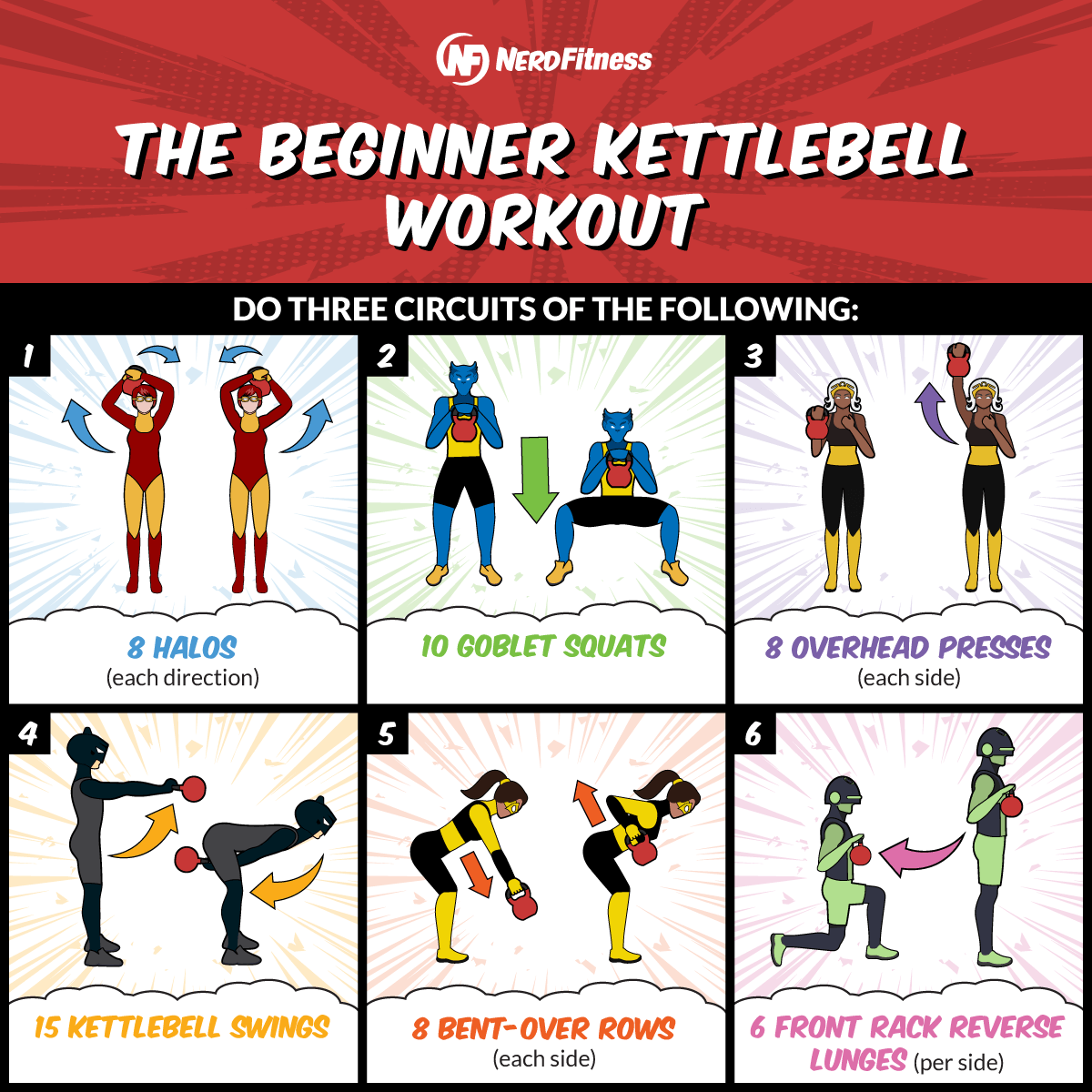
COMPLETE THE FOLLOWING KETTLEBELL CIRCUIT 3 TIMES:
8 Halos (each side)
10 Goblet Squats
8 Overhead Presses (each side)
15 Kettlebell Swings -OR- Romanian Deadlifts
8 Bent Over Rows (each side)
6 Front Rack Reverse Lunge (per side)
And because we like to have fun around here, we made a graphic where superheroes do the workout.
Here’s the Beginner Kettlebell Workout as an infographic:
Our Beginner Kettlebell Workout is what’s called a circuit (you can learn all about circuit training here). That’s just a fancy term for doing a workout like so:
1 set of exercise A, go immediately to
1 set of exercise B, go immediately to
1 set of exercise C, and so on…
Repeat from the top!
Your long-term goal should be to do 3 full circuits, back to back, for a complete workout.
4 if you’re on fire, like in NBA Jam.
If you can only go through it once or twice, that’s okay too!
And if you need to take a break at any time between sets or after a circuit, do it! The most important thing is performing each rep with great technique – so if you need a breather to recover and give it your best effort, take it!
Prior to jumping into the kettlebell circuit, don’t forget to do some mobility warm-up (you can see our warm-up routine here):
Nothing too crazy, just something to “grease the groove” and get your body used to movement so you don’t pull any muscles once you start swinging the kettlebell.
In other words, prepare your muscles and joints to move some weight around!
A few minutes of running in place, air punches and kicks, some jumping jacks, and arm swings, should get your heart rate up.
After that, do a couple of reps of movements that mimic what you’ll do in the workout (i.e. do bodyweight squats to prep for goblet squats, etc.), and your muscles and joints will be warmed for the full Kettlebell Workout.
You can do all of the Beginner Kettlebell Workout with one single bell, from anywhere.
We’ll go over each move in our next section, so you can perfect your kettlebell technique.
Tip from Coach Matt: for the goblet squat, focus on depth. It’s more important to practice doing a full squat than to pump out reps. If you can’t make 10, don’t stress it. Do what you can.
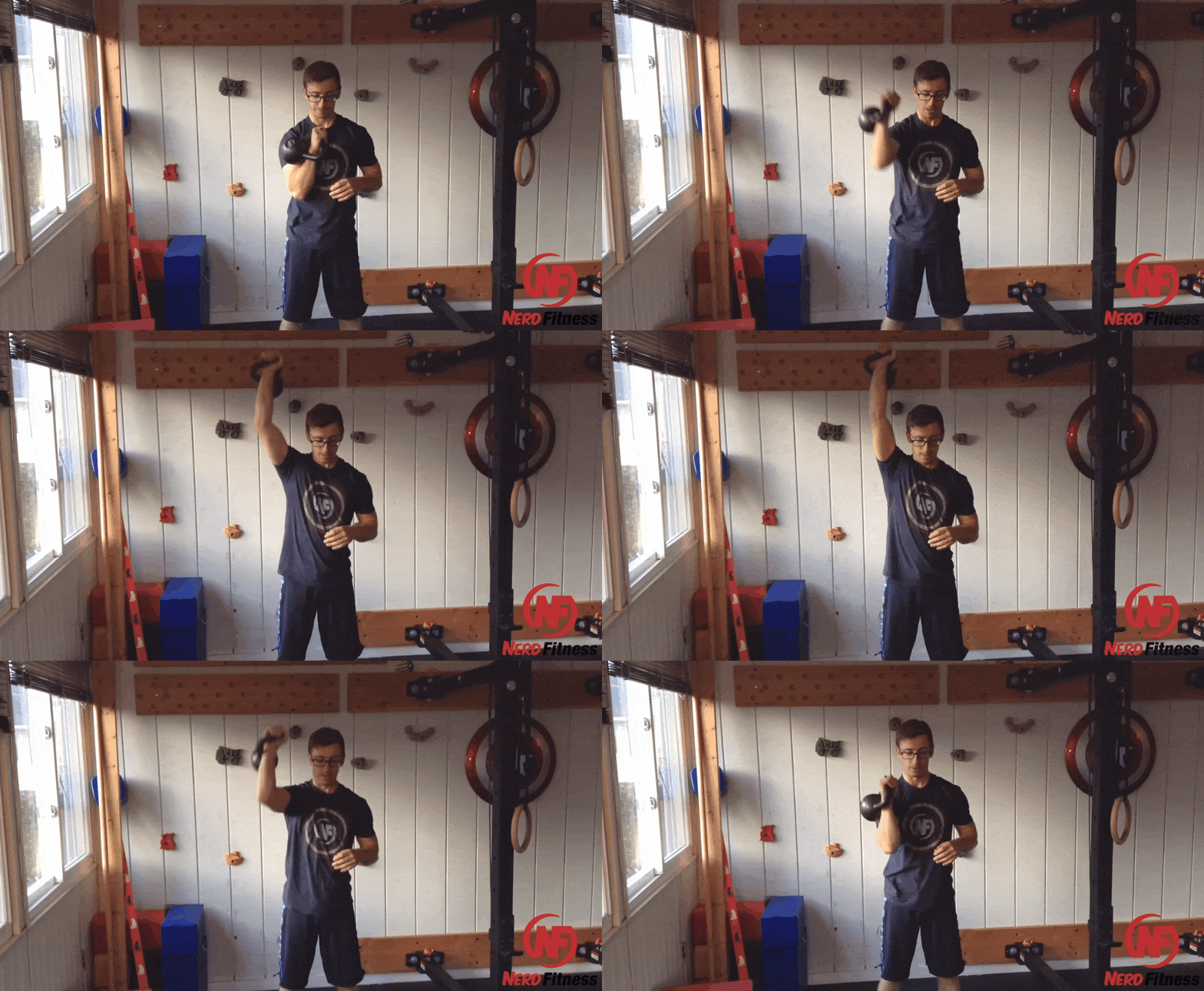
#3) KETTLEBELL OVERHEAD PRESS
Grab the kettlebell with one hand, with the handle going down your palm (if the handle is too close to your fingers it’ll pull your wrist down).
Press straight up with your fist driving the movement (your fist would be pointing up the entire time).
Reverse the movement and bring the kettlebell back down. Then repeat.
Tip from Coach Matt: lower the bell under control by slowly hugging your elbow to your side. Tightening your lat this way will create a more stable position for the press.
#4) KETTLEBELL SWING -OR- ROMANIAN DEADLIFT
If you’ve never done a deadlift or a Romanian deadlift (RDL) before, we recommend starting with this variation, as it will set you up for success in the kettlebell swing later.
Here’s a detailed demonstration of how to do an RDL with dumbbells. With a kettlebell, all the same principles apply; you just hold the kettlebell with both hands.
Grab the weight and stand tall with knees slightly bent.
Keeping your back in a straight line, pivot from the hips and push your hips back towards the wall behind you. (Imagine you are slamming a car door shut with your butt while your arms are full of groceries.)
Stop the movement when your hips stop moving backward. (Lots of people will continue to drop their chest even when the hips are no longer moving.)
Press your feet through the floor and stand back up in one motion.
Repeat.
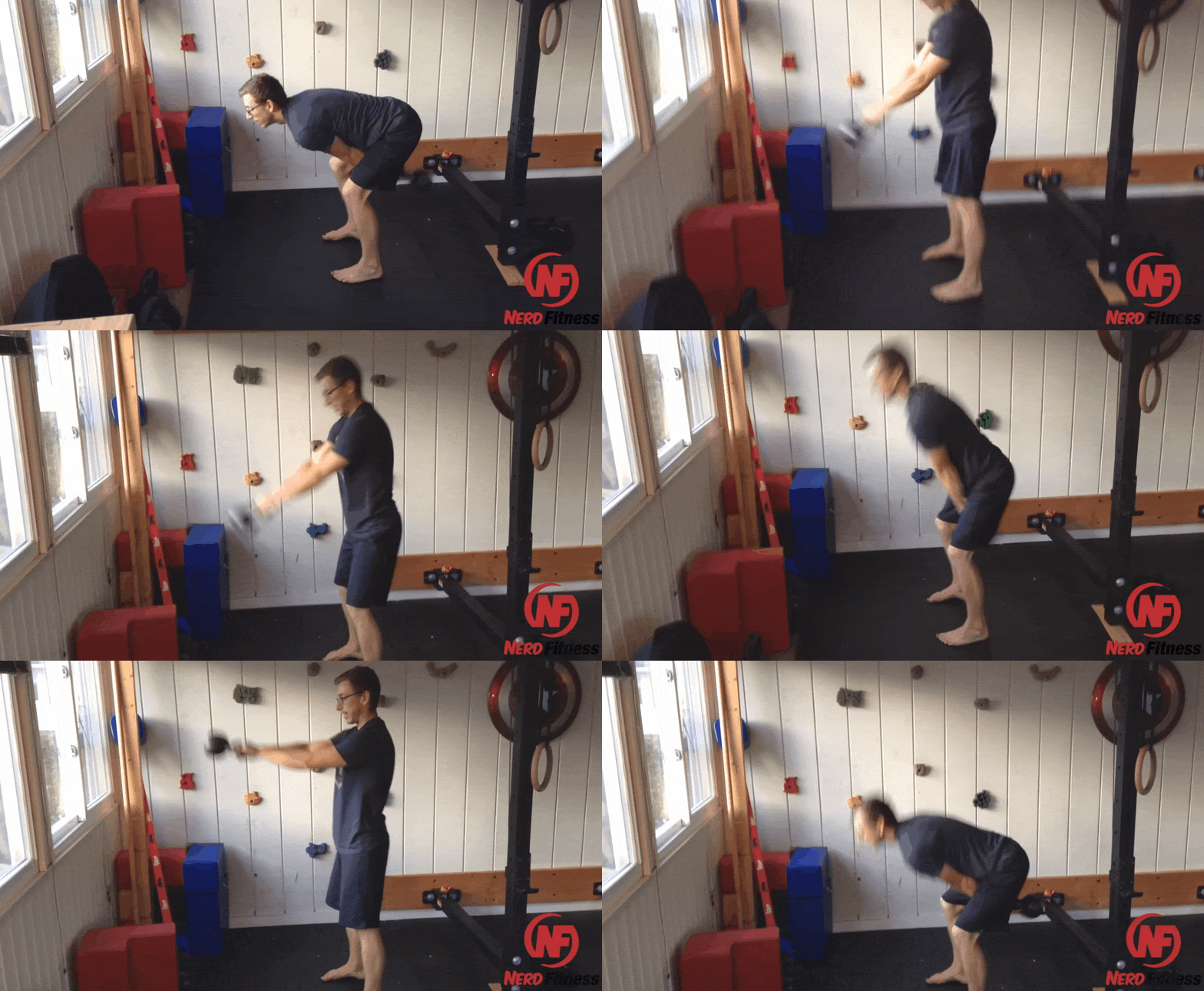
Once you’ve mastered the RDL, it’s time to move on to the Kettlebell Swing.
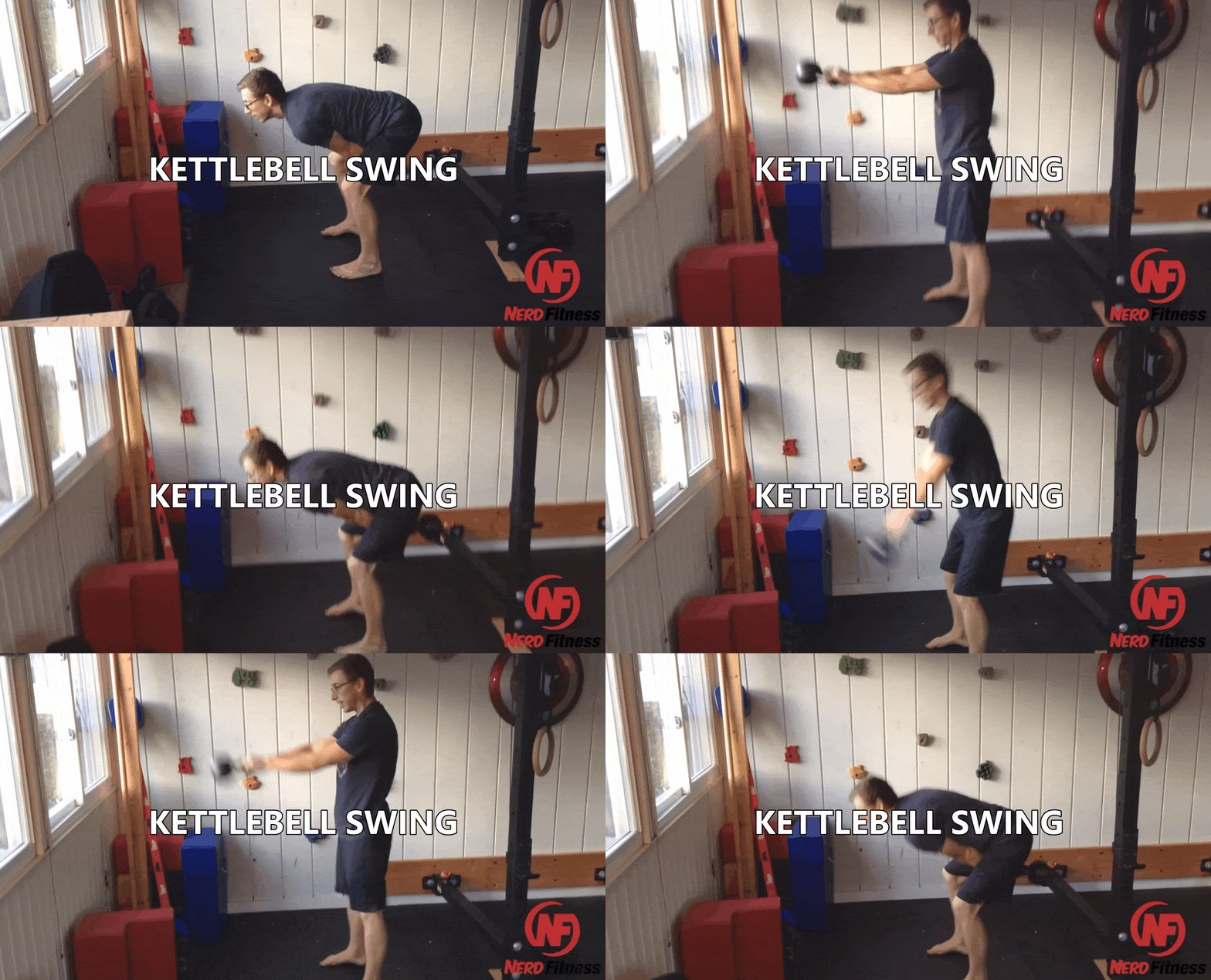
Get down into a bent-over, flat-back position and grab the kettlebell with both hands from the handle.
Swing the kettlebell behind you, then get ready to jump up.
Jump up (without leaving the ground) and swing the kettlebell up. You should be standing tall at the peak of the movement.
Reverse the movement and bring the kettlebell back down and behind you.
Repeat.
Tip from Coach Matt: during the kettlebell swing, focus on hinging your hips. The swing is like a deadlift movement, so you should feel it in your hamstring and glutes.
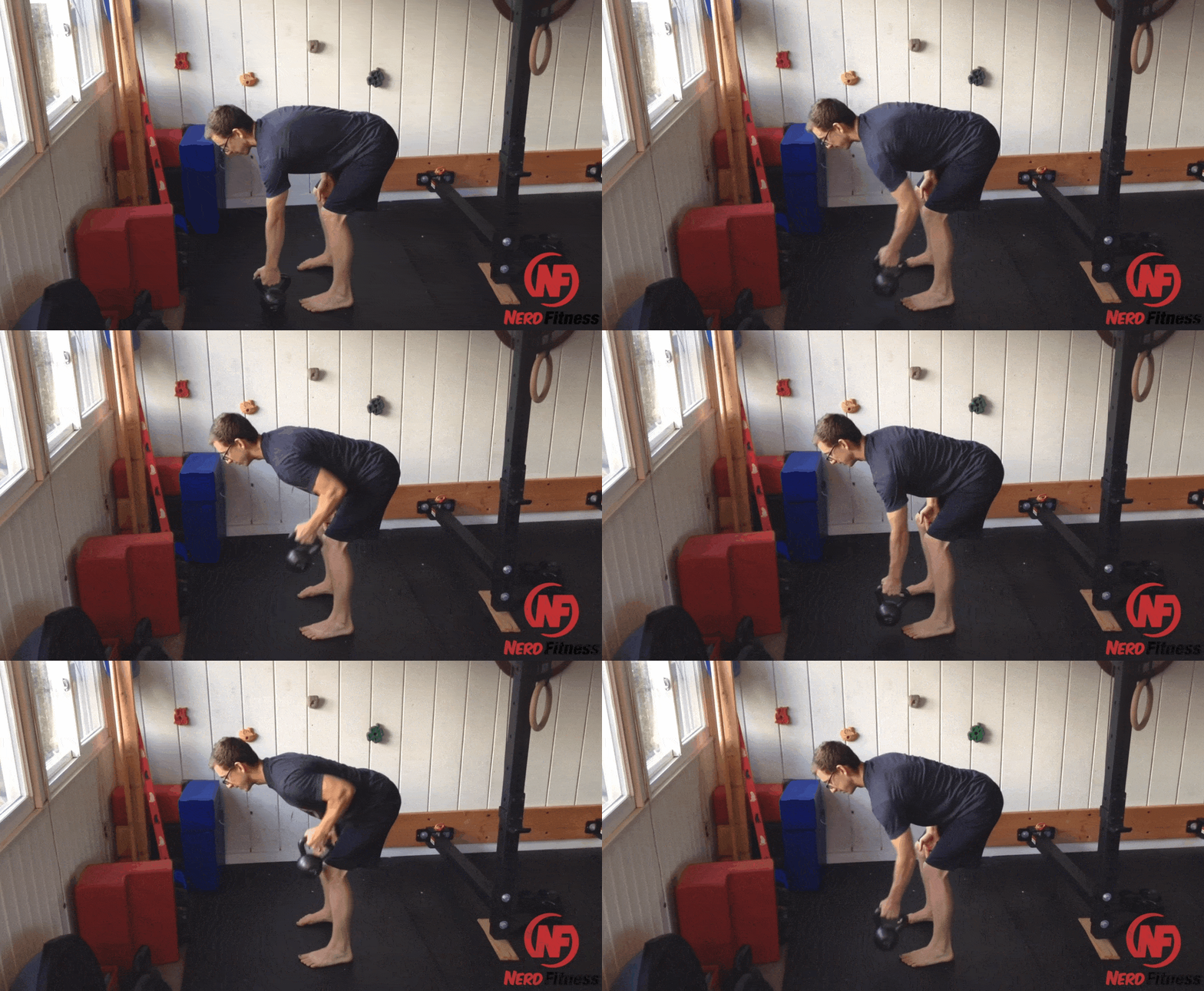
#5) BENT OVER ROW
Get down into a bent-over, flat-back position and grab the kettlebell with one arm.
Pick up the kettlebell by driving your elbow up into your rib cage.
Lower the kettlebell back down by reversing the movement.
Tip from Coach Matt: try to keep your back straight and stomach tight during the row. This will help engage your legs for stabilization as you pull the kettlebell toward your stomach.
#6) FRONT RACK REVERSE LUNGE
Grab the kettlebell with one hand and rest the weight between your arm and chest.
Step your leg back (the same side your kettlebell is on) and lower down until your shin is parallel-ish with the ground (or as low as you can).
Spring back up to your starting position.
Tip from Coach Matt: for the lunges, again keep your back straight. This reduces pressure on your lower back.
Boom! There you have it.
The 6 best kettlebell exercises for beginners.
If you want someone to review your form on any of these kettlebell movements, or you’re looking to level up your kettlebell game, our coaches can do just that! Our spiffy mobile app lets you send a video of your exercises directly to your coach, who will provide feedback so you can perfect your technique.
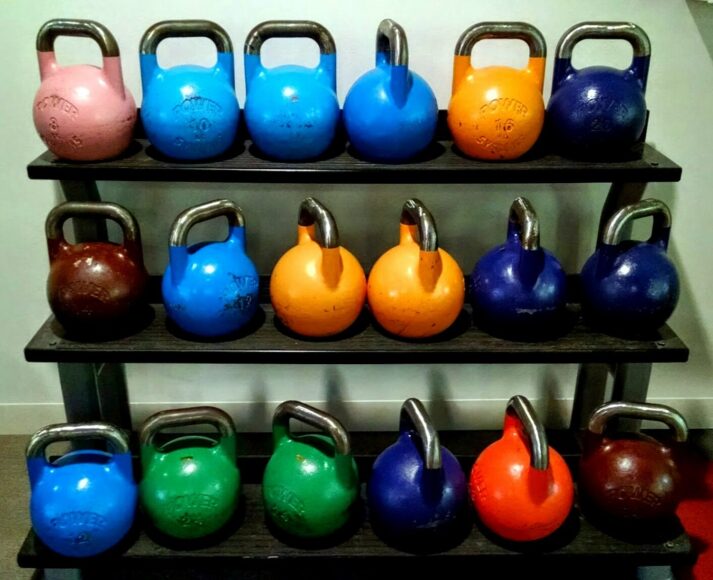
In case you’re still on the fence about grabbing a kettlebell, let’s dig into them a little bit more.[1]
What Type of Kettlebell Is Best? What Is the Best Kettlebell Weight for Me?
So you want to buy a kettlebell, eh?
They come in all sorts of materials, in all sorts of shapes, and in all sorts of sizes.
Which one you pick will come down to your personal preference, your budget, and your experience with kettlebells.
Let’s contemplate the following when picking the right kettlebell:
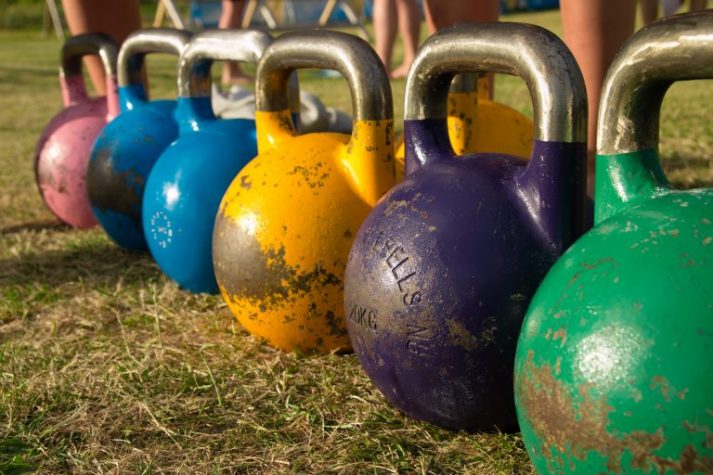
#1) Standard vs.Competition. A standard traditional kettlebell will be cast iron, and as the weight goes up, the dimensions go up.
For example, a 16kg (35 lb.) bell will be larger than a 6kg (15lb) bell. This isn’t true for competitive kettlebells.
No matter their weight, competitive kettlebells will have the same dimensions for bell shape, base, and handle width.
So the 16kg will look just like the 6kg. This can be helpful to make sure you are consistent with your technique.
#2) Weight. In general, pick a weight that allows you to complete a workout with good form.
When in doubt, start with a lighter weight, as you can always increase the weight/size later. If you’re forcing me to pick one for you, knowing NOTHING about you, I’d say consider purchasing a 16kg (35 lbs) if you’re a male or 12kg (25 lbs) if you’re a female.
Now, this isn’t an exact science, and we are all unique snowflakes. If you think you’re stronger than average, go heavier. Not quite there? Go lighter.
#3) Ballistic vs. Grind. You’ll often hear the terms ballistic and grinding in kettlebell workout discussions, for fast and slow movements respectively.
Ballistic movements would be quick, like the kettlebell swing.
Grinding movements would be slow, like the overhead press. For ballistic movements, you might actually want a heavier kettlebell, to help with momentum.
For grinding movements, less weight might be in order to help with control.
For now, if you are just starting out, go ahead and stick to one kettlebell. Branch out as you advance in experience.
#4) Handle. This is where quality comes into play. You’ll be doing many, many repetitions with your kettlebell.
If the handle has rough edges, you’ll feel each and every one of the movements cut into your hand.
Not fun.
Quality matters when it comes to handles. So we’ll chat about ideal brands in a moment. I’ll end our discussion on handles by saying they are generally standardized at 35mm for thickness.
Use this as your baseline for differences when comparing bell grips.
Okay, let’s talk about kettlebell brands:
#1) Cap Barbell. This would be an ideal first kettlebell. Not too expensive and of decent quality, Cap Barbell kettlebells can be found on Amazon or at any Walmart.
The Cap Barbell is the most highly reviewed and reasonably priced kettlebell we have encountered. Do you have any experience with one?
Let us know in the comments if you like it!
#2) Kettlebell Kings. You see Kettlebell Kings ranked as some of the best bells out there. Not a bad price for the quality.
Plus, they offer free shipping in the US, which is nice since you’re essentially mailing a cannonball.
#3) Dragon Door. Some call Dragon Door the gold standard of anything and everything “kettlebell.”
I wouldn’t disagree, but expect to pay for it.
#4) Onnit. Onnit rocks and they offer good quality bells that are quite popular.
#5) Home Gym Equipment companies have grown massively in recent years, which is great for you as a consumer! You can also find great Kettlebell options at reputable home gym companies like Rogue Fitness, REP Fitness, and Fringe Sport. (Special shout out to FringeSport for loaning us equipment to run Camp Nerd Fitness in the past!) You can’t go wrong with any of these options.
OUR ADVICE: Before you go buy an expensive kettlebell, check your gym!
I bet it has kettlebells, and you can try out different brands/ sizes/ weights/ styles to see which one you like the best.
Check out Craigslist or a used sporting goods store like Play it Again Sports for a previously owned kettlebell from a person who no longer needs it.
A used kettlebell is still a kettlebell.
Crafty? Build your own!
Here’s a video on how to make a kettlebell:
If you make your own kettlebell (be careful – you don’t want it breaking mid-swing!), please email me. I would be so pumped!
And if you need help with ALL of this and just want somebody to tell you how to train, I got you covered too.
The Intermediate Kettlebell Workout
If you’ve been rocking and rolling with the Beginner Kettlebell Workoutfor a while, it might be time to switch things up for a more challenging routine.
What should you do?
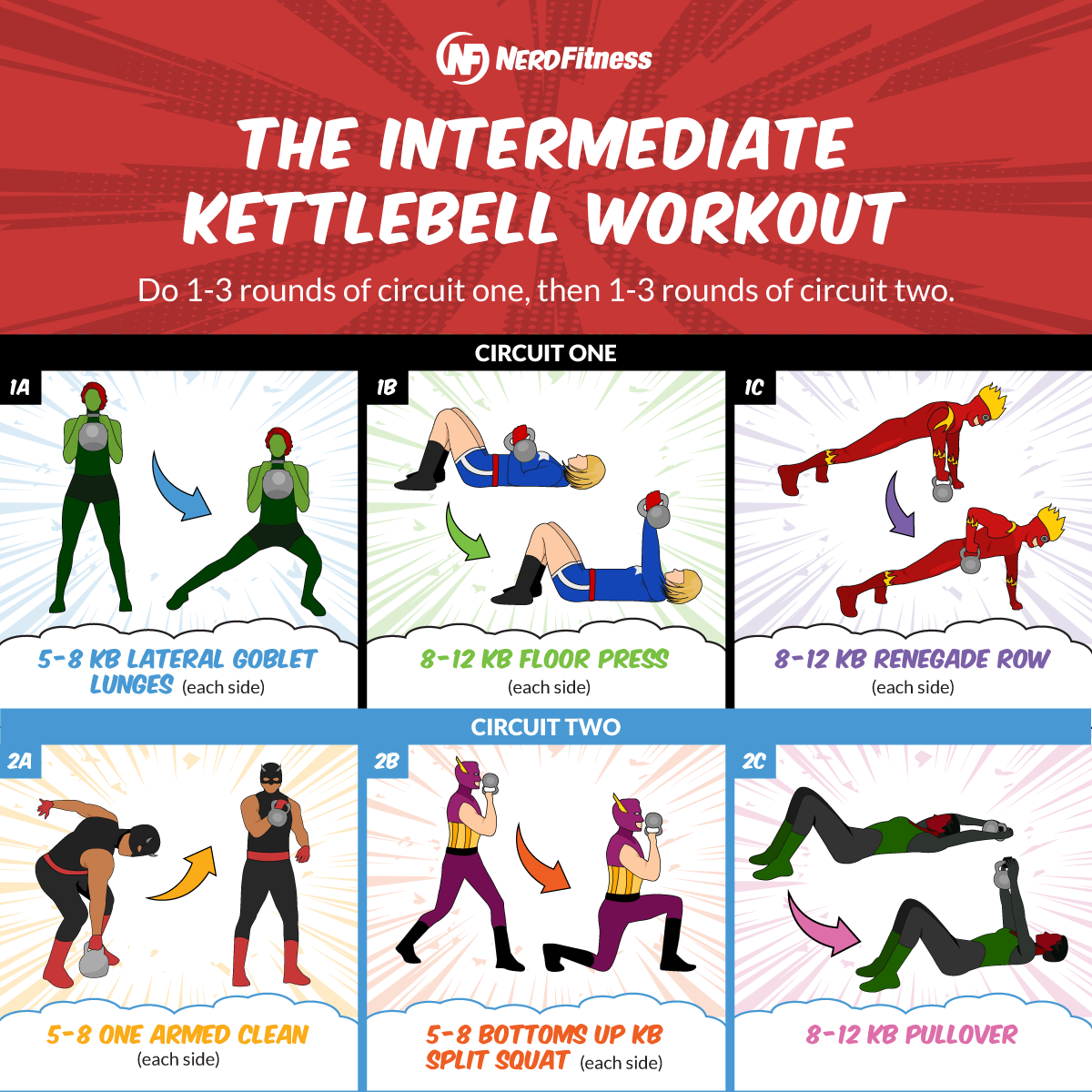
Try our intermediate workout above!
It’ll have you doing moves like:
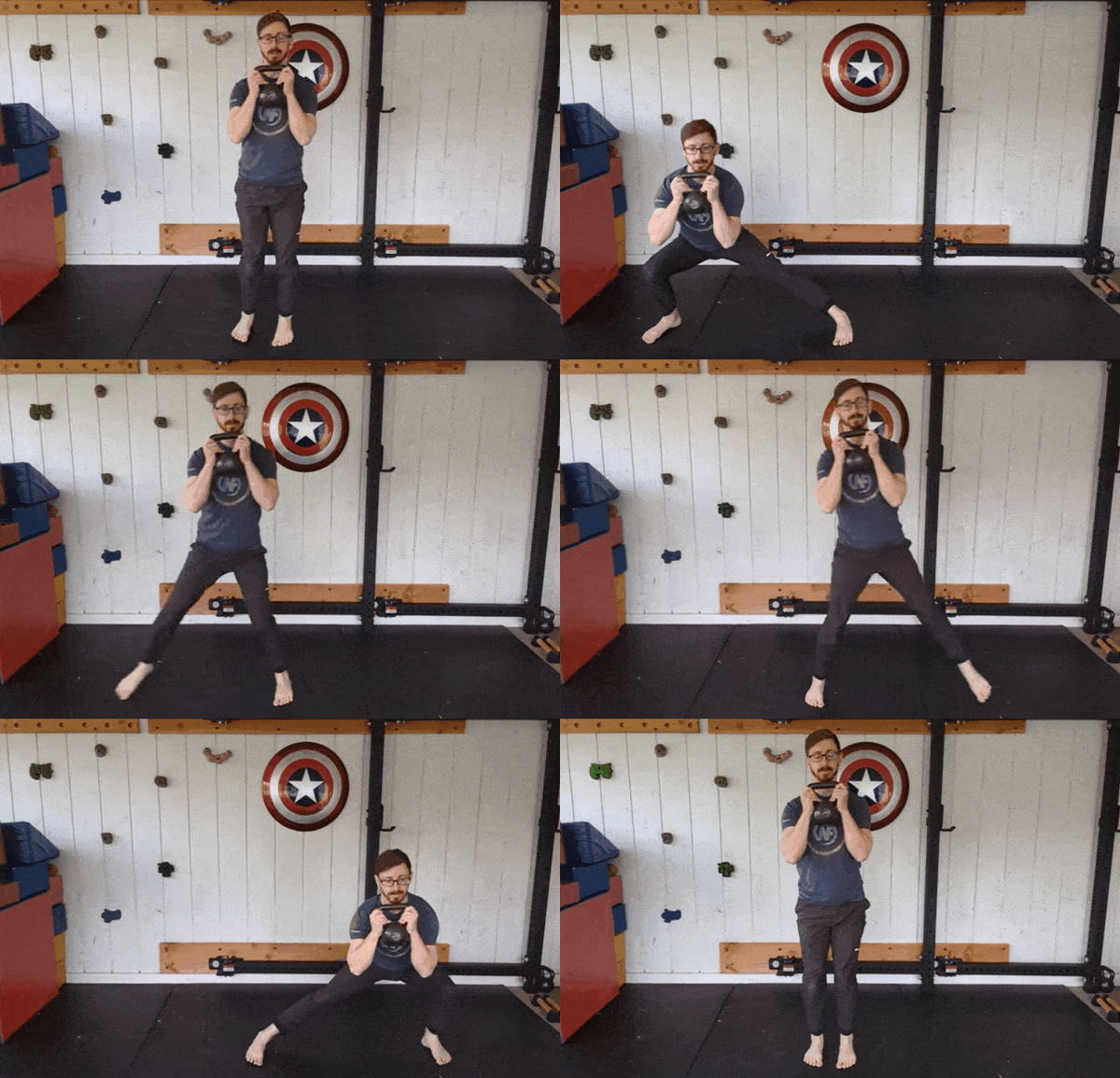
Kettlebell Lateral Goblet Lunges
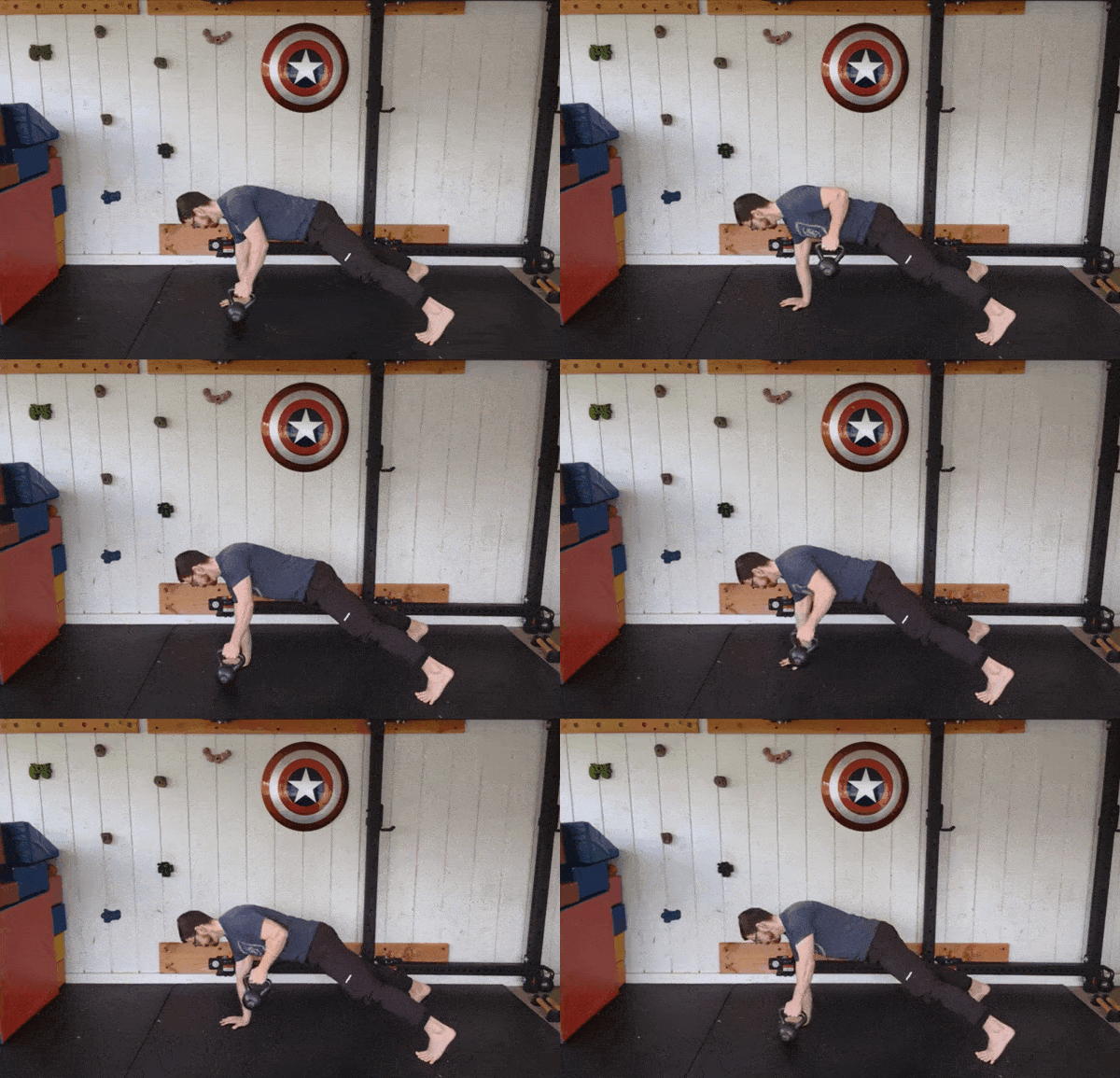
Kettlebell Renegade Rows
Here’s the Intermediate Kettlebell Workout as an infographic:
The workout is your perfect next step if the beginner version got a little too easy.
Want another full-body movement you can do with the kettlebell? Try adding in the Turkish Get-Up ~ perhaps the most famous kettlebell movement outside of the kettlebell swing!
Can You Lose Weight with Kettlebells?
If you’re trying to lose weight, a kettlebell and the workout routines above would be a great part of the plan!
The other part of the plan should be your nutrition.
As we lay out in our Coaching Program and our massive guide on “Healthy Eating,” we believe that proper nutrition is 80-90% of the equation for weight loss.
No joke.
It’s by far the biggest factor for success.
So will you lose weight training with kettlebells?
Maybe!
If you fix your diet AND begin to incorporate our kettlebell routine a few times per week, you’ll will find yourself building muscle, losing fat, and getting stronger!
If your goal is weight loss, you have to eat less than you burn each day. This can be through eating less and burning more (from the kettlebell workout above)
Processed foods and junk food make it really tough to lose weight: They have lots of calories and carbs, low nutritional value, don’t fill you up, and cause you to overeat.
Liquid calories are sabotaging your efforts. Soda, juice, sports drinks: they’re all pretty much high-calorie sugar water with minimal nutritional value. Get your caffeine from black coffee or tea, fizzy-drink fix from sparkling water.
Not losing weight? Track your calories and work on consuming slightly less each day. We tackle this point in-depth in our article “Why can’t I lose weight?”
Eat more protein! Protein helps rebuild muscle, and can help you stay under your calorie limit because it’s satiating and filling. Here’s exactly how much protein you should be eating every day.
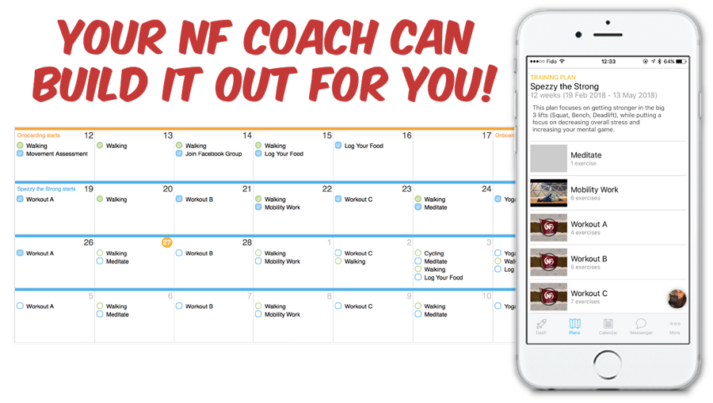
Those tips should get you started, but if you want more specific instruction and guidance, check out the NF Coaching Program – Your Coach will build a routine tailored to your individual needs and what equipment you have available:
Download the Kettlebell Worksheet!
Like most things in life, the important aspect of any exercise regimen is starting it.
No matter what strength training program you choose, start TODAY.
You don’t need to get strong before you can play with a kettlebell. You can play with a kettlebell to get stronger!
Here’s that Beginner Kettlebell Workout one more time to recap:
Halos: 8 reps each side
Goblet Squats: 10 reps
Overhead Presses: 8 reps
Kettlebell Swings -or- Romanian Deadlifts: 15 reps
Bent Over Rows: 8 reps each side
Front Rack Reverse Lunge: 6 reps each side
Here are the next two steps you can take with our community if you dig what we do!
1) Check out our 1-on-1 Online Coaching program. Our coaches can work with you to pick up a kettlebell for the first time or to learn more advanced moves.
Whether you are brand new to your fitness journey, or ready to take it to the next level, we have your back!
2) Join the Rebellion! Join our free community with a biweekly newsletter, and I’ll send you our Beginner Kettlebell Worksheet.
Simply sign up in the box below, and let us know what you think of it!
Grab Your Beginner Kettlebell Routine Worksheet!
Complete this workout at home or gym with 1 kettlebell.
Avoid the common mistakes everybody makes when doing kettlebell exercises.
Build strength, burn fat, level up your life!
For the Rebellion!
-Steve
PS: If you are using Kettlebells to get started with Strength Training, make sure you read the other articles in our Strength Training series!
I get multiple emails and messages per day asking:
“Steve, what should I do for a workout?”
Well, partner, today is your lucky day.
I’m gonna help build you a custom workout program, step-by-step!
After all, a workout should be developed around a person’s training age, goals, injury history, free time, and available equipment, not to mention things you ENJOY doing!
Considering all those factors, it’s easy to overcomplicate this process. There are a seemingly infinite number of exercises, sets, reps, and programs to choose from. Don’t worry – together, we’ll cut through the noise and get to the good stuff.
Now, if you’re somebody that wants to skip all of that, and JUST be told what exactly to do:
We build customized workouts for our Online Coaching Clientsand would love to have you. We get to know your story: your goals, challenges, and lifestyle. Then we develop a workout plan specific to your schedule and needs.
Now, if you’re more of a “figure this stuff out on my own” kind of person – we’re going to dig into how to build your own workout plan today!
We’ve also created a free resource you can take with you, Strength Training 101: Everything You Need to Know, which covers all of this stuff in a single guide. You can download it here:
Download our comprehensive guideSTRENGTH TRAINING 101!
Everything you need to know about getting strong.
Workout routines for bodyweight AND weight training.
How to find the right gym and train properly in one.
OKAY! Are you ready to start building your own routine?
Whatever your goals are, it’s good to write them down and be aware of what you’re trying to accomplish.
These goals will shape HOW you build your workout.
An effective way to create goals is by using the SMART method, which stands for specific, measurable, attainable, relevant, and timely.[1]
Specific – Specifically state what is to be accomplished. For example, “I want to gain 5 pounds of muscle.” (In this article we’ll cover how to build a workout to help you lose weight, build muscle, and get stronger. If you have specific goals like getting your first pull-up, getting your first push-up, or running your first 5k, we have articles covering each of these in detail.)
Measurable – Find a way to measure your progress. For example, you will need body composition equipment to assess your fat and muscle mass.
Attainable – Your goals should be realistically attainable. For example, a realistic rate of muscle gain is up to 0.5 pounds per week. To gain 5 pounds of muscle, 10 weeks would be an attainable starting point.
Relevant – Your goals must relate to your interests, needs, likes/dislikes, and abilities. Another thing to remember is that your goals need to be generated by you and you alone! For example, if you don’t care about gaining 5 pounds of muscle, or aren’t quite sure how this will benefit your life, then this isn’t a great goal for you!
Timely – Your goals must have a timeline for completion. If your goal is to gain 5 pounds of muscle then a reasonable end-point should be at minimum 10 weeks.
If you are struggling with your goals, revisit the SMART framework and see if you can tweak your goals to work better for you.
QUESTION 2: How much time can you devote to exercise?
If you can do an hour a day, that’s fantastic.
But maybe you have a wife or husband, three kids, a dog, two jobs, and no robot butler…
…then maybe you only have thirty minutes, twice a week.
That’s fine too!
In the past 15 years of working with folks from all walks of life, we’ve realized there’s a warped sense of HOW much working out is needed to achieve your goals. For many of our 1-on-1 coaching clients, working out 2 to 4 times per week for 30 to 45 minutes is PLENTY to see some serious progress. (And as Staci mentioned in the video above, even 1 workout per week can work, especially for beginners!)
Another key thing to remember: your workout doesn’t have to happen all at once! According to the American College of Sports Medicine (ACSM), if you accumulate three 10-minute bouts of exercise throughout the day to total 30 minutes of exercise, then that is as effective as someone who does one 30-minute bout of exercise.[2]
Now, no matter how much time you have, developing the most efficient workout is crucial.
Why spend two hours in a gym when you can get just as much accomplished in 30 minutes, right?
So whether you are building muscle or looking to lose weight, a strength training workout will get you the results you’re after (when combined with the right eating strategy!)
While we’re talking about time, let me quickly mention something important:
As we mention in that guide, here are some realistic timeframes for weight loss or muscle gain:[3]
For weight loss, a realistic rate is 0.5-1% of body weight per week. For example, if you weigh 200 pounds with a weight loss goal of 0.5% per week, your goal would be a 500-calorie-per-day deficit.
For muscle gain, a realistic rate is 0.25-0.5% of body weight per week. For example, if you weigh 200 pounds with a muscle gain goal of 0.25% per week, your goal would be a 250-calorie-per-day surplus.
Unless you’ve been strength training for years and know what you’re doing, we recommend a full-body routine that you can do 2-3 times a week.
You want a workout routine that has at least one exercise for your:
Quads (front of your legs).
Butt and hamstrings (back of your legs).
Chest, shoulders, and triceps: (“push” muscles).
Back, biceps, and grip ( “pull” muscles).
I have a trick for you: by targeting compound movements that recruit multiple muscles at the same time, you can build a full-body routine that uses only a handful of exercises.
How’s THAT for efficiency!?!
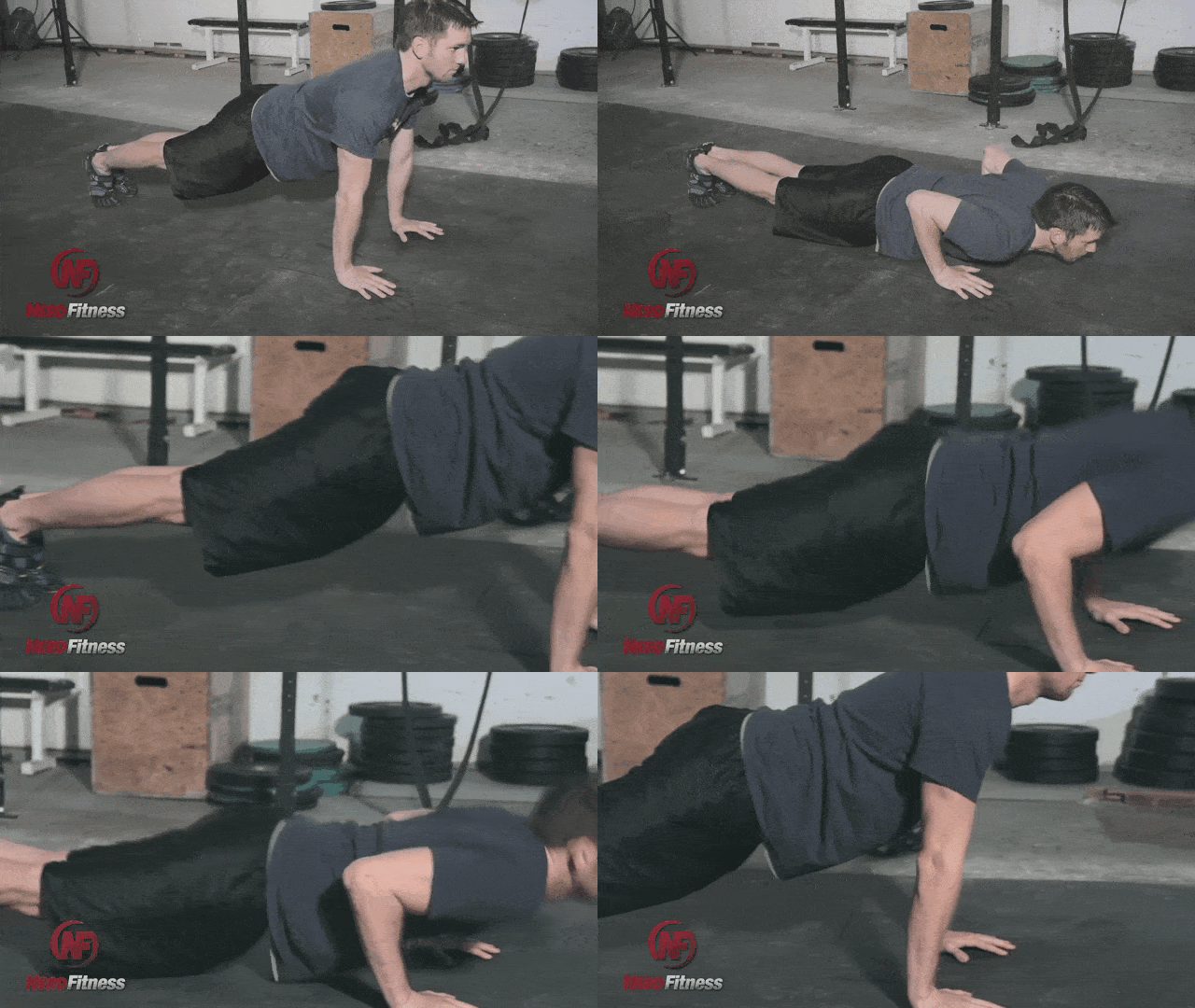
A compound exercise would be the yin to the yang of the isolation exercise.
Think of a push-up (compound):
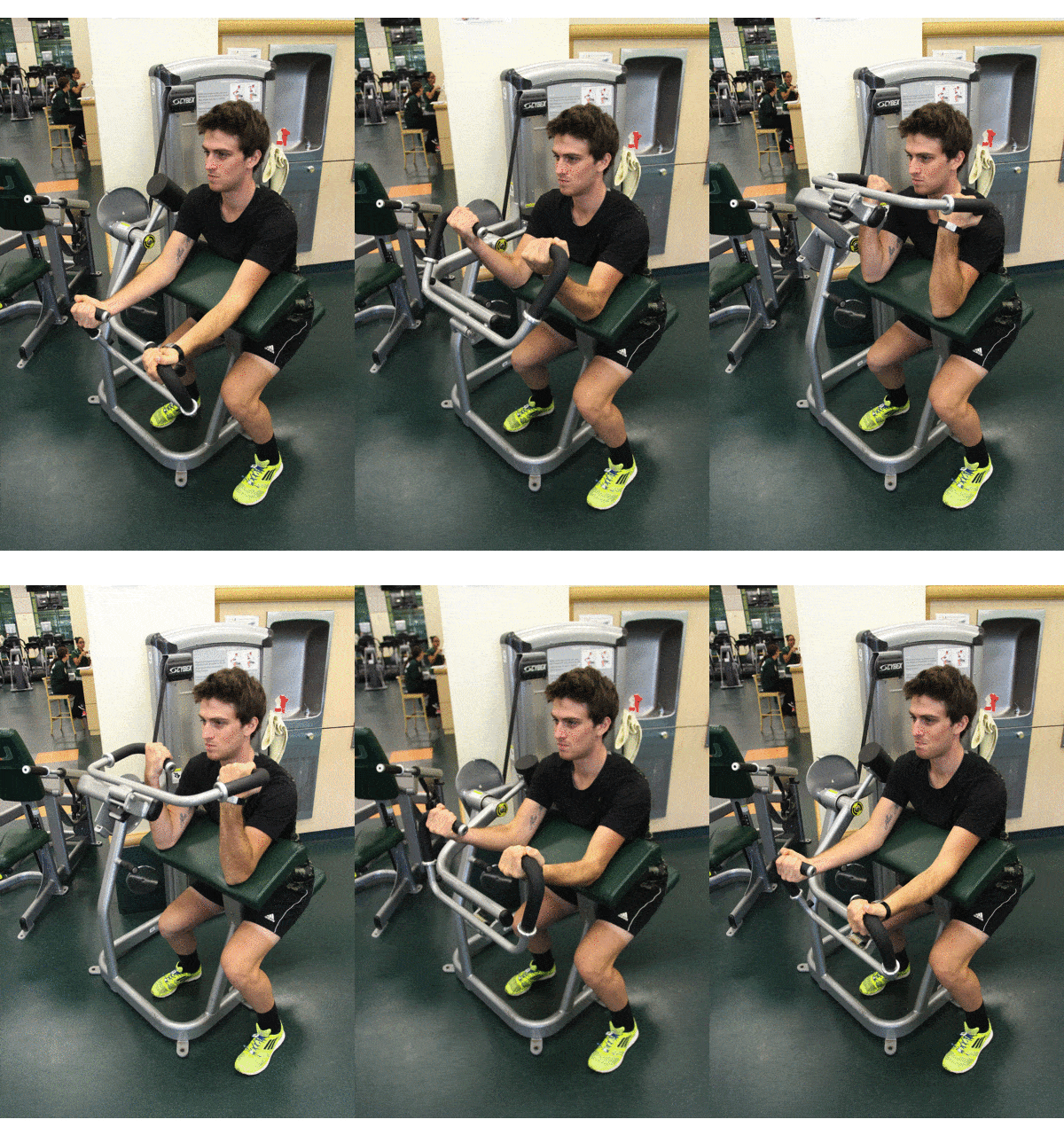
Compared to bicep curls through a machine (isolation):
Compound exercises have been found to result in improvements in aerobic endurance, muscular fitness, and flexibility, since you’re recruiting all sorts of muscle groups at once.[5]
Isolation exercises, on the other hand, focus on single-joint movements targeting one specific muscle group, like the biceps curl above.
Both compound and isolation exercises have a time and place in your training program.
As you get more advanced, isolation exercises are great for targeting specific muscles to promote further strength or development. They can also help beginners who struggle to “feel” their muscles working in specific movements learn more body awareness and control.
However, for people looking to lose weight, add some muscle, and get stronger – we recommend you start with predominantly compound exercises because of the huge return on investment for your time invested. These movements are the staple of the most effective training programs out there!
You don’t need to make things more complicated than this!
(Not that we humans have a tendency to overcomplicate things to the point of paralysis and inaction…)
Ahem.
If you’re not sure how to do any of the movements above, click on their links for thorough write-ups and video demonstrations.
Pick one exercise from EACH category above, specifically ones that scare you the least, and that will be your workout every other day for the next week.
Get really good at these basic movements and focus on getting stronger each week (I’ll cover how below).
If you get really strong at squats, deadlifts, pull-ups, and push-ups, you will build an incredible physique to be proud of.
Plus, building strength with these exercises will also help in other areas such as improving your performance in sports, decreasing your risk of chronic diseases (e.g., CVD) and premature mortality (an early death).[6]
*mic drop*
**picks up mic**
Then, once you get confident in those movements, feel free to add some variety.
Why?
If you do the same exact routine, three days a week, for months and months, you might get bored, and start slacking…
Do deadlifts every Wednesday, but change up the sets and reps you pick!
If you hit a plateau or find yourself getting bored, pick a different exercise or adjust your sets and reps so you’ll stay challenged, and you’ll actually DO the workout!
“But Steve, what about core exercises like sit-ups or planks? I don’t see those listed here.”
I’m so glad you asked! While it’s cool to add more specific core work to your program if you want to, squats, pull-ups, dips and deadlifts all do a great job of challenging your core to stay stable all on their own. If you do add in ab work, we recommend doing so at the end of your program so that you aren’t tiring out those muscles before doing your other big, compound lifts. Also, abs are revealed in the kitchen.
I know it’s really easy to overcomplicate this process as there’s an infinite number of exercises, sets, reps, and programs to choose from.
And yes, we have a solution for people that JUST want to be told what exactly to do: our uber-popular 1-on-1 coaching program pairs you with your own Nerd Fitness Coach who will get to know you, your goals, and your lifestyle, and develop a workout plan that’s specific to not only your body, but also to your schedule and life:
Step #3: How Many Sets And Reps Should I Do?
SIMPLE ANSWER: Not including a warm-up set or two, I recommend:
If you can do more than 15 reps without much of a challenge, consider increasing the weight or the difficulty of the movement. This is true for things like lunges, bodyweight squats, push-ups, pull-ups, etc.
If you want to focus more on building strength, keep your repetitions in the 5-10 range per set. As you get comfortable with the movements, you can move into lower rep ranges – but we find for beginners that starting with slightly higher reps gives you more time to practice doing the movement correctly.
There are some other generally accepted ‘rules’ about how to determine how many reps you should target per set, based on your goals:
Reps in the 1-5 range build super dense muscle and strength (called myofibrillar hypertrophy).
Reps in the 6-12 range build a somewhat equal amount of muscular strength and muscular size (this is called sarcoplasmic hypertrophy). [35]
Reps in the 12+ range build muscular endurance.
However, don’t think of these as hard and fast rules. For example, a 2015 study [10] called into question the best rep strategy for building muscle or size:
It appears that high-intensity resistance (sets of 3-5 reps) training stimulates greater improvements in some measures of strength and hypertrophy in resistance-trained men during a short-term training period [compared to sets of 8-10 reps].
Other recent studies have found that people built a similar amount of muscle with anywhere from 5 to 30 repetitions, as long as they worked close to failure.[38]
What this means: Do not freak yourself out by worrying if you should do 3 sets or 4 sets of 8 reps or 10 reps.
Our advice would be to START with lighter weights and more reps as you learn the movement, and then decide if you want to stay at higher reps and lower weight or vice versa.
You do you, because either way will get you results!
The only thing you need to worry about: get stronger the next time you do that movement.
Either pick up a heavier weight, or do 1 more repetition than last time.
“JUST GIVE ME THE ANSWER!”
Keep your TOTAL (all exercises combined) workout number of sets for all exercises in the 10-20 set range, with 5-15 reps per set:
4 exercises total, each with 2 to 5 “work sets” is a good start. [36]
Remember, the most important part is to get started – you’ll learn how your body responds and you can adapt as you go.
What you DON’T need to do: multiple exercises for each body part with 10 sets.
This will result in significant fatigue during your workout increasing your risk of sustaining an injury. It can also result in overtraining, in which you will experience a decrease in performance and plateauing (will not see muscular improvements).[11]
So calm down you eager beaver.
A BIG CAVEAT:How you eat will determine if you get bigger or stronger. Nutrition is 80-90% of the equation. So pick a range that feels good, and then focus on nutrition.
And if you don’t want to figure any of this out and just want to be told exactly how what exercises, sets, and reps to do, our online coaches can take care of that for you.
Step #4: How Long Should I Wait Between Sets?
Keep it simple, you “smart, good-looking, funny, modest person” you.
Below is a basic formula for you to determine how long you should wait between sets, but this can be adjusted based on your level of health.
The goal is to wait the least amount of time you need, but still rest enough that you can perform all reps of the next set safely and properly!
Adequate rest in-between sets will allow your body to regenerate energy, so you can execute the next set of reps with good form and technique, therefore, decreasing your risk of injury.
I’ll provide some guidelines for how long to rest based on how heavy you’re lifting (not rules set in stone!):
1-3 Reps (lifting heavy for strength/power): Rest for 3 to 5 minutes between sets.
4-7 Reps (lifting for strength): Rest for 2 to 3 minutes between sets.
8-12 Reps (lifting for size/strength): Rest for 1 to 2 minutes between sets.
13 Reps+ (lifting for endurance): Rest long enough to recover to allow you to do the next long-ass set!
If you need more or less rest than the above recommendations, that’s fine. The key is being recovered enough that you can perform the next set at similar intensity and with great technique. Whatever it takes to get you there, do it![13]
Do the best you can, record how long it takes you to rest between sets. The amount of rest you need to take over time may vary.
Your body will adjust as you get stronger and healthier!
The simple-to-learn but tough-to-implement answer:
Lift enough so that you can get through the set, but not too much that you have NO fuel left in the tank at the end.
How do you determine how much that is?
Trial and error.
ALWAYS err on the side of “too light” versus “too heavy” when starting out.
It’s better to say “I bet I could have done more!” instead of “That was too much, and now I need to go to the hospital!”
Plus, when you start working out, you’re actually programming your neuromuscular systems to do the movement correctly.[14] You can’t rush this, so it’s best not to start off too heavy.[15]
If a person can do two reps (or more) over their set goal, then they should increase the load.
How much should you increase weight?
For less trained people (i.e., beginners), it is recommended that for upper body exercises you increase the load by 2 – 5 pounds and by 5 – 10 pounds for lower body exercises.
For more trained people (i.e., advanced), it is recommended that for upper body exercises you increase the load by 5 – 10 pounds or more and by 10 – 15 pounds or more for lower body exercises [37]
I will say, if you’re doing exercises with just your body weight, you need to make each exercise more difficult as you get in shape – once you get past 20 reps for a particular exercise and you’re not gassed, it’s time to mix things up.
20 bodyweight squats too easy? Hold some weights high above your head as you do the next set. Eventually, you can scale up to do exercises like the pistol squat:
Step #6: How Long Should I Exercise For? How Long Should My Workout Be?
Easy answer: 45 minutes to an hour.
Longer answer: If you’re doing 10-20 sets of total exercise (2-5 sets for your 4 exercises), you should be able to get everything done within that 45-minute block.[17]
Now, factor in a five or ten-minute warm-up, and then some stretching afterward, and the workout can go a little bit longer.[18]
If you can go for over an hour and you’re not completely worn out, try increasing the intensity.
What’s that? You want to build some cardio into your weight training.
That’s where this next section comes in.
Step #7: How To Create Supersets And Circuit Training Workouts
For those short on time, a circuit training workoutis a highly efficient framework for training.
You’re getting a cardiovascular workout by consistently moving from exercise to exercise.
You’re exercising different muscles back to back, giving each muscle group a chance to recover, but in a condensed amount of time. Efficiency for the win!
It also increases the amount of calories burned in your post-workout window. [20]
If you’re familiar with CrossFit, many of those workouts are built on circuit principles.
This is also the most effective way to make you involuntarily swear at inanimate objects because you’re so tired and beat up.
We get this question quite a bit, usually from overeager beavers who decide they are going to go from “sitting on the couch watching The Office on repeat” to “exercising 7 days per week.”
I would advise something different.
I mean you can still watch The Office…
…but you don’t need to be training 7 days a week!
We don’t want you burning out quickly and falling back to square one, a concern we mention in our guide “How Often Should I Work Out?“
For starters, your muscles don’t get built in the gym.
They actually get broken down in the gym, and then get rebuilt stronger while you’re resting…watching The Office.[24]
By giving your muscles 48 hours to recover between workouts, especially when training heavy, you’ll stay injury-free and get stronger.[25]
A Monday-Wednesday-Friday workout routine works well to ensure enough time to recover, especially when you are just getting started.
If you want to do Tuesday-Thursday-Saturday, or Sunday-Tuesday-Thursday, great.
And we get it. Life doesn’t always perfectly align with this every-other-day schedule. The most important thing is to do the work with the time you have.
Then, pay attention to how you are recovering in between workouts. Are you still sore and tired when you begin your next workout? Do you notice you are having to use lighter and lighter weights because you are too fatigued? It may be worth trying to give yourself more time in between workouts so you can recover!
Just pick “exercise” that’s fun for you and that won’t exhaust your muscles. (Same questions as above.)[26][[26]]However, don’t forget that recovery is key to preventing injuries and allowing the body to rebuild itself after the stress of exercise. If you are looking to exercise on your off days we suggest that you cross-train. Cross-training involves engaging in a training routine or exercises that are different from what you normally would do. For example, if you always run for cardio, we would suggest that you change things up and go on the elliptical or bike. This allows you to stay active on your off days while also allowing the muscles that are always stressed from running to rest and recuperate. (Haff G, Triplett NT. (2016). Essentials of strength training and conditioning. Fourth edition. Champaign, IL: Human Kinetics).[[25]]
Also, here’s a lifehack: Program your workouts INTO your Google calendar (or Outlook).
You’re much more likely to do a workout that has been planned for in your work week!
Alternatively, you can hire a coach to program your workouts for you, so every day you know exactly what you need to do!
Step #9: Keep Track Of Everything!
Last but not least, keep a workout journal!
As they say, that which gets measured gets improved.
You should be getting stronger, faster, or more fit with each day of exercise.
Around these parts, we say “Level up your life, every single day.”
If you want to build from scratch, great! Let’s break it down into easy chunks with this recap:
Warm-up – 5-10 minutes on a bike, rowing machine, jumping jacks, running up and down your stairs, etc. Get the blood flowing and your muscles warm.[29]
Pick one exercise for each big muscle group – quads, butt and hamstrings, push, and pull.[30]
Do 2-5 sets for each exercise. (Start with lower sets to begin with.)
Do 5-15 reps per set for each exercise. (If you aren’t sure where to start, 10 reps is a nice middle ground.)
Rest and recovery between sets for each exercise. Keep it simple. 1-2 minutes and adjust from there.[31]
Increase your efficiency and work your heart by doing supersets or circuits. This results in a higher EPOC meaning greater caloric expenditure and weight loss!
Give yourself permission to mess up, learn a little, and keep improving as you train more regularly!
More often than not, when I email people back and tell them how to build their own workout, they generally respond with:
“Steve, can’t you just TELL me what to do? I’m afraid of building a crappy workout.”
Why we built TWO options for people like that:
1) If you are somebody who wants to know they are following a program that is tailor-made for their life, situation, and goals, check out our Online Coaching Program.
You’ll work with our certified NF instructors who will get to know you better than you know yourself and program your workouts and nutrition for you.
2) Join the Rebellion (our free community) and I’ll send you free guides, workouts, and worksheets that you can read at your leisure.
We need good people like you!
Download our comprehensive guideSTRENGTH TRAINING 101!
Everything you need to know about getting strong.
Workout routines for bodyweight AND weight training.
How to find the right gym and train properly in one.
I certainly encourage you to try and build your own workout routine.
It can really help you develop a sense of excitement and pride when you start to get in shape based on your workout!
-Steve
PS: Check out the rest of our beginner content. I promise, it kicks ass
American College of Sports Medicine. ACSM’s Guidelines for Exercise Testing and Prescription. Philadelphia: Lippincott Williams & Wilkins, 2000
Read, “Effect of short moderate intensity exercise bouts on cardiovascular function and maximal oxygen consumption in sedentary older adults.” Souce, BMJ Journals
(Spano MA, Kruskall LJ, Thomas DT. (2018). Nutrition for Sport, Exercise, and Health).
American College of Sports Medicine. ACSM’s Guidelines for Exercise Testing and Prescription. Philadelphia: Lippincott Williams & Wilkins, 2000
Haff G, Triplett NT. (2016). Essentials of strength training and conditioning. Fourth edition. Champaign, IL: Human Kinetics
Remember, it all comes down to a caloric deficit or surplus. if you are trying to lose weight it is recommended that you seek a calorie deficit by consuming 250-500 less calories per day below your typical calorie intake. This will result in a realistic weight loss goal of 1-2 pounds per week. If you’re trying to gain muscle mass, then it is recommended that you seek a calorie surplus by consuming 250-500 additional calories above your typical calorie intake. This will result in a realistic gain in lean muscle mass of about 0.5 pounds per week. Source: Spano MA, Kruskall LJ, Thomas DT. (2018). Nutrition for Sport, Exercise, and Health
American College of Sports Medicine. ACSM’s Guidelines for Exercise Testing and Prescription. Philadelphia: Lippincott Williams & Wilkins, 2000)
This goes back to the progressive overload principle. Remember, in order to achieve your training goals or to see improvements, your training must gradually and constantly increase Source: Haff G, Triplett NT. (2016). Essentials of strength training and conditioning. Fourth edition. Champaign, IL: Human Kinetics.
If you do not progress your workout, then you will reach a plateau because your body has met the demands of your exercise or stress that you have placed upon it. If you progress your workout (e.g., do more reps, lift heavier weights, do different exercises, etc.), then those microscopic tears (that don’t hurt) will happen and your muscles will go through hypertrophy and grow bigger and stronger. Source: Powers SK, Howley ET. (2011). Exercise physiology: Theory and application to fitness and performance. New York: McGraw-Hill Humanities/Social Sciences/Languages).
You’ll see a few different recommendations around this. The National Strength and Conditioning Association (NSCA) recommends 6-12 reps for 3-6 sets for muscle hypertrophy and more than 12 reps for 2-3 sets for muscular endurance (Source: Haff G, Triplett NT. (2016). Essentials of strength training and conditioning. Fourth edition. Champaign, IL: Human Kinetics). While the American College of Sports Medicine (ACSM) simply recommends 8-12 reps for 2-4 sets for healthy individuals (Read, American College of Sports Medicine position stand. Progression models in resistance training for healthy adults. Source, PubMed.
While these are great places to start, more recent studies show that anything between 5 and 30 reps, as long as you train close to failure, are similarly effective in stimulating muscle growth.
As you get more advanced, adding more sets may continue to be beneficial – as long as you can recover from the amount of workload. See this study on the effects of hypertrophy gains in trained men up to 45 sets per target muscle per week.
Read, “Musculoskeletal adaptations and injuries due to overtraining.” Soucre, PubMed.
Excessive muscle fatigue, often resulting by engaging in higher intensity exercise or engaging in exercise with short rest intervals has been found to increase one’s risk for muscle strains due to fatigue eliciting poor exercise technique. For more, read “Muscle strain injury: diagnosis and treatment.” Source, PubMed.
The NSCA also has guidelines in-place to help you determine your rest intervals in-between sets: 2 to 5 minutes for strength and power, 30 seconds to 1.5 minutes for hypertrophy, and 30 seconds or less for muscular endurance (Haff G, Triplett NT. (2016). Essentials of strength training and conditioning. Fourth edition. Champaign, IL: Human Kinetics).
Plus, ACSM has a basic recommendation of 2 to 3 minutes (American College of Sports Medicine. ACSM’s Guidelines for Exercise Testing and Prescription. Philadelphia: Lippincott Williams & Wilkins, 2000). So we don’t have to get overly dogmatic here.
More efficient communication between your neuromuscular systems results in proper motor unit recruitment. A motor unit is a single motor neuron and the muscle fibers it innervates. We have small motor units, meaning that a single motor neuron innervates relatively few muscle fibers, and these smaller motor units are good for precise and detailed movements (e.g., moving your fingers). On the other hand, we have large motor units, meaning that a single motor neuron innervates hundreds of muscle fibers, and these larger motor units are good for generating a lot of force (e.g., getting larger muscle groups like the quads to generate a lot of force to help in running) (Powers SK, Howley ET. (2011). Exercise physiology: Theory and application to fitness and performance. New York: McGraw-Hill Humanities/Social Sciences/Languages; Heckman CJ, Enoka RM. Motor unit. Compr Physiol. 2012 Oct;2(4):2629-82. doi: 10.1002/cphy.c100087. PMID: 23720261).
When you first start strength training, your motor units don’t fire as quickly and smaller motor units that don’t generate a lot of force are recruited. As you continue working out and become more trained, your motor units fire more rapidly and your brain recruits larger motor units that can generate more force allowing you to lift heavier weights. This is why the progressive overload principle is important! As your neuromuscular system communicates more efficiently, you will see improvements in your exercise technique and muscle adaptations (e.g., hypertrophy) taking place.
Haff G, Triplett NT. (2016). Essentials of strength training and conditioning. Fourth edition. Champaign, IL: Human Kinetics.
Note: these numbers can be misleading. As you get to heavier and heavier total loads, the amount of stress placed on the body increases, and so you may have to make much smaller jumps in weight, rather than larger. The important thing is to pay attention to recovery and make sure you don’t add too much weight, too soon.
According to ACSM and the CDC, all healthy adults aged 18-65 years should participate in moderate-intensity aerobic physical activity for a minimum of 30-minutes on five days per week, or vigorous-intensity aerobic activity for a minimum of 20-minutes on three days per week. Additionally, every adult should perform activities that maintain or increase muscular strength and endurance for a minimum of two days per week. Performing exercise at a moderate-to-vigorous intensity will result in greater caloric expenditure and weight loss. (American College of Sports Medicine. ACSM’s Guidelines for Exercise Testing and Prescription. Philadelphia: Lippincott Williams & Wilkins, 2000).
The NSCA recommends a 5-10 minute warm-up to prepare the body for the exercise session, and the exercise session should be followed by a 5-10 minute cool-down to bring the body back down to rest (Haff G, Triplett NT. (2016). Essentials of strength training and conditioning. Fourth edition. Champaign, IL: Human Kinetics).
The ACSM and other researchers have found that if you ACCUMULATE 10-minute bouts of exercise throughout the day that can be as effective as one who does one 30-minute bout of exercise. Read, “The Effects of Continuous Compared to Accumulated Exercise on Health: A Meta-Analytic Review.” Source, PubMed.
Circuit training results in a higher excess post-exercise oxygen consumption (EPOC) resulting in great caloric expenditure when compared to traditional strength training with longer rest intervals in between sets and exercises. Read, “Circuit weight training and its effects on excess postexercise oxygen consumption.” Source, PubMed.
Haff G, Triplett NT. (2016). Essentials of strength training and conditioning. Fourth edition. Champaign, IL: Human Kinetics
Oh, and even if you aren’t doing a ciruict, don’t use your cell phone for other purposes besides using it to listen to music! Other cell phone functions such as texting and talking have been found to lower the intensity of exercise resulting in lower caloric expenditure, and disrupt balance leading to a greater risk of musculoskeletal injuries. Read, “The Impact of Cell Phone Use on the Intensity and Liking of a Bout of Treadmill Exercise.” Source, PubMed. Read, “The impact of different cell phone functions and their effects on postural stability.” Source, ScienceDirect.
The NSCA recommends 2-3 training sessions for novice or beginners, 3 sessions if using total body training or 4 sessions if using a split routine for intermediates, and 4-6 sessions for advanced lifters (Haff G, Triplett NT. (2016). Essentials of strength training and conditioning. Fourth edition. Champaign, IL: Human Kinetics).
Strength training results in microscopic muscle tears in the muscles. This causes a cascade of events eventually leading to muscle repair and growth (i.e., hypertrophy). Our muscles adapt to the overload stress of strength training immediately after each bout of exercise, but it takes roughly eight weeks to see physical improvements (Powers SK, Howley ET. (2011). Exercise physiology: Theory and application to fitness and performance. New York: McGraw-Hill Humanities/Social Sciences/Languages).
Adequate recovery is essential to prevent overtraining. When we become overtrained, our injury risk increases and we reach a plateau and no longer see any improvements from our training. For more, read “The effects of resistance training, overtraining, and early specialization on youth athlete injury and development.” Source, PubMed.
This applies to all healthcare professionals who are working with clients, athletes, military personnel, special populations (e.g., cardiac rehab). These healthcare professionals are tracking everything so they can see if you are improving or not. And if you’re not improving, that is okay. At least you know and then you can start making changes to your exercise routine: change your exercises from bodyweight to free weights; change the number of sets and rep; shorten or lengthen your rest intervals, etc.
And if you’re not improving, that is okay. At least you know and then you can start making changes to your exercise routine: change your exercises from body weight to free weights; change the number of sets and rep; shorten or lengthen your rest intervals, etc.
A traditional warm-up usually consists of two components. The first is a general warm-up of 5-10 minutes of low- to moderate-intensity aerobic exercise, such as jogging or stationary cycling. The second is a specific warm-up that involves less intense movements similar to the sport or activity about to be performed. This second part involves performing dynamic stretches such as high knees, butt-kicks, skipping, shuffling, carioca, etc. The purpose of this type of warm-up is to allow the body to gradually adjust to the demands of exercise by allowing for increases in heart rate, blood flow, muscle temperature, and core body temperature (Haff G, Triplett NT. (2016). Essentials of strength training and conditioning. Fourth edition. Champaign, IL: Human Kinetics).
These big muscle groups allow for everyday activities to be performed with more ease and for you to maintain a more independent lifestyle for a longer period of time. For more, read “American College of Sports Medicine position stand. Progression models in resistance training for healthy adults. Source, PubMed.
But remember, the sets, reps, and rest intervals will change as your training goals change.
The longer your workout the more fatigue you will experience, therefore, increasing your risk of injury. Keep your cell phone in the locker room if you’re having a difficult time keeping your workout to less than an hour!
The same rules apply as for the warm-up. After you are done with your exercise session perform 5-10 minutes of low- to moderate-intensity aerobic exercise. The second part of the cool-down will consist of static stretching instead of dynamic stretching. Static stretching involves slowly moving a muscle to the end of its range of motion and then holding that position for a period of time (10-30 seconds or 30-60 seconds for its greatest benefits). You should stretch the muscle enough to feel a slight discomfort, but don’t go too far where you start to feel pain. For more, read “American College of Sports Medicine position stand. Quantity and quality of exercise for developing and maintaining cardiorespiratory, musculoskeletal, and neuromotor fitness in apparently healthy adults: guidance for prescribing exercise.” Source, PubMed.
Remember, the only way you’re going to know if you’re improving and if your program works is if you’re recording the data. If it’s not working, at least you can catch it early and make the necessary adjustments.