Categories
Uncategorized

#healthyliving #holistic #nutrition What is Body Positivity? (And What Is It NOT?)

what is body positivity

What is body positivity? Well, that’s a great question—and one that many are wondering as the movement has morphed and been co-opted in different ways. To me, body positivity is about showing love and appreciation for your body. 

More importantly, it’s about choosing that love for your body over the messages from our modern culture that your body is a representation of your worth—that you need to change it to fit a cultural expectation of what defines a “good” “beautiful” or “healthy” body.

I also think, however, that the movement has led some people to think that embracing the body you have today means that you don’t need to care for it. Or that you can’t work toward fitness or health goals and also love your body now. 

Ultimately, most of us in the wellness space will answer the question of “what is body positivity” differently. Here at Lindywell, we take a grace over guilt approach while also supporting our bodies for long-term health. 

If that’s the way you approach life (or want to!), then let’s talk about what body positivity really means and how it can fit into a wholistically healthy life.
The Origins of the Body Positivity Movement

Body positivity can trace its origins to a 20th-century social movement started by intersectional Black and LGBTQIA+ activists. Their goal was to resist the discrimination and marginalization of bodies that exist outside Western society’s “thin, white, straight, cis” norm. 

The first wave of body positivity celebrated all sizes, races, abilities, genders, and sexualities. It centered on their unique experiences and encouraged everyone to cultivate healthy relationships with their bodies. 

In short, this movement is rooted in confronting unrealistic beauty ideals to embrace body acceptance and representation for everyone. And I love that!

How Modern Body Positivity Is Missing the Mark

There are many ways the modern body positivity movement is missing the mark. As it’s been picked up on social media, the sentiment has been co-opted, leading to misrepresentation, unnecessary pressure, and more. Here’s what the research tells us about how body positivity is actually hurting more than helping. 

It’s Leaving People Out

Let’s jump ahead more than half a century to the modern iteration of body positivity. In a recent analysis of #BodyPositive TikTok videos, 93 percent featured conventionally thin bodies, while only 32 percent featured larger bodies. What’s more, less than 35 percent even mentioned the theme of body image acceptance at all.

In another study, researchers looked at 500 Instagram posts with the hashtags #BodyPositivity or #BodyPositive to examine the diversity within this content. Less than one-fifth of the posts showed a non-white person, about one-sixth showed someone in a larger body, three showed a queer person, and two showed someone with a disability. Most of the content overwhelmingly focused on the pursuit of fitness and weight loss. 

Keep in mind that this began as a countercultural movement to push back against narrow, exclusive beauty norms and create space for all bodies to thrive. But social media’s interpretation of “body positivity” can erase the experiences of those for whom this term originated. 

The consequences speak for themselves. According to a survey of 11,620 adults across the U.S., those from marginalized communities are more likely to face appearance-related stigma. Folks in larger bodies are especially vulnerable to prejudice, harassment, or discrimination for their weight, which can influence eating disorder behaviors.

If Often Feels Unattainable

Another potential issue with body positivity is that it’s often an unattainable goal to strive for. As healing as radical self-acceptance and affirmation can be, we cannot always will ourselves to just manufacture these feelings. 

More than 60 percent of 35 to 54-year-olds across the globe confirm that poor body image has had an adverse effect on their well-being. Whether your dissatisfaction is a result of size, weight, shape, or some other external factor, you might not be able to reframe this internalized critique at a moment’s notice. 

Sometimes it’s hard to love how we look in the mirror—and no amount of positive thinking will transform this mindset entirely. This is where body positivity can fall short.

It Feels Pressuring

Messages such as, “Be comfortable in your own skin,” or “Love yourself no matter what,” sound beneficial on the surface. These sentiments, however well-intentioned, can actually make us feel worse. Research shows that when a body positivity mantra comes across as controlling or pressuring, it can undermine our sense of agency and harm our self-esteem.

Consider Opting for Body Neutrality Instead

Body neutrality removes the pressure of feeling like you need to love all facets of your external appearance at all times. Rather, it encourages you to recognize that your body is worthy of love, respect, and kindness no matter how it looks. 

Psychologists Dr. Mia Pellizzer and Dr. Tracy Wade have established three main components to define “body neutrality” as:

  • A mindful, realistic, and flexible view of the body as a whole
  • A willingness to respect, care for, and appreciate how the body functions
  • A realization that self-worth is not based on external appearance 

The objective of body neutrality is not to ignore complicated emotions that come to the surface when you look in a mirror, wear a certain outfit, or see a post on social media. It’s to recognize none of that defines you. 

This neutral outlook on body image lets self-compassion and curiosity replace criticism, so you’re free to accept the truth: Nobody is perfect, and that’s alright. You have more important qualities to offer than how you look.

How to Be Body Positive or Neutral—and Also Focus on Long-Term Health

I believe that we can be body-positive and still work toward long-term health goals. I don’t just believe this—I know it to be key to feeling good in every season of life. This comes down to how you approach health and fitness. It’s not about forcefulness or physical appearance but listening to your body and setting yourself up for health and happiness in every season of life. 

If you want to be body-positive (or neutral), while still taking care of your body, here are a few helpful strategies.

Let your body lead.

If you’re working out just to check a box or forcing yourself through workouts that you don’t like, it’s time to take a step back. Let your body lead. Is it craving a slow, stretching workout? Or is it feeling ready for the challenge of a HIIT or strength-training workout? This is about focusing on movement that feels good for your body.

Focus on consistency, not duration.

Creating long-term health is not about working out for 60+ minutes every time you move your body. It’s about prioritizing that movement daily, even if it’s only for 10-15 minutes. This comes back to giving your body what it needs rather than forcing some arbitrary version of what a workout “should be.” Plus, we all have 10-15 minutes each day for movement, no matter how busy we are!

Set an intention.

Workouts shouldn’t be focused on how your body looks. Instead, I want you to focus each workout on an intention that has nothing to do with what you see in the mirror. For example, your intention may be to stoke some creativity for your workday or get an energy boost mid-day. Movement fuels your mental health, gives you energy, reduces stress and so much more. Being body positive is all about shifting the focus to how you feel, rather than how you look.

Incorporate more nourishing foods.

Eating “healthy” doesn’t mean you need to have a salad every day. It means choosing foods that nourish your body (provide fuel and energy) and your mind (tastes good). I want you to think about both your mind and body when thinking about long-term health goals. If one is thriving and the other isn’t, you’ll struggle to create a balanced and fulfilling life. 

If you want support on moving your body consistently, choosing nourishing foods, and focusing on grace over guilt in your health journey, start your 14-day free trial of Lindywell. Join thousands of women across the globe who have finally found the one workout program that keeps them consistent while reducing stress and building strength!

Embrace Your Health Journey With Body Positivity

Body positivity matters—but the message has been skewed. In its purest form, this movement includes, represents, embraces, and celebrates the full spectrum of human bodies. It was never meant to erase or overlook anyone, nor was it created to shame you into a disingenuous, performative brand of self-love.

If you want to cultivate a healthier, more authentic relationship with yourself, I invite you to join Lindywell. As a member, you get immediate access to 350+ Pilates classes, conscious breathwork sessions, and nourishing recipes. You will also be part of a diverse community that champions the vibrance and uniqueness we all bring to this world.

The post What is Body Positivity? (And What Is It NOT?) appeared first on Lindywell.

from Blog – Lindywell https://ift.tt/wF2jTXA
via IFTTT
Categories
Uncategorized

#holistic #getfit #nutrition What to do if you DON’T like to exercise:

I don’t really like to exercise.

Okay, I kind of like picking up heavy weights and doing handstands.

But I certainly don’t love “cardio.”

Rather than nerd out about biomechanics, I’m more interested in anthropology and human behavior.

Rather than going to run a 5K, I’d rather sit on my couch and play Fallout 4 I (just watched the show, it’s fantastic.)

What I’m trying to say is I’m not a fitness nerd.

I’m a nerd who tries to be fit.

So if you’re somebody who also just doesn’t “like to exercise,” you are in good company.

I also have some amazing news for you.

Back in Time

I recently read Exercised by Daniel Lieberman, professor of anthropology at Harvard University.

Lieberman has spent large swaths of time studying and living with hunter-gatherer tribes all over the world, including the Tarahumara (who appear in the book Born to Run), the people of Pemja (Kenya), and the Hazda tribe of Tanzania.

Lieberman points out that most studies and research are conducted on very specific, narrow subset of humans:

WEIRD humans!

Western, Educated, Industrialized, Rich, and Democratic.

Modern western society only makes up a tiny part of the total human experience.

Homo Sapiens have been around for 150,000-300,000+ years!

So, if our goal is to see “what most humans do,” we need to expand the variety of humans we observe, look way back in time, and observe human behavior outside of modern western culture.

Luckily, Lieberman has done exactly that, living with modern hunter-gatherer tribes and studying ancient cultures:

For generation after generation, our ancestors young and old woke up each morning thankful to be alive and with no choice but to spend several hours walking, digging, and doing other physical activities to survive to the next day.

Sometimes they also played or danced for enjoyment and social reasons.

Otherwise, they generally steered clear of nonessential physical activities that divert energy from the only thing evolution really cares about: reproduction.

For 99.99% of our existence as a species, we needed to conserve energy, not needlessly try and burn extra energy. Whenever we weren’t actively securing our survival, we were resting to conserve energy. This whole modern concept of trying to build excess muscle, or exercising to burn extra calories would be a foreign concept to our ancestors.

Food was always in short supply, which meant every day the bodily cycle for each human has to decide how to use each calorie consumed.

Because we had to burn precious calories to hunt or find our food, needlessly burning excess calories during the rest of the day just doesn’t make any sense to ancient humans, nor to modern hunter-gatherers.

So! Of course…

It makes sense you don’t want to exercise!

As Lieberman points out:

We never evolved to exercise.

…exercise today is most commonly defined as voluntary physical activity undertaken for the sake of health and fitness.

But as such it is a recent phenomenon…

The mantra of this book is that nothing about the biology of exercise makes sense except in the light of evolution, and nothing about exercise as a behavior makes sense except in the light of anthropology.”

As Lieberman shares in the book, tribes like the Hazda certainly burn more calories than western office-workers, but only because they have to, and not dramatically so: “Typical hunter-gatherers are about as physically active as Americans or Europeans who include about an hour of exercise in their daily routine,” but don’t have abundant access to easily consumable energy the way the rest of us do.

This is where we encounter the “Evolutionary Mismatch Hypothesis”:

Differences in stressors between the environment in which humans evolved and the current environment are mismatches that can cause disease.

Up until 10,000 years ago, humans lived a nomadic lifestyle as hunter-gatherers, with different stressors from the ones that people experience nowadays in modern environments.

Note: this is NOT where I’ll tell you to start eating Paleo (Paleo is a misguided diet that works because of math, not “ancestral” reasons).

I’m specifically talking about how our brains and bodies try and function in a modern environment. Edward Wilson said it best: “We have Paleolithic emotions, medieval institutions and godlike technology.”

Which means we need to start with acceptance: Rather than beating ourselves up for struggling to build a voluntary exercise habit, we can accept we’re human.

We evolved to survive in scarcity, and now exist in a world of abundance.

Exercise is beneficial AND no longer “necessary”

Exercise is good for us.

Cardio is good for our heart and lungs. Exercise of any type can help create a calorie deficit, and reducing our body fat percentage can help reduce all-cause mortality. Building and maintaining muscle mass and strong bones is critical for our health as we get older. We also feel better after we exercise: thanks dopamine and serotonin and endorphins!

There are literally hundreds of benefits of exercise with regards to our health.

We all know this.

And yet we all think: “I know I should exercise more, but I can’t get myself to do it.”

Let’s set aside the fact right now that we’re all busy as hell, and taking extra time out of our day to exercise is a BIG ask for many (shout out to single parents working multiple jobs!). With that out of the way, why is it so hard for us to build a new exercise habit and stick with it?

Because we’re fighting against biology and our history.

For our day-to-day survival, we don’t need to exercise anymore:

  • We used to have to find/hunt our food, now we can hit a button on our phone.
  • We used to have to travel by foot everywhere, now we can drive a car.
  • We used to have to stay active or die, but we can now survive for a long time even if we’re unhealthy and inactive.

And if exercise is no longer necessary for our survival…

The Only Two Reasons We Exercise

Unless we’re being chased by a wild boar or fell off a boat and need to swim to shore, none of us need to exercise today specifically to survive.

Then why does anybody exercise at all? As Lieberman categorizes it, we exercise for one of two reasons:

  • It’s emotionally rewarding
  • It’s physically rewarding

We can exercise because it’s emotionally rewarding: We might go for a run because of the dopamine hit, or because we are part of a socially active club. We might strength train because it feels empowering, or because we don’t want to feel lonely or lazy, or because it helps us process our anxiety or depression.

We can exercise because it’s physically rewarding. We might try to get better at pickleball because we’re competitive. Or we might exercise because we want to lose weight and fit into certain sized clothes, or because we don’t want to die of a heart attack at an early age like our dad.

In ALL of the examples above, we’re all having an internal debate with our lazy brains, who would rather conserve energy.

We have to convince ourselves “the benefits of this activity now outweigh the negatives, so I’m willing to take time out of my day to do it!”

Here’s how you can do exactly that.

How to Make Exercise More Rewarding

With “necessity” off the table, we need to find ways to make exercise emotionally rewarding, physically rewarding, or both.

Here are some thoughts to get you started.

Let’s start with making it more emotionally rewarding:

Socializing is a HUGE part of humanity, and includes things like camaraderie, positive social pressure, etc.

  • Join a running club where the goal isn’t even “get better at running,” but because it’s your friends.
  • Dance classes or martial arts classes in disciplines that seem fun to you.
  • A kickball league or pickleball league for your apartment building.

We can also reframe how we think about exercise. Instead of just calories burned, what if we focused your exercise on “This makes me feel better.”

  • Listen to your favorite podcasts while working out (temptation bundling).
  • Treat your daily walk like a walking meditation.
  • Running a 5K to raise money for a charitable cause.
  • Your Big Why (to be a role model for your kids, to be around for your grandkids).

Can you find ways to make exercise feel physically rewarding? Yep, “look good naked” is still a viable motivator for many. Feel free to keep that as part of your reason for exercise! It’s certainly one of my reasons.

However, for many of our coaching clients, their big shift to sustainable exercise happens when their mentality changes from “How much weight do I need to lose?” to “I wonder what my body is capable of!”

Instead of just weight loss, they have goals like:

Alternatively, exercise can be physically rewarding when it doesn’t feel like exercise! Dancing, yoga, LARPING, hiking, walking. We’ve even written about 40 ways to exercise without realizing it. Movement can be fun.

You may also start to enjoy the physical sensations of exercising and feeling your body move. For many of our clients, focusing on what their body is capable of doing and the feeling of moving their body can completely shift their associations with exercise from noxious to welcoming.

Finally, exercise can be physically rewarding when we find ways to make exercise secretly more “necessary.” Parking at the other end of the parking lot, adopting a cute pup that needs to be walked every day, taking the stairs, walking or biking instead of driving.

It all adds up!

Why I Personally Exercise

This book caused me to reflect on my personal reasons for working out.

I have a single workout folder in Evernote with 1975 notes in it, and my workouts over the last 11 years haven’t changed that much.

How do I get myself to do the same boring workout, 4 times a week, every week, for more than a decade, even though I don’t like to exercise?

It’s combination of all the methods above:

  1. Genetic lottery (luck). I exercise because I’ve always exercised. I grew up being active, I played sports, I worked out in college, it’s now just something I do. I got lucky.
  2. Working out makes me feel good (emotionally and physically rewarding). When I exercise, I feel like I did something good for myself. Like showering and flossing my teeth, it’s part of my hygiene. I also sleep better and eat better on days when I exercise.
  3. Exercise is the path to aesthetic self-confidence (physically rewarding). I might have more fun exercising in other ways, but I know strength training with heavy compound movements helps me look a certain way (like a guy who owns a fitness company)
  4. Working out is my podcast-meditative time (emotionally rewarding). I know I have 1 hour where I can’t look at a screen. Which means I can listen to a fun podcast and exercise.
  5. I go for meditative walks (emotionally rewarding). When I’m walking I can’t be looking at a screen. I’m also outside. I might listen to a walking meditation, or a podcast, or just force myself to actually be present with my thoughts on walks.
  6. Exercise makes me better at golf (emotionally and physically rewarding). I like golf, and I know strength training will make me better at golf. And golf doesn’t feel like exercise, but it gets me out of the house, off my phone, hanging with my friends and walking 5+ miles every time I play.

Remember, it’s okay if you don’t want to exercise.

Exercise is no longer necessary for immediate survival and we didn’t evolve to want to exercise to burn excess calories. This is a modern, mismatched phenomenon.

We’re still monkeys on a rock, built for scarcity, but surrounded by abundance.

So if you can find a way to make exercise more physically rewarding or emotionally rewarding, you’re more likely to turn it into a routine you look forward to, rather than something you have to endure.

Good luck, fellow monkey on a rock!

-Steve

PS: If you hate treadmills, feel free to keep this fact from Exercised in your back pocket:

“Treadmill-like devices were first used by the Romans to turn winches and lift heavy objects, and then modified in 1818 by the Victorian inventor William Cubitt to punish prisoners and prevent idleness.

For more than a century, English convicts (among them Oscar Wilde) were condemned to trudge for hours a day on enormous steplike treadmills.”

The post What to do if you DON’T like to exercise: first appeared on Nerd Fitness.

from Nerd Fitness: Helping You Lose Weight, Get Stronger, Live Better. https://ift.tt/ugqkJIX
via IFTTT

Categories
Uncategorized

#healthyliving #holistic #nutrition Pilates vs. Barre: Which Workout is Better?

Pilates vs. barre

People often ask me about Pilates vs. Barre—which is better and what are the differences. I’ve taught Pilates for more than a decade and got certified as a barre instructor nearly 9 years ago as well, so I love to discuss the differences as well as what to watch for when determining if Pilates or barre is the best fit for you.

If you’re trying to choose between the two, come along. Let’s compare and contrast these two popular low-impact workout styles so you can weigh out the unique advantages of each.

Pilates vs. Barre: On the Surface, They’re Very Similar

In 2023, about 11 million Americans took Pilates classes, and another 4 million took Barre. At first glance, these workouts have a lot in common. Both can improve your balance, strength, flexibility, and posture.

The movements are also easy to adapt for various fitness or mobility needs, which makes these forms of exercise accessible to just about everyone. There are even seated Pilates and Barre routines, tailored specifically to wheelchair users. 

Not to mention, since Barre integrates certain elements of Pilates, both reinforce the mind-body connection. This has been found to increase present awareness, reduce stress, stabilize the nervous system, regulate emotions, and boost mental health outcomes. 

In short, Pilates and Barre have much to offer—but let’s explore some of their key distinctions.

Pilates: Mindful Strength-Building

Pilates combines fluid motions to strengthen the muscles, conscious breathwork to open the lungs and calm the nervous system, and core activation to maintain a stable center of gravity. It also uses functional movements such as bending, leaning, twisting, and reaching to promote mobile joints, so you can perform daily tasks with ease (and no restrictions). 

While you can use resistance bands, free weights, or reformer machines, you can do all of the original mat Pilates exercises without equipment. (This makes up the majority of our workouts in the Lindywell app!) This makes it a convenient option for anyone who prefers to work out at home—or even in a hotel while traveling. If you have room to stretch out your arms and legs, then you can move through a quick routine.

The mindfulness component of Lindywell Pilates also helps ground your attention, tune into physical sensations, and restore inner peace. As such, here are some of the many holistic wellness benefits you can get from a Pilates workout:  

  • Muscular strength and endurance
  • Balance and motor coordination
  • Joint mobility and flexibility
  • Enhanced pelvic floor function
  • Less anxiety or depression 
  • Chronic pain relief and lower falling risk
  • Protection from bone density loss
  • Increase in mood state and sleep quality
  • More physical and mental energy
  • Postural control and alignment

Barre: Ballet Turned Into Fitness

Barre fuses the precision of ballet, the aerobic elements of a cardio workout, and the core activation of Pilates together. Unlike the flowing and lengthening movements you do in Pilates, Barre often uses controlled tucks, pulses, or isometric holds with a small range of motion to keep your muscles contracted at all times. 

It’s important to note, that just like Pilates—not all baree workouts are created equal.

Unfortunately, I’ve worked with many clients you have experienced back pain and back issues as a result of classes that focus far too heavily on moving in a “tucked” pelvis in the majority of exercises. I share more about that in this blog post about Barre workouts if you’re curious to learn more.

Barre also moves at a higher, more dynamic tempo than Pilates, which increases your heart rate and causes the slow-twitch muscle fibers to shake. The combination of aerobic exercise and isometric resistance can be a great way to add more cardio into your routine to reap the benefits of lower blood pressure, improved heart health, and improved circulation.

I completed my barre training through Balanced Body which integrates the principles of Pilates into barre movements. I love the way it focuses on a neutral pelvis (to support back health) and a strong center as you move through the exercises. 

Barre workouts that include Pilates principles and work within a neutral spine can be found in the Lindywell app and membership. A few of my favorites are (insert names of a few barre workouts in the app)

The Lindywell Difference

While we focus primarily on Pilates at Lindywell, we do it uniquely. We focus on grace over guilt, consistency over long-duration workouts, and building strength that lasts through every season of life. We’ve created more than 350 Pilates workouts that you can find in the Lindywell app and in each workout, we focus on a few key things:

Mindfulness: Each movement is controlled and intentional. Despite what modern fitness culture has taught you, speed is not always the goal of each exercise. In fact, the slower you do a movement, likely the harder you have to work.

Meeting your body where it’s at: Some days, you may want to push yourself. On other days, you may want a slow and simple movement practice. We have workouts for every mood and need within the Lindywell app so you can meet your body where it is every day—no forcing required. We want you to enjoy every single workout!

Modifying: The fullest expression of a movement isn’t always the best option for you. Especially if you’re just starting to build strength, working through an injury, or coming back from a season with less movement. That’s why myself and our other instructors always provide modifications that allow you to push your body harder or slow it down, depending on what you need that day.

The results of this approach speak for themselves! See what our thousands of members around the globe have to say about Lindywell

Bottom Line: Which Workout Is Right for You?

Ultimately, choosing Pilates vs. Barre will come down to preference. Each movement style has its unique benefits. While Pilates is at our core, we also love to incorporate barre in ways that are aligned with what is best for the body from a mechanical and functional perspective—as long it’s taught well and doesn’t cause pain or harm to your body, we like Barre too!

Start your 14-day trial of Lindywell and see for yourself! As a member, you get instant access more than 350 online Pilates classes, along with conscious breathwork sessions and nourishing (and easy to make!) recipes.

The post Pilates vs. Barre: Which Workout is Better? appeared first on Lindywell.

from Blog – Lindywell https://ift.tt/rGeU207
via IFTTT

Categories
Uncategorized

#holistic #getfit #nutrition What we get wrong about time

Today I’m going to teach you a valuable lesson about time from a giant tree.

No, not Groot.

Redwoods.

If you drive down the Avenue of the Giants in Northern California, you’ll find yourself weaving in and out of some of the most majestic, gigantic redwood trees you’ll ever see.

If you’re having trouble picturing this in your mind, think back to the Endor speeder chase scene in The Return of the Jedi. This scene was filmed near the Avenue of the Giants in Humboldt Redwoods State Park.

And as you’re driving down the Avenue of the Giants, you’ll eventually stop at a nondescript gift shop along the side of the road, and this is where things get even crazier.

You’ll encounter a slice of a redwood tree standing on its side. This tree has a diameter of nine feet and was over 300 feet tall at the time of its felling, the length of a football field.

The first observation you’d make: “Sweet sassy molassy, this tree is gigantic.”

The next jaw dropping moment happens when you get closer and notice its concentric rings. As we all learned in grade school biology class, the rings of a tree can tell us the tree’s age: each ring represents a year and tells a story.

This is where the fun happens.

Scattered across this dissection of the tree are little name tags, identifying key moments in history, starting in the center and working its way outward. Photo here from Barry Swackhamer:

1000AD: “Vikings Discover America.”

1096AD: “Oxford University Founded.”

1218AD: “Genghis Khan conquers Persia.”

This head-exploding trip through history continues, from the Ming Dynasty to the Renaissance to the Printing Press, Cortez conquering the Aztecs, Pilgrims at Plymouth Rock, Boston Tea Party, and so on, to the founding of the California National Parks System in 1927, and beyond.

Here you can see the entirety of modern history, separated by a few feet within tiny concentric rings inside a 1000+ year old tree.

It’s wild that from the perspective of a tree, just a few feet (1 meter) separate “Vikings reaching America,” and modern life 1000+ years later. Zoomed out, it’s wild to see how insignificant this time gap is:

Which brings me to today’s point.

We’ve got time wrong.

We humans are really good at worrying about what we can get accomplished today, what we ate for ONE meal, what’s important this week, or how much we can change in a month.

From the perspective of a 1000 year old tree, these time frames are comically short and insignificant.

If trees could laugh (like the Ents of Fangorn Forest), they would laugh at us.

This realization had me thinking about time and how to reframe the timeline on which I think about stuff.

As I talked about in a recent newsletter about the additive method for habit building, I’m in the process of building a meditation habit.

And as I was reading Jon Kabat-Zinn’s book Wherever you Go, There You Are, and this quote rattled my brain:

“It may take some time for concentration and mindfulness to become strong enough to hold such a wide range of objects in awareness without getting lost in them or attached to particular ones, or simply overwhelmed.

For most of us, it takes years and depends a good deal on your motivation and the intensity of your practice. So, at the beginning, you might want to stay with the breath, or use it as an anchor to bring you back when you are carried away.

Try it for a few years and see what happens.

That final sentence completely shifted my expectations.

In the past, I would think “if I could just meditate for 30 days straight, THEN I’ll be really good at mindfulness”

This quote helped me realize I was thinking about this all wrong. I wasn’t going to have some magical epiphany when I reached enlightenment. I wasn’t going to “get there” in weeks or months. Instead, the only goal was to set aside time to sit with my awkward brain and focus on my breath. That’s it.

Suddenly, “trying it for a few years” had me thinking about this completely differently.

Here’s why this is important.

Extend your time horizon

Here are two of my favorite quotes about time:

Bill Gates: “Most people overestimate what they can do in one year and underestimate what they can do in ten years.”

Daniel Hofstadter: “Hofstadter’s Law dictates it will always take longer than you expect, even when you take into account Hofstadter’s Law.”

Everybody is in such a rush to see how many weeks or months it will take to get in shape. Or how long they need to go on a diet to lose the weight, and then they can go back to “normal eating.”

Reality plays out differently: things will always take longer than we want, so we should change how we think about it.

Instead of “how fast can I get there,” we should be thinking “what’s the least amount of work I can do today, to help me be in better shape a year from now?”

If we change our time horizon, paradoxically we often end up making more progress, more permanently.

If everything takes longer than expected, then we should probably pick reasonable goals, sustainable routines, and enjoyable activities that we won’t mind doing for a much longer period of time.

We talk about this a lot with our coaching clients.

I even made this video a number of years ago: “Think in terms of days and years, not weeks and months.

Here’s one final helpful reframing of time horizons:

Whenever I’m finding myself overwhelmed with making a certain decision…I ask myself “Will this matter 6 months from now? A year from now? A decade from now?” By extending my time horizon, it often helps me realize that the thing I’m agonizing over doesn’t matter nearly as much.

What’s one area of your life that you’re thinking about on a short term time scale, that would benefit from thinking on a far longer horizon?

  • A short term crash diet, vs. long term reevaluation of your relationship with food
  • An unsustainable workout program vs building a daily habit of movement.
  • Agonizing over small decisions that won’t matter a month from now, let alone a year from now.

Extend your timeframe, and see if that changes how you think about things.

-Steve

The post What we get wrong about time first appeared on Nerd Fitness.

from Nerd Fitness: Helping You Lose Weight, Get Stronger, Live Better. https://ift.tt/YKu1sm0
via IFTTT

Categories
Uncategorized

#healthyliving #holistic #nutrition 5 Practical Ways to Slow Down and Enjoy Life

slow down and enjoy life

We hear it all the time: slow down and enjoy life. As if it’s so normal and easy to do. The truth is, in our go-go-go culture, this can feel completely unnatural—and hard!

Yet, we do need to slow down. Especially women, 53 percent of whom (in the U.S.) deal with chronic stress. Even worse, only 36 percent get the hours of sleep they require—and we also know sleep is the most crucial and practical way to truly slow down.

We live in a culture where busyness has become a status symbol. Research even found that we perceive those who multitask as highly important and morally virtuous. 

This busyness feels inescapable—whether we actually want to cram our schedules or not. I know I feel like I’m often hopping from a Zoom meeting to cleaning and then right out the door to soccer practice for my kiddos. There’s always another commitment to focus on it seems. 

The problem is that a frenzied, hectic pace can ultimately lead to burnout which can lead to more damaging health issues. A real-life example of this is my own life. Living that go-go-go lifestyle led to my surprising health diagnosis.

I’ve made a lot of progress over the last few years, but to be honest, I still have a lot of room for improvement. Just recently I had a heart-to-heart with my husband about the pace of life we’re living and how we can make changes to support not only my health but also the whole family. It’s a real challenge and I don’t want to pretend that it’s easy.

Ladies, it’s time for us to slow down. This is a priority for me right now and it’s also one of the primary reasons I wrote my book, Well to the Core. So let’s dive into a few practical steps we can take to finally do this—enjoy life again!

First of All, What Does It Mean to Slow Down?

If the idea of slowing down makes you feel anxious, let’s clear up some misconceptions first. This doesn’t mean you suspend all tasks until further notice. Nor does it mean you should blow off the invitation you accepted a month ago so you can stay home and take it slow.

Slowing down is the practice of being intentional with your time. It’s not realistic or beneficial to just shove your career, personal, and family commitments aside. You can, however, create more room for more spaciousness, mindful awareness, and sheer enjoyment by picking and choosing how you spend your time. 

This slower pace will remind you to choose presence over distraction, embrace moments of calm or rest, and breathe in all the beauty life has to offer. Doesn’t that sound like such a relief? (It sounds so lovely to me!)

Interestingly, doing more—and multi-tasking to get it done—isn’t even effective. According to a researcher at the University of Washington, our brains are up to 40 percent less efficient and more prone to errors when we multitask! Add that to the list of things we believe as fact, and yet, has been simply taught to us by modern culture.

Let’s get to the practical steps to slow down and enjoy life. 

5 Practical Ways to Slow Down 

Mindful awareness creates a deeper sense of meaning and appreciation for the moment you’re living in. So, it’s not surprising that mindfulness can also promote stress management, alleviate depression or anxiety, regulate emotions, and increase life satisfaction overall. Slowing down is a form of mindfulness that you can practice at any time. The following practical (and enjoyable!) techniques will help you reclaim the value of slowness.    

1. Create simple, joyful rituals. 

Set aside a few quiet moments each day to prioritize whatever brings you bliss—even if it’s only 5 minutes. Here are a few ideas you can do no matter what else is going on in your life:

  • Savor your cup of coffee or tea on the patio each morning (while leaving your phone inside!). 
  • Bask in a luxurious skincare routine at night. 
  • Burn your favorite candle or incense while practicing a 3-5 minute meditation
  • Do something playful to unleash your inner child.   

The goal is to create this space in each day. Remember that it might change from day to day, depending on what you need and what your schedule looks like. All that matters is that you do something that brings you true joy and peace each day.

2. Be intentional with your breath. 

Conscious breathwork is a healing somatic practice to reduce stress, ease muscle tension, and calm the autonomic nervous system. As you inhale from the diaphragm, this motion signals the brain to soothe the nervous system’s arousal response, which fosters relaxation and stabilizes intense emotions. 

One practical way to prioritize intentional breathing is to set a timer on your phone to go off 2-3 times each day. Think: morning, afternoon and night. When that timer goes off, you stop what you’re doing and take 3 slow, deep breaths. If you’re in the middle of something, snooze the alarm, and come back to it.

You can also simply start and end your day with three deep breaths in bed. It takes less than a minute but gives you a chance to pause, slow, and quiet some of that noise in your head.

3. Immerse yourself in nature. 

I have been loving taking a walk every single day—sometimes for 10 minutes and others for 30 minutes or more. I’m not so much worried about how long I go, but more that I simply make the time to do it because it slows me down and makes me feel good. 

The best part is, you can do this anywhere, whether on a city sidewalk or through a nearby nature preserve. If you don’t want to walk, or don’t have time, just prioritize being outside:

  • Read a book at the local park.
  • Start a garden in the backyard.
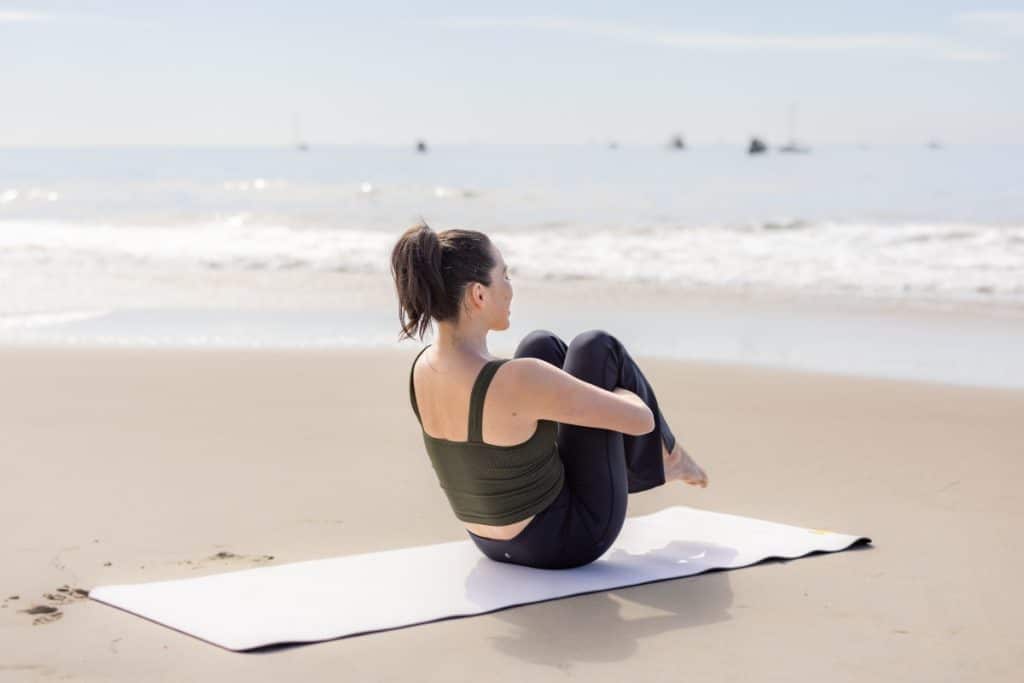
  • Enjoy a restorative Pilates session at the beach. (Lindywell members know we love this!) 
  • Sit on your patio or front lawn and listen to the birds or watch the people going by.
  • Step outside to catch the sunset for a few moments wherever you are.

Not only does this force you to slow down, but it reduces stress. In fact, spending just 10 to 30 minutes in nature can reduce your cortisol levels, blood pressure, heart rate, and other biological stress markers. Such a win-win!

4. Moderate your screen time. 

Consider how much time you spend responding to emails, browsing the internet, or checking social media. A lot of this is needed—but it doesn’t mean you can’t cut back. The reality for many of us is that we need our devices to work, plan, and live life. Here are a few practical ways to cut back, even a little:

  • Schedule 2-3 times each day to check your email. For example, you might check once in the morning, once mid-day, and once before logging off for the night. This eliminates the back-and-forth of checking each time a notification comes in. 
  • Set clear digital boundaries for yourself, like no phone for the first hour of the day no screen time after 7pm. You might also try picking one day each week to have no devices at all, like Saturday or Sunday. 
  • Re-think your evening routine. Lately, I’ve been reading in bed each night Sunday-Thursday and then watch shows after the kids are in bed on Friday and Saturday only. This ritual has helped my sleep and become a rhythm that has helped me to reduce screentime.
  • Walk during calls and meetings when you can. I have also been taking as many calls as I can on walks as opposed to sitting in the house. This isn’t always possible, but when video isn’t required, I’m opting back for a good old-fashioned phone call in an effort to take a break from screens and get some fresh air and movement in the midst of my day.

5. Cultivate a gratitude practice. 

I did a 30 days of gratitude challenge and it changed my life. While you don’t need to do a specific challenge, though, to reap the benefits—it is important to make this a regular practice. Not only does this encourage you to slow down and enjoy those precious moments you might otherwise overlook—gratitude has many health benefits, including:

  • Reduced depression and anxiety
  • Improved heart health
  • Better sleep

Here’s the thing: you can have a gratitude practice and still be rushing around from thing to thing. Here are a few ideas I’ve truly been living out lately that haven’t been easy:

Mindful Answering: Asking myself “at what cost?” instead of immediately committing to do more and take more onto my plate, I’m making sure to pause and think through the implications of doing so. Are there drawbacks that could impact my ability to slow down and enjoy my life? 

If so, I need to consider those thoroughly before saying yes. This applies in terms of work commitments, but also volunteer commitments and even commitments that we make for our kids (such as joining another sports team or RSVP’ing for multiple birthday parties on a given weekend).

Mindful Scheduling: Taking a look at our schedule on a monthly basis and ensuring that after busy stretches, we have weekend of rest as well. We can accidentally pack our weekends and pack our weeks and realize that we didn’t reserve any time in our schedule for downtime. Looking at our schedule in advance helps us to plan for downtime to avoid burnout and future stress.

Embrace a Slower, More Intentional Life with Lindywell

Whether you want to carve out more time for rest, or are craving being more present, consider joining our community here at Lindywell. 

As a member, you can access over 350 online Pilates classes, breathwork sessions, nourishing recipes, and other resources to slow down, invest in self-care, and enjoy life. Start a free 14-day trial now and reap the benefits for yourself!     

The post 5 Practical Ways to Slow Down and Enjoy Life appeared first on Lindywell.

from Blog – Lindywell https://ift.tt/hduwyDl
via IFTTT

Categories
Uncategorized

#holistic #getfit #nutrition Ulysses Pacts: STOP believing in yourself

Last week, I downloaded a new video game to play.

And 30 minutes later, I uninstalled the game. Not because I didn’t like the game, but specifically because I liked the game too much. The game is called Dave the Diver, where you are a SCUBA Diver/Sushi restaurant owner. You spend each day diving and catching fish, and then each evening serving sushi at the restaurant.

This game pressed every biological button my brain has for “efficiency.”

My brain told me I had to execute each dive as efficiently as possible. Each night at the restaurant meant I needed to receive a 100% customer satisfaction rating.

Of course, nothing would happen if I didn’t.

But this game + my brain equaled a recipe for addictive disaster. After 30 minutes I knew if I didn’t delete it, I would spend every possible minute playing the game, and every minute not playing would be spent thinking about how to get more efficient at the game.

Animated GIF

Because I’m in the middle of writing a secret-book-shaped-project that I can’t talk about… I knew I needed to save Future Steve.

In other words, it was time to channel an ancient strategy for survival:

A “Ulysses Pact.”

What is a Ulysses Pact?

In Homer’s Odyssey, Ulysses (also known as “Odysseus”) is about to sail past a dangerous island of Sirens who sing beautiful music. This music is so beautiful that anybody who hears it loses all control, and will sail toward the island, crashing their boat on the rocks surrounding the island.

Luckily, our boy Uylsses has been advised by the witch Circe on the only way he and his men can survive. In Madelline Miller’s Circe, she recounts the advice Circe gives the captain:

“[For] the Sirens, there you may use your tricks. Fill your men’s ears with wax, and leave your own free. If you tie yourself to the mast, you may be the first man to ever hear their song and tell the tale.”

As author Corey Doctorow points out in a recent newsletter:

“Ulysses was strong enough to know that he would someday be weak. He expressed his strength by guarding against his weakness.

“When you take some possibility off the table during a moment of strength in recognition of some coming moment of weakness.”

In other words, sometimes giving up on yourself is the most courageous thing you can do. It asks you to accept your weaknesses, and make a strategic pre-planned decision to protect against them.

Ulysses Pacts In My Life

I am a comical disaster trapped in the body of an adult who pretends to be a functioning member of society. I am also my own boss, completely in control of my time. Yikes.

I struggle with impulse control. There are certain experiences that I am just incapable of doing “a little bit.” I also know that once I start an enjoyable activity, it will take over.

Which means it’s practically impossible for me to only do some things “just a little bit” and then say “okay that’s enough for today.”

After all, I know my brain isn’t equipped to handle the life of abundance we’re surrounded with: endless distraction, hedonistic enjoyment, unlimited food, etc.

E.O. Wilson said it best:

“The real problem of humanity is the following: We have Paleolithic emotions, medieval institutions and godlike technology.”

Rather than lament my lack of willpower when it comes to addictive technology, I practice acceptance and instead make willpower unnecessary.

Thus, my life is held together with spit, duct tape, and Ulysses Pacts:

  • I have an app on my phone called Opal. It automatically activates at 7AM and blocks certain apps, websites, and all social media for most of the hours of the work day. I still pick up my phone 10-20 times per day and try to open those apps, and then I’m reminded to get back to work.
  • I use a program on my computer called Focus. It automatically activates at 7AM and blocks practically ANYTHING fun or distracting on my computer until the end of the work day.
  • I don’t keep snacks in my house. I love snacks. And once a bag is open, it gets eaten. But when I’m sitting on the couch watching TV (I just finished Fallout and loved it), and I’m craving a snack, there’s no decision to be made. I’m certainly not going to drive to the store.
  • I don’t have any games on my phone. I know that I can’t control any impulses, especially for “gatcha” free games that encourage you to buy gems to level up.
  • I am locked out of each social media app after 15 minutes every day. Social Media has been designed by behavioral scientists, with billions of dollars, to be as addictive as possible. So I don’t try to “use it just a little bit.” I simply don’t let myself use it for any longer than “a little bit” because I’m literally locked out.
  • I don’t play multiplayer games. I have no regulation around “okay I’m done,” so I no longer play multiplayer games. I bet if I played World of Warcraft, you would never get another newsletter from me. Thus, I exclusively play single player games with a story or narrative.
  • I automatically donate to two charities every month: ProPublica investigative journalism and the Nashville Food Kitchen. Both of these decisions were made ONCE, which means I never have to remember to donate, nor am I tempted to spend the money once it hits my account.
  • Whenever I go to the doctor, dermatologist, or dentist, I always schedule my next appointment while I’m there. Because I know I’ll forget to do so months later, or I’ll tell myself I don’t need to go. Future Steve will not want to get his teeth cleaned or get bloodwork done.
  • My workouts are pre-scheduled in my calendar. I would much rather not work out, but I know if I don’t plan for them in my calendar, something else far more fun (but less beneficial) will take their place.

The only reason you get this newsletter every week, and the only reason I get to the gym a few times per week (in addition to winning the genetic and environmental lottery), is because of these Ulysses Pacts.

Here’s how you can use them in your own life.

You-lysses Pacts in Action

Returning to Corey Doctorow:

“Ulysses pacts aren’t perfect, but they are very important. At the very least, creating a Ulysses pact starts with acknowledging that you are fallible. That you can be tempted, and rationalize your way into taking bad action, even when you know better.

Becoming an adult is a process of learning that your strength comes from seeing your weaknesses and protecting yourself and the people who trust you from them.”

Let’s see how we can add some Ulysses Pacts to your life.

To create your own Ulysses Pact: look for opportunities to make a decision TODAY in a moment of strength, to safeguard yourself against an anticipated moment of weakness TOMORROW.

Even better, look for opportunities to make a decision once, and it prevents you from needing to use willpower to repeatedly do the right thing in the future.

A few more examples:

  • Decide to not keep problematic foods in the house once, and you don’t have to spend all night, every night, deciding NOT to eat those foods.
  • Decide to automatically donate to a cause you love once, and you don’t have to remember to not spend that money on something else and donate each month.
  • Delete and/or block social media and time-wasting games on your phone once, and suddenly the decision to read a book or go for a walk rather than mindlessly scroll through TikTok or Instagram becomes much easier.

Remember, acknowledging and creating safeguards against our weaknesses isn’t a sign of giving up or weakness.

It’s a courageous sign of acceptance.

It’s also smart.

What are the Ulysses Pacts you use in your own life? Did this article inspire you to create one for yourself?

Reach out and let me know!

-Steve

The post Ulysses Pacts: STOP believing in yourself first appeared on Nerd Fitness.

from Nerd Fitness: Helping You Lose Weight, Get Stronger, Live Better. https://ift.tt/lFHAgvk
via IFTTT

Categories
Uncategorized

#healthyliving #holistic #nutrition Why Setting Boundaries in Relationships is So Hard and How to Do It Anyway

boundaries in relationships

Setting boundaries in relationships isn’t easy—and there are several misconceptions about what setting boundaries actually means. You might hesitate to form boundaries in your career, romantic relationships, or friendships because you assume this will make you come across as unreliable, selfish, or inconsiderate. 

You’re afraid to push others away, turn down opportunities, and fall short of expectations, so you just continue showing up—often to your own detriment. A recent survey found that 65 percent of women have trouble saying, “No,” to a request or invitation they don’t want to be part of. 

I know I’ve done this before and I’m sure you have too. It doesn’t feel good—and yet, it feels impossible to just do what you actually want to do. So you stay stuck in that cycle.

The truth is that setting healthy boundaries in relationships is an essential form of self-care and, as a result, is critical for your overall health and wellness. Let’s unpack what setting boundaries means (hint: it might not be what you think!) and the benefits of creating them for both your physical and mental health.

Understanding What Healthy Boundaries Mean for Your Health

First and foremost, I want to be clear on what I mean when I say “setting boundaries.” For me, setting a boundary is about determining what I want or need and then making a decision about how to achieve that for myself. Boundaries give us permission to:

  • Honor our own limits
  • Restore our inner peace and balance
  • Determine where we should invest our time and energy
  • Notice what doesn’t serve us
  • Trust ourselves to know exactly what we need

In other words, boundaries aren’t always necessarily meant to keep people out or push people or experiences away. They’re more about tuning into what you need and honoring that deeply and completely.

Believing the latter is true might be why setting boundaries feels uncomfortable. You fear that you’ll sabotage your relationships or environments that matter to you. 

The truth is, the more you learn to establish, communicate, and maintain boundaries, the more full and complete all areas of your life will start to feel. You’ll also feel less resentment toward other people and situations in your life.

Here are great things that boundaries can do for you:   

  • Make it easier to clarify and align with your main priorities. 
  • Help you distinguish your own needs, thoughts, and emotions from those of others. 
  • Help you release responsibility for someone else’s expectations.
  • Reinforce confidence, resilience, and a clear sense of identity.
  • Ensure that your time and resources are being allocated intentionally.
  • Promote healthy conflict resolution to enrich your relationships.
  • Recharge your mental, emotional, and physical batteries.
  • Nurture self-respect by communicating what you will not tolerate.

Different Types of Boundaries for Your Many Relationships

Relationship boundaries strengthen your connections with both people and things in your life. These boundaries can take many forms and each one can create more space for your authentic self to flourish and intentional, mindful living to take root. 

Notice how I’m not just referencing relationships with other people. There are many ways I’ve set boundaries in my relationships, yes with people like friends or partners, but also with technology and work—and so much more. You have a relationship with both things and people in your life—and being clear with how they play a role in your life is powerful. 

Let’s break down some different types of boundaries and how you can set them in your own life.

Emotional Boundaries

Emotional boundaries allow for a healthy relationship. They ensure that you’re safe to communicate how you feel without taking on the emotions of others. These boundaries will help you set the emotional investment you’re able to put forth so you can pull back to regulate your emotions and return to a state of balance. 

Setting an emotional boundary in a situation or with a person also empowers you to combat false narratives about yourself. In turn, you can begin to release the expectations, insecurities, and negative beliefs or reactions. Here are some examples of healthy emotional boundaries:

  • I won’t tolerate being spoken to disrespectfully.
  • I’m not comfortable discussing my past traumas with someone I just met.
  • I need some space to process my feelings before discussing that topic further.
  • I won’t take responsibility for someone else’s emotions.
  • I’m going to focus on my own needs and self-care right now.

I know this can be really hard, especially if you haven’t set boundaries in the past. But, by practicing little by little, it will get easier and be worth it in the end.”

Physical Boundaries

Physical boundaries establish a comfortable, protective barrier around your own space or body, from choosing to rest when you’re tired to telling a friend when you need space. These boundaries reinforce a compassionate, self-aware, and intuitive connection with your own body, which helps you develop deeper self-trust. 

For example, a physical boundary could be to establish alone time or even a physical space within your home where you can retreat for solitude and relaxation, such as a reading nook or a home office. 

Remember, you’re allowed to ask for personal space, even if you’re in a romantic relationship, live with roommates, or have children.

Work-Life Boundaries

Work-life boundaries create a firm separation between your personal and career obligations. An intentional work-life balance prevents the time you spend on the job from blurring into the time you allocate toward self-care and family activities. 

A good example of this might be a time boundary: turning off your email notifications right at 5 PM. While a lack of boundaries in this area can lead to exhaustion and burnout, a healthy work-life balance will improve your mental health, reduce stress levels, and increase happiness. 

I know this is something you’ve heard before—but do you actually set and respect those boundaries? 

Technology Boundaries

Technology boundaries help you establish restrictions on smartphone usage, so you can unplug from virtual screens and connect with the real world. I know that if I’m not intentional about this, I’ll check my phone continually throughout the day without even thinking about it.  

This is a chance to set some guidelines for when you want to be on your phone or how much time you want to spend on social media. Putting physical space between yourself and these aspects of your life can help you better align with the self-care you want to give yourself.    

Interestingly, a two-week detox from social media was found to result in less anxiety, stress, sleep disturbances, and even sedentary habits. If those are goals for your life, a digital detox or better tech boundaries are a good thing to consider.

Putting Boundary-Setting into Practice

Now, we get to the part that might feel the hardest—drawing the line in the sand and setting those clear boundaries. Here’s an exercise you can use to take the emotion of this practice and instead, focus on what you need and how you can make it possible. 

Take a piece of paper and draw two lines down it so you have three columns. Fill them out as follows:

Column 1: Identify how you want to take better care of yourself. Coming back to self-care and what is getting in the way of that. Start with 5-10 things that your mind and body is craving. Maybe it’s more nutritious food options during the week or extra quiet time before or after work.

Column 2: Determine what’s getting in the way of those things. Write this in column two next to each thing. Maybe you’re eating out for lunch each day, rather than making yourself a nutrient-dense lunch because you’re not giving yourself the time to get to the grocery store. Write that down.

Column 3: In the last column, write what small action you can take to set a healthy boundary and give yourself the thing you’ve been needing. Be realistic here—this isn’t about magically creating more hours in the day. It’s about doing what you can with what you have. 

Finally, choose 2-3 of these things that you can start doing this week. Set those boundaries, get a little uncomfortable as you put them in place, and see what happens. With a little practice, setting boundaries will get easier—and you’ll feel good too!

Communicating Boundaries (With Yourself and Others)

Effective boundary-setting with others requires clarity, consistency, communication, and assertiveness. Clearly articulating your boundaries helps to avoid misunderstandings and conflicts. 

I want you to remember that being assertive doesn’t mean being aggressive or confrontational. It’s about expressing your needs and limits firmly but respectfully, while also being open to negotiation and compromise when appropriate. 

For example, if you repeatedly experience a boundary violation, it’s necessary to calmly but firmly reassert what you need, perhaps with additional clarification if necessary. It might even be necessary to put space between you and the person who’s violating your boundary to protect yourself and your mental health. 

Just as important as communicating to others is holding healthy boundaries for yourself. This requires you to not only recognize your own limits, needs, and desires—but also keep yourself accountable to prioritizing those things. 

In doing this, you empower yourself in other areas of your life too, which allows you to further set boundaries that are needed as your life changes and evolves.  

Strengthen Your Boundaries and Nurture Self-Care with Lindywell

Healthy boundaries in your relationships with people, technology, and work make it possible to regulate emotions, maintain inner peace, successfully navigate relationships, restore energy levels, and, ultimately, prioritize your own self-care. Boundaries are about more than just saying, “No,” to what doesn’t serve you. Boundaries also free you up to offer a resounding, ”Yes!” to what feels most important in each season of life.

To prioritize your well-being in a way that is easy and convenient, I invite you to become a part of our community at Lindywell. Join now and get 14 days free! As a member, you’ll gain instant access to more than 350 Pilates classes, guided breathwork sessions, and nourishing recipes. Shift into grace over guilt while you make time for YOU.

The post Why Setting Boundaries in Relationships is So Hard and How to Do It Anyway appeared first on Lindywell.

from Blog – Lindywell https://ift.tt/T8OdZrj
via IFTTT

Categories
Uncategorized

#holistic #getfit #nutrition The 20 Minute Beginner Kettlebell Workout: Try This Simple Workout at Home or Anywhere!

Kettlebells can provide a great full body workout.

Our simple beginner kettlebell workout will blow your mind.

Come on: Who else is going to teach you to use a kettlebell with Mario and Mega Man references?

In today’s guide, we’ll go over the following (click to go right to that section):

These are the types of programs that we create for our 1-on-1 Online Coaching Clients, and we’re getting amazing results for people. 


And make sure you download our Kettlebell Worksheet! It’ll come in handy in just a moment.

Okie dokie, let’s jump right in.

The 20-Minute Beginner Kettlebell Workout (with Video Demonstration)

Once you’ve watched the video above (featuring Matt Shortis, a lead trainer in our 1-on-1 Coaching Program) here’s a quick recap with repetitions for the workout here:

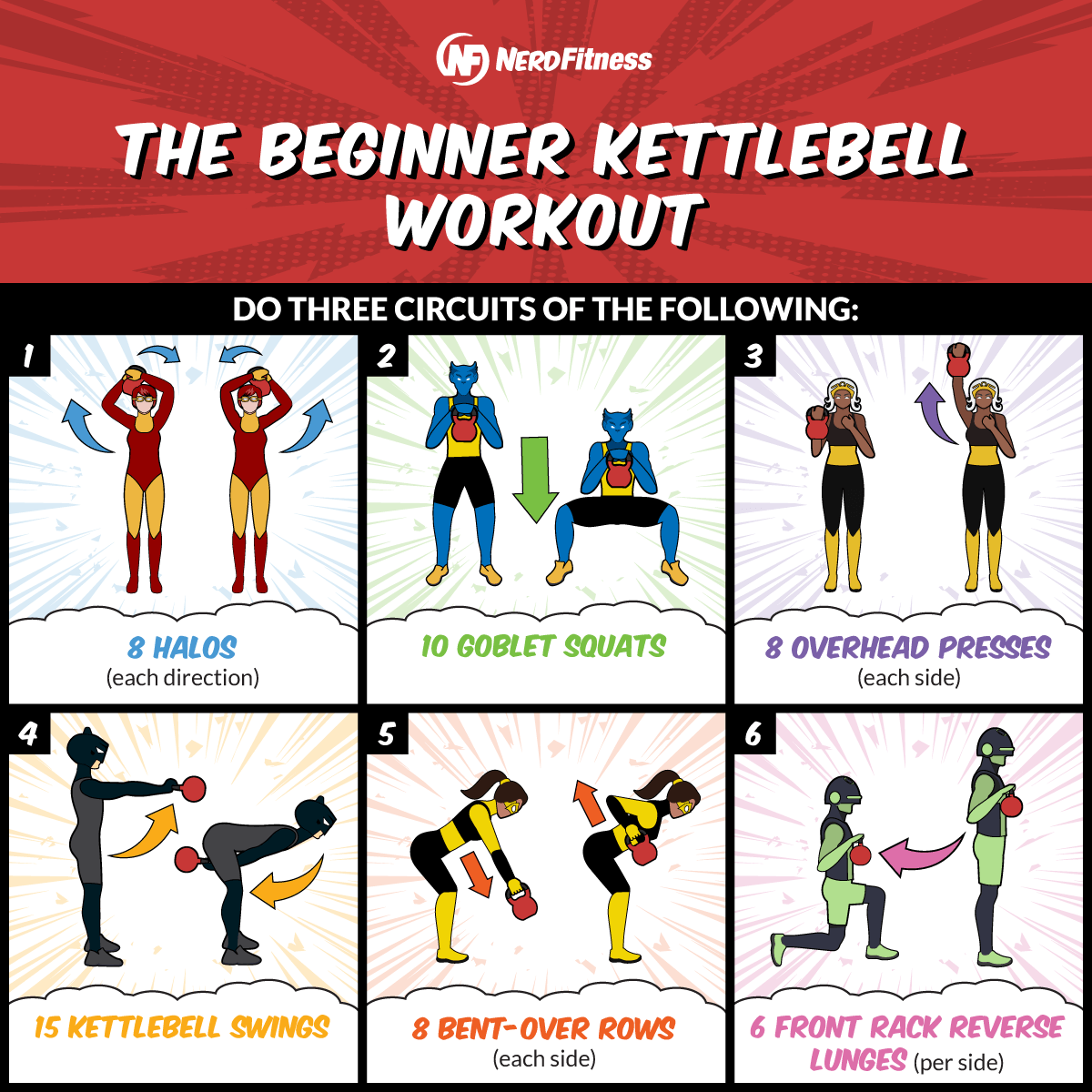
COMPLETE THE FOLLOWING KETTLEBELL CIRCUIT 3 TIMES:

  • 8 Halos (each side)
  • 10 Goblet Squats
  • 8 Overhead Presses (each side)
  • 15 Kettlebell Swings -OR- Romanian Deadlifts
  • 8 Bent Over Rows (each side)
  • 6 Front Rack Reverse Lunge (per side)

And because we like to have fun around here, we made a graphic where superheroes do the workout.

Here’s the Beginner Kettlebell Workout as an infographic:

This infographic shows the 6 exercises needed for the Beginner Kettlebell Workout

Our Beginner Kettlebell Workout is what’s called a circuit (you can learn all about circuit training here). That’s just a fancy term for doing a workout like so:

  • 1 set of exercise A, go immediately to
  • 1 set of exercise B, go immediately to
  • 1 set of exercise C, and so on…
  • Repeat from the top!

Your long-term goal should be to do 3 full circuits, back to back, for a complete workout.

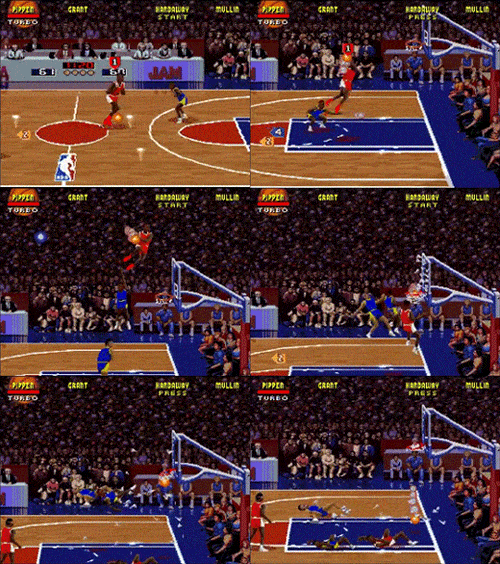
4 if you’re on fire, like in NBA Jam.

On fire from NBA Jams

If you can only go through it once or twice, that’s okay too!

And if you need to take a break at any time between sets or after a circuit, do it! The most important thing is performing each rep with great technique – so if you need a breather to recover and give it your best effort, take it!

Prior to jumping into the kettlebell circuit, don’t forget to do some mobility warm-up (you can see our warm-up routine here):


Nothing too crazy, just something to “grease the groove” and get your body used to movement so you don’t pull any muscles once you start swinging the kettlebell.

In other words, prepare your muscles and joints to move some weight around!

A few minutes of running in place, air punches and kicks, some jumping jacks, and arm swings, should get your heart rate up.

After that, do a couple of reps of movements that mimic what you’ll do in the workout (i.e. do bodyweight squats to prep for goblet squats, etc.), and your muscles and joints will be warmed for the full Kettlebell Workout.

Coach Matt showing you how to rock the kettlebell swing.

You can do all of the Beginner Kettlebell Workout with one single bell, from anywhere.

We’ll go over each move in our next section, so you can perfect your kettlebell technique.

When you’re done, do some light stretching to cool down. A couple of yoga poses would suffice. Make sure you drink water too.

Feel free to follow this routine at least once a week and up to 2-3 times a week, with a day off between.

Remember, you don’t build muscle when you’re exercising, you build muscle when you’re resting.

This cat put his kettlebell away so he can rest and grow muscle.

Your muscles are broken down when you strength train, and then they rebuild themselves stronger over the following days of recovery!

If you just can’t sit still, feel free to do some fun exercises, go for a walk, or do one of these off-day activities.

Don’t forget to download our Beginner Kettlebell Worksheet, which covers the above sequence from Coach Matt.

You can print it out and track the number of sets and repetitions you complete, which will help ensure you progress in your training.

You can grab yours free when you sign up in the box below:

How to Hold A Kettlebell

In the video above, Coach Matt walks you through the proper technique for holding a kettlebell.

Give it a quick watch before we break down all the exercises found in our beginner workout.

The 6 Best Kettlebell Exercises for Beginners

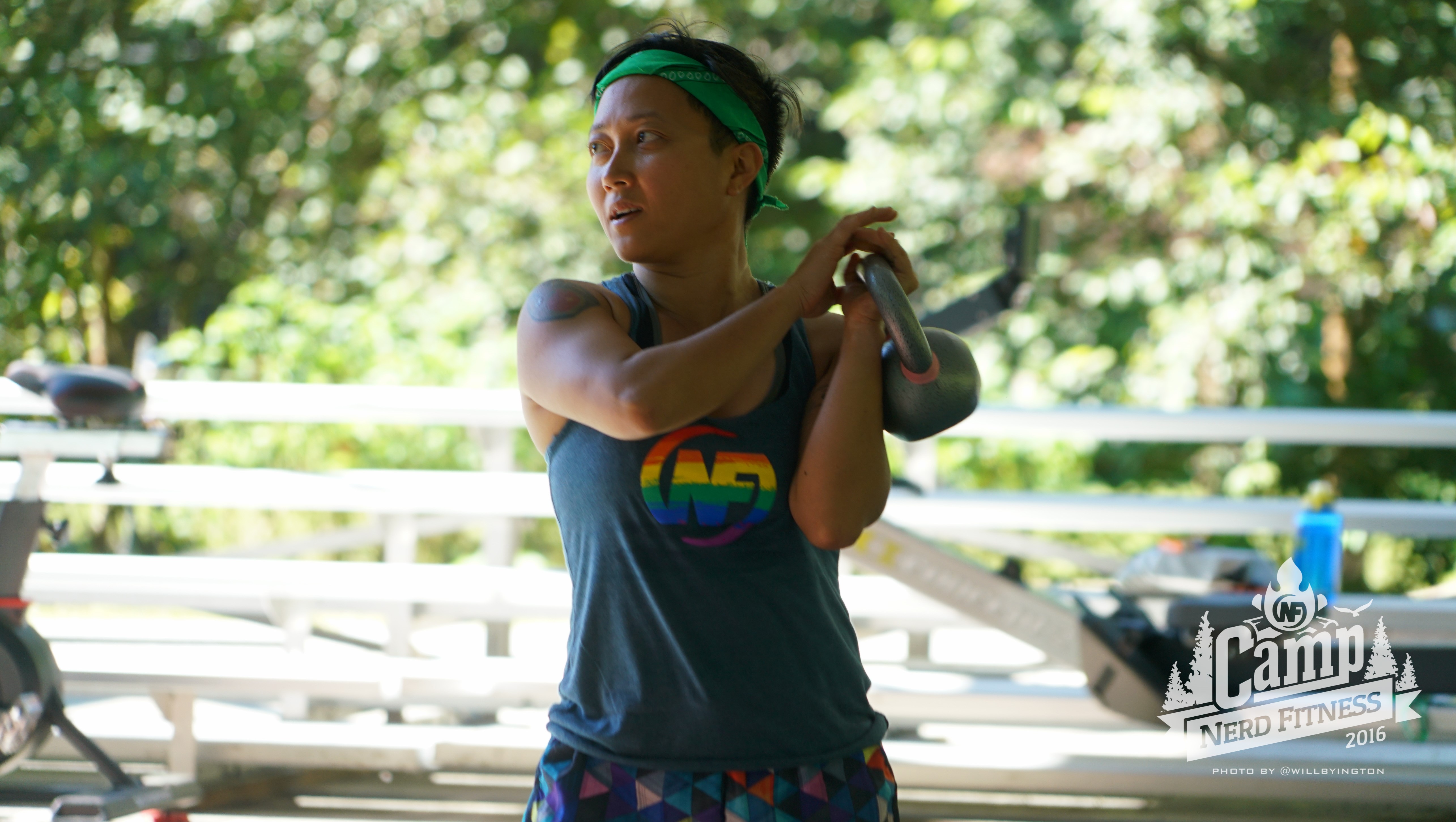
One of the campers from Camp Nerd Fitness with a kettlebell!

Let’s go over each exercise in the 20-Minute Beginner Kettlebell Workout: 

#1) KETTLEBELL HALOS

Coach Matt showing you kettlebell halos.

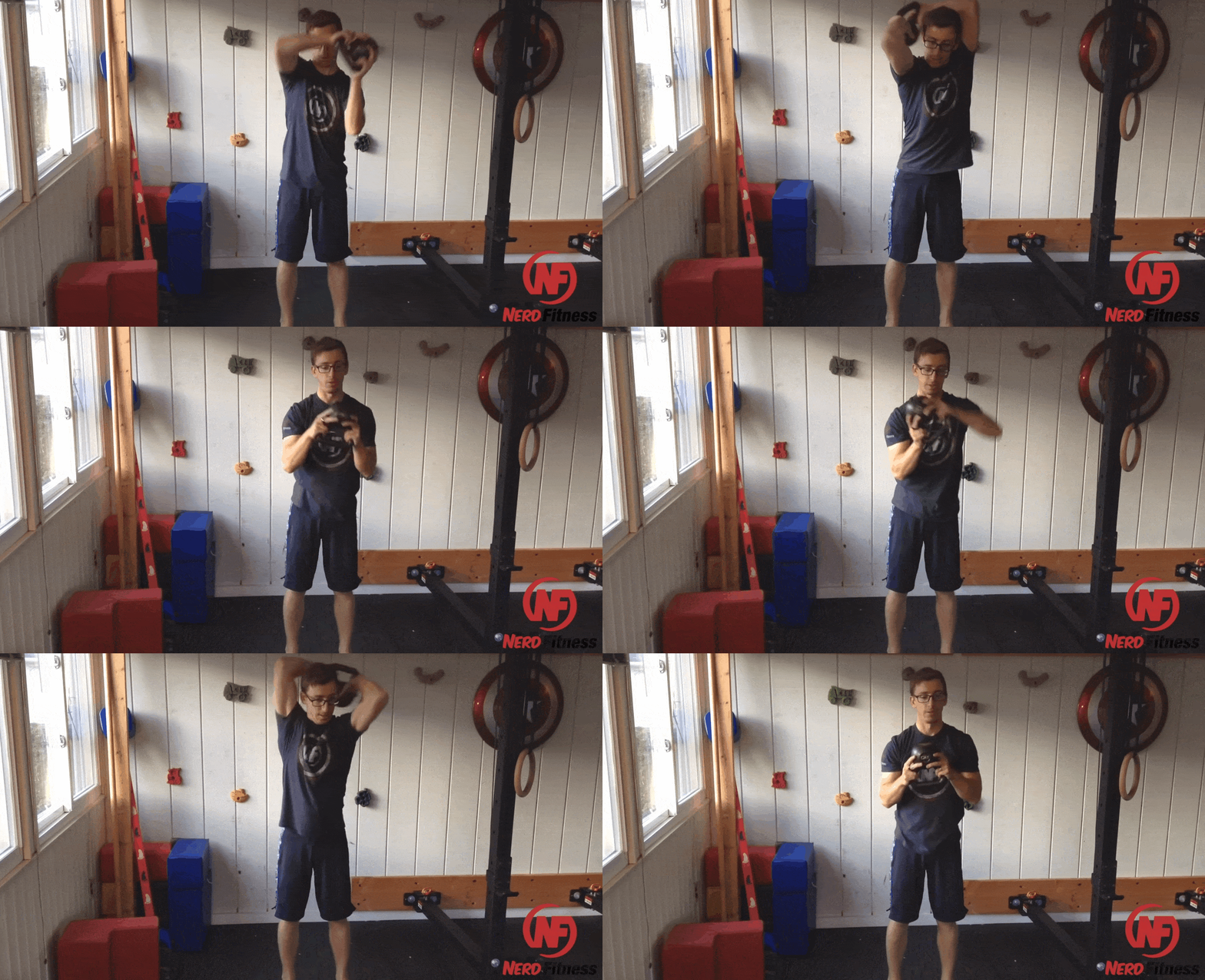
  1. Grab the kettlebell with two hands on the handle.
  2. Raise the kettlebell above your head.
  3. Move around your head like you’re tracing a halo.

Tip from Coach Matt: with your halos, remember to keep the movement smooth. You don’t want to accidentally slam your head with the bell.

#2) KETTLEBELL GOBLET SQUAT

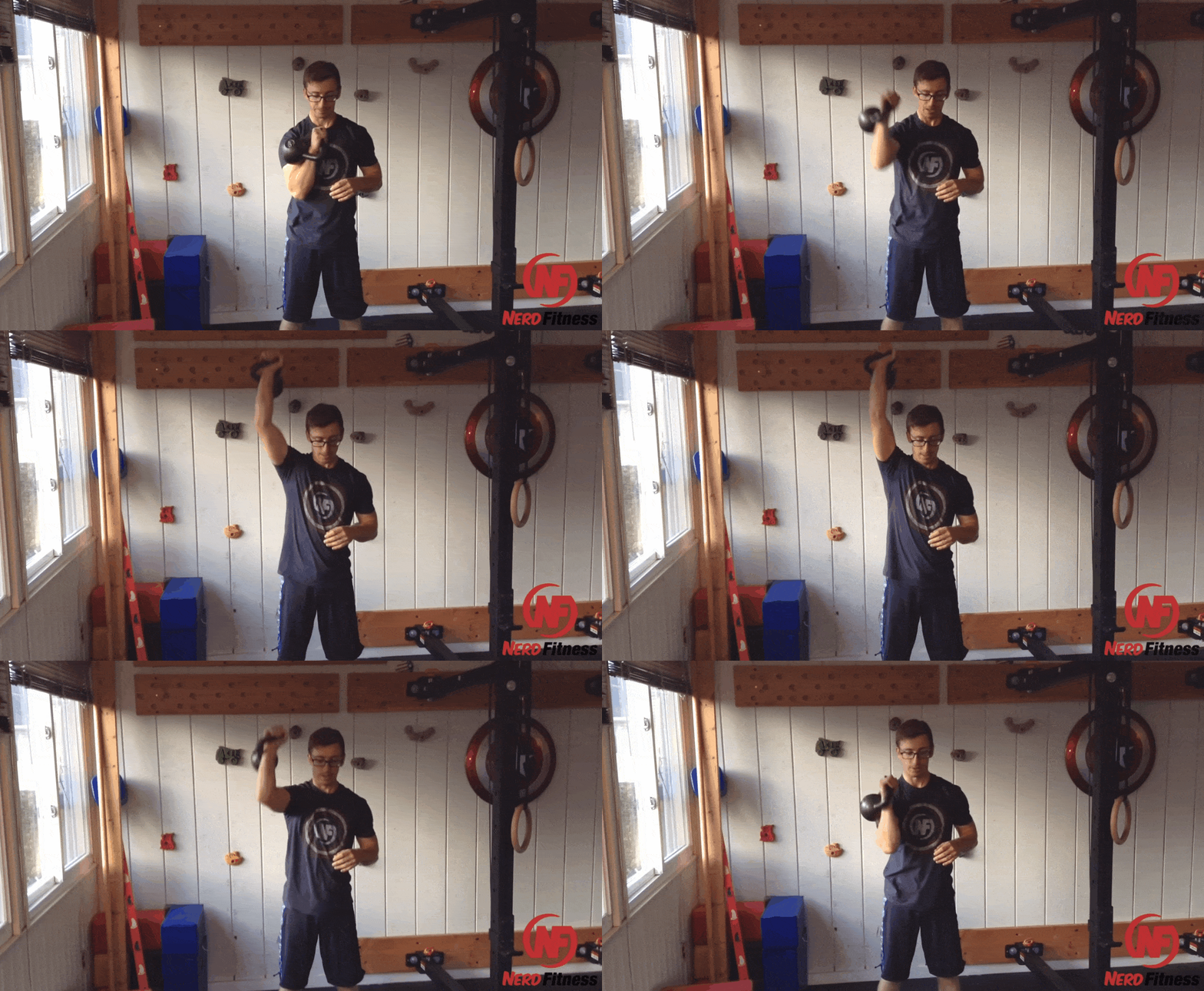
  1. Grab the kettlebell with two hands “by the horns,” aka the handle.
  2. Keep your elbows in tight and your feet about parallel.
  3. Then lower down like you would in a bodyweight squat.
  4. Reverse the movement to raise back up.

Tip from Coach Matt: for the goblet squat, focus on depth. It’s more important to practice doing a full squat than to pump out reps. If you can’t make 10, don’t stress it. Do what you can.

#3) KETTLEBELL OVERHEAD PRESS

Coach Matt showing you how to do the kettlebell press.

  1. Grab the kettlebell with one hand, with the handle going down your palm (if the handle is too close to your fingers it’ll pull your wrist down).
  2. Press straight up with your fist driving the movement (your fist would be pointing up the entire time).
  3. Reverse the movement and bring the kettlebell back down. Then repeat.

Tip from Coach Matt: lower the bell under control by slowly hugging your elbow to your side. Tightening your lat this way will create a more stable position for the press.

#4) KETTLEBELL SWING -OR- ROMANIAN DEADLIFT

If you’ve never done a deadlift or a Romanian deadlift (RDL) before, we recommend starting with this variation, as it will set you up for success in the kettlebell swing later.

Here’s a detailed demonstration of how to do an RDL with dumbbells. With a kettlebell, all the same principles apply; you just hold the kettlebell with both hands.

  1. Grab the weight and stand tall with knees slightly bent.
  2. Keeping your back in a straight line, pivot from the hips and push your hips back towards the wall behind you. (Imagine you are slamming a car door shut with your butt while your arms are full of groceries.)
  3. Stop the movement when your hips stop moving backward. (Lots of people will continue to drop their chest even when the hips are no longer moving.)
  4. Press your feet through the floor and stand back up in one motion.
  5. Repeat.

Once you’ve mastered the RDL, it’s time to move on to the Kettlebell Swing.

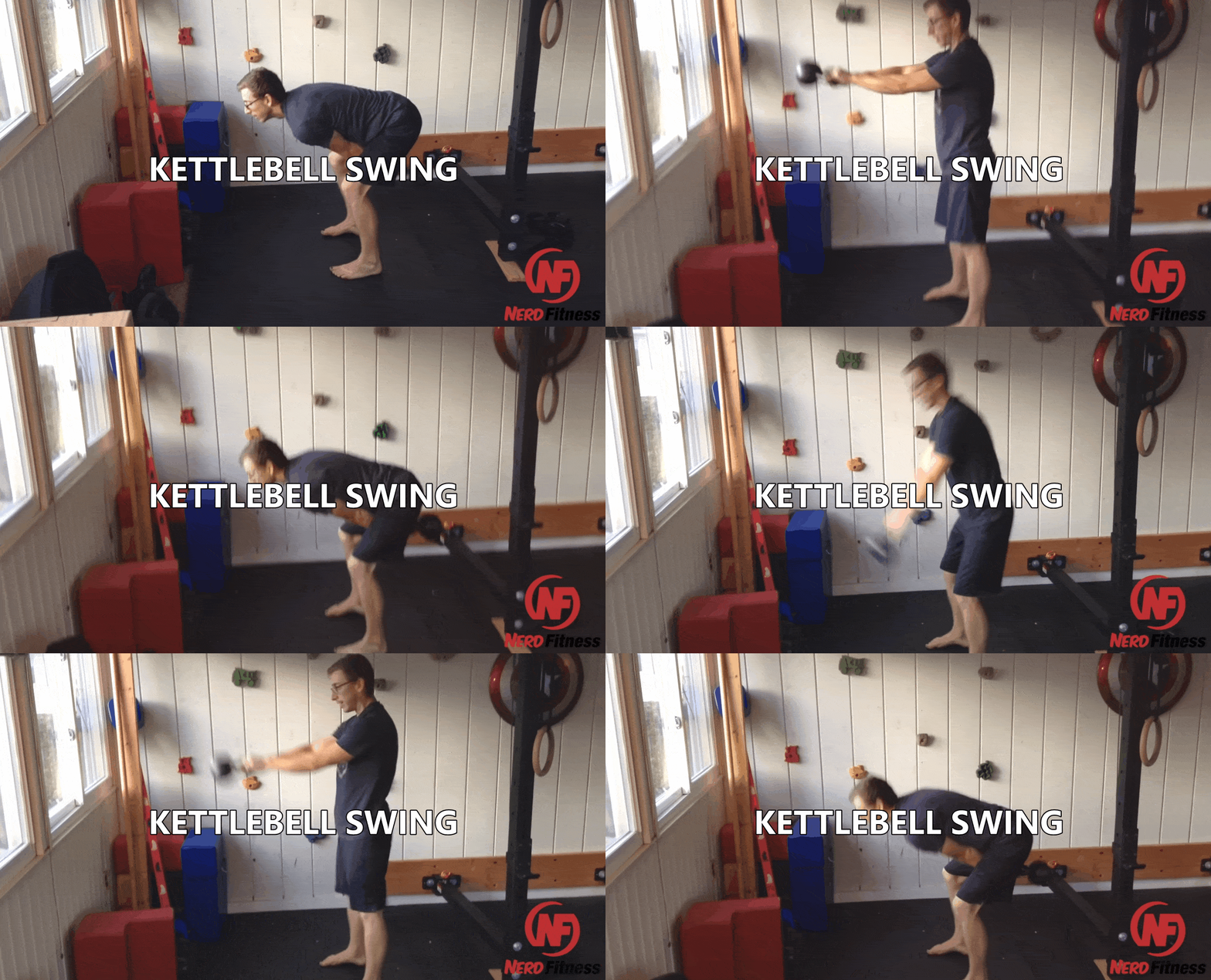
Coach Matt showing you how to do the kettlebell swing.

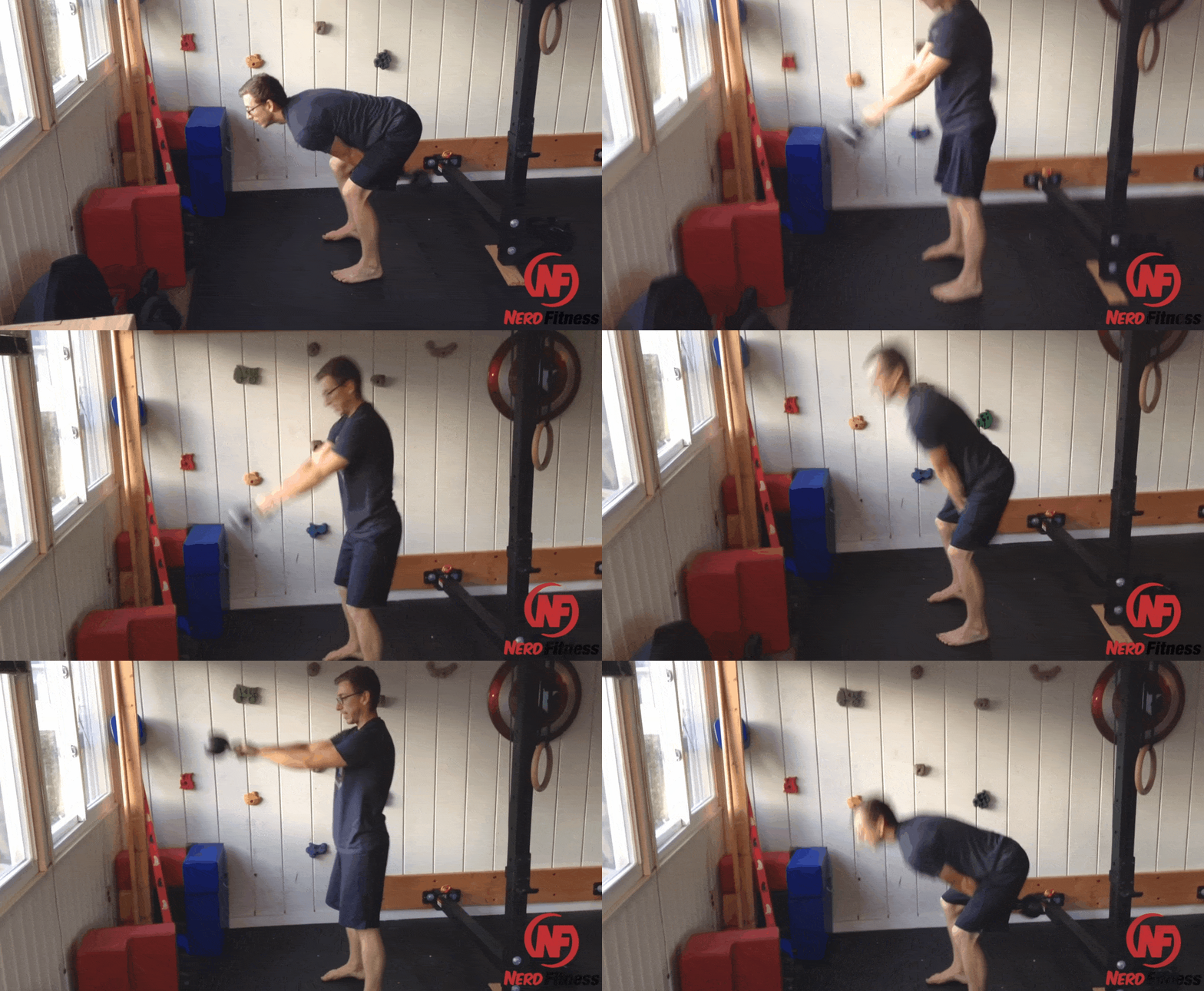
  1. Get down into a bent-over, flat-back position and grab the kettlebell with both hands from the handle.
  2. Swing the kettlebell behind you, then get ready to jump up.
  3. Jump up (without leaving the ground) and swing the kettlebell up. You should be standing tall at the peak of the movement.
  4. Reverse the movement and bring the kettlebell back down and behind you.
  5. Repeat.

Tip from Coach Matt: during the kettlebell swing, focus on hinging your hips. The swing is like a deadlift movement, so you should feel it in your hamstring and glutes.

#5) BENT OVER ROW

And here is the kettlebell row!

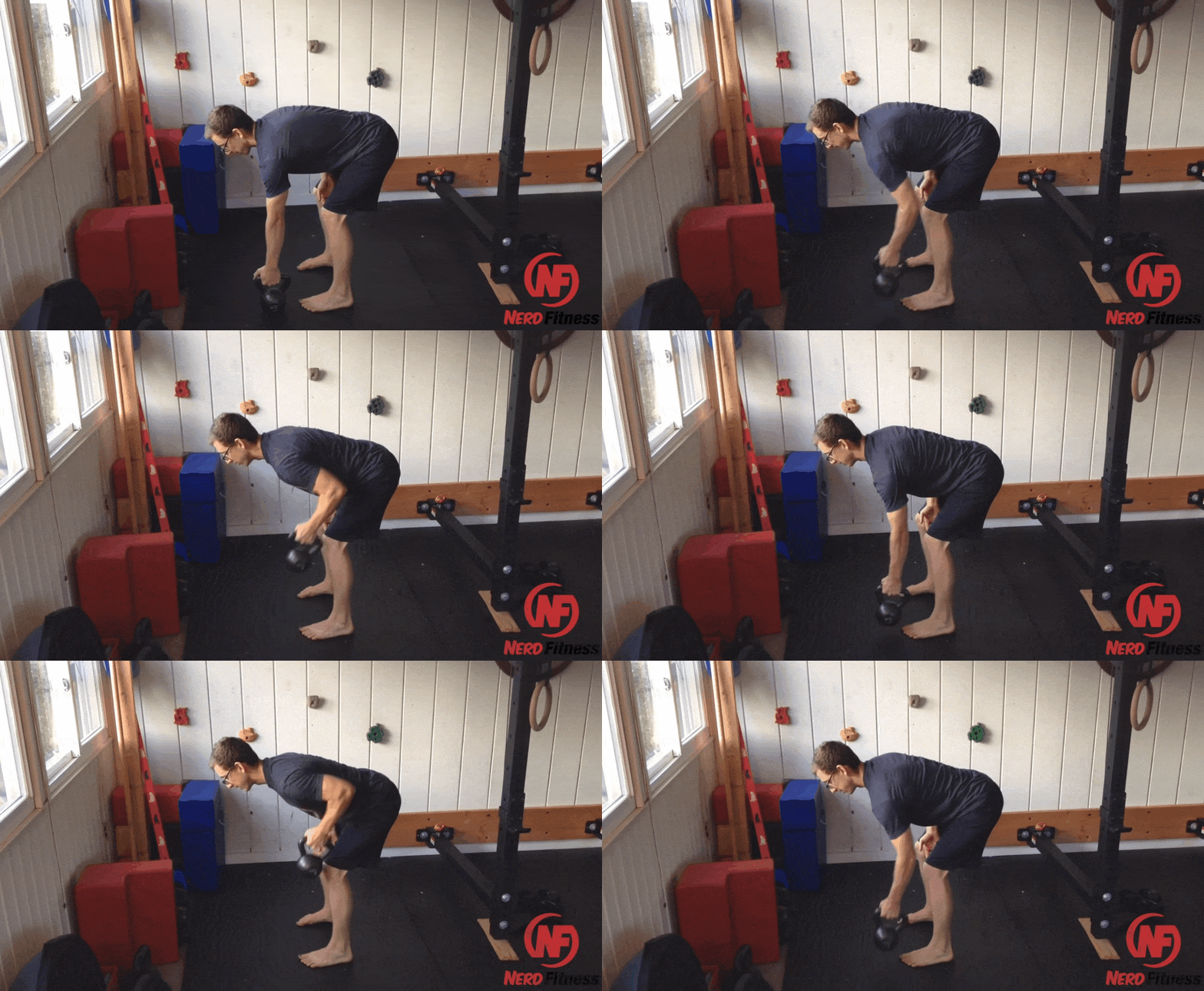
  1. Get down into a bent-over, flat-back position and grab the kettlebell with one arm.
  2. Pick up the kettlebell by driving your elbow up into your rib cage.
  3. Lower the kettlebell back down by reversing the movement.

Tip from Coach Matt: try to keep your back straight and stomach tight during the row. This will help engage your legs for stabilization as you pull the kettlebell toward your stomach.

#6) FRONT RACK REVERSE LUNGE

And last but not least, here is the kettlebell lunge.

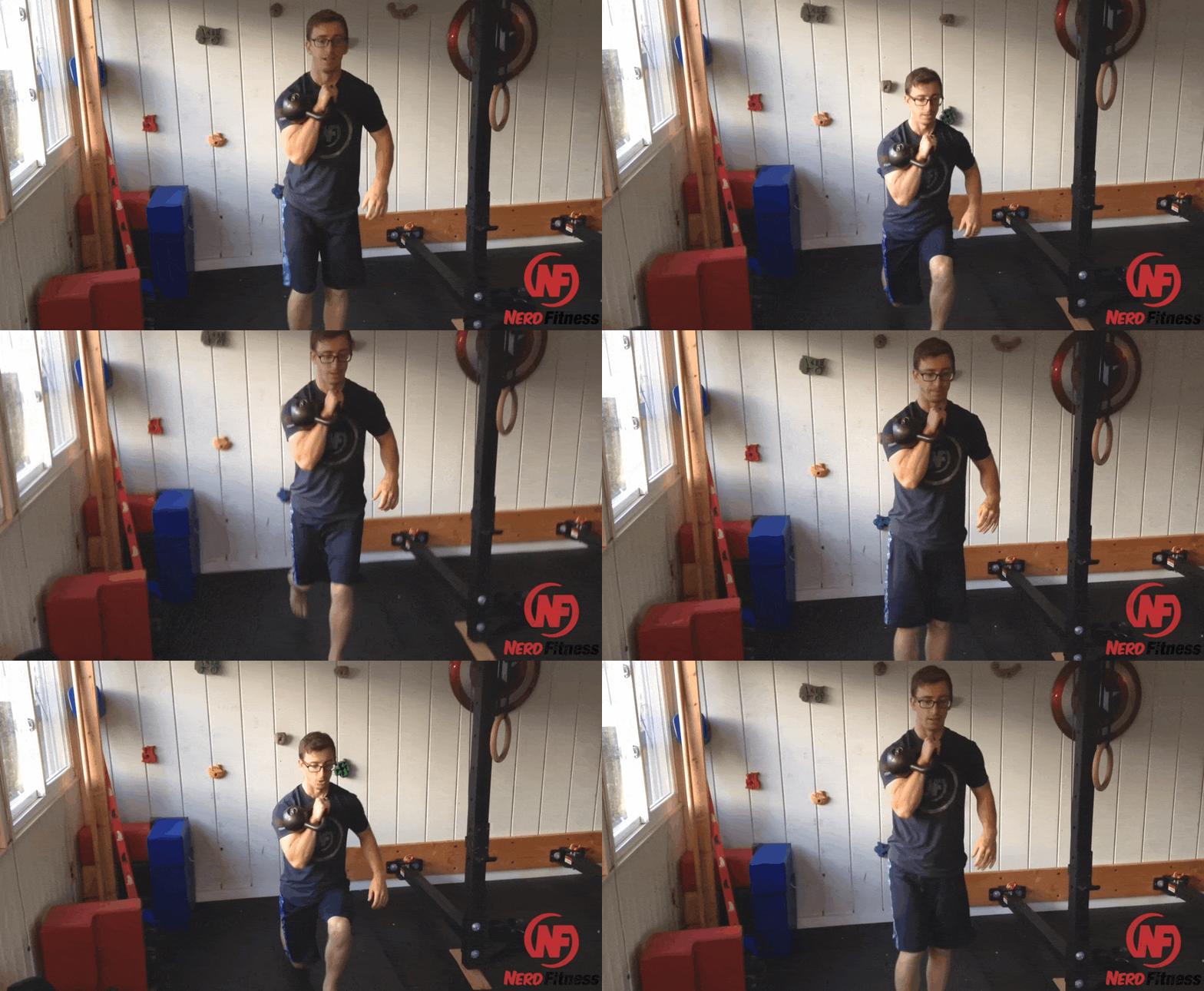
  1. Grab the kettlebell with one hand and rest the weight between your arm and chest.
  2. Step your leg back (the same side your kettlebell is on) and lower down until your shin is parallel-ish with the ground (or as low as you can).
  3. Spring back up to your starting position.

Tip from Coach Matt: for the lunges, again keep your back straight. This reduces pressure on your lower back.

Boom! There you have it.

The 6 best kettlebell exercises for beginners

If you want someone to review your form on any of these kettlebell movements, or you’re looking to level up your kettlebell game, our coaches can do just that! Our spiffy mobile app lets you send a video of your exercises directly to your coach, who will provide feedback so you can perfect your technique.


In case you’re still on the fence about grabbing a kettlebell, let’s dig into them a little bit more.[1]

What Type of Kettlebell Is Best? What Is the Best Kettlebell Weight for Me?

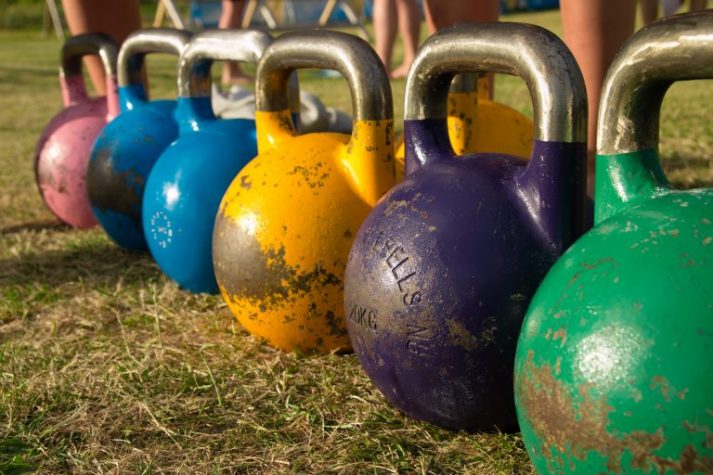
What kind of kettlebell should you use?

So you want to buy a kettlebell, eh?

They come in all sorts of materials, in all sorts of shapes, and in all sorts of sizes.

Which one you pick will come down to your personal preference, your budget, and your experience with kettlebells.

Let’s contemplate the following when picking the right kettlebell:

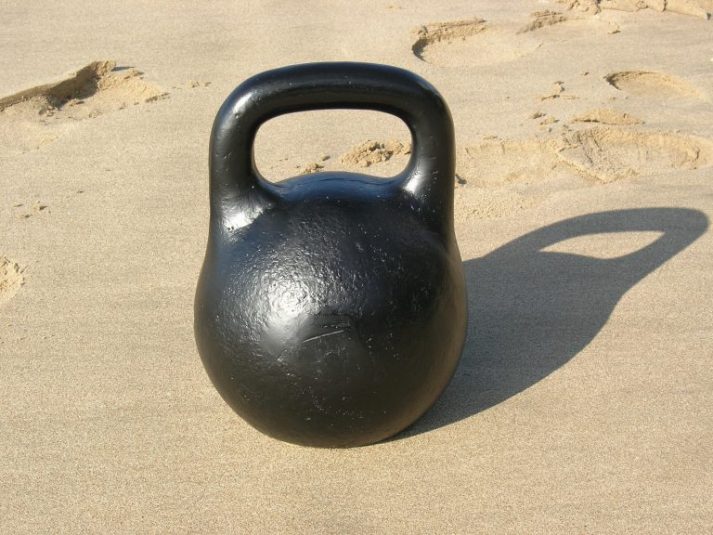
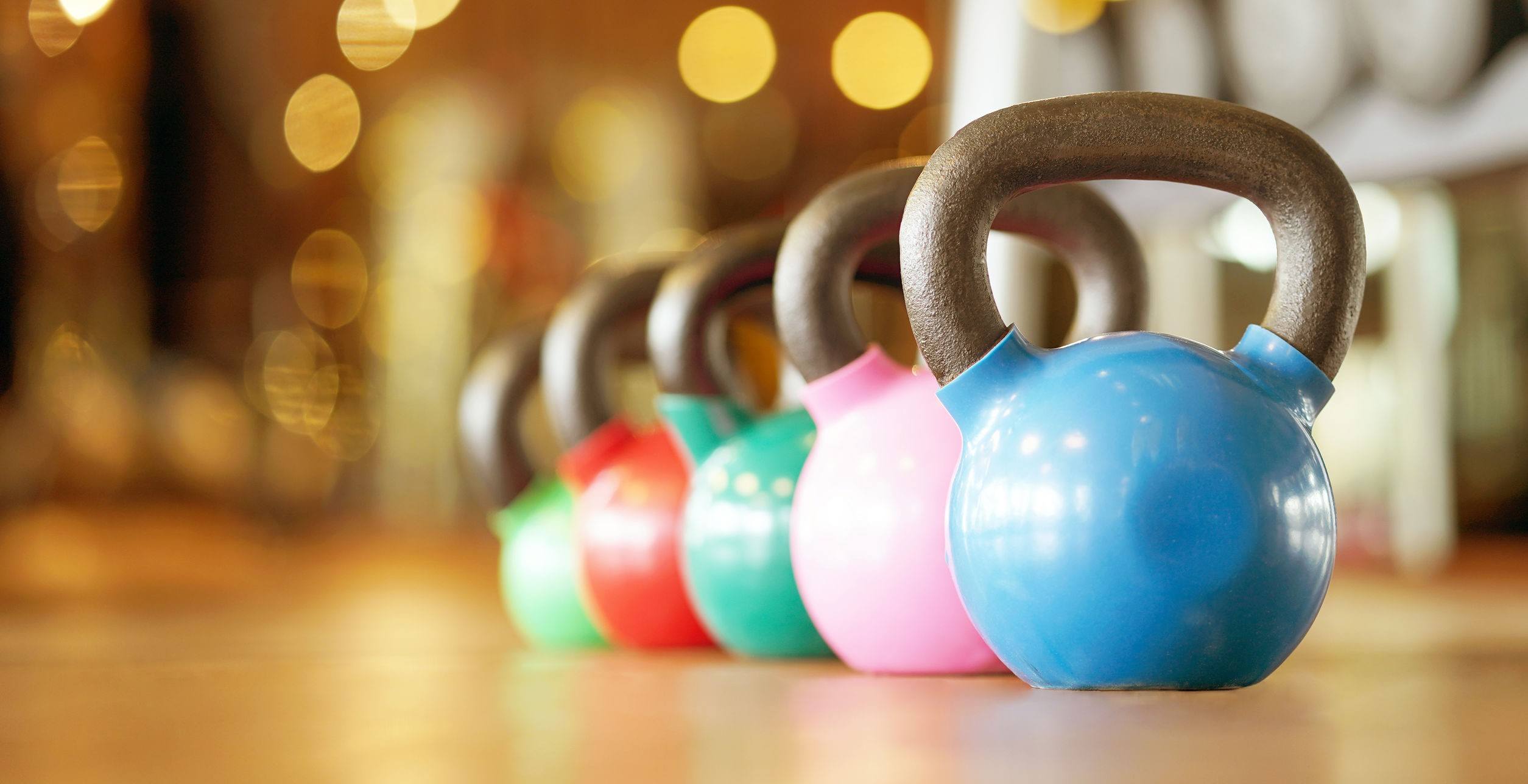
#1) Standard vs.Competition. A standard traditional kettlebell will be cast iron, and as the weight goes up, the dimensions go up.

For example, a 16kg (35 lb.) bell will be larger than a 6kg (15lb) bell. This isn’t true for competitive kettlebells.

No matter their weight, competitive kettlebells will have the same dimensions for bell shape, base, and handle width.

So the 16kg will look just like the 6kg. This can be helpful to make sure you are consistent with your technique.

#2) Weight. In general, pick a weight that allows you to complete a workout with good form.

When in doubt, start with a lighter weight, as you can always increase the weight/size later. If you’re forcing me to pick one for you, knowing NOTHING about you, I’d say consider purchasing a 16kg (35 lbs) if you’re a male or 12kg (25 lbs) if you’re a female.

Now, this isn’t an exact science, and we are all unique snowflakes. If you think you’re stronger than average, go heavier. Not quite there? Go lighter.

#3) Ballistic vs. Grind. You’ll often hear the terms ballistic and grinding in kettlebell workout discussions, for fast and slow movements respectively.

Ballistic movements would be quick, like the kettlebell swing.

Grinding movements would be slow, like the overhead press. For ballistic movements, you might actually want a heavier kettlebell, to help with momentum.

For grinding movements, less weight might be in order to help with control.

For now, if you are just starting out, go ahead and stick to one kettlebell. Branch out as you advance in experience.

#4) Handle. This is where quality comes into play. You’ll be doing many, many repetitions with your kettlebell.

If the handle has rough edges, you’ll feel each and every one of the movements cut into your hand.

If you're not careful, the kettlebell handle can scratch your hand and hurt. Ouch!

Not fun.

Quality matters when it comes to handles. So we’ll chat about ideal brands in a moment. I’ll end our discussion on handles by saying they are generally standardized at 35mm for thickness.

Use this as your baseline for differences when comparing bell grips.

Okay, let’s talk about kettlebell brands:

#1) Cap Barbell. This would be an ideal first kettlebell. Not too expensive and of decent quality, Cap Barbell kettlebells can be found on Amazon or at any Walmart.

The Cap Barbell is the most highly reviewed and reasonably priced kettlebell we have encountered. Do you have any experience with one?

Let us know in the comments if you like it!

#2) Kettlebell Kings. You see Kettlebell Kings ranked as some of the best bells out there. Not a bad price for the quality.

Plus, they offer free shipping in the US, which is nice since you’re essentially mailing a cannonball.

#3) Dragon Door. Some call Dragon Door the gold standard of anything and everything “kettlebell.”

I wouldn’t disagree, but expect to pay for it.

#4) Onnit. Onnit rocks and they offer good quality bells that are quite popular.

#5) Home Gym Equipment companies have grown massively in recent years, which is great for you as a consumer! You can also find great Kettlebell options at reputable home gym companies like Rogue Fitness, REP Fitness, and Fringe Sport. (Special shout out to FringeSport for loaning us equipment to run Camp Nerd Fitness in the past!) You can’t go wrong with any of these options.

OUR ADVICE: Before you go buy an expensive kettlebell, check your gym!

I bet it has kettlebells, and you can try out different brands/ sizes/ weights/ styles to see which one you like the best.

Afraid of going? Here’s how to train in a gym.

Don’t care about buying your bell new?

Check out Craigslist or a used sporting goods store like Play it Again Sports for a previously owned kettlebell from a person who no longer needs it.

A used kettlebell is still a kettlebell.

Crafty? Build your own!

Here’s a video on how to make a kettlebell:

If you make your own kettlebell (be careful – you don’t want it breaking mid-swing!), please email me. I would be so pumped!

And if you need help with ALL of this and just want somebody to tell you how to train, I got you covered too.


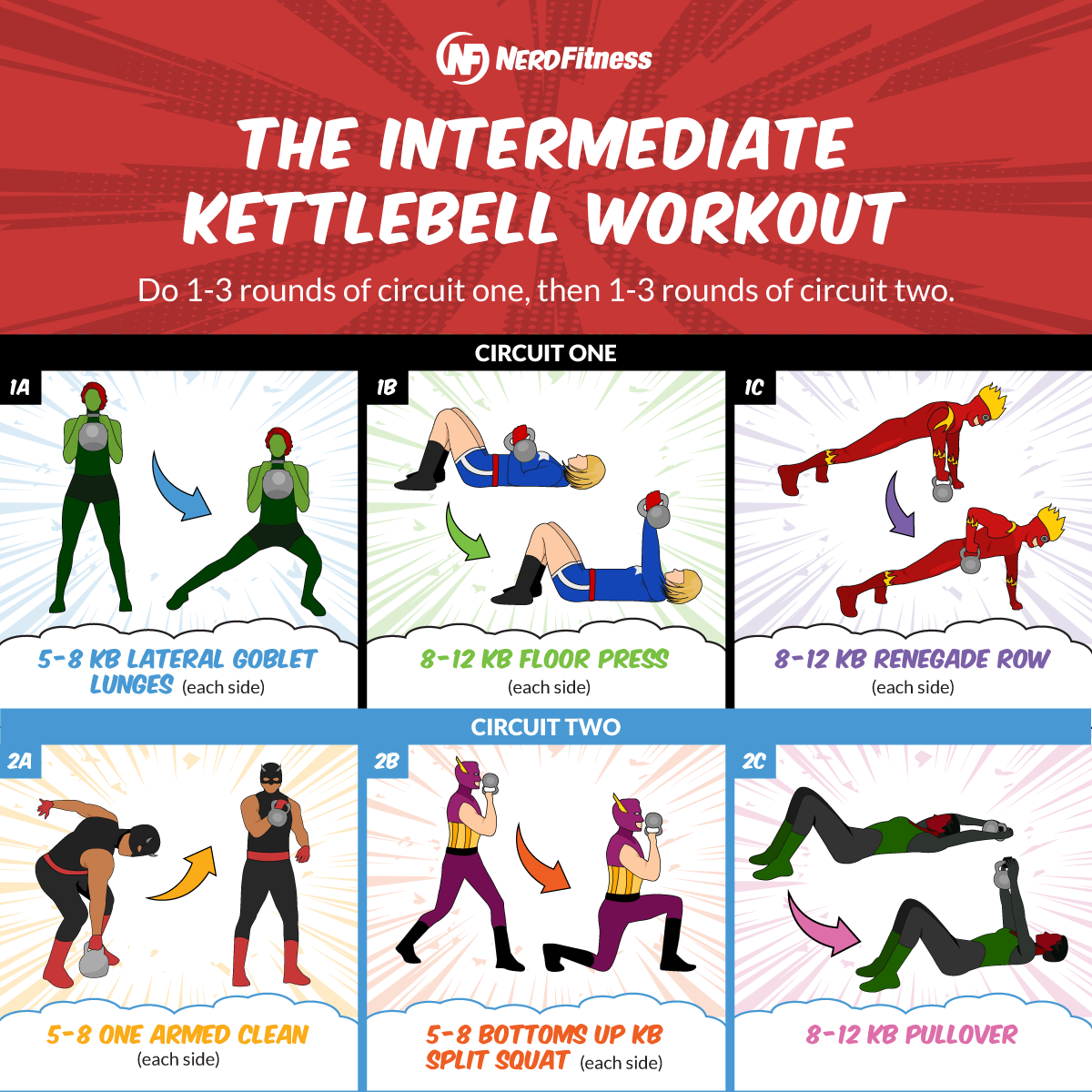
The Intermediate Kettlebell Workout

If you’ve been rocking and rolling with the Beginner Kettlebell Workout for a while, it might be time to switch things up for a more challenging routine.

What should you do?

Try our intermediate workout above!

It’ll have you doing moves like:

Kettlebell Lateral Goblet Lunges

Kettlebell Renegade Rows

Here’s the Intermediate Kettlebell Workout as an infographic:

An infographic showing the Nerd Fitness Intermediate Kettlebell Workout

The workout is your perfect next step if the beginner version got a little too easy.

Want another full-body movement you can do with the kettlebell? Try adding in the Turkish Get-Up ~ perhaps the most famous kettlebell movement outside of the kettlebell swing!

Can You Lose Weight with Kettlebells?

Can a kettlebell help you lose weight?

If you’re trying to lose weight, a kettlebell and the workout routines above would be a great part of the plan!

The other part of the plan should be your nutrition.

As we lay out in our Coaching Program and our massive guide on “Healthy Eating,” we believe that proper nutrition is 80-90% of the equation for weight loss.

Yes, a kettlebell alone won't get you in shape!

No joke.

It’s by far the biggest factor for success.

So will you lose weight training with kettlebells?

Maybe!

If you fix your diet AND begin to incorporate our kettlebell routine a few times per week, you’ll will find yourself building muscle, losing fat, and getting stronger!

Wayne stoked that a kettlebell workout plus proper nutrition will help him get in shape.

So how do you fix your diet?

Great question.

Here are some basic tips though (as we cover in our Beginner’s Guide to Healthy Eating):

  1. If your goal is weight loss, you have to eat less than you burn each day. This can be through eating less and burning more (from the kettlebell workout above)
  2. Processed foods and junk food make it really tough to lose weight: They have lots of calories and carbs, low nutritional value, don’t fill you up, and cause you to overeat.
  3. Vegetables are your friend. If you don’t like veggies, here’s how to make vegetables taste good.
  4. Liquid calories are sabotaging your efforts. Soda, juice, sports drinks: they’re all pretty much high-calorie sugar water with minimal nutritional value. Get your caffeine from black coffee or tea, fizzy-drink fix from sparkling water.
  5. Not losing weight? Track your calories and work on consuming slightly less each day. We tackle this point in-depth in our article “Why can’t I lose weight?
  6. Eat more protein! Protein helps rebuild muscle, and can help you stay under your calorie limit because it’s satiating and filling. Here’s exactly how much protein you should be eating every day.

Those tips should get you started, but if you want more specific instruction and guidance, check out the NF Coaching Program – Your Coach will build a routine tailored to your individual needs and what equipment you have available:

Download the Kettlebell Worksheet!

Colorful kettlebells in gym

Like most things in life, the important aspect of any exercise regimen is starting it.

No matter what strength training program you choose, start TODAY.

This cat is ready to start his kettlebell workout! Let's hope he doesn't lose the shades.

You don’t need to get strong before you can play with a kettlebell. You can play with a kettlebell to get stronger!

Here’s that Beginner Kettlebell Workout one more time to recap:

  1. Halos: 8 reps each side
  2. Goblet Squats: 10 reps
  3. Overhead Presses: 8 reps
  4. Kettlebell Swings -or- Romanian Deadlifts: 15 reps
  5. Bent Over Rows: 8 reps each side
  6. Front Rack Reverse Lunge: 6 reps each side

Here are the next two steps you can take with our community if you dig what we do! 

1) Check out our 1-on-1 Online Coaching program. Our coaches can work with you to pick up a kettlebell for the first time or to learn more advanced moves.

Whether you are brand new to your fitness journey, or ready to take it to the next level, we have your back!


2) Join the Rebellion! Join our free community with a biweekly newsletter, and I’ll send you our Beginner Kettlebell Worksheet.

Simply sign up in the box below, and let us know what you think of it!

For the Rebellion!

-Steve

PS: If you are using Kettlebells to get started with Strength Training, make sure you read the other articles in our Strength Training series! 

PPS: As a reminder, this infographic shows you the Beginner Kettlebell Workout:

This infographic shows the 6 exercises needed for the Beginner Kettlebell Workout


*All photo sources can be found in this footnote right here: kettlebell, kettlebell press, kettlebells, kettlebell II, svershinsky © 123RF.com.

The post The 20 Minute Beginner Kettlebell Workout: Try This Simple Workout at Home or Anywhere! first appeared on Nerd Fitness.

from Nerd Fitness: Helping You Lose Weight, Get Stronger, Live Better. https://ift.tt/mCHkXQq
via IFTTT

Categories
Uncategorized

#healthyliving #holistic #nutrition Cleansing from the Inside Out: Top Detoxifying Foods for Renewal

detoxifying-foods

The idea of eating detoxifying foods might feel like a fad. It’s often linked to trendy teas, shakes, powders, herbs, juices, or supplements that claim to remove all the toxins from your bloodstream in a “miraculously” short amount of time. 

Although it’s been co-opted as a marketing tactic by the diet industry, as a nutrition therapist myself, I can tell you that the process of detoxification offers many health benefits. (And no, you don’t need to be an expert to know how reap those benefits.) 

I want to cut through all the buzz and hype and get right into what we all need to know about eating detoxifying foods. Plus, we’ll talk about how a few simple swaps can have a significant impact on your health and well-being (hint: you don’t need an entire “detox diet” or “expensive juice cleanse” to reap the benefits).

As a disclaimer, I want to emphasize that no foods are inherently evil—food is fuel; we need it for energy, alertness, endurance, strength, and wellness. Some foods have more nutritional density than others, but all foods are permissible and can be part of a balanced and joyful lifestyle. Listen to your body and your own specific needs, then make dietary choices that feel nourishing to you. 

Managing Toxins in Today’s World

There are thousands of toxic chemicals in the products we use, the clothes we wear, the foods we eat, and even the environment around us. Many of us are exposed to these chemicals on a daily basis, which can lead to major health concerns over time. 

According to the Environmental Protection Agency, here are a few ways that toxins impact many aspects of our health, including:

  • Compromised immune function
  • Hormonal imbalances
  • Increased cholesterol levels
  • Reproductive or fertility issues
  • Hypertension in pregnant women
  • Elevated risk of cancer

It’s crucial to be aware that pesticides, antibiotics, preservatives, and artificial ingredients that are in many of the mass-market brands and processed food in grocery store aisles. However, while these chemicals can increase the toxic load in our systems, we don’t have to give them up altogether.

The beautiful thing is that our bodies were designed with the ability to detoxify. It’s incredible. We have detoxification pathways that move toxins through our body to protect our health. The problem comes when either our detoxification pathways aren’t working as they should (they’re sluggish) or our toxic load gets so high that our body’s innate detoxification pathways can’t keep up.

This is why the goal is to balance and bring other foods into your diet to minimize the impact of these toxins and support our body’s natural detox pathways.

How Detoxing Foods Help

Detoxifying foods help your liver utilize GST enzymes, which are responsible for flushing out the harmful chemicals we take in. This lowers oxidative stress to protect us from chronic illness, bolster our various organ functions, and even sharpen our brain health. In short: nutrition cleanses us naturally from the inside out.

When you work some of the foods I share below into your diet, you can reduce your risk of: 

  • Chronic inflammation
  • Reproductive issues
  • Cardiovascular problems
  • Immune dysfunction
  • Cognitive impairment 

The Best Foods for Detoxification and Their Benefits 

The first thing to know is that products in the grocery store promoted as “detox food” or the newest fad detox supplement are not what we’re looking for. To reap the physical and mental health benefits of detoxifying foods, choose whole foods that are high in antioxidants. (I get into some great examples of these foods in a minute—don’t worry, I’ve got you covered!)

These organic compounds neutralize free radical molecules (which occur due to chemical exposure and cause damage to the cells), so you can metabolize and eliminate those toxins.

Many antioxidant-rich foods also contain probiotics, fiber, and omega-3 fatty acids, which can aid in healthy digestion and contribute to a diverse gut microbiome. Here is a wide range of detoxifying foods to add to your grocery list.

Cruciferous Vegetables

Brussels sprouts, cabbage, radishes, broccoli, cauliflower, and leafy greens will help your liver create a protein called glutathione, which it uses to excrete harmful chemicals. These cruciferous vegetables also contain many vitamins, minerals, and bioactive metabolites that can protect against cancer.

Try our Kale and Brussel Sprout Salad recipe.

Nuts and Seeds

Almonds, walnuts, flax, hemp, sesame, chia, and sunflower seeds can lower your risk of diabetes, stroke, infections, heart issues, metabolic syndrome, cancer, and all-cause mortality. These benefits are due to their protein, fiber, antimicrobial, and antioxidant profile, which helps manage the effects of inflammation.

Try our Homemade Nutty Granola recipe.

Fermented or Cultured Foods

Kimchi, yogurt, sauerkraut, miso, tofu, kefir, seaweed, or pickled vegetables contain healthy bacteria (including probiotics) that will cleanse and improve your gut microbiota. The fermentation process also releases organic molecules to promote intestinal health, lower cholesterol, and boost immunity.

Try our Veggie Packed Kimchi Rice recipe.

Allium Vegetables

Ginger, onions, chives, shallots, garlic, leeks, and turmeric have a high concentration of antioxidants to help lower inflammation, oxidative stress, blood pressure, and metabolic dysfunction. The sulfur content in many allium vegetables has also been found to treat the effects of toxic heavy metal absorption.

Try our Grain-Free Ginger Collagen muffins recipe.

Berries and Citrus Fruits

Grapefruits, lemons, oranges, limes, and all types of berries contain a wide range of antioxidants (ex. phenolic acid, luteolin, flavanone, anthocyanin, chalcone, etc.). These nutrients combat the free radicals known to cause tissue damage, viral or bacterial infections, and cancer or other chronic diseases.

Try our Orange Flax Smoothie recipe.

Foods with Natural Oils

We’re all about the healthy fat here at Lindywell because of the goodness it provides our minds and bodies. Avocados, soybeans, mackerel, sardines, tuna, salmon, and pasture-raised eggs contain omega-3 fatty acids from natural oils, which act as a line of defense against cadmium exposure. This heavy metal can harm your immune function, musculoskeletal growth, nervous system, and vital organs. However, omega-3 fatty acids will form a protective barrier around your cells to decrease absorption.

Try our Avocado Egg Bake with Salsa recipe

Nourishing and Detoxifying Recipes for Each Meal

Choosing detoxifying foods isn’t just about supporting liver health, boosting your immune system or toxin elimination—though those are all great benefits! The foods you consume can also help cultivate radical self-love, nourishment, and balance. Not only will optimal nutrition make you feel more energetic, and vibrant—but it can also promote mindful, intuitive eating habits that help to heal your relationship with food

So, what does it look like to bring this all together? Here’s a little cheat sheet to create some tasty meals each week!

Breakfasts:

  • Vanilla chia seed parfait
  • Avocado toast with eggs and scallions
  • Ginger and grapefruit smoothie
  • Almond flour blueberry muffins

Lunches:

  • Mexican quinoa, avocado, and citrus salad
  • Poached egg, leafy green, and cauliflower rice bowl
  • Maple roasted Brussels sprouts salad
  • Salmon, tofu, and buckwheat noodle soup

Dinners:

  • Broccoli, onion, and tofu green curry
  • Chicken orzo stew with lemon, garlic, and leeks
  • Slow-roasted salmon with fennel and citrus
  • Ginger, miso, and tahini squash soup with brown rice

Snacks and Desserts:

  • Spinach, egg, and shallot quinoa bites
  • Miso-glazed whole nuts and seeds
  • Ginger and turmeric cookies with vanilla icing
  • Lemon, blueberry, and yogurt bark

Beyond Nutrition: Other Holistic Detox Practices 

Eating nutrient-rich foods is just one way to stimulate the body’s natural detoxification process. Now let’s turn our attention to a couple of other holistic wellness practices that you can work into your routine—alongside nutrition—for balance, cleansing, and renewal.   

Optimal Hydration: There’s a direct correlation between high water intake and a lower risk of all-cause mortality. That’s because optimal hydration activates the liver enzymes to flush out waste products, carcinogens, and other harmful toxins while promoting healthy nutrient digestion and absorption. Most people need about half their body weight in ounces – and possibly more depending on how rich your diet is in fruits and vegetables, weather, activity level, phase of menstrual cycle, and other factors that impact water intake and needs.

Physical Activities: Regular movement helps open your detoxification pathways and in turn, decreases inflammation. This lowers oxidative stress so your cells can purge excess liver build-up more efficiently. If you struggle to make time for movement, start your 14-day free trial of Lindywell to get instant access to 350+ on-demand Pilates classes.

Nourish and Flourish with the Lindywell Community

Ready to embrace a deep sense of renewal from the inside out and support your overall health, both mind and body? Bring some detoxifying foods into your diet and join us here at Lindywell. Our online community will empower you with the tools to nourish your mental and physical wellness so you can flourish in all areas of life. 

Sign up now to get 14 days free and access more than 350 gentle Pilates sessions, breathwork practices, and nutritious meal plans to cultivate a healthy, non-toxic relationship with yourself!

The post Cleansing from the Inside Out: Top Detoxifying Foods for Renewal appeared first on Lindywell.

from Blog – Lindywell https://ift.tt/AfOgE6j
via IFTTT

Categories
Uncategorized

#healthyliving #holistic #nutrition Gardening as Therapy: Cultivating Wellness and Connection to Nature

benefits of gardening

The health benefits of gardening go far beyond the delicious food, herbs, and flowers you harvest throughout the season. (Though there are few things as rewarding as biting into the food you grew yourself!) 

That primal sensation of growing plants, touching the earth, basking in the sunshine, and nurturing seeds rejuvenates both your mental and physical well-being. Although I don’t always have time to garden, I have high hopes for starting a garden every year because I love all the benefits of it.

Those who do garden feel deeply rooted in the present in those moments, and that sense of presence is powerful for our mental health. But that’s not the only benefit. Being in nature, having your hands in the dirt, and other aspects of gardening boost feelings of enjoyment and calm and promote self-care. Plus it can actually be a great low-impact movement option and help you feel more connected to others.

If you’re ready to start your first vegetable garden—or already love gardening and just want to learn more—let’s dive into why this is a great addition to your mental health toolkit.

The Wholesome Joys of Gardening

At Lindywell, we believe in living a wholistically healthy lifestyle. That means thinking about more than just what you eat and how you move. We also want you to do things that make you happy, reduce stress, and support your sleep. All of this impacts every aspect of your life in meaningful ways. 

Gardening is a hobby that helps you reap all of those rewards, but it’s about so much more than just being in a green space, which we know reduces stress. Let’s get into the specifics of why you may need to become a garden gal this year!

Gardening for Your Physical Health

You may be surprised to know that gardening has physical benefits! Yes, gardening is a low-impact, moderate-intensity form of exercise that can easily be tailored to all mobility levels. 

Interestingly, participating in this activity for about 150 minutes (2.5 hours) a week could lower your risk of chronic medical issues such as type-2 diabetes, high blood pressure, cardiovascular disease, or even cancer, while bolstering resilience and life satisfaction. Sign me up!

The functional movements associated with this physical activity can also increase flexibility, strength, bone density, balance, and range of motion—all of which we need now and as we age joyfully. Meanwhile, getting sunshine will stimulate Vitamin D production, which regulates your metabolism, enhances sleep quality, reduces inflammation, and protects against arthritis or chronic pain. 

As if it couldn’t get any better, eating fresh produce from your garden will nurture a healthy gut microbiome thanks to the vitamin-synthesizing bacteria in the soil. This helps you digest vital nutrients like fiber, iron, selenium, antioxidants, and Vitamins C and K—all of which the body requires to perform essential organ, cellular, and brain functions. And that’s just the start of the benefits!

Gardening to Connect With Nature

Almost 90 percent of gardeners feel the main benefit of this activity is a connection to nature. Gardening is full of sensory and somatic practices like breathing in the fresh air, listening to the sounds of birds, or noticing how soil feels on your skin. 

This can help you tune out distractions and immerse yourself in natural surroundings, dissipating your stress as the peace sets in. I can feel that ease even just thinking about it. Time spent in nature has a soothing effect on the neuroendocrine system as well, reducing cortisol levels, which can boost immune function and mood.

Ultimately, the stronger your connection to nature, the deeper the sense of fulfillment you’ll have. Connecting back to nature is specifically associated with mental health, emotional balance, vitality, personal growth, stress relief, self-acceptance, joyfulness, and meaning in life. All of which can help reset the nervous system, too. (And most of us can use more nervous system support!)

Gardening for Mindfulness

Gardening as a therapeutic intervention shares many similarities with mindfulness practices such as meditation, breathwork, gratitude affirmations, or gentle movement. Those who garden often report a heightened awareness of the present, which reinforces attentional focus, cognitive function, self-efficacy, and positive mental health outcomes.

Gardening for Stress Relief and Mental Health Benefits

You may be realizing that the way you feel after spending time in the garden isn’t just in your head. That stress relief you feel isn’t either—there’s a direct correlation between gardening activities and lower rates of chronic stress, anxiety, or depression. 

This is thanks to the restorative effects of nature, which create a psychological response to stabilize blood pressure and cortisol levels, thus increasing your mood, positive affect, and emotional regulation. This is actually called horticultural therapy and it’s been documented since the 19th century!

Plus, interacting with flowers, plants, and other natural elements can calm the autonomic nervous system, which has also been shown to strengthen mental resilience and promote healthy stress management. The more resilience you cultivate, the easier it becomes to recover from stressful circumstances, adapt to challenges, and steer clear of harmful coping mechanisms or impulsive reactions. 

Gardening for Self-Esteem and Connection

As if it couldn’t get any better, gardening can also boost your self-esteem, happiness, quality of life, and mental wellbeing. If you plant in a community garden, social interaction can also cause you to experience less loneliness and feel more connection and cohesion. 

Community gardening is a great way to get to know the people around you if you’re new to your area or just haven’t had a chance to connect yet—another important aspect of your mental health.

Now I’m really ready to finally get into the garden! It’s incredible to me what a positive impact this hobby can have on our lives.

Grow, Flourish, and Thrive with Lindywell 

Here at Lindywell, we’re all about making play a daily habit and taking care of your whole self—mind and body! Gardening checks each of those boxes, not to mention, the results are so worthwhile. Soaking in the beauty of colorful flowers or taking a bite of fresh, juicy tomatoes make summer even better.

If you’re looking for more enjoyable, therapeutic ways to nurture your well-being and flourish in all areas of life, come grow with us at Lindywell. As a member of our vibrant, global community, you get access to nourishing recipes (that you’ll need with all that fresh produce!), mindful breathwork sessions, and 350+ Pilates classes to help you thrive from the inside out. Start your 14-day free trial now!

The post Gardening as Therapy: Cultivating Wellness and Connection to Nature appeared first on Lindywell.

from Blog – Lindywell https://ift.tt/1k5ufT9
via IFTTT