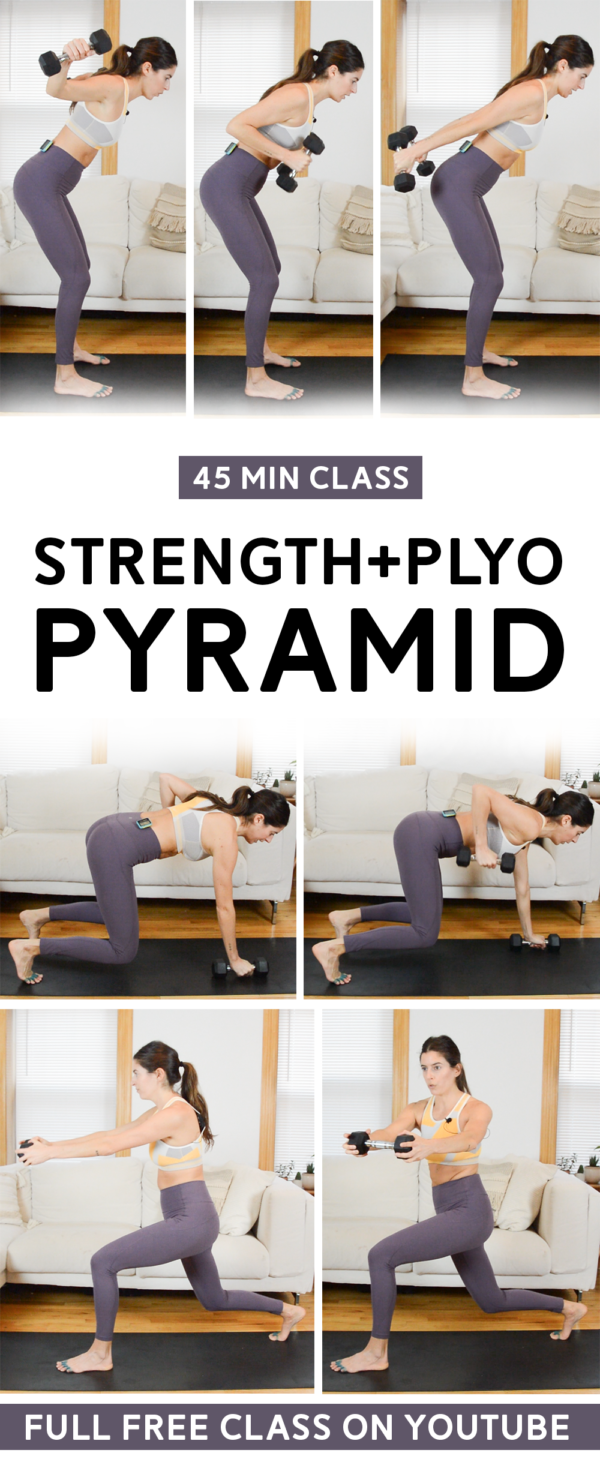
Happy New Year, friends! Hey it can’t be worse than 2020, right?? *crosses fingers and toes, silently prays, cries* Today I have a strength and plyo workout class for you. It mixes strength exercises using dumbbells and bodyweight plyo exercises. Each time through the circuit, the interval length gets shorter in a pyramid structure.
And you know the drill! If you want more classes like this, they’re available to Patreon members.
Strength + Plyo Workout Class
EQUIPMENT FOR CLASS:
Set of medium weights (I’m alternating between a set of 10 lbs and 8 lbs, but “medium” could be anything from 5-20lbs depending on the person)
In this class, we start with a guided warm up, focusing on mobility and dynamic movement to build some heat. We then move onto our strength and plyo pyramids. In each of the two pyramids, you’ll preform five exercises. The first time through the five exercises, you do them for 60 seconds each. Then just 45 seconds each. Then 30 seconds each.
You get 15 seconds of rest/transition time between each exercises. Between pyramids, you get about a minute to recover, but pause the video and take more time if needed. Always listen to your body, modifying or stopping as needed.
We finish class with a guided cool down and stretch.
There is some (minimal) jumping throughout class. Low-impact modifications will be shown on the screen if you want to keep the entire workout low impact.
No matter which at-home workout you pick, I want you to start with one important thing:
Warm-up!
I cover why you should always warm up in an article found right here. It doesn’t have to be much though, give it about five minutes to get your muscles active and your heart rate up.
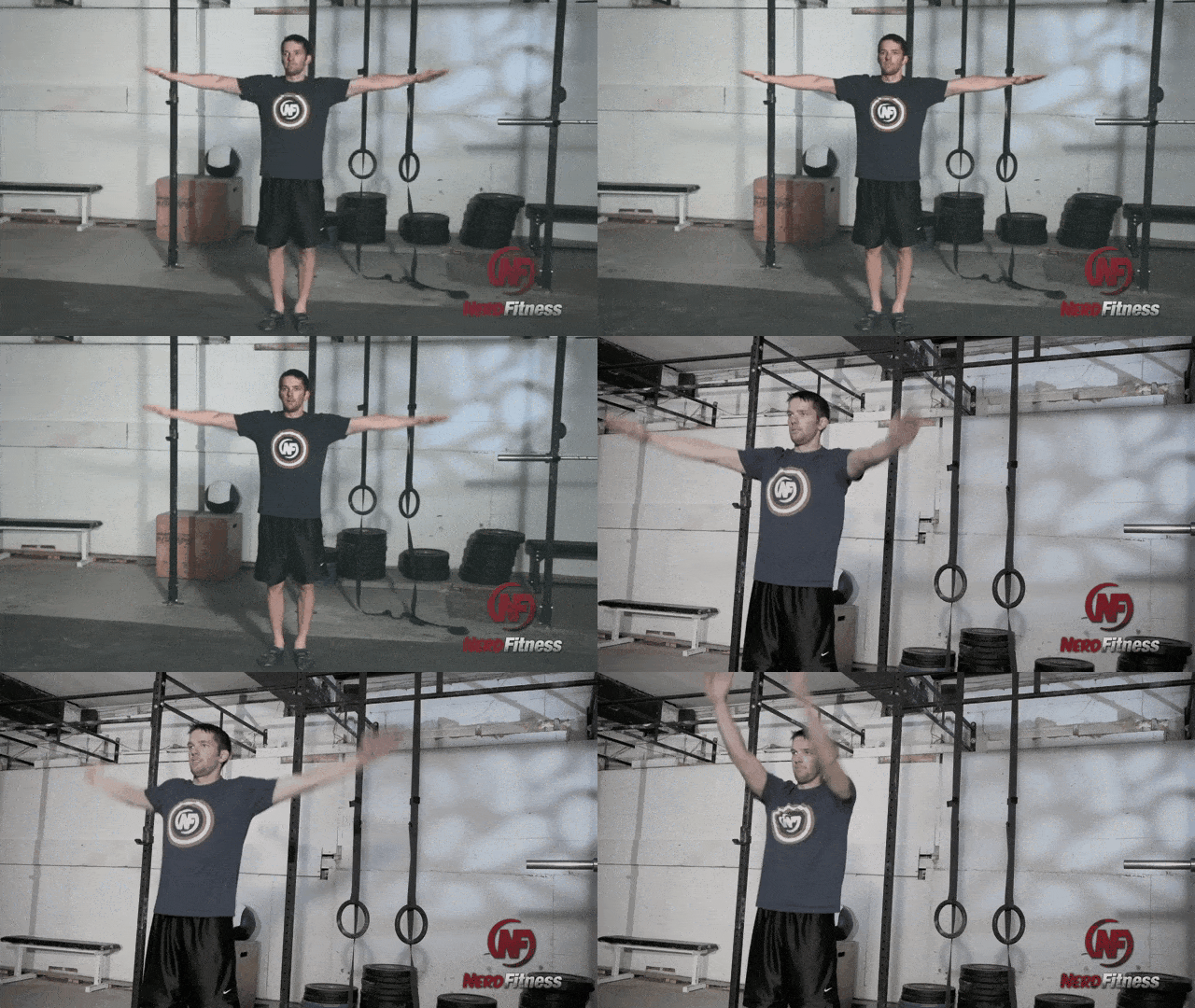
This will help you do exercises properly and help prevent injury. You can run in place, do air punches and kicks, or some jumping jacks.
Here is NF Senior Coach Staci (you might know her incredible story) showing you many beginner options you can use to warm up as well:
If you’re curious, here’s my personal (advanced) warm-up:
Jump rope: 2-3 minutes
Jumping jacks: 25 reps
Bodyweight squats: 20 reps
Lunges: 5 reps each leg.
Hip extensions: 10 reps each side
Hip rotations: 5 each leg
Forward leg swings: 10 each leg
Side leg swings: 10 each leg
Push-ups: 10-20 reps
Spider-man steps: 10 reps
Our goal isn’t to tire you out, instead we want to warm you up.
That’s step one.
Completing your chosen at-home workout would be step two.
Below, you’ll find 8 sequences you can follow along with!
I warn you, the above sequence will hurt… in a good way. You should be proud if you can get through this three times.
Do you want to get as strong as possible so this workout ain’t no thang?
Sign up in the box below to grab our guide, Strength Training 101: Everything You Need to Know. It’ll teach you all of these advanced bodyweight exercises!
Download our comprehensive guideSTRENGTH TRAINING 101!
Everything you need to know about getting strong.
Workout routines for bodyweight AND weight training.
How to find the right gym and train properly in one.
Home Workout #3: The 20-Min Hotel Routine
Sometimes, you just plain find yourself stuck in a hotel room. Maybe you can find the hotel gym, but I bet it’s terrible! It probably has 2 machines, a broken treadmill, and no free weights.
Ugh.
Instead, how about a 20-min workout you can do in the room itself! Utilize the furniture to its full potential.
If you don’t have time to run through the whole sequence, no problem!
Depending on how much time you have during the day, you can do your whole workout at once, or break up your training into four different sessions throughout the day (with each session being ONE of the exercises).
Here’s a sample day for your No-Equipment Workout:
Wake up, do 40 jumping jacks to warm up, and then do bodyweight squats.
At lunch, you grab your suitcase (if you’re at work, milk jug if you’re at home) and do inverted rows.
After work, you do another 50 jumping jacks and then do your push-ups.
After dinner, you do your planks while watching TV.
You could even split it up over two days if needed, but the goal would be to do it the whole sequence at once.
The main Angry Birds Workout article describes in detail Levels 1-6, but here’s Level 3 for you:
Bonus points if you somehow do this no-equipment workout in a cave, as that’s how Bruce Wayne would roll.[1]
This workout is separated into two days for you:
Batman No-Equipment Workout Day 1:
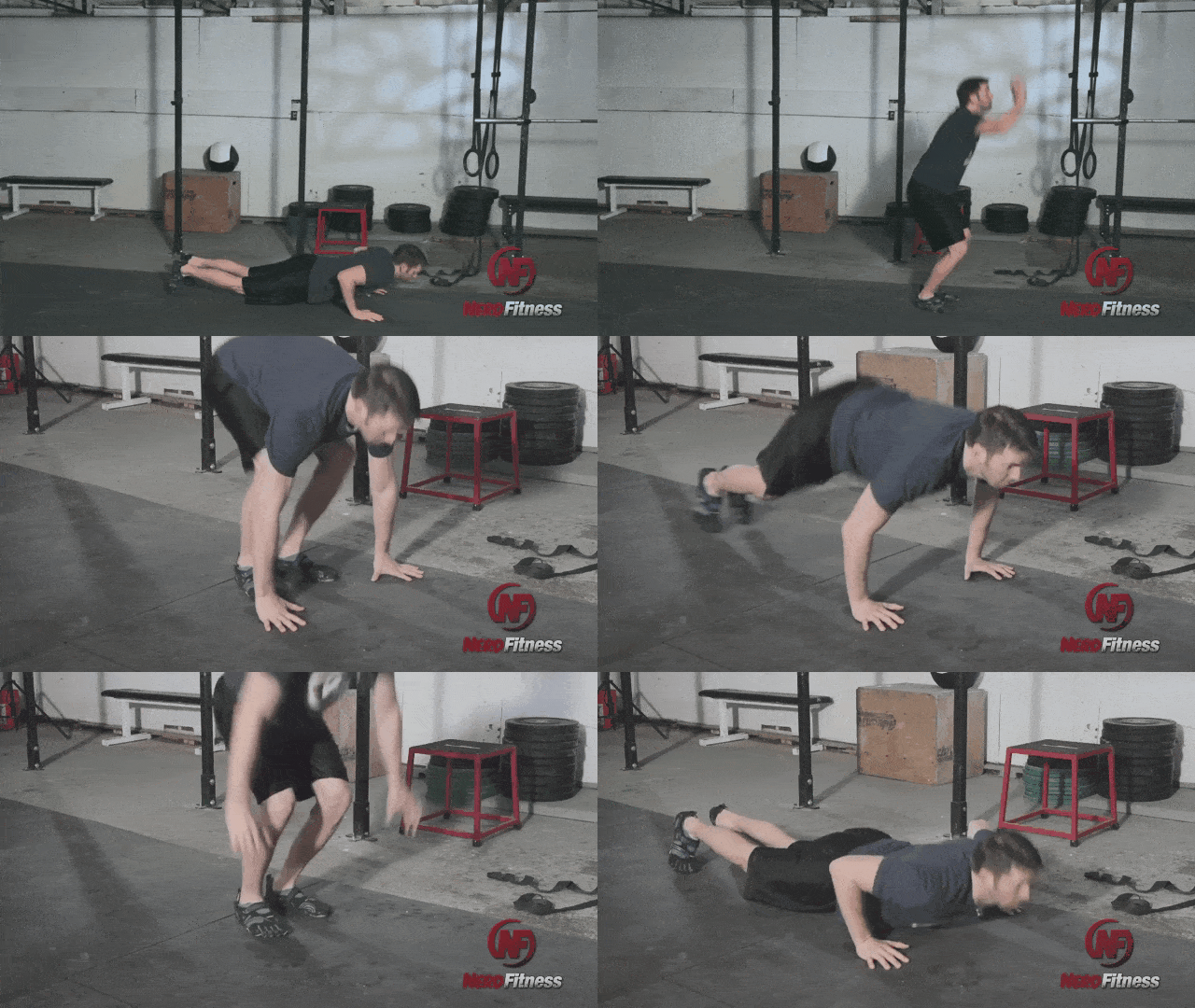
Rolling squat tuck-up jumps: 5 reps
Side to side push-ups: 5 reps
Modified headstand push-ups: 5 reps
Jump pull-up with tuck / Pull-up with Tuck-up: 5 reps
Handstands against wall: 8 seconds
Batman No-Equipment Workout Day 2:
‘180 Degree’ jump turns: 5 reps
Tuck front lever hold: 8 seconds
Tuck back lever hold: 8 seconds
Low frog hold: 8 seconds
This is a relatively advanced workout already, but if you want to progress to the next level, check out the main Batman Bodyweight Workout for tips on how to do just that.
NOTE: This is NOT a beginner program, and should not be attempted unless you have been training consistently and can do multiple repetitions of pull-ups and push-ups with great form.
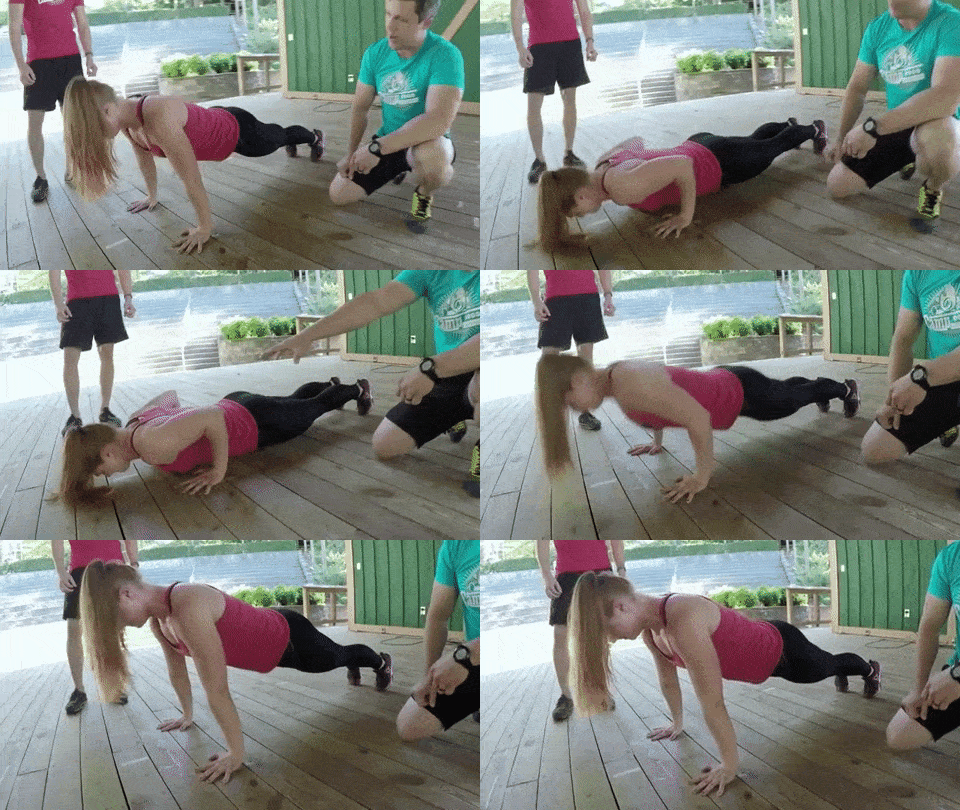
Like this perfect push-up:
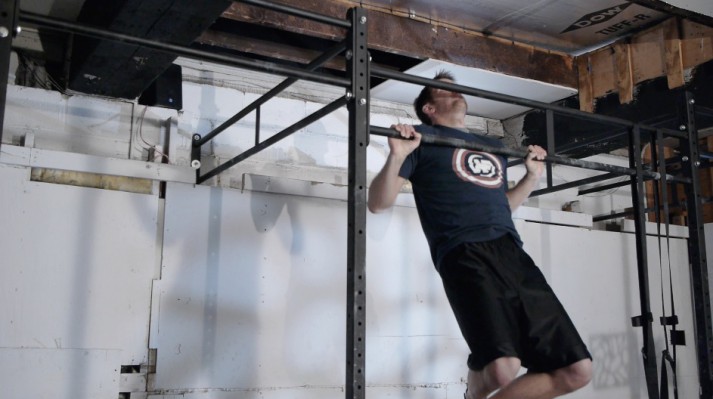
And this perfect pull-up:
Here’s how the PLP Progression works:
Day 1:
Pull-ups: 10 reps
Push-ups: 10 reps
Lunges: 10 reps (each leg)
Day 2:
Pull-ups: 11 reps
Push-ups: 11 reps
Lunges: 11 reps (each leg)
Day 3:
Pull-ups: 12 reps
Push-ups: 12 reps
Lunges: 12 reps (each leg)
How long do you keep doing this?
As originally envisioned by Chad Waterbury, the PLP Workout lasts 60 days.[3]
Yeah…by the end of it you’ll be doing more than 50 pull-ups.
There are two versions:
If you can do 10 straight pull-ups: Start day 1 with 10 reps of each.
If you cannot do 10 straight pull-ups: Start day 1 with 1 rep of each.
Complete your required reps each day in as many sets as you need, whenever you need to. The goal is to do it in as few sets as possible, but enough so that you can complete each rep with proper form.
If you want to advance to the Jedi Knight or Master Levels, check out The Star Wars Workout, which will also offer you a full description of each move.
Bonus No-Equipment Workout: The Playground Circuit
Do you have a nearby playground? Why not work out there! If you have kids, you can do it together. Or let them ignore you.
You don’t have to stick to these though! I have two resources to help you design your own no-equipment workout:
The 42 Best Bodyweight Exercises: This guide will teach you how to perform the best bodyweight exercises – no equipment required! Check it out if you are unfamiliar with any of the movements referenced in today’s guide.
How To Build Your Own Workout Routine: Once you’re comfortable with a handful of bodyweight exercises, use this guide to pull them all together into a full-body workout!
That should get you going on building a workout you can do in the comfort of your own home.
Want more? Alright, eager beaver, I got you.
We built THREE options for people just like you:
1) If you want step-by-step guidance, a custom workout program that levels up as you get stronger, and a coach to keep you accountable, check out our killer 1-on-1 coaching program:
2) If you want a daily prompt for doing workouts at home, check out NF Journey. Our fun habit-building app helps you exercise more frequently, eat healthier, and level up your life (literally).
Try your free trial right here:
3) Join the Rebellion! We need good people like you in our community, the Nerd Fitness Rebellion.
Sign up in the box below to enlist and get our guide, Strength Training 101: Everything You Need to Know. It’ll help you start incorporating these bodyweight moves into your training.
Download our comprehensive guideSTRENGTH TRAINING 101!
Everything you need to know about getting strong.
Workout routines for bodyweight AND weight training.
How to find the right gym and train properly in one.
Alright, your turn: I’d love to hear how your home training is going!
Which workout above did you try? Did you make one of your own?
Leave a comment below with your results or any questions you have on working out at home.
For the Rebellion!
-Steve
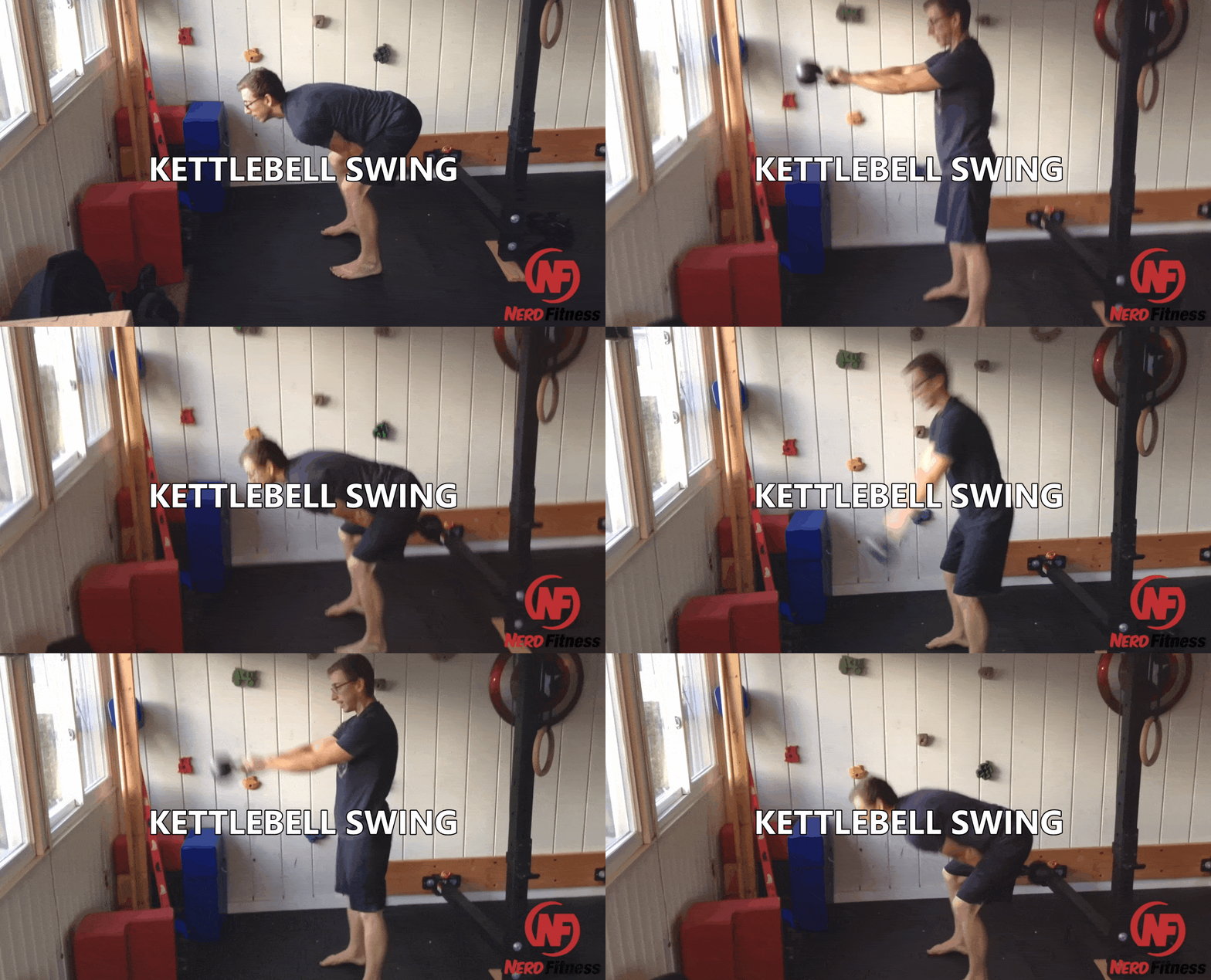
PS: If you were going to buy one piece of equipment to utilize in your home, a kettlebell would offer you a lot of versatility:
Trying to reach big and flashy goals can be intimidating, especially as we head into a new year that still has a lot of uncertainties. In this upcoming year, we have an opportunity to let go of that need for control and allow ourselves to find peace in the areas of life we can control.
In today’s episode, Robin shares how to integrate new rhythms and routines into your daily life to make them a habit. She also discusses how you can set little goals in your day-to-day life without putting pressure on yourself.
Join Robin in this episode to learn more about her new guide to create a life that works for you by integrating components of a healthy, balanced life.
You can also print out the free guide in the show notes to help you walk through setting these intentions in 2021.
Show highlights: what you can look forward to in this episode!
How to take what we’ve learned this past year and have a fresh start
Setting intentional rhythms and routines for the new year
How setting small goals will support you building new habits
The importance of reflecting on habits that did and didn’t work
Ways to prioritize your health on a daily basis
The importance of establishing your why
Robin shares the rhythms and routines she’s integrating in her life
Why visualization is important
Why you should always choose grace over guilt
Robin provides an overview of the Intentional Rhythms + Routines Guide
Let’s get right to it so you can start rocking 2021!
Why do we suck At Building Healthy Habits?
“I know what I’m supposed to do, I just can’t get myself to do it!” Welcome to the club – we all know what we need to do, but we just can’t get ourselves to make the important changes.
And yet, we can’t get ourselves to stick with ANY of these things for longer than a few weeks.
Why?
Simple: Building new healthy habits is tough, our lizard brains crave instant gratification, we don’t fully understand how habits are built, life gets busy, and our default behavior is often as unhealthy as it is easy.
As a result, we don’t put the right systems in place in order to make changes stick.
If you’re somebody that eats a typically poor diet, never runs, and hasn’t set foot in a gym since grade-school dodgeball with Mr. Wazowski, changing alllll of these at once is almost a surefire way to succeed at precisely NONE of them.
We’re conditioned these days to expect and receive instant gratification. If we want food we can get it from a drive-through, stick a frozen meal in a microwave, or sit down at a restaurant that’s open 24 hours. If we want a game we can download it to our computers/phones/PS5s within a matter of seconds. If we want to watch a TV show, it’s a few clicks away.
Hell, Netflix even starts the next episode for you without any action required!
We expect getting in shape to go the same way.
And this is why we suck at building healthy habits that stick.
We tell ourselves “Hey, I’ve been dedicated for a whole two weeks, why don’t I look like Ryan Reynolds yet?”, not remembering that it took us decades of unhealthy living to get where we are, which means it’s going to take more than a few weeks to reverse the trend.
And then we miss a workout because life was busy or our kid got sick. And we get disheartened that exercise or giving up candy is not nearly as fun as Netflix and video games and Peanut M&M’s.
This is where everybody gives up:
They try to change too many habits too soon
They get impatient the results don’t come more quickly
We’ll cover the specific healthy habits and resolutions you SHOULD be picking later in this article, but I have a big damn question to ask you first: “But why though?”
The First Step of Building Healthy Habits (Know Your “Big Why”)
Before we do ANYTHING with actually building habits, you need a damn good reason as to why you want to build them in the first place or the changes will never stick.
This whole “change who I am” stuff needs to be at the center of your decision making moving forward.
And if you don’t have a good reason, you’re dead in the water:
If you’re here because you decided you “should” get in shape, you’re going to fail the second life gets busy.
If you are dragging yourself to the gym because you think you “should” run on a treadmill five days a week even though you hate it, you’re screwed!
As you’re determining the habits or resolutions you’re trying to set, make the habit part of a bigger cause that’s worth the struggle.
You’re not just going to the gym, you’re building a new body that you’re not ashamed of so you can start dating again.
You’re not just learning to like vegetables, you’re losing weight so you can fit into your dream wedding dress.
You’re not just dragging yourself out of bed early, you’re getting up earlier so you can work on your side business before your kids get up so you can set money aside for their college education.
In our 1-on-1 Coaching Program and throughout Nerd Fitness Prime, we refer to this as your “Big Why.” Without it, you’re just forcing yourself to do things you don’t like to do – that’ll never last.
Tie it to a greater cause and you’re infinitely more likely to push through the muck and mire to get it done.
So dig 3 levels deep and ask “why” until you get to the root cause of WHY you want to build a new healthy habit or change a bad one. Write it down. And hang it up somewhere you can see it every day.
Got your reason? Great.
Now let’s get into the science of habits.
How to Build Healthy Habits (The Three Parts)
As Charles Duhigg points out in The Power of Habit (a must-read for anybody interested in behavior change), there are three parts to a habit:
#1) Cue (what triggers the action): It can be a feeling: I’m tired, I’m hungry, I’m bored, I’m sad. Or it can be a time of day: it’s Monday at 9am, work is done, etc.
#2) Routine (the action itself): This can either be a negative action you want to cut back: I drink soda, I eat cake, I snack, I drink alcohol, I smoke cigarettes, I watch TV – or a positive one: I go to the gym, I go for a run, I do push-ups, I read a book.
#3) Reward (the positive result because of the action): I’m now awake. I am temporarily happy. My hands/mind are occupied. I can forget the bad day I had. I feel energized. I feel good about myself.
Depending on your routine/action above, habits can either be empowering and amazing, or part of a negative downward spiral. Your body isn’t smart enough to KNOW what it needs to do: it just wants to fix the pain or chase the pleasure of the cue, and whichever way you choose to respond will become the habit when it’s done enough times.
Factor in genius marketing, behavioral psychology, and an environment set up for us to fail – and bad habits rule us.
It’s why we crave certain foods, why we can’t help but check our phone every time it vibrates, and why we can’t keep ourselves from watching one more episode or grinding one more level in World of Warcraft.
Duhigg lays things out very clearly:
“There is nothing programmed into our brains that makes us see a box of doughnuts and automatically want a sugary treat.
But once our brain learns that a doughnut box contains yummy sugar and other carbohydrates, it will start anticipating the sugar high. Our brains will push us toward the box. Then, if we don’t eat the doughnut, we’ll feel disappointed.”
Picture this:
We have trained your brain to take a cue (you see a doughnut), anticipate a reward (a sugar high), and make the behavior automatic (nom nom that donut).
Compare that to a cue (you see your running shoes), anticipate a reward (a runner’s high), and make the behavior automatic (go for a run!).
The Dark Knight himself said it best: “It’s not who I am underneath, but what I do that defines me.”
Let’s take a look at each part of the habit-building process and start to hack the sh** out of it!
Learn Your Cues: Recognize the triggers.
Whether you are trying to change an old habit, stop an unhealthy habit, or begin a healthy habit, it starts with the first step in the process:
“The Cue.”
If you want to stop drinking soda, but feel like you need it every afternoon to get through work, your brain has been wired to think SODA after the cue:
Cue: I’m tired, thirsty, and have no energy.
Routine: I drink a soda around 3pm.
Reward: Weeeeee caffeine! Sugar! Happy! My life has meaning!
When identifying bad habits to avoid, it starts by becoming aware of the cue that sets the habit in motion. Simply being aware of the cue is a great start to breaking the cycle:
When I get bored (cue), I eat snacks (routine), and it fills the void with a happy stomach (reward).
When I come home from work (cue), I plop down on the couch and play video games (routine), and it helps me forget about work (reward).
When I get nervous (cue), I start to bite my nails (routine), to take my mind off the awkwardness (reward).
So if you are looking to break a bad habit, it begins by identifying what the cues are that make you take the action that you’re trying to stop.
At the same time, you can mentally train yourself, just like Pavlov’s dog, to build a new healthy habit by identifying the habit you want to build and the cue you want to use to proceed it:
When I wake up (cue), I will go for a walk (routine), and reward myself with an audiobook on the walk (reward)
When I get tired (cue), I will drink black coffee instead of soda (routine), and along with the caffeine boost (reward), I’ll get new running shoes after 30 soda-free days (reward), and satisfaction from the weight loss thanks to fewer calories (reward).
When I come home from work (cue), I will walk straight to my computer to work on my novel for 30 minutes (routine), and reward myself with Netflix after I have written 500 words (reward).
So, whether you’re breaking a bad habit or starting a new one, it begins by recognizing the cue that triggers the habit.
Once you recognize or pick the cue, you can start working on fixing the routine (action).
The Key to Sustainable Healthy Habits: Use Systems
“Steve, I get it, but I still struggle with the ‘building the routine’ part…for some reason I just can’t bring myself to do it.”
Yup – welcome to the toughest part of a habit:
The Routine (the action itself!).
This is where we’re going to start thinking and acting like nerds and scientists.
Whether we’re trying to stop a negative routine (stop drinking soda) or start doing a healthy routine (start running), both need to be addressed with a different plan of attack.
For starters, we’re going to stop relying on two things:
Willpower: if you have to get yourself to exercise, you’ll give up when you get too busy or it’s too cold.
Motivation: if you need to be motivated, you’re going to give up and then beat yourself up for not being more motivated!
Both motivation and willpower are finite and fickle resources that will abandon you when you need them most. Suckers and chumps hope and pray that they have enough motivation and willpower to build a habit. That’s clearly a:
Not us though!
We’re going to remove both from the equation and use systems and outside forces to make the routine even easier to build (or tougher to build if it’s a bad habit you’re trying to swap!).
This can be done in a few ways:
Environmental hacks: making the routine easier by removing steps needed to complete it, or adding steps between you and a bad habit.
Programming hacks: add your habit to your daily calendar, track your progress daily with a journal, and make it part of your day.
We are products of our environment. We can use this information to our advantage and make the process of building a new habit or changing a bad habit easier by modifying our environment. I dig into this more fully in our article: “Build your Batcave for Habit Change,” but I’ll cover the basics here.
Look at the places you spend your time. Reduce the steps between you and a good habit, and increase the steps between you and a bad habit. You’ll be less reliant on willpower and motivation and more likely to do the healthy habit or skip the bad habit.
Here are five examples of environmental hacks you can use:
RUN EVERY MORNING: Go to sleep with your running shoes at the foot of your bed, with your running uniform laid out already. Hell, you can sleep in your running/workout clothes. Put your alarm clock on the other side of the room so you HAVE to get out of bed to turn it off.
GO TO THE GYM AFTER WORK: Pack your gym bag BEFORE going to sleep the night before. That way, every morning you already have a bag to throw in your car or bring with you. As soon as 5pm hits, you are in your car on your way to the gym. (Gym currently closed? Here’s how to build a gym in your home).
EAT HEALTHIER: Don’t give yourself the option of not eating healthy – throw out the junk food in your house and start preparing meals the night before. Put a lock on your web browser from ordering pizza online (yes, you can do that now), and don’t drive down the street full of fast food places.
WATCH LESS TV/PLAY FEWER GAMES: Use your laziness in your favor. Unplug the TV/system. Increase the steps between you and watching the TV. Put parental controls on your own system and have your friend set the time limit and the password. I knew somebody who put his TV in his closet and cut his TV viewing by close to 100%. Don’t rely on willpower – make it more difficult!
CHECK YOUR PHONE LESS: Turn off your notifications and uninstall the apps that waste your time. Put your phone in Do Not Disturb mode when you are at work, and put it in your desk drawer. Don’t rely on willpower to get yourself to not check your phone when it buzzes – get rid of the buzz.
You can also use programming hacks to help build NEW healthy habits:
EXERCISE: If you want to exercise more, set calendar alerts at the beginning of your week so that every day at 8AM you receive a cue (ding! on your phone) and a reminder to do the activity. You’re much more likely to stay on target when the activity has been scheduled ahead of time.
HEALTHY EATING: Consider batch cooking! If cooking healthy meals every night sounds like way too much work (I hear you on that), consider doing it all on ONE day – it’s a significant time-saver, and it also will reduce the steps between you and healthy eating because the meal is already cooked and in the fridge!
WRITING: If you want to write a book, tell yourself you have to write 500 crappy words every day. This is how I wrote Level Up Your Life. Buy a calendar, and draw a big red X on every day you complete your task. Make your singular focus every day continuing the streak[1].
Make the Reward Momentum-Building
And we are finally at the third part of the habit:
“The Reward.”
When looking to replace bad habits, do some reward analysis on your bad habits:
Soda gives you a caffeine kick and a burst of energy in the afternoon when you’re tired.
Can you replicate that energy boost for your body in a healthier way? Perhaps you can switch to black coffee and go for an afternoon walk.
Here’s another example:
You find you spend too much time watching TV because you love escaping into worlds, and it’s affecting your health.
Can you listen to your favorite audiobook only when you walk?
This step will require some analysis, by digging into the reward you’re trying to recreate, without the negative action. This can lead your brain to some tough places, but it’s healthy to dig into it.
For example, if you want to start drinking less (or give up completely), you might discover that the reward you’re chasing is actually “escape from a job I hate” and “avoiding social anxiety.”
Dig into your reward and what your brain is craving, and then see if you can reverse engineer a healthier routine with the same reward.
And then use outright bribery to get yourself to actually do the new healthier and choose the better action/routine.
What works for science and physics also holds true to building habits: inertia and momentum will work against you when it comes to building habits…until it starts to work for you as the habit becomes automatic.
We can fix the third part of the habit-building loop, the reward, with momentum-building prizes or results to bribe ourselves to continue. With each healthy and positive reward, with each completed routine, we make the habit sliiiiightly more likely to become more automatic the next time.
In other words, create rewards that reward you back!
DO reward your routine (running for 5 minutes every day for 30 days straight) with a reward that makes you want to keep running (a snazzy new pair of running shoes).
Our new app, Nerd Fitness Journey, specifically follows this “cue, routine, and reward” format to help build new habits. In the app, we “reward” you with cool loot and XP, so you can level up (literally) while you getting lean and strong.
If you’re interested, you can try it for free right here:
5 Hacks for Effortless Healthy Habit building
Your life will get busy.
There will be days when you don’t want to do your new habit. Or you want to backslide and go back to old habits. Actually, that will pretty much be every day, especially early on.
So don’t leave it up to yourself!!!
Stop relying on yourself and start relying on outside forces. Here are the best tips you can use to get yourself to actually follow through with a habit:
1) RECRUIT ALLIES: find a friend or group of friends to build the habits with you. A recent study [2] showed that:
Among the weight loss patients recruited alone and given behavioral therapy, 24% maintained their weight loss in full from Months 4 to 10.
Among those recruited with friends and given therapy plus social support, 95% completed treatment and 66% maintained their weight loss in full.
You do not have to go on this habit-building journey alone. Building a guild or recruiting a group of people to support you and help you and make you better could be the difference-maker in building habits!
When your friend is already at the gym waiting for you, you HAVE to go. If it was up to you, skipping out and watching Netflix has no negative consequences. Recruit friends and allies!
Remember, those first few weeks are the toughest, which means they’ll require the most effort to get started.
2) CULTIVATE DISCIPLINE WITH ACCOUNTABILITY: When you can’t get yourself to follow through on a new healthy habit you’re desperately trying to build, make the pain of skipping the habit more severe than the satisfaction you get from skipping it.
Allow me to introduce some BRUTAL consequences:
Every time I skip ______________ this month, I will pay $50 to my wife/husband/friend who will donate my money to a cause I HATE.
Every time I decide not to _______________ this month, I have to run around my house naked.
Every time I do ____________ when I shouldn’t, I will let my three-year-old do my makeup before work.
Do any of these results sound like fun? If you can’t afford to pay your friend $50, if running naked around your house might get you arrested, and if you’ll get fired looking like a drunk clown thanks to your kid’s makeup skills…maybe you just do what you know you need to do. The more painful it is to skip something, the more likely you’ll be to actually suck it up and do it.
3) NEVER MISS TWO IN A ROW. What happens if you miss a day? Who cares! One day won’t ruin you – but two days will, because 2 becomes 30 in the blink of an eye.
As pointed out in a research summary: “Missing the occasional opportunity to perform the behavior did not seriously impair the habit formation process: automaticity gains soon resumed after one missed performance.[3].
4) DON’T PICK HABITS YOU HATE: “Steve I know I should run so I’m trying to build a running habit even though I hate running.” Stop.
Can you get the same results with a different habit, like rock climbing or hiking or swing dancing? Pick a habit that isn’t miserable and you’re more likely to follow through on it.
At the same time, we have tons of success stories of people who went from hating exercise to loving how it feels.
It’s because they made the habit part of a bigger picture: “I am working out because I am building a kickass body so I can start dating again!”
It’s because they had a BIG enough why to overcome their initial dislike of exercise until they learned to love how exercise made them feel.
5) TRY TEMPTATION BUNDLING: Consider combining a habit you dislike with something you LOVE, and you’ll be more likely to build the habit.
If you hate cleaning your apartment, only allow yourself to listen to your favorite podcast when you are cleaning or doing the dishes.
Want to go to the gym more? Allow yourself an hour of watching Netflix, but ONLY while you’re on the elliptical.
The Secret to Fulfilling Your Resolution (Do Less)
Now that you’re educated like a boss on the different parts of a habit, it’s time to build one!
I’ll leave you with a final bit of advice: if you decide that you want to run a marathon or save the world or lose hundreds of pounds, you’re going to screw up unless you internalize the following information:
DO WAY LESS.
Or in the immortal words of Kunu from Forgetting Sarah Marshall: “The less you do, the more you do”:
Pick ONE habit, make it small, and make it binary.Something that at the end of every day you can say “yes I did it” or “no I didn’t.”
Habits that are nebulous like “I am going to exercise more” or “I’m going to start eating better” are more useless than a Soulcycle membership for Jabba the Hutt.
Here are big examples. Be specific. Be small. And track it:
Want to start exercising more? Awesome. For that first week, ONLY go for a walk for just 5 minutes every morning. Literally 5 minutes.
Want to start cooking your own healthy meals? Just aim for one meal per day or one meal per week. Whatever works for you and your schedule.
Want to stop drinking a 2 liter of Mountain Dew every day? Scale it back to 1.9 liters a day for a week. Then 1.8 for a week. Then 1.7…
Want to get out of debt and build the habit of frugality? Start by saving an extra five bucks a day, or finding a way to earn an extra 5 bucks a day.
Want to learn a new language? Speak your new language out loud for 10 minutes per day. That’s it!
Keep your goals SMALL and simple. The smaller and simpler they are, the more likely you are to keep them. And the habit itself pales in comparison to the momentum you build from actually creating a new habit.
I don’t care how many calories you burn in a 5-minute walk, just that you can prove to the new YOU that you can build the habit of walking, and only then can you up the difficulty.
We’re thinking in terms of years and decades here! So think small.
My real-life example: I wanted to build the habit of learning the violin at age 31, but couldn’t get myself to do it because I told myself I was too busy, which is a lie (“I only have 25 minutes; I need 30 minutes to practice…might as well not practice at all”), and thus I never played!
Once I lowered the threshold to “I have to only play for 5 minutes per day,” it gave me permission to pick it up here and there – and I ended up practicing WAY more frequently, and got better much faster.
I still suck, mind you, but I’m lightyears ahead of where I was before!
And please: DON’T BUILD ALL THE HABITS AT THE SAME TIME.
If you’re new to building habits, or you have never stuck with anything long enough to make it automatic, it’s because you did too much. Habits are compound interest.
As you build a new habit, it bleeds over to other parts of your life and makes future habits easier to build too – momentum!
“Willpower is like a muscle. It can be exercised and practiced and built up. It can also be forgotten, weakened and atrophied.
Just like going to the gym and building up strength and endurance, you can build up your discipline and willpower over a long period of time by setting and accomplishing a series of tasks on a consistent basis.”
You’ve probably tried the whole “build all the habits at once” and it doesn’t work. So try building ONE habit for 30 days. And then pick a habit that stacks on top of that one and helps you build more and more progress and more and more momentum.
Start today: Pick Your Habit and Go
I’ll leave you with a final quote from Duhigg’s The Power of Habit:
“If you believe you can change – if you make it a habit – the change becomes real. This is the real power of habit: the insight that your habits are what you chose them to be. Once that choice occurs – and becomes automatic – it’s not only real, it starts to seem inevitable, the thing…that bears us irresistibly toward our destiny, whatever the latter may be.”
You’ll need more brainpower initially, until your default behavior becomes the automatic habit-building you’re chasing.
With each day of you building your new habit, you’re overcoming any self-limiting belief, building momentum, and becoming a habit-building badass! And then those habits become automatic. Then, we rejoice:
So today, I want you to look at just ONE habit you want to change:
Identify the cue that spurs it on – Is it the time of day? Boredom? Hunger? After work? Stress?
Identify the potential rewards – Happiness? Energy? Satisfaction?
Identify a new routine you’d like to establish that results in the same “reward” from the negative behavior…but in a more productive and healthy way.
And I know this journey is tough – it’s the reason I’ve been working with a coach myself for the past 4 years. Having somebody else to help me pick the right habits and focus, somebody to keep me accountable, and somebody to learn from has been HUGE!
If want expert guidance on your healthy habit building in 2021, let’s make it happen! You can sign up for a free call with our coaching team in the box below to learn more about the program and see if it’s the right fit:
I want you to leave a comment below: pick ONE habit that you’re going to build this month and identify the three portions of the habit you’re looking to build.
Good luck – now go build some momentum.
And ONE habit.
-Steve
PS:Our new app, Nerd Fitness Journey, is all about creating new habits! It’s designed so when you wake up in the morning, you have a “cue” on exactly what “routine” to get started with. Plus, we “reward” you with cool loot and XP, so you can literally level up.
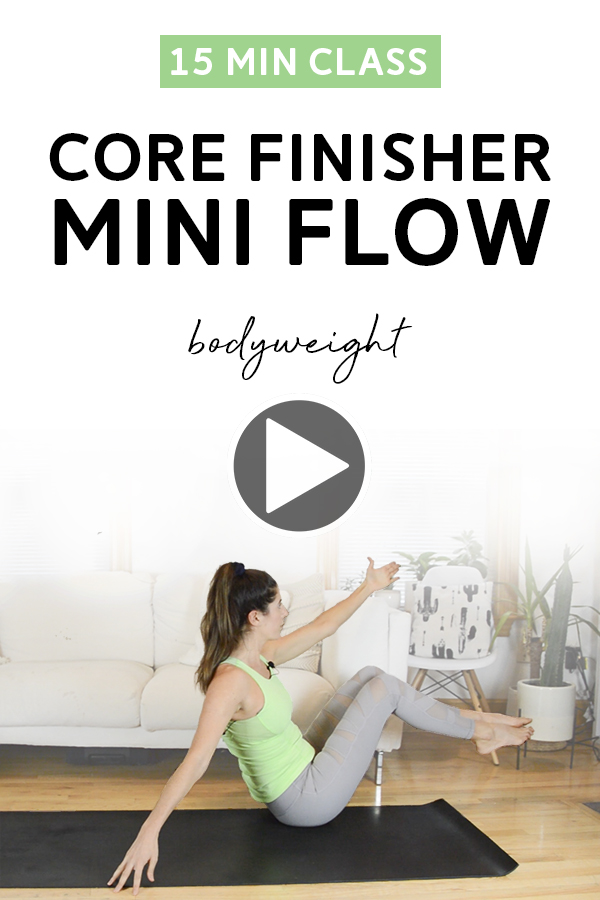
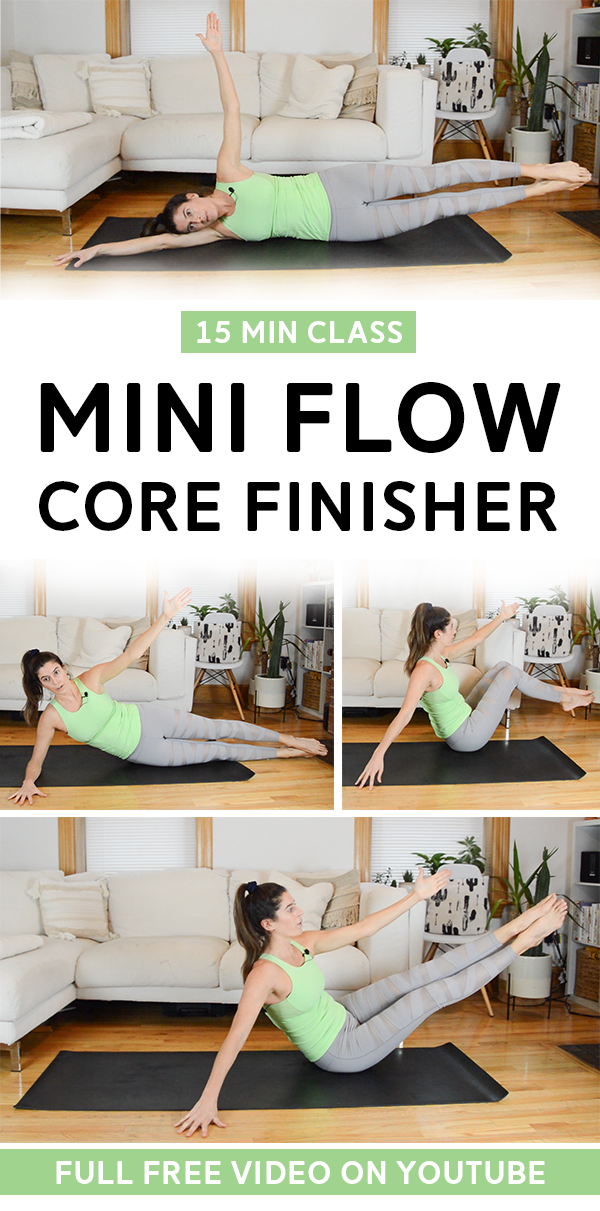
This mini Pilates flow core finisher is great if you’re short on time or are looking for a bit of core work to round out a longer workout. Focus is on obliques.
This is a short version of the Mini Flows classes I’ve shared in the past:
If you like this class, you can get access to more by becoming a Patreon member!
Mini Pilates Flow Core Finisher
In this class, we start with a quick warm up that moves right onto our mini flows workout. The best way to describe this structure is to picture a Pilates mat class. We essentially take a small sequence out of that class and turn it into a circuit.
The mini flow is a short sequence (2:45 minutes long). You’ll do it twice on the right then twice on the left. You rest for 15 seconds in between completed sequences and 30 seconds between sides.
Always listen to your body, modifying or stopping as needed. We finish class with a (very quick) guided cool down.
Workout Breakdown
(0:58) Preview of Exercises
(01:44) Warm Up
(04:14) Mini Flows Workout
(15 sec) Side lying leg lifts (start with hand down)
(30) Continue side lying leg lifts but with top arm reaching up
(45) Leg & torso lift
(45) Side lying to boat
(30) Side v up
(16:56) Cool Down & Stretch
If you like this Pilates flow core finisher, all my other core workouts from the archives can be found on this page.
That means there are a ton of things that affect why you’ve gained weight over the past decade(s) and why you struggle to lose it:
Genetics
Age
Biological sex
Stress level
Home environment
Mental health
Activity level
Nutrition
All of these things play a factor in what you look like and how healthy you are. Despite these various factors, I’ve seen a common thread in people who build healthy habits and stick with them:
A Groot Mindset.
Let’s get nerdy for a second (you’re reading Nerd Fitness after all). I assume you’re familiar with Groot, the tree-like superhero from Guardians of the Galaxy. He can grow and change his shape to suit the situation.
He also only says, “I am Groot,” but that’s less applicable here.
HOW TO BUILD A GROWTH MINDSET LIKE GROOT:
Unhealthy Person: “I have a hectic job. My parents are overweight. There’s a pandemic going on. I have children. I have a slow metabolism. I’m never going to be able to lose weight. This plan won’t work for me because [excuse to let myself off the hook]. I’m the out of shape guy/gal and that’s all there is to it.”
Habit Building Badass: “I have a hectic job. My parents are overweight. There’s a pandemic going on. I have children. Soooo….How can I make this work for me in my situation? I know people like me have lost weight, which is a great sign. I refuse to accept that I am a lost cause. I am Groot.”
Even if it isn’t your fault where you are, if you can accept that it’s your personal responsibility to deal with it then you’re taking a huge first step.
We all have emotional, visceral responses to what we see in the mirror or how we feel when we wake up.
We need to cut through the emotion and get to the truth: we alone are responsible for our fate, and that means we alone can fix it.
Like Groot, you can change and grow.
And dance.
You’ll learn that your excuses are moot – if busier, poorer, older, and more overweight people than you can get in shape, you can too.
And yep, people have even got in shape during our current Apolocalyse Simulator.
So, decide TODAY that this year you are “a healthy, habit-building badass” and then simply do the things that perpetually healthy nerds do.
With each meal or each decision, ask yourself “what would a healthy person do?” And then do that.
2. Know Your “Big Why”.
The road to perpetual weight loss and healthiness is fraught with peril.
Even the best-laid plans and New Years Resolutions will end up in a ditch on the side of the road unless you have a damn good reason.
After all, life gets busy and it’s Taco Tuesday and a new video game just came out and schools are closed and you just don’t feel like exercising and it’s cold.
There will ALWAYS be something.
You will never NOT be busy.
That perseverance will form from a damn good answer to the question: “Why?”
Not just “Because I need to lose weight,” but 2-3 levels deeper:
WHY do you want to lose weight?
What will losing weight mean for your life or happiness?
What will you be able to do thanks to that weight loss?
That’s the motivation and answer you need to be reminded of to persevere over the next few months.
If your answer is: “I’m here because my doctor/wife/husband thinks I should lose weight. I know I should exercise more and do more,” you are doomed. You will give up at the first sign of adversity.
Compare this to the raw, deep, honest answers we get from NF Coaching Clients when we ask about their “Big WHY”:
“I’m here because my dad died of a heart attack at age 45, and I don’t want my kids growing up without a father like I did.”
“I’m here because I want my husband/wife to look at me the way he/she used to, and I want us to grow old together.”
“I’m here because I just got dumped and I want to get healthy so I can start dating again. I don’t want people swiping left on my photos anymore.”
“I’m here because I want to look in the mirror and be proud of what I see. I want to stop hiding behind others in photographs.”
Why are you here? Why do you want to build healthy habits?
Write down your Great Big Why – and go deep, my friend. Way down. And ask yourself “Why?” to the answer of each of your questions until you get to the root of your reason for being here.
Once you write that answer down, hang it up somewhere you can see it every day: fridge, home office, bathroom mirror. Accept responsibility for your current situation, be compassionate that you’re in a tough spot, and then ALSO accept that you CAN change, and your identity can change with small wins that prove it.
3. don’t go on a diet. adjust Your nutrition.
Perpetually unhealthy people have a love/hate relationship with diets.
Mostly hate.
They go on diets all the time – especially in early January, and then they go off diets. And then they go on another diet. And then they find another diet that’s supposed to promise even faster, easier weight loss, so they switch to that one.
Unhealthy people get dieting wrong from the start, and this is what dooms them.
Unhealthy people go on a diet for a month or two, and they can’t wait to go back to “eating normally.”
The problem is that their “eating normally” is the reason why they’re overweight in the first place.
They go Keto for a month and have success, then fall off…then go Paleo for 6 weeks and lose 40 pounds, and then fall off…then they do a cleanse for 30 days and drop 2 pant sizes, and then fall off…
Temporary changes to one’s eating results in temporary results to one’s weight and physique.
Like an addict chasing the next high, somebody consistently has to chase the next diet because their normal eating is the problem in the first place!
Starvation, eliminating favorite foods, and trying to use willpower to avoid candy and sweets is a terrible strategy. So stop doing it.
No wonder people abandon diets as soon as they start them; they think, “If this is what it takes to be skinny, I’d rather stay out of shape and happy.”
This year, make a pledge to NOT go on a diet.
Instead, come to terms with this: “My concept of ‘normal eating’ is broken, which means that needs to change permanently in order for me to get healthy permanently.”
Think about that for a second.
If you “never get to be done” with your nutrition, and you can’t go back to how you were eating before, then the ONLY way permanent success happens is if you actually enjoy your new “normal.”
Stop going on diets!
No more diet pills, cleanses, or crazy 30-day strategies.
Nothing you do can be temporary, or the results will be temporary.
Instead, you are going to make deliberate, incremental permanent changes to your daily nutrition, slowly, over a period of many months.
If you are afraid of giving up something, don’t! Make unhealthy foods more of a treat and less of a daily indulgence:
If giving up soda forever is scary, slowly cut back from 12 a day down to one a day.
If giving up pasta forever sounds like a life not worth living, learn about portion sizes and make it an experience (only at restaurants, for example).
When you think about getting healthy this year, think in terms of days and years, not weeks and months:
Know that it took years for you to get to your current physique, and it’s going to take months if not years to correct it. This means you HAVE to enjoy the journey.
Once you accept that you never get to be “done,” you can start picking small adjustments or changes that won’t scare you away from adhering to your plan.
4.know what’s in the food You eat.
Did you know that when it comes to weight loss, your nutrition choices will account for 90% of your success or failure?
Tattoo this on your forehead. Hire somebody to skywrite it above your home every day. Pay somebody to call you every morning and remind you of this fact.
Whatever it takes to get you to realize that changing your eating habits will be the fastest (and only) path to weight loss in 2021.
And it starts by educating yourself about your food.
Make a habit of knowing what’s in the food you eat!
Whether it’s portion control, calorie counting, tracking macros, or even keeping a food journal, it’s important to have a rough idea of the total calories and nutritional breakdown of the food you consume regularly.
After all, GI Joe tells us that “Knowing is half the battle!”
The other half is lasers:
With each meal tracked, these habits add up to knowing what needs to happen every day for you to get healthy.
Once you know how many calories you should be eating every day, you can start to make more informed decisions on foods that fill you up but are low in calories:
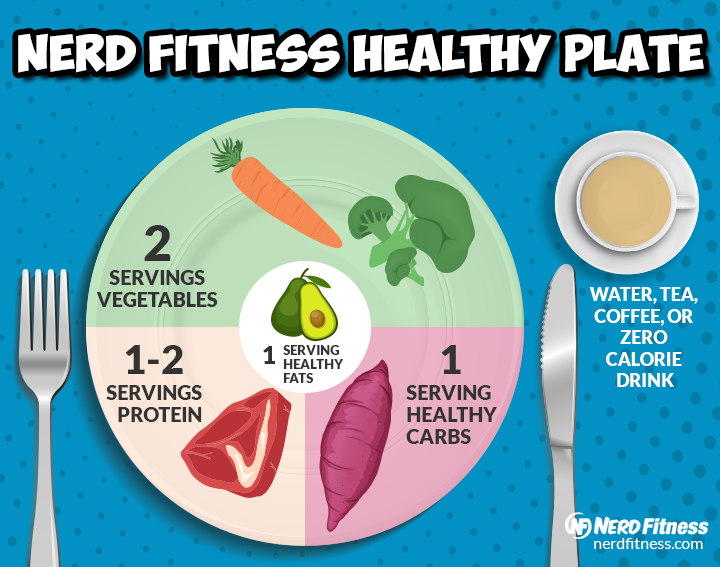
Spoiler alert: as we point out in our healthy eating guide, it’s healthy protein, fruits, veggies, and correct portions of healthy carbs.
It’ll come together and look sort of like this:
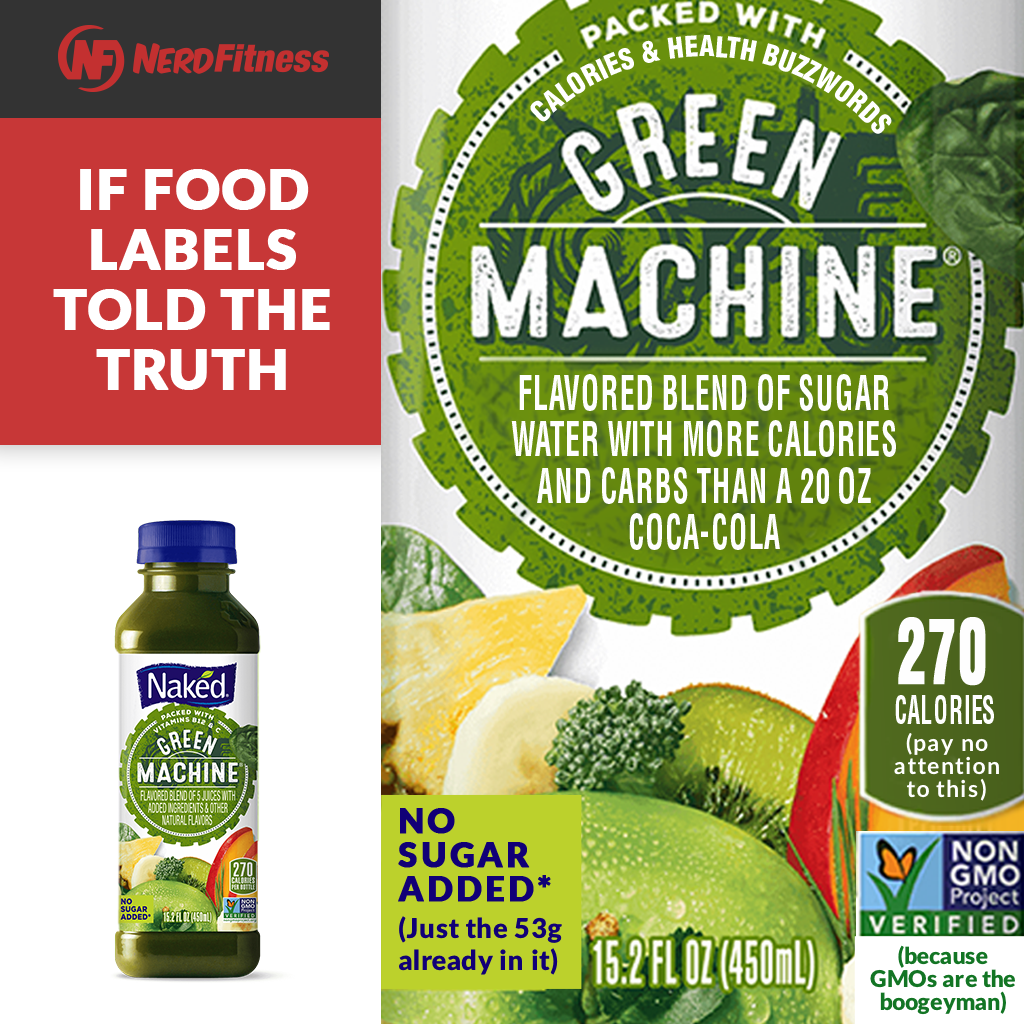
Plus, once you learn to read a nutrition label, you can start to avoid marketing hype and buzzwords and focus on the actual product!
For example, here are two different beverages:
Coca-Cola (20 oz): 240 calories, 65 g of carbs (65 g of sugar)
Naked Juice Green Machine (15 oz): 270 calories, 63 g of carbs (55 g of sugar)
Look at those two things above: one is a can of cola that you know is bad for you, the other is marketed as a “healthy beverage.”
Neither one is great for you, and the calories must be accounted for in your daily intake.
Learn about the food you’re eating. You’re an adult, you can take 3 minutes and Google it.
Once you know the composition of your meals, you can start to make subtle adjustments or change quantities over time as you start to approach a healthier weight.
Be okay with “good enough” to start, and get more accurate as time goes on.
Don’t overthink this: Write down what you eat every day for a week. If your weight isn’t changing, adjust down total calories, and minimize sugar consumption and see how your weight changes.
Make small adjustments over time and see how your body responds.
Speaking of goals…
5. Use Blueprints and Blocks to Create Goals.
Perpetually unhealthy people say things like “I’m going to exercise more this year!”
Goals like this are cloudy with no real markers for success.
With no beacon guiding them, perpetually unhealthy people don’t know if they’re on track, and there’s no accountability if they don’t succeed. These goals get tossed in the abandoned pile next to goals like “I’m gonna start flossing!”
Compare this to what you’re going to do in 2021:
Pick a reachable blueprint to follow: an outcome-based goal.
Place the blocks to build that blueprint: a habit-based goal.
Let’s see this in action: “I want to lose X amount of weight by X date.”
With a very specific goal and a specific timeline, we can work backward to calculate how much weight we need to lose each week to build that blueprint: our target weight.
Once you know where you want to be a year from now – you can then just focus on what you need to do TODAY.
EXAMPLE: I want to lose 50 pounds by December 31st, 2021.
Okay, if it’s January 1st, that’s roughly one pound per week. So then, what needs to happen each day to help us reach that goal? Let’s focus there.
Focusing on the habit (“today I’m going to drink only one soda instead of 3, and have one vegetable“) allows you to not get overwhelmed at the big picture.
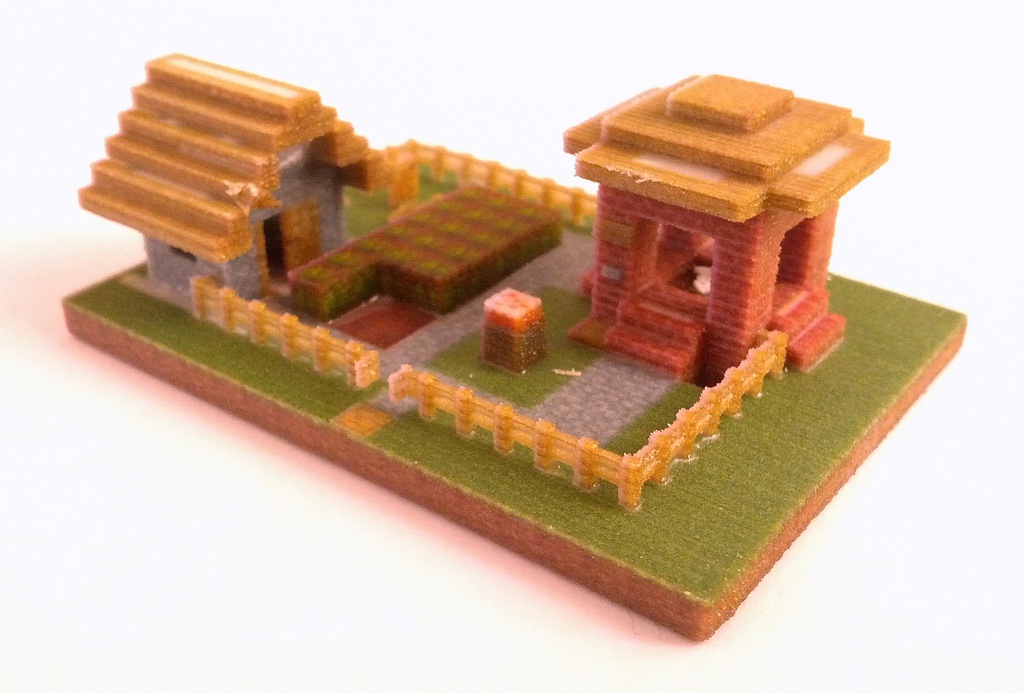
In Minecraft terms, once you have the blueprints for a replica of Rivendell from Lord of the Rings, all you have to focus on is placing the next block in the right place. And then repeat!
Eventually, you’ll have Rivendell:
Here’s a real-life example of this block-placing mentality:
“My goal is to reach my goal weight of 150 pounds by December 1st, 2021, so I will eat one vegetable every day, and I will strength train for 30 minutes, two days per week. On other days, I’ll go for a 10-minute walk.”
What happens when you do this: you stop worrying about the outcome, and instead JUST focus on the habit you have to do today.
It allows you to very easily answer the question: “Yes, I placed the block” or “no, I did not place the block.”
You either ate a vegetable today or you didn’t.
You either exercised for 30 minutes today or you didn’t.
Make sure you are picking a blueprint that you can build (it’s not TOO unrealistic), and keep things simple. A target weight loss goal of 1 pound per week is reasonable and sustainable. Remember that the focus should be on SUSTAINABLE progress – not “progress at any cost.”
Once you start reaching goals, you can create more complex plans.
They run on a treadmill because they think they should, but they hate it, and they never want to go back. Or they get dragged to some virtual fitness class and pretend they lost their internet connection to turn it off.
While they do their best to build the habit, they’re so unhappy and unexcited about the exercise that the habit never sticks. They only exercise until they reach a goal and then they stop. Ugh. Temporary changes = temporary results!
You don’t have to exercise in a way that you hate.
Pick the kind of exercise that makes you come alive. Don’t have that form of exercise yet? Try new things!
Especially the stuff that doesn’t feel like exercise.
Nutrition is 90% of the battle, so the exercise can be something that you enjoy, that reminds you to make better food choices so your efforts don’t go to waste.
Have a specific physique in mind (six-pack, toned arms, a better butt, broader chest, etc.)?Build the body you want and get hooked on improvement: “I can’t wait to go work out and find out how much stronger I got today compared to last week.”
When it comes down to our health, we can invest in three ways:
Time
Effort
Money
Healthy habit-building badasses know this and prioritize accordingly: they know investing in their health is the best decision they can make for the long term. So they decide what’s the correct balance of time, effort, and money to use for that investment.
Your health is an investment, just like your net worth:
If you want to devote your effort and time to building your own workouts, crafting your own meal plans, and keeping yourself accountable, that’s awesome! I did this for myself for years.
You might decide to outsource your programming to a coach, recruit an accountability partner, or buy into a program that creates your workouts and nutrition for you.
Either way, this is a months or years-long process that requires discipline! Every day you get a tiny bit better compounds upon the day before and builds you a big nest egg (read: a great physique) that will keep you wealthy (read: healthy) for decades and decades.
We’ve had thousands of people who read all the free content on Nerd Fitness for years with no results, because they never invested in themselves.
However, the second they finally invested in themselves by hiring a 1-on-1 coach, they took action and lost weight within months. The same is true for our self-paced adventure Nerd Fitness Journey (a part of NF Prime).
Why?
Because we VALUE what we pay for and invest in, making us more likely to actually do the damn thing. And we don’t value what we get for free or take for granted.
Unhealthy people don’t look at all of this stuff rationally – they complain about spending 99 cents on an iPhone app that could dramatically improve the quality of their life, and then gladly spend $6 on a sugary Starbucks beverage each morning without a second thought.
People email me all the time asking, “Why should I pay for a course when there is free information online?”
Welp, there has been free information online for decades – has it gotten you in shape yet? Maybe there’s a point to investing in yourself!
Many people – myself included – will gladly pay for somebody to cut through all of the noise and bad information to deliver ONLY the right information that they need to read or hear.
Your money, your time, and your effort are all limited resources: how you choose to spend each of them tells me a lot about your priorities.
Personally, I gladly pay hundreds of dollars every month for my own online fitness coach, and have done so since 2014.
Many probably think I’m crazy and that this is a waste of money (“just do your own workouts!”), but I feel that it’s the best money I spend every month, and it’s why I’ve prioritized it over other expenses.
I’m not just paying for a workout plan in an excel document.
I am paying for accountability from somebody who is checking in on me, expertise from a trained professional who can spot my weaknesses, and the knowledge that I’ll actually do the workout because I’m spending my hard-earned money on it.
It’s not what you say is a priority, it’s what you spend your time or money on that’s a priority.
Prioritize your money and time on the best stuff, even at the expense of other creature comforts, and you’re more likely to get in shape because you’ll actually care about it.
Answer these questions:
How much money do you spend on your health?
How much time and effort do you devote to creating your workouts or fine-tuning your nutrition?
Have you ever hired a coach or paid for an online course?
Do you buy apps or software that makes your life easier, or do you try to get by with free stuff that you know you won’t actually use?
Sometimes spending money is the best investment you can make in yourself – because you KNOW that the free option is something you won’t stick with!
Although you have a small room with weights in your apartment complex, pay money to join an outdoor class in a park because you hate working out alone. If you know people are counting on you to show up, you’ll more likley work out.
Pre-pay for 20 personal trainer sessions (virtual is okay) – if you’ve already paid for it and scheduled the workouts, you’ll actually DO IT.
Don’t have time to cut up vegetables? Buy them pre-prepared. Expensive? Maybe, but worth the price if it gets you to eat more veggies.
Decide what to sacrifice. It might mean you have to skip movies out or cancel your cable to prioritize a healthy meal service or buy more cookbooks so you never get bored with cooking new healthy meals.
Start thinking about this from a different perspective:
You’re not buying a fitness course or a trainer or an overpriced salad (that you would never make for yourself anyways).
You’re not just hiring a coach that prescribes you a workout that you could have found for free on the internet.
You’re investing in your future and purchasing accountability and expertise and momentum.
If you are looking for that expert guidance, accountability, and peace of mind that you’re training the right way for your goals, schedule a free consultation with Team NF to learn about our coaching program today!
8. Go All In On Momentum.
Remember that Isaac Newton guy?
“An object at rest tends to stay at rest, and an object in motion tends to stay in motion, unless acted on by another force.”
This is called “inertia,” and nothing could be more applicable when it comes to your health.
Unhealthy people have a LOT of inertia to overcome when they are trying to build healthy habits and get in shape:
Their body is used to sitting on a couch and eating junk food, which means the habit of exercise is agonizing. They have to convince themselves to get off the couch and go out into the wilderness. Eating vegetables and healthy food sucks compared to their normal comfort food.
But they use max effort to do these things a few times, and momentum starts to shift away from unhealthy and towards healthy.
And that’s when things fall apart.
Their kid gets sick or they work late and they miss a workout. Not the end of the world, right? But then it snows the next day, and one missed workout day becomes two, which becomes a month in the blink of an eye.
And they’re back to square one.
We are going to focus instead on cultivating and protecting momentum.
Perpetual health doesn’t happen in days, or with a few decisions. It takes months (or more likely, years) of consistent effort.
And shit happens.
Pandemics. Kids. Work. Life.
It’s more than just “missing a workout.” It’s killing your momentum, and momentum is crucial to long term health.
So focus on doing whatever you can to build momentum quickly and maintain it.
Momentum is crucial to being perpetually healthy. So you need to protect it with your life.
Exercising 4 days per week without fail. Yes, even on holidays. Yup, even if it’s only push-ups for 5 minutes.
Going for a morning walk every single day, even when it’s snowing.
Scheduling workouts for early Saturday morning with a virtual trainer so you won’t drink like a fish Friday night.
Putting your workouts in your calendar. Have a friend give $50 of your money to a cause you hate every time you miss a workout.
Which means you should be following my favorite rule: never miss two in a row.
Two missed workouts quickly becomes 30 in the blink of an eye. Two bad meals quickly becomes a week of pizza and Chinese food.
So “never two in a row!” – never eat two bad meals in a row, never miss a workout two days in a row.
If you miss a workout, that next day is suddenly the most important workout of your life. Do whatever you need to do to get to the gym!
If you eat a bad meal, that’s fine! Enjoy it. But that next meal is suddenly the most important meal of your life! Do whatever you need to do to eat a dang vegetable!
9. Know Your Kryptonite.
I want to share an important quote from the late, great physicist Richard Feynman:
“The first principle is that you must not fool yourself – and you are the easiest person to fool.”
Unhealthy people might be aware of their Kryptonite, but they just hope and pray they have enough willpower to overcome it every day.
They eat a single Oreo, and then spend an hour thinking about cookies until they go eat a whole sleeve of Oreo cookies and then berate themselves for not having more willpower to avoid the temptation.
Unhealthy people try to fix their flaws through sheer willpower and then feel deep shame when they can’t stop their behavior.
Permanently healthy people recognize their Kryptonite, and have a plan to avoid or protect against it:
If they know grains make them unhappy and bloated, they follow a Paleo diet and remove those foods completely so there’s no attempt to only eat half a serving of something.
If they know they struggle with portion control, then maybe they try skipping a meal with Intermittent Fasting.
They also ask the questions that get to the heart of their Kryptonite with regards to weight gain:
Maybe they eat when they’re bored.
Maybe they eat when they’re upset.
Maybe they eat when they’re nervous.
Maybe they eat when they’re watching TV.
They KNOW these things about themselves, and they know unhealthy food has been designed to be addictive.
So they plan for it!
Know thyself, my dear friend, and know what your triggers are.
We’re all flawed; plan for your flaws instead of trying to fight them. These triggers can be environmental or situational or emotional. Know it will happen, and build a Kryptonite-proof plan so you don’t have to worry about avoiding it.
Build your Batcave (your environment) so it’s tougher to make unhealthy decisions and easier to make healthy ones.
Don’t order out from unhealthy restaurants, and schedule early workouts on Saturdays so you won’t drink yourself silly on Friday.
You don’t need to be flawless. You don’t need a perfect plan. What you do need is to have an honest conversation with yourself about things you need to avoid while you’re trying to make healthier choices.
That might be certain restaurants, certain aisles of the supermarket, or even certain people….
10. Surround Yourself with Supporters, Not Anchors
You are the average of the 5 people you associate most with.
Are they banana peels?
Or are they Lakitus?
Banana peels need no introduction: drive over one in Mario Kart and they’ll ruin a perfectly good race by crushing all of your momentum.
Compare that to Lakitu. If you’re not familiar, he’s the little guy on the cloud in Mario Kart that picks you up when you fall off the track and puts you back on course.
Unhealthy people get spun out all the time by the banana peels in their lives:
“What do you mean you don’t want to eat my lasagna anymore? You love my cooking.”
“Everybody is coming over to play D&D and eat pizza, you can’t miss this.”
“You don’t need to lose weight. You look fine. Live a little. Come on.”
Questions and comments like these subtly influence our behavior every day. Which is how you end up looking like and acting like the 5 people you associate most with.
Compare this to Lakitus: the people who want you to succeed, who hold you accountable and make you want to be better.
I recently asked our private community from Nerd Fitness Prime what the group meant to them.
This response jumped out at me:
You need to be surrounded by people that pick you up, not slow you down.
Healthy people know this, and they make the hard decisions about who is worthy of their time and attention.
They often fire their unhealthy friends and family – even if only temporarily – because they can’t be around negative influence as they’re trying to build momentum.
I’ve heard of tons of stories where unhealthy relationships have ended because a newly healthy individual was dating an unhealthy person who didn’t want them to be healthy and was actively sabotaging them.
Why does this happen? Because it’s often easier to drag other people down than it is to look honestly in the mirror and address one’s shortcomings or unhealthy.
If you are trying to get healthy, minimize your time around banana peels and MAXIMIZE your time with Lakitus.
You are influenced dramatically by the people around you whether you realize it or not. How are these people influencing you?
Take exercise:
Banana Peel: You want to exercise, but your friends are mad at you for skipping Among US or a World of Warcraft raid… you’re going to skip the workout.
Lakitu: You want to exercise, and your friends are currently doing yoga in the park… you’re gonna find your mat!
Food:
Banana Peel: Your family orders take out and everyone wants pizza. You’ll likely order junk food to fit in, rather than order a salad and endure the scorn.
Lakitu: You decide on delivery and the 4 people in your house want salads – I’d bet $1000 you’re going to order something healthy too.
Mental health:
Banana Peel: You have 5 friends who never talk about anything serious: how are you supposed to tell them about your depression medication or that you’re thinking about going to see a therapist?
Lakitu: You have 5 friends who are not only accepting of your flaws, but share theirs too and have advice for you.
Decide who is worthy of your attention, and work on putting yourself in situations with people who make you want to be better.
This might mean a serious conversation with your significant other that “likes you more full-figured” if your goal is to be healthier and happier.
Join a running club at work, or start a running club if one doesn’t exist yet (when it’s safe to do so).
If you don’t have people in real life cheering you on, find an online group that pushes you to be better.
How is NEXT YEAR Going to Be Different?
Phew! Okay, let’s see how many of these you can actually check off:
I have a Groot Mindset
I know my Big Why
I don’t go on diets. I adjust my nutrition.
I know what my food is made of.
I have blueprints and blocks.
I don’t have to exercise; I GET to.
I invest in my health like a 401(k).
I go all-in on momentum.
I know my Kryptonite.
I seek out Lakitus, not banana peels.
Give yourself a score, and let me know which ones are the toughest for you to follow through on.
If you checked 6 or fewer boxes, pick ONE of the habits and work on it for the next month. Internalize it. Make it part of your new identity. And then move onto the next one.
You’re overcoming inertia and building momentum!
And NEVER underestimate momentum. Once you build it, it can be hard to stop!
We have three great ways to start the ball rolling, right here in our own community. Pick the path that best aligns with your goals:
#1) Our 1-on-1 Online Coaching Program: a coaching program for busy people to help them make better food choices, stay accountable, and get healthier, permanently.
You can schedule a free call with our team so we can get to know you and see if our coaching program is right for you.
#2) Exercising at home and need a plan to follow? Check out Nerd Fitness Journey!
Our fun habit-building app helps you exercise more frequently, eat healthier, and level up your life (literally).
Try your free trial right here:
#3) Join The Rebellion! We have a free email newsletter that we send out twice per week, full of tips and tricks to help you get healthy, get strong, and have fun doing so.
I’ll also send you tons of free guides that you can use to start leveling up your life too:
Download our free weight loss guide
THE NERD FITNESS DIET: 10 Levels to Change Your Life
Follow our 10-level nutrition system at your own pace
What you need to know about weight loss and healthy eating
3 Simple rules we follow every day to stay on target
Alright, now it’s your turn:
Agree with my 10 traits? Disagree?
Anything missing?
Leave that in the comments too!
-Steve
PS: Make sure you check out the rest of our Sustainable Weight Loss Content:
Do you struggle with tension in your upper and lower back or are you looking to help improve your overall mobility?
Then this foam roller routine is for you!
In this quick workout, I’m going to lead you through a few stretches that you can do with your foam roller to help release tension in your upper and lower back, improve overall mobility, and feel good.
Click here to watch this video directly on youtube – these quick stretches are a perfect way to end another Pilates workout, run, or walk.
Give these stretches a try today – you’re going to feel so good when you’re done!
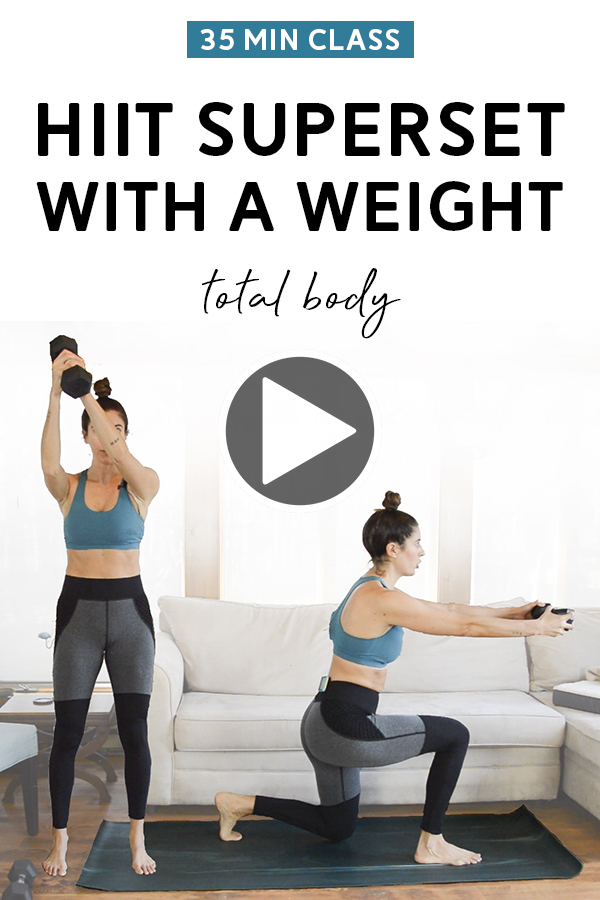
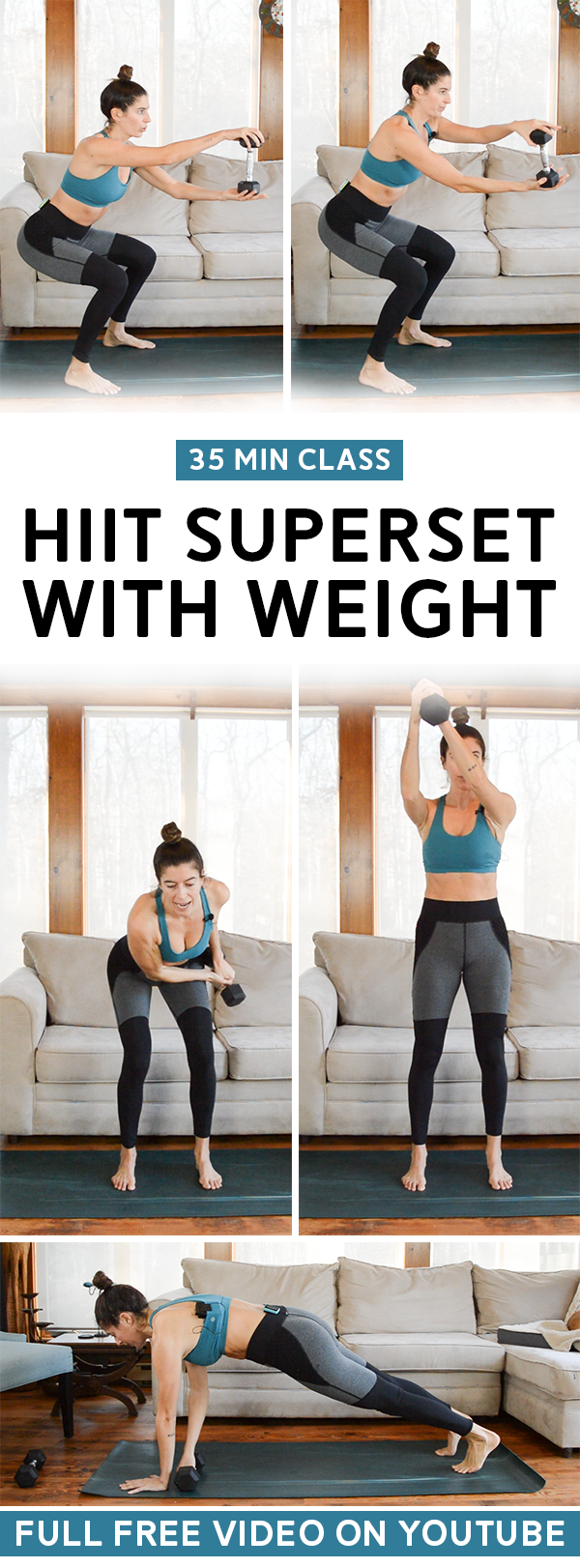
I’ve shared a bodyweight HIIT Superset class, an Express version focused on lower body, and now today: a single dumbbell HIIT Superset workout. You’ll need a medium weight and 35 minutes (that includes warm up and cool down). Get ready to sweat!
If you love this single dumbbell hiit workout, I have a bunch of other HIIT Superset classes available to Patreon members.
In this class, we thoroughly prepare our body for HIIT training with mobility work and light cardio. We then move onto our HIIT superset work. In each of the five supersets, you’ll preform two exercises, back to back, for 20 seconds each. You then rest 20 seconds before repeating. You’ll do four sets total.
The superset pairings will be similar, but Exercise A is lower impact, and then we dial up the intensity for Exercise B. A great modification option is to stay on Exercise A for the entire 40 seconds of work, rather than progressing to Exercise B.
Between supersets, you get a minute to recover, but pause the video and take more time if needed. Always listen to your body, modifying or stopping as needed (low-impact modifications will be shown).
We finish class with a guided cool down and stretch.
Every year I set a goal to embrace a “Slow December” and after the events of 2020, I think it’s even more important this year to slow down, reset, and recharge for a new year.
Now that I have a whole team working with me here at The Balanced Life, it would be easy to give this up and continue with business as usual. But, I’ve held on to this concept of “Slow December” and now I encourage my team (and our whole community) to embrace this too!
We are working on some really exciting new things for 2021 and can’t WAIT to share them with you soon.
But for now, we hope you’ll join us in slowing down this season, connecting with those you love, and looking ahead to an exciting new year with The Balanced Life.
In true 2020 fashion, I hope you enjoy our “team photo” – thanks to Zoom.
And I thought it would be fun to round up the best of 2020 at The Balanced Life with your favorite blog posts + podcasts. Check out the top 5 below if you’re looking for a quick workout, a last minute gift idea, or need a podcast to listen to on a morning walk.
Looking for a recipe to keep you warm and cozy this winter?
Full of nourishing ingredients like garlic, bone broth, spinach, and turmeric – this delicious turkey & sweet potato immune-boosting soup is the perfect cozy meal for when you aren’t feeling your best or just want something to warm you up on a chilly day.
INGREDIENTS:
Coconut or avocado oil for cooking
1 lb ground turkey
2 cloves of garlic, minced
1 small yellow onion, chopped
7 cups chicken or turkey bone broth
1.5 medium sweet potatoes, peeled and cubed
1 cup canned chickpeas drained and rinsed
1 handful of chopped spinach or kale
1⁄2 tsp ground turmeric
1⁄4 tsp ground ginger
Sea salt and pepper to taste
INSTRUCTIONS:
Start by heating a large skillet over medium heat with coconut or avocado oil. Add the ground turkey and saute until completely cooked through.
While the turkey is cooking, add additional oil to a large stockpot over medium heat and add the garlic and onion. Saute for 3-5 minutes or until translucent.
Add the cooked ground turkey to the pot with the garlic and onion and add the bone broth, cubed sweet potatoes, and chickpeas. Bring to a boil and then reduce to a simmer and cook for about 20-25 minutes or until the sweet potatoes are tender.
Add the chopped spinach or kale, turmeric, ginger, salt, and pepper. Stir well. Cool and pour into a serving bowl. Enjoy!
Hope you have a wonderful winter season!
xo,
PS – Not feeling 100%? Check out my sick day survival guide for my tricks for boosting my immune system this time of year.