Categories
Uncategorized

#holistic #getfit #nutrition “Why Can’t I Lose Weight?” 8 Uncomfortable Truths Holding You Back

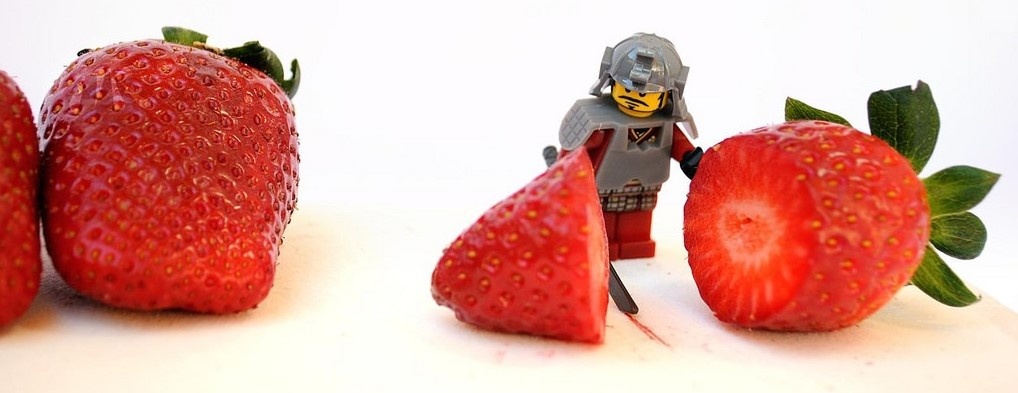
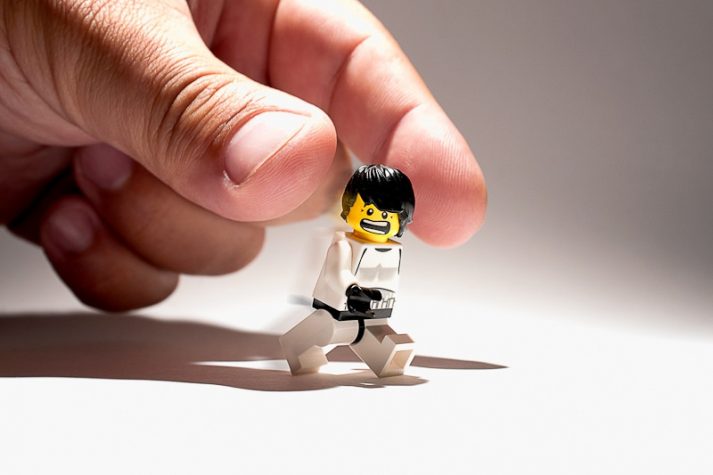
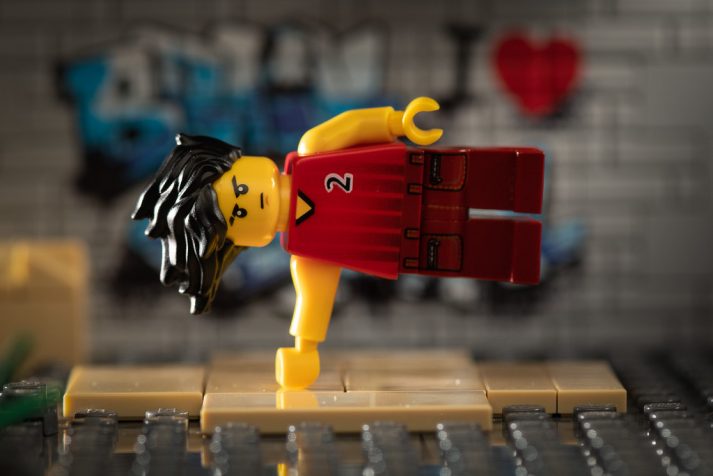
This lego wants to know why he can't lose weight.

“Why can’t I lose weight, Steve?”

This question breaks my heart every time I hear it. And I hear it multiple times per day from frustrated people like yourself.

Some of those people are our 1-on-1 coaching clients, who we work closely with to uncover the truth.

And that’s what we’re after: the truth on why weight loss is so tough to achieve.

Why “eat less and move more” sounds nice in theory, but is insulting to those who KNOW this, try their best, and still can’t lose weight.

We’ll tackle today’s topic with statistics, science, and plenty of Harry Potter analogies. This is Nerd Fitness after all.

We’ll go over:

Let’s jump in, Scuba Steve style, so you can start seeing results!

If you’re somebody that wants a Yoda in your corner to coach you through the ups and downs of your fitness journey, we’re here for you with our Online Coaching Program!

No shame or judgments – just a supportive person who works hard to help you succeed 🙂
Our Online Coaching Program changes lives

Why the Nutrition Industry Makes Me So Angry
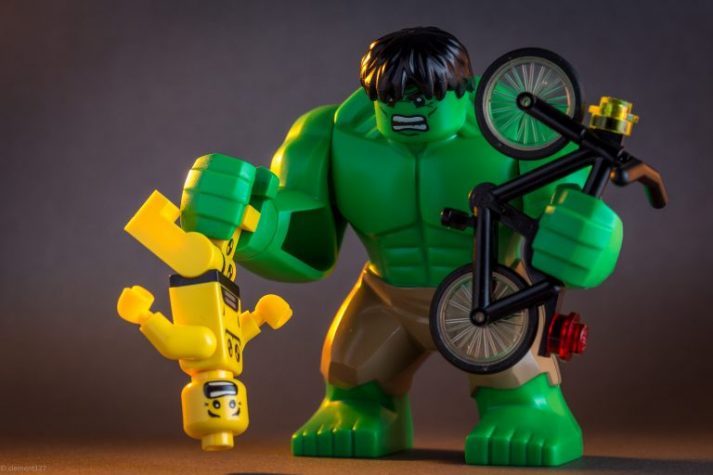
Hulk wants to smash all of the nutrition industry.

I took this picture walking around Manhattan last week:
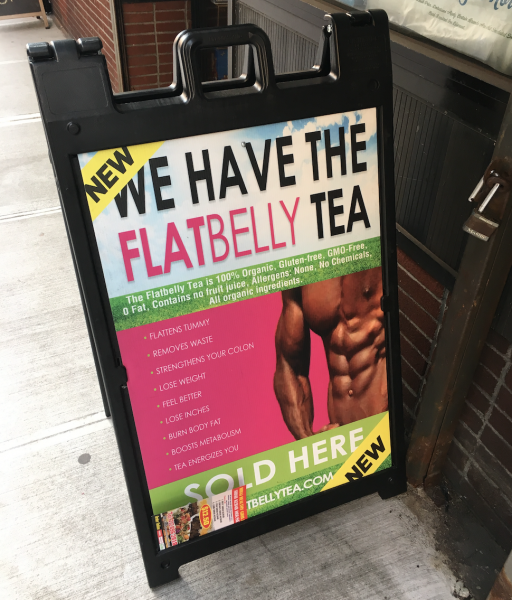
This flatbelly tea ad drove me crazy!

There is some SERIOUS psychological warfare going on here, and it hurts my soul.

For starters, they advertise as “THE” flat belly tea.

This means there are many other companies selling similar products, which would ALSO lead me to believe this is a lucrative product to sell!

They list every fitness buzzword and term every marketer uses when it comes to selling health and fitness:

  • Gluten-free
  • Removes waste
  • Organic
  • Burn fat

Including some real head-scratchers.

“Strengthen your colon?”

How the hell do you strengthen your colon?!

This reminds me of the brilliant Saturday Night Live skit about “Colon Blow” cereal:

Gif on an old SNL sketch.

But I digest digress…

People are buying this stuff, even if they know it probably won’t work.

Like buying a lottery ticket even when we know the odds of winning are 0% –  what we’re really buying is “hope”:

  • Hope that this will actually work – unlike the last 10 attempts.
  • Hope we can overcome 20 years of bad choices with a beverage.
  • Hope that this product will give us the confidence and self-love we deserve.

Don’t get me wrong.

“Hope is a good thing, and no good thing ever dies.”

I just HATE when hope gets weaponized to sell you expensive snake oil and pretty-packaged fluff.

This is what we are rebelling against here in the NF Rebellion: marketers and companies who are crappy enough to prey on our hopes and fears and sell snake-oil in a bottle.

We’re also rebelling against that voice in our head that talks down to us, calls us failures for not getting in shape yet, and berates us every time we break down and eat a cookie.

I say no more.

Let’s fight fire with fire science.

How Much Exercise Do I Need to Lose Weight?
This lego is trying to pedal his way thin!

There are a few generally accepted truths when it comes to weight loss.

All of these come with baggage attached, and your results will vary depending on your:

Setting all of that aside, I’m going to try and keep things simple just to prove my point.

Let’s go with an (understandably) oversimplified look at weight loss: a pound of fat equals around 3,500 calories.[1]

This would mean you’ll need to either eat 3,500 fewer calories, or burn an extra 3,500 calories to lose 1 pound of fat.

So…how long does it take to burn 3,500 additional calories per week?

Let me answer a question with another question:

…How many hours do you have?

Studies show you’ll burn an extra 100 calories (approximately) when walking or running a mile.[2]

So, you would need to be running/walking an additional 5 miles per day, 7 days a week, to lose one pound of fat per week.

Batman has to fun whether he likes to or not...part of fighting crime means running 5Ks (ish).

I don’t know about you, but I don’t have time to run an extra 5 miles a day.

Nor do I want to!

Not only that, but as you’ll see below – this idea of just burning an extra 500 calories per day to lose a pound a week only works early on.

You’ll quickly run into speed bumps and roadblocks – figurative ones, try to avoid the real ones on your run –  that slow down your progress significantly.

Simply put, exercising your way thin has been proven time and time again not to work.

Here are three such reports:

#1) Many people develop increased appetites as a result of exercise, which leads to no weight loss.[3] Time Magazine got in trouble for pointing this out  – even though they were right!

#2) A 2011 systematic review and meta-analysis came to the conclusion:[4]

“In overweight and obese populations… our results show that isolated aerobic exercise is not an effective weight loss therapy.”

#3) Another study compared people who dieted vs people who only exercised:[5]

Body weight decreased by 10% in the diet group and by 9% in the diet–exercise group, but did not decrease in the exercise group or the control group.

What I’m trying to say, and a lesson we try to deeply understand at Nerd Fitness: “you can’t outrun your fork”

…and the bad news isn’t done.

How Our Metabolism Responds to a Caloric Deficit (6 Facts)

This swimmer wants to know how to lose weight.

When you start to lose weight, your resting metabolism slows down.[6]

You might think this is some sort of evil sorcery worthy of “He Who Must Not Be Named,” but unfortunately – it’s just 2nd-grade math.

When you start to lose weight, there is less of you that needs fuel.
Yep, the bigger you are, the more calories you need.

In other words: your metabolism doesn’t have to work as hard to fuel all of your bodily functions, has less weight to carry, and thus it will burn significantly fewer calories compared to when you were much bigger.

Here is the estimated daily resting calorie burn (“sit on your ass all day”) of a 35-year old male nerd at 3 very different weights – as determined by our free Calorie Calculator:

  • 300 lbs: 2,600 calories.
  • 250 lbs: 2,300 calories.
  • 200 lbs: 2,000 calories.  

WHAT THIS MEANS: Unless you adjust your calorie intake as you lose weight, your calorie intake will become less and less effective for weight loss, until you hit equilibrium.

Put a different way: this person could eat 2,300 calories per day and over time, lose 50 pounds (from 300 pounds to 250 pounds), but that’s where he’ll hit equilibrium: calories burned equals calories consumed.

In order for him to lose the next 50 pounds, he’ll need to decrease his caloric intake even more, and then STAY at that calorie consumption to keep the weight off.

And then it gets even worse!

There is a solid body of evidence on a bodily feature called “adaptive thermogenesis.”[7]

Which has nothing to do with the band Genesis – though feel free to listen to “Invisible Touch” right now.

It might soften the blow while you learn about “adaptive thermogenesis.”

“Adaptive thermogenesis” refers to the process in which our bodies will adjust based on how many calories we burn – and do whatever it can to preserve the body fat we have.[8]

Our bodies WANT to maintain the extra body fat we have (“I don’t know when I’ll need this, better save”), and are actively working in unison to preserve it – so even after a few pounds are lost from running, it’s going to be a persistent challenge to keep the weight off.

As pointed out in the article above:

“In long-term studies of weight-reduced children and adults, 80%-90% return to their previous weight percentiles, while studies of those successful at sustained weight loss indicate that the maintenance of a reduced degree of body fatness will probably require a lifetime of meticulous attention to energy intake and expenditure.”

This is why so many people can LOSE weight, but can’t seem to keep the weight off.[9]

This doesn’t even factor in all of the other challenges surrounding weight loss: an “obesogenic” environment (you can smell Cinnabon minutes before seeing it), psychological challenges like depression and anxiety, menopause, medications, and hormones.

These factors cause us to crave high-calorie foods, increase our odds of fat gain, and make it tough to keep our calorie intake in-check, because chocolate cake.

To Recap Why Weight Loss Is Difficult:

  1. You can’t exercise your way to weight loss.
  2. Your metabolism slows down when you lose weight.
  3. Your environment makes it difficult not to overeat.
  4. Your body will try to keep its fat stores.
  5. Even when you lose weight, your body wants to keep the fat it has.
  6. If you lose weight, you’ll have to stay diligent or you’ll put the weight back on.

This is all terrible, horrible, no good, very bad news.

And the toughest truth of all: Due to those factors above, it might not be your fault that you’re overweight…but it IS your responsibility to navigate!

Don't shoot the messenger on the truth of weight loss.

I know, I know.

However, there is HOPE!

And here at Nerd Fitness – and in the Star Wars universe – rebellions are built on hope.

We have thousands of success stories from people who thought they couldn’t lose weight…until they did.
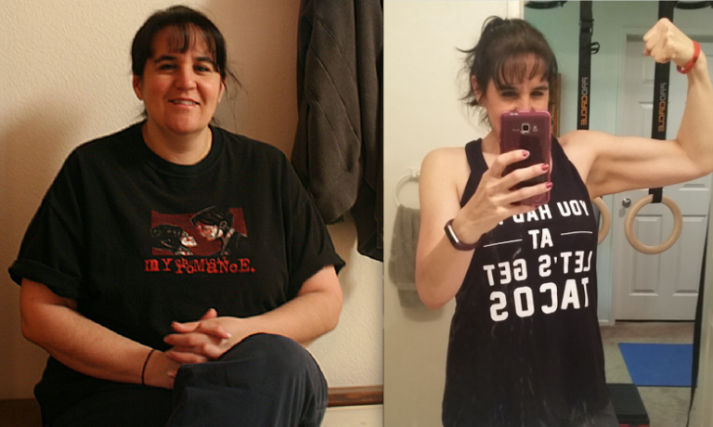
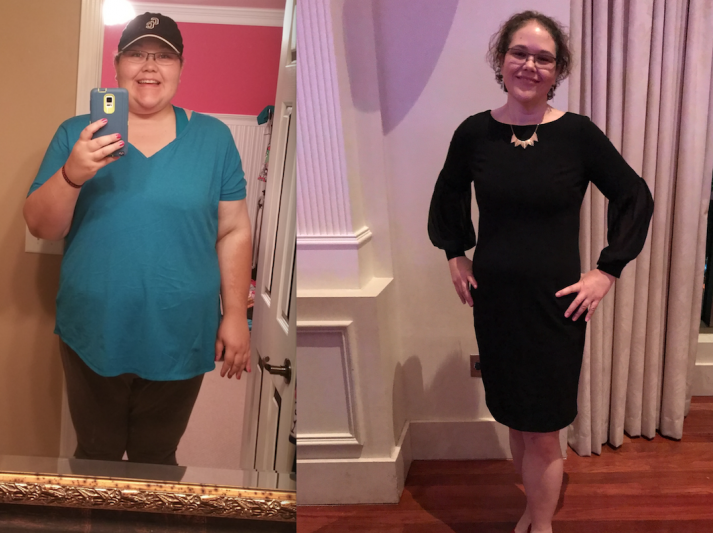
How did Leslie transform? Strength training. with pull-ups

People HAVE lost weight, and kept it off.

People who are older, bigger, have more children, less money, more illnesses, and bigger hardships than you.

It’s a constant battle, but one that’s absolutely worth fighting.

And this means that you are not broken. You don’t have metabolic damage. You are not doomed.

Sure, you’re flawed.

But so are your heroes.

You might be playing life on “Legendary” difficulty, but people like you have succeeded.

It starts by using all of the tools at our disposal, because the forces working against us are doing the same.

Let’s get nerdy.


The Science of Fat Loss

This scientist is trying to discover the truth of weight loss.

YES, it would be awesome if you could drink tea or wrap yourself in plastic to magically lose fat.

YES, it would be amazing if a 30-minute bootcamp class allowed you to eat junk food all day, every day, and not gain an ounce.

YES, it would be amazing if you could take a magic pill that gave you the body you had 10 years ago.

It would also be cool if superheroes were real and I could fly.
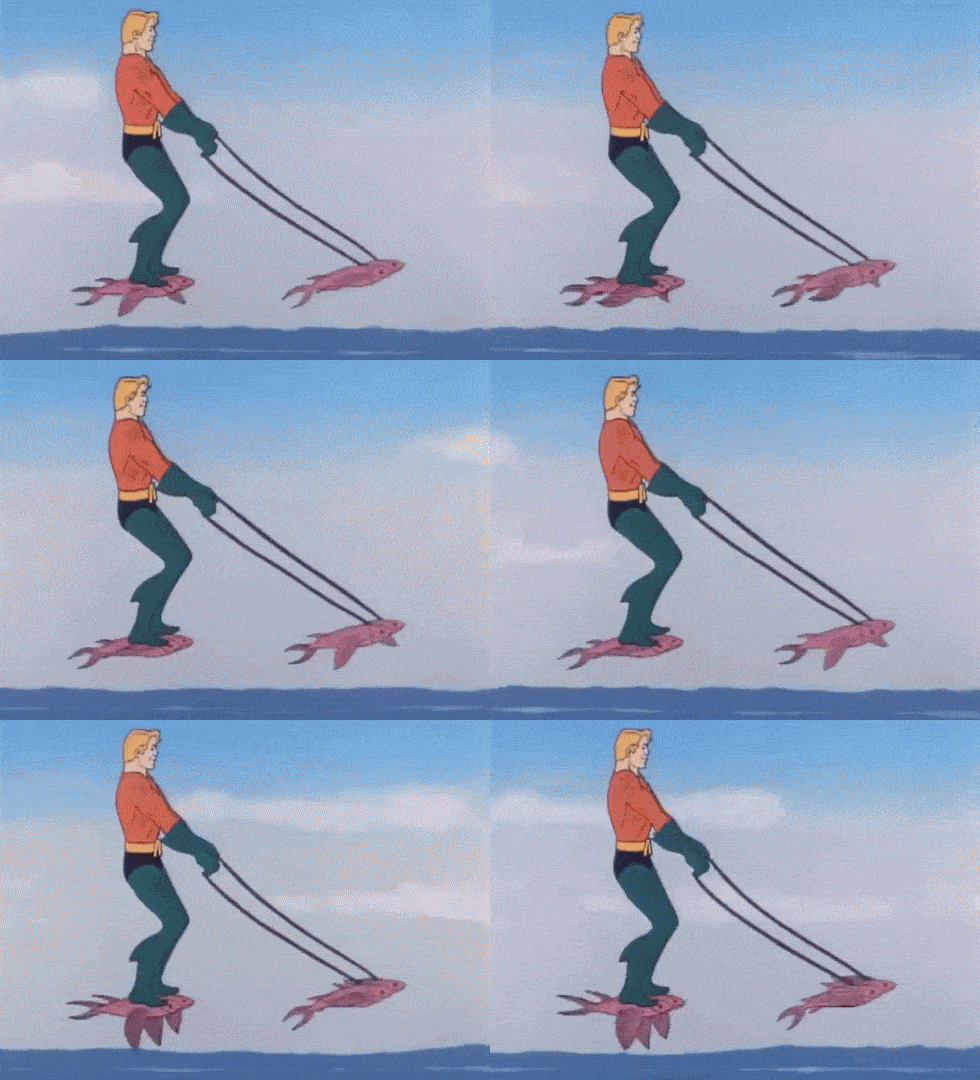
Aquaman looking silly.

Well, not like that.

Come on, Aquaman. People can see you.

We live in a world of science, physics, and thermodynamics.

This means we should ALWAYS look at life through the following lenses:

  1. Occam’s Razor: The simplest explanation is PROBABLY the correct one.
  2. Law of energy: Energy can’t be created or destroyed, only transformed.
  3. Reality: If it sounds TOO good to be true, it probably is.

Let’s apply this to our waistlines:

If we are overweight…

It’s not because we have “toxins” in our bodies that need to be flushed out.

It’s not because we didn’t spend enough time in the “fat-burning” zone during our “muscle confusion” bootcamp.

It’s not because we need fat-burning tea.

These are all pseudoscience buzz terms to sell products, and have no truth to their claims.

Occam’s Razor dictates the simplest solution is PROBABLY the right one.

So what’s the simple explanation to why we’re overweight?

Every day, we consume food that gets transformed into energy.

This food has three options once it enters our body:

  1. Fuel our bodily functions: fuel our organs, regulate our body temperature, etc.
  2. Pass through as waste: pee and poop.
  3. Get stored (usually as fat): saved for a rainy day.

If we are overweight, we are consuming more ‘energy’ than our bodies need every day. Because our body doesn’t need all of it, too much is being stored as fat.

This brings us to the main point of our nutritional focus:

If weight loss is our goal, we must consume FEWER calories than we burn on a consistent basis.

By doing so, our body has no choice but to dip into that “rainy day” fund of fat stores to still get all of its bodily tasks done each day.

Do this consistently, and that’s how we end up with a lower number on the scale and a smaller pants size.

“Steve I know I should eat less. It’s doing it consistently that’s the tough part. Have you tried CAKE?!”

Cake won't help weight loss.

Great point.

And yes, cake is awesome.

But we have to start somewhere!

And it starts here: we need to eat fewer calories, but it ALSO has to be sustainable and enjoyable, otherwise we’ll never stick with it.

And temporary changes produce temporary results. We want permanent weight loss!

Just saying “eat less” doesn’t factor the crazy biological, physiological, and/or emotional challenges we face every day:

We might eat when we’re stressed, depressed, or bored.

We might be on medication that is causing us to overeat without us realizing it.

We can’t eat just one potato chip without eating an entire bag.

We absentmindedly grab a handful of Peanut M&M’s when visiting Kevin in Accounting.

Chugging M&M's won't help with weight loss.

Not only that, but even when we pay attention to what we eat, studies show that we often underestimate our calorie consumption by 15+%.[10]

Crap. This just keeps getting worse!

What’s a smart nerd like you supposed to do in this scenario!?

If we KNOW we overeat without realizing it, and we KNOW restricting calories is tough to stick with long term, then the only path forward is to attack the problem differently.

Not with fit tea.

Nor with body wraps.

Not with “muscle confusion.”

But with science, math, and psychology.

What to Eat For Weight Loss

A table set for dinner.

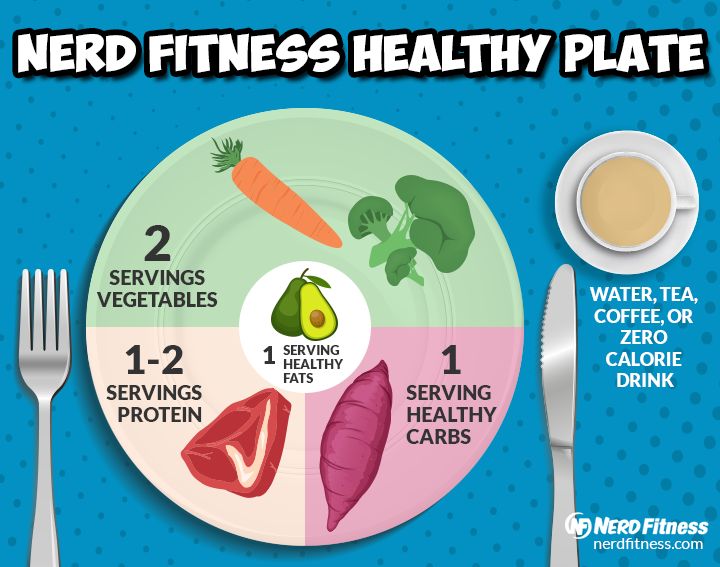
If weight loss is the goal, we need to shift our food choices to foods that give us more “bang for our buck” – healthy, filling, nutritious foods that fill us up and makes us less likely to overeat calorie-bomb foods.

These foods allow us to feel full, but still keep us under our calorie goal for the day:

  • Protein like meat, fish, eggs, and so on.  
  • Fruit like apples, bananas, and berries.
  • Vegetables like broccoli, Brussels sprouts, and kale.
  • Carbohydrate sources like quinoa, legumes, oats, rice, and potatoes.

These are foods that take up a lot of space in our stomach and make us feel full.

If we do this consistently, without feeling miserable, we have a really good chance of not only losing weight, but keeping the weight off.

In contrast, here are some foods that are loaded with calories which DON’T fill us up – thus making it easy for us to overeat:

  • High-calorie, easy to overeat foods like breads, french fries, pasta, and pizza.
  • Soda, juices, and sugary coffee beverages.
  • Candy, cookies, crackers, etc.

To really HAMMER this point home…

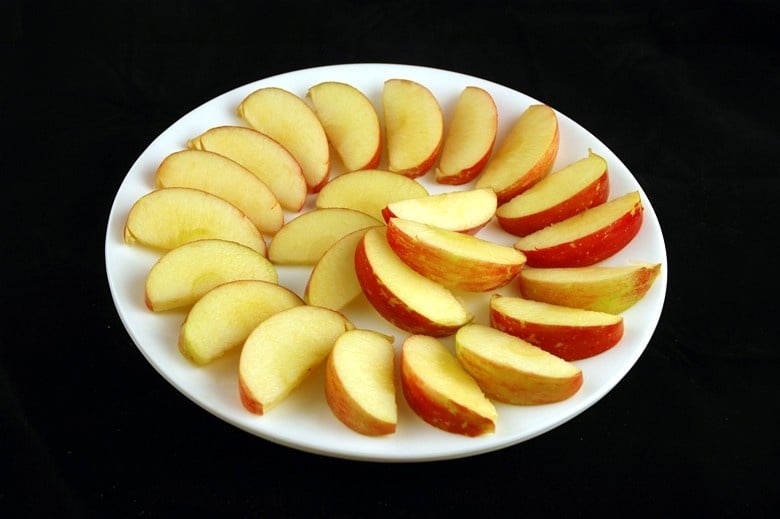
As we point out in “Can You Burn Fat and Build Muscle at the Same Time?” here’s what 200 calories look like, thanks to WiseGEEK.

Which ones do you think will make you feel full, and which ones will make you eat more than you realize?

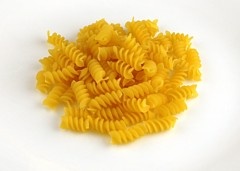
2/3 of a bagel is 200 calories.This handful of pasta is 200 calories.

This handful of turkey is 200 calories.

This plate full of apples is 200 calories.

Can you get yourself to stop after 2/3rds of a bagel or a small handful of pasta?

Of course not!

One more example – here’s 200 calories of broccoli:

This plate of broccoli is 200 calories.

“Steve, that is an absurd amount of broccoli.”

Yup. It’s also the SAME number of calories as 2/3rds of a bagel (which doesn’t even include the calories from the cream cheese or butter).

Now, it’s insulting to say “You should eat more broccoli and less bagels. There’s yer problem.”

I’m merely pointing this out to emphasize the difference between energy (calories) and volume.

(Hate broccoli and vegetables? Read how to make vegetables taste good!)

Depending on what you eat, you could feel “OH SO FULL” after your meal or “Why am I already hungry again? NOM NOM NOM.”

Which means…

If you can start to make even SMALL changes, focusing on nutrient-dense, calorically-light foods like protein, fruit, and veggies, to replace some junk food – even occasionally, it’s going to shift the energy balance back in the right direction.

You’ll become more likely than not to eat fewer calories than you burn, moving you beneath your daily equilibrium.

Do that consistently, and you start to pull from those fat stores.

And we find ourselves at the holy grail:

Sustainable, non-miserable weight loss.

This is actually the secret sauce for ALL popular diets these days.

As we point out in our “What is the Perfect Diet” article, all the popular diets get you to eat more REAL food and less junk food.

They just all have their own unique marketing spin to sell cookbooks and courses and subscriptions. 

Let’s look at each of these diets in a nutshell:

  • Paleo: cut out grains and dairy. Consume only meat, veggies, fruits, and nuts.
  • Keto: cut out ALL carbs. Consume only meat, veggies, nuts, and fatty sauces.
  • Intermittent Fasting: cut out an entire MEAL every day.
  • Mediterranean Diet: focus on REAL foods, with whole grains. Cut out processed foods.
  • Carnivore Diet: Only eat meat. Remove everything else.
  • Military Diet: Nevermind. Please don’t do this diet.

ANY of the diets above will result in temporary weight loss if you strictly follow the rules, but not for the reason you’d think.

It’s not because we’re designed to eat like cave people (though we are), or that our bodies function differently on a Ketogenic Diet (it does), or even that fasting has plenty of health benefits (it does!).

Those things are like 2% of the reason why they work for weight loss. [2% is a statistic I made up to emphasize the smaller importance of any ancillary benefit compared to the bigger picture]

The other 98%: they make us more likely than not to consume fewer calories on average than we usually eat, which will lead to weight loss in the long term… if you can stick with it.

And each diet has rules and guidelines that speak to the specifics of individual people.

If you’re freaking out about how to eat and which diet to pick and you’re worried if you’ll even be able to stick with it, you’re not alone.

It’s why we created our 1-on-1 Coaching Program!

To help people like you change their habits around food to start seeing permanent weight loss results without being miserable!


Which Diet Should I Pick to Lose Weight?

This lego is nervous about which diet to pick.

Nearly EVERY diet will work in the short term, because they all lead to temporary calorie restriction. Every diet above will fail you too in the long term, because you need to do the diet permanently to get the results permanently!

So in my opinion, you should only follow a strict diet like those above IF you can see yourself sticking with it consistently for the next 10 years.

“Steve, that’s melodramatic. Come on.”

That’s what I was going for.

If a diet sounds too restrictive to stick with permanently, then it’s too restrictive for you to devote weeks or months of your life to!

After all, temporary changes equal temporary results.

You’re better off picking a diet that you confidently feel like you can stick with permanently. You should be thinking in terms of “days and years,” not “weeks and months!”

Here’s the end goal we’re working towards:

Sustainable weight loss, weight maintenance, and actually enjoying life.

Looking in the mirror and being happy with what you see, knowing that the weight will stay off.

And most importantly, habits that allow us to enjoy life, have great meals with friends and family, while still reaching our goals

Not temporary changes, but rather permanent small adjustments that adjust over time as we start to see results and build momentum.

Sound good?

Let’s get back to basics and start learning about the food we’re putting into our bodies.

Cool? Cool.

A Primer on Strength Training

Of course Batman Strength Trains.

Conservatively speaking, strength training is the greatest thing ever invented in the history of the galaxy.

Okay, so maybe it’s third after electricity and Nintendo.

But I say this to make a point.

There’s a huge difference between “exercise” and strength training when it comes to body composition.

Coach Matt explains exactly why in this video on gaining muscle while losing fat:

We also cover this in a very in-depth manner in our “Can I Lose Weight and Build Muscle?” guide – which is one giant Harry Potter allegory that you’ll love – but I’ll share the basics right here.

If your goal is consistent, permanent, healthy weight loss and weight management, 80-90% of the battle will be nutrition,

When it comes to exercise, you really only have TWO things to focus on:

  1. What exercise do you love? Good. Do that.
  2. Strength train as often as you have time for.

I’ll touch on the first one quickly.

When you do exercise you love, you’re giving your heart and body a good workout. You’re reminding yourself “I am living healthy” and THUS you should be more likely than not to stick with your healthy eating strategy.

Notice I said “exercise you love.”

If you hate running, never run a mile again.
Hate going to the gym? Never set foot in one.

Hate bootcamps? Me too. Don’t do them.

Instead, go rock climbing, or hiking, or do yoga, or swing dancing, or LARPing.

Really, anything that gets you off your ass and moving. Cool? Cool.


How Strength Training Assists Weight Loss

This fireman stays fit because of strength training.

Your body functions differently when you strength train, in all of the right ways.

We have a whole Strength Training 101 sequence that can you get you started, but I’ll whet your appetite with the nerdiest metaphor ever below.

You can find study[11] after study[12] after study[13] that shows you the benefits of strength training for weight management.

Let me explain it here quickly, borrowing from Harry Potter:

(You know, the wizard.)

At the Hogwarts School of Witchcraft and Wizardry, when each student arrives they put on the “Sorting Hat,” an actual hat that determines which House (group) that child will join for his time at Hogwarts.

The hat acts almost like a traffic director:

“Harry, you will go to Gryffindor! Draco, you will go to Slytherin!”

Your body is a lot like the Sorting Hat.

Your body operates in a VERY similar fashion: every day, it receives new calories (when you eat), and it needs to decide what to do with them!

For example:

You eat a large Hawaiian pizza and 20 ounces of Mountain Dew. Your body has to do SOMETHING with all those calories.

To keep things simple, let’s look at the 3 most common results.

It’ll sort those calories into one of three Houses:

A: Burn for Fuel.
B: Rebuild Muscle.
C: Store as Fat.

Your body sorts most of those calories into “Burn for Fuel.” There’s a number of calories your body burns each day just existing: to keep your liver functioning, your heart pumping, your brain operating, and so on – it burns a good chunk of calories just keeping the lights on.

Here are two quick examples (from our TDEE calculator!):

  • A 6’, 34-year old male weighing 250 pounds burns 2,300 calories a day just by existing.
  • A 5’5”, 40-year old female weighing 140 pounds burns 1,350 calories a day just by existing.

Now, if you don’t do any exercise, and you consume MORE calories than the rate you burn each day, the “Sorting Hat” in your body needs to put those calories somewhere!

Where do you think it’ll sort them?

“C: Store as Fat.”

Storing fat is not always good.

However, your body’s sorting behavior changes when you strength train.
Specifically, when you train in a way that really challenges your muscles. This is completely relative to where you are at in your life right now:

  • HEAVY weight training might be a 500 lb deadlift or a 5 pound dumbbell curl.
  • INTENSE bodyweight training might be a handstand push-up or a knee push-up.

When you strength train – by picking up something heavy – your muscles are “broken down” during the exercise itself, and then they rebuild themselves stronger over the next 24-48 hours.

Guess what happens during those 24-48 hours?

Your body will divert as many calories as possible to “Rebuild Muscle!”

It also diverts additional calories to “Burn as Fuel” to handle this increased “muscle rebuilding” activity.[14]

This means two amazing things:

  • Your metabolism is revved up for this time period, burning more calories than normal.
  • Rebuilding muscle is a calorie taxing activity!

There are significantly fewer calories available for “Store as Fat.”

AND IT GETS BETTER.

When you consume fewer calories than your body burns each day, continuing to strength train will cause your body to get even more clever.

Let’s imagine a scenario where you’re eating fewer calories than you burn every day:

  • You strength train regularly, and your muscles break down and need to be rebuilt.
  • You don’t consume enough calories compared to how many calories your body needs to both rebuild muscle and fuel itself…
  • So does your body just shut down?

NOPE!

Your body has been preparing for this, by storing any excess calories over the years in the “Store as Fat” house.

This is the moment your body has been saving up for.

This means your body can pull from “Store as Fat” to make sure all the work still gets done, including your daily functions as a human, and rebuilding the muscle.

This is the Tri-wizard cup[1] of physical transformation victory:

  • You get stronger and keep the muscle you have.
  • You burn through the fat you’re trying to get rid of.
  • You’re decreasing your body fat percent and keeping your muscle = look good naked.

This would be a “win-win-win” according to Michael Scott, Regional Manager, Dunder Mifflin Scranton.

Want help learning how to strength train? You can absolutely build your own workout, or you can work with one of our coaches who can create a custom program that’s specific to your goals and lifestyle.

We’ll even make sure you’re doing the movements correctly via video, because we’re nice like that 🙂


“How I Lost Weight” (Megan’s Story)

In the video above, Megan explains her incredible journey to lose over 200 pounds!

(Not a typo.)

I know, freaking AMAZING.

I bring it up, because Megan’s story demonstrates a lot of the key points brought up in today’s guide, especially the importance of strength training.

She also talks about:

  • How she struggled for years to lose weight.
  • The importance of “starting small.”
  • Why she destroyed her scale.

For more on Megan, make sure you read her interview with us!

BACK TO BASICS: How To Guarantee Successful Weight Loss

This lego is a winner, thanks to small changes.

If you’re still reading, then there is hope for you yet.

You can do this – but you have to be smart and diligent about it! Stop trying to exercise your way thin, and stop trying to find ‘get fit quick’ solutions.

Instead, take this one day at a time. We’re here for you!

We talk about proper nutrition in our big “Healthy Eaters” guide, and we go more in-depth into the specific foods that we recommend, but it starts here:

  • You have to eat fewer calories than you eat now to lose weight, and do so permanently.
  • The best way to do that is to substitute more protein and veggies onto your plate.
  • Strength training will supercharge your results, building muscle while making it easier to burn extra fat.

Understand you’re overeating, and forgive yourself for doing so – most foods have been designed for you to overeat!

YOUR MISSIONS, SHOULD YOU CHOOSE TO ACCEPT THEM:

#1) Pledge to stop buying snake oil. If you’re not sure, ask yourself “Does this sound too good to be true?” and “What would Steve do?”

In addition: stop doing exercises you hate just to lose weight. Pick exercises you enjoy, and put all of your focus on slowly adjusting your nutrition instead!

Shun the Dark Side and come back to the Light!

#2) Be deliberate in your decisions. Every calorie counts. Every decision counts. So make ONE different decision as a result of you being more aware of what you put in your body.

Drinking water instead of soda or juice.

Swapping out a salad for fries once per week. It all counts, but make your decision deliberate.

You’re a smart person. You know what foods should be daily staples, and what foods should be occasional treats. It all counts. So make ONE decision differently to prove to yourself that you can change.

#3) Educate yourself on the serving size of ONE food that you eat regularly. Google it. Find out if what you THINK is a serving and what’s actually in a serving is anywhere close to accurate.

You might be surprised to find out:

  • A serving of pasta is HALF the size of what you normally eat with your meal.
  • How much peanut butter is considered a serving (hint: it ain’t much).
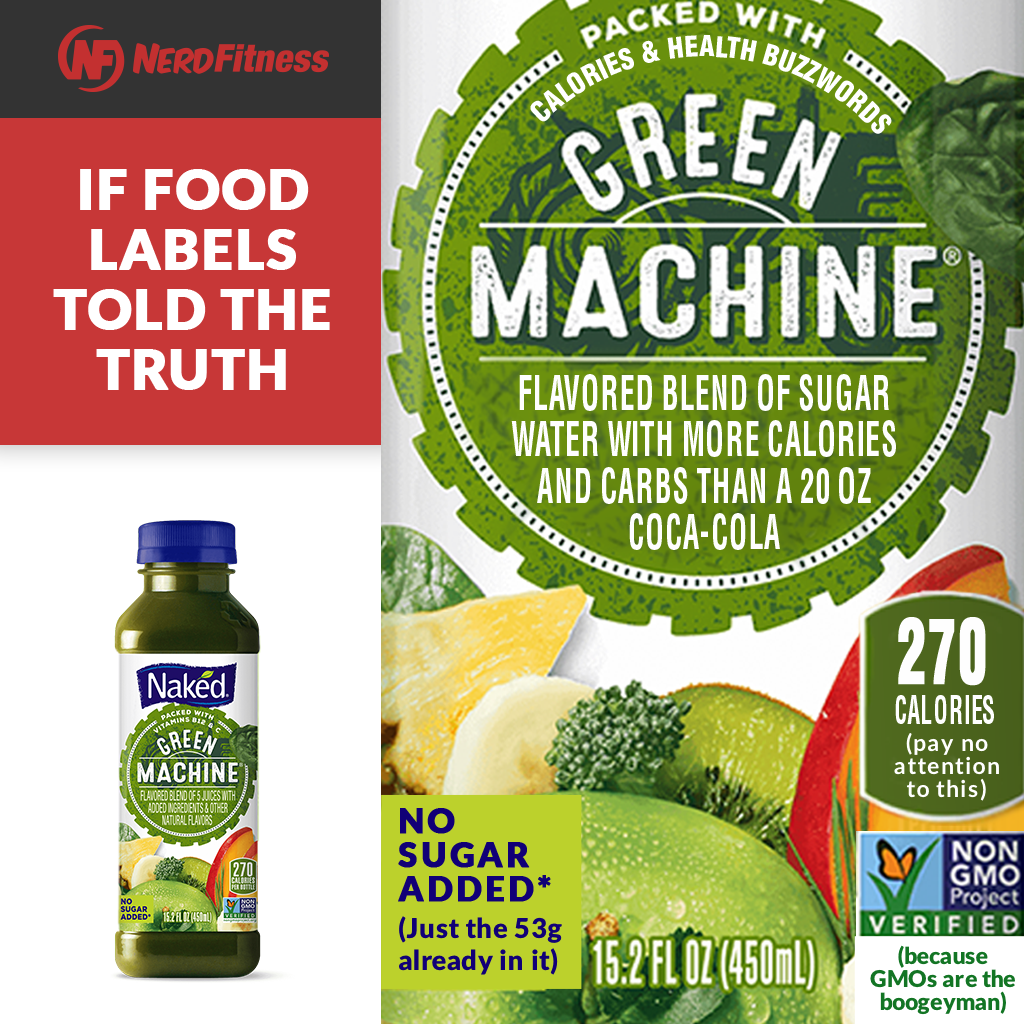
  • There are 2.5 servings in that one bottle of Green Machine Naked Juice.

I don’t want you to change the food or the portions yet. I just want you to educate yourself on what you’re eating, and compare it to how much you thought you were eating.

NEXT STEPS IF YOU WANT TO GO FARTHER! 

If you are looking for more hands-on guidance, we have three options for ya!

1) 1-on-1 Online Coaching Program! If that sounds like you, and you’re looking for nutritional guidance, custom strength training routines just for your situation, and expert accountability, we’d love to hear your story!


2) If you want a roadmap for sustainable weight loss, check out NF Journey. Our fun habit-building app helps you exercise more frequently, eat healthier, and level up your life (literally).

Try your free trial right here:
3) Join the Rebellion! Join our free email list and community – I send out two fun emails a week – and I’ll send you our free 10-level Nutrition Guide along with a bunch of other free bonuses. Get them when you sign up in the box below:

#4) Do a strength training routine! We have so many awesome free options for you here on Nerd Fitness. Pick the ones that jump out at you!

“What is the biggest question you have around nutrition, strength training, and weight loss?”

Oh and please, go eat a vegetable 🙂

-Steve

PS: I know this HOPEFULLY goes without saying, but this is the internet: I totally get that this issue is very complicated to begin with. If you have a hormonal imbalance, PCOS, are on medication for any number of reasons, it could also be affecting your weight.

PLEASE speak with your doctor about your weight and any changes you are looking to make!

###

Photo source: A good Sunday to you, Can I have your bicycle, Speed!, Swimming pool, Pizza lab, Dinner is set, Happy monday!, Speed.

The post “Why Can’t I Lose Weight?” 8 Uncomfortable Truths Holding You Back first appeared on Nerd Fitness.

from Nerd Fitness: Helping You Lose Weight, Get Stronger, Live Better. https://ift.tt/nl6oL38
via IFTTT

Categories
Uncategorized

#holistic #getfit #nutrition How to Exercise With Your Kids (Work out as a Family!)

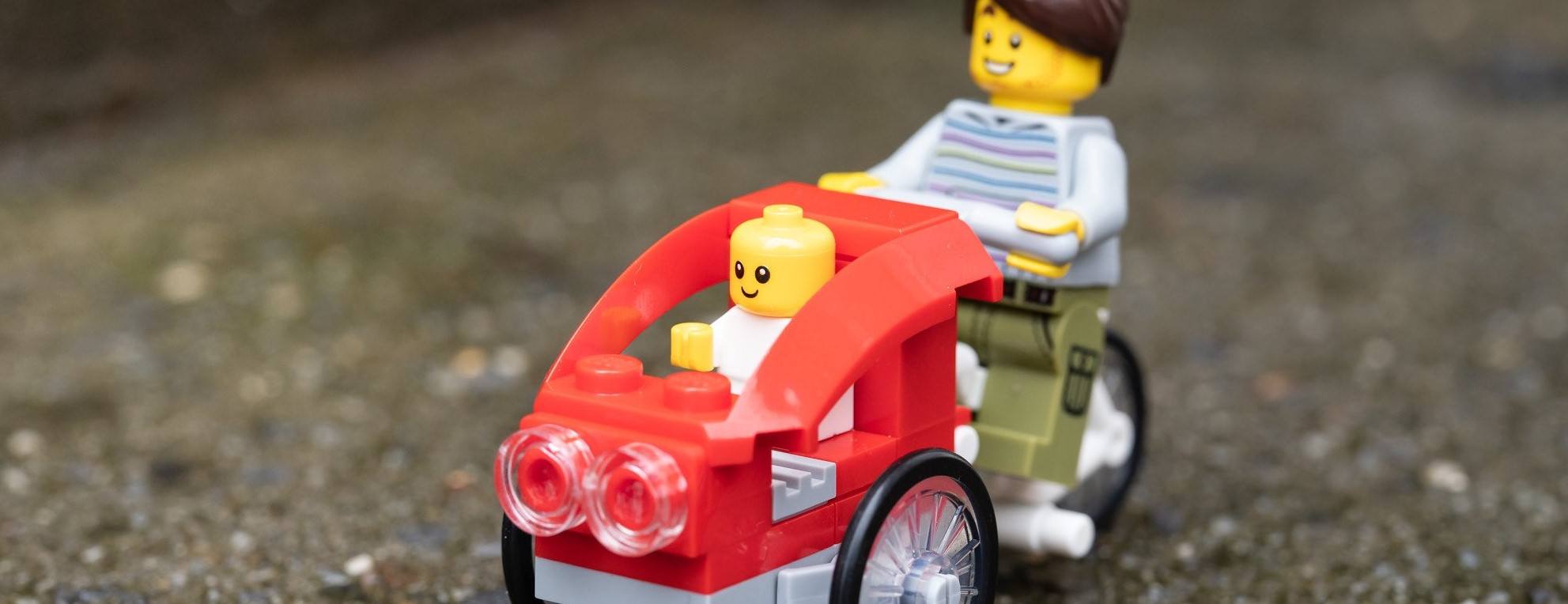
This picture shows a LEGO on a bike with a stroller attached.

So you’ve got kids running around the house… 

And you need to work out, but can’t seem to distract the little monsters any longer?

No problem!

Many of our coaching clients have to train at home with their kids around. Today, we’ll show you how to get them involved!


Here’s what we’ll cover:

Let’s jump right in!

How to Workout With Your Kids (Video Tutorial)

LEGO Maggie doing the iconic James Bond intro.

Quite a few of our Nerd Fitness Coaches are parents, so they know firsthand how challenging it can be to train while you have a three-year-old running around in the background.

When I asked them for advice for this guide, the most common response I received went something like: 

“Training with kids running around is going to be chaos. That’s okay. Do the best you can.”

In other words, it might be challenging to hit personal records (PRs) in your deadlift while also watching over a four-year-old.

This doesn’t mean “Don’t bother working out.” 

It just means you should forgive yourself ahead of time if all doesn’t go according to plan.

A funny scene of a disaster with Leslie Nielsen.

If you want proof of how working out with kids can be “a hot mess,” watch Coach Matt exercising with his young children. 

The video is all sorts of adorbs. 

THE BEGINNER BODYWEIGHT WORKOUT (KIDS EDITION):

When working out with kids, remember:

#1) Meet kids where they are. For young kids, invite them to be a partner. Maybe they can count your reps, tell you when to start, etc. 

On the other hand, older kids might be able to participate more fully, and maybe even train alongside you. 

No matter what, it’s a good idea to invite kids to join when and IF they want, without requiring it. 

#2 ) While every kid is different, here are some very general guidelines from Coach Matt’s experience:

  • 2-6 Years Old. These kids are often way more interested in just playing, wrestling, etc. So doing a specific workout may be challenging. However, these kids may still want to be a part of things, so look for ways to get them involved. 
  • 7-12 Years Old. At this age, they can start handling a little more structure. They will probably really enjoy “skills” training (more on this below), as well as many play aspects.
  • 13+ (Depending on the Kid). They may be ready to step in and join you more fully in a workout if they want to.

#3) Consider a focus on skills/practice. It can be really frustrating to have a timed exercise or workout interrupted. 

A gif of Stewie from Family Guy shouting for attention.

Instead, consider thinking of it like “practice time” of building a skill. You can practice for a couple of minutes, take a break, come back to it, etc.

Kids might respond better to “skills” training instead of “exercises” too. Together, you can practice:

  • Crawling
  • Jumping
  • Swinging
  • Getting up and down off the floor
  • Dancing
  • Throwing/Catching

This might go over better than “let’s do squats” or “push-ups.”

#4) There are lots of different ways to get workouts in throughout the day:

  • Short workouts: a lot of times Coach Matt finds himself squeezing a workout in 10 mins or less.
  • Accumulation: take little micro-breaks throughout the day to do a couple of reps of some bodyweight exercises. Kind of like “exercise snacks.” 
  • Longer workouts: maybe creating that time and space for your training is still important. If possible, defend this time and let the kids move in and out of the frame as they are interested.
  • “I go, you go”: you may snag a workout set in, then play a game with your kids, then go back to the workout set. Breaking it up like this can make them still feel engaged and give you a little more time to train.

#5) Whatever happens is okay! Remember, do the best you can, and it’s perfectly fine if your workout gets cut short because your kid starts drawing on the walls.

The 8 Best Exercises to Do With Young Kids

A kid holding himself up with one arm on a jungle gym.

If your kids are light enough, you can actually use them as makeshift weights during your workout.

Just be careful, and if anything feels unsafe, don’t do it.

But if things DO feel good, here are some exercises you can do along with kiddos (or using them as weight).

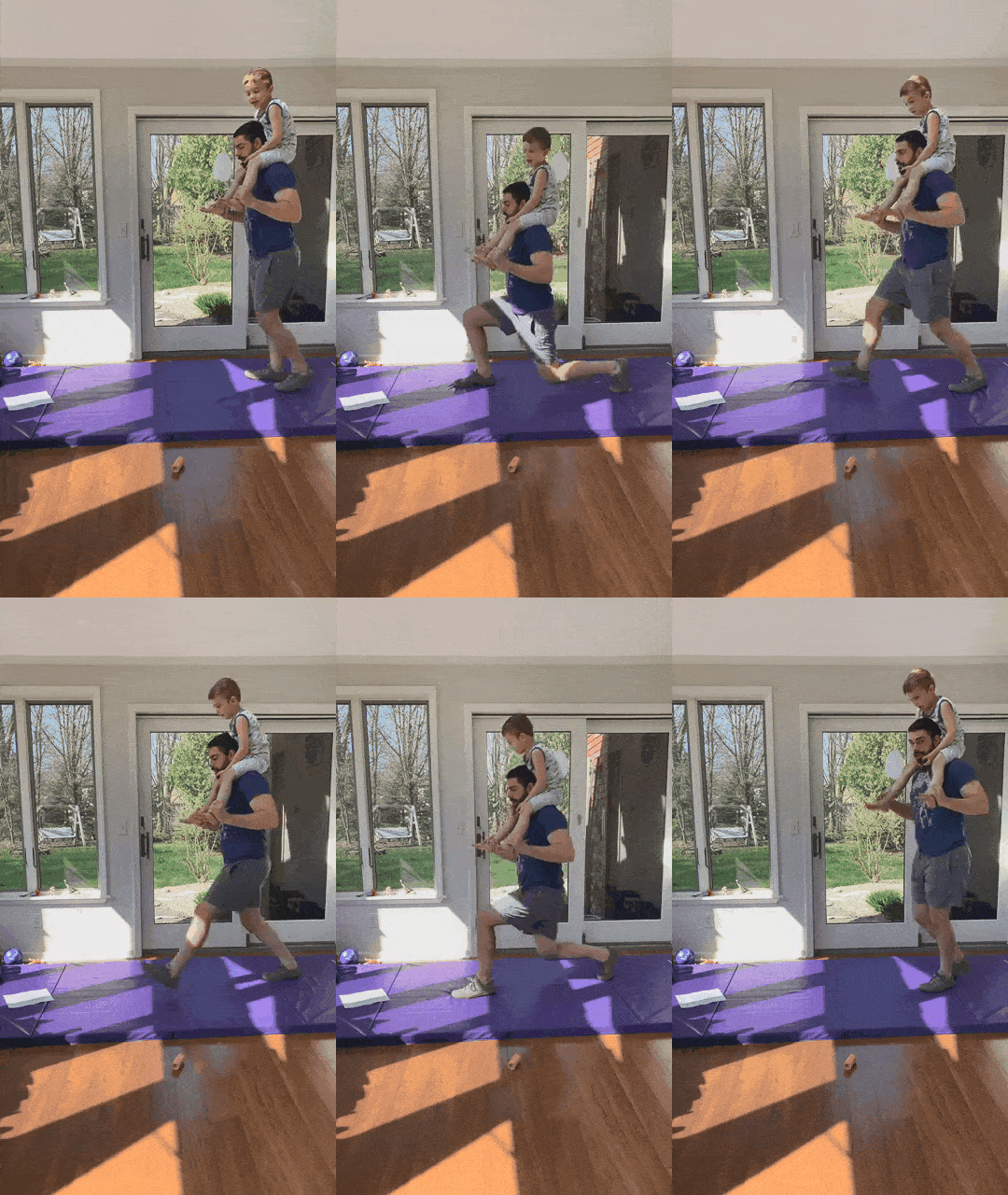
#1) Bodyweight Squats (with Child) 

Matt has his kiddo resting on his shoulders, almost like a safety squat bar would.

This is much like a normal bodyweight squat, but with your kids sitting on your shoulders.

Coach Matt recommends having your kid’s legs come forward, and for you to grab them, almost like you would with a safety squat bar.

Before attempting this, make sure you can do squats with comparable weight! 

#2) Lunges

Much like the bodyweight squats above, but instead do a lunge:

Same idea as our bodyweight squat, your kid will rest on your shoulders as you do your lunge.

Since you’re engaging one leg at a time, this can be really challenging with a kid on your shoulders.

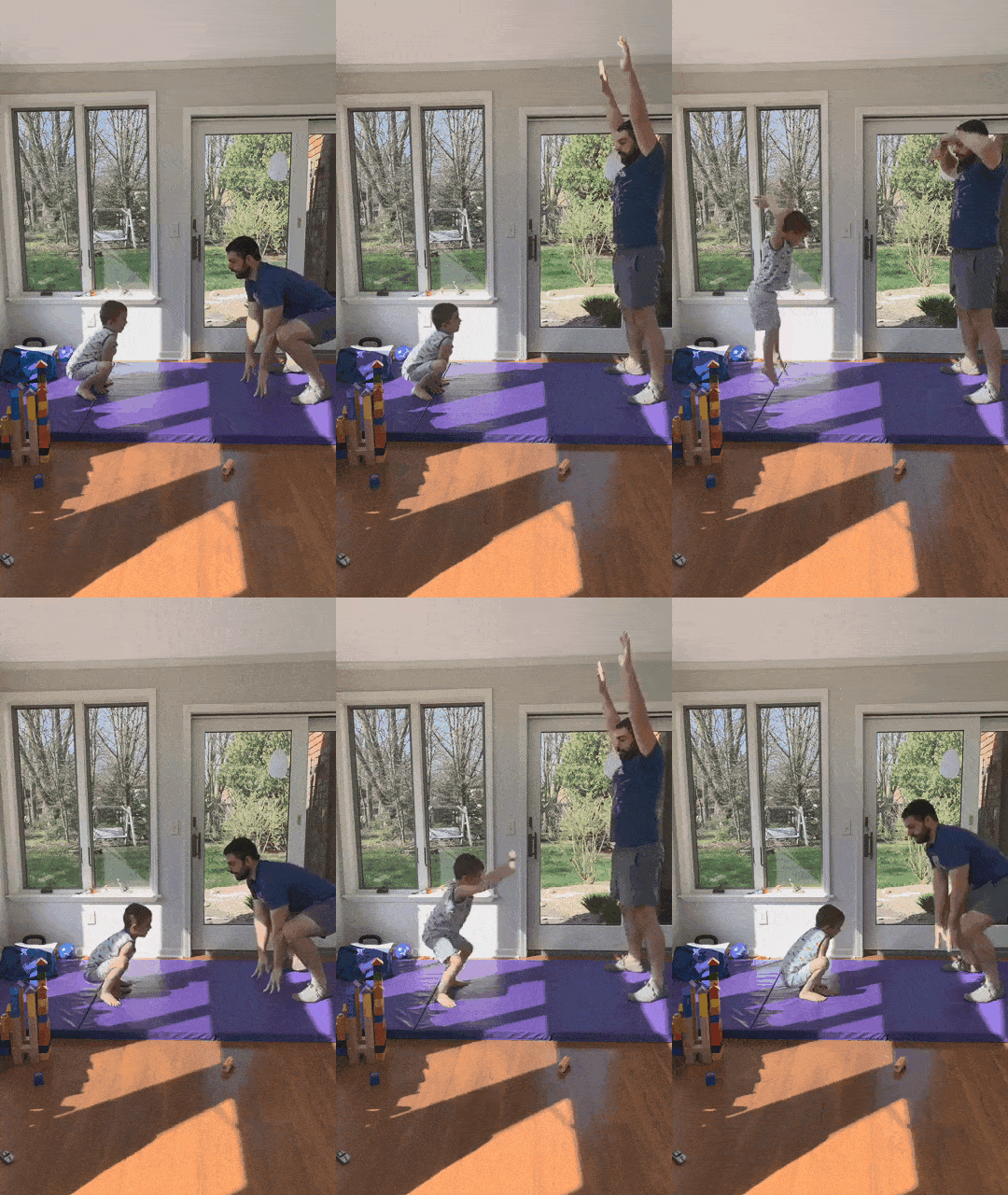
#3) Touch the Sky

This gif shows both Matt and his kid going from a squat to standing tall, arms up.

As Coach Matt explains, getting young kids to do squats and push-ups might be tough.

But kids do like to jump! 

For “Touch the Sky,” sit in a squat or frog position. Then stand up tall, arms reaching towards the sky.

Bonus points if you jump up!

This will train many of the same muscles as you would with squats.

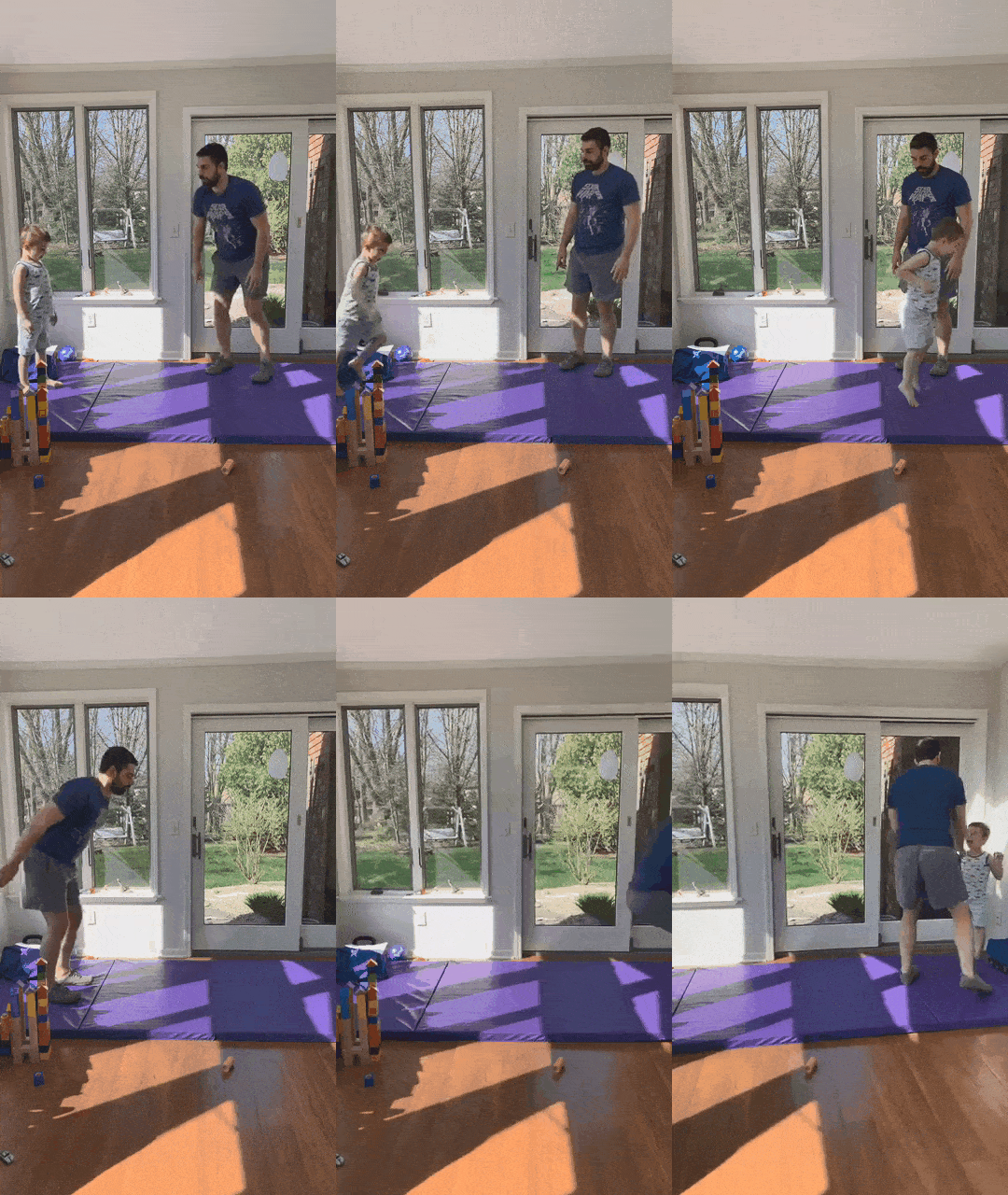
#4) Jumps

Coach Matt performing jumps with his kids, a great exercise to try.

Another good squat substitution to try with kids is long jumps!

You probably want to try this on some type of soft surface (or in your backyard), like the tumbling mat Coach Matt uses. As long as it’s safe, jumping can be really fun with kids.

Make a game out of it, by pointing to a line (or marking one with a soft object) and seeing who can jump over it. You’ll not only train your lower body with jumps, but you’ll also build some explosive power.

#5) Push-ups

You have a few options here. 

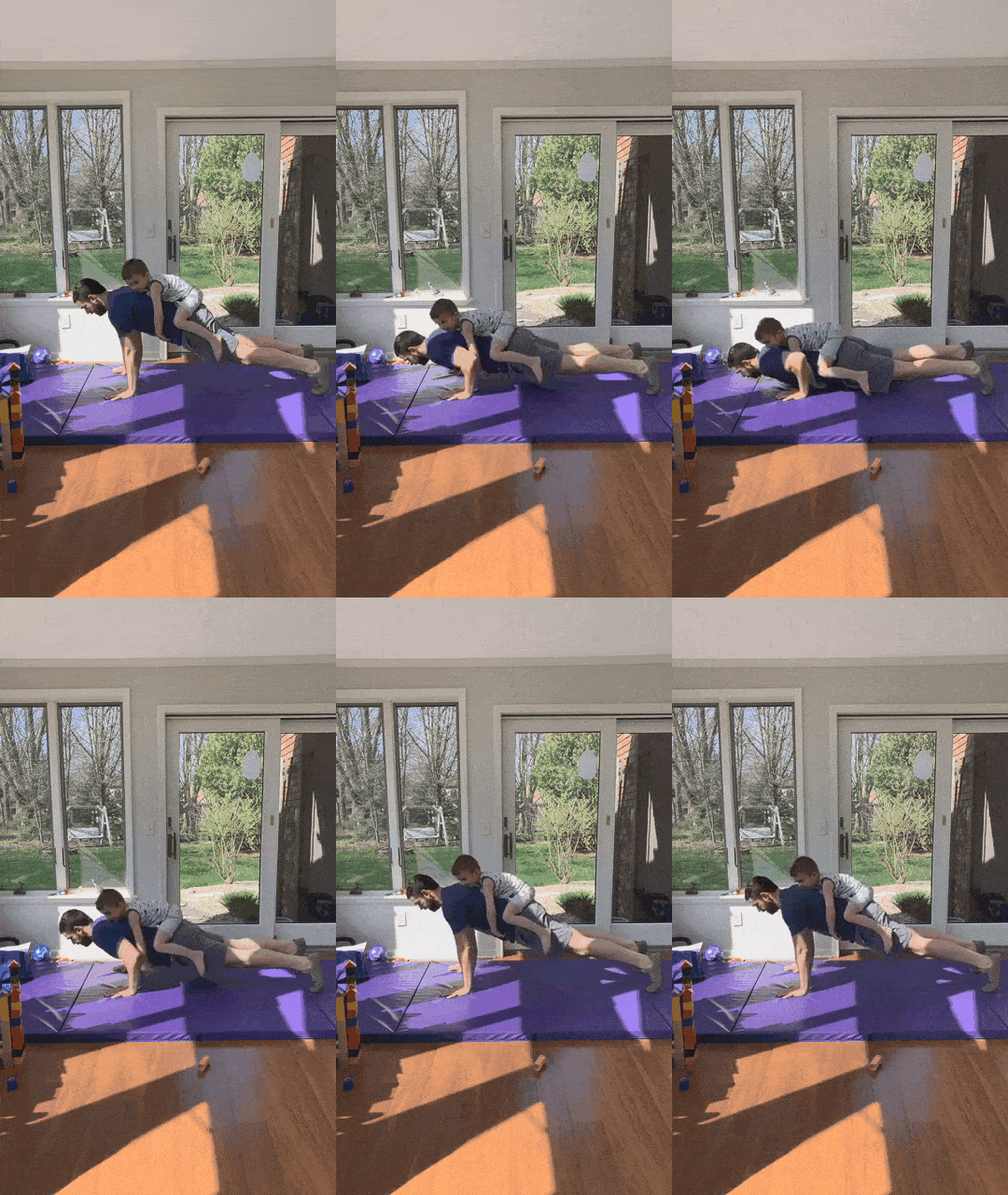
The first is to have your kid crawl on your back and use them as a weight:

This is a gif of Matt doing push-ups, with his kid attached to his back.

Feel free to do knee push-ups here too if it’s a little too challenging.

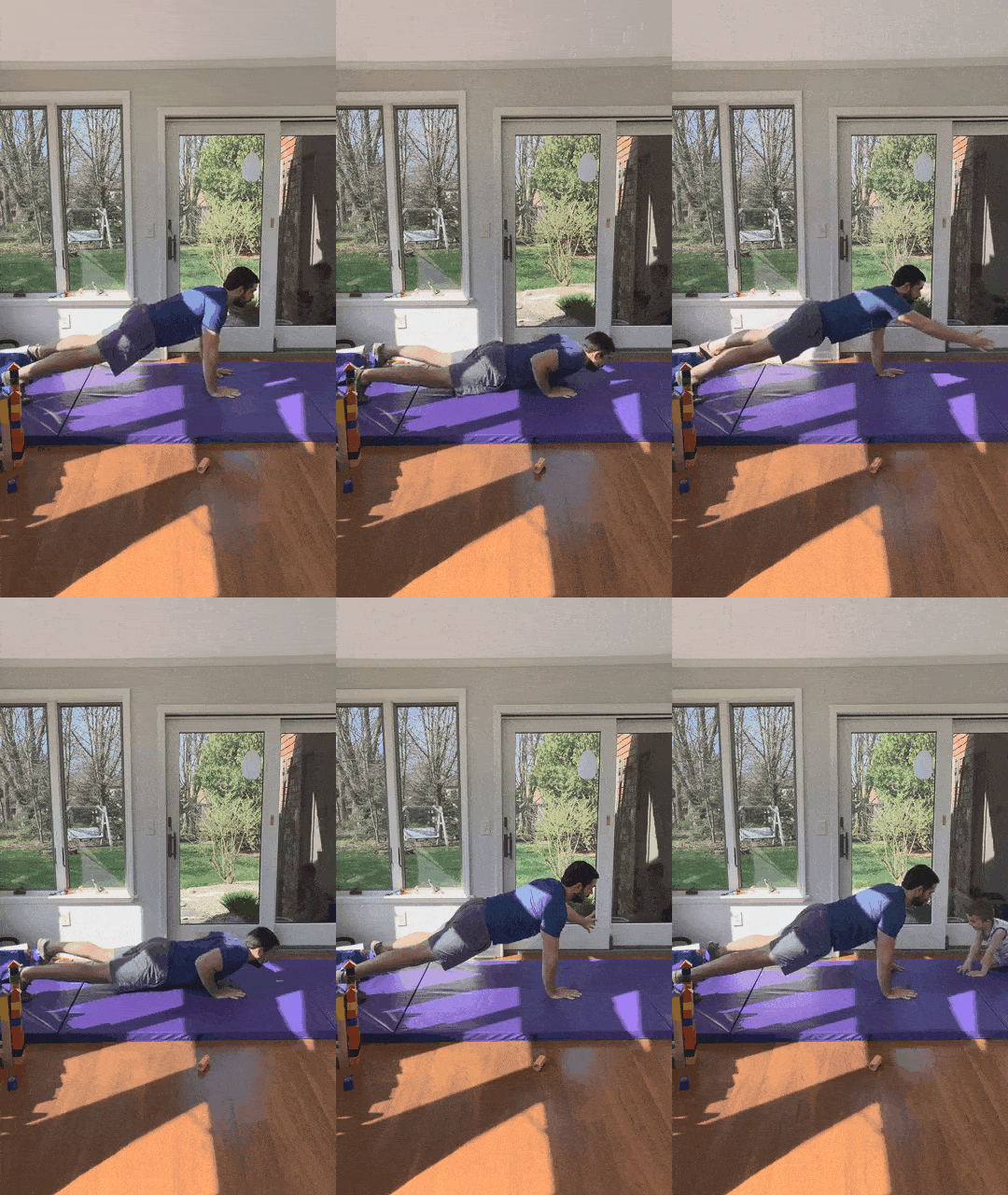
The next option is to include your kid in the workout by giving them high-fives between reps:

At the top of your push-up, stick your arm out and give the kid a high-five!

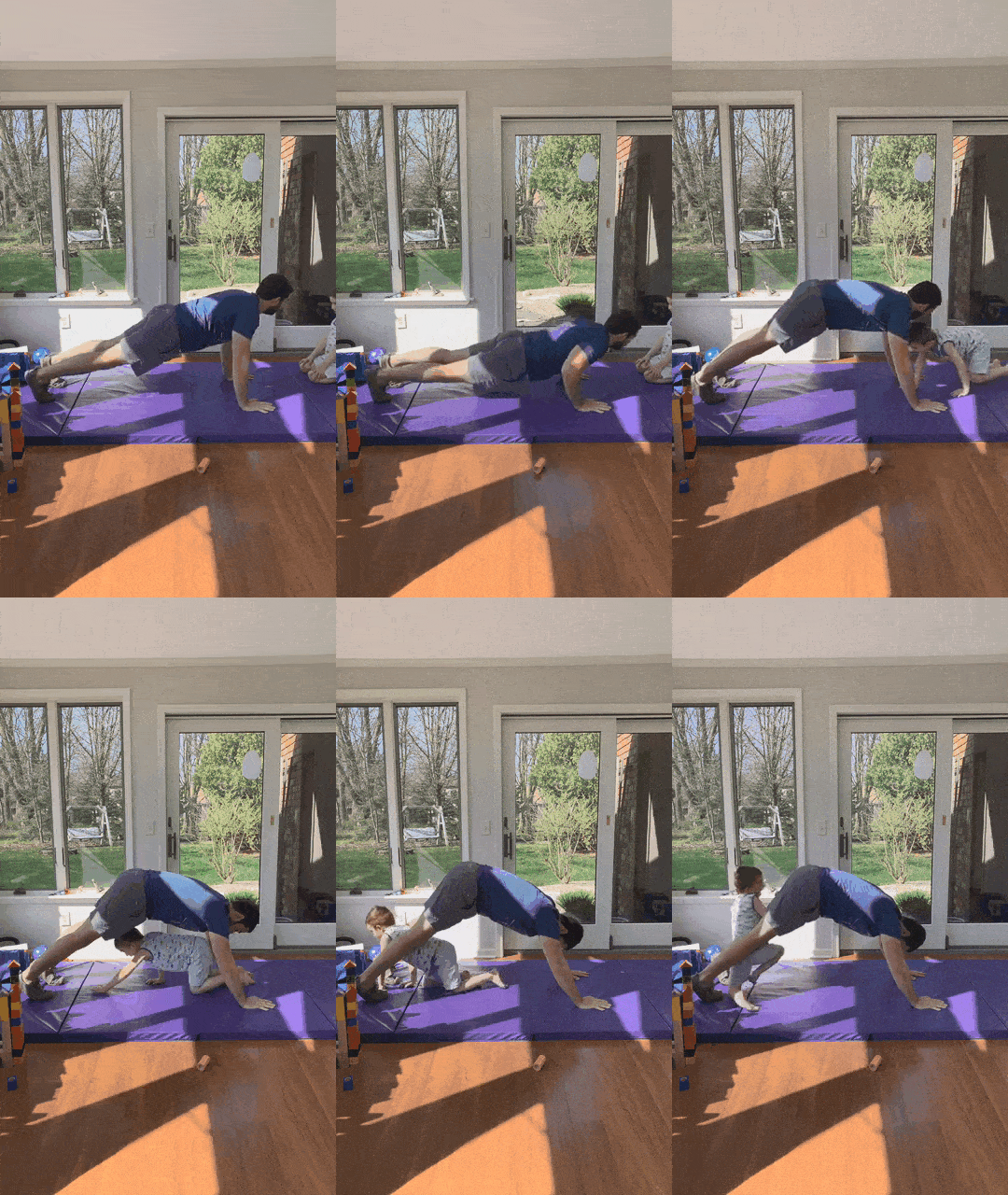
Lastly, you can have your kids crawl under you between repetitions, trying to worm their way from one end to the other:

Once at the top of your push-up, have your kid crawl under you, like so.

#6) Bear Crawl

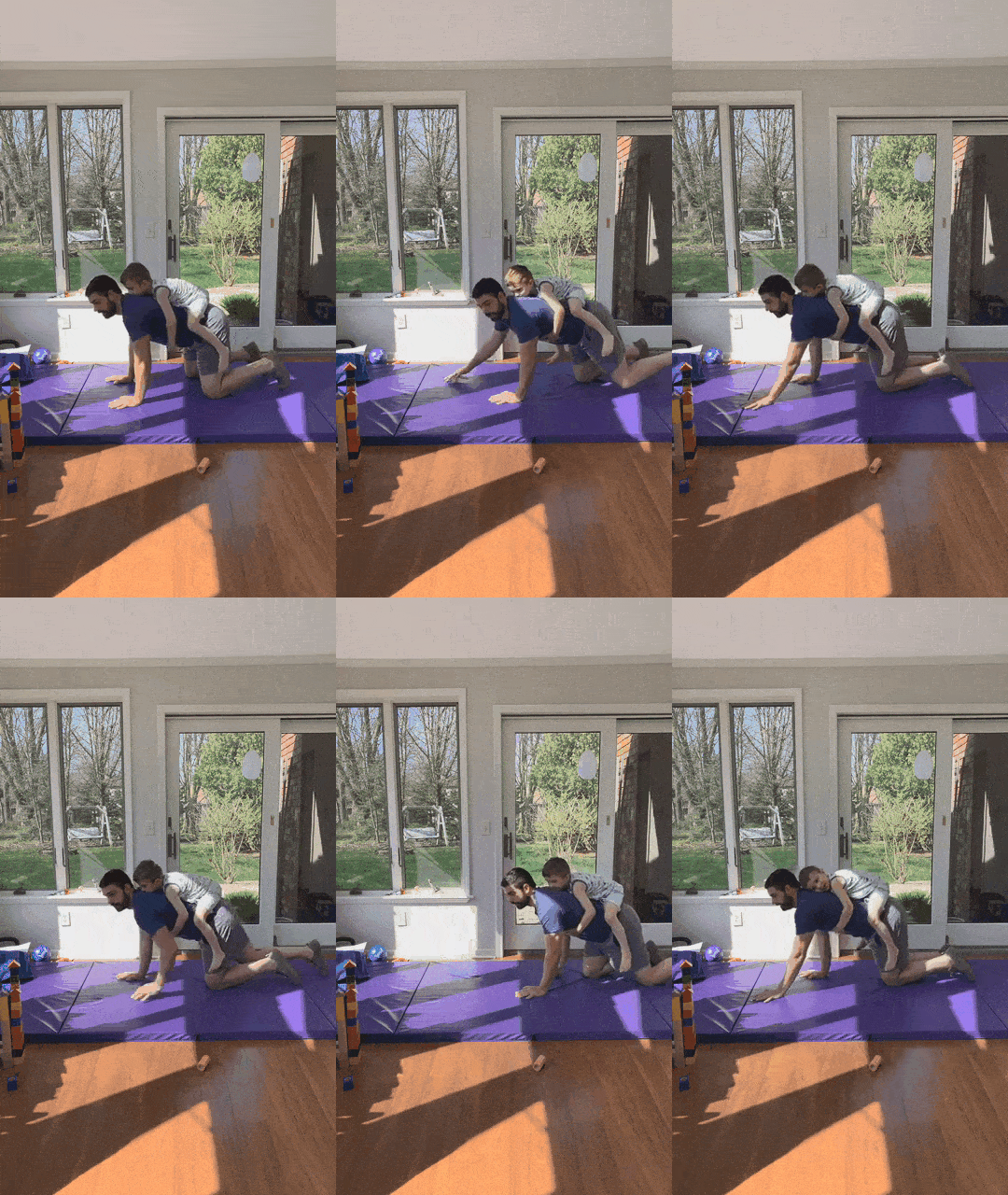
A fun exercise to do with your kids is to crawl around like a bear with them latched on!

Coach Matt crawling around with his kid on his back.

Crawling is a great functional fitness exercise that will help you stay mobile on the floor. A kid on your back will up the intensity of the workout. 

Bonus points if you make growling and roaring noises.

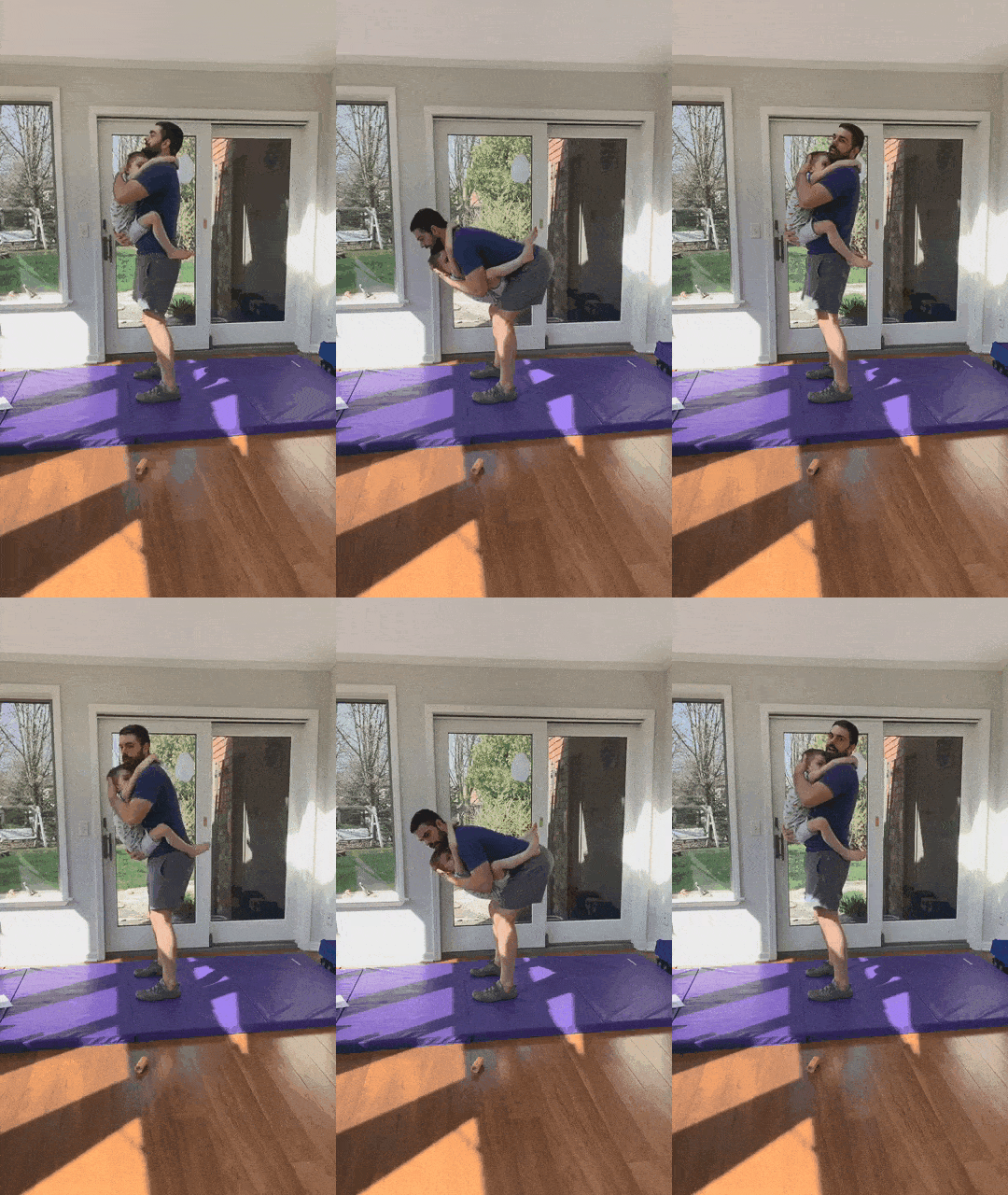
#7) Goat Bag Hinge

This exercise has your kid clenching onto the front of your chest, while you push your hips back.

This exercise will have you strengthening your hinge muscles, kind of like you would in a kettlebell swing or deadlift. 

Stand tall, clenching your kid, chest to chest. Have them hold onto you too.

Push your hips back, again, like you would in a kettlebell swing. When your torso is parrell-ish to the ground, come back up, driving through your heels. 

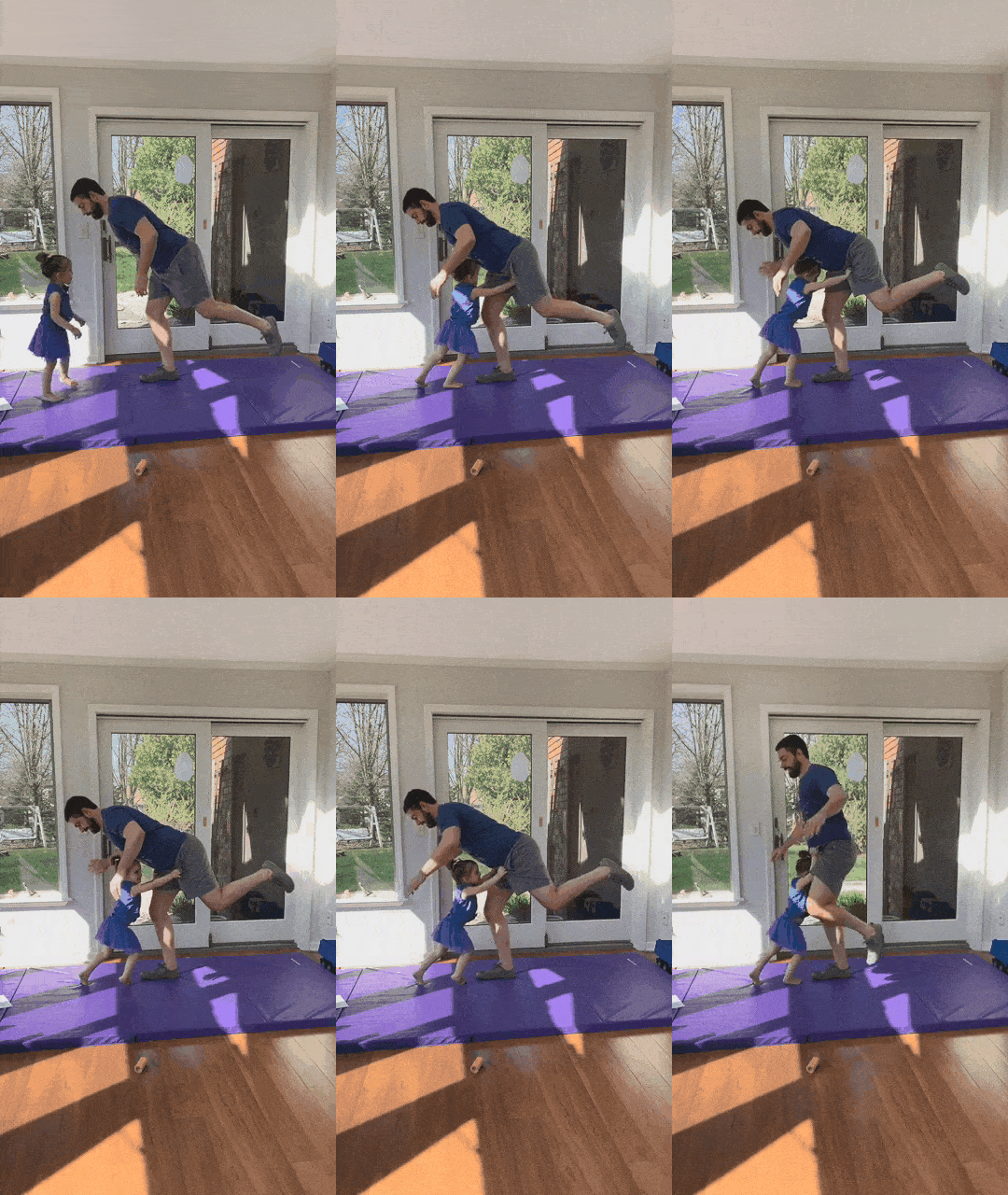
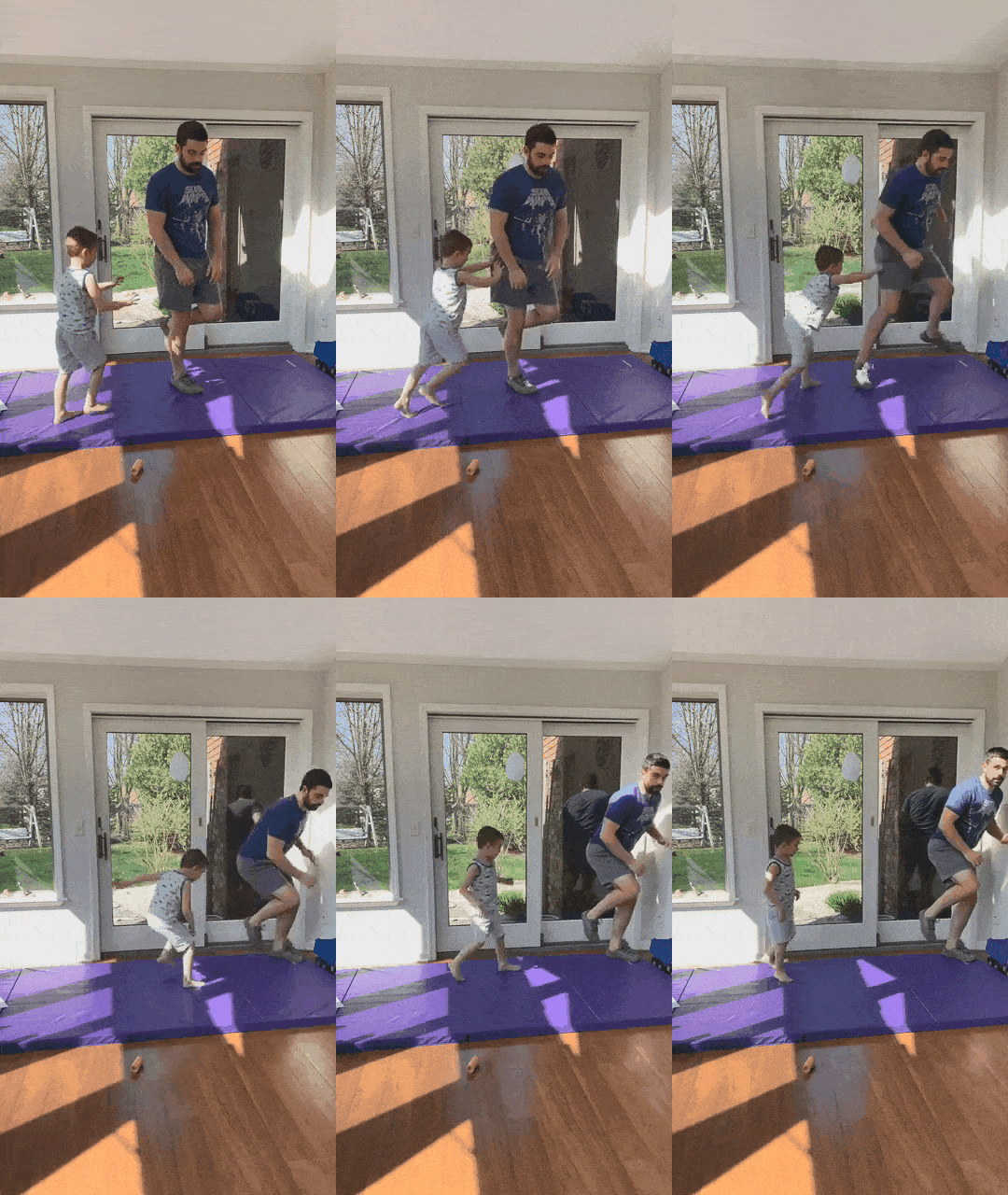
#8) Balancing

One leg balances can become a lot more challenging when your kid is trying to push you over:

A gif of Matt's kid trying to push him over as he balances on one leg.

Another idea is to stand on one leg, then have your kid push you, and use that force to jump onto your other leg. Attempt to only use one leg at a time to balance:

Use the force of your kid to jump from one leg to the other, as shown here.

10 Workout Games to Play as a Family

This picture some Stormtroopers and mini-stormtroopers play fighting.

Being able to lift your kid a few times for some exercises is great. But Coach Matt highlights that anything over 10 repetitions, probably isn’t happening.

The kids will get bored, whine, or revolt.

That’s why you might be better off playing some games with them. 

Here are 10 fun and active games to play as a whole family:

#1) Ninja Training

This is easy: just ask your child: “Want to train like a ninja with me?”

If they’re into it, start practicing some of your jumps and crawls!

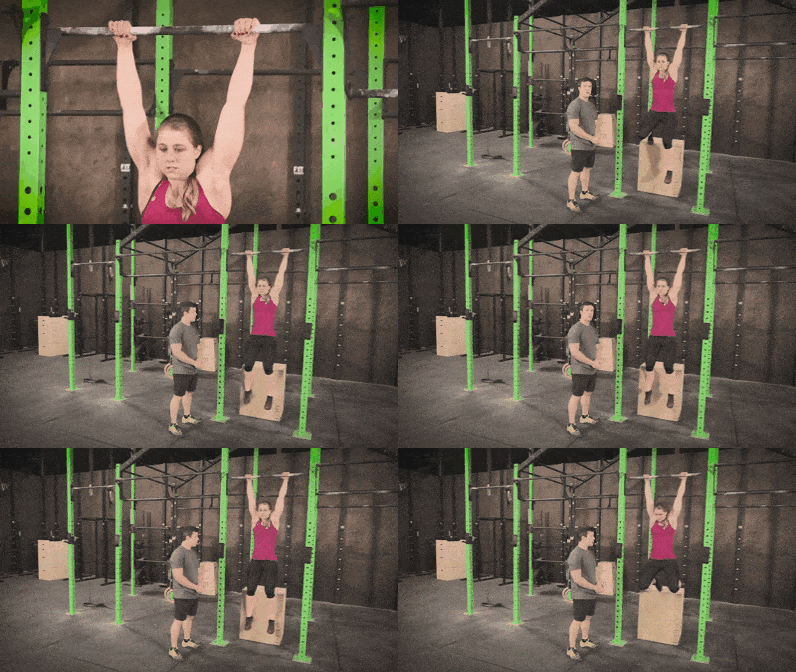
You can also hoist them up and help them hang from something (ninjas always have to climb up buildings), which would work if you have a pull-up bar:

Coach Staci showing you the bar hang

Don’t have a pull-up bar? We makeshift clever replacements in our guide to building a home gym.

Some house parkour might also be in the cards here. 

#2) Chase (Cops and Robbers)

Here, you’re gonna build some type of fort. When playing this game, Coach Matt stands up his gymnastic mat tall and together, then places his kids in the middle.

Their job? Escape!

Run and track them down and send them back to jail (or your makeshift fort).

Feel free to teach them the phrase, “You’ll never catch me alive, coppers!”

#3) Freeze Ball

This might require a purchase, but foam dodgeballs are a great way to play with kids.

Have the different colored dodgeballs result in a different outcome:

  • Red: if you’re hit with the “fireball,” hop five times in a row.
  • Blue: if you’re hit with the “iceball,” you need to freeze for five seconds. 
  • Green: if you’re hit with the “earthball,” it’s time to place your chest to the ground, like you would in a burpee.

#4) Animal Walks

Have someone call out an animal. Then everyone has to walk around like that!

Walking to Mordor is much tougher if you need to crawl like a snake for part of the journey.

#5) Hot Lava

With this game, you’re more or less building an obstacle course in your house, trying to jump from furniture to furniture…because the floor is now lava.

Here are some ideas on creating home obstacle courses:

Another fun way to start this game: start counting down from 5 out loud.

After “1” shout “hot lava” and if anyone is still on the normal floor, it’s time for them to start playing like Gollum when he finally got the ring:

A scene of Gollum falling into lava from Return of the King.

This is a fun standing game to ensure spontaneous activity.

#6) Jump/Duck

This game is pretty easy: take an imaginary sword and swing high or low at the kids, or have them come at you with their imaginary weapon.

Just swing high or low at your kid, and have then duck or jump respectively.

You need to either jump if they’re coming low or duck if they’re coming high.

This is really simple, but lots of fun, and can be done with a group of people.

#7) King of the Log (Balance Challenges)

Much like the balance exercises we showed you earlier, but as a game!

Find some territory (a mat, some comfy carpet, grass) and try to push the other off it. Let your kiddos team on you for a more even match.

#8) Wolf & Rabbit

Create a mark or identify a “safe place” within a short sprint away. 

Have two people face each other, but keep enough distance that the “Rabbit” feels comfortable reaching safety.

The Rabbit stays frozen until the Wolf makes a move. Then the Rabbit attempts to sprint to safety before the Wolf can tag it.

#9) Ninja Red Light, Green Light

If you’ve ever played “Red Light, Green Light” this is similar, although it involves some sneaking around, because ninjas.

A gif of a ninja doing ninja stuff.

“The Mark” walks around aimlessly, taking turns liberally, while the Ninja tries to sneak up behind and tag them. 

If the Mark faces the Ninja, the Ninja must freeze. 

Otherwise, the Ninja is free to tag the Mark.

#9) Commando

This game is kind of like Ninja Red Light, Green Light.

  • You have a Counter (normally the adult).
  • You have Runners (kids).

The Counter picks a number from five to ten, then counts down.

Before doing so, they announce “Fast” or “Slow.”

  • Fast, you would count “5, dot, 4, dot, 3, dot, 2, dot, 1.”
  • Slow, you would count “5, dot, dot, 4, dot, dot, 3, dot, dot, 2, dot, dot, 1.”

So twice as many “dots” are said allowed.

While the Counter counts, they move about (carefully) with their eyes closed. They make sure to turn around a lot to keep the Runners on their toes.

When the Counter reaches “1,” they freeze and open their eyes.

Any Runners caught in the Counter’s eyes has to do a silly “croak.”

This dog does a good "play dead" in this gif

Working Out at Home With Kids

Coach Matt is a father of 5, yet he’s still able to train with little ones in the house.

How’s he do it?

Here are 4 tips on how to train with kids at home:

  1. Use every minute. Yep, that means you might be breaking up your workout. This is fine.
  2. Talk to your partner. If there’s another parent involved, share with them your goals. Maybe one of you can watch the kids while the other works out.
  3. Involve your kids.  You can always do some exercises with your kiddos. Who knows, you might even help them find a love of working out.
  4. Play some games. You can try one of the 10 games we mentioned above, or even a more traditional sport might be fun if they can handle it.

If you’re juggling working out with your kiddos around, give the video a watch.

How to Workout as a Family (Next Steps)

This picture shows a family on the beach looking into the sunset.

The most important thing about working out with your kids: have fun!

If kids see you having fun, they might want to join you.

If you make your exercise together enjoyable by including some game elements, they might want to keep doing it.

That would be great!

If you need more ideas, here are 40 ways to exercise without realizing it. 

However, if your kids are not into it, that’s okay. Just try to sneak in whatever workout you can, when you can.

Do the best you can. 

The most important thing you can do now: try an exercise or game with your kids!

You’ll never know how your kids deal with your workouts, until you try it out.

So pick one of the exercises or games we highlighted and give it a whirl.

If it devolves to chaos, you can always try again with a different workout or strategy.

Again, just do the best you can.

This girl is ready to strength train. Are you?

If you want some more help, Nerd Fitness is here for you.

We have three options on how to continue with us. Pick the option that best aligns with your goals:

Option #1) If you want a daily prompt for doing home workouts, check out NF Journey. Our fun habit-building app helps you exercise more frequently, eat healthier, and level up your life (literally).

Try your free trial right here:
Option #2) If you want a professional coach in your pocket, who can do video form checks, provide feedback, and adjust your workouts based on the equipment you have available, check out our 1-on-1 Online Coaching Program! 

For example, let’s say you find yourself stuck indoors and you want somebody to custom-build you a workout program based on the equipment and furniture you have. That’s where an online coach is a game-changer! 

Personally, I’ve been working with the same online coach since 2015 and it’s changed my life. You can learn more by clicking on the box below: 


Option #3) Become part of the Rebellion! We need good people like you in our community, the Nerd Fitness Rebellion.

Sign up in the box below to enlist and get our Rebel Starter Kit, which includes all of our “work out from home” guides.

Alright, I want to hear from you and your experience with working out with your children! 

Are you a parent who is now learning how to exercise with your kids?

Any tips or tricks for training with screaming kids in the background?

Any fun games we missed?

Let me know in the comments!

-Steve

P.S. If you have older kids, they might be more into doing a workout right alongside you. If so, have them pick a routine from The 7 Best At-Home Workouts and try it together!

###

Photo Source: Cargo bike family, The clones are working hard, Family looking into sunset, Untitled, Simpson…Maggie Simpson.

The post How to Exercise With Your Kids (Work out as a Family!) first appeared on Nerd Fitness.

from Nerd Fitness: Helping You Lose Weight, Get Stronger, Live Better. https://ift.tt/qsjWhKl
via IFTTT
Categories
Uncategorized

#holistic #getfit #nutrition 15 Circuit Training Routines: Try These Fast Workouts Anywhere!

circuit training is awesome, even dinosaurs love it

This circuit training guide is gonna give you EVERYTHING you need to do your first kickass circuit training workout today.

I mean come on, it has dinosaurs in it.

These workouts are similar to the custom programs we build for our Online Coaching Clients who work out at home, on the road, and in outer space.

Okay, FINE we don’t have any clients in space (yet). But we do have clients in Antarctica, and multiple aerospace engineers. Close enough?


If you’re hoping circuit training will maximize your results in a minimum amount of time, one of the 15 circuits below will do the trick:

Let’s jump right in.

What is Circuit Training?

As Coach Lauren mentions above, the “circuit” in circuit training comes from the fact that you do a sequence of exercises back to back to back, and then you repeat the sequence.

And then again.

You cycle through the planned sequence of exercises, or circuit, multiple times.

That’s circuit training.

Generally, you hit each major muscle group during one full circuit. You may do a lower body for one exercise. Then the upper body the next.

You’ll find all sorts of different circuit training sequences. Here are some things most will have in common:

  • Several different exercises. A normal circuit will have five to ten different movements per circuit. You’ll often hear these referred to as “stations.” Overhead press station, squat station, etc.
  • Little to no rest in between. The goal of circuit training is to keep your heart rate up. Ideally, if you’re physically able, you go from one exercise to another without stopping. Maybe you rest after the whole circuit. Maybe.
  • Rinse and repeat. Generally, you’ll run through your circuit a few times. Three rounds are common.

Make sense?

The Tick is stoked you are putting on weight, muscle or fat, it means our strategy is working.

The point here is to work different parts of your body with different exercises, and then while those parts are recovering, you’re working on your other movements! This helps build cardiovascular health, while also improving muscular endurance and strength.

Plus you’ll burn calories!

As we lay out in our article, Cardio vs Interval Training vs. Weight Training, research supports that doing strength training circuits is great for weight loss and overall health.

More importantly, for somebody with limited time, doing a strength training circuit is more effective at building strength and burning fat than an equivalent amount of cardio.

In other words, if you are trying to lose weight, you should be doing circuit training.

Our Beginner Bodyweight Circuit would be a great place to begin, and you can download a worksheet to help you get started right here:

Why Should I do circuit training?

This runner definitely has a strong core!

Generally, you’ll hear exercise divided into strength training or aerobic exercise (cardio).

What’s the difference, you wonder?

  • Strength training. Strength training is also referred to as anaerobic exercise, which would be a short burst of energy for movement. Think of a push-up or pull-up. These exercises help build and tone muscle.
  • Aerobic Exercise. “Aerobic” means “needs oxygen.” Your heart rate increases to get oxygen where your body needs it, thus the word “cardio.” Running, biking, or jumping jacks would be examples of aerobic exercise.

The thing about a circuit is, you actually do both categories. Presses and lunges fall into strength training. Jumping jacks are cardio.

And since you aren’t stopping much in between stations, you’ll need more oxygen, and voila. Even more cardio.

With circuit training, you build muscle and burn fat WHILE building stamina.

As Michael Scott would say, “that’s a win, win, win.”

circuit training is a win win win

There’s some debate on what kind of exercise is better for weight loss: aerobic or anaerobic.

My thoughts?

If you’re limited on time and only can pick one, I would pick strength training: when you strength train, you break your muscles down, and your body needs to work extra hard over the next 24-48 hours to rebuild those muscles (with increased calories burned).

We work with our 1-on-1 Coaching Clients to create programs that combine both strength and cardio in a fun way – it really comes down to a program that you actually WANT to do.


Before and after your circuit training: Warm up and stretch

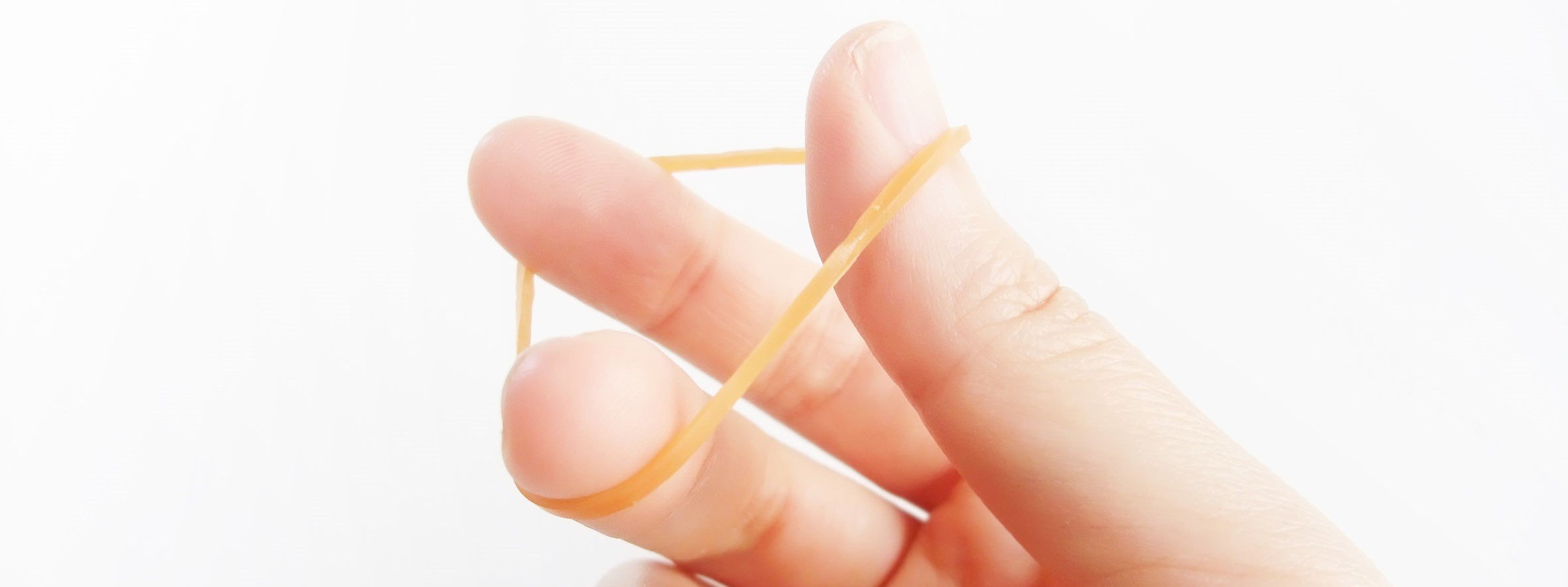
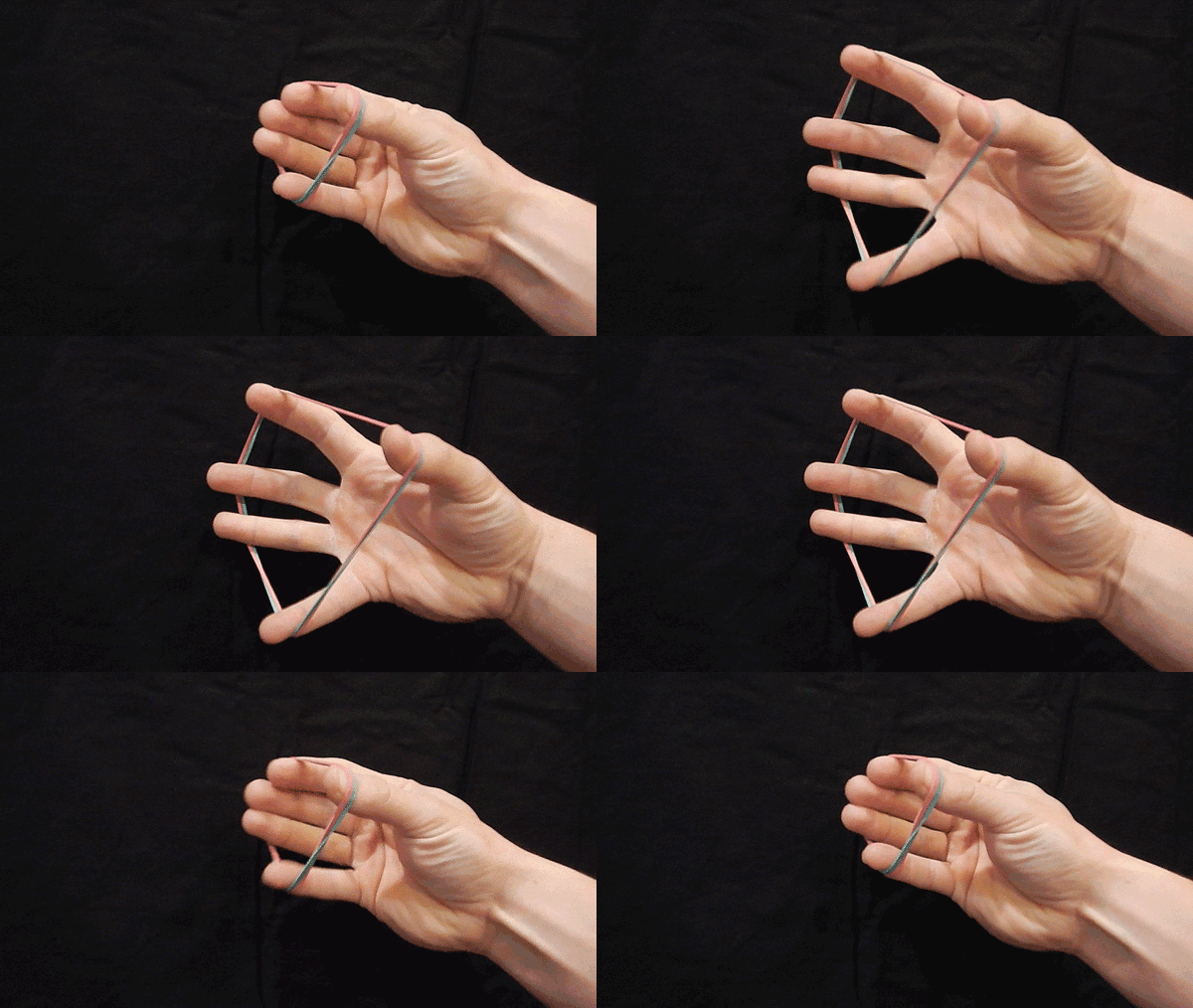
Some stretching a rubber band

No matter which circuit you pick, I want you to start with one important thing:

Warm-up!

I cover why you should always warm up in an article found right here. It doesn’t have to be much though, give it about five minutes to get your muscles active and your heart rate up.

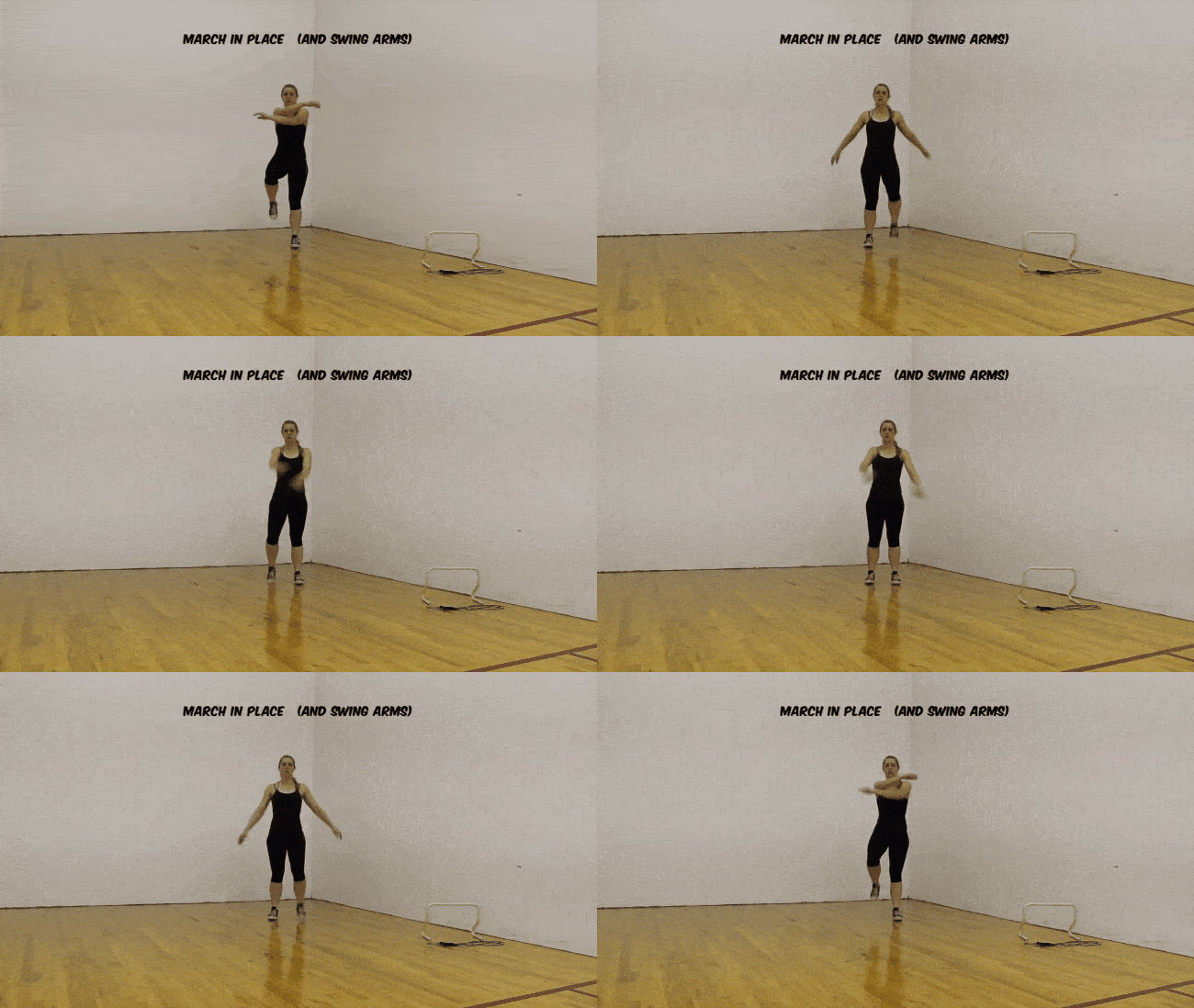
This will help you do exercises properly and help prevent injury. You can run in place, do air punches and kicks, or some jumping jacks.

Here is NF Senior Coach Staci (you might know her incredible story) showing you many beginner options you can use to warm up as well:

Did I just tell you to prepare for circuit training, with a circuit?!

If you’re curious, here’s my personal (advanced) warm-up:

THE NERD FITNESS ADVANCED WARM-UP:

  • Jump rope: 2-3 minutes 
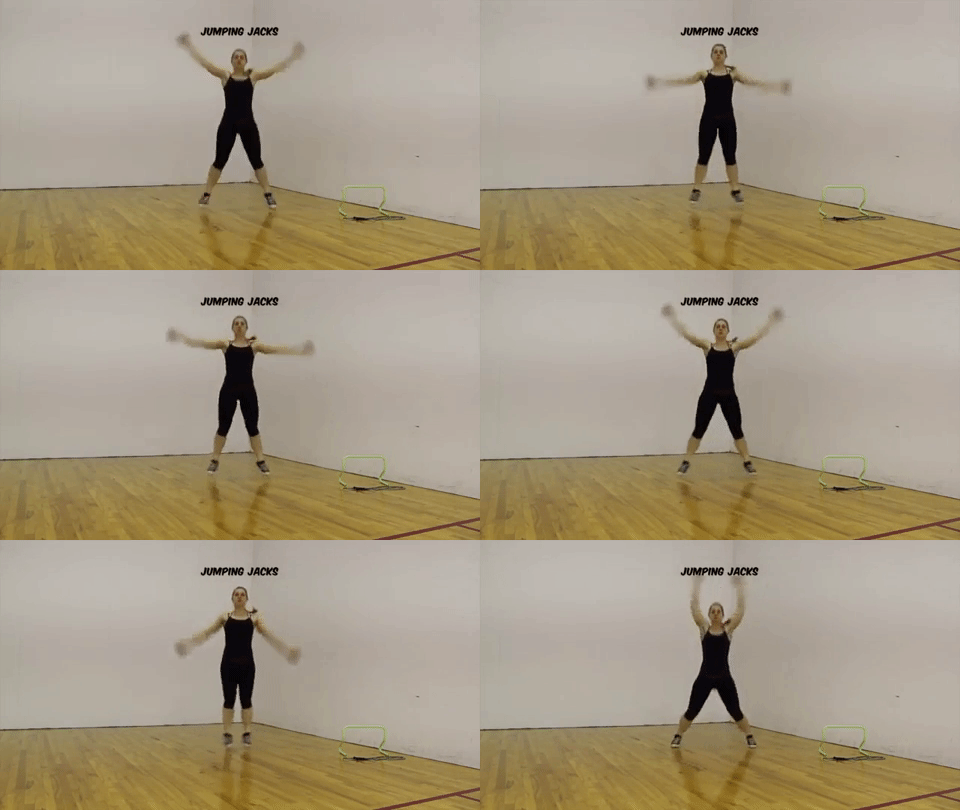
  • Jumping jacks: 25 reps
  • Bodyweight squats: 20 reps
  • Lunges: 5 reps each leg.
  • Hip extensions: 10 reps each side
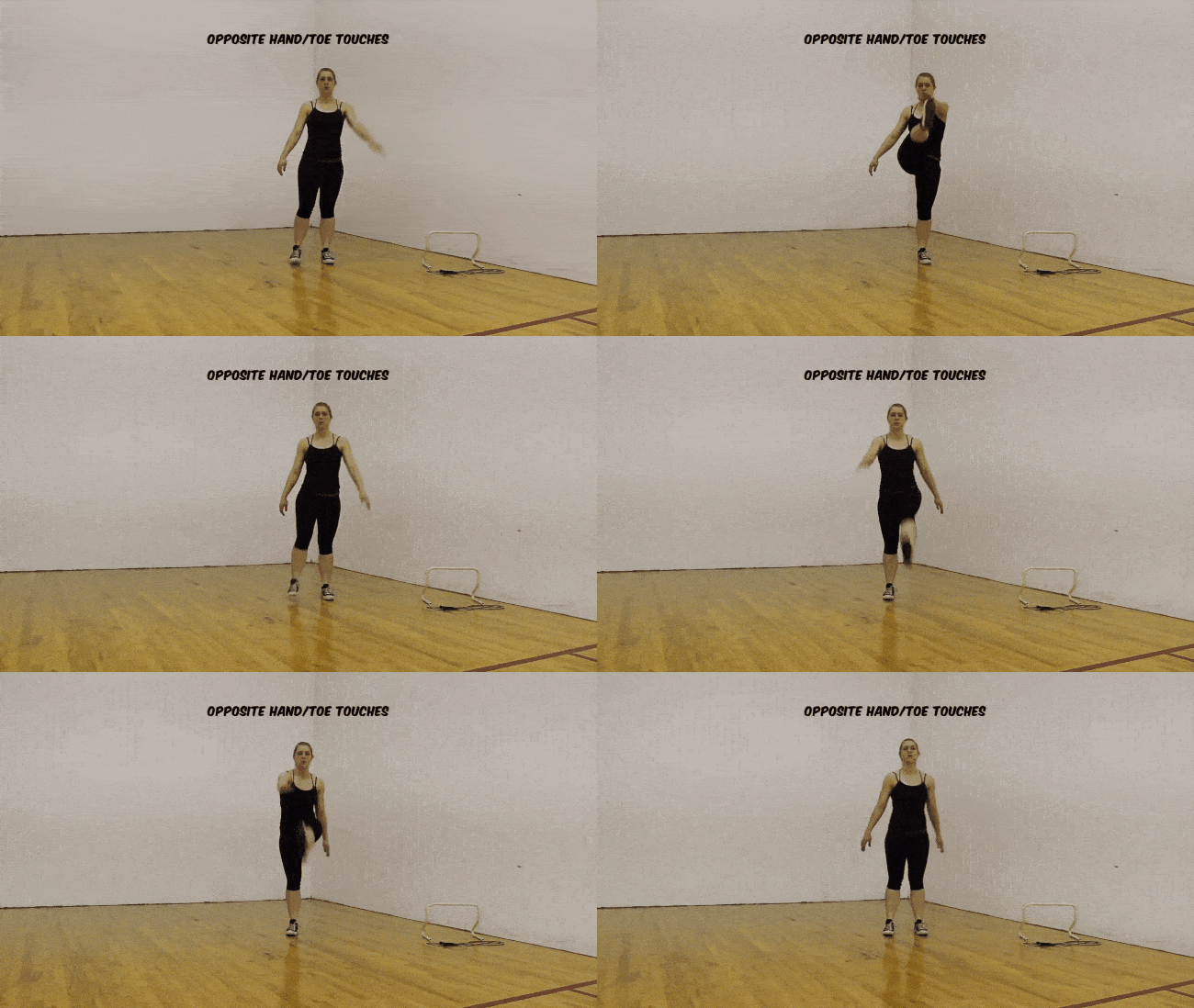
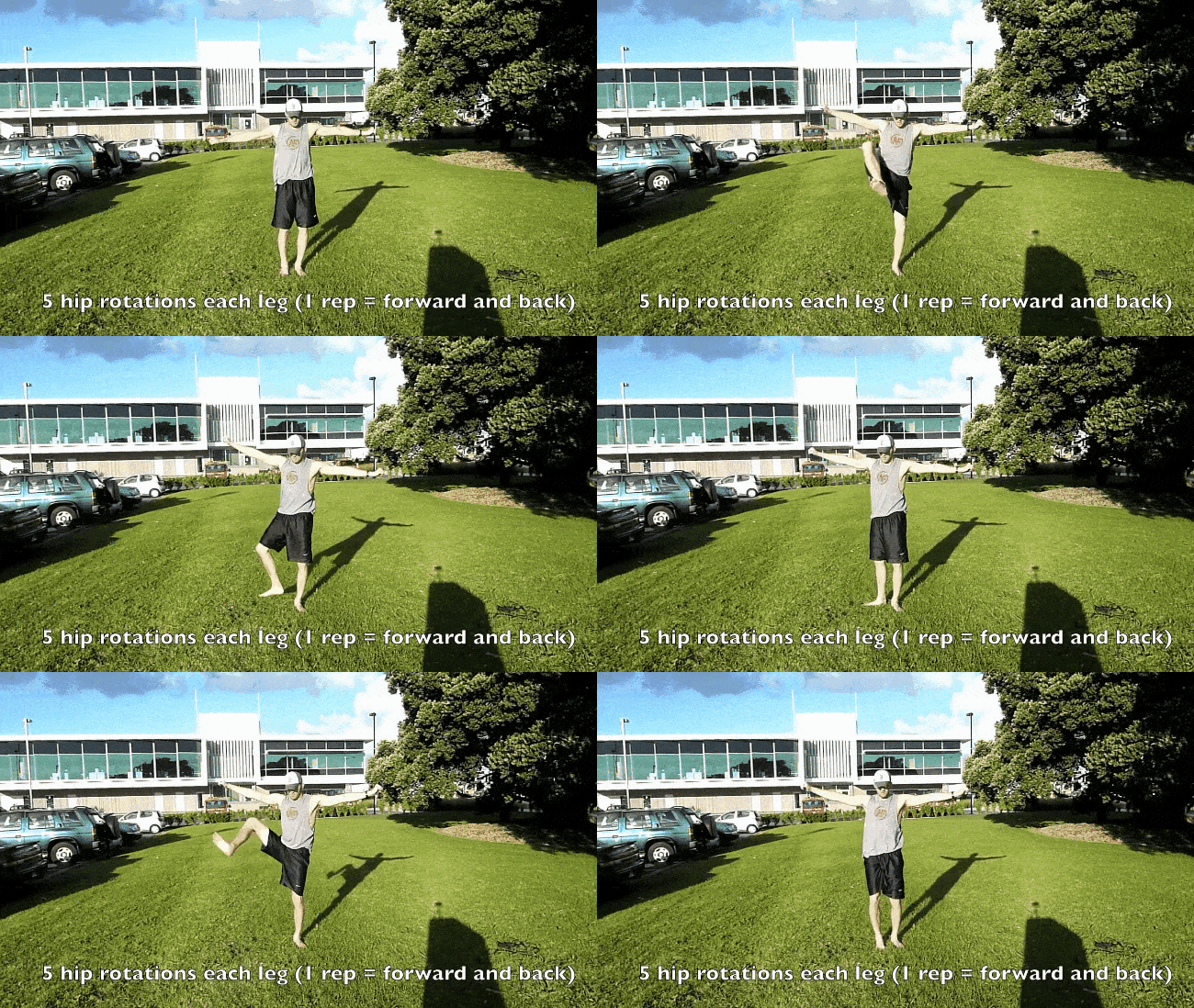
  • Hip rotations: 5 each leg
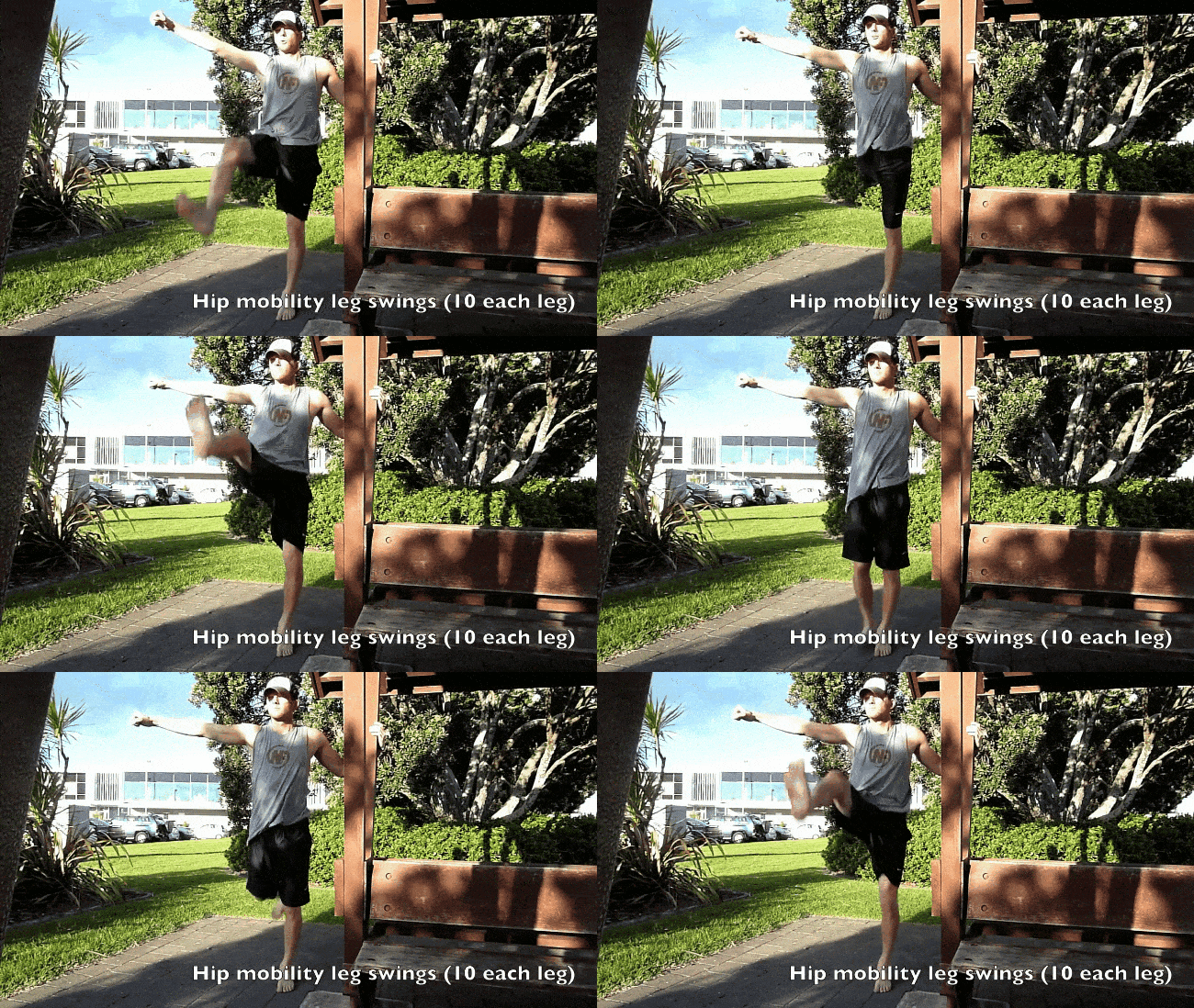
  • Forward leg swings: 10 each leg
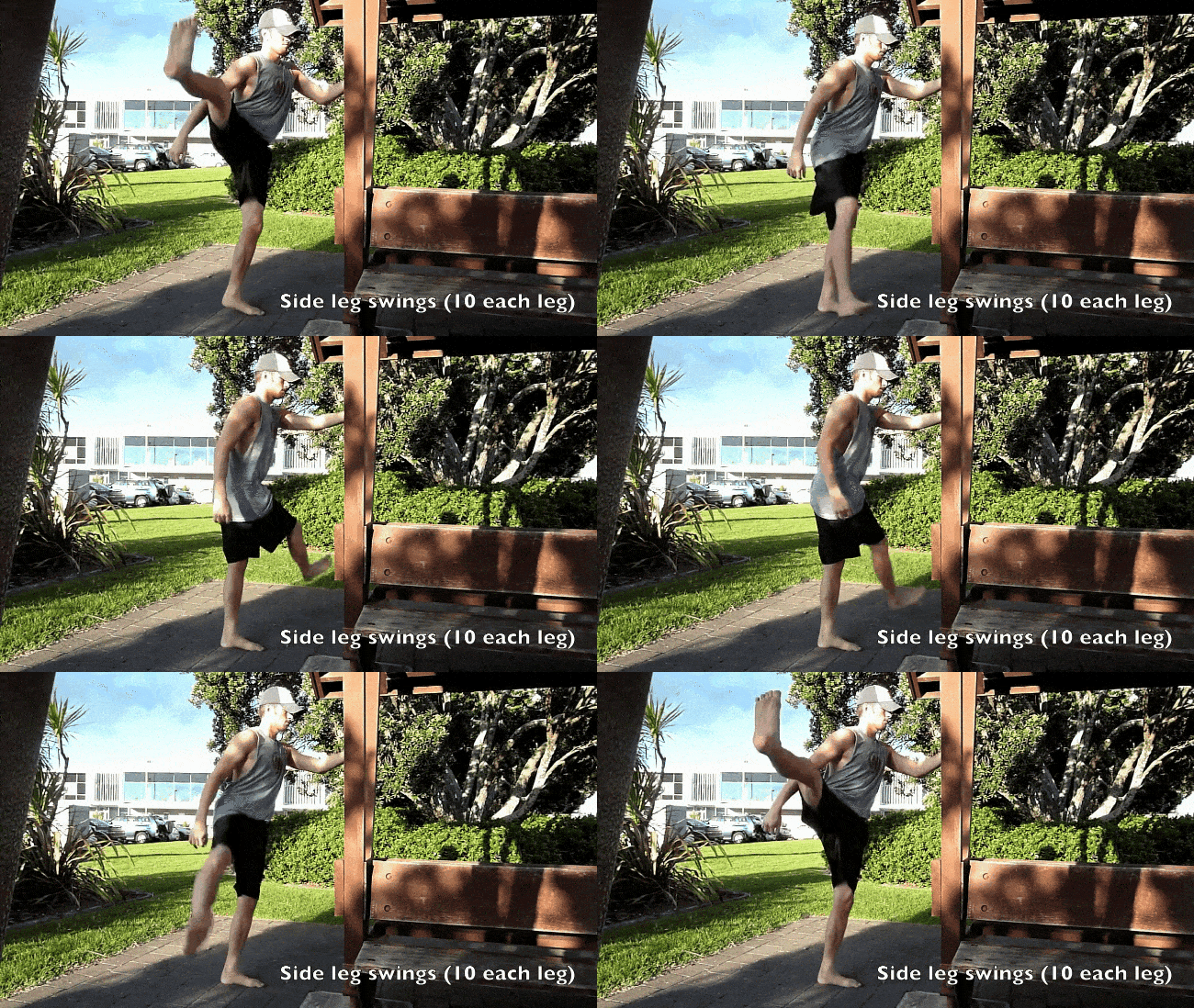
  • Side leg swings: 10 each leg
  • Push-ups: 10-20 reps
  • Spider-man steps: 10 reps

Our goal isn’t to tire you out. Instead, we want to warm you up.

That’s step one.

Completing your chosen circuit training routine would be step two.

Below, you’ll find 15 workouts you can follow along with! And if you like our style of workouts, you might like our new app, Nerd Fitness Journey!

Our fun habit-building app helps you exercise more frequently, eat healthier, and level up your life (literally).

Right now, you can try it for free for a full week (no credit card required). Jump in below:

Beginner Bodyweight Workout Circuit

This workout circuit, as we lay out in our Beginner Bodyweight Workout article, is as follows:

  • Bodyweight squats: 20 reps
  • Push-ups: 10 reps
  • Walking lunges – 10 each leg
  • Dumbbell rows (using a gallon milk jug or another weight): 10 each arm.
  • Plank: 15 seconds
  • Jumping jacks: 30 reps

Run through this circuit three times. If you don’t have milk in the house for the rows, find something of roughly the same weight with a good handle.

We also turned this workout into a fun infographic with superheroes, because that’s how we roll:

An infographic of the Beginner Bodyweight Workout

If you want to download this Beginner Bodyweight Workout as a worksheet, you can do so when you sign up in the box below:


Advanced Bodyweight Exercises Circuit

If the beginner circuit above is too easy for you, move on to our Advanced Bodyweight Workout Circuit. The workout looks like this:

  • One-legged squats – 10 each side [warning super-difficult, only attempt if you’re in good enough shape]
  • Bodyweight squats: 20 reps
  • Walking lunges: 20 reps (10 each leg)
  • Jump step-ups: 20 reps (10 each leg)
  • Pull-ups: 10 reps [or inverted bodyweight rows]
  • Dips (between bar stools): 10 reps
  • Chin-ups: 10 reps [or inverted bodyweight rows with underhand grip]
  • Push-ups: 10 reps
  • Plank: 30 seconds

I warn you, the above circuit will hurt… in a good way. You should be proud if you can get through this three times.


Playground Workout Circuit

Do you have a nearby playground? Why not work out there! If you have kids, you can do it together. Or let them ignore you.

I’ll give you a Level One workout, and a Level Two. Check out the main playground article for some Level Three exercises.

Level One:

  • Alternating step-ups: 20 reps (10 each leg)
  • Elevated push-ups: 10 reps
  • Swing rows: 10 reps
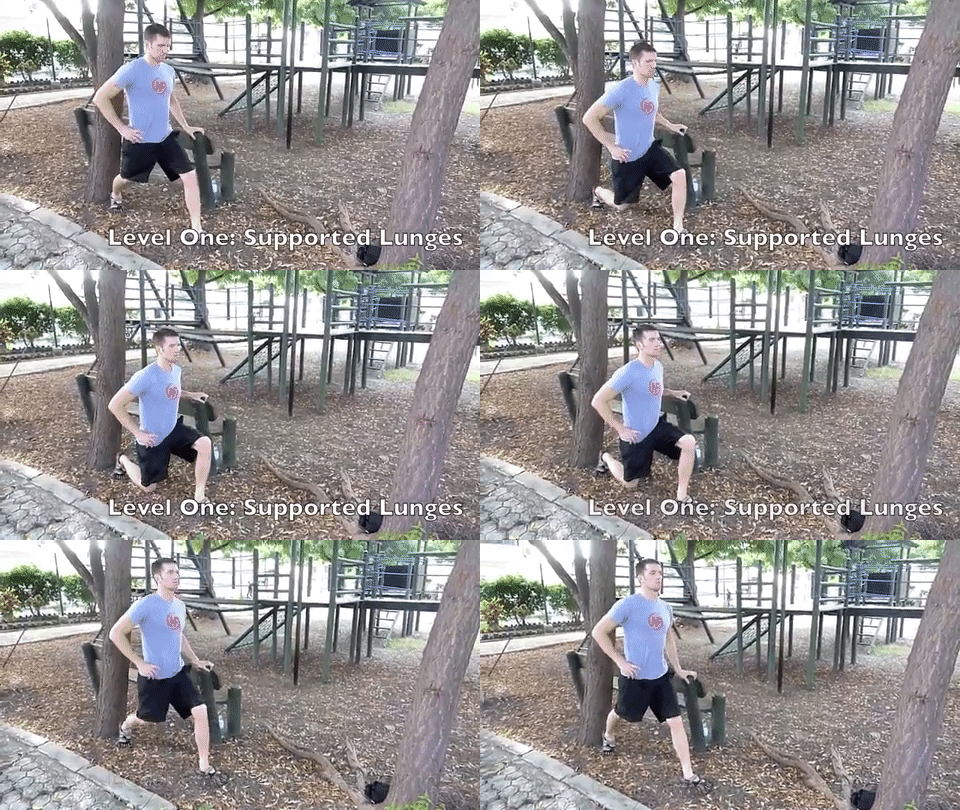
  • Assisted lunges: 8 reps each leg
  • Bent leg reverse crunches: 10 reps

Level Two:

  • Bench jumps: 10 reps
  • Lower incline push-ups: 10 reps
  • Body rows: 10 reps
  • Lunges: 8 reps each leg
  • Straight leg reverse crunches: 10 reps

After you’ve gone through a complete set three times, go down the slide!


Kettlebell Workout Circuit

Have a kettlebell lying around? Use it for a circuit!

Here’s our kettlebell workout full write-up, but you can also just watch the video and see the workout here:

  • Halos: 8 reps (each side)
  • Goblet squats: 10 reps
  • Overhead presses: 8 reps (each side)
  • Kettlebell swings: 15 reps
  • Bent Over Rows: 8 reps (each side)
  • Front rack reverse lunge: 6 reps (per side)

Once you’ve done the above three times, go ahead and put your kettlebell away for your final step: stretches.

If you want a kettlebell worksheet for this workout, grab one by signing up in the box below:

We also have a fun new adventure in our app that will allow you to train with your kettlebell right alongside Hack Morris (this will make sense more sense when start).

Jump in right now for your free trial:

Beginner Gym Circuit Training

use free weights and to do circuit trainingIf you have access to a gym, you have a lot of circuit options.

If it’s your first time stepping foot in a fitness facility, check out our Beginner’s Guide to the Gym. The gym can be a scary place, but we’ll give you a strategy to get comfy.

(Gym closed do to COVID? Here’s how to build a gym in your home.) 

We’ll also walk you through each movement for both Days A and B below. I would recommend picking one of our 5 Beginner Gym Workouts, going through the leveled progressions, and working your way up to the circuits below:

DAY A GYM WORKOUT:

Day B GYM WORKOUT:

  • Barbell Romanian deadlifts/regular deadlifts: 10 reps
  • Push-ups: 10 reps
  • Dumbbell rows: 10 reps per arm

Alternate your circuits on different days. Rest in between. “Day A” could be Monday. Rest Tuesday. Wednesday could be “Day B.”

We LOVE helping people get started in the gym, as we’re huge fans of barbell training and helping beginners build confidence with weight training! If that sounds like you…


And you can download our full Strength 101 guide too, which has this routine along with other circuits to help you start building strength today:

The Hotel Workout Circuit: For Travelers that Train

Is there anyway to work out in this hotel room?

Sometimes, you just plain find yourself stuck in a hotel room. Maybe you can find the hotel gym, but I bet it’s terrible! It probably has 2 machines, a broken treadmill, and no free weights. 

Ugh.

Instead, how about a workout circuit you can do in the room itself! Utilize the furniture to its full potential.

Level 1

Level 2

Set the alarm clock to 15 minutes from now and see how many circuits you can do!

Check out our full post on hotel circuits if you want Level 3!

We have a LOT of business travelers in our 1-on-1 coaching program, which is why we create workouts for both their home gym and while traveling!

If you need worldwide accountability, workouts for home and the road, and want expert guidance…


Nerdy Circuit Training Exercises

Lego minifigures standing in rows. In first row - Batman, The Jo

If those workouts above don’t tickle your fancy, we have these other nerdy circuits you can do too!

The Batman Workout Circuit

Day 1

  • Rolling squat tuck-up jumps: 5 reps
  • Side to side push-ups: 5 reps
  • Modified headstand push-ups: 5 reps
  • Jump pull-up with tuck / Pull-up with Tuck-up: 5 reps
  • Handstands against wall: 8 seconds

Day 2

  • ‘180 Degree’ jump turns: 5 reps
  • Tuck front lever hold: 8 seconds
  • Tuck back lever hold: 8 seconds
  • Low frog hold: 8 seconds


The Lord of the Rings Workout Circuit

try this lord of the rings circuit training workout

Superset 1: The Fellowship of the Ring

  • “YOU SHALL NOT PASS!” Slams: 3 medicine ball slams
  • Legolas Bow Pulls: 7 renegade rows
  • “One does not simply walk/lunge into Mordor”: 9 lunges, each leg
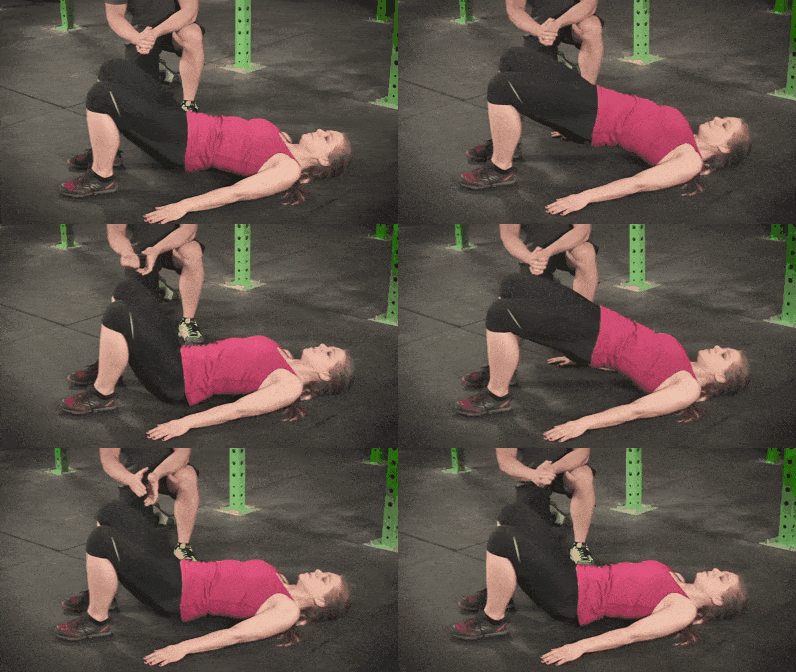
  • Hip “Bridge of Khazad Dum”: 1-minute hip raises and hold at the top position

Superset 2: The Two Towers

  • Riders of ROWhan: 3 bodyweight rows
  • Gimli “Shall I get you a box?” jumps: 7 box jumps – REALLY explode
  • Helm’s Deep-Squats: 9 bodyweight squats – get your ass to the ground
  • Tower of Orthanc Holds: 1 minute (Kick up against a wall and hold a handstand for as long as you can until 1 minute is complete, in as few as sets as possible. Check out our Guide to Handstands.)

Superset 3: The Return of the King

If you can get through a superset three times, consider yourself an honorary Ranger. Nothing found in Mordor can faze you.


The 300 Workout Circuit

do the 300 circuit training workout to get strong like King Leonidas

The below circuit is no joke. Then again, neither were the Spartans.

  • Pull-ups: 25 reps
  • Deadlifts with 135lbs: 50 reps
  • Push-ups: 50 reps
  • ‘24-inch’ Box jumps: 50 reps
  • Floor wipers: 50 reps
  • Single-arm clean-and-press with 36 lbs. kettlebell: 25 each side
  • Pull-ups: 25 reps

The above sequence is designed to be completed once. If you can go through it twice, you’re ready to defend Greece.


The Wolverine Workout Circuit

  • Barbell Deadlift / Dumbbell RDL / Banded Good Morning / Regular Good Morning: 10 reps
  • Medicine Ball Slam / Quick Downwards Bodyweight Squat: 10 reps
  • Push-up to Renegade row (push-up, row left, push-up, row right, repeat): 5 Rows per side
  • Transverse Lunge and Chop: 5 reps each side

How many times do you do this circuit? AMRAP, or, As Many Rounds As Possible. I suggest setting a 12-minute timer and getting to work. Be careful though, because only Wolverine can heal automatically.

wolverine does workout circuits too

You’ll need actual rest.

Boom!

There are your nerdy circuits. Feel free to rock the soundtrack of the referenced movies during your workout. If you own a cape, now’s the time.


Complete List of Circuit Training Exercises

A picture of a LEGO Spider-man, who is interested in weight loss.

You can do any of the workouts in this article and get a great workout, but if you want to build your own workout, you can totally do that too!

Here is a list of exercises you can use to create your workout.

Simply pick a few, and do one after the other in as many circuits as you want!

Pick your exercises from this list to build your own circuit training workout, or suggest your own for us to add in the comments below!

CARDIO EXERCISES:

  1. Jump rope
  2. Jumping Jacks
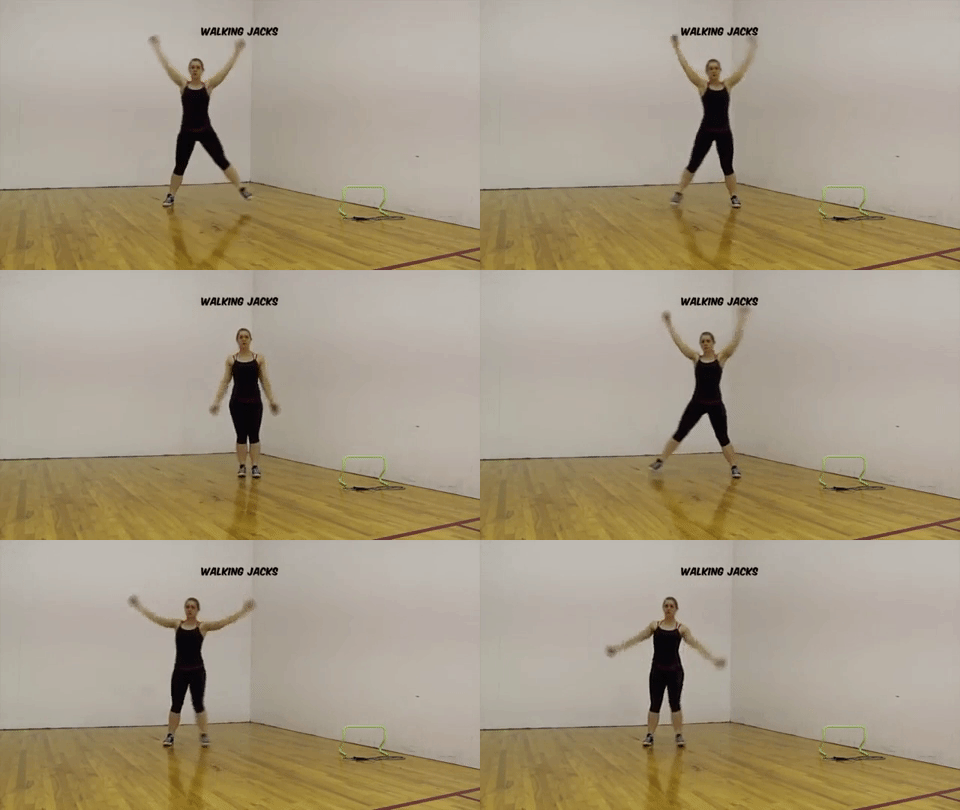
  3. Walking Jacks
  4. Burpees
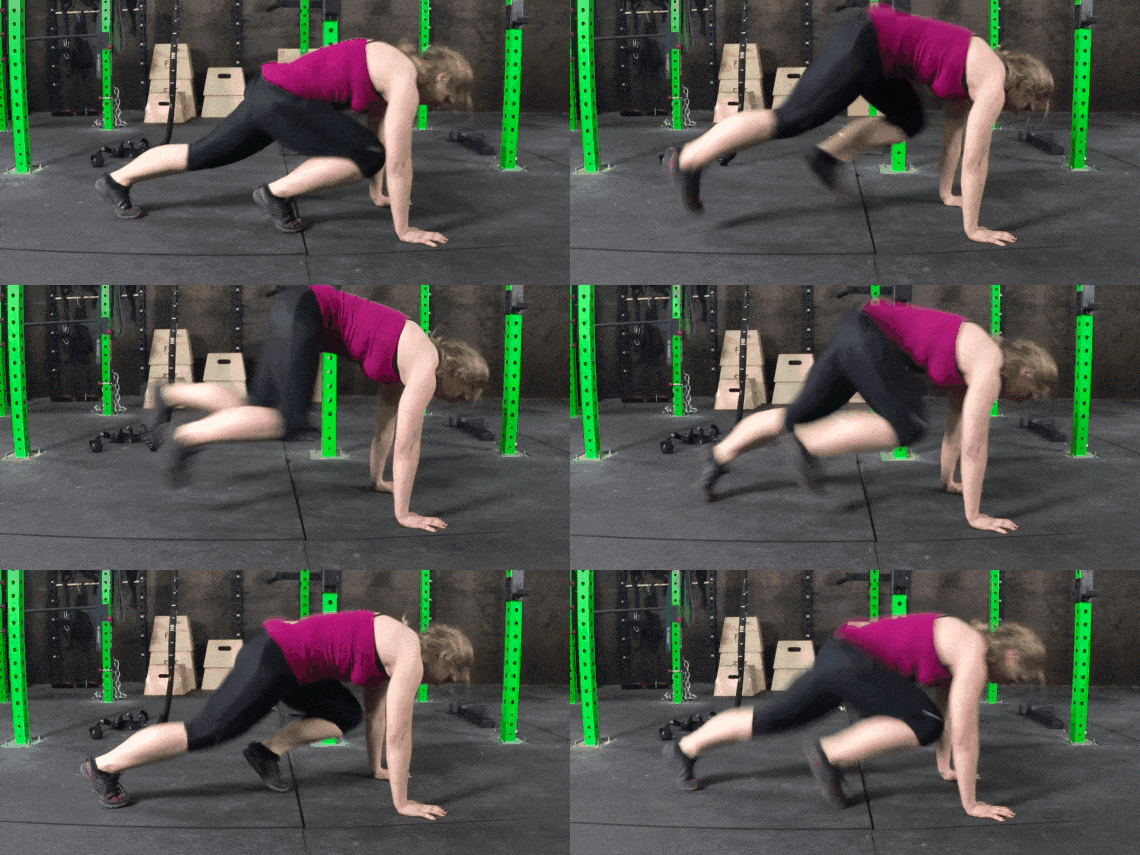
  5. Mountain climbers
  6. Stairs
  7. Sprints
  8. High knees
  9. Running in place
  10. Rowing machine
  11. Long-distance jumps
  12. Box jumps

UPPER BODY PUSH EXERCISES:

  1. Push-ups (any variation)
  2. Handstands.

UPPER BODY PULL EXERCISES

  1. Dumbbell rows
  2. Bodyweight rows
  3. Negative pull-ups or chin-ups
  4. Pull-ups or Chin-ups

LOWER BODY EXERCISES

  1. Bodyweight squats
  2. Lunges
  3. Kettlebell swings
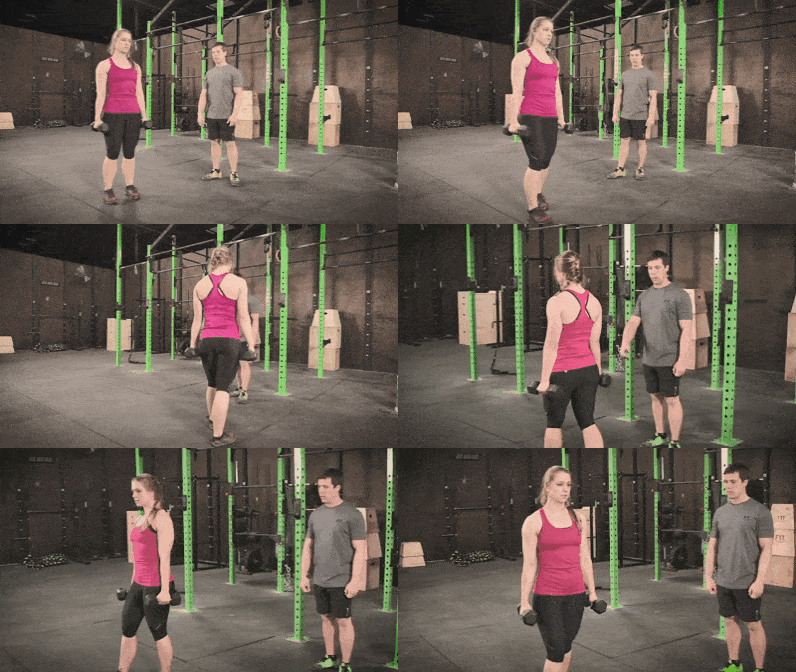
  4. Farmer carries (carry dumbbells and walk around)

Coach Staci showing Farmer's Walk

CORE EXERCISES:

  1. Planks
  2. Side planks
  3. Reverse crunches

Pick 3-5 exercises, and arrange them as we discuss in our “how to build your own workout routine.” We also have The 42 Best Bodyweight Exercises for movements that you can choose from.

Do 3 circuits with 10 reps of each exercise, one after the other!

Have fun and keep things interesting. And if you don’t want to build your own workout, that’s cool too! We have 15 free workouts in this article, and we can also do all the heavy lifting for you.

(Well, not literally DO the heavy lifting, but you know what I mean.)

We create custom workout solutions for busy people just like you in our 1-on-1 Coaching Program. Let us create a workout and help you make better food choices.

It’s like having a Yoda in your pocket (again, not literally).


How to Stretch After Circuit Training

Once you finish your workout, the final step (three) would be stretching and cool down. No matter what circuit you go through, stretch after a workout. It can help a lot with muscle recovery.

Scope this video for an awesome stretching sequence to follow:

You could also do some yoga poses. For stretching, find what feels good and take your time. Let your heart rate come down while you stretch.

You could even do some foam rolling too if you’re a glutton for punishment!

For more ideas on how to make the most of your stretches, check out The Ultimate Guide for Improving Flexibility in 30 Days. It has Spider-Man in it, so you know we aren’t messing around.


Getting Started With Circuit Training

want to be a superhero like these legos? do circuit training!

There are all sorts of different ways to do circuit training. We just showed you fifteen.

YOUR MISSION: Complete one of the above circuit training workouts! If you don’t know which one to pick, start with the Beginner Bodyweight Circuit. It’ll get you used to the idea of hustling from one exercise to the next.

And you can do it in your living room!

If you’re looking for more hands-on instruction and customized guidance, check out our 1-on-1 Coaching program. You’ll work with our certified NF instructors who get to know you better than you know yourself, and then build a workout program that is specific to your exact goals.

Simply put, we tell you exactly what to do every day, and how to eat. And then, we check in with you regularly to make sure you’re doing it!


If you got this far in the article, I really want you to try one of these workouts. Right NOW. I always mention the most important step in a fitness journey is starting it. Today, start circuit training.

Once completed, I’d love for you to share your story with the community in the comments:

  • How’d it go?
  • Did you get through three full circuits?
  • Which routine did you pick?

Find a circuit you’re comfortable with, and do it.

Then do it next week. And the following. And track your progress! 

If you add circuit training to your fitness routine, you’ll be on a solid path for leveling up your life.

-Steve

PS: I couldn’t quite figure out how to use this gif, but it was too good not to include.

I bet short circuit likes circuit training

If someone creates the “Short Circuit Workout Circuit” you’ll be my best friend forever.

###

All Photo credits can be found right here[1].

The post 15 Circuit Training Routines: Try These Fast Workouts Anywhere! first appeared on Nerd Fitness.

from Nerd Fitness: Helping You Lose Weight, Get Stronger, Live Better. https://ift.tt/O4mfabS
via IFTTT

Categories
Uncategorized

#holistic #getfit #nutrition 3 HIIT Workouts for Beginners: Start Interval Training and Sprint Running!

This biker loves interval training.

This High-Intensity Interval Training (HIIT) guide is probably the best interval training guide in the galaxy.

My justification for such a bold claim?

We’re really good at this stuff, AND we have dinosaurs and Muppets.

Plus, lots of great gifs:

This runner can't do interval training.

We build custom interval training programs just like the ones in this guide for our 1-on-1 Online Coaching Clients, including workouts for at home, the gym, or even while traveling.


In this Ultimate Guide to Interval Training, we’ll cover:

If you’re interested in starting a HIIT practice (which you are, ’cause you’re here), you may want to try our new app! It contains a fun adventure that will take you from sitting on your couch to a full HIIT workout – with plenty of benchmarks in between for you to find your groove. No guesswork needed, just jump into the app and follow it’s next steps.

You can sign-up for a free trial right here:

Alright, let’s do this thang.

What is Interval Training? What is HIIT?

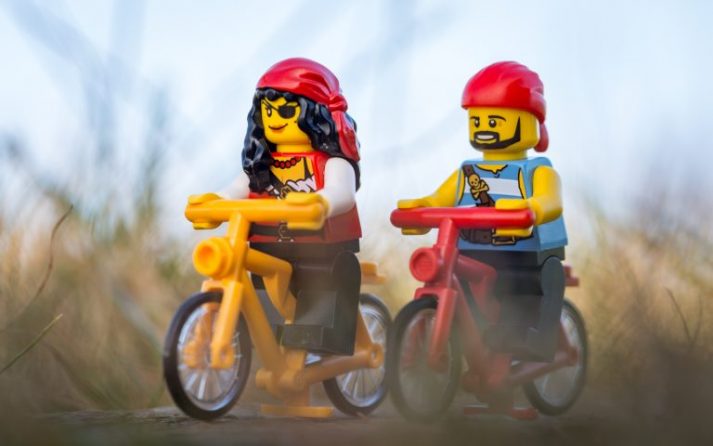
These bikers love doing HIIT.

In 2018, High-Intensity Interval Training (HIIT) was ranked the number one fitness trend by American College of Sports Medicine.[1]

They wrote:

HIIT typically involves short bursts of high-intensity exercise followed by a short period of rest or recovery and typically takes less than 30 minutes to perform.

Essentially, HIIT is just following a specific regimen where you vary your speeds and intensity throughout a shorter run, swim, bike, or row.

Any exercise can be a form of HIIT, but here’s a common routine:

  • Jogging lightly for three minutes.
  • Pushing yourself harder for a minute (run or sprint).
  • Repeating this cycle 4 more times.

Because everybody is busy and overwhelmed, fast results in the least amount of time is why most people discover HIIT. 

Plus, you can do HIIT with just about anything, including a jump rope:

Coach Jim showing you jump rope double unders

You may be asking, “Steve, just how short and intense are we talking about here? Also, your new haircut looks spiffy.”

Thank you, you’re very kind.

So let’s explore the pros and cons of intervals.

What are the Benefits of HIIT? Why Should You Do Interval Training?

 silhouette of man running towards the sun at cloudy background

The 1996 landmark Tabata study demonstrated the benefits of extreme HIIT.[2]

Dr. Izumi Tabata, from Japan’s National Institute of Fitness and Sports, was obsessed with interval training.

The doctor sought to see exactly what kind of gains were obtained from short, intense, periods of exercise. He conducted an experiment with Olympic athletes on stationary bikes and put them through intense bouts of exercise followed by short periods of rest.

The results were fascinating.

Tabata found:

That 6 weeks of moderate-intensity endurance training did not affect anaerobic capacity, but that 6 weeks of high-intensity intermittent training (HIIT) may improve both anaerobic capacity and VO2max simultaneously.

Let’s translate that: compared to regular cardio, HIIT had a greater impact on improving BOTH:

  • Aerobic increases (endurance).
  • Anaerobic increases (power).

Even crazier?

Tabata was able to demonstrate improvements in his athletes with just FOUR-MINUTE bursts.

So what’s happening here?

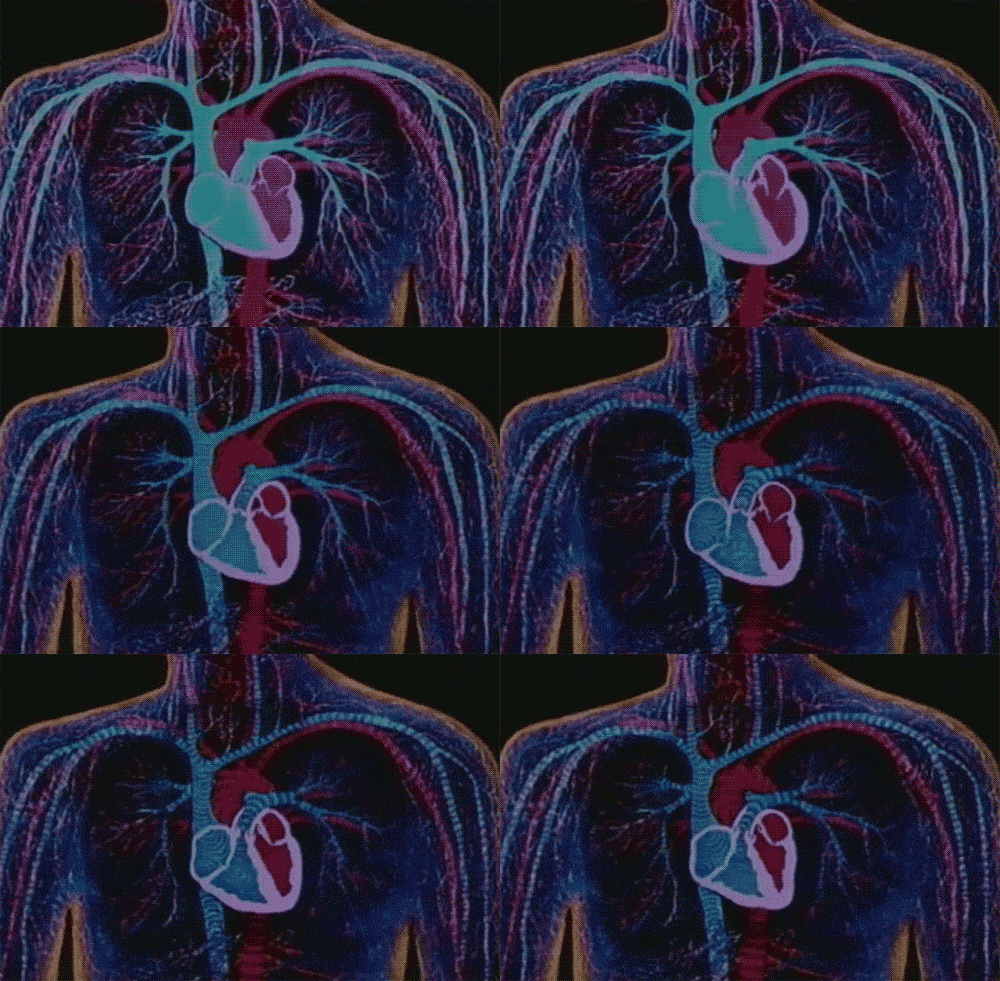
Simple: your heart is a muscle.

Yes, the heart is a muscle.

If you keep your heart beating at a constant rate, never expanding it outside of its comfort zone, it will never grow stronger.

By introducing chaos and pushing your muscles outside of their comfort zone, they must adapt and grow more resilient in order to survive.

Intense interval training challenges your heart by constantly forcing it outside of its comfort zone.

In other words: progressive overload – the same concept behind building strength.

Coach Jim explains 7 different ways to achieve progressive overload in this video:

Since Tabata’s 1996 study, many other trials have shown the positive impact of interval training. 

Here are some of the benefits of High-Intensity Interval Training:

#1) HIIT can burn lots of calories in a short amount of time.

Revving up your effort requires more out of you, including calories. 

Batman has to fun whether he likes to or not...part of fighting crime means running 5Ks (ish).

One study backed this up, finding HIIT burned about 20-30% more calories than regular cardio.[3]

The researchers stated:

These data suggest that individuals can burn more calories performing an HIIT session  than spending the same amount of time performing a steady-state exercise session.

The name of the game here is “intensity.” The more intense you go, the more calories you’ll burn.

#2) HIIT for lowering blood sugar. Managing blood sugar is really important for health, not just for diabetics.

Those trying to lose fat should be aware of their blood sugar and corresponding insulin levels.

The good news for our current discussion? HIIT has been shown to help lower and manage blood sugar levels.[6]

#3) HIIT for heart health. Touching on the “antifragile” topic again, HIIT has been shown to help with overall cardiovascular health.

It does so in the same way traditional endurance training does, but at a fraction of the time (almost half).[7]

Alright, let’s chat about how to actually do some interval training.

What’s an Example of Interval Training? How to Do Interval Running

Man running in a gym on a treadmill

The key to HIIT is being able to go from “easy” to “difficult.” All sorts of different exercises can get you there:

  • Aerobic (cardio).
  • Bodyweight (strength training).
  • Resistance (weight training).

HIIT is generally associated with running (aerobic), so we’ll devote this section to just that.

The easiest way to experiment with HIIT would be to run.

Mr. Gump ran like 1,000 5Ks when he crossed America.

Here’s how to start with a basic HIIT running workout. Go to a park in your neighborhood. Warm-up with some light jogging, high knees, and mobility – leg swings, arm swings, etc,

And then begin your workout!

  • Run/jog at a brisk pace for 30 seconds.
  • Jog/walk at a slower pace for 2 minutes.
  • After your rest, shoot for another 30-second run/jog.
  • Continue until you get tired or after about ten “push/rest” intervals.

And BAM! You just did HIIT.

Don’t get disheartened if you find yourself stopping a lot during your first week of HIIT training. 

Andy Dwyer hates running, but I bet he'd like HIIT more.

You’ll be surprised how quickly you get better at this!

Also, “running” or “jogging” is subjective. Whatever walking fast means to you is great. Do that for your periods of intensity.

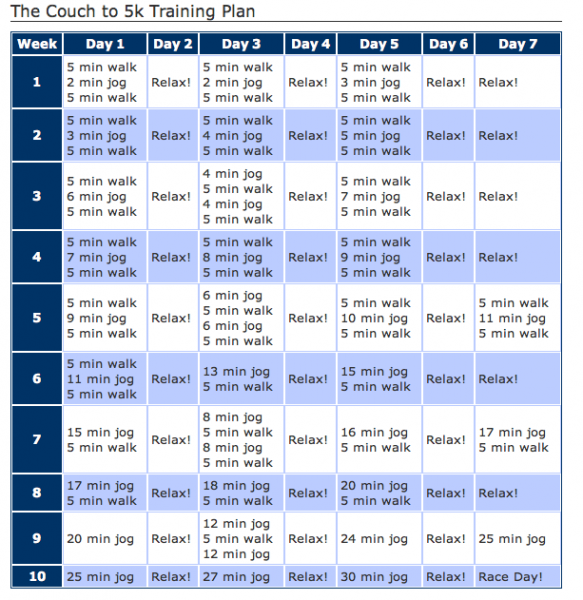
It should be noted, that the entire “Couch to 5K” concept rests on interval training through running.

It’s all broken down into “walking,” “jogging” and “running.”

If you’re curious, check out our in-depth Couch to 5k review. If you want to start interval training, “Couch to 5K” could be a good way to do it.

More of an indoor person?

Consider a treadmill, where it actually sets intervals for you based on your desired difficulty.

Just be careful on it…

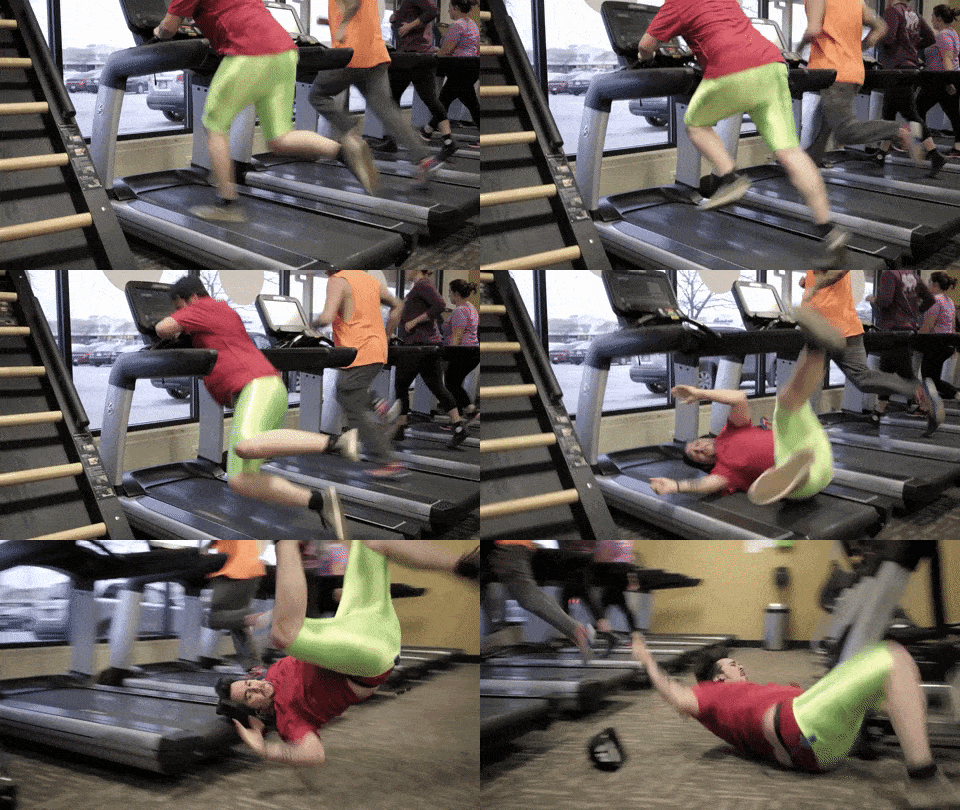
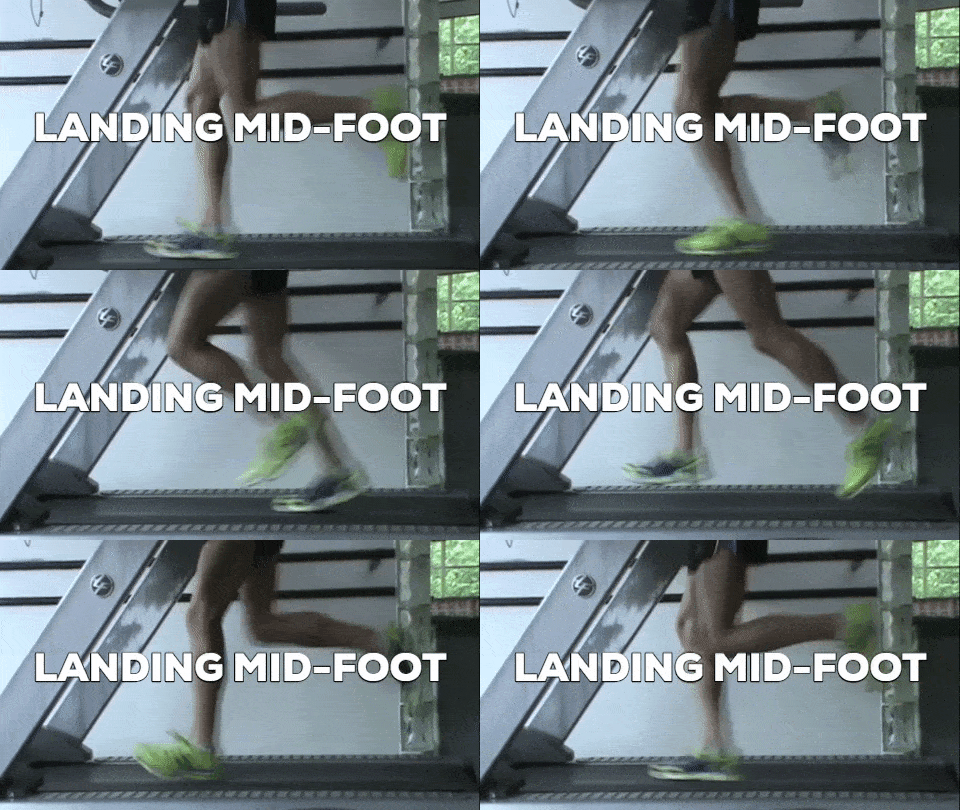
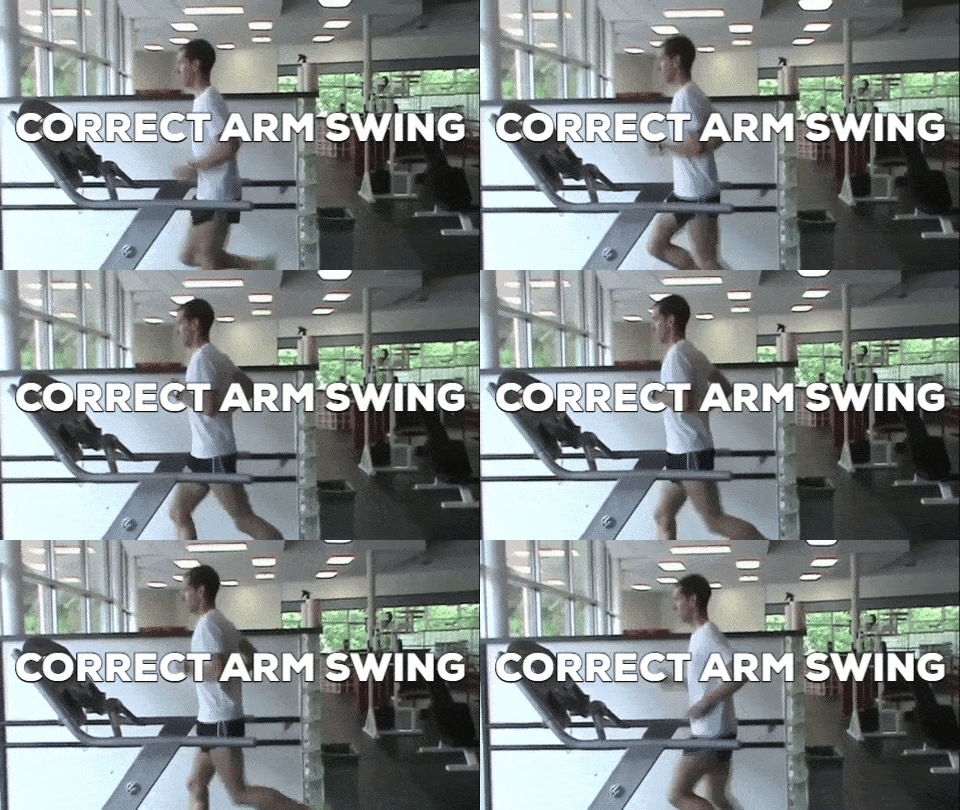
Pay attention to your running technique or things can go wrong!

We’ll be talking about machines a lot more in the next section, but a treadmill is all you need to do a HIIT workout.

Experiment with the speed and incline to find a setting that you would consider “intense.” Many machines can be programmed to flip between this and an “easy” setting.

And you know what that means… boom! It’s built for HIIT.

When we designed NF Journey (our awesome new app), we used an “intense” and “easy” interval switch for most of the workouts.

If you want, you can sign-up for a free trial right here to see what I mean:

How do HIIT Workouts Work? (More HIIT cardio to choose from)

Biking is perfect for HIIT.

There are a lot of different aerobic exercises for HIIT cardio.

For example, you could jump on a bike, which is like HIIT running but with wheels (duh):

Kermit loves interval training on his bike.

Every spin class is based on HIIT cycling (SoulCycle, Flywheel, or even your local gym now has spin classes).

They’re popular for a reason, and you can make a friend or two!

Here are some more examples of interval training:

  1. Elliptical. If it has a dial for resistance, it can be used for interval training. For a couple of minutes, go on low resistance (0-2 level). Then crank up the resistance for one minute (up to 8-10). Repeat this process 12 times, which will give you a 20-minute workout.
  2. Stair Climber. Much like the elliptical, alternate between periods of low intensity for two minutes, then one minute for high intensity. The difference with the climber is the dial will control the speed of the stairs. Be careful.
  3. Rowing Machine. Start with a two-minute warm-up. On minute three, row like you’re being chased by the Kraken for a full 60 seconds. Then catch your breath. The rowing machine might be hard to do for a full 20 minutes, since it’s a lot of upper body. Shoot for ten minutes at first.
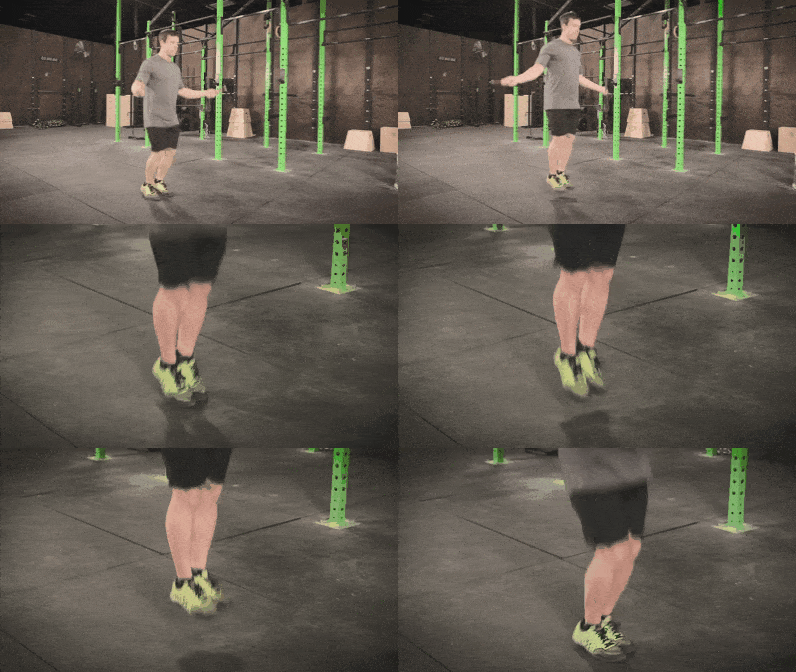
  4. Jumping Rope. Jumping rope is a full-body exercise. Also, it’s fun. There’s no dial here, your own body controls the pace of the jump. Follow the same two-minute easy, one-minute intense as above. Jump rope can also be done with friends!

This dino loves jump rope for HIIT.

So far we’ve just been talking about aerobic exercises.

Let’s cover our other categories, of bodyweight and resistance.

What Are the Best HIIT Exercises? (Two Other Forms of Interval Training)

The woman rower in a boat, rowing on the tranquil lake

“Steve, this all sounds great. But I hate running!”

Confession: So do I.

So I get my cardio in other forms!

Here are some bodyweight exercises to get going on HIIT:

  • Burpees. Stand up, then squat down, kick your legs out, do a push-up, bring your legs back in, and explode up into a jump. Try to do 20 repetitions, then rest for two minutes. Repeat until you hate yourself:

  • Push-ups. For 20 seconds, do as many push-ups as possible. Rest. Then do it again. If you’re worried about proper form, check out our push-up guide and watch this:

  • Pull-ups. Same idea as above, do pull-ups for 20 seconds, then rest. If you can’t do a pull-up, we got you covered in our pull-up progression guide:

Let’s now chat about some Weight Training Examples for HIIT:

  1. Kettlebell swing. For ten minutes, do 20 kettlebell swings on every minute.Coach Staci showing you the kettlebell swing
    This will be intense, and worthy of congratulations when you’re done. Check out our 20 Minute Beginner Kettlebell Workout for everything you’ve ever wanted to know about kettlebells.
  2. Battle ropes. If your gym has battle ropes, they’ll be a great tool for HIIT. For intensity, the amount of slack in the rope determines the load. The more slack on the rope the tougher, and more intense, the workout. Also, don’t get stuck in just up and down movements. Some variation will help target different muscles.
  3. Weight lifting. The critical piece will be moving from one exercise to another quickly enough. For example, hustling from the bench press to the lat bar: we call this circuit training!

To answer your next question: yes, you can also do circuit training as a form of HIIT.

Circuit training is going through a sequence of exercises, or stations, back to back.

Coach Lauren explains the ins and outs of circuit training in this video:

So in a circuit you could go from push-ups to pull-ups, back to push-ups, only resting briefly from one exercise to another.

Circuit training would be perfect to mix into a HIIT workout, since you can design your circuit to be very intense.

Check out our post for 15 Circuit Training Routines to choose from.

Plus, there’s a Batman workout hidden in there. You’re welcome.

We create custom HIIT programs for busy people like you that are ACTUALLY fun. If you’re looking for a supportive coach to guide you and tell you exactly what to do each day, we got you covered!


If you just want a beginner circuit to get started with, you can try out our Beginner Bodyweight Workout Routine. Plus you can download a free worksheet to track your progress with this circuit when you join the Rebellion below:

Oh, what’s that? You want to have even MORE fun while getting the benefits of HIIT? 

Let's get crazy with Interval Training

Sure. Let’s think outside the box:

Basketball, tennis, soccer, and Ultimate (frisbee) are AMAZING styles of exercise that use interval training (it’s all start and stop!).

Run here, catch this, and wait for the next round to start.

That’s what we’re looking for in a HIIT workout.

So pick a form of FUN exercise that gets your heart racing faster and slower throughout the activity (yes, I suppose even THAT activity would count).

Is HIIT Good for Losing Weight? Is Interval Training Good for Losing Weight?

This mermaid is interested in HIIT for weight loss.

My guess is that you’re reading this article because you’re trying to get the most efficient “bang for your buck” when it comes to getting in shape.

And HIIT is a great form of exercise and COULD help with weight loss.

I will, however, lower some of these outlandish claims that exist in the media.

For example, Time magazine calls HIIT “miraculous” in one article.[8]

That’s a little much, even for me, who writes for a living on why you should work out and likes using hyperbole for effect.

Seriously, I’m better at it than ANYBODY ON THE PLANET.

Ahem.

Cardio, strength training, and HIIT all have many benefits.

However, a meta-study reviewed HIIT compared to steady-state cardio, specially looking at fat loss.

The results?

They found no real difference.[9]

The Doctor saying "it doesn't matter"

As researchers noted:

Regular exercise is an integral component of long-term weight management. However, unless implemented in very large volumes, short-term exercise in isolation (including HIIT) is unlikely to produce clinically meaningful fat loss.

What’s that mean?

As long as your energy expenditure is the same (and you’re in a caloric deficit), steady-state cardio is equivalent to HIIT for fat loss.

In other words, if you want to lose body fat, how you eat will be responsible for 80% of your success or failure.

It doesn’t matter how many intervals you do – it’s not gonna help you lose weight if you don’t also fix your nutrition.

You can read our Beginner’s Guide to Healthy Eating if you want more information, which will help you build a plate like this:

If your meal plate looks like this, you're doing a lot of the heavy lifting for weight loss.

And if you want to download our free 10-level Nutrition Guide to help you fix your diet starting today, you can do so by signing up in the box below:

Getting Started with Interval Training

These pirates are ready to do some HIIT.

When it’s time to advance your high-intensity interval training, think about the following:

  1. Frequency. This would be the number of intervals in your workout.
  2. Intensity. How hard are you going in each interval?
  3. Time. How long are your intervals and rest periods?

Maybe you start out doing 3 intervals of intense running.

Once it becomes routine, bring it up to 4.

Maybe you crank the resistance on your stationary bike to “8” during your intense interval. When it becomes normal, bring it up to “10.”

Maybe you do pull-ups for 20 seconds. When you’ve got a good handle on that, aim for 30 seconds.

This mindset will keep you advancing in interval training.

A group of allies can help with victory

Consistency is the name of the game here. Even just doing a HIIT workout once a week will help you progress in all three categories.

For more ideas on how to improve workout consistency, check out this video from Coach Jim:

Oh, and if you want help along the way, don’t forget about our Online Coaching Program:


Mistakes to Avoid When Doing High-Intensity Interval Training

Don't anger people by doing HIIT wrong.

There’s a lot to consider when embarking on a HIIT practice.

No matter which routine you end up starting with, make sure you follow these words of wisdom:

  1. Ease into it. As the saying goes, “you must walk before you can run.” The importance is building a HIIT practice. If you need to go “less intense” before progressing to “intense,” that’s fine. It’ll help build your aerobic capabilities (endurance), which will be important when working on intensity. Start with walking.
  2. Keep proper form. Doing your movements correctly will help prevent injury. Here’s how to run properly. This is even more critical in your later intervals, where you may be exhausted and tired. If you find yourself breaking form, go ahead and slow down. Intense isn’t worth an injury.
  3. Get rest. Our bodies actually build muscle while we are resting. So take some “off days” from your HIIT practice. Want to stay active on these days? Do some fun exercise!

Take it easy, focus on your form, and make sure to prioritize rest.

HIIT Timer Recommendations

A timer is great for doing interval training.

HIIT centers on doing intervals.

One moment it’s intense, the next you’re onto a short rest break.

A good way to know when it’s time to go from one sequence to the next is a timer. A loud “beep” can tell you when it’s okay to catch your breath or when you have to kick it in gear.

Here are 5 HIIT timers you can try out:

  1. Runtastic. Don’t let the name fool you, this free app is for more than just running. You can customize for many different interval workouts, depending on what exercise you go with. And the interface looks slick.
  2. Seconds. It’s free and customizable to any form of HIIT. It can also integrate with your music, which is pretty sweet.
  3. Seven. If you’re new to HIIT, Seven would be a good app for you. It’s free, plus it has illustrations for exercises. You also get to customize your own virtual personal trainer, which may be the future of fitness. The bots are coming…
  4. Sworkit. First off, it’s a clever name (taken from “Simply Work It.”) Second, it’s free. Third, it can display your workout, goals, and calories burned. I like it.
  5. J&J Official Seven Minute Workout. This free app from Johnson & Johnson is actually really awesome. It has premade workouts you can choose form based on your fitness level, or tweak them to make it your own.

Also, we need to talk about interval timers. Most of the apps referenced are completely customizable.

For example, you can change the intense interval from 120 seconds to 90 seconds.

This is critical because it’s up to you to decide how long you can do intense vs. rest.

Generally, folks recommend one minute of intensity and then two for rest when doing HIIT.

However, this all depends on the individual, and exercises performed.

For example, burpees are tougher to do than jumping over a rope:

The infamous burpee bodyweight exercise!

So feel free to make changes like 30 seconds of intensity and three minutes of rest. Make it your own.

Whatever way you chose to do HIIT, is fine, as long as you actually do it. The benefits of HIIT kick in when going HARD for you.

In other words, you don’t have to be an Olympic athlete to get the benefits of HIIT.[10]

A light jog totally works. Just don’t do it in a mascot costume.

Running - just don't fall over!

As we discussed, if you’re consistent, you’ll improve.

So don’t stress about where you have to start.

For now, download an app and get going. Ours will help you train with HIIT too:

I hate multiple choice. Pick a HIIT workout for me!

This lego loves running for HIIT.

Let’s power walk as our form of HIIT. 

This is an example of a beginner HIIT workout we might prescribe for our Coaching Clients who are starting to train for their first 5K.

Let’s do seven intervals, two minutes each:

  1. Warm-up. For three minutes, walk at an easy pace.
  2. Intervals. For the first 60 seconds, power walk, like you’re trying to beat someone to the front of the line at Starbucks.
  3. For the next 60 seconds, just walk.
  4. Repeat six more times.
  5. Cool down. You can do some more light walking, or a little bit of stretching here would be great.

Total time: 20 minutes.

Wayne is stoked that he made his small change for weight loss.

I want to stress, that you can do just about any exercise in exchange for this routine. Just minus “power walk” and add “push-ups and bodyweight squats”

It’ll still be a great HIIT workout.

“But Steve, that’s still multiple choice!”

Right, right… sorry. Stick to power walking! Done!

How to Start Interval Training now

These two girls jump for their interval training.

Do our power walking routine above. It’s a great place to start.

Remember, our goal at this stage is to “build the habit.”

We can work on “whoa, that was intense” later.

If you’re looking for EVEN MORE stuff to do, we have a few options for ya:

1) Check out our popular 1-on-1 coaching program. You’ll work with our certified NF instructors who will get to know you better than you know yourself and program your workouts and nutrition for you.


2) Exercising at home and need a plan to follow? Check out Nerd Fitness Journey!

Our fun habit-building app helps you exercise more frequently, eat healthier, and level up your life (literally).

Try your free trial right here:

3) Enlist in the Rebellion! We need good people like you in our community, the Nerd Fitness Rebellion. 

Sign up in the box below to enlist and get our guide, Strength Training 101: Everything You Need to Know. It’ll help you start incorporating interval training into your workouts.

There are a zillion ways to do HIIT, so don’t let the options paralyze you.

Pick one. Anyone. And get to it.

Interval training, in any form, is a solid fitness choice and a great practice to have in the workout arsenal.

Any questions?

Which HIIT workout style is your favorite?

Leave it in the comments below!

-Steve

PS: Make sure you check out the rest of our content on interval training:

  1. The HIIT Workout for Home
  2. How to Do Tabata Sprints
  3. Should You Do Couch to 5K?

###

All photo credits can be found in this footnote.[11]

The post 3 HIIT Workouts for Beginners: Start Interval Training and Sprint Running! first appeared on Nerd Fitness.

from Nerd Fitness: Helping You Lose Weight, Get Stronger, Live Better. https://ift.tt/3e0jvQa
via IFTTT
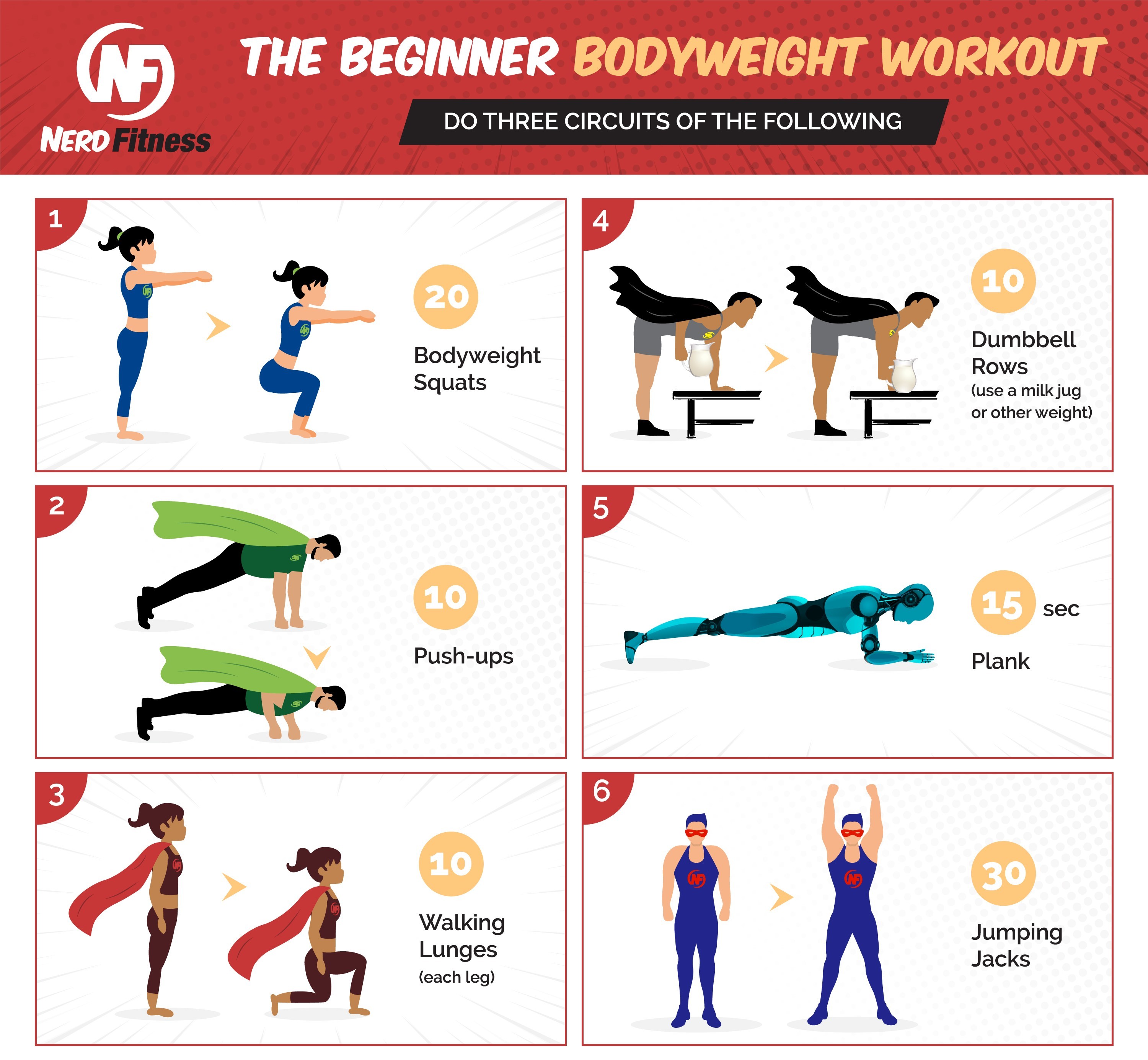
Categories
Uncategorized

#holistic #getfit #nutrition A Beginner’s Guide to Hiking: Everything You Need For Your First Hike!

A great place to hike.

Before you step foot in the great outdoors, read this guide!

There’s nothing more embarrassing than a city slicker getting lost in the woods, so let’s make sure you know where you’re going, what to wear, and what to bring.

That way your first hike will be fun, adventurous, and more importantly safe!

Today we will cover:

I’m happy you’re excited about hiking and I can’t wait for you to get started!

I took the above picture while hiking through Killarney National Park in Ireland many years ago, and every time I look at it, I can’t help but think of Tolkien’s Middle-earth masterpiece, so I apologize (not really) for all of the Lord of the Rings nerdery running throughout this post!

Our community members love hiking too. In fact, one of our recent success stories specifically cited hiking as one of the fun activities she loved to do to help her lose 50 pounds:

Christina started rocking pull-ups after Nerd Fitness Coaching

By the end of today’s post, my goal is to have you pick a trail, pick a date, and identify a fella or gal to join your fellowship (galship?).

Before we jump in, are you here because you’re learning to hike to lose weight? Did you hear it’s a fun way to exercise and get your body moving?

If so, you’ve come to the right place!

As I mentioned, some clients in our uber-popular 1-on-1 Online Coaching Program used hiking as part of their weight loss training. These folks would rather head outside than jump on a treadmill, and our coaches designed a program so they could do just that!

Here’s how it works: your NF Coach will build a custom workout plan based on your experience level and goals. Training to climb up a literal mountain? Maybe you need to get rid of an old ring? We’ll create a plan to get you to the top!


Alright, let’s get you hiking!

How Do I Find Hiking Trails Near Me? (How to Start Hiking)

The view of a great place to hike.

When you think of hiking, you might imagine a bunch of road-tested perma-travelers with oversized backpacks, hiking through epic mountains for weeks upon weeks at a time. 

Or maybe, a pair of hobbits setting out on a worldwide adventure to destroy a ring of awe-inspiring power.

If you’re just beginning your journey to a better lifestyle, just thinking about serious hiking can be enough to keep you inside your comfy hobbit hole.

Although hiking can be an epic undertaking, it doesn’t need to be!

A hike also can be super simple and fun:

  1. A quick jaunt (such a great word, right?) around your local park after work.
  2. Exploring the woods behind your house with your kids on a Saturday morning.
  3. A half-day hike with your friends on a fun nature trail.
  4. A full day or overnight hike that also includes camping.

Here’s my definition for hiking: A person (or halfing, or self-aware robot) exploring their surroundings and their feet are on the actual ground. Like, dirt. And grass.

Some might say it needs to be difficult, have a certain elevation change, require a blah blah blah. It literally doesn’t matter.

What matters is that you go outside and do something you wouldn’t have done otherwise.

Here in the Nerd Fitness Rebellion, hikers would fall into the Adventurer class.

If you’re looking for a fun “cardio” activity and want to exercise in a way that’s exciting, hiking is a great way to get your legs, feet, and body used to some strenuous activity.

You get to pick your speed and difficulty, and you can always find the right amount of challenge for you.

HIKING 101: 5 STEPS TO PLAN OUT YOUR ADVENTURE

1) Decide how long you have to hike

This is a beginner’s guide to hiking, we’re not looking to hike the Appalachian Trail.

Instead, we want to start with trails that can be done in less than a day, that won’t require you to pack a tent, or bring an extra change of clothes. Pick a hike based on how much time you have – do you have the entire Sunday? Or do you just have a few hours on a Tuesday afternoon? It took Frodo and Sam 6 months to get to Mordor, but you probably don’t have that much time.

However, if you DID want to “walk to Mordor,” I got you covered there too. You’re welcome!

2) Decide if you’ll be hiking solo or with a friend/group

I love hiking solo – it’s mobile meditation for me.  However, it’s also more dangerous should anything happen while you’re out on the trail! If you’re heading into the wilderness, I’d recommend buddying up with a friend or your significant other for your hike. It’s the perfect bonding opportunity. This is especially true if they have more hiking experience or they know the area that you’re hiking in.

3) Determine your level

If you are a hiking newbie and out of shape, sending yourself out on an eight-hour hike through the unmapped wilderness isn’t a great idea.

Start slow, and pick places around your town that will allow you to stop when necessary and get back to your car or home quickly. No need to be a hero; it’s always better to come back excited and say “wow that was easier than I expected!” than to realize you’re six hours from home and out of steam. Well, being a hero is cool. But not THAT kind of hero.

4) Pick your hiking location

Keep it simple! Go to AllTrails.com, put in your zip code, find your hiking trail!

Or pull up Google Maps and look for big green plots of land. We call those “parks.” Google the park name, learn about it, and decide if that’s where you want to go. Do not overcomplicate this step. Just get started.

Ask your active, adventurous friends or coworkers if they know any good spots.

The world is FULL of hiking trails and awesomeness – you just need to know where to look.

5) Regardless of where you are going, let somebody else know where and when

If you are out hiking alone, take the time to email or call somebody and let him know that you’ll be hiking and when you expect to be back.

We don’t want to hear about any 127 Hours[1] stories on NF…that would make playing video games way more difficult.

You don’t need to tell them the brand of your underwear (please tell me you’re wearing underwear) or how many almonds you’re bringing, but let them know the important details so if they don’t hear back from you by a certain time they know to alert the proper authorities.

So right now, you should have answers to the following questions:

  1. How much time you can dedicate to hiking.
  2. Who you will be hiking with.
  3. Your level of experience
  4. Using AllTrails.com or GoogleMaps to pick your hiking location.
  5. Who you will tell about your hiking experience.
  6. How much XP will I earn by doing this?

That last point is about our fun new habit-building app, which allows you to level up (literally) by going on walks or hikes.

You can try it for free right here:

What Shoes Do I Wear Hiking? (Proper Footwear)

Steve at the Great Wall

This is simple: stilettos, your favorite mini skirt, a fishnet halter top, and a vest made out of raw meat. You’re welcome!

Wait, don’t do that.

I’m a big fan of being comfortable without breaking the bank. Like, you probably already have most of the clothing you need to go hiking.

WHAT SHOES SHOULD I WEAR TO HIKE IN?

We cover footwear extensively in our healthy feet article, but I’ll cover shoes specifically in the case of hiking here.

We at Nerd Fitness are huge fan of Merrell products – Merrell shoes of various types have treated me well for the past decade.

Just don’t let a lack of quality hiking boots keep you from a hike. If you’re concerned, pick an easy-paced hike with your current shoes to be safe and ramp up when you can ramp up your gear!

Some people hike the Appalachian Trail in their bare feet (must be part-Hobbit), so whatever you do: don’t let your footwear options keep you from getting started. Just make sure you break your shoes in and take them on test drives! Don’t take the tags off a new pair of shoes and then go on a multi-day hike – that’s a recipe for blisters and a miserable time.

Okay, let’s look at our feet. 

Now that we’ve done that, let’s look at some shoe options:

LEVEL ONE: Hiking shoes – “hiking shoes” are great if you’re going to be doing simple day hikes or hiking occasionally: they have a good grip on the bottom, give you enough support, but aren’t too heavy that they are a hindrance.

Here are my favorite options if you are in the market for some new basic walking/hiking shoes:

  1. Merrell Vent Hiking Shoe
  2. Merrell Trail Glove 4 (Men) – I have the blue ones. They rock.
  3. Merrell Trail Glove 4 (women)

Oh, what’s that? “Steve, I don’t have hiking shoes! Is this the end of the world?”

Well, do you have any sort of athletic shoe? Depending on the grip on the bottom, they could be decently okay for you to get started with when it comes to a basic hike. If sneakers are your only option, lace em up, pick a beginner hike, and see how they do. Just be careful on slippery surfaces – your kicks might not give you the grip you need to get over them.

LEVEL TWO – Hiking boots – I don’t hike enough or do enough multi-day hikes to justify the cost of hiking boots, but again I would point to Merrell boots if you’re in the market.

“Why boots over shoes, Steve?” 

Although many prefer trail shoes (like yours truly), I can absolutely see the value in a great pair of hiking boots if you’re going on a serious hike, traveling for multiple days, or more. They have more ankle support, thicker tread, thicker shoes, and provide your feet with significantly more protection.

REI has a great article helping you pick between Trail shoes and Trail boots. My advice? Start with what you currently have before deciding whether or not to invest in big boots. Once you build up the habit of hiking and decide you want to make it a bigger part of your life, you can make the investment.

My advice? If you are going to buy boots, go to a professional store, get fitted properly, and then break them in over many weeks before going out on a trail.

WEIRD BUT FUN FOR SIMPLE HIKES: Vibram FiveFingers – I hiked all around the globe, in various situations, wearing my Vibrams for close to 4 years. They made me feel like a ninja monkey and a hobbit. I got weird looks, but something just felt right about being able to feel the contours of the ground beneath me. I will say, when hiking in Vibrams it can be easier to twist an ankle when stepping on a root or rock, stepping on sharp rocks can hurt, so I found myself watching my feet much more than expected.

These days, I’m much more of a trail shoe kind of guy, but some still swear by Vibrams!

If you’re in the market for buying new boots, this quick video is a good primer:

WHAT SOCKS SHOULD YOU WEAR?

If you’re wearing boots or sneakers, you want to wear socks that aren’t going to give you blisters or make your feet all sweaty and gross.

Depending on how long the hike is, how serious you are about hiking, and your budget, you can look into merino-wool socks.

Like the rest of your outfit, what you wear on your feet will largely be dependent on a few things:

  1. Weather! Are you hiking in the forest and it’s 72 degrees out? Or are you hiking up the side of the mountain in cold conditions?
  2. Shoes! Are you in lightweight hiking shoes, lightweight hiking socks for the win. Hiking in big boots in cold months? Big thick warm socks are almost a requirement.
  3. Budget! Are you shopping for specific socks? Tall or short? Great. If you are brand new to hiking, just wear whatever athletic socks you wear while exercising.
  4. What’s the environment? If you’re hiking through grass, tall plants, etc. I’d go with tall socks (with your pants possibly tucked into them too). You’re not out there to win a fashion show!

Here’s Switchback Travel’s best hiking socks of 2018, and here’s a great article from Art of Manliness on proper feet care after a hike or ruck! 

What Do I Wear While Hiking? (Clothing)

Steve out hiking in the woods.

SHOULD I WEAR PANTS OR SHORTS?

Pro tip: Don’t go pantless through the wilderness. I cannot stress this enough.

The real advice when it comes to pants/shorts is heavily dependent upon your environment. If it’s going to be cold, shorts might keep you shivering. If it’s going to be hot, pants might get too uncomfortable.

Jeans? Ehhhhh. Sure. ONLY if it’s going to be a comfortable temperature and you have no other option. Being sweaty and hot while wearing jeans isn’t very fun.

I’m a big fan of my nerd pants – the Columbia Silver Ridge pants. Although they look kind of goofy, they’re incredibly lightweight, dry quickly, and can transform from pants to shorts in mere seconds!

Traveling through woods, not sure what you’ll encounter? Wear lightweight pants. I am horribly allergic to poison ivy and who knows what else, so I like to keep as much of my body covered while hiking to make sure I don’t make contact with anything I’m allergic to. [2]

WHAT TYPE OF SHIRT SHOULD I WEAR? 

My favorite options are merino wool long shirts and t-shirts: they’re light, wick away moisture, hide odors, and breathe well – though you will be paying top dollar for them.

If you’re just starting out, pick an old t-shirt and rock that – you can work on optimizing performance once you’ve got a few hikes under your belt.

If you’re on a multi-day hike in various conditions then having lightweight merino wool shirts you can layer and not need to wash would be great. But just going for a hike in the woods in your backyard? Whatever you would wear while running, training, etc. Aka whatever won’t chafe!

SHOULD I BRING A JACKET?

I’ve been wearing this Mountain Hardware jacket on most of my hikes and it has been awesome (10 years and counting) – very lightweight so packing it isn’t a hassle, waterproof so it keeps me dry when it rains, and heavy enough to block the wind to keep me warm when it’s chilly.

Don’t go out of your way to buy a new jacket if you have a decent windbreaker, but if you’re going to be doing a lot of hiking or you’re in the market for a new coat, here’s my advice: go to a local store and try out all of the jackets until you find one you like.

Once you find the perfect jacket, go home and check online (you can sometimes find the same jacket for up to 60% less) – then, ask the local store if they’ll price match or just buy it online.

SHOULD I WEAR A HAT?

You should definitely bring a hat. I’m usually rocking my Nerd Fitness hat or my Red Sox hat (booo Yankees), but while hiking in Australia I wore a hat with a giant floppy brim to keep my ears and face protected from the sun.

The tops of your ears and back of your neck are highly susceptible to getting burned while on the trail, so either get some sunscreen or wear a hat that keeps them covered.

The same is true for keeping pesky things out of your hair, the sun from burning your ears and face, and keep you a bit cooler.

WHAT KIND OF BACKPACK SHOULD I BRING?

Digging into the ins and outs of backpacks is far beyond the scope of this article. I’d recommend you check out my friend Chase’s Bag Review Youtube channel – guaranteed to be the most fun you’ll ever have learning about bags.

So what would I recommend for a beginner on a hike? The bag you currently have! If you’re going on a short hike, you can start with simply whatever bag you have. The lighter and comfier it is, the better.

Multi-day hikes where you’re living out of your bag, packing up, and building a tent each day – this is beyond the scope of this article. I have rocked a Kelty Coyote bag that I’ve lived out of for months at a time, and have also used on multi-day hikes.

If you have the means and the time, and you’re planning to go on certain hikes, go to an outdoor specialty store, speak with a professional, and get fitted for your body type and the type of hike you’re doing!

THE MORAL OF THE STORY: VERSATILITY

If your weather forecast is “75 and sunny,” and you’re hiking for the afternoon through a gradually sloping wooded forest, you can severely limit what you’re bringing with you.

If it’s questionable or looks like things might change during the day, versatility is your best bet – a jacket, pants that can become shorts, a long sleeve shirt that you can take off or roll the sleeves up, etc.

Don’t go out and buy all new stuff until you’re sure hiking is an activity you want to invest in. Borrow from friends, make do with what you have

Just get started.

BY NOW YOU SHOULD HAVE A ROUGH IDEA OF WHAT YOU WILL BE WEARING! 

In your head you should be saying, “Steve how can you read my mind?!

I just decided:

  1. I’d hike in my current gym sneakers.
  2. I have a pair of gardening pants and tall socks I can wear.
  3. I have a floppy hat.

I feel like I’m good to go!”

Perfect.

How Much Water Should I Bring On My Hike?

Killarney was a great place to hike.

If there’s ONE thing you should not leave home without, it’s a water container so you can stay hydrated.

“How much water should I be drinking on my hike, Steve?”

Great question. I knew you were smart from the moment you started reading this article.

You should be drinking 1 liter of water every two hours as a rough guideline. Increase this amount if you are hiking in very warm/desert climates.

FAVORITE WATER CONTAINERS:

I’m partial to stainless steel bottles or aluminum bottles over Nalgene or reused plastic bottles, but make do with what you have.  Just make sure you bring enough water with you to keep you hydrated through your adventure.

Going on longer hikes?

Get yourself a hydration backpack (which can double as your hiking pack!) to transplant water more conveniently.

Not only that but make sure you have been consuming water before you go hiking so that you’re not starting at a hydration deficit.

Hangovers + early morning hikes – water = bad news bears.

What Gear Should I Bring on My Hike? (Sunscreen, Knives, and First Aid Kits)

Steve hanging at at Machu Picchu

If you’re just getting started, I’m going to guess you won’t be climbing to the top of a mountain in Alaska, but rather going on an introductory hike that will help build your confidence and get you rolling.

Here’s what I’d recommend you bring with you on your adventure:

  1. Sunscreen – If it’s sunny outside and you’re hiking through the woods or up a mountain with a cool breeze in your face, you probably won’t be able to tell that your ears and face are getting absolutely torched. Get yourself some waterproof sweatproof sunscreen (SPF 30 minimum) to cover up those ears, cheeks, and back of your neck.
  2. Bug spray – especially if it’s “that time of the year” in your area where bugs are out in full force. Nothing worse than coming home to arms and legs covered in bug bites.
  3. First aid kit – Having some first aid stuff with you is a good idea: band-aids and moleskin for blisters and cuts, Neosporin or some type of disinfectant for cuts/scrapes, and maybe a bandage or two just in case. Outdoor stores sell travel first aid kits (as does Amazon), but I’d advise you to make your own (you should have these things in your medicine cabinet anyway – and then you’ll know exactly where everything is!).
  4. Pocket knife – Not essential if you’re in a park, but a good thing to have with you out in the woods so you’re prepared for anything. Like McGyver.
  5. Sunglasses – No need to go blind while out on the trail. You probably already have sunglasses floating around your house: I’d recommend bringing the $5 ones rather than $250 Ray-Bans.
  6. Cellphone – a phone can help bail you out in case of an emergency, and if you have a smartphone it can multitask as your compass, distance tracker, mapper, and so on. Even if you have a cellphone, bringing a compass or GPS system isn’t a bad idea (unless it’s bright and sunny and you’re good at orienting yourself).

If you’re going on a longer hike, bringing a lightweight phone charger that you can use to charge your phone up quickly is usually pretty easy.

What Food Should I Bring Hiking? What Should I Eat on a Day Hike?

Nuts are great hiking snacks.

FOOD!

You know, the stuff that keeps us alive.

The answer to this will vary greatly depending on how long you plan on hiking for, the time of day, your love of snacking, so the advice here is going to largely mirror the advice we give in our nutritional posts!

Although by no means a complete list of snacks, this is usually what I like to pack in my bag before a hike:

  1. Nuts – Almonds or walnuts. Great for snacking on, loaded w/ healthy fat and protein. Nut butters are a good healthy fat option too – my favorite is Trader Joe’s raw unsalted almond butter. Ingredient: almonds! They are high in calorie content however, so if you are trying to lose weight, don’t do a 10-minute walk and eat 4000 calories worth of nuts. We in the business like to call that “counterproductive.”
  2. Fruit – I throw two or three apples in my bag; apples and nuts mean I’ve pretty much got all of the fat, protein, and carbs I need for my day. Things like bananas, raisins, and other fruit are good options as well – pick based on your personal preference and tastes. Just be careful with dried fruit, because it can have lots of sugar and calories, so don’t kid yourself into eating 5000 calories worth of dried fruit and call it healthy! It’s something we explore in-depth in our guide “Is Fruit Healthy?“
  3. Beef jerky! Make your own or go with some high-quality store-bought stuff. Lots of protein, easy to pack, and keeps well. Mmmmmm.

What about trail mix or granola bars? You’d probably think granola bars and trail mix are synonymous with hiking, but I’m actually not a fan of either unless they’re homemade – these products are usually loaded with salt/sugar and processed grains and are pretty damn unhealthy.

If you’re gonna go with trail mix, make your own with dried fruit and raw unsalted nuts. If you DON’T have other options, tossing a few granola bars in the bag isn’t the end of the world.

More food advice here:

Primal Trail Food

A book (optional) – I LOVE READING (more than I love lowercase letters), so I always travel with my Kindle. Although hiking with friends can be fun, I also get a huge thrill out of hiking out to a remote location overlooking a valley or sitting on the edge of a river with a book so that I can spend a few hours getting lost in a story.

If it’s a multi-day hike and you’re avoiding technology, then bringing a dead tree book is worth the extra weight in your bag!

A camera (optional) – Although I have a camera that I travel with, most of the pictures I’ve been taking recently have been done with my iPhone using apps like Camera+ or ProHDR (which I freaking love). Both apps are worth the price.

You don’t need to be a great photographer, just need to capture the moment to look back on fondly as a crotchety old grandpa. Obviously, if you’re a serious photographer, you’ve already planned to pack your DSLR so I won’t get into that.

Seven Hiking Tips for Beginners

Steve hanging out with an ostrich.

  1. KNOW THE LOCAL WILDLIFE! Do a quick search of your hike to know what sorts of critters you’ll encounter on the trail. If you are hiking in bear country or snake country, these are things it’s very important to know. Whether it’s carrying a can of bear mace or knowing what to look for, this can help you prevent serious problems. Also, watch out for wild ostriches.
  2. CLEAN UP, CHECK FOR TICKS – if you’re in a heavily wooded area and carving through the wilderness, check yourself for ticks and make sure you take a shower with hot water and soap immediately when you get home in case you came in contact with any poisonous plants or things like that. I can’t tell you how many times I woke up with a swollen face as a kid because of my hike through poison ivy the day before.
  3. AIM FOR THE HIGH GROUND – I love hiking to tall things: the top of a mountain, the high point in a town, the roof of a building. It gives you a great halfway point to stop, eat some lunch or dinner, and enjoy the view; plus, you already know exactly how far you need to go on your way down. One piece of advice on going DOWN a steep mountain or a lot of steps: Shorten your stride, and take care to land on the balls of your feet with a bent knee if possible – if you’re landing on your heels for thousands of steps, it can wreak havoc on your knees and joints as there’s no shock absorption. I remember how sore my knees were the day after hiking down Colca Canyon in Peru with my buddy Cash because I didn’t make an effort to soften my steps and take care of my body.
  4. URBAN HIKING – “But Steve I live in a city, I can’t go hiking!” Why the hell not? Load up your backpack, map out a route on Google Maps, maybe even find a tall building – avoid the elevator, climb the steps. Or walk until you find a park, sit on a bench, and read a book. Sure, it’s not the same as hiking the Rockies, but it will still get your heart pumping and feet moving! Like The Goonies teaches us, adventure can be found in your own backyard with the right attitude!
  5. KEEP TRACK OF IT – If you have an iPhone or Android, download a hiking or running app to keep track of how far you go and how much hiking you do. Although I haven’t been tracking my hikes abroad (I leave my phone in Airplane mode while traveling), I’ve heard great things about RunKeeper and EasyTrails. If you have more apps or suggestions on how to keep track of your hikes, let me know in the comments and I’ll add them here. I personally use a cheap Fitbit Flex 2, which tracks my steps and elevation. Good enough!
  6. GEOCACHING – Great fun can be had while geocaching. Simply go to the website, track your location, and then decide on which cache you’re going to track down. Think of it as a real-life version of Indiana Jones or Uncharted, minus the Nazis and undead warriors. We geocached around Sydney for a Nerd Fitness meetup, and it was delightful!
  7. GIVE A HOOT, DON’T POLLUTE – Pack it in, pack it out. If you bring anything with you, it better be coming back with you. Don’t leave trash in the woods, and pick up any extra trash you see out there. The wilderness thanks you for your service, citizen!

Not all those who wander are lost (sTART hIKING tODAY)

What shoes should you bring hiking?

This article is just a primer, meant to whet your appetite and make you excited to go hiking and exploring the wonderful world around us. 

Here are a few other resources on hiking if you want more information.  Feel free to let me know more in the comments:

  1. Tips for Primal/Paleo Hiking
  2. Hiking Emergencies on Art of Manliness
  3. American Hiking Society

I challenge you to plan a hike for this upcoming weekend. YES, even if you’re in the opposite hemisphere and it’s really cold out!

Get some great snacks, strap on your shoes, grab a friend, and go explore.

I’d love to hear from you about the place you’re going hiking this weekend.

Leave a comment below and let me know:

  1. Where you’re going.
  2. When you’re going.
  3. And what you’re most excited about!
  4. Promise that you won’t hike pants-less.
  5. Any tips you have for your fellow hikers.

-Steve

PS: Still unsure if you’ll be ready for your big hike? I’ll again remind you of our 1-on-1 Online Coaching Program. We have clients who successfully used the program to train for hiking up large mountains, and we’d love to see if we can help you too!

Nerd Fitness Coaching Banner

PPS: If Coaching ain’t your bag, you can always use our new app to jumpstart your new adventures!

###

photo credit: 77krc Mixed Nuts

All other photos from my Photostream


The post A Beginner’s Guide to Hiking: Everything You Need For Your First Hike! first appeared on Nerd Fitness.

from Nerd Fitness: Helping You Lose Weight, Get Stronger, Live Better. https://ift.tt/amWdf9N
via IFTTT
Categories
Uncategorized

#holistic #getfit #nutrition 40 Fun Ways to Exercise (Without Realizing It)

Have fun while exercising!

I know plenty of people who hate exercise but WANT to find a way to like it.

And that’s what today’s post is all about:

Exercising in a way where life doesn’t suck AND helps you reach your goals.

Luckily, this is exactly what we do for a living!

I know what it’s like to hate exercise, and ALSO want to lose weight and see results. Ugh.

We’ve built an entire company and community around helping people overcome these obstacles – our Online Coaching Program helps people find exercises they love, and also how to make the right nutritional choices.

We are all on a unique journey and we’d love to help you with yours!


ExercIse Sucks. Do This Instead.garfield

“But Steve, I don’t like to exercise!”

While some are like Odie and love to run around all day, others are like Garfield and feel like they must be allergic to exercise.

I hear this every day, and I’m not surprised.

After all, I think “exercise” sucks too.

Which is why we’re gonna focus on exercise that doesn’t feel like exercise!

Will Ferrell thinks having fun while exercising is important too!

After all, nutrition is like 90% of the equation. 

Exercise is merely a supporting actor, which is why we don’t ever NEED to spend time doing exercise we hate.

We’ve already talked extensively on Nerd Fitness on how to eat nutritiously, so I won’t hash that out here.

So let’s talk about exercise.

Sure, it would be great if we all strength trained 5 days a week and got super strong, but the reality is most of us don’t have that time – or the desire – to hit the gym.

And more importantly – the best exercise program is the one you actually do!

And thus today we’re going to focus on TWO key elements of getting more exercise in our lives:

#1) FIDGETING:

Did you know ‘fidgeting’ (aka “small micromovements”) can account for up to 350 additional calories burned per day?

Per the New York Times:

Overweight people have a tendency to sit, while lean ones have trouble holding still and spend two hours more a day on their feet, pacing around and fidgeting, researchers are reporting in findings published today.

The difference translates into about 350 calories a day…

350 extra calories burned per day ain’t no joke!

As we cover in our “How many calories should I eat every day?” guide, burning an extra 350 calories per day can result in sustainable weight loss and maintenance over time for many.

Not only that, but when you factor in inertia (an object at rest tends to stay at rest, and object in motion tends to stay in motion), it paints a pretty interesting picture:

We spend our lives trying to be more “efficient.” What if the key to weight loss is to be LESS efficient?

From standing up more frequently to parking FARTHER away from the grocery store, every additional step or movement counts. Today’s guide shares TONS of ways to get yourself used to moving more frequently.

I’m actually air drumming and shuffling my feet as we speak!

Play the air drums like the Foo Fighters - it counts as fun exercise

#2) FUN EXERCISE:

Who cares what the optimal workout is?

Unless you have a very specific physique you’re trying to build, ANY exercise is good exercise.

From dancing to yoga to climbing to roughhousing with your kids, it all counts.

This brings me to today’s point:

Exercise is a bonus. Exercise helps your heart get stronger, can help build muscle, usually gets you outside the house and absorbing vitamin D, and brings you a litany of other health benefits. Also, any additional calories burned is a bonus!

Exercise can help us make fewer unhealthy food choices. Instead of “I earned this” you can start telling yourself: “If I’m going to exercise regularly, I might as well make it worth it by eating right too.”

Daily exercise is a constant reminder that we are leveling up our lives – that we should continue to make other good choices or we’re practically wasting our time.

This is the type of stuff we focus on – with personalized instruction, with each of our online coaching clients.

Some clients are learning Olympic lifting, while others are simply focusing on taking the stairs more and tracking their food.

We are all on a unique journey and we’d love to help you with yours!


40 Ways to Exercise Without Exercising

A border collie dog playing with a frisbee

#1) Hiking, especially with friends – Strap on a pair of shoes, get out of the comfy confines of your hobbit-hole, and go explore the world around you!

Make sure you follow our Beginner Hiking Guide on how to find a hiking spot near you, what shoes to wear, what to bring with you, and more.

#2) Walking – No time to hike? Go for a simple walk. Even a 15-minute brisk walk is enough time to get close to a mile walked, which gets you one step closer to Mordor.

Sam and Frodo walked to Mordor, why not go for a walk too?

Do you have a 30-minute meeting at work? Have a walking meeting instead. Steve Jobs was known for doing this.

You should know Tim, a member of our Nerd Fitness community who lost 50 pounds – while injured – just by fixing his nutrition and going for long walks every day!

I’m proud that Tim used the philosophies laid out in our online courses under Nerd Fitness Prime to get his results!

Tim lost 50 pounds with the Nerd Fitness Academy

#3) LARP – Live Action Role Playing. Might seem silly to those on the outside, but to those playing, it’s an amazing adventure that reminds us how awesome our imaginations are.

Also, depending on the game, you could be wearing a heavy costume, swinging heavy weaponry, and running for your life!

#4) Rock Climbing – I love rock climbing. It’s one of the best arm/back/forearm workouts in existence, you get to feel like a badass when you reach the top of the wall, and all climbing routes are graded so you can level up the challenge as you get stronger/fitter/better.

It’s a fit nerd’s dream!

#5) Geocaching – If rock climbing is a fit-nerd’s dream, then geocaching is an adventure nerd’s dream brought to life. Become a real-life treasure-hunter (Lara Croft? Nathan Drake? You decide!), and get a great workout in while you’re at it.

Or, if you’re truly nerdy, you can do some Digital Geocaching with Pokemon Go or Harry Potter: Wizards Unite.

#6) Dancing – Ever tried serious swing dancing? You’ll be sweating within ten minutes. How about hip hop? Drenched in sweat, and sore as hell the next day.

Zumba? Tango? Flamenco? You’d be surprised at what you can sign up for and what will elevate your heart rate.

#7) Roughhousing with your kids. I don’t have kids, but when I do, you can bet your ass I’ll be the dad out rolling around in the back yard with them. Don’t forget what it’s like to be a kid – it keeps you young.

I really enjoyed this article from Art of Manliness on the importance of roughhousing!

#8) Climbing on stuff – A few years back, I attended a great conference, Midoricon, and I was walking through the woods with NF Rebel Joe (No, not THAT Joe).

It was awesome to see this guy, having lost 100 pounds since finding Nerd Fitness, explore the woods like it was no problem: climbing on stumps, balancing on fallen trees, climbing trees, and more. 

We work with LOTS of Coaching Clients to get them outdoors and help build them “fun climbing programs” that burn tons of calories but don’t really feel like exercise.


#9) Martial arts – Be honest. You watched The Matrix, you heard Neo go “I know Kung Fu” and you wanted to be able to one day say the same thing.

Whether it’s Kung Fu, Muay Thai, Tae Kwon Do, Karate or Capoeira (breakdance fighting, seriously), there’s a martial art out there that will make you feel like a badass.

And might help you defeat your archenemy. 

#10 Consider a standing desk – Although we all know that correlation does not prove causation, it’s no surprise that there’s a strong correlation between sitting all day and an unhealthy lifestyle.

Why not fix your posture, strengthen your legs, get more “fidget time” in, and spend the day being more productive with a standing desk? I have THIS desk and it allows me to switch between sitting and standing.

If you don’t want to stand all day, make sure you read up on our guide, “how to survive sitting all day in an office.”

#11) Have an active meeting – Hat tip to Charlie Hoehn on this one. If somebody wants to meet up with you for coffee, suggest something active: throwing a baseball, tossing a frisbee, going for a hike – anything that gets you up and moving.

I say yes to pretty much anybody that invites me to play golf. Wink wink.

Golf is a fun form of exercise, even if you stink at it!

#12) You know… that thing that consenting adults do?

Yeah. Do that.

Self-explanatory.

Moving on…

#13) Clean! – Ugh, nobody likes to clean the house/apartment. It’s not my favorite thing to do. So I instead make a game out of it.

I see how much I can accomplish with a single song blasting at max volume, while probably also dancing. I also CRUSH podcasts while doing the dishes.

Of course, after getting through one song, I figure “welp, I’ve already started, might as well keep going.”

#14) Try handstands – This is a fun activity that builds up some serious arm and core strength and will leave you sweating bullets after even a few minutes.

Rebel Leader Steve showing you how to kick up to a handstand.

So go find a park, go do handstands, cartwheels, somersaults, and whatever else makes you feel young again.

Here’s our guide on How to Do Handstands.

#15) Parkour – Our Beginner’s Guide to Parkour is one of the most popular on Nerd Fitness. I don’t care how old you are, there’s no reason you can’t get started with rolling around in your yard and vaulting over picnic tables and bike racks.

Or, you can do it in your office:

#16) Playout – Is Parkour too serious for you? Try a playout! Spiderman was on to something – climbing walls, swinging from skyscrapers, and popping flips around the bad guys.

You might not be able to swing between buildings, but you can definitely visit a playground in your area and get creative!

#17) Adult gymnastics – In the same vein as parkour, gymnastics will help you build some of the BEST real-world strength you can get with any type of exercise, and it’s all done in a playful way without a single weight being picked up.

Swing from rings, somersault, flip onto pads, and more.

There are gyms all over the country.

#18) Yoga – Build flexibility and strength, plus learn to freaking relax.

There are a million kinds of Yoga, including awesome stuff like Acro-Yoga, baby goat Yoga (not kidding), and Yoga with beer.

Sign up for a few different kinds and see which one lines up the best with what you’re looking for.

#19) Play video games that make you be active – Beat Saber. DDR (Dance Dance Revolution) counts too. Just Move. Anything that gets you off your ass and moving!

Oh, what’s that? You’re playing a normal game like Grand Theft Auto V? Make a rule that you can only play while standing up, or that you have to do 10 push-ups every time you die.

That’s what I do to keep myself from spending twelve hours on the couch in marathon gaming sessions!

#20) Play on a playground – Go down the slide, swing across the monkey bars, climb the rope all, balance on the balance beam.

Create an obstacle course for yourself and see how quickly you can get through it.

You can even work out on a playground too:

#21) Play a musical instrument – Did you know playing musical instruments can burn a boatload of calories too?

I imagine this is doubly true if you’re dancing around like Taylor Davies playing the violin.

#22) Join a Rec League – New in town? Want to be active and meet people? Join a co-ed kickball, softball, or tennis league.

You get to exercise AND it’s a great way to meet new people through exercise!

#23) Bike to work – I know there are a lot of Rebels in our community who dropped a bunch of weight by making one change: they biked to work, or biked to their friend’s house, or started biking generally.

You get from Point A to Point B, you save money on gas, and you get a workout.

Plus, you can do it with friends!

a gif of the biking scene from the Muppet movie

Here’s our Guide to Biking if you want some help getting started. 

#24) Play a childhood game – What games did you play as a child? Capture the flag? Kick the can? Simple tag?

Get a few friends together and give it a try – it will be the most fun you’ve had in a while!

#25) Park at the far end of the parking lot – Every step counts.

Every tiny decision that is slightly different than the “OLD you” counts.

IT ALL COUNTS when it comes to burning more calories than you consume every day.


#26) Take the stairs. It’s only two flights! And we are designed to move. You can do this.

Sure, you’ll get winded the first handful of times. But it eventually becomes routine.

And it all counts! Make a game out of it.

#27) Crush audiobooks while “exercising.” This is called ‘temptation bundling.‘ Pair something you love with an activity you’re trying to do more of.

But I bet if you could only listen to Harry Potter (for the 600th time) while walking on a treadmill, you’d be more likely to get to the gym.

#28) Build stuff. Whether you’re building a fort with your kid in the backyard, or trying to figure out why you have 5 extra screws in that IKEA dresser you’re putting together, building stuff involves lots of moving and bending and picking up and maneuvering.

Warning: you’ll swear no less than 100 times building furniture. Earmuffs! 

#29) Sit in a squat, or pike position on the floor while watching TV. No, not leaning against the couch. Sitting up actively engaging your core!

You can also do some sort of stretch or movement like these bodyweight exercises during commercials (or in the 15 seconds between Netflix episodes!)

#30) Impromptu dance parties. Kids or no kids, I find that great Disney songs are fantastic for bringing out your inner child.

Blast the tunes, dance around the house, and be absurd. WHO CARES! As a wise woman once said…”Let it gooooooo.”

Napoleon spontaneously busts into dance for fun exercise

#31) Go for a walk while on the phone. What if you just decided you had to stand for all of your phone calls?

For starters, I know many people who do phone interviews while standing because it makes them more alert and a better guest.

Next: you’re gonna get so many steps in while on the phone without realizing it!

#32) Having an impromptu picnic. Instead of sitting and gorging yourself at the dining room table, why not eat on the floor?

Grab a blanket or a towel, eat in your living room or head out into the backyard, and make it a picnic!

You’ll need to adjust your posture and seating style constantly.

#33) Sit in a squat. We cover this in our “How to squat” guide, but sitting in a deep squat – often for long timeframes – is built into us as a species! We’ve just become soft from sitting in chairs all day long.

I try to accumulate 15 minutes of “squat time” each day – sitting in a squat while reading a chapter in a book, or journaling, or answering an email with my laptop on the ground.

Here I am sitting in a squat while reading Level Up Your Life (available online and in bookstores nationwide!)

Steve sitting in a squat reading the book, Level Up Your Life

#34) The “Pull-up bar Tax”. Get yourself a door-frame pull-up bar. Put it on a door that you have to cross through regularly.

And every time you go through, you have to do either 1 pull-up, 1 negative pull-up, or 10 seconds of hanging from the bar.

Can’t do a pull-up yet? Learn how to get your first pull-up or chin-up.

#35) Lasers around the house. Set up colored string pulled tightly across your kid’s rooms or in certain hallways, and you have to go over and under the lasers each time you traverse the hallway.

Kids walking through a lazer hallway

Don’t touch the lasers!

#36) Climb a tree. Your level of safety and ability on this will be dependent on your experience here, but I remember climbing trees like a monkey as a kid and loving every minute of it.

Even if it’s just hanging from a tree branch or trying to scramble up to a low branch, it can be a great way to “exercise.”

#37) The floor is lava. This is both great for exercising around your apartment, for a fun date night or night with the kids, and for playing True American. Though one is slightly more healthy than the other.

#38) Casual Parkour. From avoiding cracks on the sidewalk to balancing on curbs, or jumping from tile to tile, or hopping up onto a bench and then back down, it all counts!

Just get yourself to move differently than you would have otherwise! We are currently working with a woman who has lost 100-pounds through our Coaching Program, and her exercise is all “fun parkour in the woods behind the house!”


#39) Literally fidget more! Yes, from tapping your toes to music and twitching your legs to the beat of the music. Getting up and sitting back down. Doing laps around your office.

You don’t need to get a standing desk or treadmill desk, but there’s a definite correlation between those that can’t sit still and body composition.[1]

#40) Your kid is a backpack! From piggyback rides to playing horsey, staying active with your kids is really powerful in instilling a love of fitness in them.

If you’re a badass mom like Brownwyn – a success story from Nerd Fitness Prime, you can even do pull-ups while your kid holds on!

Here are more tips on how to work out as a whole family.

Challenge yourself to Have fun: Next Steps!

Legs walking on steel pipe with balance

If you are looking for more guidance beyond the 40 Fun Exercise Suggestions above, we have three options to continue your journey:

1) Join our epic Online Coaching Program! We create personalized programs for each customer based on their lifestyle, goals, and personality. From parkour in the park to just walking more with your children, or even “becoming a badass powerlifter,” we cater each experience to each person.


2) If you’re looking for a bunch of fun ways to exercise, check out NF Journey. Our fun habit-building app helps you move more frequently, eat healthier, and level up your life (literally).

We assign fun missions daily to get you to exercise in a way that doesn’t feel like exercise…because it’ll feel like a side quest instead.

Try your free trial (no credit card needed) right here:

3) Enlist in The Rebellion (it’s free)! Sign up for our biweekly newsletter and join the Nerd Fitness Rebellion!

I’ll send you tons of free guides and bonuses to help you get started on your journey today.

Sign up below:

No matter which path you pick above, I want you to commit to trying something new, or doing something different, at some point in the next week:

  • Say yes before you can say no. Stop saying “I don’t have time” and realize you do. Stop saying “I can’t afford it” and find a way to make it a priority. Do all of this before you can talk yourself out of it. The best way to do that?
  • Commit in advance. Put down a deposit and make an investment in yourself. I pre-paid 6 weeks of swing dance lessons. Having already paid for it, I knew I’d be just throwing my money away if I didn’t attend.
  • Go with a friend. I went to my swing classes alone, which forced me to further develop my social skills, but if you happen to be TOO afraid to attend a class, get a friend to drag you there.
  • Expect to suck. If you are learning a new skill, expect to suck at it. You’ll get better as long as you remember to…
  • Have fun. Remember, we could get hit by a bus tomorrow. Every day above ground is a blessing, so enjoy it!
  • When in doubt, move more.

That one thing you always wanted to try but have been putting off?

Today’s a good day to get started. Just take that FIRST step.

Google classes in your city. Find a site that focuses on beginners, and read about it. If there’s a place to pre-pay or make a deposit, do it.

And then go.

Use 20 seconds of courage if you have to.

What’s the one new thing you’re going to try this month?

-Steve

###

photo credit: Reiterlied 02/52 – Confidence, JD Hancock Garfield, treadmill fall, Denes Paragi © 123RF.com, It’s Always Autumn: Lazer Hallway, lzflzf © 123RF.com

The post 40 Fun Ways to Exercise (Without Realizing It) first appeared on Nerd Fitness.

from Nerd Fitness: Helping You Lose Weight, Get Stronger, Live Better. https://ift.tt/SA2uD6Z
via IFTTT

Categories
Uncategorized

#holistic #getfit #nutrition Should I Eat Fruit? The Ultimate Guide for Determining “Is Fruit Good for You?”

Should this LEGO eat berries? Daily? Let's find out!

Want to know how fruit fits into a healthy diet?

It’s a valid question! After all, it’s absolutely possible to lose weight eating fruit…and GAIN weight eating fruit! 

This is an area of focus for our 1-on-1 Coaching clients, but we’re gonna tell you everything you need to know below too.


Today we’ll help you determine how much fruit, and what kind of fruit, you should be eating. 

Here’s what we’ll cover to answer the question, “Is eating Fruit healthy?”

If you’re curious about where fruits and other foods such as potatoes fall on the “healthy eating” spectrum, you should check out the Nerd Fitness Diet guide and cheat sheet. It’s a level-up system designed for you to adopt new healthy habits that will stick, by slowly progressing you from a newbie to an expert.

You can check it out for free when you join the Rebellion!

Is Fruit Good for you?

Eat a variety of fruits, like mandarins. We'll explain why shortly.

As we lay out in our “Healthy Eating” guide, fruit is absolutely healthy and can help you reach your goals – in the right quantities.[1] 

Eating fruit is great because:

  • Full of nutrients.[2]
  • Packed with fiber.[3]
  • A great snack option or it can be part of a protein-focused breakfast!

Watermelon can be part of a healthy diet. Just maybe don't eat the kind that dances.

That’s why eating fruit is “universally promoted” as being good for you.[4]

Which makes inquiries of “is fruit healthy?” perplexing. 

What’s with the controversy?

For that, we need to talk about the calorie and sugar content of fruit.

Is the Sugar in Fruit Bad for You?

Are they harvesting sugar here? Is that a good idea?

If anyone tells you not to eat fruit, it’s most likely because they’re afraid of the sugar content of the produce.

With the rise of low-carb diets like Keto, many people are turning away from fruit entirely.

What’s going on here?

A couple of things:

  1. There is A LOT of evidence that the excessive intake of added sugar is indeed harmful to human health. Study[5] after study[6] after study[7] shows the adverse effects of added sugar into the diet. Fruit contains fructose, which is a sugar. 
  2. Sugar is a carbohydrate. If you’re following the Keto Diet, the Paleo Diet, or any other low-carb plan, you need to limit the number of carbs you eat – which includes sugar.

If you’re not doing Keto, you don’t need to worry about that second point, because you aren’t eliminating carbs.

But how about the first one? Is the sugar in fruit harmful to us?

In one word: no.

Yep, the sugar in fruit is fine for humans. Let's explain.

Fruits are loaded with fiber and water, so it’s not strictly composed of fructose. 

It also takes a decent amount of effort to chew an actual piece of fruit. 

All of this slows down the absorption of fructose from the fruit. 

According to Dr. Ludwig of Harvard Medical School, if you eat whole fruit, it’s difficult to consume enough fructose to be harmful.[8]

Notice that caveat “whole fruit.” This is critical and deserves its own section.

But first…

Is Eating Fruit Good for Weight Loss?

This LEGO eats watermelon on the regular. Is that good for weight loss?

We’ve established that fruit is good for you. 

That news shocks exactly no one. 

But is fruit good for weight loss?

To answer that question, let’s consider two points:

#1) Fruit can be generally low in calories

Here is 200 calories worth of an apple (thanks to WiseGEEK): 

This is about 200 calories of apple.

Compare that to 200 calories worth of a bagel:

This picture shows you 200 calories worth of a bagel, which is about 2/3 of one.

#2) Fruit can be satiating

Fruit can help kill hunger or scratch that “I WANT SUGAR” itch. When you eat 200 calories worth of an apple, it can help make you feel fairly full. 

When you eat 200 calories worth of bread, you haven’t even finished a single bagel yet.

Studies done on the satiating power of different foods have shown fruit to be some of the most satisfying food studied. People feel more full from eating an apple or an orange than from eating beef or eggs.[9]

In summary: Fruit can be high in nutrients, low in calories, and can help us feel full.

As we discuss in our Guide to Healthy Eating, this is a great recipe for successful weight loss. 

So yes, fruit can indeed be part of a meal plan to lose weight.

Yep, go ahead and eat fruit as part of your weight loss plan.

We need to stop and make a point here: fruit, like every other food, obeys the laws of thermodynamics. Meaning the calories in fruit will still contribute to your total daily calorie goal. 

Why does this matter?

Weight loss comes down to eating fewer calories than you burn. 

Yes, there’s nuance, hormones messing with our hunger signals, and so on. But successful weight loss depends on consuming fewer calories than you expend consistently. 

If you’re trying to lose weight, you need to establish calorie goals. Fruit can factor into those goals and the calories should be accounted for.

This means that even with all the nutrients and fiber, eating all of your meals along with 30 bananas a day will result in you wondering “Why can’t I lose weight?” 

Save that for Donkey Kong:

I wonder if DK burns over 30 calories a day? Probably.

Where fruit can really get you into trouble is if you start to move in the direction of “fruit-like.” We’ll jump to that with our next section.

First, if you are trying to lose weight and wondering where fruit fits into the equation, I want you to know you’re on the right track. 

Lots of our coaching clients come to us with all sorts of different fitness questions, like what to eat and how to exercise, proving we all start from unique situations. The important thing is that you’re beginning to ask questions and looking for answers. 

If you want help on your journey, we’re here for you. Our 1-on-1 Online Coaching Program partners busy people just like you with a coach who will get to know you better than you know yourself.


Is Fruit Juice Healthy?

Fruit is healthy, but fruit juice like shown here is where you can get into trouble.

While fruit can 100% be part of a healthy diet, “fruit like things” don’t quite get our stamp of approval.

Without the fiber, water, and intact cell walls of the fruit, your body will absorb the fructose very quickly.[10]

Not good.

Let’s chat specifically about “drinkable” fruit first:

#1) Fruit juices (cranberry juice, orange juice, grape juice): these are high-calorie, sugar-filled beverages. 

For example, here are the calories in one 8 oz  serving of: 

  • Apple Juice: 103 calories, 22 g of sugar
  • Orange Juice: 103 calories, 18 g of sugar
  • Grape Juice: 136 calories, 32 g of sugar

For reference, an 8-ounce glass of Coca-Cola would have about 26 grams of sugar.

2) Fruit Smoothies: Just because it’s a fruit smoothie doesn’t mean it won’t make you fat! Have you seen the calorie count and sugar content of smoothies and ‘green drinks’? Yikes.

  • Green Machine Naked Juice (15.2 oz or 450 ml bottle): 270 calories, 53 g of sugar.
  • Smoothie King Banana Boat (20 oz or 591 ml smoothie): 450 calories, 70 g of sugar.

A man realizing how difficult this at-home workout will be.

Yeah…which is why we made this:

The Green Machine is more or less just a bottle of sugar.

We have a full guide “Is Drinking Fruit Juice Healthy?” if you’d like to learn more. 

Should I Eat Dried Fruit?

While fruit is healthy, how about dried fruit? Eh, not really.

Another “fruit-like thing” we need to talk about is dried fruit.

Dried fruits are notoriously easy to overeat because they are so small. Since the water has been taken out, all that’s left is the sugar and fiber. 

Here’s 1 serving of raisins, which is 108 calories and 21 g of sugar:

Since the water is taken out, raisins have a lot of sugar and calories.

If you are saying “oh man, I eat 5x that many raisins when I eat them…” then multiply those calorie and sugar numbers by 5!

Per weight, all dried fruit will be higher in calories and sugar than its “whole fruit” counterpart.

The other thing to consider is that sugar is often ADDED to dried fruit to make it even sweeter. 

Consider these banana chips:

Not only is the water taken out of these bananas, but sugar is ADDED into it.

Second ingredient after dried banana? “Organic sugar.”

An ounce of these banana chips is going to run you about 147 calories and 10 grams of sugar (17g for total carbs).

For comparison, an ounce of a regular banana is about 25 calories.

You really have to be careful with dried fruit because it’s so easy to overeat.

However, this isn’t the only place where sugar is added to fruit.

Is Canned Fruit Healthy?

Is canned fruit healthy? Depends what's added with it!

The big concern with canned fruit is the syrup that is often included with it.

What’s in the syrup? Sugar. Of course it’s sugar. 

Let’s take a look at Del Monte’s canned peaches:

Canned fruit is fine, as long as it's just fruit. Be careful with added sugar here.

The syrup here is composed of “high fructose corn syrup, corn syrup, and sugar.”

Let’s compare the canned fruit to a normal peach you’d pick from a tree:

Del Monte’s Canned Peaches (in heavy syrup):

  • Serving size: 256g
  • Calories: 200
  • Total Sugar: 42g
  • Total Carbohydrates: 50g

Extra Large Peach

  • Serving size: 224g
  • Calories: 88 
  • Total Sugar: 19g
  • Total Carbohydrates: 21g

When you package peaches this way you DOUBLE the calories and the sugar content.

Our advice would be to purchase canned food that HASN'T been pumped full of sugar.

This is why you should always read the nutrition label when purchasing canned fruit (although it’s a good habit in general).

To summarize the last few sections: fruit is healthy, provided you stick to fresh or frozen and not fruit-like food, dried fruit, or canned fruit packed in syrup. 

If you enjoy a small glass of orange juice occasionally, or you pack a serving of raisins in your lunch and it makes life worth living, by all means! 

Just don’t chug OJ by the gallon, drink a 64 oz “real fruit smoothie,” and eat raisins by the handful and then wonder why you’re not losing weight.

AVERAGE CALORIE AND SUGAR CONTENT of popular FRUIT

Is this a serving of raspberries? Let's see!

The best way to paint a picture of sugar and calorie content of fruit is with some actual serving sizes.

So let’s do that.

We’ll also share carb content and fiber content, in case you are following a ketogenic or low-carb diet.

#1) APPLES

A regular apple contains about 95 calories.

  • Serving size: 1 medium-size apple (182g)
  • Calories: 95
  • Protein: .5g
  • Total Carbohydrates: 25g
    • Dietary Fiber: 4.4g
    • Sugar: 19g
    • Net Carbs 20.6g

#2) BANANAS

A medium-sized banana will contain roughly 105 calories.

  • Serving size: 1 medium-size banana (118g)
  • Calories: 105
  • Protein: 1.3g
  • Total Carbohydrates: 27g
    • Dietary Fiber: 3.1g
    • Sugar: 14g
    • Net Carbs 23.9g

#3) BLUEBERRIES

A cup of blueberries (about a fist) is about 85 calories.

  • Serving size: 1 cup (148g)
  • Calories: 85
  • Protein: 1.1g
  • Total Carbohydrates: 21g
    • Dietary Fiber: 3.6g
    • Sugar: 15g
    • Net Carbs 17.4g

#4) GRAPES

A cup of grapes (again about a fist) is roughly 62 calories.

  • Serving size: 1 cup (92g)
  • Calories: 62
  • Protein: .6g
  • Total Carbohydrates: 16g
    • Dietary Fiber: .8g
    • Sugar: 15g
    • Net Carbs 15.2g

#5) ORANGES

A small orange is about 45 calories, which is fairly low.

  • Serving size: 1 small orange (96g)
  • Calories: 45
  • Protein: .9g
  • Total Carbohydrates: 11g
    • Dietary Fiber: 2.3g
    • Sugar: 9g
    • Net Carbs 8.7g

#6) RASPBERRIES

Raspberries are low in calories in that one cup is only about 65.

  • Serving size: 1 cup (123g)
  • Calories: 65
  • Protein: 1.5g
  • Total Carbohydrates: 15g
    • Dietary Fiber: 8g
    • Sugar: 5g
    • Net Carbs: 7g

#7) WATERMELON

Watermelon is another fruit low in calories because it contains so much water.

  • Serving size: 280g
  • Calories: 85
  • Protein: 1.7g
  • Total Carbohydrates: 21g
    • Dietary Fiber: 1.1g
    • Sugar: 17g
    • Net Carbs: 20.9g

As we mentioned earlier, understanding how many calories you’re consuming is a key component of weight loss.

If you’re targeting 2,500 calories a day, and your meals are bringing you up to about 2,300 calories, you know you can fit in a couple of bananas for a snack.

If you’re following a low-carb diet, and you have about 10 net carbs left in your daily allowance, you know you can eat a handful of raspberries and still meet your goals.

Building a Healthy Plate (Next Steps)

You now know that this plate would actually be a healthy snack!

Like anything else, Nerd Fitness recommends fresh fruit in moderation.

Except for awesomeness.

Like this.

You can have as much of that as you want.

Back to fruit!

We recommend eating a healthy combination of vegetables, protein, and healthy fats.

It ends up looking like this Healthy Plate (taken from our Healthy Eating guide):

If your meal plate looks like this, you're doing a lot of the heavy lifting for weight loss.

Your “healthy carb” could 100% be a serving of fruit.

Of any type of fruit!

The different colors of fruit will correspond to different nutrients, so go wild![11] Try different fruits and experiment with new kinds. Keep rotating to ensure you give lots of different vitamins and minerals. 

If you’re trying to lose weight, just remember to watch your overall calorie intake (fruit included).

You got this!

Wayne is stoked that he made his small change for weight loss.

Still here? Want some more help starting your fitness journey?

Alright, I’ll give you my favorite next steps. But only caused you asked nicely.

#1) Our 1-on-1 Online Coaching program: a coaching program for busy people to help them make better food choices, stay accountable, and get healthier, permanently.

You can schedule a free call with our team so we can get to know you and see if our coaching program is right for you. Just click on the image below for more details:


#2) If you want an exact blueprint for leveling up your nutrition, check out Nerd Fitness Journey! Our fun habit-building app helps you exercise more frequently, eat healthier, and level up your life (literally).

If you follow our Nutrition missions, you’ll learn to eat healthier while earning XP! Sah-weeeet.

Try your free trial right here:

#3) Enlist in the Rebellion! We have a free email newsletter that we send out twice per week, full of tips and tricks to help you get healthy, get strong, and have fun doing so. 

I’ll also send you tons of free guides that you can use to start leveling up your life too:

Okay enough about me, let’s talk about you: 

  • Do you LOVE fruit?
  • How do you compose a healthy plate?
  • Any great snack or recipe ideas?

For the Rebellion!

-Steve

PS: Make sure you read our Full Guide on Healthy Eating if you are just starting to level up your nutrition game. 

###

Photo source: Fruit Ninja, Mandarin, Berry Hard Work, Watermelon Dude, Juice Boxes, Raspberry Harvesting Squad, Breakfast Fruit Plate, Watermelon, Raspberries, Oranges, Grapes, Blueberries, Bananas, Apple, Raisins, Dried Mango Spears, Banana Chips, Canned Peaches, Plate of Peaches. 

GIF Source: Dancing Watermelon, Belle, Thumbs Up, Donkey Kong, Spit, Cat on Carpet, Wayne, Batman.

The post Should I Eat Fruit? The Ultimate Guide for Determining “Is Fruit Good for You?” first appeared on Nerd Fitness.

from Nerd Fitness: Helping You Lose Weight, Get Stronger, Live Better. https://ift.tt/vuocYMz
via IFTTT

Categories
Uncategorized

#holistic #getfit #nutrition Should You Do Couch to 5K? Don’t Make These 5 Mistakes

Has is Indy so quick to leave temples? He runs races on the weekends.

If you’re looking to run your first 5K, you’ve come to the right place. 

In today’s guide, we’ll cover common questions – and 5 mistakes – about the Couch to 5K program:

Before we jump in…

If you’re interested in running a 5k (which you are, ’cause you’re here) you may want to try our new app! It contains a fun adventure that will take you from sitting on your couch to running a full 5k – with plenty of benchmarks in between for you to find your groove. No guesswork needed, just tie your shoes and follow along with the app. 

You can sign-up for a free trial right here:

What is Couch to 5K? Why is the Couch to 5K Plan so popular?

young dog sleeping on modern sofa in the living room

“Couch to 5K” is a free program that takes people from their couch to running a 5K race in 9 weeks.

5K is short for 5 kilometers, or 5,000 meters or 3.1 miles.

This running program was invented by Josh Clark of CoolRunning WAY back in the day.

What's older, this clip or Couch to 5K? Hard to tell.

It has since been co-opted and copied by every running blog out there, so we’re going to be referring to a generic “Couch to 5K” program when we talk about it.

(When people ask the question “How long does it take to complete Couch to 5K,” it really depends on which program they pick. 

It might be 6 weeks, or 12 weeks, or 9 weeks. The original Couch to 5K plan created by Cooling Running took 9 weeks).

Here’s the Couch to 5K plan a nutshell:

The program utilizes an uber-popular concept called interval training – moving at different speeds throughout a running session – and lays out exactly what to do every day for 6-12 weeks after starting.

What's cool about Couch to 5K is each day you know exactly how you should be training!

By varying your pacing, your body is forced to adapt to different speeds, and your heart and lungs have to adapt to various levels of strenuous activity (and get stronger/healthier as a consequence).

As a result, you actually burn more calories and get better prepared for a race than compared to just training at a constant speed.

In other words, interval training rocks and should be used by anybody who wants to get better at running.

Over the weeks, Couch to 5K slowly ramps up the amount of time you spend running and cuts back the time you spend walking until you’re at the point where you can actually run a 5K without stopping.

Mr. Gump ran like 1,000 5Ks when he crossed America.

“STEVE, I’M INTRIGUED. WHY IS COUCH TO 5K SO DANG POPULAR?”

#1) It’s simple and clear.

Print out a PDF or download an iPhone app and for the next 9 weeks you simply do what it tells you:

Today, do this.

Tomorrow, do that.

Repeat.

We’re all busy. Most of us lead hectic lives. And programs that tell us EXACTLY what to do allow us to follow instructions without needing to figure it out ourselves.

Not that us nerds overanalyze things to the point of giving ourselves anxiety attacks…

#2) Most people think running = weight loss.

If you’re brand new to health and fitness, and you’re trying to lose weight, you’re most likely overwhelmed by what you should start with and how you should train.

Are you gonna go sign up for a gym membership, hire a trainer, and start doing squats and deadlifts?

Rebel Leader Steve showing how to do a 420 lb deadlift at the gym.

As much as I would WISH that was the answer (it’s probably the fastest path to changing one’s physique), it’s often a bridge too far for many folks.

So a majority of newbies equate running with weight loss (which MIGHT be true, but MIGHT not, I’ll explain here), and decide to start with a jog around the block.

#3) Couch to 5K is not overwhelming.

It’s a free program (or inexpensive app), and it’s very approachable.

Programs like P90X and Insanity are designed to appeal to people that consider themselves hardcore (whatever the hell that means).

Couch to 5K appeals to people who are overwhelmed at the idea of doing P90X or Insanity or mustering up the courage to go to Crossfit.

Couch to 5K makes you think “maybe I can actually do this…” which is the most important part of any fitness journey: starting.

Homer wants to eat donuts so he is doing Couch to 5K. Is he doing it right?

#4) Everybody wants to “have run a 5K.”

If you’re new to health and fitness and working on setting a good obtainable goal, “run a 5K this year” is a great place to start.

  • It’s a short enough distance that with some training you can pull it off, even if you have to walk some or all of it.
  • There are 5Ks practically every weekend, many of which raise money for charity or are themed in a fun way,
  • It’s an amazing activity to do as a group with friends.
  • Humans are wired for achievements, progress, and gratification – 5Ks are perfectly designed for that.

So in completing Couch to 5K, you train and get to see yourself progress weekly, you get to finish a race and feel a  sense of accomplishment, and you go home with a medal you can hang on your wall reminding you of the proud moment.

Humans are wired for achievements like these trophies, which makes running a 5K awesome.

Plus, it might get you in shape!

Maybe…we’ll explore in just a moment.

If you are trying to get in shape, I’ll mention our 1-on-1 Online Coaching Program. I know of no better way to transform yourself than through the help of an expert who knows exactly what to do. We’ve helped hundreds of people run their first 5K and helped others train for triathlons!


Does Couch to 5K actually work? Will I lose weight Doing Couch to 5K?

Buddha isn't trying to lose weight. But he's also zen about you trying to.

“Steve that’s all fine and good. But what do you REALLY think about running 5Ks and Couch to 5K?”

Okay, you got me. I got thoughts. I also got jokes (they’re bad).

RANT INCOMING!

Consider this a "warning" on an incoming rant about C25K.

Will the Couch to 5K program help you run a 5k? YES! If you actually stick with it for the entirety of the training program.

Will the Couch to 5K program help you lose weight? MAYBE.

Is Couch to 5K a program that will get you healthy permanently? MAYBE.

Will Couch to 5K make me sexy and look damn good in a bathing suit? MAYBE, but probably not.

Here’s the truth about Couch to 5K: It’s the same truth with popular programs like P90X or Insanity or any other structured workout program:

It totally works and will help you lose weight if you do two things:

  1. You actually complete the program, AND
  2. You fix your diet.

MISTAKE #1: Couch to 5K totally doesn’t work and won’t help you lose weight if you do two things:

  1. You actually complete the program, BUT
  2. You don’t fix your diet.

As sexy as it is to think that just going for a run will help you lose weight, the data doesn’t back it up. In fact, as Time Magazine rightly pointed out years ago and got yelled at for telling the truth, exercise alone won’t make you lose weight.

I believe that to be especially true when exercise is only steady-speed cardio.

Homer is doing Couch to 5K...week 1.

In fact, many people gain weight after starting an exercise routine and get completely demoralized.

What gives?

As we say here at Nerd Fitness, you can’t outrun your fork, and nutrition is 90% of the battle.

If you go for a mile run and then stuff your face with extra calories “because you earned it,” you’re going to gain weight.

It’s not because you have a slow metabolism, I promise. It’s because you’re consuming too many calories.

This is Common Mistake #1: not fixing your nutrition if you’re running for weight loss!

If this were a movie, nutrition would be Tom Cruise in Mission: Impossible and exercise is that funny sidekick who helps Tom. Let’s be real here, Tom is doing all of the heavy lifting to make that movie what it is.

Tom Cruise is the heart of Mission Impossible, like nutrition is the heart of weight loss.

Couch to 5K helps people run a 5K.

That’s it.

It’s not designed to help you lose weight or build a body you’re proud of. It’s also a temporary program that lasts a certain number of weeks until you run your 5K.

For Couch to 5K to be successful for you long term, and for it to help you lose weight, it needs to be the catalyst that causes you to build a consistent long term habit of exercise and changes how you think about food.

Remember: you never get to be “done”, so you need to enjoy the journey and look forward to exercising daily.

You also need to train the right way to build the type of body you want! And eat the right way.

That’s priority numero uno.

The Tick knows you can't outrun a bad diet, even with Couch to 5K.

I know nutrition is a really challenging, complex, controversial topic (Keto? Paleo? Ah!), which is why we make it stupidly simple for smart, good looking, modest people like yourself.

In addition to our online coaching program that guides you on making healthier food choices, we also created a free 10-level NF Diet blueprint you can hang on your fridge next to your Couch to 5K PDF.

Print it out, hang it on your fridge, and follow the instructions to level up every 2 weeks! You can get yours free when you sign up in the box below:

Now that we have the “will I lose weight?” stuff out of the way, I have two BIG questions to ask you:

Do you like running?

Are you healthy enough to run?

Do I Even Like Running?

This runner definitely has a strong core!

Bodybuilder Ronnie Coleman said it best:

“Everybody wanna be a bodybuilder, don’t nobody wanna lift no heavy ass weight.”

In other words: “Everybody wants to be in shape, and look great, but nobody wants to put the work in to actually GET in shape and look great.”

And yup, getting in shape is tough; if it were easy we’d all look like Captain America and Wonder Woman.

Instead, 70% of America is overweight and 30+% are obese. Crap.

This brings me back to the most crucial question of this entire 5K process:

Do you even LIKE running?

Batman has to fun whether he likes to or not...part of fighting crime means running 5Ks (ish).

The world is split into three groups:

  • People that like running and want to run.
  • People that don’t like running but eventually learn to love it.
  • People that don’t like running and will never like running.

Here’s that Ronnie Coleman quote, slightly adapted: “Everybody wants to have run a 5K, but many people don’t actually enjoy running.”

Running a 5K is a great achievement and a worthwhile fun goal, but it’s only one way of thousands to “get in shape.”

Many people feel like Andy Dwyer in Parks and Rec when they go running.

An image showing a damaged character from running too much while training with Couch to 5K.

Some people love that feeling of anguish or pushing beyond the limits, and that’s awesome!

But for everybody else, they make Mistake #2: they force themselves to run even though they don’t like it!

So before you start Couch to 5K, think of it as a science experiment:

“I hypothesize that following Couch to 5K will help me run a 5K. I also hypothesize I’ll enjoy the process, enjoy how I feel after a run, enjoy running a 5k, and/or enjoy the achievement of having run a 5k.”

And that’s all this is: an experiment to see if running is the type of exercise you want to continue doing consistently for the next few years.

If 2 weeks into Couch to 5K you’re miserable and hate it: fantastic!

You just discovered that you hate running and are now free to NEVER RUN EVER AGAIN FOREVER. It doesn’t make you a failure.

It means your science experiment produced a result that you can now use to inform future exercise decisions.

Treat your Couch to 5K experience as an experiment to see if you enjoy running.

Again, it doesn’t make you a failure.

It just means you found a type of exercise that doesn’t work for you.

If you discover you LOVE running and how it makes you feel: fantastic! You can now make running part of your regular exercise routine. Combine this with a good nutritional strategy, and you will build yourself a runner’s physique. And you’ve found something you can do for the rest of your life.

If you are running to prove something to yourself, because a friend is doing it, because you’re raising money for charity, or anything else: fantastic! Do Couch to 5K and then decide after if this is the strategy that you enjoy and want to stick with permanently.

Don’t make Mistake #2: If you’re ONLY doing this to lose weight and it’s making you miserable, quit. Don’t run. Ever.

No, you don't have to run if you don't like it. We promise.

Instead, pick an exercise you actually enjoy. But not because the exercise is going to help you lose weight – because doing an exercise you love is a constant reminder of “I’m making healthier choices, and thus I should probably eat healthier!”

If weight loss above all else is your goal, I’d recommend our Beginner Bodyweight routine you can do at home and combine it with our “Beginner’s Guide to Healthy Eating.” I can promise that if you read those strategies and start to implement them in your life, you’ll see results without ever having to set foot on a treadmill.

Phew! Okay, that covers “do you actually LIKE running?”

There’s another massive question you should be asking yourself before you start…

Are You Healthy Enough to Run a 5K?

Being chased by zombies is a good way to get you off the couch and running a 5K.

Just because you WANT to run doesn’t mean you SHOULD necessarily start running just yet.

It could be a fast track to injury, disappointment, and misery!

Those are literally three of my least favorite things. The fourth being brunch.[1]

You won't find Steve chugging mimosas at brunch like this lady.

Back to your health: are you physically ready to run?

If you’re at or close to your goal weight, then starting a running program is a good idea.

Read the section below on “How to not get injured doing Couch to 5K” and get started.

If you are obese or very overweight, I think (power) WALKING a 5K is a great goal for the immediate future.

However, I think Mistake #3 would be running a 5K before properly preparing your body for it! In fact, running prematurely without addressing your weight might cause damage to your joints and ligaments and cause you to backslide a whole bunch.

WHAT I WOULD DO INSTEAD: Focus on healthy eating, building the habit of daily walks, and follow a beginner strength-building routine like the Beginner Bodyweight Circuit.

This will build you a solid foundation of strength, core strength, and endurance.

Download our free Bodyweight Workout Worksheet when you sign up in the box below:

Here’s why you should focus on strength and nutrition before pounding the pavement with hours of running:

  • As you begin to drop weight, a lot of the stress on your joints, organs, bones, etc. will start to decrease.
  • As you strength train, the ligaments that hold your body together will become stronger and more adequately prepared for the rigors of running.
  • As you refine your running form to minimize resistance and jarring shocks throughout your body, your body will learn to become more efficient.
  • When you start to approach your goal weight, you can start to introduce increase your speed from power walking to jogging – with correct running technique (see below) – and staying healthy.

“STEVE, I was all excited to run a 5k, and now you have me demoralized. I’m overweight but I still want to run!”

Okay okay okay, fine! I don’t want to keep you from exercising, I want to help you build momentum and make you antifragile.

Did the hulk get shredded by running 5Ks? Or was it radioactive something or other?

Obviously, you’re going to do what you’re going to do, and if running before you’re physically ready is what you want to do, go for it!

Just do it safely, please! Read the section below on proper running technique!

I would still advise that you focus your efforts on strength training, hiking, long walks on the beach…low impact activities that strengthen rather than deteriorate your body.

But you do you, boo.

If you want any help getting in shape to run your 5K, we got you! We help men and women and self-aware robots with our 1-on-1 Online Coaching Program. We offer nutritional guidance, professional accountability, and custom workouts!


How to Start the Couch to 5K Program

If you have to chase a dog, you'll be off the couch and running without even trying.

“Steve I’m in. I read all of that jazz above and I am ready to get started. Whether I’m walking or running, I want to start Couch to 5K!”

If you’re ready to do the Couch to 5K program, you can download the following which I believe is the Original Couch to 5K Program (they’ve made it quite tough to find!).

The reason it’s tough to find is they’re pushing people towards the official Couch to 5K App.

This image shows you the original Couch to 5K plan.

Here’s another which I found on Antrandado.com

This image shows you another Couch to 5K plan.

For us Nerds, I’d be remiss if I didn’t mention the super fun Zombies Run! app, which uses interval training combined with fun audio cues and video game mechanics throughout your running sessions.

What I would do next after downloading the program? Do the first day of training!

These soldiers are ready to start Couch to 5K. Or fight orcs, whichever happens first.

I would also recommend finding a race that’s 2-3 months from now, and sign up for it even if you’re not ready.

Recruit a friend or two to join you in training and the race!

Doing these things create immediate motivation and accountability.

It’s the strategy that Jaime from Nerd Fitness used to get herself in shape: signing up for races in the future that she wasn’t quite ready for yet.

She also strength trained and dramatically overhauled her nutrition, but she used races as great motivational events to stay on target!

Jamie used an upcoming race as motivation for her weight loss journey.

HOW TO FIND A 5K IN YOUR TOWN: Let me google that for you. Type “5K + [your town]”, and I bet there’s a 5k every weekend for the rest of the year coming up. The Couch to 5K app also lists local races for you.

To recap:

  • Pick a race that looks fun that raises money for a good cause
  • Recruit a friend or two
  • Go for your first day of running!

It’s gonna suck, and you’re going to be fine. You’ll get better!

This is exactly what I did years ago when I dressed up like a Caveman with 20 of my friends and raised thousands of dollars for kids with cancer to go to summer camp!

How to Not Get Injured Training For a 5K

This LEGO runs 5Ks while running from people who want to glue him to stuff.

If you don’t learn how to run correctly, you’re doomed to develop an overuse injury and that’s going to negate the whole reason you started running in the first place!

This is Mistake #4: Crappy running form!

When you run, you’re putting hundreds of pounds of pressure on your joints and ligaments with each bounding step down the road.

This is then repeated thousands of times over the course of training and a race.

No wonder nearly every runner has tons of stories of injuries they’ve had to deal with. It can be a brutal activity that can wreak havoc even with good running mechanics.

With poor running mechanics, the results are compounded.

Pay attention to your running technique or things can go wrong!

And not the GOOD kind of “compounded” like compound interest like you learned in 2nd grade with the story about starting with 1 penny a day and doubling it every day for 30 days.

The BAD kind of “compounded” like plantar fasciitis and stress fractures and sore IT bands and torn ligaments and crazy soreness all the time.

We don’t want that.

I’m going to get super granular into proper running technique in this section, so if you already have perfect running form, you can skip this section. But I’d still read it.

Yeah, you should probably read it.

Here are the “5 Steps to Not Sucking at Running a 5K,” thanks to my friend Jason Fitzgerald of Strength Running:

1) Lean From Your Ankles

A gif showing you proper running form for your Couch to 5K (lean forward).

Lean from your ankles, and keep a straight line from your ankle, through your butt, and up to your head.

If you’re standing still with this slight forward lean, you should feel like you’re about to fall forward.

When you start running, gravity will help keep you progressing forward. A proper lean from the ankles keeps your body in alignment and loads your muscles properly and efficiently.

2) Increase Your Cadence

Cadence is your stride rate, or the number of steps you take per minute. It will probably seem weird at first, but you’re putting less stress on your legs with shorter foot strikes.

Your cadence should be at least 170-190 steps per minute when you’re running at an easy, conversational pace. It will probably increase once you start running faster—that’s normal.

“Steve, what the hell do I do with “170-190 steps per minute?”

Great question. Go to Spotify and look for 170-190BPM playlists, like these which I found here:

Not on Spotify? Cool. (But like, why?) To get a cadence, try running to Outkast’s “Hey Ya” and time your strides to match the beat. That’s the cadence you’re looking for:

Research has shown[2] that increasing your cadence and taking more steps (around 180 per minute) provides many of the same benefits of barefoot running: less impact shock that goes up your legs, improved running economy (or your efficiency, which means you’ll run faster with less effort!), and a reduced chance of injury.

You’ll feel like you’re taking way more steps than normal – that means you probably had poor form before and now you’re fixing it!

If your legs get to the point where they’re going this fast, let me know:

3) Foot Strike at the Right Time

When your foot comes down and makes contact with the ground, it should be underneath your body, not in front of it.

This gif shows that your foot should be underneath you while running.

Combined with a quick cadence and a slight forward lean from your ankles, you’ll be distributing impact shock evenly—and efficiently.

This aspect of running form is often skipped over by beginning runners.

Instead of focusing on where the foot is landing in relation to the rest of the body, they focus too much on running on their forefoot. If you don’t first land in the right place, a midfoot or forefoot strike will only do more damage.

As you’re running, a good mental cue is to think that you’re just “putting your foot down” in a straight line underneath your body.

There’s no reaching or stretching your leg out in front of you. Practicing this mental cue will have your leg touching down almost exactly underneath your center of mass, distributing your weight evenly and safely.

4) Land on Your Mid-Foot

While not as important as landing underneath your center of mass, becoming a mid-foot striker has a host of benefits.

This gif shows that your foot should come down mid-foot when you are running.

It can help you avoid a lot of injuries by absorbing impact shock and preventing a severe heel striking running stride.

Heel-striking can’t be entirely blamed for injuries and labeled “bad.”

Even elite athletes heel strike when they run races! It’s not entirely bad— especially if you’re putting weight down on your foot just after you heel strike, instead of directly on the heel.[3]

What you should focus on is having a higher cadence, landing underneath your body, and not aggressively heel striking.

Try to land with your foot flat on the ground, instead of with your toes angled upwards.[4]

5) Symmetrical Arm Swing

Nobody wants to look at you running if you’re flailing your arms wildly all over the place like Elaine dancing from Seinfeld.

Don't do this while running...maybe dancing...maybe. Def not during a 5K.

An ideal arm swing has your arm bent at about 90 degrees and a front-to-back swing (not side-to-side).

Like this gif shows, keep your arms at about 90 degrees while running.

Imagine a pretend line that goes down your mid-line or center of your body. When you run, your hands should not cross over this imaginary line.

Cup your hands loosely together (no clenched fists!) and if you want to use your arms for momentum, pump your elbows, not your hands.

Once you incorporate these changes into your running form, you’ll feel a lot more comfortable and your injury risk is going to plummet.

For extra credit, learn to run softly and quietly. Foot stomping isn’t allowed and gets increasingly more difficult as you approach 180 steps per minute.

A few other things you want to keep in mind:

  • Keep a tall back, chest up. No slouching.
  • Look 30-50 meters in front of you – not head down looking at your toes.

Both are easy cues to keep an athletic posture and good running form.

Go back through and read this section a few more times. We know it’s a LOT to think about while running, but it is incredibly important. If you get a chance, have somebody film you running, and then watch your tape back to see how you’re doing.

I should note that we provide form checks to our coaching clients. Through our awesome app, you can record a video of your running form or exercise technique and send it right to your coach! That way you can know your running and training safely and correctly!


10 Tips and Tricks for Training for Your 5K

After today's guide, you can run like the Flash...kind of.

Although the Couch to 5K Program covers specifically how you should be training, it still leaves out quite a few important things (like technique, which I covered above!).

Once you’ve picked your 5K training program, here’s how to get yourself to ACTUALLY follow through on your training!

#1) Recruit an accountability partner. Have somebody that trains with you (or at least somebody you tell about your training), so that each day you can check in with each other.

A friend can be a great asset in starting Couch to 5K.

Wanna be diabolical?

Give somebody else $100 of your money. And tell them you’ll check in with them after your training every day – if you don’t do your run, they’ll donate $50 of that money to a political cause you HATE.

While you’re building the habit of running, you need to make the pain of skipping your run greater than the pain of doing the run.

Do this enough times until you build up enough momentum and get hooked on that runners high so that you actually look forward to training.

#2) Warm-up before, stretch after. Don’t do static stretches before your runs. It’s not doing what you think it is[5]. Instead, you’re going to warm up your muscles through active movement.

  • Do a dynamic warm-up before you run. Continue this by going for a light jog, high knees, and warming up your muscles through movement.
  • Do the following cool-down stretching routine after you run. Stretching after for the win!

#3) Make it the first thing you do each day. Build the habit of doing your run first thing in the morning when life hasn’t had a chance to get in the way.

Sleep in your running clothes.

Put your alarm clock/phone across the room. Put your running shoes by the door. By hacking your Batcave, you’ll minimize the steps between you and the new habit you’re trying to build.
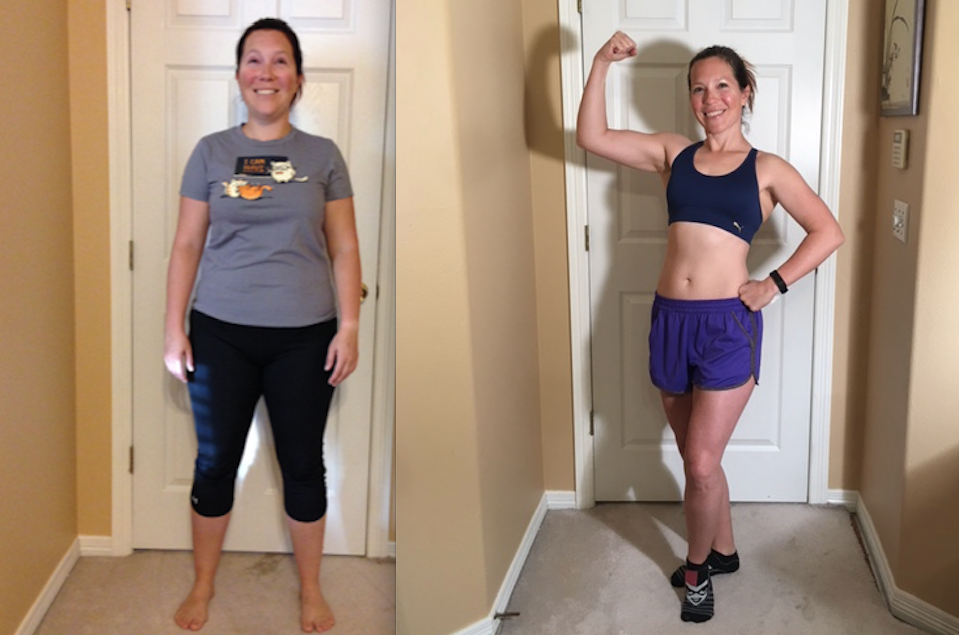
#4) Strength training makes running easier. Doing 1-2 sessions of strength training per week (on days you’re not running) will help you burn fat, build muscle, and stay injury-free.

Follow our Beginner Bodyweight Routine, no equipment required. We’ll have you training with your furniture instead:

Be careful here, but a table can be great to do inverted rows from.

If you sign-up for our free weekly newsletter, I’ll send you a PDF of the workout so you can track your progress.

#5) Don’t worry about your shoes when you start. Wear whatever shoes you have so that you can just get started building the habit immediately. If you START to love running, read our article on proper footwear and get yourself some better kicks.

Get comfy running a little before you invest in new shoes...because you might not actually like running.

The same is true for “running clothes.” Do not let this be a barrier to entry.

Start running first and make sure you like it before you go spending any hard-earned cash on stuff you’re not gonna use.

Oh, and as Coach Jim mentions in the video below, DON’T RUN IN BRAND NEW SHOES!

Trust us on this one.

#6) Sign up for your race as far in advance as possible. Use 20 seconds of courage if you need to, but commit to the race.

If you don’t sign up, you’re going to be much more likely to back out when life gets busy.

Go sign-up for a 5K right now! Don't be too busy like this cat.

But if you pay for it ahead of time, and get other people to run with you, you’re going to be using positive peer pressure to follow through on your commitments.

#7) Your race time doesn’t matter! Who cares if you’re the last person to finish? Like the Rock taught us, it doesn’t matter.

The Rock doesn't care what your 5K time is!

What’s important is that you finish something that you started. That’s a huge accomplishment in itself.

#8) Start a running club or join one at work – the more people you surround yourself with that are doing the things you want to do, the better. Hang out with runners that are faster than you.

You’re the average of the 5 people you associate most with, so you might as well start associating with faster, healthy runners.

#9) Don’t have an in-person running community? That’s cool! Join the Scouts Guild in the Nerd Fitness Rebellion.

It’s the section of our community that does running, biking, swimming, and other distance-based activities!

#10) Hire a coach. Outside of having a group of friends or co-workers keeping you accountable, a coach who routinely checks in with you and your progress can be a godsend. We’ve helped tons of people build the habit of running!


What Do I do After the Couch to 5k?

What do you do after running your 5K? You eat!!!

You made it through the training, and you ran/walked your first 5K! I’m so proud of you.

Gold star.

A+.

So after successfully completing your first 5K, you may be wondering what you should do next. To run again or not…

Many new runners absolutely love the atmosphere at a race; the number pick- up, pre-race motivational speech, cheering crowds, and crossing that finish line.

Oh, and the post-race beer and meal is the best food and drink you’ve ever tasted.

So after the excitement settles down, you need to ask what you want to do next.

Your three options:

  1. Run Faster: Sign up for another 5K, keep training, and try to beat your previous race time.
  2. Run longer: Maybe you want to run a longer race like a 5 miler, a 10k, or go slay a bigger dragon, like half-marathons or marathons.
  3. Pick a different activity: Going from Couch to 5K to Couch doesn’t help you at all. Temporary changes create temporary results.

Notice there wasn’t a 4th option, the option that usually everybody picks:

“Go back to sitting on the couch”

That’s Mistake #5: not having a plan to CONTINUE exercising after Couch to 5K!

As we say at Nerd Fitness: “Temporary changes create temporary results.”

So you have to do SOMETHING next, otherwise all that hard work and training will have been for naught! 

Want help figuring out exactly where you should go from here? I got you!

Pick the option below that best aligns with your goals and timeline:

#1) We have a bunch of NF Coaching clients that are training for 5Ks, 10Ks, half-marathons, and tough mudders. If you want step-by-step guidance on how to lose weight, eat better, and train for races, check out our killer 1-on-1 coaching program:


2) If you want a fun way to start running 5ks, check out NF Journey. Our fun habit-building app helps you exercise more frequently, eat healthier, and level up your life (literally).

Try your free trial right here:

3) Join the Rebellion! We need good people like you in our community, the Nerd Fitness Rebellion.

Sign up in the box below to enlist and get the Nerd Fitness Starter Kit, including the 15 fitness mistakes you don’t want to make and our guide to the most effective diet and why it works

4) Check out these other sweet running resources:

To recap our guide on the Couch the 5K plan, these are the 5 Mistakes to avoid:

  1. Running a 5K might be a good way to lose weight. It is entirely dependent on your nutrition. The same is true of literally ANY workout program. (Mistake #1: Not changing your nutrition)
  2. Couch to 5K may or may not be a great program for you. It depends on how much you enjoy running, and what you are hoping to get out of the program. (Mistake #2: not actually enjoying running)
  3. Make sure you are fit enough to endure the rigors of running! If you’re severely overweight, let’s get you in shape FIRST before we put stress on your knees and joints for thousands of running steps. (Mistake #3: Running before you’re ready)
  4. Make sure your running technique is solid. It’ll save you years of pain and injury. (Mistake #4: Running with improper form)
  5. Recruit a friend or find a way to stay accountable so you actually do the race!
  6. Who cares about your race time! Just completing the race should be your goal.
  7. Once you finish the race, decide if you want to keep running or if you are going to pick a different activity. (Mistake #5: Not having another goal after completing your 5K)

Okay, it’s your turn. I’d love to hear your experiences when it comes to training for a 5K, and if you enjoyed the process.

Have you DONE Couch to 5K? Did you stick with it?

What challenges did you run into along the way?

Share it in the comments below!

-Steve

PS: I’ll leave you with a final reminder of our 1-on-1 Coaching Program. If you’re blown away by the fact that you don’t have to run to get in shape, but don’t know where else to begin, we got you.

Nerd Fitness Coaching Banner

###

photo credit: mripp Fun run, 632imagine © 123RF.com,Four Bricks Tall Morning run with the Fitbit and Laughing Buddha, clement127 Halloween is coming!!, Flash, and Banquet, Andreas Just a Lego Minifig, Reiterlied Wandering in the North,

The post Should You Do Couch to 5K? Don’t Make These 5 Mistakes first appeared on Nerd Fitness.

from Nerd Fitness: Helping You Lose Weight, Get Stronger, Live Better. https://ift.tt/QPghzqS
via IFTTT

Categories
Uncategorized

#holistic #getfit #nutrition How Much Water Do I Really Need? (A Guide for Proper Hydration)

I probably wouldn't drink that.

So you want to know, “How much water should I drink a day?”

The short answer: drink enough to not be thirsty (maybe slightly more).

The long answer: read this guide for that!

Proper water consumption is a must for health and fitness, which is why we discuss it with every single member of our 1-on-1 Online Coaching Program. We even assign them fun missions to make sure they’re adequately hydrated.


Here’s what we’ll cover to answer the question, “How much water do you really need?”

Pour yourself a glass of water (duh), then let’s do this thing!

Should You Drink 8 Glasses of Water a Day? (The Controversy)

This is a really cool picture of a glass of water.

First and foremost, yes you need water.

Boom. Article done. I’m going on break.

I kid, I kid.

Water is good for you; a significant portion of your body is composed of water, and when you lose fluids through sweat, exertion, bodily functions, etc, consuming water can help you replenish fluids.

HOWEVER…

The whole “8 glasses of water a day” thing is not law. 

In fact, there’s no real proof of this being a proper amount at all.[1]

As we’ve told you before (the perfect workout, the perfect diet), we are all unique snowflakes, and we all require different amounts of water!  

Chef saying "Everybody's different, but that's okay."

Somebody that exercises with regularity and goes on a lot of long runs will require more water than somebody who exercises less regularly. 

There’s no exact amount of water that works for each person.

So where did this magical “8 glasses of water a day” number initially come from?  

Nobody really knows.  

A gif of Han Solo shrugging, because he doesn't know where that water advice came from either.

According to Snopes[2]:

Back in 1945 the Food and Nutrition Board of the National Research Council stated that adults should take in about 2.5 liters of water per day (which is roughly the equivalent of eight glasses of water), but it also noted most of that intake level was already satisfied through the consumption of food without the need for the additional drinking of water.

That’s right, you get a SIGNIFICANT amount of water from the food you are consuming. A huge percentage of our body is water, a huge percentage of the planet is water…why wouldn’t a huge percentage of our food be water too?

So, yes. Consuming water is important. 

But the 8 glasses a day case doesn’t hold water (ha!), as we get a significant portion of our daily H2O from the food we consume.  Things like fruits and vegetables (and even meat) are composed of a tremendous amount of water, all of which count towards our ‘hydration quotient’ for the day.

Do you know what else counts? 

EVERY OTHER BEVERAGE WE DRINK!

Things like tea, coffee, dreaded sugary beverages, milk, and juices, and even alcoholic beverages. [3] 

How Much Water a Day Do You Really Need? (Follow Your Thirst)

Very cute.

So you now know you don’t need to always drink 8 glasses of water.

It could be less and it could be more. 

So how much exactly do you need?

Honestly? Drink when you are thirsty. 

That’s it. I’m going on vacation!

Kidding again. 

Seriously though, your thirst is a pretty damn good indicator of when you should consume more water. Do you think dogs and cats and elephants worry about hydration levels?  

Nope – they simply consume water when their body tells them that they are thirsty.

A cute elephant drinking from a hose.

Adorbs. 

As nerds, we tend to overthink, overanalyze, and drive ourselves crazy with too much info.

Now, if you happen to be one of those people that needs MORE advice than that, check your urine color.

Weird, I know.

This chart provides a great test for the proper shade of urine: 

This chart of urine color can help you decide if you should drink more water or not.
Things to consider:

  • You want to aim (not literally) for the first three categories from the top, or “lemonade” color.  
  • If your pee is starting to resemble Lemon Lime Gatorade (4th category down), you’re dehydrated. From here, the darker and browner the color, the more dehydrated you are. 
  • If your pee comes out a different color altogether, I would probably seek medical attention immediately. You’re welcome 🙂

What if your pee doesn’t have ANY color to it? You might actually be “overhydrated,” which we talk about in this section.

So what are the telltale signs that something is wrong, that you are dehydrated?

A scene from the Three Amigos, where they clearly need more water.

According to the National Institute of Health,[4] your primary signs of dehydration are:

  • A feeling of thirst (duh)
  • Dry or sticky mouth
  • Low or no urine output; urine looks dark yellow
  • Sunken eyes
  • Lethargy

If you are feeling one or some of these symptoms, you may be dehydrated. We want to take this seriously, because SEVERE dehydration can be terrible for your health, even resulting in a coma.

Not good. So drink water whenever you get thirsty.

A scene from the Three Amigos, when someone finally drinks water.

There’s a myth running around that says “if you are feeling thirsty, it’s too late and you’re already dehydrated.”

This is also not true.[5] If you are feeling the signs of dehydration, consuming some water can get you right back on track.

If you are regularly dehydrated, let’s discuss a quick hack to make sure you’re consistently hydrated.

How to Drink More Water

The above video comes from our Daily Win series as part of Nerd Fitness Prime. 

The series is based on quick actions you can take (5 minutes or less) to help you build healthy habits.

In this video, Coach Lauren walks you through a quick hack if you find yourself constantly dehydrated during the day: drink a glass of water first thing in the morning!

That way you can start off properly hydrated before the chaos of the day takes over:

A gif of a pirate saying he's too busy to drink water.

It can also help you wake up to seize the day!

Here are some more tips for drinking plenty of water:

  • Fill up a water bottle before bed, leave it in plain sight, and drink it first thing in the morning.
  • If you don’t like the taste of water, you can try adding some cucumber slices and mint leaves to your overnight bottle. Your morning water will soak up the flavor!
  • If cucumbers or mint ain’t your thing, you could also try some frozen berries or some cut-up lemon.

We’ve heard from many of our coaching clients that water first thing in the AM helps them feel more energized throughout their day.

Next, I want to address a question we get quite often from our readers. 

Can You Lose Fat by Drinking Lots of Water? (Weight Loss and Water Intake)

A Stormtrooper in water, which is way too much water for him to drink.

It’s common advice to drink lots of water for weight loss. 

Is it legit? 

Is there any evidence that drinking plenty of water can help one lose weight?

Eh, there’s a little!

One study conducted had two groups go on the same diet, the only difference being one group had 500 ml of water (about 17 ounces) 30 minutes before breakfast, lunch, and dinner.

The result?[6]

  • The Water Group: lost about 4.4% body fat
  •  The Non-Mandated Water Group: lost about 1.1% body fat

This isn’t a TREMENDOUS difference, but it is interesting!

Batman is curious on how carbs and fat factor into weight loss.

What might be going on? 

Here are two reasons why drinking plenty of water might help with weight loss:

  1. You’re full. Drinking water takes up room in your stomach. There is less room now for food, but also other water like drinks (which may have sugar and hidden calories in it, like fruit juice). 
  2. Water consumption may slightly raise your metabolism. I’m not talking a crazy impact here, but one study found your BMR (Basal Metabolic Rate or how many calories you burn at rest) is raised by 24% for 60 minutes after drinking 500 ml (17 oz).[7]

Let’s provide some context here. 

As we address in our guide “Why Can’t I Lose Weight?”, our bodies obey the Laws of Conservation of Energy and Thermodynamics: 

To lose weight, we need to burn more calories than we consume regularly. 

The two factors above might lower your “calories in” and raise your “calories out” respectively (a concept we discuss in our Guide to The CICO Diet). This may help someone get in shape. 

However, I wouldn’t bet the farm (note to self: buy a farm) on solely drinking water for weight loss. When we highlighted the study above on water consumption and weight loss, it’s important to remember that the two groups were both on a calorically restricted diet. It’s not like strategically drinking water alone made people lose weight. 

If you are on a weight loss journey, and wondering what might help, I have two resources for you to check out:

  1. How to Lose Weight Without Dieting (The 5 Rules of Weight Loss): you’ve probably been on a diet before. You might even be on a diet right now. We discuss why they generally don’t work (temporary changes create temporary results) and provide a less conventional but more permanent solution (tiny changes for the win).
  2. Our 1-on-1 Online Coaching Program: many of our clients spent years yo-yoing their weight, going from one diet to another. It’s only when working with one of our coaches that they were able to achieve sustainable weight loss. 


Wayne is stoked that he made his small change for weight loss.

I now hear you saying: 

“Okay Steve, I got it. I don’t want to be dehydrated, and drinking water before meals may make me feel full. Why don’t I just start pounding water all day long?”

Great question, my dear friend.   

Can I Be Overhydrated? (Too Much of a Good Thing)

This picture shows a waterfall, which would be too much water to drink.

While being properly hydrated is good, it doesn’t mean chugging a gallon of water during your gym session is a good idea either. 

If not, then why is this so common to see?

From Outdoors[8]:

A single individual working for the U.S. military decided that water was a tactical weapon. 

That if the military could be encouraged to drink more during maneuvers, they’d have less heatstroke and less illness and they’d be more productive and could be better soldiers. It was purely his idea. It had no scientific basis at all. 

Two years later he published a paper supposedly saying that if the US soldiers drank 1.9 liters per hour [64 ounces] when they were exercising in the heat they would perform much better. There was utterly no concrete evidence that that was true. 

The problem was, his advice was embraced by the U.S. Military. They changed their drinking guidelines to say that you should now drink 1.9 liters per hour. The same people who drew up those guidelines were then invited by the American College of Sports Medicine to get involved with drawing up guidelines for runners.

In 1996, that culminated with the new American guidelines,[9] which said that you must drink as much as tolerable during exercise, up to 40 ounces per hour. 

That became the mantra—that you had to drink before you became thirsty, and as much as possible during exercise. It was after that the problems of hyponatremia really become problematic around the world.

Combine this with the sports beverage industry (which I’ll skewer in a minute) and the bottled water industry (one of the best scams going, which I’ll get to as well), and you have a marketing engine that won’t slow down:

“Drink before you’re thirsty or it’s too late.”  

“Running a marathon?  It’s better to over hydrate then not drink enough!” 

“Better safe than sorry!”

Actually, you CAN overhydrate, and it can be dangerous – it’s called hyponatremia, it’s an electrolyte imbalance from too much water consumed, and it’s bad news bears.[10]

Want to know the people who suffer from hyponatremia the most?

Marathon and ultra-runners.

Batman has to fun whether he likes to or not...part of fighting crime means running 5Ks (ish).

Dr. Timothy Noakes, the author of Waterlogged, explains that the overconsumption of water can lead to our body developing a severe imbalance of sodium in our system, which can lead to a litany of side effects, even death.[11]

What Noaks discovered people who have dealt with cases of exercise-induced hyponatremia:

“What I’ve found is that all of these people were probably drinking 1.2 liters per hour [40 ounces]. They continue to drink like that for four or five hours. Now, normally, if you’re drinking at that rate, you simply pass it out as urine. 

A person who is overdrinking will start passing urine so frequently that they’ll realize, this is stupid. I’m going to stop drinking.

But what happens in hyponatremia is that, for some reason, the brain interprets that the person is dehydrated and secretes the antidiuretic hormone. As a consequence, that prevents all urine production. 

Although they are sweating, they may be sweating at a rate of 20 ounces per hour, but they are drinking at a rate of 40 ounces per hour. Every hour they are accumulating 20 ounces. You can do that for a couple of hours, but once you’ve accumulated about 60 to 80 ounces of water in your body, all of your tissues become bloated, and the organ that becomes most affected is the brain.

The brain swells, and because it is in a rigid skull, it cannot swell very much. The more it swells, the more pressure, and that eventually squeezes the arteries supplying blood to the brain. Ultimately, there is less oxygen getting to the brain, and certain parts become damaged.“

Not good. 

One 2002 study found that 13% of Boston Marathon runners experienced hyponatremia. While many experience hyponatremia without being in immediate danger, it certainly isn’t healthy.[12]

So, how do you combat this? 

Drink when you are thirsty!  

A gif of a cat drinking water

LISTEN TO YOUR BODY!

Time to answer your next question: “If drinking too much water causes an issue with sodium imbalances, what about sports drinks? They have electrolytes and sodium in them!”

Allow me!

Are Sports Drinks More Hydrating Than Water? (Water, Sugar, Salt, and You)

A picture of Gatorade, which is more or less just sugar water.

Michael Jordan is famously seen drinking Gatorade during his flu game in 96, which tells us that without Gatorade he wouldn’t have been able to play:

Little do they tell you that Michael also had another secret weapon at his disposal that helped him play up to snuff in that game: apple sauce!

So why is that famous commercial all about Gatorade and not about apple sauce? 

One word, and it rhymes with “honey.”

It's a shame even scientific studies can be bought.

There’s wayyyy more money in the sports beverage industry, and they can sell on the term “replenish electrolytes” which is actually way simpler to do than they make it out to be.

We’re promised that without the careful combination of electrolytes and ingredients in Gatorade, we’re going to get dehydrated when exercising and suffer.

Here’s what happens: When you sweat, you lose fluids and electrolytes, especially sodium and chloride (which is why your sweat tastes salty…stop tasting your sweat). Now, when you’re lacking fluids and electrolytes, your muscles and performance can suffer.

So that’s where Gatorade ALLEGEDLY will solve all of your problems.

Here’s the truth: unless you are exercising for hours and hours and hours, your electrolyte imbalance will not cause a drop in performance. If you are exercising for an hour or less, some sips of water to quench your thirst is more than enough. 

If you ARE exercising for hours upon hours, then additional electrolyte products may help.

In these instances, Gatorade could help potentially, but there’s nothing in Gatorade that’s magic. It’s sugar, water, sodium, potassium, and then some artificial and natural flavoring to make it taste and look the way it does.

Want the benefits of Gatorade while on your marathon run without having to buy Gatorade? Make your own!

As Al Kavado talks about here, try mixing water, honey, salt, and/or lemon juice. Try different combos (mixing in some OJ or using coconut water!)

And just like that, you have your sodium, some sugars, and rehydration. No fancy marketing required.

THE WORST THING YOU CAN DO?  

Do some boring cardio for 20 minutes (which burns a minimal number of calories), and then chug a 32 oz Gatorade (200 calories and 50+ grams of sugar!) and think you’re better off. 

Negatory!

Water works just fine for 98% of the activities you will ever do.

Does Coffee Dehydrate You? (Caffeine as a Diuretic)

This pictured cup of coffee will indeed hydrate you, because it has so much water.

Time to put the myth-busting cap back on: You’ve probably been told that drinking caffeinated beverages will dehydrate you.

That by consuming caffeinated beverages, you’re actually expelling more water than you are consuming.

This is another one of those bits of conventional wisdom that gets blown out of proportion.

Yes, caffeine is a mild diuretic. However, our bodies are pretty darn smart, and because all drinks are composed almost entirely of water, it more than makes up for the effects.

As pointed out here in this study:[13]

Ingestion of caffeine in large doses (at least 250-300 mg, equivalent to the amount found in 2-3 cups of coffee or 5-8 cups of tea) results in a short-term stimulation of urine output in individuals who have been deprived of caffeine for a period of days or weeks. 

A profound tolerance to the diuretic and other effects of caffeine develops, however, and the actions are much diminished in individuals who regularly consume tea or coffee. 

Doses of caffeine equivalent to the amount normally found in standard servings of tea, coffee and carbonated soft drinks appear to have no diuretic action.

So coffee can actually help you stay hydrated.

A gif of Bill Murray drinking coffee, but ah, maybe use a cup though.

What about alcohol? 

Same thing.

Alcohol has diuretic properties, but only causes dehydration when consumed at beyond normal levels. (Here’s our Guide to Drinking, which covers our thoughts on being a fit nerd that can still enjoy an occasional cocktail.)

What ALLLLL OF THIS MEANS: 

  • Drink when you are thirsty. 
  • All liquids you consume count towards hydration, and only in cases of overconsumption can they negatively affect your hydration.

A Note on Bottled Water (Invest in a Water Filter)

A picture of a bottle of water, which you should only buy if you have to.

In 2019, total U.S. bottled water consumption increased to 14.4 billion gallons, up from 9.1 billion gallons in 2011.[14]

  • Every person in America drank an average of 43.7 gallons of bottled water last year.  
  • Bottled water sales increased by 3.6 percent in 2019, and now total $34.6 billion.

Yikes,

It is very likely that your local tap water is fine!

Check your local government for more information, but if you live in the United States, chances are your tap water is equal or better to the bottled stuff! Heck Coca-Cola knows this, as their Dasani Brand is ultimately filtered tap water.[15]

Want that bottle of Fiji water because it’s clean and pure and provides you with magical abilities like a waterbender?

Drinking Fiji water probably isn't going to turn you into this waterbender from Avatar.

There is less arsenic in Cleveland Tap water than Fiji water![16] Much less expensive too 🙂

If you don’t like the taste of, or are concerned about your local tap water, try a Brita filter or something equivalent. Stop going through hundreds of plastic bottles of water every year, and drink the water you already have available to you.

Yes, if the choice is between no beverage, a Coke, or a bottle of water, go with the bottled water!

Just don’t go out of your way to buy water from the polar ice caps, Hoth glaciers, or the Swiss Alps because you think it’s going to be healthier for you, provide you with more of a benefit than regular water.  

That’s all hype, sucka!

So go invest in a nice refillable water bottle. You can even snag a Nerd Fitness one if you want!

Picture of a Nerd Fitness water bottle

Staying Properly Hydrated (Next Steps)

A picture of a glass of water, which you should drink when thirsty.

There you have it, the long answer on how much water you should drink. 

Water keeps your body functioning properly. Consume it when you feel the need and your thirst will be quenched, your body will stay regulated, and you will live to see tomorrow.

On top of that, consuming water before a meal can help you feel fuller and thus prevent you from overeating. 

If this works for you, keep doing what you’re doing!

Water should definitely be consumed when you are thirsty!  

Pikachu drinking water, but maybe you shouldn't drink out of a stream though.

But the importance of water has been overblown, and you don’t need to spend hundreds of dollars each year on fancy bottled water from glaciers.

Here’s how often you should drink H2O::

  • Chill out about water, don’t overthink it.
  • Drink when you feel thirsty.
  • If your pee is a darker color than normal, drink more water.
  • Don’t stress about drinking water neurotically throughout the day.
  • Don’t bother with sports drinks unless your exercise is intense, over several hours, or in very hot conditions.
I think that about does it for today’s guide.

If you’d like to join our community, I have three ways for you to continue your journey with Nerd Fitness:

#1) Our 1-on-1 Online Coaching Program: a coaching program for busy people to help them make better food choices, stay accountable, and get healthier, permanently.

You can schedule a free call with our team so we can get to know you and see if our coaching program is right for you. Just click on the image below for more details:

Your NF Coach can help you lose weight and get healthy!

#2) If you want an exact blueprint leveling up your nutrition, check out Nerd Fitness Journey! Our fun habit-building app helps you exercise more frequently, eat healthier, and level up your life (literally).

If you follow our Nutrition missions, you’ll learn to drink more water while earning XP! Sah-weeeet.

Try your free trial right here:

#3) Join The Rebellion! We have a free email newsletter that we send out twice per week, full of tips and tricks to help you get healthy, get strong, and have fun doing so. 

I’ll also send you tons of free guides that you can use to start leveling up your life too:

Have any more questions for me?  What else do you need to know about water?

Let’s hear it.

-Steve

PS: We walk about how water fits into a proper diet in our Guide to Healthy Eating. Check it out if you’re just embarking on leveling up your nutrition game.

###

photo source: Han Shot First: Aquaman, jDevaun: Gatorade, RLhyde: Glass,, philografy: bottled water, 27147: coffee cup,, Adventures With My Dogs: Waterfall, Urine Color, 1upLego: Lego Dawn of Justice Aquaman, Kristina Alexanderson: Maybe the droids we’re looking for are at the bottom of the pool, Jeanne Menjoulet: building in a glass of water, Lisa Zins: The Facuet, az: d-136 I’m not just going too far, I’ve arrived, 


The post How Much Water Do I Really Need? (A Guide for Proper Hydration) first appeared on Nerd Fitness.

from Nerd Fitness: Helping You Lose Weight, Get Stronger, Live Better. https://ift.tt/WMhQLAb
via IFTTT

Categories
Uncategorized

#holistic #getfit #nutrition Warm Up Properly: The 15 Best Dynamic Warm Up Exercises & Routines To Prevent Injury

Today, you’re gonna learn the importance of warming up, and how to warm up with specific video routines…because I’m a nice person.

This is so critical for training safely that whenever we design a workout for our coaching clients, it always starts with a proper warm-up. So I’m excited to share these warm-up tips and tricks with you too.


In this guide we’ll cover the following (click to go to that section):

This stuff is so important because getting injured sucks.

And every single day I watch people wander into the gym, immediately lie down on a bench, and start cranking out their workout with a heavy weight within seconds.

This makes me weep for humanity.

These people are just WAITING to get injured. They’re essentially playing with dynamite (also not recommended).

Playing with dynamite is not recommended

So you’re reading the right article.

Also, if you’re interested in a program that tells you exactly how to warm up and work out, you may like our new app!

Nerd Fitness Journey will set you on an adventure that will tell you exactly when to workout, when to warm up, and when you should rest. No guesswork needed. 

You can sign-up for a free trial right here:

Should I Stretch Before A Workout? No. Warm Up Instead

Above all else, the most important thing you can do when working out is to warm up properly.

Now, you might be saying to yourself, “Come on. Surely it’s not the MOST important thing…”

To which I’d reply: “First, don’t call me Shirley. Secondly, if you don’t have enough time to warm up, then you don’t have enough time to work out.”

Boom!

So WHY is it so important? 

Think of your muscles like rubber bands.

Your muscles are kind of like this.

If you spend all day sitting at a desk, hunched over a keyboard, those rubber bands have gone almost completely unused.

Then, if you go to a gym and immediately start lifting heavy weights or sprinting really fast, those cold, unstretched rubber bands get pulled apart very quickly and can get snapped or pulled out of shape.

#Fail.

So, what about just regular, static stretching before working out? 

Nope.

As we point out in “Should you stretch before or after your workout?“:

“A consolidation of studies showed there aren’t many benefits to static stretching before workouts. 

For starters, static stretching will not result in the reduction of the chance of injury.

Also, static stretching can actually decrease your potential for strength gains and performance.”

However, dynamic warm-ups – what you’ll learn in this article and what we focus on with our 1-on-1 coaching clients – are AWESOME for prepping you to get ready to strength train:

Think of it like a pregaming for your muscles – except replace “alcohol” with “awesome.” By jumping around and getting your muscles loose, active, warm, and ready for action, you are putting your muscles through their full range of motion and getting them ready to start handling heavier loads (strength training).

As pointed out in this study, “warming up” can also help reduce soreness after a workout.

On top of that, doing a dynamic warm-up can help activate your central nervous system, priming your muscles for a great workout that produces your best effort.

Add “improved blood circulation” to the list of benefits of warming up, which will help you perform well in each exercise.

Need another reason? When your body is properly warmed up, your muscles and joints are ready for maximum flexibility, which means you can perform each exercise with PROPER form (like deep barbell squats, for example) that maximize results and minimize the risk of injury.

So, whether you are running or strength training…a proper warm-up is probably the most important 5-10 minutes of your day. 

Still with me? 

Great. If you have been injured in the past, and you’re learning to warm up so you can stop stalling out on your progress, let us help!

We create custom workout solutions with nutritional guidance for busy people like you.

In other words, we help you get strong and eat better, every step of the way. 


Beginner Dynamic Warm-Up Video And Exercises

The above video comes from Senior Coach Staci Ardison, whose success story is here (and she’s now a lead trainer in our NF Coaching Program)

Don’t overthink this: Your goal is to elevate your heart rate, put your muscles and joints through their range of motion to warm them up and make sure everything is functioning properly, and preparing your body to strength train!

This will get you prepped for a day of getting stronger.

If you read the above paragraph and thought: “Yes I am doing strength training, please tell me more Steve! More!”

Firstly, thanks for saying please – your mom taught you well.

Next: let us help get you strong, safely! We help busy people go from strength-training-newbie to strength training badasses.

Whether you’re doing bodyweight or new to weight training, we create a workout program and provide food guidance that’s specific to YOUR life.


3 Advanced Dynamic Warm-Ups And Videos

#1) Here is an Advanced Warm-up Circuit you can do anywhere:

  • Jump rope: 2-3 minutes (optional)
  • Jumping jacks: 50 reps(pull your shoulder blades back, extend arms and really focus on the movement)
  • Bodyweight Squats: 20 reps
  • Lunges: 5 reps each leg
  • Hip extensions: 10 reps
  • Hip rotations: 10 reps each leg (like you’re stepping over a fence)
  • Forward leg swings: 10 reps each leg.
  • Side leg swings: 10 reps each leg
  • Push-ups: 10-20 reps
  • Spider-man steps: 5 each leg

This particular warm-up might be more difficult than your actual workout, especially if you’re following something like The Beginner Bodyweight Workout.

Yes, there is a lot of work put on your hips, butt, legs, and core. As nerds/desk jockeys, these tend to be the muscles that are the tighest and least active, and thus most susceptible to an injury.

If your arms and chest are particularly tight or sore, you can throw two more movements as well: 

  • Arm swings (holding your arms straight out to the side, and then swing them and cross them in front of your chest)
  • Shoulder rotations (holding your arms straight out to the side, and move your arms in a circular motion, making bigger circles each time)

Are you a runner? 

#2) Check out our warm-up routine specifically designed for runners:

You can also check out our Beginner’s Guide to Running for more tips on how to run safely.

#3) Here’s another advanced dynamic warm-up video from my coach, Anthony, which also covers a lot of Mobility:

When it comes time for your workout, if you are doing heavy strength training (with barbells or dumbbells), make sure you do some warm-up sets before jumping into the weight you’ll be training with for EACH EXERCISE.

Always start with a set using just the bar to work on your form and get your body used to the movement.

Then, do a few sets of just a few reps with increasing weight (but won’t tire you out) and THEN start your workout.

It’s something we bring up before every workout in Nerd Fitness Journey, our new habit-building app! If you want, you can test drive it right now for free!

15 Best Dynamic Warm-Up Exercises To Prevent Injury

This LEGO man warms up so he doesn't get injured during exercise

These are our favorite quick warm-up exercises that can help you prevent an injury during your workout! 

  1. Marching in place while swinging your arms.
  2. Jumping jacks
  3. Walking jacks
  4. Arm circles and shoulder shrugs.
  5. Mountain Climbers
  6. Swinging toe touches.
  7. Leg swings (forward)
  8. Leg swings (side to side).
  9. Hip rotations (like stepping over a fence)
  10. Hip circles (like you’re hula hooping)
  11. Bodyweight squats.
  12. Push-ups.
  13. Lunges.
  14. Hip extensions.

Get into the habit of doing these exercises before doing any workout. They’ll help keep you mobile and limber and injury free. If you’re not sure how to do any of these movements, watch the videos for them below.

1. MARCHING IN PLACE WHILE SWINGING ARMS

Marching in place swinging arms

2. WALKING JACKS (If You Can’t Do Jumping Jacks)

Do walking jacks if you can't do jumping jacks!

3. JUMPING JACKS

Jumping Jacks are a great cardiovascular bodyweight exercise

4. ARM CIRCLES AND SHOULDER SHRUGS

Arm circles like so are a great way to get your heart rate up before doing HIIT.

5. MOUNTAIN CLIMBERS

Staci doing a mountain climber

6. SWINGING TOE TOUCHES

Coach Staci doing a toe touch warm up , by lifting leg and touching toes with opposite arm.

7. LEG SWINGS (FORWARD)

Steve doing forward leg swings for a warm up

7. LEG SWINGS (SIDE)

Steve doing a warm up by swinging a leg side to side

8. HIP ROTATIONS

Steve doing hip rotations warm ups

9. HIP CIRCLES

Someone rotating their hips like a hula hoop for a warm up

10. BODYWEIGHT SQUATS

Do a proper bodyweight squat to work out your legs

11: KNEE PUSH-UPS

Knee push-ups like this are a great way to progress to a regular push-up!

12: REGULAR PUSH-UPS

This gif shows Staci doing a push-up in perfect form.

13. SUPPORTED LUNGES

Do the assisted lunge until you can do regular lunges

14. REGULAR LUNGES

Do Lunges to strengthen your legs for the beginner bodyweight exercises!

15. HIP RAISES

Raising your hips of the floor, like so, is how you do the bridge bodyweight exercise.
These exercises are the PERFECT movements you should be doing before any strength training program.

Oh, what’s that? You’re new to strength training and not sure what you’re doing? No problem!

We help people exactly like you.

Well, not exactly. You’re a unique snowflake, your mom loves you, etc.

What I mean is we help people like you to start strength training.

We do form checks, create custom workouts based on your equipment and time commitment, and more.


To Answer Your First Few Questions…

“Steve, I can’t do jumping jacks/I live on the second floor.” 

That’s okay – the reason I love jumping jacks is that they work out all four of your limbs at once and get you bouncing around.

Instead, channel your inner Chuck Norris and do punches and kicks with each leg. I don’t care if you can’t kick higher than your shins and your punch wouldn’t kill a fly…just get those limbs flailing and warmed up!

You could also just do “Walking Jacks.”

Do walking jacks if you can't do jumping jacks!

“Um, your warm-up is tougher than my actual workout!” 

The dynamic warm-up above is designed for people who are doing serious training.

If you are doing heavy deadlifts and squats and overhead presses, a proper warm-up could keep you out of a career-ending injury.

However, if you are just getting started with exercise and you’re only doing bodyweight exercises, obviously 20 real push-ups during your workout isn’t possible…

THAT’S OKAY. Think of the above as the warm-up you aspire to complete. In the meantime, do the best you can. Let’s say:

Follow the rest of the routine as planned if possible.

In this routine, your warm-up will act as part of your workout, as you’ll be doing the same functional movements.

Do the BEST you can, keep track of your results for your warm-up too, and improve with each workout.

With enough consistency and persistency (not a word, but rhymed better and sounded way better than persistence), you’ll be busting out the full warm-up routine before kicking ass at your actual workout!

Don’t have a program to follow? Or tired of following a random plan online that’s not getting you results?

Check out our Online Coaching Program – we’ll take care of all the heavy lifting (except the actual “heavy lifting,” that’s your job).


Warm-Up Properly and Avoid Injury!

Hopefully, this is a post you bookmark, as it’s probably one of the more important ones I’ve ever written.

If you want to stay injury-free, put your body through a dynamic warm-up before you start your exercise.

If you are somebody that wants to follow a program that is tailor-made for their life and situation and goals, check out our popular 1-on-1 Coaching program.

You’ll work with our certified NF instructors who will get to know you better than you know yourself, answer any and all fitness questions you have, and program your workouts and nutrition for you.


What other questions can I answer for you about warming up properly?

I’m here to help!

-Steve

PS: Still here, but not sure what to do after your warm-up? Why not let our app tell you exactly what to do!

PPS: The companion post to this guide is “How to Stretch After a Workout.” Give it a read if you’re wondering about what post-workout routines you should try.

###

All photo sources can be found right here.[1]

The post Warm Up Properly: The 15 Best Dynamic Warm Up Exercises & Routines To Prevent Injury first appeared on Nerd Fitness.

from Nerd Fitness: Helping You Lose Weight, Get Stronger, Live Better. https://ift.tt/a5E0vom
via IFTTT