Categories
Uncategorized

#holistic #getfit #nutrition How Much Water Do I Really Need? (A Guide for Proper Hydration)

I probably wouldn't drink that.

So you want to know, “How much water should I drink a day?”

The short answer: drink enough to not be thirsty (maybe slightly more).

The long answer: read this guide for that!

Proper water consumption is a must for health and fitness, which is why we discuss it with every single member of our 1-on-1 Online Coaching Program. We even assign them fun missions to make sure they’re adequately hydrated.


Here’s what we’ll cover to answer the question, “How much water do you really need?

Pour yourself a glass of water (duh), then let’s do this thing!

Should You Drink 8 Glasses of Water a Day? (The Controversy)

This is a really cool picture of a glass of water.

First and foremost, yes you need water.

Boom. Article done. I’m going on break.

I kid, I kid.

Water is good for you; a significant portion of your body is composed of water, and when you lose fluids through sweat, exertion, bodily functions, etc, consuming water can help you replenish fluids.

HOWEVER…

The whole “8 glasses of water a day” thing is not law. 

In fact, there’s no real proof of this being a proper amount at all.[1]

As we’ve told you before (the perfect workout, the perfect diet), we are all unique snowflakes, and we all require different amounts of water!  

Chef saying "Everybody's different, but that's okay."

Somebody that exercises with regularity and goes on a lot of long runs will require more water than somebody who exercises less regularly. 

There’s no exact amount of water that works for each person.

So where did this magical “8 glasses of water a day” number initially come from?  

Nobody really knows.  

A gif of Han Solo shrugging, because he doesn't know where that water advice came from either.

According to Snopes[2]:

Back in 1945 the Food and Nutrition Board of the National Research Council stated that adults should take in about 2.5 liters of water per day (which is roughly the equivalent of eight glasses of water), but it also noted most of that intake level was already satisfied through the consumption of food without the need for the additional drinking of water.

That’s right, you get a SIGNIFICANT amount of water from the food you are consuming. A huge percentage of our body is water, a huge percentage of the planet is water…why wouldn’t a huge percentage of our food be water too?

So, yes. Consuming water is important. 

But the 8 glasses a day case doesn’t hold water (ha!), as we get a significant portion of our daily H2O from the food we consume.  Things like fruits and vegetables (and even meat) are composed of a tremendous amount of water, all of which count towards our ‘hydration quotient’ for the day.

Do you know what else counts? 

EVERY OTHER BEVERAGE WE DRINK!

Things like tea, coffee, dreaded sugary beverages, milk, and juices, and even alcoholic beverages. [3] 

How Much Water a Day Do You Really Need? (Follow Your Thirst)

Very cute.

So you now know you don’t need to always drink 8 glasses of water.

It could be less and it could be more. 

So how much exactly do you need?

Honestly? Drink when you are thirsty. 

That’s it. I’m going on vacation!

Kidding again. 

Seriously though, your thirst is a pretty damn good indicator of when you should consume more water. Do you think dogs and cats and elephants worry about hydration levels?  

Nope – they simply consume water when their body tells them that they are thirsty.

A cute elephant drinking from a hose.

Adorbs. 

As nerds, we tend to overthink, overanalyze, and drive ourselves crazy with too much info.

Now, if you happen to be one of those people that needs MORE advice than that, check your urine color.

Weird, I know.

This chart provides a great test for the proper shade of urine: 
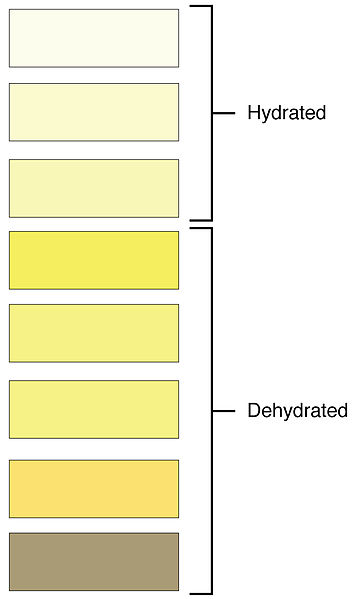
This chart of urine color can help you decide if you should drink more water or not.
Things to consider:

  • You want to aim (not literally) for the first three categories from the top, or “lemonade” color.  
  • If your pee is starting to resemble Lemon Lime Gatorade (4th category down), you’re dehydrated. From here, the darker and browner the color, the more dehydrated you are. 
  • If your pee comes out a different color altogether, I would probably seek medical attention immediately. You’re welcome 🙂

What if your pee doesn’t have ANY color to it? You might actually be “overhydrated,” which we talk about in this section.

So what are the telltale signs that something is wrong, that you are dehydrated?

A scene from the Three Amigos, where they clearly need more water.

According to the National Institute of Health,[4] your primary signs of dehydration are:

  • A feeling of thirst (duh)
  • Dry or sticky mouth
  • Low or no urine output; urine looks dark yellow
  • Sunken eyes
  • Lethargy

If you are feeling one or some of these symptoms, you may be dehydrated. We want to take this seriously, because SEVERE dehydration can be terrible for your health, even resulting in a coma.

Not good. So drink water whenever you get thirsty.

A scene from the Three Amigos, when someone finally drinks water.

There’s a myth running around that says “if you are feeling thirsty, it’s too late and you’re already dehydrated.”

This is also not true.[5] If you are feeling the signs of dehydration, consuming some water can get you right back on track.

If you are regularly dehydrated, let’s discuss a quick hack to make sure you’re consistently hydrated.

How to Drink More Water

The above video comes from our Daily Win series as part of Nerd Fitness Prime

The series is based on quick actions you can take (5 minutes or less) to help you build healthy habits.

In this video, Coach Lauren walks you through a quick hack if you find yourself constantly dehydrated during the day: drink a glass of water first thing in the morning!

That way you can start off properly hydrated before the chaos of the day takes over:

A gif of a pirate saying he's too busy to drink water.

It can also help you wake up to seize the day!

Here are some more tips for drinking plenty of water:

  • Fill up a water bottle before bed, leave it in plain sight, and drink it first thing in the morning.
  • If you don’t like the taste of water, you can try adding some cucumber slices and mint leaves to your overnight bottle. Your morning water will soak up the flavor!
  • If cucumbers or mint ain’t your thing, you could also try some frozen berries or some cut-up lemon.

We’ve heard from many of our coaching clients that water first thing in the AM helps them feel more energized throughout their day.

Next, I want to address a question we get quite often from our readers. 

Can You Lose Fat by Drinking Lots of Water? (Weight Loss and Water Intake)

A Stormtrooper in water, which is way too much water for him to drink.

It’s common advice to drink lots of water for weight loss. 

Is it legit? 

Is there any evidence that drinking plenty of water can help one lose weight?

Eh, there’s a little!

One study conducted had two groups go on the same diet, the only difference being one group had 500 ml of water (about 17 ounces) 30 minutes before breakfast, lunch, and dinner.

The result?[6]

  • The Water Group: lost about 4.4% body fat
  •  The Non-Mandated Water Group: lost about 1.1% body fat

This isn’t a TREMENDOUS difference, but it is interesting!

Batman is curious on how carbs and fat factor into weight loss.

What might be going on? 

Here are two reasons why drinking plenty of water might help with weight loss:

  1. You’re full. Drinking water takes up room in your stomach. There is less room now for food, but also other water like drinks (which may have sugar and hidden calories in it, like fruit juice). 
  2. Water consumption may slightly raise your metabolism. I’m not talking a crazy impact here, but one study found your BMR (Basal Metabolic Rate or how many calories you burn at rest) is raised by 24% for 60 minutes after drinking 500 ml (17 oz).[7]

Let’s provide some context here. 

As we address in our guide “Why Can’t I Lose Weight?, our bodies obey the Laws of Conservation of Energy and Thermodynamics: 

To lose weight, we need to burn more calories than we consume regularly. 

The two factors above might lower your “calories in” and raise your “calories out” respectively (a concept we discuss in our Guide to The CICO Diet). This may help someone get in shape

However, I wouldn’t bet the farm (note to self: buy a farm) on solely drinking water for weight loss. When we highlighted the study above on water consumption and weight loss, it’s important to remember that the two groups were both on a calorically restricted diet. It’s not like strategically drinking water alone made people lose weight. 

If you are on a weight loss journey, and wondering what might help, I have two resources for you to check out:

  1. How to Lose Weight Without Dieting (The 5 Rules of Weight Loss): you’ve probably been on a diet before. You might even be on a diet right now. We discuss why they generally don’t work (temporary changes create temporary results) and provide a less conventional but more permanent solution (tiny changes for the win).
  2. Our 1-on-1 Online Coaching Program: many of our clients spent years yo-yoing their weight, going from one diet to another. It’s only when working with one of our coaches that they were able to achieve sustainable weight loss. 



Wayne is stoked that he made his small change for weight loss.

I now hear you saying: 

“Okay Steve, I got it. I don’t want to be dehydrated, and drinking water before meals may make me feel full. Why don’t I just start pounding water all day long?”

Great question, my dear friend.   

Can I Be Overhydrated? (Too Much of a Good Thing)

This picture shows a waterfall, which would be too much water to drink.

While being properly hydrated is good, it doesn’t mean chugging a gallon of water during your gym session is a good idea either. 

If not, then why is this so common to see?

From Outdoors[8]:

A single individual working for the U.S. military decided that water was a tactical weapon. 

That if the military could be encouraged to drink more during maneuvers, they’d have less heatstroke and less illness and they’d be more productive and could be better soldiers. It was purely his idea. It had no scientific basis at all. 

Two years later he published a paper supposedly saying that if the US soldiers drank 1.9 liters per hour [64 ounces] when they were exercising in the heat they would perform much better. There was utterly no concrete evidence that that was true. 

The problem was, his advice was embraced by the U.S. Military. They changed their drinking guidelines to say that you should now drink 1.9 liters per hour. The same people who drew up those guidelines were then invited by the American College of Sports Medicine to get involved with drawing up guidelines for runners.

In 1996, that culminated with the new American guidelines,[9] which said that you must drink as much as tolerable during exercise, up to 40 ounces per hour. 

That became the mantra—that you had to drink before you became thirsty, and as much as possible during exercise. It was after that the problems of hyponatremia really become problematic around the world.

Combine this with the sports beverage industry (which I’ll skewer in a minute) and the bottled water industry (one of the best scams going, which I’ll get to as well), and you have a marketing engine that won’t slow down:

“Drink before you’re thirsty or it’s too late.”  

“Running a marathon?  It’s better to over hydrate then not drink enough!” 

“Better safe than sorry!”

Actually, you CAN overhydrate, and it can be dangerous – it’s called hyponatremia, it’s an electrolyte imbalance from too much water consumed, and it’s bad news bears.[10]

Want to know the people who suffer from hyponatremia the most?

Marathon and ultra-runners.

Batman has to fun whether he likes to or not...part of fighting crime means running 5Ks (ish).

Dr. Timothy Noakes, the author of Waterlogged, explains that the overconsumption of water can lead to our body developing a severe imbalance of sodium in our system, which can lead to a litany of side effects, even death.[11]

What Noaks discovered people who have dealt with cases of exercise-induced hyponatremia:

“What I’ve found is that all of these people were probably drinking 1.2 liters per hour [40 ounces]. They continue to drink like that for four or five hours. Now, normally, if you’re drinking at that rate, you simply pass it out as urine. 

A person who is overdrinking will start passing urine so frequently that they’ll realize, this is stupid. I’m going to stop drinking.

But what happens in hyponatremia is that, for some reason, the brain interprets that the person is dehydrated and secretes the antidiuretic hormone. As a consequence, that prevents all urine production. 

Although they are sweating, they may be sweating at a rate of 20 ounces per hour, but they are drinking at a rate of 40 ounces per hour. Every hour they are accumulating 20 ounces. You can do that for a couple of hours, but once you’ve accumulated about 60 to 80 ounces of water in your body, all of your tissues become bloated, and the organ that becomes most affected is the brain.

The brain swells, and because it is in a rigid skull, it cannot swell very much. The more it swells, the more pressure, and that eventually squeezes the arteries supplying blood to the brain. Ultimately, there is less oxygen getting to the brain, and certain parts become damaged.“

Not good. 

One 2002 study found that 13% of Boston Marathon runners experienced hyponatremia. While many experience hyponatremia without being in immediate danger, it certainly isn’t healthy.[12]

So, how do you combat this? 

Drink when you are thirsty!  

A gif of a cat drinking water

LISTEN TO YOUR BODY!

Time to answer your next question: “If drinking too much water causes an issue with sodium imbalances, what about sports drinks? They have electrolytes and sodium in them!”

Allow me!

Are Sports Drinks More Hydrating Than Water? (Water, Sugar, Salt, and You)

A picture of Gatorade, which is more or less just sugar water.

Michael Jordan is famously seen drinking Gatorade during his flu game in 96, which tells us that without Gatorade he wouldn’t have been able to play:

Little do they tell you that Michael also had another secret weapon at his disposal that helped him play up to snuff in that game: apple sauce!

So why is that famous commercial all about Gatorade and not about apple sauce? 

One word, and it rhymes with “honey.”

It's a shame even scientific studies can be bought.

There’s wayyyy more money in the sports beverage industry, and they can sell on the term “replenish electrolytes” which is actually way simpler to do than they make it out to be.

We’re promised that without the careful combination of electrolytes and ingredients in Gatorade, we’re going to get dehydrated when exercising and suffer.

Here’s what happens: When you sweat, you lose fluids and electrolytes, especially sodium and chloride (which is why your sweat tastes salty…stop tasting your sweat). Now, when you’re lacking fluids and electrolytes, your muscles and performance can suffer.

So that’s where Gatorade ALLEGEDLY will solve all of your problems.

Here’s the truth: unless you are exercising for hours and hours and hours, your electrolyte imbalance will not cause a drop in performance. If you are exercising for an hour or less, some sips of water to quench your thirst is more than enough. 

If you ARE exercising for hours upon hours, then additional electrolyte products may help.

In these instances, Gatorade could help potentially, but there’s nothing in Gatorade that’s magic. It’s sugar, water, sodium, potassium, and then some artificial and natural flavoring to make it taste and look the way it does.

Want the benefits of Gatorade while on your marathon run without having to buy Gatorade? Make your own!

As Al Kavado talks about here, try mixing water, honey, salt, and/or lemon juice. Try different combos (mixing in some OJ or using coconut water!)

And just like that, you have your sodium, some sugars, and rehydration. No fancy marketing required.

THE WORST THING YOU CAN DO?  

Do some boring cardio for 20 minutes (which burns a minimal number of calories), and then chug a 32 oz Gatorade (200 calories and 50+ grams of sugar!) and think you’re better off. 

Negatory!

Water works just fine for 98% of the activities you will ever do.

Does Coffee Dehydrate You? (Caffeine as a Diuretic)

This pictured cup of coffee will indeed hydrate you, because it has so much water.

Time to put the myth-busting cap back on: You’ve probably been told that drinking caffeinated beverages will dehydrate you.

That by consuming caffeinated beverages, you’re actually expelling more water than you are consuming.

This is another one of those bits of conventional wisdom that gets blown out of proportion.

Yes, caffeine is a mild diuretic. However, our bodies are pretty darn smart, and because all drinks are composed almost entirely of water, it more than makes up for the effects.

As pointed out here in this study:[13]

Ingestion of caffeine in large doses (at least 250-300 mg, equivalent to the amount found in 2-3 cups of coffee or 5-8 cups of tea) results in a short-term stimulation of urine output in individuals who have been deprived of caffeine for a period of days or weeks

A profound tolerance to the diuretic and other effects of caffeine develops, however, and the actions are much diminished in individuals who regularly consume tea or coffee. 

Doses of caffeine equivalent to the amount normally found in standard servings of tea, coffee and carbonated soft drinks appear to have no diuretic action.

So coffee can actually help you stay hydrated.

A gif of Bill Murray drinking coffee, but ah, maybe use a cup though.

What about alcohol? 

Same thing.

Alcohol has diuretic properties, but only causes dehydration when consumed at beyond normal levels. (Here’s our Guide to Drinking, which covers our thoughts on being a fit nerd that can still enjoy an occasional cocktail.)

What ALLLLL OF THIS MEANS: 

  • Drink when you are thirsty. 
  • All liquids you consume count towards hydration, and only in cases of overconsumption can they negatively affect your hydration.

A Note on Bottled Water (Invest in a Water Filter)

A picture of a bottle of water, which you should only buy if you have to.

In 2019, total U.S. bottled water consumption increased to 14.4 billion gallons, up from 9.1 billion gallons in 2011.[14]

  • Every person in America drank an average of 43.7 gallons of bottled water last year.  
  • Bottled water sales increased by 3.6 percent in 2019, and now total $34.6 billion.

Yikes,

It is very likely that your local tap water is fine!

Check your local government for more information, but if you live in the United States, chances are your tap water is equal or better to the bottled stuff! Heck Coca-Cola knows this, as their Dasani Brand is ultimately filtered tap water.[15]

Want that bottle of Fiji water because it’s clean and pure and provides you with magical abilities like a waterbender?

Drinking Fiji water probably isn't going to turn you into this waterbender from Avatar.

There is less arsenic in Cleveland Tap water than Fiji water![16] Much less expensive too 🙂

If you don’t like the taste of, or are concerned about your local tap water, try a Brita filter or something equivalent. Stop going through hundreds of plastic bottles of water every year, and drink the water you already have available to you.

Yes, if the choice is between no beverage, a Coke, or a bottle of water, go with the bottled water!

Just don’t go out of your way to buy water from the polar ice caps, Hoth glaciers, or the Swiss Alps because you think it’s going to be healthier for you, provide you with more of a benefit than regular water.  

That’s all hype, sucka!

So go invest in a nice refillable water bottle. You can even snag a Nerd Fitness one if you want!
Picture of a Nerd Fitness water bottle

Staying Properly Hydrated (Next Steps)
A picture of a glass of water, which you should drink when thirsty.

There you have it, the long answer on how much water you should drink. 

Water keeps your body functioning properly. Consume it when you feel the need and your thirst will be quenched, your body will stay regulated, and you will live to see tomorrow.

On top of that, consuming water before a meal can help you feel fuller and thus prevent you from overeating. 

If this works for you, keep doing what you’re doing!

Water should definitely be consumed when you are thirsty!  

Pikachu drinking water, but maybe you shouldn't drink out of a stream though.

But the importance of water has been overblown, and you don’t need to spend hundreds of dollars each year on fancy bottled water from glaciers.

Here’s how often you should drink H2O::

  • Chill out about water, don’t overthink it.
  • Drink when you feel thirsty.
  • If your pee is a darker color than normal, drink more water.
  • Don’t stress about drinking water neurotically throughout the day.
  • Don’t bother with sports drinks unless your exercise is intense, over several hours, or in very hot conditions.

I think that about does it for today’s guide.

If you’d like to join our community, I have three ways for you to continue your journey with Nerd Fitness:

#1) Our 1-on-1 Online Coaching Program: a coaching program for busy people to help them make better food choices, stay accountable, and get healthier, permanently.

You can schedule a free call with our team so we can get to know you and see if our coaching program is right for you. Just click on the image below for more details:
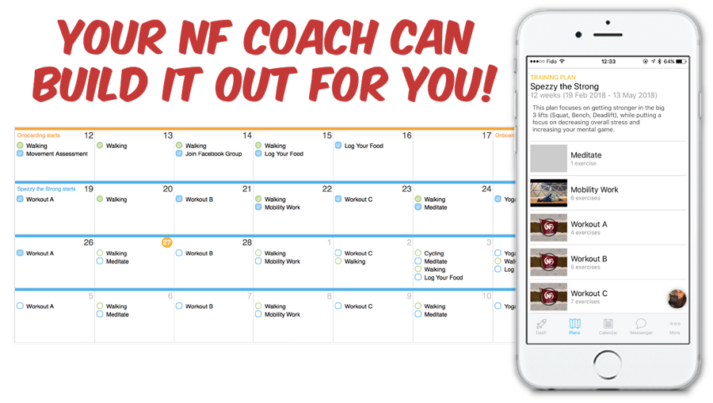
Your NF Coach can help you lose weight and get healthy!

#2) If you want an exact blueprint leveling up your nutrition, check out Nerd Fitness Journey! Our fun habit-building app helps you exercise more frequently, eat healthier, and level up your life (literally).

If you follow our Nutrition missions, you’ll learn to drink more water while earning XP! Sah-weeeet.

Try your free trial right here:
#3) Join The Rebellion! We have a free email newsletter that we send out twice per week, full of tips and tricks to help you get healthy, get strong, and have fun doing so. 

I’ll also send you tons of free guides that you can use to start leveling up your life too:

Have any more questions for me?  What else do you need to know about water?

Let’s hear it.

-Steve

PS: We walk about how water fits into a proper diet in our Guide to Healthy Eating. Check it out if you’re just embarking on leveling up your nutrition game.

###

photo source: Han Shot First: Aquaman, jDevaun: Gatorade, RLhyde: Glass,, philografy: bottled water, 27147: coffee cup,, Adventures With My Dogs: Waterfall, Urine Color, 1upLego: Lego Dawn of Justice Aquaman, Kristina Alexanderson: Maybe the droids we’re looking for are at the bottom of the pool, Jeanne Menjoulet: building in a glass of water, Lisa Zins: The Facuet, az: d-136 I’m not just going too far, I’ve arrived


The post How Much Water Do I Really Need? (A Guide for Proper Hydration) first appeared on Nerd Fitness.

from Nerd Fitness: Helping You Lose Weight, Get Stronger, Live Better. https://ift.tt/WMhQLAb
via IFTTT


Categories
Uncategorized

#holistic #getfit #nutrition Warm Up Properly: The 15 Best Dynamic Warm Up Exercises & Routines To Prevent Injury

Today, you’re gonna learn the importance of warming up, and how to warm up with specific video routines…because I’m a nice person.

This is so critical for training safely that whenever we design a workout for our coaching clients, it always starts with a proper warm-up. So I’m excited to share these warm-up tips and tricks with you too.


In this guide we’ll cover the following (click to go to that section):

This stuff is so important because getting injured sucks.

And every single day I watch people wander into the gym, immediately lie down on a bench, and start cranking out their workout with a heavy weight within seconds.

This makes me weep for humanity.

These people are just WAITING to get injured. They’re essentially playing with dynamite (also not recommended).

Playing with dynamite is not recommended

So you’re reading the right article.

Also, if you’re interested in a program that tells you exactly how to warm up and work out, you may like our new app!

Nerd Fitness Journey will set you on an adventure that will tell you exactly when to workout, when to warm up, and when you should rest. No guesswork needed. 

You can sign-up for a free trial right here:

Should I Stretch Before A Workout? No. Warm Up Instead

Above all else, the most important thing you can do when working out is to warm up properly.

Now, you might be saying to yourself, “Come on. Surely it’s not the MOST important thing…”

To which I’d reply: “First, don’t call me Shirley. Secondly, if you don’t have enough time to warm up, then you don’t have enough time to work out.”

Boom!

So WHY is it so important? 

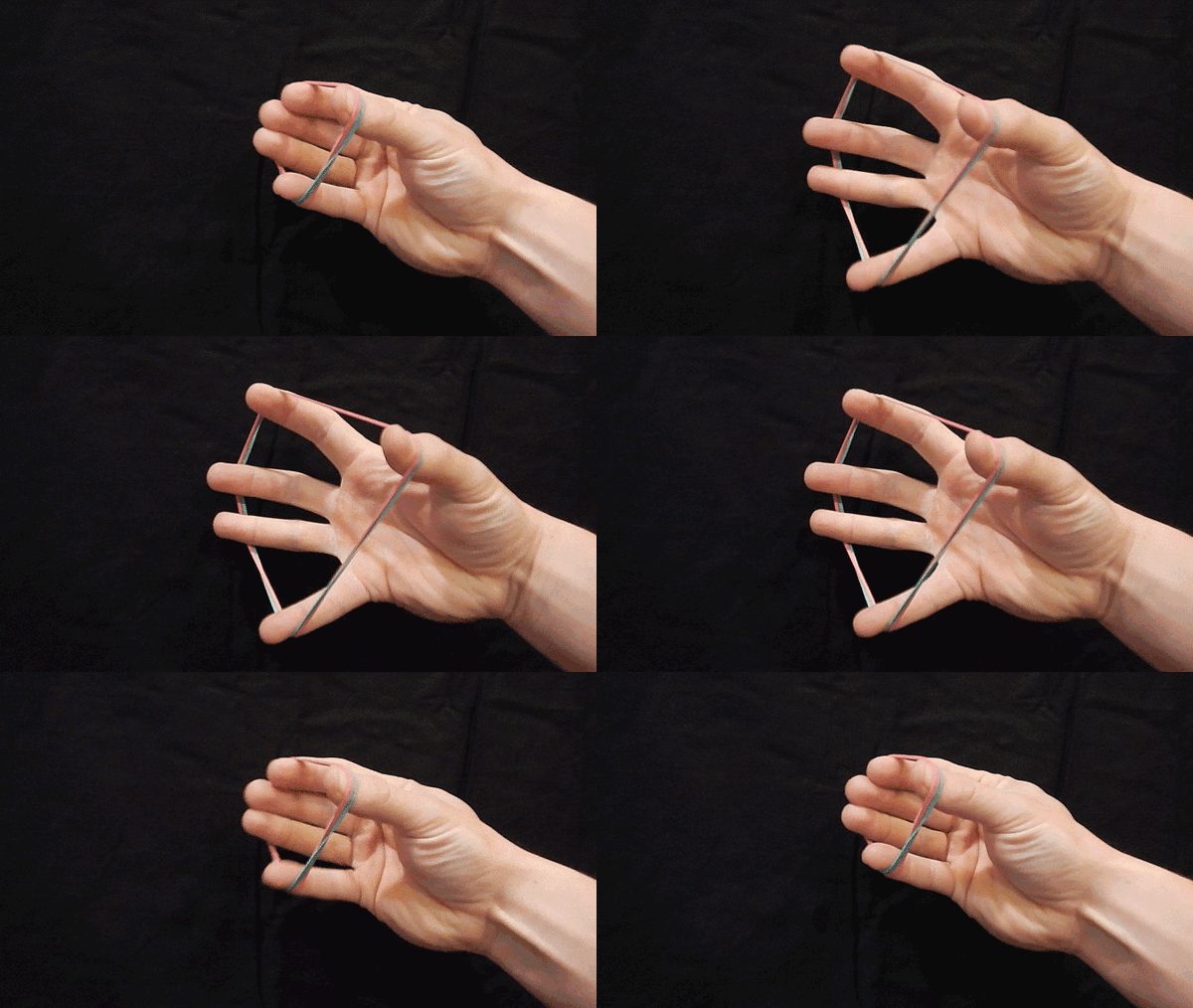
Think of your muscles like rubber bands.

Your muscles are kind of like this.

If you spend all day sitting at a desk, hunched over a keyboard, those rubber bands have gone almost completely unused.

Then, if you go to a gym and immediately start lifting heavy weights or sprinting really fast, those cold, unstretched rubber bands get pulled apart very quickly and can get snapped or pulled out of shape.

#Fail.

So, what about just regular, static stretching before working out? 

Nope.

As we point out in “Should you stretch before or after your workout?“:

A consolidation of studies showed there aren’t many benefits to static stretching before workouts. 

For starters, static stretching will not result in the reduction of the chance of injury.

Also, static stretching can actually decrease your potential for strength gains and performance.”

However, dynamic warm-ups – what you’ll learn in this article and what we focus on with our 1-on-1 coaching clients – are AWESOME for prepping you to get ready to strength train:

Think of it like a pregaming for your muscles – except replace “alcohol” with “awesome.” By jumping around and getting your muscles loose, active, warm, and ready for action, you are putting your muscles through their full range of motion and getting them ready to start handling heavier loads (strength training).

As pointed out in this study, “warming up” can also help reduce soreness after a workout.

On top of that, doing a dynamic warm-up can help activate your central nervous system, priming your muscles for a great workout that produces your best effort.

Add “improved blood circulation” to the list of benefits of warming up, which will help you perform well in each exercise.

Need another reason? When your body is properly warmed up, your muscles and joints are ready for maximum flexibility, which means you can perform each exercise with PROPER form (like deep barbell squats, for example) that maximize results and minimize the risk of injury.

So, whether you are running or strength training…a proper warm-up is probably the most important 5-10 minutes of your day. 

Still with me? 

Great. If you have been injured in the past, and you’re learning to warm up so you can stop stalling out on your progress, let us help!

We create custom workout solutions with nutritional guidance for busy people like you.

In other words, we help you get strong and eat better, every step of the way. 


Beginner Dynamic Warm-Up Video And Exercises

The above video comes from Senior Coach Staci Ardison, whose success story is here (and she’s now a lead trainer in our NF Coaching Program)

Don’t overthink this: Your goal is to elevate your heart rate, put your muscles and joints through their range of motion to warm them up and make sure everything is functioning properly, and preparing your body to strength train!

This will get you prepped for a day of getting stronger.

If you read the above paragraph and thought: “Yes I am doing strength training, please tell me more Steve! More!”

Firstly, thanks for saying please – your mom taught you well.

Next: let us help get you strong, safely! We help busy people go from strength-training-newbie to strength training badasses.

Whether you’re doing bodyweight or new to weight training, we create a workout program and provide food guidance that’s specific to YOUR life.


3 Advanced Dynamic Warm-Ups And Videos

#1) Here is an Advanced Warm-up Circuit you can do anywhere:

  • Jump rope: 2-3 minutes (optional)
  • Jumping jacks: 50 reps(pull your shoulder blades back, extend arms and really focus on the movement)
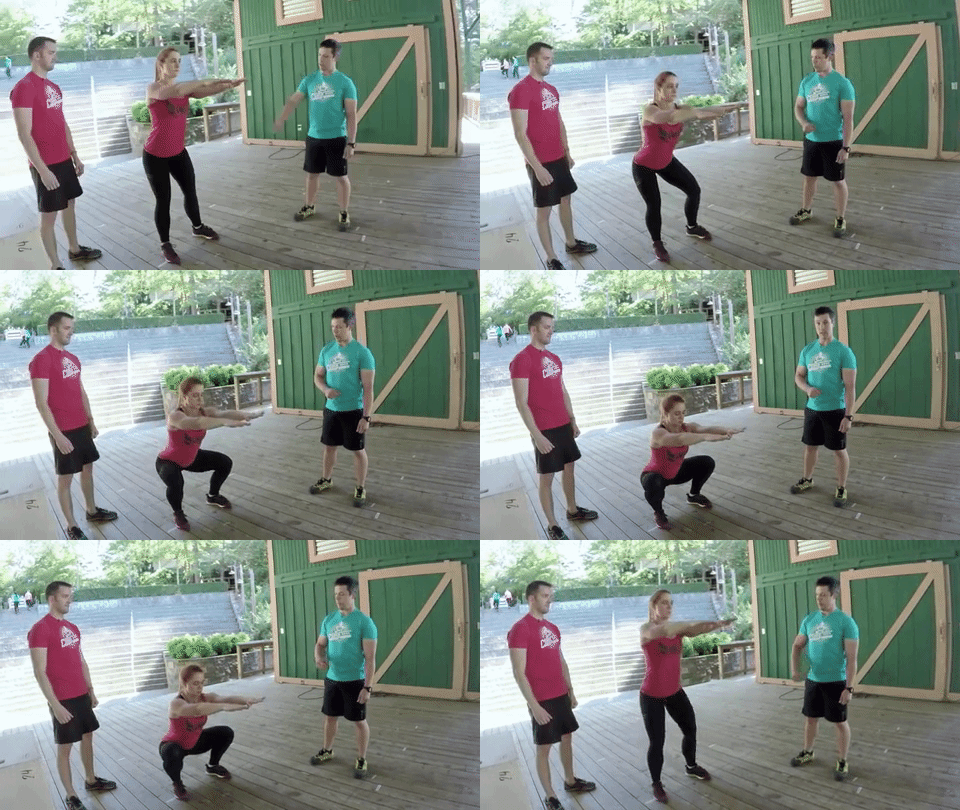
  • Bodyweight Squats: 20 reps
  • Lunges: 5 reps each leg
  • Hip extensions: 10 reps
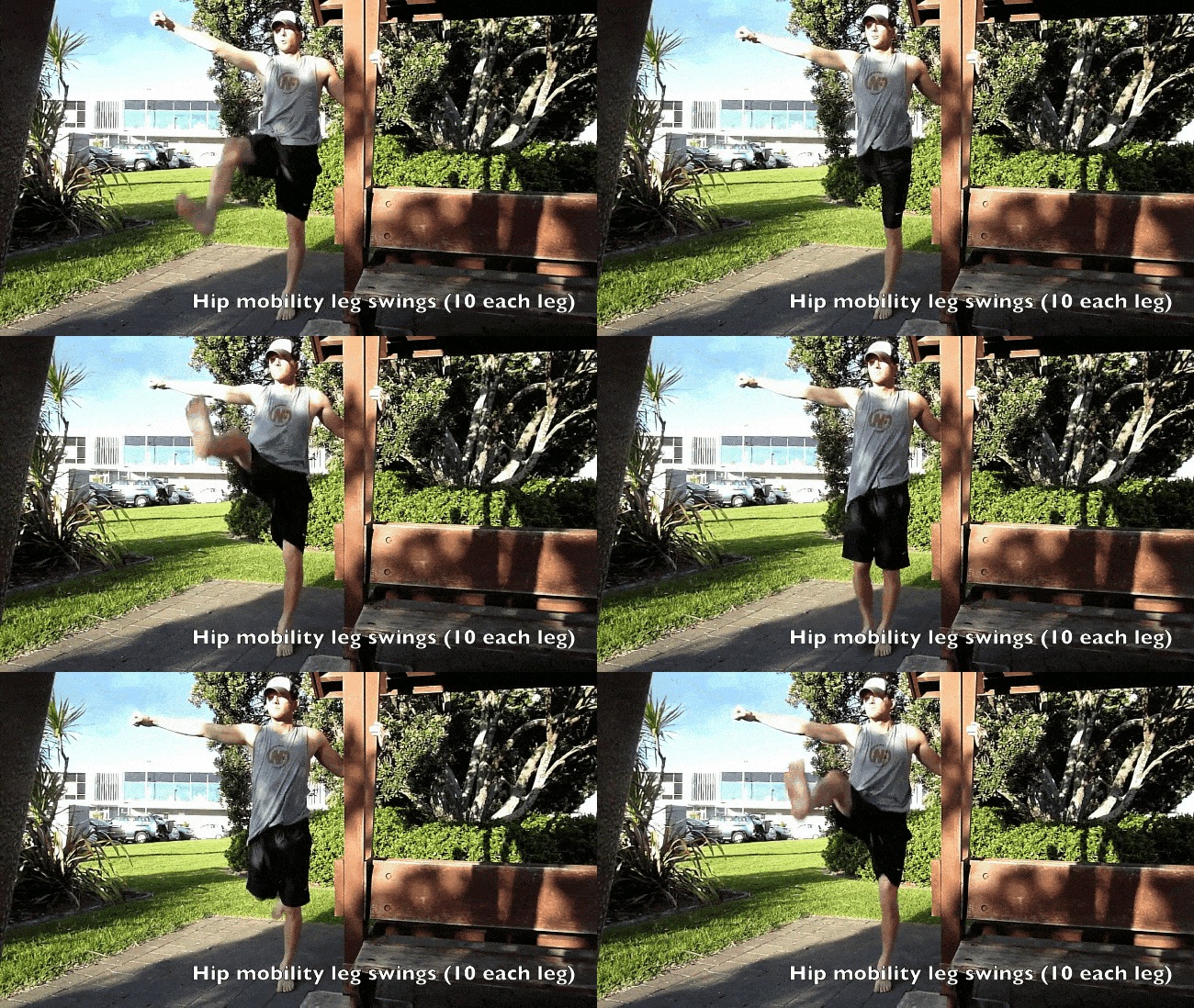
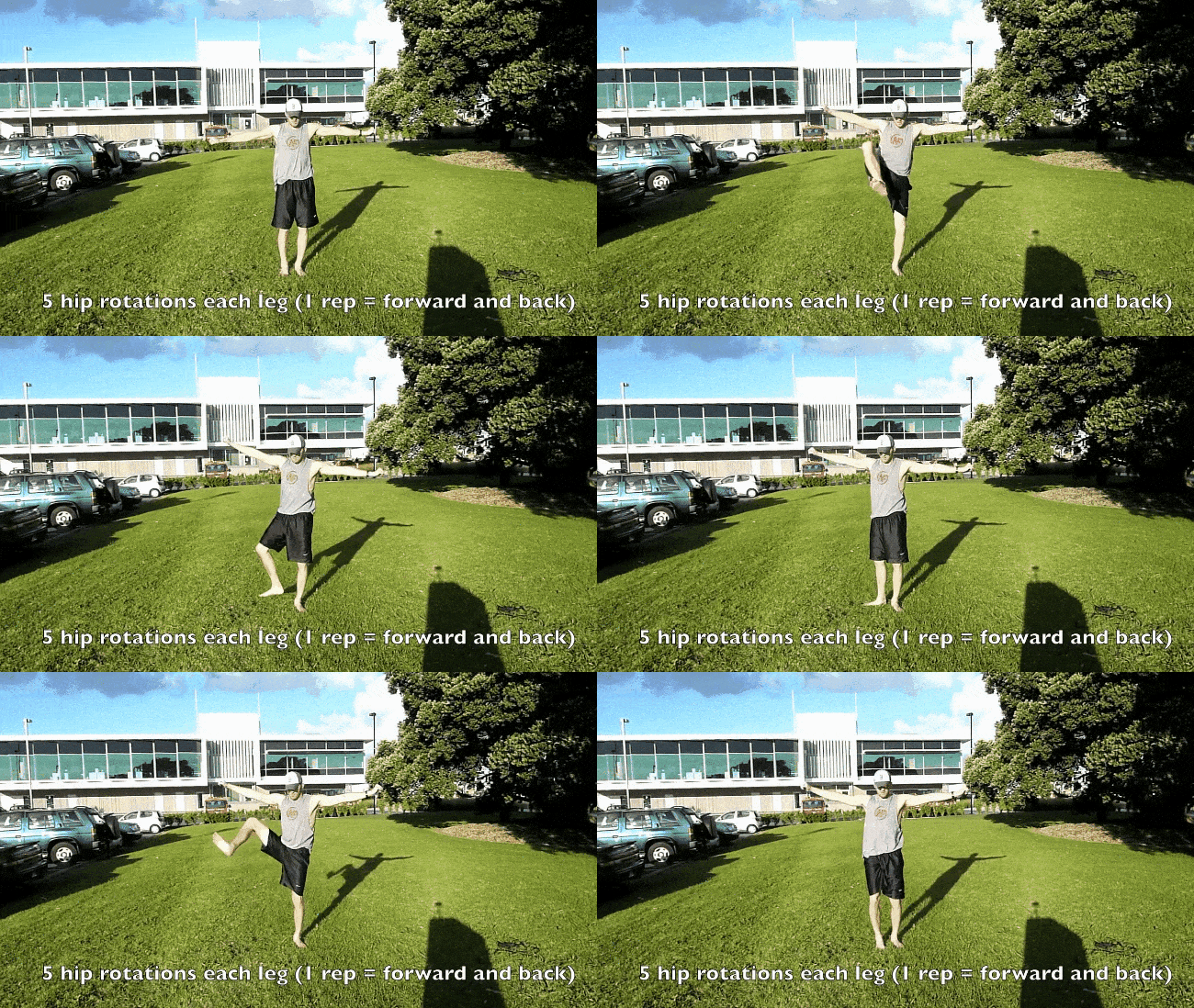
  • Hip rotations: 10 reps each leg (like you’re stepping over a fence)
  • Forward leg swings: 10 reps each leg.
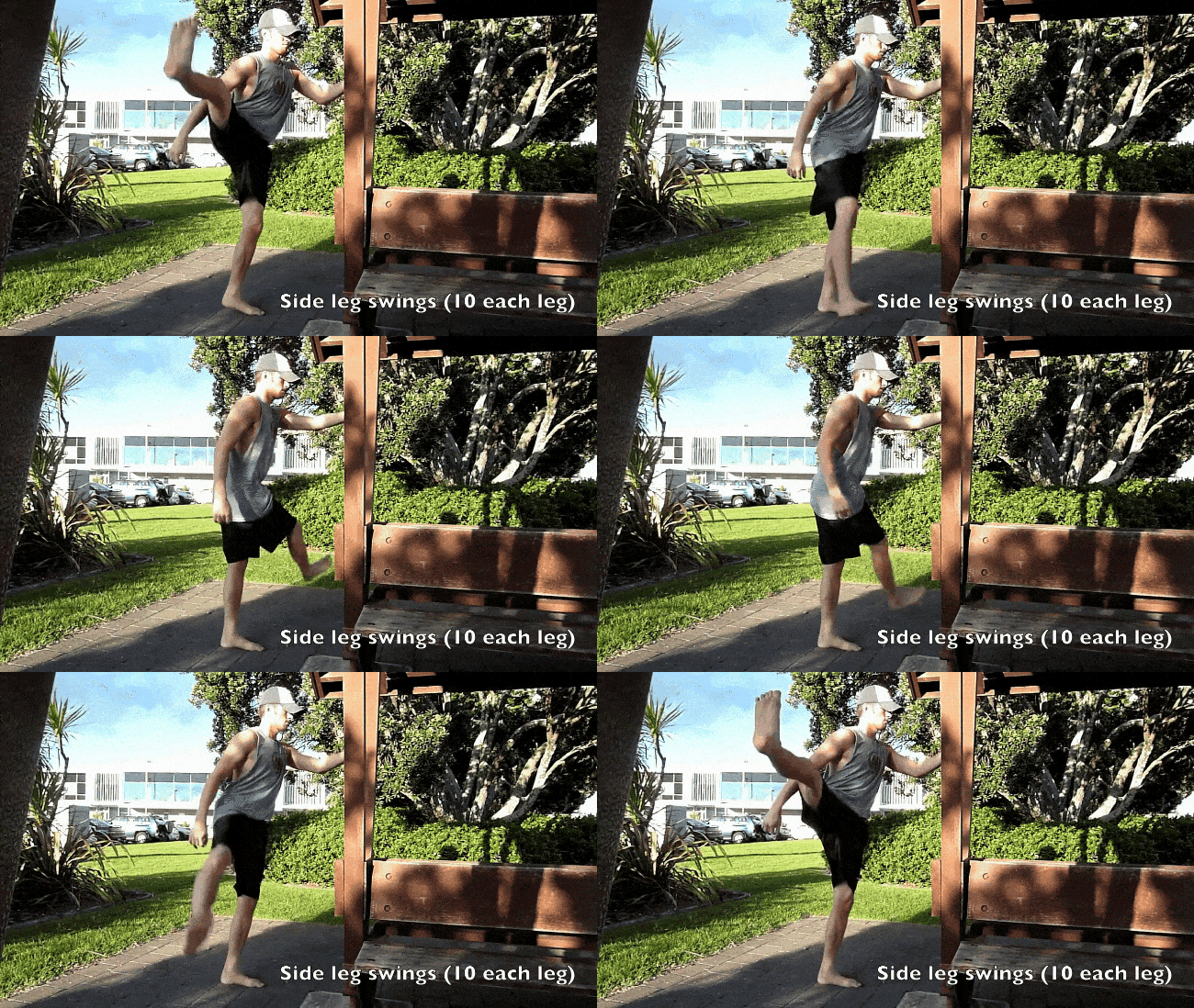
  • Side leg swings: 10 reps each leg
  • Push-ups: 10-20 reps
  • Spider-man steps: 5 each leg

This particular warm-up might be more difficult than your actual workout, especially if you’re following something like The Beginner Bodyweight Workout.

Yes, there is a lot of work put on your hips, butt, legs, and core. As nerds/desk jockeys, these tend to be the muscles that are the tighest and least active, and thus most susceptible to an injury.

If your arms and chest are particularly tight or sore, you can throw two more movements as well: 

  • Arm swings (holding your arms straight out to the side, and then swing them and cross them in front of your chest)
  • Shoulder rotations (holding your arms straight out to the side, and move your arms in a circular motion, making bigger circles each time)

Are you a runner? 

#2) Check out our warm-up routine specifically designed for runners:

You can also check out our Beginner’s Guide to Running for more tips on how to run safely.

#3) Here’s another advanced dynamic warm-up video from my coach, Anthony, which also covers a lot of Mobility:

When it comes time for your workout, if you are doing heavy strength training (with barbells or dumbbells), make sure you do some warm-up sets before jumping into the weight you’ll be training with for EACH EXERCISE.

Always start with a set using just the bar to work on your form and get your body used to the movement.

Then, do a few sets of just a few reps with increasing weight (but won’t tire you out) and THEN start your workout.

It’s something we bring up before every workout in Nerd Fitness Journey, our new habit-building app! If you want, you can test drive it right now for free!

15 Best Dynamic Warm-Up Exercises To Prevent Injury

This LEGO man warms up so he doesn't get injured during exercise

These are our favorite quick warm-up exercises that can help you prevent an injury during your workout! 

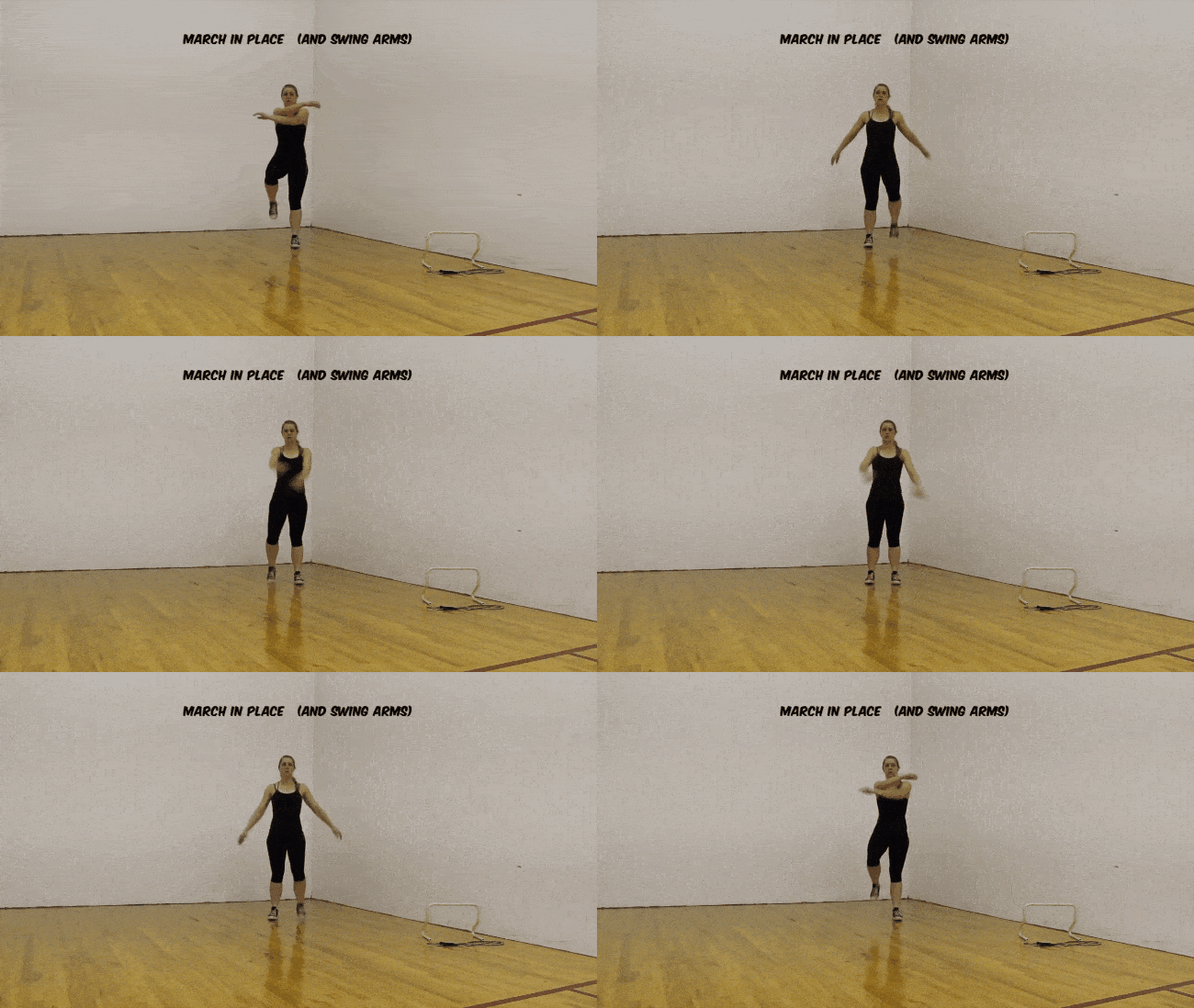
  1. Marching in place while swinging your arms.
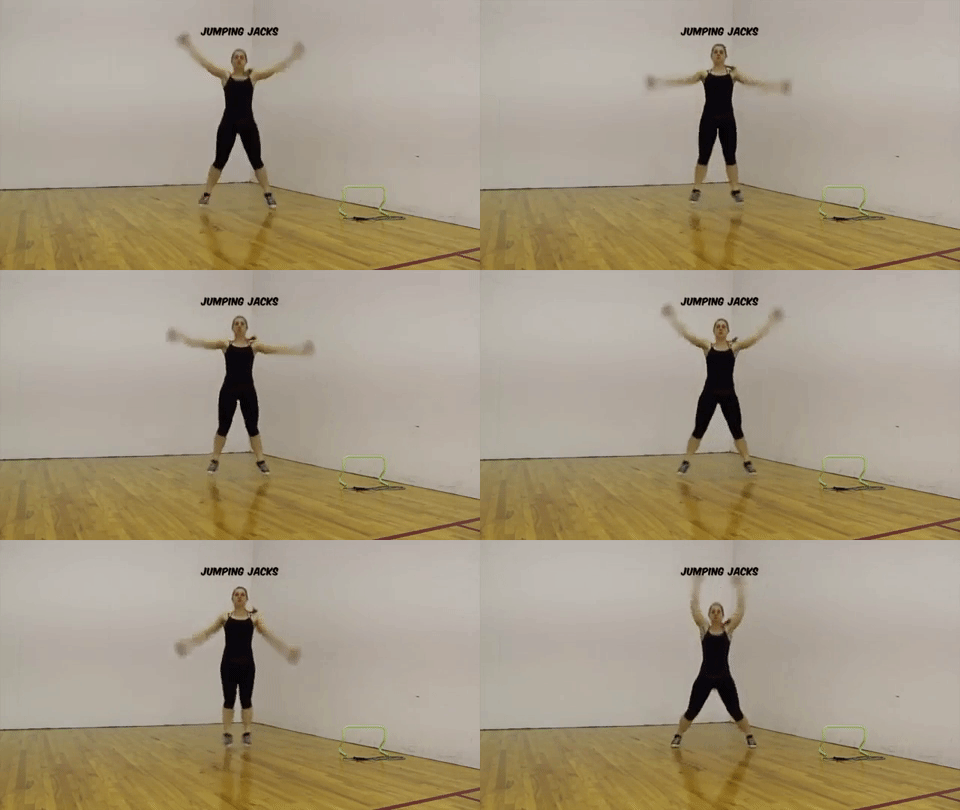
  2. Jumping jacks
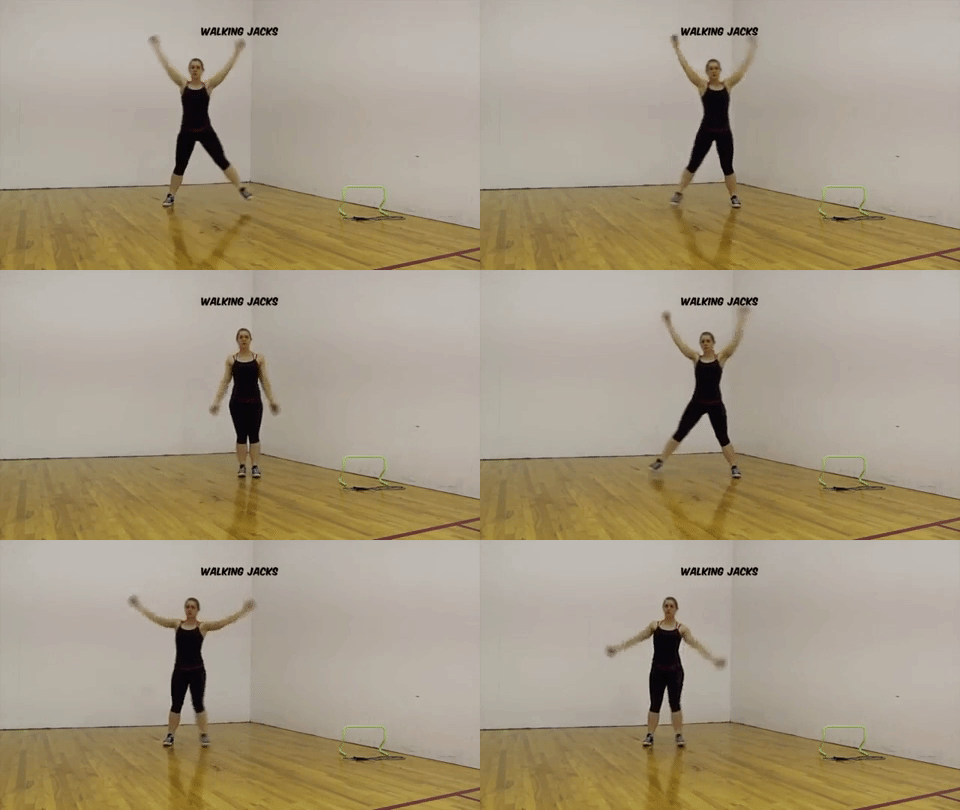
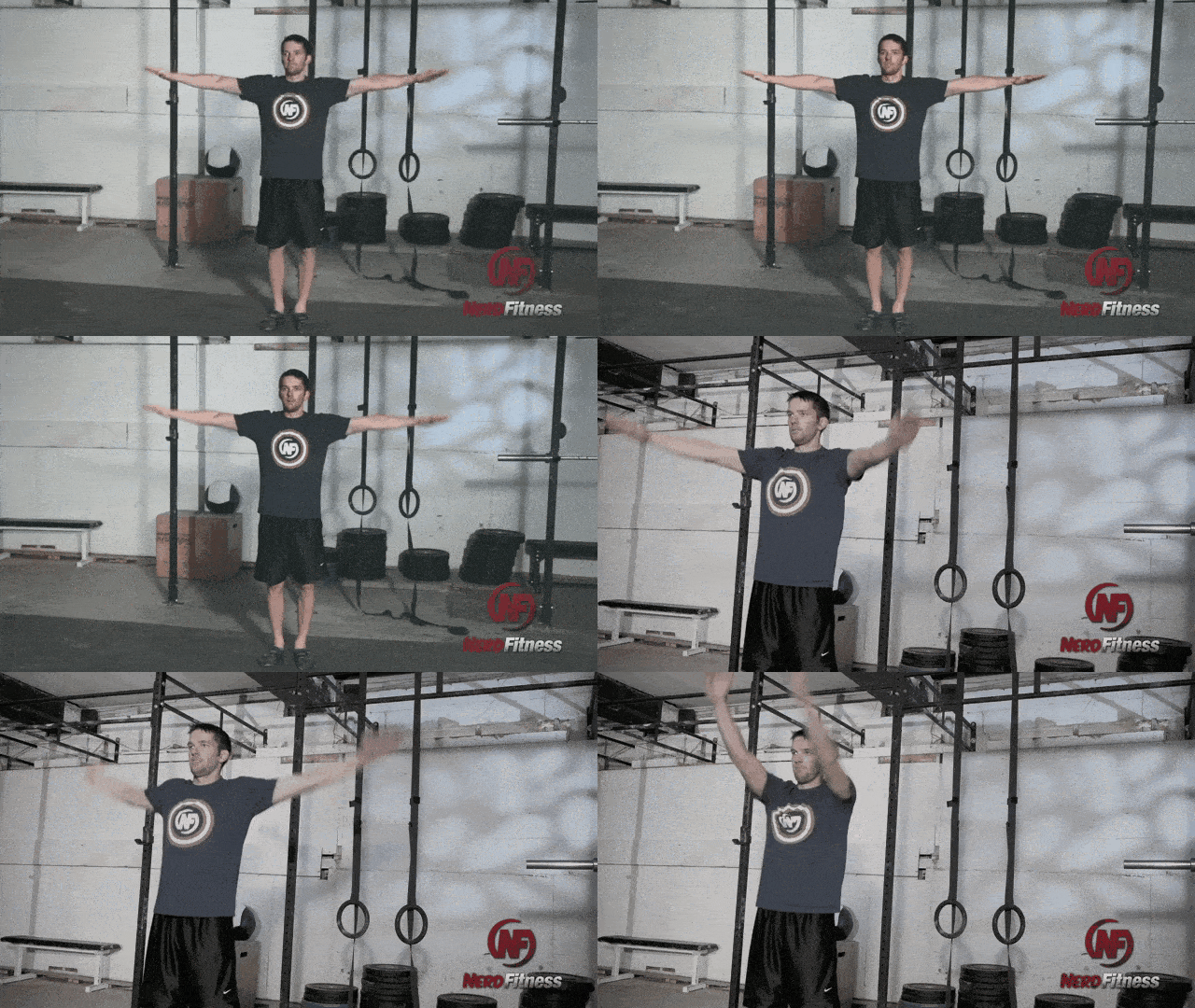
  3. Walking jacks
  4. Arm circles and shoulder shrugs.
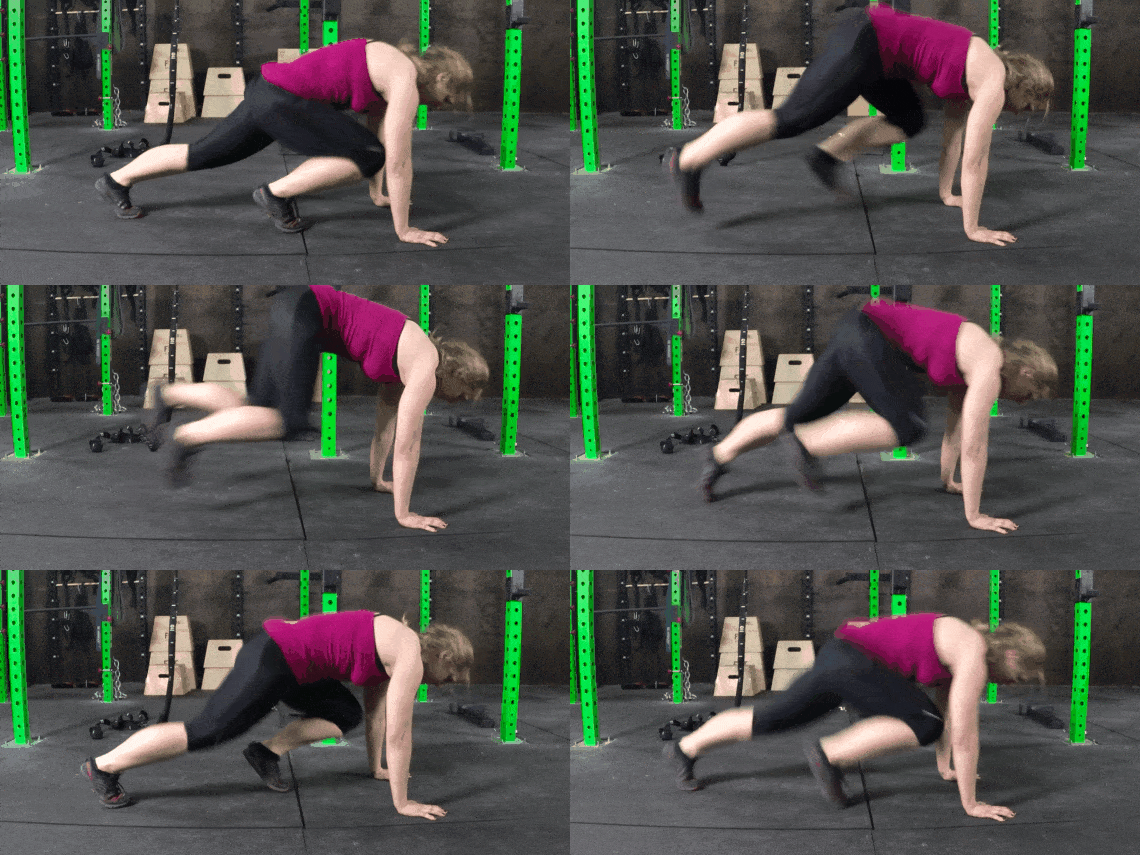
  5. Mountain Climbers
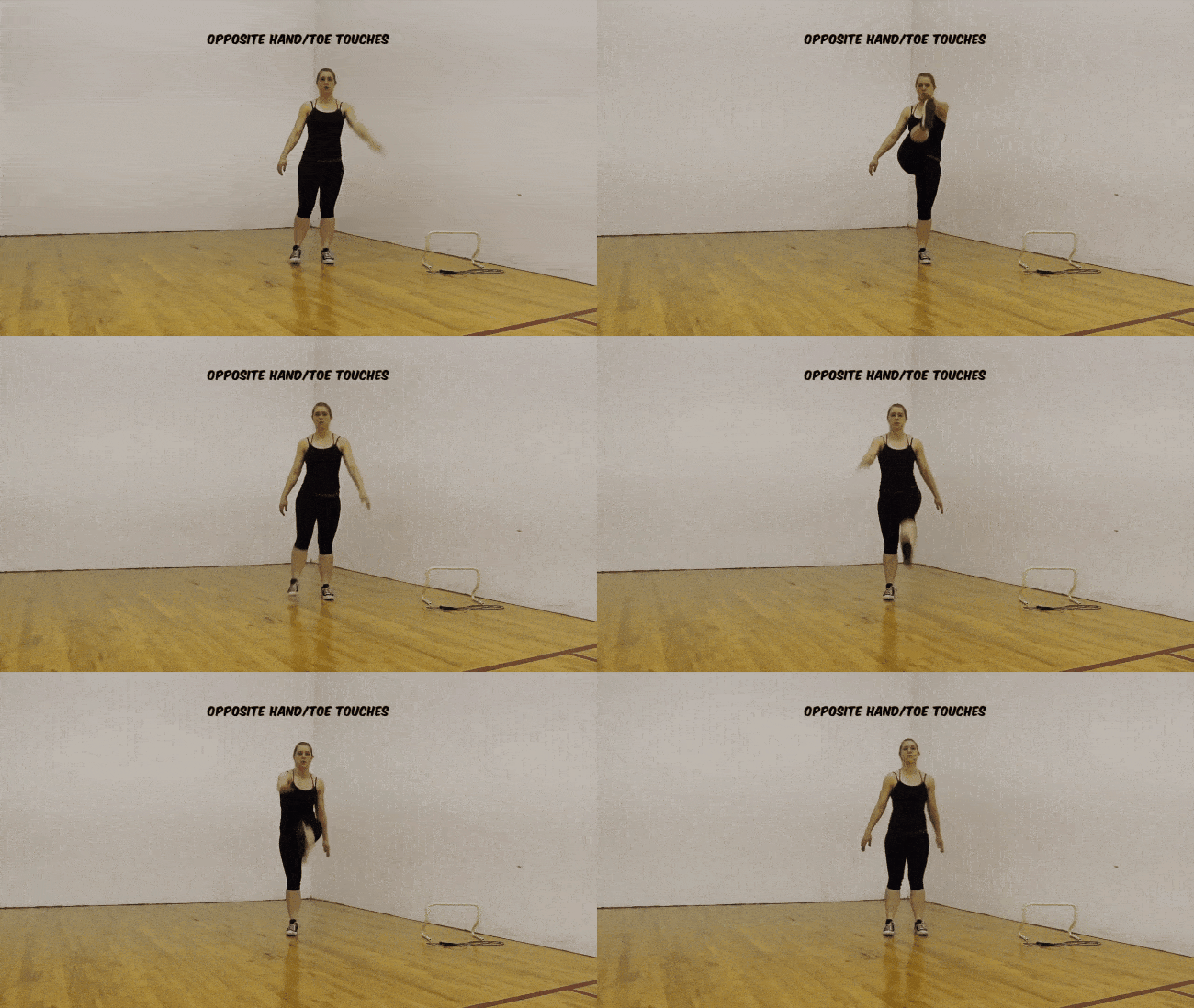
  6. Swinging toe touches.
  7. Leg swings (forward)
  8. Leg swings (side to side).
  9. Hip rotations (like stepping over a fence)
  10. Hip circles (like you’re hula hooping)
  11. Bodyweight squats.
  12. Push-ups.
  13. Lunges.
  14. Hip extensions.

Get into the habit of doing these exercises before doing any workout. They’ll help keep you mobile and limber and injury free. If you’re not sure how to do any of these movements, watch the videos for them below.

1. MARCHING IN PLACE WHILE SWINGING ARMS

Marching in place swinging arms

2. WALKING JACKS (If You Can’t Do Jumping Jacks)

Do walking jacks if you can't do jumping jacks!

3. JUMPING JACKS

Jumping Jacks are a great cardiovascular bodyweight exercise

4. ARM CIRCLES AND SHOULDER SHRUGS

Arm circles like so are a great way to get your heart rate up before doing HIIT.

5. MOUNTAIN CLIMBERS

Staci doing a mountain climber

6. SWINGING TOE TOUCHES

Coach Staci doing a toe touch warm up , by lifting leg and touching toes with opposite arm.

7. LEG SWINGS (FORWARD)

Steve doing forward leg swings for a warm up

7. LEG SWINGS (SIDE)

Steve doing a warm up by swinging a leg side to side

8. HIP ROTATIONS

Steve doing hip rotations warm ups

9. HIP CIRCLES

Someone rotating their hips like a hula hoop for a warm up

10. BODYWEIGHT SQUATS

Do a proper bodyweight squat to work out your legs

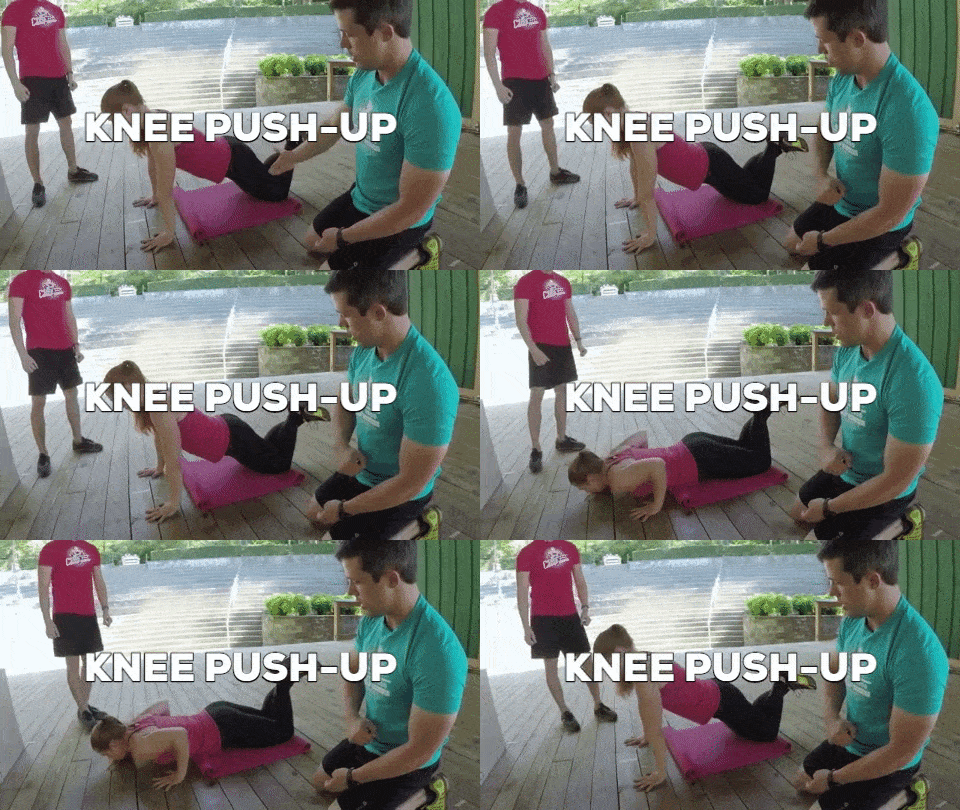
11: KNEE PUSH-UPS

Knee push-ups like this are a great way to progress to a regular push-up!

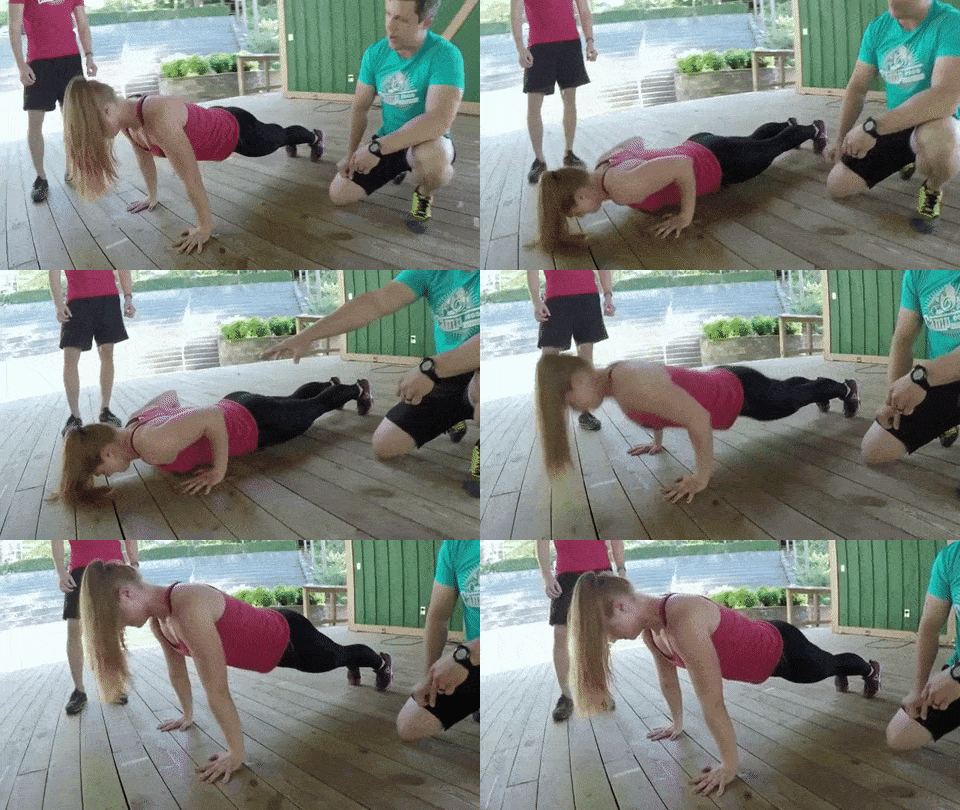
12: REGULAR PUSH-UPS

This gif shows Staci doing a push-up in perfect form.

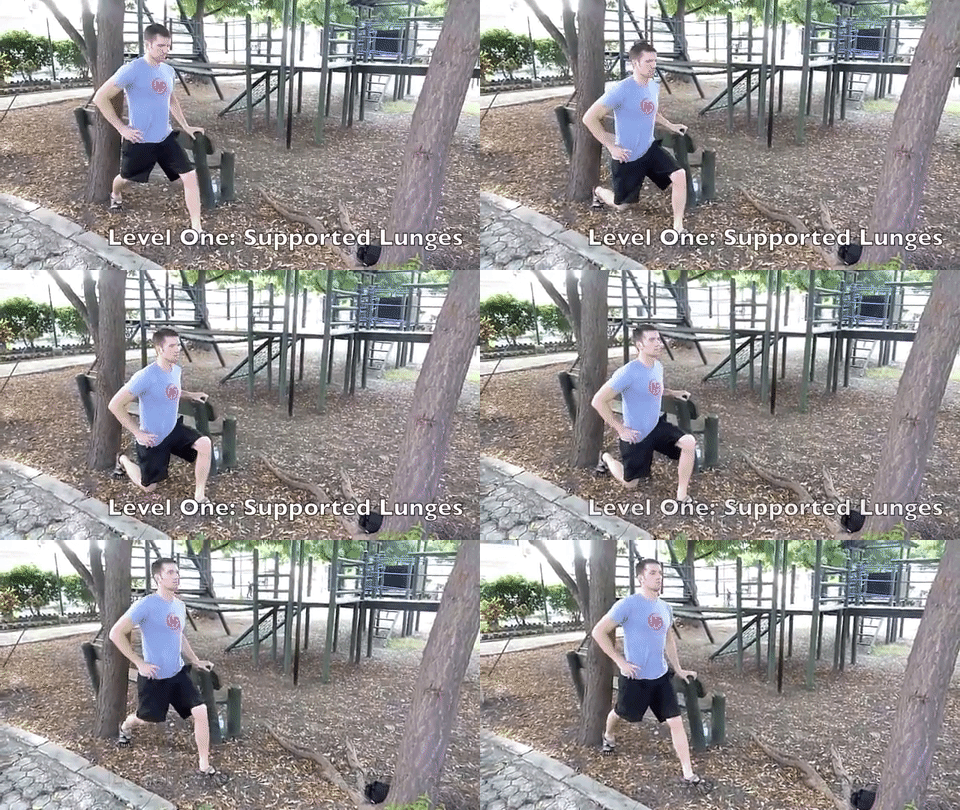
13. SUPPORTED LUNGES

Do the assisted lunge until you can do regular lunges

14. REGULAR LUNGES

Do Lunges to strengthen your legs for the beginner bodyweight exercises!

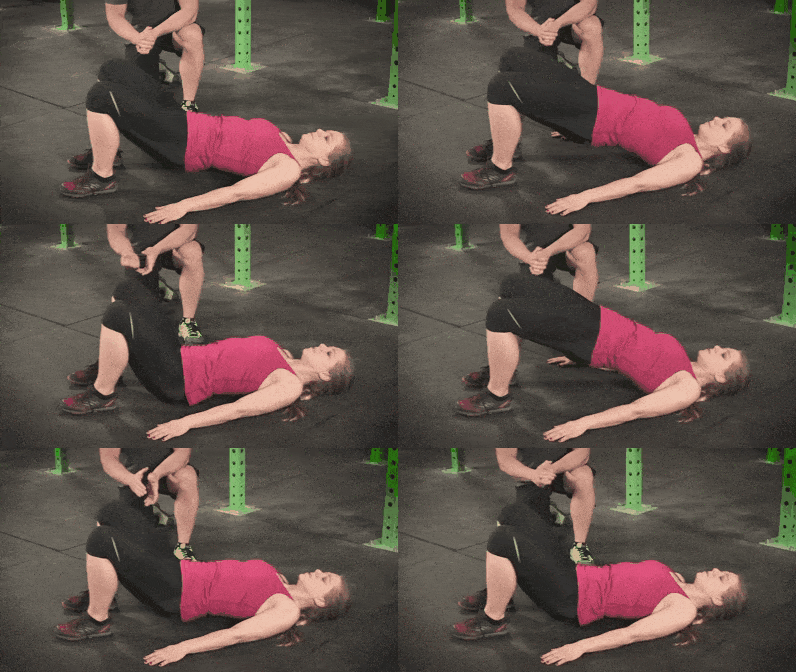
15. HIP RAISES

Raising your hips of the floor, like so, is how you do the bridge bodyweight exercise.
These exercises are the PERFECT movements you should be doing before any strength training program.

Oh, what’s that? You’re new to strength training and not sure what you’re doing? No problem!

We help people exactly like you.

Well, not exactly. You’re a unique snowflake, your mom loves you, etc.

What I mean is we help people like you to start strength training.

We do form checks, create custom workouts based on your equipment and time commitment, and more.


To Answer Your First Few Questions…

“Steve, I can’t do jumping jacks/I live on the second floor.” 

That’s okay – the reason I love jumping jacks is that they work out all four of your limbs at once and get you bouncing around.

Instead, channel your inner Chuck Norris and do punches and kicks with each leg. I don’t care if you can’t kick higher than your shins and your punch wouldn’t kill a fly…just get those limbs flailing and warmed up!

You could also just do “Walking Jacks.”

Do walking jacks if you can't do jumping jacks!

“Um, your warm-up is tougher than my actual workout!” 

The dynamic warm-up above is designed for people who are doing serious training.

If you are doing heavy deadlifts and squats and overhead presses, a proper warm-up could keep you out of a career-ending injury.

However, if you are just getting started with exercise and you’re only doing bodyweight exercises, obviously 20 real push-ups during your workout isn’t possible…

THAT’S OKAY. Think of the above as the warm-up you aspire to complete. In the meantime, do the best you can. Let’s say:

Follow the rest of the routine as planned if possible.

In this routine, your warm-up will act as part of your workout, as you’ll be doing the same functional movements.

Do the BEST you can, keep track of your results for your warm-up too, and improve with each workout.

With enough consistency and persistency (not a word, but rhymed better and sounded way better than persistence), you’ll be busting out the full warm-up routine before kicking ass at your actual workout!

Don’t have a program to follow? Or tired of following a random plan online that’s not getting you results?

Check out our Online Coaching Program – we’ll take care of all the heavy lifting (except the actual “heavy lifting,” that’s your job).


Warm-Up Properly and Avoid Injury!

Hopefully, this is a post you bookmark, as it’s probably one of the more important ones I’ve ever written.

If you want to stay injury-free, put your body through a dynamic warm-up before you start your exercise.

If you are somebody that wants to follow a program that is tailor-made for their life and situation and goals, check out our popular 1-on-1 Coaching program.

You’ll work with our certified NF instructors who will get to know you better than you know yourself, answer any and all fitness questions you have, and program your workouts and nutrition for you.


What other questions can I answer for you about warming up properly?

I’m here to help!

-Steve

PS: Still here, but not sure what to do after your warm-up? Why not let our app tell you exactly what to do!

PPS: The companion post to this guide is “How to Stretch After a Workout.” Give it a read if you’re wondering about what post-workout routines you should try.

###

All photo sources can be found right here.[1]

The post Warm Up Properly: The 15 Best Dynamic Warm Up Exercises & Routines To Prevent Injury first appeared on Nerd Fitness.

from Nerd Fitness: Helping You Lose Weight, Get Stronger, Live Better. https://ift.tt/a5E0vom
via IFTTT

Categories
Uncategorized

#getfit #holistic #nutrition NEW! Women of Colour Cycling Mugs

Read this post NEW! Women of Colour Cycling Mugs on keep it simpElle.

Picture this; I’m online shopping and if I add a few more great British pounds to my basket, I can get free delivery. It’s actually an order I’m placing for my mum and she tells me to spend the extra….

Read More

Read more on keep it simpElle –

from keep it simpElle https://ift.tt/Qhcae2k
via IFTTT
Categories
Uncategorized

#holistic #getfit #nutrition 5 Best Strength Training Workout Routines For Beginners (Home & Gym)

These LEGOs are working the bench and doing some deadlifts. Nerd Fitness approves.

Want to get strong like these LEGO lifters but don’t how to start?

In this Beginner’s Guide to Strength Training (part of our Strength 101 series), you’ll have both the confidence to start getting strong with resistance training AND a plan to follow.

These are the exact strategies we use with our Online Coaching Clients to help them start strength training, and I’m excited to cover everything you need.


We’ll be digging into the following:

By the way, we’ve combined this article along with the rest of our strength articles into a “Strength Training 101: Everything You Need to Know” guide.

Grab it free when you join the Rebellion by putting your email in the box below.

How Do I Start Strength Training?

Barbells in a gym bar bells and rope

Welcome to the first day of the rest of your life.

You’ll look back years from now and thank “Past You” for starting strength training today.

And I promise, you WILL strength train today.

After all, strength training or resistance training doesn’t need to be scary or overcomplicated!

Strength training really comes down to two things:

#1) Movement of any weight against “resistance”(including your body weight) – Doing ANY exercise that pushes your muscles outside of their comfort zone, forcing them to rebuild stronger to prepare for the next challenge.

#2) Progressive overload: doing slightly more than last time (lift heavier weight or do 1 more rep) consistently. Your muscles will constantly have to adapt and rebuild themselves. These microscopic tears (that don’t hurt) force your muscles to go through hypertrophy, meaning they grow bigger and stronger so they can meet the demands of the exercise.[1]

Coach Jim explains the ins and outs of progressive overload in this video:

That’s all there is to it: do some resistance training and attempt to make it more and more challenging, and you’ll grow stronger.[2]

  • This means if you drop down and do ONE knee push-up right now, technically you’ve done a strength training workout.
  • It also means if you then do TWO knee push-ups tomorrow, then you are officially following a strength training routine.

In other words…

Like this man says, "You can do it" wants you to start strength training!

Now, there are many different “strength training” and “resistance training” paths.

Like a “skill tree” in a video game (with branching paths and progressions), you can progress up one path, and mix and match movements from others depending on the situation.

These paths depend on your goals and what equipment you have available to you.

What Are Some Examples of Strength Training?

Does the Empire mandate this training?

Let’s chat about a few different types of strength training.

#1) BODYWEIGHT TRAINING

Batman does bodyweight training for his strength training!

Bodyweight training is simply doing an exercise in which your own body is the “weight” you are “lifting.”

Duh.

This is the BEST place for anybody – regardless of weight or age – to start their strength training journey.

Why is this the best place to start? Two big reasons:

A) You always have your body with you (unless you are a ghost, in which case, this is awkward). This means you can work out ANYWHERE with bodyweight training:

B) Using your body for resistance training is the most “human” thing ever! By learning to push and pull and hang and squat and lunge, you are doing what your body is literally designed to do.

By getting strong with bodyweight movements, you’re making yourself antifragile and less injury-prone.

Now, it’s SCIENCE TIME!

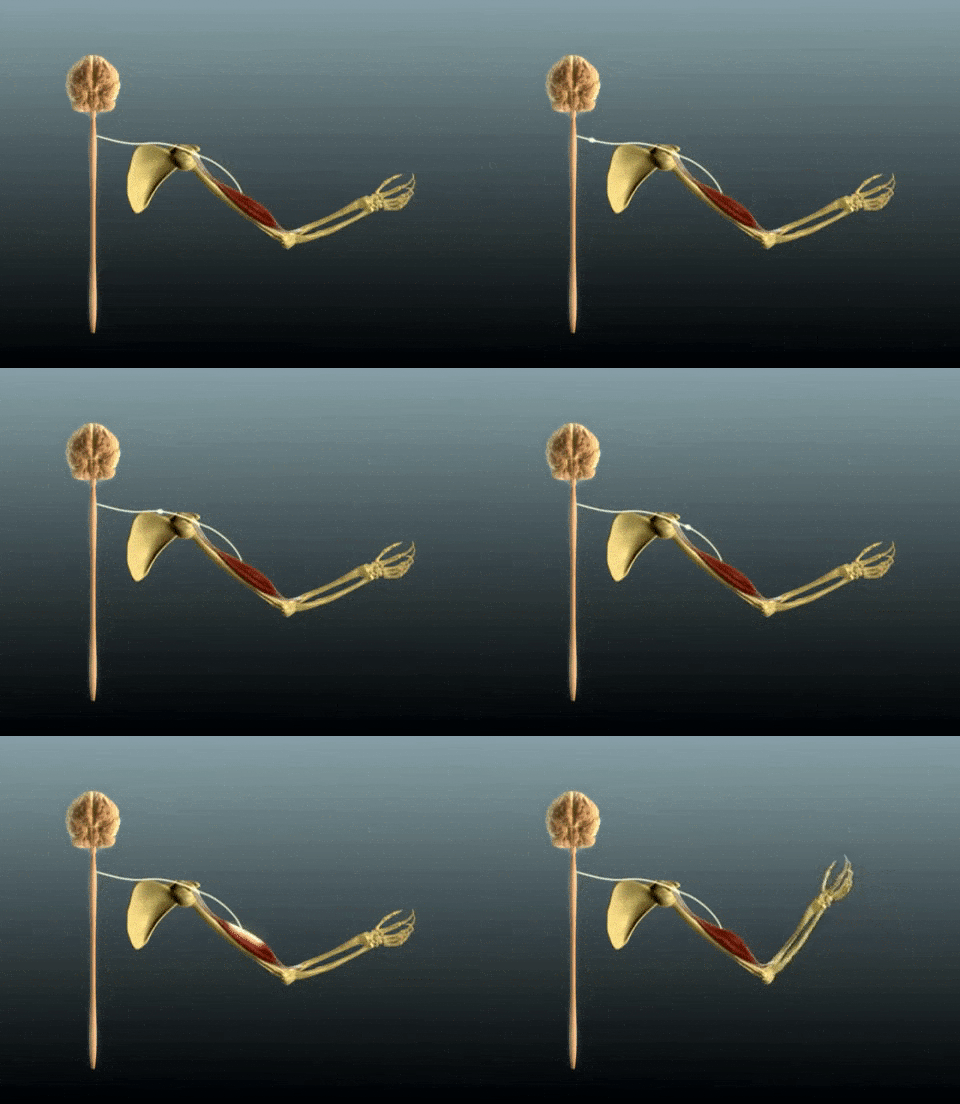
While learning the movements with bodyweight exercises, you are allowing for proper communication to develop between your neuromuscular systems.

This gif shows an arm bending from a neuromuscular junciton

More efficient communication between your neuromuscular systems will result in something known as “proper motor unit recruitment.”

You may be asking yourself: what is a motor unit?

That’s okay because I was asking myself this same question.

A motor unit is a single motor neuron and the muscle fibers it innervates.

You can think of two different types of motor units:[3]

  • We all have small motor units, meaning that a single motor neuron innervates relatively few muscle fibers, and these smaller motor units are good for precise and detailed movements (e.g., moving your fingers).
  • We all also have large motor units, meaning that a single motor neuron innervates hundreds of muscle fibers, and these larger motor units are good for generating a lot of force (e.g., getting larger muscle groups like the quads to generate a lot of force to help in sprinting).

When you start strength training, you really are helping your muscles communicate better together.[4] This is why we recommend starting with bodyweight exercises, to help start this process.

However, bodyweight training isn’t as easy to ‘scale’ the difficulty as some of the other strength training methods (“put more weight on barbell”), but you can get REALLY strong with just bodyweight training.

For example, you can start with knee push-ups, then go to regular push-ups, then elevated push-ups, then even up to things like handstands and handstand push-ups.

You just have to know HOW and WHEN to scale up (we can help there too).


#2) DUMBBELL TRAINING

This cartoon uses free weights for his strength training.

Dumbbells are a great first step into the world of weight training and strength training:

  1. Most gyms will have dumbbells, even if it’s a basic gym in your apartment complex.
  2. A set of dumbbells doesn’t take up a lot of room, which means you can have a pair at home without a large footprint.
  3. Dumbbells make it easy to add difficulty to a bodyweight movement: holding dumbbells while doing lunges, for example.
  4. Dumbbell exercises can be less intimidating than barbell training for some, and are a step towards barbell training.
  5. Dumbbells have an added stabilization challenge,[4] and will point out muscle imbalances pretty easily (“oh my right arm is stronger than my left arm.”).
  6. Dumbbells allow for single-arm and single-leg exercises to be performed. This can allow you to strengthen any muscle imbalances and can come in handy especially after an injury.
  7. You can scale easily. Once the 10-pound weights become too easy, pick up the 15-pound ones!

#3) KETTLEBELL TRAINING

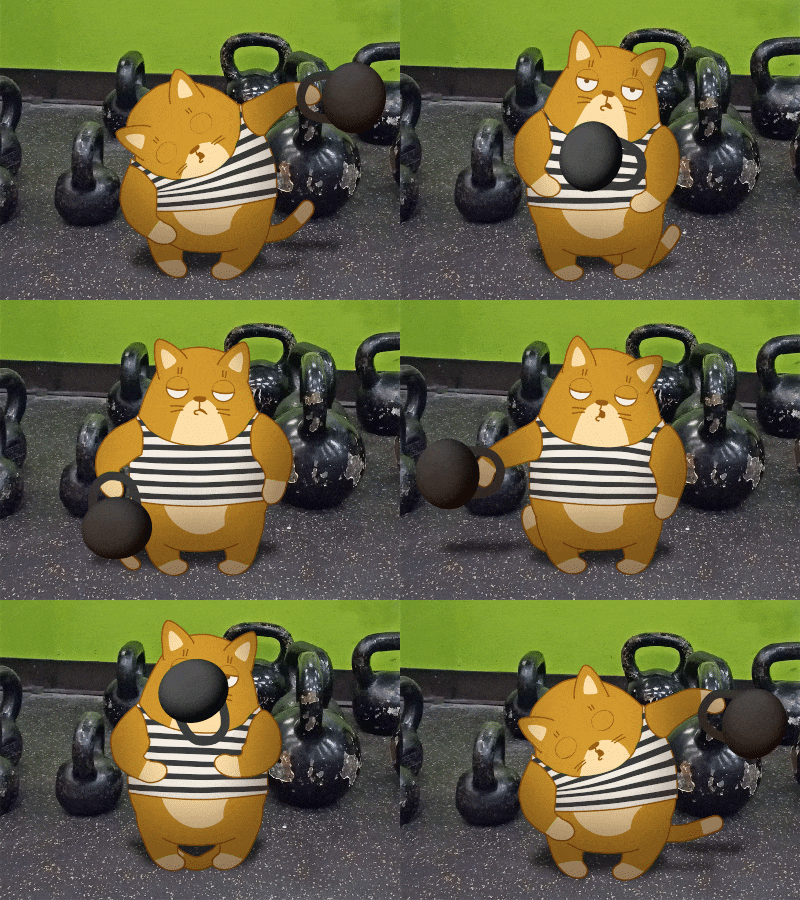
This cat loves doing a beginner kettlebell workout for strength

A kettlebell is essentially a cannonball with a handle on it. They come in any weight imaginable, they don’t take up a lot of room, and can be used in dozens of ways for a great compact workout.

Our 20-minute kettlebell workout has 8 simple exercises you can do with just one weight.

Although there are “adjustable kettlebells,” you’ll most likely be working with a single kettlebell, and then adjusting your movements for “progressive overload” (making the workout slightly more difficult each time).

If you are a member at a gym, they’ll probably have multiple kettlebells that you can use to level up.

#4) BARBELL TRAINING

Rebel Leader Steve showing how to do a 420 lb deadlift at the gym.

Regardless of sex or gender age, if your goal is to get strong quickly, use 20 seconds of courage and get comfortable training with a barbell (I’ll help you, I promise):

  1. Progressive overload” is easy – you simply add weights to either side of the bar, allowing you to progressively lift more and more weight each week.
  2. It’s much easier to go heavy safely – especially for lower body movements like the squat and the deadlift.

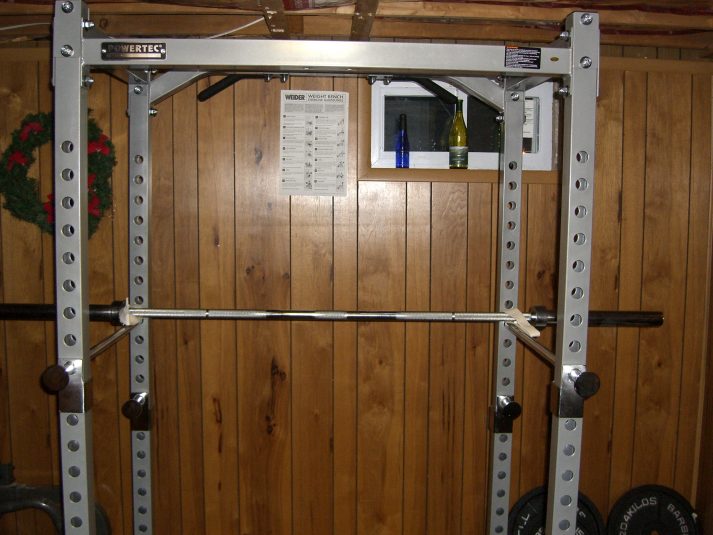
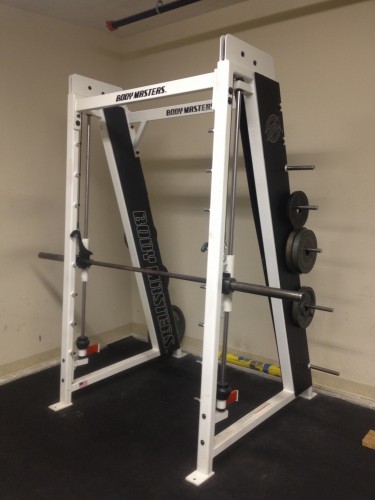
The biggest downside to barbell training is that in order to train at home, you need to have purchased a squat rack, a barbell, a bench, and enough weights for your house or garage (which can be an expensive investment, especially when starting out!).

If not, you definitely will need to join a gym.

WHICH RESISTANCE TRAINING PATH IS RIGHT FOR YOU?

Not sure which path to pick? You’re not alone – this stuff can be overwhelming. Check out our 1-on-1 Coaching Program. We get to know you and your goals, will check your form via video, and make adjustments based on your progress!


Which Strength Training Program is Right for Me?

Do you think he supplements with creatine?

So, what’s the best workout program to start as a beginner?

Realistically, it’s the one that you will ACTUALLY do.

Barbell training might be optimal in terms of building pure strength quickly, but if you don’t see yourself getting to the gym regularly – or you’re too self-conscious to enter the free weight section (for now) – no problem!

Start with bodyweight training.[5]

Conversely, bodyweight training might seem convenient and easy to start now, but if you can’t motivate yourself to work out at home, you might be better off joining a gym.[6]

So let’s get you a workout program!

Everyone, including Carlton here, is happy you want to start strength training.

As we cover in our “How to Find the Perfect Workout Plan (for you)”: MOST beginners will be best served by following a “full-body” or “total body” routine, 2 to 3 times per week, with a day of rest in between each workout.[7]

This full-body workout will have 4-5 big compound movements.

A compound movement is an exercise that recruits LOTS of muscles simultaneously and forces your body to work in unison. These compound exercises are considered multi-joint exercises meaning that they involve more than a single muscle group.[8]

An example would be the barbell squat, which recruits every muscle in your core, butt, and legs to work together to lift the weight.

A squat is a life changing exercise

This is WAY more efficient – and effective at building pure strength – than doing 5 different isolated leg exercises.[9]

Why do 5 exercises when 1 exercise will get you better results in 20% of the time?

To answer your next question, let me tell you about how many sets and reps you should do as a beginner!

As we explain in our “How Many Sets and Reps” guide:

  • Reps in the 1-5 range build super dense muscle and strength.
  • Reps in the 6-12 range build equal amounts of muscular power, strength, and size.
  • Reps in the 12+ range primarily build muscular endurance and size and also cardiovascular health.[10]

If you want more, Coach Jim breaks down different set and rep ranges in this video:

Many beginner strength programs will encourage you to keep things simple, doing just 5 sets of 5 reps for each exercise.

Personally, I encourage people to aim for a weight that they can lift for 8-10 reps. This gives you a chance to really work on your form and lift safely!

The max lifts will come later, my friend. You gotta learn to walk before you can run!

Staci, which workout plan is best for me?” 

It depends on your goals!

If your main goal is general fitness and fat loss, doing a circuit training workout will likely help you reach your goals (make sure you see our section below for “strength training for weight loss”).[11]

If your main goal is to get stronger and/or put on muscle, following a more traditional, pure-strength-style gym workout is going to get you there faster.

TRUTH BOMB: ANY strength training workout will help you reach nearly any goal provided you do two things:

  1. Eat correctly for your goals too. How you eat will account for 80-90% of your success or failure when it comes to weight loss or bulking up.[12]
  2. Increase the difficulty of your workouts. This is that “progressive overload” stuff we were talking about earlier. Doing 1 more bodyweight squat, lifting 5 more pounds, or completing your circuit 10 seconds faster than last workout. By forcing your body to constantly adapt, your muscles will never get complacent and have to keep burning extra calories and rebuilding themselves stronger.

Depending on your current situation, and how quickly you’re looking to cut through the “trial and error” and get expert guidance, I might have an interesting solution for you.

We have a pretty killer 1-on-1 Online Coaching Program here at Nerd Fitness. You’ll work with a coach that will build a workout program for your body type and goals, check your form to make sure you’re doing them safety, and even help plan out your nutrition too.


The 5 Best Beginner Strength Training Programs

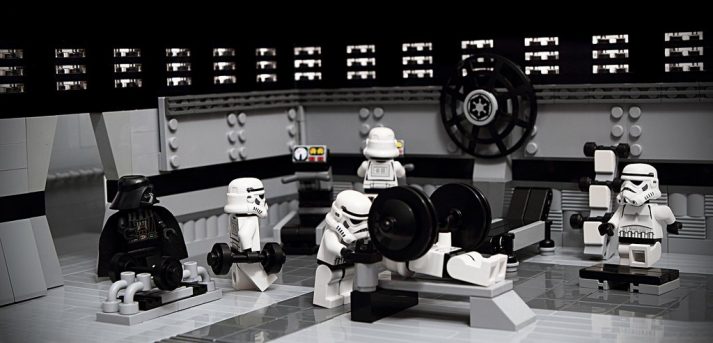
A gym like this is a great way to strength train, as Darth Vader knows.

“Alright Staci, are there any ‘out of the box’ beginner workout programs I can start following now?”

Yup! Let me share with you some of our suggestions:

Here are 5 resistance training workouts you can follow TODAY. Pick the level that you feel most comfortable with, and then level up when you feel ready:

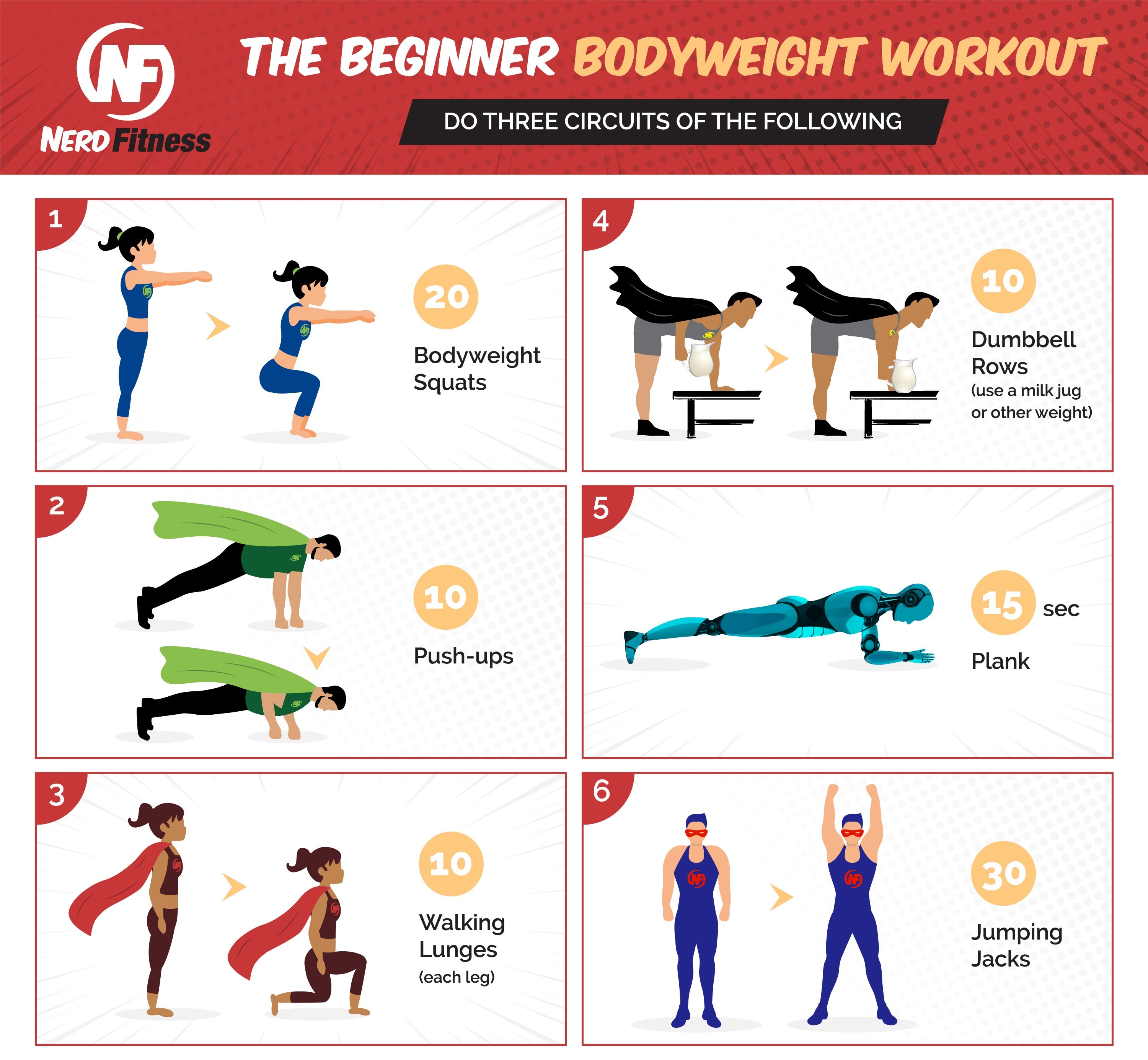
#1) BEGINNER BODYWEIGHT WORKOUT:

Our Beginner Bodyweight Workout has a variety of rep ranges to promote endurance, strength, and cardiovascular health.

Complete one set of each exercise and then moving directly to the next exercise:

  • 20 bodyweight squats
  • 10 push-ups
  • 20 walking lunges
  • 10 dumbbell rows (using a gallon milk jug)
  • 15-second plank
  • 30 Jumping Jacks
  • Repeat for 3 rounds

Want to stick with bodyweight training? When you’re ready to level up, check out our advanced bodyweight training circuit.[13]

Otherwise, you can move onto weight training when you feel comfortable!

#2A) BEGINNER NERD FITNESS DUMBBELL WORKOUT

If you are just getting started with dumbbells and you’re looking for a beginner workout program to follow, this is our Level 3 Gym Workout, “Dumbbell Division”:

  • 10 goblet squats
  • 10 push-ups
  • 10 dumbbell rows per side

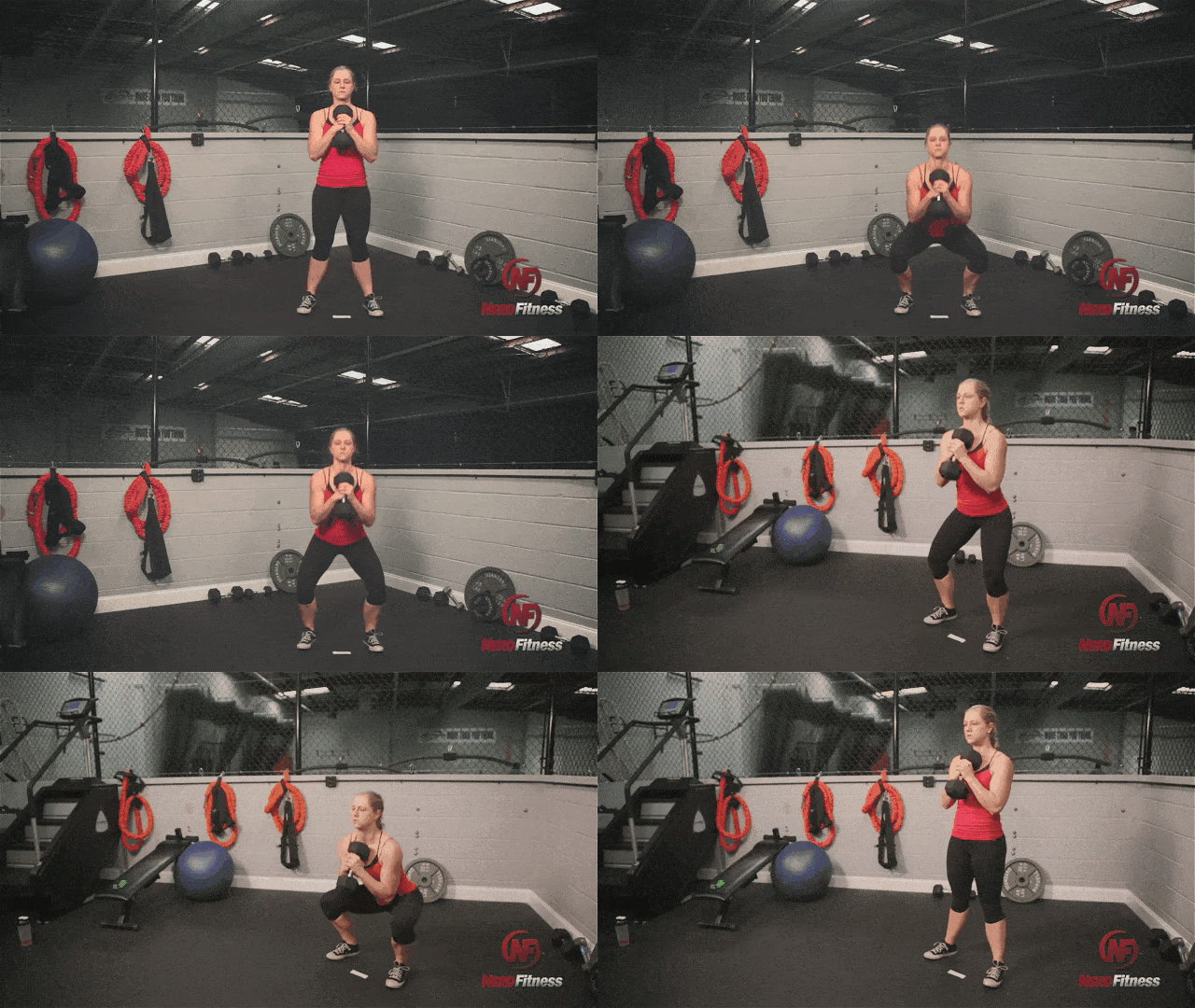
I knew you’d ask, so here is Goblet Squat video explanation (from Nerd Fitness Prime):

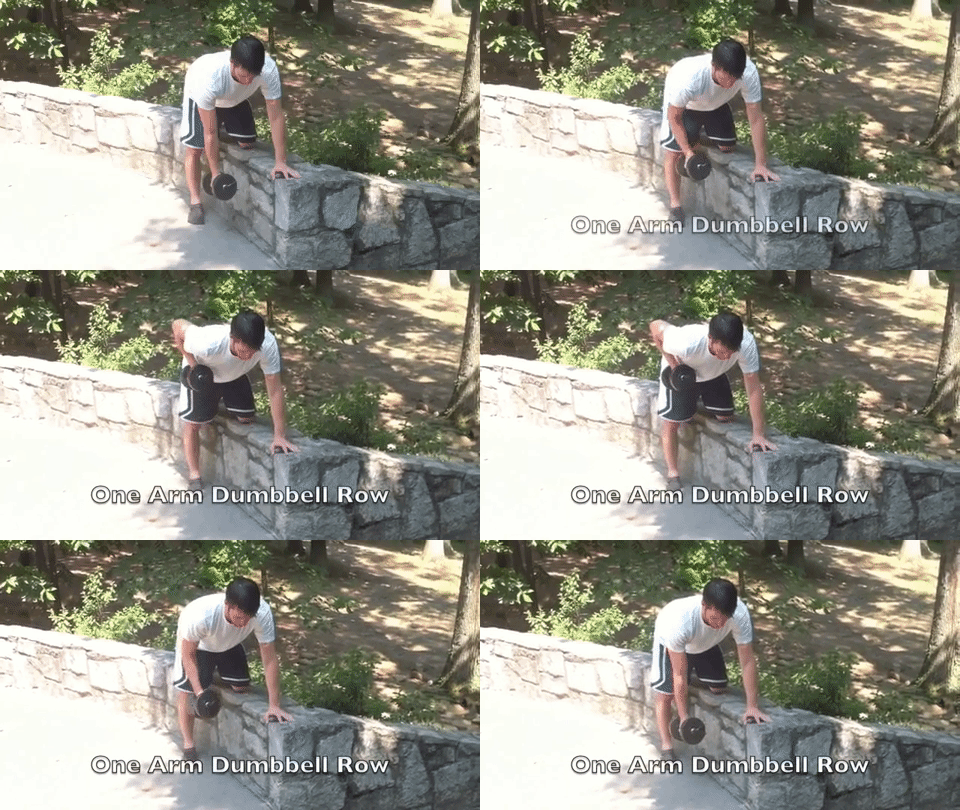
And here is our video on how to do dumbbell rows:

#2B) BEGINNER NERD FITNESS KETTLEBELL WORKOUT

Our Beginner Kettlebell Routine is a workout you do anywhere you have room to swing a kettlebell.

So, probably not in a phone booth or a closet or a bathroom stall. But other than that, pretty much anywhere else.

Complete 3 Kettlebell Workout Circuits:

  • 8 Halos (each side)
  • 10 Goblet Squats
  • 8 Overhead Presses (each side)
  • 15 Kettlebell Swings
  • 8 Bent Over Rows (each side)
  • 6 Front Rack Reverse Lunge (per side)

#3) BARBELL TRAINING: 2 DAY WORKOUT SPLIT

As we cover in our “How to Train in a Gym” guide (where we take you from “lost sheep” to “barbell badass”), this routine is a much more focused weight training, strength building workout that gets your feet wet with barbell training. Click on ANY exercise to learn how to do it properly.

NF BEGINNER BARBELL STRENGTH WORKOUT: DAY A

Do 3 rounds of:

NF BEGINNER BARBELL STRENGTH WORKOUT: DAY B

Do 3 rounds of:

WHAT ARE SOME OTHER POPULAR STRENGTH TRAINING PROGRAMS?

#1) “Starting Strength” is considered the gold standard beginner barbell weight training program by many. We highly recommend you pick up the actual book if you are serious about barbell training – it’s one of the most important training books you can ever read.

#2) Strong Lifts 5X5: A solid workout program that starts you out very slow, with just the barbell, and helps you master form before you get too heavy. It also keeps things VERY easy with “do 5×5.” Strong Lifts has been around for a long time and is a solid program.

#3) Jim Wendler’s 5/3/1: This program allows you a little more freedom to do exercises that you enjoy, or work on personal weaknesses, because you choose some of the assistance work.

Note: You can modify any of the barbell training programs to be done with dumbbells, if that’s what you have at home!

Lastly, you can always write your own workout planI wrote my own workouts for a decade and it taught me a LOT about training and health.

We do have our own 1-on-1 Online Coaching Program where you’ll work with a coach that will build a strength training workout program for your body type and goals, check your form on each exercise via video, and even help you plan out your nutrition too.


How Much Weight Should I lift?

Is this LEGO lifting too much or too little for his strength training?

We have a FULL resource on how to determine your starting weight for lifting, but I’ll give you the gist here.

The simple to learn but tough to implement answer: lift enough so that you can get through the set, but not too much that you have NO fuel left in the tank at the end.

And then, try to lift sliiiightly more than last time.

Here are two common questions on strength training:

#1) How much weight should I start with?

  • If you are using dumbbells or a kettlebell, always err on the side of “too light” versus “too heavy.” You want to learn the movement correctly and build correct form.
  • If you are training with a barbell, ALWAYS start with JUST the bar, no matter the exercise (By the way, a standard barbell weighs 45 pounds).

#2) How fast should I add weight to the bar?

Here’s what we teach all of our coaching clients: add the minimum amount of weight each week you can, even if you THINK you can lift more. It’s better to finish a workout full of momentum and say “I can do more!” than defeated and saying “that was too much, crapola.”

Think of it this way, even if you are adding just 5 pounds per week to the bar, within a year you would be lifting 300+ pounds!

The National Strength and Conditioning Association (NSCA) recommends a similar approach:[14]

  • For less trained people (i.e., beginners), it is recommended that for upper body exercises you increase the load by 2 – 5 pounds and by 5 – 10 pounds for lower body exercises.
  • For more trained people (i.e., advanced), it is recommended that for upper body exercises you increase the load by 5 – 10 pounds or more and by 10 – 15 pounds or more for lower body exercises.

So go SLOW. Even slower than the NSCA recommends if needed.

Team NF’s Steve even bought little half-pound weights and increases many of his lifts by just 1 pound per week. It’s a big part of how he transformed (jokingly) from Steve Rogers to Captain America.

And if you are looking for this content in easily digestible form, make sure you download our free Strength 101 Guide when you join the Rebellion below:

The 9 Best Strength Training Exercises to Learn

If you’re new to all this “strength training” stuff, hopping into a program and going from zero to sixty might be a recipe for failure.

Instead, be patient, and take the time to learn these movements first.

I’m going to share with you the 9 best strength training exercises that every beginner should master (scroll down for full video and explanations!):

  • 1. Push-up: uses every push muscle in your body (chest, shoulders, triceps)
  • 2. Bodyweight squat: uses every muscle in the lower body (quads, hamstrings, glutes, core)
  • 3. Bodyweight row: works every “pull” muscle and helps prepare you for a pull-up!
  • 4. Pull-up or chin-up: the best “pull” exercise in history! Everybody should have a goal to get their first pull-up.
  • 5. Bodyweight dip: advanced “push” movement that targets your push muscles (chest, shoulders, triceps) in a different way than push-ups.
  • 6. Barbell squat: the best bang for your buck on muscle building. recruits nearly every push muscle in your whole body, and great core workout.
  • 7. Barbell deadlift: the favorite exercise of every coach at Nerd Fitness. Uses every “pull,” leg, and core muscle in your body.
  • 8. Barbell benchpress: as basic and powerful as they come. Uses every “push” movement in your upper body and can get you strong as heck!
  • 9. Barbell press: press the bar above your head! Targets shoulders and triceps more than the chest.

All of the exercises listed above are considered functional (closed-chain) exercises. That means they relate to our everyday movements and can be used to predict our success in sports, recreational and occupational activities, and activities of daily living.[15]

When attempting all of these above listed exercises, aim to master the movement and perform the exercise through its entire range of motion (ROM).

Why?

Because it will decrease your risk for injury, activate all of the appropriate muscle groups, and result in greater muscle hypertrophy.[16] 

Let’s go over these now.

Click on any of these exercises to get a FULL explanation of the movement, step-by-step:

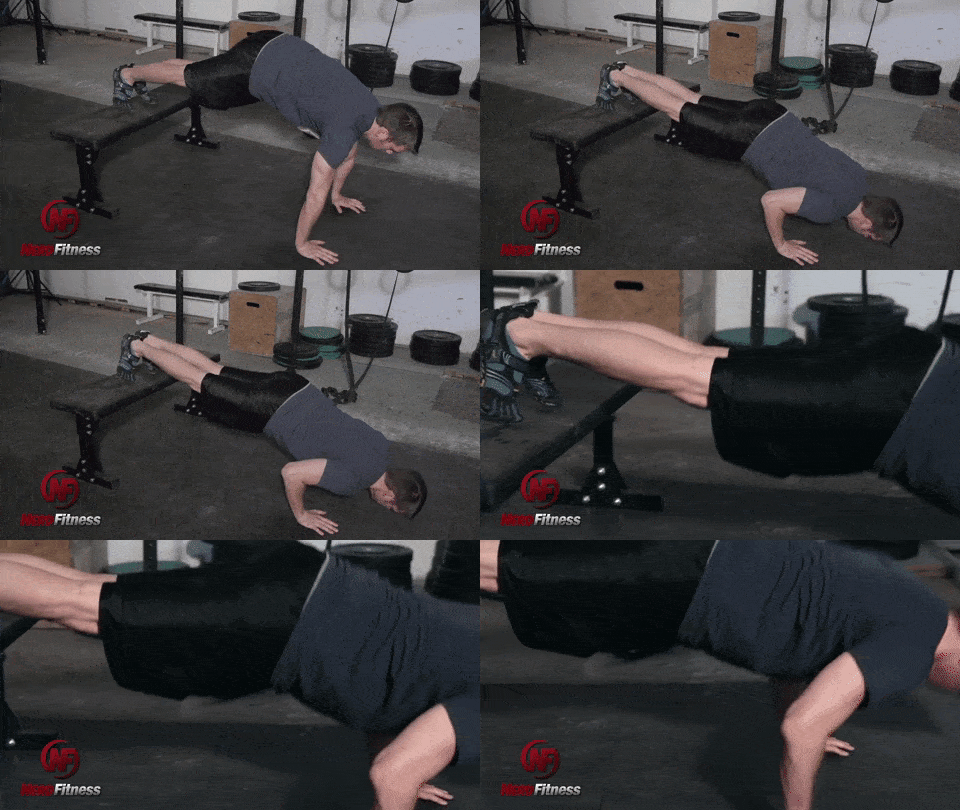
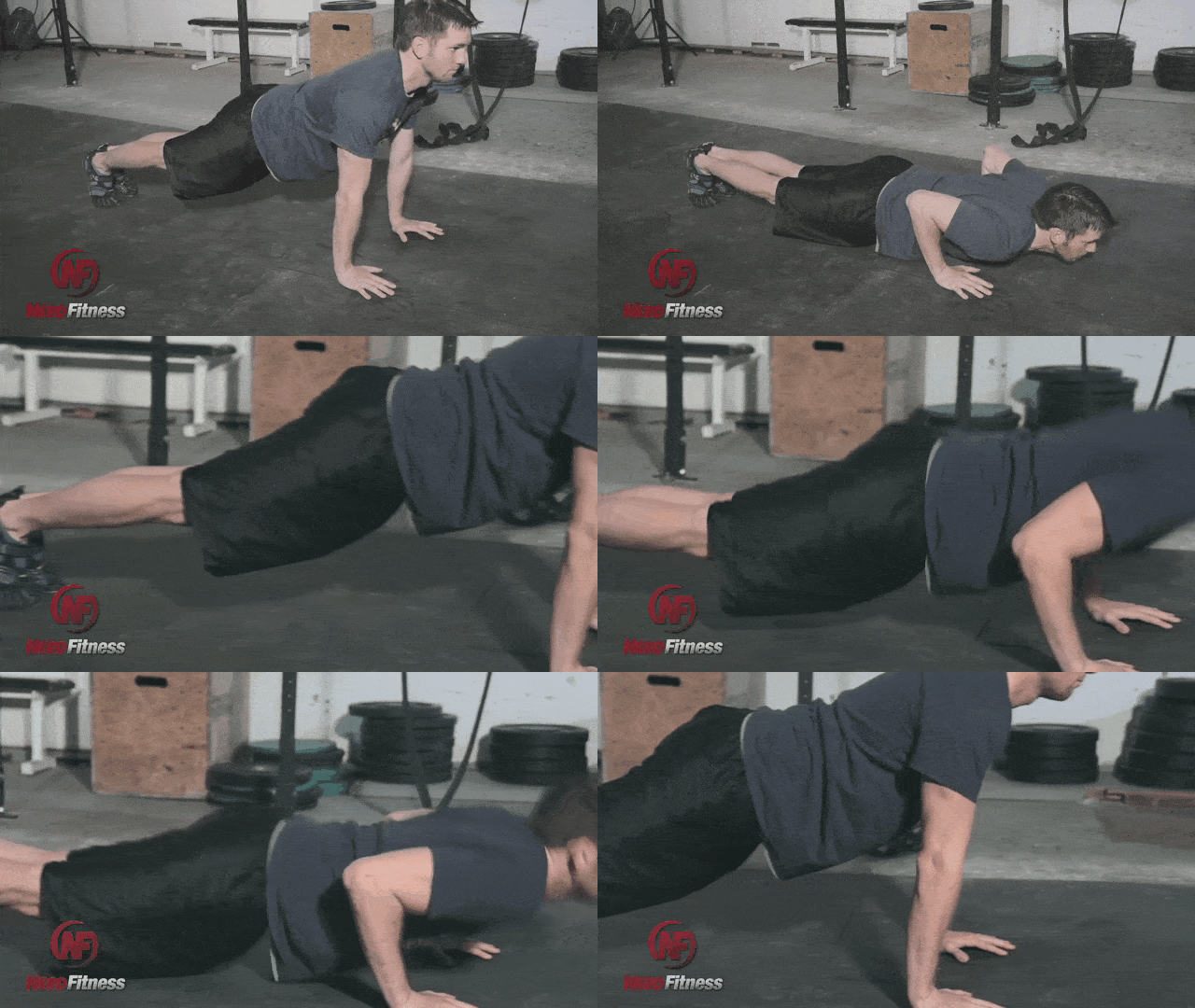
1) The Push-Up: The best exercise you could ever do for yourself when it comes to using your bodyweight for push muscles (your chest, shoulders, and triceps):

2) The Bodyweight Squat: This exercise serves a dual purpose: it is the foundation for building strength AND helps build proper mobility. If you are going to ever do barbell squats, you need to work on hitting proper depth with a bodyweight squat first!

3) The Inverted Bodyweight Row: Until you can get your first pull-up or chin-up, these exercises are GREAT to start building your pull-muscle strength: your back, biceps, and forearms.

4) The Pull-Up and Chin-Up: Once you can support your bodyweight above the bar, the world becomes your playground. No strength training routine should be without pull-up or chin-up work! (Click here if you can’t do a pull-up or chin-up yet?)

5) The Bodyweight Dip: As you start to get stronger with push-ups and need to find a way to increase the challenge, consider doing dips – warning: these are very advanced, but incredible strength building exercises.

And now we’re into the best weight training exercises:

6) The Barbell Squat: Probably the best exercise when it comes to building strength and muscle throughout your whole body. It also burns crazy calories and makes life better. This is a MUST:

7) The Barbell DeadliftMaybe the best exercise of all time. Actually no, it IS the best exercise of all time. It’s certainly the most primal: “pick the weight up off the ground. Done.”

This is a very technical lift, so make sure you read our article on how to do it with proper form:

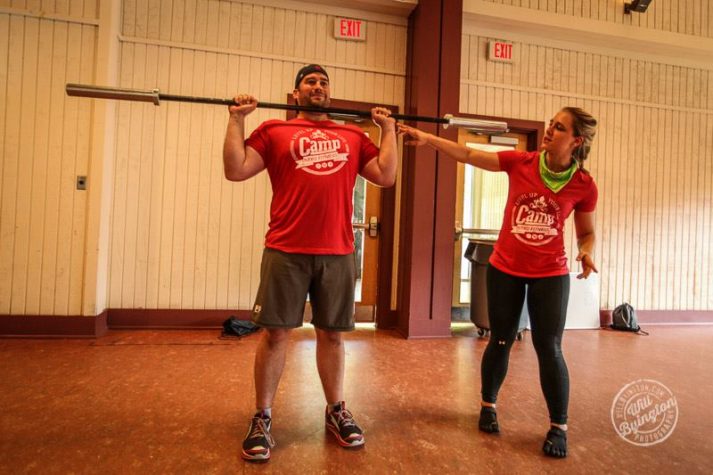
8) The Barbell Press: Press a barbell above your head. This recruits all of the muscles in your chest, shoulders, and arms in order for you to lift the weight over your head.

As a bonus, you need to really flex and brace your core, which gets those muscles working too.

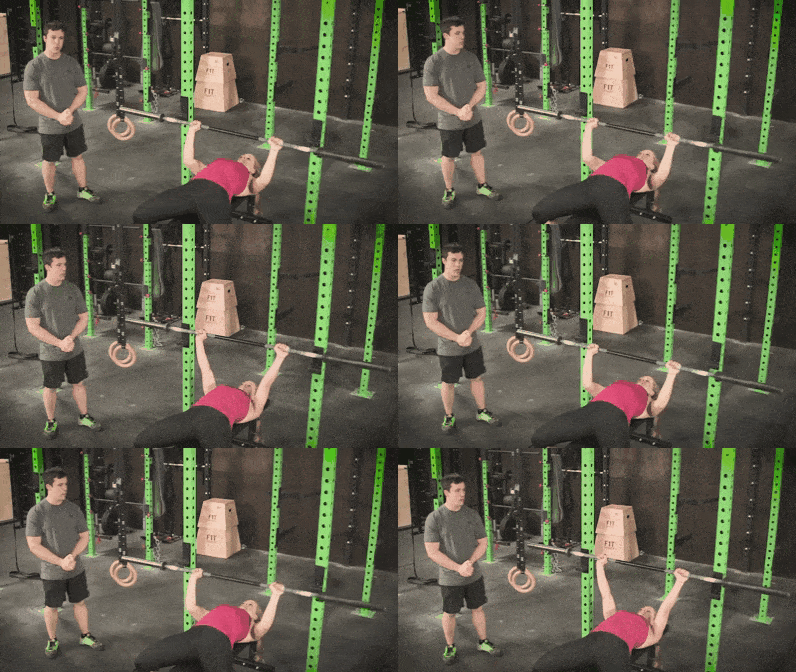
9) The Barbell Bench Press. Lie on a bench, and lower a barbell until it almost touches your chest. Pause, and press it back up towards the sky. Repeat! And get strong.

NOTE: All exercises were explained according to the guidelines that have been established by the NSCA.[17]

Your mission, should you choose to accept it: commit to trying ONE of these movements in the next week. Use 20 seconds of courage, recruit a friend who has lifted or trained before, and try your best.

And if you want somebody to help you put these into a workout program, teach you HOW to do these movements properly, and have the confidence to know you’re training correctly for your goals…


How to Know You’re Doing a Strength Training Movement Properly (Form Checks)

This cameraman knows a form check is valuable when it comes to strength training. And a raincoat in a storm. Both practical.

Always start out with just your body’s weight and make sure your movement is correct!

  • If it’s a barbell movement, use a broomstick (or PVC Pipe).
  • If it’s a dumbbell movement, use two sections of PVC or something else that is light and small to simulate a dumbbell.

When it comes to movements like squats, deadlifts, pull-ups, bench press, your form is crucial. Develop good habits with lightweight and you will save yourself months of frustration later and will protect you from injury.[18]

If you’re struggling with certain elements of a movement, don’t get frustrated! Remember, proper communication between your neuromuscular systems needs to develop.

Things will start to improve.[19] 

How do you know if your movement is correct?

Do regular video form checks! Record yourself and watch the video.

Some LEGOs taking a selfie

Alternatively, an expert reviewing your specific movement can be invaluable. 

If you’re looking for someone who can do video form checks, provide feedback, and adjust your workouts based on your progress, you can check out our 1-on-1 Online Personal Training!

I’ve had an online coach for 4 years and it’s changed my life.


You could also get expert guidance in person: Look around at your local strength and conditioning gyms and see if you could hire a coach (here’s how to find a good personal trainer) for one or two sessions just to go over the basic movements.

If you can’t do either of those two options, no big deal! Videotape yourself and compare it to the videos here in the articlesYou can also post your video to the form check section of the Nerd Fitness Forums.

When I started, I really liked practicing all of the movements at home because I could watch a video online at the same time as I was watching myself do it in a mirror. Studies have found this can actually help![20]

Strength Training for Weight Loss

Strength training like with these dumbbells is key for a weight loss program.

So you’re looking to lose weight, and tired of hours of cardio (me too).

And you’re wondering if strength training for weight loss – by following one of the workouts in this guide is a viable solution.

Or, gasp – will strength training make you too bulky? (SPOILER: it won’t)

Yes, Strength training will help you lose weight IF you do two key things for effective weight loss:

  • Calorie restriction: eating fewer calories than you burn every day[21]
  • Strength training with progressive overload (picking up heavier stuff)

As we point out in our “Cardio vs Intervals vs Weight Training” article, strength training is the MOST efficient method for weight loss.

Not only that, but you can find study after study after study that shows you the benefits of strength training for weight management when combined with “calorie restriction.”[22]

As we cover in our “Why Can’t I Lose Weight?” article, here’s why eating a caloric deficit and strength training is SO magical when combined:

When you strength train – by picking up something heavy – your muscles are “broken down” during the exercise itself, and then they rebuild themselves stronger over the next 24-48 hours.

Guess what happens during those 24-48 hours?

Your body will divert as many calories consumed as necessary to “Rebuild Muscle!”[23]

Look at me all big and strong!

It also diverts additional calories to “Burn as Fuel” to handle this increased “muscle rebuilding” activity.

This means two amazing things:

  • Your metabolism is revved up for this time period, burning more calories than normal.
  • Rebuilding muscle is a calorie-taxing activity!

Not only that, but when you eat a caloric deficit, your body doesn’t have enough calories to fuel all the day’s activities. In these instances, your body will pull from your stored fat to make sure all the work still gets done.

This is the trifecta of physical transformation victory:

  • You get stronger and keep the muscle you have.
  • You burn through the fat you’re trying to get rid of.
  • You’re decreasing your body fat percent and keeping your muscle = look good naked.

In other words, strength training + eating right is the BEST path for weight loss out there! And yes, in certain situations, you can actually lose weight AND build muscle at the same time.

Coach Matt explains how to gain muscle WHILE losing fat in this video:

So how do you put this into practice? Pick one of the strength workouts in this article. Calculate your daily caloric needs. Learn about healthy eating. And start.

In other words…

Pick up something heavy, and eat a vegetable.

These are the types of things we work on with our 1-on-1 Coaching Clients: helping them lift weights confidently and eat correctly for their goals! Let us help you:


“Just Tell Me What Strength Training Program to Follow!”

Relax, you'll be fine strength training, just like this little trooper is fine with his bear.

Okay! Unless you are collecting underpants, you should now have a workout program you want to try out!

“Staci, this is a lot, can you just TELL me what to do?”

Okay fine.

Here are the steps again for you:

STEP #1: PICK YOUR WORKOUT PATH:

A) If YOU ARE TRAINING AT HOME. Pick one of these 3 based on what equipment you have:

B) IF YOU ARE TRAINING IN A GYM: Amazing! I love gyms.

Read our “How to train in a gym” guide and go from Level 1 to Level 6 over the next month. Gym closed? Here’s how to build a home gym.

STEP #2: TRY A NEW EXERCISE: In addition to following a workout program, I’m gonna push outside of your comfort zone – that’s where real growth happens.

Learn ONE new movement this week.

Pick one of the exercises below and try it out!

Here are 42 bodyweight exercises you can do too.

STEP #3) HIRE A YODA: If you are somebody that just wants to be told exactly what to, how to train for your goals, and are good at following direction, consider hiring a coach.

I’ve been working with an online coach since 2014 and it has changed my life – and I do this stuff for a living!

Nerd Fitness Coaching Banner

STEP #4) JOIN THE REBELLION! If you like how we do things around here at Nerd Fitness, we’d love to have you in our community of misfits, mutants, and rebels!

Sign up in the box below and I’ll send you our free Strength 101 guide:

No matter what you do today:

Don’t be afraid of doing anything wrong – truth be told, the majority of the people in the gym don’t have any idea what they are doing, and are just as nervous as you are!

Muster up your 20 seconds of courage if you need to, and let me know in the comments how it goes!

What questions do you have about getting started?

So, what’s the biggest thing holding you back from starting strength training?

-Staci

PS – Check out the rest of the articles in our Strength Training 101 series:

photo source: LEGO bench pres, tonobalaguer © 123RF.com, Stormtroopers lifting, Chris Christian:Strongman, W_Minshull: Stormtroopers in Gym, Lego Lifting, RainstormKristina Alexanderson: Teddy Love

The post 5 Best Strength Training Workout Routines For Beginners (Home & Gym) first appeared on Nerd Fitness.

from Nerd Fitness: Helping You Lose Weight, Get Stronger, Live Better. https://ift.tt/exLs9yM
via IFTTT
Categories
Uncategorized

#healthyliving #holistic #nutrition Q&A: how I de-stress, the weekly task I don’t enjoy, and tips to stay active

Today we’re diving into an “Ask Me Anything” episode, where Robins answers your most asked questions from Instagram.. 

The questions Robin answers today are the ones that she thinks will have the most impact, and hopefully help as many people as possible.

Some are informative and specific to Pilates and exercising, and some are more personal as Robin reveals how she balances being a mom of 4, a wife, while running a business. You’ll also get a look at the new and exciting things that are coming to The Balanced Life this year! 

Show highlights: what you can look forward to in this episode!

  • By loving her career and being a mom so much, it gives Robin the ability to balance things as she moves through different seasons in her professional and personal life
  • Robin doesn’t necessarily enjoy meal planning, but the real value in meal planning comes from reducing decision fatigue.
  • How Robin and Matt are teaching balanced living to their children.
  • Find time in your day to find at least one thing that you do daily to de-stress. 
  • Robin gives specific questions you can ask yourself to determine when is the best time to work out for you.
  • Movement can be medicine, and look at your health as an investment! Robin shares how to jumpstart your fitness routine if you don’t feel like you have the time or energy, or you’re dealing with chronic pain.
  • Having a negative relationship with exercise actually led Robin to what she does today, and everything changed for her when she found Pilates.
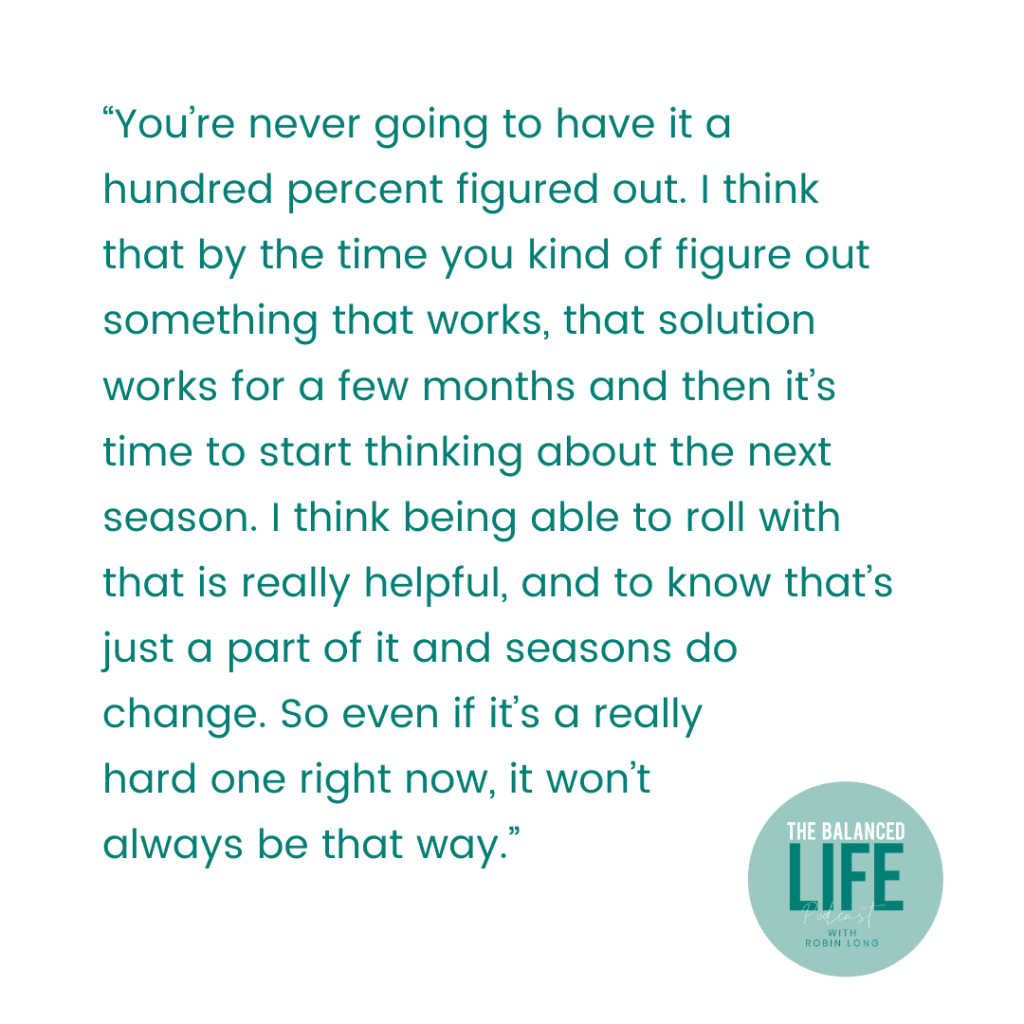
  • You don’t have to be perfect when it comes to your exercise routine, and give yourself grace, especially if you’re also raising children. Make small changes, and those small steps will add up to big results. 

Links in this episode:

Share this podcast episode!

The post Q&A: how I de-stress, the weekly task I don’t enjoy, and tips to stay active appeared first on The Balanced Life.

from Blog – The Balanced Life https://ift.tt/ktpxafP
via IFTTT
Categories
Uncategorized

#holistic #getfit #nutrition The Star Wars Workout: Begin Your Jedi Training!

It's Star Wars time!!!

It’s time to start training like a Jedi!

We love Star Wars around these parts (our site is literally called “Nerd Fitness”), so you’re in the perfect place to begin your training, my young Padawan. 

We specialize in creating nerdy themed workouts and today one of our coaches will walk you through an exercise routine that would make even Mace Windu proud. 


Here’s what we’ll cover in today’s guide:

Grab your lightsaber and let’s punch it!

The Star Wars Workout

A photo of some Star Wars LEGOs

Workout Summary: This workout includes a number of explosive movements meant to fire up your nervous system, build explosive-muscles, and get your body to start thinking “power!”.

It also includes some static holds, whole-body movements, and even grip strength moves.

THE STAR WARS WORKOUT:

Time: 30-45 minutes

Equipment needed:

If you’re having trouble finding any of the above items, we walk you through some clever replacements in How to Build a Home Gym (When Everything is Sold Out).

ALWAYS: Start with a warm-up and end with a cool-down stretch.

Here’s another warm-up sequence you can run through:

Here’s another cool-down routine you can try:

Part 1: SkyWalker Handstands

This is an awesome photo

Here’s the first part of your Jedi Workout:

  • Padawan: 3 sets of 30-second knee or feet front plank
  • Knight: 3 sets of 30-second push-up position taps or pike shoulder taps
  • Master: 3 sets of 30-second wall walks

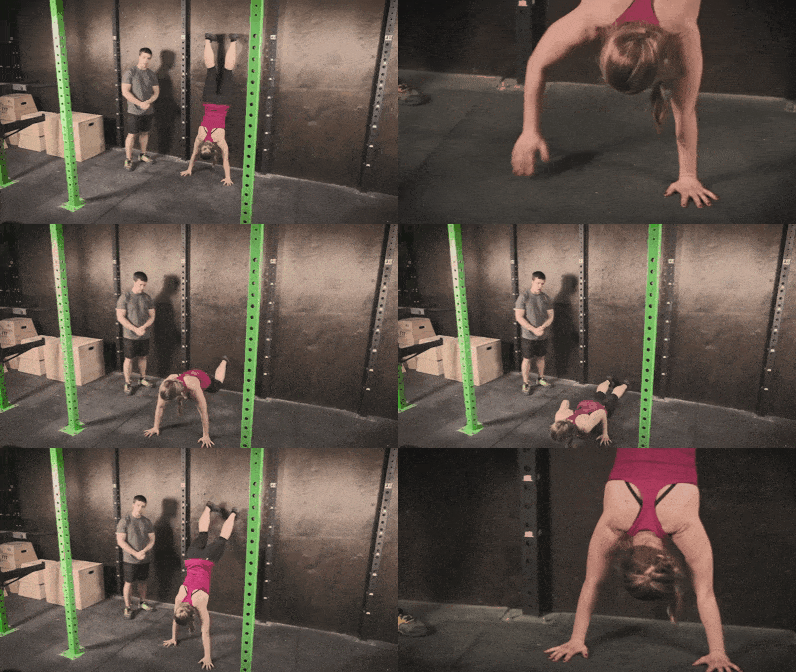
If you’re gonna do Jedi training, someone is going to make you do a handstand:

A classic scene from the Empire Strikes Back

Here are some variations to consider:

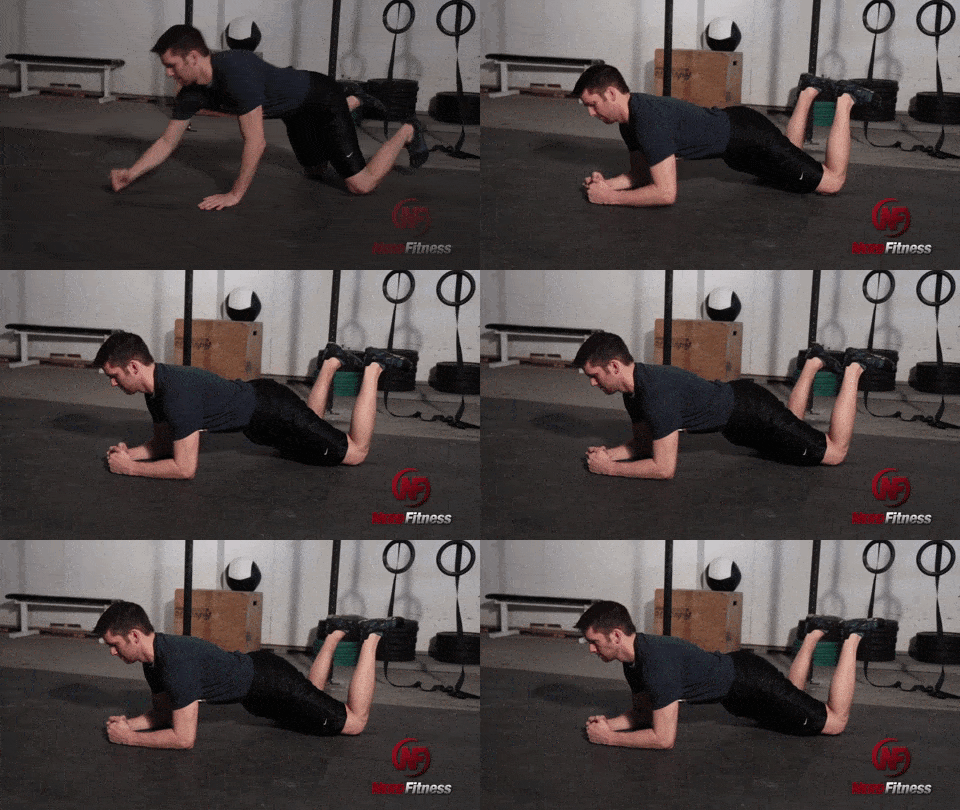
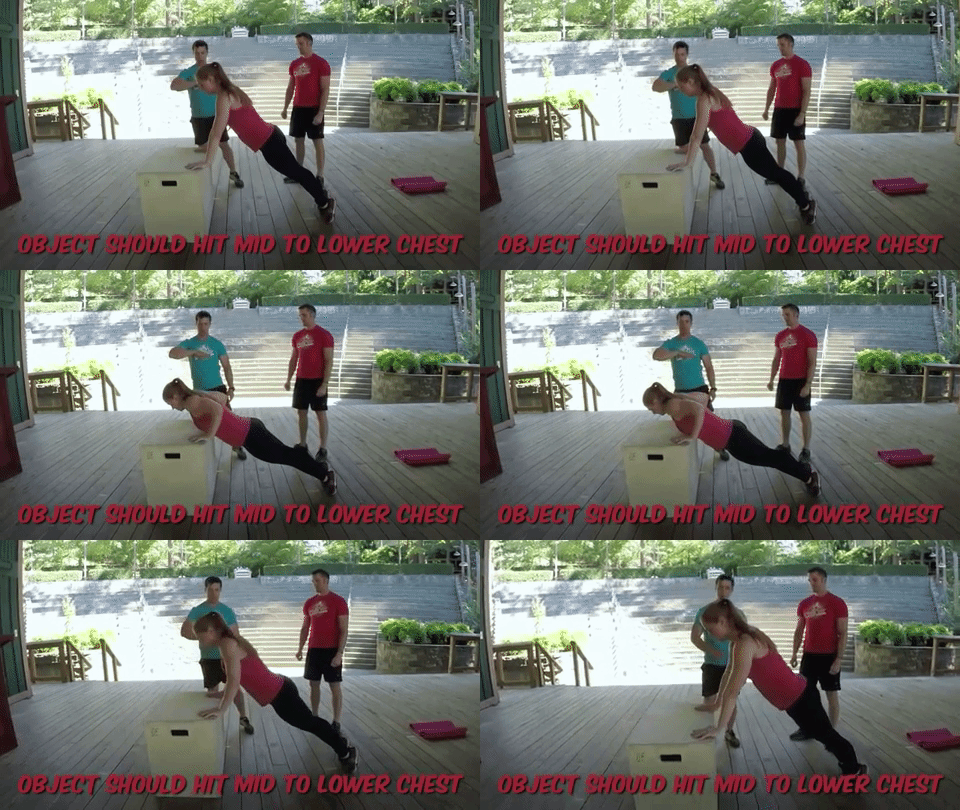
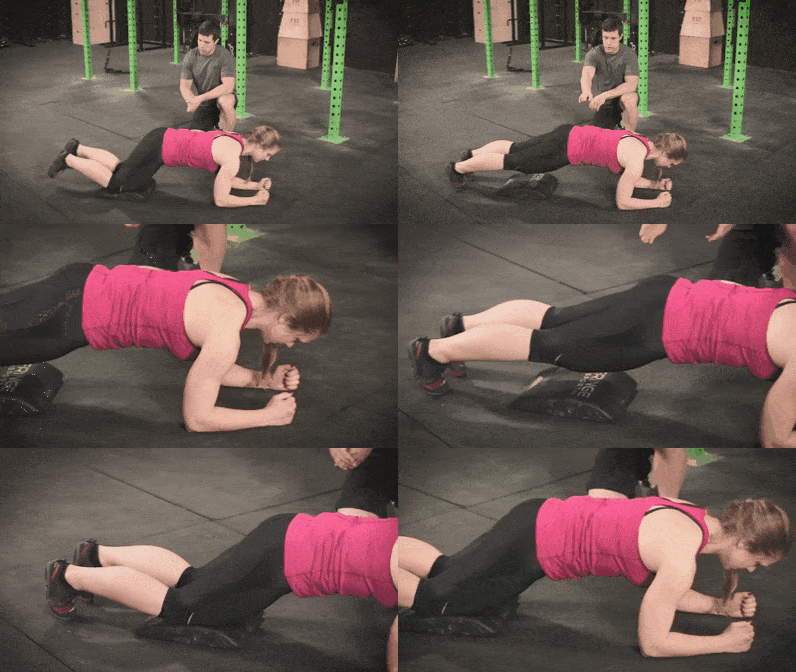
For Padawans, your knee planks will look something like this:

If you can't do a normal plank, start with doing them on your knees until you can advance.

Shoulder taps are like so:

Coach Jim performing shoulder taps

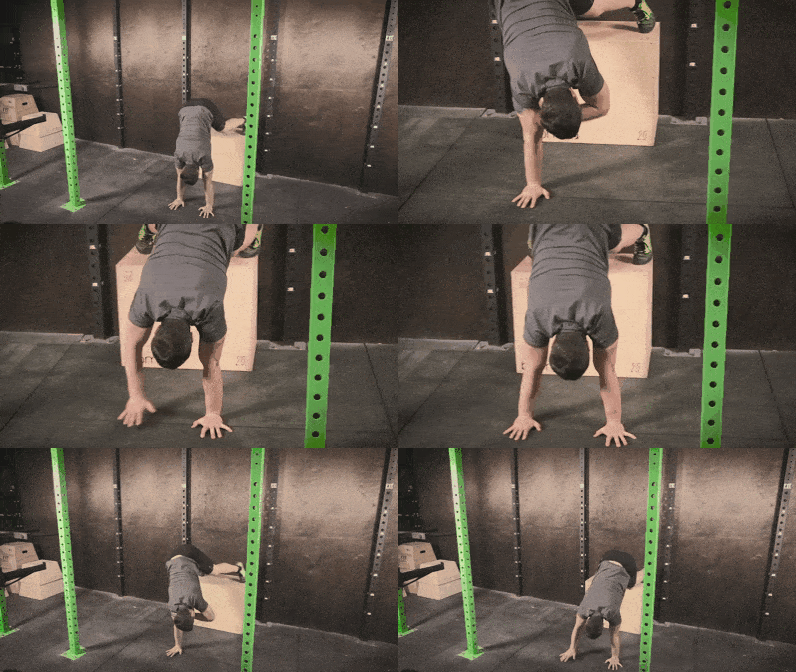
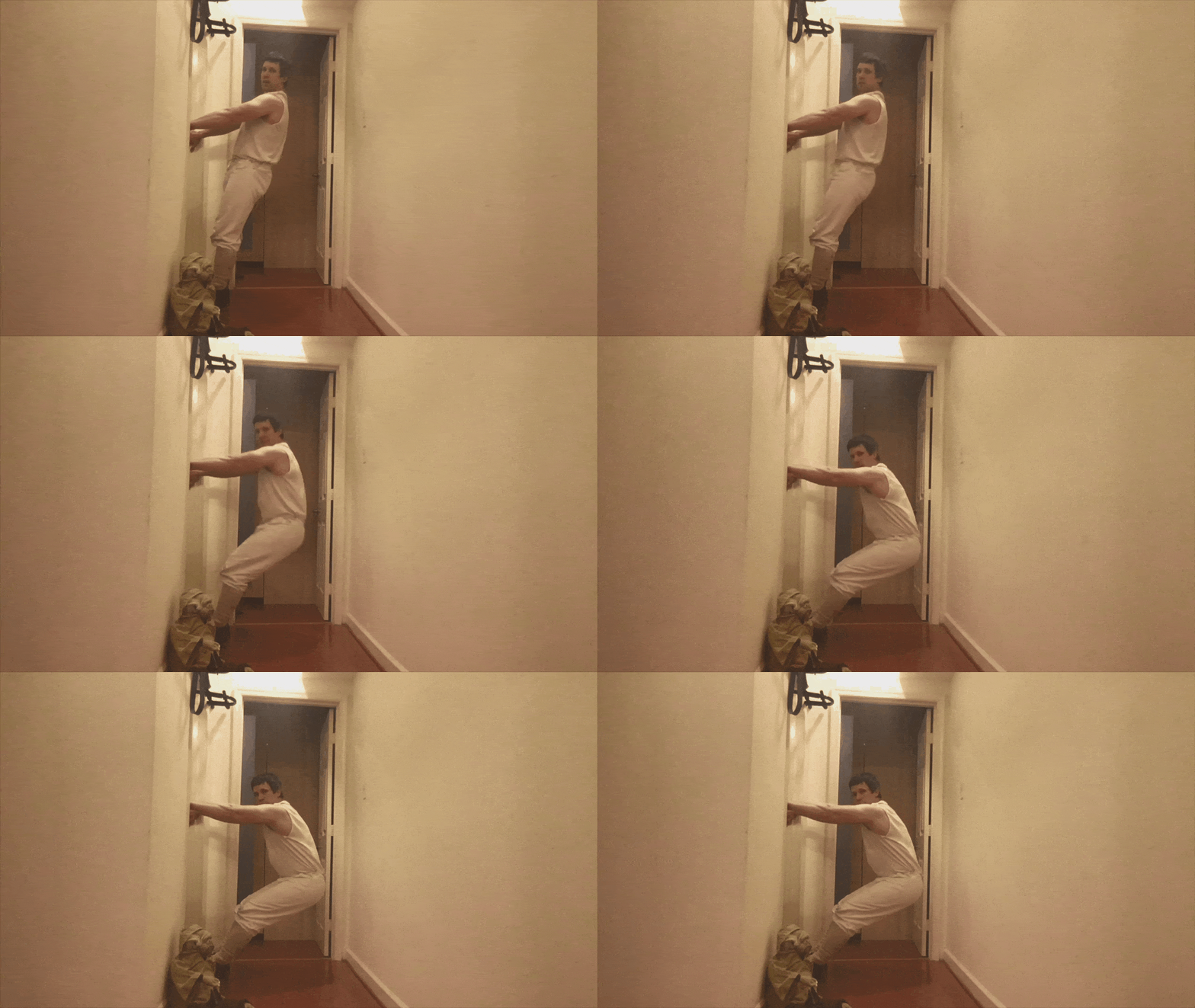
A wall-walk, would look something like this:

Coach Staci showing you the wall walk hold

If you can do one-arm handstands like Luke, go ahead and do those here. Then use your Force-telepathy to tell us how it goes.

If you want to become a handstand master, we have a full course found in Nerd Fitness Prime that would make Yoda stoked.

Part 2: Jedi High Jumps

I guess Yoda did jump about in the prequels.

Here’s the second act of your Jedi Workout:

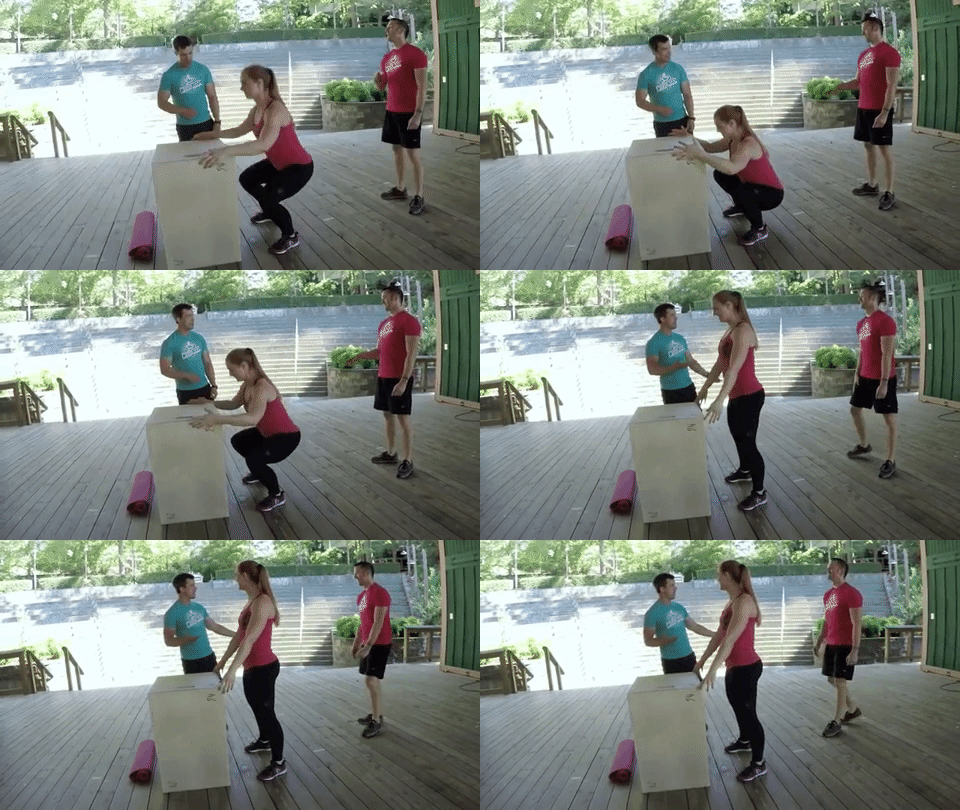
  • Padawan: 3 sets of 10 assisted squats or squats
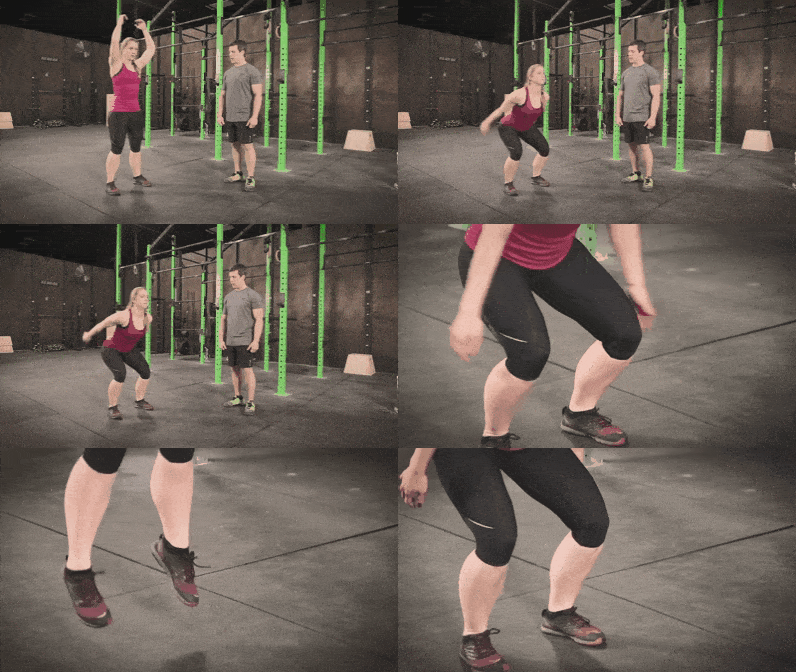
  • Knight: 3 sets of 10 jump squats
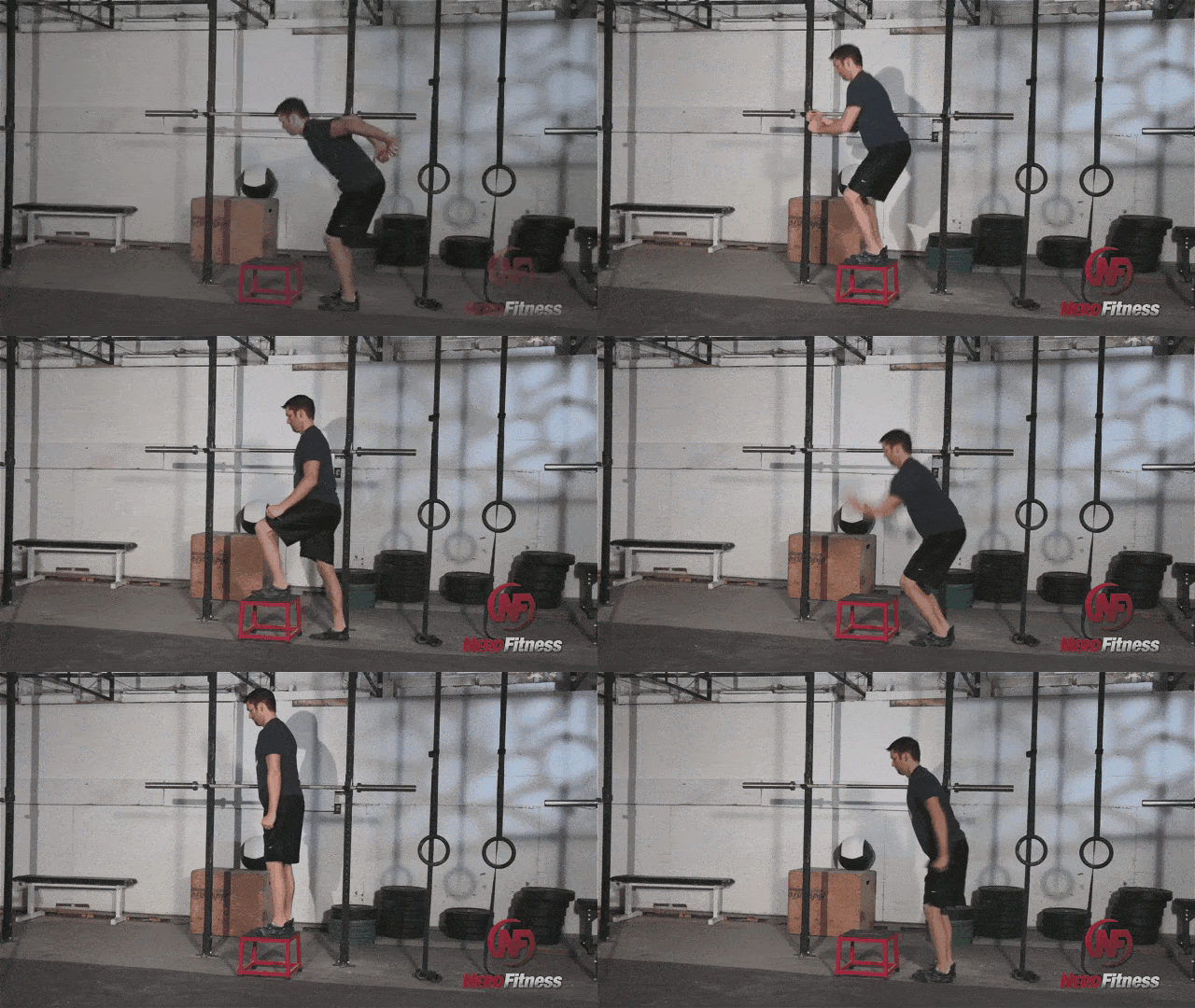
  • Master: 3 sets of 10 box jumps (STEPPING DOWN AFTER JUMP!) or tuck jumps (bringing the knees up)

Young Obi-Wan needed to use his Jedi high jump skills to return to the proper level to meet up with Qui-Gonn Jinn and Darth Maul.

We want you to do the same.

Here are your Jedi jump variations:

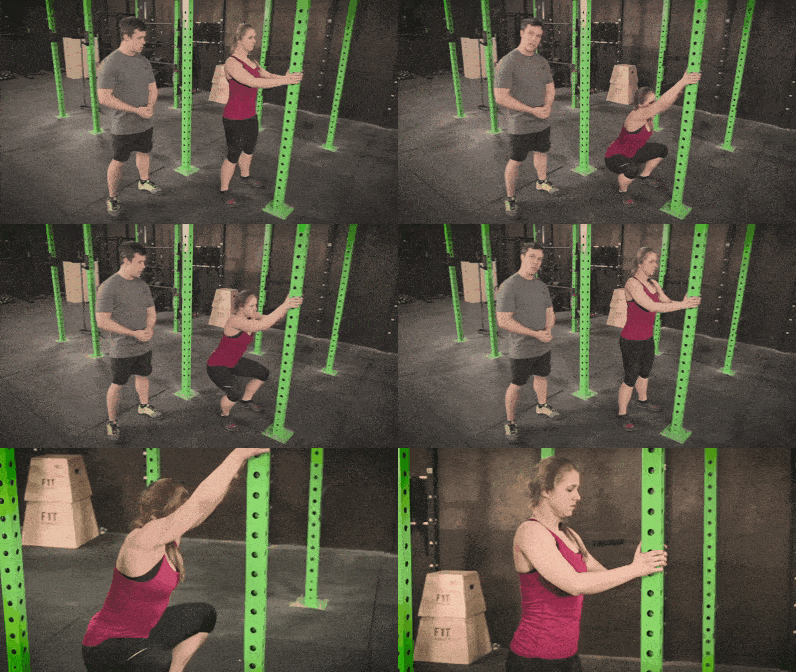
You could do squats or assisted squats:

All too easy? Go for jump squats!

Coach Staci showing you how to perform the jumping squat

True Jedi Masters will be doing tuck jumps or box jumps:

Be careful on your box jump! But it is a bodyweight exercise.

Rest: 1-2 minutes in between sets. Keep things safe – rest during the 30 second work period as needed. 

Part 3: Jabba the HutT Chokes

A toy set of Jabba's palace

For the third installment of the Jedi Workout, you’ll be doing:

  • Padawan: 3 sets of 10 doorway rows
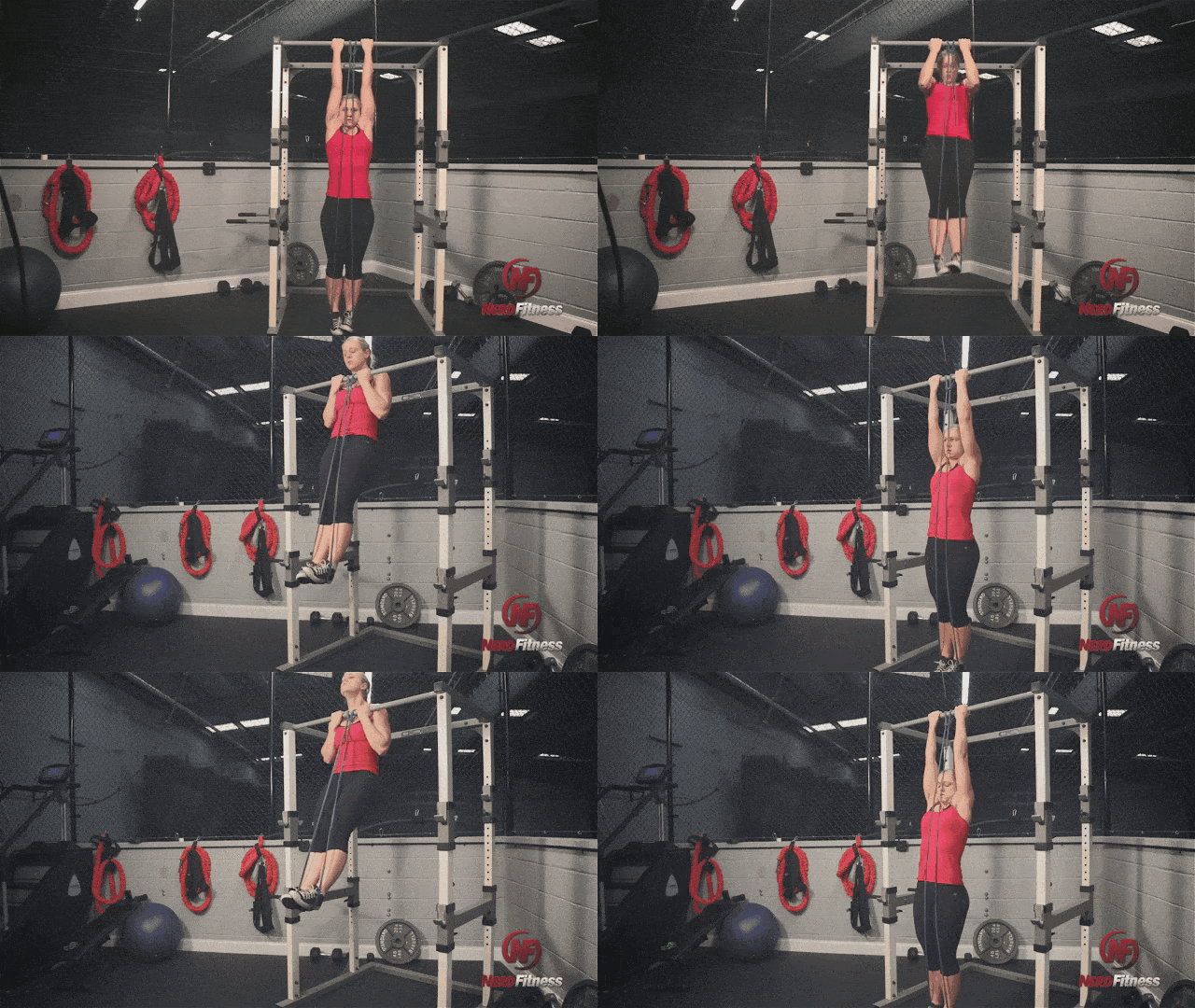
  • Knight: 3 sets of 10 towel doorway rows or band-assisted chin-ups
  • Master: 3 sets of 5-10 chin-ups

Is there anything more satisfying than watching Leia take out Jabba the Hutt? I know I let out a cheer when I first saw the scene:

We'll get you strong like this.

Leia is strong, and you need to be strong too.

Work on your pull-muscles by completing one of these “end Jabba” variations:

You can do rows from a doorway:

Coach Jim showing you the doorway bodyweight row

You can do towel doorway rows or band-assisted chin-ups: 

Coach Staci showing you how to do an assisted chin-up!

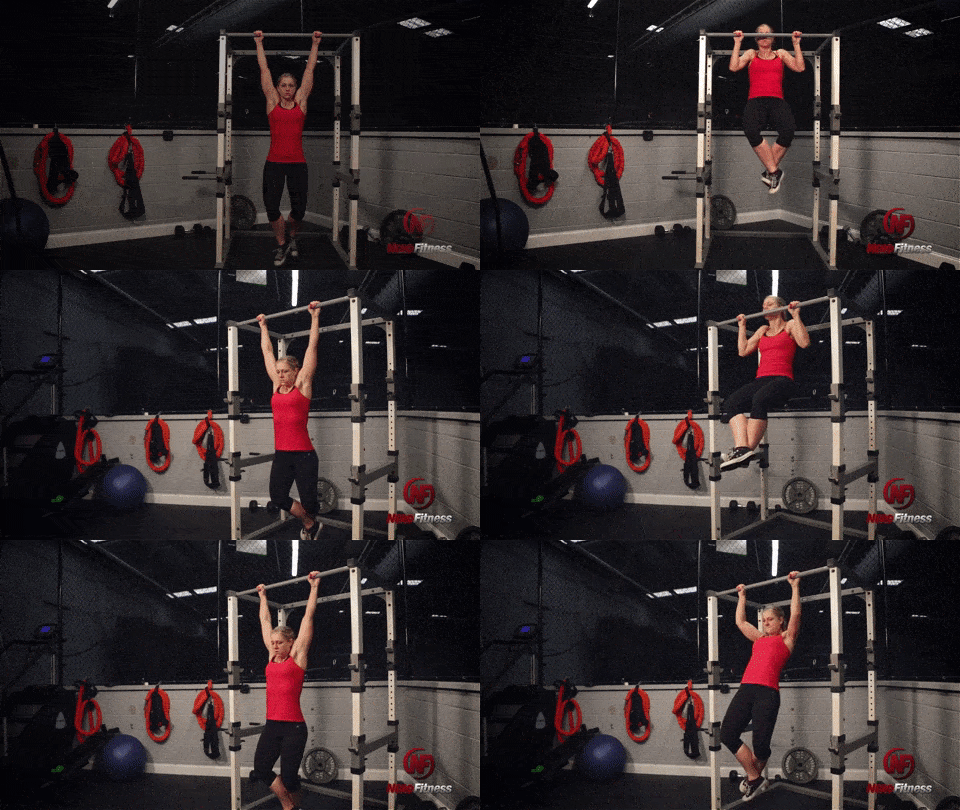
You’re training is complete when you can do normal chin-ups or pull-ups:

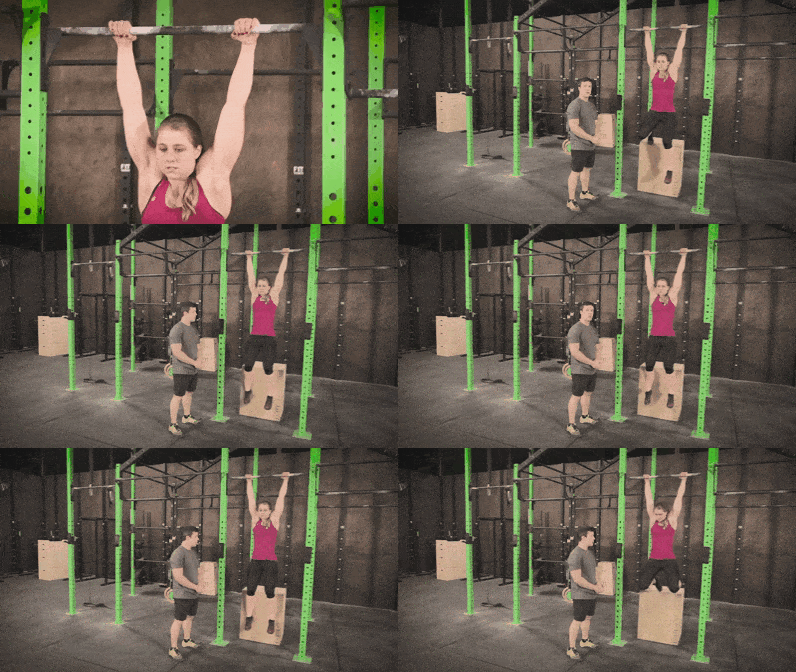
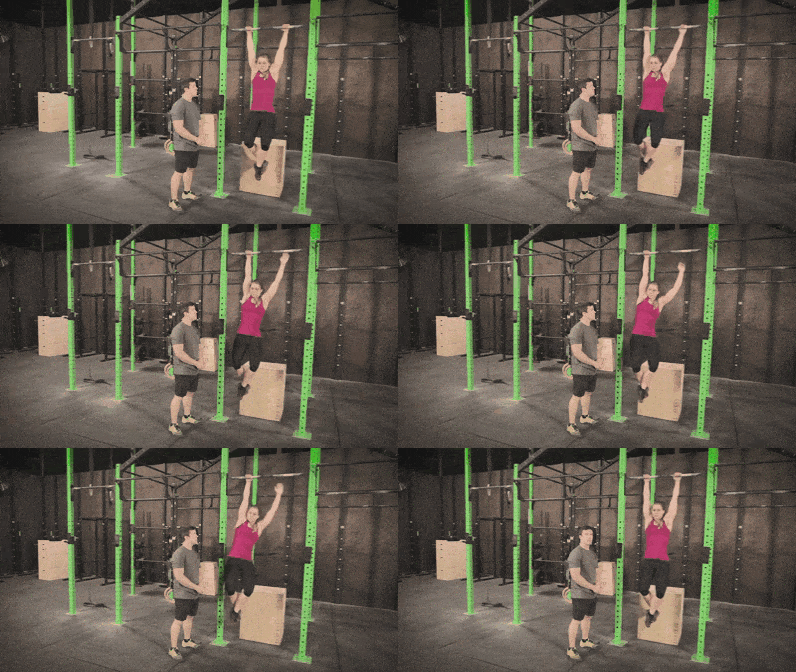
The classic pull-up

Rest: 1-2 minutes in between sets. Keep things safe – rest during the 30 second work period, as needed.

Part 4: Chewbacca carries

Chewbacca with a "free hugs" sign

The Jedi Workout for episode IV will be:

  • Padawan: Farmer-carry (Farmer’s Walk) dumbbells – 2 x 60 seconds 
  • Jedi: Rack carry – 2 x 60 seconds 
  • Master: Rack carry with some lunges – 2 x 60 seconds

Chewy is strong. Freakishly strong. He has no problem carrying robots, people, ripping people’s arms off, and more:

A true badass.

We want you to channel your inner Chewbacca by working on carrying heavier weight!  Feel free to try any of the variations:

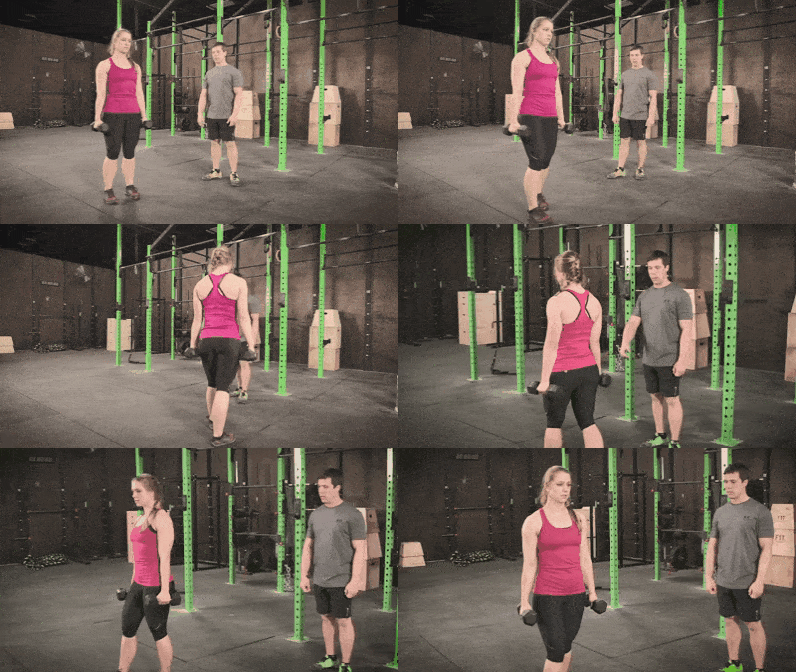
Farmer’s walks can be done with dumbbells or some impromptu weights:

Coach Staci showing Farmer's Walk

Walk or stand for 60 total seconds with weights at your side.

Rack carry:

Walk or stand for 60 total seconds with weights at shoulder height. 

The Jedi Master Variation: Rack carry with some lunges – 2 x 60 seconds –

Walk or stand for 60 total seconds with weights at shoulder height. Master-level if you’re able to knock out 10 total lunges (5/side) during that time).

The goal with Chewbacca Carries is to pick up the heaviest weight (or luggage) you can manage and then carry it around your house for the set amount of time. This builds up bone density, tendon strength, and muscular strength, and fires up your body’s central nervous system.

Rest: Again, slow down 1-2 minutes in between sets. Keep things safe.

Part 5: Han Solo Shuttle runs

A picture of a Han Solo toy

I love Han.

He shoots first (literally) and asks questions later.

He also runs into situations where he might not have the upper hand.

Han does always find some trouble to escape form

This round of your Jedi Workout looks like:

  • Padawan: March in place for 3 minutes of intervals (6 sets of 20 seconds on, 10 seconds off)
  • Knight: High knees in place for 3 minutes of intervals (6 sets of 20 seconds on, 10 seconds off)
  • Master: Alternating sets of high knees and burpees for 3 minutes of intervals (6 sets of 20 seconds on, 10 seconds off)

A Tabata Timer might be helpful in setting your intervals here.

We’re having you mostly run in place because you’re probably trapped inside your house (or escape pod). If you have a big backyard, feel free to use it.

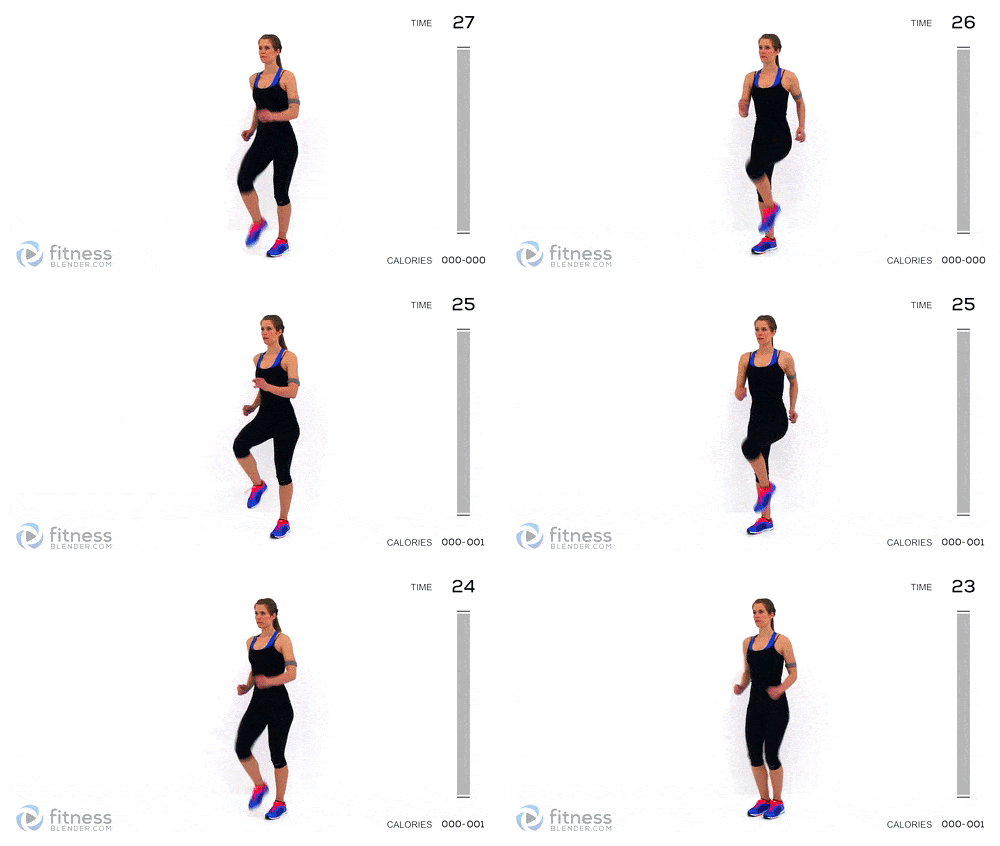
For our Padawans out there, you’ll march in place:

This exercise will be our Padawan

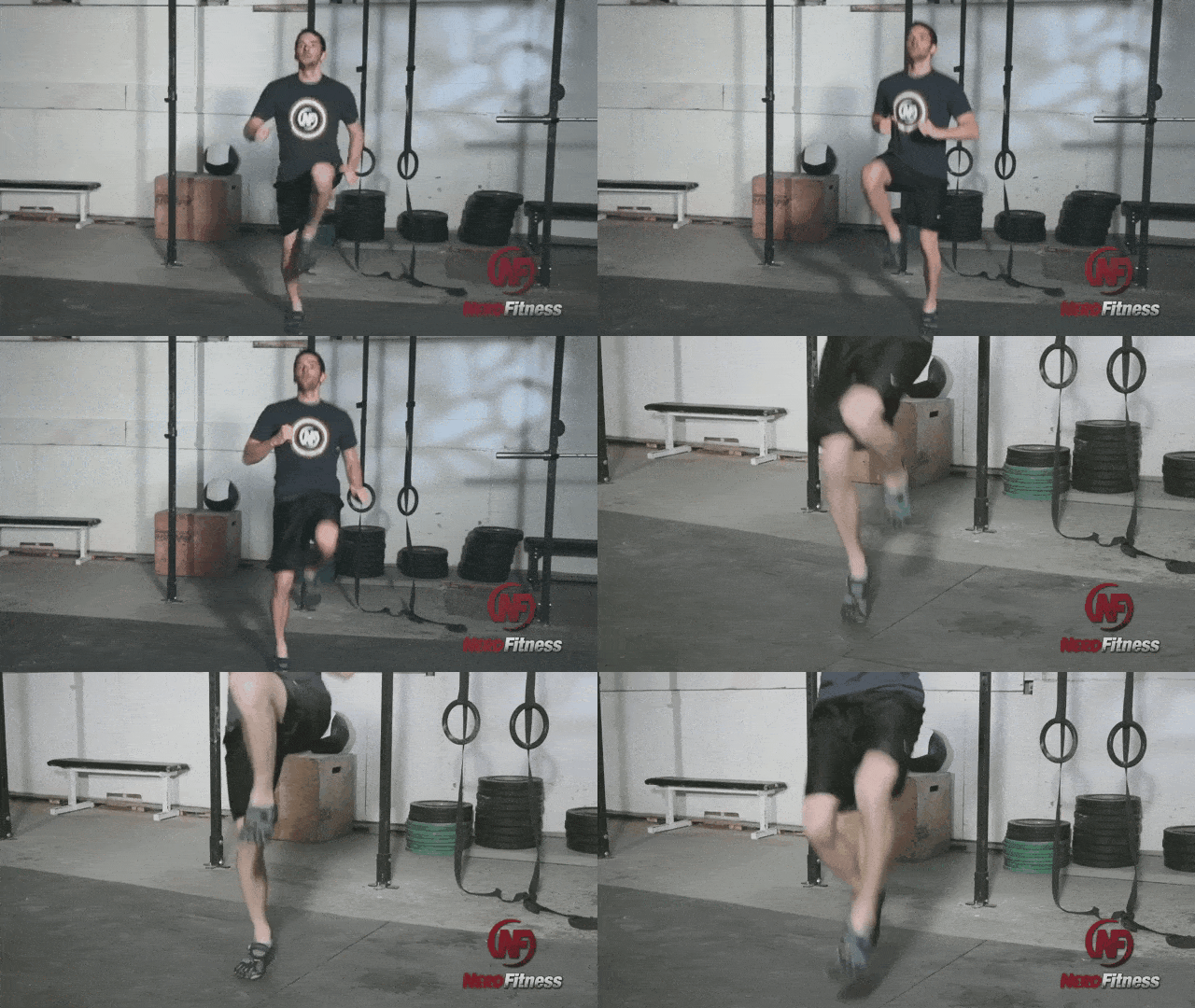
When you reach Knight status, do some high-knees:

Raising one knee after the other is a great level up to marching in place.

For the Jedi Masters out there? You’ll mix in some burpees with your high-knees:

The infamous burpee bodyweight exercise!

For this last variation, do alternating sets of high knees and burpees for 3 minutes of intervals:

  • 20 seconds of high-knees
  • 10 seconds of rest
  • 20 seconds of burpees
  • 10 seconds of rest
  • Repeat for three minutes

Email me if you make the run under 12 parsecs.[1]

Part 6: Force Push-Ups

A cool shot of Star Wars LEGOs

Part 6 of your Jedi Workout looks like:

  • Padawan: 4 sets of 8 elevated or knee push-ups
  • Knight: 4 sets of 8 push-ups or dive-bomber push-ups
  • Master: 4 sets of 8 pike or handstand push-ups

This is probably my favorite Jedi move. Channel the Force, and use it to violently PUSH things away? Awesome. Where do I sign up?

This would come in handy

Now, although we can’t actually Force Push in real life…yet, it doesn’t mean we can’t build up our explosive Force push muscles.

For our Padawans, you’ll do elevated or knee-push-ups:

Rebel Leader Steve doing knee push-ups

Our Jedi Knights will do normal push-ups or divebomber push-ups:

Rebel Leader Steve showing you the divebomber push-up

Are you now the master? Then you’re doing pike or handstand push-ups:

Coach Jim showing you the handstand push-up

Again, this can get sketchy if you start doing these last push-up variations while tired. Go ahead and rest whenever you need to.

Part 7: hanging Over the Sarlacc

This is a great LEGO pic

The last section of the Jedi Workout looks like:

  • Padawan: Doorway Leans – 2 x 60 seconds
  • Knight: Bar hang – 2 x 60 seconds
  • Master: One arm bar hang – 2 x 30 seconds for each arm

Sometimes, Jedi find themselves dealing with a creature that wants to digest them for 1,000 years.

A classic scene from Return of the Jedi

That’s where your hanging skills will come in use!

Another scene from Return of the Jedi

Our Padawans will start with some simple doorway leans:

Simply grab the edge of your door frame and lean back.

You’ll hold onto the edge of a doorway and lean back for 60 seconds of hang time – should feel harder on the grip than doorway rows

If you’re following our “Knight variations,” you’re going to be doing bar hangs:

Coach Staci showing you the bar hang

Not enough? Then train to hang from one arm:

Coach Staci showing you a one arm bar hang

This skill will become useful if you ever lose an upper appendage in a lightsaber duel (it happens to the best of us).

Note: this can be challenging on your joints if you’re not used to hanging, so progress slowly on this one! Start with just a few seconds and work your way up!

May the force be with you (Next Steps)

A picture of two Star Wars toys

Here’s a recap!

Complete this workout with regularity, and work your way up to the Jedi Master levels for each.

As I discuss in our guide, How to Build Your Own Workout Routine, I generally recommend newbies complete a full-body workout two to three times a week.

Our Star Wars Workout would be considered “full-body” since we hit every major muscle group. You could also alternate it with a more conventional strength training practice.

On your “rest days,” you can look into doing some active recovery, yoga, or fun movement.

If you can only get yourself to work out once a week, that’s okay! Let that become normal, then we can brainstorm ways to squeeze in an extra day. 

Building the habit of working out is our goal today. We can worry about maximizing “gainz” down the road. 

Don’t get me wrong, I’m all about maximizing gainz

Now the only thing left to do is start!

"Punch it," as Han would say.

Here are some options for next steps with Nerd Fitness

Option #1) If you want a professional coach in your pocket, who can do video form checks, provide feedback, and adjust your workouts based on the equipment you have available, check out our 1-on-1 Online Coaching Program

For example, let’s say you find yourself stuck indoors during a pandemic, and you want somebody to custom-build you a workout program based on the equipment and furniture you have. That’s where an online coach is a game-changer! 

Personally, I’ve been working with the same online coach since 2015 and it’s changed my life. You can learn more by clicking on the box below: 


Option #2) If you want an exact blueprint for working out at home (while doing nerdy-themed workouts!), check out NF Journey. Our fun habit-building app helps you exercise more frequently, eat healthier, and level up your life (literally).

Try your free trial right here:

Option #3) Become part of the Rebellion! We need good people like you in our community, the Nerd Fitness Rebellion (the real name).

Sign up in the box below to enlist and get our Rebel Starter Kit, which includes all of our “work out from home” guides.

Alright, I want to hear from you and your experience:

Did you try the Star Wars Workout?

What level are you on?

Any exercises that we missed that would be perfect for a Jedi?

Let me know in the comments!

May the Force be with you.

-Steve

PS: If you’re looking for more nerdy-themed workouts that can be done at anywhere, check out The 8 Best At-Home Workout Routines.

###

photo source: Leg0fenris: Dagobah, JD Hancock: Yoda Jump, JD Hancock: Han Solo vs Luke Skywalker, Boba Fett & the Sarlacc Pit, Teymur Madjderey, Darth Vader Force, JD Hancock: Han Solo, Pedro Vezini: Chewbacca, metaphorge: Jabba, Leg0fenris: Darth and Leia, Pedro Vezini: Yoda and Luke

gif source: walk in place,


The post The Star Wars Workout: Begin Your Jedi Training! first appeared on Nerd Fitness.

from Nerd Fitness: Helping You Lose Weight, Get Stronger, Live Better. https://ift.tt/Nu6ndEt
via IFTTT
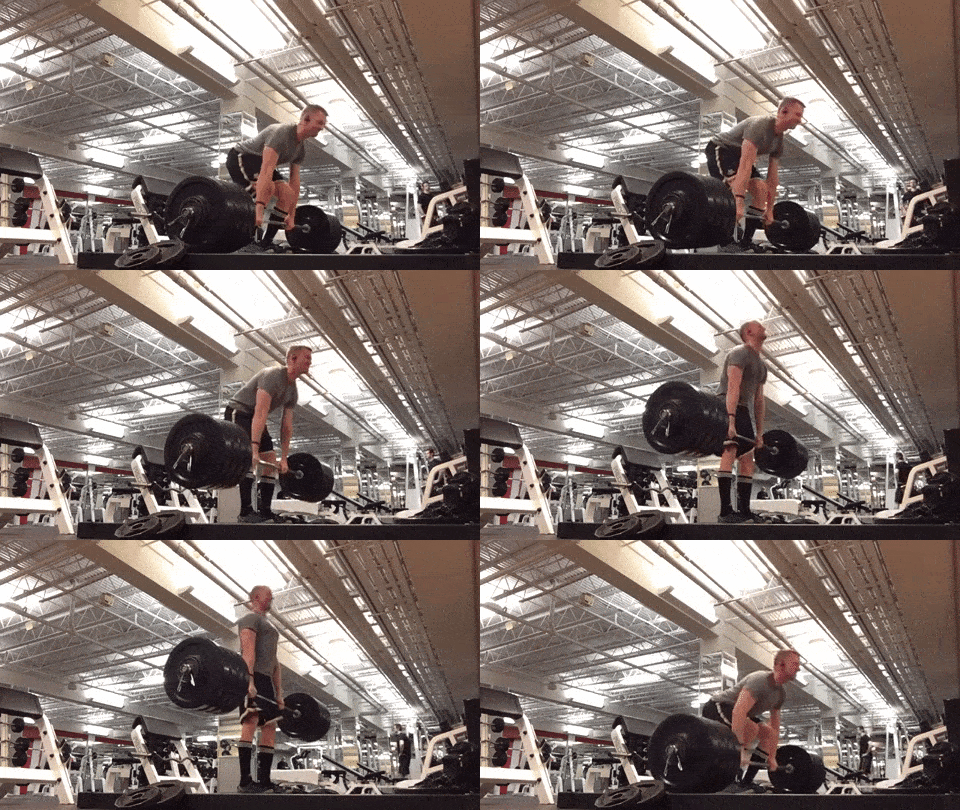
Categories
Uncategorized

#healthyliving #holistic #nutrition My favorite products + tips for hormone health

You know when you find something that feels like a total game-changer and you want to tell everyone you know? 

Well, over the past year, I’ve found several hormone-health-friendly products that have made a huge difference in my life that I want to share with you. They’ve helped me tackle stress, get better sleep, and improve my skin — all areas of my health that affect how I feel on a daily basis.

And while I’m by no means perfect, I do feel so much better as a result of making small changes to my daily routine and adding in these products.

Here are just a few that I’m loving lately…

This post includes affiliate links, which means The Balanced Life may receive a commission, at no cost to you, if you make a purchase through the link!

Favorite Products

  • Non-Toxic Cookware
    • Reducing exposure to hormone-disrupting chemicals in my food is essential. I love my Caraway set and Le Creuset (an investment for sure – I bought mine at their outlet) to help me reduce these chemicals on a daily basis.
  • Clean Beauty products
    • Your skin is your largest organ, so what you put on your skin is important! I love Osea for their serums + moisturizer, Ilia for their cheek stain, and Native Deodorant (I’ve been using this for years!).
  • Hydration
    • It’s no secret staying hydrated is an essential part of staying healthy! I love using my large hydroflask to keep water nearby all day and have Harmless Harvest Coconut Water on hand for days I’m feeling a little more depleted and want some extra minerals and hydration support.
  • Blue Light Blocking Glasses
    • Blue light can really affect our sleep and our body’s biological clock (AKA circadian rhythm) when we look at screens late at night or too close to bed. By using blue light blocking glasses, you help the production of melatonin, which helps keep your body to its natural timing and get better sleep. I love these glasses and TBL team uses them too!
  • Himalayan Salt Lamp
    • The warm pink and orange glow creates a calming and relaxing atmosphere within a room, helping to increase melatonin production for a comfortable night’s sleep.
  • Supplements
    • I’ve talked a lot about my daily supplements on the podcast here!

Routines + Habits

  • Winding down an hour before bed with an epsom salt bath + a good book to help prepare me for a good night’s sleep.
  • Keeping a lighter schedule in an effort to slow down (always a work in progress!).
  • Morning sunlight as often as possible – this helps by triggering my body to stop the production of melatonin and increase cortisol, to help me feel away and ready for the day!
  • Afternoon stretch + breathing breaks to calm my mind and refocus (and lowering stress-related hormones).
  • Daily Pilates to help release endorphins and serotonin to help me feel my best (you aren’t surprised by that one, are you?).

Nourishing meals + snacks

  • I’ve been making a lot of smoothies with blueberries recently, like this one from Recipe Central! Smoothies are a great way to sneak in a lot of nutrients and help reduce inflammation.
  • Eggs for breakfast for a solid protein and nutrient-rich start to the day. I love a good breakfast bowl! I also do my best to eat within an hour of waking to help keep my hormones and insulin balanced throughout the day.

While swapping out products isn’t a cure-all, simple changes to our products and routines can have a direct impact on our health and the way we feel each day, so I hope you find these helpful and are able to make small steps towards your healthiest self!

xo,

PS – These products and recommendations should not be considered medical advice. I encourage you to talk to your doctor so you can care for your hormones in a way that works best for you!

The post My favorite products + tips for hormone health appeared first on The Balanced Life.

from Blog – The Balanced Life https://ift.tt/l8Yvkyx
via IFTTT

Categories
Uncategorized

#holistic #getfit #nutrition 6 Beginner Gym Workouts: How to Work Out in a Gym The Right Way!

These Troopers get to work out in the Death Star's gym. You might have to buy a membership.

Welcome to the Ultimate Beginner’s Guide to the Gym! 

As part of our Strength 101 series, this guide will dive deep into everything you need to know about working out properly in a gym.

By the time you finish reading, you’ll never have to wonder “what should I do in the gym?”

I bet I also make you laugh once or twice with bad jokes and perfect gifs.

This Muppet knows strength training will help him gain muscle and lose fat.

We’ve helped thousands of Online Coaching Clients build confidence and start strength training in the gym, so I worked with our coaches to create today’s Ultimate Beginner Gym Guide!


Okay, time to start working out. Let’s hit the gym and explore the following:

Scared to Work Out in a Gym? Read This First.

Having a plan, like this LEGO does, will help with your first day at the gym.
Regardless of your physique, if you are 400 pounds or 100 pounds, going to a regular commercial gym for the first time can be intimidating as hell.

And that’s only if you can get yourself to use 20 Seconds of Courage to walk in the door!

I explain exactly what I mean by it in this video:

I know many people who say “gyms are not for me,” or “gyms are dumb” and never even go into one, simply because gyms can be scary/not welcoming/not cool.

By the way, if you don’t have a gym membership, here’s how to find the right gym, and 6 things to know before joining a gym.

Now, if you CAN work up the courage to walk through the door, you’ll be faced with the following:

#1) People with pained looks on their faces dutifully using machines that somewhat resemble medieval torture devices.

#2) Others on cardio machines, treadmills, and ellipticals, and you can already picture yourself wiping out and ending up in a YouTube fail montage.

Make sure you know what you're doing at the gym so you don't accidentally go viral like this poor guy.

#3) Really strong jacked people picking up heavy free weights so effortlessly that you can’t help but instantly compare yourself to them…and get intimidated.

If you struggle with self-confidence, or you don’t love how you look, you might assume that everybody around you will be judging you the whole time and don’t want to subject yourself to this torture.

In fact, you might think that somehow you need to get in shape FIRST, and THEN you can go to the gym…

Wrong!

You go to the gym TO get in shape. And I will get you there.

If you are going to start using a gym, here are some truths you need to know:

  1. Everybody around you is just as self-conscious as you are. Yes, that super jacked dude. Or that thin (or jacked) fit woman on the elliptical. They aren’t focused on you, because they’re too busy living inside their own head wondering if everybody is thinking about them.
  2. Everybody starts somewhere. You don’t look good so that you can then go to the gym. You go to the gym to get stronger, more confident, and then look good.
  3. MOST will applaud you for trying. When I see somebody who is severely overweight at the gym, it makes me happy – they’re trying to better themselves! That’s freaking AWESOME. This is the mentality 90%+ of the people will have.
  4. MANY will be too self-focused to even notice you. These are the dudes lifting up their shirt in the mirror to check their abs, doing bicep curls in the squat rack, and/or making sure they take photos to post on Facebook to prove they did in fact go to the gym. #Fitspo #Instagram #OtherNonsensicalHashtags
  5. A RARE few will judge. Though, they’re not just judging you, I promise. They’re judging EVERYBODY around you, because they can’t help but compare themselves to others and they’re terrible people. This is no different than in real life. Screw these people, haters gonna hate, slaters gonna slate.

Be like Slater and do your own thing at the gym. Bring your weird glasses, who cares?

Sure, you can say “people are mean, the gym is scary, I just won’t show up.” But then, the terrorists win. And so do those people. So f*** that!.

Instead, this is going to be your gym mentality:

  • Accept that some people suck (like anywhere in life), and most people are indifferent or focused on being self-conscious themselves. Everybody else will applaud you for trying and being there.
  • Make an epic Spotify playlist that makes you feel heroic.
  • Wear clothes that you feel comfortable in.
  • Keep your headphones on, zone out everybody, and go about your business. Imagine you’re the only one there.
  • Use 20 seconds of courage when necessary to get you to take action.

These are tips Coach Matt brings up in his video How to Overcome Gym Anxiety:

We work with all of our Online Coaching clients who are worried about looking foolish in the gym. We know this is a huge challenge, so we create small levels and missions for our clients to get them comfortable in the gym.

We’ve helped people just like you go from sheepish beginner to barbell-wielding badass. Let us help you!


NOTE: if you’re questioning whether you should go to the gym during the pandemic, you can follow along with our Beginner Bodyweight Training program at HOME until you feel safe going.

Sign up in the box below and I’ll send you this workout free (along with some other goodies):

How Often Should I go to the Gym?

This soldier should hit the gym enough to make progress while also allowing plenty of time to rest.

Many people think they need to hit the gym 6 days per week, dutifully alternating weight training with cardio and bootcamps to get that jacked/toned body they’re after. 

That sounds exhausting and miserable to me…

Make sure you add in rest days for your gym schedule or you'll end up like this dude.

…and I LOVE the gym!

So here’s what you need to know about gym frequency:

Go as much as you can, or as little as you want. 

All of the workouts in this guide are “full-body workouts” which means they work out all of the muscles in your body. 

And as we lay out in “Strength 101: Beginner Strength Workouts,” your muscles get broken down in the gym and then they rebuild themselves stronger over the next 48 hours.

For that reason, we recommend you hit the gym 2-3 times per week, with a day off or more in between each session. 

This advice comes with a few caveats: 

  • If you’re a single mom or working two jobs or just busy living your life and you can only go to the gym once, great! Once a week is better than zero times a week!
  • If you have specific athletic or cardiovascular goals you’re training for, then hitting the gym more frequently might get you faster results.
  • If you are trying to lose weight, going to the gym more frequently probably WON’T get you faster results. It’s all diet.

“Steve, just tell me how often I should go to the gym!”

Fine! Try to work up to going to the gym 3 times per week.

I like Monday-Wednesday-Friday workout plans.

Start and end the week with good wins! 

Oh, what’s that? You want to exercise on your off days too? Cool. Here’s what you should be doing on your non-training days.

We craft our workout routines for our coaching clients around their schedules – some people hit the gym 5 days per week, while others only go once a week. We’re all unique snowflakes!

Okay! Now that we got THAT out of the way, are we ready!?

Great! Let’s level up in the gym!

Level One Gym Workout: First Day At the Gym

Vader remembers his first day at the gym...he choked out his personal trainer with the force.

The toughest part about going to a gym for the first time is just walking through the door.

If you do that, you’ve already gone farther than 74% of the population (a totally made-up statistic that I’m using to prove my point), so give yourself a pat on the back.*

*Don’t have enough mobility to pat yourself on the back? We’ll help you with that too.

So on your first day in the gym, just GOING to the gym is a big step in the right direction. And I’m proud of you.

Both of us are super proud that you're going to the gym. It's a big first step!

Note: You might need to also change into gym clothes if you’re coming from work. I know walking out onto the floor in gym clothes might be intimidating too (another chance to use 20 Seconds of Courage).

But now you’re wondering, “Steve you half-witted, scruffy-looking nerf herder, what do I DO on my first day at the gym?”

If you haven’t already done so, ask somebody at the front desk the following:

  • “Hey I’m new here, could I get a tour of the gym?”
  • “Excuse me, today’s my first day, can you point me in the direction of a place I can stretch?”
  • “Can you help me work the treadmill?”
  • Go full YOLO and try to figure these things out on your own.

If you’re able to get a personal tour, great! Ask the treadmill question when you get to them. If they can’t walk you through, just do a lap yourself and see where things are and who is doing what.

Pro tip (also works outside of the gym): pretend you’re confident – even if you’re dying inside – walk with purpose, and nobody will question why you’re doing what you’re doing.

So, when you’re ready, walk over towards the stretching area, and do a few basic mobility/warm-up stretches while continuing to get the lay of the land and see what people are doing (don’t stare excessively, cool? cool).

Not sure what to do for warm-up movements? That’s okay!

Day 1 Beginner Warm-up Routine:

  • Roll your head in half-circles slowly, from shoulder to shoulder. 5 circles in each direction
  • Slowly roll your shoulders forwards and backwards. 10 each way.
  • Keep your legs stationary, and twist your torso, left and right. 10 twists on each side.
  • Quad stretch: Hold each stretch for 5 seconds. Do 3 on each side:

Focus on stretching like above your first day at the gym.

  • Cross one arm in front of your chest, then the other, as demonstrated here by lead coach Jim: Hold each stretch for 5 seconds. Do 3 on each side:

Coach Jim showing you a great stretch for your first day at the gym.

These movements have the awesome side-effect of you being able to look around the gym and get the “flow” of things, while still looking busy. Jim STILL uses this “trick” when checking out new gyms.

dynamic warm-up is the appetizer to ANY main course of strength training.

Really, just get your body moving. We don’t have to make you a gym warrior on Day 1. Some stretches and sightseeing will be good enough.

LEVEL 1 MISSION:

Take a lap around the gym and do your stretches.

If you walked out right now after doing these things, it’s still a win for Day 1 in a gym. Seriously – I don’t care what you do on Day 1 – as long as it leaves you feeling good enough to come back for a Day 2!

GYM LEVEL 1 RECAP:

  • Walking through the door makes you a winner.
  • Ask for a tour if you need to know where things are!
  • Change into workout clothes.
  • Stand in one spot, do a few stretches, get the lay of the land.

If you’re up for MORE or ready to level up consider going to the next level, become a cardio cadet!


Level 2 Gym Workout: Join the Cardio Cadets

Man running in a gym on a treadmill

Get on the treadmill and start it up, based on the staff’s instructions.

If you weren’t able to get instructions, many treadmills have a “quick start” button that will start things up.

Why start with just walking?

It gets you moving and out of your head! I know you’re smart – you’re reading NERD Fitness. But you also probably deal with paralysis by analysis a lot by overanalyzing everything, so we need to get OUT of our heads and get moving!!

Not only that, but walking is an AMAZING form of exercise. Walking is how Tim, the NF Prime member, lost 50 lbs through walking and nutritional changes. Don’t underestimate walking!

How did Tim get in shape? By walking, like you do on a treadmill at the gym.

So, for your first 10-15 minutes, just walk. Set the treadmill at 3mph or 3.5 or whatever speed is comfortable but not too strenuous.

A speed that gets you moving and gives you a chance to decide what you’ll do next while you look around the gym. (Aka, it gives you a chance to get out of your head and stop thinking everyone is looking at you. They’re not)

LEVEL 2 MISSION

Do your Level 1 stretches, then spend 15 minutes walking, and then you are free to go home.

Repeat this as many days in a row that you need to until this starts to feel comfortable and you stop feeling self-conscious.

Scientists, Benedictine monks, and German scholars refer to such a thing as a “routine.”

As you get more comfortable, you can increase your walking speed or length of walking (20 minutes, 60 minutes, whatever)

If I’m gonna walk, I like to crush podcasts while doing so (My favorites: Watch out for Fireballs, Pardon My Take, and Bill Burr). Maybe you listen to Harry Potter on Audible.

Listening to audio books like Harry Potter is a great way to spend time on a treadmill

Whatever floats your boat.

GYM LEVEL 2 RECAP:

  • What you do in the gym doesn’t matter – build the habit of going regularly.
  • Develop confidence at the treadmill with just walking.
  • Start to realize you have just as much of a right to be there as anybody else.
  • Give yourself a high five for being you.

This routine of walking and stretching might only be one day in the gym for you, or it might be two months of this before you finally feel like you don’t want to jump out of your own skin while in the gym.

Going to the gym is the habit I want you to build, so this is a great start. Remember, you should be thinking in terms of “days and years,” not “weeks and months”:

We have many coaching clients who spend MONTHS just walking and working up the courage to move beyond the treadmill. That’s cool. We’re all on our own journey, at our own pace, so go at the pace that fits YOUR schedule.


Level 3 Workout: Join the Bodyweight Brigade!

Bodyweight training is a great place to start training at the gym.

After getting comfortable with the stretching/treadmill routine, you may want to hop on a weight lifting machine at this point like the leg press or chest press machine.

Is this progress? Sure!

Can you do this? Absolutely!

But, but, but… we are going to recommend you try some bodyweight exercises instead as your next step.

Controlling your body through space (not outer space) is going to be more beneficial in the long run than strapping into a machine and moving through a set path.

If you can do bodyweight exercises proficiently, then stepping into a machine is “easy.”

The reverse is not always the case.

So, if we’ve convinced you to try some bodyweight exercises, then next thing is to identify a place in the gym you can do bodyweight exercises where you’re not in the way. This oftentimes might double as the place that some people are doing stretches, where you’ve already been before!

If you don’t know, ask the front desk or find a trainer! That’s what they’re there for!

LEVEL 3 MISSION:

After your 5 minutes of warm-up (Level 1) and 10 minutes on the treadmill (Level 2), your next step is to go to a place you can do the Level 3 Gym Workout:

  • 10 bodyweight squats
  • 10 push-ups
  • 10 bodyweight squats
  • 10 push-ups
  • 10 bodyweight squats
  • 10 push-ups

Can’t get through it all? No worries, do what you can.

This style of alternating one exercise with another is called a circuit workout, by the way!

Now you know how to do a circuit workout at the gym!

If you don’t know how to do those movements well, watch coaches Jim, Staci, and myself show you how!

HOW TO DO A PROPER PUSH-UP:

HOW TO DO A SQUAT:

These are two key movements in our Beginner Bodyweight Workout Routine, and the foundation of any strength training routine!

If you just did the above mini-workout for a month, you’d be off to a great start! If you’re feeling frisky and starting to find some confidence in the gym, it’s time to branch out more!

GYM LEVEL 3 RECAP:

  • Warm-up on the treadmill with a 10-minute walk
  • Find a place where you can do bodyweight movements out of the way
  • Complete 3 circuits of 10 push-ups and 10 bodyweight squats each at a pace that works for you

Stay at this stage as long as you need, until you can move on!

Note: If you enjoy the bodyweight brigade, or you’re not quite ready to start doing weight training yet, that’s cool too.

We have tons of 1-on-1 coaching clients who have gotten in GREAT shape without ever picking up a weight. It all comes down to constantly increasing the challenge and making progress each week. 


Level 4 Gym Workout: Join the Dumbbell Division

dumbbells in gym

It’s time to wander into the place that strikes fear in the heart of most gym goers:

The free weight section.

Gulp.

DO NOT FORGET THIS: If you are a 400 pound woman, or 85 years-old, or a 100-pound man, you have just as much of a right to be in the free weight section as anybody else.

It might take yet another 20 Seconds of Courage to wander in there, so I’m challenging you to try it.

LEVEL 4 MISSION:

After you do 10 minutes of walking on the treadmill, go to the dumbbell section, grab a single 10 lb (4.5kg) dumbbell, and find a flat bench like this:

Most gyms will have plenty of benches like this for you to try out.

Stand next to that bench, and make sure nobody is using it. If somebody is at a bench nearby, ask them “is anybody using this bench?” If they say no, put your towel on the bench, your 10 lb dumbbell on it, and stand next to it.

We’re going to add a 1-arm dumbbell row to our circuit above:

That’s it! Just one dumbbell exercise! Boom! You are now weight training like a boss.

Here’s your new Level 4 Gym Workout Circuit: Dumbbell Division A

  • 10 bodyweight squats
  • 10 push-ups
  • 10 one arm dumbbell rows (10 per arm)

Do this circuit once, and then repeat two more times if you’re feeling good.

To recap, or if you skipped Steps 1-3 (I’m only slightly offended), here’s how to properly do:

A BODYWEIGHT SQUAT:

A PROPER PUSH-UP:

Congrats! You’ve used dumbbells!

Remember, everybody started somewhere, and we’re just working on getting you comfortable being in the free weight section.

Want to continue adding dumbbells movements into your workout? Let’s add them to the squats.

Use the same dumbbell to do “goblet squats.”

The goblet squat is a great way to build muscle for women.

They’re named as such because it looks like you’re holding a goblet that you don’t want to spill.

Here’s a video of Staci and Jim demonstrating the Goblet Squat pulled from Nerd Fitness Prime:

So your Level 4 Gym Workout: Dumbbell Division B is 3 circuits of the following:

  • 10 goblet squats
  • 10 push-ups
  • 10 dumbbell rows/side

If you go to the gym 3x a week, work your way up to the following routine:

  • Light stretching and walk on the treadmill for 10 minutes
  • 3 complete circuits of this beginner circuit
  • Go home and eat good food and play video games

This will put you ahead of 95% of the gym going population. You’ll be on a great path to building a healthy, antifragile, resilient body.

Add a little more weight here and there- making the minimal possible jumps each time (going from 10 lb to 12.5 lb dumbbells, for example).

Make your push-up variation a little harder over time.

Decline push-ups like this are a great way to progress your bodyweight exercises.

You can stick with the above for MONTHS.

Ready for another upgrade?

The last dumbbell exercise to learn is the dumbbell Romanian deadlift (RDL). This is like a cousin of the bodyweight squat where we move through the hips more than the knees.

Grab a pair of dumbbells now, push your hips back and bow forward like you’re being polite. Or, you’re like one of those novelty “drinking birds.”

When at the gym doing a Romanian deadlift, move like this drinking bird.

Bring the dumbbells down to about your knees, not to the ground, then stand back up.

You can see the exercise right here:

Every other workout, swap out the goblet squat for the dumbbell Romanian deadlift.

So our circuit is now alternating with each gym workout.

Do 3 circuits of each if you can! If the weight is too light, use heavier dumbbells the next time you train.

Level 4 Gym Workout: Dumbbell Division C:

  • 10 goblet squats OR 10 dumbbell Romanian deadlifts
  • 10 push-ups
  • 10 dumbbell rows per arm.

GYM LEVEL 4 RECAP:

  • Remember you have just as much a right as everybody else to use the free weights.
  • Take a deep breath, go into free weights section, and get a 10 lb. dumbbell.
  • Learn to do a bent over row and goblet squats.
  • Learn to do dumbbell Romanian deadlifts.
  • High five yourself for weight training.

Training with dumbbells opens up infinite possibilities.

Okay, probably not INFINITE possibilities, but close enough.

If you are somebody that wants to learn how to train with dumbbells even more seriously, or you’re looking for ways to put that dumbbell set you have in your garage to proper use, let us help!

If you have a great program to follow, you can get in incredible shape with just a set of dumbbells.


Level 5: Enlist in the Barbell Battalion

Barbells in a gym bar bells and rope

The two final pieces of the puzzle are things I want for you so badly, I can taste it. These two exercises have changed my life, our lead coach Jim’s life, Staci’s life, and the lives of hundreds of thousands of people in the Nerd Fitness Rebellion:

Picking up a barbell, and learning how to squat and learning how to deadlift.

There’s something powerful about old-school strength training with exercises like the back squat and the deadlift.

Show me somebody that’s strong at both of these movements, and I’ll show you somebody that’s in better shape than most of the human population.

But wait!

Even an empty barbell can be heavy, so before we jump into the deep end, you need to be able to complete our circuit with the following weights:

Level 4 Gym Workout: Dumbbell Division C:

  • 10 goblet squats – 45 lbs (20Kg dumbbell), 10 RDLs with 20 lbs (9-10 Kg dumbbells)
  • 10 push ups (on knees or regular)
  • 10 dumbbell rows with each arm  – at least a 20 lb dumbbell

Can’t do those movements at that weight, or not sure what they are? Go back to the Level 4 Gym Workout.

YOUR LEVEL 5 MISSION:

WHEN YOU ARE READY, please read the following:

Strength Training 101: The Squat

And here is a quick video demonstration of the Squat, but I would REALLY read our full article!

And then I want you to find a squat rack:

THIS IS ONE TYPE OF SQUAT RACK (the barbell is NOT connected to the apparatus). USE THESE:

Use a squat rack like this.

THIS IS A SMITH MACHINE (bar is attached to apparatus). THIS IS DIFFERENT FROM A “SQUAT RACK”:

Don't use the Smith Machine, unless it's for inverted rows at the gym.

Note: if you are training in a hotel gym, an apartment gym, or at some locations like Planet Fitness, they might NOT have a squat rack!

This can be for a variety of issues (liability, lack of space, most people just want to use a Smith Machine, etc.). They might even tell you, “A Smith Machine is the same thing.” It is not, in fact, the same thing. You hopefully can find a gym that has an ACTUAL squat rack with a free barbell.

If your gym doesn’t have a squat rack, and you want to start barbell training, I would consider finding a new gym or just hanging out in the Level 4: Dumbbell Division!

If using a squat rack scares the crap out of you: wait to attempt your FIRST trip to the squat rack when the gym is nearly empty, or recruit a buddy who knows what they’re doing. If there’s a special day you can go VERY early to the gym, or VERY late, or during the workday, do it then.

Watch this video from The Nerd Fitness Prime about how to set the ‘pins’ in the squat rack to put the bar at the proper height!

YOUR NEXT LEVEL 5 MISSION:

Attempt 1 set of a 5 barbell squats with JUST the bar (first ask the staff or a trainer how much the bar weighs: most standard barbells weigh 45 lbs (20Kg) but your gym might not have standard barbells).

You can then complete our tried and true circuit – replacing goblet squats with barbell squats.

So our circuit is now 3 circuits.

Level 5 Gym Workout: Barbell Battalion A:

  • 10 barbell squats or 10 dumbbell Romanian deadlifts
  • 10 push-ups
  • 10 dumbbell rows/side

(See Level 4 for explanations on the Dumbbell deadlifts and rows)

Congrats! You’re using barbells! If you haven’t already read NF’s Senior Coach Staci’s transformation story of how she went from barely being able to lift a 10 lb dumbbell to now deadlifting 425 lbs, it’s a really inspiring story! 

Speaking of Staci, let’s move on to her favorite exercise (and mine!)…

I can deadlift 425 pounds now, but I started with just a PVC pipe

YOUR NEXT LEVEL 5 MISSION:

Read: Strength Training 101: The Deadlift

And watch the video demonstration here:

The deadlift movements starts with the weight on the ground, and ends with it back on the ground.

Rebel Leader Steve showing how to do a 420 lb deadlift at the gym.

If you’ve got regular, large weights (usually 45 lbs/20 kgs) on each side then the bar sits the proper height off the ground.

Some facilities have lighter plates at that same large diameter. Use them.

If you are lifting less weight (or just using the bar to start off) then DON’T do the deadlift from the ground. The bar will be too low to the ground and mess up proper technique.

Instead, do the following to start your deadlifts at proper height:

1) Use blocks to adjust the barbell starting height:

You can use all sorts of things to raise a deadlift bar up, like these boxes.

2) Use the safety bars in a squat rack to set the height of the bar correctly!

This picture shows a deadlift rack, great for...deadlifting!

3) Do the Romanian deadlift instead! (Whew, glad we learned that!). It’s the exact same movement as the dumbbell Romanian deadlifts, you’re just using a barbell instead.

Coach Staci showing the Romanian deadlift

START WITH A LIGHT WEIGHT – JUST the bar. As we cover in our “How much weight should I lift?”, you should ALWAYS start with just the bar.

And work on technique.

Only then should you start adding more weight, and add it slowly – you’ll be picking up heavy weights in no time, so don’t rush it.

Here’s Staci demonstrating a proper barbell Romanian deadlift from Nerd Fitness Prime:

Once you’ve started doing these two movements in your routine, your two alternating gym days will look like this. Simply alternate every time you go to the gym (with a day off in between sessions).

Level 5 Gym Workout: Barbell Battalion:

Day A Circuit – 3 rounds of:

Day B Circuit – 3 rounds of:

  • 5 barbell Romanian deadlifts
  • 10 push-ups
  • 10 dumbbell rows per arm

Not sure what a bodyweight row is? It’s an AMAZING exercise that you’ll need to master if you’re going to get your first pull-up or chin-up one day! 

Read our article on bodyweight rows, and also watch our quick video demonstration here of Staci doing them:

GYM LEVEL 5 RECAP:

  • Barbell training will change your life like it has changed mine.
  • Learn to squat and learn to deadlift properly.
  • Focus on proper form, and slowly start to add weight to the bar.
  • You are now a gym “regular” and I salute you!

Now, I know the barbell squat and barbell deadlift are two complex, potentially scary exercises. It’s important to get your form correctly now when you are just lifting the bar, so that you don’t hurt yourself once you start adding weight!

If you want a professional to check your form, tell you when to add weight to the bar, and teach you other barbell movements, check out our online coaching program!


Level 6 Gym Workout: Gym Class Hero

Steve is a gym warrior you trains with barbells and bodyweight training

Did I tell you that I’m proud of you yet? I really am, I promise. Your mom is proud too. So is your dad, but he just doesn’t know how to express it.

So now you’re thinking: “Steve, I did a barbell squat. It was terrifying but I did it. I tried deadlifts too and those are kind of fun.

What’s next? Give me MOAR!!”

It’s like you’ve finally learned to cook, and now you’re asking for more spices.

So, here in Level 6, we’re going to turn you into a full Gym Class Hero. And it requires you to learn a super standard, incredibly challenging exercise that also happens to be amazing for you…

The pull-up or chin-up!

Here's a gif of a pull-up in perfect form.

If you can’t do a pull-up or chin-up yet, you can read our full guide on how to get your first pull-up or chin-up.

We also have a full article on doing a perfect pull-up or chin-up with proper form, but I would watch this video too for some quick ways to scale the movement to fit your experience level:

YOUR LEVEL 6 GYM WORKOUT MISSION:

Alternate inverted bodyweight rows with pull-ups or an easier pull-up variation every other workout.

So our circuit will be alternating these movements on your A and B Days:

LEVEL 6 DAY A CIRCUIT – 3 rounds of:

  • 10 barbell squats
  • 10 push-ups
  • 10 pull-ups or pull-up alternatives!

LEVEL 6 DAY B CIRCUIT – 3 rounds of:

  • 10 barbell Romanian deadlifts/regular deadlifts
  • 10 push-ups
  • 10 inverted bodyweight rows

Spice it up further! If you’ve read up to this point, and put the work in, we hope you feel like a Gym Class Hero, and you can start to build your own workout!

Coach Staci explains exactly how to design an exercise routine in this video:

SO what can you do to add some variety? Throw in or replace another exercise!

Want to do some planks? Put them in the circuit after your other movements!

Lunges to replace the squats or deadlifts one day? Sounds good!

Want to start training with gymnastic rings? Go for it!

Want to learn how to do handstands? Try practicing for 5 minutes at the start of each workout!

There are a ton of different options for what to do and where to go.

If we’ve gotten you more comfortable in the gym, we’ve done our job!

WANT MORE HANDS-ON INSTRUCTION? If you’re looking to get out of the generic workout programs and follow along with a routine that fits your goals and lifestyle, consider checking out our 1-on-1 Coaching Program!

Sure, we help beginners get started with strength training. But we also help seasoned gym-goers take their training more seriously, and even help some folks start competing in powerlifting competitions. 

I personally hired an online coach in 2014, and I’ve been with him ever since. It’s the best money I spend every month, and the best investment I make in myself.

We’ve worked with men and women like Leslie here, a single mom that lost 100 + pounds thanks to following Coach Jim’s program.

Leslie used NF Coaching and her local gym to transform herself.

She now works on things like gymnastic training and handstands and deadlifts and squats!

Interested in having expert guidance in your pocket? Click on the image below to book a free call with our team!

Nerd Fitness Coaching Banner

Gym Etiquette: Tips and Tricks

modern gym interior with various equipment

I asked the entire 15-person staff in our Online Coaching Program – most of whom have trained clients in a gym for 5+ years – what information they would share with new gym-goers:

#1) Take your time. The above 6 level workout plan might take you 12+ months to move through, and that’s okay! I would rather you slowly wade into the water instead of terrifying yourself with the thought of cannonballing into the deep end and never even starting a gym routine.

Stick with what you know, and then bit by bit, one movement at a time, branch out and try new things.

Remember: “days and years,” not “weeks and months.”

#2) Do what makes you happy. You might have noticed above I didn’t mention things like bicep curls, bench press, cardio classes, spin class, etc.

If those things make you happy, start adding them to the mix. However, if you are only doing those things because you think you are supposed to, don’t!

The above 6-Stage strategy combined with a healthy nutritional strategy will get you 95% of the way to where you want to go.

I promise. Nerd’s honor.

#3) Write down everything you’re doing and track your progress. Keep a simple note on your phone, write in a notebook, use Evernote, whatever. Write down what you do so that you know what to do next time.

When you get stronger and things feel too easy, you know to move up in weight slowly (and record that too!).

Keeping track of everything is one of the easiest and most important ways to make progress. Staci, Jim, and I ALL still record every workout and never stop trying to get a teeny, tiny bit stronger with each session.

#4) It’s better to lift a TOO LIGHT weight than try one that’s TOO HEAVY. You want to finish the workout saying “hey I could do more, this is encouraging” rather than “that was too much, I hurt myself/failed/and I’m demoralized.”

#5) If you don’t know, ask somebody who works there. If you’re worried that you’re using a machine incorrectly, and you’re sheepish and self-conscious about it, ask somebody who works in the gym.

Usually, there will be trainers that work there walking around the floor – ask them! That’s what they’re there for.

They can help you set the safety bars and pins on the squat rack if you’re not sure how. They can tell you how to adjust the seat on a machine, or how the treadmill works. That is what they are there for!

#6) If you want to hire a trainer for a few sessions, it might be a great investment! Good trainers are hard to come by, but if you happen to like our style of doing things here at Nerd Fitness, we have our own 1-on-1 Coaching Program that will program your workouts and help you fix your diet:

Nerd Fitness Coaching Banner

#7) Work out with what you can work with.

If you are a member at a Planet Fitness or similar gym: Your gym might not allow you to do barbell deadlifts, might not have a squat rack, or ONLY have a Smith Machine. If this is true of your gym, this is okay!

Do the best you can with what you have. Like MacGyver.

You can still get quite strong with the dumbbell workouts and bodyweight movements in Stage 4! And you’ll be that much more prepared when you do start working with barbells if you eventually join a different gym.

#8) Don’t let perfect be the enemy of the good. Just going to the gym takes courage.

  • Trying a machine for the first time takes courage.
  • Picking up a dumbbell takes courage.
  • Using the squat rack takes a lot of courage.

Don’t worry about perfect, or having perfect form or the perfect routine after you finish this article, just START! It’s how we all learn: like scientists trying new experiments and subtly tweaking the variables.

Act like a scientist until you get your workout routine at the gym just right. Experiment!

These are our favorite tips and tricks with regards to the gym. But I’d be remiss if I didn’t also mention something equally important:

Gym etiquette

We’ve created another article in this gym series called “29 Unwritten Rules to the Gym,” to make sure you don’t be an accidental ass in the gym. 

This list includes some obvious things like wiping down the bench after you use it, or not monopolizing a squat rack, but then some other more subtle things that will keep you in everybody’s good graces!

How to Build the Routine of Going to the Gym.

This LEGO needs to relax, all his training at the gym will pay off.

If you read this far, 6000 words later, I have to imagine it means you’re really interested in getting started with strength training! 

The first time going to a gym can be nerve-wracking and exciting, but it’s the 100th, 500th, 1000th trip to the gym where results get made.

And that means you need to BUILD the habit correctly for going to the gym. 

It comes down to a few key things:

1) Accountability! If you’re new to going to the gym, it’s really easy to fall off the wagon once life gets busy. For that reason, I encourage you to be accountable to somebody other than yourself. 

You see, motivation sucks, and will fail you when you need it most. 

So, instead of using motivation, cultivate discipline and accountability. 

Make it almost impossible for you to skip the gym:

  • Recruit a friend to join you at the gym! You don’t want to let them down, right?
  • Prepay for a bunch of sessions with a good personal trainer.
  • Hire an online coach who checks in on you regularly!

2) Focus on hacking into the Matrix and setting up your system! Put your workout time and place into your Google Calendar so that you always know when your next workout is. Focus on creating an environment where you are more likely than not gonna DO THE THING you want to do (go to the gym). We call this “Building your Batcave.”

3) Cultivate a love of constant improvement. Imagine this: you’re no longer going to the gym just to lose weight or look good. Those things are a happy consequence of what you’re really there for:

Because you ACTUALLY like to work out! 

I cannot tell you how many NF Coaching Clients I’ve seen message me and say “Holy crap Steve, I don’t know how it happened, but I actually LIKE working out now!”

Every week, you’re excited to hit the gym because: 

  • You’re adding more weight to your squats.
  • You are attempting a new personal best for the deadlift.
  • You’re trying to get your first pull-up
  • You get to see your gym friend and hear how his day went.
  • You LOVE how you feel after the gym. 

Getting there takes time and energy, but that’s really when life changes and sh** gets magical with regards to your health and fitness.

These are the tools we’ve created to help you turn the gym into something you look forward to:

1) Our popular 1-on-1 coaching program. No more guesswork, no wondering if you’re doing the right program, no shame or guilt. Just results that don’t suck, and a plan that doesn’t make you miserable. 

We keep you accountable to make sure you actually do your workout, we answer any questions you have, and we cheer you on every step of the way:


2) If you want a daily prompt for doing workouts at the gym (or at home), check out NF Journey. Our fun habit-building app helps you exercise more frequently, eat healthier, and level up your life (literally).

Try your free trial right here:

3) Join the Rebellion! Our free community numbers in the hundreds of thousands scattered throughout the globe, and we need good people like you!

You can join by signing up in the awesome yellow box below, and I’ll send you a bunch of free guides and printable workouts, including our Strength 101 guide! 

PHEW!

Okay, by now you should have all of the tools you need to get started in the gym, but maybe you have more questions. If you do, I have answers! 

Simply leave a comment below and I’ll do my best to answer it soon!

I’d love to hear from you too if you found this article helpful. Which gym workout are you following? 

Have you made it all the way to Level 6 yet!?

-Steve

PS: Make sure you read the other 3 articles in our gym series:

PPS: Don’t forget to read our awesome Strength 101 Series either!

###

Photo Sources:Hardcore Stormies Hit The Gym, Iron Lego, stormtrooper out of line, Venting Off, Scenes from an empty lot in Brooklyn, vol 1., siraphol © 123RF.com, tonobalaguer © 123RF.com, Edvard Nalbantjan © 123RF.com, Oops this doesn’t seem to be London 24th March 2017power rack,

The post 6 Beginner Gym Workouts: How to Work Out in a Gym The Right Way! first appeared on Nerd Fitness.

from Nerd Fitness: Helping You Lose Weight, Get Stronger, Live Better. https://ift.tt/u0V1EDR
via IFTTT
Categories
Uncategorized

#holistic #getfit #nutrition How To Build Your Own Workout Routine: Plans, Schedules, and Exercises

How do you become like this perfect man? Building your own workout will help!

I get multiple emails and messages per day asking:

“Steve, what should I do for a workout?”

Well, partner, today is your lucky day.

I’m gonna help build you a custom workout program, step-by-step! 

After all, a workout should be developed around a person’s age, goals, nutritional strategy, free time, etc.

Not only that, but it’s easy to overcomplicate this process – there are an infinite number of exercises, sets, reps, and programs to choose from.

Now, if you’re somebody that wants to skip all of that, and JUST want to be told what exactly to do: 

We build customized workouts for our Online Coaching Clients and would love to have you. We get to know your story and struggles, your goals, and your lifestyle, and develop a workout plan that fits your schedule.

Your coach can build a workout for you!


Now, if you’re more of a “figure this stuff out on my own” kind of person – we’re going to dig into how to build your own workout plan today!

We’ve also created a free resource for folks who want to build their own workout but would love some more specific direction and instruction.

You can download our free guide, Strength Training 101: Everything You Need to Know, which covers all of this stuff in a single guide:

OKAY! Are you ready to start building your own routine and want to know how it’s done?

Great! Let’s do this:

Step #1: Determine Your “Get in Shape” Situation

As Coach Staci lays out in the video above, we need to answer a few key questions when designing a workout:

QUESTION 1: What are your goals?

Whatever your goals are, it’s good to write them down and be aware of what you’re trying to accomplish.

These goals will shape HOW you build your workout.

An effective way to create goals is by using the SMART method, which stands for specific, measurable, attainable, relevant, and timely.[1]

  • SpecificYour goals must specifically state what is to be accomplished.  They must be clear and easy to understand.
  • MeasurableYour goals must be measurable so you can tell if you’re making progress or not.  For example, I want to gain 5 pounds of muscle.  To track your progress you will need body composition equipment that is designed to assess your fat and muscle mass.
  • AttainableYour goals should be realistically attainable.  Remember, a realistic amount of muscle mass to gain per week is about 0.5 pounds.  For example, gaining 5 pounds of muscle should realistically take about 10 weeks
  • RelevantYour goals must be relevant to your particular interests, needs, likes/dislikes, and abilities.  Another thing to remember is that your goals need to be generated by you and you alone!
  • TimelyYour goals must have a timeline for completion.  If your goal is to gain 5 pounds of muscle then a reasonable end-point should be at minimum 10 weeks.

A SMART goal is a good goal.

QUESTION 2: How much time can you devote to exercise?

If you can do an hour a day, that’s fantastic.

But maybe you have a wife or husband, three kids, a dog, two jobs, and no robot butler…then maybe you only have thirty minutes, twice a week.

If you're swamped like Sponge Bob here, a 30 minute workout here and there is a great way to start.

That’s fine too!

Also, break up your workout! According to the American College of Sports Medicine (ACSM), if you accumulate three 10-minute bouts of exercise throughout the day to total 30-minutes of exercise, then that is as effective as someone who does one 30-minute bout of exercise.[2]

Now, no matter how much time you have, developing the most efficient workout is crucial.

Why spend two hours in a gym when you can get just as much accomplished in 30 minutes, right?

Here’s the good news: weight training is the fat-burning prize fight victor, and efficiency rules all.

As Staci shows here, keep your arms vertical (as much as you can).

So whether you are building muscle or looking to lose weight, a strength training workout will get you the results you’re after (when combined with the right eating strategy!)

While we’re talking about time, let me quickly mention something important:

Proper expectations!

As we cover “How Fast Can I Get the Body I Want,” make sure you are thinking about your journey with a realistic timeline:

As we mention in that guide, here are some realistic timeframes for weight loss or muscle gain:[3]

  • If you are trying to lose weight it is recommended that you seek a calorie deficit by consuming 250-500 fewer calories per day below your typical calorie intake.  This will result in a realistic weight loss goal of 1-2 pounds per week
  • If you’re trying to gain muscle mass, then it is recommended that you seek a calorie surplus by consuming 250-500 additional calories above your typical calorie intake. This will result in a realistic gain in lean muscle mass of about 0.5 pounds per week.

QUESTION 3: WHERE do you want to work out?

Where you work out will largely determine if you are going to train with your body’s weight, or if you can start doing gym strength training.

If you’re paying attention here, you may notice I’m setting you up to work out no matter what your current situation is.

Why?

Because according to ACSM, the #1 reason people don’t exercise is:[4]

They don’t have time for it.

The White Rabbit being late

All of us, all the time. 

BUT, with the information I’m hitting you with, technically you should have no excuse for not exercising unless (you’re injured or sick).

After all, your workout:

  • Can be accumulated with just 10-minute bouts of exercise throughout the day.
  • Doesn’t need to be done with a gym membership.
  • Can be done with exercises in the comfort of your own home or while outside (weather permitting).

Cool?

Cool.

RECAP OF QUESTIONS – At this point, we should have:

  • Determined your “get in shape” goals.
  • Decided how much time you have to train.
  • Picked WHERE you want to work out.

We can now start to build your workout routine, your daily workout plan, and your monthly workout schedule!

Let’s do it.

Step #2: What Exercises Should I do to lose weight (or build muscle?)

A coach checking your form like so can help when designing and building a workout.

I like to follow the motto of “Keep it simple, stupid.”

(Note: I am not calling you stupid. You’re reading Nerd Fitness, which means you’re intelligent, good-looking, really funny, and most of all, modest.)

The best workout is the one that you actually stick with, and people make things FAR too complicated and try to target a bazillion different individual muscles with six types of exercises for each body part.

It’s exhausting, unnecessary, inefficient, and intimidating.

So keep it simple!

We’re going to pick 5 exercises, and get really strong with those movements.

This Muppet knows strength training will help him gain muscle and lose weight.

This is the ENTIRE philosophy behind our Strength 101 series.

Unless you’ve been strength training for years and know what you’re doing, we recommend that you pick a full-body routine that you can do 2-3 times a week.

You want a workout routine that has at least one exercise for your:

  • Quads (front of your legs).
  • Butt and hamstrings (back of your legs).
  • Chest, shoulders, and triceps: (“push” muscles).
  • Back, biceps, and grip ( “pull” muscles).
  • Core (abdominals and lower back).

I have a trick for you: by targeting compound movements that recruit multiple muscles at the same time, you can build a full-body routine that uses only four or five exercises.

How’s THAT for efficiency!

A compound exercise would be the yin to the yang of the isolation exercise.

Think a push-up (compound):

Here Rebel Leader Steve shows you the classic push-up.

Compared to bicep curls through a machine (isolation):

A man doing biceps curls on a machine

Compound exercises have been found to result in improvements in aerobic endurance, muscular fitness, and flexibility, since you’re recruiting all sorts of muscle groups at once.[5]

Where an isolation exercise would be a single-joint movement involving only one single muscle group, like the biceps, in our example above.

I will say, there is a time and place for implementing compound and isolation exercises.

We cover all this in our The 12 Best Compound Exercises For Beginners (How To Train Efficiently) guide.

Here is a quick breakdown of which compound exercises will work for each of those muscle groups:

Not sure how to do any of these movements? Want more examples?

Check out:

The 42 Best Bodyweight Exercises You Can Do Anywhere!

Pick one exercise from each category above for your workout, and you’ll work almost every single muscle in your body. 

Doing a plank on your side is a great way to progressive this bodyweight movement.

Get stronger with each movement each week, and you have yourself a recipe for a great physique.

Here is an example of a great, effective simple gym workout:

You don’t need to make things more complicated than this!

(Not that we humans have a tendency to overcomplicate things to the point of paralysis and inaction…)

Don't make building your own workout overly complicated like this man is doing.

Ahem.

If you’re not sure how to do any of the movements above, click on their links for thorough write-ups and video demonstrations.

Pick one exercise from EACH category above, specifically ones that scare you the least, and that will be your workout every other day for the next week.

The great news: the above workout routine will work whether you’re looking to bulk up and build muscle OR if you’re trying to lose weight.

You simply adjust your calories consumedwhich is 80% of the equation – and that’s how you’ll start to change your physique.[5]

Oh, and you’ll also need to think about macronutrient breakdowns (carbs, fats, proteins), like in our Nerd Fitness Healthy Plate:

If your meal plate looks like this, you're doing great!

But you can check out our Guide to Healthy Eating for more info on that.

STEVE’S BIG PIECE OF ADVICE: GET STRONG.

Get really good at these basic movements and focus on getting stronger each week (I’ll cover how below).

If you get really strong at squats, deadlifts, pull-ups, and push-ups, you will build an incredible physique to be proud of.

Plus, building strength with these exercises will also help in other areas such as improving your performance in sports, decreasing your risk of chronic diseases (e.g., CVD) and premature mortality (an early death).[6]

*mic drop*

**picks up mic**

Then, once you get confident in those movements, feel free to add some variety.

Why?

If you do the same exact routine, three days a week, for months and months, you might get bored, and start slacking…

Someone on their phone at gym

Or you might hit a workout plateau.[7] 

So if you find yourself getting bored, feel free to stick with the above ‘formula,’ but change the ingredients:

If you hit a plateau or find yourself getting bored, pick a different exercise to improve so you’ll stay challenged, and you’ll actually DO the workout!

Then, focus on getting stronger![8] (You are writing down your workouts, right?).

I know it’s really easy to overcomplicate this process as there’s an infinite number of exercises, sets, reps, and programs to choose from.

And yes, we have a solution for people that JUST want to be told what exactly to do: our uber-popular 1-on-1 coaching program pairs you with your own Nerd Fitness Coach who will get to know you, your goals, and your lifestyle, and develop a workout plan that’s specific to not only your body, but also to your schedule and life:


Step #3: How Many Sets And Reps Should I Do?

How did Batman get so ripped? How do you build a workout to get those abs?

SIMPLE ANSWER: Not including a warm-up set or two, I recommend:

  • 3 to 5 sets per exercise.
  • 8 to 10 reps per set when starting out.[9]

LONGER ANSWER – watch this video:

As we cover in our “How Many Sets and Reps?” guide, a “set” is a series of repetitions that you complete without stopping.

For example, if you drop down and do 10 push-ups right now, you just did 1 SET of 10 REPETITIONS (or REPS) of push-ups.

Got it? Cool.

Some general rules on repetitions you can follow as you’re starting to build your workout plan:

  1. If you’re looking to burn fat while building muscle, keep your number of repetitions per set in the 8-15 range per set.
  2. If you can do more than 15 reps without much of a challenge, consider increasing the weight or the difficulty of the movement. This is true for things like lunges, bodyweight squats, push-ups, pull-ups, etc.

There are some other generally accepted ‘rules’ – as pointed out in Starting Strength – about how to determine how many reps you should target per set, based on your goals:

  • Reps in the 1-5 range build super dense muscle and strength (called myofibrillar hypertrophy).
  • Reps in the 6-12 range build a somewhat equal amount of muscular strength and muscular size (this is called sarcoplasmic hypertrophy).
  • Reps in the 12+ range build muscular endurance.

A 2015 study [10] called into question the best rep strategy for building muscle or size:

“It appears that high-intensity resistance (sets of 3-5 reps) training stimulates greater improvements in some measures of strength and hypertrophy in resistance-trained men during a short-term training period [compared to sets of 8-10 reps].”

What this means: Do not freak yourself out by worrying if you should do 4 sets or 5 sets of 8 reps or 10 reps. 

Our advice would be to START with lighter weight and more reps as you learn the movement, and then decide if you want to stay at higher reps and lower weight or vice versa.

You do you, because either way will get you results!

The only thing you need to worry about: get stronger the next time you do that movement.

Either pick up a heavier weight, or do 1 more repetition than last time.

Even Marshall knows to go for One More each time you try your workout

“JUST GIVE ME THE ANSWER!”

Keep your TOTAL (all exercises combined) workout number of sets for all exercises in the 15-25 set range, with 8-10 reps per set:

5 exercises total, each with 4 “work sets” is a good start.

Remember, the most important part is to get started – you’ll learn how your body responds and you can adapt as you go.

What you DON’T need to do: multiple exercises for each body part with 10 sets.

This will result in significant fatigue during your workout increasing your risk for sustaining an injury. It can also result in overtraining, in which you will experience a decrease in performance and plateauing (will not see muscular improvements).[11]

So calm down you eager beaver.

This beaver is ready to start his at home training.

A BIG CAVEAT: How you eat will determine if you get bigger or strongerNutrition is 80-90% of the equation. So pick a range that feels good, and then focus on nutrition.

And if you don’t want to figure any of this out and just want to be told exactly how what exercises, sets, and reps to do, our online coaches can take care of that for you.


Step #4: How Long Should I Wait Between Sets?

A stopwatch like this can help when timing and building your workout.

Keep it simple, you “smart, good looking, funny, modest person” you.

Below is a basic formula for you to determine how long you should wait between sets, but this can be adjusted based on your level of health.

The goal is to wait the least amount of time you need, but still rest enough that you can perform all reps of the next set safely and properly!

Here’s why that’s important:[12]

Adequate rest in-between sets will allow your body to regenerate energy, so you can execute the next set of reps with good form and technique, therefore, decreasing your risk of injury.

I’ll provide some guidelines for how long to rest based on how heavy you’re lifting (not rules set in stone!):

  • 1-3 Reps (lifting heavy for strength/power): Rest for 3 to 5 minutes between sets.
  • 4-7 Reps (lifting for strength): Rest for 2 to 3 minutes between sets.
  • 8-12 Reps (lifting for size/strength): Rest for 1 to 2 minutes between sets.
  • 13 Reps+ (lifting for endurance): Rest long enough to recover to allow you to do the next long-ass set!

If you need more or less rest than the above recommendations, that’s fine.[13]

Do the best you can, record how long it takes you to rest between sets, and try to rest for shorter periods in the future.

Keanu is stoked he now has his own bodyweight workout routine!

Your body will adjust as you get stronger and healthier!

If you want more information on how much you should lift, how many reps, and when to scale certain movements or adjust your workout, check out our Strength 101: Everything You Need to Know.

It’s free when you join the Rebellion with your email in the box below:

Step #5: How Much Weight Should I Lift?

When Rebels get together like at Camp, we build workouts that include deadlifts.

We have a FULL resource on how to determine your starting weight for lifting, but I’ll give you the gist here.

The simple to learn but tough to implement answer:

“Lift enough so that you can get through the set, but not too much that you have NO fuel left in the tank at the end.”

How do you determine how much that is?

Trial and error.

ALWAYS err on the side of “too light” versus “too heavy” when starting out.

It’s better to say “I bet I could have done more!” instead of “that was too much, and now I need to go to the hospital!”

Don't act like Homer and do a workout that you can't handle.

Plus, when you start working out, you’re actually programming your neuromuscular systems to do the movement correctly.[14] You can’t rush this, so it’s best not to start off too heavy.[15]

When is it time to move up in resistance?

The NSCA has a 2-for-2 rule that recommends:[16]

If a person can do two reps (or more) over their set goal, then they should increase the load.

How much should you increase weight by?

  • For less trained people (i.e., beginners), it is recommended that for upper body exercises you increase the load by 2 – 5 pounds and by 5 – 10 pounds for lower body exercises.
  • For more trained people (i.e., advanced), it is recommended that for upper body exercises you increase the load by 5 – 10 pounds or more and by 10 – 15 pounds or more for lower body exercises

I will say, if you’re doing exercises with just your body weight, you need to make each exercise more difficult as you get in shape – once you get past 20 reps for a particular exercise and you’re not gassed, it’s time to mix things up.

That’s the key to “Progressive Overload,” as Coach Jim explains in this video:

Can you do 20 push-ups no problem? It’s time to start mixing them up to be more challenging. Pick a variation from this article and make yourself work for it!

20 bodyweight squats too easy? Hold some weights high above your head as you do the next set. Eventually, you can scale up to do exercises like the pistol squat:

The one legged "pistol" squat is a great advanced bodyweight movement.

Looking for more bodyweight exercises? Check out the list of our favorite 42 bodyweight exercises you can do anywhere.

And if you’re not sure how to scale bodyweight movements, or you are interested in mixing things up and want guidance…


Step #6: How Long Should I Exercise For? How Long Should My Workout Be?

What workout does this LEGO do? Does he have a coach build him his workout routine?

Easy answer: 45 minutes to an hour.

Longer answer: If you’re doing 15-25 sets of total exercise (3-5 sets for your 5 exercises), you should be able to get everything done within that 45-minute block.[17]

Now, factor in a five or ten-minute warm-up, and then some stretching afterward, and the workout can go a little bit longer.[18]

If you can go for over an hour and you’re not completely worn out, try increasing the intensity.

Less time, more intensity, better results.

What if you don’t have 45 minutes?

Do the best you can![19]

What’s that? You want to build some cardio into your weight training.

That’s where this next section comes in.

Step #7: How to Create Supersets and Circuit Training Workouts

Kettlebells can be used in circuits to help build a perfect workout.

Strength training in a circuit training workout is the most efficient way to burn fat when exercising:[20]

  • You’re getting a cardiovascular workout by consistently moving from exercise to exercise.
  • You’re exercising different muscles back to back, giving each muscle group a chance to recover, but in a condensed amount of time. Efficiency for the win!

If you’re familiar with CrossFit, many of the workouts are built on circuit principles.

This is also the most effective way to make you involuntarily swear at inanimate objects because you’re so tired and beat up.

We’re going to cover TWO things here:

  • Supersets (or alternating sets).
  • Workout circuits.

#1) SUPERSETS

The NSCA defines it as:[21]

A superset is performing two exercises in a row on two different muscle groups.

For example, you perform a set of squats, wait one minute, then do a set of dumbbell presses, wait one minute, then do your next set of squats, and so on.

Because you’re exercising two completely different muscle groups, you can exercise one while the other is “resting.”

You’re now getting the same workout done in half the time.

Captain Marvel is pumped she has a plan to build muscle.

Also, because you’re resting less, your body has to work harder so your heart is getting a workout too. Jackpot.

Let’s see how this would play out in a sample workout:

  • Lunges alternating with incline dumbbell presses, four sets each, one minute between sets.
  • Wait a few minutes to catch your breath and get set for your next two exercises.
  • Straight leg deadlifts alternating with wide-grip pull-ups, four sets each, one minute between sets.
  • 3 Sets of planks, stretch, and get the hell out of there!

#2) CIRCUIT TRAINING

A circuit requires you to do one set for EVERY exercise, one after the other, without stopping.

After you’ve done one set of each exercise in succession, you then repeat the process two, or three, or four more times.[22]

I’ve written about multiple bodyweight circuits here on the site:

You can download our Beginner Bodyweight Worksheet too to help you get started:

We have also 15 FREE circuits you can follow in our big Circuit Training roundup guide!

And lastly, we love building circuit training routines for our Coaching Clients – and we’d love to build them for you too:


Step #8: How Many Days per Week Should I Train?

Deadlifts make a great addition when you build your own workout.

We get this question quite a bit, usually from overeager beavers who decide they are going to go from “sitting on the couch watching The Office on repeat” to “exercising 7 days per week.”

I would advise something different.

I mean you can still watch The Office…

You can build muscle while watching the office!

…but you don’t need to be training 7 days a week!

We don’t want you burning out quickly and falling back to square one, a concern we mention in our guide “How Often Should I Work Out?

Instead, focus on building proper habits and set a goal of 2-3 full-body workouts per week.[23]

For starters, your muscles don’t get built in the gym.

They actually get broken down in the gym, and then get rebuilt stronger while you’re resting…watching The Office.[24]

By giving your muscles 48 hours to recover between workouts, especially when training heavy, you’ll stay injury-free and get stronger.[25]

A Monday-Wednesday-Friday workout routine works well to ensure enough time to recover, especially when you are just getting started.

If you want to do Tuesday-Thursday-Saturday, or Sunday-Tuesday-Thursday, great.

Personally, I stuck with a Monday-Wednesday-Friday full day routine for nearly 10 years and just focused on getting stronger with each movement.

These days, I train on Monday-Wednesday-Thursday-Saturday (my workouts on Wednesday and Thursday don’t work the same muscles!)

“But Steve, what if I WANT to exercise on my off days?” That’s fine!

Just pick “exercise” that’s fun for you, that won’t exhaust your muscles.[26][[26]]However, don’t forget that recovery is key to preventing injuries and allowing the body to rebuild itself after the stress of exercise. If you are looking to exercise on your off days we suggest that you cross-train. Cross-training involves engaging in a training routine or exercises that are different from what you normally would do. For example, if you always run for cardio, we would suggest that you change things up and go on the elliptical or bike. This allows you to stay active on your off days while also allowing the muscles that are always stressed from running to rest and recuperate. (Haff G, Triplett NT. (2016). Essentials of strength training and conditioning. Fourth edition. Champaign, IL: Human Kinetics).[[25]] 

Also, here’s a lifehack: Program your workouts INTO your Google calendar (or Outlook).

You’re much more likely to do a workout that has been planned for in your work week!

Alternatively, you can hire a coach to program your workouts for you, so every day you know exactly what you need to do!

Learn how our NF Coaching Program can help you reach your goals

Step #9: Keep Track Of Everything!

A photo of someone journaling their fitness progress.

Last but not least, keep a workout journal!

As they say, that which gets measured gets improved.

You should be getting stronger, faster, or more fit with each day of exercise.

Around these parts, we say “Level up your life, every single day.

So track and measure your progress!

Things to record for your workout:

  • Can lift more weight?
  • Can you lift the same amount of weight more times than before?
  • Can finish the same routine faster than before?

If you see your numbers improving (more weight, faster times, etc.), then you’re getting stronger and gaining more lean muscle mass![27]

Woot.

Personally, I track all of my workouts in Evernote.

I note the sets, reps, weight, and date.

I have over 1,000 workouts in my folder, which makes it super simple to see what I did last month, or even last year, and to make sure I’m improving!

Evernote can be great to track the workout you build.

You can use an actual notebook, a bullet journal, an Excel spreadsheet, a workout app, or a Word document.

Don’t overcomplicate it:

  1. Write down the date and your sets, reps, and weight for each exercise.
  2. Compare yourself to your previous workout with those exercises.
  3. Focus on getting stronger (more reps, heavier weight, an additional set, etc.)
  4. Repeat.

Do this with a workout you’ve built, and you WILL get results. I promise.[28]

Here’s how to properly track your progress and set a new personal best every time you train.

Steve, Just Build a Workout For Me!

Inverted rows, like shown here, can make a great addition to a workout. If you build your own workout, make sure to include a pull exercise like this.

If you’re looking for sample workouts to build off of, take one of the 6 Workouts in our “Gym 101” guide.

Or if you want a plan to follow, pick one of our 15 Circuit Training Routines!

If you want to build from scratch, great! Let’s break it down into easy chunks with this recap:

  • ALWAYS warm up – 5-10 minutes on a bike, rowing machine, jumping jacks, run up and down your stairs, etc. Get the blood flowing and your muscles warm.[29]
  • Pick one exercise for each big muscle group – quads, butt and hamstrings, push, pull, and core.[30]
  • Do 3-5 sets for each exercise.
  • Do 5-10 reps per set for each exercise.
  • Determine how many reps and how long you’ll wait between sets for each exercise. Keep it simple. 60 seconds.[31]
  • Increase your efficiency and work your heart by doing supersets or circuits. This results in a higher EPOC meaning greater caloric expenditure and weight loss!
  • Keep your workout to under an hour.[32]
  • Stretch AFTER your workout.[33]
  • Write everything down![34]
  • Give yourself permission to mess up, learn a little, and keep improving as you train more regularly!

More often than not, when I email people back and tell them how to build their own workout, they generally respond with:

“Steve, can’t you just TELL me what to do? I’m afraid of building a crappy workout.”

Why we built THREE options for people like that:

1) If you are somebody that wants to know they are following a program that is tailor-made for their life and situation and goals, check out our Online Coaching Program.

You’ll work with our certified NF instructors who will get to know you better than you know yourself and program your workouts and nutrition for you.


2) Exercising at home and need a plan to follow? Check out Nerd Fitness Journey!

Our fun habit-building app helps you exercise more frequently, eat healthier, and level up your life (literally). Plus, NF Journey will build a workout for you!

Try your free trial right here:

3) Join the Rebellion (our free community) and I’ll send you free guides, workouts, and worksheets that you can read at your leisure.

We need good people like you!

I certainly encourage you to try and build your own workout routine.

It can really help you develop a sense of excitement and pride when you start to get in shape based on your workout!

If you have more questions, or have a workout program you’re really proud of, share it in the comments below!

-Steve

PS: Check out the rest of our beginner content. I promise, it kicks ass 🙂

###

Photo Sources: mdwombat, joshtasman: Question Finger 6black.zack00: Yeaaaah…. Surprise ladies!!, Sterling College: Sterling Gym, ako_law: Stopwatch, black.zack00: Boxing a gentleman’s sport, Photographing Travis: Kettlebells. ahockley: DDC Stuff Sheath and EEEK Field Notes, Ivan Kruk © 123RF.com

The post How To Build Your Own Workout Routine: Plans, Schedules, and Exercises first appeared on Nerd Fitness.

from Nerd Fitness: Helping You Lose Weight, Get Stronger, Live Better. https://ift.tt/wqnkvYm
via IFTTT
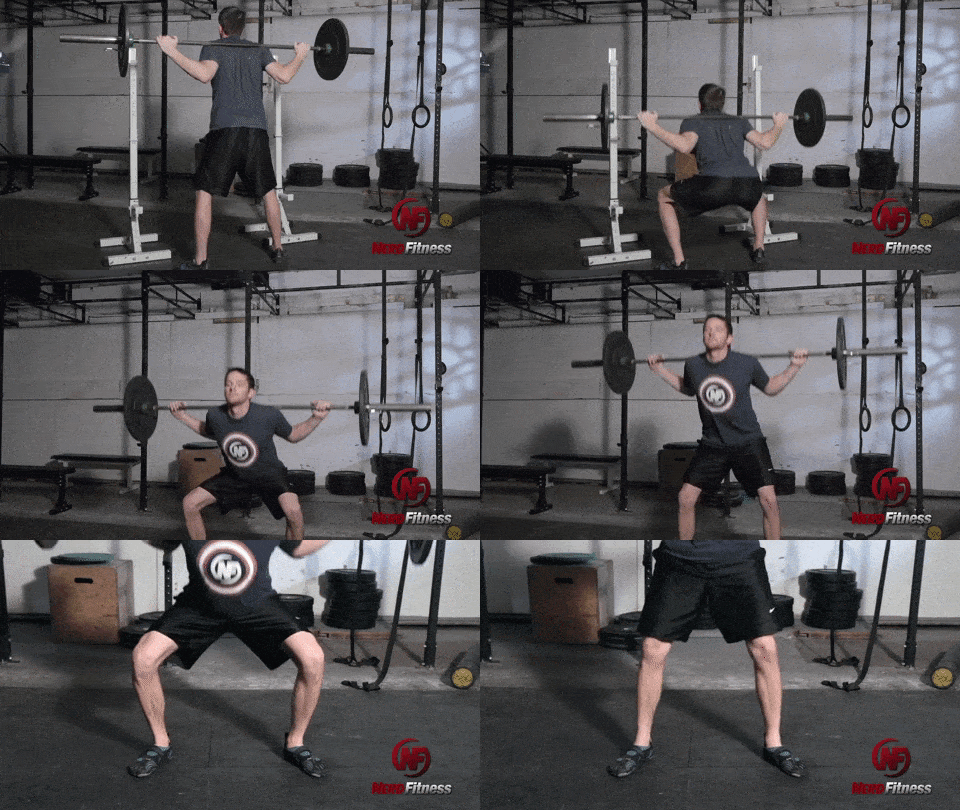
Categories
Uncategorized

#holistic #getfit #nutrition The Beginner Bodyweight Workout: 20-Minute Routine To Do At Home or Anywhere!

So you want to lose weight and get in shape, but don’t want to leave your house?

Well, as your fitness Yoda, I will teach you a great bodyweight workout routine that you can do ANYWHERE: In your living room, at a park, or in a galaxy far, far away… 

These are the types of workouts we build for our busy Online Coaching Clients, and I’m pumped to share it with you today! 


Let’s dig into the different parts of this workout and get to the action:

Make sure you also download the Beginner Bodyweight Workout PDF so you can track your progress and level up at home.

I’ll send it on over when you join the Nerd Fitness Rebellion in the box below:

Let’s jump right in!

Can You Build Muscle Mass With Bodyweight Exercises?

This runner definitely has a strong core!

You want to know:

Can you build muscle mass with bodyweight exercises?

Yep, bodyweight exercises can build muscle mass, as long as continuously challenge your muscles by:

  • Increasing reps.
  • Decreasing your rest periods.
  • Performing more difficult variations.
  • Increasing your time under tension (by going slower).

Just ask our friend Jimmy here, who got in great shape using bodyweight exercises in his apartment:

Jimmy before and after he did bodyweight training

You just need to make sure you have the right program to follow.

Enter the Beginner Bodyweight Workout.

I’m going to take you through a basic home workout today that can be completed anywhere – in your house, apartment, out at a park, in your basement, on the moon, wherever.

Beginner Body Weight Workout Video & exercises

This is the Beginner Bodyweight Workout (3 Circuits): 

  • 20 Bodyweight squats.
  • 10 Push-ups.
  • 10 Walking lunges (each leg).
  • 10 Dumbbell rows (use a milk jug or other weight).
  • 15 Second Plank.
  • 30 Jumping jacks

We turned this bodyweight workout into a fun infographic, because that’s how we roll around here:

An infographic of the Beginner Bodyweight Workout

Jump to the “Best Bodyweight Exercises” section for a full breakdown of each movement.

In a circuit routine, you’ll do each exercise in succession without a break in between (if you’re able).

  • Once you’ve finished all exercises in the circuit, do it again.
  • If you’re still able after the 2nd run through, go for a third.

Because all of these exercises come one after another, you’re bound to get tired – and that’s okay!

It’s better to stop and take a break than to do an exercise incorrectly.

Before you start, don’t forget to do a Dynamic Warm-Up – Make sure to get your heart rate pumping and get your muscles warmed or you’re just asking for injury.

You can run in place, jump rope, do a few push-ups, pedal on a stationary bike, do some punches and kicks, jog up and down your stairs, and/or twist and swing your arms and legs to get them moving!

Here’s a beginner warm-up you can try:

After you’ve completed your workout at home, feel free to cool down and stretch

“HOW OFTEN SHOULD I DO THE BEGINNER BODYWEIGHT WORKOUT?”
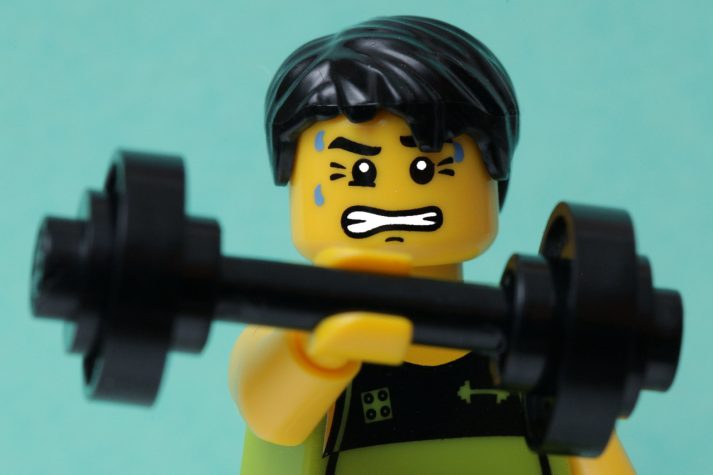
Do this routine 2-3 times a week, but never on consecutive days.

You don’t build muscle when you’re exercising, you build muscle when you’re resting, so try not to do a strength training routine (of the same muscle groups) two days in a row.

I like to follow a training pattern of:

Alternatively, pick one of these fun exercises to do on your off days instead!

In addition to checking out our Online Coaching Program, make sure you download the worksheet for this workout by joining the Rebellion (our free online community)!

I’ll send it to you right away when you sign up in the box below:

The 12 Best Bodyweight Exercises For Beginners

Another angle of showing how to setup a proper push-up.

As laid out above in our Beginner Bodyweight Workout video, there are some key movements you can work on to help you get started strength training

Here’s how to do every bodyweight exercise covered today:

#1) KNEE PUSH-UP

Knee push-ups like this are a great way to progress to a regular push-up!

#2) ELEVATED PUSH-UP

Do elevated push-ups to work up to regular push-ups

#3) REGULAR PUSH-UP

This gif shows Staci doing a push-up in perfect form.

We have a whole article on how to do a proper push-up, but we also cover it extensively in this 5-minute video:

#4) ASSISTED BODYWEIGHT SQUAT
Doing assisted bodyweight squats is a great step towards regular bodyweight squats

Use this variation if you can’t do regular bodyweight squats yet.

#5) BODYWEIGHT SQUAT:

Do a proper bodyweight squat to work out your legs

If you want even more instruction, here’s how to do a proper bodyweight squat:

#6) SUPPORTED LUNGES:

Do the assisted lunge until you can do regular lunges

#7) REGULAR LUNGES:

Do Lunges to strengthen your legs for the beginner bodyweight exercises!

Here’s how to properly perform lunges

#8) ONE ARM ROW

Do a dumbbell row as a great beginner exercise to get strong

Use a milk jug, suitcase, or actual dumbbell.

#9) PLANK

Coach Staci showing you the front plant

#10) SIDE PLANK

Doing a plank on your side is a great way to progressive this bodyweight movement.

#11) WALKING JACKS 

Do walking jacks if you can't do jumping jacks!

Use this variation if you can’t do jumping jacks yet.

#12) JUMPING JACKS

Jumping Jacks are a great cardiovascular bodyweight exercise

If you are looking for even MORE bodyweight exercises you can use in your workouts, make sure to check out our mega-resource:

 “The 42 Best Bodyweight Exercises You Can Do Anywhere.

Note: We have helped hundreds of 1-on-1 Coaching clients get started with strength training and other awesomeness – but EVERYBODY starts with bodyweight training like these movements and this workout!


Is Bodyweight Training Effective for Weight Loss?

Lego Red Suit Brick Guy minifigure on gray baseplate background.

The question of the day is:

Is bodyweight training effective for weight loss?

Yep! Bodyweight training can be great for weight loss, as long as you have your nutrition dialed in.

If you don’t…then no, it won’t be your magic bullet.

That’s because a good workout and a crappy diet won’t help you lose weight.

After all, one of the Rules of the Nerd Fitness Rebellion is “you can’t outrun your fork” and you can’t out-train a bad diet!

This means if you don’t ALSO fix your relationship with food, then all the exercise you do won’t help you get in shape.

It’ll just make you frustrated…

"Everything hurts, running is impossible" from Andy

So if you are trying to lose weight, then you need to fix your nutrition first and foremost.

Remember, when it comes to fitness, eating healthy is key!

You have two options here to dial in your nutrition:

We’ve actually developed our own 10-level nutrition system and mindset blueprint in Nerd Fitness Prime, but let me break this down into some basics:

  • Eat natural, whole foods whenever possible.
  • Cut back on sugar and liquid calories wherever you can. The stuff is in everything!
  • Put vegetables and fruit on your plate!
  • Know your fats and carbs – these are the foods we can overeat without realizing it.
  • Make sure you get enough protein each day (meat, chicken, fish) – this helps with rebuilding muscles and things like that.

You can download a Free 10 Level Diet Guide too when you join the Rebellion and sign up in the box below:

The raw honest truth: how you eat will be responsible for at least 80% of your success or failure.

If you’re doing bodyweight workouts because you’re interested in losing weight, know that training is only 10-20% of the puzzle!

If you need help figuring this all out, or you just want your own Yoda to tell you what to do, you’re in the right place!

We’ve been helping busy people like you train at home and make better food decisions without hating life! It’s our 1-on-1 Online Coaching Program, and it might be a great fit for you.

Schedule a call with us to learn more by clicking on the image below:

After the Beginner Bodyweight Workout: Next Steps!

A yoga mat for beginner bodyweight training

Do this Beginner Bodyweight Workout for the next 4-6 weeks and focus on getting better.

If doing just one circuit of the workout was really challenging, no big deal!

Write down how you did, and try to do just 1 more rep or exercise next time through.

The whole point is “do a bit more than last time.”

I also have MULTIPLE options for you to take for your next step too. Pick the option below that best aligns with your goals and timeline:

1) If you want step-by-step guidance on how to lose weight, eat better, and get stronger, check out our killer 1-on-1 coaching program:


2) If you want a daily prompt for doing workouts at home, check out NF Journey. Our fun habit-building app helps you exercise more frequently, eat healthier, and level up your life (literally).

Try your free trial right here:

3) Join the Rebellion! We need good people like you in our community, the Nerd Fitness Rebellion.

Sign up in the box below to enlist and get the Beginner Bodyweight Workout sheet so you can print out the sheet and train at home!

I’d love to hear how this workout went for you, and how else we can help!

This is what we’ve dedicated our lives to, and you’re now part of a killer community.

Welcome to the Nerd Fitness Rebellion!

You can do this, we got your back!

-Steve

PS: If you’re looking for more workout routines to follow, I got you covered:

PPS: As a reminder, today’s bodyweight workout looks like so:

This infographic will show you the 6 exercises needed to complete our Beginner Bodyweight Workout.

Click on it to pull up your own PDF of the infographic!

###

PHOTO SOURCES: Four Bricks Tall: “Follow or follow not. There is no follow for follow.” and “Morning run with the Fitbit“, Ekaterina Minaeva © 123RF.com, parilovv © 123RF.com.

INFOGRAPHIC SOURCES: superhero costume, male graphic, female graphic, various graphics, icon, milk jug, robot, comic background.

The post The Beginner Bodyweight Workout: 20-Minute Routine To Do At Home or Anywhere! first appeared on Nerd Fitness.

from Nerd Fitness: Helping You Lose Weight, Get Stronger, Live Better. https://ift.tt/BAJfNxC
via IFTTT