Categories
Uncategorized

#holistic #getfit #nutrition 15 Circuit Training Routines: Try These Fast Workouts Anywhere!

circuit training is awesome, even dinosaurs love it

This circuit training guide is gonna give you EVERYTHING you need to do your first kickass circuit training workout today.

I mean come on, it has dinosaurs in it.

These workouts are similar to the custom programs we build for our Online Coaching Clients who work out at home, on the road, and in outer space.

Okay, FINE we don’t have any clients in space (yet). But we do have clients in Antarctica, and multiple aerospace engineers. Close enough?


If you’re hoping circuit training will maximize your results in a minimum amount of time, one of the 15 circuits below will do the trick:

What is Circuit Training?

As Coach Lauren mentions above, the “circuit” in circuit training comes from the fact that you do a sequence of exercises back to back to back, and then you repeat the sequence.

And then again.

You cycle through the planned sequence of exercises, or circuit, multiple times.

That’s circuit training.

Generally, you hit each major muscle group during one full circuit. You may do a lower body for one exercise. Then the upper body the next.

You’ll find all sorts of different circuit training sequences. Here are some things most will have in common:

  • Several different exercises. A normal circuit will have five to ten different movements per circuit. You’ll often hear these referred to as “stations.” Overhead press station, squat station, etc.
  • Little to no rest in between. The goal of circuit training is to keep your heart rate up. Ideally, if you’re physically able, you go from one exercise to another without stopping. Maybe you rest after the whole circuit. Maybe.
  • Rinse and repeat. Generally, you’ll run through your circuit a few times. Three rounds are common.

Make sense?

The Tick is stoked you are putting on weight, muscle or fat, it means our strategy is working.

The point here is to work different parts of your body with different exercises, and then while those parts are recovering, you’re working on your other movements! This helps build cardiovascular health, while also improving muscular endurance and strength.

Plus you’ll burn calories!

As we lay out in our article, Cardio vs Interval Training vs. Weight Training, research supports that doing strength training circuits is great for weight loss and overall health.

More importantly, for somebody with limited time, doing a strength training circuit is more effective at building strength and burning fat than an equivalent amount of cardio.

In other words, if you are trying to lose weight, you should be doing circuit training.

Our Beginner Bodyweight Circuit would be a great place to begin, and you can download a worksheet to help you get started right here:

Why Should I do circuit training?

This runner definitely has a strong core!

Generally, you’ll hear exercise divided into strength training or aerobic exercise (cardio).

What’s the difference, you wonder?

  • Strength training. Strength training is also referred to as anaerobic exercise, which would be a short burst of energy for movement. Think of a push-up or pull-up. These exercises help build and tone muscle.
  • Aerobic Exercise. “Aerobic” means “needs oxygen.” Your heart rate increases to get oxygen where your body needs it, thus the word “cardio.” Running, biking, or jumping jacks would be examples of aerobic exercise.

The thing about a circuit is, you actually do both categories. Presses and lunges fall into strength training. Jumping jacks are cardio.

And since you aren’t stopping much in between stations, you’ll need more oxygen, and voila. Even more cardio.

With circuit training, you build muscle and burn fat WHILE building stamina.

As Michael Scott would say, “that’s a win, win, win.”

circuit training is a win win win

There’s some debate on what kind of exercise is better for weight loss: aerobic or anaerobic.

My thoughts?

If you’re limited on time and only can pick one, I would pick strength training: when you strength train, you break your muscles down, and your body needs to work extra hard over the next 24-48 hours to rebuild those muscles (with increased calories burned).

We work with our 1-on-1 Coaching Clients to create programs that combine both strength and cardio in a fun way – it really comes down to a program that you actually WANT to do.


Before and after your circuit training: Warm up and stretch

Some stretching a rubber band

No matter which circuit you pick, I want you to start with one important thing:

Warm-up!

I cover why you should always warm up in an article found right here. It doesn’t have to be much though, give it about five minutes to get your muscles active and your heart rate up.

This will help you do exercises properly and help prevent injury. You can run in place, do air punches and kicks, or some jumping jacks.

Here is NF Senior Coach Staci (you might know her incredible story) showing you many beginner options you can use to warm up as well:

Did I just tell you to prepare for circuit training, with a circuit?!

If you’re curious, here’s my personal (advanced) warm-up:

  • Jump rope: 2-3 minutes 
  • Jumping jacks: 25 reps
  • Bodyweight squats: 20 reps
  • Lunges: 5 reps each leg.
  • Hip extensions: 10 reps each side
  • Hip rotations: 5 each leg
  • Forward leg swings: 10 each leg
  • Side leg swings: 10 each leg
  • Push-ups: 10-20 reps
  • Spider-man steps: 10 reps

Our goal isn’t to tire you out. Instead, we want to warm you up.

That’s step one.

Completing your chosen circuit training routine would be step two.

Below, you’ll find 15 workouts you can follow along with! And if you like our style of workouts, you might like our new app, Nerd Fitness Journey!

Our fun habit-building app helps you exercise more frequently, eat healthier, and level up your life (literally).

Right now, you can try it for free for a full week (no credit card required). Jump in below:
Beginner Bodyweight Workout Circuit

This workout circuit, as we lay out in our Beginner Bodyweight Workout article, is as follows:

  • Bodyweight squats: 20 reps
  • Push-ups: 10 reps
  • Walking lunges – 10 each leg
  • Dumbbell rows (using a gallon milk jug or another weight): 10 each arm.
  • Plank: 15 seconds
  • Jumping jacks: 30 reps

Run through this circuit three times. If you don’t have milk in the house for the rows, find something of roughly the same weight with a good handle.

We also turned this workout into a fun infographic with superheroes, because that’s how we roll:
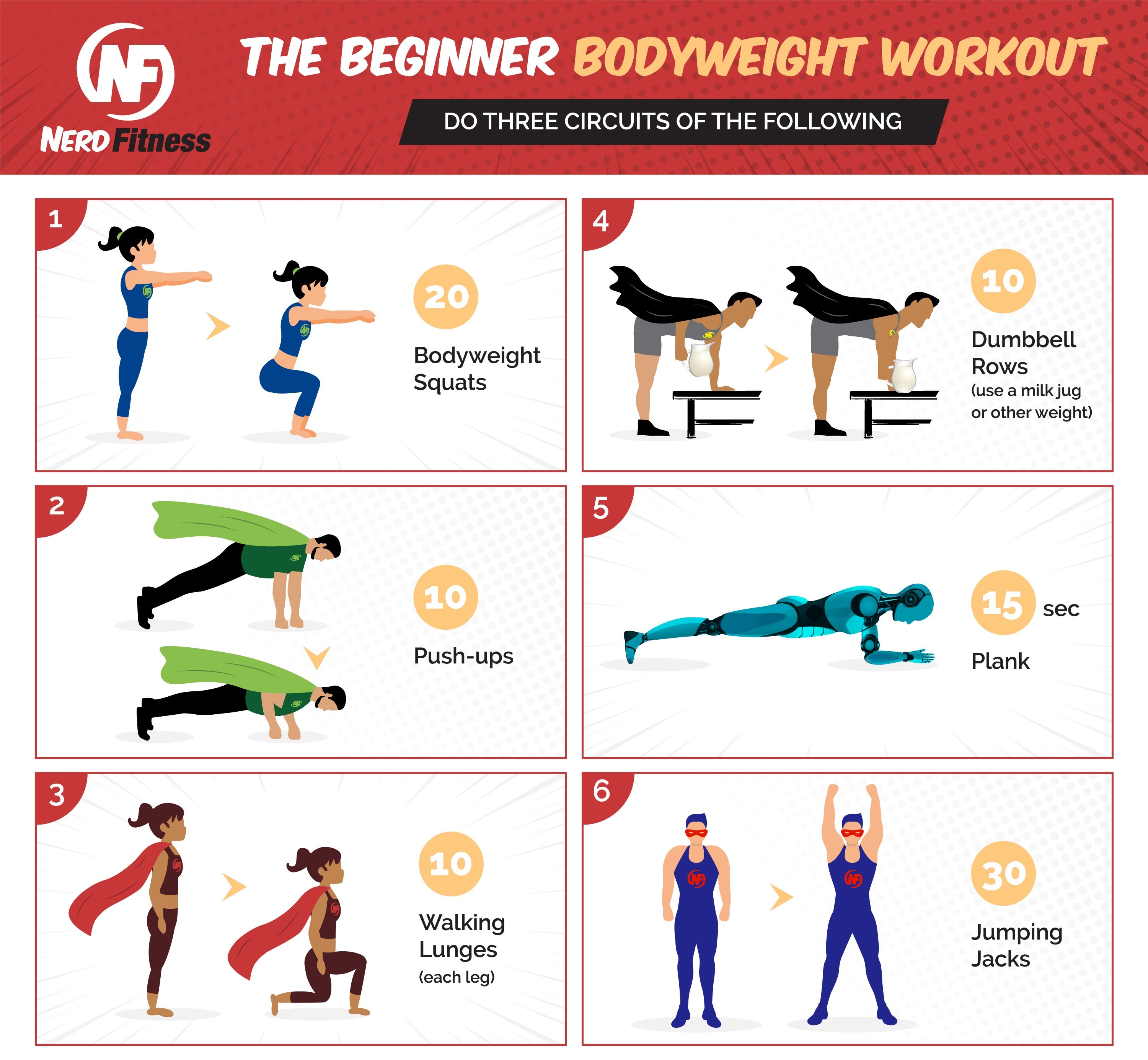
An infographic of the Beginner Bodyweight Workout

If you want to download this Beginner Bodyweight Workout as a worksheet, you can do so when you sign up in the box below:


Advanced Bodyweight Exercises Circuit

If the beginner circuit above is too easy for you, move on to our Advanced Bodyweight Workout Circuit. The workout looks like this:

  • One-legged squats – 10 each side [warning super-difficult, only attempt if you’re in good enough shape]
  • Bodyweight squats: 20 reps
  • Walking lunges: 20 reps (10 each leg)
  • Jump step-ups: 20 reps (10 each leg)
  • Pull-ups: 10 reps [or inverted bodyweight rows]
  • Dips (between bar stools): 10 reps
  • Chin-ups: 10 reps [or inverted bodyweight rows with underhand grip]
  • Push-ups: 10 reps
  • Plank: 30 seconds

I warn you, the above circuit will hurt… in a good way. You should be proud if you can get through this three times.


Playground Workout Circuit

Do you have a nearby playground? Why not work out there! If you have kids, you can do it together. Or let them ignore you.

I’ll give you a Level One workout, and a Level Two. Check out the main playground article for some Level Three exercises.

Level One:

  • Alternating step-ups: 20 reps (10 each leg)
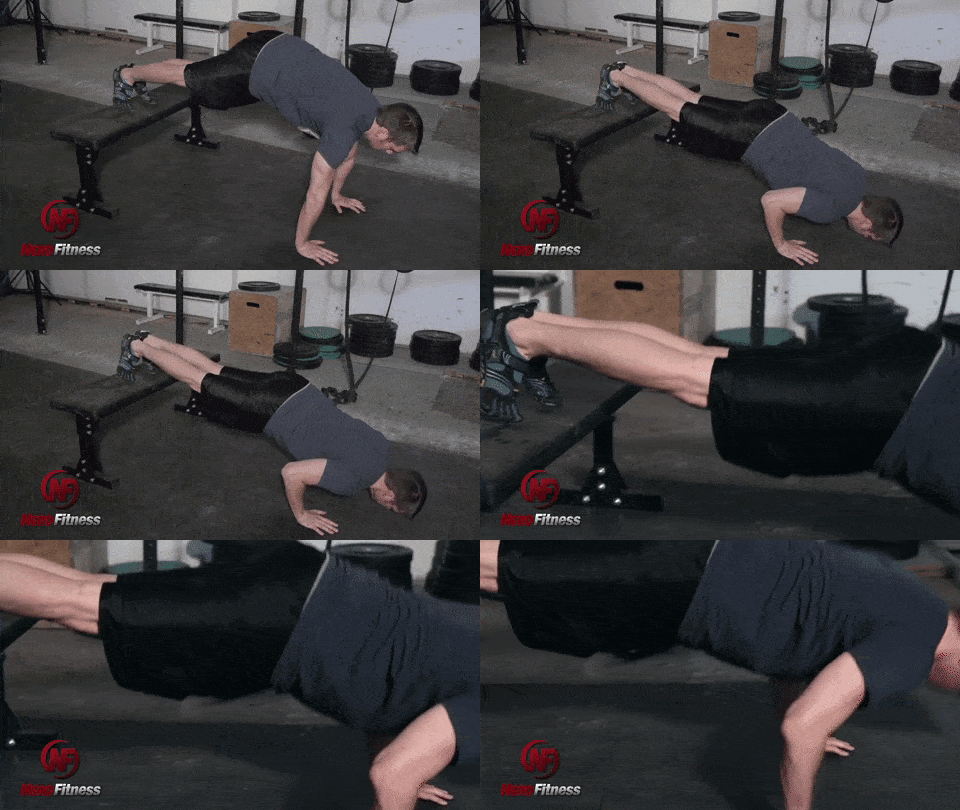
  • Elevated push-ups: 10 reps
  • Swing rows: 10 reps
  • Assisted lunges: 8 reps each leg
  • Bent leg reverse crunches: 10 reps

Level Two:

  • Bench jumps: 10 reps
  • Lower incline push-ups: 10 reps
  • Body rows: 10 reps
  • Lunges: 8 reps each leg
  • Straight leg reverse crunches: 10 reps

After you’ve gone through a complete set three times, go down the slide!


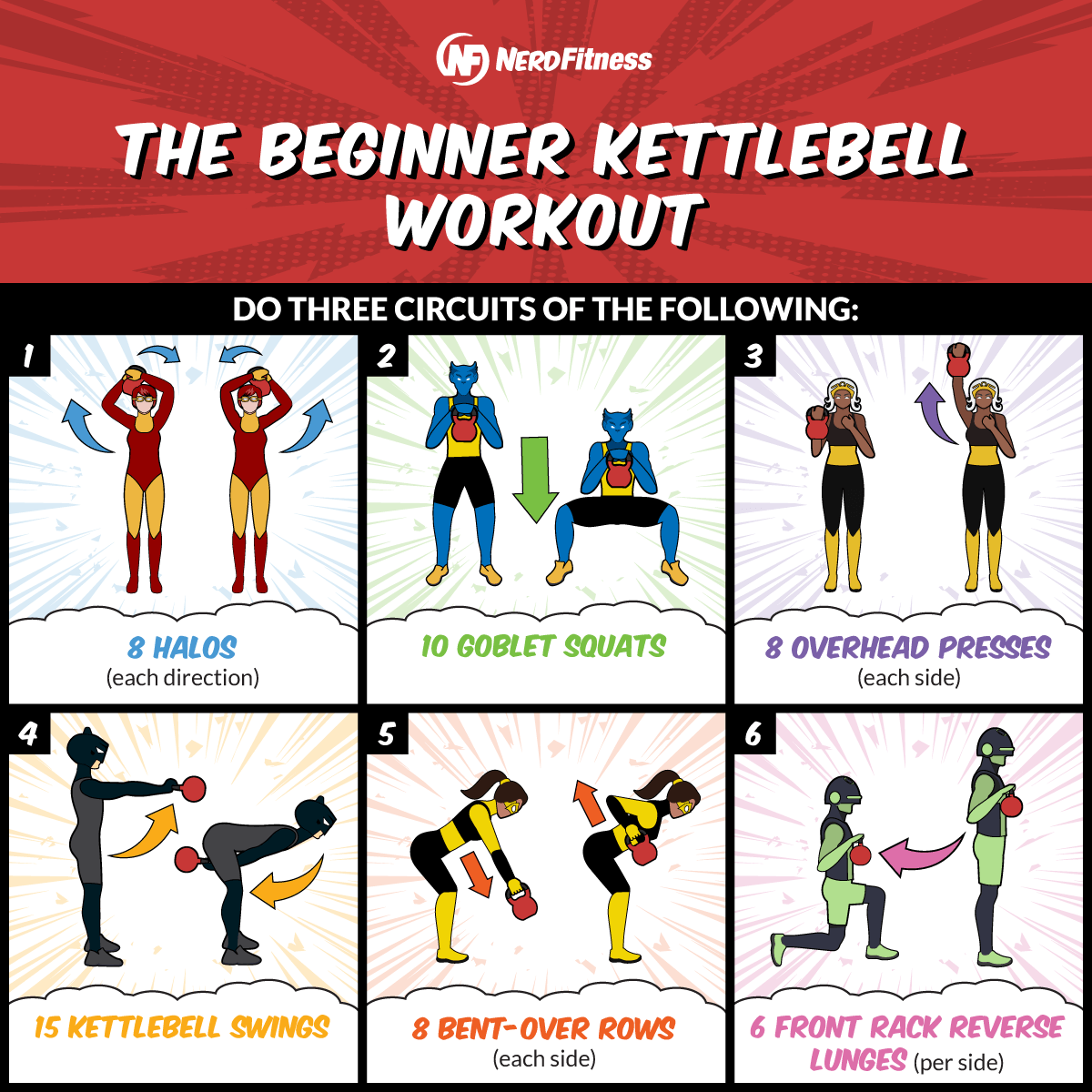
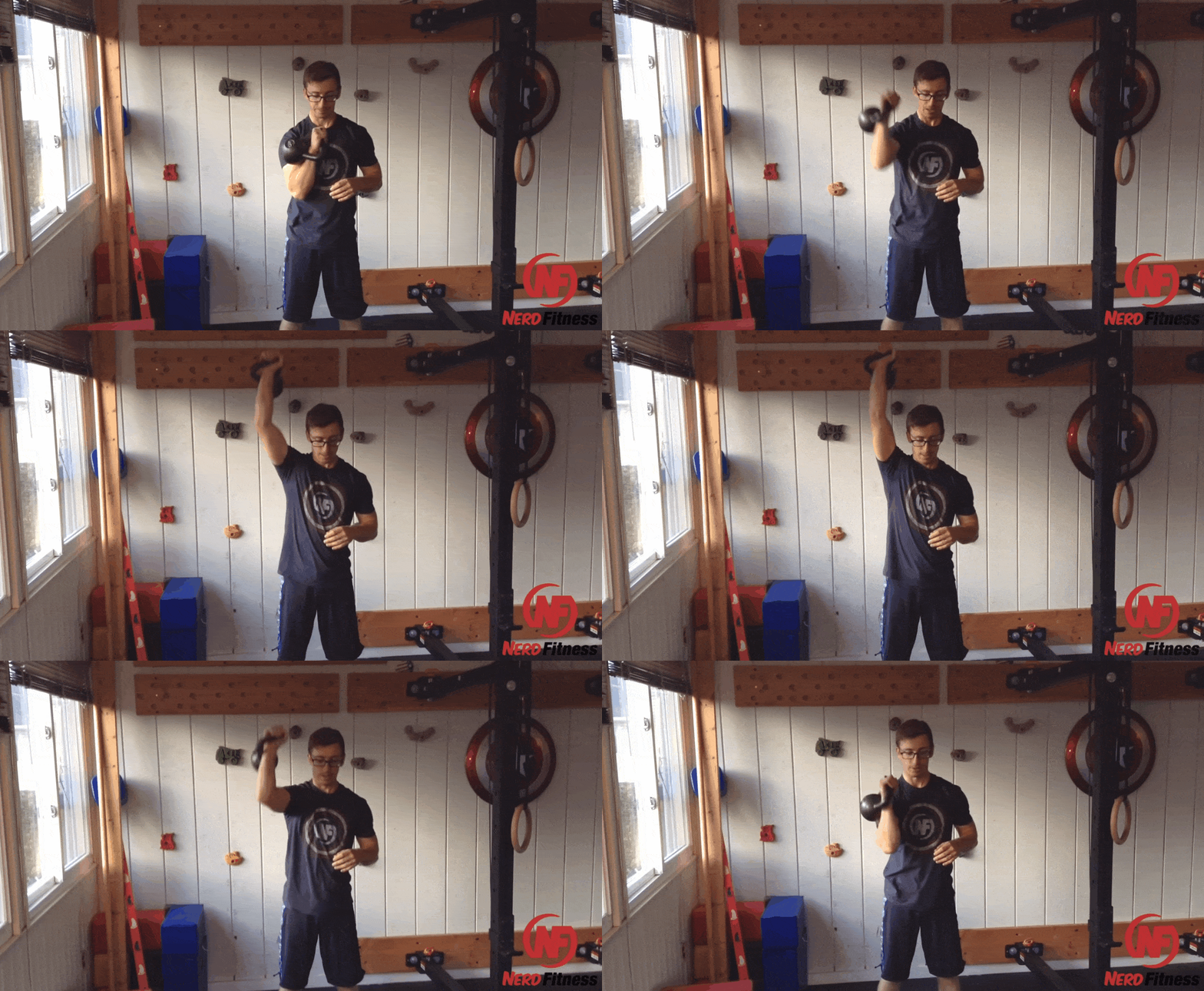
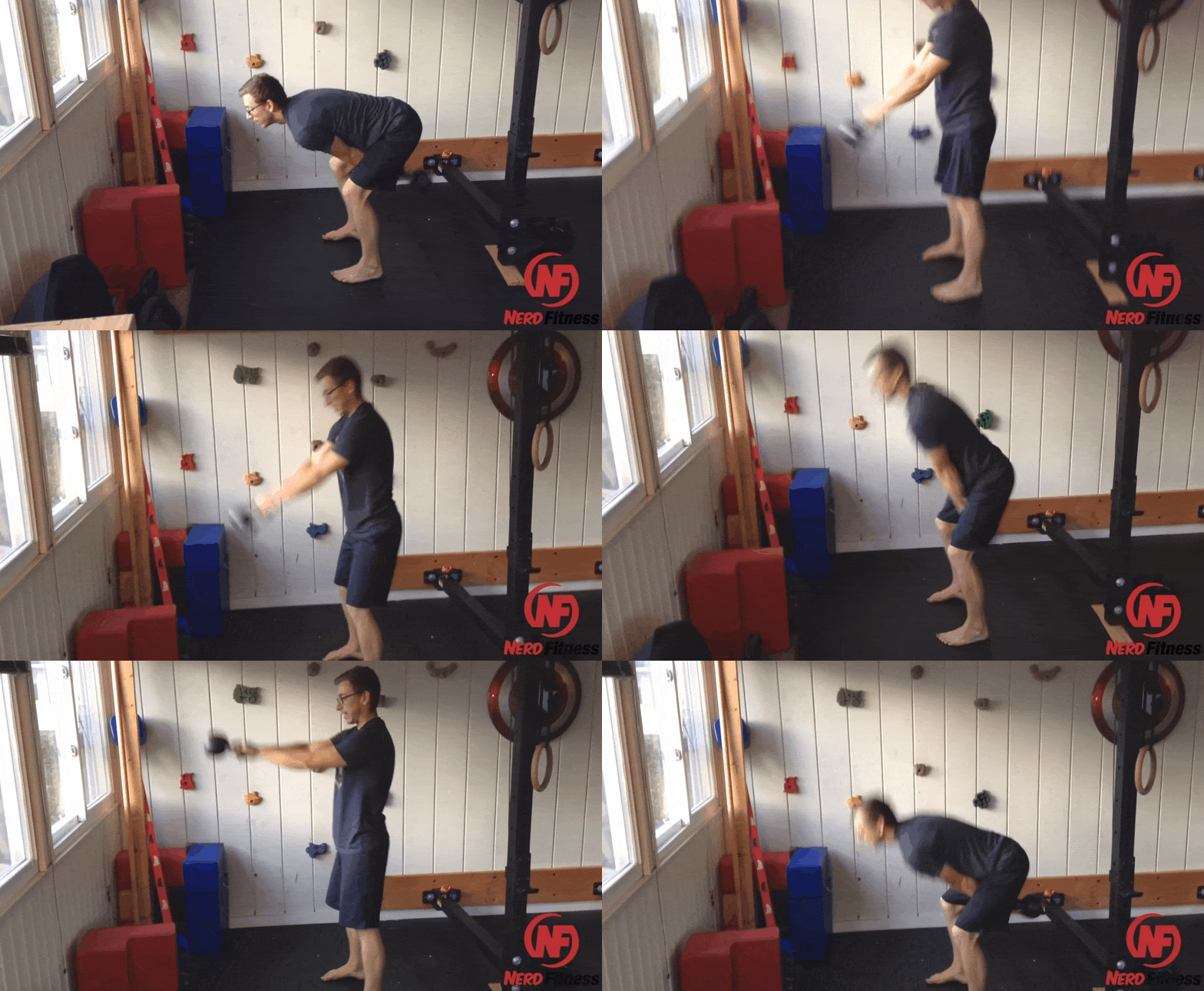
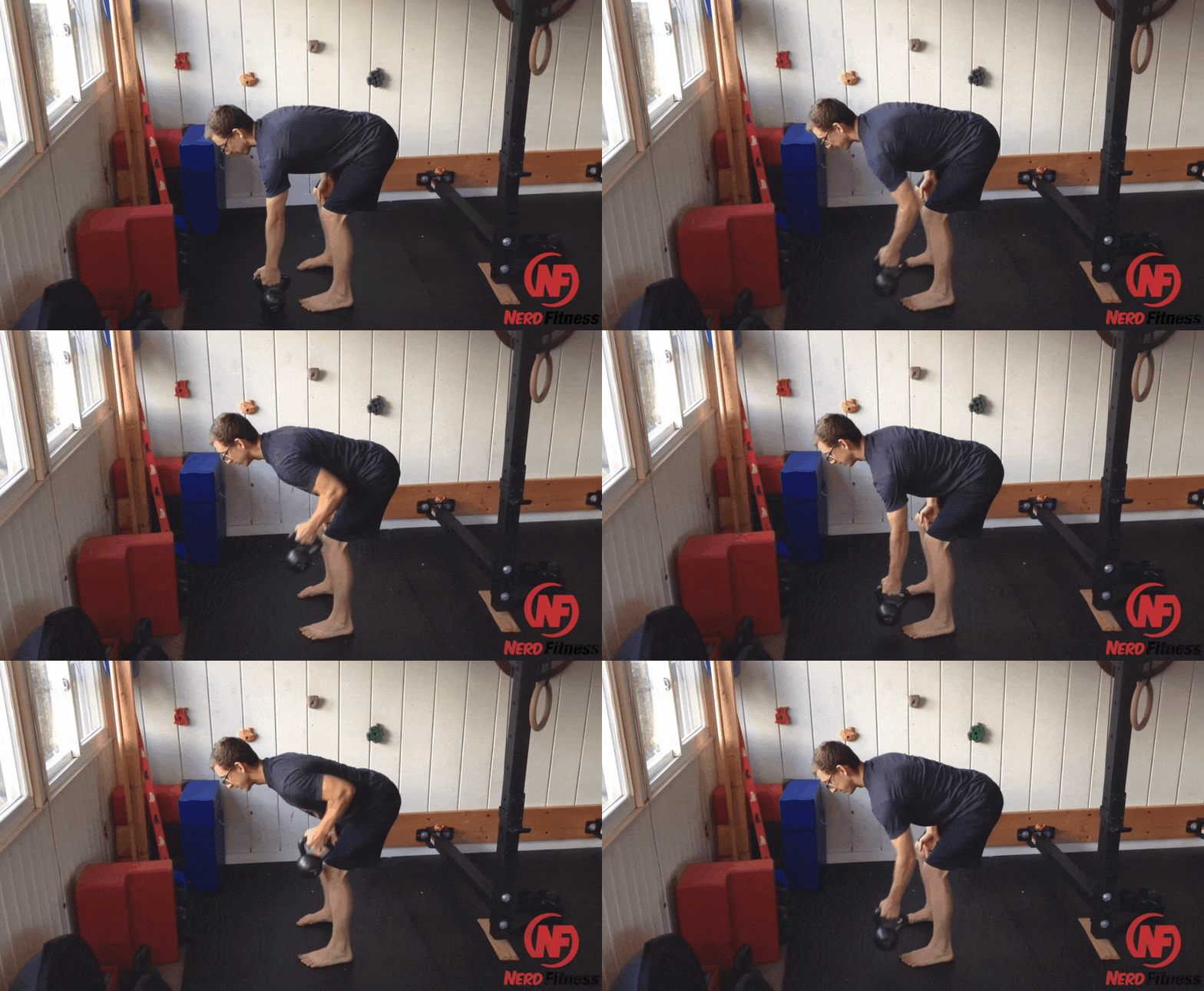
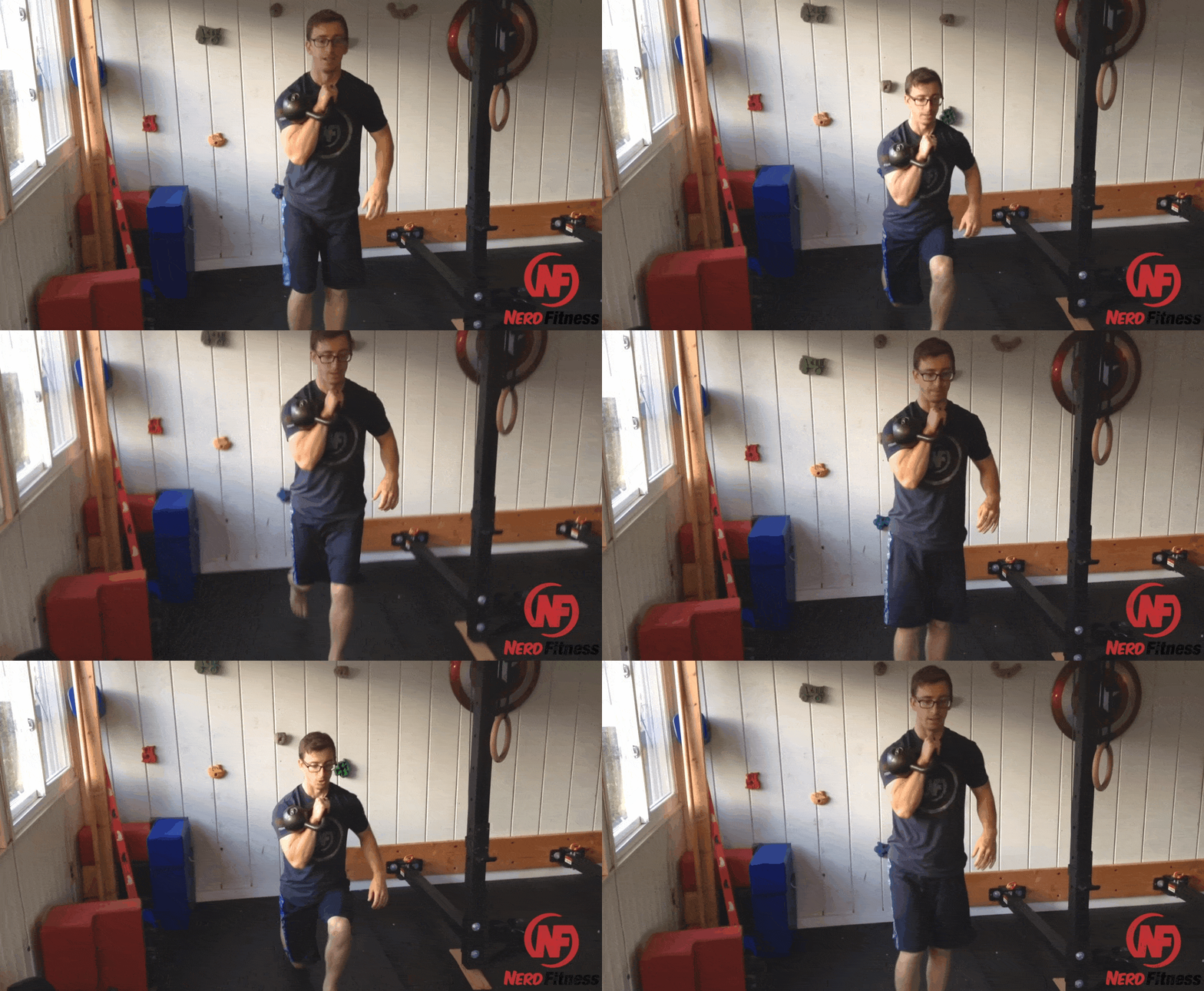
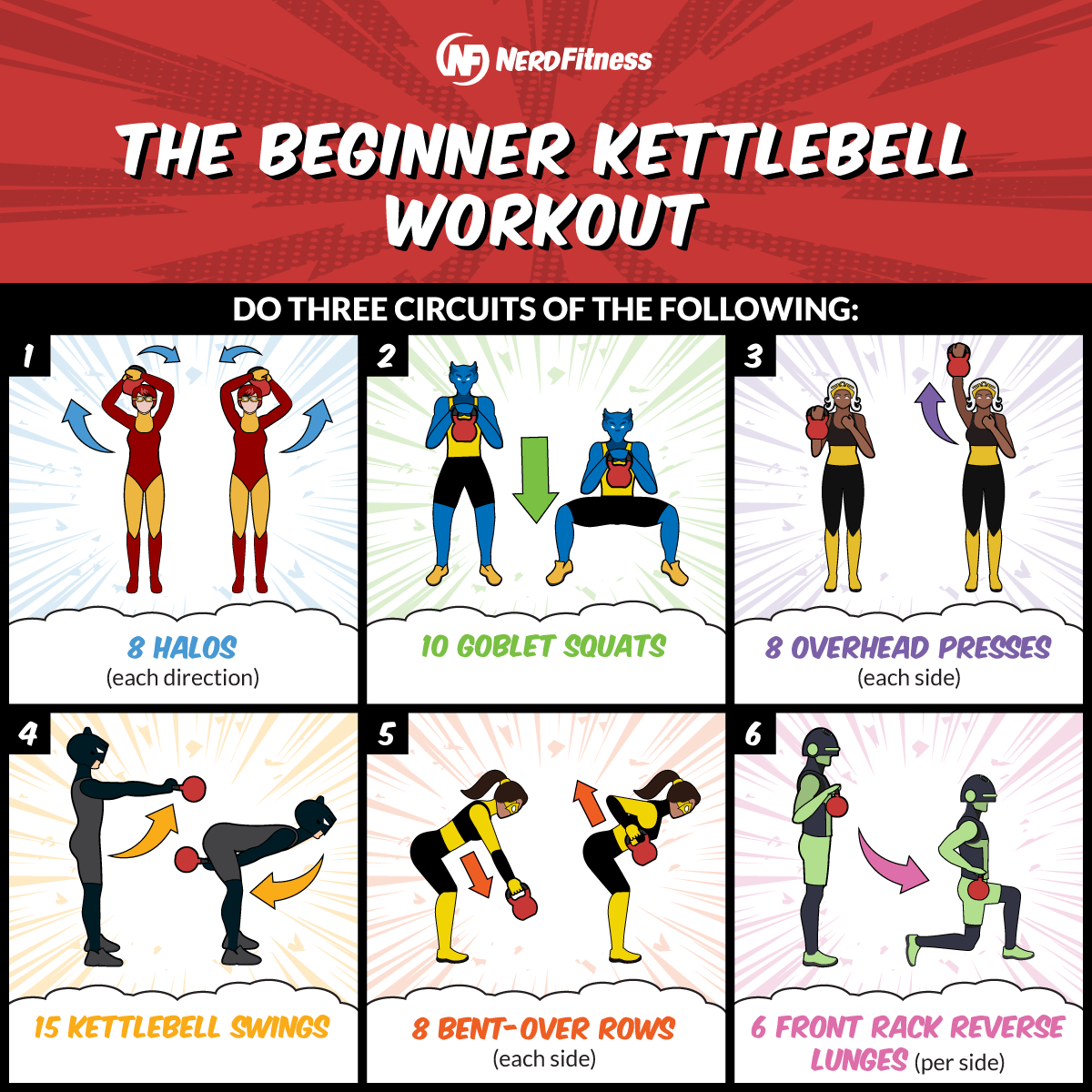
Kettlebell Workout Circuit

Have a kettlebell lying around? Use it for a circuit!

Here’s our kettlebell workout full write-up, but you can also just watch the video and see the workout here:

  • Halos: 8 reps (each side)
  • Goblet squats: 10 reps
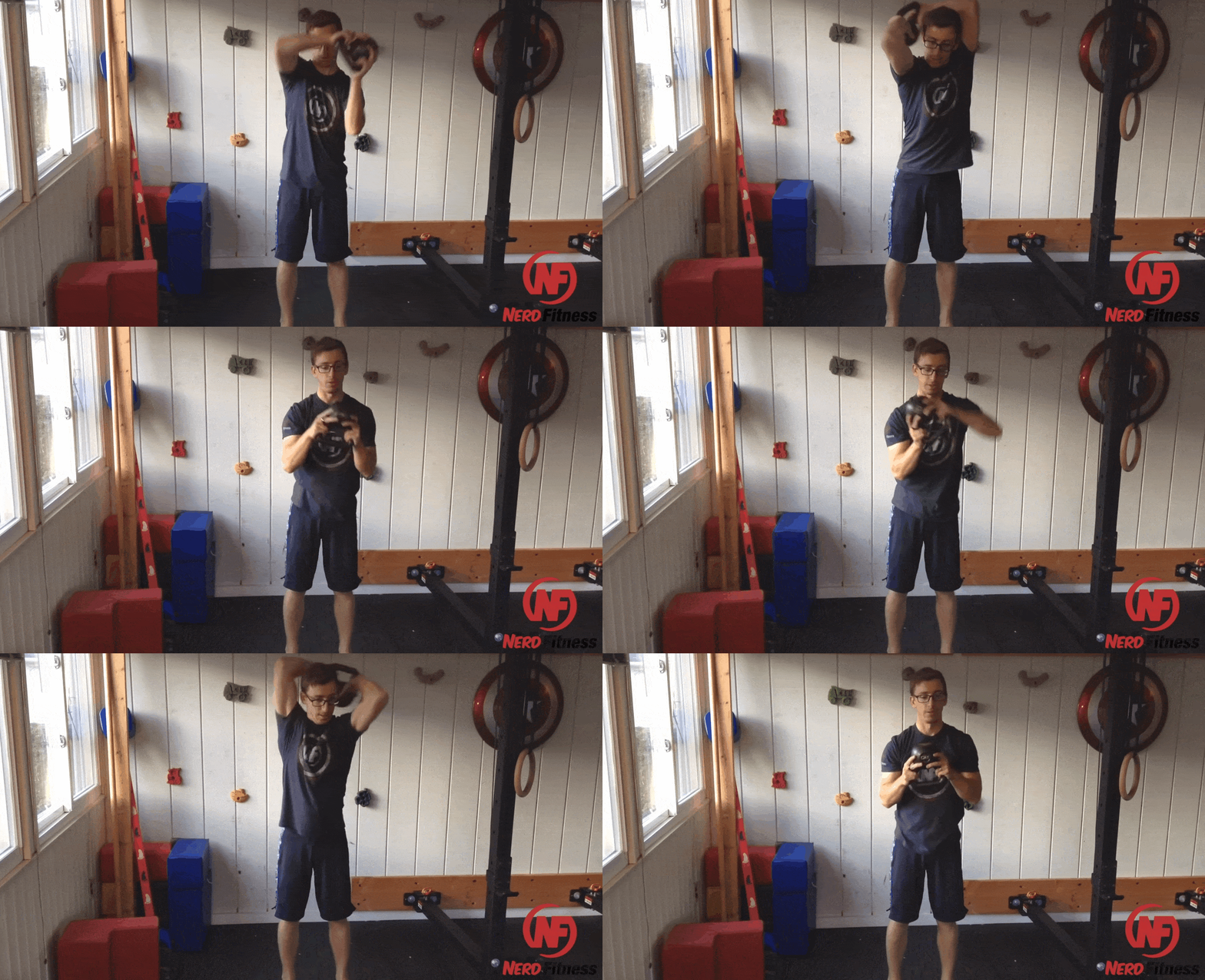
  • Overhead presses: 8 reps (each side)
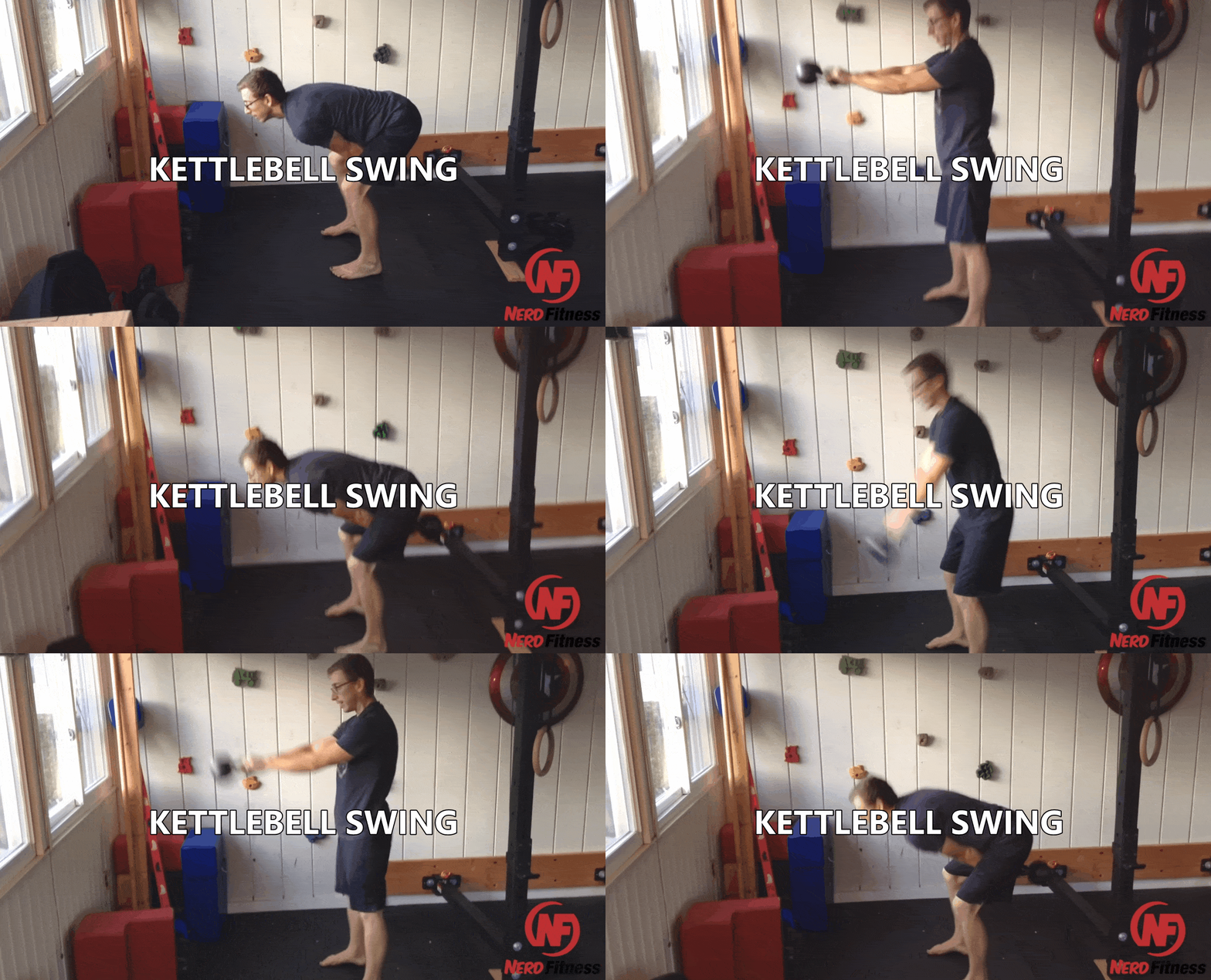
  • Kettlebell swings: 15 reps
  • Bent Over Rows: 8 reps (each side)
  • Front rack reverse lunge: 6 reps (per side)

Once you’ve done the above three times, go ahead and put your kettlebell away for your final step: stretches.

If you want a kettlebell worksheet for this workout, grab one by signing up in the box below:

We also have a fun new adventure in our app that will allow you to train with your kettlebell right alongside Hack Morris (this will make sense more sense when start).

Jump in right now for your free trial:
Beginner Gym Circuit Training
use free weights and to do circuit trainingIf you have access to a gym, you have a lot of circuit options.

If it’s your first time stepping foot in a fitness facility, check out our Beginner’s Guide to the Gym. The gym can be a scary place, but we’ll give you a strategy to get comfy.

(Gym closed do to COVID? Here’s how to build a gym in your home.) 

We’ll also walk you through each movement for both Days A and B below. I would recommend picking one of our 5 Beginner Gym Workouts, going through the leveled progressions, and working your way up to the circuits below:

DAY A GYM WORKOUT:

Day B GYM WORKOUT:

  • Barbell Romanian deadlifts/regular deadlifts: 10 reps
  • Push-ups: 10 reps
  • Dumbbell rows: 10 reps per arm

Alternate your circuits on different days. Rest in between. “Day A” could be Monday. Rest Tuesday. Wednesday could be “Day B.”

We LOVE helping people get started in the gym, as we’re huge fans of barbell training and helping beginners build confidence with weight training! If that sounds like you…


And you can download our full Strength 101 guide too, which has this routine along with other circuits to help you start building strength today:

The Hotel Workout Circuit: For Travelers that Train

Is there anyway to work out in this hotel room?

Sometimes, you just plain find yourself stuck in a hotel room. Maybe you can find the hotel gym, but I bet it’s terrible! It probably has 2 machines, a broken treadmill, and no free weights. 

Ugh.

Instead, how about a workout circuit you can do in the room itself! Utilize the furniture to its full potential.

Level 1

Level 2

Set the alarm clock to 15 minutes from now and see how many circuits you can do!

Check out our full post on hotel circuits if you want Level 3!

We have a LOT of business travelers in our 1-on-1 coaching program, which is why we create workouts for both their home gym and while traveling!

If you need worldwide accountability, workouts for home and the road, and want expert guidance…


Nerdy Circuit Training Exercises

Lego minifigures standing in rows. In first row - Batman, The Jo

If those workouts above don’t tickle your fancy, we have these other nerdy circuits you can do too!

The Batman Workout Circuit

Day 1

  • Rolling squat tuck-up jumps: 5 reps
  • Side to side push-ups: 5 reps
  • Modified headstand push-ups: 5 reps
  • Jump pull-up with tuck / Pull-up with Tuck-up: 5 reps
  • Handstands against wall: 8 seconds

Day 2

  • ‘180 Degree’ jump turns: 5 reps
  • Tuck front lever hold: 8 seconds
  • Tuck back lever hold: 8 seconds
  • Low frog hold: 8 seconds


The Lord of the Rings Workout Circuit

try this lord of the rings circuit training workout

Superset 1: The Fellowship of the Ring

  • “YOU SHALL NOT PASS!” Slams: 3 medicine ball slams
  • Legolas Bow Pulls: 7 renegade rows
  • “One does not simply walk/lunge into Mordor”: 9 lunges, each leg
  • Hip “Bridge of Khazad Dum”: 1-minute hip raises and hold at the top position

Superset 2: The Two Towers

  • Riders of ROWhan: 3 bodyweight rows
  • Gimli “Shall I get you a box?” jumps7 box jumps – REALLY explode
  • Helm’s Deep-Squats: 9 bodyweight squats – get your ass to the ground
  • Tower of Orthanc Holds: 1 minute (Kick up against a wall and hold a handstand for as long as you can until 1 minute is complete, in as few as sets as possible. Check out our Guide to Handstands.)

Superset 3: The Return of the King

If you can get through a superset three times, consider yourself an honorary Ranger. Nothing found in Mordor can faze you.


The 300 Workout Circuit

do the 300 circuit training workout to get strong like King Leonidas

The below circuit is no joke. Then again, neither were the Spartans.

  • Pull-ups: 25 reps
  • Deadlifts with 135lbs: 50 reps
  • Push-ups: 50 reps
  • ‘24-inch’ Box jumps: 50 reps
  • Floor wipers: 50 reps
  • Single-arm clean-and-press with 36 lbs. kettlebell: 25 each side
  • Pull-ups: 25 reps

The above sequence is designed to be completed once. If you can go through it twice, you’re ready to defend Greece.


The Wolverine Workout Circuit

  • Barbell Deadlift / Dumbbell RDL / Banded Good Morning / Regular Good Morning: 10 reps
  • Medicine Ball Slam / Quick Downwards Bodyweight Squat: 10 reps
  • Push-up to Renegade row (push-up, row left, push-up, row right, repeat): 5 Rows per side
  • Transverse Lunge and Chop: 5 reps each side

How many times do you do this circuit? AMRAP, or, As Many Rounds As Possible. I suggest setting a 12-minute timer and getting to work. Be careful though, because only Wolverine can heal automatically.

wolverine does workout circuits too

You’ll need actual rest.

Boom!

There are your nerdy circuits. Feel free to rock the soundtrack of the referenced movies during your workout. If you own a cape, now’s the time.


Complete List of Circuit Training Exercises

A picture of a LEGO Spider-man, who is interested in weight loss.

You can do any of the workouts in this article and get a great workout, but if you want to build your own workout, you can totally do that too!

Here is a list of exercises you can use to create your workout.

Simply pick a few, and do one after the other in as many circuits as you want!

Pick your exercises from this list to build your own circuit training workout, or suggest your own for us to add in the comments below!

CARDIO EXERCISES:

  1. Jump rope
  2. Jumping Jacks
  3. Walking Jacks
  4. Burpees
  5. Mountain climbers
  6. Stairs
  7. Sprints
  8. High knees
  9. Running in place
  10. Rowing machine
  11. Long-distance jumps
  12. Box jumps

UPPER BODY PUSH EXERCISES:

  1. Push-ups (any variation)
  2. Handstands.

UPPER BODY PULL EXERCISES

  1. Dumbbell rows
  2. Bodyweight rows
  3. Negative pull-ups or chin-ups
  4. Pull-ups or Chin-ups

LOWER BODY EXERCISES

  1. Bodyweight squats
  2. Lunges
  3. Kettlebell swings
  4. Farmer carries (carry dumbbells and walk around)
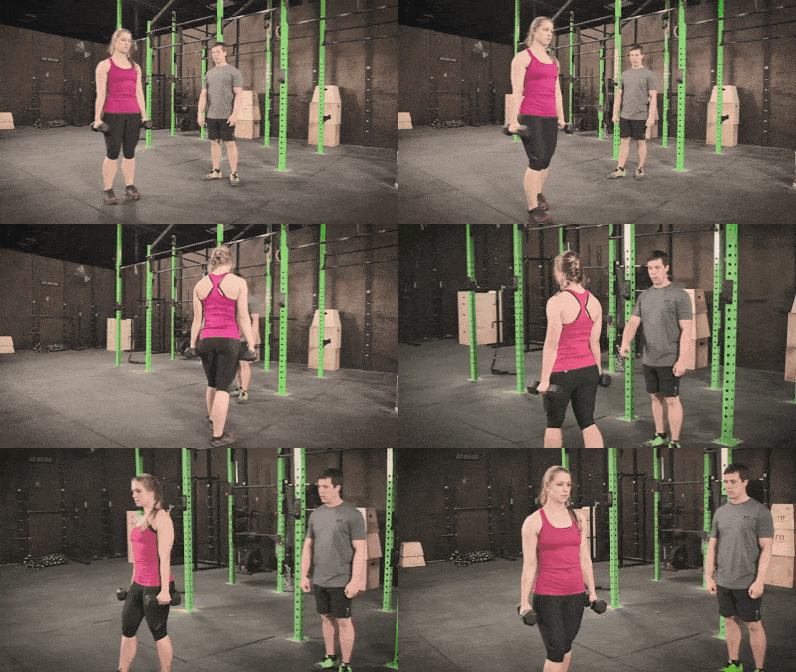
Coach Staci showing Farmer's Walk

CORE EXERCISES:

  1. Planks
  2. Side planks
  3. Reverse crunches

Pick 3-5 exercises, and arrange them as we discuss in our “how to build your own workout routine.” We also have The 42 Best Bodyweight Exercises for movements that you can choose from.

Do 3 circuits with 10 reps of each exercise, one after the other!

Have fun and keep things interesting. And if you don’t want to build your own workout, that’s cool too! We have 15 free workouts in this article, and we can also do all the heavy lifting for you.

(Well, not literally DO the heavy lifting, but you know what I mean.)

We create custom workout solutions for busy people just like you in our 1-on-1 Coaching Program. Let us create a workout and help you make better food choices.

It’s like having a Yoda in your pocket (again, not literally).


How to Stretch After Circuit Training

Once you finish your workout, the final step (three) would be stretching and cool down. No matter what circuit you go through, stretch after a workout. It can help a lot with muscle recovery.

Scope this video for an awesome stretching sequence to follow:

You could also do some yoga poses. For stretching, find what feels good and take your time. Let your heart rate come down while you stretch.

You could even do some foam rolling too if you’re a glutton for punishment!

For more ideas on how to make the most of your stretches, check out The Ultimate Guide for Improving Flexibility in 30 Days. It has Spider-Man in it, so you know we aren’t messing around.


Getting Started With Circuit Training

want to be a superhero like these legos? do circuit training!

There are all sorts of different ways to do circuit training. We just showed you fifteen.

YOUR MISSION: Complete one of the above circuit training workouts! If you don’t know which one to pick, start with the Beginner Bodyweight Circuit. It’ll get you used to the idea of hustling from one exercise to the next.

And you can do it in your living room!

If you’re looking for more hands-on instruction and customized guidance, check out our 1-on-1 Coaching program. You’ll work with our certified NF instructors who get to know you better than you know yourself, and then build a workout program that is specific to your exact goals.

Simply put, we tell you exactly what to do every day, and how to eat. And then, we check in with you regularly to make sure you’re doing it!


If you got this far in the article, I really want you to try one of these workouts. Right NOW. I always mention the most important step in a fitness journey is starting it. Today, start circuit training.

Once completed, I’d love for you to share your story with the community in the comments:

  • How’d it go?
  • Did you get through three full circuits?
  • Which routine did you pick?

Find a circuit you’re comfortable with, and do it.

Then do it next week. And the following. And track your progress

If you add circuit training to your fitness routine, you’ll be on a solid path for leveling up your life.

-Steve

PS: I couldn’t quite figure out how to use this gif, but it was too good not to include.

I bet short circuit likes circuit training

If someone creates the “Short Circuit Workout Circuit” you’ll be my best friend forever.

###

All Photo credits can be found right here[1].

The post Blog first appeared on Nerd Fitness.

from Nerd Fitness: Helping You Lose Weight, Get Stronger, Live Better. https://ift.tt/2sE7En7
via IFTTT

Categories
Uncategorized

#holistic #getfit #nutrition 5 Best Strength Training Workout Routines For Beginners (Home & Gym)

These LEGOs are working the bench and doing some deadlifts. Nerd Fitness approves.

Want to get strong like these LEGO lifters but don’t how to start?

In this Beginner’s Guide to Strength Training (part of our Strength 101 series), you’ll have both the confidence to start getting strong with resistance training AND a plan to follow.

These are the exact strategies we use with our Online Coaching Clients to help them start strength training, and I’m excited to cover everything you need.


We’ll be digging into the following:

By the way, we’ve combined this article along with the rest of our strength articles into a “Strength Training 101: Everything You Need to Know” guide.

Grab it free when you join the Rebellion by putting your email in the box below.

How Do I Start Strength Training?

Barbells in a gym bar bells and rope

Welcome to the first day of the rest of your life.

You’ll look back years from now and thank “Past You” for starting strength training today.

And I promise, you WILL strength train today.

After all, strength training or resistance training doesn’t need to be scary or overcomplicated!

Strength training really comes down to two things:

#1) Movement of any weight against “resistance”(including your body weight) – Doing ANY exercise that pushes your muscles outside of their comfort zone, forcing them to rebuild stronger to prepare for the next challenge.

#2) Progressive overload: doing slightly more than last time (lift heavier weight or do 1 more rep) consistently. Your muscles will constantly have to adapt and rebuild themselves. These microscopic tears (that don’t hurt) force your muscles to go through hypertrophy, meaning they grow bigger and stronger so they can meet the demands of the exercise.[1]

Coach Jim explains the ins and outs of progressive overload in this video:

That’s all there is to it: do some resistance training and attempt to make it more and more challenging, and you’ll grow stronger.[2]

  • This means if you drop down and do ONE knee push-up right now, technically you’ve done a strength training workout.
  • It also means if you then do TWO knee push-ups tomorrow, then you are officially following a strength training routine.

In other words…

Like this man says, "You can do it" wants you to start strength training!

Now, there are many different “strength training” and “resistance training” paths.

Like a “skill tree” in a video game (with branching paths and progressions), you can progress up one path, and mix and match movements from others depending on the situation.

These paths depend on your goals and what equipment you have available to you.

What Are Some Examples of Strength Training?

Does the Empire mandate this training?

Let’s chat about a few different types of strength training.

BODYWEIGHT TRAINING

Batman does bodyweight training for his strength training!

Bodyweight training is simply doing an exercise in which your own body is the “weight” you are “lifting.”

Duh.

This is the BEST place for anybody – regardless of weight or age – to start their strength training journey.

Why is this the best place to start? Two big reasons:

#1) You always have your body with you (unless you are a ghost, in which case, this is awkward). This means you can work out ANYWHERE with bodyweight training:

#2) Using your body for resistance training is the most “human” thing ever! By learning to push and pull and hang and squat and lunge, you are doing what your body is literally designed to do.

By getting strong with bodyweight movements, you’re making yourself antifragile and less injury-prone.

Now, it’s SCIENCE TIME!

While learning the movements with bodyweight exercises, you are allowing for proper communication to develop between your neuromuscular systems.

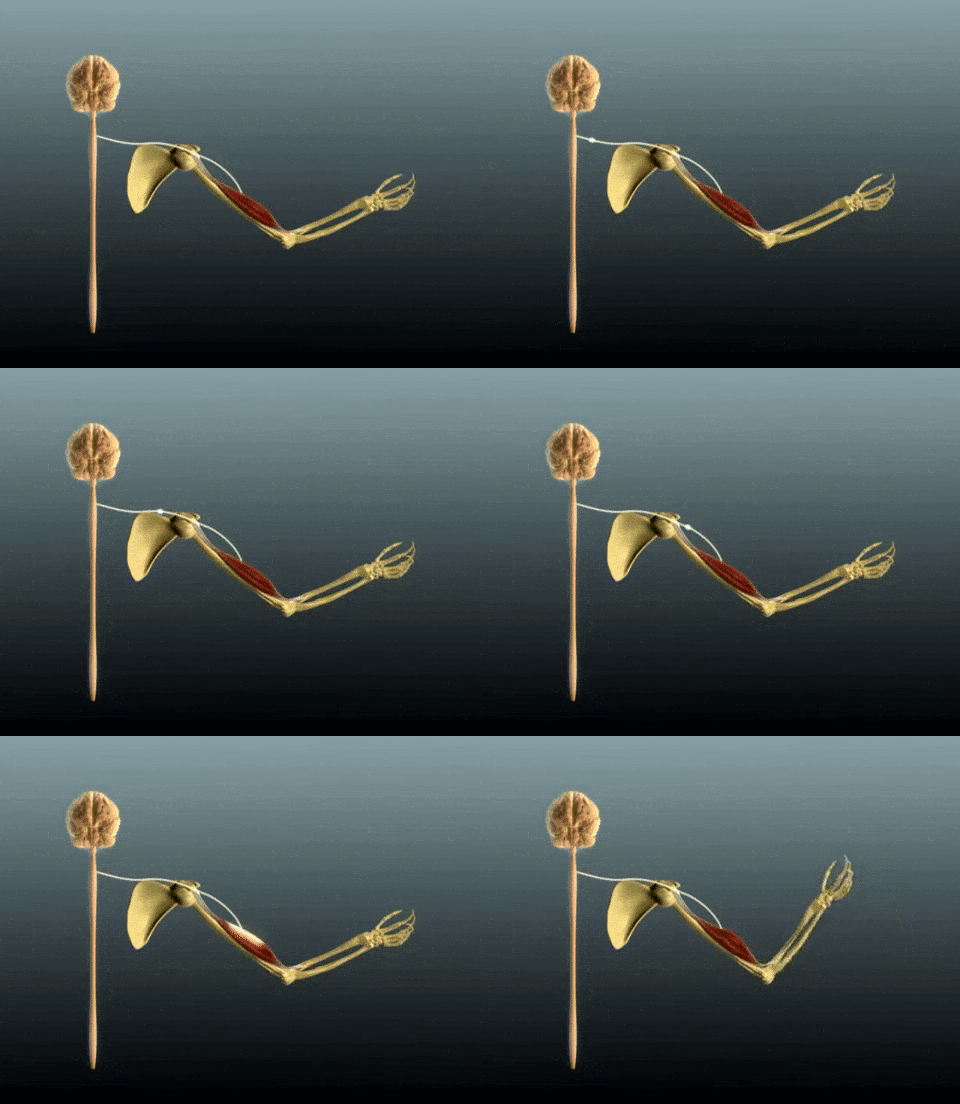
This gif shows an arm bending from a neuromuscular junciton

More efficient communication between your neuromuscular systems will result in something known as “proper motor unit recruitment.”

You may be asking yourself: what is a motor unit?

That’s okay because I was asking myself this same question.

A motor unit is a single motor neuron and the muscle fibers it innervates.

You can think of two different types of motor units:[3]

  • We all have small motor units, meaning that a single motor neuron innervates relatively few muscle fibers, and these smaller motor units are good for precise and detailed movements (e.g., moving your fingers).
  • We all also have large motor units, meaning that a single motor neuron innervates hundreds of muscle fibers, and these larger motor units are good for generating a lot of force (e.g., getting larger muscle groups like the quads to generate a lot of force to help in sprinting).

When you start strength training, you really are helping your muscles communicate better together.[4] This is why we recommend starting with bodyweight exercises, to help start this process.

However, bodyweight training isn’t as easy to ‘scale’ the difficulty as some of the other strength training methods (“put more weight on barbell”), but you can get REALLY strong with just bodyweight training.

For example, you can start with knee push-ups, then go to regular push-ups, then elevated push-ups, then even up to things like handstands and handstand push-ups.

You just have to know HOW and WHEN to scale up (we can help there too).


DUMBBELL TRAINING

This cartoon uses free weights for his strength training.

Dumbbells are a great first step into the world of weight training and strength training:

  1. Most gyms will have dumbbells, even if it’s a basic gym in your apartment complex.
  2. A set of dumbbells doesn’t take up a lot of room, which means you can have a pair at home without a large footprint.
  3. Dumbbells make it easy to add difficulty to a bodyweight movement: holding dumbbells while doing lunges, for example.
  4. Dumbbell exercises can be less intimidating than barbell training for some, and are a step towards barbell training.
  5. Dumbbells have an added stabilization challenge,[4] and will point out muscle imbalances pretty easily (“oh my right arm is stronger than my left arm.”).
  6. Dumbbells allow for single-arm and single-leg exercises to be performed. This can allow you to strengthen any muscle imbalances and can come in handy especially after an injury.
  7. You can scale easily. Once the 10-pound weights become too easy, pick up the 15-pound ones!

KETTLEBELL TRAINING

This cat loves doing a beginner kettlebell workout for strength

A kettlebell is essentially a cannonball with a handle on it. They come in any weight imaginable, they don’t take up a lot of room, and can be used in dozens of ways for a great compact workout.

Our 20-minute kettlebell workout has 8 simple exercises you can do with just one weight.

Although there are “adjustable kettlebells,” you’ll most likely be working with a single kettlebell, and then adjusting your movements for “progressive overload” (making the workout slightly more difficult each time).

If you are a member at a gym, they’ll probably have multiple kettlebells that you can use to level up.

BARBELL TRAINING

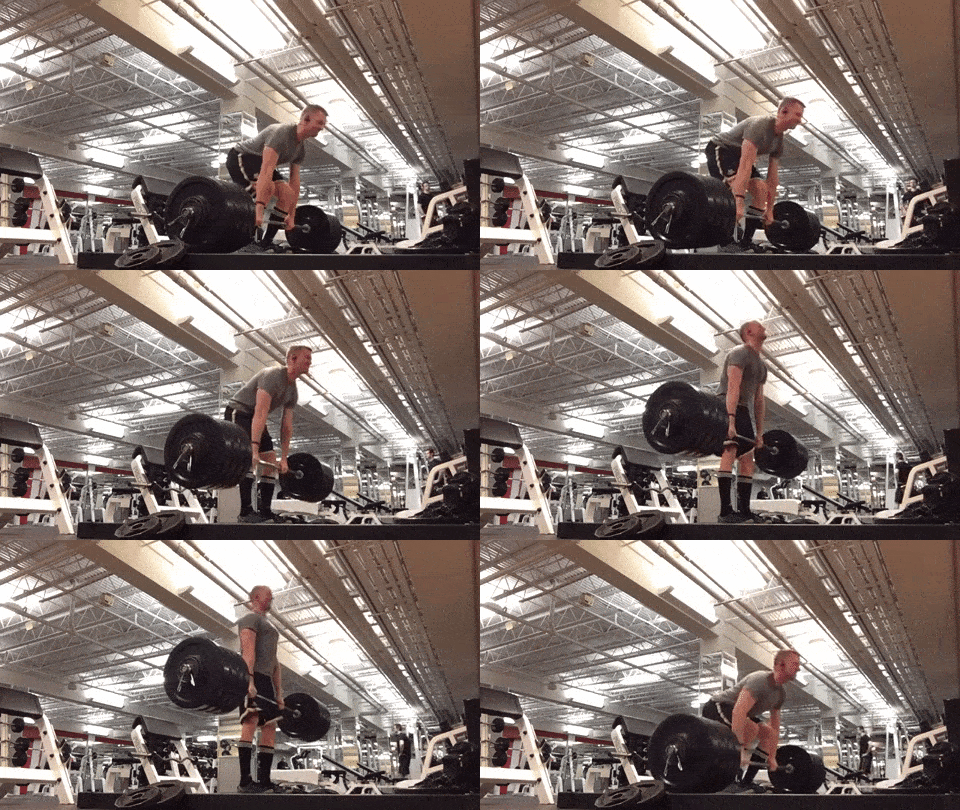
Rebel Leader Steve showing how to do a 420 lb deadlift at the gym.

Regardless of sex or gender age, if your goal is to get strong quickly, use 20 seconds of courage and get comfortable training with a barbell (I’ll help you, I promise):

  1. Progressive overload” is easy – you simply add weights to either side of the bar, allowing you to progressively lift more and more weight each week.
  2. It’s much easier to go heavy safely – especially for lower body movements like the squat and the deadlift.

The biggest downside to barbell training is that in order to train at home, you need to have purchased a squat rack, a barbell, a bench, and enough weights for your house or garage (which can be an expensive investment, especially when starting out!).

If not, you definitely will need to join a gym.

WHICH RESISTANCE TRAINING PATH IS RIGHT FOR YOU?

Not sure which path to pick? You’re not alone – this stuff can be overwhelming. Check out our 1-on-1 Coaching Program. We get to know you and your goals, will check your form via video, and make adjustments based on your progress!


Which Strength Training Program is Right for Me?

Do you think he supplements with creatine?

So, what’s the best workout program to start as a beginner?

Realistically, it’s the one that you will ACTUALLY do.

Barbell training might be optimal in terms of building pure strength quickly, but if you don’t see yourself getting to the gym regularly – or you’re too self-conscious to enter the free weight section (for now) – no problem!

Start with bodyweight training.[5]

Conversely, bodyweight training might seem convenient and easy to start now, but if you can’t motivate yourself to work out at home, you might be better off joining a gym.[6]

So let’s get you a workout program!

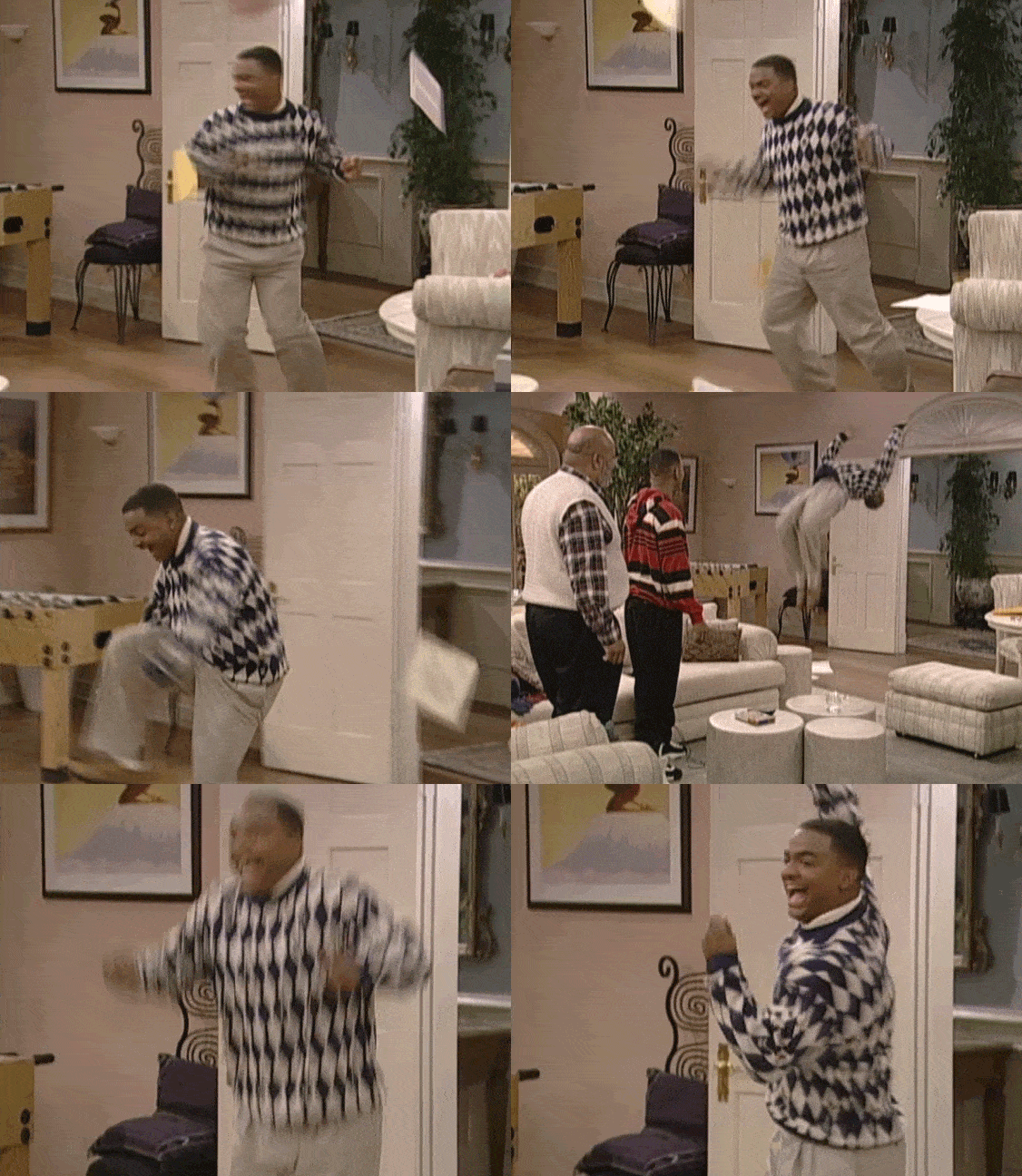
Everyone, including Carlton here, is happy you want to start strength training.

As we cover in our “How to Find the Perfect Workout Plan (for you)”: MOST beginners will be best served by following a “full-body” or “total body” routine, 2 to 3 times per week, with a day of rest in between each workout.[7]

This full-body workout will have 4-5 big compound movements.

A compound movement is an exercise that recruits LOTS of muscles simultaneously and forces your body to work in unison. These compound exercises are considered multi-joint exercises meaning that they involve more than a single muscle group.[8]

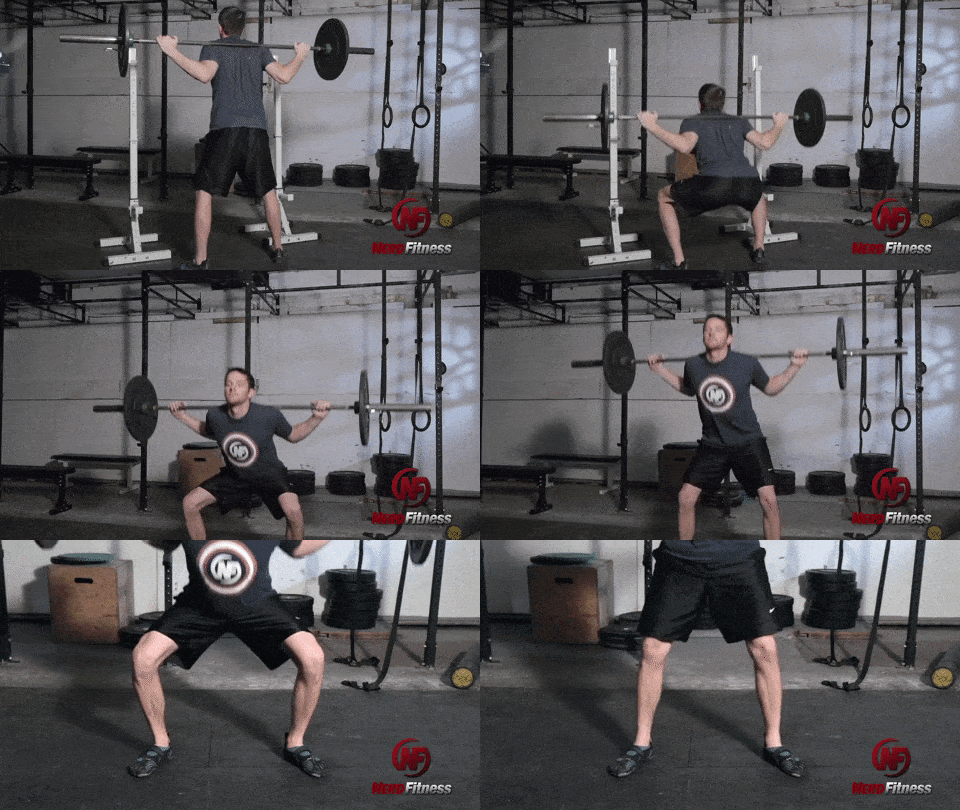
An example would be the barbell squat, which recruits every muscle in your core, butt, and legs to work together to lift the weight.

A squat is a life changing exercise

This is WAY more efficient – and effective at building pure strength – than doing 5 different isolated leg exercises.[9]

Why do 5 exercises when 1 exercise will get you better results in 20% of the time?

To answer your next question, let me tell you about how many sets and reps you should do as a beginner!

As we explain in our “How Many Sets and Reps” guide:

  • Reps in the 1-5 range build super dense muscle and strength.
  • Reps in the 6-12 range build equal amounts of muscular power, strength, and size.
  • Reps in the 12+ range primarily build muscular endurance and size and also cardiovascular health.[10]

If you want more, Coach Jim breaks down different set and rep ranges in this video:

Many beginner strength programs will encourage you to keep things simple, doing just 5 sets of 5 reps for each exercise.

Personally, I encourage people to aim for a weight that they can lift for 8-10 reps. This gives you a chance to really work on your form and lift safely!

The max lifts will come later, my friend. You gotta learn to walk before you can run!

Staci, which workout plan is best for me?” 

It depends on your goals!

If your main goal is general fitness and fat loss, doing a circuit training workout will likely help you reach your goals (make sure you see our section below for “strength training for weight loss”).[11]

If your main goal is to get stronger and/or put on muscle, following a more traditional, pure-strength-style gym workout is going to get you there faster.

TRUTH BOMB: ANY strength training workout will help you reach nearly any goal provided you do two things:

  1. Eat correctly for your goals too. How you eat will account for 80-90% of your success or failure when it comes to weight loss or bulking up.[12]
  2. Increase the difficulty of your workouts. This is that “progressive overload” stuff we were talking about earlier. Doing 1 more bodyweight squat, lifting 5 more pounds, or completing your circuit 10 seconds faster than last workout. By forcing your body to constantly adapt, your muscles will never get complacent and have to keep burning extra calories and rebuilding themselves stronger.

Depending on your current situation, and how quickly you’re looking to cut through the “trial and error” and get expert guidance, I might have an interesting solution for you.

We have a pretty killer 1-on-1 Online Coaching Program here at Nerd Fitness. You’ll work with a coach that will build a workout program for your body type and goals, check your form to make sure you’re doing them safety, and even help plan out your nutrition too.


The 5 Best Beginner Strength Training Programs

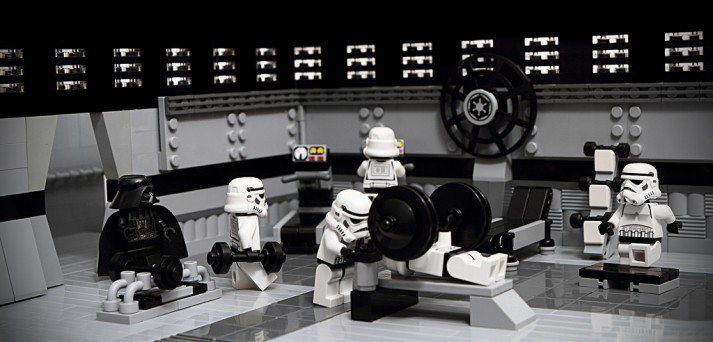
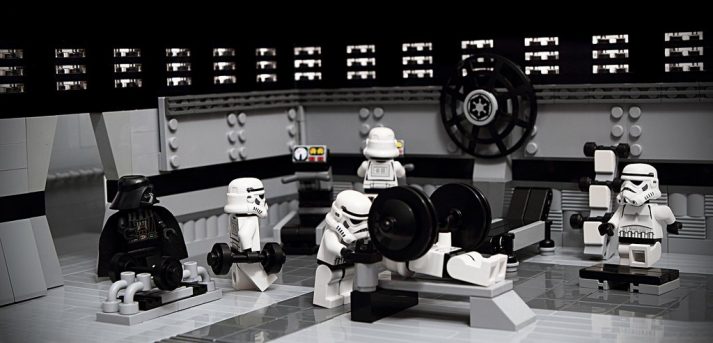
A gym like this is a great way to strength train, as Darth Vader knows.

“Alright Staci, are there any ‘out of the box’ beginner workout programs I can start following now?”

Yup! Let me share with you some of our suggestions:

Here are 5 resistance training workouts you can follow TODAY. Pick the level that you feel most comfortable with, and then level up when you feel ready:

#1) BEGINNER BODYWEIGHT WORKOUT:

Our Beginner Bodyweight Workout has a variety of rep ranges to promote endurance, strength, and cardiovascular health.

Complete one set of each exercise and then moving directly to the next exercise:

  • 20 bodyweight squats
  • 10 push-ups
  • 20 walking lunges
  • 10 dumbbell rows (using a gallon milk jug)
  • 15-second plank
  • 30 Jumping Jacks
  • Repeat for 3 rounds

Want to stick with bodyweight training? When you’re ready to level up, check out our advanced bodyweight training circuit.[13]

Otherwise, you can move onto weight training when you feel comfortable!

#2A) BEGINNER NERD FITNESS DUMBBELL WORKOUT

If you are just getting started with dumbbells and you’re looking for a beginner workout program to follow, this is our Level 3 Gym Workout, “Dumbbell Division”:

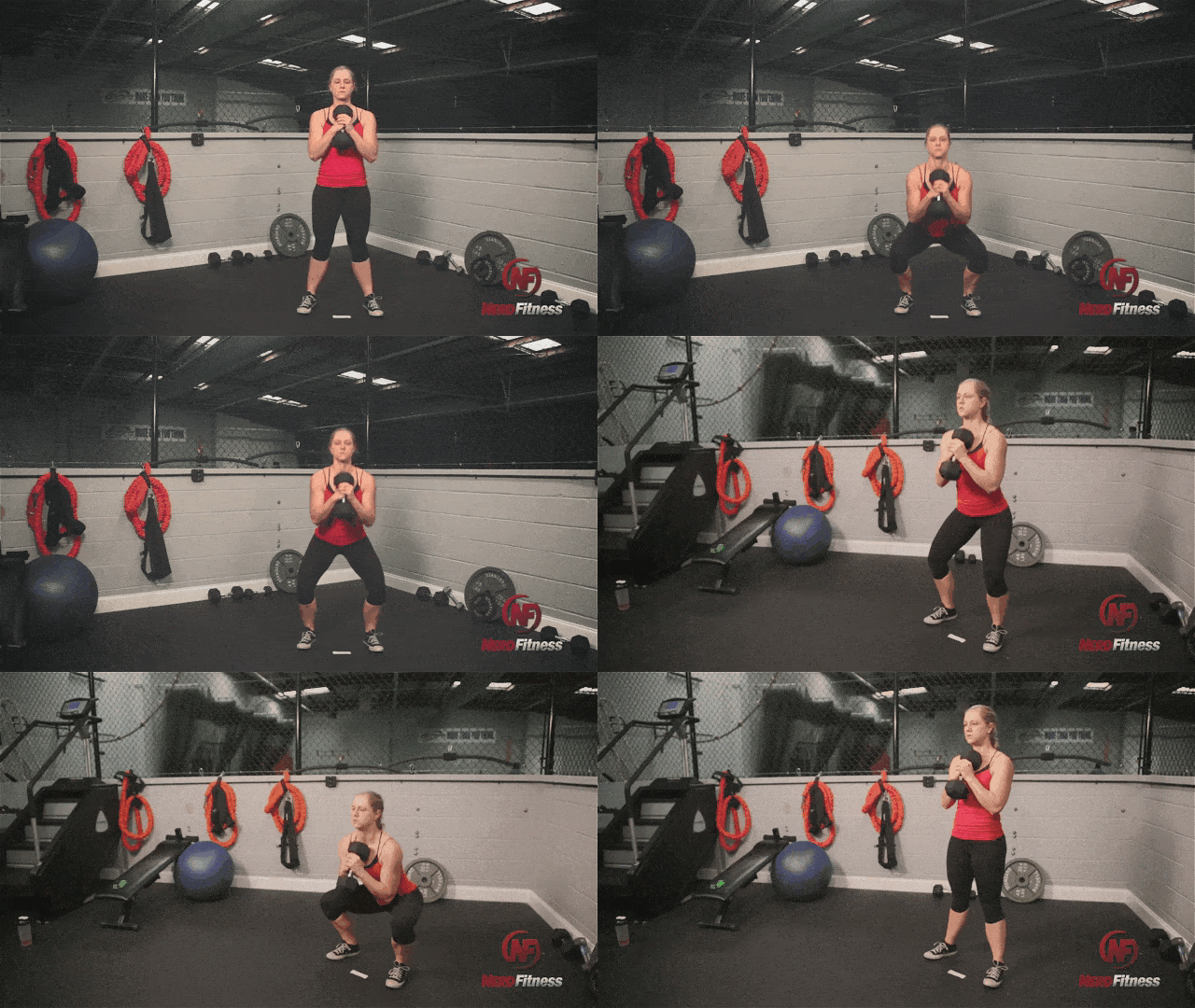
  • 10 goblet squats
  • 10 push-ups
  • 10 dumbbell rows per side

I knew you’d ask, so here is Goblet Squat video explanation (from Nerd Fitness Prime):

And here is our video on how to do dumbbell rows:

#2B) BEGINNER NERD FITNESS KETTLEBELL WORKOUT

Our Beginner Kettlebell Routine is a workout you do anywhere you have room to swing a kettlebell.

So, probably not in a phone booth or a closet or a bathroom stall. But other than that, pretty much anywhere else.

Complete 3 Kettlebell Workout Circuits:

  • 8 Halos (each side)
  • 10 Goblet Squats
  • 8 Overhead Presses (each side)
  • 15 Kettlebell Swings
  • 8 Bent Over Rows (each side)
  • 6 Front Rack Reverse Lunge (per side)

#3) BARBELL TRAINING: 2 DAY WORKOUT SPLIT

As we cover in our “How to Train in a Gym” guide (where we take you from “lost sheep” to “barbell badass”), this routine is a much more focused weight training, strength building workout that gets your feet wet with barbell training. Click on ANY exercise to learn how to do it properly.

NF BEGINNER BARBELL STRENGTH WORKOUT: DAY A

Do 3 rounds of:

NF BEGINNER BARBELL STRENGTH WORKOUT: DAY B

Do 3 rounds of:

WHAT ARE SOME OTHER POPULAR STRENGTH TRAINING PROGRAMS?

#1) “Starting Strength” is considered the gold standard beginner barbell weight training program by many. We highly recommend you pick up the actual book if you are serious about barbell training – it’s one of the most important training books you can ever read.

#2) Strong Lifts 5X5: A solid workout program that starts you out very slow, with just the barbell, and helps you master form before you get too heavy. It also keeps things VERY easy with “do 5×5.” Strong Lifts has been around for a long time and is a solid program.

#3) Jim Wendler’s 5/3/1: This program allows you a little more freedom to do exercises that you enjoy, or work on personal weaknesses, because you choose some of the assistance work.

Note: You can modify any of the barbell training programs to be done with dumbbells, if that’s what you have at home!

Lastly, you can always write your own workout planI wrote my own workouts for a decade and it taught me a LOT about training and health.

We do have our own 1-on-1 Online Coaching Program where you’ll work with a coach that will build a strength training workout program for your body type and goals, check your form on each exercise via video, and even help you plan out your nutrition too.


How Much Weight Should I lift?

Is this LEGO lifting too much or too little for his strength training?

We have a FULL resource on how to determine your starting weight for lifting, but I’ll give you the gist here.

The simple to learn but tough to implement answer: lift enough so that you can get through the set, but not too much that you have NO fuel left in the tank at the end.

And then, try to lift sliiiightly more than last time.

Here are two common questions on strength training:

#1) How much weight should I start with?

  • If you are using dumbbells or a kettlebell, always err on the side of “too light” versus “too heavy.” You want to learn the movement correctly and build correct form.
  • If you are training with a barbell, ALWAYS start with JUST the bar, no matter the exercise (By the way, a standard barbell weighs 45 pounds).

#2) How fast should I add weight to the bar?

Here’s what we teach all of our coaching clients: add the minimum amount of weight each week you can, even if you THINK you can lift more. It’s better to finish a workout full of momentum and say “I can do more!” than defeated and saying “that was too much, crapola.”

Think of it this way, even if you are adding just 5 pounds per week to the bar, within a year you would be lifting 300+ pounds!

The National Strength and Conditioning Association (NSCA) recommends a similar approach:[14]

  • For less trained people (i.e., beginners), it is recommended that for upper body exercises you increase the load by 2 – 5 pounds and by 5 – 10 pounds for lower body exercises.
  • For more trained people (i.e., advanced), it is recommended that for upper body exercises you increase the load by 5 – 10 pounds or more and by 10 – 15 pounds or more for lower body exercises.

So go SLOW. Even slower than the NSCA recommends if needed.

Team NF’s Steve even bought little half-pound weights and increases many of his lifts by just 1 pound per week. It’s a big part of how he transformed (jokingly) from Steve Rogers to Captain America.

And if you are looking for this content in easily digestible form, make sure you download our free Strength 101 Guide when you join the Rebellion below:

The 9 Best Strength Training Exercises to Learn

If you’re new to all this “strength training” stuff, hopping into a program and going from zero to sixty might be a recipe for failure.

Instead, be patient, and take the time to learn these movements first.

I’m going to share with you the 9 best strength training exercises that every beginner should master (scroll down for full video and explanations!):

  • 1. Push-up: uses every push muscle in your body (chest, shoulders, triceps)
  • 2. Bodyweight squat: uses every muscle in the lower body (quads, hamstrings, glutes, core)
  • 3. Bodyweight row: works every “pull” muscle and helps prepare you for a pull-up!
  • 4. Pull-up or chin-up: the best “pull” exercise in history! Everybody should have a goal to get their first pull-up.
  • 5. Bodyweight dip: advanced “push” movement that targets your push muscles (chest, shoulders, triceps) in a different way than push-ups.
  • 6. Barbell squat: the best bang for your buck on muscle building. recruits nearly every push muscle in your whole body, and great core workout.
  • 7. Barbell deadlift: the favorite exercise of every coach at Nerd Fitness. Uses every “pull,” leg, and core muscle in your body.
  • 8. Barbell benchpress: as basic and powerful as they come. Uses every “push” movement in your upper body and can get you strong as heck!
  • 9. Barbell press: press the bar above your head! Targets shoulders and triceps more than the chest.

All of the exercises listed above are considered functional (closed-chain) exercises. That means they relate to our everyday movements and can be used to predict our success in sports, recreational and occupational activities, and activities of daily living.[15]

When attempting all of these above listed exercises, aim to master the movement and perform the exercise through its entire range of motion (ROM).

Why?

Because it will decrease your risk for injury, activate all of the appropriate muscle groups, and result in greater muscle hypertrophy.[16] 

Let’s go over these now.

Click on any of these exercises to get a FULL explanation of the movement, step-by-step:

1) The Push-Up: The best exercise you could ever do for yourself when it comes to using your bodyweight for push muscles (your chest, shoulders, and triceps):

2) The Bodyweight Squat: This exercise serves a dual purpose: it is the foundation for building strength AND helps build proper mobility. If you are going to ever do barbell squats, you need to work on hitting proper depth with a bodyweight squat first!

3) The Inverted Bodyweight Row: Until you can get your first pull-up or chin-up, these exercises are GREAT to start building your pull-muscle strength: your back, biceps, and forearms.

4) The Pull-Up and Chin-Up: Once you can support your bodyweight above the bar, the world becomes your playground. No strength training routine should be without pull-up or chin-up work! (Click here if you can’t do a pull-up or chin-up yet?)

5) The Bodyweight Dip: As you start to get stronger with push-ups and need to find a way to increase the challenge, consider doing dips – warning: these are very advanced, but incredible strength building exercises.

And now we’re into the best weight training exercises:

6) The Barbell Squat: Probably the best exercise when it comes to building strength and muscle throughout your whole body. It also burns crazy calories and makes life better. This is a MUST:

7) The Barbell DeadliftMaybe the best exercise of all time. Actually no, it IS the best exercise of all time. It’s certainly the most primal: “pick the weight up off the ground. Done.”

This is a very technical lift, so make sure you read our article on how to do it with proper form:

8) The Barbell Press: Press a barbell above your head. This recruits all of the muscles in your chest, shoulders, and arms in order for you to lift the weight over your head.

As a bonus, you need to really flex and brace your core, which gets those muscles working too.

9) The Barbell Bench Press. Lie on a bench, and lower a barbell until it almost touches your chest. Pause, and press it back up towards the sky. Repeat! And get strong.

NOTE: All exercises were explained according to the guidelines that have been established by the NSCA.[17]

Your mission, should you choose to accept it: commit to trying ONE of these movements in the next week. Use 20 seconds of courage, recruit a friend who has lifted or trained before, and try your best.

And if you want somebody to help you put these into a workout program, teach you HOW to do these movements properly, and have the confidence to know you’re training correctly for your goals…


How to Know You’re Doing a Strength Training Movement Properly (Form Checks)

This cameraman knows a form check is valuable when it comes to strength training. And a raincoat in a storm. Both practical.

Always start out with just your body’s weight and make sure your movement is correct!

  • If it’s a barbell movement, use a broomstick (or PVC Pipe).
  • If it’s a dumbbell movement, use two sections of PVC or something else that is light and small to simulate a dumbbell.

When it comes to movements like squats, deadlifts, pull-ups, bench press, your form is crucial. Develop good habits with lightweight and you will save yourself months of frustration later and will protect you from injury.[18]

If you’re struggling with certain elements of a movement, don’t get frustrated! Remember, proper communication between your neuromuscular systems needs to develop.

Things will start to improve.[19] 

How do you know if your movement is correct?

Do regular video form checks! Record yourself and watch the video.

Some LEGOs taking a selfie

Alternatively, an expert reviewing your specific movement can be invaluable. 

If you’re looking for someone who can do video form checks, provide feedback, and adjust your workouts based on your progress, you can check out our 1-on-1 Online Personal Training!

I’ve had an online coach for 4 years and it’s changed my life.


You could also get expert guidance in person: Look around at your local strength and conditioning gyms and see if you could hire a coach (here’s how to find a good personal trainer) for one or two sessions just to go over the basic movements.

If you can’t do either of those two options, no big deal! Videotape yourself and compare it to the videos here in the articlesYou can also post your video to the form check section of the Nerd Fitness Forums.

When I started, I really liked practicing all of the movements at home because I could watch a video online at the same time as I was watching myself do it in a mirror. Studies have found this can actually help![20]

Strength Training for Weight Loss

Strength training like with these dumbbells is key for a weight loss program.

So you’re looking to lose weight, and tired of hours of cardio (me too).

And you’re wondering if strength training for weight loss – by following one of the workouts in this guide is a viable solution.

Or, gasp – will strength training make you too bulky? (SPOILER: it won’t)

Yes, Strength training will help you lose weight IF you do two key things for effective weight loss:

  • Calorie restriction: eating fewer calories than you burn every day[21]
  • Strength training with progressive overload (picking up heavier stuff)

As we point out in our “Cardio vs Intervals vs Weight Training” article, strength training is the MOST efficient method for weight loss.

Not only that, but you can find study after study after study that shows you the benefits of strength training for weight management when combined with “calorie restriction.”[22]

As we cover in our “Why Can’t I Lose Weight?” article, here’s why eating a caloric deficit and strength training is SO magical when combined:

When you strength train – by picking up something heavy – your muscles are “broken down” during the exercise itself, and then they rebuild themselves stronger over the next 24-48 hours.

Guess what happens during those 24-48 hours?

Your body will divert as many calories consumed as necessary to “Rebuild Muscle!”[23]

Look at me all big and strong!

It also diverts additional calories to “Burn as Fuel” to handle this increased “muscle rebuilding” activity.

This means two amazing things:

  • Your metabolism is revved up for this time period, burning more calories than normal.
  • Rebuilding muscle is a calorie-taxing activity!

Not only that, but when you eat a caloric deficit, your body doesn’t have enough calories to fuel all the day’s activities. In these instances, your body will pull from your stored fat to make sure all the work still gets done.

This is the trifecta of physical transformation victory:

  • You get stronger and keep the muscle you have.
  • You burn through the fat you’re trying to get rid of.
  • You’re decreasing your body fat percent and keeping your muscle = look good naked.

In other words, strength training + eating right is the BEST path for weight loss out there! And yes, in certain situations, you can actually lose weight AND build muscle at the same time.

Coach Matt explains how to gain muscle WHILE losing fat in this video:

So how do you put this into practice? Pick one of the strength workouts in this article. Calculate your daily caloric needs. Learn about healthy eating. And start.

In other words…

Pick up something heavy, and eat a vegetable.

These are the types of things we work on with our 1-on-1 Coaching Clients: helping them lift weights confidently and eat correctly for their goals! Let us help you:


“Just Tell Me What Strength Training Program to Follow!”

Relax, you'll be fine strength training, just like this little trooper is fine with his bear.

Okay! Unless you are collecting underpants, you should now have a workout program you want to try out!

“Staci, this is a lot, can you just TELL me what to do?”

Okay fine.

Here are the steps again for you:

STEP #1: PICK YOUR WORKOUT PATH:

A) If YOU ARE TRAINING AT HOME. Pick one of these 3 based on what equipment you have:

B) IF YOU ARE TRAINING IN A GYM: Amazing! I love gyms.

Read our “How to train in a gym” guide and go from Level 1 to Level 6 over the next month. Gym closed? Here’s how to build a home gym.

STEP #2: TRY A NEW EXERCISE: In addition to following a workout program, I’m gonna push outside of your comfort zone – that’s where real growth happens.

Learn ONE new movement this week.

Pick one of the exercises below and try it out!

Here are 42 bodyweight exercises you can do too.

STEP #3) HIRE A YODA: If you are somebody that just wants to be told exactly what to, how to train for your goals, and are good at following direction, consider hiring a coach.

I’ve been working with an online coach since 2014 and it has changed my life – and I do this stuff for a living!

Nerd Fitness Coaching Banner

STEP #4) JOIN THE REBELLION! If you like how we do things around here at Nerd Fitness, we’d love to have you in our community of misfits, mutants, and rebels!

Sign up in the box below and I’ll send you our free Strength 101 guide:

No matter what you do today:

Don’t be afraid of doing anything wrong – truth be told, the majority of the people in the gym don’t have any idea what they are doing, and are just as nervous as you are!

Muster up your 20 seconds of courage if you need to, and let me know in the comments how it goes!

What questions do you have about getting started?

So, what’s the biggest thing holding you back from starting strength training?

-Staci

PS – Check out the rest of the articles in our Strength Training 101 series:

photo source: LEGO bench pres, tonobalaguer © 123RF.com, Stormtroopers lifting, Chris Christian:Strongman, W_Minshull: Stormtroopers in Gym, Lego Lifting, RainstormKristina Alexanderson: Teddy Love

The post Blog first appeared on Nerd Fitness.

from Nerd Fitness: Helping You Lose Weight, Get Stronger, Live Better. https://ift.tt/2u8lamE
via IFTTT

Categories
Uncategorized

#holistic #getfit #nutrition How Many Sets and Reps Should I Do? (Building The Correct Workout Plan)

If this plot asked how many reps and sets should he do, what would you tell him?

If you’ve ever asked yourself “Am I doing too little or too many reps and sets?” then this guide is for you.

This article is part of our Strength 101 series, and we’ll show you exactly how to determine the number of repetitions and sets for specific exercises, so you can build your own workout routine.

It sounds easy, but depending on your goals, the answer to “How many reps and sets should I do?” can vary greatly.

This Muppet knows strength training will help him gain muscle and lose fat.

We work hand-in-hand with our Online Coaching Clients to create the correct workout program that suits their goals, needs, and available equipment


In today’s guide on workout programing, we’ll cover (click each to get right to that answer):

The Correct Number of Reps and Sets for a Workout

As Coach Jim mentions above, “Rep” stands for “repetition” and defines one complete motion of an exercise.

And one “set” is a consecutive number of reps without stopping.

And one “smorgasbord” is a buffet of food.

(This has nothing to do with this article, but it’s a fun word to say.)

As we mentioned throughout our Strength Training 101 series, how many reps and sets you should do is really going to be dependent on your goals.

For example, is your goal to improve:

  • Muscular endurance
  • Muscular hypertrophy
  • Muscular strength
  • Muscular power

Depending on what your goal is, the sets, reps, and rest intervals will change.

Oh, you’re just starting your strength training journey?

Well, make sure you grab our free guide, Strength Training 101: Everything You Need to Know I’ll send it to you for free when you join the Rebellion (that’s us!). 

Alright, let’s break down reps and sets for you, because I can see you still have questions.

How Many Reps Should I Do?

How many reps should this lego do?

Remember, “Rep” stands for “repetition” and is more or less one complete exercise.

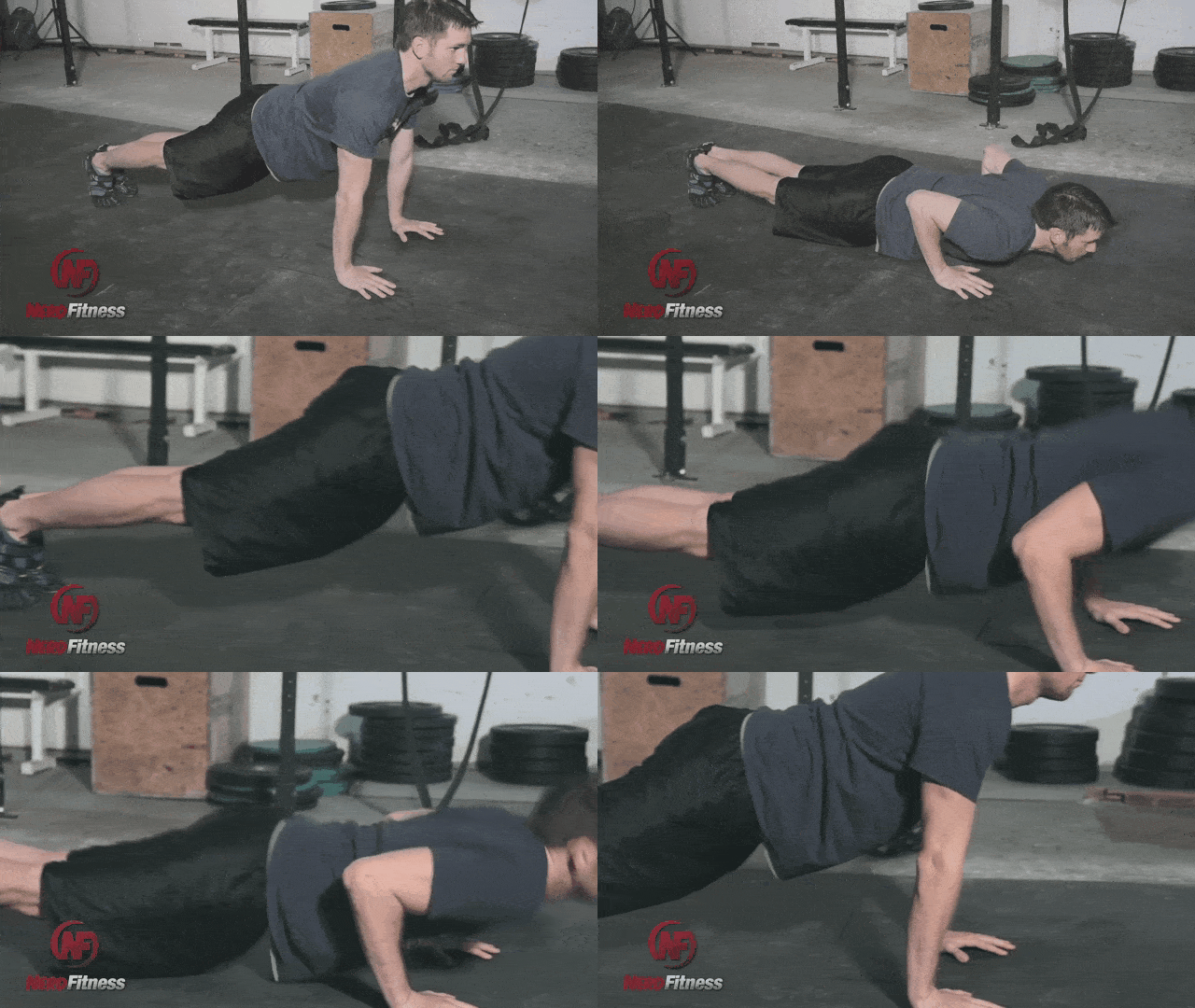
Like a push-up:

Here Rebel Leader Steve shows you the classic push-up.

So “2 sets of 5 reps of push-ups” means, “5 consecutive push-ups, a rest, then another 5 consecutive push-ups.”

Cool?

If you don't know what reps and sets are, the rest of the article is going to be really confusing.

Cool.

When deciding on how many sets and reps to do, it begins by asking What am I trying to get out of this workout?!

We’ll group different rep ranges into different goals, for:

  • Muscular endurance
  • Muscle size
  • Overall strength

I’m going to share with you the commonly accepted answers, but they ALL come with a HUGE caveat that I’ll share at the end of this article.

I’m going to start with the “widely accepted numbers here.”

Let’s chat about the following:

1) MUSCULAR ENDURANCE (long-lasting muscle) Endurance means encouraging and training your muscles to perform for an extended period of time. This means doing a LOT of repetitions. 

People targeting muscular endurance will aim for a range from 12 to 20+ reps.

Obviously, you won’t be able to lift heavy amounts of weight for 20+ reps, so you’ll be lifting lighter loads.

Also, because you’re targeting endurance improvements, you want to decrease the amount of rest between sets: 30 seconds to a minute.[1]

If you are a runner or cyclist, strength training with higher repetitions can help your muscles develop more endurance as well![2]

I wonder if this kid is biking to go squat?

Reps for increased muscular endurance: 12+

2) MUSCLE SIZE (“sarcoplasmic hypertrophy”) This is for guys or gals looking to build larger muscles.

The scientific term here is “sarcoplasmic hypertrophy,” as it focuses on increasing the amount of sarcoplasm, the non-contractile fluid found in your muscle.

Up to 30% of your muscle’s size is attributed to the sarcoplasm, so focusing on this type of hypertrophy helps build overall size (i.e., increased cross-sectional area of the muscle).

If you’re looking to get bigger:

  • Target a rep range of 6 – 12 reps per set.
  • Aim for 3-5 sets.
  • Rest time between sets should be short, about 60 to 90 seconds.

Reps for increased muscle size: 6-12[3]

3) STRENGTH AND POWER (“myofibril hypertrophy”) – If you’re training for specific sports and just want to get stronger with more power – but not necessarily get bigger, this is the strategy for you.

This type of training focuses on strengthening the myofibril, the contractile part of the muscle, hence the name “myofibril hypertrophy.”

For this, target reps in the 1-5 range. And yep, that means you’re going to be picking up heavy weights, focusing all that concentrated effort into just one or a few reps.[4]

A scene from the Simpsons, someone throwing bleachers through the roof.

Something to note when lifting for strength and power: not only are you shocking your muscles, but you’re also putting a lot of pressure on your body’s central nervous system (CNS).

So what does this mean?

In a way, it means your body’s ability to communicate with its muscles has grown fatigued, and performance may suffer.

That’s why you may want to rest between 2-5 minutes in this range.

Oh, and your CNS will adapt and become stronger, which will be critical for building strength and power.[5]

This is how powerlifters train:

  • Low reps
  • High weight
  • Long time between sets

Since powerlifting really taxes the central nervous system, you may be waiting 3-5 minutes between sets when training in this fashion.

TO RECAP, these are the rep ranges you should be considering:

  • Reps in the 1-5 range build super dense muscle and strength.
  • Reps in the 6-12 range build equal amounts of muscular power, strength, and size.
  • Reps in the 12+ range primarily build muscular endurance and size and also cardiovascular health.

I realize this is a lot to figure out, so if you are somebody – like me – who just wants to be told what to do and outsource all the worry of “am I doing the right workout for my goals?” I got you covered!

I’d love to learn your story, and then build a custom program that fits your goals. We’ll help you with your nutrition, your workouts, and even check in regularly to keep you accountable!


How Many Sets Should I Do?

How many sets should this lego do?

As explained above, a “set” describes a group of repetitions performed for an exercise without stopping.

For example, if you do 10 squats right now, you just did 1 SET of 10 reps of squats.

So let’s talk about the “correct” number of sets per exercise.

The simple answer: “Do 3-5 work sets of a given exercise.”[6]

Just make sure you’re not compromising your form.

Steve Rogers doing a push-up (with bad form)

At least he’s trying!

The National Strength and Conditioning Association (NSCA) will break this down, suggesting the following set ranges:[7]

  • 2-3 will help build muscular endurance (12 to 20+ reps)
  • 3-6 build muscular hypertrophy (6 to 12 reps)
  • 3-5 build muscular power (3 to 5 reps)
  • 2-6 build muscular strength (less than 6 reps)

“STEVE, JUST TELL ME WHAT TO DO.”

FINE! Pick a weight that feels light to you, and then do 3 sets of 10 reps.

(Learn how much weight should I be lifting”).

And then next time?

Do more than last time:

  • Did 3 sets of 10 reps of a 65 lb bench press? Do 3 sets of 8 at 75 lbs this week!
  • Did 3 sets of 5 pull-ups last week? Go for 3 sets of 6 this week.

That’s the key to progressive overload, as Coach Jim explains in this article:

If you’re not sure if “3 sets of 10” or “5 sets of 5” is right for you, we got you covered.

We’ll build a program that fits your goals, and then adjust it each month based on your progress. Never guess or wonder what you should be doing again.


How to Build a Workout Routine!

Batman knows how many reps and sets to do.

Now that you have “edumacated” yourself on how your specific goals influence the number of reps per set, and what sets actually are, you can build your workout program around this info.

TO RECAP, aim for 3-5 sets in the following rep rangers per exercise based on your goals:

  1. Endurance: 12+ reps per set.
  2. Hypertrophy (bigger muscles): 6-12 reps per set.
  3. Strength (dense, powerful muscle): 1-5 reps per set.

Two points worth mentioning:

  • A recent study showed that heavier weight for low reps created more muscle mass than a higher volume (lower weight for more reps).[8]
  • Studies show that bodyweight training exercises can build muscle, but require a LARGE number of sets per rep, and pushing oneself to absolute failure.[9]

What this means: studies suggest targeting heavier weight with fewer reps for big lifts like squats and deadlifts to build muscle, while targeting high reps to absolute failure with bodyweight exercises for muscle building.

Just remember to rest enough between sets so you don’t fatigue your central nervous system too bad.[10]

One last point: Nutrition is still 90% of the equation!

Your rep range doesn’t matter nearly as much as you think, so don’t overthunk it!

Don't overthink your sets and reps! Just do more than last time.

Here are some examples:

  1. If you’re trying to build muscle and get bigger, doing sets of 3 or sets of 5 or sets of 10 will ALL help you get bigger, if you’re eating enough to get bigger![11]
  2. If you’re trying to lose weight, it doesn’t matter if you do sets of 15 or sets of 5 if you are consistently overeating by 1,000 calories a day. You need to eat the right number of calories.[12]
  3. It doesn’t matter if you train like a bodybuilder, you ALSO need to eat enough food to provide your muscles with enough calories to rebuild themselves bigger and stronger! This is the biggest mistake I see skinny people make when trying to bulk.

This brings me to my final point: because nutrition is 90% of the equation, your sets and reps don’t matter nearly as much as you think they do!

All that matters? Doing MORE this workout than the last workout.

Remember, how you build muscle and strength and burn fat: “progressive overload.”

One more rep than last time.

Even Marshall knows to go for One More each time you try your workout

Doing one more set than last time.

Picking up a weight that’s 5 lbs. heavier than last week.

So get out of your own head, and START TODAY:

1) GET HELP: If you want expert guidance and accountability so you don’t have to figure out all of this stuff on your own, I got you. 

Click the red button below to get the details about our amazing online coaching program:


2) FIGURING IT OUT OUT ON YOUR OWN!

Download our free Strength Training 101 Guide! You get it free when you join our Rebellion (the name of our awesome free online community). Sign up in the box below:

3) WORKOUTS YOU CAN DO NOW:

Remember: the goal should be to get stronger each workout.

Write down what you did last time, and then do MORE this time.

By continually challenging your muscles to do more, they’ll have to adapt by getting bigger, stronger, burning more calories, etc.

There’s a lot of different truths and fallacies on plateaus and how your muscles can get “used” to working out and stop growing.

If that’s something you’re battling, here’s a way to continue making progress:

Spend a week in a different rep range with different amounts of weight.

This will introduce a little chaos into the system, which could be a good thing…unless you’re Batman.

Joker knows how to bring chaos into a system.

What we’re talking about is muscle confusion theory, which is a preplanned period of variation.[13] Not, you know, wandering into the gym with no plan and just doing something different every time (whatever you feel like doing at that moment).

That won’t help.

But spend a week deliberating mixing it up. Then go back to your regularly scheduled routine and you’ll be right back on track.

Make sure you know what you want, and then design a plan to get there.

-Steve

PS: If you want a nice shiny app to tell you EXACTLY how many seps and reps to do, our shiny new app will do just that!

You can sign-up for a free 7-day trial to Nerd Fitness Journey, which will build a workout around your experience level!

Jump in right here:

###

All photo citations: Evel Knievel, Me riding a bicycle, Bicylelifter, Project Story 1/3

The post Blog first appeared on Nerd Fitness.

from Nerd Fitness: Helping You Lose Weight, Get Stronger, Live Better. https://ift.tt/2A0m9aq
via IFTTT

Categories
Uncategorized

#holistic #getfit #nutrition The Ultimate Guide to Losing Fat and Gaining Muscle (At the Exact Same Time)

Is Vader on the right track to lose fat and gain muscle? Let's find out!

There’s an argument in the fitness world that you can either choose to lose fat OR gain muscle.

That they just can’t be done simultaneously.

To this, I say, “Hogwash!”

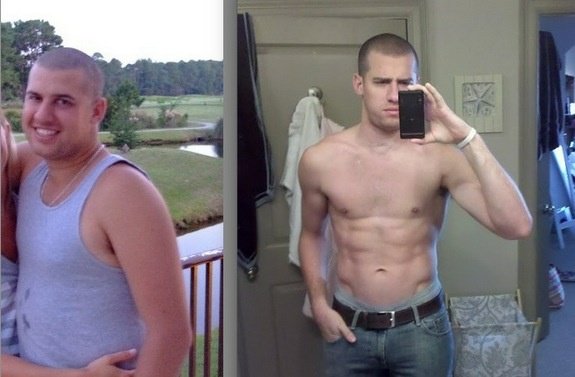
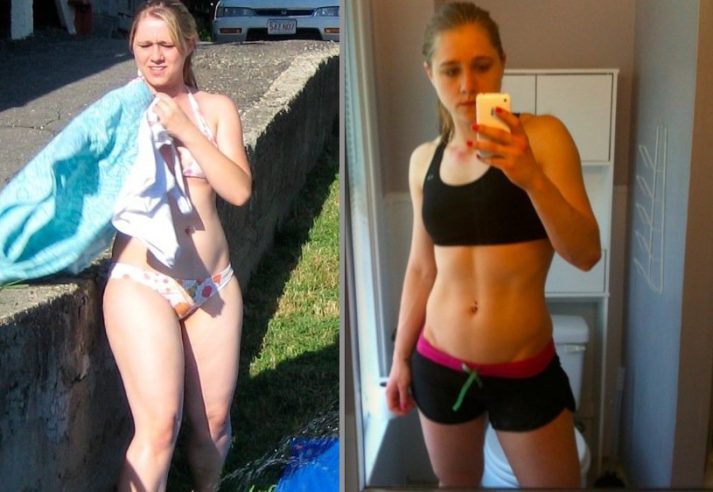
We have tons of success stories from our online coaching clients who have been able to do both simultaneously:


And that’s what we’ll cover in today’s guide!

We’ll do so by discussing:

Plus, I have tons of sweet LEGO photos and silly gifs on their way, which is always a good time. 

What’s Body Recomposition?

As Coach Matt mentions in the video above, gaining muscle and losing fat simultaneously is called “body recomposition.”

So yes, the process is indeed possible, as long as you follow the right plan.

…but you don’t have to take my word for it.

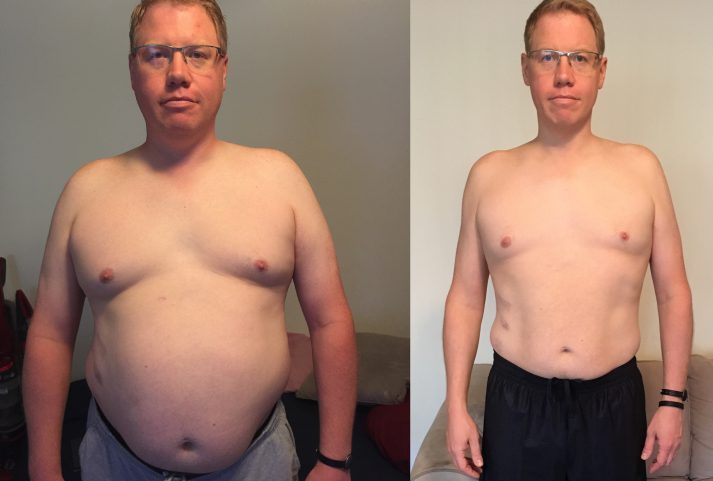
Just ask our friend Aksel here (who achieved an impressive body recomp with the help of a NF Coach):

A side-by-side of Aksel's before and after

Read more about his incredible story!

However, as I mentioned in the intro, you’ll often hear that losing fat while gaining muscle is impossible. The argument goes that you should just focus on one or the other, because doing both at once is destined to fail.

Let’s explore this claim.

Losing Fat and Gaining Muscle at the Same Time (The Controversy)

This picture shows two LEGO miners, who don't have much to do with fast weight loss, but look cool.

To understand why losing fat while gaining muscle can be problematic, we need to explore both processes.

Let’s consider the following points:

  • To lose fat, your body needs to be in a caloric deficit. This deficit forces your body to use pre-existing fat stores for fuel.

  • To gain muscle, your body needs to be in a caloric surplus. This surplus provides the energy your body requires to repair and build bigger muscles.

Given this, losing fat (caloric deficit) at the same time one is gaining muscle (caloric surplus) seems impossible.

However, if we go a few steps deeper into the science, it IS possible!

A foe from the Prince Bride not believing you can lose fat while gaining muscle.

To appreciate the nuance here, let’s get into some specifics on losing fat and gaining muscle separately, and then we’ll combine them.

HOW DO YOU LOSE FAT?

a picture of Homer Simpson with Donut

There is a simple answer and a slightly less simple answer when it comes to losing body fat.

The simple answer: “consume fewer calories than you expend or burn.”[1]

Eight words, and one or two of those could probably be thrown out.

When your body needs more calories than the amount you are eating, you are in a “caloric deficit.” Your body doesn’t have the calories it needs as fuel, so it’ll start breaking down parts of itself for its energy requirements.

(If you’re curious, you can calculate your daily caloric needs here).

The hope is that your body will mostly pull from fat stores, though depending on how you are training it will also break down muscle too.[2]

Said again: when you are eating a caloric deficit, your body will pull from both its fat stores AND existing muscle for energy.

Yes, if you're not careful you can lose fat AND muscle while losing weight.

From a physique and health standpoint, obviously we’d prefer that your body doesn’t break down muscle when in a caloric deficit, and instead really focuses on using fat stores instead.[3]

I make this point for a reason: your goal in fitness shouldn’t only be “weight loss,” despite the common vernacular used.

Who cares what the scale says, right?

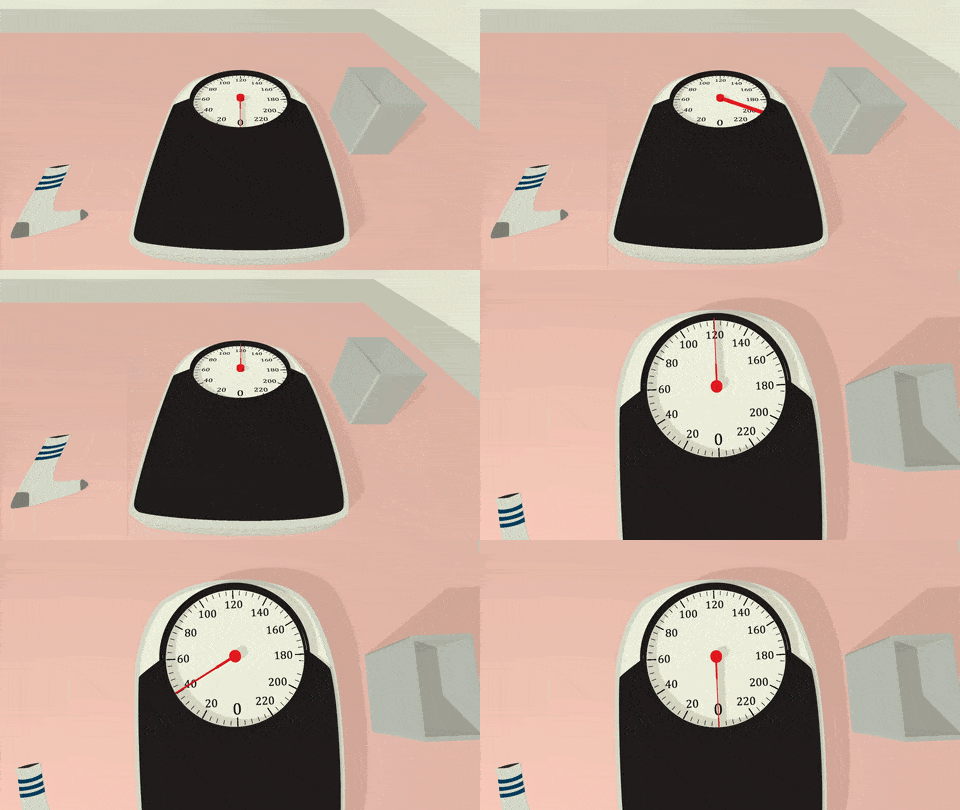
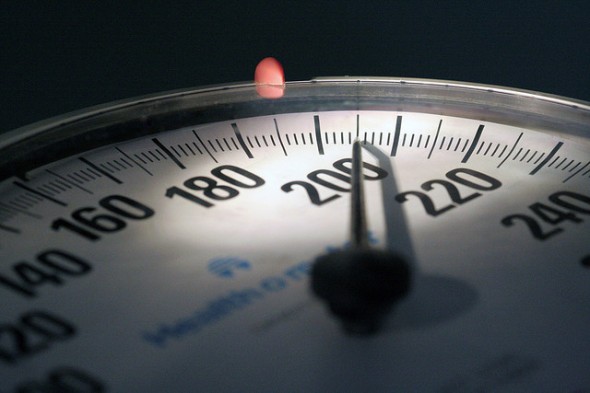
A scale can be misleading when you're trying to lose fat and gain muscle.

The goal instead is to reduce body fat while also keeping the muscle you have (or even building more muscle).

That leads to a better physique and a healthier body.

This is why there is a big market for devices that supposedly assess your body fat percentage.

By reducing your total fat on your body, OR increasing muscle mass, you’ll end up with a lower body fat percentage (it’s just a simple ratio of fat to everything else).

And lower body fat percentages are where “toned arms” and “6-pack abs” hang out.

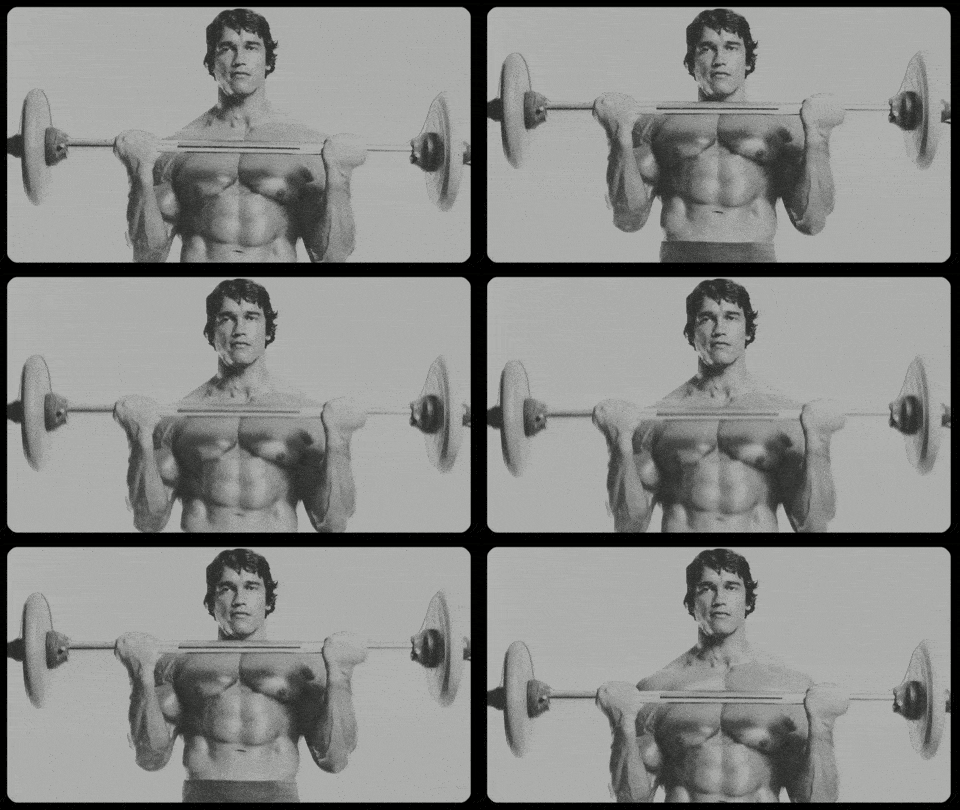
Arnold lost body fat and gained muscle to achieve his physique. And maybe some super glue.

We’ll discuss tips on keeping and growing your muscle while in a calorie deficit later in this guide. For now, remember you need fewer calories “in” compared to calories “out” for weight loss to occur, from either fat stores or muscle.

You may be asking, “Steve, what’s easier to do? Burn more calories or consume less?”

Good question.

Numbers will help tell the story: though this is a gross oversimplification – let’s use the ‘widely accepted’ starting point of “3,500 calories equals roughly one pound of fat.”[4]

If you want to lose one pound – or half a kilogram – of body fat in a week (a worthy, sustainable goal for some), you need to create a caloric deficit of 500 calories per day. 

Your options to create this caloric deficit include:

  • Consuming 500 fewer calories
  • Burning 500 more calories
  • A combination of the two

Which is easier?

Here are both halves of that equation. 500 calories equals:

  • The number of calories found in a Big Gulp of Mountain Dew.
  • An estimate of the calories required to run five miles.

Yes, you will have to run for a long time to burn 500 calories.

Yep.

When it comes to maintaining a caloric deficit, it really comes down to diet.

It’s significantly more effective and time-efficient to consume 500 fewer calories than it is to burn 500 additional calories.

As Time magazine controversially pointed out – with tons of cited studies – “exercise alone won’t make you thin.” It’s too easy to add more calories in, and requires too much work to effectively influence “calories out.”

We dig into this in our guide to The CICO Diet

This brings us to our slightly less simple answer on getting in shape:

To lose body fat, you need to watch what you eat, and do so in a sustainable way.

Here at Nerd Fitness, we are firm believers that 80-90% of the fat-loss equation comes down to diet (check out Rule # 4).

Here’s another idea we focus on: EAT MOSTLY UNPROCESSED FOOD.[5]

These image shows some real food, critical if you're trying to lose body fat.

Meat, fish, eggs, vegetables, fruits, nuts are all great examples.

These foods are very nutrient-dense and often low in calories compared to their processed counterparts. Which means you get filled up without overeating.

Win-win-win.

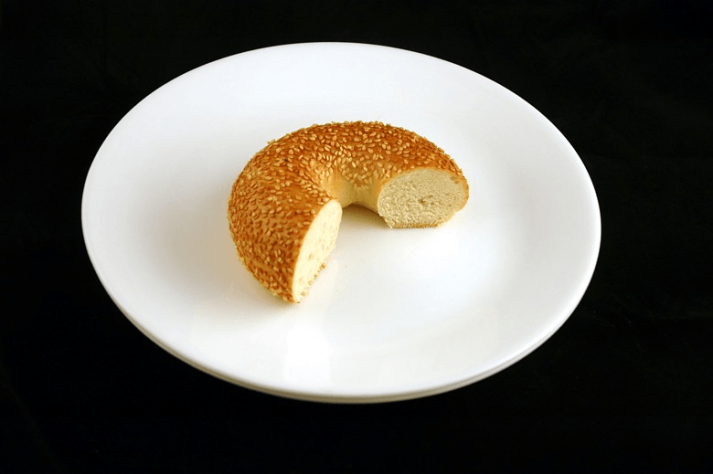
Have you ever seen the difference between 200 calories of broccoli and 200 calories of a bagel? WiseGEEK does a great job of displaying this, so we’ll borrow a couple of their photos.

200 calories of broccoli:

A pic of 200 calories of broccoli

200 calories of a bagel:

This picture shows you 200 calories worth of a bagel, which is about 2/3 of one.

That’s why REAL food is the answer to creating a sustainable caloric deficit.

Most people can eat an entire bagel, no problem. Plates of broccoli, with all of the fiber, are much tougher to overeat.

We lay it all out in our Beginner’s Guide to Healthy Eating. It’ll provide tips on how to gradually create habits that get you to a “REAL food” way of eating, including proper portion sizes, tips on batch cooking, and a cameo from Winnie the Pooh.

Pooh knows that to lose fat and gain muscle, he really needs to cool it with all the honey.

With all of this, we advise you to take it slow, so new habits of healthy eating become permanent.

Something you can do for the rest of your life.

It’s a strategy we work closely with our coaching clients on: small nutritional adjustments they feel comfortable making. It’s how some of them have been able to lose 50-100 pounds!


Let me explain again: what you eat will be 80%-90% of the equation to lose body fat.

The other 10-20%? Exercise.

Of course it’s exercise.

That’s a pretty good segue into…

HOW DO YOU GAIN MUSCLE?

Toy Hulk and the wilds trunks of huge plants

If you want to build muscle, you’ll have to lift heavy things and ensure that your body has enough calories and protein to adapt by building more muscle.

In our Beginner’s Guide to Building Muscle and Strength, I summarize it as follows:

  • Lift heavy things
  • Eat a diet based on your goals
  • Rest so your body can recover

Let’s chat about each one quickly.

1) Lift heavy things. I will always be on Team Strength Training. If you’re looking to build muscle, you’re gonna need to lift heavy things.

This Muppet knows strength training will help him gain muscle and lose fat.

When you lift an object (or your own bodyweight) enough times, your muscles reach the point of failure. This causes your muscles to tear and breakdown.

When your muscle rebuilds itself following the workout, it’ll be bigger and stronger than before. Then you do it again.

And again.

And again.

As long as you are eating enough to rebuild your muscle, you’ll get stronger!

Not sure where to start on a Strength Training practice? No problem! You can download our free guide Strength Training 101: Everything You Need to Know when you join the Rebellion (our free community) below:

2) Eat a diet based on your goals. Because your muscle needs to be rebuilt after exercise, the calories are gonna need to come from somewhere. I’ll talk a lot about proper diet in the next section (with a Harry Potter analogy), so I won’t spend too much time on it here.

Just know that eating the right quantity of foods will be a big part of gaining muscle.  

3) Rest. Your body rebuilds itself while you sleep, so make sure you get plenty of rest each night. I’m talking 7-8+ hours. This will help ensure your body has the time it needs to grow stronger.

If you’re strength training and only getting 6 hours of sleep a night or less, you’re really doing yourself a disservice. Go to bed!

Donald knows he has to get plenty of rest to grow muscle. If only that sink would stop dripping.

That’s the short gist of how to build strength: challenge your muscles, eat well, and get some rest.

Let’s narrow in on our second point, “Eat a diet based on your goals.” It’ll become very important when balancing both losing body fat and gaining muscle.

To do that properly, grab your owl, and let’s chat about Hogwarts.

How to Lose Fat WHILE Gaining Muscle (The Science)

Close-up shot of microscope with metal lens at laboratory.

To answer the question of losing body fat and gaining muscle at the same time, I’d like to introduce an analogy from the world of Harry Potter.

Recall the “Sorting Hat:” The Sorting Hat’s job was to determine which of the four houses kids will call their home.

The sorting hat will help us tell the story on calories and losing fat.

It’s almost like a traffic director: “Harry, you will go to Gryffindor! Draco, you will go to Slytherin!”

Your body operates on a VERY similar operation: every day it receives new calories (when you eat), and it needs to decide what to do with them!

For example:

You eat a chicken parm sub with fries and a 20-ounce soda. Your body then has to know where to route all those calories.

To keep things simple, it has three choices. It’ll sort those calories into one of three houses:[6]

A. Burn for Fuel.

B. Rebuild Muscle.

C. Store as Fat.

Right now, when you eat food, your body sorts most of those calories into “Burn for Fuel.”

There’s a number of calories your body needs each day just existing: to keep your liver functioning, your heart pumping, your brain operating, to regulate your body temperature, and so on – it burns a good chunk of calories just keeping the lights on.

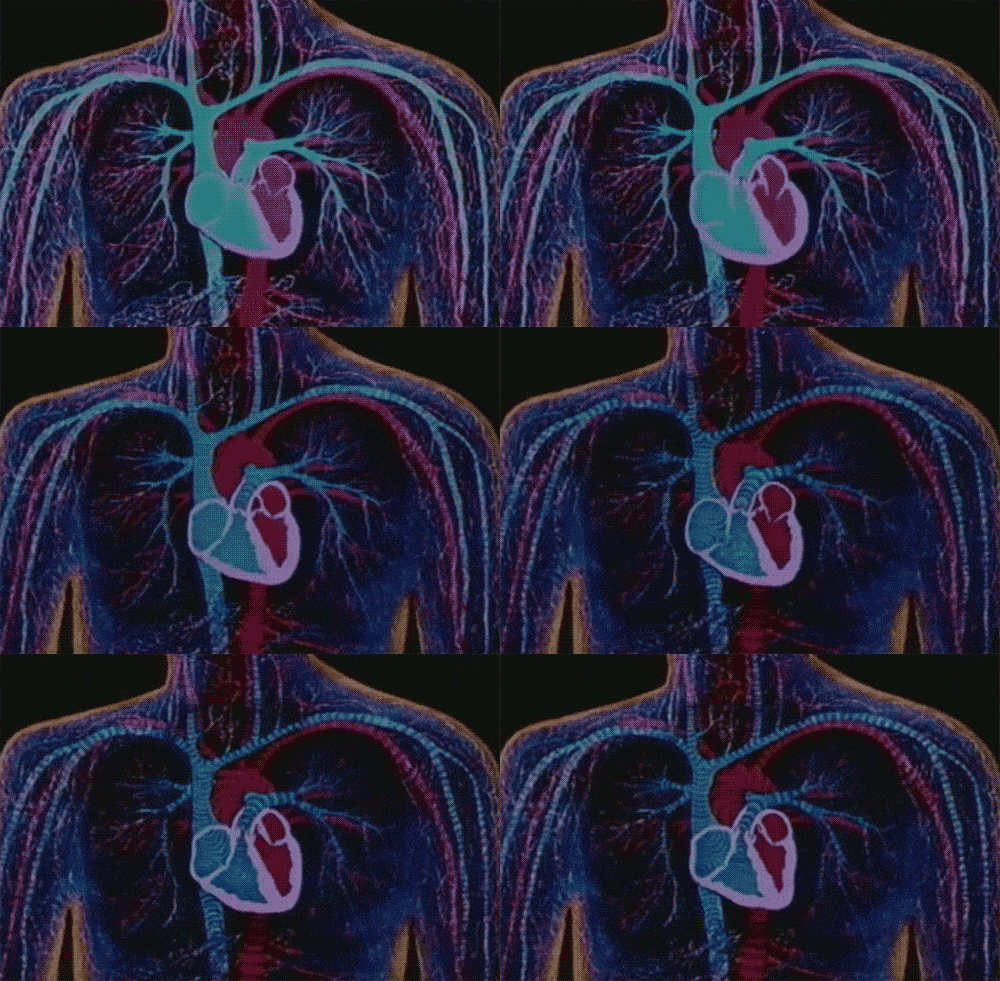
A beating heart requires calories, which factors into your calorie needs.

This is your “Basal Metabolic Rate” which you can calculate for yourself in our TDEE calculator.

There’s also “B. Rebuild as Muscle” and “C. Store as Fat,” which I devoted entire sections to above.

This is where the problems arise: When you overeat calories and your body doesn’t need anymore to fuel itself, it takes those extra calories and stores them as fat.

However, our goal is the OPPOSITE of this.

We want to keep the muscle we have (or grow it) while getting rid of the fat!

So let’s imagine a scenario where we pull all this together by strength training heavy AND reducing our caloric intake:

  1. You strength train regularly, and your muscles break down and need to be rebuilt.
  2. You don’t consume enough calories to both rebuild muscle and fuel itself. There’s not enough to go into the “Burn for Fuel” and “Rebuild Muscle” houses.

Does your body just shut down?

NOPE!

Yep, if you have fat on you your body will pull from it to take care of its needs.
Your body has been preparing for this, by storing any excess calories over the years in the “Store as Fat” house.

This means your body can pull from “Store as Fat” to make sure all the work still gets done, including your daily functions as a human and rebuilding the muscle you tore apart.

Said another way:

If you have fat stores (and we all do), you do not need to be in a “caloric surplus” to rebuild muscle. The calories stored in your fat cells act as this required energy.

There is also evidence that muscle can even be grown while in a caloric deficit.[7]

Meaning bigger muscles with a lower belt size.[8]

This dog just found out it's possible to both lose fat AND gain muscle.

However, if you want to skip all the experimentation and trial and error, you can have a Nerd Fitness Coach do all the heavy lifting for you (not really, you’ll still need to work out).


TIPS TO LOSE BODY FAT WHILE GAINING MUSCLE

Superhero Couple. Male and female superheroes. Cloudy sky.

Let’s bring this all together and create some actionable steps to losing body fat and building muscle at the same time.

1) Sustain a caloric deficit while eating enough protein. You need your body to burn more calories than you consume, and also provide your body with enough protein to rebuild its muscle.

You can only lose fat if you’re in a calorie deficit.

You need to reduce your calories and be in a deficit if your goal is to lose fat.

Remember the Sorting Hat analogy:

If you’re eating too much, your excess calories are being sent to the “Store as Fat” house.

We want to pull from this house instead. So eat less than you burn consistently. 

To help here, I have 3 resources for you:

  1. Beginner’s Guide to Healthy Eating. If you want tips and tricks to create habits based on REAL food, that guide will help get you there.
  2. Determining the Perfect Diet for You.” I talk about the benefits of creating a Mental Model on nutrition like Intermittent Fasting, Paleo or Keto (or Paleolithic Ketogenic) to help navigate all the food choices you need to make.
  3. Count calories: This means learning your total daily energy expenditure, and tracking your other calories through an app (and/or weighing your food).

You don’t have to follow some predetermined blueprint like “low-carb.” You can create your own diet (which is what I do). Learn all about it right here.

2) Strength train. If you could sell a pill that could be prescribed to every single person on Earth to make them healthier, it would look something like a strength training routine in a bottle.

A one arm push-up can help you lose fat and build muscle, but maybe start with regular push-ups first.

It is one of the best things you can do for your body.[9]   

And really, if you want to build muscle, you’re gonna need to lift something! Either weights or your own bodyweight.

You need to challenge your muscles in order for them to get stronger. Now, as we discuss in our article on the correct number of reps and sets, there are multiple ways to do so.

To build muscle:

Lift lighter weights for lots of reps.

Lift really heavy with fewer reps.

The important thing: pick a strategy and get started.

Vada is ready to strength train! And torment her Dad's GF.

Here are 3 paths forward:

  1. Start with a beginner bodyweight workout.
  2. Follow one of our 5 Beginner Strength Training Routines.
  3. Go through our 6 Level Gym Workouts.

To recap: if you train heavy and eat a caloric deficit, your body will pull from its fat stores to both fuel itself and potentially also build muscle. This is a double whammy of AWESOME.

3) Prioritize protein. Outside of being in a caloric deficit and lifting weights (or yourself), eating enough protein is one of the key components of both losing body fat and building muscle.

Protein is the number one nutrient for creating new tissue.[10]

Sponge Bob knows how to build muscle and strength.

So when you cut out calories to create a caloric deficit, don’t cut them from protein sources.

Studies have shown that participants can gain muscle, even while in a caloric deficit, as long as they eat enough protein.[11]

It’s important enough that I’ll say it again:

If you don’t want your body cannibalizing its muscles while you are in a caloric deficit, you need to eat plenty of protein.[12]

How much protein?

As we point out in our Guide to Protein, roughly 1 gram for every pound of your weight, with an upper limit of 250 grams.[13] Or two grams for every kilogram if you are on the metric system. This means:

  • If you weigh 300 pounds (136 kg), eat 250g of protein.
  • If you weigh 250 pounds (113 kg), eat 250g of protein.
  • If you weigh 200 pounds (91 kg), eat 200g of protein.
  • If you weigh 180 pounds (82 kg), eat 180g of protein.

The gist: don’t skip out on protein. It should be on your plate for every meal (we’ll show you exactly how much in the next section).

If these generalized recommendations stress you out, and you want to know exactly what to do, we can help!

I’ll remind you of Nerd Fitness Coaching, where we help clients lose body fat, gain muscle, and level up their lives. We provide tailored and specific recommendations based on your body and lifestyle, plus accountability and mindset changes to help ensure your new habits stick.

Nerd Fitness Coaching Banner

WHAT SHOULD I EAT TO LOSE FAT AND GAIN MUSCLE?

Toy Dinosaur holding a fork next to a slice of birthday cake on a blue background.

Remember, your eating strategy needs to include two points to lose fat while gaining muscle:

  1. Sustain a caloric deficit.
  2. Prioritize protein so you can build muscle even while in a deficit.

You may be thinking, “That’s all well and good Steve, but what’s that actually look like?” 

It looks like this!

If your meal plate looks like this, you're doing great!

Taken from our Guide to Start Eating Healthy, which I really want you to read.

The plate is composed of the following: 

  • 1-2 servings of protein (¼ of plate)
  • 2 servings of vegetables (½ of plate)
  • 1 serving potatoes, rice, or pasta. (1/4th of plate)
  • 1 serving of fat (size of your thumb)
  • 1 zero calorie or low calorie beverage (water, diet soda, tea)

By sticking to our Healthy Plate strategy above, you’ll focus on “REAL food,” which will help you maintain a caloric deficit over time.

Let’s hone in on protein for a moment, because it’s the critical piece for “building muscle.”

Protein can come from any number of sources, including:

  • Meat (steak, bison, pork).
  • Poultry (chicken, turkey, duck).
  • Eggs![14]
  • Fish and shellfish (salmon, tuna, shrimp).
  • Legumes (black beans, chickpeas).

Not a meat-eater? Read our massive plant-based guide!

A serving of protein is about the size and thickness of your palm.

A serving of protein should be about the size of your palm, like so.

*The 4 oz serving is for an uncooked piece of meat. Cooking reduces about 25% of the weight, bringing it down to about 3 oz.

If you’re curious, here’s how much protein is in a serving of food:

  • 4 oz (113 g) serving of chicken has around 30 g of protein.
  • 4 oz (113 g) serving of salmon has 23 g of protein
  • 4 oz (113 g) of steak has 28 g of protein. 

While all of the Healthy Plate above is important, I want you to pay extra attention to your protein intake since we are trying to build muscle. 

If you’re having trouble making your protein intake goals, check out our Guide on Protein Supplements for some tips and tricks to up your intake, including some awesome smoothie recipes.

This is the exact strategy I followed to lose 22 pounds and get to single-digit bodyfat percentage WHILE building muscle:

  • Lift super heavy.
  • Eat LOTS of protein.
  • Reduce carb and fat intake.

If you are NOT losing weight, it means you are still eating too many calories. Keep your protein intake high, and reduce your fat and carbohydrate intake. 

I cover this in greater detail in our “why can’t I lose weight?” guide.

Eventually, you’ll reach a status where there just isn’t enough fat on you to help with “Rebuild Muscle.” At this stage, you can no longer stay with a caloric deficit. You’ll need to flip to a slight “caloric surplus” to build more muscle.

Which means you’ll have to eat more.

Like this turtle, you may reach a point where you have to eat more to gain muscle.

It’s debatable when this will actually occur, and we are all different. Reaching 8% body fat for men and 16% body fat for women is a good place to start.

I talk about this extensively in our guide “How to Build Muscle.”

It covers ways to increase your calories for muscle gain, from eating plentiful amounts of Paleo foods to drinking enough milk to make Santa Clause jealous.

Santa is drinking milk to put on some muscle. The cookies are just because he likes them.

Go check it out if you’ve been having trouble putting on muscle.

I want to stress that if you are lifting heavy, and not gaining muscle, diet is likely the culprit.

It was my problem for years, and I’ve seen it amongst countless readers of Nerd Fitness who have trouble gaining muscle.

If you want an expert who will tell you exactly when to eat more or less, check out our 1-on-1 Online Coaching Program


HOW TO TELL IF IT’S ALL WORKING (Continuing to Lose Fat While Gaining Muscle)

Now you're ready to start losing fat and gaining muscle!

If you’re trying to improve something, it’s important to track it. This also holds true of body composition.

Most people do this by jumping on the scale. This can be “okay,” but it’s only going to tell part of the story.

If you’re building muscle while losing fat, the scale might not go down. You might even weigh more!

Despite weighing more, you could potentially have a better physique.

Don't just look at the scale. You might have lost bodyfat and gained muscle, but the scale won't show it!

That’s why in addition to jumping on the scale, I would also encourage you to take progress photos.

Take front and side photos in your mirror, wearing underwear or a bathing suit. Each week, take new photos, and record the number on the scale under the same scenario. Two forms of tracking here allow us to get the full picture.

The scale sometimes lies!

If you eat for a caloric deficit, strength train, and prioritize protein, see what happens.

You may find yourself losing some fat and gaining muscle.

If not, track each category:

Data can help tell the story.

Data and numbers will help you know if you're losing fat and gaining muscle. Numbers, not the robot.

…I was thinking of detailed notes.

But an android would be helpful too.

Oftentimes if you’re not seeing desired results, notes and record-keeping can help point us in the direction to make adjustments.

Test your assumptions if things don’t appear to be on track. Here’s our Guide on Tracking Fitness Progress for you to learn more.

The tips outlined above will get you started losing fat while building muscle, but if you’re looking to go a bit further…

#1) If you want step-by-step guidance on how to lose weight, eat better, and get stronger, check out our killer 1-on-1 coaching program:


#2) If you want an exact blueprint for getting in shape, check out NF Journey. Our fun habit-building app helps you exercise more frequently, eat healthier, and level up your life (literally).

Try your free trial right here:

#3) Enlist in the Rebellion! We have a free email newsletter that we send out twice per week, full of tips and tricks to help you get healthy, get strong, and have fun doing so. 

I’ll also send you tons of free guides that you can use to start leveling up your life too:

Alright, I think that about does it for this guide.

Did I miss anything? Do you have any tips and tricks when it comes to shedding body fat and building muscle?

Share it with us!

-Steve,

PS: Make sure you read the rest of the articles in our “How to Lose Weight 101” Series!

###

All photo sources are right here: Venting Off, Ekaterina Minaeva © 123RF.com, czgur © 123RF.com, morethanl8ve © 123RF.com, Константин Колосов © 123RF.com, Maxim Maksutov © 123RF.com, Julianna Funk © 123RF.com, jump

The post Blog first appeared on Nerd Fitness.

from Nerd Fitness: Helping You Lose Weight, Get Stronger, Live Better. https://ift.tt/2ZZLxrm
via IFTTT
Categories
Uncategorized

#holistic #getfit #nutrition 6 Beginner Gym Workouts: How to Work Out in a Gym The Right Way!

These Troopers get to work out in the Death Star's gym. You might have to buy a membership.

Welcome to the Ultimate Beginner’s Guide to the Gym! 

As part of our Strength 101 series, this guide will dive deep into everything you need to know about working out properly in a gym.

By the time you finish reading, you’ll never have to wonder “what should I do in the gym?”

I bet I also make you laugh once or twice with bad jokes or perfect gifs.

This Muppet knows strength training will help him gain muscle and lose fat.

We’ve helped thousands of Online Coaching Clients build confidence and start strength training in the gym, so I worked with our coaches to create today’s Ultimate Beginner Gym Guide!


Okay, time to start working out. Let’s hit the gym and explore the following:

Note: Nervous about heading to the gym with the novel coronavirus on the loose? Make sure you dead this guide on Gym Safety During the Pandemic

Scared to Work Out in a Gym? Read This First.

Having a plan, like this LEGO does, will help with your first day at the gym.
Regardless of your physique, if you are 400 pounds or 100 pounds, going to a regular commercial gym for the first time can be intimidating as hell.

And that’s only if you can get yourself to use 20 Seconds of Courage to walk in the door!

I explain exactly what I mean by it in this video:

I know many people who say “gyms are not for me,” or “gyms are dumb” and never even go into one, simply because gyms can be scary/not welcoming/not cool.

By the way, if you don’t have a gym membership, here’s how to find the right gym, and 6 things to know before joining a gym.

Now, if you CAN work up the courage to walk through the door, you’ll be faced with the following:

  • People with pained looks on their faces dutifully using machines that somewhat resemble medieval torture devices.
  • Others on cardio machines, treadmills, and ellipticals, and you can already picture yourself wiping out and ending up in a YouTube fail montage.Make sure you know what you're doing at the gym so you don't accidentally go viral like this poor guy.
  • Really strong jacked people picking up heavy free weights so effortlessly that you can’t help but instantly compare yourself to them…and get intimidated.

If you struggle with self-confidence, or you don’t love how you look, you might assume that everybody around you will be judging you the whole time and don’t want to subject yourself to this torture.

In fact, you might think that somehow you need to get in shape FIRST, and THEN you can go to the gym…

Wrong!

You go to the gym TO get in shape. And I will get you there.

If you are going to start using a gym, here are some truths you need to know:

  1. Everybody around you is just as self-conscious as you are. Yes, that super jacked dude. Or that thin (or jacked) fit woman on the elliptical. They aren’t focused on you, because they’re too busy living inside their own head wondering if everybody is thinking about them.
  2. Everybody starts somewhere. You don’t look good so that you can then go to the gym. You go to the gym to get stronger, more confident, and then look good.
  3. MOST will applaud you for trying. When I see somebody who is severely overweight at the gym, it makes me happy – they’re trying to better themselves! That’s freaking AWESOME. This is the mentality 90%+ of the people will have.
  4. MANY will be too self-focused to even notice you. These are the dudes lifting up their shirt in the mirror to check their abs, doing bicep curls in the squat rack, and/or making sure they take photos to post on Facebook to prove they did in fact go to the gym. #Fitspo #Instagram #OtherNonsensicalHashtags
  5. A RARE few will judge. Though, they’re not just judging you, I promise. They’re judging EVERYBODY around you, because they can’t help but compare themselves to others and they’re terrible people. This is no different than in real life. Screw these people, haters gonna hate, slaters gonna slate.

Be like Slater and do your own thing at the gym. Bring your weird glasses, who cares?

Sure, you can say “people are mean, the gym is scary, I just won’t show up.” But then, the terrorists win. And so do those people. So f*** that!.

Instead, this is going to be your gym mentality:

  • Accept that some people suck (like anywhere in life), and most people are indifferent or focused on being self-conscious themselves. Everybody else will applaud you for trying and being there.
  • Make an epic Spotify playlist that makes you feel heroic.
  • Wear clothes that you feel comfortable in.
  • Keep your headphones on, zone out everybody, and go about your business. Imagine you’re the only one there.
  • Use 20 seconds of courage when necessary to get you to take action.

We work with all of our Online Coaching clients who are worried about looking foolish in the gym. We know this is a huge challenge, so we create small levels and missions for our clients to get them comfortable in the gym.

We’ve helped people just like you go from sheepish beginner to barbell-wielding badass. Let us help you!


NOTE: if you’re questioning whether you should go to the gym during the pandemic, you can follow along with our Beginner Bodyweight Training program at HOME until you feel safe going.

Sign up in the box below and I’ll send you this workout free (along with some other goodies):

How Often Should I go to the Gym?

This soldier should hit the gym enough to make progress while also allowing plenty of time to rest.

Many people think they need to hit the gym 6 days per week, dutifully alternating weight training with cardio and bootcamps to get that jacked/toned body they’re after. 

That sounds exhausting and miserable to me…

Make sure you add in rest days for your gym schedule or you'll end up like this dude.

…and I LOVE the gym!

So here’s what you need to know about gym frequency:

Go as much as you can, or as little as you want. 

All of the workouts in this guide are “full-body workouts” which means they work out all of the muscles in your body. 

And as we lay out in “Strength 101: Beginner Strength Workouts,” your muscles get broken down in the gym and then they rebuild themselves stronger over the next 48 hours.

For that reason, we recommend you hit the gym 2-3 times per week, with a day off or more in between each session. 

This advice comes with a few caveats: 

  • If you’re a single mom or working two jobs or just busy living your life and you can only go to the gym once, great! Once a week is better than zero times a week!
  • If you have specific athletic or cardiovascular goals you’re training for, then hitting the gym more frequently might get you faster results.
  • If you are trying to lose weight, going to the gym more frequently probably WON’T get you faster results. It’s all diet.

“Steve, just tell me how often I should go to the gym!”

Fine! Try to work up to going to the gym 3 times per week.

I like Monday-Wednesday-Friday workout plans.

Start and end the week with good wins! 

Oh, what’s that? You want to exercise on your off days too? Cool. Here’s what you should be doing on your non-training days.

We craft our workout routines for our coaching clients around their schedules – some people hit the gym 5 days per week, while others only go once a week. We’re all unique snowflakes!

Okay! Now that we got THAT out of the way, are we ready!?

Great! Let’s level up in the gym!

Level One Gym Workout: First Day At the Gym

Vader remembers his first day at the gym...he choked out his personal trainer with the force.

The toughest part about going to a gym for the first time is just walking through the door.

If you do that, you’ve already gone farther than 74% of the population (a totally made-up statistic that I’m using to prove my point), so give yourself a pat on the back.*

*Don’t have enough mobility to pat yourself on the back? We’ll help you with that too.

So on your first day in the gym, just GOING to the gym is a big step in the right direction. And I’m proud of you.

Both of us are super proud that you're going to the gym. It's a big first step!

Note: You might need to also change into gym clothes if you’re coming from work. I know walking out onto the floor in gym clothes might be intimidating too (another chance to use 20 Seconds of Courage).

But now you’re wondering, “Steve you half-witted, scruffy-looking nerf herder, what do I DO on my first day at the gym?”

If you haven’t already done so, ask somebody at the front desk the following:

  • “Hey I’m new here, could I get a tour of the gym?”
  • “Excuse me, today’s my first day, can you point me in the direction of a place I can stretch?”
  • “Can you help me work the treadmill?”
  • Go full YOLO and try to figure these things out on your own.

If you’re able to get a personal tour, great! Ask the treadmill question when you get to them. If they can’t walk you through, just do a lap yourself and see where things are and who is doing what.

Pro tip (also works outside of the gym): pretend like you’re confident – even if you’re dying inside – walk with purpose, and nobody will question why you’re doing what you’re doing.

So, when you’re ready, walk over towards the stretching area, and do a few basic mobility/warm-up stretches while continuing to get the lay of the land and see what people are doing (don’t stare excessively, cool? cool).

Not sure what to do for warm-up movements? That’s okay!

Day 1 Beginner Warm-up Routine:

  • Roll your head in half-circles slowly, from shoulder to shoulder. 5 circles in each direction
  • Slowly roll your shoulders forwards and backwards. 10 each way.
  • Keep your legs stationary, and twist your torso, left and right. 10 twists on each side.
  • Quad stretch: Hold each stretch for 5 seconds. Do 3 on each side:

Focus on stretching like above your first day at the gym.

  • Cross one arm in front of your chest, then the other, as demonstrated here by lead coach Jim: Hold each stretch for 5 seconds. Do 3 on each side:

Coach Jim showing you a great stretch for your first day at the gym.

These movements have the awesome side-effect of you being able to look around the gym and get the “flow” of things, while still looking busy. Jim STILL uses this “trick” when checking out new gyms.

dynamic warm-up is the appetizer to ANY main course of strength training.

Really, just get your body moving. We don’t have to make you a gym warrior on Day 1. Some stretches and sightseeing will be good enough.

LEVEL 1 MISSION: Take a lap around the gym and do your stretches.

If you walked out right now after doing these things, it’s still a win for Day 1 in a gym. Seriously – I don’t care what you do on Day 1 – as long as it leaves you feeling good enough to come back for a Day 2!

LEVEL 1 RECAP:

  • Walking through the door makes you a winner.
  • Ask for a tour if you need to know where things are!
  • Change into workout clothes.
  • Stand in one spot, do a few stretches, get the lay of the land.

If you’re up for MORE or ready to level up consider going to the next level, become a cardio cadet!Nerd Fitness Coaching Banner

Level 2 Gym Workout: Join the Cardio Cadets

Man running in a gym on a treadmill

Get on the treadmill and start it up, based on the staff’s instructions.

If you weren’t able to get instructions, many treadmills have a “quick start” button that will start things up.

Why start with just walking?

It gets you moving and out of your head! I know you’re smart – you’re reading NERD Fitness. But you also probably deal with paralysis by analysis a lot by overanalyzing everything, so we need to get OUT of our heads and get moving!!

Not only that, but walking is an AMAZING form of exercise. Walking is how Tim, the NF Prime member, lost 50 lbs through walking and nutritional changes. Don’t underestimate walking!

How did Tim get in shape? By walking, like you do on a treadmill at the gym.

So, for your first 10-15 minutes, just walk. Set the treadmill at 3mph or 3.5 or whatever speed is comfortable but not too strenuous.

A speed that gets you moving and gives you a chance to decide what you’ll do next while you look around the gym. (Aka, it gives you a chance to get out of your head and stop thinking everyone is looking at you. They’re not)

LEVEL 2 MISSIONDo your Level 1 stretches, then spend 15 minutes walking, and then you are free to go home.

Repeat this as many days in a row that you need to until this starts to feel comfortable and you stop feeling self-conscious.

Scientists, Benedictine monks, and German scholars refer to such a thing as a “routine.”

As you get more comfortable, you can increase your walking speed or length of walking (20 minutes, 60 minutes, whatever)

If I’m gonna walk, I like to crush podcasts while doing so (My favorites: Watch out for Fireballs, Pardon My Take, and Bill Burr). Maybe you listen to Harry Potter on Audible.

Listening to audio books like Harry Potter is a great way to spend time on a treadmill

Whatever floats your boat.

LEVEL 2 RECAP:

  • What you do in the gym doesn’t matter – build the habit of going regularly.
  • Develop confidence at the treadmill with just walking.
  • Start to realize you have just as much of a right to be there as anybody else.
  • Give yourself a high five for being you.

This routine of walking and stretching might only be one day in the gym for you, or it might be two months of this before you finally feel like you don’t want to jump out of your own skin while in the gym.

Going to the gym is the habit I want you to build, so this is a great start. Remember, you should be thinking in terms of “days and years,” not “weeks and months”:

We have many coaching clients who spend MONTHS just walking and working up the courage to move beyond the treadmill. That’s cool. We’re all on our own journey, at our own pace, so go at the pace that fits YOUR schedule.


Level 3 Workout: Join the Bodyweight Brigade!

Bodyweight training is a great place to start training at the gym.

After getting comfortable with the stretching/treadmill routine, you may want to hop on a weight lifting machine at this point like the leg press or chest press machine.

Is this progress? Sure!

Can you do this? Absolutely!

But, but, but… we are going to recommend you try some bodyweight exercises instead as your next step.

Controlling your body through space (not outer space) is going to be more beneficial in the long run than strapping into a machine and moving through a set path.

If you can do bodyweight exercises proficiently, then stepping into a machine is “easy.”

The reverse is not always the case.

So, if we’ve convinced you to try some bodyweight exercises, then next thing is to identify a place in the gym you can do bodyweight exercises where you’re not in the way. This oftentimes might double as the place that some people are doing stretches, where you’ve already been before!

If you don’t know, ask the front desk or find a trainer! That’s what they’re there for!

LEVEL 3 MISSION:

After your 5 minutes of warm-up (Level 1) and 10 minutes on the treadmill (Level 2), your next step is to go to a place you can do the Level 3 Gym Workout:

  • 10 bodyweight squats
  • 10 push-ups
  • 10 bodyweight squats
  • 10 push-ups
  • 10 bodyweight squats
  • 10 push-ups

Can’t get through it all? No worries, do what you can.

This style of alternating one exercise with another is called a circuit workout, by the way!

Now you know how to do a circuit workout at the gym!

If you don’t know how to do those movements well, watch coaches Jim, Staci, and myself show you how!

HOW TO DO A PROPER PUSH-UP:

HOW TO DO A SQUAT:

These are two key movements in our Beginner Bodyweight Workout Routine, and the foundation of any strength training routine!

If you just did the above mini-workout for a month, you’d be off to a great start! If you’re feeling frisky and starting to find some confidence in the gym, it’s time to branch out more!

LEVEL 3 RECAP:

  • Warm-up on the treadmill with a 10-minute walk
  • Find a place where you can do bodyweight movements out of the way
  • Complete 3 circuits of 10 push-ups and 10 bodyweight squats each at a pace that works for you

Stay at this stage as long as you need, until you can move on!

Note: If you enjoy the bodyweight brigade, or you’re not quite ready to start doing weight training yet, that’s cool too.

We have tons of 1-on-1 coaching clients who have gotten in GREAT shape without ever picking up a weight. It all comes down to constantly increasing the challenge and making progress each week. 


Level 4 Gym Workout: Join the Dumbbell Division

dumbbells in gym

It’s time to wander into the place that strikes fear in the heart of most gym goers:

The free weight section.

Gulp.

DO NOT FORGET THIS: If you are a 400 pound woman, or 85 years-old, or a 100-pound man, you have just as much of a right to be in the free weight section as anybody else.

It might take yet another 20 Seconds of Courage to wander in there, so I’m challenging you to try it.

LEVEL 4 MISSION:

After you do 10 minutes of walking on the treadmill, go to the dumbbell section, grab a single 10 lb (4.5kg) dumbbell, and find a flat bench like this:

Most gyms will have plenty of benches like this for you to try out.

Stand next to that bench, and make sure nobody is using it. If somebody is at a bench nearby, ask them “is anybody using this bench?” If they say no, put your towel on the bench, your 10 lb dumbbell on it, and stand next to it.

We’re going to add a 1-arm dumbbell row to our circuit above:

That’s it! Just one dumbbell exercise! Boom! You are now weight training like a boss.

Here’s your new Level 4 Gym Workout Circuit: Dumbbell Division A

  • 10 bodyweight squats
  • 10 push-ups
  • 10 one arm dumbbell rows (10 per arm)

Do this circuit once, and then repeat two more times if you’re feeling good.

To recap, or if you skipped Steps 1-3 (I’m only slightly offended), here’s how to properly do:

A BODYWEIGHT SQUAT:

A PROPER PUSH-UP:

Congrats! You’ve used dumbbells!

Remember, everybody started somewhere, and we’re just working on getting you comfortable being in the free weight section.

Want to continue adding dumbbells movements into your workout? Let’s add them to the squats.

Use the same dumbbell to do “goblet squats.”

The goblet squat is a great way to build muscle for women.

They’re named as such because it looks like you’re holding a goblet that you don’t want to spill.

Here’s a video of Staci and Jim demonstrating the Goblet Squat pulled from Nerd Fitness Prime:

So your Level 4 Gym Workout: Dumbbell Division B is 3 circuits of the following:

  • 10 goblet squats
  • 10 push-ups
  • 10 dumbbell rows/side

If you go to the gym 3x a week, work your way up to the following routine:

  • Light stretching and walk on the treadmill for 10 minutes
  • 3 complete circuits of this beginner circuit
  • Go home and eat good food and play video games

This will put you ahead of 95% of the gym going population. You’ll be on a great path to building a healthy, antifragile, resilient body.

Add a little more weight here and there- making the minimal possible jumps each time (going from 10 lb to 12.5 lb dumbbells, for example).

Make your push-up variation a little harder over time.

Decline push-ups like this are a great way to progress your bodyweight exercises.

You can stick with the above for MONTHS.

Ready for another upgrade?

The last dumbbell exercise to learn is the dumbbell Romanian deadlift (RDL). This is like a cousin of the bodyweight squat where we move through the hips more than the knees.

Grab a pair of dumbbells now, push your hips back and bow forward like you’re being polite. Or, you’re like one of those novelty “drinking birds.”

When at the gym doing a Romanian deadlift, move like this drinking bird.

Bring the dumbbells down to about your knees, not to the ground, then stand back up.

You can see the exercise right here:

Every other workout, swap out the goblet squat for the dumbbell Romanian deadlift.

So our circuit is now alternating with each gym workout.

Do 3 circuits of each if you can! If the weight is too light, use heavier dumbbells the next time you train.

Level 4 Gym Workout: Dumbbell Division C:

  • 10 goblet squats OR 10 dumbbell Romanian deadlifts
  • 10 push-ups
  • 10 dumbbell rows per arm.

LEVEL 4 RECAP:

  • Remember you have just as much a right as everybody else to use the free weights.
  • Take a deep breath, go into free weights section, and get a 10 lb. dumbbell.
  • Learn to do a bent over row and goblet squats.
  • Learn to do dumbbell Romanian deadlifts.
  • High five yourself for weight training.

Training with dumbbells opens up infinite possibilities.

Okay, probably not INFINITE possibilities, but close enough.

If you are somebody that wants to learn how to train with dumbbells even more seriously, or you’re looking for ways to put that dumbbell set you have in your garage to proper use, let us help!

If you have a great program to follow, you can get in incredible shape with just a set of dumbbells.


Level 5: Enlist in the Barbell Battalion

Barbells in a gym bar bells and rope

The two final pieces of the puzzle are things I want for you so badly, I can taste it. These two exercises have changed my life, our lead coach Jim’s life, Staci’s life, and the lives of hundreds of thousands of people in the Nerd Fitness Rebellion:

Picking up a barbell, and learning how to squat and learning how to deadlift.

There’s something powerful about old-school strength training with exercises like the back squat and the deadlift.

Show me somebody that’s strong at both of these movements, and I’ll show you somebody that’s in better shape than most of the human population.

But wait!

Even an empty barbell can be heavy, so before we jump into the deep end, you need to be able to complete our circuit with the following weights:

Level 4 Gym Workout: Dumbbell Division C:

  • 10 goblet squats – 45 lbs (20Kg dumbbell), 10 RDLs with 20 lbs (9-10 Kg dumbbells)
  • 10 push ups (on knees or regular)
  • 10 dumbbell rows with each arm  – at least a 20 lb dumbbell

Can’t do those movements at that weight, or not sure what they are? Go back to the Level 4 Gym Workout.

YOUR LEVEL 5 MISSION:

WHEN YOU ARE READY, please read the following:

Strength Training 101: The Squat

And here is a quick video demonstration of the Squat, but I would REALLY read our full article!

And then I want you to find a squat rack:

THIS IS ONE TYPE OF SQUAT RACK (the barbell is NOT connected to the apparatus). USE THESE:

Use a squat rack like this.

THIS IS A SMITH MACHINE (bar is attached to apparatus). THIS IS DIFFERENT FROM A “SQUAT RACK”:

Don't use the Smith Machine, unless it's for inverted rows at the gym.

Note: if you are training in a hotel gym, an apartment gym, or at some locations like Planet Fitness, they might NOT have a squat rack!

This can be for a variety of issues (liability, lack of space, most people just want to use a Smith Machine, etc.). They might even tell you, “A Smith Machine is the same thing.” It is not, in fact, the same thing. You hopefully can find a gym that has an ACTUAL squat rack with a free barbell.

If your gym doesn’t have a squat rack, and you want to start barbell training, I would consider finding a new gym or just hanging out in the Level 4: Dumbbell Division!

If using a squat rack scares the crap out of you: wait to attempt your FIRST trip to the squat rack when the gym is nearly empty, or recruit a buddy who knows what they’re doing. If there’s a special day you can go VERY early to the gym, or VERY late, or during the workday, do it then.

Watch this video from The Nerd Fitness Prime about how to set the ‘pins’ in the squat rack to put the bar at the proper height!

YOUR NEXT LEVEL 5 MISSION:

Attempt 1 set of a 5 barbell squats with JUST the bar (first ask the staff or a trainer how much the bar weighs: most standard barbells weigh 45 lbs (20Kg) but your gym might not have standard barbells).

You can then complete our tried and true circuit – replacing goblet squats with barbell squats.

So our circuit is now 3 circuits.

Level 5 Gym Workout: Barbell Battalion A:

  • 10 barbell squats or 10 dumbbell Romanian deadlifts
  • 10 push-ups
  • 10 dumbbell rows/side

(See Level 4 for explanations on the Dumbbell deadlifts and rows)

Congrats! You’re using barbells! If you haven’t already read NF’s Senior Coach Staci’s transformation story of how she went from barely being able to lift a 10 lb dumbbell to now deadlifting 425 lbs, it’s a really inspiring story! 

Speaking of Staci, let’s move on to her favorite exercise (and mine!)…

I can deadlift 425 pounds now, but I started with just a PVC pipe

YOUR NEXT LEVEL 5 MISSION:

Read: Strength Training 101: The Deadlift

And watch the video demonstration here:

The deadlift movements starts with the weight on the ground, and ends with it back on the ground.

Rebel Leader Steve showing how to do a 420 lb deadlift at the gym.

If you’ve got regular, large weights (usually 45 lbs/20 kgs) on each side then the bar sits the proper height off the ground.

Some facilities have lighter plates at that same large diameter. Use them.

If you are lifting less weight (or just using the bar to start off) then DON’T do the deadlift from the ground. The bar will be too low to the ground and mess up proper technique.

Instead, do the following to start your deadlifts at proper height:

1) Use blocks to adjust the barbell starting height:

You can use all sorts of things to raise a deadlift bar up, like these boxes.

2) Use the safety bars in a squat rack to set the height of the bar correctly!

This picture shows a deadlift rack, great for...deadlifting!

3) Do the Romanian deadlift instead! (Whew, glad we learned that!). It’s the exact same movement as the dumbbell Romanian deadlifts, you’re just using a barbell instead.

Coach Staci showing the Romanian deadlift

START WITH A LIGHT WEIGHT – JUST the bar. As we cover in our “How much weight should I lift?”, you should ALWAYS start with just the bar.

And work on technique.

Only then should you start adding more weight, and add it slowly – you’ll be picking up heavy weights in no time, so don’t rush it.

Here’s Staci demonstrating a proper barbell Romanian deadlift from Nerd Fitness Prime:

Once you’ve started doing these two movements in your routine, your two alternating gym days will look like this. Simply alternate every time you go to the gym (with a day off in between sessions).

Level 5 Gym Workout: Barbell Battalion:

Day A Circuit – 3 rounds of:

Day B Circuit – 3 rounds of:

  • 5 barbell Romanian deadlifts
  • 10 push-ups
  • 10 dumbbell rows per arm

Not sure what a bodyweight row is? It’s an AMAZING exercise that you’ll need to master if you’re going to get your first pull-up or chin-up one day! 

Read our article on bodyweight rows, and also watch our quick video demonstration here of Staci doing them:

LEVEL 5 RECAP:

  • Barbell training will change your life like it has changed mine.
  • Learn to squat and learn to deadlift properly.
  • Focus on proper form, and slowly start to add weight to the bar.
  • You are now a gym “regular” and I salute you!

Now, I know the barbell squat and barbell deadlift are two complex, potentially scary exercises. It’s important to get your form correctly now when you are just lifting the bar, so that you don’t hurt yourself once you start adding weight!

If you want a professional to check your form, tell you when to add weight to the bar, and teach you other barbell movements, check out our online coaching program!


Level 6 Gym Workout: Gym Class Hero

Steve is a gym warrior you trains with barbells and bodyweight training

Did I tell you that I’m proud of you yet? I really am, I promise. Your mom is proud too. So is your dad, but he just doesn’t know how to express it.

So now you’re thinking: “Steve, I did a barbell squat. It was terrifying but I did it. I tried deadlifts too and those are kind of fun.

What’s next? Give me MOAR!!”

It’s like you’ve finally learned to cook, and now you’re asking for more spices.

So, here in Level 6, we’re going to turn you into a full Gym Class Hero. And it requires you to learn a super standard, incredibly challenging exercise that also happens to be amazing for you…

The pull-up or chin-up!

Here's a gif of a pull-up in perfect form.

If you can’t do a pull-up or chin-up yet, you can read our full guide on how to get your first pull-up or chin-up.

We also have a full article on doing a perfect pull-up or chin-up with proper form, but I would watch this video too for some quick ways to scale the movement to fit your experience level:

YOUR LEVEL 6 GYM WORKOUT MISSION:

Alternate inverted bodyweight rows with pull-ups or an easier pull-up variation every other workout.

So our circuit will be alternating these movements on your A and B Days:

LEVEL 6 DAY A CIRCUIT – 3 rounds of:

  • 10 barbell squats
  • 10 push-ups
  • 10 pull-ups or pull-up alternatives!

LEVEL 6 DAY B CIRCUIT – 3 rounds of:

  • 10 barbell Romanian deadlifts/regular deadlifts
  • 10 push-ups
  • 10 inverted bodyweight rows

Spice it up further! If you’ve read up to this point, and put the work in, we hope you feel like a Gym Class Hero, and you can start to build your own workout!

SO what can you do to add some variety? Throw in or replace another exercise!

Want to do some planks? Put them in the circuit after your other movements!

Lunges to replace the squats or deadlifts one day? Sounds good!

Want to start training with gymnastic rings? Go for it!

Want to learn how to do handstands? Try practicing for 5 minutes at the start of each workout!

There are a ton of different options for what to do and where to go.

If we’ve gotten you more comfortable in the gym, we’ve done our job!

WANT MORE HANDS-ON INSTRUCTION? If you’re looking to get out of the generic workout programs and follow along with a routine that fits your goals and lifestyle, consider checking out our 1-on-1 Coaching Program!

Sure, we help beginners get started with strength training. But we also help seasoned gym-goers take their training more seriously, and even help some folks start competing in powerlifting competitions. 

I personally hired an online coach in 2014, and I’ve been with him ever since. It’s the best money I spend every month, and the best investment I make in myself.

We’ve worked with men and women like Leslie here, a single mom that lost 100 + pounds thanks to following Coach Jim’s program.

Leslie used NF Coaching and her local gym to transform herself.

She now works on things like gymnastic training and handstands and deadlifts and squats!

Interested in having expert guidance in your pocket? Click on the image below to book a free call with our team!

Nerd Fitness Coaching Banner

Gym Etiquette: Tips and Tricks

modern gym interior with various equipment

I asked the entire 15-person staff in our Online Coaching Program – most of whom have trained clients in a gym for 5+ years – what information they would share with new gym-goers:

#1) Take your time. The above 6 level workout plan might take you 12+ months to move through, and that’s okay! I would rather you slowly wade into the water instead of terrifying yourself with the thought of cannonballing into the deep end and never even starting a gym routine.

Stick with what you know, and then bit by bit, one movement at a time, branch out and try new things.

Remember: “days and years,” not “weeks and months.”

#2) Do what makes you happy. You might have noticed above I didn’t mention things like bicep curls, bench press, cardio classes, spin class, etc.

If those things make you happy, start adding them to the mix. However, if you are only doing those things because you think you are supposed to, don’t!

The above 6-Stage strategy combined with a healthy nutritional strategy will get you 95% of the way to where you want to go.

I promise. Nerd’s honor.

#3) Write down everything you’re doing and track your progress. Keep a simple note on your phone, write in a notebook, use Evernote, whatever. Write down what you do so that you know what to do next time.

When you get stronger and things feel too easy, you know to move up in weight slowly (and record that too!).

Keeping track of everything is one of the easiest and most important ways to make progress. Staci, Jim, and I ALL still record every workout and never stop trying to get a teeny, tiny bit stronger with each session.

#4) It’s better to lift a TOO LIGHT weight than try one that’s TOO HEAVY. You want to finish the workout saying “hey I could do more, this is encouraging” rather than “that was too much, I hurt myself/failed/and I’m demoralized.”

#5) If you don’t know, ask somebody who works there. If you’re worried that you’re using a machine incorrectly, and you’re sheepish and self-conscious about it, ask somebody who works in the gym.

Usually, there will be trainers that work there walking around the floor – ask them! That’s what they’re there for.

They can help you set the safety bars and pins on the squat rack if you’re not sure how. They can tell you how to adjust the seat on a machine, or how the treadmill works. That is what they are there for!

#6) If you want to hire a trainer for a few sessions, it might be a great investment! Good trainers are hard to come by, but if you happen to like our style of doing things here at Nerd Fitness, we have our own 1-on-1 Coaching Program that will program your workouts and help you fix your diet:

Nerd Fitness Coaching Banner

#7) Work out with what you can work with.

If you are a member at a Planet Fitness or similar gym: Your gym might not allow you to do barbell deadlifts, might not have a squat rack, or ONLY have a Smith Machine. If this is true of your gym, this is okay!

Do the best you can with what you have. Like MacGyver.

You can still get quite strong with the dumbbell workouts and bodyweight movements in Stage 4! And you’ll be that much more prepared when you do start working with barbells if you eventually join a different gym.

#8) Don’t let perfect be the enemy of the good. Just going to the gym takes courage.

  • Trying a machine for the first time takes courage.
  • Picking up a dumbbell takes courage.
  • Using the squat rack takes a lot of courage.

Don’t worry about perfect, or having perfect form or the perfect routine after you finish this article, just START! It’s how we all learn: like scientists trying new experiments and subtly tweaking the variables.

Act like a scientist until you get your workout routine at the gym just right. Experiment!

These are our favorite tips and tricks with regards to the gym. But I’d be remiss if I didn’t also mention something equally important:

Gym etiquette

We’ve created another article in this gym series called “29 Unwritten Rules to the Gym,” to make sure you don’t be an accidental ass in the gym. 

This list includes some obvious things like wiping down the bench after you use it, or not monopolizing a squat rack, but then some other more subtle things that will keep you in everybody’s good graces!


How to Build the Routine of Going to the Gym.

This LEGO needs to relax, all his training at the gym will pay off.

If you read this far, 6000 words later, I have to imagine it means you’re really interested in getting started with strength training! 

The first time going to a gym can be nerve-wracking and exciting, but it’s the 100th, 500th, 1000th trip to the gym where results get made.

And that means you need to BUILD the habit correctly for going to the gym. 

It comes down to a few key things:

1) Accountability! If you’re new to going to the gym, it’s really easy to fall off the wagon once life gets busy. For that reason, I encourage you to be accountable to somebody other than yourself. 

You see, motivation sucks, and will fail you when you need it most. 

So, instead of using motivation, cultivate discipline and accountability. 

Make it almost impossible for you to skip the gym:

  • Recruit a friend to join you at the gym! You don’t want to let them down, right?
  • Prepay for a bunch of sessions with a good personal trainer.
  • Hire an online coach who checks in on you regularly!

2) Focus on hacking into the Matrix and setting up your system! Put your workout time and place into your Google Calendar so that you always know when your next workout is. Focus on creating an environment where you are more likely than not gonna DO THE THING you want to do (go to the gym). We call this “Building your Batcave.”

3) Cultivate a love of constant improvement. Imagine this: you’re no longer going to the gym just to lose weight or look good. Those things are a happy consequence of what you’re really there for:

Because you ACTUALLY like to work out! 

I cannot tell you how many NF Coaching Clients I’ve seen message me and say “Holy crap Steve, I don’t know how it happened, but I actually LIKE working out now!”

Every week, you’re excited to hit the gym because: 

  • You’re adding more weight to your squats.
  • You are attempting a new personal best for the deadlift.
  • You’re trying to get your first pull-up
  • You get to see your gym friend and hear how his day went.
  • You LOVE how you feel after the gym. 

Getting there takes time and energy, but that’s really when life changes and sh** gets magical with regards to your health and fitness.

These are the tools we’ve created to help you turn the gym into something you look forward to:

1) Our popular 1-on-1 coaching program. No more guesswork, no wondering if you’re doing the right program, no shame or guilt. Just results that don’t suck, and a plan that doesn’t make you miserable. 

We keep you accountable to make sure you actually do your workout, we answer any questions you have, and we cheer you on every step of the way:


2) If you want a daily prompt for doing workouts at the gym (or at home), check out NF Journey. Our fun habit-building app helps you exercise more frequently, eat healthier, and level up your life (literally).

Try your free trial right here:

3) Join the Rebellion! Our free community numbers in the hundreds of thousands scattered throughout the globe, and we need good people like you!

You can join by signing up in the awesome yellow box below, and I’ll send you a bunch of free guides and printable workouts, including our Strength 101 guide! 

PHEW!

Okay, by now you should have all of the tools you need to get started in the gym, but maybe you have more questions. If you do, I have answers! 

Simply leave a comment below and I’ll do my best to answer it soon!

I’d love to hear from you too if you found this article helpful. Which gym workout are you following? 

Have you made it all the way to Level 6 yet!?

-Steve

PS: Make sure you read the other 3 articles in our gym series:

PPS: Don’t forget to read our awesome Strength 101 Series either!

###

Photo Sources:Hardcore Stormies Hit The Gym, Iron Lego, stormtrooper out of line, Venting Off, Scenes from an empty lot in Brooklyn, vol 1., siraphol © 123RF.com, tonobalaguer © 123RF.com, Edvard Nalbantjan © 123RF.com, Oops this doesn’t seem to be London 24th March 2017power rack,

The post Blog first appeared on Nerd Fitness.

from Nerd Fitness: Helping You Lose Weight, Get Stronger, Live Better. https://ift.tt/3sOBO8J
via IFTTT

Categories
Uncategorized

#holistic #getfit #nutrition The 20 Minute Beginner Kettlebell Workout: Try This Simple Workout at Home or Anywhere!

Kettlebells can provide a great full body workout.

Our simple beginner kettlebell workout will blow your mind.

Come on: Who else is going to teach you to use a kettlebell with Mario and Mega Man references?

In today’s guide, we’ll go over the following (click to go right to that section):

These are the types of programs that we create for our 1-on-1 Online Coaching Clients, and we’re getting amazing results for people. 


And make sure you download our Kettlebell Worksheet! It’ll come in handy in just a moment.

The 20 Minute Beginner Kettlebell Workout (with Video Demonstration)

Once you’ve watched the video above (featuring Matt Shortis, a lead trainer in our 1-on-1 Coaching Program) here’s a quick recap with repetitions for the workout here:

COMPLETE THE FOLLOWING CIRCUIT 3 TIMES:

  • 8 Halos (each side)
  • 10 Goblet Squats
  • 8 Overhead Presses (each side)
  • 15 Kettlebell Swings
  • 8 Bent Over Rows (each side)
  • 6 Front Rack Reverse Lunge (per side)

And because we like to have fun around here, we made a graphic where superheroes do the workout.

Here’s the Beginner Kettlebell Workout as an infographic:

This infographic shows the 6 exercises needed for the Beginner Kettlebell Workout

Our Beginner Kettlebell Workout is what’s called a circuit (you can learn all about circuit training here). That’s just a fancy term for doing a workout like so:

  • 1 set of exercise A, go immediately to
  • 1 set of exercise B, go immediately to
  • 1 set of exercise C, and so on…
  • Repeat from the top!

Your long-term goal should be to do 3 full circuits, back to back, for a complete workout.

4 if you’re on fire, like in NBA Jam.

On fire from NBA Jams

If you can only go through it once or twice, that’s okay too!

And if you need to take a break at any time between sets or after a circuit, do it! You do you.

Prior to jumping into the kettlebell circuit, don’t forget to do some mobility warm-up (you can see our warm-up routine here):

Nothing too crazy, just something to “grease the groove” and get your body used to movement so you don’t pull any muscles once you start swinging the kettlebell.

In other words, preparing your muscles and joints to move some weight around!

A few minutes of running in place, air punches and kicks, some jumping jacks, and arm swings, should get your heart rate up and your muscles warmed for the Kettlebell Workout.

Coach Matt showing you how to rock the kettlebell swing.

You can do all of the Beginner Kettlebell Workout with one single bell, from anywhere.

We’ll go over each more in our next section, so you can perfect your kettlebell technique.

When you’re done, do some light stretching to cool down. A couple of yoga poses would suffice. Make sure you drink water too.

Feel free to go through this routine at least once a week, and up to 2-3 times a week, with a day off between.

Remember, you don’t build muscle when you’re exercising, you build muscle when you’re resting.

This cat put his kettlebell away so he can rest and grow muscle.

Your muscles are broken down when you strength train, and then they rebuild themselves stronger over the following days of recovery!

If you just can’t sit still, feel free to do some fun exercises, go for a walk, or do one of these off-day activites.

Don’t forget to download our Beginner Kettlebell Worksheet, which covers the above sequence from Coach Matt.

You can print it out and track the number of sets and repetitions you complete, which will help ensure you progress in your training.

You can grab yours free when you sign up in the box below:

The 6 Best Kettlebell Exercises for Beginners

One of the campers from Camp Nerd Fitness with a kettlebell!

Let’s go over each exercise in the 20 Minute Beginner Kettlebell Workout: 

#1) KETTLEBELL HALOS

Coach Matt showing you kettlebell halos.

  1. Grab the kettlebell with two hands on the handle.
  2. Raise the kettlebell above your head.
  3. Move around your head like you’re tracing a halo.

Tip from Coach Matt: with your halos, remember to keep the movement smooth. You don’t want to accidentally slam your head with the bell.

#2) KETTLEBELL GOBLET SQUAT

  1. Grab the kettlebell with two hands “by the horns,” aka the handle.
  2. Keep your elbows in tight and your feet about parallel.
  3. Then lower down like you would in a bodyweight squat.
  4. Reverse the movement to raise back up.

Tip from Coach Matt: for the goblet squat, focus on depth. It’s more important to practice doing a full squat than to pump out reps. If you can’t make 10, don’t stress it. Do what you can.

#3) KETTLEBELL OVERHEAD PRESS

Coach Matt showing you how to do the kettlebell press.

  1. Grab the kettlebell with one hand, with the handle going down your palm (if the handle is too close to your fingers it’ll pull your wrist down).
  2. Press straight up with your fist driving the movement (your fist would be pointing up the entire time).
  3. Reverse the movement and bring the kettlebell back down. Then repeat.

Tip from Coach Matt: when doing the overhead press, get tight. Tightening your muscles will engage your core, offering a fuller body workout.

#4) KETTLEBELL SWING

Coach Matt showing you how to do the kettlebell swing.

  1. Get down into a bent-over, flat-back position and grab the kettlebell with both hands from the handle.
  2. Swing the kettlebell behind you, then get ready to jump up.
  3. Jump up (without leaving the ground) and swing the kettlebell up. You should be standing tall at the peak of the movement.
  4. Reverse the movement and bring the kettlebell back down and behind you.
  5. Repeat.

Tip from Coach Matt: during the kettlebell swing, focus on hinging your hips. The swing is like a deadlift movement, so you should feel it in your hamstring and glutes.

#5) BENT OVER ROW

And here is the kettlebell row!

  1. Get down into a bent-over, flat-back position and grab the kettlebell with one arm.
  2. Pick up the kettlebell by driving your elbow up into your rib cage.
  3. Lower the kettlebell back down by reversing the movement.

Tip from Coach Matt: try to keep your back straight and stomach tight during the row. This will help engage your legs for stabilization as you pull the kettlebell towards your stomach.

#6) FRONT RACK REVERSE LUNGE

And last but not least, here is the kettlebell lunge.

  1. Grab the kettlebell with one hand and rest the weight between your arm and chest.
  2. Step your leg back (the same side your kettlebell is on) and lower down until your shin is parallel-ish with the ground (or as low as you can).
  3. Spring back up to your starting position.

Tip from Coach Matt: for the lunges, again keep your back straight. By keeping your shoulders back, you’ll get a fuller body workout when you come in and out of your lunge.

Boom! There you have it.

The 6 best kettlebell exercises for beginners

If you want someone to review your form on any of these kettlebell movements, or you’re looking to level up your kettlebell game, our coaches can do just that! Our spiffy mobile app lets you send a video of your exercises directly to your coach, who will provide feedback so you can perfect your technique.


In case you’re still on the fence about grabbing a kettlebell, let’s dig into them a little bit more.[1]

What Type of Kettlebell Is Best? What Is the Best Kettlebell Weight for Me?

What kind of kettlebell should you use?

So you want to buy a kettlebell, eh?

They come in all sorts of materials, in all sorts of shapes, and in all sorts of sizes.

Which one you pick will come down to your personal preference, your budget, and your experience with kettlebells.

Let’s contemplate the following when picking the right kettlebell:

#1) Standard vs.Competition. A standard traditional kettlebell will be cast iron, and as the weight goes up, the dimensions go up.

For example, a 16kg (35 lb.) bell will be larger than a 6kg (15lb) bell. This isn’t true for competitive kettlebells.

No matter their weight, competitive kettlebells will have the same dimensions for bell shape, base, and handle width.

So the 16kg will look just like the 6kg. This can be helpful to make sure you are consistent with technique.

#2) Weight. In general, pick a weight that allows you to complete a workout with good form.

When in doubt, start with a lighter weight, as you can always increase the weight/size later. If you’re forcing me to pick one for you, knowing NOTHING about you, I’d say consider purchasing a 16kg if you’re a male or 8kg if you’re a female.

Now, this isn’t an exact science, and we are all unique snowflakes. If you think you’re stronger than average, go heavier. Not quite there? Go lighter.

#3) Ballistic vs. Grind. You’ll often hear the terms ballistic and grinding in kettlebell workout discussions, for fast and slow movements respectively.

Ballistic movements would be quick, like the kettlebell swing.

Grinding movements would be slow, like the overhead press. For ballistic movements, you might actually want a heavier kettlebell, to help with momentum.

For grinding movements, less weight might be in order to help with control.

For now, if you are just starting out, go ahead and stick to one kettlebell. Branch out as you advance in experience.

#4) Handle. This is where quality comes into play. You’ll be doing many, many repetitions with your kettlebell.

If the handle has rough edges, you’ll feel each and every one of the movements cut into your hand.

If you're not careful, the kettlebell handle can scratch your hand and hurt. Ouch!

Not fun.

Quality matters when it comes to handles. So we’ll chat about ideal brands in a moment. I’ll end our discussion on handles by saying they are generally standardized at 35mm for thickness.

Use this as your baseline for differences when comparing bell grips.

Okay, let’s talk about kettlebell brands:

#1) Cap Barbell. This would be an ideal first kettlebell. Not too expensive and decent quality, Cap Barbell kettlebells can be found on Amazon or at any Walmart.

The Cap Barbell is the most highly reviewed and reasonably priced kettlebell we have encountered. Do you have any experience with one?

Let us know in the comments if you like it!

#2) Kettlebell Kings. You see Kettlebell Kings ranked as some of the best bells out there. Not a bad price for the quality.

Plus, they offer free shipping in the US, which is nice since you’re essentially mailing a cannonball.

#3) Dragon Door. Some call Dragon Door the gold standard of anything and everything “kettlebell.”

I wouldn’t disagree, but expect to pay for it.

#4) Onnit. Onnit rocks, and they offer good quality bells that are quite popular.

And… they sell a Darth Vader one.

Onnit earns respect for selling a Vader kettlebell.

I know, I should have started with that.

OUR ADVICE: Before you go buy an expensive kettlebell, check your gym!

I bet it has kettlebells, and you can try out different brands/ sizes/ weights/ styles to see which one you like the best.

Afraid of going? Here’s how to train in a gym.

Don’t care about buying your bell new?

Check out Craigslist or a used sporting goods store like Play it Again Sports for a previously owned kettlebell from a person who no longer needs it.

A used kettlebell is still a kettlebell.

Crafty? Build your own!

Here’s a video on how to make a kettlebell:

If you make your own kettlebell (be careful – you don’t want it breaking mid-swing!), please email me. I would be so pumped!

And if you need help with ALL of this and just want somebody to tell you how to train, I got you covered too.


Can You Lose Weight with Kettlebells?

Can a kettlebell help you lose weight?

If you’re trying to lose weight, a kettlebell and the workout routine above would be a great part of the plan!

The other part of the plan should be your nutrition.

As we lay out in our Coaching Program and our massive guide on “Healthy Eating,” we believe that proper nutrition is 80-90% of the equation for weight loss.

Yes, a kettlebell alone won't get you in shape!

No joke.

It’s by far the biggest factor for success.

So will you lose weight training with kettlebells?

Maybe!

If you fix your diet AND begin to incorporate our kettlebell routine a few times per week, you’ll will find yourself building muscle, losing fat, and getting stronger!

Wayne stoked that a kettlebell workout plus proper nutrition will help him get in shape.

So how do you fix your diet?

Great question.

Whether you choose to follow a Keto Diet, Paleo Diet, Mediterranean Diet, or something like Intermittent Fasting, the best path will be up to your goals, your situation, and your habits.

Here are some basic tips though (as we cover in our Beginner’s Guide to Healthy Eating):

  1. If your goal is weight loss, you have to eat less than you burn each day. This can be through eating less and burning more (from the kettlebell workout above)
  2. Processed foods and junk food make it really tough to lose weight: They have lots of calories and carbs, low nutritional value, don’t fill you up, and cause you to overeat.
  3. Vegetables are your friend. If you don’t like veggies, here’s how to make vegetables taste good.
  4. Liquid calories are sabotaging your efforts. Soda, juice, sports drinks: they’re all pretty much high-calorie sugar water with minimal nutritional value. Get your caffeine from black coffee or tea, fizzy-drink fix from sparkling water.
  5. Not losing weight? Track your calories and work on consuming slightly less each day. We tackle this point in-depth in our article “Why can’t I lose weight?
  6. Eat more protein! Protein helps rebuild muscle, and can help you stay under your calorie limit because it’s satiating and filling. Here’s exactly how much protein you should be eating every day.

Those tips should get you started, but if you want more specific instruction and guidance, check out the NF Coaching Program – Your Coach will build a routine tailored to your individual needs and what equipment you have available:

Nerd Fitness Coaching Banner

DoWnload the Kettlebell Worksheet!

Colorful kettlebells in gym

Like most things in life, the important aspect of any exercise regimen is starting it.

No matter what strength training program you choose, start TODAY.

This cat is ready to start his kettlebell workout! Let's hope he doesn't lose the shades.

You don’t need to get strong before you can play with a kettlebell. You can play with a kettlebell to get stronger!

Here’s that Beginner Kettlebell Workout one more time to recap:

  1. Halos: 8 reps each side
  2. Goblet Squats: 10 reps
  3. Overhead Presses: 8 reps
  4. Kettlebell Swings: 15 reps
  5. Bent Over Rows: 8 reps each side
  6. Front Rack Reverse Lunge: 6 reps each side

Here are the next two steps you can take with our community if you dig what we do! 

1) Check out our 1-on-1 Online Coaching program. Our coaches can work with you to pick up a kettlebell for the first time or to learn more advanced moves.

Whether you are brand new to your fitness journey, or ready to take it to the next level, we have your back!


2) If you want an exact blueprint for growing strong, check out NF Journey. Our fun habit-building app helps you exercise more frequently, eat healthier, and level up your life (literally).

We even have a fun kettlebell adventure that you can follow!

Try your free trial right here:

3) Join the Rebellion! Join our free community with a biweekly newsletter, and I’ll send you our Beginner Kettlebell Worksheet.

Simply sign up in the box below, and let us know what you think of it!

I’d love to hear how this goes for you! Simply leave a comment below.

Hell, leave a comment if there’s anything else we can help you with too.

For the Rebellion!

-Steve

PS: If you are using Kettlebells to get started with Strength Training, make sure you read the other articles in our Strength Training series! 

PPS: As a reminder, this infographic shows you the Beginner Kettlebell Workout:

This infographic shows the 6 exercises needed for the Beginner Kettlebell Workout

*All photo sources can be found in this footnote right here: kettlebell, kettlebell press, kettlebells, kettlebell II, svershinsky © 123RF.com.

The post Blog first appeared on Nerd Fitness.

from Nerd Fitness: Helping You Lose Weight, Get Stronger, Live Better. https://ift.tt/2EttLqD
via IFTTT

Categories
Uncategorized

#holistic #getfit #nutrition 7 Ways to Measure or Calculate Your Body Fat Percentage (And Lower It!)

Cartoon images of body shapes

Today we are going to teach you everything you’ve ever wanted to know about body fat percentage but were too afraid to ask.

We’ve been helping thousands of people get their body fat percentage to their desired level through our 1-on-1 Online Coaching Program, and I’m pumped to share with you our strategies in this guide.

Plus, lots of cute animal videos as rewards for reading each section.

Even wombats want to learn about how to measure body fat percentages

Fair warning: lots of half-naked people of all different shapes and sizes in this guide!

In this Body Fat Measurement Ultimate Guide, we’ll cover:

If you have been struggling with your weight (and having too high of a body fat percentage) for a while, I know how frustrating that can be.

It’s why we built our popular 1-on-1 Online Coaching program, so this time things can be different. Your NF Coach will help you track the right metrics (like body fat percentage) and set the right goals.

Nerd Fitness Coaching Banner


What is body fat percentage?

A tape measure can help determine body fat percentage.

In its simplest form: body fat is the amount of fat in your body, compared to everything else:

  • your organs
  • muscles
  • bones
  • tendons
  • water
  • any demons currently possessing you
  • and so on

Both men and women carry different amounts of body fat percentage due to…you know…being different.

A super ripped male bodybuilder who is minimizing body fat percentage could have a percentage down as low as 3-4%, while a super ripped female bodybuilder who is minimizing body fat percentage would only get as low as 8-9%.

A male athlete could be in fantastic shape and have 10% body fat, while a women at a comparable level of athleticism and appearance might be at 18-20% body fat.

To take the comparison to the other end of the spectrum, an overweight male at 30% will look vastly different than an overweight woman at 30%.

Feel free to take a break with this video of a lion cub hanging out with a puppy and a rabbit.

What are some examples of body fat percentage?

Below, you’ll see images of what people look like with different amounts of body fat.

Men:

This picture shows different body fat %.

This picture shows different body fat %.

Women:

This picture shows different body fat % of women.

This picture shows different body fat % of women.

A quick note: your body fat percentage is just the amount of body fat you have.

It has nothing to do with the amount of muscle mass you have, which means you can have two people with the same amount of body fat percentage that look WAY different from each other.

Are you surprised about what you thought and what the actual percentages look like?

If so, don’t worry about it – most people have no idea what their body fat percentage is, and will often over or underestimate it pretty dramatically.

Yeah, most bodyfat percentages are way off.

We’ll get into what’s a good number to AIM for, and how to measure it next.

We work with both men and women in our Online Coaching Program, and help them reach a level of body fat that they’re happy with.

More importantly? We do it sustainably, and without making you only eat chicken and broccoli.


You have unlocked this video of a baby sea otter trying to sleep on mom:

What should my body fat percentage be?

This lego wants to know his ideal body fat %.

Here is the “generally accepted” (yeah, I don’t like this term either) chart for women and men when it comes to body fat percentage:

Women

Men

Essential fat

10-12%

2-4%

Athletes

14-20%

6-13%

Fitness

21-24%

14-17%

Acceptable

25-31%

18-25%

Obese

32% plus

26% plus

In what I’m sure is news to nobody, body fat is essential to survival – fat protects your internal organs, provides you with necessary energy stores in times of peril, and more.

“Essential fat” means the minimal amount of fat required for survival – Anything less than this amount would mostly likely result in organ failure, but even approaching this amount of body fat is dangerous.

Eh, Homer could probably stand to lose a few more pounds.

It’s for this reason that bodybuilders, who can minimize their body fat to the “essential fat” level only do so when prepping for a show – during the rest of the year they maintain a higher body fat percentage so that they can stay healthy and function properly.

If you are looking to have that “ripped” or “toned” look, you’ll want your body fat percentage to hover in the “athletes” section.

(I cover the philosophy behind this extensively in our “How to build any physique” article.)

If you’re just looking to get healthy and look in the mirror with pride, aim for the Fitness range.

Once you get into the upper ends of “acceptable” and “obese,” a decrease in body fat percentage would benefit your health.

Now, I’m going to GUESS you’re reading this article because you’re interested in reducing your body fat percentage.

For starters, you need to determine what’s an optimal goal for you:

  • If you are trying to look like Ryan Reynolds or Jessica Beil in Blade III, good luck! You’ll need to aim for a body fat percentage of 6-8% (men) or 13-15% (women). Note: your athletic/strength gaining performance will most likely suffer at this percentage, and can be really really challenging to maintain. Your call.
  • If you are interested in getting that coveted six pack, drop your body fat down to the 8-11% range for men and 15-17% range for women.
  • If you are an athlete and interested in optimal athletic performance, aim for a body fat percentage around 15% (men) or 20% (women). NF team member Staci trains much better at 20% body fat than at 15% body fat.
  • If you are just interested in looking pretty good and feeling pretty good, anything less than 18% for men and anywhere in the 20-23% range for women should get you the “hey, lookin pretty good!” response from your friends.
  • Ladies: if you are concerned about menstruation or fertility, it has been said not to drop below 15% body fat. Studies are conflicted on this, your results may vary, but I thought it was worth mentioning!

Want a step-by-step plan to follow that will help you lower your body fat percentage safely and permanently? Great!

That’s literally what our Online Coaching Program is for!


Hey, you’re still awake!

You’ve unlocked the “cute baby pigmy goat jumping around” video:

How do I calculate or Measure my body fat percentage?

A body fat caliper can help determine fat %.

This question I get asked above ALLLLLL others.  

There are seven main methods that you can use, each with varying levels of accuracy and cost: 

1) Take a Look – This might be my favorite method, although it requires a trained eye and isn’t exact. By having an accurate progression of pictures from week to week and comparing a picture of yourself, you can determine somewhat closely what your body fat percentage is.

Make sure to note the difference in the two men, both at 10% body fat further down the page.

2) Body Fat Calipers – Pick up a set of calipers for $5. Pull the fat away from your muscles, pinch them with the caliper, take the measurements, and look at a chart to figure out your body fat percentage. Some recommend using one test site, some multiple.

In my experience, I have found that these calipers tend to slightly underestimate body fat percentage (mine tell me that i’m 9 or 10% when I’m really 12%, and Staci’s say she’s 17% when she’s more like 20%), but are surprisingly accurate considering how cheap they are.

However, the accuracy isn’t as important as the fact that you pinch and measure the same area, under the same conditions, from week to week. By doing so, you can track overall trends in how the measurement changes to make sure you’re on the right path.

3) The measurement method – By taking measurements (like the US Navy measurement or the YMCA measurement), you can calculate your body fat percentage. I have found, as have others, that this method isn’t incredibly accurate as it can very easily overestimate your body fat.

Considering it only takes a few points of data, this is not surprising.

4) Body fat scales and monitors – An electrical current is sent through your body and uses “biometrical impedance analysis.” I don’t really like this method, as I find the number that it spits out can be horribly inaccurate.

Because they send an electrical current through your body, the amount of water you are carrying can drastically adjust this number too.

5) The Bod Pod – The method calculates your body fat percentage by using air displacement to measure your body mass, volume, and density. This is also pretty darn accurate, but also pretty darn expensive at usually around $75 per session. Find a bod pod location by putting in your location in the right hand column.

6) Water displacement – Although very accurate (within 1-3% percent), it’s expensive, tedious, and a huge pain in the butt. If anybody has any experience with a water displacement test, please share your story in the comments.

7) DEXA Scanning– This is considered the most accurate method, as it actually takes a full dual X-ray of your body composition and gives you numbers. You can get this done at a health facility, and involves you lying on an X-Ray table for about 10 minutes. It’s typically expensive, anywhere from $50-150 per session depending on where you are located.

VERY IMPORTANT: If you are going to start testing your body fat percentage, do whatever you can to test yourself under the same conditions each and every time.

For example: every Monday morning, on an empty stomach, while drinking a single glass of water. This way, even if you’re not getting the correct body fat percentage (due to user error), you’ll at least get a consistent incorrect body fat percentage and can calculate how much you lost or if you are progressing in the right way.

“Steve, just tell me the best method!”

If you have the money, and you have a Bod Pod center close to you, then I’d say this would be the best combination of practicality and accuracy.

If you don’t have the money, then I would go with a simple body fat caliper, along with the “take a look” method of taking weekly photos. Take a photo of yourself each week and compare the photos week to week to see if you can notice more definition in your muscles (which happens when you start to reduce your body fat percentage!).

Here’s the thing with body fat percentage: although it’s fun to know and fun to see it getting lower as you get leaner, methods to track it can often be inaccurate.

Take multiple tests with your preferred methods and understand that even then it might be off by 1-3% in either direction. So, track overall TRENDS and go off how you look, and that will get you 95% of the way there.

It comes down to this: Look in the mirror, and compare your progress photos: do you like how you look and are you moving in the right direction? Awesome.

DON’T like what you see?

Let us help!

Our Online Coaching Program is changing people’s lives every day. We help folks like you make better food choices, follow the right workout program for your goals and keep you accountable!


Another section, another reward.

You’ve unlocked the “baby otter attacks a stuffed animal walrus” video:

What’s the best way to lower body fat percentage?

Saint dropped his body fat %.

Alrighty! Let’s say you’re interested in dropping your body fat percentage, like my childhood friend Saint above.

Staci (follow her full success story) also followed the principles of Nerd Fitness to get her results and significantly reduce her body fat percentage:Staci dropped her body fat %.

I’m sliiiiiightly biased, but both Saint and Staci, along with 35,000+ other students, reduced their body fat percentage by following the methods we teach all clients in our 1-on-1 Online Coaching Program.

Not only that, but Staci is now one of our Lead Coaches!


As you’ll read below, the biggest piece of the puzzle to getting to a low body fat percentage is having the right nutritional strategy of consistent caloric restriction, the right mental attitude, a supportive network of people to help you, and a plan to follow.

We know how tough it can be to change your diet. If you’re not sure what to eat, or you’re sick of trying a diet only to give up a few weeks later, I got you covered.

It’s something I’m really proud of, and I know it’s helped a lot of people: our 10-level Nerd Fitness Diet Cheat Sheet. Pick the level you’re comfortable with, stick with it for at least 2 weeks, and then level up when ready and follow the next level! Simple.

Grab your cheat sheet free, along with 4 other free guides, when you sign up in the box below – I’m confident it can help you reduce your body fat percentage permanently.

I can’t teach you everything in a quick article, though I can absolutely give you some overall tips and tricks below to get you started.

Here are the Nerd Fitness methods we recommend to all coaching clients get down to a lower body fat percentage.  

Note: these are JUST suggestions, your results may vary!  

If you only want to drop a few percentage points (to a healthier weight), you can start with the advice at the top, and work your way down towards the bottom as you get lower and lower – the closer you get to single digits (dudes) or low double digits (ladies), the more strict you need to be with your diet and training.

1. Eat a caloric deficit – Although I believe there is more to it than just this, in order to lose weight, you need to be eating a caloric deficit – burning more calories than you consume consistently.

Don’t forget to calculate your daily caloric needs first! If you are not strength training while eating a caloric deficit, you will most likely be losing muscle along with fat, which is not optimal but will help you lose body fat.

Do this consistently and you’ll start to lose body fat.

2. Lift heavy things and move frequently – When you strength train with heavy objects (or with intense bodyweight training), you get stronger and keep the muscle mass that you already have.

And yes, you can build muscle and burn fat at the same time. On top of that, you also push your metabolism into an “afterburner” effect which burns extra calories even after you are done working out.

3. Incorporate sprints into your off days – When you run sprints, you create a similar afterburner effect with strength training, meaning extra calories burned after the completion of your workout.

4. Consume enough protein, experiment with lower carb or lower fat Set your caloric intake to be low enough that your body must pull from fat stores to fuel itself, resulting in fat loss.

I’d recommend consuming enough protein to keep your muscles growing and rebuilding, while determining what’s best for your body to make up the rest of your calories each day: many people work better on a low carb diet.

Others (like myself) can lose weight faster on a low-fat diet. Your results may vary. Read up more on the Keto Diet, the Paleo Diet, the Carnivore Diet, and the Mediterranean Diet for popular strategies.

And no, don’t do the Military Diet.

5. Work out in a fasted state, consider intermittent fasting Although advanced techniques to get to super low body fat percentages are beyond the scope of this article, here’s another tactic if you want to drop the last few percentage points:

Strength train in a fasted state, and don’t consume your first meal of the day until AFTER your workout.

Added bonus: by skipping a meal occasionally, you’re more likely than not to end up in a caloric deficit compared to when you were eating 6 meals per day.

I’ve been training in a fasted state for 5 years with zero issues on energy, but your results will vary.

6. Not losing weight? You’re eating too much! Get more accurate with your tracking. Consider a cheap food scale to make sure you’re actually eating the number of calories each day you think you’re eating.

Example: I eat 1 serving of oats each day. If you look at a container of oats, it says “1 serving = 1/2 cup, or 40 grams.” I then put half a cup of oats on a food scale, and it weighed 60 grams. This means that every day, I was eating 1.5 servings of oats, not 1 serving.

By weighing my food, I got my calories dialed in, and managed to lose about 15 pounds over the past 6 months, dropping my body fat down to 8%, while also hitting a deadlift PR.

7. Hire a Coach! Doing all of this stuff alone is absolutely manageable, it just requires a lot of trial and error. If you are somebody that wants to work with a trainer, here’s how to find a good trainer!

Oh what’s that? You want a coach you can take with you everywhere, that will check your form AND help you with food and essentially do everything except the actual heavy lifting of weights?) Sure!


Along with the above, keep reading Nerd Fitness articles, join our community, and start to implement the philosophies here and you’ll be on the right track.

The important thing to remember: this is NOT an overnight process. The best thing you can do is start treating yourself like a science experiment.

Treat lowering your bodyfat percentage like an experiment!

Implement the suggestions above, track your bodyfat and see how it changes, and then course-correct and adjust based on results!

And another big thing to remember:

TEMPORARY CHANGES GET TEMPORARY RESULTS.

If you starve yourself to get shredded but then rebound aggressively by eating buckets of ice cream when you’re “done,” say goodbye to those abs!

Instead, our advice would be to find a nutritional strategy that works for you, a workout you enjoy, that you can see yourself sticking with permanently, that gets you at a body fat percentage you can maintain without being miserable.

Also, here’s a video of a wombat. Because, wombats:

Is BMI the same as body fat percentage?

What can a scale tell you about body fat %?
When you go to a doctor, they will most likely ONLY calculate your Body Mass Index (BMI).

Body Mass Index looks at your height and your weigh; based off this ratio, it tells you whether you are underweight, normal, overweight, or obese.

Seems pretty straightforward right? Obviously, as your weight increases disproportionately compared to your height, you are more likely to be overweight.

Notice I just said “more likely.”

Here’s why: Your BMI isn’t directly correlated to your body fat percentage – it only factors in your height and weight. It will give you the same reading if you’re made of 180 pounds of pure muscle, or 180 pounds of pure Cheetos.

For example, if I was six feet tall and 185 pounds with a body fat percentage of 10%, I would be put in the same “overweight” category as a guy who was six feet tall, 185 pounds, and a body fat percentage of 25%.

If two women have the same amount of body fat, and one tends to carry more water weight or have bigger bones than the other, one woman could be considered “overweight” while the other might be “average.”

For example: LeBron James is considered borderline obese when measured on the BMI scale, at a height of 6’8″ and 250 pounds.

Of course, unless you look like LeBron James, or you can see your abs, disregarding BMI is missing the point.

I do believe BMI can be helpful if you are above 20% body fat (men) or 25% (women). Both your BMI and your body fat percentage would tell you that fat loss can be a worthwhile goal.

HOWEVER, as soon as you start to get serious about your body weight and training and drop down to flat stomach levels of body fat percentage, then BMI becomes less of an accurate indicator of health.

If you like our style here with cute animal videos and fun content, let us help you reach your body fat and BMI goals with our 1-on-1 Online Coaching Program


You’ve unlocked the final reward: “the hedgehog boat”:

What other questions do you have on body fat percentage?

What's this bunny's body fat %?
And that concludes today’s lesson on body fat percentage, friend!

I do most of my work in coffee shops these days, so I hope you understand the amount of work and the ridiculous number of awkward Google searches that had to happen in order to bring this post together.

Now, I know this is one of those super complicated topics, so I’d love to help any other way than I can. 

If you are somebody that wants to know they are following a program that is tailor-made for their life and situation and goals, check out our popular 1-on-1 Coaching program.

You’ll work with our certified NF instructors who will get to know you better than you know yourself, and program your nutrition and workouts for you.

Nerd Fitness Coaching Banner


If you are fired up and want to start reducing your body fat percentage in a healthy, sustainable way, consider trying our 10 Level Nerd Fitness Diet – we’ll send you a cheat sheet telling you exactly how to change your diet each week so you don’t get overwhelmed!

Grab your NF Diet sheet along with four guides to help you reduce your body fat percentage when you sign up in the box below:

We’ve helped tens of thousands of people transform into real life superheroes.

Either way, continue to poke around Nerd Fitness – all of our content is focused on helping you get results in a fun, non-condescending, supportive, and (most importantly) effective way.

Also, if you’re willing to put in the time, you WILL get the results you’re after.

Okay, time to watch more cute animal videos 🙂

-Steve

PS: Admittedly this article took 10 hours longer than it needed to, because I kept getting lost in YouTube watching cute animal videos!

###

The post Blog first appeared on Nerd Fitness.

from Nerd Fitness: Helping You Lose Weight, Get Stronger, Live Better. https://ift.tt/2oLRPYL
via IFTTT

Categories
Uncategorized

#holistic #getfit #nutrition Should You Do Couch to 5K? Don’t Make These 5 Mistakes

Has is Indy so quick to leave temples? He runs races on the weekends.

If you’re looking to run your first 5K, you’ve come to the right place. 

In today’s guide, we’ll cover common questions – and 5 mistakes – about the Couch to 5K program:

Before we jump in…

If you’re interested in running a 5k (which you are, ’cause you’re here) you may want to try our new app! It contains a fun adventure that will take you from sitting on your couch to running a full 5k – with plenty of benchmarks in between for you to find your groove. No guesswork needed, just tie your shoes and follow along with the app. 

You can sign-up for a free trial right here:

What is Couch to 5K? Why is the Couch to 5K Plan so popular?

young dog sleeping on modern sofa in the living room

“Couch to 5K” is a free program that takes people from their couch to running a 5K race in 9 weeks.

5K is short for 5 kilometers, or 5,000 meters or 3.1 miles.

This running program was invented by Josh Clark of CoolRunning WAY back in the day.

What's older, this clip or Couch to 5K? Hard to tell.

It has since been co-opted and copied by every running blog out there, so we’re going to be referring to a generic “Couch to 5K” program when we talk about it.

(When people ask the question “How long does it take to complete Couch to 5K,” it really depends on which program they pick. 

It might be 6 weeks, or 12 weeks, or 9 weeks. The original Couch to 5K plan created by Cooling Running took 9 weeks).

Here’s the Couch to 5K plan a nutshell:

The program utilizes an uber-popular concept called interval training – moving at different speeds throughout a running session – and lays out exactly what to do every day for 6-12 weeks after starting.

What's cool about Couch to 5K is each day you know exactly how you should be training!

By varying your pacing, your body is forced to adapt to different speeds, your heart and lungs have to adapt to various levels of strenuous activity (and get stronger/healthier as a consequence).

As a result, you actually burn more calories and get better prepared for a race then compared to just training at a constant speed.

In other words, interval training rocks and should be used by anybody who wants to get better at running.

Over the weeks, Couch to 5K slowly ramps up the amount of time you spend running and cuts back the time you spend walking until you’re at the point where you can actually run a 5K without stopping.

Mr. Gump ran like 1,000 5Ks when he crossed America.

“STEVE, I’M INTRIGUED. WHY IS COUCH TO 5K SO DANG POPULAR?”

#1) It’s simple and clear. Print out a PDF or download an iPhone app and for the next 9 weeks you simply do what it tells you:

Today, do this.

Tomorrow, do that.

Repeat.

We’re all busy. Most of us lead hectic lives. And programs that tell us EXACTLY what to do allow us to follow instructions without needing to figure it out ourselves.

Not that us nerds overanalyze things to the point of giving ourselves anxiety attacks

#2) Most people think running = weight loss. If you’re brand new to health and fitness, and you’re trying to lose weight, you’re most likely overwhelmed at what you should start with and how you should train.

Are you gonna go sign up for a gym membership, hire a trainer, and start doing squats and deadlifts?

Rebel Leader Steve showing how to do a 420 lb deadlift at the gym.

As much as I would WISH that was the answer (it’s probably the fastest path to changing one’s physique), it’s often a bridge too far for many folks.

So a majority of newbies equate running with weight loss (which MIGHT be true, but MIGHT not, I’ll explain here), and decide to start with a jog around the block.

#3) Couch to 5K is not overwhelming. It’s a free program (or inexpensive app), and it’s very approachable.

Programs like P90X and Insanity are designed to appeal to people that consider themselves hardcore (whatever the hell that means).

Couch to 5K appeals to people who are overwhelmed at the idea of doing P90X or Insanity or mustering up the courage to go to Crossfit.

Couch to 5K makes you think “maybe I can actually do this…” which is the most important part of any fitness journey: starting.

Homer wants to eat donuts so he is doing Couch to 5K. Is he doing it right?

#4) Everybody wants to “have run a 5K.” If you’re new to health and fitness and working on setting a good obtainable goal, “run a 5K this year” is a great place to start.

  • It’s a short enough distance that with some training you can pull it off, even if you have to walk some or all of it.
  • There are 5Ks practically every weekend, many of which raise money for charity or are themed in a fun way,
  • It’s an amazing activity to do as a group with friends.
  • Humans are wired for achievements, progress, and gratification – 5Ks are perfectly designed for that.

So in completing Couch to 5K, you train and get to see yourself progress weekly, you get to finish a race and feel a  sense of accomplishment, and you go home with a medal you can hang on your wall reminding you of the proud moment.

Humans are wired for achievements like these trophies, which makes running a 5K awesome.

Plus, it might get you in shape!

Maybe…we’ll explore in just a moment.

If you are trying to get in shape, I’ll mention our 1-on-1 Online Coaching Program. I know of no better way to transform yourself than through the help of an expert who knows exactly what to do. We’ve helped hundreds of people run their first 5K and helped others train for triathlons!


Does Couch to 5K actually work? Will I lose weight Doing Couch to 5K?

Buddha isn't trying to lose weight. But he's also zen about you trying to.

“Steve that’s all fine and good. But what do you REALLY think about running 5Ks and Couch to 5K?”

Okay, you got me. I got thoughts. I also got jokes (they’re bad).

RANT INCOMING!

Consider this a "warning" on an incoming rant about C25K.

Will the Couch to 5K program help you run a 5k? YES! If you actually stick with it for the entirety of the training program.

Will the Couch to 5K program help you lose weight? MAYBE.

Is Couch to 5K a program that will get you healthy permanently? MAYBE.

Will Couch to 5K make me sexy and look damn good in a bathing suit? MAYBE, but probably not.

Here’s the truth about Couch to 5K: It’s the same truth with popular programs like P90X or Insanity or any other structured workout program:

It totally works and will help you lose weight if you do two things:

  1. You actually complete the program, AND
  2. You fix your diet.

MISTAKE #1: Couch to 5K totally doesn’t work and won’t help you lose weight if you do two things:

  1. You actually complete the program, BUT
  2. You don’t fix your diet.

As sexy as it is to think that just going for a run will help you lose weight, the data doesn’t back it up. In fact, as Time Magazine rightly pointed out years ago and got yelled at for telling the truth, exercise alone won’t make you lose weight.

I believe that to be especially true when exercise is only steady-speed cardio.

Homer is doing Couch to 5K...week 1.

In fact, many people gain weight after starting an exercise routine and get completely demoralized.

What gives?

As we say here at Nerd Fitness, you can’t outrun your fork, and nutrition is 90% of the battle.

If you go for a mile run and then stuff your face with extra calories “because you earned it,” you’re going to gain weight.

It’s not because you have a slow metabolism, I promise. It’s because you’re consuming too many calories.

This is Common Mistake #1: not fixing your nutrition if you’re running for weight loss!

If this were a movie, nutrition would be Tom Cruise in Mission: Impossible and exercise is that funny sidekick who helps Tom. Let’s be real here, Tom is doing all of the heavy lifting to make that movie what it is.

Tom Cruise is the heart of Mission Impossible, like nutrition is the heart of weight loss.

Couch to 5K helps people run a 5K.

That’s it.

It’s not designed to help you lose weight or build a body you’re proud of. It’s also a temporary program that lasts a certain number of weeks until you run your 5K.

For Couch to 5K to be successful for you long term, and for it to help you lose weight, it needs to be the catalyst that causes you to build a consistent long term habit of exercise and changes how you think about food.

Remember: you never get to be “done”, so you need to enjoy the journey and look forward to exercising daily.

You also need to train the right way to build the type of body you want! And eat the right way.

That’s priority numero uno.

The Tick knows you can't outrun a bad diet, even with Couch to 5K.

I know nutrition is a really challenging, complex, controversial topic (Keto? Paleo? Ah!), which is why we make it stupidly simple for smart, good looking, modest people like yourself.

In addition to our online coaching program that guides you on making healthier food choices, we also created a free 10-level NF Diet blueprint you can hang on your fridge next to your Couch to 5K PDF.

Print it out, hang it on your fridge, and follow the instructions to level up every 2 weeks! You can get yours free when you sign up in the box below:

Now that we have the “will I lose weight?” stuff out of the way, I have two BIG questions to ask you:

Do you like running?

Are you healthy enough to run?

Do I even like running?

This runner definitely has a strong core!

Bodybuilder Ronnie Coleman said it best: “Everybody wanna be a bodybuilder, don’t nobody wanna lift no heavy ass weight.”

In other words: “Everybody wants to be in shape, and look great, but nobody wants to put the work in to actually GET in shape and look great.”

And yup, getting in shape is tough; if it were easy we’d all look like Captain America and Wonder Woman.

Instead, 70% of America is overweight and 30+% are obese. Crap.

Which brings me back to the most crucial question of this entire 5K process:

Do you even LIKE running?

Batman has to fun whether he likes to or not...part of fighting crime means running 5Ks (ish).

The world is split into three groups:

  • People that like running and want to run.
  • People that don’t like running but eventually learn to love it.
  • People that don’t like running and will never like running.

Here’s that Ronnie Coleman quote, slightly adapted: “Everybody wants to have run a 5K, but many people don’t actually enjoy running.”

Running a 5K is a great achievement and a worthwhile fun goal, but it’s only one way of thousands to “get in shape.”

Many people feel like Andy Dwyer in Parks and Rec when they go running.

An image showing a damaged character from running too much while training with Couch to 5K.

Some people love that feeling of anguish or pushing beyond the limits, and that’s awesome!

But for everybody else, they make Mistake #2: they force themselves to run even though they don’t like it!

So before you start Couch to 5K, think of it as a science experiment:

“I hypothesize that following Couch to 5K will help me run a 5K. I also hypothesize I’ll enjoy the process, enjoy how I feel after a run, enjoy running a 5k, and/or enjoy the achievement of having run a 5k.”

And that’s all this is: an experiment to see if running is the type of exercise you want to continue doing consistently for the next few years.

If 2 weeks into Couch to 5K you’re miserable and hate it: fantastic!

You just discovered that you hate running and are now free to NEVER RUN EVER AGAIN FOREVER. It doesn’t make you a failure.

It means your science experiment produced a result that you can now use to inform future exercise decisions.

Treat your Couch to 5K experience as an experiment to see if you enjoy running.

Again, it doesn’t make you a failure.

It just means you found a type of exercise that doesn’t work for you.

If you discover you LOVE running and how it makes you feel: fantastic! You can now make running part of your regular exercise routine. Combine this with a good nutritional strategy, and you will build yourself a runner’s physique. And you’ve found something you can do for the rest of your life.

If you are running to prove something to yourself, because a friend is doing it, because you’re raising money for charity, or anything else: fantastic! Do Couch to 5K and then decide after if this is the strategy that you enjoy and want to stick with permanently.

Don’t make Mistake #2: If you’re ONLY doing this to lose weight and it’s making you miserable, quit. Don’t run. Ever.

No, you don't have to run if you don't like it. We promise.

Instead, pick an exercise you actually enjoy. But not because the exercise is going to help you lose weight – because doing an exercise you love is a constant reminder of “I’m making healthier choices, and thus I should probably eat healthier!”

If weight loss above all else is your goal, I’d recommend our Beginner Bodyweight routine you can do at home and combine it with our “beginner’s guide to healthy eating.” I can promise that if you read those strategies and start to implement them in your life, you’ll see results without ever having to set foot on a treadmill.

Phew! Okay, that covers “do you actually LIKE running?”

There’s another massive question you should be asking yourself before you start…

Are you healthy enough to run a 5K?

Being chased by zombies is a good way to get you off the couch and running a 5K.

Just because you WANT to run doesn’t mean you SHOULD necessarily start running just yet.

It could be a fast track to injury, disappointment, and misery!

Those are literally three of my least favorite things. The fourth being brunch.[1]

You won't find Steve chugging mimosas at brunch like this lady.

Back to your health: are you physically ready to run?

If you’re at or close to your goal weight, then starting a running program is a good idea.

Read the section below on “How to not get injured doing Couch to 5K” and get started.

If you are obese or very overweight, I think (power) WALKING a 5K is a great goal for the immediate future.

However, I think Mistake #3 would be running a 5K before properly preparing your body for it! In fact, running prematurely without addressing your weight might cause damage to your joints and ligaments and cause you to backslide a whole bunch.

WHAT I WOULD DO INSTEAD: Focus on healthy eating, building the habit of daily walks, and follow a beginner strength building routine like the Beginner Bodyweight Circuit.

This will build you a solid foundation of strength, core strength, and endurance.

Download our free Bodyweight Workout Worksheet when you sign up in the box below:

Here’s why you should focus on strength and nutrition before pounding the pavement with hours of running:

  • As you begin to drop weight, a lot of the stress on your joints, organs, bones, etc. will start to decrease.
  • As you strength train, the ligaments that hold your body together will become stronger and more adequately prepared for the rigors of running.
  • As you refine your running form to minimize resistance and jarring shocks throughout your body, your body will learn to become more efficient.
  • When you start to approach your goal weight, you can start to introduce increase your speed from power walking to jogging – with correct running technique (see below) – and staying healthy.

“STEVE, I was all excited to run a 5k, and now you have me demoralized. I’m overweight but I still want to run!”

Okay okay okay, fine! I don’t want to keep you from exercising, I want to help you build momentum and make you antifragile.

Did the hulk get shredded by running 5Ks? Or was it radioactive something or other?

Obviously, you’re going to do what you’re going to do, and if running before your physically ready is what you want to do, go for it!

Just do it safely, please! Read the section below on proper running technique!

I would still advise that you focus your efforts on strength training, hiking, long walks on the beach…low impact activities that strengthen rather than deteriorate your body.

But you do you, boo.

If you want any help getting in shape to run your 5K, we got you! We help men and women and self-aware robots with our 1-on-1 Online Coaching Program. We offer nutritional guidance, professional accountability, and custom workouts!


How to start the Couch to 5K Program

If you have to chase a dog, you'll be off the couch and running without even trying.

“Steve I’m in. I read all of that jazz above and I am ready to get started. Whether I’m walking or running, I want to start Couch to 5K!”

If you’re ready to do the Couch to 5K program, you can download the following which I believe is the Original Couch to 5K Program (they’ve made it quite tough to find!).

The reason it’s tough to find is they’re pushing people towards the official Couch to 5K App.

This image shows you the original Couch to 5K plan.

Here’s another which I found on Antrandado.com

This image shows you another Couch to 5K plan.

For us Nerds, I’d be remiss if I didn’t mention the super fun Zombies Run! app, which uses interval training combined with fun audio cues and video game mechanics throughout your running sessions.

What I would do next after downloading the program? Do the first day of training!

These soldiers are ready to start Couch to 5K. Or fight orcs, whichever happens first.

I would also recommend finding a race that’s 2-3 months from now, and sign up for it even if you’re not ready.

Recruit a friend or two to join you in training and the race!

Doing these things create immediate motivation and accountability.

It’s the strategy that Jaime from Nerd Fitness used to get herself in shape: signing up for races in the future that she wasn’t quite ready for yet.

She also strength trained and dramatically overhauled her nutrition, but she used races as great motivational events to stay on target!

Jamie used an upcoming race as motivation for her weight loss journey.

HOW TO FIND A 5K IN YOUR TOWN: Let me google that for you. Type “5K + [your town]”, and I bet there’s a 5k every weekend for the rest of the year coming up. The Couch to 5K app also lists local races for you.

To recap:

  • Pick a race that looks fun that raises money for a good cause
  • Recruit a friend or two
  • Go for your first day of running!

It’s gonna suck, and you’re going to be fine. You’ll get better!

This is exactly what I did years ago when I dressed up like a Caveman with 20 of my friends and raised thousands of dollars for kids with cancer to go to summer camp!

How to Not Get Injured Training For a 5K

This LEGO runs 5Ks while running from people who want to glue him to stuff.

If you don’t learn how to run correctly, you’re doomed to develop an overuse injury and that’s going to negate the whole reason you started running in the first place!

This is Mistake #4: Crappy running form!

When you run, you’re putting hundreds of pounds of pressure on your joints and ligaments with each bounding step down the road.

This is then repeated thousands of times over the course of training and a race.

No wonder nearly every runner has tons of stories of injuries they’ve had to deal with. It can be a brutal activity that can wreak havoc even with good running mechanics.

With poor running mechanics, the results are compounded.

Pay attention to your running technique or things can go wrong!

And not the GOOD kind of “compounded” like compound interest like you learned in 2nd grade with the story about starting with 1 penny a day and doubling it every day for 30 days.

The BAD kind of “compounded” like plantar fasciitis and stress fractures and sore IT bands and torn ligaments and crazy soreness all the time.

We don’t want that.

I’m going to get super granular into proper running technique in this section, so if you already have perfect running form, you can skip this section. But I’d still read it.

Yeah, you should probably read it.

Here are the “5 Steps to Not Sucking at Running a 5K,” thanks to my friend Jason Fitzgerald of Strength Running:

1) Lean from your ankles.

A gif showing you proper running form for your Couch to 5K (lean forward).

Lean from your ankles, and keep a straight line from your ankle, through your butt, and up to your head.

If you’re standing still with this slight forward lean, you should feel like you’re about to fall forward.

When you start running, gravity will help keep you progressing forward. A proper lean from the ankles keeps your body in alignment and loads your muscles properly and efficiently.

2) Increase your cadence. Cadence is your stride rate, or the number of steps you take per minute. It will probably seem weird at first, but you’re putting less stress on your legs with shorter foot strikes.

Your cadence should be at least 170-190 steps per minute when you’re running at an easy, conversational pace. It will probably increase once you start running faster—that’s normal.

“Steve, what the hell do I do with “170-190 steps per minute?”

Great question. Go to Spotify and look for 170-190BPM playlists, like these which I found here:

Not on Spotify? Cool. (But like, why?) To get a cadence, try running to Outkast’s “Hey Ya” and time your strides to match the beat. That’s the cadence you’re looking for:

Research has shown[2] that increasing your cadence and taking more steps (around 180 per minute) provides many of the same benefits of barefoot running: less impact shock that goes up your legs, improved running economy (or your efficiency, which means you’ll run faster with less effort!), and a reduced chance of injury.

You’ll feel like you’re taking way more steps than normal – that means you probably had poor form before and now you’re fixing it!

If your legs get to the point where they’re going this fast, let me know:

3) Foot strike at the right time. When your foot comes down and makes contact with the ground, it should be underneath your body, not in front of it.

This gif shows that your foot should be underneath you while running.

Combined with a quick cadence and a slight forward lean from your ankles, you’ll be distributing impact shock evenly—and efficiently.

This aspect of running form is often skipped over by beginning runners.

Instead of focusing on where the foot is landing in relation to the rest of the body, they focus too much on running on their forefoot. If you don’t first land in the right place, a midfoot or forefoot strike will only do more damage.

As you’re running, a good mental cue is to think that you’re just “putting your foot down” in a straight line underneath your body.

There’s no reaching or stretching your leg out in front of you. Practicing this mental cue will have your leg touching down almost exactly underneath your center of mass, distributing your weight evenly and safely.

4) Land on your mid-foot. While not as important as landing underneath your center of mass, becoming a mid-foot striker has a host of benefits.

This gif shows that your foot should come down mid-foot when you are running.

It can help you avoid a lot of injuries by absorbing impact shock and preventing a severe heel striking running stride.

Heel-striking can’t be entirely blamed for injuries and labeled “bad.”

Even elite athletes heel strike when they run races! It’s not entirely bad— especially if you’re putting weight down on your foot just after you heel strike, instead of directly on the heel.[3]

What you should focus on is having a higher cadence, landing underneath your body, and not aggressively heel striking.

Try to land with your foot flat on the ground, instead of with your toes angled upwards.[4]

5) Symmetrical arm swing. Nobody wants to look at you running if you’re flailing your arms wildly all over the place like Elaine dancing from Seinfeld.

Don't do this while running...maybe dancing...maybe. Def not during a 5K.

An ideal arm swing has your arm bent at about 90 degrees and a front to back swing (not side-to-side).

Like this gif shows, keep your arms at about 90 degrees while running.

Imagine a pretend line that goes down your mid-line or center of your body. When you run, your hands should not cross over this imaginary line.

Cup your hands loosely together (no clenched fists!) and if you want to use your arms for momentum, pump your elbows, not your hands.

Once you incorporate these changes into your running form, you’ll feel a lot more comfortable and your injury risk is going to plummet.

For extra credit, learn to run softly and quietly. Foot stomping isn’t allowed and gets increasingly more difficult as you approach 180 steps per minute.

A few other things you want to keep in mind:

  • Keep a tall back, chest up. No slouching.
  • Look 30-50 meters in front of you – not head down looking at your toes.

Both are easy cues to keep an athletic posture and good running form.

Go back through and read this section a few more times. We know it’s a LOT to think about while running, but it is incredibly important. If you get a chance, have somebody film you running, and then watch your tape back to see how you’re doing.

I should note that we provide form checks to our coaching clients. Through our awesome app, you can record a video of your running form or exercise technique and send it right to your coach! That way you can know your running and training safely and correctly!


10 Tips and Tricks for Training for Your 5K

After today's guide, you can run like the Flash...kind of.

Although the Couch to 5K Program covers specifically how you should be training, it still leaves out quite a few important things (like technique, which I covered above!).

Once you’ve picked your 5K training program, here’s how to get yourself to ACTUALLY follow through on your training!

#1) Recruit an accountability partner. Have somebody that trains with you (or at least somebody you tell about your training), so that each day you can check in with each other.

A friend can be a great asset in starting Couch to 5K.

Wanna be diabolical?

Give somebody else $100 of your money. And tell them you’ll check in with them after your training every day – if you don’t do your run, they’ll donate $50 of that money to a political cause you HATE.

While you’re building the habit of running, you need to make the pain of skipping your run greater than the pain of doing the run.

Do this enough times until you build up enough momentum and get hooked on that runners high so that you actually look forward to training.

#2) Warm-up before, stretch after. Don’t do static stretches before your runs. It’s not doing what you think it is[5]. Instead, you’re going to warm up your muscles through active movement.

  • Do a dynamic warm-up before you run. Continue this by going for a light jog, high knees, and warming up your muscles through movement.
  • Do the following cool-down stretching routine after you run. Stretching after for the win!

#3) Make it the first thing you do each day. Build the habit of doing your run first thing in the morning when life hasn’t had a chance to get in the way.

Sleep in your running clothes.

Put your alarm clock/phone across the room. Put your running shoes by the door. By hacking your Batcave, you’ll minimize the steps between you and the new habit you’re trying to build.

#4) Strength training makes running easier. Doing 1-2 sessions of strength training per week (on days you’re not running) will help you burn fat, build muscle, and stay injury-free.

Follow our Beginner Bodyweight Routine, no equipment required. We’ll have you training with your furniture instead:

Be careful here, but a table can be great to do inverted rows from.

If you sign-up for our free weekly newsletter, I’ll send you a PDF of the workout so you can track your progress.

#5) Don’t worry about your shoes when you start. Wear whatever shoes you have so that you can just get started building the habit immediately. If you START to love running, read our article on proper footwear and get yourself some better kicks.

Get comfy running a little before you invest in new shoes...because you might not actually like running.

The same is true for “running clothes.” Do not let this be a barrier to entry.

Start running first and make sure you like it before you go spending any hard-earned cash on stuff you’re not gonna use.

Oh, and as Coach Jim mention in the video below, DON’T RUN IN BRAND NEW SHOES!

Trust us on this one.

#6) Sign up for your race as far in advance as possible. Use 20 seconds of courage if you need to, but commit to the race.

If you don’t sign up, you’re going to be much more likely to back out when life gets busy.

Go sign-up for a 5K right now! Don't be too busy like this cat.

But if you pay for it ahead of time, and get other people to run with you, you’re going to be using positive peer pressure to follow through on your commitments.

#7) Your race time doesn’t matter! Who cares if you’re the last person to finish? Like the Rock taught us, it doesn’t matter.

The Rock doesn't care what your 5K time is!

What’s important is that you finish something that you started. That’s a huge accomplishment in itself.

#8) Start a running club or join one at work – the more people you surround yourself with that are doing the things you want to do, the better. Hang out with runners that are faster than you.

You’re the average of the 5 people you associate most with, so you might as well start associating with faster, healthy runners.

#9) Don’t have an in-person running community? That’s cool! Join the Scouts Guild in the Nerd Fitness Rebellion.

It’s the section of our community that does running, biking, swimming, and other distance-based activities!

#10) Hire a coach. Outside of having a group of friends or co-workers keeping you accountable, a coach who routinely checks in with you and your progress can be a godsend. We’ve helped tons of people build the habit of running!


What Do I do After the Couch to 5k?

What do you do after running your 5K? You eat!!!

You made it through the training, and you ran/walked your first 5K! I’m so proud of you.

Gold star.

A+.

So after successfully completing your first 5K, you may be wondering what you should do next. To run again or not…

Many new runners absolutely love the atmosphere at a race; the number pick- up, pre-race motivational speech, cheering crowds, and crossing that finish line.

Oh, and the post-race beer and meal is the best food and drink you’ve ever tasted.

So after the excitement settles down, you need to ask what you want to do next.

Your three options:

  1. Run Faster: Sign up for another 5K, keep training, and try to beat your previous race time.
  2. Run longer: Maybe you want to run a longer race like a 5 miler, a 10k, or go slay a bigger dragon, like half-marathons or marathons.
  3. Pick a different activity: Going from Couch to 5K to Couch doesn’t help you at all. Temporary changes create temporary results.

Notice there wasn’t a 4th option, the option that usually everybody picks:

“Go back to sitting on the couch”

That’s Mistake #5: not having a plan to CONTINUE exercising after Couch to 5K!

As we say at Nerd Fitness: “Temporary changes create temporary results.”

So you have to do SOMETHING next, otherwise all that hard work and training will have been for naught! 

Want help figuring out exactly where you should go from here? I got you!

Pick the option below that best aligns with your goals and timeline:

#1) We have a bunch of NF Coaching clients that are training for 5Ks, 10Ks, half-marathons, and tough mudders. If you want step-by-step guidance on how to lose weight, eat better, and train for races, check out our killer 1-on-1 coaching program:


2) If you want a fun way to start running 5ks, check out NF Journey. Our fun habit-building app helps you exercise more frequently, eat healthier, and level up your life (literally).

Try your free trial right here:

3) Join the Rebellion! We need good people like you in our community, the Nerd Fitness Rebellion.

Sign up in the box below to enlist and get the Nerd Fitness Starter Kit, including the 15 fitness mistakes you don’t want to make and our guide to the most effective diet and why it works

4) Check out these other sweet running resources:

To recap our guide on the Couch the 5K plan, these are the 5 Mistakes to avoid:

  1. Running a 5K might be a good way to lose weight. It is entirely dependent on your nutrition. The same is true of literally ANY workout program. (Mistake #1: Not changing your nutrition)
  2. Couch to 5K may or may not be a great program for you. It depends on how much you enjoy running, and what you are hoping to get out of the program. (Mistake #2: not actually enjoying running)
  3. Make sure you are fit enough to endure the rigors of running! If you’re severely overweight, let’s get you in shape FIRST before we put stress on your knees and joints for thousands of running steps. (Mistake #3: Running before you’re ready)
  4. Make sure your running technique is solid. It’ll save you years of pain and injury. (Mistake #4: Running with improper form)
  5. Recruit a friend or find a way to stay accountable so you actually do the race!
  6. Who cares about your race time! Just completing the race should be your goal.
  7. Once you finish the race, decide if you want to keep running or if you are going to pick a different activity. (Mistake #5: Not having another goal after completing your 5K)

Okay, it’s your turn. I’d love to hear your experiences when it comes to training for a 5K, and if you enjoyed the process.

Have you DONE Couch to 5K? Did you stick with it?

What challenges did you run into along the way?

Share it in the comments below!

-Steve

PS: I’ll leave you with a final reminder of our 1-on-1 Coaching Program. If you’re blown away by the fact that you don’t have to run to get in shape, but don’t know where else to begin, we got you.

Nerd Fitness Coaching Banner

###

photo credit: mripp Fun run, 632imagine © 123RF.com,Four Bricks Tall Morning run with the Fitbit and Laughing Buddha, clement127 Halloween is coming!!, Flash, and Banquet, Andreas Just a Lego Minifig, Reiterlied Wandering in the North,

The post Blog first appeared on Nerd Fitness.

from Nerd Fitness: Helping You Lose Weight, Get Stronger, Live Better. https://ift.tt/2mJDXzi
via IFTTT
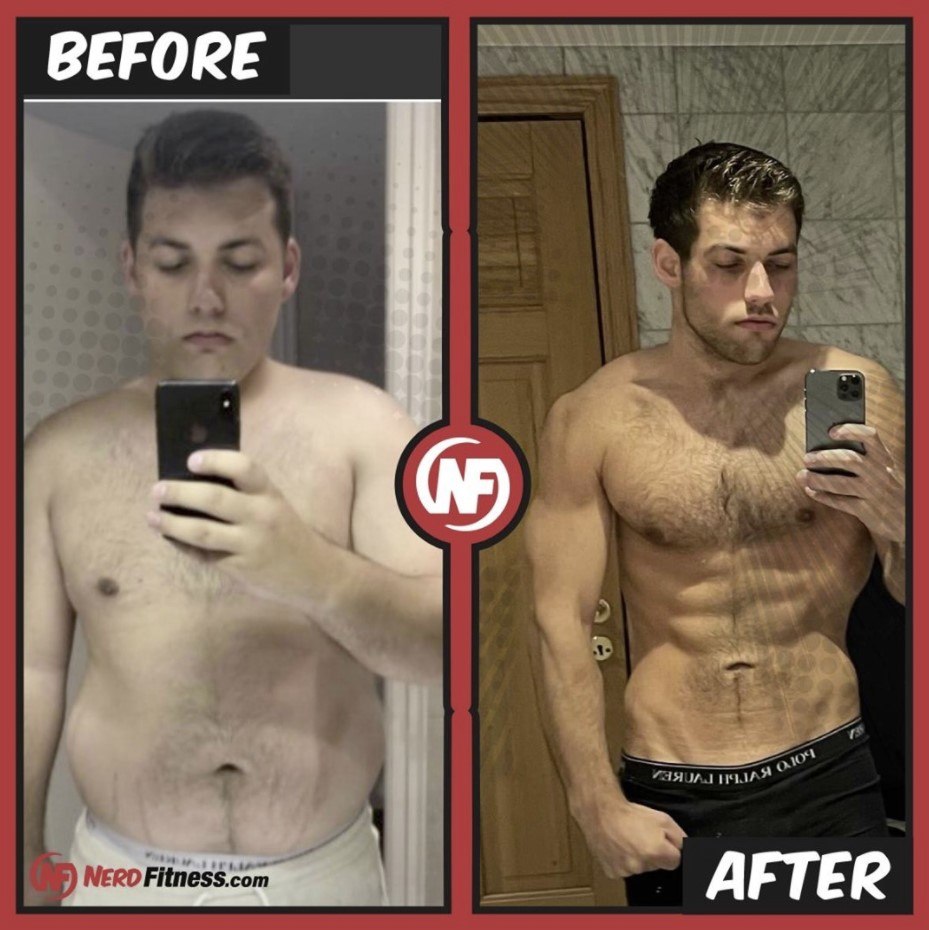
Categories
Uncategorized

#getfit #holistic #nutrition Talking Tax & Expenses For Fitness Professionals

Read this post Talking Tax & Expenses For Fitness Professionals on keep it simpElle.

The new tax year has started (6th April 2021) and if you’re anything like me, you still have some catching up to when it comes to tax and self assessments. It might seem like you have forever to submit your…

Read More

Read more on keep it simpElle –

from keep it simpElle https://ift.tt/3HkvVV1
via IFTTT

Categories
Uncategorized

#holistic #getfit #nutrition 5 Hacks to Effortlessly Build Healthy Habits in 2022

Top view New Year Resolutions text list with marker and eyeglasses for business presentation mock up for adding your list

At some point in the past week (or five minutes ago after a Google search), you’ve made a resolution to change your life.

Maybe you decided to exercise every day. Perhaps it’s time to start eating better.

Or maybe you decided to stop wearing jorts.

Although I think this puppy is making the jorts work.

Well my friend, I’m excited for you, and I want you to know you’ve arrived at the right place!

We help folks build healthy habits as part of our 1-on-1 Online Coaching Program, so you’ve come to the right place to fulfill your resolution.


Here’s what we’ll cover in our Guide to Build Healthy Habits in 2022:

Let’s get right to it so you can start rocking 2022!

Why Do We Suck At Building Healthy Habits?

Human hand holding crumpled paper or trash and white paper ball and waste on the floor, A hand are crumpling a paper

“I know what I’m supposed to do, I just can’t get myself to do it!” 

Welcome to the club – we all know what we need to do, but we just can’t get ourselves to make the important changes.

We know how to get in shape: move more and eat less!

We know how to exercise: get your heart rate up, do some push-ups, get stronger.

We know how to eat healthy: more vegetables and less sugar.

And yet, we can’t get ourselves to stick with ANY of these things for longer than a few weeks.

Why?

Simple: Building new healthy habits is tough, our lizard brains crave instant gratification, we don’t fully understand how habits are built, life gets busy, and our default behavior is often as unhealthy as it is easy.

As a result, we don’t put the right systems in place in order to make changes stick.

We also rely wayyyyy too much on willpower and motivation.

We tend to bite off more than we can chew, go too fast too soon, and then get overwhelmed too quickly.

This reaction is priceless.

Does this sound familiar?

  • I’m going to eat 100% Paleo/Keto AND
  • I’m going to run 5 miles a day AND
  • I’m going to work out in a gym five times a week.

If you’re somebody that eats a typically poor diet, never runs, and hasn’t set foot in a gym since grade-school dodgeball with Mr. Wazowski, changing alllll of these at once is almost a surefire way to succeed at precisely NONE of them.

We’re conditioned these days to expect and receive instant gratification. If we want food we can get it from a drive-through, stick a frozen meal in a microwave, or sit down at a restaurant that’s open 24 hours. If we want a game we can download it to our computers/phones/PS5s within a matter of seconds. If we want to watch a TV show, it’s a few clicks away.

Hell, Netflix even starts the next episode for you without any action required!

George binging some TV

We expect getting in shape to go the same way.  

And this is why we suck at building healthy habits that stick.

We tell ourselves “Hey, I’ve been dedicated for a whole two weeks, why don’t I look like Ryan Reynolds yet?”, not remembering that it took us decades of unhealthy living to get where we are, which means it’s going to take more than a few weeks to reverse the trend.

And then we miss a workout because life was busy or our kid got sick. And we get disheartened that exercise or giving up candy is not nearly as fun as Netflix and video games and Peanut M&M’s.

This is where everybody gives up:

  • They try to change too many habits too soon
  • They get impatient the results don’t come more quickly
  • They slip up when life gets busy
  • And they go back to square one

It’s why we are doomed to stay overweight and suck at building habits. It’s the videogame equivalent of attacking too many bad guys at once, which always leads to:

A game over screen

We’ll cover the specific healthy habits and resolutions you SHOULD be picking later in this article, but I have a big damn question to ask you first:

“But why though?”

The First Step of Building Healthy Habits (Know Your “Big Why”)

3D rendering of question mark

Before we do ANYTHING with actually building habits, you need a damn good reason as to why you want to build them in the first place or the changes will never stick.

This whole “change who I am” stuff needs to be at the center of your decision making moving forward.

And if you don’t have a good reason, you’re dead in the water:

If you’re here because you decided you “should” get in shape, you’re going to fail the second life gets busy.

If you are dragging yourself to the gym because you think you “should” run on a treadmill five days a week even though you hate it, you’re screwed!

Well at least he's using it...

As you’re determining the habits or resolutions you’re trying to set, make the habit part of a bigger cause that’s worth the struggle.

You’re not just going to the gym, you’re building a new body that you’re not ashamed of so you can start dating again.

You’re not just learning to like vegetables, you’re losing weight so you can fit into your dream wedding dress.

You’re not just dragging yourself out of bed early, you’re getting up earlier so you can work on your side business before your kids get up so you can set money aside for their college education.

In our 1-on-1 Coaching Program and throughout Nerd Fitness Prime, we refer to this as your “Big Why.” Without it, you’re just forcing yourself to do things you don’t like to do – that’ll never last.

Tie it to a greater cause and you’re infinitely more likely to push through the muck and mire to get it done.

So dig 3 levels deep and ask “why” until you get to the root cause of WHY you want to build a new healthy habit or change a bad one. Write it down. And hang it up somewhere you can see it every day.

Got your reason? Great.

Now let’s get into the science of habits.

How to Build Healthy Habits (The Three Parts)

As Charles Duhigg points out in The Power of Habit (a must-read for anybody interested in behavior change), there are three parts to a habit:

#1) Cue (what triggers the action): It can be a feeling: I’m tired, I’m hungry, I’m bored, I’m sad. Or it can be a time of day: it’s Monday at 9am, work is done, etc.

#2) Routine (the action itself)This can either be a negative action you want to cut back: I drink soda, I eat cake, I snack, I drink alcohol, I smoke cigarettes, I watch TV – or a positive one: I go to the gym, I go for a run, I do push-ups, I read a book.

#3) Reward (the positive result because of the action)I’m now awake. I am temporarily happy. My hands/mind are occupied. I can forget the bad day I had. I feel energized. I feel good about myself.

Depending on your routine/action above, habits can either be empowering and amazing, or part of a negative downward spiral. Your body isn’t smart enough to KNOW what it needs to do: it just wants to fix the pain or chase the pleasure of the cue, and whichever way you choose to respond will become the habit when it’s done enough times.

Factor in genius marketing, behavioral psychology, and an environment set up for us to fail – and bad habits rule us.

We've all been here.

It’s why we crave certain foods, why we can’t help but check our phone every time it vibrates, and why we can’t keep ourselves from watching one more episode or grinding one more level in World of Warcraft.

Duhigg lays things out very clearly:

“There is nothing programmed into our brains that makes us see a box of doughnuts and automatically want a sugary treat.

But once our brain learns that a doughnut box contains yummy sugar and other carbohydrates, it will start anticipating the sugar high. Our brains will push us toward the box. Then, if we don’t eat the doughnut, we’ll feel disappointed.”

Not eating that doughnut can be tough.

Picture this:

  • We have trained your brain to take a cue (you see a doughnut), anticipate a reward (a sugar high), and make the behavior automatic (nom nom that donut).
  • Compare that to a cue (you see your running shoes), anticipate a reward (a runner’s high), and make the behavior automatic (go for a run!).

The Dark Knight himself said it best: “It’s not who I am underneath, but what I do that defines me.”

Let’s take a look at each part of the habit-building process and start to hack the sh** out of it!

Learn Your Cues: Recognize the triggers.

A picture of a LEGO Spider-man, who is interested in weight loss.

Whether you are trying to change an old habit, stop an unhealthy habit, or begin a healthy habit, it starts with the first step in the process:

“The Cue.”

If you want to stop drinking soda, but feel like you need it every afternoon to get through work, your brain has been wired to think SODA after the cue:

  • Cue: I’m tired, thirsty, and have no energy.
  • Routine: I drink a soda around 3pm.
  • Reward: Weeeeee caffeine! Sugar! Happy! My life has meaning!

When identifying bad habits to avoid, it starts by becoming aware of the cue that sets the habit in motion. Simply being aware of the cue is a great start to breaking the cycle:

  • When I get bored (cue), I eat snacks (routine), and it fills the void with a happy stomach (reward).
  • When I come home from work (cue), I plop down on the couch and play video games (routine), and it helps me forget about work (reward).
  • When I get nervous (cue), I start to bite my nails (routine), to take my mind off the awkwardness (reward).

So if you are looking to break a bad habit, it begins by identifying what the cues are that make you take the action that you’re trying to stop.

At the same time, you can mentally train yourself, just like Pavlov’s dog, to build a new healthy habit by identifying the habit you want to build and the cue you want to use to proceed it:

  • When I wake up (cue), I will go for a walk (routine), and reward myself with an audiobook on the walk (reward).
  • When I get tired (cue), I will drink black coffee instead of soda (routine), and along with the caffeine boost. (reward), I’ll get new running shoes after 30 soda-free days (reward), and satisfaction from the weight loss thanks to fewer calories (reward).
  • When I come home from work (cue), I will walk straight to my computer to work on my novel for 30 minutes (routine), and reward myself with Netflix after I have written 500 words (reward).

So, whether you’re breaking a bad habit or starting a new one, it begins by recognizing the cue that triggers the habit.

Once you recognize or pick the cue, you can start working on fixing the routine (action).

The Key to Sustainable Healthy Habits: Use Systems

“Steve, I get it, but I still struggle with the ‘building the routine’ part…for some reason I just can’t bring myself to do it.”

Yup – welcome to the toughest part of a habit:

The Routine (the action itself!).

This is where we’re going to start thinking and acting like nerds and scientists.

Whether we’re trying to stop a negative routine (stop drinking soda) or start doing a healthy routine (start running), both need to be addressed with a different plan of attack.

We'll need more paint cans for this.

For starters, we’re going to stop relying on two things:

  • Willpower: if you have to get yourself to exercise, you’ll give up when you get too busy or it’s too cold.
  • Motivation: if you need to be motivated, you’re going to give up and then beat yourself up for not being more motivated!

Both motivation and willpower are finite and fickle resources that will abandon you when you need them most. Suckers and chumps hope and pray that they have enough motivation and willpower to build a habit. That’s clearly a:

Yep, don't rely on willpower alone to create habits.

Not us though!

We’re going to remove both from the equation and use systems and outside forces to make the routine even easier to build (or tougher to build if it’s a bad habit you’re trying to swap!).

This can be done in a few ways:

  • Environmental hacks: making the routine easier by removing steps needed to complete it, or adding steps between you and a bad habit.
  • Programming hacks: add your habit to your daily calendar, track your progress daily with a journal, and make it part of your day.

We are products of our environment. We can use this information to our advantage and make the process of building a new habit or changing a bad habit easier by modifying our environment. I dig into this more fully in our article: “Build your Batcave for Habit Change,” but I’ll cover the basics here.

Look at the places you spend your time. Reduce the steps between you and a good habit, and increase the steps between you and a bad habit. You’ll be less reliant on willpower and motivation and more likely to do the healthy habit or skip the bad habit.

Here are five examples of environmental hacks you can use: 

  1. RUN EVERY MORNINGGo to sleep with your running shoes at the foot of your bed, with your running uniform laid out already. Hell, you can sleep in your running/workout clothes. Put your alarm clock on the other side of the room so you HAVE to get out of bed to turn it off.
  2. GO TO THE GYM AFTER WORK: Pack your gym bag BEFORE going to sleep the night before. That way, every morning you already have a bag to throw in your car or bring with you. As soon as 5pm hits, you are in your car on your way to the gym. (Don’t want to head to the gym? Here’s how to build a gym in your home). 
  3. EAT HEALTHIERDon’t give yourself the option of not eating healthy – throw out the junk food in your house and start preparing meals the night before. Put a lock on your web browser from ordering pizza online (yes, you can do that now), and don’t drive down the street full of fast food places.

  4. WATCH LESS TV/PLAY FEWER GAMES: Use your laziness in your favor. Unplug the TV/system. Increase the steps between you and watching the TV. Put parental controls on your own system and have your friend set the time limit and the password. I knew somebody who put his TV in his closet and cut his TV viewing by close to 100%. Don’t rely on willpower – make it more difficult!
  5. CHECK YOUR PHONE LESS: Turn off your notifications and uninstall the apps that waste your time. Put your phone in Do Not Disturb mode when you are at work, and put it in your desk drawer. Don’t rely on willpower to get yourself to not check your phone when it buzzes – get rid of the buzz.

You can also use programming hacks to help build NEW healthy habits: 

  • EXERCISE: If you want to exercise more, set calendar alerts at the beginning of your week so that every day at 8AM you receive a cue (ding! on your phone) and a reminder to do the activity. You’re much more likely to stay on target when the activity has been scheduled ahead of time.
  • HEALTHY EATING: Consider batch cooking! If cooking healthy meals every night sounds like way too much work (I hear you on that), consider doing it all on ONE day – it’s a significant time-saver, and it also will reduce the steps between you and healthy eating because the meal is already cooked and in the fridge!
  • WRITING: If you want to write a book, tell yourself you have to write 500 crappy words every day. This is how I wrote Level Up Your Life. Buy a calendar, and draw a big red X on every day you complete your task. Make your singular focus every day continuing the streak[1].

Make the Reward Momentum-Building

Orange carrot hanging on stick above black hole with rabbit in it abstract isolated on blue

And we are finally at the third part of the habit:

“The Reward.”

When looking to replace bad habits, do some reward analysis on your bad habits:

Soda gives you a caffeine kick and a burst of energy in the afternoon when you’re tired.

Can you replicate that energy boost for your body in a healthier way? Perhaps you can switch to black coffee and go for an afternoon walk.

Walking is a great habit to build!

Here’s another example:

You find you spend too much time watching TV because you love escaping into worlds, and it’s affecting your health.

Can you listen to your favorite audiobook only when you walk?

(This is called temptation bundling).

This step will require some analysis, by digging into the reward you’re trying to recreate, without the negative action. This can lead your brain to some tough places, but it’s healthy to dig into it.

For example, if you  want to start drinking less (or give up completely), you might discover that the reward you’re chasing is actually “escape from a job I hate” and “avoiding social anxiety.”

Jesse awkwardly drinking

Dig into your reward and what your brain is craving, and then see if you can reverse engineer a healthier routine with the same reward.

And then use outright bribery to get yourself to actually do the new healthier and choose the better action/routine.

What works for science and physics also holds true to building habits: inertia and momentum will work against you when it comes to building habits…until it starts to work for you as the habit becomes automatic.

We can fix the third part of the habit-building loop, the reward, with momentum-building prizes or results to bribe ourselves to continue. With each healthy and positive reward, with each completed routine, we make the habit sliiiiightly more likely to become more automatic the next time.

In other words, create rewards that reward you back!

DON’T reward your routine (running!) with an unhealthy reward (cake!). That’s “one step forward, two steps back.” And nutrition is 90% of the equation when it comes to weight loss anyway!

DO reward your routine (running for 5 minutes every day for 30 days straight) with a reward that makes you want to keep running (a snazzy new pair of running shoes).

Our new app, Nerd Fitness Journey, specifically follows this “cue, routine, and reward” format to help build new habits. In the app, we “reward” you with cool loot and XP, so you can level up (literally) while you getting lean and strong.

If you’re interested, you can try it for free right here:

5 Hacks for Effortless Healthy Habit building

Lego star wars stormtrooper a sneak is key keyboard notebook.

Your life will get busy. 

There will be days when you don’t want to do your new habit. Or you want to backslide and go back to old habits. Actually, that will pretty much be every day, especially early on.

So don’t leave it up to yourself!!!

Stop relying on yourself and start relying on outside forces. Here are the best tips you can use to get yourself to actually follow through with a habit:

1) RECRUIT ALLIES: find a friend or group of friends to build the habits with you. A recent study [2] showed that:

Among the weight loss patients recruited alone and given behavioral therapy, 24% maintained their weight loss in full from Months 4 to 10.

Among those recruited with friends and given therapy plus social support, 95% completed treatment and 66% maintained their weight loss in full.

You do not have to go on this habit-building journey alone. Building a guild or recruiting a group of people to support you and help you and make you better could be the difference-maker in building habits!

A group of allies can help with victory

When your friend is already at the gym waiting for you, you HAVE to go. If it was up to you, skipping out and watching Netflix has no negative consequences. Recruit friends and allies!

Don’t have that support group at home? Consider joining ours 🙂

Remember, those first few weeks are the toughest, which means they’ll require the most effort to get started.

2) CULTIVATE DISCIPLINE WITH ACCOUNTABILITY: When you can’t get yourself to follow through on a new healthy habit you’re desperately trying to build, make the pain of skipping the habit more severe than the satisfaction you get from skipping it.

Allow me to introduce some BRUTAL consequences:

  • Every time I skip ______________ this month, I will pay $50 to my wife/husband/friend who will donate my money to a cause I HATE.
  • Every time I decide not to _______________ this month, I have to run around my house naked.
  • Every time I do ____________ when I shouldn’t, I will let my three-year-old do my makeup before work.

Do any of these results sound like fun? If you can’t afford to pay your friend $50, if running naked around your house might get you arrested, and if you’ll get fired looking like a drunk clown thanks to your kid’s makeup skills…maybe you just do what you know you need to do. The more painful it is to skip something, the more likely you’ll be to actually suck it up and do it.

3) NEVER MISS TWO IN A ROW. What happens if you miss a day? Who cares! One day won’t ruin you – but two days will, because 2 becomes 30 in the blink of an eye.

It’s something I bring up in this video:

As pointed out in a research summary:

“Missing the occasional opportunity to perform the behavior did not seriously impair the habit formation process: automaticity gains soon resumed after one missed performance.[3]

4) DON’T PICK HABITS YOU HATE: “Steve, I know I should run so I’m trying to build a running habit even though I hate running.” Stop.

Captain Kirk saying "stop"

Can you get the same results with a different habit, like rock climbing or hiking or swing dancing? Pick a habit that isn’t miserable and you’re more likely to follow through on it.

At the same time, we have tons of success stories of people who went from hating exercise to loving how it feels.

It’s because they made the habit part of a bigger picture: “I am working out because I am building a kickass body so I can start dating again!”

It’s because they had a BIG enough why to overcome their initial dislike of exercise until they learned to love how exercise made them feel.

5) TRY TEMPTATION BUNDLING: Consider combining a habit you dislike with something you LOVE, and you’ll be more likely to build the habit.

If you hate cleaning your apartment, only allow yourself to listen to your favorite podcast when you are cleaning or doing the dishes.

Want to go to the gym more? Allow yourself an hour of watching Netflix, but ONLY while you’re on the elliptical.

This is called temptation bundling, and it can be a powerful change.

The Secret to Fulfilling Your Resolution (Do Less)

Ladder to freedom from dirty room

Now that you’re educated like a boss on the different parts of a habit, it’s time to build one!

I’ll leave you with a final bit of advice: if you decide that you want to run a marathon or save the world or lose hundreds of pounds, you’re going to screw up unless you internalize the following information:

DO WAY LESS.

Or in the immortal words of Kunu from Forgetting Sarah Marshall: “The less you do, the more you do”:

Pick ONE habit, make it small, and make it binary. Something that at the end of every day you can say “yes I did it” or “no I didn’t.”

Habits that are nebulous like “I am going to exercise more” or “I’m going to start eating better” are more useless than a Soulcycle membership for Jabba the Hutt.

Here are big examples. Be specific. Be small. And track it:

  • Want to start exercising more? Awesome. For that first week, ONLY go for a walk for just 5 minutes every morning. Literally 5 minutes.
  • Want to start cooking your own healthy meals? Just aim for one meal per day or one meal per week. Whatever works for you and your schedule.
  • Want to stop drinking a 2 liter of Mountain Dew every day? Scale it back to 1.9 liters a day for a week. Then 1.8 for a week. Then 1.7…
  • Want to get out of debt and build the habit of frugality? Start by saving an extra five bucks a day, or finding a way to earn an extra 5 bucks a day.
  • Want to learn a new language? Speak your new language out loud for 10 minutes per day. That’s it!

Keep your goals SMALL and simple. The smaller and simpler they are, the more likely you are to keep them. And the habit itself pales in comparison to the momentum you build from actually creating a new habit.

I don’t care how many calories you burn in a 5-minute walk, just that you can prove to the new YOU that you can build the habit of walking, and only then can you up the difficulty.

This gif is perfect for our site

We’re thinking in terms of years and decades here! So think small.

My real-life example: I wanted to build the habit of learning the violin at age 31, but couldn’t get myself to do it because I told myself I was too busy, which is a lie (“I only have 25 minutes; I need 30 minutes to practice…might as well not practice at all”), and thus I never played!

Once I lowered the threshold to “I have to only play for 5 minutes per day,” it gave me permission to pick it up here and there – and I ended up practicing WAY more frequently, and got better much faster.

I still suck, mind you, but I’m lightyears ahead of where I was before!

And please: DON’T BUILD ALL THE HABITS AT THE SAME TIME

If you’re new to building habits, or you have never stuck with anything long enough to make it automatic, it’s because you did too much. Habits are compound interest.

As you build a new habit, it bleeds over to other parts of your life and makes future habits easier to build too – momentum!

As Mark Manson lays out in his guide on Habits

“Willpower is like a muscle. It can be exercised and practiced and built up. It can also be forgotten, weakened and atrophied.

Just like going to the gym and building up strength and endurance, you can build up your discipline and willpower over a long period of time by setting and accomplishing a series of tasks on a consistent basis.”

You’ve probably tried the whole “build all the habits at once” and it doesn’t work. So try building ONE habit for 30 days. And then pick a habit that stacks on top of that one and helps you build more and more progress and more and more momentum.

Start today: Pick Your Habit and Go

Very clever use of stickers here.

I’ll leave you with a final quote from Duhigg’s The Power of Habit:

“If you believe you can change – if you make it a habit – the change becomes real. This is the real power of habit: the insight that your habits are what you chose them to be. Once that choice occurs – and becomes automatic – it’s not only real, it starts to seem inevitable, the thing…that bears us irresistibly toward our destiny, whatever the latter may be.”

You’ll need more brainpower initially, until your default behavior becomes the automatic habit-building you’re chasing.

With each day of you building your new habit, you’re overcoming any self-limiting belief, building momentum, and becoming a habit-building badass! And then those habits become automatic. Then, we rejoice:

Healthy habits can feel like this.

So today, I want you to look at just ONE habit you want to change:

  • Identify the cue that spurs it on – Is it the time of day? Boredom? Hunger? After work? Stress?
  • Identify the potential rewards – Happiness? Energy? Satisfaction?
  • Identify a new routine you’d like to establish that results in the same “reward” from the negative behavior…but in a more productive and healthy way.

And I know this journey is tough – it’s the reason I’ve been working with a coach myself for the past 4 years. Having somebody else to help me pick the right habits and focus, somebody to keep me accountable, and somebody to learn from has been HUGE!

If want expert guidance on your healthy habit building in 2022, let’s make it happen! You can sign up for a free call with our coaching team in the box below to learn more about the program and see if it’s the right fit:


I want you to leave a comment below: pick ONE habit that you’re going to build this month and identify the three portions of the habit you’re looking to build.

Good luck – now go build some momentum.

And ONE habit.

-Steve

PS: Our new app, Nerd Fitness Journey, is all about creating new habits! It’s designed so when you wake up in the morning, you have a “cue” on exactly what “routine” to get started with. Plus, we “reward” you with cool loot and XP, so you can literally level up.

You can try it for free right here:

###

photo source: Syahrir Maulana © 123RF.com, KHOTCHARAK SIRIWONG © 123RF.com, alphaspirit © 123RF.com, Evolution – Alternative, Nattapol Sritongcom © 123RF.com, obradov © 123RF.com, Chayapon Bootboonneam © 123RF.com, Boris Rabtsevich © 123RF.com, #13/366 Placing the head, Mixed Messages

The post Blog first appeared on Nerd Fitness.

from Nerd Fitness: Helping You Lose Weight, Get Stronger, Live Better. https://ift.tt/3FwAY46
via IFTTT