Categories
Uncategorized

#holistic #getfit #nutrition How to Squat Properly: The Ultimate Guide

The barbell squat is the one of the best exercises on the planet

One of the best exercises for you, whether you’re trying to build muscle or lose weight (or both) HAS to be the squat.

However, it’s also an exercise I see nearly EVERYBODY do incorrectly.

We do video form checks with every Online Coaching Client to make sure they’re squatting correctly, and we use a LOT of the same cues and instruction we cover in this guide! 


So have no fear…

After reading this big ass squat guide (pun intended, I suppose?) – part of our Strength 101 series – you can start performing this compound exercise safely and effectively.

Click any link below or scroll down to read the whole guide:

What Are the Benefits of Squats?

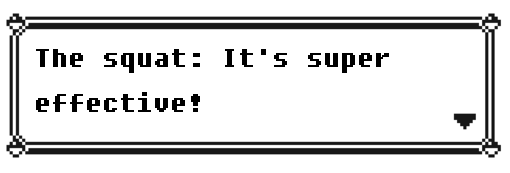
As this sign shows, the squat is a super effective exercise.

Squats are one of the most foundational functional movements in our lives. Let’s talk about the benefits and why you should be squatting all the time.

#1) We’re designed to squat: We’ve been squatting since we were babies, but as we get older and sit in unnatural positions all day, our squat form goes from perfect to terrible.

Crap.

In many countries, people often sit in a full squat for hours at a time. 

In many parts of the world, a squat is a normal position to sit in for hours.

From an evolutionary standpoint – it makes sense that we are genetically designed to, and can be really good at – squatting.

Before modern-day furniture and technology, you didn’t stop sitting in a full squat once you got older like we do today…you continued squatting your entire life.

That’s why squatting is one of the key moves for functional fitness.

#2) Squats are a compound movement that recruits most of our muscles – this means it’s a movement that uses multiple muscle groups and joints (your hip and knee joints) to complete.
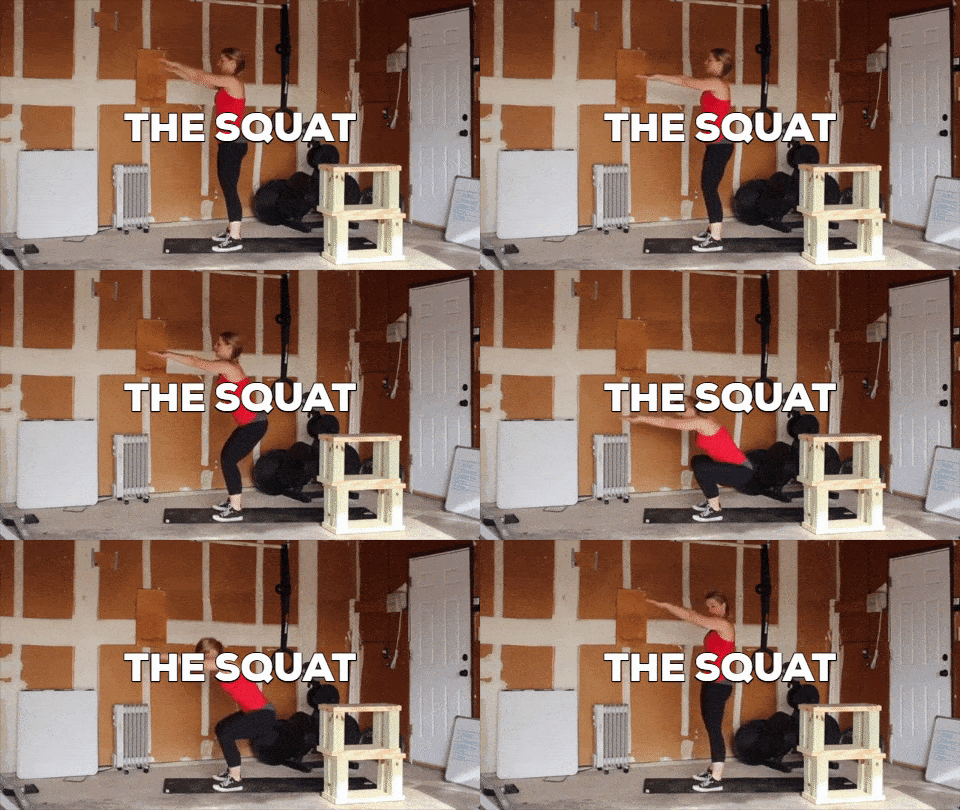
The squat movement as shown here.

A simple bodyweight squat – which I’m demonstrating above – uses almost every muscle in the core and lower body.

If you add a dumbbell or barbell into the equation, I would even argue that they use every single major muscle group to complete.
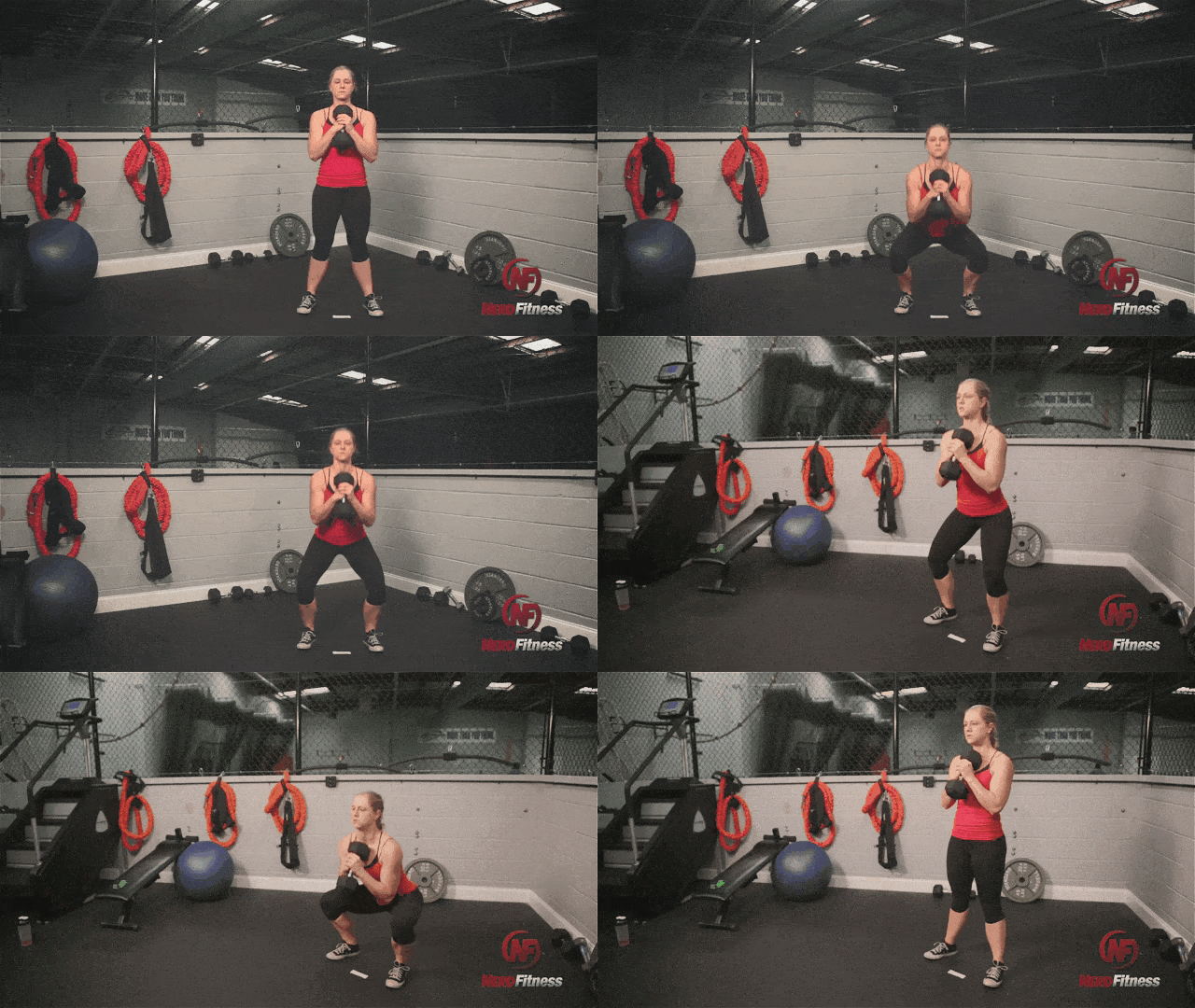
The goblet squat is a great way to build muscle for women.

In addition to every muscle in your “legs,” you need your:

  • Hips
  • Back
  • Core
  • Shoulders
  • Arms.

Nothing is left out with this monster movement.

Because of the utilization of a large amount of muscle groups, squats cause your body to increase our anabolic hormone production, helping us lose fat and build muscle.[1]

#3) Squats will help strengthen your bones and your muscles (and your knees!), and can also increase flexibility.

Increasing the strength in your knees and hips (and entire body) reduces your chance of injury while doing both athletic movements and everyday life things (such as shoveling the driveway or standing up and sitting down).

And by learning to squat deeply, safely, you’re improving your range of motion and helping make you antifragile and protecting yourself against future injury.

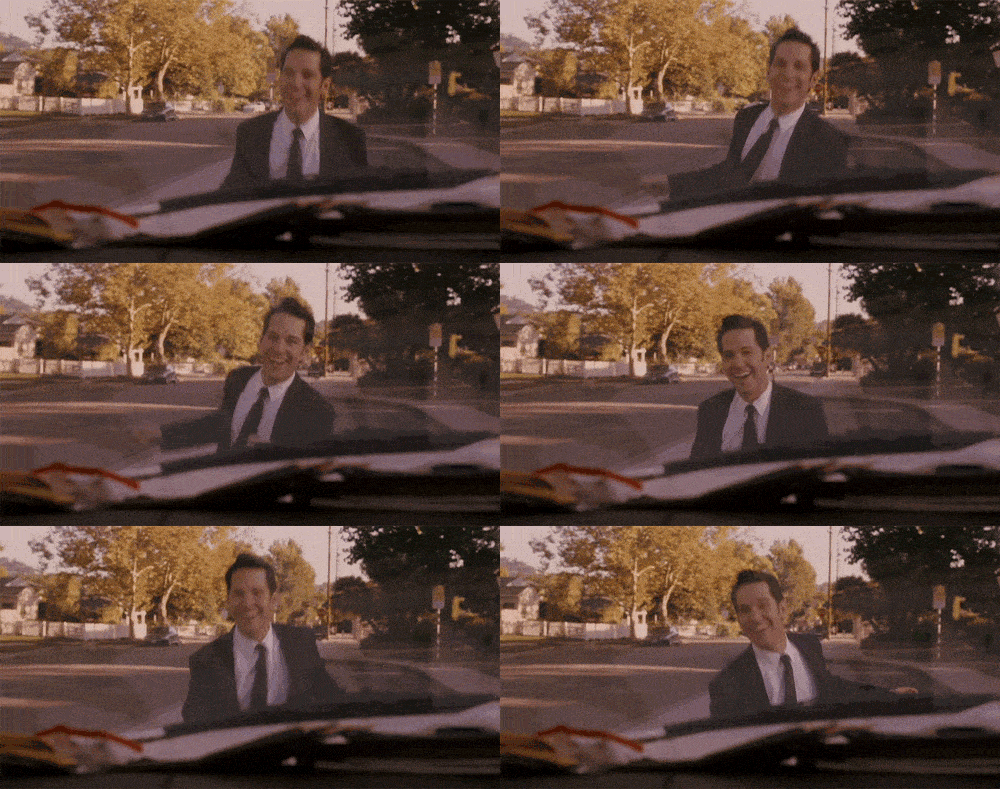
Bazinga!

Sheldon knows how amazing squats are for you, as demonstrated by this clever smile.

If your goals are to:

  • Build muscle and get stronger, squats will get you there faster.
  • Lose weight and get ‘toned,’ squats will get you there faster.
  • Look better naked, squats will get you there faster.
  • Get healthier and happier, squats will get you there faster.
  • Feel like an absolute badass in the gym, squats will get you there faster.

In short, squats are amazing.

(See what I did there?)

My name is Staci Ardison, I’m a Senior Coach at Nerd Fitness, and my life has been absolutely transformed by barbell training, which is why I’m so excited to share this guide with you. 

Back in 2011, I could barely pick up a pink dumbbell, and now I regularly compete in powerlifting competitions.

Here’s a scene of my homemade squat rack:
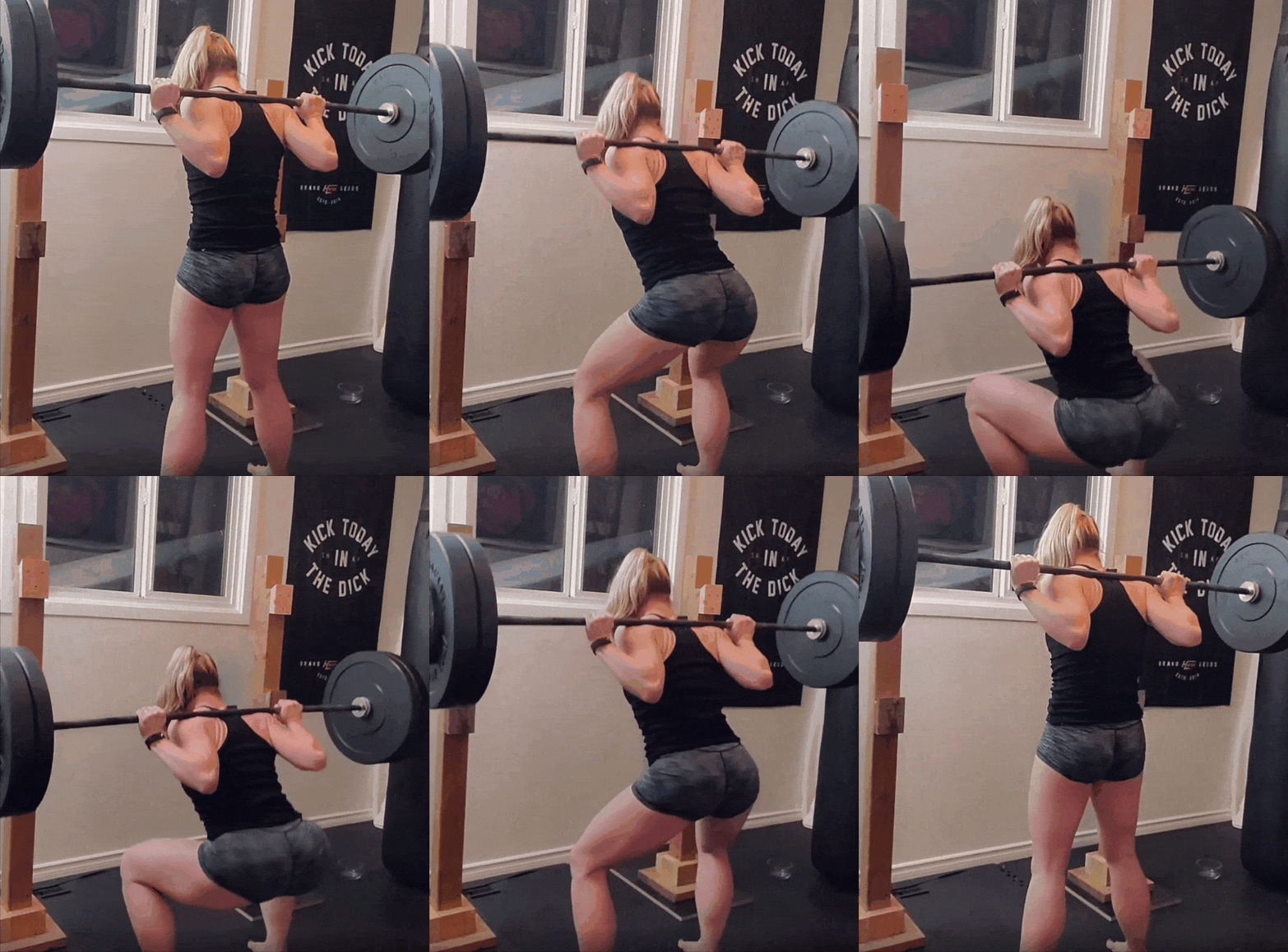
Staci doing a barbell squat

I am so excited to teach you how to squat today, as I’ve taught tons of coaching clients how to get started too. 


Let’s start off by taking a look at the bodyweight squat – the first move you should master before you add weight.

How to Do a Bodyweight Squat With Proper Form
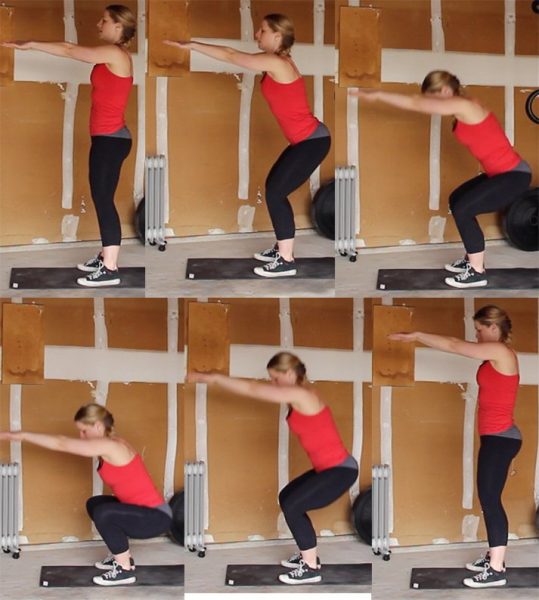
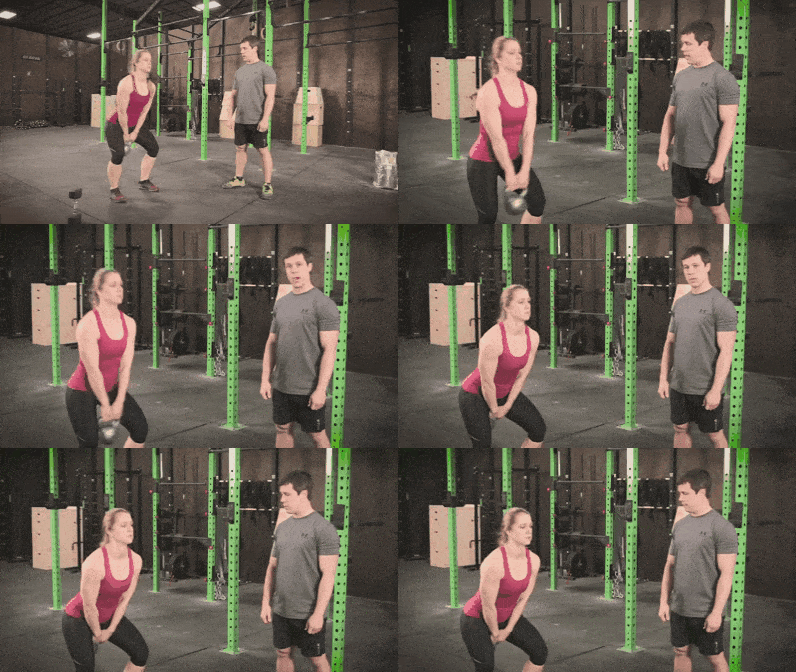
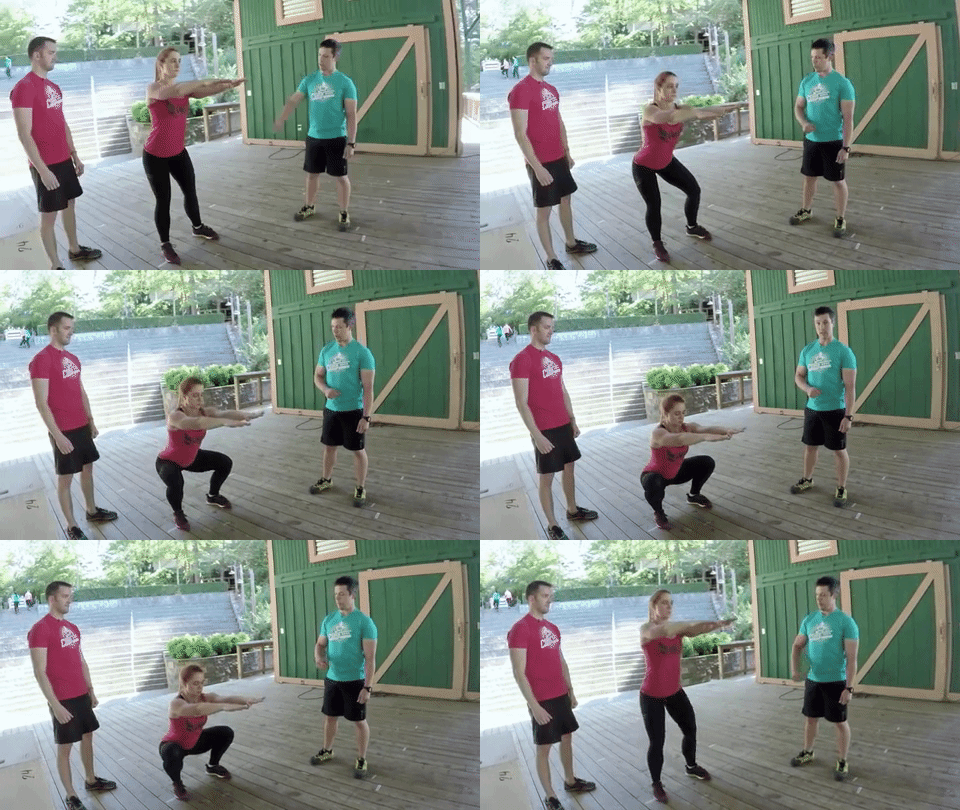
This series of photos shows you how to do a proper squat.

The setup for the squat exercise is incredibly simple.

  • Stand with your feet slightly wider than your hips.
  • Your toes should be pointed slightly outward – about 5 to 20 degrees outward (the wider your stance, the more you’ll want to rotate your feet outward).
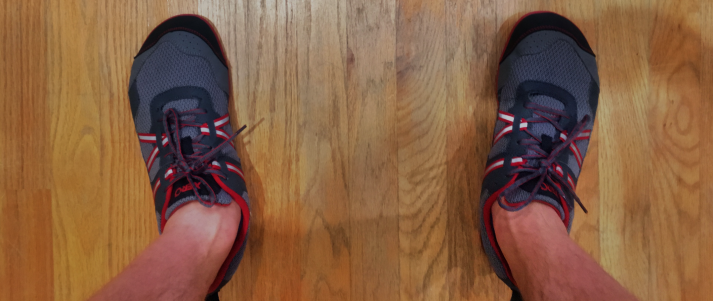
Your heels should be slightly wider than hip width apart, with your toes pointed outward

  • Look straight ahead and pick a spot on the wall in front of you.
  • Look at this spot the entire time you squat, not looking down at the floor or up at the ceiling.

I go over the setup and the full movement in this video:

1) Put your arms straight out in front of you, parallel to the ground. Keep your chest up and proud, and your spine in a neutral position.

2) Your weight is on your feet – it should be on the heels and the balls of your feet, as if they were pasted to the ground. You should be able to wiggle your toes the entire movement (though that’s not a part of squatting!).

3) Keep your entire body tight the entire time, your core flexed like you’re bracing to be punched in the gut!

4) Breathe deeply into your stomach, break at your hip and push your butt back. Keep sending your hips backwards as your knees begin to bend.

It’s important to start with your hips back, and not by bending your knees.

5) As you squat down, focus on keeping your knees in line with your feet.

Many new lifters need to focus on pushing their knees out so they track with their feet.

When your knees start to come inside the toes, push them out (but not wider than your feet).[2]

Make sure your knees aren’t moving inward toward each other through the movement – this is very common. 
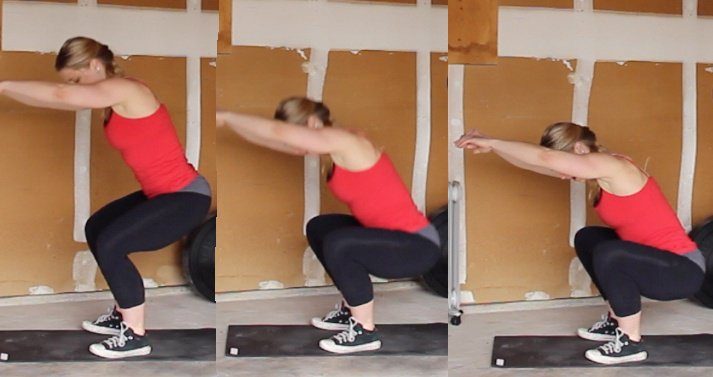
Make sure you go deep enough with your squats!

6) Squat down until your hip joint is lower than your knees (what we call “parallel” in the squat game). Note: if you THINK you might not be squatting deep enough, you probably aren’t!
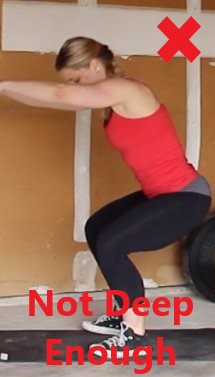
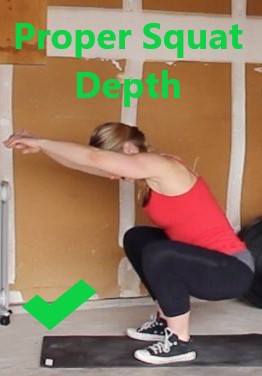
Keep going when doing your squat.

Your squat should go about this low.

Once at the bottom, it’s time to stand back up from your squat:

7) Keeping everything tight, breathe out and drive through your heels (keep the balls of your feet on the ground as well).

8) Drive your knees outward (away from each other) the same way you did on the way down, and squeeze your butt at the top to make sure you’re using your glutes.

Here is a video from us nerds at Team Nerd Fitness (with instructions from Jim, lead trainer at our 1-on-1 Online Coaching Program) that will teach you good form on a bodyweight squat, including all the mistakes NOT to make:

Once you can do multiple sets of 15+ deep bodyweight squats with proper form, it’s time to move onto barbell squats!

If you are confident in doing bodyweight squats and want to work up to a barbell squat, follow our Gym Workout Level 4 Program, which includes dumbbell goblet squats, a good stepping stone to barbell squats:

The majority of the population has some sort of mobility issue (including myself!) that they are working on fixing.

We have LOTS of 1-on-1 coaching clients who are new to squatting, and it often comes down to ankle flexibility and hip mobility.

If you spend all day, every day, sitting in a desk chair, this might be you.

If you want us to help you fix your squat depth and start getting stronger, that’s what we’re here for! 


How to Set Up Properly For The Barbell Back Squat
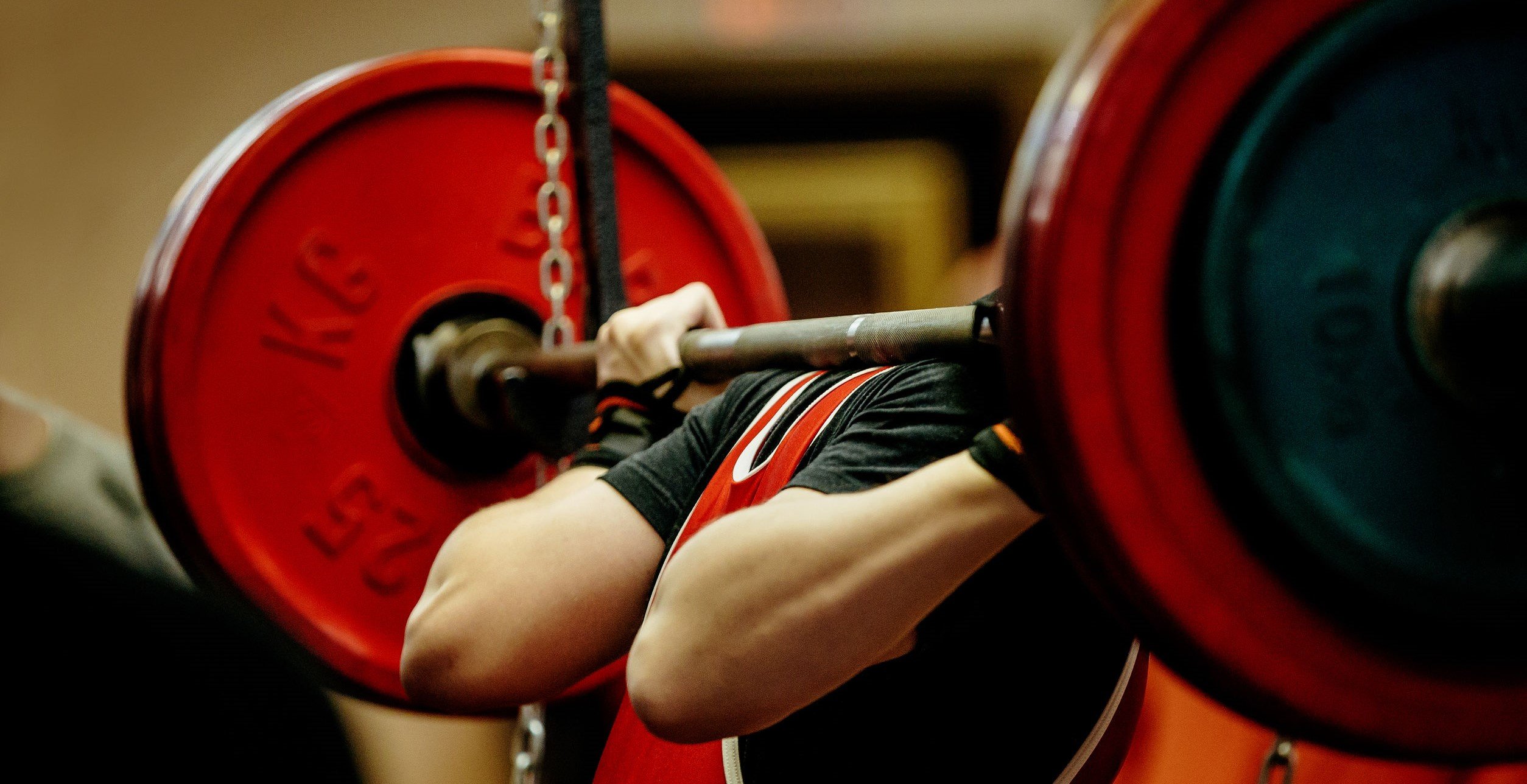
female powerlifter squat barbell for competition powerlifting

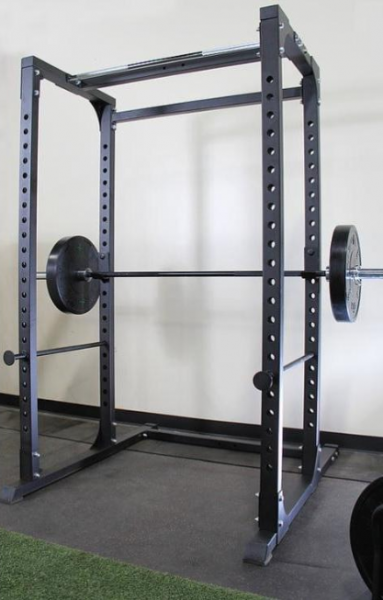
#1) Find your squat rack! It’ll look something like this, with an unattached barbell:

A. Squat Stand:If you find a squat stand like this in your gym you are good to squat!
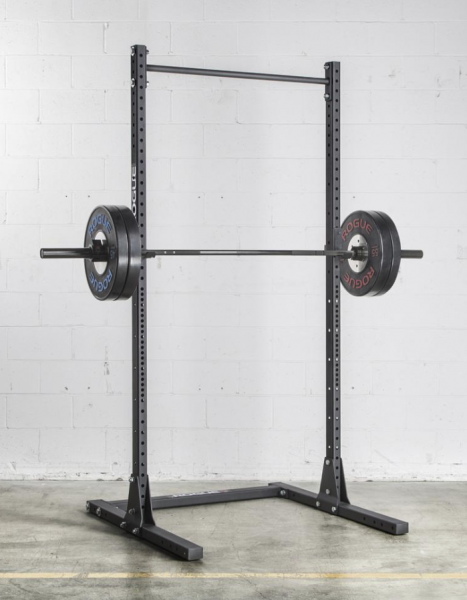
B. Power Cage/Squat Rack:

C. Half Rack (Least favorite*):
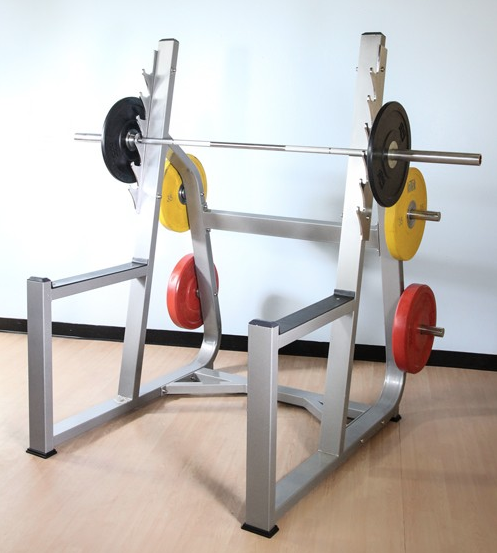
*I don’t like Half-racks without adjustable safety bars – if you want to squat deep the barbell might hit the immovable bars! Not cool. Aim for the A or B options if you have the choice!

Note: a squat rack is NOT the same thing as a Smith Machine, where the barbell is attached to the machine, and slides up and down two bars:
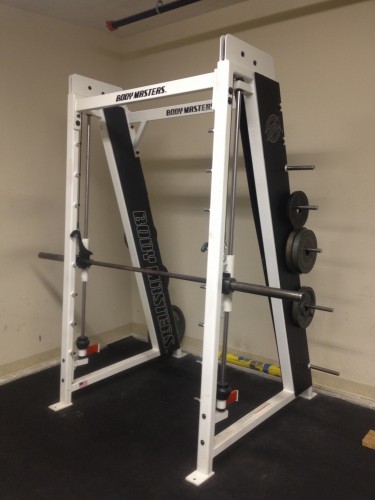
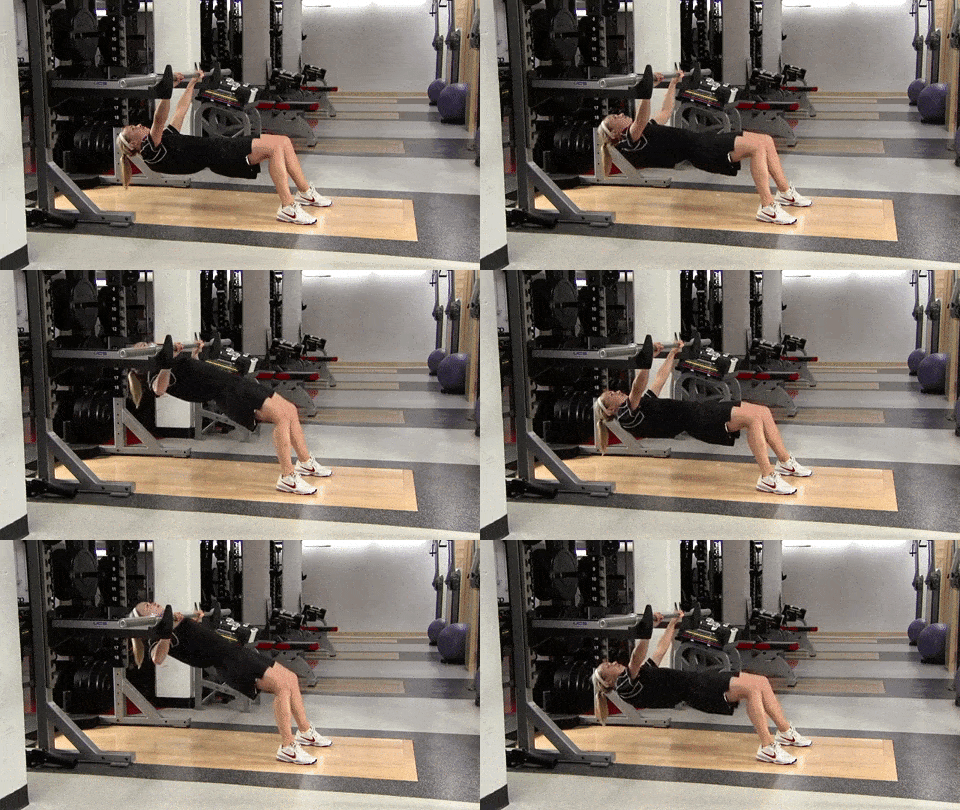
Don't use the Smith Machine, unless it's for inverted rows at the gym.

You do NOT want a Smith Machine.

You need a completely unattached barbell in order to do a barbell squat properly and safely. Don’t squat in a Smith Machine.

#2) Set the height of the bar to be about the same height as your collarbone.

Not sure how to set the height of the bar? I got you:

If your options are either too high or too low, it’s always best to set the pins slightly lower than you need them. 

You don’t want to have to get up on your toes to rack/unrack the bar, especially as the weight gets heavier.

#3) Decide if you are going to do a high bar squat, or a low bar squat. Either is fine, but there IS a difference:
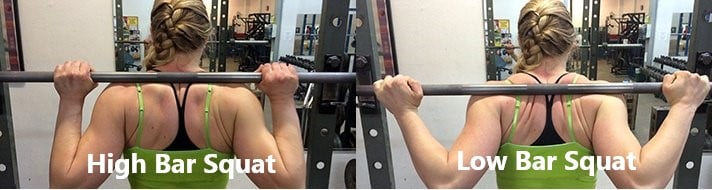
These two photos show the high vs low bar grip for squat

The “Low Bar Back Squat” is the most common form done by beginners, general lifters, and powerlifters.

It’s also the form taught in Starting Strength, one of the best books for beginners on the market.

So we’ll be focusing on that version for the rest of this section:

#4) Always squat with just the bar to startas we discuss in “How much weight should I be lifting,” even if you’re planning on squatting 500 lbs, always start with just the bar!

How to Do a Proper Barbell Back Squat, Step By Step
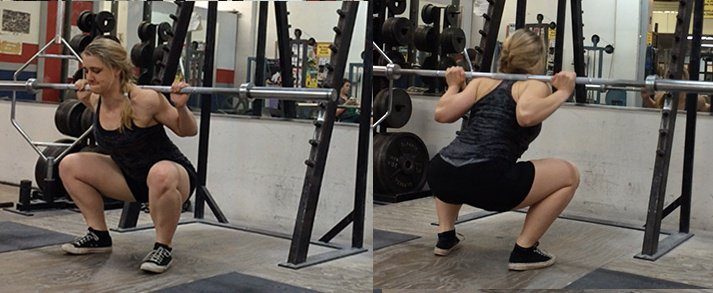
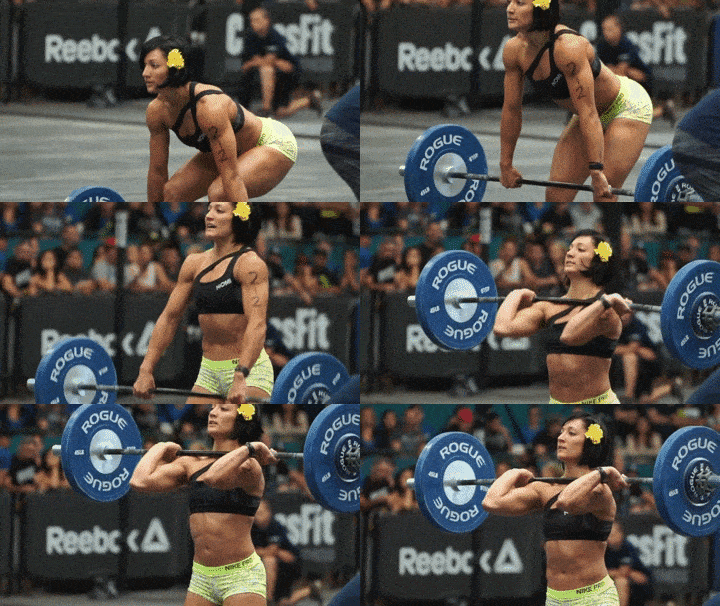
Here's how to properly do a barbell squat

1) Facing the bar, step under it, and put your hands around it on either side of you. 

For this type of squat in our example, we are going to want a thumbless grip, so that our wrists are properly aligned with our forearms.
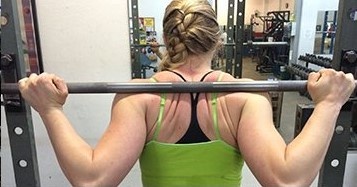
This photo shows the squat grip we will start with.

The width of your grip will be dependent on flexibility, but generally, a narrower (hands closer to your shoulers) grip will help create a meaty shelf for you to place the bar on the muscles in your upper back.

If you lack the flexibility for the narrower grip (which is super common), start out wider, then slowly bring it in as you get more flexible.

See the difference here between a “high bar, wrapped grip” (Left) and “low bar, thumbless grip” (right):
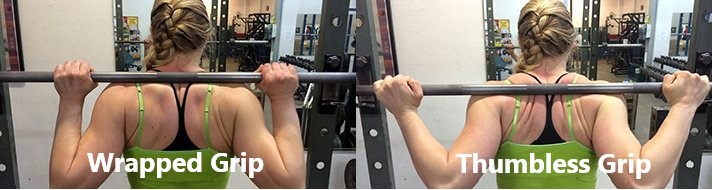
Here are the two common grips for your barbell squat.

And now time to DO A BARBELL BACK SQUAT!

Definitely watch the video above and listen to the instructions, and then read this description when you need to restart:

  1. With the weight on your shoulders, step back from the supports.
  2. Your feet should be slightly wider than hip-width apart.
  3.  Your toes should be slightly pointing outward.
  4. Flex your stomach, squeeze your glutes, inhale deeply into your stomach.
  5. Move your butt back, squat down slowly.
  6. Continue to drop until the tops of your legs are parallel or lower (the crease of your hip is below your waist).
  7. Explode back up to the starting position.
  8. After your set is complete, walk carefully forward to return the weight to the rack, and lower it down safely onto the supports.
  9. High five yourself, you just did a barbell squat!

Not sure if you squatted deep enough?

Record yourself! 95% of the people I see doing squats in a gym don’t go deep enough!

Nervous about squatting correctly? Yes, I am a mind reader, and yes we can help you!

If you want an expert to check your squat form check out our 1-on-1 Coaching program. Our coaching app lets you record and send a video of your movement directly to your coach, who will provide specific feedback and build a custom program just for you.

Interested? Click below to jump on a free call with our team to see how our online coaching program will get you the results you’re after:


How To Bail Out of a Squat Safely

If you are going to squat, you have to know how to “fail” at squatting safely! After all, there’s nothing scarier than being stuck in the bottom of a squat movement and not knowing how to get out of there!

A squat is very different from a barbell deadlift in that aspect: if you fail on a deadlift, you just don’t pick up the weight.

If you fail on a squat, you’re trapped under a bar…with potentially a lot of weight on it. 

This can lead to SERIOUS injury. So please, learn how to bail out of a squat safely before you start attempting to do heavy barbell squats. 

This will help give you the confidence to push yourself and get stronger!


7 Common Mistakes When Doing Squats
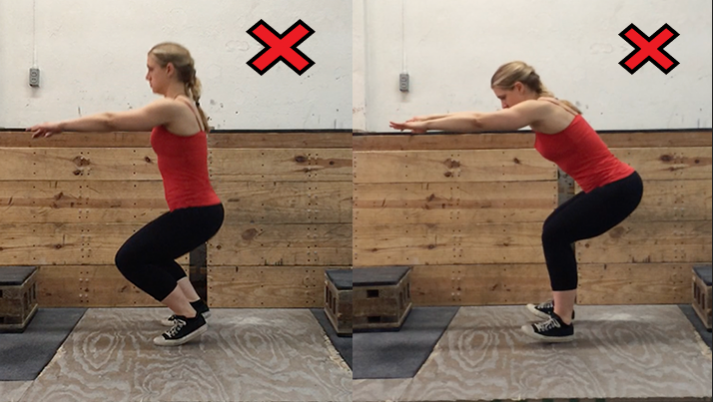
As these two photos shows, keep your feet planted while you are doing your squat.

The squat is a basic movement, but those new to lifting often fall victim to a handful of common mistakes.

Let’s take a look at some of the big problems and how to fix it!

#1) Coming up on your toes with your knees forward during your squat

It’s important to keep your heels on the ground the entire time you’re squatting.

You should be driving down through your heels, and in order to do that, they need to be on the ground!

While some of your weight will be on the balls of your feet, you never want all of your weight to be on the balls of your feet or your toes.

You should be able to lift your toes up off the ground and wiggle them at any point and it shouldn’t change anything about your squat.

#2) Not going deep enough on your squats

Make sure you go deep enough with your squats!

Your squat should hit at least parallel (middle image above) – where your hip joint goes below the knee.

Depending on what you’re training for, you can go lower, but in order to maximize the muscles worked in the squat, it needs to be done to at least parallel or lower (you can see lower in the upper right image).

If you squat above parallel (a partial squat) you’re leaving the hamstrings out of the movement. This puts more pressure on the knee – the force put on your knee is actually reduced as you drop below parallel.

Unfortunately, there’s a lot of misunderstanding about squats and knee issues.

The deeper the squat, the more glutes that are activated as well.[3] This will result in more muscle being created from the squat, as shown by this infographic:
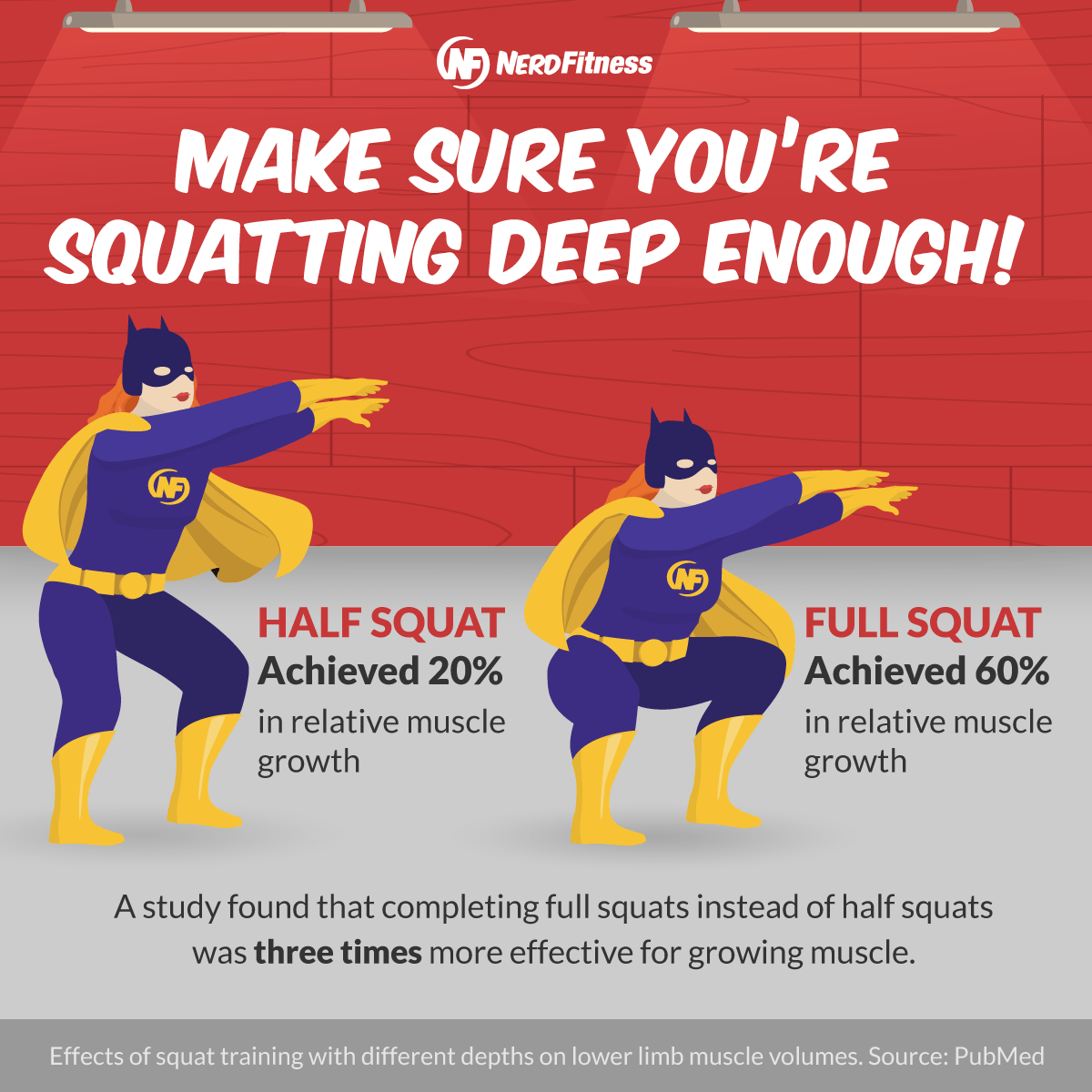
This infographic shows that a full squat will achieve three times the muscle growth as a half squat.

Now, a deeper squat is typically harder, both strength and flexibility wise.

However, depending on your goals, squatting to parallel may make more sense.

If you’re struggling hitting depth there could be many causes – you could have poor ankle mobility, tight hip flexors and/or hamstrings, weak glutes, or poor pelvic alignment (among many other things).

This is something we work closely with our coaching clients on, and often prescribe ankle and hip mobility drills to help clients reach proper depth on squats!


#3) Knee Positioning 
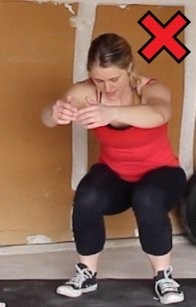
Don't let your knees cave in like this during your squat.

When you squat, you want your knees to track along with your toes.

This means if you are looking down at your knees and feet, your knees should be aligned at the same angle as your feet throughout the movement.

This infographic shows you the correct knee position for a squat:

This infographic shows proper squat form, with knees aligned with the feet during the movement.

Everyone’s exact positioning is going to be slightly different, but they should not be on the outside or the inside of the foot.

#4) Back Positioning 
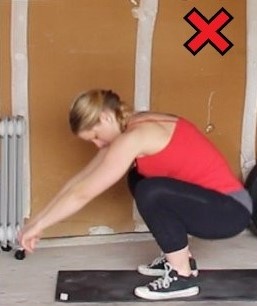
Don't let your back cave in like so when doing squats.

Your chest should be up and your shoulders should be back, like you’re King Kong about to pound your chest proudly.

Your body should stay in this position the entire time.

You don’t want your shoulders to round forward, but you also don’t want to hyperextend your back either.

Keeping your spine in a neutral position will help your spine safe and build a strong foundation throughout the heavy squat movement.

#5) Head Positioning 
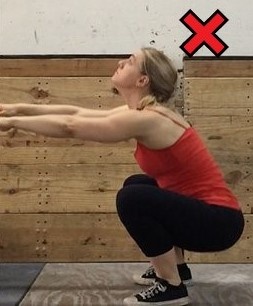
Don't let your head come up like so during your squat movement.

Many coaches will tell their lifters to look up, as that is the direction in which you want to be moving, but this is actually the last thing you want to do.

Take a second quick and look at the ceiling (I’ll wait! 🙂 ).

Now, see that position your neck vertebrae are in? That is a very unsafe position for your spine to be in, especially when more weight starts getting included in the equation.

You also don’t want to be looking directly at the floor.

Look straight out in front of you the entire time, with your head in a “neutral” position. Your chin should be in a position where you could hold a tennis ball between your chest and your chin.

#6) Attempting to keep your shins vertical.

Unless there is a current underlying knee issue that would cause additional pain – the shin can and should go past vertical in the squat. This will often allow a deeper squat which will build more strength and stability in the knee.
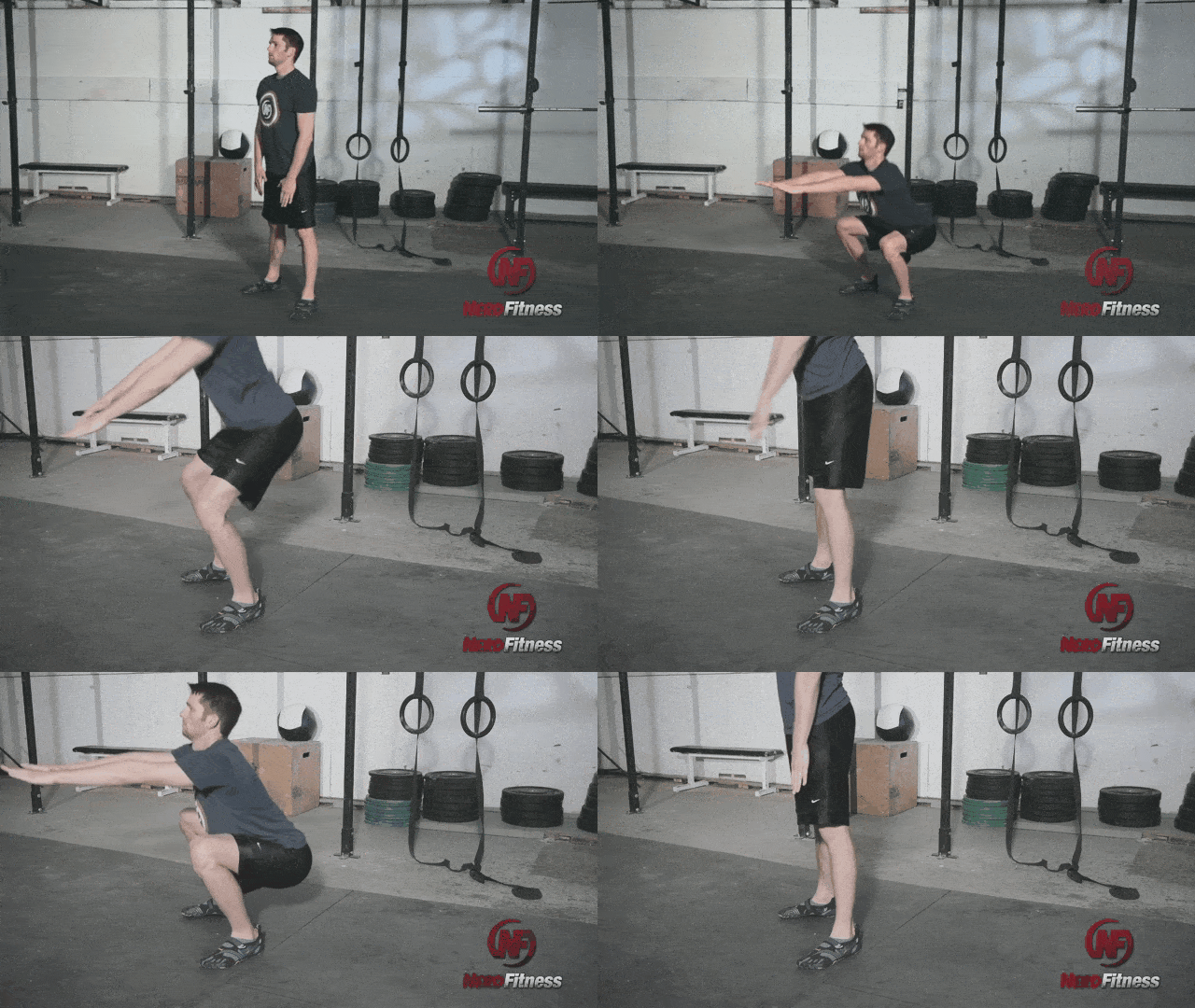
Rebel Leader Steve doing the bodyweight squat

A forward lean in the shins is also present when we engage in any number of daily activities such as walking up steps or standing up from a chair. Squat as deep as you are able, but do not focus on holding a vertical shin.”

#7) Too much weight on the heels/on the outside or inside of feet during your squat

When trying to fix coming up on your toes, or your knee positioning, it is common for people to focus so much on keeping their weight on their heels that they forget to keep the balls of their feet on the ground!

Some of your weight will still be on the ball of your foot – if you are truly only having weight on your heels, it’s pretty hard to balance.

To the same effect, if the inside of your foot or the outside of your foot comes up off the floor, this is also not a good thing! 

How do you know if you’re making these mistakes? Simple!

Record yourself doing squats.

I do.

And so does anybody else who is serious about improving their squats. 

Often we look VERY different than we think we look when doing an exercise, so having a video of the movement is often the only way we can improve.

If you can’t self-diagnose your squat challenges, let us help!


Squat Variations for Beginners (Box Squat):
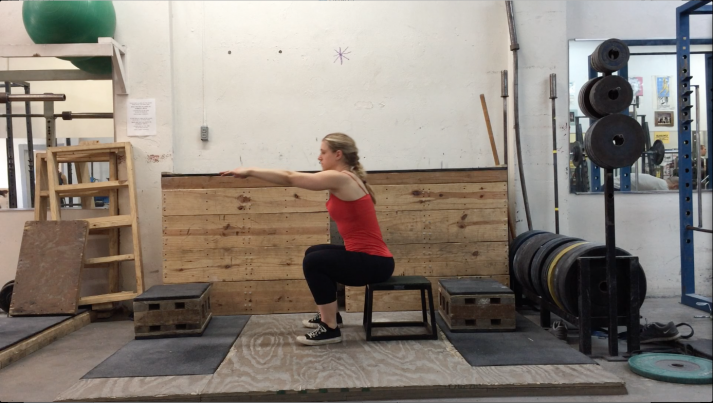
Squatting on a box like so is a great way to start squatting.

In this section, we’re going to go over some squat variations to help you improve your form and build confidence before hitting the free weights section of the gym.

If you’re struggling to do a squat correctly, don’t fret!

I’m going to teach you about…

BOX SQUATS!

Squatting to a box will help teach you to sit back and keep your weight on your entire foot, instead of squatting with your knees forward and up on your toes.

Squatting back to a box is also great for people who have bad knees and can’t do bodyweight squats anymore.

You can do box squats with a barbell as well, but for this explanation, we’re just going to keep it simple with bodyweight box squats.

In order to do this, find a box or a chair that is the right height so when you sit on it, you are at parallel with your squat.

Your options include things like step stools, milk crates, or the smallest box at the gym (there’s usually a set of plyo boxes, and the shortest is around 10″.)
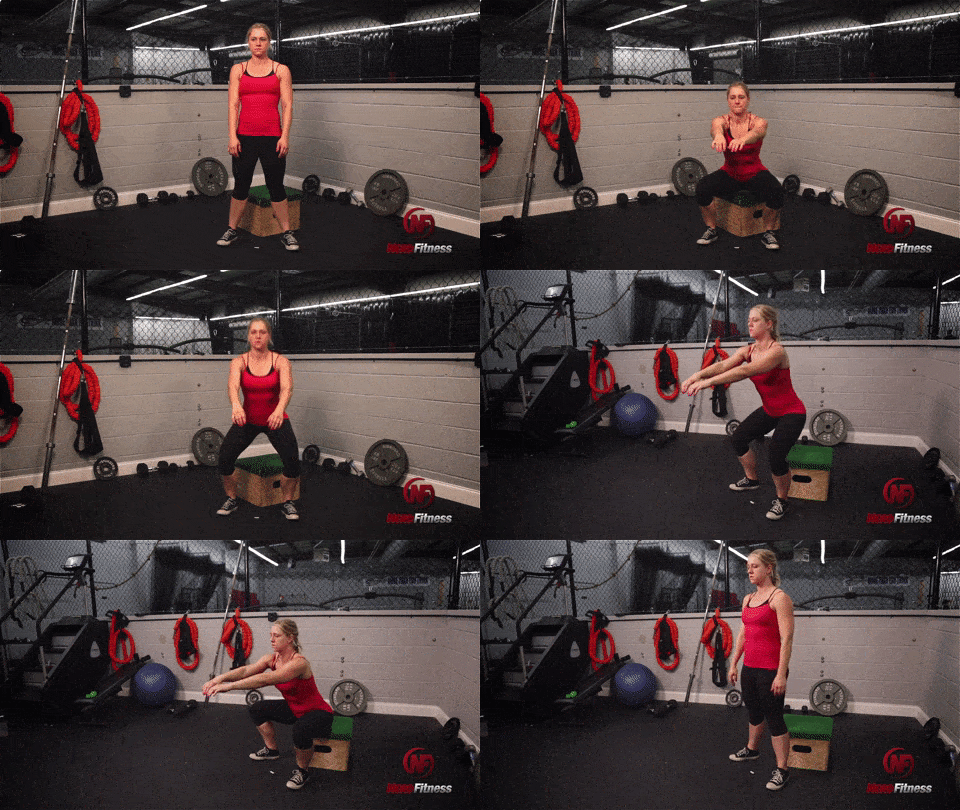
Using a box to squat like so is a great way to start bodyweight squatting.

The lower the box, the more it will help you develop stronger hips and low back – the box at exactly parallel will help you more with quad strength.

Set up exactly as if you were going to do a regular bodyweight squat, only standing about a foot in front of the box.

1) Breathe in deeply, brace your core, move butt back, and keep your knees in line tracking in the same direction as your toes and squat back until you sit completely on the box.

Don’t plop back on the box, make it slow and deliberate while keeping your entire body tight.

2) Now, don’t move! Think about your positioning:

  • Are your back and core still super tight?
  • Is your weight on your heels and your mid foot?
  • Is your head in a neutral position?

Great, now stand up by driving your hips upward, don’t let your weight shift forward and onto your toes (drive through your heels!), shoulders and chest up, knees out keeping them lined up with your toes.

For your first few, feel free to sit on the box while you evaluate your positioning, but as you get better at them, sit back and then quickly stand up again.

You know you’re doing a good squat when you can stand back up from the bottom of a squat position without having to lean forward and use momentum to get up.

You can squat, touch your butt to the box, and then stand back up without having to shift your weight around!

KEEP THAT BUTT BACK!

How to Perform a Front Squat
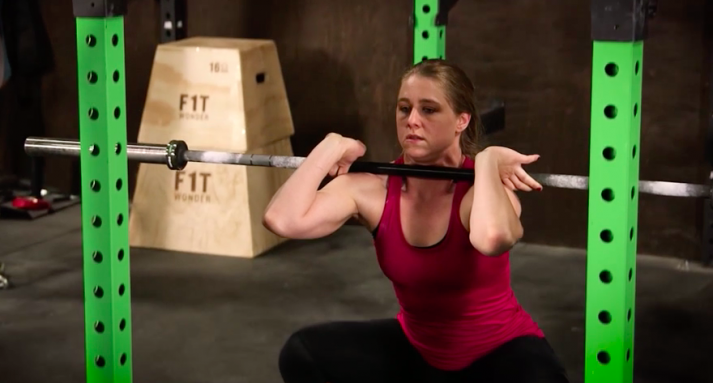
Staci doing a front squat

If you’re up for a similar-but-different squat, try…

The barbell front squat!
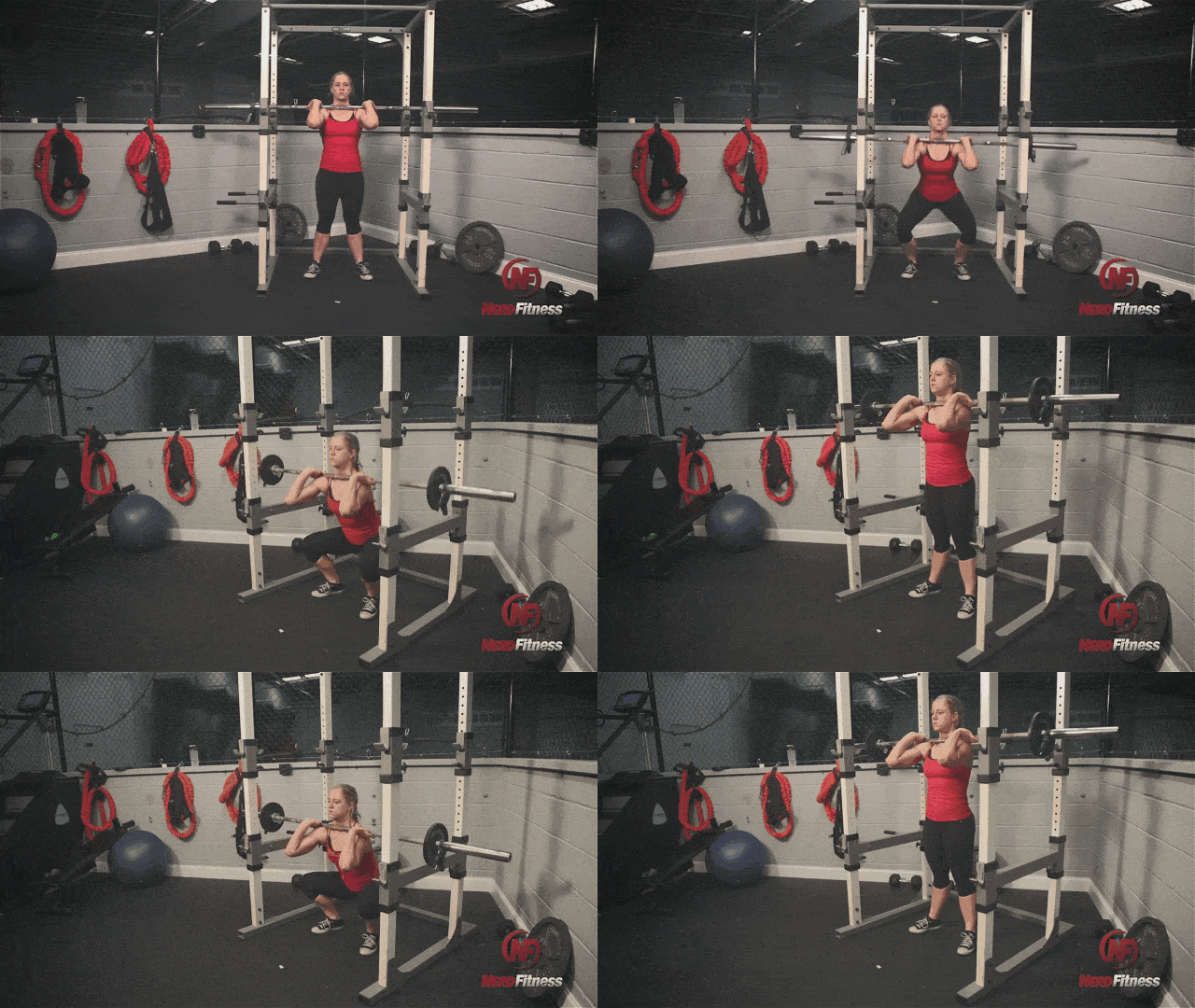
Coach Staci performing the barbell front squat

A front squat moves the weight from behind you to in front of you, which requires different muscles and mobility in different places.

I personally alternate front squats and back squats on my leg days.

Make sure you read our full guide on how to do a proper front squat

I know all of this can be overwhelming, so the important thing is that you START! I realize I sound like a broken record at this point, but I really want you to begin strength training today.

We created our free guide, Strength Training 101: Everything You Need to Know, just for that purpose. I’d love to send it to you, because I know it’ll help you overcome any fears and confusion and have you getting stronger TODAY

Get it when you sign up in this box below – I’m excited to hear what you think of it!

How to Perform a One-Legged Squat (The Pistol Squat)

In the video above, Coach Jim shows you how to perform the one-legged squat, also known as the pistol squat.

To perform a one-legged squat:

  • Squat down on one leg as low as you can go.
  • Keep the heel flat on the ground and lift the other leg out in front of you.

It’ll look something like this:
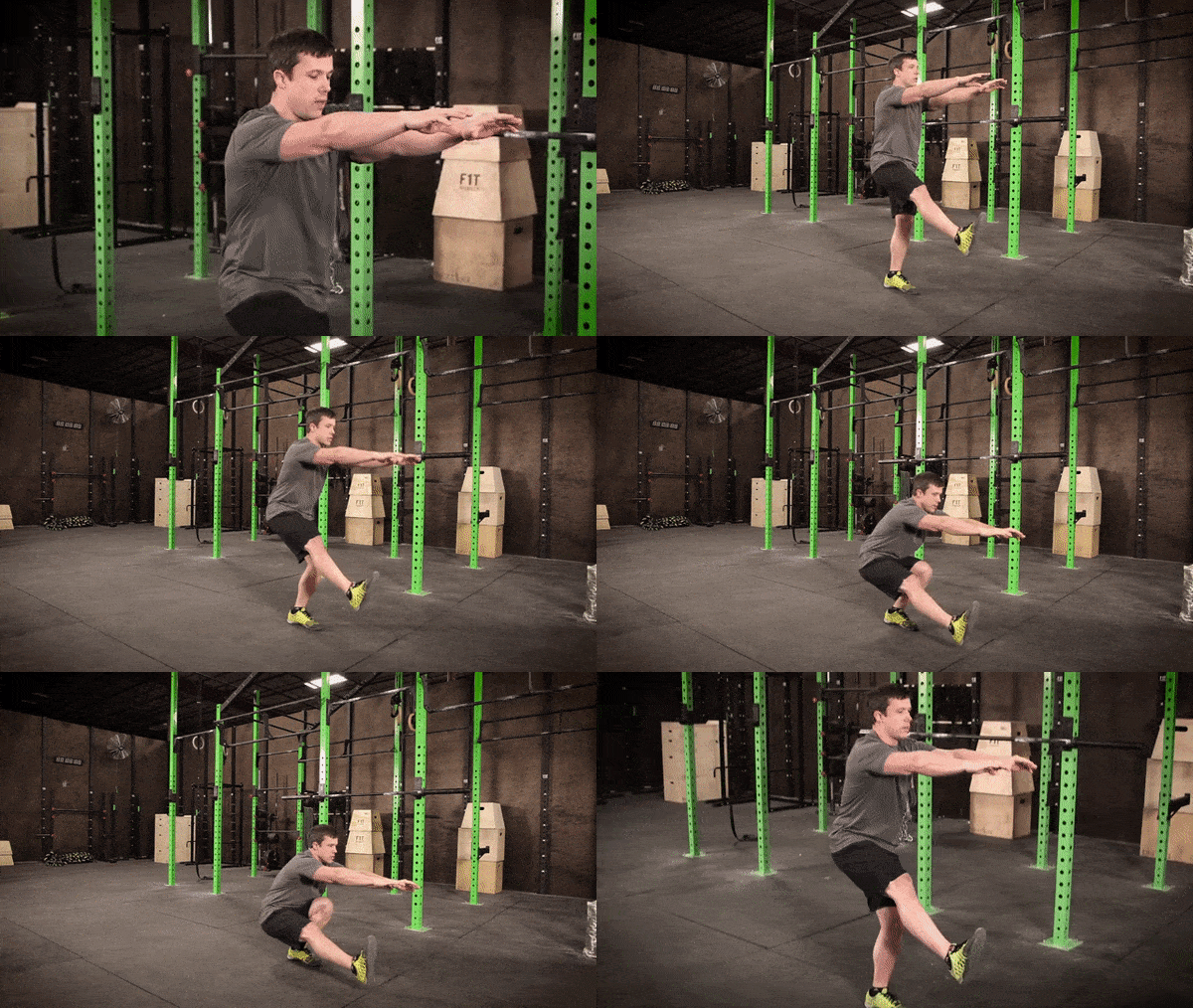
The one legged "pistol" squat is a great advanced bodyweight movement.

If this is too much, work on performing an assisted one-legged squat.

Perform an assisted one-legged squat by holding onto a doorframe, squat rack, rings or another stable object, then squat down on one leg as low as you can go.
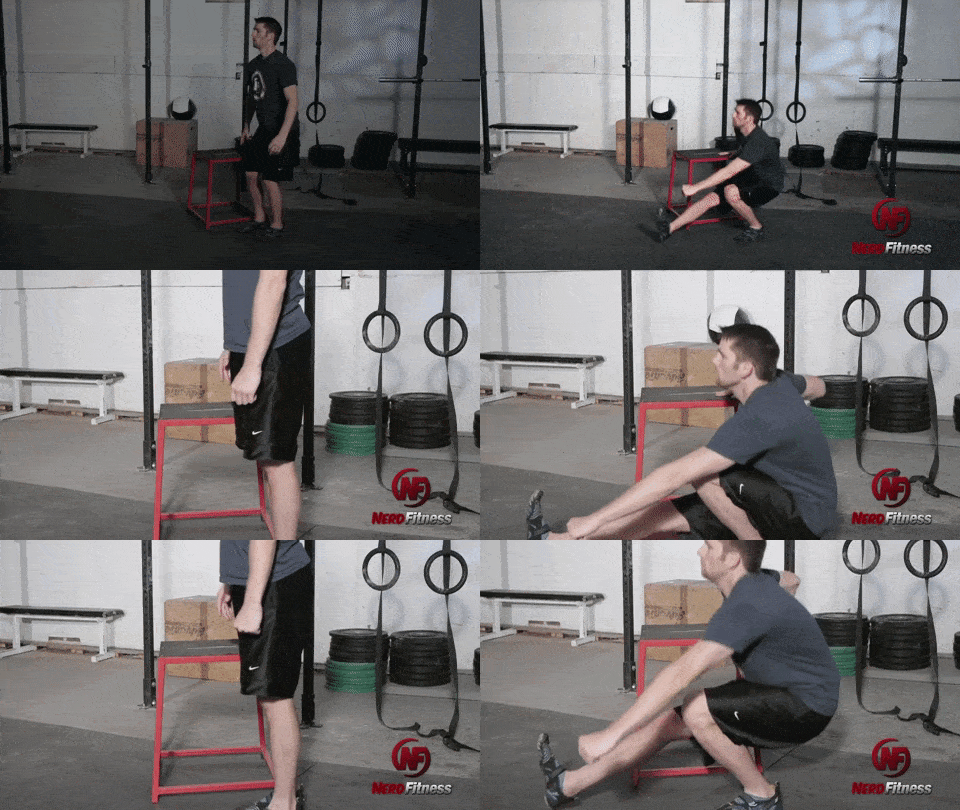
A small stool can help when you first start doing one legged squats!

How to Start Squatting Like A Pro

Female golf player with putter squatting to study the green at golf course.

Squats are awesome.

How awesome? Look at that woman above owning her squat before owning her putt!

Once you’ve mastered the Back Squat, give Front Squats a try!

And if you want to learn more about squats, or you’re looking to build more confidence before you get started, we have a few options for you:

1) If you are somebody that wants to follow a tailor-made program designed around their life and goals, check out our popular 1-on-1 Online Coaching Program.

You’ll work with our certified NF instructors who will get to know you better than you know yourself, check your form, and program your workouts and nutrition for you.
Nerd Fitness Coaching Banner

2) If you want a snazzy app to teach you exactly how to start crushing squats, check out NF Journey. Our fun habit-building app helps you exercise more frequently, eat healthier, and level up your life (literally).

Try your free trial right here:
3) Download our free Strength 101 Guide, which you can get when you sign up in the box below:

And I’d love to hear from you! PLEASE leave your questions, squat or fitness or otherwise below so we can answer them and become best friends:

What struggles do you have when trying to squat?

What questions do you have?

If you haven’t squatted before, what else do you need us to tell you to give you the confidence to start squatting TODAY!?

-Staci

PS: Be sure to check out the rest of the Strength Training 101 series:

PPS: I typed this whole article while sitting in a squat. Okay, no I didn’t, but that would have been cool.

###

photo source: Barbell Squat, spotpoint74 © 123RF.com,  power rack, squat stand, squat rack, Otmar Winterleitner © 123RF.com

The post Blog first appeared on Nerd Fitness.

from Nerd Fitness: Helping You Lose Weight, Get Stronger, Live Better. https://ift.tt/3dxr4De
via IFTTT

Categories
Uncategorized

#holistic #getfit #nutrition How to Gain Weight Quickly: 12 Tips On What to Eat & How to Train

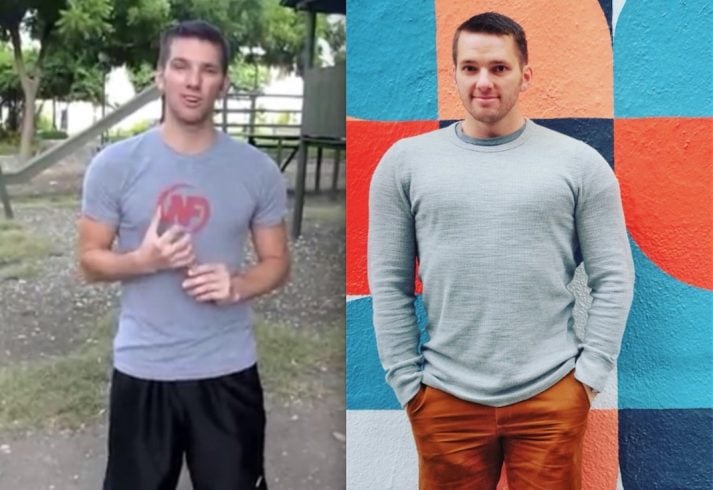
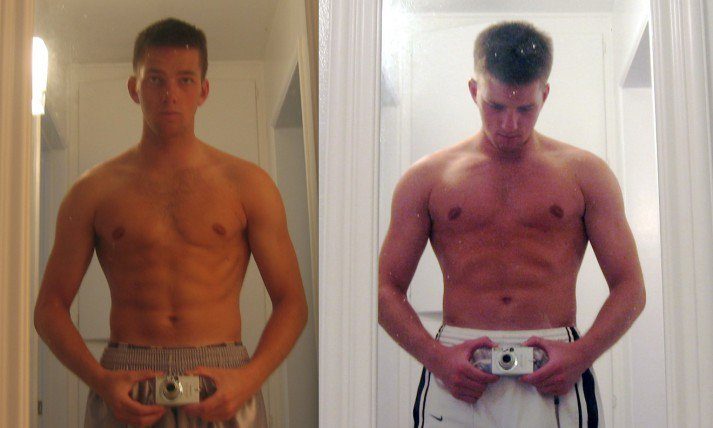
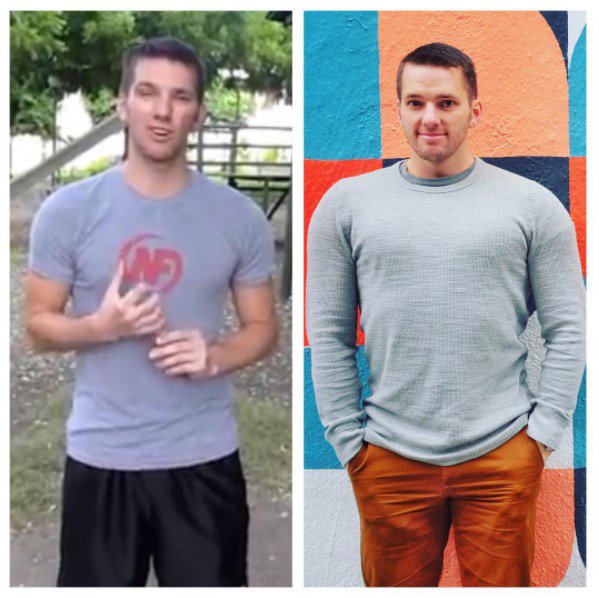
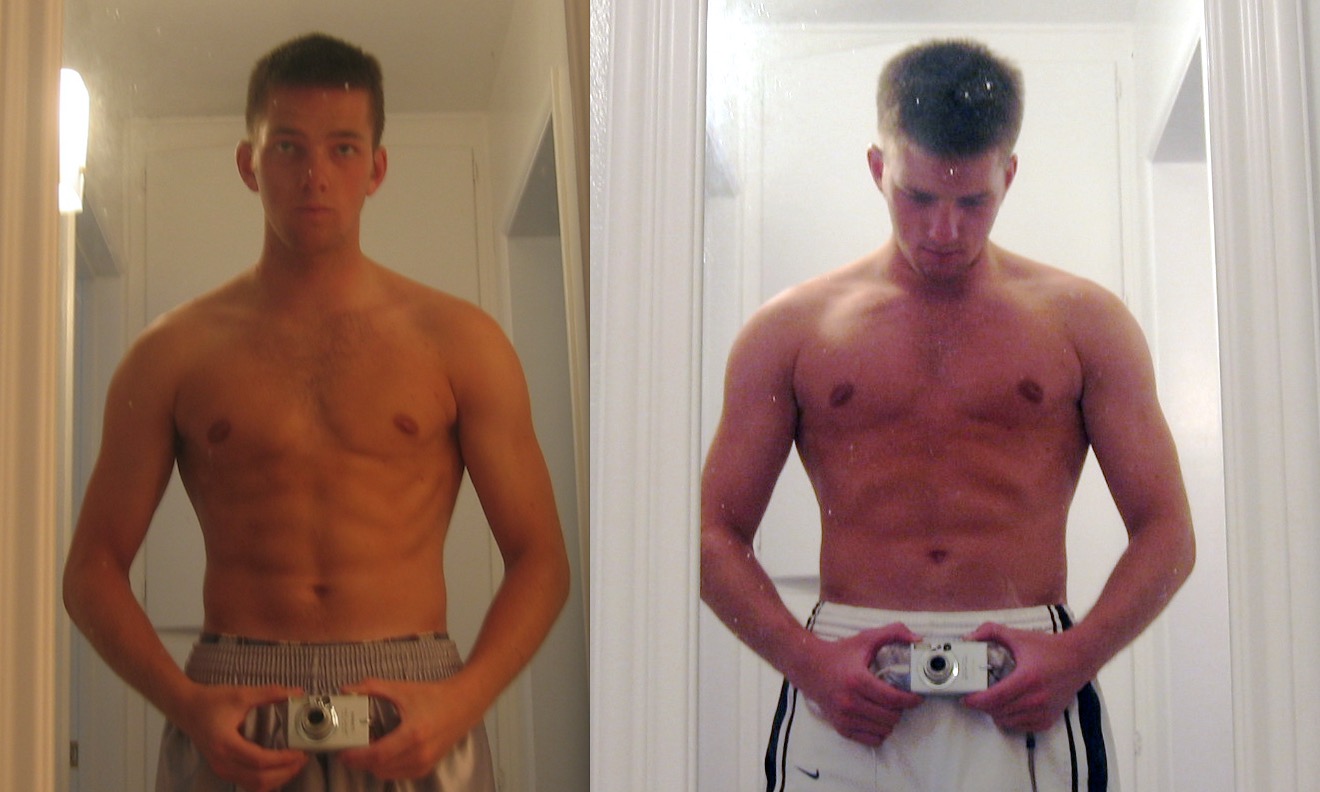
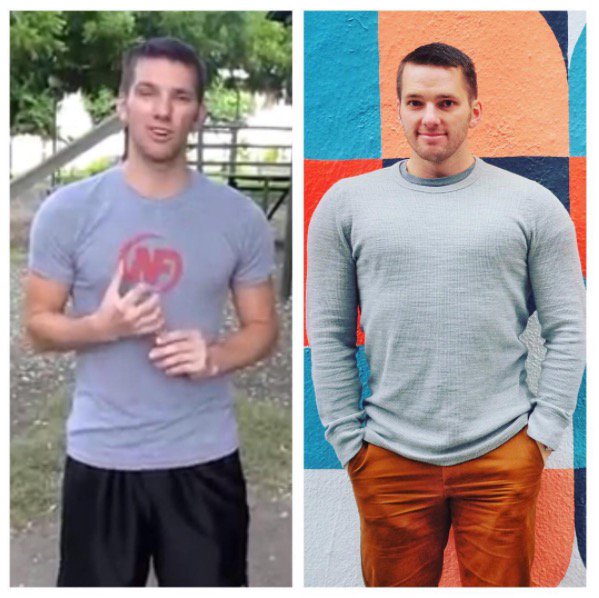
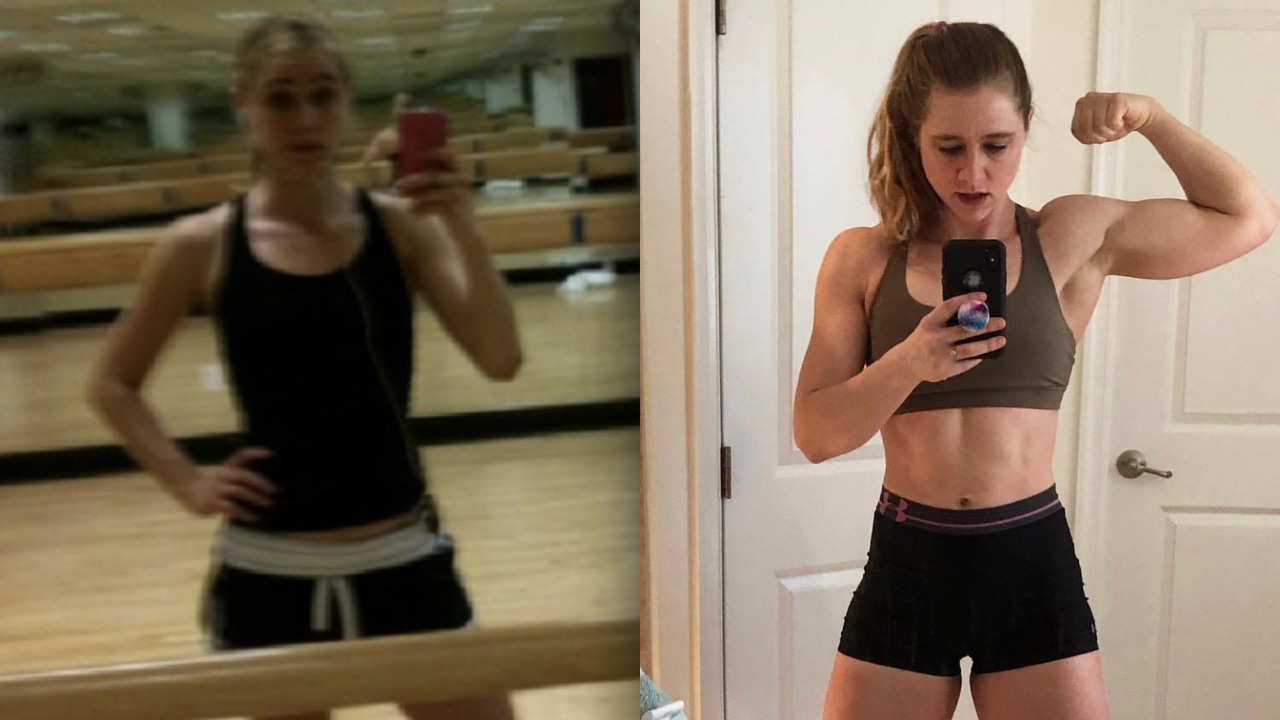
SteveBeforeAfter

So you want to gain weight fast (and safely)? 

You’ve come to the right place, because this is what we do!

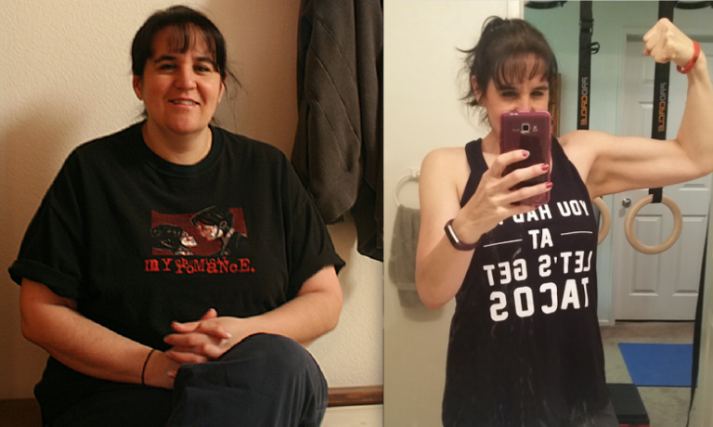
This guide covers the exact weight gain strategies I’ve used to go from my “before” (on the left above) to reach my “after” (on the right above). Believe it or not, that “before” photo is me after a DECADE of strength training and trying to get bigger.

It’s the stuff in this guide that finally allowed me to actually get results (the after).

It’s also exactly how we help our online coaching clients: nutritional guidance and workout plans that line up with their goals.


Oh, and if you sign up in any of the yellow email boxes throughout, you can download our “Gain Weight and Build Muscle” Shopping List and Cheat Sheet to hang on your fridge!

Let’s start putting on weight right NOW.

These are the 12 lessons I wish I knew when I started trying to get bigger (click to jump right to that lesson):

NUTRITION

  1. How to eat to gain weight.
  2. What foods should I eat to gain weight?
  3. How much protein do I need to gain weight?
  4. How many carbs and fats should I eat to gain weight?
  5. How fast can I gain weight and get bigger?

STRENGTH TRAINING

  1. What exercises are best for weight gain?
  2. How to get stronger and build muscle.
  3. How many days should I exercise to gain weight?

RECOVERY

  1. How much sleep should I get to gain weight?
  2. Should I do cardio while trying to gain weight?
  3. Can you build muscle without gaining fat?
  4. Gain weight, get bigger, and supercharge your results.

Let’s get to it!

Rule #1) How to eat to gain weight.

Like this turtle, try to eat slow for a weight loss strategy.

As we cover in our “Ultimate Skinny Guy’s Guide to Bulking Up Fast,” there’s one rule you need to know above EVERYTHING else.

“If you’re not gaining weight, you’re not eating enough food.”

It’s science and thermodynamics.

Allow me to explain: depending on your current size and level of activity, your body burns 1200-2500+ calories every day just doing all of its daily processes:

  • Breathing.
  • Keeping your heart beating.
  • Powering your liver, kidneys, and brain.
  • Powering your movement.
  • Rebuilding muscle.

And dozens of other things. We burn a lot of calories just keeping the lights turned on.

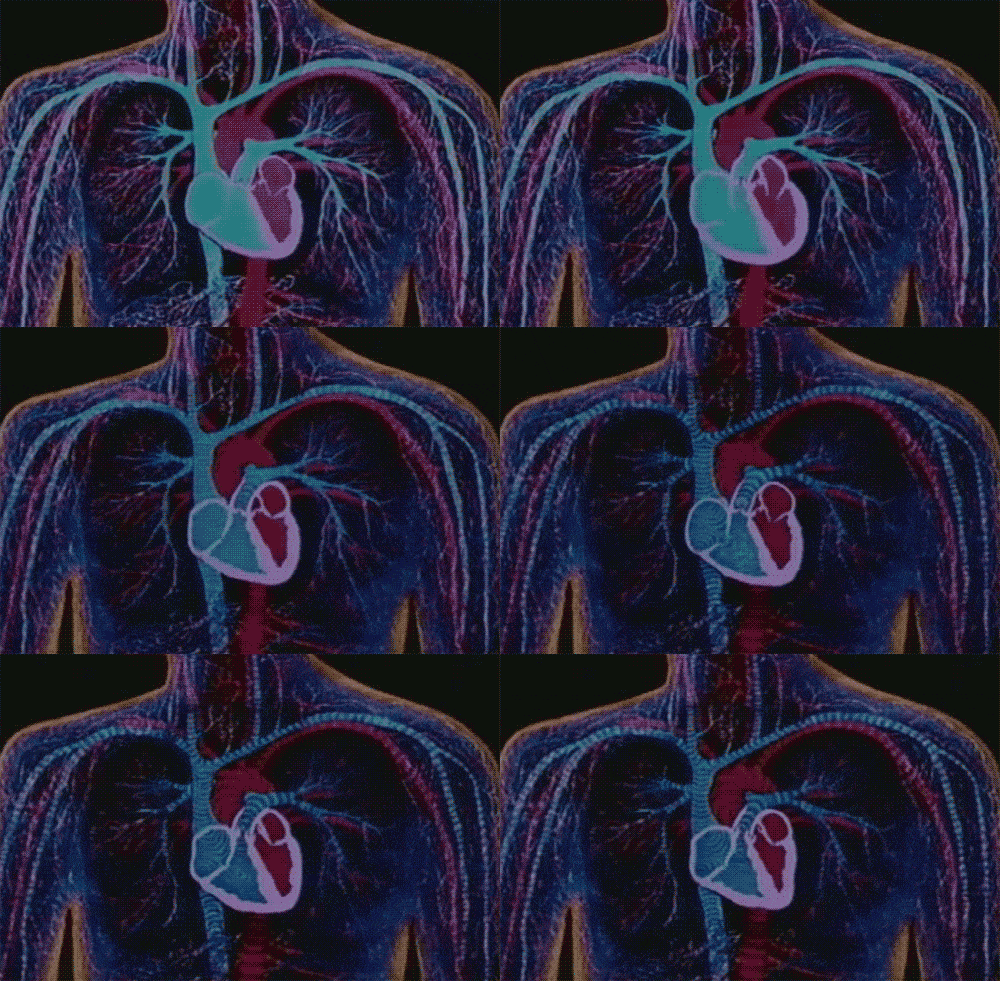
Yes, the heart is a muscle.

Here’s the problem: because your body efficiently uses up all of the calories you consume every day, there are no calories left over to build muscle (or get stored as fat).

Want to know how many calories you burn every day? Check out our Total Daily Energy Expenditure TDEE calculator:

Total Daily Energy Expenditure Calculator


Male/Female

Use age in years.

Use pounds (lbs). If using metric system, multiple kg times 2.2 for lbs.

Use inches. If using metric system, divide cm by 2.54 for total inches.

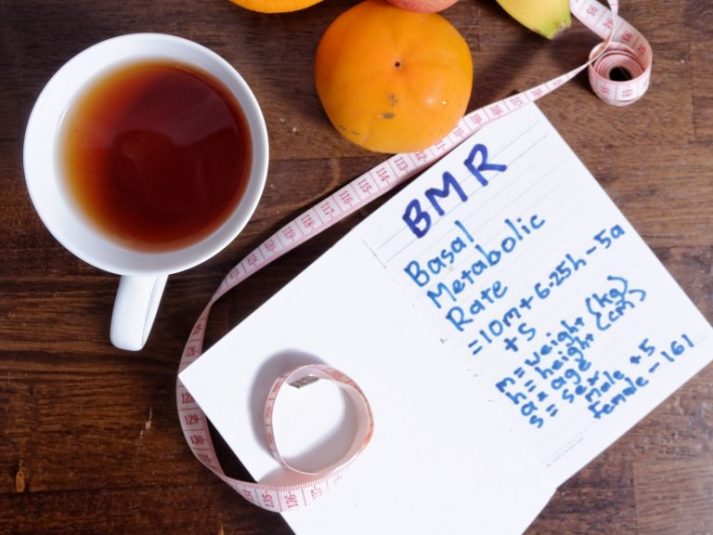
Your BMR is an estimate of the total calories burned a day, while in a state of rest.

For “Activity Level,” veer toward the side of less active. Studies consistently show that people are not as active as they self-assess.

Your TDEE is an estimate of the total calories burned during a single day, when exercise is factored in.


Use the metric system? I wish we did too here in the States! Click right here for our Metric calculator.

Note: we have used The Mifflin-St Jeor Equation to create this calculator! [1]

Hooray! You now know estimates of your Basal Metabolic Rate (calories you burn existing) and TDEE (calories you burn while moving throughout the day)![2]

So, in order to get bigger, you need to eat ABOVE this TDEE number consistently.

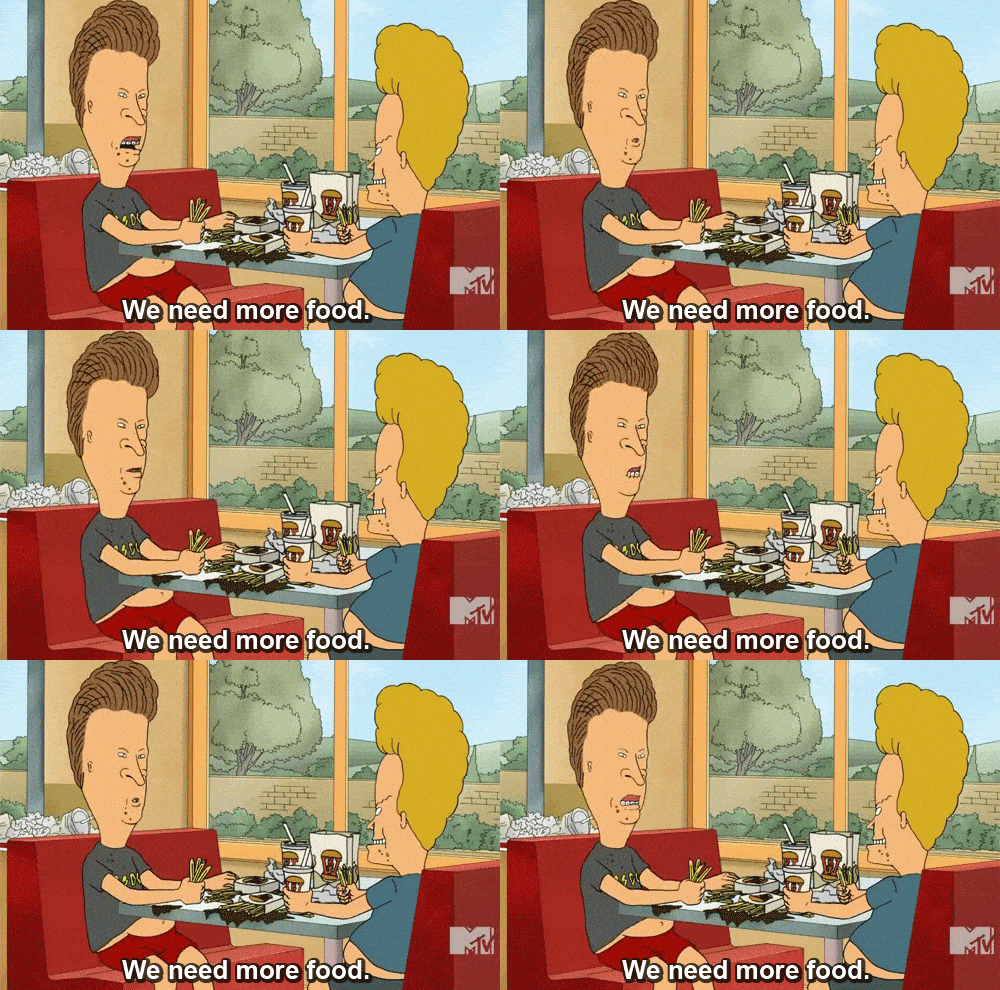
Beavis and Butthead saying "we need more food."

That’s it.

This is the NUMBER ONE mistake skinny people make trying to get bigger: 

We think we have an overly fast metabolism.

Although there is SOME variation with regards to metabolism variability, it’s insignificant when compared to the effect of the more important part of the equation:

We overestimate how many calories we’re eating each day, we don’t account for the calories we burn through movement or exercise, and there aren’t enough calories left over to create a “caloric surplus.”

And without that surplus, we’ll never gain weight or get bigger. 

Look at me all big and strong!

MY STORY: I had been training in a gym for 6 years without gaining size.

I then worked with a great trainer, who had me DOUBLE the amount of food I was eating.

I thought he was out of his mind.

Until I did it…and it worked.

I put on 18 pounds in 30 days [3], and I realized I had been severely undereating for my goals:

I a

In order to gain weight, target an additional 300-500 calories above your Total Daily Energy Expenditure[4]:

  • If you have a TDEE of 1800 calories: target 2100-2300 calories per day to gain a pound a week (0.5 kg per week).
  • If you have a TDEE of 2000 calories: target 2300-2500 calories per day to gain a pound a week (0.5 kg per week).

Want to gain weight even faster? As long as you know you’ll also be gaining lots of fat, you can target 800-1000 calories above your TDEE.

  • If you have a TDEE of 1800 calories: target 2600-2800 calories per day to gain 2 lbs a week (1 kg per week).
  • If you have a TDEE of 2000 calories: target 2800-3000 calories per day to gain 2 lbs. a week (1 kg per week).

Question: What about meal timing?

Does it matter WHEN I eat my meals?

A clock on the wall

“Can I eat now?”

Answer: “WHEN” you eat doesn’t matter nearly as much as “HOW MUCH” you eat.

Your body will process all calories efficiently[5], so focus on total calories consumed.

Depending on your schedule, you can:

  • Eat 3 big meals for breakfast, lunch, and dinner.
  • Eat 6 regular sized meals throughout the day.
  • Skip breakfast and eat two MONSTER meals (this is what I do).

It comes down to your personal preference. You might struggle to eat 3000 calories in 3 meals, so having 6 500-calorie meals throughout the day might make you feel less bloated and full.

Your results may vary! 

See the next section for tips and tricks on WHAT foods you should eat to gain weight.

If you want somebody to help keep you accountable and help you actually bulk up safely and quickly, we have a pretty great online coaching program that has helped people reach their weight gain goals safely and quickly.


Rule #2) What Foods Should I Eat to Gain Weight?

Someone eating a healthy breakfast

If you want to build muscle, target whole foods that come from high quality, high-calorie sources whenever possible.

Sure, you could obtain 3500 calories eating Taco Bell, Twinkies, candy, and Mountain Dew. However, this isn’t a good long term solution to gaining weight and building a good physique (goodbye health).

Trust me, I know. I put on 18 pounds in 30 days by eating meatball subs from Subway, drinking whole milk, eating McDonald’s, and drinking weight gainer shakes.

I certainly wasn’t healthy, and today I’m much more intelligent and knowledgeable about how to bulk up safely.

HERE’S HOW TO EAT TO GAIN HEALTHY WEIGHT:

  • Calculate your (Total daily energy expenditure) and add 300-500 cal over your number for sustainable weight gain.
  • Consume at least 1-1.5g per pound (2.2-3.3g per kg) of body weight in protein daily.
  • Consume .25-.4g per pound (.5-.8g per kg) of body weight in fat daily.
  • Consume the rest of your calorie goals from healthy carbs.
  • Eat vegetables so that your body can process all the extra food.
  • If you are not gaining weight, add more carbs and/or fats to your meal.

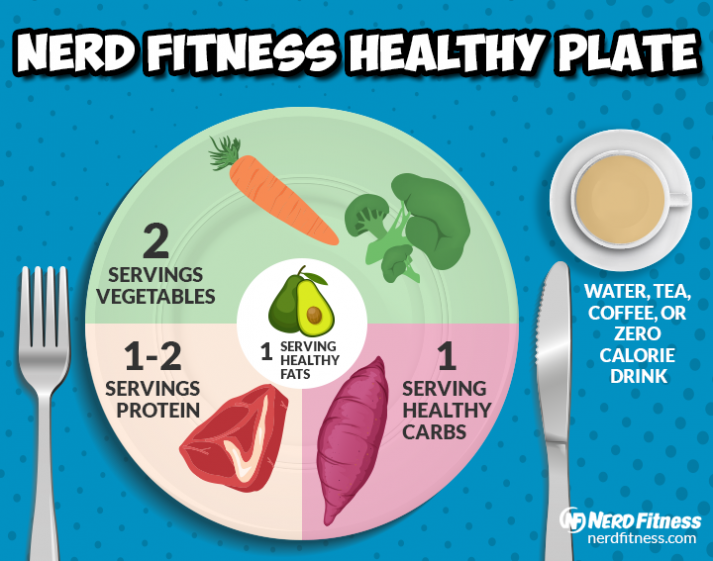
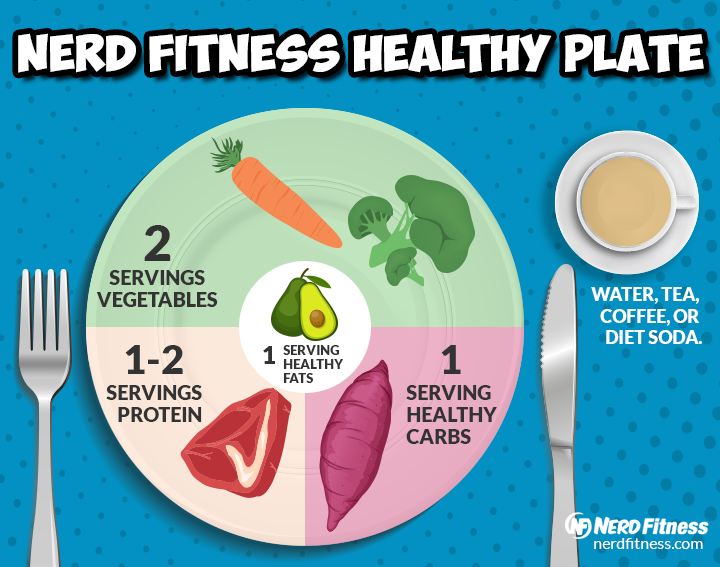
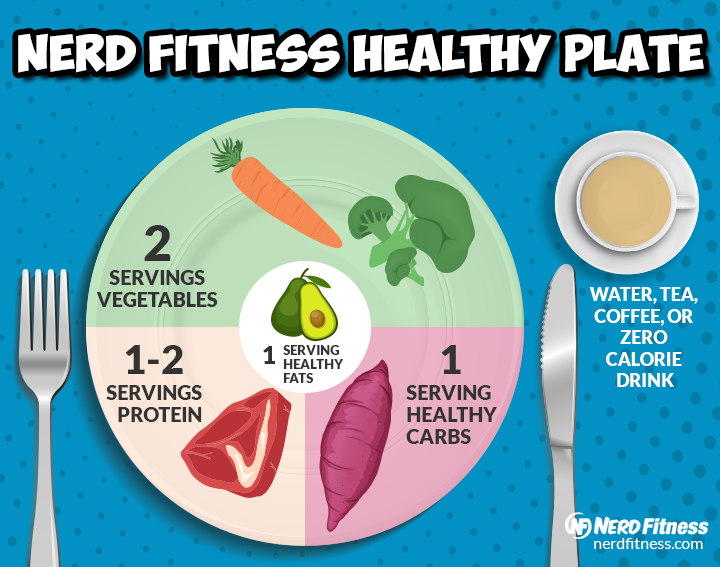
We’re going to start building a Healthy Plate, like so:

If your meal plate looks like this, you're doing a lot of the heavy lifting for weight loss.

The most important macro we’re going to focus on is protein.[6]. Studies show you’re more likely to put on the right kind of weight with a high protein diet compared to a low protein diet.

So that’s where we’ll start.

FOOD PRIORITY #1: PROTEIN

Protein can come from any number of sources, including:

  • Meat (steak, bison, pork).
  • Fowl (chicken, turkey, duck).
  • Eggs![7]
  • Cheese and dairy.
  • Fish and shellfish (salmon, tuna, shrimp).
  • Legumes (black beans, chickpeas).
  • Other vegetarian protein sources here.

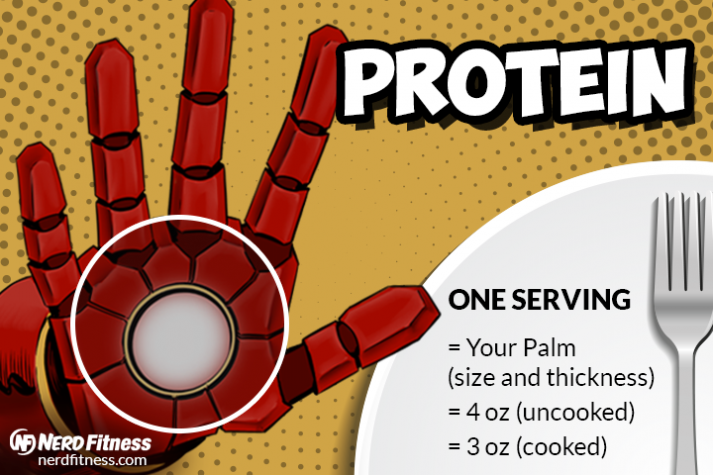
If you’re curious, from our healthy eating article, this is what a portion of protein looks like:

A serving of protein should be about the size of your palm, like so.

Also, here’s how much protein is in a serving of food:

  • 4 oz (113 g) of chicken has around 30 g of protein.
  • 4 oz (113 g) of salmon has 23 g of protein
  • 4 oz (113 g) of steak has 28 g of protein.

We’ll cover below the answer to the question “How much protein should I eat?

PRIORITY #2: CARBS

In order for you to gain weight, you need to consume plenty of calories, so the remainder of those calories will come from carbs and/or fats.

Here are whole foods full of carbohydrates:

  • Rice
  • Quinoa
  • Oats
  • Legumes and lentils
  • Sweet potatoes
  • Yams
  • Regular potatoes
  • Whole grain pasta
  • Whole grain bread

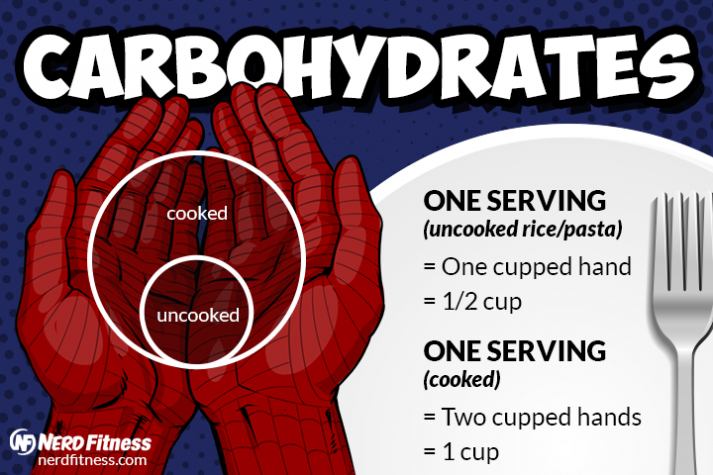
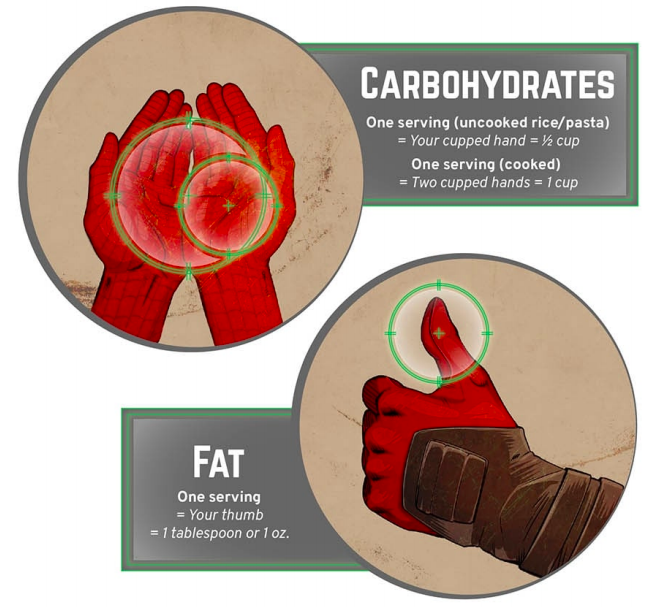
To help you get better at eyeballing serving sizes:

Showing you a serving of carbs

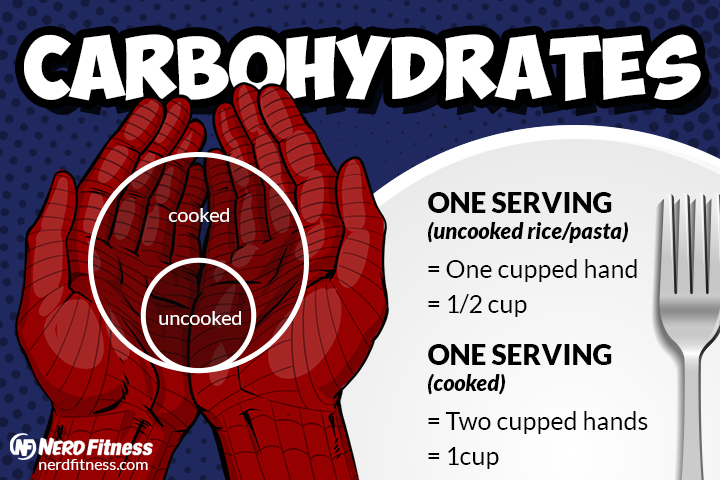
1 serving of a starchy carbohydrate is 1 cupped hand (uncooked), or your two hands forming a cup (cooked).

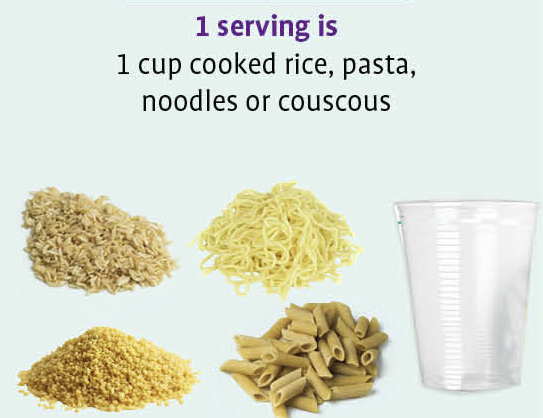
Here are some images to help you learn proper portion sizes (thanks to SafeFood):

This picture will help you determine proper serving sizes for carbs!

In addition to consuming carbohydrates from these sources, it’s okay to consume plenty of fruit while trying to bulk up!

You can read our full “Is fruit healthy” guide to learn more.

PRIORITY #3: FAT! 

Fat is a macronutrient that can help reach your surplus goals, as fat can be higher in calories. Plus, you can eat lots of it without feeling full.

Healthy fat can be found in foods like:

  • Avocado
  • Almonds
  • Walnuts
  • Macadamia nuts
  • Olive oil
  • Almond butter
  • Peanut butter

Saturated fats[8] can come from things like:

  • Whole milk
  • Full fat dairy
  • Coconut oil
  • Grass-fed butter
  • Fatty cuts of meat
  • Lard

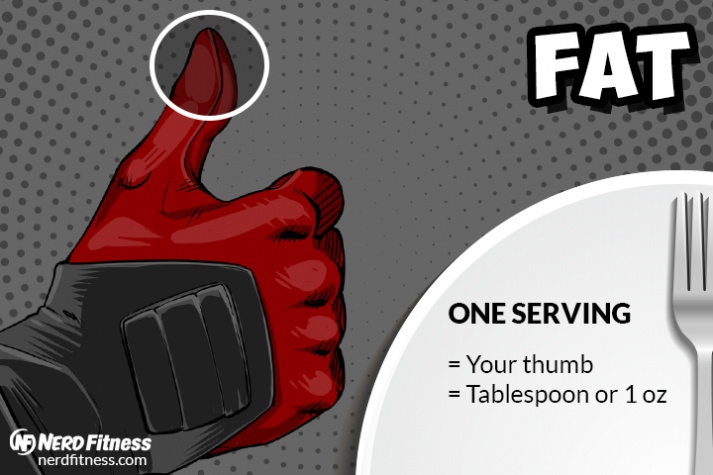
To help you gauge: a serving size of fat is roughly the size of your thumb!

A serving of fat should be about your thumb!

For reference, this is a single serving of almonds (162 calories):

Knowing the correct amount of almonds to eat can help you with your calorie goals.

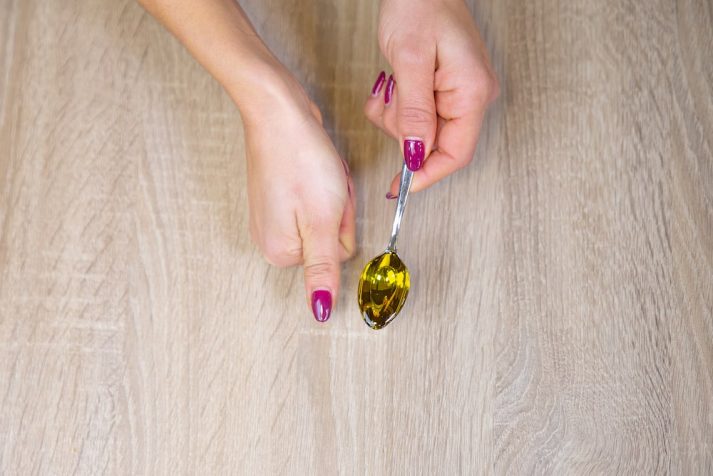
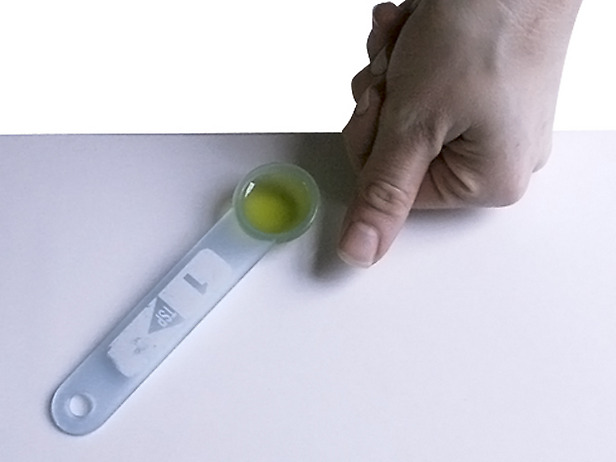
THIS is a serving of olive oil (60 calories):

A thumb sized portion of olive oil is around 60 calories - from Runtastic

As you can see, you can eat an extra 500 calories of “healthy fats” by eating lots of “heart-healthy” fats like nuts or adding more olive oil to your meals.

PRIORITY #4: VEGETABLES!

Last but not least, you need vegetables in your diet.

If you start to eat a lot more food, your “indoor plumbing” is going to really benefit from eating some high-fiber veggies with each meal:

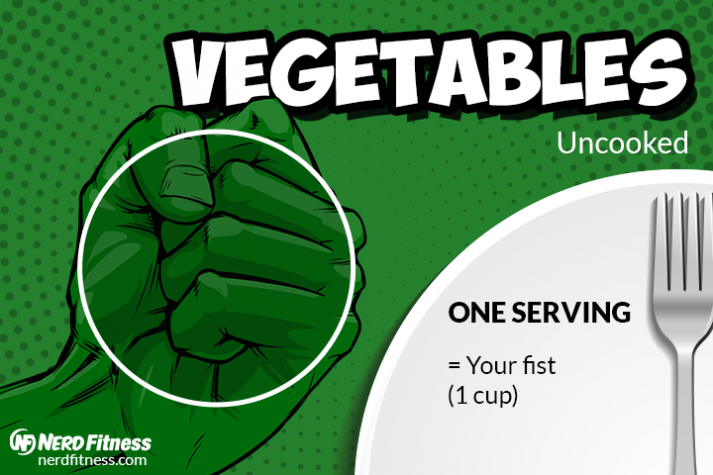
A serving of veggies is about the size of your fist:

A serving of veggies should be the size of your first (or greater).

Here’s a quick, non-complete list of veggies that you can choose:

  • Broccoli
  • Broccolini
  • Cauliflower
  • Spinach
  • Kale
  • Spaghetti squash
  • Brussels sprouts
  • Zucchini
  • Cucumber
  • Carrots
  • Onion
  • Asparagus

“BUT STEVE, I REALLY STRUGGLE TO EAT ENOUGH CALORIES FROM WHOLE FOODS EVERY DAY!

I do as well. It’s why I consume a good portion of liquid calories every day too.

A blender can help you obtain more calories for weight gain.

It’s a surefire way to make sure you hit your calorie goals.

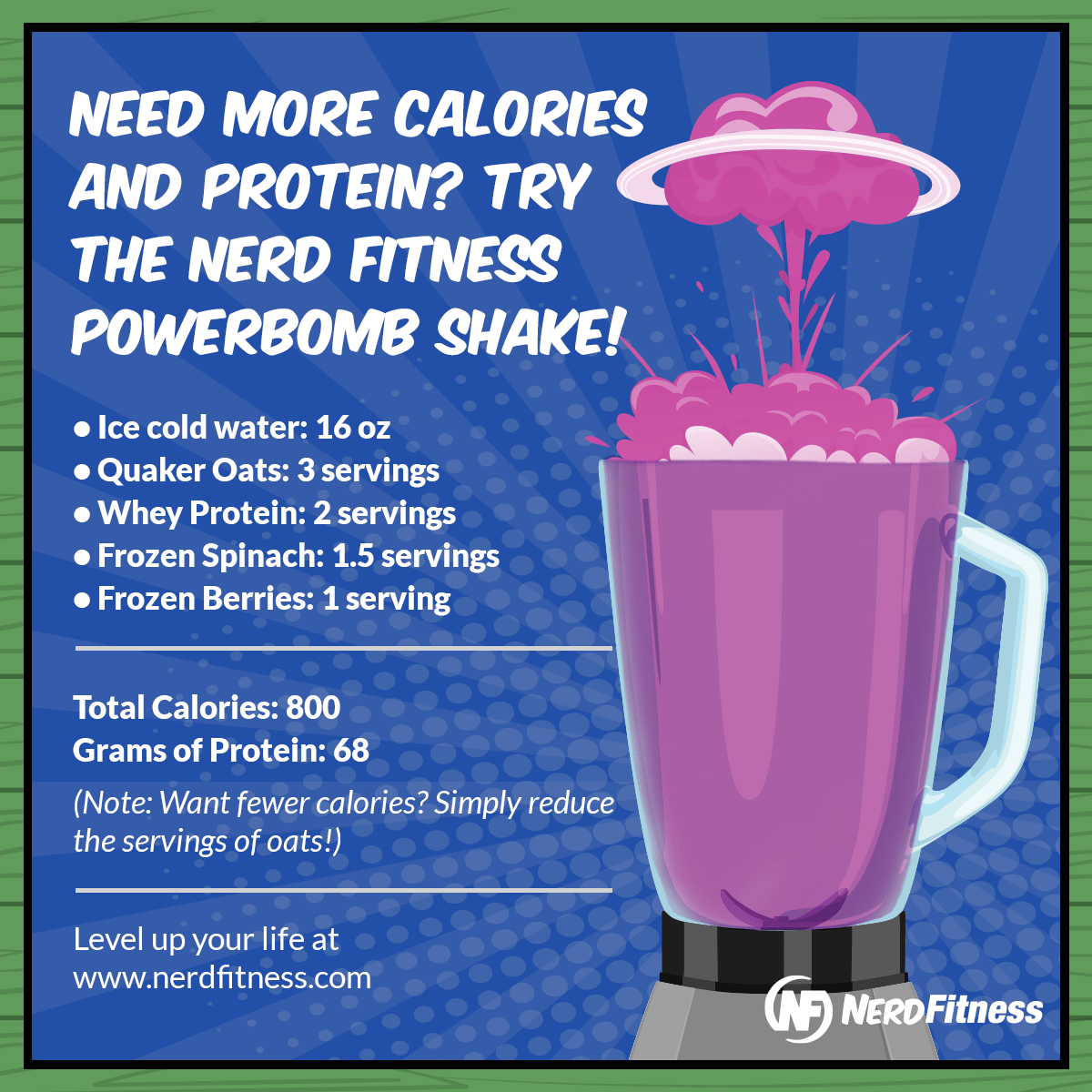
As I lay out in our massive Protein Shake Guide, creating high-calorie protein shakes to eat between meals can be the game changer:

The Powerbomb Protein Shake Recipe

Also, download our Skinny Guy Guide which has both lessons and a shopping list you can use to prioritize eating the right high calorie, high-quality foods!

Rule #3) How Much Protein to Eat to Gain Weight?

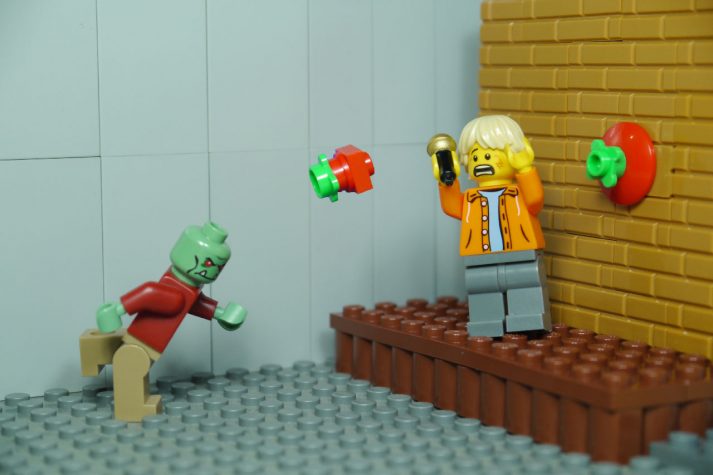
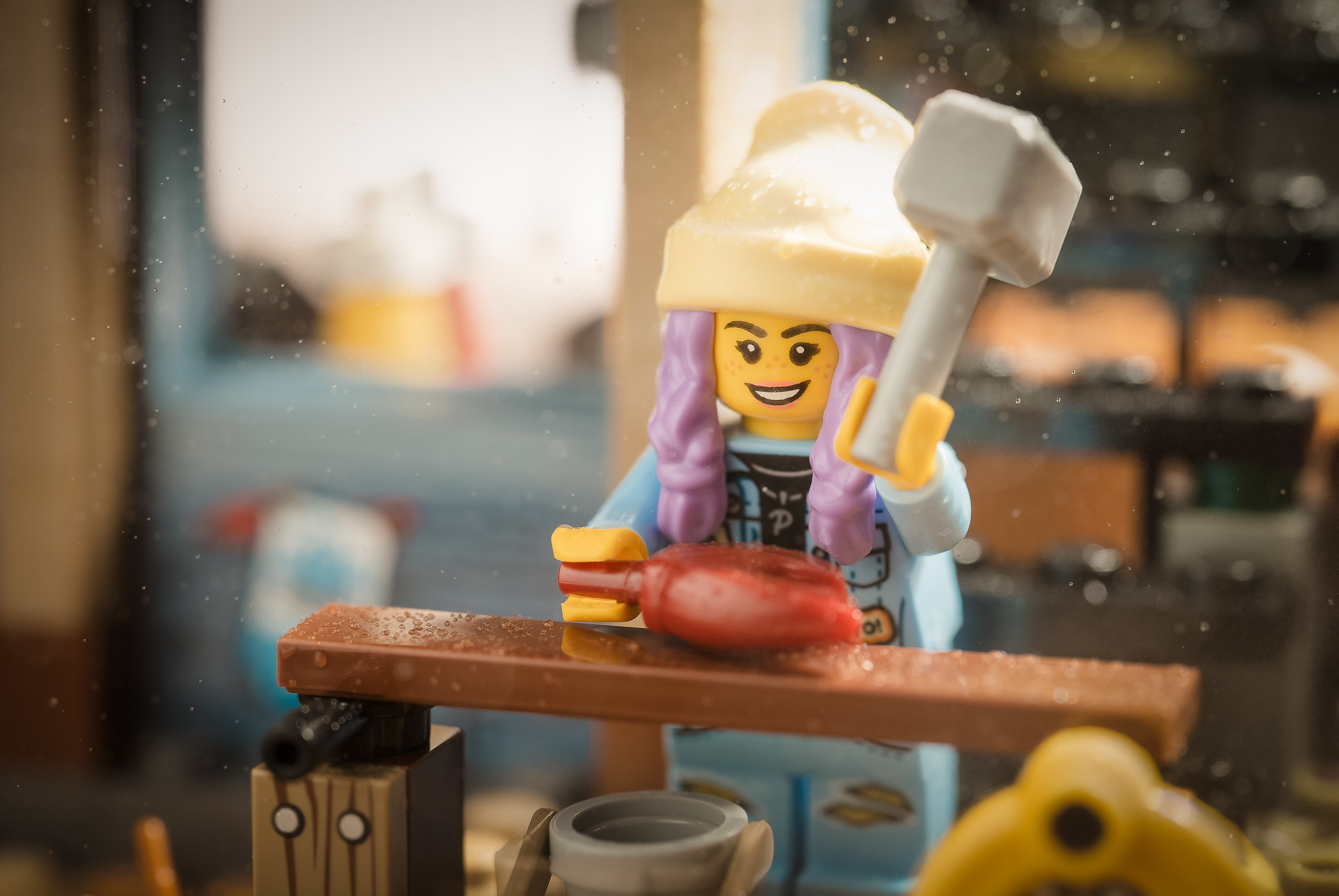
Even this LEGO character knows to eat plenty of protein to gain weight

Let’s answer the question: “How much protein do you need every day?”

The current international Recommended Dietary Allowance (RDA) for protein is 0.4g per pound of body weight (0.8 g per kg of body weight):[9].

In our opinion, and as pointed out by this study[10] the RDA # for protein is too low and should be higher regardless of your body composition.

But you don’t care about that. You just want me to know how much protein to eat, right?

The Doctor saying "tell me NOW"

I figured.

Here is our recommendation[12]:

If you’re of healthy weight, active, and wish to build muscle, aim for 1 g/lb (2.2 g/kg).

If you’re going to be strength training while getting bigger, intakes up to 1.50 g/lb (3.3 g/kg) may help you minimize fat gain.[13]

Let me simplify it for you: target at least 1 gram of protein per pound of body weight (2.2 grams per kg). 

Provided you’re a healthy individual with a healthy liver, you don’t need to worry about eating too much protein[14] – you should be more concerned with eating too little protein.

Long story short: studies suggest you will not put on the right kind of weight without consuming enough protein!

Okay, so let’s talk portions. Here’s how much protein is in a palm-sized serving of food:

  • 4 oz (113 g) of chicken has around 30 g of protein.
  • 4 oz (113 g) of salmon has 23 g of protein
  • 4 oz (113 g) of steak has 28 g of protein.

EXAMPLE TIME!

It's now time to show you some examples for how much protein to eat.

Let’s say you weigh 150 pounds (68 kg).

That would mean a day of eating could be:

  • 1 serving of protein with breakfast: protein shake (30g).
  • 2 servings of protein with lunch: 2 chicken breasts (60g).
  • 2 servings of protein with dinner: 2 portions of steak (56g).

As we cover in our Ultimate Guide to Protein Shakes, a protein supplement can help you reach your protein goals for the day. 

Creating a high-calorie protein shake with foods like frozen fruit, oats, milk, and a scoop of protein can be huge.

It’s how I hit my goals every day! 

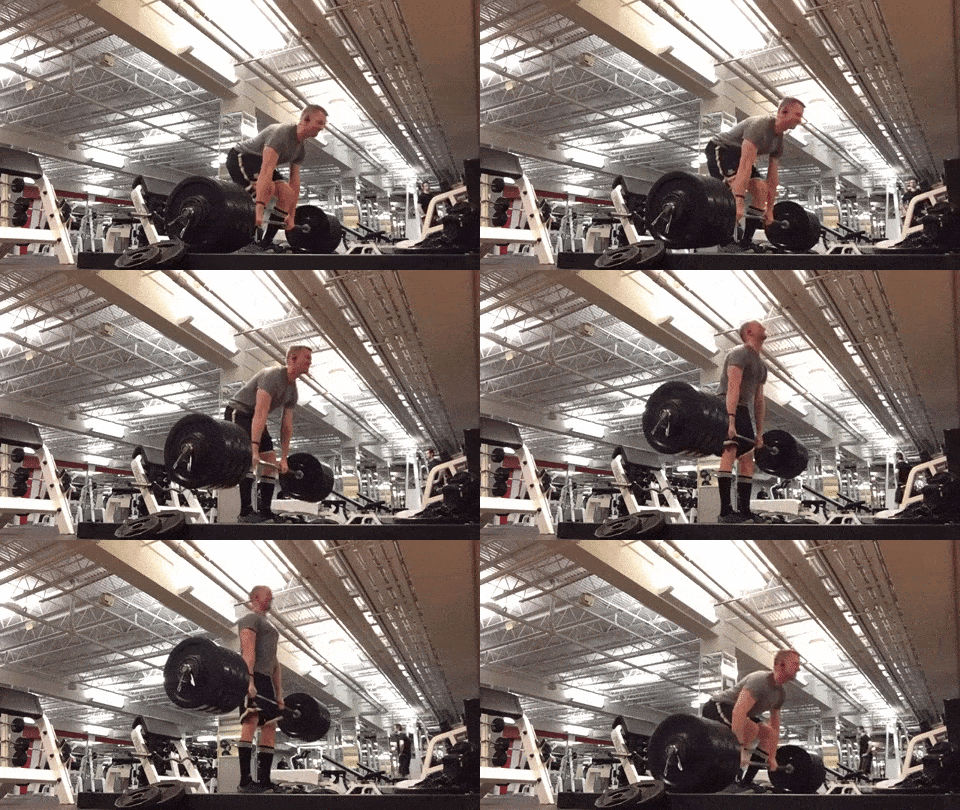
MY STORY: I am currently bulking up, and according to my online coach, I need to eat 3200 calories with 240g of protein on workout days (I weigh 172 pounds).

That much protein and calories helps me do things like this:

Rebel Leader Steve showing how to do a 420 lb deadlift at the gym.

After fasting until noon, here’s how I get 240 g of protein daily:

  • LUNCH: Double chicken bowl at Chipotle for lunch (rice, chicken, guac, lettuce, cheese): 77g of protein.
  • SNACK: 2 servings Optimum Nutrition Whey in my powerbomb shake: 70g of protein.
  • DINNER: 8 oz of grilled chicken, 2 servings of rice, lots of broccoli: 62 g of protein.
  • SNACK: 1 serving Optimum Nutrition Whey in my 1/2 powerbomb shake. 35g of protein.

Total protein intake for me: 244 grams. Adjust to fit YOUR goals!

RECAP ON PROTEIN INTAKE: Target 1-1.5g per lb of bodyweight (2.2-3.3g per kg) while trying to gain weight. When in doubt, eat more.


Rule #4) How Much Carbs and Fats Should I Eat to Gain Weight?

This LEGO knows that if you want to gain weight and muscle, carbs will be your friend.

If you are trying to put on a lot of weight, then carbs and fats are your friends.

They have a high-calorie count and you can eat lots of them without getting as full as some other things (like protein-rich foods).

Here are foods full of carbohydrates you can prioritize for bulking up:

  • Rice
  • Quinoa
  • Oats
  • Legumes and lentils
  • Sweet potatoes
  • Yams
  • Regular potatoes
  • Whole grain pasta
  • Whole grain bread

Healthy fat can be found in foods like:

  • Avocado
  • Almonds
  • Walnuts
  • Macadamia nuts
  • Olive oil
  • Almond butter
  • Peanut butter
  • Whole milk
  • Full fat dairy
  • Coconut oil
  • Grass-fed butter
  • Fatty cuts of meat
  • Lard

Once you know your Total Daily Energy Expenditure + 500 cal (for weight gain), and you know how many grams of protein you need to eat every day, then the remainder of your daily calories can come from carbs and fats.

Want even simpler info?

Target 2 portions of carbs, and 2 portions of fat in your meals.

Remember, our portions look like so:

Remember these are your servings of carbs and fat!

If you’re not gaining weight, increase those numbers even more.

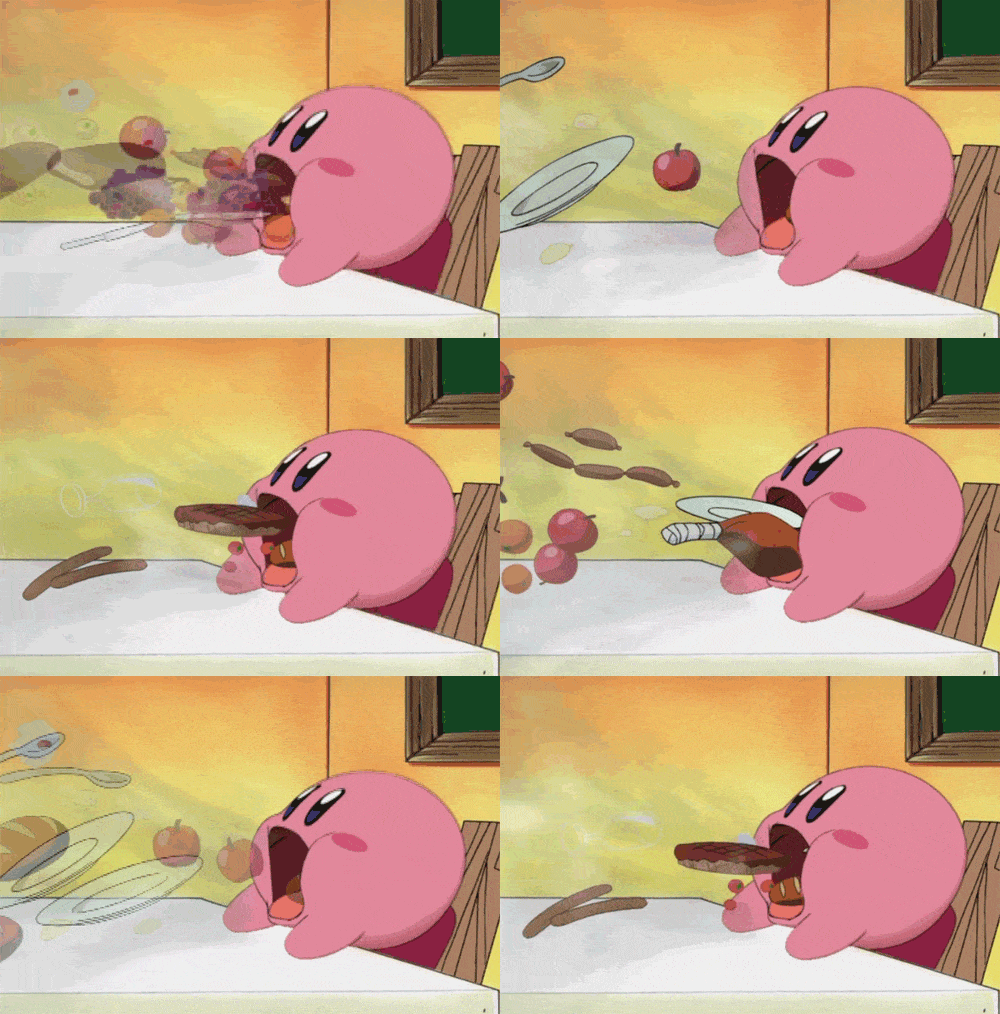
This is all about math! Not getting bigger = need MOAR food.

If you're not bulking up, eat more, like Kirby here!

What about other foods like pizza, pasta, candy soda? Sure, you can get away with consuming less healthy things ON OCCASION (pizza, subs, etc.) but avoid fueling yourself with ONLY junk food.

If you’re not sure specifically what you should be eating for protein, carbs, and fats, download our “Get Bigger” Shopping List by putting your email in the box below:

Rule #5) How Fast Can I gain Weight?

This pencil is a perfect tool to track your fitness progress.

Depending on your training, genetics, how skinny you are, and how much muscle you need to obtain, you can decide how much weight you want to gain each week.

Everybody’s results will vary, and thoughts are mixed on how quickly we can build muscle:

  • Under optimal conditions, some say you can expect to gain 1 pound (.5 kg) of muscle per week,
  • My results have shown that 2 lbs (1kg) per month is more realistic.
  • A 2016 study[15]revealed that strength training produced a 2.2 lb increase (1kg) increase in lean mass in 8 weeks.

Now, depending on how thin you are currently, you might WANT to gain weight even faster and put on a bit of fat.

If you want to gain more weight, some of it will be fat. It's okay, you won't end up like Big Hero 6 for a while.

If you target 500 calories above your Calorie Expenditure every day, you’ll gain a pound a week.

  • If you have a TDEE of 1800 calories: target 2100-2300 calories per day to gain a pound a week (0.5 kg per week).
  • If you have a TDEE of 2000 calories: target 2300-2500 calories per day to gain a pound a week (0.5 kg per week).

If you target 1000 calories above your TDEE, you’ll gain 2 pounds per week:

  • If you have a TDEE of 1800 calories: target 2600-2800 calories per day to gain 2 lbs a week (1 kg per week).
  • If you have a TDEE of 2000 calories: target 2800-3000 calories per day to gain 2 lbs. a week (1 kg per week).

Yes, it is possible to put on even more weight than that in a short amount of time, like when I gained 18 pounds (8.1kg) in 30 days

This was due to consuming 1500 cal above my TDEE, heavy barbell training, targeting lots of protein, and carrying extra water weight (from supplementing with creatine):

I put on 18 pounds of weight in 30 days

My advice: Rather than chasing massive weight gain over a month, you’d be much better off gaining .5-1.5 lbs. (.25-.75 kg) a week, every week, for six months…and keeping the weight on!

So, how do you know if your efforts are working? Simple.

Taking measurements, take photos, and weigh yourself daily:

  • Take front and side photos every Monday.
  • Track your meals every day.
  • Weigh yourself every other day.

If the scale is moving UP, keep doing what you’re doing.

If the scale is NOT moving: EAT MORE.

If you’re ever unsure if you’ve eaten enough that day, eat more.

Once you start to get a good feel for how many calories you eat each day, try to eat the same meals to keep it easy.

Still convinced you can’t gain weight even after tracking things? Let us help. I too was convinced that it was my “fast metabolism,” until I learned from my personal trainer that I simply wasn’t eating enough.


Rule #6) What Are the 10 Best Exercises For Weight Gain?

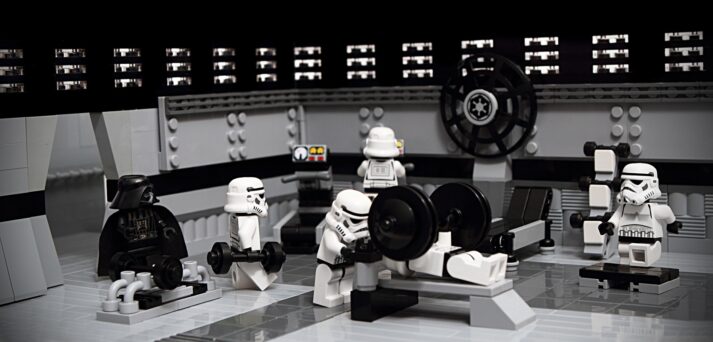
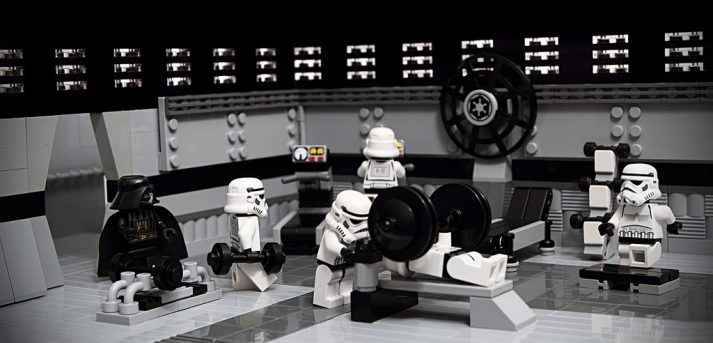
storm troopers hit the gym to gain weight and bulk up

Up until this point, we’ve only talked about the weight gain portion.

Do Steps 1-5 above, and you’ll put on plenty of weight.

HOWEVER, if you’re not also training correctly, you’ll just be getting fat, and not building muscle!

Dr. House knows that temporary changes create temporary results

That’s where strength training comes in!

If you want to bulk up correctly, you need to be strength training with heavy weights and bodyweight movements.

As we lay out in our “Beginner Strength Workouts” guide, these are the BEST exercises you can do to gain weight:  

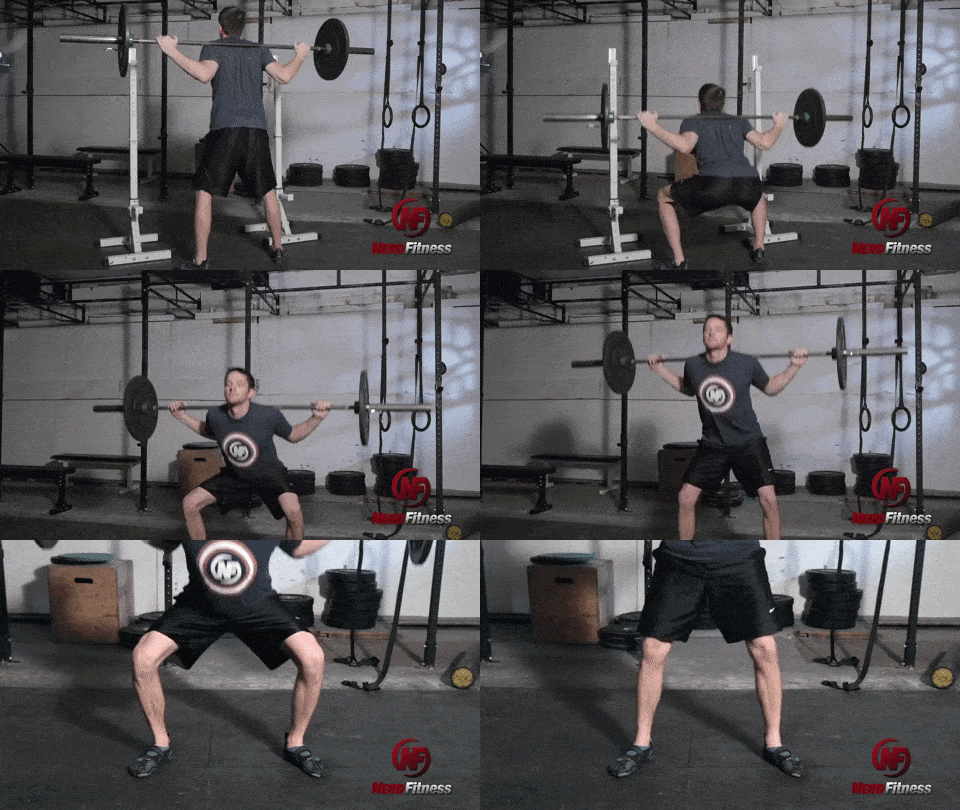
A squat is a life changing exercise

I promise you, learning how to deadlift will change your life.

One of the staple exercises to develop a chest area.

  • INCLINE BENCH PRESS:

A variation of the press that will help develop your chest area.

The overhead press is a great way to strengthen your chest muscles.

This gif shows Staci doing a push-up in perfect form.

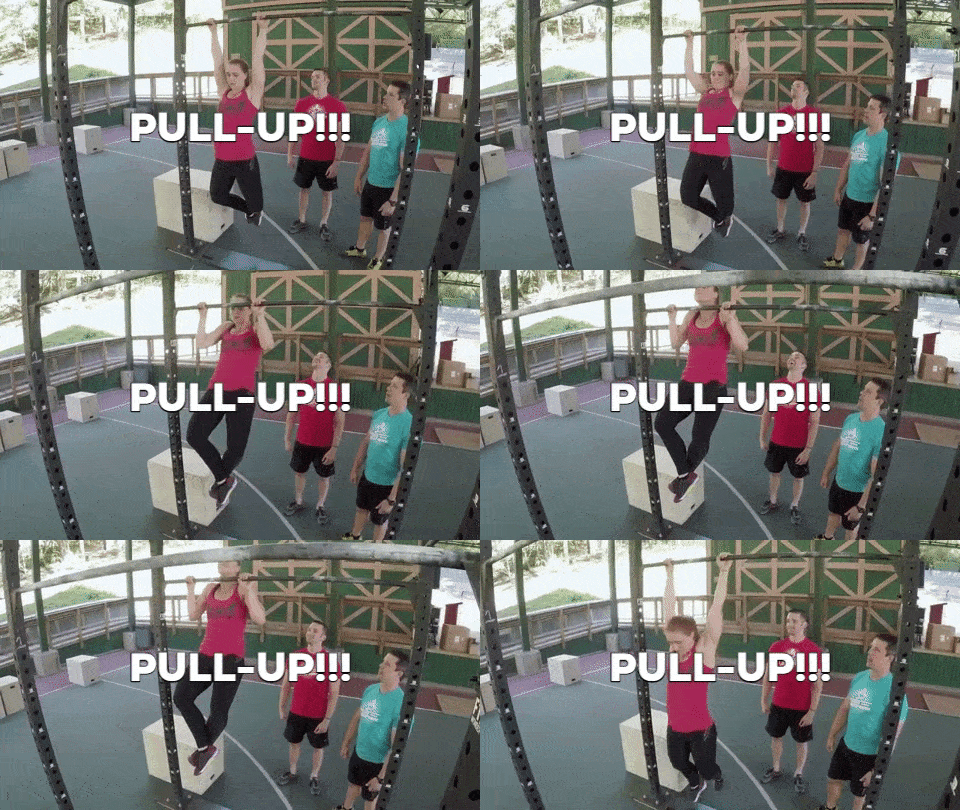
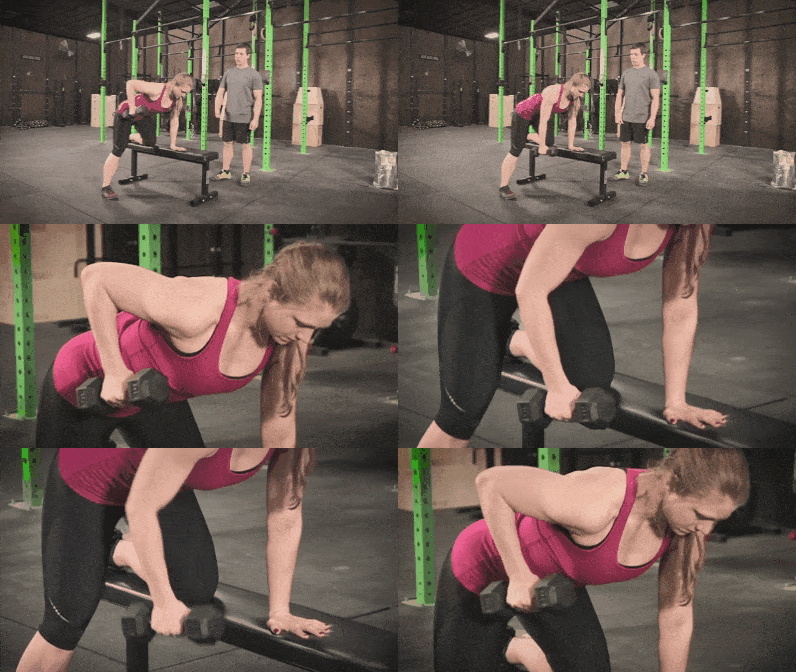
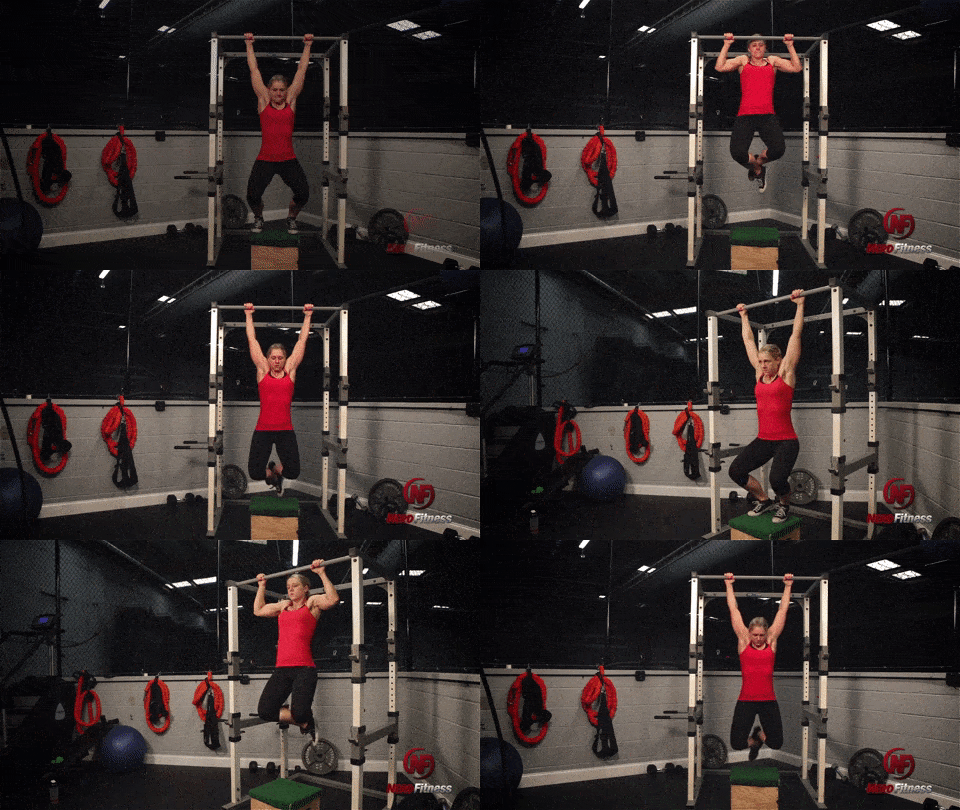
A weighted pull-up is great for progressive overload on your muscles.

A chin-up is a pull-up, but with your hands facing towards you.

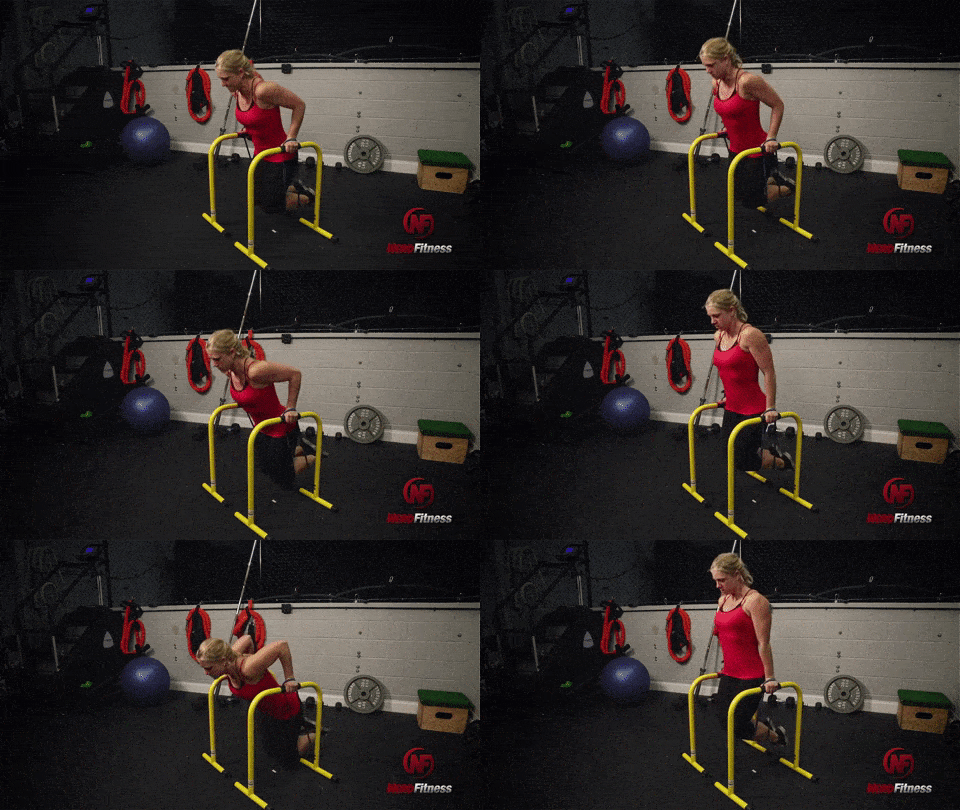
Bodyweight dips are a great exercise to include in an strength training practice.

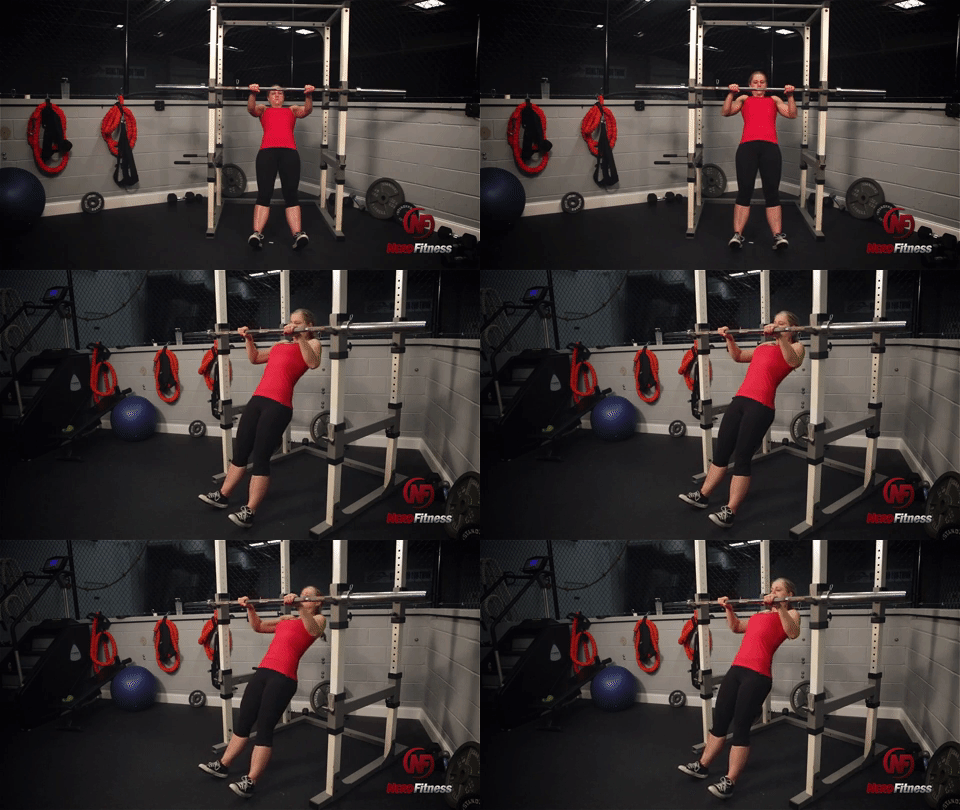
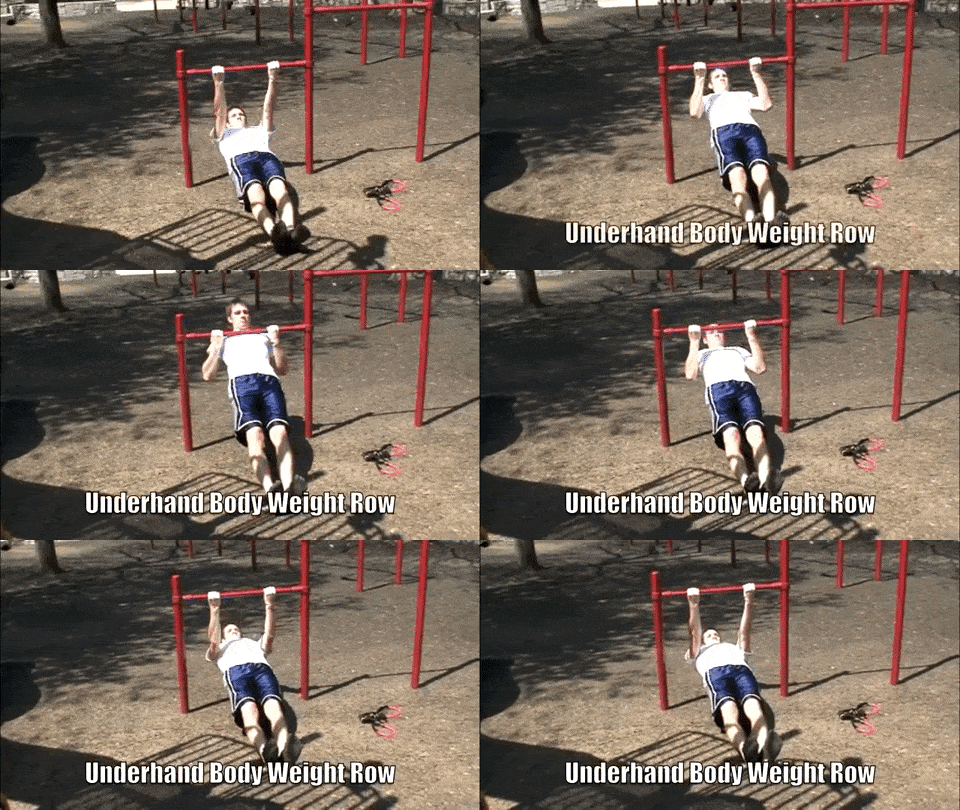
Alternate between an overheand and underhand bodyweight row.

Get as strong as possible with these exercises while eating enough calories and protein, and you will gain the right kind of weight! It’s how I bulked up correctly:)

Here’s a sample workout to gain weight, though you can follow our 6 level gym workout routine too.

WEIGHT GAIN MONDAY WORKOUT:

  1. Squats (4 sets of 8 reps)
  2. Benchpress (3 sets of 8 reps)
  3. Pull-Ups (3 sets of 10 reps)

WEIGHT GAIN WEDNESDAY WORKOUT:

  1. Deadlift (3 sets of 5 reps)
  2. Overhead Press (3 sets of 8 reps)
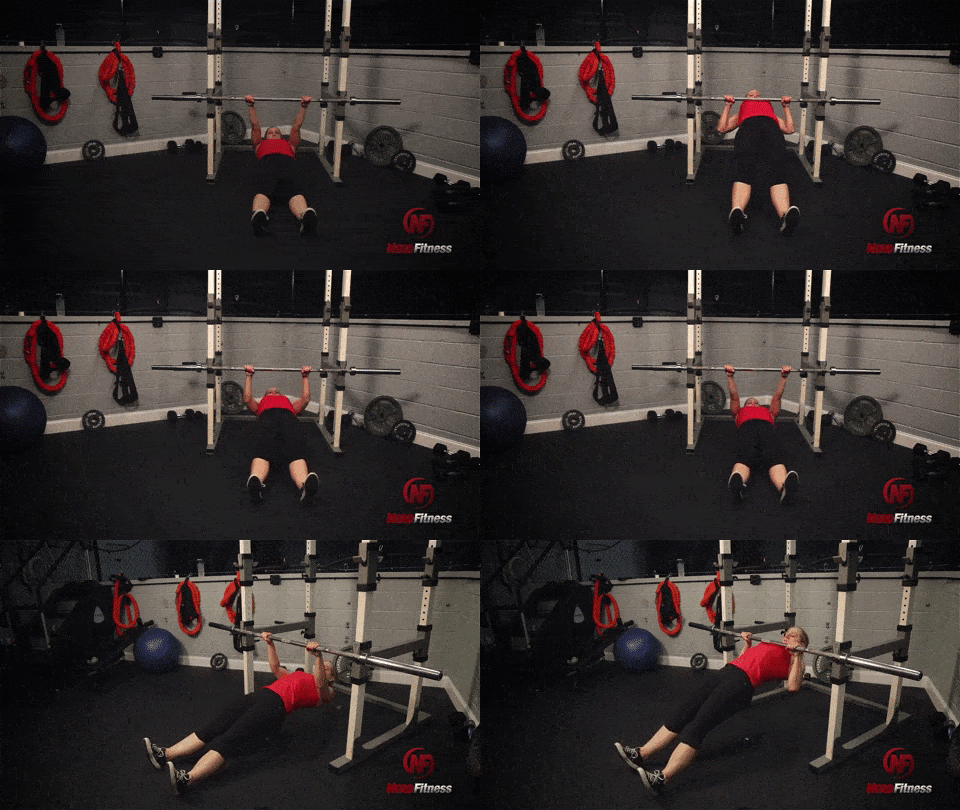
  3. Inverted Rows (3 sets of 8 reps)

WEIGHT GAIN FRIDAY WORKOUT:

Here are some resources to help make heads or tails of the above:

Important point: don’t worry about isolation exercises like triceps extensions, shoulder shrugs, bicep curls, or crunches.

You don't need to play with tricep curls like this man is trying. Stick to big compound movements to bulk up.

You can certainly do them, but only AFTER you’ve done your heavy lifts for the day!

All of the compound exercises listed here use every muscle in your body, and when you overload your body with calories and protein, those muscles will grow.

  • Want more workouts to follow? Read through our Strength Training 101 series that will answer all your questions!
  • Terrified to even step foot into a gym? We understand! Check out our Beginner’s Guide to the Gym article for some basic strategies and workouts.
  • Want somebody to tell you EXACTLY how to exercise and how to eat? Check out our 1-on-1 Coaching Program.

Your NF Coach Can Help you build a workout

Rule #7) How to Strength Train to Gain Weight

Coach Staci doing a barbell lunge, an advanced lunge variation.

If you are going to get bigger, you need to consistently increase the difficulty with every workout.

Every time you train, your muscles break down and have to rebuild themselves.

You are teaching them to say “I must get bigger and stronger in case I have to do that again!”[16]

This is called “progressive overload,” and it’s the foundation of strength training.

This Muppet knows he needs to eat plenty of protein to meet his goals.

So how do you progressively overload your muscles?

  • Lift more weight than last time.
  • Do more sets or reps than last time.
  • Wait less time between sets than last time.
  • Do a more difficult movement or variation.

If you did 3 sets of 5 reps of squats at 95 pounds last week, go for 3 sets of 5 reps at 100 pounds this week!

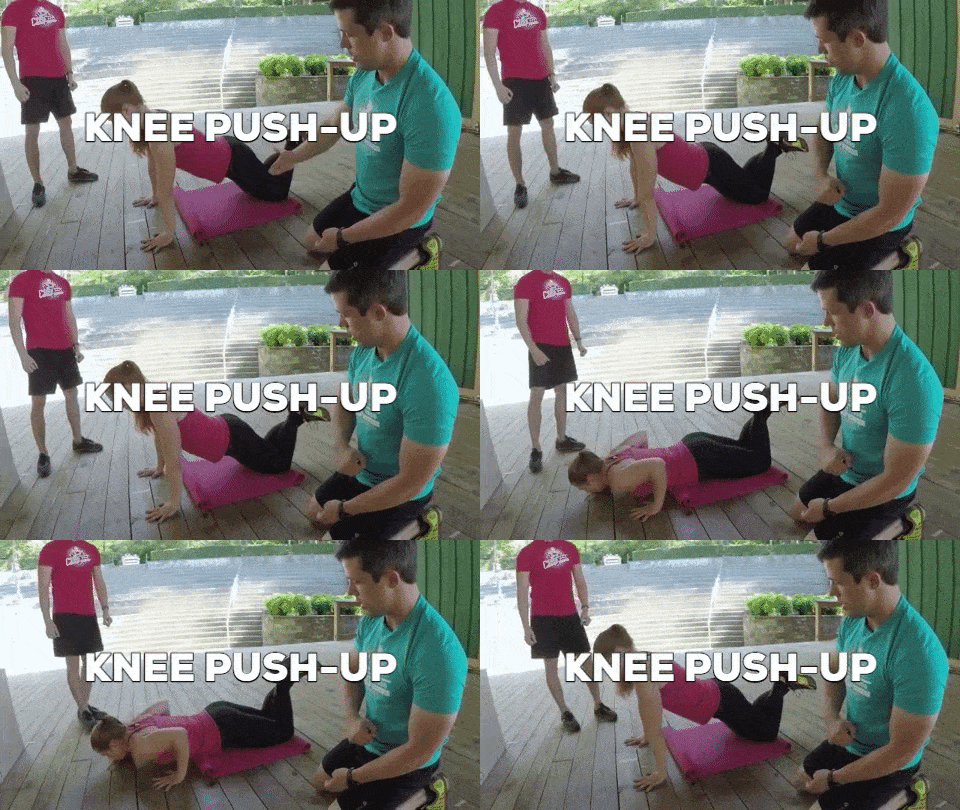
Did knee push-ups last month?

Knee push-ups like this are a great way to progress to a regular push-up!

Great, try to do regular push-ups this month.

Coach Jim breaks down the ins and outs of progressive overload for you in this video:

The trick with progressive overload is to continuously increase the challenge, and the best way to do that is by tracking your workouts

Write down how you train, so that way you know exactly how to get stronger next time. I use Evernote on my phone, but you can use an old school notebook or whatever floats your boat.

Write down exactly:

And then next time?

Pick up more.

Gonzo knows he has to eat protein to match his strength training goals, but he doesn't eat chicken, for obvious reasons.

In addition to the protein shakes mentioned back in Rule #3, consider a creatine supplement – it allows your muscles to store more water – which will both help you potentially lift heavier and improve your performance in the gym!

If you don’t want to build your own workout routine, or you’re not sure how and when to scale up your workouts for the best results, let us build a routine for you!

Our coaches will build a workout program for your goals, and every day you can check your coaching app and know exactly what to do:


Rule #8) How Many Days Per Week Should I Exercise to Gain Weight And Get Bigger?

Make sure you prioritize rest like Jiminy here if you're trying to bulk up and grow muscle.

Muscles are made in the kitchen and while sleeping, NOT in the gym.

When you train, you are essentially ripping apart and breaking down your muscles.

Then, during the next 48 hours, as you are eating a caloric surplus and recovering, your muscles get rebuilt bigger and stronger.

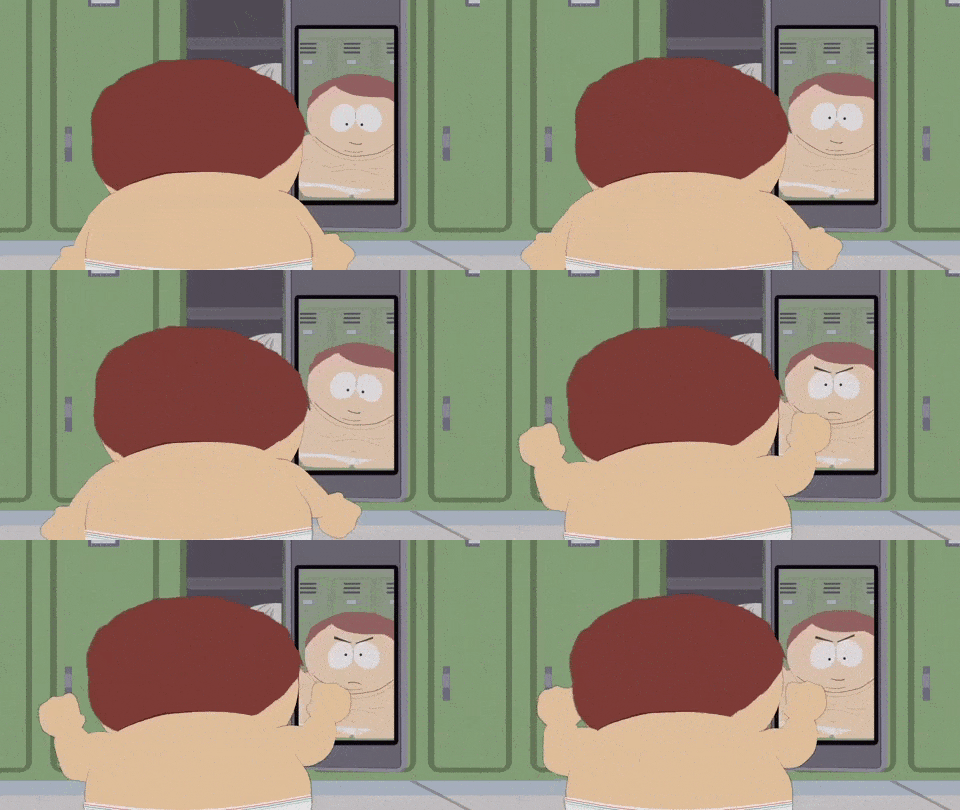
Cartman flexing in mirror

For this reason, never exercise the same muscle before it’s ready.

In other words, try not to exercise the same muscle on two consecutive days.

Here are the best common practices for weight gain: Do a gym workout 3-4 days a week with a day off in between each (while consuming plenty of calories). This is plenty of training to promote muscle growth and weight gain.

Long story short: pick up a heavy weight in the gym 3-4 days a week for an hour.

Go HARD, go HEAVY.

And then come home, eat, and rest. If you are interested in doing some active recovery on your off days, that’s fine too.

Skinny people usually don’t need to train more, they need to eat and rest more!

Rule #9) How Much SLeep Should I get To Get Bigger?

Of course this dog gets enough sleep, because he is trying to gain weight.

You should get at least 6 hours of sleep to function as a human, but getting 7-8 hours of sleep will help aid in building more muscle.[17]

This study[18] also found:

“Inadequate sleep impairs maximal muscle strength in compound movements when performed without specific interventions designed to increase motivation.”

Think of it this way:

Building muscle is hard work, your body can use all the help (and calories) it can get. Your body is doing nothing but lying there and building muscle while you’re sleeping. [19]

If you are only getting 6 hours or less, you’re not going to get all the benefits of your exercising and diet, and not giving yourself the best chance to gain weight and grow bigger.

So don’t make these sleep mistakes!

We often spend quite a bit of time with our coaching clients working with them on their sleep and environmental habits! From turning off the TV an hour earlier to even becoming a morning person, we build fun missions and challenges for our clients around stuff like this to get results.


Rule #10: Should You Do Cardio While Trying to Gain Weight?

As we know now, running won't help this lizard go from skinny to bulky.

Depending on how you currently feel about running, this next sentence will either make you happy or miserable:

“Running might work against your efforts to gain weight and build muscle.”

When you run, your body uses up calories to fuel your runs. This leaves fewer calories left over to build muscle.

Now, nobody will refute the benefits of improved cardiovascular health, nor would I EVER tell you to not do an exercise that you find fun

In addition, a 2016 study[20] showed that doing endurance training AND strength training actually created larger muscle hypertrophy in untrained subjects than just resistance training alone.

What this means:

As this gif explains, you do you when it comes to bulking up.

If you’re somebody that runs and enjoys it, great!

If you’re trying to get bigger, here’s what I would recommend:

  • Find a way to increase your food intake, and still know that you might be building muscle slightly slower than if you ONLY did strength training.
  • Cut back on running until you reach your goal weight/size, and then introduce it back into your routine.

Is your SOLE focus on getting bigger? Do 3 things:

  • Eat (a lot).
  • Lift (heavier).
  • Sleep (a lot).

Interested in giving your heart a workout without steady cardio?:

Want to incorporate cardio the RIGHT way into your life, along with strength training, to start gaining weight?

Our coaching program builds custom programs to help people just like you reach your goals.


Rule #11: Realize you will put on some fat, and that’s okay.

This LEGO knows if he follows the tips in this article, he'll gain weight successfully.

With all of this eating, you will probably put on some fat along with your muscle.

That’s okay!

You might even be skinny enough that a bit of extra “cushion” on you is a good thing!

If you are trying to put on MOSTLY muscle and minimal fat gain:

  • Target at least 1.5g of protein per pound of body weight (3.3g per kg).
  • Eat a caloric surplus that is 250cal over your current TDEE.

And then fine-tune it from there:

An engine being fined tuned.

You’re trying to thread the needle of “only build muscle, don’t add fat” which is fairly advanced and challenging.

As this 2017 study points out[21], “Protein overfeeding or the consumption of a high protein diet may not result in a gain in body weight or fat mass despite consuming calories that exceed one’s normal or habitual intake.

This is incredibly challenging, and you do run the risk of not eating enough to build muscle. In addition, you might build less muscle than had you consumed a larger surplus of calories.

Now, what if you’re “skinny fat?”

What if you have a gut/belly, and thin arms? 

IF YOU ARE “SKINNY FAT”:

Then, once you get to a low enough body fat percentage that you can see some abdominal muscle definition, you can get back to bulking up.

Rule 12: SuperCharge Your Weight Gain Results (Build the Habit)

Steve Kamb turning into Captain America with the help of an intermittent fasting plan.

These are the 11 rules I’ve followed multiple times in my life whenever I have decided to gain weight. 

There’s a 12th rule I want to share with you too:

Build the habit of eating and exercise:

It’s important to build a system that sets you up for weight gain success.

It comes down to two things:

  • Don’t miss workouts.
  • Don’t miss meals.

So do whatever you need to do to make those things happen!

Here’s my final piece of advice: If you want permanent success, stop thinking in terms of “How fast can I gain weight?” and instead think:

“What can I do today that feels sustainable enough that I can stick with it for a year?”

This is how I get results, and how you can use the tools and tips in this article to get results too. Build small habits that become permanent parts of your life, and the results you’ll get will be permanent too.

Now, if you’re somebody that wants even MORE guidance, and specific instructions to follow, I got you:

1) Our 1-on-1 online coaching program, work with a member of Team Nerd Fitness that gets to know you and your situation. We’ll provide expert guidance and accountability, a custom workout, and regular ongoing support:


2) Exercising at home and need a plan to follow? Check out Nerd Fitness Journey!

Our fun habit-building app helps you exercise more frequently, eat healthier, and level up your life (literally).

Try your free trial right here:

3) Sign up for our free email list, the Nerd Fitness Rebellion! Join a few hundred thousand rebels just like you and I’ll send you a bunch of free guides too. I’m nice like that.

To recap our full article, here are the “12 Rules To Gain Weight Quickly”:

  1. Eat more food to create a caloric surplus
  2. Eat mostly high quality, high-calorie food.
  3. Eat enough protein to promote muscle growth.
  4. Eat enough carbs and fats to reach your goals.
  5. Track your progress to make sure you are getting results
  6. Strength training is the key to the RIGHT weight gain
  7. Get stronger to gain weight.
  8. Strength train 3 days per week with plenty of recovery.
  9. Get at least 7-8+ hours of sleep for optimal growth.
  10. Decide if cardio belongs in your workout routine.
  11. Learn how to build muscle with minimal fat gain.
  12. Build the habit of training and eating.

If you have more questions, please leave them in the comments below and I’ll gladly answer them when I get a chance!

You can do this.

Both BIll and I know you will use your TDEE to reach your fitness goals to go from skinny to muscular.

Go eat something.

Learn how to do squats and deadlifts.

Do lots of push-ups and pull-ups.

And then eat some more.

-Steve

PS: If you want to read more about this stuff, make sure you check out the following in-depth resources too:

###

photo credit: Marina Pissarova © 123RF.com, LEGO Grocery store, I love breadpencilW_Minshull Hardcore Stormies Hit The GymSpeed

The post Blog first appeared on Nerd Fitness.

from Nerd Fitness: Helping You Lose Weight, Get Stronger, Live Better. https://ift.tt/3sULKNZ
via IFTTT
Categories
Uncategorized

#holistic #getfit #nutrition How to Get Rid of Man Boobs: Step-By-Step Plan for Reducing Moobs Quickly

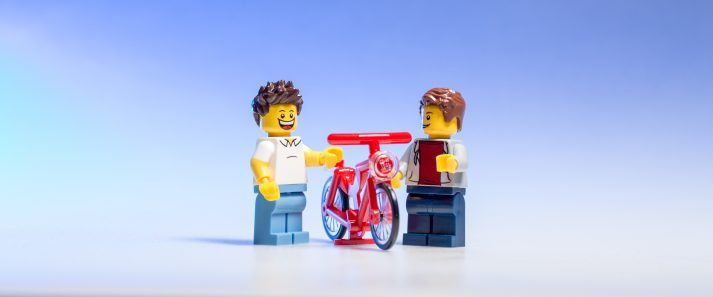
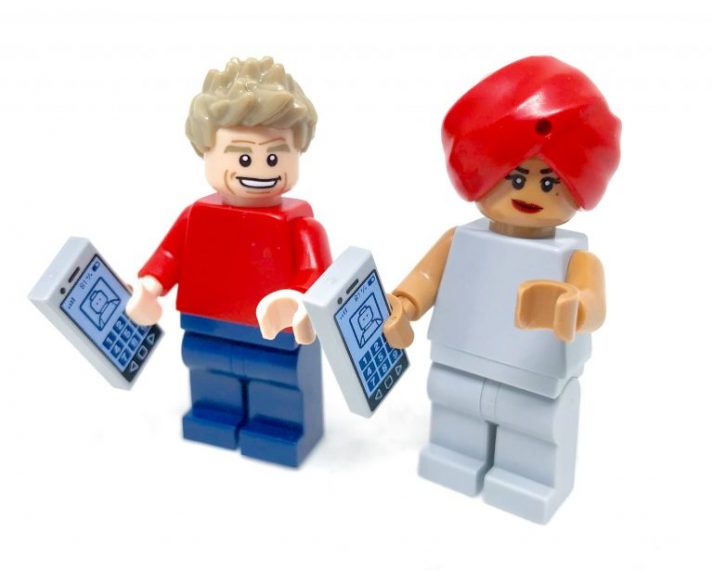
These two LEGOs are discussing how they feel about fat on their chest: man boobs.

Can I get rid of my man boobs quickly and naturally?

Awkward phrase? Sure.

But that’s not gonna get us to shy away from the topic here on Nerd Fitness.

We work on solutions to questions just like this with our Online Coaching Clients: awkward questions and challenging situations that are tough to talk about, but can be helped!

This is what we do, and we’re really good at it.


Today, let’s tackle the “moobs” situation head-on by covering all of the following in this MASSIVE guide:

Okie dokie, let’s jump in!

What are “Man Boobs”?

These two LEGOs are fighting over how to reduce man boobs.

Let’s chat about some medical definitions, because it’ll help us put “man boobs” in some proper context.

  • Gynecomastia is defined as the benign growth of the male breast glandular tissue. The National Institute of Health states it’s usually caused by “increased estrogen activity, decreased testosterone activity, or the use of numerous medications.”[1]
  • Pseudogynecomastia is when male breasts are enlarged by fat deposits, due to an increase in body fat which distributes itself on one’s body according to genetics.

Most men who struggle with “man boobs” or “moobs” are in this second category, and the “pseudo” means they don’t really have the condition “gynecomastia.”

There is no hormonal imbalance.

Instead, the body is just storing extra fat in the chest area.

This panda is sad that his body is storing fat in his chest area.

I’ll mostly be talking about shedding body fat and building muscle to lose “moobs,” but I will also talk about gynecomastia and medical conditions later.

Next up!

Can You Get Rid of Man Boobs?

The Mario Bros want to know if they can target specific areas for fat loss (you can't).

Why do some men store fat in their chest?

We all process and store calories differently in our bodies.

And how our body stores excess calories is a critical concept for our discussion on “man boobs.”  

If you eat more calories than you burn, day after day, month after month, year after year, your body has to do something with all that extra energy.

If we’re sedentary, more often than not, the body will choose to store that energy as fat to be used for later.

Depending on our genetics, our body might choose to store that fat in our butt, gut, thighs, or chest.

Probably a combination of all those things.

And for some of us, a large portion of that body fat deposits itself in our chest area.

And thus, man boobs.

Some of us, like House, can be upset about where our bodies store fat...like our chest area.

So, in order to start reversing the process, we need to have a natural, two-pronged approach to tackling the “moobs” problem naturally and safely:

Exercise and nutrition.

Specifically, strength training and calorie restriction.

If you are somebody that wants EXACT instruction and a nutritional plan that is designed to help you reduce your man boobs, check out Nerd Fitness Coaching. We’ve helped people just like you do this the right way.


Can Exercises Target Chest Fat?

This LEGO is ready to work off his man boobs.

Fat and muscle are two different ‘systems’ in our body.

Fat sits on top of muscle, like oil on water.

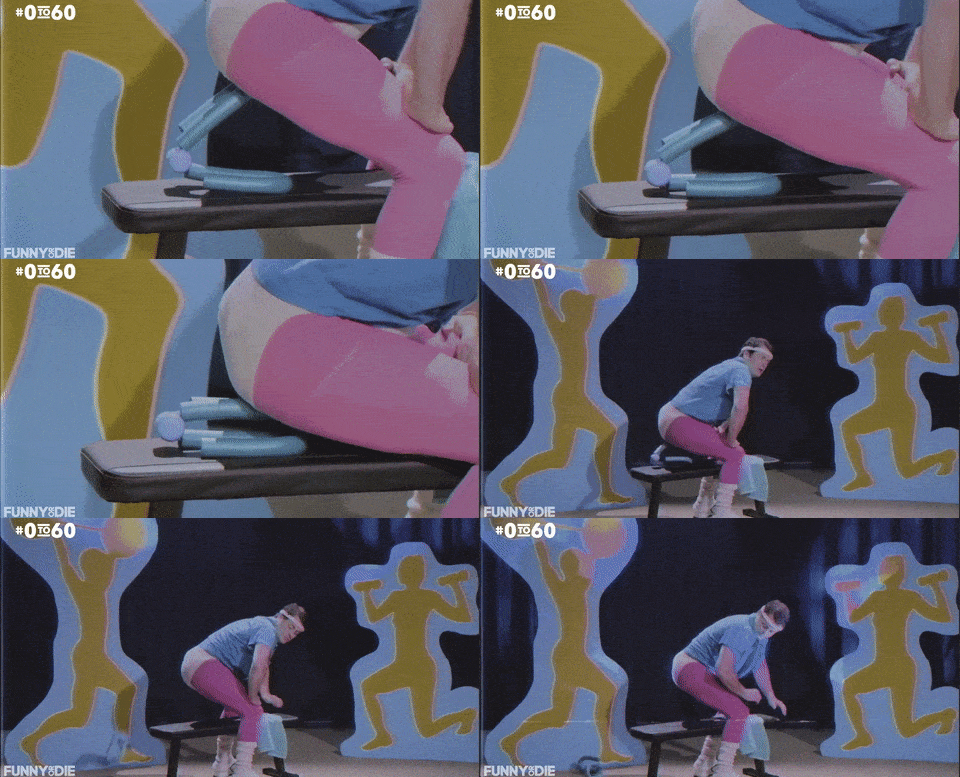
When we target a specific area for weight loss, like with a Thighmaster, all we’re really doing is exercising the muscle underneath the fat on our thighs.

And don’t get me wrong – this is GREAT (the muscle, not the Thighmaster).

Out of all the exercise equipment out there, the Thighmaster is probably the least effective.

More muscle is a good thing.

And yup, any exercise will result in calories burned – which is crucial when it comes to fat loss.

However, we need to think of the other system as well:

The fat resting on top.

So, the path to get rid of “man boobs” centers on three points:

  1. Eating a caloric deficit (consuming fewer calories than you burn) so that our body has to break down our fat stores (including the fat stored in our chest) for energy. You can calculate how many calories you should eat to start.
  2. Strength train heavy so more calories are diverted to rebuilding muscle rather than getting stored as fat.
  3. Strength train to build up the muscle under the fat. Muscular pecs with a low body fat percentage look dramatically different than man boobs.

Here’s why: strength training preserves the muscles we have (and can help build pectoral muscles).

Our body also has to rebuild the muscle that breaks down while we exercise, so it uses any extra calories we have to do that rather than storing it as fat!

Think of it kind of like the Sorting Hat from Harry Potter (come on, this is Nerd Fitness after all).

Your body is a lot like the Sorting Hat.

When we strength train, our body will act like The Sorting Hat and divert calories coming in to sit at the cool kids table (“Rebuild muscle!”) and not the “Store as fat” table.

It’s a message we really strike home in our video for Body Recomposition:

For more, check out our guide on “Losing Fat and Gaining Muscle At the Same Time.”

With a strategy of slight caloric restriction combined with enough protein and heavy strength training, we’re decreasing the body fat on top of our muscle, while also building up that same muscle underneath.

This results in tighter skin, with less padding (fat), stretched over firmer muscles.

And boom – confidence-boosting pecs that would make King Leonidas proud!

You can follow the link above to a circuit that will help you develop the body of a Spartan.

Said another way, we’ll be coming at “man boobs” from the outside and inside.

The Best Workouts for Reducing “Man Boobs”: strength Training

These LEGOs are working the bench and doing some deadlifts. Nerd Fitness approves.

If we’re currently sedentary, the best form of exercise to help build a confidence-boosting physique would be strength training.

In our opinion, a strong guy is a healthy guy.

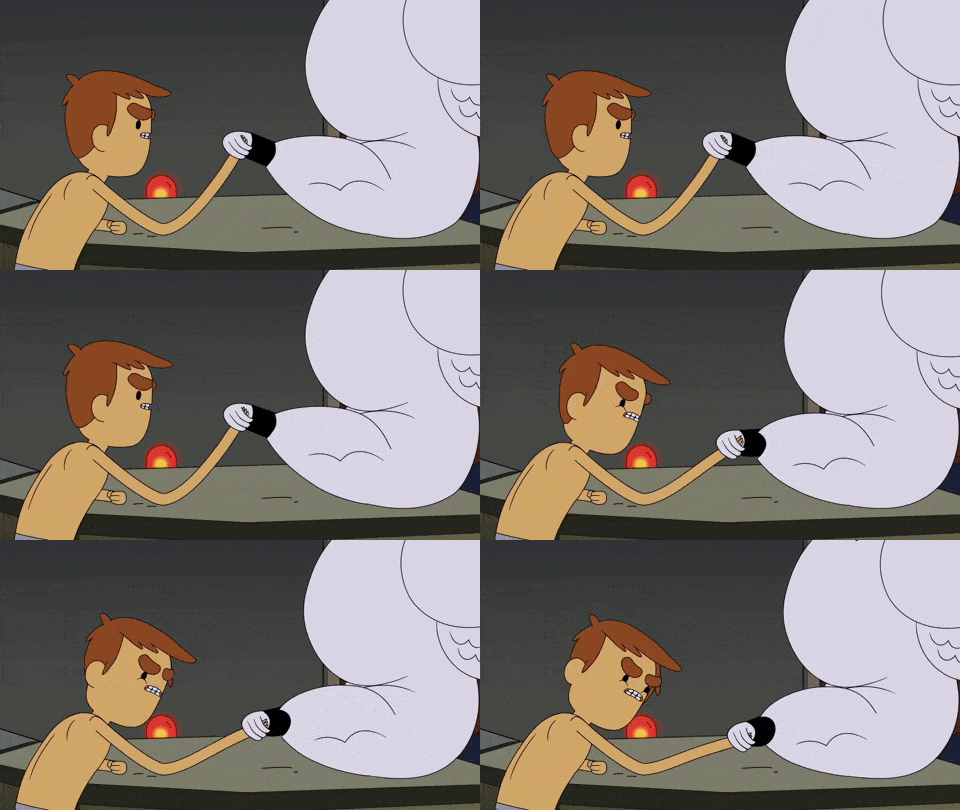
Strength training will help you get rid of your man boobs, plus help you win arm wrestling contests!

We’ll get you started in three areas:

  1. Building up our pectoral muscles (chest muscles under your “man boobs.”)
  2. Same with broadening our shoulders.
  3. We can also improve our posture to make sure we stand tall and proud, puffing our chest out and pulling our shoulder-blades back.

In order to accomplish each of these goals, we’re gonna focus on building up strength in our PUSH muscles and our PULL muscles. 

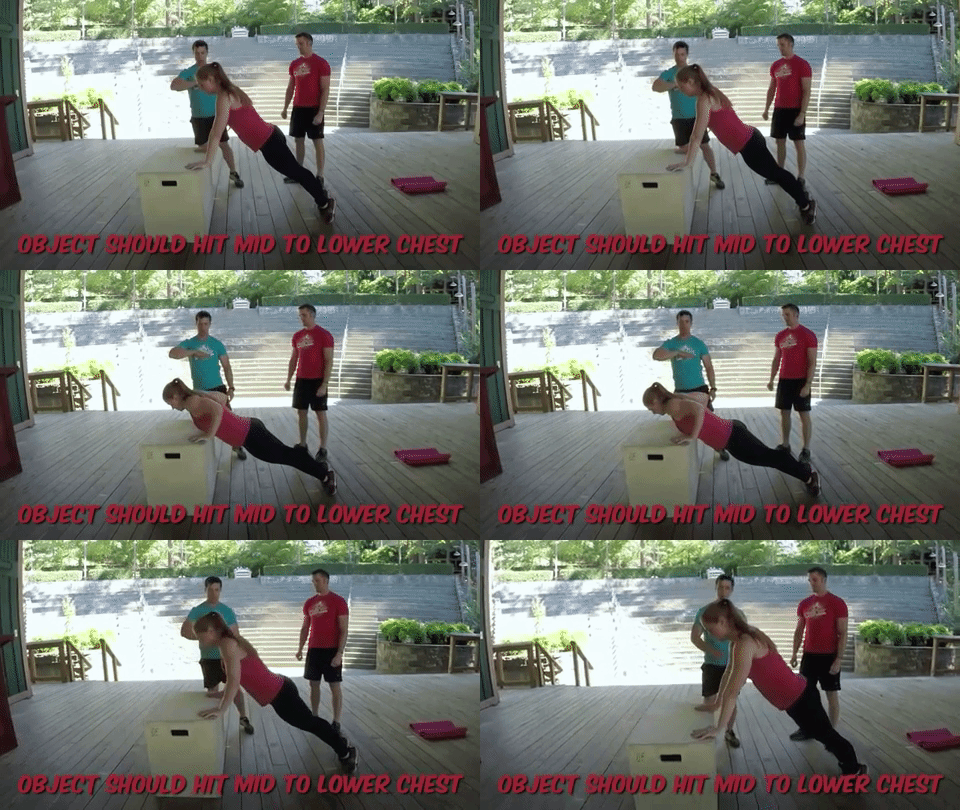
Our first stop will be push-ups, a foundational exercise for developing upper body strength.

We show the correct way to do one right here:

I don’t care if you need to do them from your knees or doing an elevated push-up:

KNEE PUSH-UP

Knee push-ups like this are a great way to progress to a regular push-up!

ELEVATED PUSH-UP

Do elevated push-ups to work up to regular push-ups

We all start somewhere, and the name of the game is progressive overload – getting stronger with each workout!

In addition to the push-up, let’s consider the following as the best 5 Advanced Chest Exercises.

These are the types of exercises we build into the workout programs for our Coaching Clients looking to reduce chest fat and build up muscle in that area:

#1) Bench press (barbell or dumbbell).

One of the staple exercises to develop a chest area.

If one piece of equipment is visually associated with a fitness gym, it would be a bench press. If you’ve never used one before, check out our guide on using a bench press safely right here.

#2) Incline bench press.

A variation of the press that will help develop your chest area.

We can also work on an incline bench press to develop a more rounded-pectoral muscle that targets your upper chest.

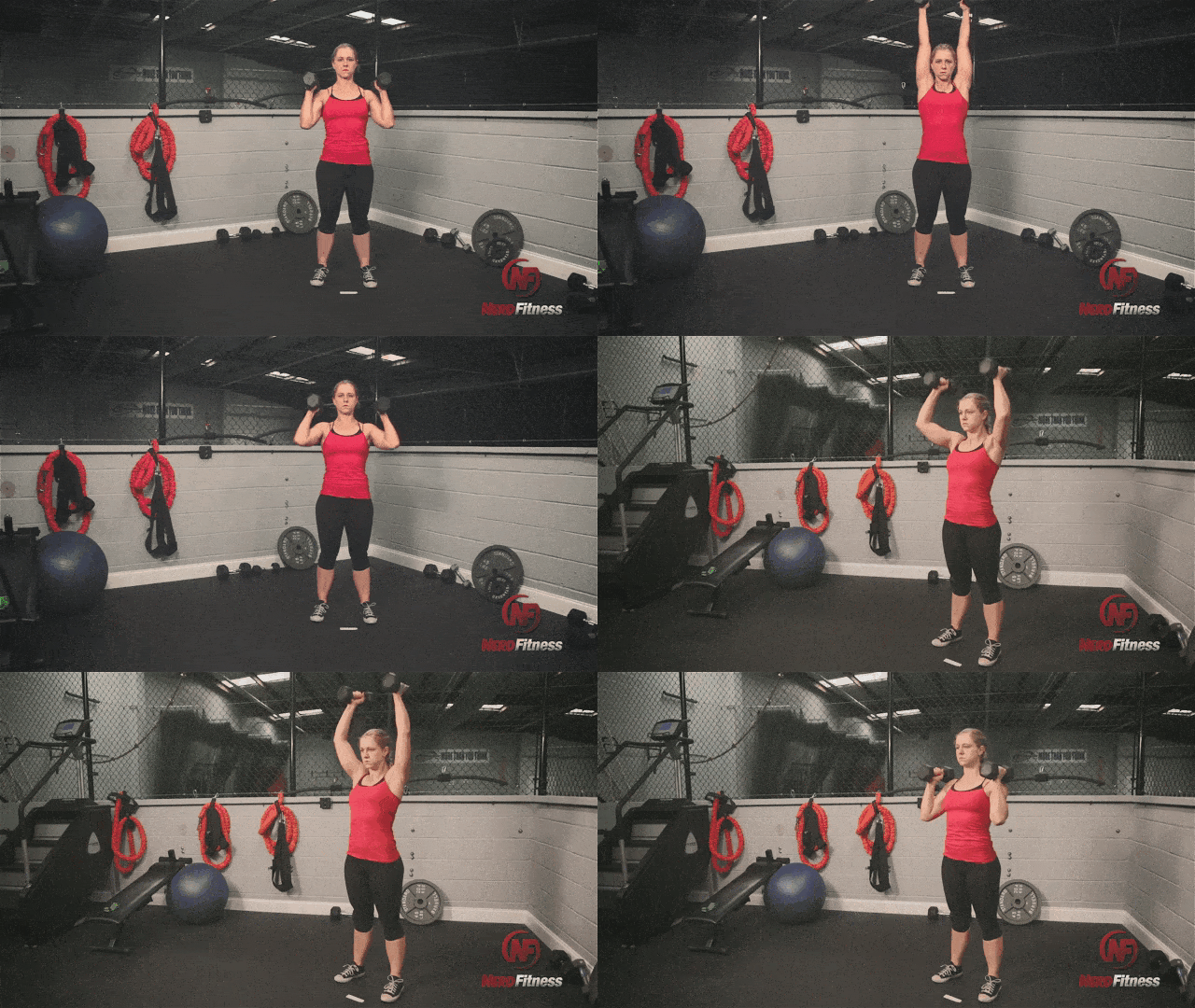
#3) Overhead presses.

The overhead press is a great way to strengthen your chest muscles.

Not only can our pectoral muscles help push forward, they also get worked out when we do an overhead press.

Varying chest exercises is a good way to help attack all different sides and parts of our chest and build well-rounded pectorals.

Here’s a dumbbell variation if you can’t train with a barbell yet:

In the neutral grip press, shown here, you have your hands together during the movement.

#4) Bodyweight Dips (ADVANCED)

Bodyweight dips are a great exercise to include in an strength training practice.

Once we start to develop some serious strength, we can start to level up your advanced bodyweight training with bodyweight dips

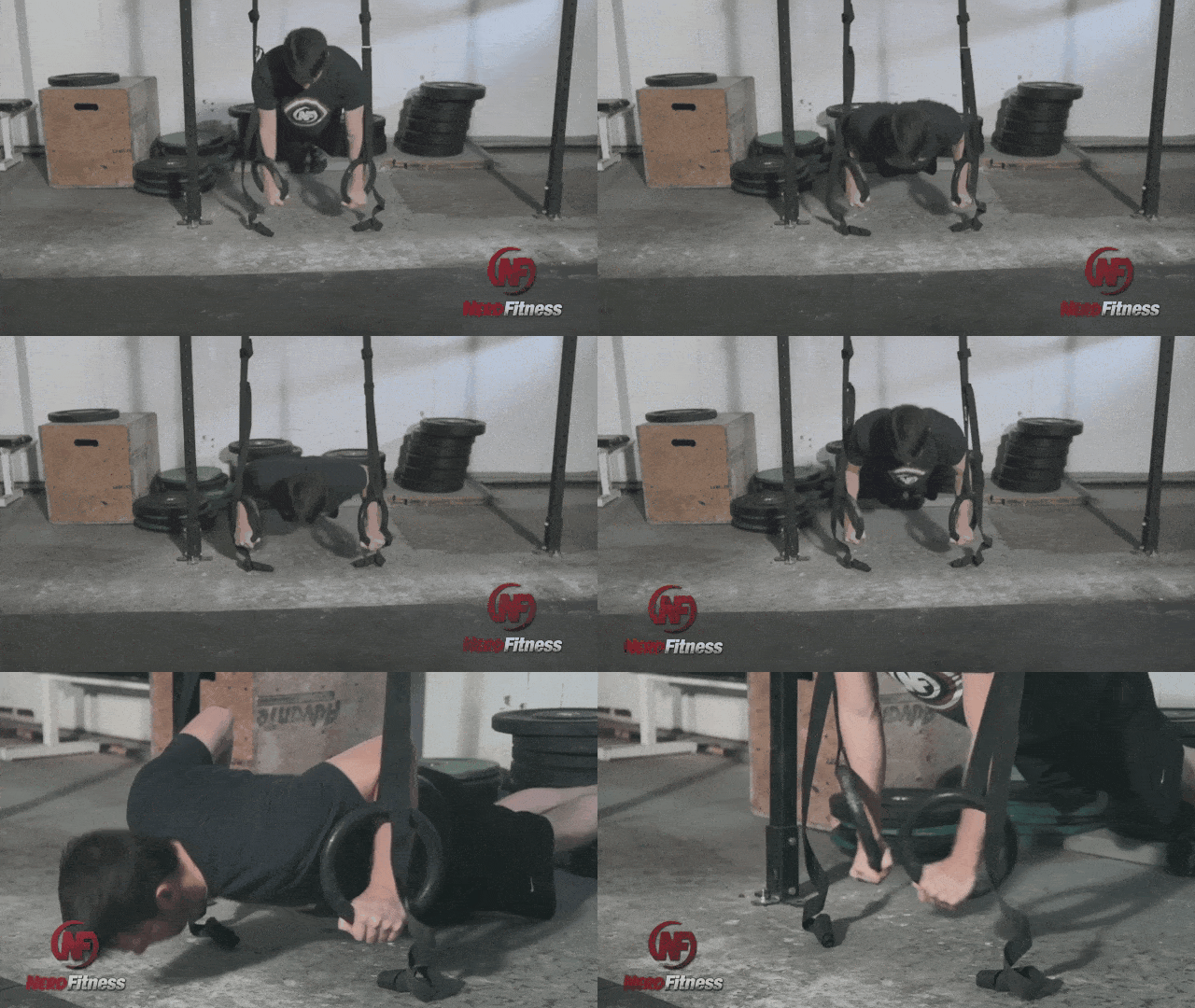
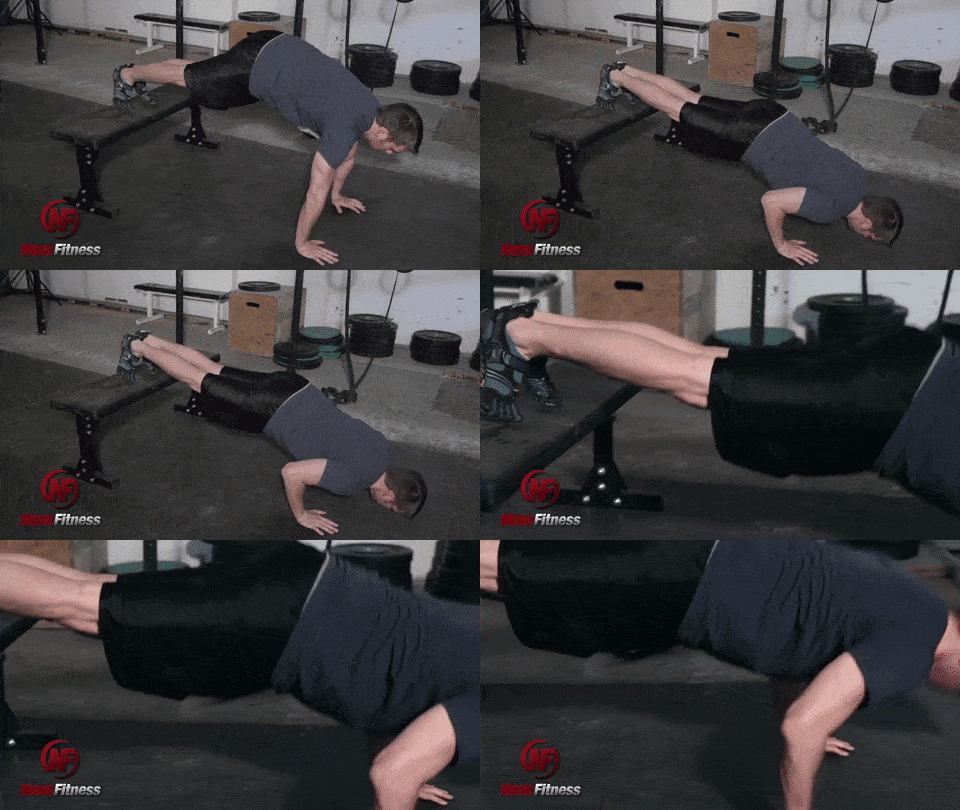
#5) Ring Push-Ups (ADVANCED)

Ring push-ups like this are an advanced chest exercise to develop your pectoral muscles.

It’s no secret I’m a fan of gymnastic rings. It’s hard to keep secrets when you write about how great gymnastic ring training is. I personally know of no better way to build upper body strength and muscle than with a pair of gymnastic rings.

As we cover in our “how to build your own workout” guide, make sure to do a push exercise in every workout to start building up pectoral muscles. 

Again, start with push-ups.

Start doing them today.

This gif shows Staci doing a push-up in perfect form.

Again, if you can’t do a regular push-up, a knee push-up is totally fine.

Just do them.

After you get cozy with push-ups, move onto the above advanced moves or follow some of the following workouts:

I asked the male members of our Nerd Fitness Prime about man boobs, and many have reported improving their appearance with these pectoral exercises.

Outside of improving man boobs, strength training will make every other aspect of your life better.

Bringing groceries in from the car, doing that thing that consenting adults do, and defending yourself against ninjas will all be much easier after strength training.

Strength training can help you reduce your man boobs, as well as defend yourself from ninjas.

Now, I’d be remiss if I didn’t include two other exercises that can change your life:

#1) Barbell Squats 

A squat is a life changing exercise

#2) Barbell Deadlifts

Rebel Leader Steve showing how to do a 420 lb deadlift at the gym.

These two basic barbell movements are the most ‘efficient’ exercises at building strength and burning fat.

They recruit your central nervous system and every muscle, joint, tendon, and bone in our body to get stronger.

In fact, if you could only do 4 exercises for the rest of your life, I would say:

  1. Squats
  2. Deadlifts
  3. Push-ups
  4. Pull-ups

Show me somebody who is super strong at those four movements, and I’ll show you somebody who has a great physique.

Seriously, don’t neglect those PULL muscles!

Here's a gif of a pull-up in perfect form.

This exercise might seem counterintuitive: why work on your back muscles if we’re trying to build up the muscle in our pecs?

Balance and posture.

By building strength in our PULL muscles, we strengthen and tighten our back muscles. This will naturally cause us to pull our shoulder blades back and down into proper position, and give us a better posture. 

If we ONLY do chest exercises, we’re more likely to get out of balance, which leads to contracted chest muscles, hunched shoulders, and poor posture. 

Here are some options for building up our back muscles and improving our posture:

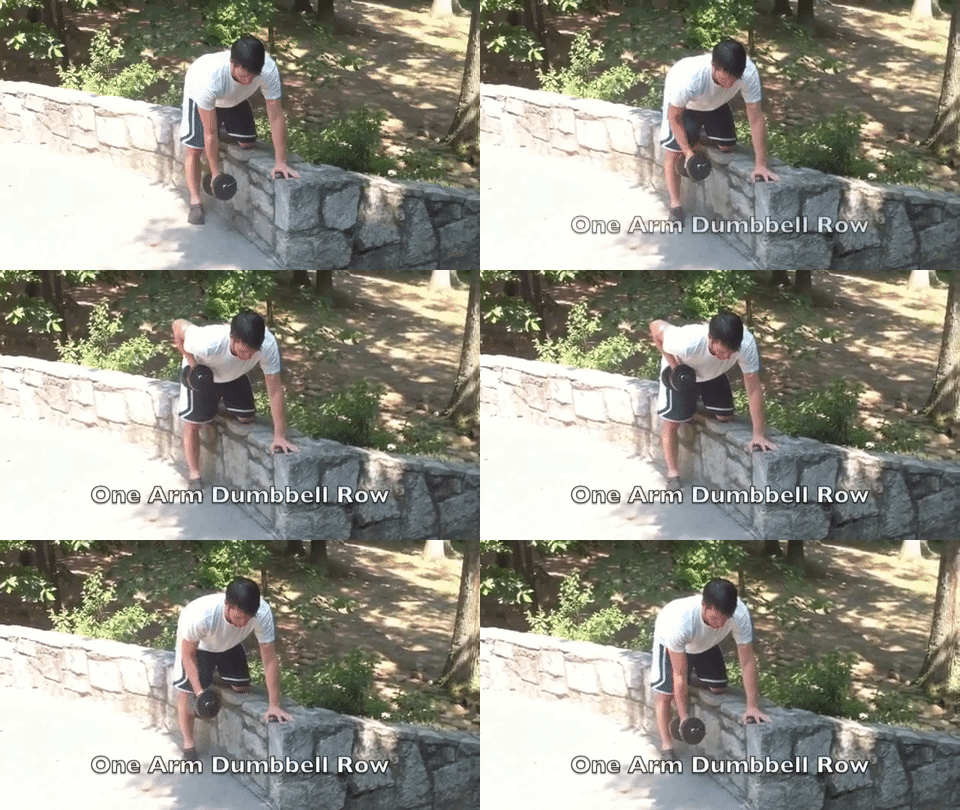
#1) Dumbbell Rows 

Do a dumbbell row as a great beginner exercise to get strong enough for a pull-up!

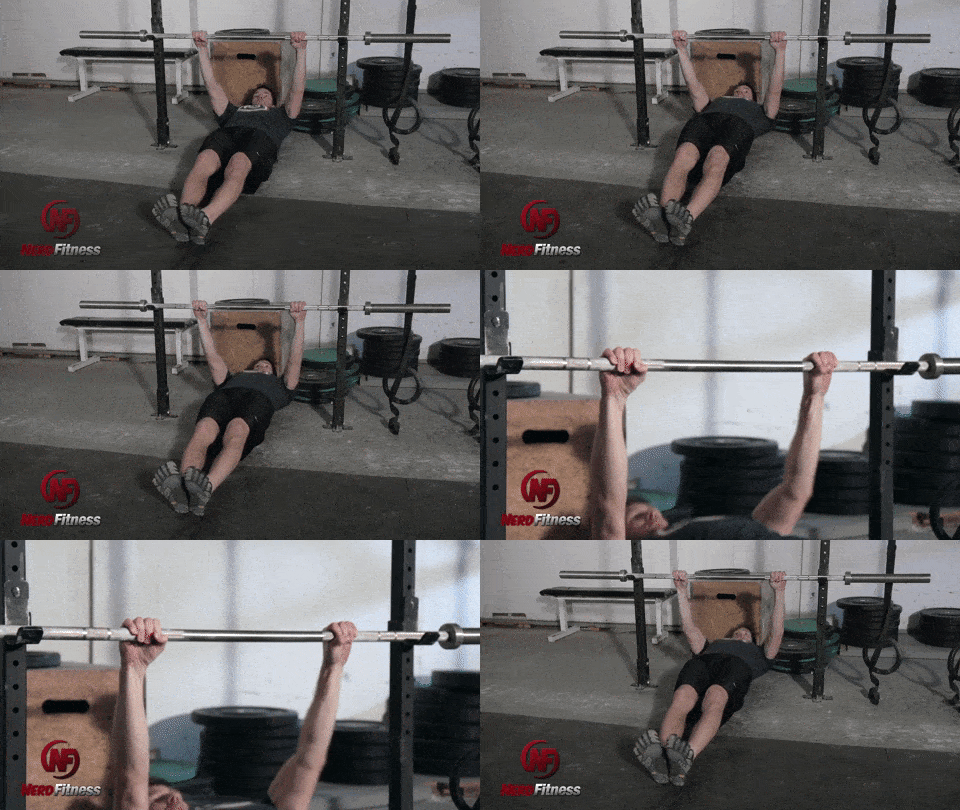
#2) Bodyweight Rows

The inverted row is a great way to develop your "pull" and back muscles.

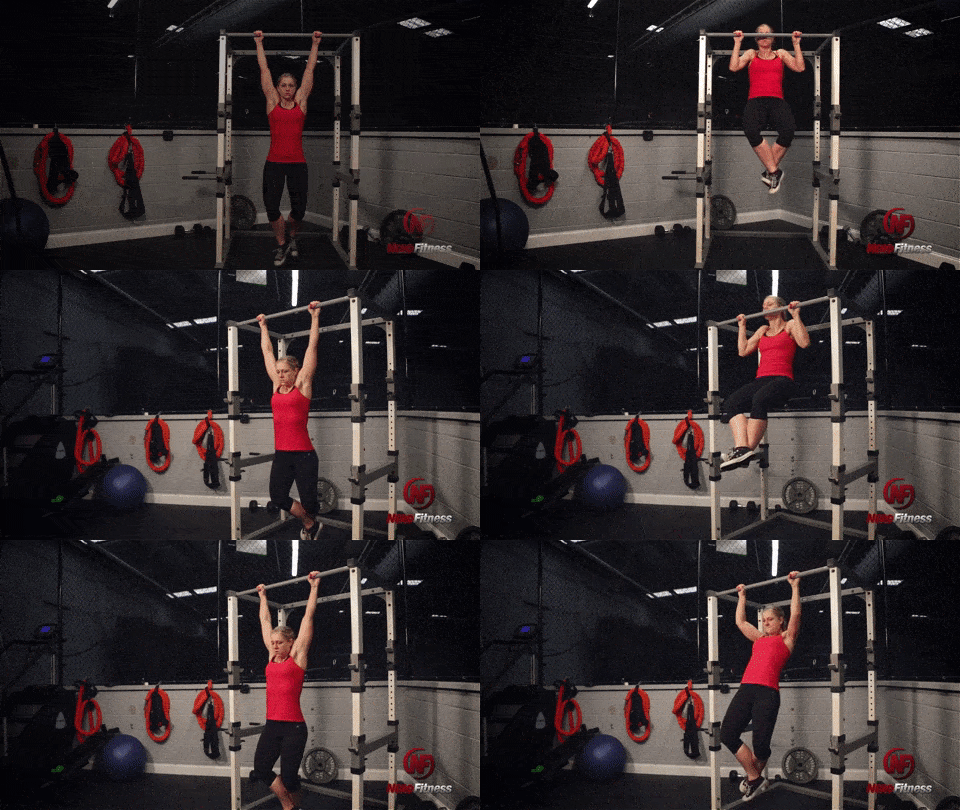
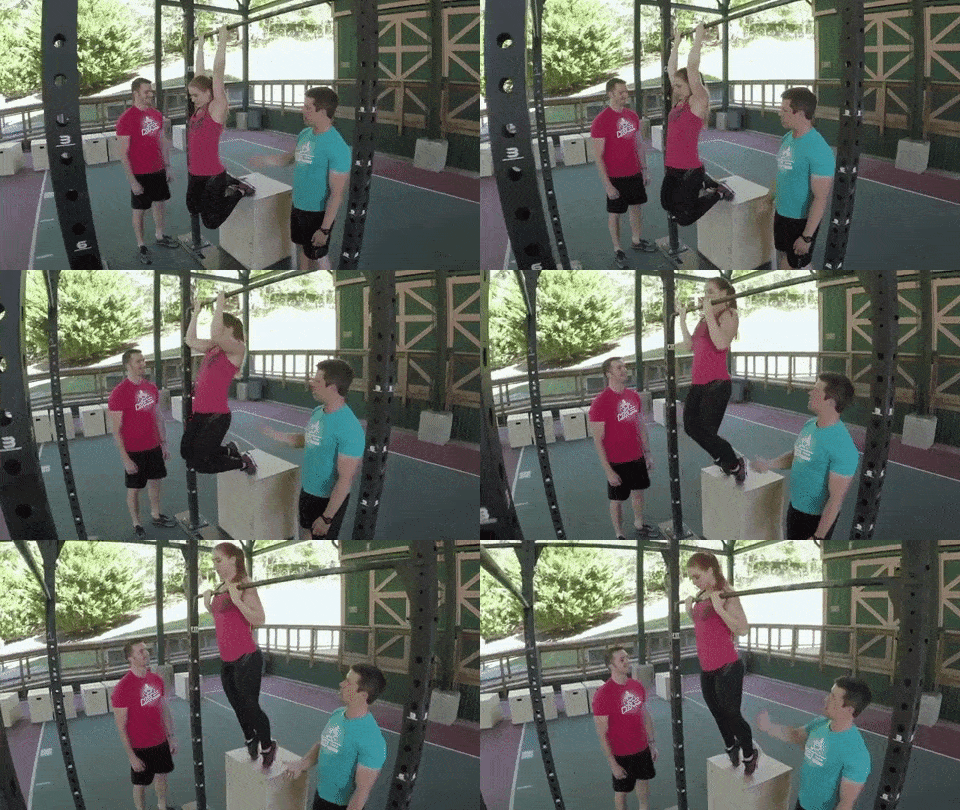
#3) Pull-ups (here’s how to do proper pull-ups)

The classic pull-up

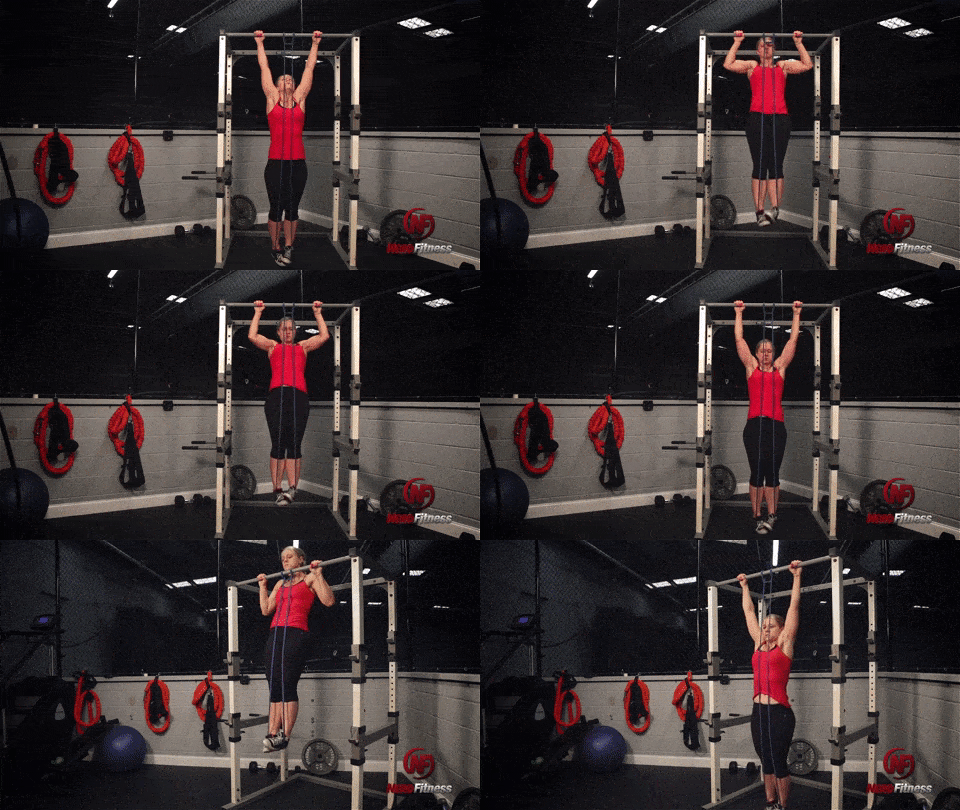
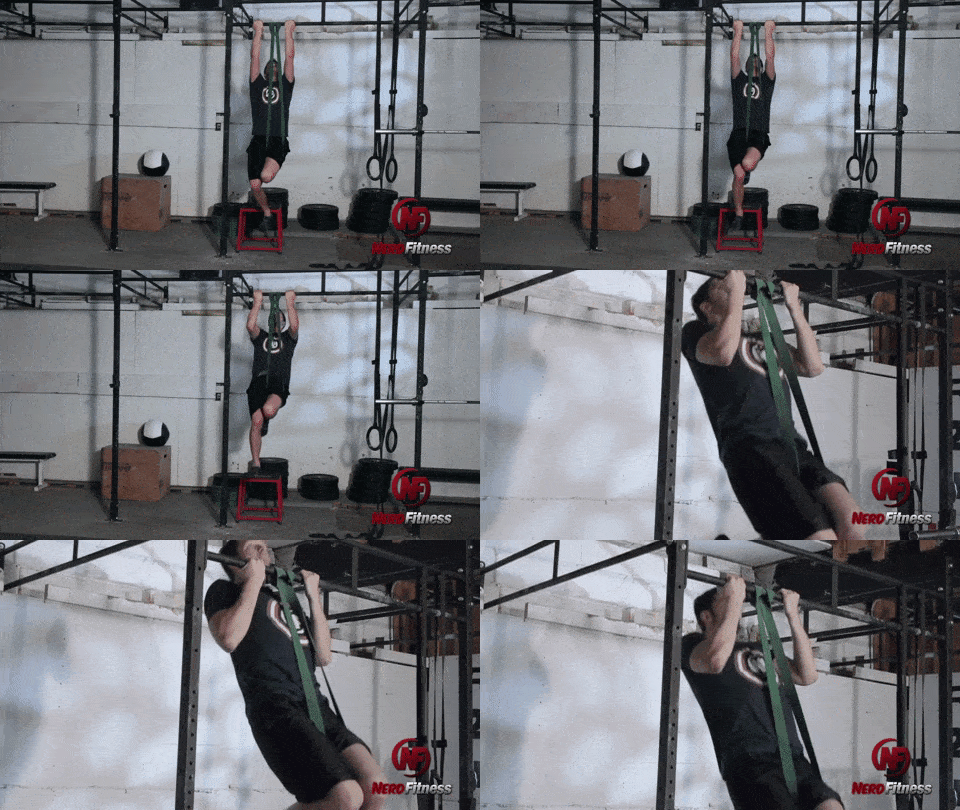
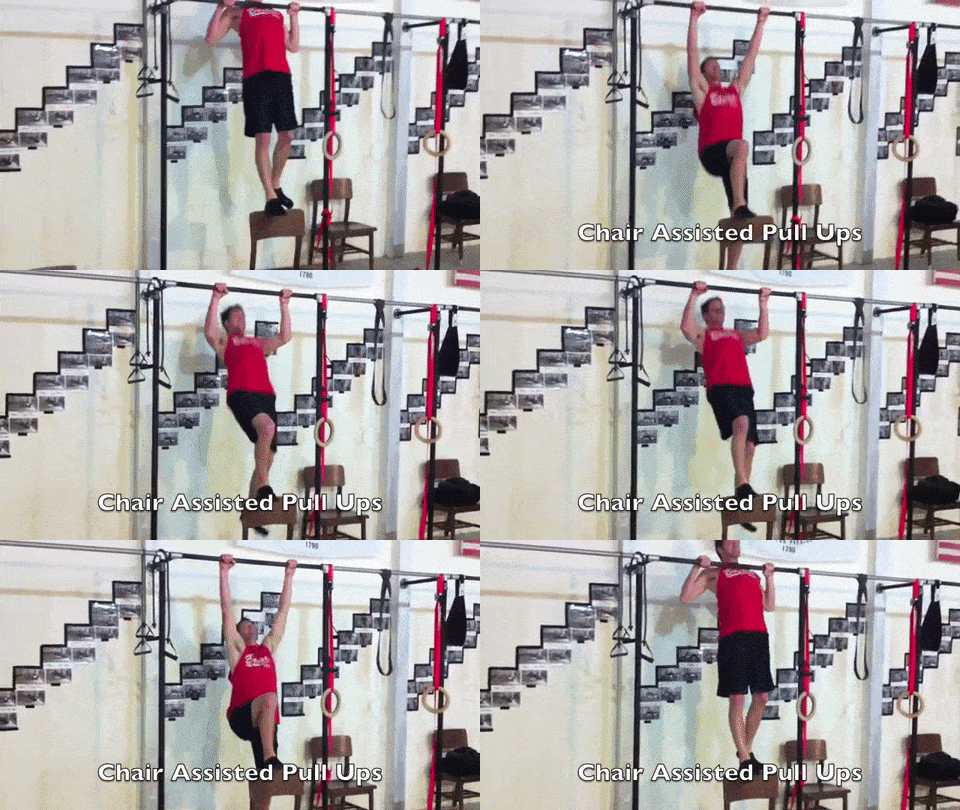
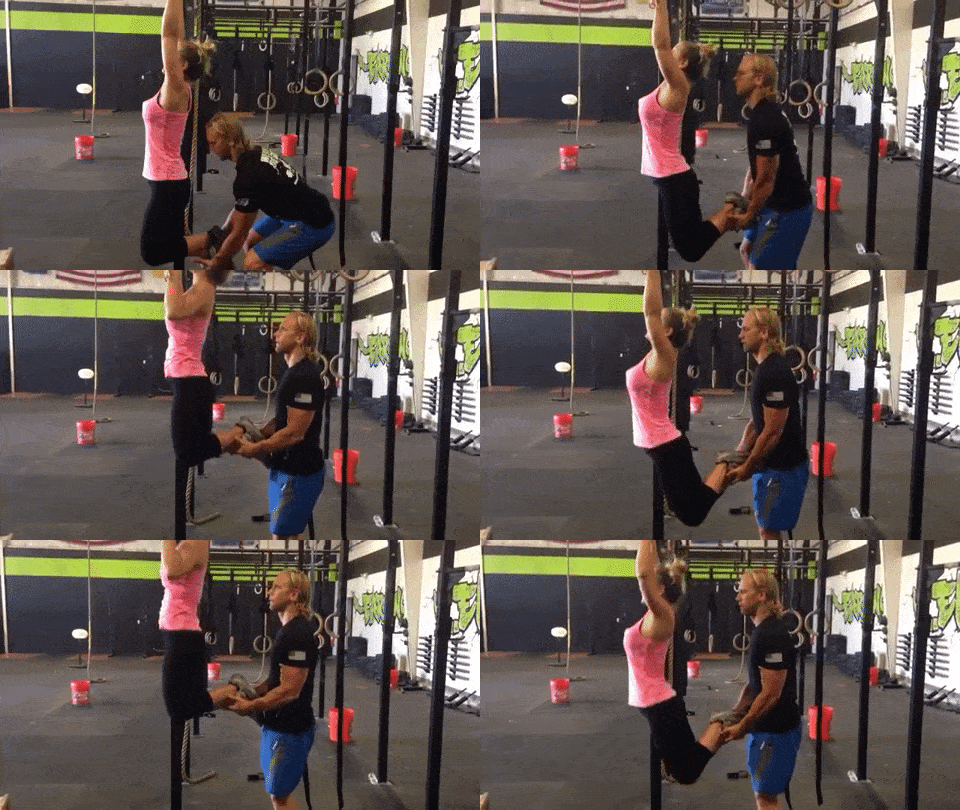
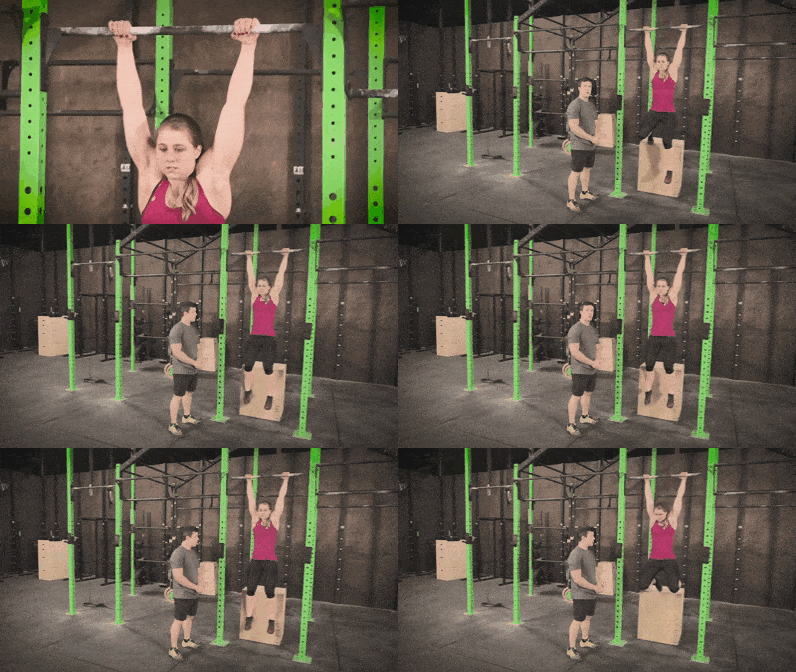
And if you can’t do a pull-up yet, here’s a great pull-up progression that will show you how to do assisted pull-ups to build up strength, like so:

Staci using a band for an assisted pull-up, a great exercise for a bodyweight circuit.

Too long didn’t read: get strong, and your life will get better.

Build muscle in the right places, and it can help you reduce “man boob” problems.

Now, if you’re all:

Steve this sounds awesome. I want to strength train, but damn man. I’m already self-conscious enough about my man boobs.

How the hell do I get enough confidence to go into a gym when I don’t know what I’m doing!

Great question.

If you want expert guidance, form checks, and a custom build workout (and nutritional guidance) to help you transform your physique, we have a private, 1-on-1 coaching program that spurs nerds into action.

Nerd Fitness Coaching Banner

Also, you don’t even NEED a gym to train (it might sketchy thanks to the pandemic). Here’s exactly how to start working out from home

Okay, we talked about exercise.

And I mentioned “nutrition” as a MAJOR component when it comes to weight and fat loss.

80-90% of “how to get rid of man boobs” will rest on how we answer the question: “what do I normally eat?

The science of fat loss (Proper nutrition and “moobs”)

We'll show you how to use science to experiment with reducing your man boobs.

TOUGH LOVE ALERT:

I can almost guarantee that your man boobs are NOT a result of a slow metabolism or genetics (outside of how your body stores excess body fat).

It’s due to the fact that you have been consistently overeating, day in, and day out, for years. 

Once you’re done being mad at me and defensive about this, you’ll realize this is great news!

Why? Because it’s fixable.

You are not broken.

You simply need to change how you deal with food.

I'll use this any chance I get!

To do that, we’re going to focus on sustainable changes.

After all, temporary changes create temporary results.

And we want to get rid of man boobs permanently.

So, in order for us to lose body fat, we need to expend more calories than our body consumes, consistently.

Let’s put some numbers to this: 3,500 calories equals roughly one pound of fat.

So if we do the math here:

  • There are seven days in a week.
  • If we want to lose one pound of body fat in a week (a worthy, sustainable goal for some), we need to create a caloric deficit of 500 calories a day.
  • We can do this by consuming 500 fewer calories, burning 500 more calories, or a combination of the two.

Remember this: a daily 500 calorie deficit compared to how we normally eat to lose a pound a week.

What does 500 calories look like?

Here are two examples:

  • The number of calories found in a Big Gulp of Mountain Dew.
  • An estimate of the calories required to run five miles.

Hopefully, those two dots above made your head explode.

Steve, you’re saying that in order for me to counteract just sipping on a Mountain Dew while owning noobs in Fortnite, I’d need to run 5 miles?

I haven’t run a mile since gym class. And that was 15 years ago.

Yup.

Nutrition is 90% of the equation when it comes to weight loss.

NINETY. PERCENT.

Luke saying "that's not true"

Okay, I don’t actually know the exact percentage, but 90% is dramatic enough.

I hope to get you to realize that changing your nutrition is the most important thing you can do to reduce “man boobs.”

Sure, exercise is important.

However, when it comes to creating a caloric deficit, it’s much easier to decrease calories consumed vs. increase “calories burned.”

Put a different way: would you rather pour out that Mountain Dew, or run five miles?

This is why Rule #4 of the Rebellion states “We understand that we can’t outrun our fork.”

Let’s tie together our discussion on “man boobs” with our philosophy on fitness: we’re eating too much, and our body is choosing to store these calories wherever it sees fit.

Unfortunately in this situation, it’s choosing to store them in our chest area.

We can’t change the past.

But we can change your future…and you won’t even need a wacky scientist.

Or can you change the past? No, you probably can't.

This is why we’re gonna reverse the trend: eat a caloric deficit, consistently and permanently.

Over time, our body will respond by burning fat from certain areas, in a certain order (again, this is out of our control).

As oour body fat percentage drops far enough, it should start to remove the body fat from your pectoral area.

We have two paths forward.

PATH ONE: Count every single calorie consumed. Every meal and morsel is recorded, no matter what. We can use a food journal, a calorie counting app like MyFitnessPal, etc.

It’ll teach you a lot about the food you eat, and yourself.

As for how many calories we SHOULD eat, se our Total Daily Energy Expenditure (TDEE) Calculator.

It works, but boy is it challenging:

A gif of someone frustrated

PATH TWO: follow our “simple plate” approach from our Healthy Eating Guide. Learn portions sizes, and start making slightly better choices. Focus on getting enough protein and veggies and cut back on liquid calories. 

If your meal plate looks like this, you're doing great!

I know that overhauling one’s diet is easier said than done.

But it’s time to take a proactive approach to nutrition.

You’re reading this article because man boobs are a real problem for you – educate yourself on what you’re eating and work on cutting back on the calories!

And that’s what we’ll cover in the next section: what foods to eat that will help you reduce your calories without you being miserable.

What should I be eating to lose “moobs”?

Eating veggies like these will help you reduce man boobs.

The Nerd Fitness philosophy on diet can be written in four words:

Eat mostly REAL food.

I lay it all out in our Beginner’s Guide to Healthy Eating, but come on.

Don’t act like you don’t know what “REAL food” is.

Real food is:

Food that grew in the ground, on a tree, ran on the land, swam in the sea, or flew through the air.  

Meat, fish, eggs, vegetables, fruits, nuts are all great examples of REAL food.

These image shows some real food, critical if you're trying to reduce man boobs.

This is what we should be eating, though we all know that.

Do you know WHY real food helps with weight loss?

Because if we stick mostly to REAL food, we’ll likely create a caloric deficit naturally.

But why tho?

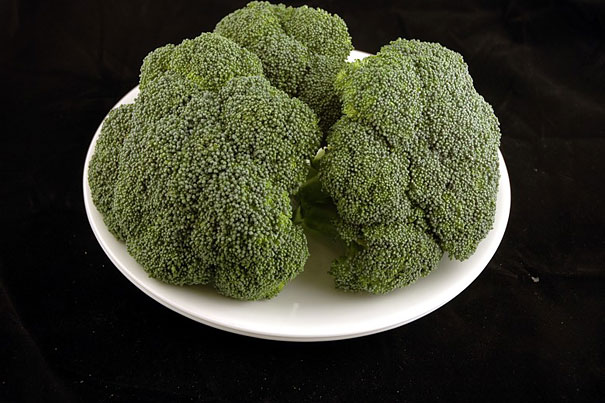
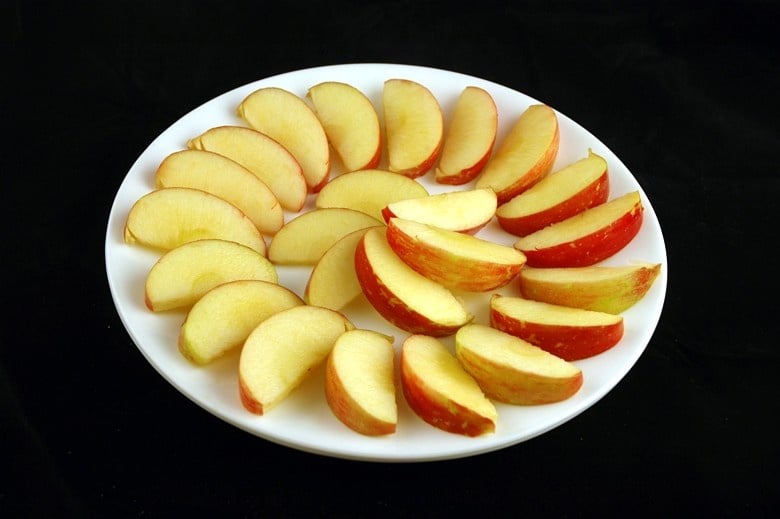
The fine folks at WiseGEEK did an awesome post where they took pictures of what 200 calories of a certain food looks like.

200 calories of broccoli gets you enough broccoli to fill up an entire plate:

Or half a Snickers bar:

Yeah. And who eats half a Snickers and says “I’ll save the other half for later?” 

Literally nobody.

If we want to create a caloric deficit consistently, focusing on REAL food is the answer.

Of course, I know a Snickers bar is way more delicious than broccoli – it was designed in a lab by scientists to be AMAZING!

And I’m not gonna tell you to never eat a Snickers ever again either.

Instead, we need to start being proactive about our food choices. If we’re gonna eat a Snickers, we better damn well be planning for that by reducing our calorie intake elsewhere.

And if the scale isn’t budging, and our man boobs aren’t getting smaller – we’re still eating too much!

Should we do the Mediterranean diet? Keto? Vegan?

Paleo?

Okay, so cavemen probably didn't live like this.

Maybe!

They all follow the same premise: by changing the foods we eat, we’re more likely than not to eat a caloric deficit without struggling. Certain people respond better to certain diets than others.

I personally follow a mental model diet, summarized here:

  1. Minimize and plan for processed food – they’re designed for us to overeat them. Take a look again at that Snickers bar. Do you really think you’d only eat half of one to stick to 200 calories? Of course not.
  2. Eat veggies. Vegetables are nutrient-dense and light on calories. Because of all the fiber, they are also tough to overeat. Imagine eating all that broccoli. Are you going for seconds? Probably not. So eat your veggies to help keep you full. Here’s how to make vegetables taste good.
  3. Avoid liquid calories. Cut back dramatically on soda, juices, smoothies, and any beverage with calories. Even most coffee orders (with sugar, cream, etc.) have a ton of hidden calories. Stick to water, and unsweetened tea or black coffee. Here are our thoughts on diet soda.
  4. Prioritize protein. Our body uses protein as the building block of muscle rebuilding. Outside of repairing our body, protein will also work to keep us full and satiated: 400 calories of chicken will leave us wayyy more full than 400 calories worth of Gatorade.[3] If you prioritize protein on your plate, you’ll be doing a lot of the heavy lifting on proper nutrition. Some great sources of protein include chicken, eggs, beef, pork, fish, nuts, legumes, quinoa, and most dairy products. Check out our Guide to Protein to measure how much protein you need every day.

These four points will help you on your journey to create a caloric deficit.

I know this is much easier said than done. After all, everybody knows they should eat more vegetables and yet 70% of the country is overweight.

Clearly, there’s more happening here than just “I need willpower and I need to try harder!”

Luckily you’re smarter than the average bear, because you’re reading Nerd Fitness:

Wayne appreciates both fitness tips and Stairway to Heaven.

If you’re struggling with portion control and challenges, jump fully into the NF community.

We cover human behavior and psychology to help you:

We’ve helped thousands of people like you here at NF, and we really focus on nutrition.

As we said, it’s 90% of the battle!

It’s why we created our 10-level nutritional system. Each level gets a bit more challenging and healthier, but you can progress at your own speed to make your changes stick!

I’ll send you the 10-Level Guide when you sign up in the box right here:

Does Soy Cause Man Boobs?

This LEGO is researching whether soy causes man boobs!

You don’t have to search far on the internet for the advice “avoid soy because it causes man boobs.”

It’s repeated so much, it’s assumed to be fact.

Is it?

This dog wants to know if soy causes man boobs.

The definition of gynecomastia (medical condition of man boobs) mentions “increased estrogen activity” as a major cause.

So when people say stay clear of soy, they’re worried about its impact on hormones like testosterone and estrogen.

Why the concern?

It comes down to a compound found in soy called “isoflavones.” Isoflavones are a type of phytoestrogen, which acts a little like estrogen, the central female hormone.

“Phyto” is derived from Greek and means “plant.” “Estrogen” is estrogen. So phytoestrogen more or less means plant-derived estrogen.

The fear of isoflavone rests with our bodies using this plant-like estrogen as actual estrogen. A report from Frontiers in Neuroendocrinology found that this is potentially possible.[4]

I should now note, we are about to wade into a controversial subject.

The science on soy is a little mix, so take warning.

We’ll be careful and rely on good old-fashioned science and studies for guidance.

However, sometimes science can point us in a couple of different and contradictory directions. When this happens, it’s important to acknowledge the uncertainty.

Compounds in soy may act like estrogen in the body. Does this apply to men though? And do they cause “man boobs?”

A 2005 study out of The Journal of Nutrition did find a relationship between soy intake and hormone levels in men.[5] However, they concluded these to be “minor.”

In 2010, Fertility and Sterility tackled the question on whether soy had “feminizing effects on men.”

They found it didn’t.[6]

Their report stated:

Neither isoflavone supplements nor isoflavone-rich soy affect total or free testosterone levels.

The journal concluded:

There is essentially no evidence from the nine identified clinical studies that isoflavone exposure affects circulating estrogen levels in men.

Case closed?

Is the case closed on soy and man boobs?

Probably, but I’d be remiss not to mention the following:

There is one documented case published in Endocrine Practice, where a man may have given himself gynecomastia by drinking three quarts of soy milk a day.[7]

His gynecomastia went away when he stopped. Granted, this is anecdotal evidence, which is far from proof.

However, it is interesting and worth noting to round out this discussion. And as mentioned earlier, the ability for phytoestrogen to act as actual estrogen does seem possible…

Steve, Just tell me: Should I ditch soy to ditch my man boobs?

Well, as with anything, quantity and context matters. Virginia Miller, an estrogen researcher at the Mayo Clinic, told a Vice journalist:[8]

The amount of phytoestrogens in various soy products varies by process method.

Dr. Miller didn’t think it was too problematic to eat soy, specifically mentioning that:

Eating tofu is probably OK.

Interestingly, Miller suggested that BPA found in plastic is more harmful to our endocrine (hormone) system than eating or drinking soy.[9]

Confusing stuff.

Whether soy causes man boos is indeed confusing.

In general, the consensus seems to be that as long as you don’t binge soy products, the amount of phytoestrogens found in a normal diet is fine.

If you have the actual condition of gynecomastia, soy is unlikely to be the root cause.

As more and more research is being done on this subject, this answer could change.

My opinion: this is a tiny piece of the puzzle…

Puzzle pieces coming together

…not the whole picture.

If we’re overeating terrible food every day, worrying about the soy we consume is missing the forest for the trees.

That’d be like…putting on a long sleeve shirt instead of a t-shirt for added protection, before driving 50 miles an hour into a brick wall.

Instead, maybe focus on wearing a seat belt, or better yet – not driving into the wall in the first place!

I swear that analogy made sense in my head before I typed it out.

Anyways – back to real specifics.

Here is the Nerd Fitness philosophy on soy: focus on total calories consumed and get that dialed in for consistently caloric deficit.

Only THEN, as our body fat starts to decrease, and we’re analyzing how our body responds to any and ALL types of food, see how our body responds to removing soy from our diet.

Want to have an expert guide you on this process? A fitness partner to help guide you on nutrition, including eliminating and then re-introducing certain foods? You can by checking out Nerd Fitness Coaching:


Do I actually have gynecomastia?

The only way to really know if you have gynecomastia is to go to a doctor.

A doctor can help you decide if you have gynecomastia.

They’ll be able to tell you (often with an ultrasound) if it’s a glandular breast enlargement or just fatty tissue.

They might also do some blood tests to check testosterone levels and female sex hormones like estrogen.

If you have an imbalance, gynecomastia could be a side effect. They’ll know for sure and can prescribe a treatment.

Also, they can verify that something very serious isn’t going on. In very rare cases, male breast enlargement can be a sign of cancer. Yes, men can get breast cancer.[10]

It should be noted: obesity itself is tied to increasing the development of real gynecomastia.

Excessive fat stimulates the body’s production of estrogen, spurring the growth of actual breast tissue.[11]

Said another way:

Pseudogynecomastia can turn into actual gynecomastia.

If you are diagnosed with gynecomastia, it’ll be between you and your doctor as to the next steps. I’ve seen men take one of three paths, as I’ve read anecdotes from our private support community for NF Prime:

  1. Men who had elective surgery (liposuction in some instances and skin tucks) to remove the fat due to gynecomastia. They are thankful for no longer being self-conscious about their chest areas. This is not an option for everybody for various reasons.
  2. Others have worked hard to reduce their man boob size through exercise and nutrition.
  3. Some have elected to not treat gynecomastia, or are working to reduce the fat around their pecs through diet and exercise before deciding what to do next.

If you’re concerned with “man boobs,” weight management is the path of action we’d recommend, whether you’re facing either gynecomastia or pseudogynecomastia. 

Reducing your body fat percentage can help keep your hormones in balance.

In addition, we’d recommend treating the root cause (poor nutrition and overconsumption of calories) instead of only treating the symptom (get rid of man boobs through liposuction).

Your unique situation is just that: unique.

I know many men who have treated pseudogynecomastia with diet and exercise, and I know others who are VERY thankful they had surgery to treat the symptom and are much happier as a result.

No judgment here. You do you, brother.

Cap here wants you to take the path you want on treating your man boobs.

At this point, I bet you have an additional question: “Can hormone balance be affected in the opposite direction? By increasing testosterone?”

Is there a way to boost my testosterone naturally?

Indiana Jones wants to know if he has gynecomastia or not.

If you do suspect you have a hormonal imbalance, speak with your doctor. They can run tests and tell you exactly what is going on, why, and how to treat it.

I will not be digging into medically supervised testosterone therapy (which is above my pay grade, and between you and your doctor), here’s our guidance on naturally boosting your testosterone levels:

#1) Strength training. I know. A few sections ago I devoted an entire area to strength training.

However, if you are looking for a natural way to boost testosterone, strength training would be a good way to go about it.

One 2017 study found, that although temporary, testosterone levels were shown to: “acutely rise immediately following an acute resistance exercise bout.”[12]

Because of the short-term increase, consistency is key with resistance training and testosterone levels. That’s likely why “regular exercise” has been linked with increased testosterone overal.l[13]

#2) Stress. Cortisol is a hormone that is promoted by stress and reduces free testosterone levels (in addition to signaling for your body to store fat).[14]

The more stressed out we are, the lower our testosterone will be. What’s a cure? Being mindful.

Meditation will help you lower your cortisol hormones.

Meditation practices have been shown to help control cortisol levels.[15] Want to start a mindfulness practice? Scope out our Nerd’s Guide to Mindfulness to get going.

Do you know what else is connected with higher cortisol levels and increased stress? Lack of sleep! If this is you, shut off Netflix and get to bed sooner.

#3) Overtraining. There can be too much of a good thing. Studies have found that both professional basketball and soccer players drop their testosterone levels by the end of a season.[16]

Which makes sense.

Tons of activity in a short amount of time gives no time to repair and heal. The same phenomenon has been found in ultra-marathoners.[17][[17]]That study on ultra-marathoners is right here.[[17]. Make sure you get plenty of sleep and schedule rest days.

#4) Eat red meat. Red meat is a great source of the amino acid carnitine, which has been linked to improved fertility.[18] Plus, it’s a good source of zinc, which has also been shown to help regulate testosterone.[19]

#5) Your results may vary. My friend Brett over at Art of Manliness did a 90-day experiment in which he doubled his testosterone levels through diet and strength training.

To be honest with you, even if you don’t have low testosterone levels, you should strength train, be mindful, and prioritize rest.

And maybe even eat a little red meat.

Red meat can be your friend, just don't make it your only friend.

And yes, I read that study that says red meat will kill you. I don’t agree with the fear-mongering.[20]

If you want help with strength training, nutrition, or even starting a mindfulness practice, check out Nerd Fitness Coaching! We help men (and women) level up their lives by providing actionable goals and accountability.


How to Start Reducing Man Boobs

A LEGO ready to fix this car and get his diet in order to tackle his chest fat.

So you have pseudogynecomastia.

And you’re interested in trying to do this the old-fashioned way before going down the route of surgery.

This would be my recommended path to everybody, though remember I’m not a doctor and I would recommend working with your doctor to put a plan in place together.

OUR NON-DOCTOR ADVICE FOR A DUDE TRYING TO GET RID OF MAN BOOBS NATURALLY:

  1. Take front and side photos without a shirt on today. This will help give you a frame of reference as you move forward with your changes. Pictures will round out your story.
  2. Consider a tape measure and take weekly chest measurements too. Just be consistent with how you take the measurements and look for overall trends! Here’s our Guide on Tracking Fitness Progress.
  3. Follow the above nutritional guidance and workout routine for the next month. Remember, I gave you four tips for healthy eating. If you requested our 10-Level Nutrition Guide, it’ll help make those suggestions permanent. Plus, I want you to start doing push-ups (on your knees is a great start). Do it immediately. It’ll help prep you for those Advanced Chest Exercises I talked to you about.
  4. If the scale is dropping, and your photos are showing “moob” improvement, keep it up! As I said earlier, consistency is the name of the game here at Nerd Fitness. “Slow and steady” beats “fast and quitting” every time.
  5. If you want to talk to a doctor to see if anything can or should be done about it, go for it! Medical advice is generally good advice. Bonus points if you find a doctor that strength trains and seeks to treat through nutrition and exercise first!

I do want to stress, that many male members of NF Prime have reported improving their “man boobs” through the strategies listed in this article.

I’d love for you to join us in NF Prime if you’re seeking a positive group to help you on your journey.

We are dealt a certain hand from the genetic lottery: whether we gain muscle quickly or slowly, whether we lose our hair or not, and whether we store fat in our legs or in our chest.

We can get mad about it, or we can play the hand we are dealt.

Until somebody develops robot legs, I’m not growing any taller.

Inspector Gadget can grow as tall as he wants. We are stuck with our genetics.

However, let’s not justify our internal excuses, or throw ourselves too big of a pity party.

What we do with our genetic fate, is completely up to us. And we have hundreds of thousands of people in the Nerd Fitness Rebellion who have overcome shitty genetics to transform themselves dramatically.

If you want 1-on-1 help to transform yourself, we got you!


We come in all shapes and sizes: you do you.

It's okay to be who you are now and want to grow into something new too.

The goal of this post is educational. To teach us how our body stores fat, and what can or cannot be done about it.

It’s more than okay to love yourself and also want to improve your physique.

Body positivity and wanting to look better are not mutually exclusive.

We’re all works in progress, and that’s great.

Keanu wants you to know it's okay to be a work in progress!

If you want to use this post to spur you to change, like cleaning up your diet or lifting some weights, awesome!

I’m glad Nerd Fitness can help lead you into action:

  • Reduce your body fat percentage through nutritional changes (which includes eating a caloric deficit).
  • Strength train to increase the amount of muscle you have, increase the “calories burned” portion of the weight-loss equation, and increase your testosterone.
  • Work with your doctor if you are reducing your body fat but not seeing any changes in your chest area – you might actually have a medical condition called gynecomastia.

Want help knowing exactly how to progress from here? 

I have MULTIPLE options for you. Pick the path below that best aligns with your goals and timeline:

1) If you want step-by-step guidance on how to lose weight, eat better, and get stronger, check out our killer 1-on-1 coaching program:

Nerd Fitness Coaching Banner

2) Exercising at home and need a plan to follow? Check out Nerd Fitness Journey!

Our fun habit-building app helps you exercise more frequently, eat healthier, and level up your life (literally).

Try your free trial right here:

3) Join the Rebellion! We need good people like you in our community, the Nerd Fitness Rebellion. 

Sign in the box below and not only will you receive our free weight loss guide, but our step-by-step plan for starting a Strength Training practice:

I know it’s easier said than done to say “f*** the haters,” but seriously, f*** the haters.

Take your shirt off at the beach: you deserve to enjoy the sun and sea like everybody else.

We’re all a work in progress, and I hope this post helps you continue to work on yours!

-Steve

PS: No seriously, f*** the haters:

It's okay to be who you are. Smile at people who hate on you for being you.

###

All photo sources can be found in this footnote right here [21]

The post Blog first appeared on Nerd Fitness.

from Nerd Fitness: Helping You Lose Weight, Get Stronger, Live Better. https://ift.tt/2zjLgEB
via IFTTT
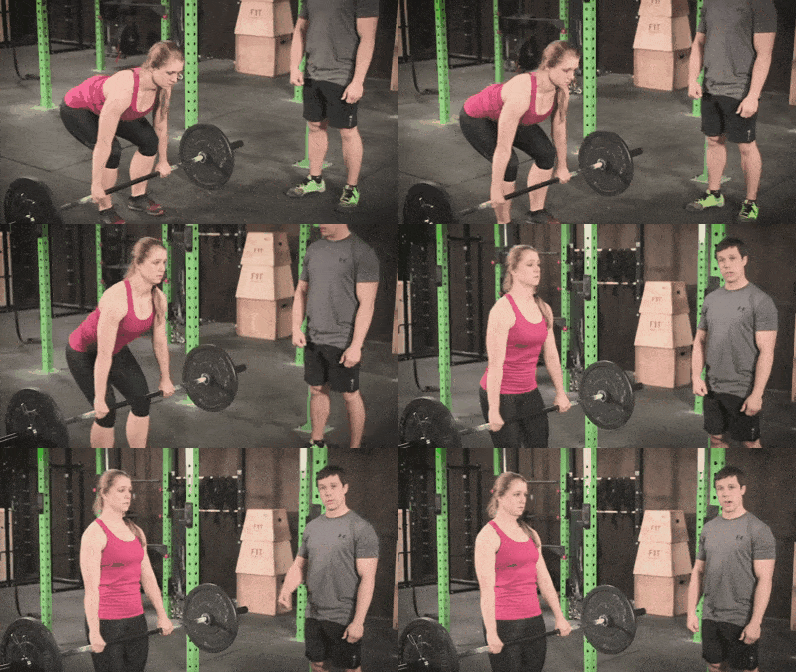
Categories
Uncategorized

#holistic #getfit #nutrition The Ultimate Guide to Building Muscle Fast (Training & Workouts)

This strongman in leotard knows how to build muscle and strength.

Want to build muscle like this guy?

(Leopard print unitard optional but encouraged)

In this guide, we’ll provide step-by-step instruction that will help you start building muscle immediately! Like, today!

We’ll explore:

That may seem like a lot of topics to cover. DON’T PANIC!

Because gaining muscle and strength really comes down to three things.

If you’re looking to start building muscle, getting bigger, and becoming stronger, these are the things you need to do:

  1. Lift heavy things[1]
  2. Eat a diet based on your goals[2]
  3. Get enough rest[3]

I realize doing those three things is much easier said than done – I struggled with progress for a decade and know exactly what you’re going through if you’re feeling unsure.

You probably don’t have years to make the mistakes that I did, and you just want to start getting results today.

In addition to the free resources below, we also offer 1-on-1 Online Coaching, where you’ll get personalized instruction for your body type and goals, and professional accountability from a Coach on Team Nerd Fitness!

Nerd Fitness Coaching Ad

But enough of that, let’s get into the nitty-gritty of how to get started with strength training!

How Do You Build Muscle and Strength? Lift Heavy Things

These barbell weights will help you grow muscle and strength.

If you are going to build muscle, you’re going to need to lift heavy things.

This means you’ll most likely need access to a gym with a great free-weight section.

Sure, bodyweight exercises can be fantastic for weight loss and keeping the muscle you already have.[4]

But if you’re serious about weight training you’ll need a gym with a:

  • Squat rack
  • Bench
  • Barbells

But we won’t completely nix bodyweight exercises, because ideally you’ll have a spot to do:

  • Pull-ups
  • Chin-ups
  • Dips

This space and equipment will help us be the most efficient, in order to apply the progressive overload principle to maximize your results.

Got access to a decent gym? If so, good, it’ll help us get started.

Because we’re looking to create functional strength and size, we’ll be doing lots of full-body routines with compound exercises that train multiple muscle groups at once.

A squat is a life changing exercise

They’re more efficient, they create solid growth and stimulation, and they will keep you safe.[5]

Why is that?

Well, when you spend all of your time doing isolation exercises on weight machines (ugh), you’re only working those specific muscles and not working any of your stabilizer muscles (because the machine is doing all of the stabilization work).[6]

On the other hand, when you do compound exercises like barbell squats, you work pretty much EVERY muscle in your body, setting yourself up to be strong and injury-free.[7]

Stay away from machines if you can and focus on dumbbells and barbell exercises.

If you’re going to do a full-body routine each workout (which is what I would recommend for ANY beginner), each routine can have one leg exercise, push exercise, pull exercise, and a core exercise:

  1. Leg Exercises: Squats, Deadlifts, or Lunges
  2. Push Exercises: Bench Press, Overhead Press, or Dips
  3. Pull Exercises: Inverted Rows, Pull-Ups, or Chin Ups
  4. Core Exercises: Reverse Crunches, Hanging Knee Raises, or Planks

That’s IT. Don’t worry about adding in any machine shoulder shrugs, iso-chest flys, preacher bicep curls, calf-raises, whatever.

Learn these few exercises, get really good at them, and your entire body will get stronger and bigger. Focus each week on adding more weight to each exercise.[8]

For example, from one week to the next you could do:

  • Week 1 Barbell Squat: 3 sets of 5 at 150 lbs.
  • Week 2 Barbell Squat: 3 sets of 5 at 155 lbs.

If you do that, you’ve gotten stronger. Then, repeat next week. Eat right, and you’ll get bigger too.

What’s a Sample Routine for Building Muscle?

These legos prioritize building muscle and strength.

Using the principles I’ve laid out in my “how to build a workout routine” article, here’s a three-day routine I’ve created for myself recently:

  1. Monday: Squats, Benchpress, Wide Grip Pull-Ups, Planks
  2. Wednesday: Deadlift, Overhead Press, Inverted Rows, Hanging Knee Raises
  3. Friday: Weighted Lunges, Weighted Dips, Weighted Chin-Ups, Reverse Crunches.

Each day has a leg exercise, push exercise, pull exercise, and some core work.

Besides having rest and recovery days in-between MWF, adequate rest intervals have been established in the workout itself!

By following the leg exercise, push exercise, pull exercise, and core exercise routine you will maximize rest in-between each exercise, therefore, limiting muscular fatigue and allowing you to perform each strength training exercise to its fullest extent.[9]

I know what you’re thinking: that Steve is very clever.

The classic head point gif.

While it’s possible to build out the perfect routine on your own, many of our Rebels end up spending hours and hours building something custom – only to realize it isn’t what they need (or isn’t effective) weeks and months later for their goals.

For people who want to avoid that altogether, we built the solution – our uber-popular 1-on-1 coaching program pairs you with your own Nerd Fitness Coach who will get to know you, your goals, and your lifestyle, and handcraft a workout plan that’s specific to not only your body, but also to your schedule and life.

Click on the image below to schedule a call with our team to see if we’re a good fit for each other!

Nerd Fitness Coaching Ad

How Many Sets and Reps Should I Do?

We have a MASSIVE guide on the exact number of sets and reps (it’s where the video above comes from), but you can follow the basics here.

  • If you’re just interested in getting stronger, you can do: 3-5 sets of 5 reps, with a focus on lifting heavier and heavier each week.
  • If you’re looking to add more size along with strength, mix up your rep ranges.[10] Sets of 5 reps will build compact explosive strength, while sets of 6-12 reps will build more size but less concentrated strength.[11]

If you get bored, want to change things up, or you’re looking to bust through a plateau, you can do the following:

  • This week, I might do 3 sets of 5 reps for each exercise (other than the core exercises), adding enough weight to each exercise so that it’s incredibly taxing.
  • Next week, I’ll do four sets for each exercise, adding weight each time and doing less reps.

For example, I’ll do an overhead press in the following sequence:

  • 100 pounds: 12 reps
  • 105 pounds: 10 reps
  • 110 pounds: 8 reps
  • 115 pounds: 6 reps

The good news is that no matter which path you take (pure strength, size, or a mix of both), as long as you are adding weight each week – and eating enough – you WILL be getting stronger.[12]

Sponge Bob knows how to build muscle and strength.

ANY path will work, provided you are progressively overloading your muscles with an increased challenge!

What’s progressive overload?

Coach Jim explains it all for you right here:

Progressive overload involves exerting slightly more effort than last time (lift a heavier weight or do 1 more rep) consistently.

Your muscles will have to adapt and rebuild themselves to get stronger. So in order to see improvements, your training must gradually and constantly increase.

We just have to make sure we get the right pace!

According to Mike Rebold from Hiram College:

Keep in mind that if the overload increases too quickly, poor technique and injury may result.  And if the overload progresses too slowly, improvements will be minimal or non-existent.

Slowly but gradually increasing your challenge could look like:

  • If you do 5 sets of 5 squats at 140 pounds this week, aim for 5 sets of 5 of 145 pounds next week.
  • Or if you’re doing 3 sets of 10 at 100 pounds, then next week try for 3 sets of 10 at 105 pounds.

Get stronger, which is 20% of the puzzle. The other 80% is nutrition (which I cover later)!

As I said before, if you want even more info, you can head to our article “Determining the Correct Number of Reps and Sets” for a deep dive into the subject.

Any Other Muscle Training and Weight-Lifting Tips?

CrossFitter lifting weights to grow muscle and strength.

#1) Warm-up before exercising – don’t walk into a gym, slap 45-pound plates on the bar, and then start your routine.

Get your heart rate up and muscles warm first by doing a dynamic warm-up of jumping jacks, lunges, bodyweight squats, hip raises, push-ups, leg swings, jumps, etc.

Arm circles like so are a great way to get your heart rate up before doing HIIT.

After that, always start with doing a set or two of lifting JUST THE BAR.[13] Only then should you start adding weight for some warm-up sets before moving into your real sets.

#2) Have a focused form – if you’re doing a bodyweight squat incorrectly, you might develop bad habits.

However, if you do a barbell squat incorrectly with 405 pounds on your shoulders, you could do some serious damage. If you’re just starting out, check your ego at the door: start with a VERY light weight and make sure you are doing the exercise properly.

There is NO SHAME in starting with just the bar. You can always add more weight next week if this week is too easy.

#3) Stimulate, don’t annihilate – I try to always have one more rep left when I finish a set.

Some trainers will preach working your muscles to annihilation, but I think that’s just asking for an injury, poor form, and beyond-sore muscles.

Your muscles get built while resting, not in the gym, so don’t worry about destroying them completely each day you step in the gym – it’s not worth it.[14]

Bugs Bunny needs to lift more to grow muscle and strength.

#4) Change up the time between sets – if you’re doing 3 sets of 5 reps of a really heavy weight, it’s okay to wait 3-5 minutes between sets – you’re focusing on pure strength here.

If you’re doing sets in the 8-12 range, try to keep the time between sets around a minute or so. This will affect your muscles in different ways.

For more, learn all about sets and rep ranges.

Just be consistent between sets and when doing the same workout between weeks to track your progress.[15]

#5) Don’t overdo it – More does not mean better in weightlifting. You don’t need to spend two hours in the gym, you don’t need to do 15 different kinds of chest exercises.

My routines last no longer than 45 minutes, I only do three or four sets (after warm-up sets) for each exercise, and it’s enough to stimulate muscle growth.[16]

Three routines a week is plenty too – you shouldn’t lift every day, as you need to give your muscles time to regrow bigger – remember muscles are made in the kitchen![17]

Less is often more – just make your routines really intense and exhausting.[18]

#6) Write down everything – Keep a training journal, and write down exactly how many sets and reps you did for every exercise.

That way, you can compare how you did this time with how you did last time. You’ll know how much more you need to lift this week to make sure you’re stronger than last week.

#7) Follow a routine, have a plan. The best thing you can do is have a plan to follow and stick with it![19]

We provide a free bodyweight routine, and a comprehensive gym training routine to get you started with strength training in our free guide, Strength Training 101: Everything You Need to Know. Grab your guide when you sign up in the box below:

Proper Diet to Gain Muscle (and Which Supplements)

What's the proper diet to gain muscle and strength?

If you’re skinny and trying to bulk up, this will be 90% of the battle. 

If you’ve been lifting weights for a while “but can’t seem to gain weight,” then you are not eating enough – it’s that simple.[20]

I thought I was one of those people who just could never gain weight…and then I learned it was all diet, started eating 4,000 calories a day, and I put on 18 pounds in 30 days.

A before and after of Steve in 2006.

Yeah, I wanted to throw up from always eating along with three Muscle Milk shakes a day, but it worked.

Looking back I would have done things differently (so many calories and so much sugar/carbs), but after 6 years of exercising without putting on any weight, it was great to see so much progress in such a short period of time.

4,000 calories sounds freaking insane, right? I know.

It makes eating a full-time job.

Arnold knows not to watch TV and eat for weight loss.

You’ll always either cooking, eating, or cleaning up after yourself.

But if you really want to get bigger and you’re struggling to do so, then all of your effort is going to have to go into eating more, eating healthier, and eating ALL THE TIME.

I’ve since changed my strategies and gotten much more calculated in my approach. It’s how I (jokingly) went from Steve Rogers to Captain America.

How fast can it take to grow muscle? It took Steve years of trial and error.

Here are a few different techniques for weight gain:

PATH #1: Eat a lot of whatever – this was my first plan years ago: it’s cheapest, the fastest, but probably the least healthy.

Just make sure you get 200+ grams of protein a day and 3,500+ calories in any way that you can:

  • Pasta
  • Rice
  • Pizza
  • Milk
  • Hamburgers
  • Chicken
  • Protein shakes

Whatever.

This is how I went from 162-180 pounds in 30 days. I’m not proud of how I ate, but it produced results and I remained healthy and strong.[21]

PATH #2: Eat a lot of “healthy” stuff – I did this once and put on about 10 pounds in 30 days. Lots of:

  • Oatmeal
  • Brown rice
  • Chicken
  • My home-made big-ass shake
  • Almond butter sandwiches on whole-grain wheat bread
  • Beef
  • Eggs
  • Fruits
  • Veggies
  • Milk

This works and is better for your insides than the previous method. Still relatively cheap, as tubs of oats, brown rice, and bread are inexpensive and can add on a lot of calories quickly.

PATH #3: Eat Paleo – I’ve tried this strategy too, and despite my best efforts to GAIN weight I managed to lose five pounds (all of which was fat).

It’s certainly possible to gain weight on the paleo diet (try adding in three big-ass Primal Shakes per day), but it is tricky and very expensive to get 4,000 calories of paleo-approved food daily. LOTS of nuts, eggs, sweet potatoes, shots of olive oil, and yams along with tons of chicken, grass-fed beef, fruit, and veggies.

PATH #4: GOMAD (Gallon of Milk a Day) – Obviously this method will only work if you’re not lactose intolerant.

GOMAD will for sure help you gain weight, as this kid can attest to.

Oh, and it has to be whole milk. You’ll definitely put on some fat, but you’ll build muscle and get really strong quickly – and then you’ll adjust the diet to thin out.

I’ve attempted this diet occasionally, as whole milk is certainly a fast path to tons of carbs, fat, protein and calories.

Plus, the calcium in the milk mike help.

Mike Rebold explains:

Milk is packed with a lot of calcium (300 mg per cup) and calcium is important because it regulates skeletal muscle contraction. In order to stimulate muscle contraction and produce force, calcium needs to be present and is responsible for stimulating something known as the sliding filament theory.[22]

If you go the GOMAD route, be prepared for your stomach and body to constantly feel bloated. Note: you can adjust the amount of milk you consume daily based on how your body responds.

“Which Supplements Should I Take to Build Muscle Quickly?” 

As we lay out in our Nerd Fitness Supplement Guide, most supplements are a waste of money and completely unnecessary for building muscle.

However, there are two supplements that CAN BE helpful in building muscle quickly:

  1. Protein ShakesIf you are struggling to hit your protein and calorie intake goals for the day, adding in a high-calorie protein shake can be a game-changer.[23]
  2. Creatine Supplements: Creatine helps your muscles retain water and can improve your performance, allowing you to push harder, for longer, in the gym.[24]

Are you vegan and trying to build muscle? Read our full article on how to go plant-based properly![25]

How Many Calories Should I Eat to Build Muscle?

How many calories do you need to grow muscle and strength.

That’s going to depend on your situation – your age, how much you weigh now, how much you want to weigh, and how fast your metabolism is.

  • For some, just 2,500 calories and strength training will be enough to build muscle.
  • For others, you might need to eat 4,000+ calories in order to put on weight.

The only way to find out is to track your normal calorie intake for a few days, and then start adding on 500 extra calories per day for a week or two and see if you notice any changes.[26]

Want a rough idea of how many calories you should be eating?

Head right here for our calorie requirement calculator.

Bottom line: If you don’t see any change, then you need to eat more.

Even if it's "vegan" it's still possible to eat a lot of calories.

  • Yes, it will feel excessive.
  • Yes, you will feel full all the time.
  • Yes, it’s a pain in the ass and expensive.

But if you really want to be bigger, then you are going to need to really dedicate yourself in the kitchen.

Unless you’re a genetic mutant, it’s incredibly tough to build muscle and strength without overloading your system with calories and nutrients.

Just keep eating.

Won’t All of This Eating Make Me Fat? I Don’t Want to Get Bulky.

Buddha isn't trying to lose weight. But he's also zen about you trying to.

I get this question all the time in emails, usually from guys who are 6 feet tall and 130 pounds.

Don’t worry, if you can’t gain weight now, putting on extra weight is going to be great for you.

Yes, you will put on SOME fat along with the muscle you’re building if you’re running a calorie surplus.

Yep, the bigger you are, the more calories you need.

This is why picking the right amount of calories per day is important:

  • If you can build muscle at 3,000 calories, but you’re eating 4,000 calories, you’ll put on a pound or two of fat per week along with your muscle.
  • However, if you need to eat 4,000 calories to build muscle and you’re only eating 3,000, you won’t see any changes.

Everybody is different, so you need to experiment and find out what works best for you.[27]

Once you get to your desired weight (actually, aim for about 10-15 pounds heavier than your goal weight), you can scale back the calories, add in some extra sprints to the end of your workout, and keep lifting heavy – the muscle will remain, the fat will disappear, and you’ll be left with the body you want.

I’m not skinny, I need to LOSE weight – what’s different for me?

As Coach Matt explains above, you can actually build muscle and lose body fat at the same time.

You just have to be careful about how you do it.

We cover the subject in depth in the post, “Can You Lose Fat and Gain Muscle at the Same Time?

This gist goes like this:

If you are eating enough protein, and have decent fat stores to pull from for energy needs, you can build muscle even while in a caloric deficit.

As long as you are resting (next section) and strength training (previous section), you can shed body fat while still putting on muscle.

Now, this only works if you have plenty of fat stores to pull from. Once you start to lean out a little, you’ll likely have to increase your calories to start putting on more muscle.

Look at me all big and strong!

I recently added some strength (and muscle) while losing 22 pounds in 6 months.

Just remember, you can build muscle while losing weight if you:[28]

  1. Sustain a caloric deficit
  2. Lift heavy
  3. Prioritize protein
  4. Rest

Let’s talk about that last one for a bit.

Rest Days for Building Muscle and Strength

How much rest should I get to build muscle?

If you’re skinny and trying to bulk up and build muscle, avoid cardio like the plague (also avoid the plague).

Why?

Take a look at the best marathon runners in the world, and compare their physique to somebody like Usain Bolt, the best sprinter in the world – tons of muscle, power, and a body to envy.

a gif of Usian Bolt

There’s nothing wrong with EITHER body – we’re all awesome and are special and blah blah blah.

But you’re reading an article about how to build muscle fast, right? So focus all of your effort on building muscle![29]

You want all the calories you’re consuming to go towards “building muscle,” and not “fuel my run.”

Mr. Gump ran like 1,000 5Ks when he crossed America.

I will admit that I’m biased against chronic cardio, but mostly because it bores me!

You can be far more effective when you focused on getting stronger and only do ‘cardio’ on things you enjoy – after all, your success will largely depend on your nutrition, NOT your cardio!

Personally, I spend three days a week in the gym, with each workout clocking in at 45 minutes.

I go for long walks on my off days along with a day of sprints to stay active, but I know that my muscles get built while I’m resting, not when I’m working out.

I really focus in on my workouts to make them as exhausting as possible, and then I give my body ample time to recover (while eating enough calories to produce a surplus).

If you’re lifting heavy, and eating enough, make sure you’re also getting enough sleep! 5-6 hours a night isn’t going to cut it – you need to get at least 8-9 hours of sleep per night for optimal muscle-building. Take naps too if you have the opportunity.

Sleep needs to become a priority, because while we’re asleep, growth hormone, a hormone responsible for regulating muscle growth is released.[30]

If you’re a big guy/girl trying to slim down, a little extra cardio might speed up your fat loss but if you’re not eating correctly, it might result in losing some of the muscle you already have.

Don’t worry about going for 10 mile runs on your off days – do 20-30 minutes of intervals or go run hill sprints in your park. The weight will come off more slowly, but you’ll only be losing fat, not fat AND muscle.

Once you hit your goal weight and the target amount of muscle mass, I’d recommend adding back in some cardio for your overall conditioning, but keep it varied (sprints and intervals). The focus is to keep building explosive muscle and not long, slow, boring muscle.

If you love going for long runs and aren’t going to give that up, I’m not gonna stop you. Just know that the long hours of cardio will severely inhibit your progress on building strength and size.[31]

Get Started Building Muscle Today

Landscape shot of someone who has built muscle and strength.

This is a basic overview to get ya started. It really boils down to a few major things:

  • Lift heavy
  • Eat lots of good food
  • Rest

Simple to understand, tough to implement.

Trust me, I know – I’ve been battling this for the past decade.

If you made it this far, and you want more specific instruction, here’s how Nerd Fitness can help!

1) If you are somebody that wants to follow a tailor-made program designed to build muscle and grow strong, check out our popular 1-on-1 Online Coaching Program.

You’ll work with our certified NF instructors who will get to know you better than you know yourself, check your form, and program your workouts and nutrition for you.

Nerd Fitness Coaching Banner

2) If you want a snazzy app to teach you exactly how build muscle and strong, check out NF Journey. Our fun habit-building app helps you exercise more frequently, eat healthier, and level up your life (literally).

Try your free trial right here:

3) Join the Rebellion! We need good people like you in our community, the Nerd Fitness Rebellion. 

I’ll send you two free resources that will help you reach your goals: our massive Strength Training 101 guide and a Bulk Up Cheat Sheet and Shopping List.

So did I miss anything:

Any unanswered muscle building questions?

Do you have any tips or tricks I’m missing?

Any success stories from our community to share?

Post your questions in the comments and I’ll go ahead and answer them.

Let’s hear your strength and muscle stories!

-Steve

PS: Be sure to check out the rest of our Strength Training 101 series:

###

All Photo Sources are found right here.[1]

The post Blog first appeared on Nerd Fitness.

from Nerd Fitness: Helping You Lose Weight, Get Stronger, Live Better. https://ift.tt/3eatY1l
via IFTTT
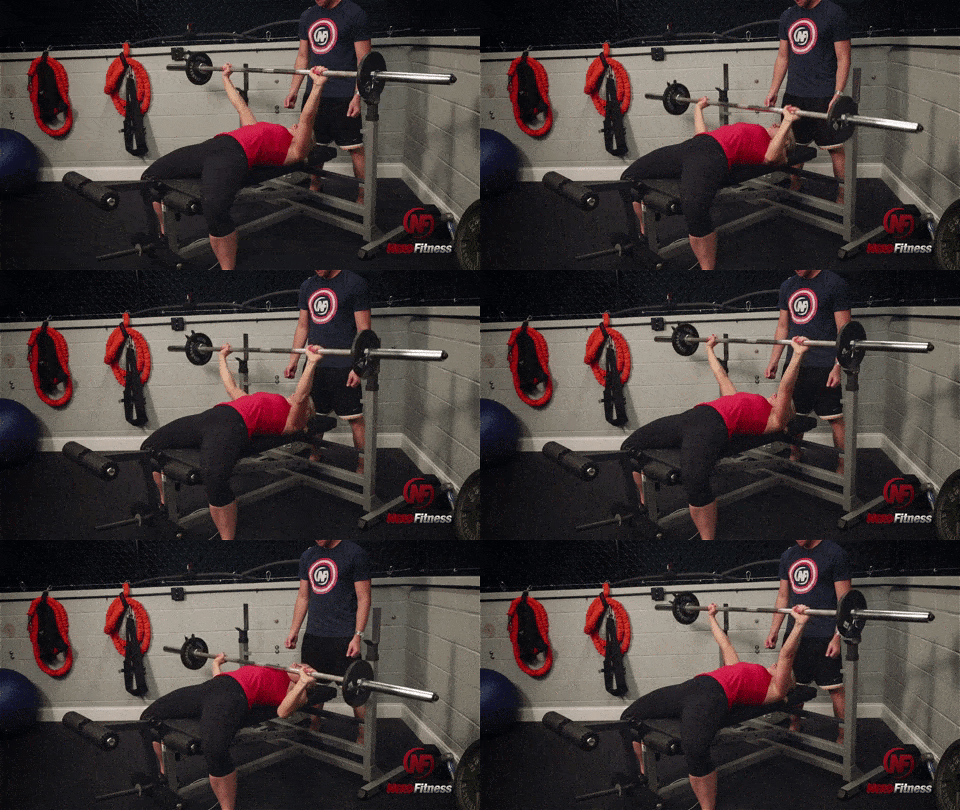
Categories
Uncategorized

#holistic #getfit #nutrition 3 HIIT Workouts for Beginners: Start Interval Training and Sprint Running!

This biker loves interval training.

This High-Intensity Interval Training (HIIT) guide is probably the best interval training guide in the galaxy.

My justification for such a bold claim?

We’re really good at this stuff, AND we have dinosaurs and Muppets.

Plus, lots of great gifs:

This runner can't do interval training.

We build custom interval training programs just like the ones in this guide for our 1-on-1 Online Coaching Clients, including workouts for at home, the gym, or even while traveling.


In this Ultimate Guide to Interval Training, we’ll cover:

If you’re interested in starting a HIIT practice (which you are, ’cause you’re here), you may want to try our new app! It contains a fun adventure that will take you from sitting on your couch to a full HIIT workout – with plenty of benchmarks in between for you to find your groove. No guesswork needed, just jump into the app and follow it’s next steps.

You can sign-up for a free trial right here:

Alright, let’s do this thang.

What is Interval Training? What is HIIT?

These bikers love doing HIIT.

In 2018, High-Intensity Interval Training (HIIT) was ranked the number one fitness trend by American College of Sports Medicine.[1]

They wrote:

HIIT typically involves short bursts of high-intensity exercise followed by a short period of rest or recovery and typically takes less than 30 minutes to perform.

Essentially, HIIT is just following a specific regimen where you vary your speeds and intensity throughout a shorter run, swim, bike, or row.

Any exercise can be a form of HIIT, but here’s a common routine:

  • Jogging lightly for three minutes.
  • Pushing yourself harder for a minute (run or sprint).
  • Repeating this cycle 4 more times.

Because everybody is busy and overwhelmed, fast results in the least amount of time is why most people discover HIIT. 

Plus, you can do HIIT with just about anything, including a jump rope:

Coach Jim showing you jump rope double unders

You may be asking, “Steve, just how short and intense are we talking about here? Also, your new haircut looks spiffy.

Thank you, you’re very kind.

So let’s explore the pros and cons of intervals.

What are the Benefits of HIIT? Why Should You Do Interval Training?

 silhouette of man running towards the sun at cloudy background

The 1996 landmark Tabata study demonstrated the benefits of extreme HIIT.[2]

Dr. Izumi Tabata, from Japan’s National Institute of Fitness and Sports, was obsessed with interval training.

The doctor sought to see exactly what kind of gains were obtained from short, intense, periods of exercise. He conducted an experiment with Olympic athletes on stationary bikes and put them through intense bouts of exercise followed by short periods of rest.

The results were fascinating.

Tabata found:

That 6 weeks of moderate-intensity endurance training did not affect anaerobic capacity, but that 6 weeks of high-intensity intermittent training (HIIT) may improve both anaerobic capacity and VO2max simultaneously.

Let’s translate that: compared to regular cardio, HIIT had a greater impact on improving BOTH:

  • Aerobic increases (endurance).
  • Anaerobic increases (power).

Even crazier?

Tabata was able to demonstrate improvements in his athletes with just FOUR-MINUTE bursts.

So what’s happening here?

Simple: your heart is a muscle.

Yes, the heart is a muscle.

If you keep your heart beating at a constant rate, never expanding it outside of its comfort zone, it will never grow stronger.

By introducing chaos and pushing your muscles outside of their comfort zone, they must adapt and grow more resilient in order to survive.

Intense interval training challenges your heart by constantly forcing it outside of its comfort zone.

In other words: progressive overload – the same concept behind building strength.

Coach Jim explains 7 different ways to achieve progressive overload in this video:

Since Tabata’s 1996 study, many other trials have shown the positive impact of interval training. 

Here are some of the benefits of High-Intensity Interval Training:

#1) HIIT for Weight loss. A study in the Journal of Obesity found participants were able to lose more body fat following a HIIT program compared to regular cardio.[3]

The Journal concluded:

HIIE (High-Intensity Intermittent Exercise) three times per week for 15 weeks compared to the same frequency of SSE (Steady-State Exercise) was associated with significant reductions in total body fat, subcutaneous leg and trunk fat, and insulin resistance in young women.

This makes sense, because other studies suggest high-intensity interval training burns more calories than a “steady state” workout.[4]

Revving up your effort requires more out of you, including calories. 

Batman has to fun whether he likes to or not...part of fighting crime means running 5Ks (ish).

Plus, interval training can take less time than steady-state cardio.

The average interval training workout is 20 minutes or less.

However, to confuse the matter, I should note that a meta-study (a review of multiple studies) found no real difference in fat loss between HIIT and steady-state cardio.[5] We’ll talk about this, and the impact of diet for weight loss, later. 

#2) HIIT for lowering blood sugar. Managing blood sugar is really important for health, not just for diabetics.

Those trying to lose fat should be aware of their blood sugar and corresponding insulin levels.

The good news for our current discussion? HIIT has been shown to help lower and manage blood sugar levels.[6]

#3) HIIT for heart health. Touching on the “antifragile” topic again, HIIT has been shown to help with overall cardiovascular health.

It does so in the same way traditional endurance training does, but at a fraction of the time (almost half).[7]

Alright, let’s chat about how to actually do some interval training.

What’s an Example of Interval Training? How to Do Interval Running

Man running in a gym on a treadmill

The key to HIIT is being able to go from “easy” to “difficult.” All sorts of different exercises can get you there:

  • Aerobic (cardio).
  • Bodyweight (strength training).
  • Resistance (weight training).

HIIT is generally associated with running (aerobic), so we’ll devote this section to just that.

The easiest way to experiment with HIIT would be to run.

Mr. Gump ran like 1,000 5Ks when he crossed America.

Here’s how to start with a basic HIIT running workout. Go to a park in your neighborhood. Warm-up with some light jogging, high knees, and mobility – leg swings, arm swings, etc,

And then begin your workout!

  • Run/jog at a brisk pace for 30 seconds.
  • Jog/walk at a slower pace for 2 minutes.
  • After your rest, shoot for another 30-second run/jog.
  • Continue until you get tired or after about ten “push/rest” intervals.

And BAM! You just did HIIT.

Don’t get disheartened if you find yourself stopping a lot during your first week of HIIT training. 

Andy Dwyer hates running, but I bet he'd like HIIT more.

You’ll be surprised how quickly you get better at this!

Also, “running” or “jogging” is subjective. Whatever walking fast means to you is great. Do that for your periods of intensity.

It should be noted, that the entire “Couch to 5K” concept rests on interval training through running.

It’s all broken down into “walking,” “jogging” and “running.”

If you’re curious, check out our in-depth Couch to 5k review. If you want to start interval training, “Couch to 5K” could be a good way to do it.

More of an indoor person?

Consider a treadmill, where it actually sets intervals for you based on your desired difficulty.

Just be careful on it…

Pay attention to your running technique or things can go wrong!

We’ll be talking about machines a lot more in the next section, but a treadmill is all you need to do a HIIT workout.

Experiment with the speed and incline to find a setting that you would consider “intense.” Many machines can be programmed to flip between this and an “easy” setting.

And you know what that means… boom! It’s built for HIIT.

When we designed NF Journey (our awesome new app), we used an “intense” and “easy” interval switch for most of the workouts.

If you want, you can sign-up for a free trial right here to see what I mean:

How do HIIT Workouts Work? (More HIIT cardio to choose from)

Biking is perfect for HIIT.

There are a lot of different aerobic exercises for HIIT cardio.

For example, you could jump on a bike, which is like HIIT running but with wheels (duh):

Kermit loves interval training on his bike.

Every spin class is based on HIIT cycling (SoulCycle, Flywheel, or even your local gym now has spin classes).

They’re popular for a reason, and you can make a friend or two!

Here are some more examples of interval training:

  1. Elliptical. If it has a dial for resistance, it can be used for interval training. For a couple of minutes, go on low resistance (0-2 level). Then crank up the resistance for one minute (up to 8-10). Repeat this process 12 times, which will give you a 20-minute workout.
  2. Stair Climber. Much like the elliptical, alternate between periods of low intensity for two minutes, then one minute for high intensity. The difference with the climber is the dial will control the speed of the stairs. Be careful.
  3. Rowing Machine. Start with a two-minute warm-up. On minute three, row like you’re being chased by the Kraken for a full 60 seconds. Then catch your breath. The rowing machine might be hard to do for a full 20 minutes, since it’s a lot of upper body. Shoot for ten minutes at first.
  4. Jumping Rope. Jumping rope is a full-body exercise. Also, it’s fun. There’s no dial here, your own body controls the pace of the jump. Follow the same two-minute easy, one-minute intense as above. Jump rope can also be done with friends!

This dino loves jump rope for HIIT.

So far we’ve just been talking about aerobic exercises.

Let’s cover our other categories, of bodyweight and resistance.

What Are the Best HIIT Exercises? (Two Other Forms of Interval Training)

The woman rower in a boat, rowing on the tranquil lake

“Steve, this all sounds great. But I hate running!”

Confession: So do I.

So I get my cardio in other forms!

Here are some bodyweight exercises to get going on HIIT:

  • Burpees. Stand up, then squat down, kick your legs out, do a push-up, bring your legs back in, and explode up into a jump. Try to do 20 repetitions, then rest for two minutes. Repeat until you hate yourself:

  • Push-ups. For 20 seconds, do as many push-ups as possible. Rest. Then do it again. If you’re worried about proper form, check out our push-up guide and watch this:

  • Pull-ups. Same idea as above, do pull-ups for 20 seconds, then rest. If you can’t do a pull-up, we got you covered in our pull-up progression guide:

Let’s now chat about some Weight Training Examples for HIIT:

  1. Kettlebell swing. For ten minutes, do 20 kettlebell swings on every minute.Coach Staci showing you the kettlebell swing
    This will be intense, and worthy of congratulations when you’re done. Check out our 20 Minute Beginner Kettlebell Workout for everything you’ve ever wanted to know about kettlebells.
  2. Battle ropes. If your gym has battle ropes, they’ll be a great tool for HIIT. For intensity, the amount of slack in the rope determines the load. The more slack on the rope the tougher, and more intense, the workout. Also, don’t get stuck in just up and down movements. Some variation will help target different muscles.
  3. Weight lifting. The critical piece will be moving from one exercise to another quickly enough. For example, hustling from the bench press to the lat bar: we call this circuit training!

To answer your next question: yes, you can also do circuit training as a form of HIIT.

Circuit training is going through a sequence of exercises, or stations, back to back.

Coach Lauren explains the ins and outs of circuit training in this video:

So in a circuit you could go from push-ups to pull-ups, back to push-ups, only resting briefly from one exercise to another.

Circuit training would be perfect to mix into a HIIT workout, since you can design your circuit to be very intense.

Check out our post for 15 Circuit Training Routines to choose from.

Plus, there’s a Batman workout hidden in there. You’re welcome.

We create custom HIIT programs for busy people like you that are ACTUALLY fun. If you’re looking for a supportive coach to guide you and tell you exactly what to do each day, we got you covered!


If you just want a beginner circuit to get started with, you can try out our Beginner Bodyweight Workout Routine. Plus you can download a free worksheet to track your progress with this circuit when you join the Rebellion below:

Oh, what’s that? You want to have even MORE fun while getting the benefits of HIIT? 

Let's get crazy with Interval Training

Sure. Let’s think outside the box:

Basketball, tennis, soccer, and Ultimate (frisbee) are AMAZING styles of exercise that use interval training (it’s all start and stop!).

Run here, catch this, and wait for the next round to start.

That’s what we’re looking for in a HIIT workout.

So pick a form of FUN exercise that gets your heart racing faster and slower throughout the activity (yes, I suppose even THAT activity would count).

Is HIIT Good for Losing Weight? Is Interval Training Good for Losing Weight?

This mermaid is interested in HIIT for weight loss.

My guess is that you’re reading this article because you’re trying to get the most efficient “bang for your buck” when it comes to getting in shape.

And HIIT is a great form of exercise and COULD help with weight loss.

I will, however, lower some of these outlandish claims that exist in the media.

For example, Time magazine calls HIIT “miraculous” in one article.[8]

That’s a little much, even for me, who writes for a living on why you should work out and likes using hyperbole for effect.

Seriously, I’m better at it than ANYBODY ON THE PLANET.

Ahem.

Cardio, strength training, and HIIT all have many benefits.

But as I said earlier, a meta-study reviewed HIIT compared to steady-state cardio.

The results?

They found no real difference.[9]

The Doctor saying "it doesn't matter"

As researchers noted:

Regular exercise is an integral component of long-term weight management. However, unless implemented in very large volumes, short-term exercise in isolation (including HIIT) is unlikely to produce clinically meaningful fat loss.

What’s that mean?

As long as your energy expenditure is the same (and you’re in a caloric deficit), steady-state cardio is equivalent to HIIT for fat loss.

In other words, if you want to lose body fat, how you eat will be responsible for 80% of your success or failure.

It doesn’t matter how many intervals you do – it’s not gonna help you lose weight if you don’t also fix your nutrition.

You can read our Beginner’s Guide to Healthy Eating if you want more information, which will help you build a plate like this:

If your meal plate looks like this, you're doing a lot of the heavy lifting for weight loss.

And if you want to download our free 10-level Nutrition Guide to help you fix your diet starting today, you can do so by signing up in the box below:

Getting Started with Interval Training

These pirates are ready to do some HIIT.

When it’s time to advance your high-intensity interval training, think about the following:

  1. Frequency. This would be the number of intervals in your workout.
  2. Intensity. How hard are you going in each interval?
  3. Time. How long are your intervals and rest periods?

Maybe you start out doing 3 intervals of intense running.

Once it becomes routine, bring it up to 4.

Maybe you crank the resistance on your stationary bike to “8” during your intense interval. When it becomes normal, bring it up to “10.”

Maybe you do pull-ups for 20 seconds. When you’ve got a good handle on that, aim for 30 seconds.

This mindset will keep you advancing in interval training.

A group of allies can help with victory

Consistency is the name of the game here. Even just doing a HIIT workout once a week will help you progress in all three categories.

For more ideas on how to improve workout consistency, check out this video from Coach Jim:

Oh, and if you want help along the way, don’t forget about our Online Coaching Program:


Mistakes to Avoid When Doing High-Intensity Interval Training

Don't anger people by doing HIIT wrong.

There’s a lot to consider when embarking on a HIIT practice.

No matter which routine you end up starting with, make sure you follow these words of wisdom:

  1. Ease into it. As the saying goes, “you must walk before you can run.” The importance is building a HIIT practice. If you need to go “less intense” before progressing to “intense,” that’s fine. It’ll help build your aerobic capabilities (endurance), which will be important when working on intensity. Start with walking.
  2. Keep proper form. Doing your movements correctly will help prevent injury. Here’s how to run properly. This is even more critical in your later intervals, where you may be exhausted and tired. If you find yourself breaking form, go ahead and slow down. Intense isn’t worth an injury.
  3. Get rest. Our bodies actually build muscle while we are resting. So take some “off days” from your HIIT practice. Want to stay active on these days? Do some fun exercise!

Take it easy, focus on your form, and make sure to prioritize rest.

HIIT Timer Recommendations

A timer is great for doing interval training.

HIIT centers on doing intervals.

One moment it’s intense, the next you’re onto a short rest break.

A good way to know when it’s time to go from one sequence to the next is a timer. A loud “beep” can tell you when it’s okay to catch your breath or when you have to kick it in gear.

Here are 5 HIIT timers you can try out:

  1. Runtastic. Don’t let the name fool you, this free app is for more than just running. You can customize for many different interval workouts, depending on what exercise you go with. And the interface looks slick.
  2. Seconds. It’s free and customizable to any form of HIIT. It can also integrate with your music, which is pretty sweet.
  3. Seven. If you’re new to HIIT, Seven would be a good app for you. It’s free, plus it has illustrations for exercises. You also get to customize your own virtual personal trainer, which may be the future of fitness. The bots are coming…
  4. Sworkit. First off, it’s a clever name (taken from “Simply Work It.”) Second, it’s free. Third, it can display your workout, goals, and calories burned. I like it.
  5. J&J Official Seven Minute Workout. This free app from Johnson & Johnson is actually really awesome. It has premade workouts you can choose form based on your fitness level, or tweak them to make it your own.

Also, we need to talk about interval timers. Most of the apps referenced are completely customizable.

For example, you can change the intense interval from 120 seconds to 90 seconds.

This is critical because it’s up to you to decide how long you can do intense vs. rest.

Generally, folks recommend one minute of intensity and then two for rest when doing HIIT.

However, this all depends on the individual, and exercises performed.

For example, burpees are tougher to do than jumping over a rope:

The infamous burpee bodyweight exercise!

So feel free to make changes like 30 seconds of intensity and three minutes of rest. Make it your own.

Whatever way you chose to do HIIT, is fine, as long as you actually do it. The benefits of HIIT kick in when going HARD for you.

In other words, you don’t have to be an Olympic athlete to get the benefits of HIIT.[10]

A light jog totally works. Just don’t do it in a mascot costume.

Running - just don't fall over!

As we discussed, if you’re consistent, you’ll improve.

So don’t stress about where you have to start.

For now, download an app and get going. Ours will help you train with HIIT too:

I hate multiple choice. Pick a HIIT workout for me!

This lego loves running for HIIT.

Let’s power walk as our form of HIIT. 

This is an example of a beginner HIIT workout we might prescribe for our Coaching Clients who are starting to train for their first 5K.

Let’s do seven intervals, two minutes each:

  1. Warm-up. For three minutes, walk at an easy pace.
  2. Intervals. For the first 60 seconds, power walk, like you’re trying to beat someone to the front of the line at Starbucks.
  3. For the next 60 seconds, just walk.
  4. Repeat six more times.
  5. Cool down. You can do some more light walking, or a little bit of stretching here would be great.

Total time: 20 minutes.

Wayne is stoked that he made his small change for weight loss.

I want to stress, that you can do just about any exercise in exchange for this routine. Just minus “power walk” and add “push-ups and bodyweight squats”

It’ll still be a great HIIT workout.

“But Steve, that’s still multiple choice!”

Right, right… sorry. Stick to power walking! Done!

How to Start Interval Training now

These two girls jump for their interval training.

Do our power walking routine above. It’s a great place to start.

Remember, our goal at this stage is to “build the habit.

We can work on “whoa, that was intense” later.

If you’re looking for EVEN MORE stuff to do, we have a few options for ya:

1) Check out our popular 1-on-1 coaching program. You’ll work with our certified NF instructors who will get to know you better than you know yourself and program your workouts and nutrition for you.


2) Exercising at home and need a plan to follow? Check out Nerd Fitness Journey!

Our fun habit-building app helps you exercise more frequently, eat healthier, and level up your life (literally).

Try your free trial right here:

3) Enlist in the Rebellion! We need good people like you in our community, the Nerd Fitness Rebellion. 

Sign up in the box below to enlist and get our guide, Strength Training 101: Everything You Need to Know. It’ll help you start incorporating interval training into your workouts.

There are a zillion ways to do HIIT, so don’t let the options paralyze you.

Pick one. Anyone. And get to it.

Interval training, in any form, is a solid fitness choice and a great practice to have in the workout arsenal.

Any questions?

Which HIIT workout style is your favorite?

Leave it in the comments below!

-Steve

PS: Make sure you check out the rest of our content on interval training:

  1. The HIIT Workout for Home
  2. How to Do Tabata Sprints
  3. Should You Do Couch to 5K?

###

All photo credits can be found in this footnote.[11]

The post Blog first appeared on Nerd Fitness.

from Nerd Fitness: Helping You Lose Weight, Get Stronger, Live Better. https://ift.tt/2U0I8Xa
via IFTTT
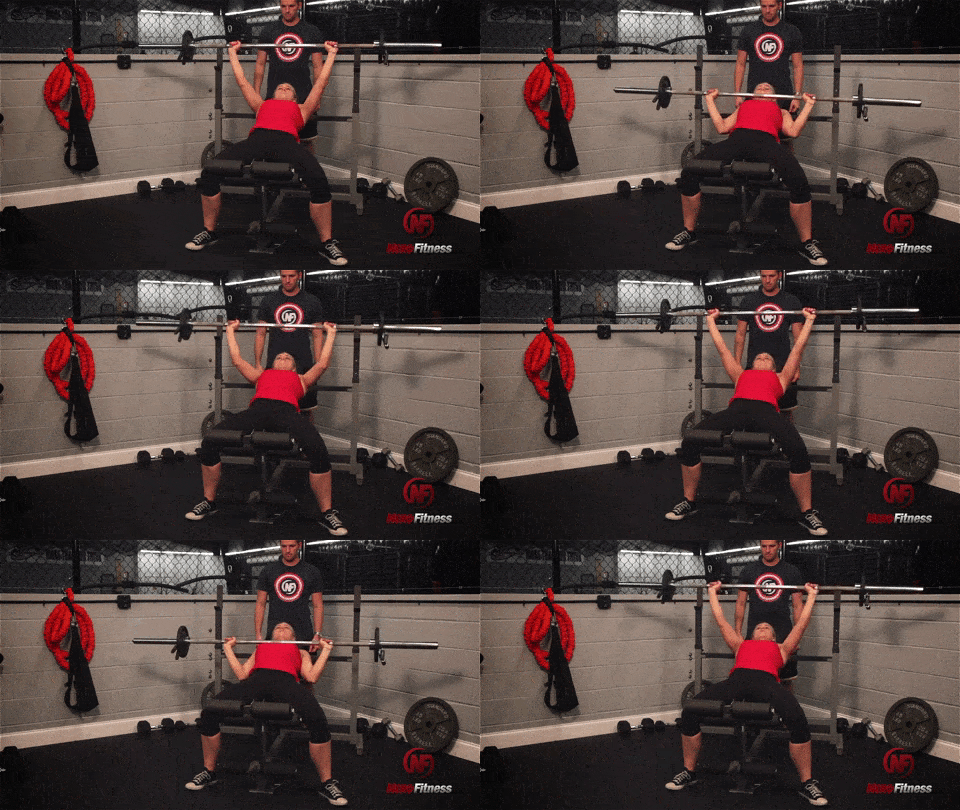
Categories
Uncategorized

#holistic #getfit #nutrition How Many Calories Should I Eat Every Day? A TDEE Calculator for Total Daily Energy Expenditure

These LEGOs are learning about their BMR and TDEE so they can calculate their calorie needs.

“Steve, how many calories should I eat every day? I have goals!”

Great question.

Knowledge is power. So today, we are going to make you more powerful by calculating your Total Daily Energy Expenditure (TDEE).

A gif that says "I have the power"

Of course, “knowing is half the battle.” The other half is using your newfound knowledge to achieve your goals!

Fortunately for you, we’ve helped thousands of Online Coaching Clients lose weight and get healthy, and TDEE is just one of many factors we consider when building a specific strategy for somebody’s goals.


Okay FINE, I’ll share the other factors and strategies below too.

Simply click on the section below for quick reading, though I’d recommend you read the whole enchilada to properly apply TDEE to your life:

Okie dokie, let’s jump right in.

THE NERD FITNESS TOTAL DAILY ENERGY EXPENDITURE CALCULATOR

These two LEGOs are ready for some simple math to determine their calorie needs. We can just use our TDEE Calculator.

We’re going to start off by doing some math.

Don’t worry, our robot calculator (beep boop boop) will do all the hard stuff for you.

We will need to know your height in inches, your weight in pounds, and an estimate of your activity level.

(Use the metric system? I wish we did too here in the States! Click right here for our Metric calculator).

Although you can adjust it, I want you to set your “Activity Level” as “Sedentary,” (I’ll explain why in a minute):

Nerd Fitness Total Daily Energy Expenditure Calculator

Total Daily Energy Expenditure Calculator


Male/Female

Use age in years.

Use pounds (lbs). If using metric system, multiple kg times 2.2 for lbs.

Use inches. If using metric system, divide cm by 2.54 for total inches.

Your BMR is an estimate of the total calories burned a day, while in a state of rest.

For “Activity Level,” veer toward the side of less active. Studies consistently show that people are not as active as they self-assess.

Your TDEE is an estimate of the total calories burned during a single day, when exercise is factored in.


(Note: we have used The Mifflin-St Jeor Equation to create this calculator! [1])

Hooray! You now know estimates of your BMR and TDEE![2]

Batman is stoked you know your BMR and TDEE!

You may be thinking, “Ah, Steve, what do either of these mean?

I got you boo.

Make sure you write down your two numbers, and then move onto the next section.

If you’re already starting to get overwhelmed, have no fear! We help hundreds of men and women calculate their calorie goals, and we’d love to help you too!


WHAT IS BASAL METABOLIC RATE (BMR)?

This notebook has the equation for BMR on it. You don't have to know it though, just use our TDEE calculator.

Basal Metabolic Rate (BMR) is the total amount of calories needed to keep your body functioning.

Body processes like breathing, cell production, pumping blood, and maintaining body temperature all burn calories.

A beating heart requires calories, which factors into your BMR.

This means that even when you sit perfectly still, you still use plenty of calories keeping your body in good working order.

To define BMR:

“Basal” more or less means “basic,” so you can think of BMR as the number of calories needed for basic daily functions.

Your sex, age, weight, and height will all affect the number of calories you need, which is why they are variables in our equation above.

The taller you are, or the more you weigh, the higher your BMR will be. 

There is simply more of you to fuel: more blood to pump, more cells to produce, more body mass to transport and manage.

Your age will also factor in: the older you get the lower your BMR will be.

Roughly two-thirds of the calories you need each day go into keeping your body running.

The other third?

That goes into powering your motion.

You know, because going from one place to another requires energy. So does lifting stuff.

So let’s talk about Total Daily Energy Expenditure (TDEE) next.

WHAT IS TOTAL DAILY ENERGY EXPENDITURE (TDEE)?

The more you move, the more calories you use, the higher your TDEE. Which is why this LEGO loves to play tennis!

Total Daily Energy Expenditure (TDEE) is an estimate of how many total calories you burn in a day.

Since your BMR includes the calories you need while resting, we’ll also need to factor in movement and exercise.

I wonder if this dog knows how his exercise factors into their TDEE and calorie goals. Probably not.

To do this, we’ll take your BMR and multiply it by an “Activity Factor.”

ACTIVITY LEVELS CAN BE THOUGHT OF AS THE FOLLOWING:

Sedentary (BMR x 1.2): You regularly have to tell Netflix you are still watching.  You don’t intentionally exercise at all.

Lightly Active (BMR x 1.375): You casually stroll through your neighborhood a few times a week. On average, you walk for exercise about 30 minutes a day. Another way to think about this would be 15 minutes per day of vigorous exercise like running or lifting weights.  

Moderately Active (BMR x 1.55): If we called the gym on a weeknight looking for you, they’d find you. This averages out to about one hour and 45 minutes of walking (for exercise, not going around your house) a day, or 50 minutes of vigorous exercise a day.

Very Active (BMR x 1.725): You work in construction during the day and you’re on the company softball team. This averages out to about four hours and 15 minutes of walking (again, for intentional exercise) a day, or two hours of vigorous exercise.

If you’re following along at home, you may notice that different Activity Factors can make a big difference in the calories burned.

Let’s use some numbers.

Suppose you’re:

  • Male
  • 35 years old
  • Weigh 200 pounds
  • Six foot even (72 inches)

You’re also wearing a recently ironed collared shirt and it looks great on you. It really brings out your eyes.

Awesome shirt or no awesome shirt, we know your BMR comes in at 1,882 calories given the variables we identified. Meaning you’ll need roughly 1,900 calories for basic bodily functions.

This is where things get interesting.

If you’re sedentary, we’ll multiply 1,882 (BMR) by 1.2 to get a TDEE of 2,258, which means you’ll need 2,258 calories to maintain your current weight, support bodily functions, and to walk around your house, to go from your car to your office, from your office back home, etc.

Let’s imagine a scenario where you are not sedentary. Let’s say you’re lightly active – you walk around your neighborhood a few times per week.

We take your BMR of 1,882 and multiply it by 1.375 to get a TDEE of 2,588.

”The difference between these two activity factors, in this case, is 230 calories. That’s equivalent to a single glazed donut.

This donut is about 230 calories, the difference between Lightly Active and Sedentary when determining TDEE.

Let’s keep going.

Let’s say you hit the gym a few times a week for strength training, and go on walks or do yoga on your off days.

This will push you into the moderately active category.

We’ll then take your BMR of 1,882 and multiply it by 1.55 to get a TDEE of 2,917.

The difference here between sedentary and moderately active would be 659 calories.

That’s an extra meal’s worth of calories!

For reference, here are some examples of things that are roughly 650 calories:

#1) A whole meal’s worth of Sicilian fish with sweet potatoes:

This meal is about 650 calories, roughly the difference Sedentary and Moderately Active when calculating TDEE.

#2) One Big Mac® with Bacon:

This burger is about 650 calories, roughly the difference Sedentary and Moderately Active when calculating TDEE.

#3) A large Orange Dream Machine® from Jamba Juice:

This smoothie is about 650 calories, roughly the difference Sedentary and Moderately Active when calculating TDEE.

All three items above have the same number of calories, but they’ll vary widely in how full they’ll make you feel!

IMPORTANT NOTE: I’ve used the word “estimate” several times in this article and will continue to do so.

Although BMR and TDEE estimations are extremely helpful, they are still just that: estimations.

Hormones, genetics, medications, and macronutrient ratios all affect an individual’s calorie needs.

Said another way, it’s CRUCIAL that we take our BMR and our TDEE as a starting point, not the definitive “answer.”

It’s the place we can start from, and then adjust based on how our bodies respond!

As we’ve just seen, different Activity Levels can influence the TDEE greatly too.

So…

Your Activity Level could through off your TDEE calculations. Be careful!


WHAT SHOULD MY ESTIMATED ACTIVITY LEVEL BE FOR TDEE?

Throwing a bunch of other people on a bike, like this LEGO is doing, could help you raise your Activity Level to achieve a higher TDEE.

Most of us are bad at estimating our levels of activity.

Study after study demonstrates that people overestimate their levels of exercise and general activity.[3]

For example, one study concluded that:[4]

These results suggest that normal weight individuals overestimate energy expenditure (EE) during exercise by 3-4 folds. Further, when asked to precisely compensate for exercise EE with food intake, the resulting energy intake is still 2 to 3 folds greater than the measured EE of exercise.

Not only that, but our fitness trackers overestimate how many calories we expend through exercise too…some by as much as 90%![5]

This infographic shows how big of a difference those calorie discrepancies can be:

This infographic shows calorie discrepancies from fitness trackers compared to actual calories burned.

We think we’re working out “intensely” for 60 minutes, so we overeat, assuming we have lots of extra calories in our “daily budget” to spare. 

However, when researchers look at stuff like heart rate, VO2 max, and calories burned, they determine that we actually only exercised “moderately.”

So yeah, don’t always trust your Fitbit:

Our Fitbit trackers might not be super accurate when reporting calories burned. Take this into account when referencing your TDEE.

Oh, and this is only one side of the equation. As I said, folks also UNDERESTIMATE how much they ate.

Regarding calories and food intake, folks consistently believe they eat less than they actually do.

Oh, and this is even true of dietitians, who are specifically trained on calories contained in different meals.

This study found that:[6]

The dietitians underreported their energy intake obtained from the food records by an average of 223 calories a day.

Again, these are experts in the field of nutrition.

What does this mean for regular people like you and me?

If you’re looking to lose weight, always underestimate your activity levels and overestimate your food consumption.

So when in doubt, choose the Activity Factor below your initial guess (i.e., instead of Moderately Active, choose Lightly Active).

This will give you a more accurate estimate of your caloric needs, and give you a larger margin for error when trying to lose weight!

The other thing to consider would be strength training.

Rebel Leader Steve doing knee push-ups

As we mention in our “Lose Fat and Build Muscle” article, strength training requires A LOT of energy, not only for the exercise itself, but also for rebuilding muscle in the days following the activity.

That’s why Coach Matt highlights the importance of strength training in our video on body recomposition:

So when determining our activity level for our calorie calculator, we consider strength training to be “vigorous exercise” (as we highlighted above).

Another way to think of this: if it takes 30 mins of walking a day to be “Lightly Active,” 15 minutes of daily strength training would roughly be equivalent.

NOTE: if estimating your Activity Factor and TDEE is starting to freak you out:

Don't Panic over your BMR and TDEE. Take it as a starting point and move on!

Trying to pick and calculate the right amount of calories to consume can be stressful.

Especially if you’ve had trouble losing weight in the past. And that’s just the math part – we haven’t even got to the psychological part about how delicious pizza and ice cream are.

It’s actually the reason we created our uber-popular 1-on-1 Coaching Program. We sought to take all the guesswork out of getting in shape, by creating a program to tell you exactly what to do.

Nerd Fitness Coaching Banner

HOW DO I USE BMR AND TDEE FOR WEIGHT LOSS?

Batman knows his TDEE and sticks to his calorie goals, which is where the six pack comes from. That and fighting crime all night.

If you’ve read this far into the article, I imagine you are interested in learning your Total Daily Energy Expenditure for weight loss.

I also imagine you support my belief that The Shawshank Redemption is the greatest movie ever made:

I mentioned earlier that if you are having trouble losing weight, it’s because you are eating too many calories.

The TDEE we calculated above provides a decent estimate of the calories you require each day.

If the scale is staying constant – congrats! You’ve found your “calorie equilibrium.”

Your body is burning just as many calories as you’re consuming each day.

However, I’m going to guess you’re here because your goal is to see the scale go down!

In order for you to lose weight, you need to start reducing your total calorie intake, which then forces your body to start burning the stored fat you have for energy.

You’ve already calculated roughly how many calories you burn (your TDEE) on a daily basis, let’s see roughly how many calories you’re consuming each day too!

(If your weight is staying steady, then these numbers should be relatively close – provided your tracking is accurate!)

It’s this nerd’s humble opinion that the easiest way to track calories consumed is with an app.

We live in the future.

Do they track calories and TDEE automatically in the future? Maybe.

Use a smartphone and download one of the following to track your food intake:

  1. My Fitness Pal. The gold standard of calorie counting apps. It’s also the most popular, supporting the largest food database in the game. Plus, it can download recipes from the internet and provide a calorie and macronutrient estimate.
  2. FatSecret. Basic, simple, and free, FatSecret is a great calorie tracker. It’ll allow you to connect with other users, plus it’s got a barcode scanner for caloric content from labels. Super nifty.
  3. Lose it! Another free calorie counting app, focusing more on goal setting. Additionally, the Snap It™ feature lets you use pictures for data input. Double nifty.

You certainly don’t have to track your food forever.

But a solid week’s worth of data will help you get a sense of the food you are consuming, especially if you eat roughly the same food each day.

Not sure if you’re getting your portion sizes correct? Most people don’t. Consider a cheap food scale to educate yourself on actual portion sizes!

You can also check out our guide How to Portion Control, which will teach you how to use your hand to estimate calories:

The important thing is to compare your daily calories consumed to your TDEE.

To lose weight, your calorie consumption should be less than your TDEE.

(If you’re currently thinking, “But Steve according to my stats I burn way more calories than I consume, but I’m not losing weight!” I would read this.)

Some numbers to keep in mind:

  • 3,500 calories equals roughly one pound of fat.
  • There are seven days in a week.

Basic math suggests if you want to lose one pound of body fat in a week (a sustainable goal for some), you need to create a caloric deficit of 500 calories a day. We can get there by:

  • Consuming 500 fewer calories
  • Burning 500 more calories
  • Or a combination of both

When you consistently consume fewer calories than you burn, your body will have to start pulling from your stored fat for its energy needs.

Aka weight loss.

Let’s imagine that your TDEE is 2,500. This means you’d want to consume around 2,000 calories a day to lose around a pound per week.

As we discuss to great detail in “Why Can’t I Lose Weight,” sustained weight loss is largely a result of consistently managing the first half of the equation: “calories in.”

Said another way: it’s much more difficult to sustainably increase your Activity Level than it is to reduce the calories you consume. 

After all, what’s more likely to become a lifelong habit? Changing your food choices, or going from being a couch potato to vigorously exercising 90 minutes per day?

This couch potato knows how hard it can be to raise your activity level to increase your TDEE.

So start by focusing on your food intake.

What’s the easiest way to eat fewer calories consistently? By prioritizing REAL food.

Why?

Because real foods are more likely to fill you up and satisfy your hunger while also keeping you under your calorie intake goal for the day.

Remember that example above comparing a full dinner vs a burger vs a shake:

Our earlier example showing you 650 calories in food.

MOVING TOWARDS A HEALTHIER WAY OF EATING

Berries are low in calories and full of vital nutrients, which make them a great addition to a healthy diet.

The Nerd Fitness philosophy on diet can be written in six words:

“You’re smart. Eat more REAL food.”

I lay it all out in our Beginner’s Guide to Healthy Eating, but again, you’re smart – you know what real food is:

Food that grew in the ground, on a tree, ran on the land, swam in the sea, or flew through the air.

Meat, fish, eggs, vegetables, fruits, and nuts are all great examples of REAL food. 

This is what you should be eating more of.

The fine folks at WiseGEEK made an awesome post, where they demonstrated what 200 calories of various foods look like.

200 calories of broccoli gets you enough broccoli to fill up an entire plate:

200 calories of broccoli is a huge plate full!

Or half a Snickers bar:

200 calories is only one half of a Snickers bar.

Yeah…

By eating REAL food, you have a MUCH higher margin for error to stay under your calorie goal for the day.

  • If you accidentally overeat broccoli, you might accidentally eat an additional 20-30 calories.
  • If you accidentally overeat candy or soda or processed foods, you can consume an extra 500-1000+ calories without feeling satiated or full.

Putting it all together: If you want to consistently be in a calorie deficit, focus on REAL food.

And yes, I know a Snickers bar is way more delicious than broccoli – it was designed in a lab by scientists to be AMAZING!

I’m not gonna tell you to never eat a Snickers ever again either.

Instead, start being proactive about your food choices.

If you want to eat a Snickers, plan for it by intentionally eating fewer calories earlier or later in the day.

And if the scale isn’t budging  – you’re still eating too much!

If only Kramer had known his TDEE, he wouldn't be shocked to learn he eats too much.

Want help with any of this?

Many of our coaching clients found weight loss previously unattainable until one of our trained professionals objectively reviewed their life and provided actionable feedback.

Now, some of them have lost between 50-100+ pounds!


WHAT’S THE BEST DIET FOR WEIGHT LOSS?

These LEGOs are searching for the perfect diet in this piece of fruit. I think they're doing it wrong.

Should you do the Mediterranean Diet? Keto? Vegan? Paleo?

Maybe!

They all follow the same premise: they reduce or eliminate certain foods or macronutrients, making it easier to eat in a calorie deficit.

While all sensible diets will prioritize protein, some might limit carbs while others might limit fats. These differences come down to what works best for the individual.

So yes, any diet can help you lose weight in the short term – just remember that you need to stick with the changes permanently to make the results stick permanently!

After all, temporary changes create temporary results.

I personally follow a mental model diet, that focuses on real food most of the time, and occasionally includes some junk food. I plan my week of eating ahead of time:

#1) Limit your intake of processed food – it’s designed to be overconsumed.

Do you really think you’d be able to eat half of a snickers bar to limit yourself to 200 calories? Of course not. This argument is essentially the rationale for following a paleo diet.

These ribs would be part of the Paleo Diet. But did they calculate their TDEE first?

#2) Eat veggies. Vegetables are nutrient-dense and light on calories. Because of all the fiber, they are also tough to overeat.

Imagine eating a plateful of broccoli.

Are you going for seconds? Probably not. So eat your veggies to help keep you full.

Hate vegetables?

I once was like you. Read “How to make vegetables taste good.”

#3) Be wary of liquid calories. Cut back on soda, juices, smoothies, and any beverage with calories.

Even most coffee orders (with sugar, cream, etc.) will have a ton of hidden calories.

This is how you make an acai bowl... kind of.

All these drinks are sugar bombs since there is no fiber to balance out all the carbs you are consuming. Stick to water and unsweetened tea or coffee. Here are our thoughts on diet soda.

#4) Prioritize protein. Your body needs to use protein to heal and rebuild muscle after exercise.

Outside of repairing your body, protein will also work to keep you full and satiated: 400 calories of chicken will leave you wayyy more full than 400 calories worth of Gatorade.[9]

If you prioritize protein on your plate, you’ll be doing a lot of the heavy lifting on proper nutrition.

As we lay out in our epic “How Much Protein Should I Eat?” guide, some great sources of protein include chicken, eggs, beef, pork, fish, nuts, legumes, quinoa, and most dairy products.

These four points will help you on your journey to create a caloric deficit.

Disclaimer: this is all easier said than done. After all, 70% of the country is overweight. Don’t worry though, because most of them don’t read Nerd Fitness.

You do. This is like a strategy guide for life.

We’ve helped thousands of people like you here at NF, and we really focus on nutrition.

As we said, it’s 90% of the battle!

It’s why we created our own free, fun 10-level nutritional system. Each level gets a bit more challenging, but you can progress at your own speed to make your changes stick.

You can download our 10-Level Nutrition Guide when you sign up in the box right here:

HERE’S WHAT TO DO TO LOSE WEIGHT WITH YOUR TDEE

Now you are ready to use your TDEE to achieve your fitness goals!

Let’s recap this whole guide for you, with some actionable steps:

#1)Determine your BMR and TDEE. This will be critical for computing your caloric deficit.  They’re good numbers to keep in mind during the whole experiment. Calculate your TDEE here.

#2) Track everything, as is, for one week. Log everything you eat. No judgment. If you eat five slices of pizza in a night, count every slice.

This step alone has helped many Rebels turn their lives around. Consider a food tracking app or online tracker to educate yourself!

#3) Compare numbers. Where is your current caloric intake at? How does this compare against your TDEE? If your intake is higher than your TDEE, you’re likely gaining body fat. We want to flip the equation.

#4) Create a consistent caloric deficit. The easiest and most sustainable way to do this is to eat REAL food. Mixing in strength training and fun cardio can help too. 

#5) Track progress.  Continue to track your calorie intake, to ensure you consistently expend more calories than you consume.

That’s it.

You can do this. I know you can because many of our readers have done it themselves.

Both BIll and I know you will use your TDEE to reach your fitness goals!

Want help taking your next step after calculating your TDEE? I have MULTIPLE options for you. Pick the path below that best aligns with your goals and timeline:

1) If you want step-by-step guidance on how to lose weight, eat better, and get stronger, check out our killer 1-on-1 Coaching Program:


2) If you want an exact blueprint for how to eat better and get in shape, check out NF Journey. Our fun habit-building app helps you exercise more frequently, eat healthier, and level up your life (literally).

Try your free trial right here:

3) Enlist in the Rebellion! We need good people like you in our community, the Nerd Fitness Rebellion. 

Sign up in the box below when you download our free weight loss guide!

You can do this, and we got your back!

-Steve

PS: Seriously, how great is The Shawshank Redemption? I could quote that movie all day long.

But if you don’t agree…

###

All photo citations can be found right here.[8]

The post Blog first appeared on Nerd Fitness.

from Nerd Fitness: Helping You Lose Weight, Get Stronger, Live Better. https://ift.tt/2UaIeuQ
via IFTTT
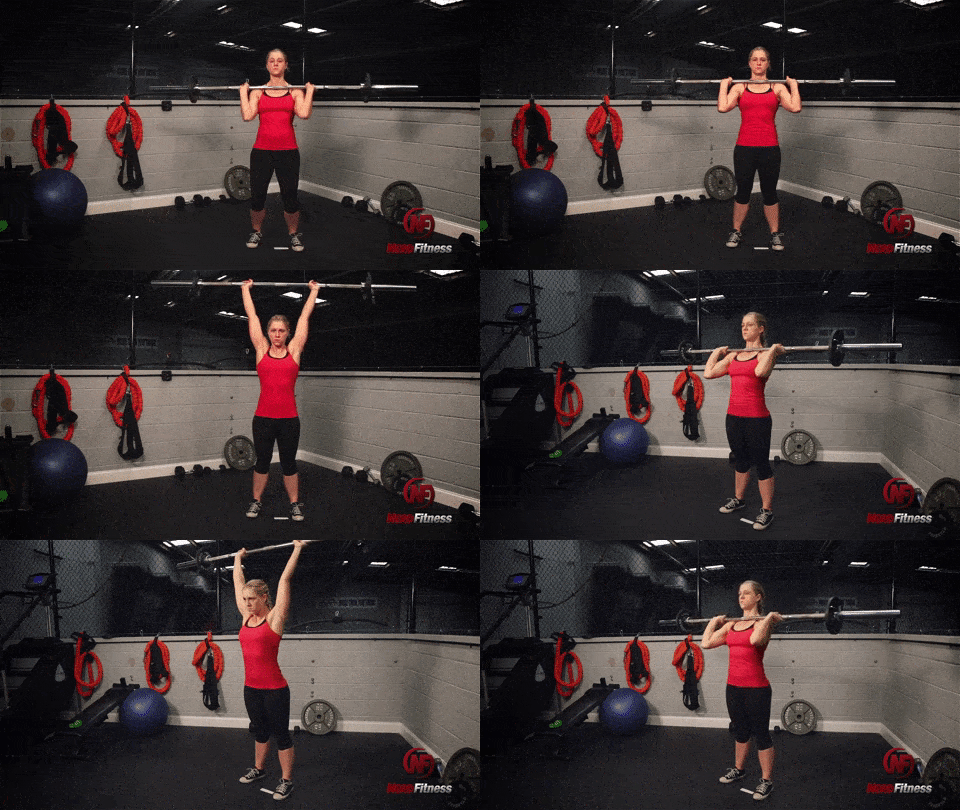
Categories
Uncategorized

#getfit #holistic #nutrition 10 Must Read Books for 2022

Read this post 10 Must Read Books for 2022 on keep it simpElle.

I’ll bet that reading more books is on your never ending list of New Years resolutions right?! I’m sure it’s on mine every year and although I’m very good at buying books… reading them is another matter. To keep myself…

Read More

Read more on keep it simpElle –

from keep it simpElle https://ift.tt/3mSrLvH
via IFTTT
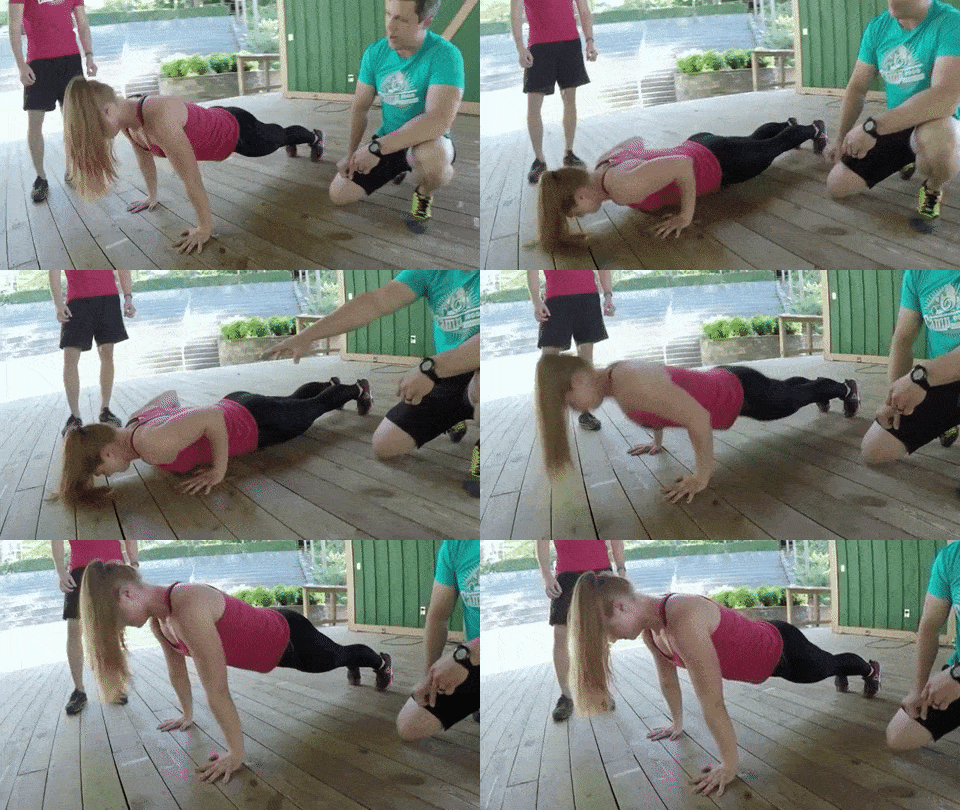
Categories
Uncategorized

#holistic #getfit #nutrition How to Build Muscle as a Woman: The Ultimate Guide for Gaining Weight the Right Way

Staci's life has been transformed by her quest to growth muscle.
If you are interested in learning how to gain weight the right way, you have come to the right place! 

My name is Staci Ardison.

I overcame an eating disorder, discovered a love for heavy strength training, and now I help women like you get stronger for a living.

Believe it or not, I’m 50 pounds heavier in the photo on the right (and WAY stronger, and healthier, and happier!).

I’m currently a lead coach here in the Nerd Fitness Coaching Program, where we train women to pick up heavy weights, get strong, and build confidence.


Speaking of picking up heavy weights, here I am deadlifting 455 pounds:

Staci showing you how to deadlift 455 pouds.

This is what I LOVE to do.

In this Ultimate Guide to Building Muscle as a Woman, I’m going to be covering:

Alright, let’s do this.

Why Building Muscle is Difficult for Some Women

A group of different LEGO women ready to build muscle.

As Steve covered in “How to build muscle” and “How to bulk up for men,” the principles of weight gain are all the same regardless of your sex or gender:

“If you want to gain weight, eat more calories than you burn regularly. Want to put on the right KIND of weight? Exercise and eat the right way too.”

Now, there’s plenty of nuance to this when comparing men and women:

  • Due to our natural hormones, it’s generally more difficult for people with typical female anatomy to gain muscle than people with typical male anatomy.[1]
  • We have a lot of factors (such as hormonal birth control) that have been proven to make it even harder as well.[2]

But that doesn’t mean it’s impossible!

It just means we have to work harder for it.

Mary isn't happy, but will build muscle anyway.

Ugh, I know.

Now, one thing I want to touch on quick: if you see a woman who is absolutely jacked and at an extremely low body fat percentage, I guarantee she has been working her butt off for a very long time with the goal of building muscle.

It’s not something that happens overnight, or by mistake.

In addition, some women with larger amounts of muscle mass choose to take steroids to help assist them in gaining muscle, because we simply don’t have the hormones naturally to get to that size.

So if you’d like to build muscle, but not as much as a professional bodybuilder – don’t worry, it’s not something that happens by accident.

With that out of the way, let’s talk about body fat and body types:

As we point out in that body fat percentage guide, we women can look very different at any weight depending on our body shape and how much muscle we have. It comes down to our own personal goals!

This picture shows different body fat % of women.

This guide is going to primarily focus on two things:

  • How to eat to gain weight and build muscle.
  • How to strength train to build muscle.

We’ve helped thousands of women with our online coaching program, many of whom are trying to gain weight and strength train for the first time in their lives.


Everybody is on their own journey, at their own pace, and everybody will end up with different results too!

Should Women Build Muscle? (7 Reasons Women Should Grow Muscle)

This woman built lots of muscle on her journey to became an astronaut.

If it can be harder for women to gain muscle (compared to men), why go through the trouble?

I’m glad you asked!

Here are the top 7 reasons why women should strength train:

#1) When you’re stronger – everyday life is easier. No need to call for help to get that 50lb bag of dog food off the top shelf, or carrying an air conditioner unit up a flight of stairs. LIFE is easier when you’re stronger. 

#2) Less injury risk – when you build strong muscles, you’re also building stronger bones, ligaments, and tendons, making you less prone to injury doing things you love (like playing in a quidditch league).[3]

#3) Helps combat age-related muscle loss,[4] allowing us to remain independent longer as we age:

#4) Muscle is harder to maintain, which means you need to eat more just to hold on to it.[5]

#5) Reduce pain – having a strong body makes living easier on your joints, as well as allows you to hold a better posture, and reduce back / hip pain.[6]

#6) Appearance – this is a personal preference! Some women like to have a lot of muscle, and some don’t. While you can’t spot reduce fat, you can choose to build more muscle in specific areas, changing your body shape. Growing up, I was an extreme pear shape, but due to strength training, I now have more of an hourglass shape. 

You can see that Staci has changed the way she looks from strength training!

#7) Live longer – want to spend more time on Earth? Strength training and growing muscle will help you do just that.[7]


How to Eat to Gain Muscle as a Woman

This woman knows gaining muscle relies on a proper diet...like seafood!

As we said above, gaining weight comes down to thermodynamics and science.

Every day, we burn a certain number of calories just existing, which is called our BMR (basal metabolic rate). We then factor in our daily activity level, and get a number that is called our “total daily energy expenditure.” You can calculate yours below:

Total Daily Energy Expenditure Calculator


Male/Female

Use age in years.

Use pounds (lbs). If using metric system, multiple kg times 2.2 for lbs.

Use inches. If using metric system, divide cm by 2.54 for total inches.

Your BMR is an estimate of the total calories burned a day, while in a state of rest.

For “Activity Level,” veer toward the side of less active. Studies consistently show that people are not as active as they self-assess.

Your TDEE is an estimate of the total calories burned during a single day, when exercise is factored in.


(Click here for our Metric calculator).

(Note: we have used The Mifflin-St Jeor Equation to create this calculator! [8]).

Since we want to gain weight, we want to take our TDEE and add 250 calories to it to get our daily goal. This should result in gaining about half a pound per week.

Now, although eating ANY EXTRA calories from any source will result in weight gain, our goal is to gain the RIGHT kind of weight, in a healthy way.

And thus, we’ll be focusing our efforts on a “healthy muscle building” strategy.

We could easily add more calories each day, and gain weight quicker, however, the slow method gives you the best chances at gaining mostly muscle, with minimal fat. The faster you try to gain weight, the higher the percentage that will likely be fat – so starting off at half a pound per week is a great place to start!

A small addition of calories, will help you gain muscle with minimal fat gain as well. So slow and steady is the ticket.

In addition to the number of calories we’ll be adding, we also want to pay attention to the type of foods we’re eating.

As we cover in our “Healthy Eating Guide,” we’re going to build muscle by consuming the three big macros in the correct quantities:

  • Protein: rebuilds muscle after you break it down.
  • Carbohydrates: provides your muscle with fuel and body with energy.
  • Fat: helps your bodily functions and can also be burned as fuel in the absence of carbs.

Let’s look at each of these individually:

PRIORITY #1: PROTEIN

Protein can come from any number of sources, including:

  • Meat (steak, bison, pork).
  • Fowl (chicken, turkey, duck).
  • Eggs![9]
  • Cheese and dairy.
  • Fish and shellfish (salmon, tuna, shrimp).
  • Legumes (black beans, chickpeas).
  • Other vegetarian protein sources here.

As we cover in our “How much Protein do I need?”, claims for the amount of protein required for muscle growth vary wildly from source to source (and athlete to athlete).

While meat sticks do have protein, try and stick to something less processed.

Here is our recommendation:

  • If you’re of healthy weight, active, and wish to build muscle, aim for 1 g per pound of body weight (2.2 g/kg).
  • If you’re an experienced lifter on a bulk, intakes up to 1.50 g/lb (3.3 g/kg) may help you minimize fat gain.

Let me simplify it for you:

“To build muscle, target at least 1 gram of protein per pound of body weight (2.2 grams per kg).”

If you’re curious, from our healthy eating article, this is what a portion of protein looks like:

A serving of protein should be about the size of your palm, like so.

Here’s how much protein is in a serving of food:

  • 4 oz (113 g) of chicken has around 30 g of protein.
  • 4 oz (113 g) of salmon has 23 g of protein
  • 4 oz (113 g) of steak has 28 g of protein.

Want to get more protein? Consider protein shakes.

PRIORITY #2: CARBS

After protein, we’ll be filling up our plate with calories from carbs (and fats).

Here are foods full of carbohydrates you can prioritize:

  • Rice
  • Quinoa
  • Oats
  • Legumes and lentils
  • Sweet potatoes
  • Yams
  • Regular potatoes
  • Whole grain pasta
  • Whole grain bread

To help you get better at serving sizes:

Showing you a serving of carbs

1 serving of a starchy carbohydrate is 1 cupped hand (uncooked), or your two hands forming a cup (cooked).

Here are some images to help you learn proper portion sizes (thanks to SafeFood):

This picture will help you determine proper serving sizes for carbs!

In addition to consuming carbohydrates from these sources, it’s okay to consume plenty of fruit while trying to build muscle!

For reference, here is roughly 200 calories worth of an apple (thanks to WiseGEEK):

This is about 200 calories of apple.

You can read our full “Is fruit healthy?” guide to learn more.

PRIORITY #3: FAT! 

Fat is a macronutrient that can help you reach your calorie goals (in the right quantity), as fat can be high in calories. Plus, you can eat lots of it without feeling full. Helpful if you’re trying to put on weight.

Healthy fat can be found in foods like:

  • Avocado
  • Almonds
  • Walnuts
  • Macadamia nuts
  • Olive oil
  • Almond butter
  • Peanut butter

Science has recently come around on saturated fat too.[10] Once completely vilified, but now considered okay for moderate consumption.

Saturated fats can come from things like:

  • Whole milk
  • Full fat dairy
  • Coconut oil
  • Grass-fed butter
  • Fatty cuts of meat
  • Lard

To help you gauge: a serving size of fat is roughly the size of your thumb!

A serving of fat should be about your thumb!

For reference, this is a single serving of almonds (162 calories):

Knowing the correct amount of almonds to eat can help you with your calorie goals.

THIS is a serving of olive oil (119 calories):

This shows the serving size of olive oil, which is very dense calorie wise.

As you can see, you can eat an extra 500 calories of “healthy fats” by eating lots of “heart-healthy” fats like nuts or adding more olive oil to your meals.

PRIORITY #4: VEGETABLES!

Last but not least, you need vegetables in your diet.

As you start to eat more food, your stomach, intestines, and other bodily functions will thank you for consuming more high-fiber vegetables! 

A serving of veggies is about the size of your fist.

A serving of veggies should be the size of your first (or greater).

Here’s a quick, non-complete list of high-fiber veggies that can fill your plate:

  • Broccoli
  • Broccolini
  • Cauliflower
  • Spinach
  • Kale
  • Spaghetti squash[11]
  • Brussels sprouts
  • Zucchini
  • Cucumber
  • Carrots
  • Onion
  • Asparagus

BRINGING IT ALL TOGETHER: A HEALTHY MUSCLE BUILDING PLATE

If your meal plate looks like this, you're doing a lot of the heavy lifting for weight loss.

This plate and serving size stuff above is just to help you get started thinking about healthy food differently and in proper portion sizes.

TO RECAP, HERE’S HOW TO EAT TO BUILD MUSCLE:

  • Calculate your TDEE (Total Daily Energy Expenditure) and add 250 calories over your number.
  • Consume 1-1.5g per pound (2.2-3.3g per kg) of body weight in protein every day.
  • Consume the rest of your calories from foods composed of carbs and fats.
  • Always eat vegetables so that your body can actually PROCESS all this extra food. I like to aim for half of my plate of vegetables.
  • If you are not gaining weight, (and you’re hitting your protein goals), add more carbs and/or fats to your meal.

It really does come down to the following:

If you are not gaining weight fast enough, you’re not eating enough. Increase your portions of carbs and fats!

Whenever we work with coaching clients who struggle to build muscle, this is the area we target: adding more carbs and fats to each meal.


8 Strength Training Exercises For Women to Build Muscle

This woman knows exactly how to build muscle...she does it by lifting that sword and shield!

Years from now, you’ll look back and thank “Past You” for starting strength training today.

And don’t worry, I’m going to tell you exactly what to do so you can start strength training TODAY!

Here’s why strength training is so important: when you eat a caloric surplus (more calories than your body needs each day), the extra calories have to go somewhere.

  • If you don’t do any exercise, your body will choose to store the extra calories as fat for later.
  • However, when you strength train, your muscles are broken down. Then they’ll use the extra calories to rebuild themselves bigger and stronger over the next 48 hours!

“Staci that sounds great, but I’ve never strength trained before, and I don’t know what I’m doing…Halp!” You might be saying into your computer or phone.

Fear not! I’ll help. Strength training doesn’t need to be scary or overly complicated.

Gonzo knows he has to eat protein to match his strength training goals, but he doesn't eat chicken, for obvious reasons.

Simply put, “strength training” means two things:

#1) “Movement of any weight against “resistance” (including your body weight) – Doing ANY exercise that pushes your muscles outside of their comfort zone, forcing them to rebuild stronger to prepare for the next challenge.

#2) Progressive overload: doing slightly more than last time (lift a heavier weight or do 1 more rep) consistently. Your muscles will have to constantly adapt and rebuild themselves stronger. This is called “progressive overload.”

Coach Jim breaks down different strategies for progressive overload in this video:

This means if you drop down and do ONE push-up or knee push-up right now…

Knee push-ups like this are a great way to progress to a regular push-up!

Technically, you’ve strength trained.

Now do that and then do a bodyweight squat…

Do a proper bodyweight squat to work out your legs

Boom, you just did a strength training workout.

Here’s what you need to know about strength training:

  1. Strength training is one of the BEST things you can do for yourself.
  2. Strength training will help you put on muscle while eating in a surplus.
  3. While you can’t spot reduce fat, you can focus on building more muscle in specific areas, which can help you attain a specific look you’re going for.
  4. If you don’t like the gym, you don’t need to go, ever. But I hope you do. Because that’s the easiest way to start training with weights.
  5. Regardless of your fitness level, body fat percentage, strength level, or biological sex, you have every right to be in the free weights section in the gym, training with heavy weights, with everybody else. The people in the gym who are very strong with a lot of muscle started somewhere, too!

I used to be a CrossFit instructor, and my favorite thing about CrossFit was that it destigmatized barbell training and heavy lifting for many women.

Crossfit is great in that in shows it's okay for women to lift heavy weights.

In order for us to strength train and build muscle, we’re going to approach this intelligently. 

We’re not going to pick up small dumbbells and do lots of reps.

We’re not going to sit down at various machines and scroll through our phones while doing leg curls.

Instead, we’re going to:

  • Get very strong with compound movements that recruit LOTS of muscles to work together.
  • Do our workouts quickly and get out of there. The workout should take no longer than 45-60 minutes.

This is how we efficiently build muscle in the minimum amount of time. What are the exercises that we’re going to target?

1) The Push-Up: The best exercise you could ever do for yourself when it comes to using your bodyweight for push muscles (your chest, shoulders, and triceps):

2The Bodyweight Squat: This exercise serves a dual purpose: it is the foundation for building strength AND helps build proper mobility. If you are going to ever do barbell squats, you need to work on hitting proper depth with a bodyweight squat first!

3The Inverted Bodyweight RowUntil you can get your first pull-up or chin-up, these exercises are GREAT to start building your pull-muscle strength (your back, biceps, and forearms).

4) The Pull-Up and Chin-UpOnce you can support your body’s weight above the bar, the world becomes your playground. No strength training routine should be without pull-up or chin-up work! (Click here if you can’t do a pull-up or chin-up yet):

And now we’re into the best weight training exercises:

5) The Barbell SquatProbably the best exercise when it comes to building strength and muscle throughout your whole body. It also burns crazy calories and makes life better. This is a MUST:

6) The Barbell DeadliftMaybe the best exercise of all time. Actually no, it IS the best exercise of all time. It’s certainly the most primal: “pick the weight up off the ground. Done.”

This is a very technical lift, so make sure you read our article on how to deadlift with proper form:

7) The Barbell Bench PressLie on a bench, squeeze your shoulder blades to keep your back tight, and then lower a barbell until it almost touches your chest. Pause, and then press it back up towards the sky. Repeat! And get strong.

8) Barbell Overhead Press: Stand with your feet about shoulder-width apart and lean back by pushing your hips forward. While keeping your entire body tight, press the bar overhead.

Once the bar passes your forehead, move your body back under the bar by driving your torso forward and back into a standing position. At the top of the lift shrug your shoulders slightly and lock your elbows.

These are some of the best compound exercises you can complete in order to build muscle. Want more muscle? Great! Get stronger at these movements!

One quick note: when I first started lifting, it took a while to build up the strength to be able to bench press or overhead press with the 45-lb bar. If your gym doesn’t have a lighter bar, dumbbells are a great option!

Your mission, should you choose to accept it:

Commit to trying ONE of these movements in the next week. Use 20 seconds of courage, recruit a friend who has lifted or trained before, and try your best.

We know you can use this guide to start building muscle...you got this!

I have three options for you next:

  1. Select one of the muscle-building routines for women in the next section.
  2. Build your own workout routine using these exercises!
  3. Work with me and our coaching program to follow a custom strength training routine for your goals.


5 Muscle Building Workout Routines For Women

No matter which version of wonder woman it is, she always knows the fastest way to build muscle (fight for justice).

I’m going to walk you through three different levels of strength training, and by the end of today, you’re going to know exactly how to get started.

My advice: do 2-3 strength training routines per week, with 1-2 days off in between. As the saying goes: “muscle isn’t built in the gym, it’s built in the kitchen!”

The Swedish Chef knows how to eat to build muscle (lots of food), which is why he's always cooking.

So your goal should be to do a strength training routine, and then make sure you eat a caloric surplus so that your body has enough calories to rebuild your muscles bigger and stronger!

LEVEL 1: BODYWEIGHT TRAINING

Here’s a beginner bodyweight training routine you can do in the comfort of your own home:

  • 20 Bodyweight squats.
  • 10 Push-ups.
  • 10 Walking lunges (each leg).
  • 10 Dumbbell rows (use a milk jug or other weight).
  • 15 Second Plank.
  • 30 Jumping jacks.

We also have a downloadable worksheet of this beginner’s workout that you can print out and hang on your fridge to track your progress! Get it when you sign up below:

LEVEL 2: DUMBBELL WORKOUT

If you have dumbbells at home or access to a gym, you can pick our Level 4 workout from our 6-Level Gym Workout Routine.

So your Dumbbell Workout is 3 circuits of the following:

  • 10 goblet squats (holding the dumbbell like a goblet with 2 hands):

The goblet squat is a great way to build muscle for women.

  • 10 push-ups (or knee push-ups):

This gif shows Staci doing a push-up in perfect form.

As you get lower, like this, the row will be harder to do. Great way to progress into a pull-up.

(By the way, these are two GREAT exercises towards getting your first pull-up)

LEVEL 2: BEGINNER KETTLEBELL WORKOUT

If you have a Kettlebell at home, here’s a 20-Minute Beginner Kettlebell Workout you can do:

Do 3 circuits of this Kettlebell Workout: 

  • 8 Halos (each side)
  • 10 Goblet Squats
  • 8 Overhead Presses (each side)
  • 15 Kettlebell Swings
  • 8 Bent Over Rows (each side)
  • 6 Front Rack Reverse Lunge (per side)

If you like this Kettlebell workout and want to follow along on a worksheet, simply print out our Kettlebell Workout and bring it with you:

LEVEL 3: BARBELL GYM WORKOUT

Here’s a Barbell workout you can follow from our Level 5 Gym Workout Routine.

BARBELL BATALLION WORKOUT A:

  • 3 sets of 10 barbell squats

  • 3 sets of 10 push-ups

This gif shows Staci doing a push-up in perfect form.

  • 3 sets of 10 bodyweight rows:

Start with inclined inverted rows for your pull-up workout. Then drop lower for more required effort.

BARBELL BATALLION WORKOUT B:

  • 3 sets of 5 barbell Romanian deadlifts (video pulled from our courses in Nerd Fitness Prime)

  • 3 sets of 10 bench presses:

  • 3 sets of 5 pull-ups, assisted pull-ups, or negative pull-ups:

A box can be used instead of a chair for a pull-up.

PICK A WORKOUT, GET STARTED!

The whole point is to do challenging movements that really make your muscles work, and then try to do ONE more rep, or lift a SLIGHTLY heavier weight next time! 

Don’t sweat the small details and instead use 20 seconds of courage to get started!

Track your workouts by writing down what you did, and then do what you can next time.

If you really want to level up quickly, LEARN HOW TO DO SQUATS AND HOW TO DO DEADLIFTS. These two exercises changed my life!

Squats and deadlifts helped me build muscle and changed my life.

“Staci, that’s still too many choices! Can you just tell me what workout routine to follow?”

Okay fine! Here’s what I would do if I was you.

Still overwhelmed? Check out our coaching program. We get to learn your story, and then build a program and strategy around your goals that you CAN do.

Christina learned to do pull-ups with NF Coaching

10 Tips for Building Muscle as a Woman

This woman is on her way to build muscle and to find water.

I interviewed multiple other coaches on our team and asked for their best advice on how to build muscle as a woman.

Here’s what they said:

Susy (Coach, BS in Psychology, Certificate III & IV in Fitness, 5+ years of experience)

Tip #1: Food is your friend when you are looking to build muscle and get stronger – your body will need fuel, so you may need to eat more on the days that you work out!

Tip #2: Strength and muscle building requires structure to your workouts – you progress through getting better at specific movements, so make sure that you enjoy the style and structure of your workouts so that you can be as consistent as possible.

Tip #3: Your progress will always be fastest if you avoid injury, so correct form and listening to your body is super important. Your muscles will fatigue and feel sore, but joint pain and sharp, stabby pain means something isn’t moving quite right.

Kerry (Coach, NASM-CPT, 6+ years of experience)

Kerry is one of our great female coaches here at Nerd Fitness.

Tip #4: Fall in love with the process. Getting stronger is a journey, one that is both rewarding and challenging. So no matter where you are starting from, take the time to celebrate each small step along the way towards a more badass version of yourself!

Christy (Coach, BS in Applied Health/Fitness, National Personal Training Institute Graduate, Precision Nutrition Certification, 6+ years of experience)

Christy is one of our great coaches and loves everything Star Wars, as shown here.

Tip #5: To get strong, you gotta lift weights. When lifting weights to get strong, you gotta be okay with testing your boundaries every now and then.

After exercising with your current weight, for the next training session…stop…and try a few reps with the next weight UP to test it out! It might surprise you how much more weight you can lift!

Here are some other tips to help you build muscle.

Tip #6: Boost your testosterone naturally: Consume enough saturated and monounsaturated fats, keep your sugar intake low, and make sure you’re getting enough Vitamin D and Zinc.

These are items linked with boosting your testosterone naturally.[12]

Speaking of testosterone – I know you may think of this as a “male” hormone, but it plays a huge part in women muscle building,[13] fat loss,[14] increase bone mass,[15] and many other health-related issues[16](remember: estrogen is made from testosterone).

Yes, women need plenty of testosterone too.

Men make about ten to fifteen times what we make naturally,[17] but it doesn’t mean we don’t need it too.

Another way we can help our testosterone levels is to watch our cortisol levels.

Cortisol is a hormone that is promoted by stress and reduces free testosterone levels (in addition to signaling for your body to store fat).[18]

Want a way to naturally lower your cortisol levels? Try meditation.[19]

Tip #7: Not getting bigger? Eat more food.

Focus on more fats and carbs. They are the easiest ways to increase your total calories.

You can check out our Guide to Build Muscle for more specific tips on how to eat more food.

If you're not bulking up, eat more, like Kirby here!

Tip #8: Make sure every meal has a solid protein source.

Protein is needed for building muscle, so prioritize this above all else when you sit down to eat.

Having trouble getting it all down? Buy a blender!

A blender can help you obtain more calories for weight gain.

Steve drinks two smoothies a day to reach his protein goals and you can check out our Guide to Protein Shakes for his personal recipe.

On the go with no blender? I like to keep protein powder with me in a small Ziploc bag – that way I can grab a bottle of water, rip off the corner of the Ziploc bag, and use that as a funnel to get the powder into the water bottle. Then, just replace the cap and shake and you’ve got a protein-filled snack!

Tip #9: Get more sleep! When you build muscle, your body is working overtime, burning extra calories. It’s going to need some time to recover. Remember, muscle is built when you rest, not when you actually lift.

Go to bed!

Tip #10: Start today!

Gaining muscle comes down to eating right and strength training. Let’s get you lifting today!

Try some push-ups and squats as we discussed in our strength training section. Tomorrow we can work on eating right and lifting more.

The most important step you can take today is to begin.

Like Bugs here, we want you to start! No matter what you do, take one small step today!

Let’s give you some more tips to get you going.

Building Muscle: Next Steps!

Climbing mountains is a great way to build muscle (man or woman).

If I can narrow down building muscle for women, it would be three main points:

  1. Get stronger by picking up heavy stuff or doing more challenging bodyweight movements.
  2. Get bigger by eating lots of food.
  3. Recover faster by sleeping enough and giving your muscles days off to rebuild.

That’s it. You can do this.

We know that you are ready to start your muscle building practice today!

If you made it this far, and you want more specific instruction and guidance, we have a few options for you:

1) If you are somebody that wants to follow a tailor-made program designed around their life and goals, check out our popular 1-on-1 Online Coaching Program.

You’ll work with our certified NF instructors who will get to know you better than you know yourself, check your form, and program your workouts and nutrition for you.

Nerd Fitness Coaching Banner

2) If you want an exact blueprint for growing strong, check out NF Journey. Our fun habit-building app helps you exercise more frequently, eat healthier, and level up your life (literally).

Try your free trial right here:

3) Join the Rebellion! We need good people like you in our community, the Nerd Fitness Rebellion.

Sign up in the box below to enlist and get our guide, Strength Training 101: Everything You Need to Know. It’ll help you begin your journey on building muscle.

Lastly, I’d love to hear from you!

PLEASE leave your questions, eating or strength or otherwise below so we can answer them and become best friends and practice karate kicks in the garage:

How can I help you get bigger and stronger?

What part of this journey are you still struggling the most with?

What are your favorite bulking up foods!?

Share with your friends in the comments so we can all go buy it in bulk at Costco.

-Staci

PS: Make sure you check out the rest of our Strength Building Articles!

###

Photo sources: Women’s Day 2015, Sea spray, The Viking, The Evolution of LEGO Wonder Woman, Apocalyptic Motorcycle, Person Mountain,

The post Blog first appeared on Nerd Fitness.

from Nerd Fitness: Helping You Lose Weight, Get Stronger, Live Better. https://ift.tt/2NkrXUs
via IFTTT
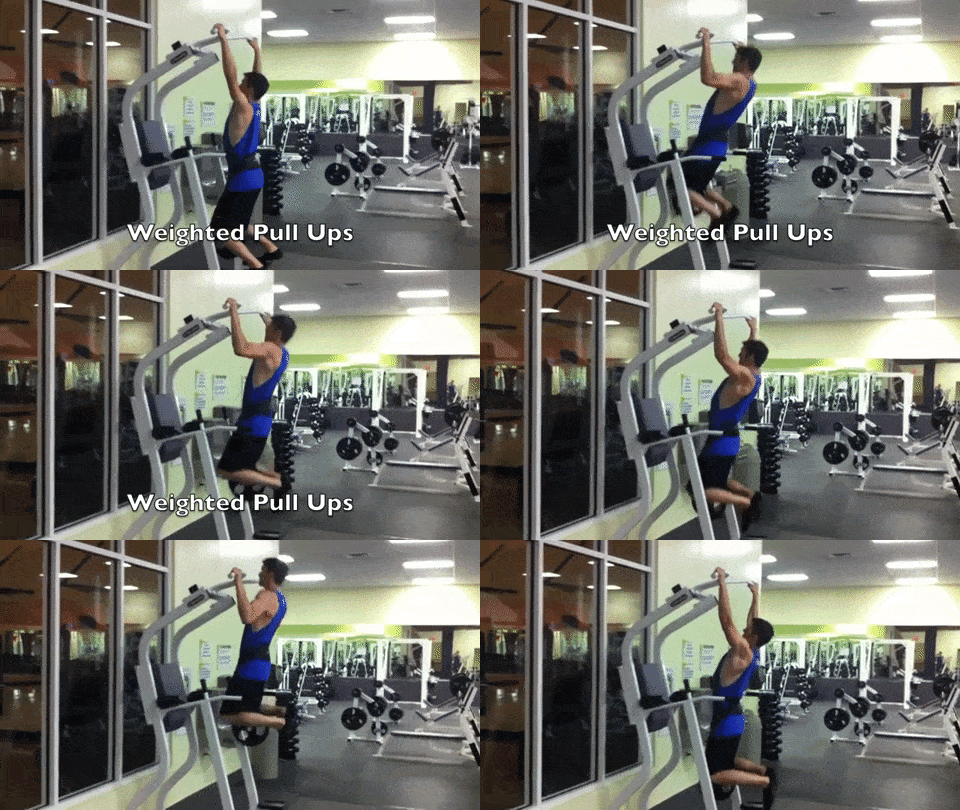
Categories
Uncategorized

#holistic #getfit #nutrition Advanced Bodyweight Workout Circuit: A Full Body Routine You Can Do At Home

Once you get good at advanced bodyweight exercises, you can bust out moves like this!

Want to get strong but hate the gym?

No problem!

With today’s Advanced Bodyweight Routine, you can burn fat, build muscle, and get a great workout in! All with no gym membership required!

It’s the kind of workout we build through our online coaching program. If you’re in a hurry, sign-up for our free weekly newsletter and we’ll send you PDFs of our “Work Out at Home” guides!


If you’re ready, click the sections below to get right into the action:

Alright, let’s do this thang.

The Advanced Bodyweight Workout

This is the Advanced Bodyweight Workout (Do 3 Circuits):

  • 10 One-Legged Squats – each side
  • 20 Bodyweight Squats
  • 20 Walking Lunges (10 each leg)
  • 20 Jump Step-Ups (10 each leg)
  • 10 Pull-Ups (or inverted bodyweight rows using your kitchen table)
  • 10 Dips – Bar Stools
  • 10 Chin-Ups (or inverted bodyweight rows with an underhand grip)
  • 10 Push-Ups
  • 30 Second Plank

See our section below on advanced bodyweight exercises to see how to do each of these movements!

I do use a door-frame pull-up bar in the video, but you can do table bodyweight rows (see the video below) if you can’t do a pull-up yet or if you don’t have a pull-up bar!

Another option is to do dowel rows, as we outline in The 5 Best Pull-up Alternatives:

This gif shows Jim doing a row on chairs

Lastly: this workout will have you sweating like a pig and leave you sore all over the next day.

If you’re just moving beyond the Beginner Bodyweight Workout for the first time, this workout might seem ridiculously difficult, which is fine.

The goal will be to go through as many circuits as you can without breaking form.

“WHAT IS A ‘CIRCUIT’?”

As Coach Lauren describes in the video above, in a circuit routine you’ll do each exercise in succession without a break in between (if you’re able).

  • Once you’ve finished all exercises in the circuit, do it again.
  • If you’re still able after the 2nd run through, go for a 3rd.
  • Because all of these exercises come one after another, you’re bound to get tired – that’s okay! 

Our goal is to give you a full-body workout that leaves you panting.

“HOW LONG SHOULD A BODYWEIGHT WORKOUT LAST?”

Go at your own pace, but the above 3 circuits and your warm-up and cool down will take you about 25-30 minutes.

And speaking of warming up and cooling down…

Before you start, do a WARM-UP

Don’t forget to warm up. You can run in place, jump rope, do a few push-ups, pedal on a stationary bike, jog up and down your stairs, etc. Since we are doing advanced movements here, the warm-up becomes even more critical. 

Also, if you want to stretch and cool down after your workout, here’s a routine you can run through:

If you are following this bodyweight workout plan because you’re trying to get in great shape without needing a gym, download our free-guide: Strength Training 101: Everything You Need to KnowIt’ll provide an exact plan to follow for growing strong.

The 21 Best Advanced Bodyweight Exercises

This LEGO knows lifting himself up is a great advanced bodyweight exercise.

Let’s go through each movement in the Advanced Bodyweight Workout Circuit, so we can ensure you’re doing each move correctly!

1) BODYWEIGHT SQUAT

Do a proper bodyweight squat to work out your legs

If you want even more instruction, here’s how to do a proper bodyweight squat:

2) ASSISTED ONE LEGGED SQUAT

A small stool can help when you first start doing one legged squats!

3) ONE LEGGED SQUAT (PISTOL SQUAT)

The one legged "pistol" squat is a great advanced bodyweight movement.

4) WALKING LUNGE

This gif shows the walking lunge, a great way to do bodyweight exercises in your own home!

5) JUMP STEP-UPS

Jump step-ups are perfect bodyweight moves you can try on your stairs.

6) ASSISTED PULL-UPS (WITH BAND)

Staci using a band for an assisted pull-up, a great exercise for a bodyweight circuit.

A resistance band is a great tool to help build strength for proper pull-ups. It’s part of our arsenal for getting your first pull-up.

7) NEGATIVE PULL-UPS

Staci jumping up to do a negative pull-up., a great movement until you can bring regular pull-ups into your circuit.

If you don’t have a resistance band, you can do negative pull-ups instead. Jump and hold yourself above the bar, and then slowly, under control, lower yourself to the ‘starting position’ of a pull-up. Then repeat!

This is a great way to build up enough strength to eventually get your first pull-up.

8) PULL-UP

A pull-up would be considered an advanced bodyweight movement, great for including in your at home training.

We have a full guide on proper pull-up form so you can hone in your technique.

9) CHIN-UPS

A chin-up is a pull-up, but with your hands facing towards you.

Much like a pull-up, but with your palms facing toward you.

Here’s a video going over proper pull-up and chin-up form:

If you can’t do pull-ups or chin-ups, you have another option…

10) INVERTED BODYWEIGHT ROW (OVERHAND)

A bodyweight row like this is a great "pull" exercise you can while building up strength for pull-ups.

An inverted bodyweight row can be a great “pull” exercise if you can’t do a pull-up yet, or if you don’t have a proper pull-up bar nearby. Because a good sturdy table can be used for inverted rows:

11) INVERTED BODYWEIGHT ROW (UNDERHAND)

A underhand inverted bodyweight row can be exchanged for a chin-up while you build up your strength.

12) ASSISTED BODYWEIGHT DIPS

A resistance band is a great way to get started with this bodyweight exercise.

With a resistance band, you can start performing assisted dips. A great exercise while you build up strength for normal dips.

13) BODYWEIGHT DIPS

Bodyweight dips are a great exercise to include in an advanced circuit.

14) KNEE PUSH-UP

Knee push-ups like this are a great way to progress to a regular push-up!

15) ELEVATED PUSH-UP

Do elevated push-ups to work up to regular push-ups

16) REGULAR PUSH-UP

This gif shows Staci doing a push-up in perfect form.

We have a whole article on how to do a proper push-up, but we also cover it extensively in this 5-minute video:

17) DECLINE PUSH-UPS

Decline push-ups like this are a great way to progress your bodyweight exercises.

18) KNEE PLANK

If you can't do a normal plank, start with doing them on your knees until you can advance.

19) PLANK

The plank is a great bodyweight exercise to engage your core muscles.

20) SIDE PLANK

Doing a plank on your side is a great way to progressive this bodyweight movement.

21) JUMPING JACKS

Jumping Jacks are a great cardiovascular bodyweight exercise

If you are looking for even MORE bodyweight exercises you can use in your workouts, make sure to check out our mega-resource:

 “The 42 Best Bodyweight Exercises You Can Do Anywhere.

How to Scale Your Bodyweight Routine

These LEGOS use their bodyweight for their training...it just looks like dancing!

As I said earlier, this whole routine is scalable based on your ability. For example, here is a sample routine for somebody who has conquered the Beginner Bodyweight Workout but can’t do the full routine above:

  • 10 Bodyweight Squats
  • 10 Walking Lunges
  • 15 Jump Ups
  • 3 Assisted Pull-Ups (or 6 inverted bodyweight rows – overhand grip on table)
  • 8 Dips (or 10 decline push-ups if these are too tough)
  • 3 Assisted Chin-Ups (or 6 inverted bodyweight rows – underhand grip on table)
  • 10 Push-Ups
  • 30 Second Plank
  • 30 Jumping Jacks

“WHAT IF THE ADVANCED BODYWEIGHT WORKOUT IS TOO EASY FOR ME?”

Hm, well then, can you do 4 circuits instead of 3? Or have you tried a circuit that would make you worthy of a Spartan?

do the 300 circuit training workout to get strong like King Leonidas

Whatever your fitness level, find a way to push yourself a little harder, get better, be faster, and grow stronger. 

We cover this extensively in our guide, Tracking Your Fitness Progress.

Keep track of:

  • Your exact routine
  • How long it took you
  • Which exercises wore you out
  • Exactly how many reps you did

Then make sure you do more next time!

“HOW OFTEN SHOULD I DO THE ADVANCED BODYWEIGHT WORKOUT?”

Do this routine 2-3 times a week, but never on consecutive days. It’s a message we really strike home in our guide, “How Often Should I Work Out?

You don’t build muscle when you’re exercising, you build muscle when you’re resting, so try not to do a strength training routine (of the same muscle groups) two days in a row.

I like to follow a training pattern of:

Alternatively, pick one of these fun exercises to do on your off days instead!

Wayne is stoked that he made his small change for weight loss.

If you’re still uneasy about this advanced workout, start with our Beginner Bodyweight Workout instead. You can download a worksheet to get started when you sign-up for our free weekly newsletter:

After the Advanced Bodyweight Workout: Next Steps!

This dancer has advanced her bodyweight training to include catching some air!

This should help you get started with a really powerful bodyweight training routine. But we hear frequently that people want MORE instruction, MORE guidance, and MORE workouts.

If that’s you, we have MULTIPLE options to take the next step. Pick the option below that best aligns with your goals and timeline:

1) If you want step-by-step guidance, a custom bodyweight training program that levels up as you get stronger, and a coach to keep you accountable, check out our killer 1-on-1 coaching program:


2) If you want a daily prompt for doing workouts at home, check out NF Journey. Our fun habit-building app helps you exercise more frequently, eat healthier, and level up your life (literally).

Try your free trial right here:

3) Enlist in the Rebellion! We need good people like you in our community, the Nerd Fitness Rebellion. 

Sign up in the box below to enlist and get our guide, Strength Training 101: Everything You Need to Know. It’ll help you start incorporating these advanced bodyweight moves into your training.

4) Level Up Your Workout! If you’re looking for more workout routines to follow, I got you covered:

I’d love to hear how this workout was for you.

Leave a comment below with your results or any questions you have on advanced bodyweight training and how else we can help. 

For the Rebellion!

-Steve

PS: Where do you go after you’ve crushed the Advanced Bodyweight Workout? Well, have you ever heard of the PLP Progression? There’s really no limit on how challenging that can get.

Good luck!

###

All photo sources can be found right here: [1]

The post Blog first appeared on Nerd Fitness.

from Nerd Fitness: Helping You Lose Weight, Get Stronger, Live Better. https://ift.tt/32InjZE
via IFTTT
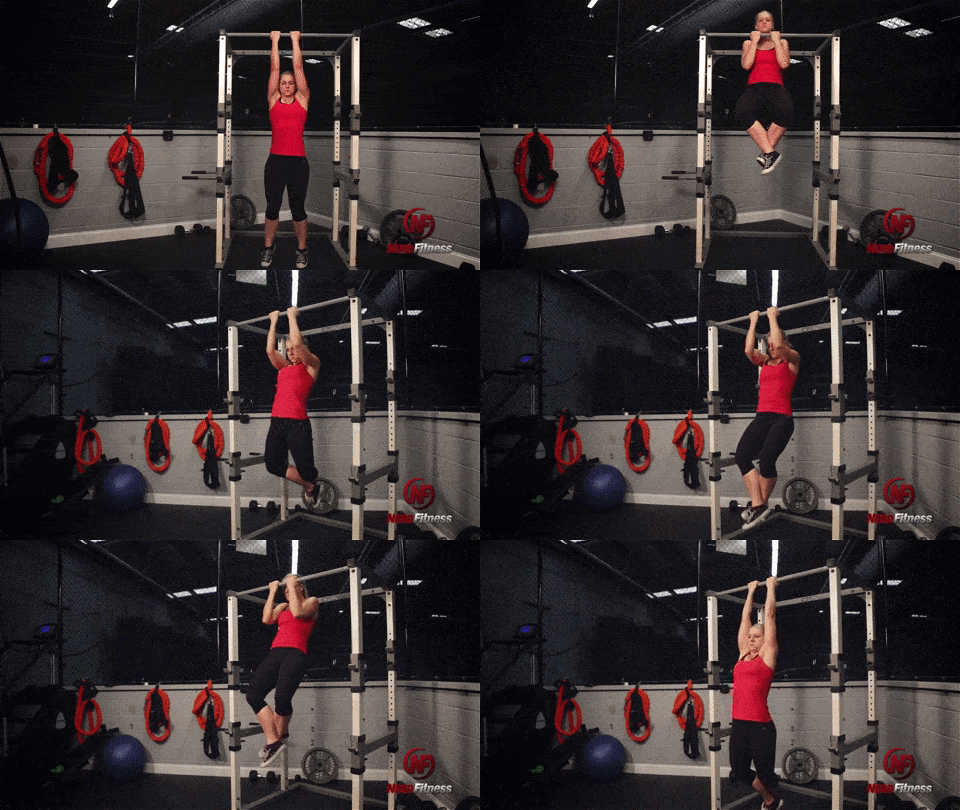
Categories
Uncategorized

#holistic #getfit #nutrition Get Your First Pull-up Or Chin-up! 30-Day Pull up Progression Plan

After today's guide you'll be able to do a pull-up everywhere, like Steve does.Pull-ups are my favorite exercise of all time.

But what if you can’t do a pull-up yet?

The answer: read this ultimate guide on getting your first pullup ASAP!

Here's a gif of a pull-up in perfect form.

We have helped hundreds of Online Coaching Clients get their first pull-up, and we’ll cover our exact strategies below! 


As part of our Strength Training 101 series, we give you an exact plan to follow leading you to your very first full pull-up:

If you can already do a pull-up (woot!), you might want to check out our article on proper pull-up form, although we’ll cover a lot of the same material here.

Let’s do this thang.

Tips on How to Start Doing Pull-Ups

In the video above, Coach Jim walks you through the exact progression system we use with our coaching clients who want to get their first pull-up (or chin-up).

Before we get into exercises to progress into a pull-up, let’s chat about some general strategies.

Consider the following three points when attempting to get your first chin-up or pull-up:

#1) This should hopefully be obvious, but the more you weigh, the more you have to lift in order to complete a pull-up.

If you’re truly serious about completing a pull-up, start by getting your diet under control. 

As we say here at Nerd Fitness, 80-90% of weight loss comes down to what you eat (#4 in the Rules of the Rebellion).

Here are some resources to help you with weight loss:

#2) MAKE YOUR “PULL” EXERCISES A PRIORITY. A lot of people do every other exercise before doing any back-related exercises, if they do any at all.

After warming up properly, your first exercise should always be the stuff that you want to work on the most – in this case, it’ll be your back muscles.

Until you get your first pull-up done, focus on the back exercises detailed in the levels and workouts in this guide.

#3) The progression we outline is a path that works for most people, but does NOT need to be followed to a T.
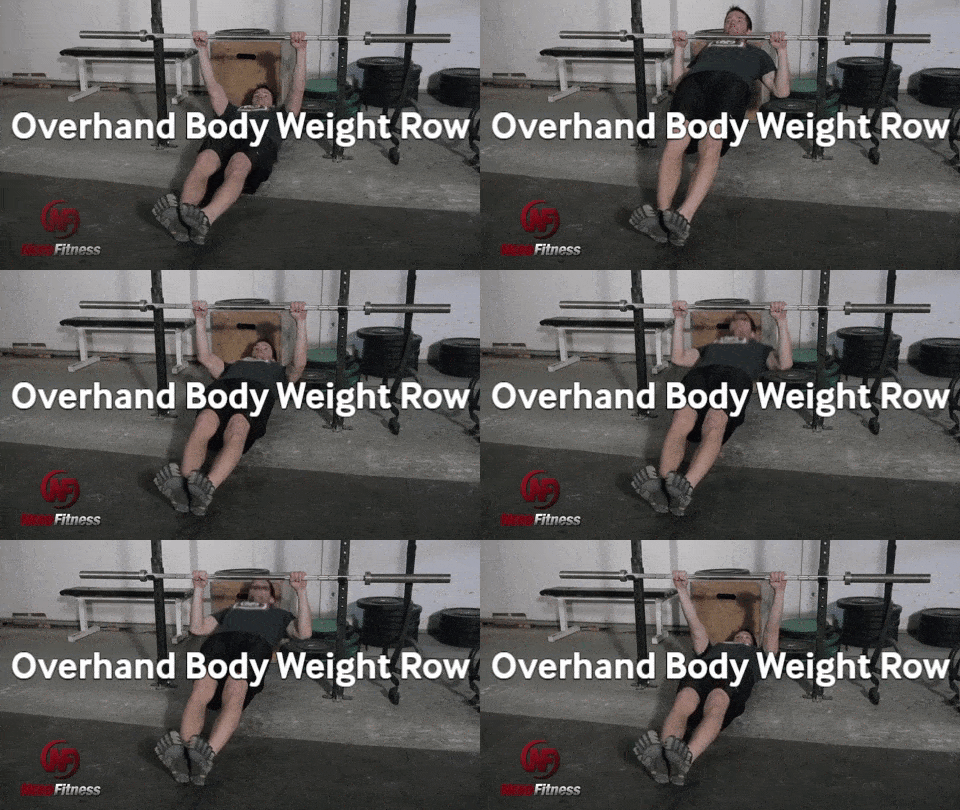
We give sample sets and reps and when to move up, but if you feel like you can progress sooner or want to try doing full pull-ups sooner than we recommend, that’s OKAY.

This is the slower progression method, where some people will want to do fewer reps and progress to the next levels sooner – that’s okay.

We recommend moving up to the next level when you can do 3 sets of 8 reps of a particular exercise. If you want the accelerated path, move on up as faster as you can do 3 sets of 5 reps. You do you boo.

You can follow our path for a pull-up but feel free to make it your own!

Want someone to build you a custom made progression plan for doing your first pull-up? Our 1-on-1 Online Coaching Program will do just that, plus your coach can review your movements through our app so you’ll know your training correctly and safely.


Level 1 Pull-up Workout: Bent Over Dumbbell Rows

Do a dumbbell row as a great beginner exercise to get strong enough for a pull-up!

We’re going to start with bent-over dumbbell rows, the most basic of back exercises, in case you’re starting from ABSOLUTELY square one.

Level 1 Pull-up Workout:

  • Bent-over dumbbell rows: 8 reps each arm (or as many as you can do)
  • Rest for a 2-minute break
  • Do another set
  • Repeat until you hit 3 sets

What weight should you start out with initially?

Whatever allows you to get to at least 5 reps a set.

Once you can do 3 sets of 8 reps (each arm), it’s time to pick up a heavier dumbbell.

This will allow you to get stronger and stronger. 

Make sure you give yourself at least 48 hours until you do the Level 1 Dumbbell Rows again, so you can include these dumbbell rows for your workouts on:

  • Monday
  • Wednesday
  • Friday

As soon as you can do 3 sets of 8 reps, it’s time to move up to a heavier dumbbell.

  • Once you can lift a 25-pound (10kg) dumbbell or heavier, consider moving up to the next level.
  • If you are a little bit bigger than the average bear, you might want to stick with this step until you lose a little bit more weight and get stronger – maybe go to 35 or 40-pound (18kg) dumbbells.

Want help designing your own workout routine? I’ve got two options for you.

The first is to head over to “Build Your Own Workout Routine” and get your hands dirty. Our guide will walk you through building a full-body exercise program in 10 simple steps.

The second is to have a Nerd Fitness Coach do all the heavy lifting for you (not really, you still have to lift stuff), by having them build you a tailor-made workout routine:


Level 2 Pull-Up Workout: Inverted Bodyweight Rows

Inverted rows are a great exercise to work on doing your first pull-up.

Bodyweight rows are the PERFECT precursor to pull-ups – they work the same muscles, and have you lifting your own bodyweight, just at a different angle.
For this level, we’ll provide you with two options: You can also make adjustments.

OPTION A: IF YOU HAVE ACCESS TO A GYM OR WANT TO JOIN A GYM:

You can follow the rest of this workout as part of our 6-Level Gym workout guide, which will help you go from total gym newbie to pull-up progressing badass!

At your gym, find your Smith Machine and set the bar at about chest height. 

A higher bar makes the exercise easier to start:

Start with inclined inverted rows for your pull-up workout. Then drop lower for more required effort.

And as you get stronger, you can set the bar lower:

As you get lower, like this, the row will be harder to do. Great way to progress into a pull-up.

Here’s a whole post I did on inverted bodyweight rows.

Here’s how to do an inverted bodyweight row (here is a video demonstration with gymnastic rings, but you can start with a bar as displayed in the images below).

  1. Set the bar at a height where it’s challenging for you to complete 3 sets of 8 reps with two minutes of rest between sets.
  2. Clench your butt and keep your abs tight and body straight throughout the exercise. 
  3. Pull your shoulder blades down and back towards each other (like you’re trying to pinch a pencil between them behind your back).
  4. Focus your mind on PULLING with your arms.
  5. Pull until your chest touches the bar (not your neck).
  6. As soon as you can complete all 3 sets of 8 reps, set the bar heigh lower to make the exercise more difficult.

If you need to make the exercise less challenging, bend your knees and put your feet flat on the ground:

Bending your knees like so can be helpful to start doing inverted rows.

Level 2 sample workout routine:

  • Monday – 3 sets of 8 reps of overhand bodyweight rows

Alternate between an overheand and underhand bodyweight row.

  • Wednesday – 3 sets of 8 reps of underhand bodyweight rows (hands reversed)

Alternate between underhand and overhand when doing bodyweight rows.

  • Friday – 3 sets of 8 reps of overhand bodyweight rows

(And then go underhand, overhand, underhand the following week)

As soon as you’re doing bodyweight rows where your body is at a 45-degree angle or lower, you can progress to Level 3.

OPTION B: IF YOU DON’T HAVE ACCESS TO A GYM FOR INVERTED ROWS:

You have 4 paths here:

1) Purchase a door frame pull-up bar, hang a pair of gymnastic rings from them. And then follow the same advice as above!

2) Use your kitchen table for rows (BE CAREFUL):

3) Do inverted rows between a couple chairs, as we walk you through in How to Do Pull-ups Without a Bar:

This gif shows Jim doing a row on chairs

4) Move up to Level 3 and progress with caution there.

If you are struggling with rows, you’re not sure you’re doing them correctly, or you’re not sure how to progress to the next level, check out our 1-on-1 coaching program

It’s the type of program that helped single mom Leslie lose 100+ pounds and start training with gymnastic rings and handstands! 

How did Leslie transform? Strength training. with pull-ups


Level 3 Pull-Up Workout: Assisted Pull-Ups

Steve doing an assisted pull-up, a perfect precursor to a regular pull-up!

Okay! It’s time to get to ACTUAL pull-ups here! Personally, I don’t like using the assisted pull-up machine in a gym as it doesn’t give you the full feeling of a pull-up, but it’s certainly better than nothing.

Instead, I recommend doing one of these alternatives:

#1) Assisted Pull-ups with chair

A chair can be a great tool to help you get your first pull-up.

Either one foot or two on the chair, depending on your needs. Your feet are ONLY there for support, use your upper body as much as possible.

You can also use a box or similar sized object for the same result:

A box can be used instead of a chair for a pull-up.

#2)Assisted Pull-ups with exercise band: 

Staci using a band for an assisted pull-up.

You can get different types of exercise bands with different levels of strength, or a variety pack for easy progression.

Put your foot in the exercise band and pull yourself up.

#3) Assisted pull-ups with a partner:

A friend can be a great asset when you're trying to do a pull-up.

Have a friend hold your feet behind you and help you complete each rep. Have them use the least amount of help possible to get you through your workouts.

Here’s how to do an assisted pull-up:

  • Clench your butt and keep your abs tight throughout the exercise – try not to swing like crazy.
  • Keep your shoulder blades pinched behind you throughout the movement and focus on PULLING the bar down with your arms.
  • Use the least amount of assistance that you can handle – as soon as you can do multiple pull-ups with both feet on the chair, switch to just one foot.
  • If you’re using an exercise band, try to get a few bands of varying tension so you can decrease the resistance as you get stronger.
  • As soon as you can do 3 sets of 8 with assistance, it’s time to move on to Level 4.

For another reference, Coach Jim and Staci show you how to do a variation of assisted chin-up right here:

This is probably the TOUGHEST level before getting your pull-ups. If you get stuck on “assisted pull-ups” and “assisted chin-ups”, you’re not alone. This is where most people get stuck.

We work hand-in-hand with people like you to get them their first pull-up in our Online Coaching Program. If you don’t know how to fit these movements into your workouts, or you just want somebody to give you the exact workout to follow every day, we got you!


Finally, a workout that includes Level 3 pull-up exercises

  • Monday – Assisted Pull-ups – 3 sets of 8 reps
  • Wednesday – Inverted Bodyweight Rows – 3 sets of 8 reps
  • Friday – Assisted Chin Ups – 3 sets of 8 reps

This will help you ramp up to Level 4.

Level 4 Pull-Up Workout: Top holds and Bar Hangs

Coach Staci showing you the bar hang

Alright, so we’ve started off great! We’re working those pulling muscles and assisted variations – but an actual chin-up might feel miles (or kilometers) away.

Heck, just even holding onto the bar may be a challenge without some assistance.

What should we do now? 

How about we work on holding onto the bar!?!

Before we work on doing full range, unassisted chin-ups or pull-ups, it’s really helpful to be strong and confident in holding unassisted parts of the movement.

This is where Top Holds and Bar Hangs come in!

#1) A Top Hold is exactly what it sounds like – we hold the top position of the chin-up or pull-up for several seconds (5 to 10). You’ll likely find holding the top of the chin-up (palms facing you) easier than the pull-up.

Coach Jim holding at the top of a pull-up

This is definitely something that you want to first do assisted. We’ll then work to transfer more weight – bit by bit over several workouts – off our feet and onto our arms until we’re holding ourselves unassisted at the top.

Using a band is a good option for assisted chin-ups, but using a box, bench, or another sturdy object will be a better option here.

It will allow you to shift that weight onto your arms a little easier.

That said, if all you have is a band for this exercise then that’s ok! Look to use thinner and thinner bands, while lifting the feet and knees up a bit to further reduce assistance (as the band won’t be stretched as far).

#2) On the other side of the movement, we have the Bar Hang…which is pretty much what it sounds like too!

Staci showing you the simple yet effective bar hang.

To perform a bar hang:

  • Grab the bar with palms facing towards you or away from you. You’ll likely find hanging with palms facing away from you to be a bit more comfortable. Either direction will help strengthen up your grip.
  • Just like with the top hold, you’ll want to start assisted then work to shift your weight from your feet onto your arms until you’re hanging unassisted.

This gif shows Coach Jim doing assisted then unassisted hangs.

To further supercharge this exercise: once you are hanging unassisted, work on retracting your shoulders down away from your ears.

Like so:

Coach Jim doing a shoulder retract, shown from the back

And so:

Coach Jim doing shoulder retracts, shown from the front.

This small movement is TOUGH (and you can even practice it assisted) but getting strong here will set your shoulders in an even better position for your first chin-up/pull-up.

We’ll look to hang from the bar (assisted or unassisted) for a total time of 30 seconds to 1 minute. At first this time may be broken up into several sets (e.g., 10 seconds, 10 seconds, 10 seconds), but you should eventually work up to one full set.

So how should we integrate either of these into our training?

#1) For the Top Holds, do this at the start of your workout (after your warm-up) for 3 sets of 5 seconds. Make sure you give it your all! Really squeeze the muscles tight and put as much weight on the arms as possible!

With all that effort, you’ll want to give yourself 30 seconds to a minute rest in-between. I know that sounds like a lot for just 5 seconds of work – but if you were working hard enough, you’ll need it!

#2) For the Bar Hang, do this at the end of your workout for 30 seconds to a minute. Again, look to complete this in as few sets as possible, while making the exercise as challenging as possible. Move from assisted to unassisted, with the shoulders retracted downwards.

You can start your gymnastic ring training by simply hanging from the rings!

If you have to take a break during the bar hang time, then take enough rest so that the next hold is productive.

Here Are the Exercises You Can Include for Your Level 4 Workout Routine:

Monday:

  • Top Hold (Assisted or Unassisted) – 4 sets of 5 seconds
  • Assisted Pull-ups – 3 sets of 8 repetitions
  • Bar Hang (Assisted or Unassisted) – 30 seconds total time

Wednesday:

  • Top hold (Assisted or Unassisted) – 4 sets of 5-10 seconds
  • Bodyweight Rows – 3 sets of 8 reps
  • Bar Hang (Assisted or Unassisted) – 30 to 60 seconds total time

Friday –

  • Top Hold (Assisted or Unassisted) – 4 sets of 5 seconds
  • Assisted Chin-ups – 3 sets of 8 reps
  • Bar Hang (Assisted or Unassisted) – 30 seconds total time

When you’re able to perform the Top Holds and Bar Hangs unassisted, then it’s time to move to the next level!!!

LEVEL 4.5 PULL-UP WORKOUT: (THE HIDDEN LEVEL)

Coach Staci showing you the front plant

What’s this??? Secret hidden exercises?

I just wanted to bring your attention to a great addition to any of these workouts – especially as things really ramp up.

Ready for it?

It’s . . . the front plank!

This gif shows Coach Jim doing a front plank

The front plank (or any of your favorite midsection stabilization exercises) is a great exercise to do, should holding a Top Hold or a Bar Hang prove tough.

If you haven’t already felt it during the the previous pull-up workouts – your middle needs to be involved too!

During a pull-up or chin-of, if we squeeze through the midsection and glutes, the nearby muscles are able to contract stronger through a phenomenon known as muscle irradiation.

Besides sounding like something the Fantastic Four encountered in space, this cool “trick” can helps engaged nearby muscles in the midsection, including those big back muscles that pull us up!

A picture showing the latissimus dorsi muscles

You can see muscle irradiation for yourself if you’ve ever been asked to flex your biceps for someone. You’ll instinctually squeeze your hand tight, because it helps the biceps engage stronger!

If needed, throw in some front planks work near the end of your workout.

You can even start on your knees:

If you can't do a normal plank, start with doing them on your knees until you can advance.

Look to hold 30 seconds to one minute of total time.

Alright, back to our regularly schedule programming!

Level 5 Pull-Up Workout: Negative Pull-Ups

Staci jumping up to do a negative pull-up.

Okay! We are now DANGEROUSLY close to getting our first pull-up!

The big step at this level is doing a negative pull-up:

  1. Grab onto the bar with an overhand grip
  2. Jump so your chest is touching
  3. Slowly lower yourself under control until you’re at the bottom of the movement.

WARNING: This can be very dangerous if you’re very overweight, which is why I’d recommend moving slowly through steps 1-3 first.

However, once you have a decent amount of back strength (which you got from Levels 1, 2, and 3), doing negatives is a great way to build arm and back strength.

You have two options for negative pull-ups:

  1. Hop up on a chair to get above the bar and then lower yourself back down. The name of the game is “in control.”
  2. Jump above the pull-up bar, and then begin to lower yourself back down IN CONTROL.

You don’t need to lower yourself so slowly that one repetition destroys you…lower yourself at a controlled speed – Counting to “three Mississippi” during the movement is a good tempo.

Here are the exercises you can include for your Level 5 Workout Routine:

Monday:

  • Negative Pull-ups – 4 sets of 1 rep
  • Assisted Pull-ups – 3 sets of 8 reps
  • Bar Hang (Unassisted) – 30 seconds total time

Wednesday:

  • Top Hold (Unassisted) – 4 sets of 5-10 seconds
  • Bodyweight Rows – 3 sets of 8 reps
  • Bar Hang (Unassisted) – 60 seconds total time

Friday:

  • Negative Chin-ups – 4 sets of 1 rep
  • Assisted Chin-ups – 3 sets of 8 reps
  • Bar Hang (Unassisted) – 30 seconds total time

Once you’re doing all of the negative repetitions in each exerciseyou’re ready to do a pull-up.

As you’ll see above, we’re giving you the “pull” exercises if you are building your own workout. If you want a good beginner gym workout program, these movements will fit in perfectly.

Alternatively, we can do all of the heavy lifting for you (well, not ALL the heavy lifting) – we’ll create a specific workout so all you have to do is log into your NF Coaching App each morning and do the workout your coach prescribed!


Level 6 – Doing Your First Pull-up or Chin-up

OH BOY! My dear Rebel, it’s time for a…

We made it! Here's Staci doing a pull-up!!!

At this point you have two options:

A chin-up is when you grab the bar with an underhand grip with your palms facing towards you.

A chin-up is a pull-up, but with your hands facing towards you.

Many find chin-ups slightly easier than…

A pull-up is when you grab the bar with your palms facing away from you. Seeing as this is a pull-up guide…

HOW TO DO A PULL-UP, STEP-BY-STEP:

  1. Grab the bar with a grip slightly wider than shoulder-width, with your hands facing away from you.
  2. Start from a dead hang.
  3. Engage your shoulders, pull them down and back towards each other (like you are pinching a pencil between your shoulder blades!)
  4. Flex your stomach, pull your body until your chest touches the bar.
  5. Slight pause, yell out “I’m a champion!”
  6. Lower yourself all the way back down to a dead hang.

We cover all of this and more in our post “How to Do a Proper Pull-Up,” but the above will get you started

Depending on your weight, your level of fitness and strength, and how far along you are in these progressions, you might be able to start with even more than one pull-up.

At this point, you can be a full Gym Class Hero by following a Gym Workout with these movements in there for your “pull” exercises:

 Level 6 routine weekly schedule:

Monday:

  • Pull-ups – 4 sets of 1-2 reps (move onto the next exercise if you can’t perform a rep)
  • Assisted Pull-ups – 3 sets of 8 reps
  • Bar Hang (Unassisted) – 60 seconds total time

Wednesday:

  • Negative Chin-ups – 4 sets of 1 rep
  • Bodyweight Rows – 3 sets of 8 reps
  • Bar Hang (Unassisted) – 60 seconds total time

Friday:

  • Chin-ups – 4 sets of 1-2 reps (move onto the next exercise if you can’t perform a rep)
  • Assisted Chin-ups – 3 sets of 8 reps
  • Bar Hang (Unassisted) – 60 seconds total time

Congratulations! You’re now doing pull-ups. Make sure you watch that video above to make sure you’re doing pull-ups with proper form. Nearly everybody does them incorrectly, with bad form.

Want to make sure you have proper form with your pull-ups? Check out our 1-on-1 Coaching program! Our spiffy mobile app lets you send video of your pull-ups directly to your coach, who will provide feedback so you can perfect your technique.

They’ll also build a workout program that’s custom to your situation, which will have you doing sets of 10 pull-ups in NO time!


Level 7 – Advanced Pull-up Moves

Now you can move onto advanced pull-ups like Steve is doing here.

Once you’re able to do 3 sets of 10 pull-ups or chin-ups, you have a few options:

OPTION #A: Continue to get better at doing more reps – 3 sets of 12, 3 sets of 15, 4 sets of 20, etc.

OPTION #B: Start doing other types of pull-ups.

Here are some advanced pull-ups you can try: 

#1) WIDE GRIP PULL-UPS (grab the bar WAY out with both hands):

Maintaining a wide grip is a great advanced pull-up.

#3) SIDE TO SIDE PULL-UPS

Another form of an advanced pull-up for you. Shift your weight from arm to arm.

#4) RING PULL-UPS

If you own some rings you can use them like so for some advanced pull-ups.

#5) TOWEL PULL-UPS (Great for grip strength)

OPTION #C) Add weight with a weight belt and do weighted pull-ups or weighted chin-ups:

A weighted pull-up is great for progressive overload on your muscles.

Personally, my favorite thing to do in a gym is weighted pull-ups; if you’re at this level and interested in doing so, here’s what you need to do:

  1. Get a weight belt. I bought this one on Amazon and it’s worked out incredibly well for me. I’ve tried doing the whole “put weights in a backpack” and it certainly works, but the angle of the weights hanging off your back is weird. With a weight belt, the weight hangs down between your legs (not a euphemism) so it feels more natural.
  2. Add small amounts at a time. Most gyms will have 2.5 lb (roughly 1kg) weights; you might feel stupid putting on a big weight belt and only hanging a tiny weight off it, but you need to start somewhere.
  3. Consistently add more weight. I’ll warm up with two sets of 5 pull-ups with no extra weight, and then do 3 sets of 5 weighted pull-ups. If I can complete all 3 sets of 5 reps (with my chin over the bar for every rep), I’ll make a note to add 2.5 or 5lbs (1 or 2kg) to my weight belt for the next time.

Here’s how to incorporate these Level 6 exercises into your gym workout routine:

  • MondayWeighted Chin Ups – 3 sets of 5 reps
  • Wednesday Elevated Feet Body Weight Rows – 3 sets of max repetitions
  • Friday – Wide Grip Pull-ups – 3 sets of maximum repetition
  • (The following week, I’d alternate by doing the chin-ups without weight, and then doing weighted pull-ups

Where do you go from here? How about working towards one of the most impressive exercises of all time? The MUSCLE UP (warning: uber advanced)!

Our new app, Nerd Fitness Journey, not only has an adventure to get you your first pull-up, but we’ll also show you exactly how to do cool bodyweight tricks like the muscle-up too. No guesswork needed here, just jump into the app and follow the missions and workouts for the day.

You can try your free trial TODAY, right here:

Lift Yourself Up (A Life With Pull-Ups)

The world can be your pull-up bar as Steve is showing here.

No matter your starting point, you CAN do pull-ups.

And you WILL do pull-ups with this guide. 

You don’t need to follow the progression above exactly – it’s merely one path that you can take in order to reach the promised land…where the pull-ups flow like wine and the women instinctively flock like the Salmon of Capistrano.

High Five! You are now doing pull-ups!

Just ask Christina, who can now do multiple sets of pull-ups – her story is incredible:

Christina started rocking pull-ups after Nerd Fitness Coaching

Or Bronwyn, who lost 50+ lbs and now does chin-ups with her daughter on her back!

For people looking for the next step, we’ve built 3 options that might float your boat:

1) If you are somebody that wants to get results like the women above and follow a tailor-made pull-up strength program designed around their life and goals, check out our popular 1-on-1 Online Coaching Program.

You’ll work with our certified NF instructors who will get to know you better than you know yourself, check your form, and program your workouts and nutrition for you.


Nerd Fitness Coaching Banner

#2) Exercising at home and need a plan to follow? Check out Nerd Fitness Journey!

Our fun habit-building app helps you exercise more frequently, eat healthier, and level up your life (literally). We even have an awesome adventure to help you get your first pull-up!

Try your free trial right here:

3) Join our free community, the Nerd Fitness Rebellion, and we’ll send you our free Strength 101 Guide, which you can get when you sign up in the box below:

Follow the path that works for your schedule, your experience, and your level of comfort with this movement – there’s no shame in going slowly and progressing safely.

And if you’re gung ho about pull-ups, ready for negatives and trying to squirm for that first rep, feel free to go for it. Just be safe.

When you DO finally do a pull-up, I want to be the first to know – email me at steve@nerdfitness.com and tell me about it!

For the Rebellion,

-Steve

PS: Check out our other three articles on pull-ups:

PPS: Want to learn more? Read the rest of the Strength Training 101 series:

###

Photo Souce: Muscles that Move the Humerus

The post Blog first appeared on Nerd Fitness.

from Nerd Fitness: Helping You Lose Weight, Get Stronger, Live Better. https://ift.tt/3bLE7jT
via IFTTT