“…Tony the Tiger tells us that breakfast is the most important meal of the day! It’s grrrrrreat!”
This adage about breakfast has become commonplace that it’s readily and unquestionably accepted as fact.
Well then, what’s with the growing popularity of Intermittent Fasting and SKIPPING breakfast?
(Tony just audibly gasped.)
We have TONS of Online Coaching Clients who do intermittent fasting, and we love helping people reach their goals in whatever path suits their life.
In this Ultimate Guide to Intermitting Fasting, I’ll teach you everything about the science of fasting and what results you can expect:
- What is Intermittent Fasting?
- How does Intermittent Fasting work?
- Should I eat 6 small meals a day?
- Should I try Intermittent Fasting? (6 Things to Consider)
- What are the negative effects of Intermittent Fasting?
- Can I build muscle and gain weight while Intermittent Fasting?
- Should I do Intermittent Fasting and the Keto Diet?
- Does Intermittent Fasting have different effects on men and women?
- Top 6 questions about Intermittent Fasting.
- 8 tips and tricks for fasting.
- Intermittent Fasting: next steps.
- Download our Intermittent Fasting Plan.
We have ALSO have a fun Intermittent Fasting Plan you can use to plan out your next few weeks of eating!
Join the Rebellion – our online community – and I’ll send you our fasting guide free:
- Complete outline of the Intermittent Fasting Protocol
- Worksheets for tracking when you eat and how long you fasted
What is Intermittent Fasting?

“Conventional wisdom” isn’t that smart.
We’re going to take two widely accepted healthy eating “rules” and turn them on their head:
RULE #1: You HAVE to eat first thing in the morning: Make sure you start off with a healthy breakfast, so you can get that metabolism firing first thing in the morning!
“Eat breakfast like a king, lunch like a prince, and dinner like a pauper.”
There are even studies that show those that eat earlier in the day lose more weight than those who ate later in the day or skipped a meal.[1]
RULE #2: Eat lots of small meals for weight loss. Make sure you eat six small meals throughout the day so your metabolism stays operating at maximum capacity all day long.”
In other words, “eat breakfast and lots of small meals to lose weight and obtain optimal health.”
But what if there’s science and research that shows SKIPPING BREAKFAST (the horror! blasphemy!) can help with optimum human performance, mental and physical health improvement, maximum muscle retention, and body fat loss?

That’s where an Intermittent Fasting Plan comes in.
Intermittent fasting is not a diet, but rather a dieting pattern.
In simpler terms: it’s making a conscious decision to skip certain meals on purpose.
By fasting and then feasting deliberately, intermittent fasting generally means that you consume your calories during a specific window of the day, and choose not to eat food for a larger window of time.
There are a few different ways to take advantage of intermittent fasting, which I learned about from Martin over at LeanGains, a resource specifically built around fasted strength training:
INTERMITTENT FASTING 16/8 PLAN
What it is: Fasting for 16 hours and then only eating within a specific 8-hour window. For example, only eating from noon-8 PM, essentially skipping breakfast.
Some people only eat in a 6-hour window, or even a 4-hour window. This is “feasting” and “fasting” parts of your days and the most common form of Intermittent Fasting. It’s also my preferred method (4 years running).
Two examples: The top means you are skipping breakfast, the bottom means you are skipping dinner each day:
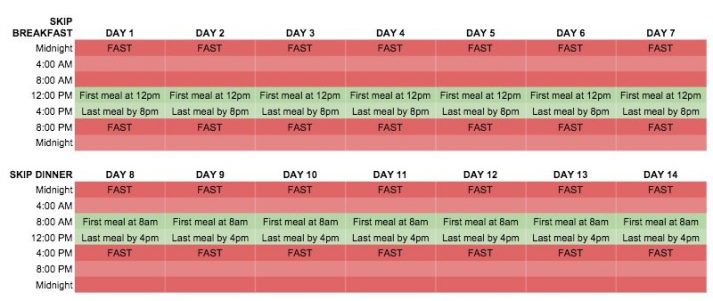
You can adjust this window to make it work for your life:
- If you start eating at: 7AM, stop eating and start fasting at 3pm.
- If you start eating at: 11AM, stop eating and start fasting at 7pm.
- If you start eating at: 2PM, stop eating and start fasting at 10pm.
- If you start eating at: 6PM, stop eating and start fasting at 2AM.
INTERMITTENT FASTING 24 HOUR PLAN
Skip two meals one day, where you take 24 hours off from eating. For example, eat on a normal schedule (finishing dinner at 8PM) and then you don’t eat again until 8PM the following day.
With this plan, you eat your normal 3 meals per day, and then occasionally pick a day to skip breakfast and lunch the next day.
If you can only do an 18 hour fast, or a 20 hour fast, or a 22 hour fast – that’s okay! Adjust with different time frames and see how your body responds.
Two examples: skipping breakfast and lunch one day of the week, and then another where you skip lunch and dinner one day, two days in a week.
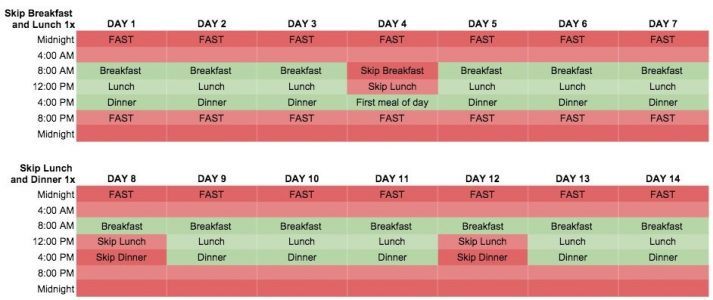
Note: You can do this once a week, twice a week, or whatever works best for your life and situation.
By the way, both those weekly charts above come from our free Intermittent Fasting Plan (with printable worksheets).
Most people struggle with knowing exactly when to eat and when to stop eating, and actually sticking with it. We address all of that in the Nerd Fitness Intermittent Fasting Guide you get free when you sign up for our email list in the box below:
- Complete outline of the Intermittent Fasting Protocol
- Worksheets for tracking when you eat and how long you fasted
Those are the two most popular intermittent fasting plans, and the two we’ll be focusing on, though there are many variations of both that you can modify for yourself:
- Some people eat in a 4 hour window, others do 6 or 8.
- Some people do 20 hour fasts or 24 hour fasts.
- Another strategy is to eat only one meal a day (OMAD).
You’ll need to experiment, adjust to work for your lifestyle and goals, and see how your body responds.
Let’s first get into the science here behind Intermittent Fasting and why you should consider it!
How Does Intermittent Fasting Work?
Now, you might be thinking: “okay, so by skipping a meal, I will eat less than I normally eat on average (2 meals instead of 3), and thus I will lose weight, right?”
Yes.
By cutting out an entire meal each day, you are consuming fewer calories per week – even if your two meals per day are slightly bigger than before. Overall, you’re still consuming fewer calories per day.
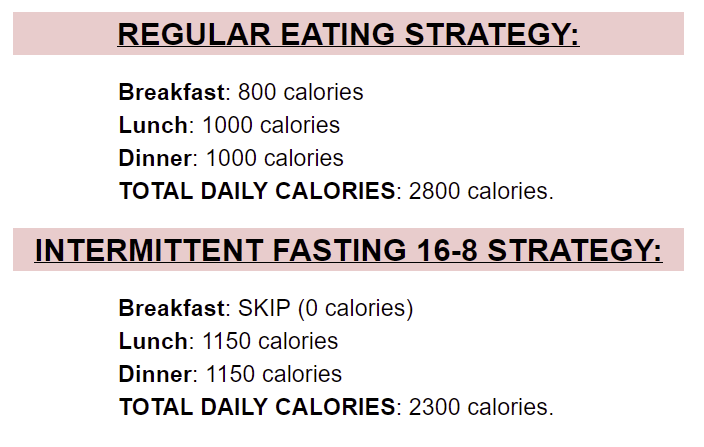
In this example, you’re eating LARGER lunches and dinners than you normally do, but by skipping breakfast you’ll consume 500 less calories per day.
And thus, weight loss!
This is highlighted in a recent JAMA study[2] in which both calorie restricted dieters and intermittent fasters lost similar amounts of weight over a year period.
That doesn’t tell the FULL story, as the timing of meals can also influence how your body reacts.
Intermittent Fasting can help because your body operates differently when “feasting” compared to when “fasting”:
When you eat a meal, your body spends a few hours processing that food, burning what it can from what you just consumed.
Because it has all of this readily-available, easy to burn energy (thanks to the food you ate), your body will choose to use that as energy rather than the fat you have stored.
During the “fasted state” (the hours in which your body is not consuming or digesting any food) your body doesn’t have a recently consumed meal to use as energy.
Thus, it is more likely to pull from the fat stored in your body as it’s the only energy source readily available.
Burning fat = win.

The same goes for working out in a “fasted” state.
Without a ready supply of glucose and glycogen to pull from (which has been depleted over the course of your fasted state, and hasn’t yet been replenished with a pre-workout meal), your body is forced to adapt and pull from a source of energy that it does have available: the fat stored in your cells.
Why does this work? Our bodies react to energy consumption (eating food) with insulin production.
The more sensitive your body is to insulin, the more likely you’ll be to use the food you consume efficiently, and your body is most sensitive to insulin following a period of fasting [3].
These changes to insulin production and sensitivity can help lead to weight loss [4] and muscle creation [5].
Next: Your glycogen (a starch stored in your muscles and liver that your body can burn as fuel when necessary) is depleted during sleep (aka during fasting), and will be depleted even further during training, which can lead to increased insulin sensitivity.
This means that a meal following your workout will be used more efficiently: converted to glycogen and stored up in your muscles or burned as energy immediately to help with the recovery process, with minimal amounts stored as fat.
Compare this to a regular day (no intermittent fasting): With insulin sensitivity at normal levels, the carbs and foods consumed will see full glycogen stores and enough glucose in the bloodstream, and thus be more likely to get stored as fat.
Back to fasting: growth hormone is increased during fasted states (both during sleep [6]and after a period of fasting). Combine this increased growth hormone secretion:[7], the decrease in insulin production (and thus increase in insulin sensitivity [8]), and you’re essentially priming your body for muscle growth and fat loss with intermittent fasting.
The less science-y version: Intermittent fasting can help teach your body to use the food it consumes more efficiently, and your body can learn to burn fat as fuel when you deprive it of new calories to constantly pull from (if you eat all day long).
TL/DR: For many different physiological reasons, fasting can help promote weight loss and muscle building when done properly.

I know Intermittent Fasting can be overwhelming for many, which is why we work with our 1-on-1 coaching clients to help them understand what’s going on, and how to make it work for THEIR life.
If that sounds like you, click the button below to learn more about how our program works:
Should I Eat 6 Small Meals a Day?
There are a few main reasons why diet books recommend six small meals:
1) When you eat a meal, your body does have to burn extra calories [9] just to process that meal. So, the theory is that if you eat all day long with small meals, your body is constantly burning extra calories and your metabolism is firing at optimal capacity, right? Well, that’s not true.
Whether you eat 2000 calories spread out throughout the day, or 2000 calories in a small window, your body will burn the same number of calories processing the food [10].
So, the whole “keep your metabolism firing at optimum capacity by always eating” sounds good in principle, but reality tells a different story.
2) When you eat smaller meals, you might be less likely to overeat during your regular meals. I can definitely see some truth here, especially for people who struggle with portion control or don’t know how much food they should be eating.
However, once you educate yourself and take control of your eating, some might find that eating six times a day is very prohibitive and requires a lot of effort. I know I do.
Also, because you’re eating six small meals, I’d argue that you probably never feel “full,” and you might be MORE likely to eat extra calories during each snack.
Although grounded in seemingly logical principles, the “six meals a day” doesn’t work for the reason you think it would (#1), and generally only works for people who struggle with portion control (#2).
If we think back to caveman days, we’d have been in serious trouble as a species if we had to eat every three hours. Do you think Joe Caveman pulled out his pocket sundial six times a day to consume his equally portioned meals?

Hell no! He ate when he could, endured and dealt with long periods of NOT eating (no refrigeration or food storage) and his body adapted to still function optimally enough to still go out and catch new food.
A recent study (written about in the NYT, highlighted by LeanGains) has done a great job of challenging the “six-meals-a-day” technique for weight loss [11]:
There were [no statistical] differences between the low- and high- [meal frequency] groups for adiposity indices, appetite measurements or gut peptides (peptide YY and ghrelin) either before or after the intervention. We conclude that increasing meal frequency does not promote greater body weight loss under the conditions described in the present study.
Factor in the potential physiological benefits listed in the previous section, and you got yourself some damn good science-backed evidence to consider trying Intermittent Fasting if you want to decrease body fat and build muscle.
Should I Try intermittent fasting? (6 Things to Consider)
Now that we’re through a lot of the science stuff, let’s get into the reality of the situation: why should you consider Intermittent Fasting?
#1) Because it can work for your goals. Although we know that not all calories are created equal, caloric restriction plays a central role in weight loss.
When you fast, you are also making it easier to restrict your total caloric intake over the course of the week, which can lead to consistent weight loss and maintenance.
#2) Because it simplifies your day. Rather than having to prepare, pack, eat, and time your meals every 2-3 hours, you simply skip a meal or two and only worry about eating food in your eating window.
It’s one less decision you have to make every day.

It could allow you to enjoy bigger portioned meals (thus making your tastebuds and stomach satiated) and STILL eat fewer calories on average.
#3) It requires less time (and potentially less money). Rather than having to prepare or purchase three to six meals a day, you only need to prepare two meals.
Instead of stopping what you’re doing six times a day to eat, you simply only have to stop to eat twice. Rather than having to do the dishes six times, you only have to do them twice.
Rather than having to purchase six meals a day, you only need to purchase two.
#4) It promotes stronger insulin sensitivity and increased growth hormone secretion, two keys for weight loss and muscle gain. Intermittent fasting helps you create a double whammy for weight loss and building a solid physique.
#5) It can level up your brain, including positively counteracting conditions like Parkinson’s, Alzheimer’s, and dementia.
As explained here in this TEDx talk by Mark Mattson, Professor at Johns Hopkins University and Chief of the Laboratory of Neurosciences at the National Institute on Aging, fasting is grounded in serious research and more studies are coming out showing the benefits:
#6) Plus, Wolverine does it:
#7) Boy George is a fasting fan (and apparently reads Nerd Fitness!):
Please look into 'Intermittent Fasting'. https://t.co/C2fCylOaWj https://t.co/060k5Ws0bh
— Boy George (the truth is in your breath) (@BoyGeorge) May 8, 2017
So if both musicians and adamantium-clawed superheroes do Intermittent Fasting, it can probably work for you too, if you can make it work for your particular lifestyle and situation!
If you’ve tried implementing something like this in the past and not had success, or you’re just looking for guidance from a coach to help you implement it into your lifestyle, I hear ya!
That was the specific problem we set out to solve with our 1-on-1 Online Coaching Program: helping busy people make lifestyle changes (like Intermittent Fasting) and also build the habit of exercise. You can schedule a call with our team to learn more by clicking on the image below!
What Are the Negative Effects of intermittent fasting?

In my own experimentation with Intermittent Fasting since 2014, I have found very few negative side effects with Intermittent Fasting.
The biggest concern most people have is that Intermittent Fasting will lead to lower energy, focus, and the “holy crap I am hungry” feeling during the fasting period and ruin them.

People are concerned that they will spend all morning being miserable because they haven’t consumed any food, and thus will be miserable at work and ineffective at whatever task it is they are working on.
The following are my thoughts and experiences, and your results may vary:
Yes, the initial transition from EATING ALL THE TIME, to intermittent fasting MIGHT be a bit of a jolt to your system; it was for me.
However, once I got through the transition after a few days, my body quickly adapted and learned to function just as well only eating a few times a day.
Although I fast for 16 hours per day with no issues, the following might help assuage your fears that skipping breakfast will cause your body to eat itself and your brain to implode:
After 48-hours of fasting in a recent study [12], “cognitive performance, activity, sleep, and mood are not adversely affected in healthy humans by two days of calorie-deprivation.” You’ll be fasting for far less time than that.
“So why do I feel grouchy and lethargic when I skip breakfast?”
In this nerd’s humble opinion, a good portion of the grumpiness is a result of past eating habits. If you eat every three hours normally, and normally eat as soon as you wake up, your body will start to get hungry every three hours as it is now used to consuming food every three hours.
If you eat breakfast every morning, your body expects to wake up and eat food.
Once you retrain your body to NOT expect food all day every day (or first thing in the morning), these side-effects become less of an issue. In addition, ghrelin (a hormone that makes you hungry [13]), is actually lowest in the mornings and decreases after a few hours of not eating too. The hunger pains will naturally pass!
Personally, I found this grumpiness subsided after a few days and now my mornings actually energize me.

It’s important to understand that Intermittent Fasting is NOT a cure-all panacea. Don’t delude yourself into thinking that if you skip breakfast and then eat 4,000 calories of candy bars for lunch and dinner that you will lose weight.
If you have an addictive relationship with food and you struggle with portion control, figure out your calorie goals and track your calorie intake in your meals to make sure you’re not overeating.
If you skip breakfast, you might be so hungry from this that you OVEREAT for lunch and this can lead to weight gain. Again, the important thing here is that with an intermittent fasting plan, you’re eating fewer calories than normal because you’re skipping a meal every day.
Think about it in caveman terms again. We certainly found ways to survive during periods of feast and famine, and that remains true today. Imagine if you needed to eat in order to be active and alert: what would hungry cavemen do?
They would go find food, and that probably required a ton of effort. It actually takes our bodies about 84 hours of fasting [14] before our glucose levels are adversely affected. As we’re talking about small fasts (16-24 hour periods), this doesn’t concern us.
AN IMPORTANT CAVEAT: Intermittent Fasting can be more complex for people who have issues with blood sugar regulation, suffer from hypoglycemia, have diabetes, etc. If you fit into this category, check with your doctor or dietitian before adjusting your eating schedule. It also affects women differently (there’s a whole section dedicated to that here).
Can I Build Muscle and Gain Weight While Intermittent Fasting?
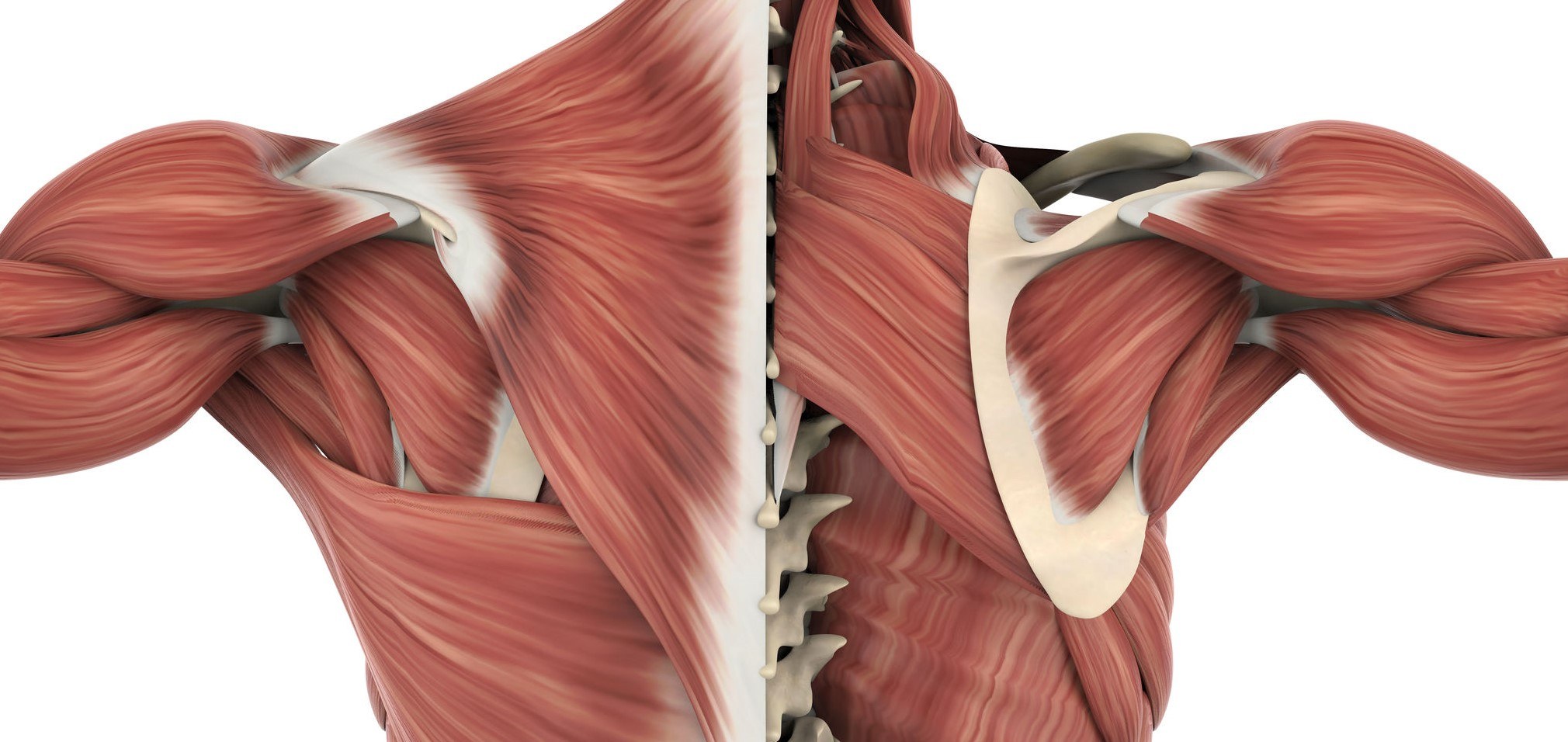
You’re damn right you can!
(We have our big “how to build muscle” guide, in addition to a whole “Strength 101” series – and I’d recommend you read those if you’re looking for a place to start strength training.)
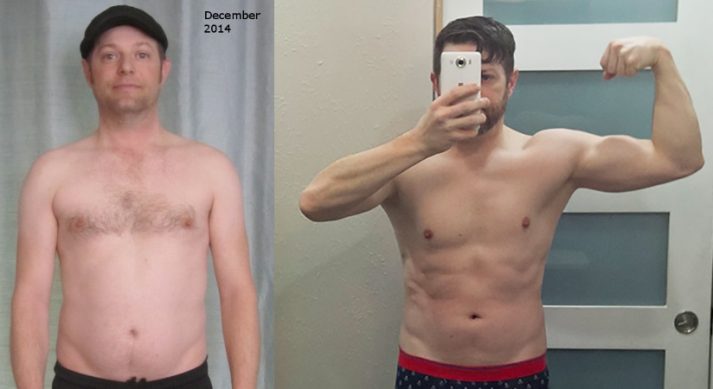
In fact, I have been intermittent fasting since 2015 while building muscle and decreasing my body fat percentage:

I still eat roughly the same number of calories I was consuming before, but instead of eating all damn day long, I condense all of my calorie consumption into an eight hour window.
- 11 AM Work out with heavy strength training in a fasted state.
- 12 PM Immediately consume 1/2 of my calories for the day (a regular whole-food meal, followed by a calorie-dense homemade protein shake).
- 7 PM Consume the second portion of my calories for the day in a big dinner.
- 8 PM – 12 PM the next day: Fast for 16 hours.
In a different method, my friend Nate Green packed on a crazy amount of muscle while fasting for a full 24 hours on Sundays – so it is possible. [15]
I’m not kidding when I say this has revolutionized how I look at muscle building and fat loss.

Ultimately, this method flies in the face of the typical “bulk and cut” techniques of overeating to build muscle (along with adding a lot of fat) before cutting calories to lose fat (along with some muscle) and settling down at a higher weight.
I prefer this method to the bulk-and-cut technique for a few reasons:
- There’s far less of a crazy swing to your weight. If you are putting on 30 pounds and then cutting 25 to gain 5 lbs of muscle, your body is going through drastic swings of body mass. Your clothes will fit differently, you’ll have different levels of definition, and your body will wonder what the hell is going on.
- You’re consuming less food and thus spending less money. Rather than overeating to put on 1 pound of muscle and 4 pounds of fat in a week or two, you’re aiming to eat exactly enough to put on 1 pound of muscle without adding much fat on top of it. Yeah, it’s a delicate balance, but there’s far less swing involved. You are just slowly, steadily, and consistently building muscle and strength over many months.
- There’s never a need to get “vacation-ready”: we all want to look good naked, right? When you are just adding muscle, you don’t need to worry about getting your body ready before by drastically altering your diet (avoiding a miserable crash diet like the Military Diet). [16]
- You can make small adjustments and stay on target. Keep your body fat percentage low, build strength and muscle, and if you happen to notice your body fat creeping up, cut back on the carbs. Within two weeks you should be back at your preferred body fat percentage and can continue the muscle building process.
A note on BCAA consumption. Martin from LeanGains [17] recommends consuming Branched Chain Amino Acids (BCAA’s) as a supplement with regards to fasted training to aid your muscles through your workout.
Personally, I used BCAAs for about 6-8 months during my initial start with fasted training (consuming them before training), though haven’t used them in the past 2+ years. I didn’t notice any adverse effects to not taking them with regards to my performance. Your value may vary!
Now, it should go without saying that if you want to build muscle while fasting, you need to work out. Specifically, by lifting heavy.

If you want help building a workout routine designed to create muscle, I have 3 options:
#1) “Build Your Own Workout Routine” and get your hands dirty. Our guide will walk you through building a full body exercise program in 10 simple steps.
#2) Follow our Strength Building Guide and start training today. You’ll want to do lots of heavy compound lifts like the Barbell Squat, Deadlift, Bench-Press, Dip, Bodyweight Row, Pull-ups, and Push-ups.
Get strong as hell, eat enough protein, and you’ll hit your goals.
#3) Have a Nerd Fitness Coach do all the heavy lifting for you (not really, you still have to lift stuff), by having them build you a tailor-made workout routine:
Should You Do Intermittent Fasting and the Keto Diet?
We have a crazy extensive guide on the Keto Diet in case you’re not familiar with it, so here it is in a nutshell:
By only eating fat and protein, your body must adapt to run on fat for fuel instead of carbohydrates. In the absence of carbs/glucose, your body converts fats to ketones and uses them for fuel.
This process is called “ketosis,” and there are two ways for a body to enter ketosis:
- Eating in a way that induces ketosis (very low carb, high fat).
- Fasting…Hey, that’s what you’re reading about right now!
We actually have an amazing success story here on Nerd Fitness, Larry, who followed our strategies, went Keto and start intermittent fasting. He ended up losing weight, getting stronger, AND overcame the challenges of rheumatoid arthritis (click on the image for his story)!
Here’s how the fasting portion of it works:
As your body enters a fast period when there are no sources of glucose energy readily available, the liver begins the process of breaking down fat into ketones.
Fasting itself can trigger ketosis.
Fasting for a period of time before kicking off a Keto-friendly eating plan COULD speed your transition into the metabolic state of ketosis, and fasting intermittently while in ketosis could help you maintain that state.
I personally love fasting for the simplicity: I skip breakfast every day and train in a fasted state. It’s one less decision I have to make, it’s one less opportunity to make a bad food choice, and it helps me reach my goals.
WHY KETO + IF WORKS = eating Keto can be really challenging. And every time you eat, it’s an opportunity to do it wrong and accidentally eat foods that knock you out of ketosis.
You’re also tempted to overeat.
So, by skipping a meal, you’re eliminating one meal, one decision, one chance to screw up.
Note: if you’re thinking “Steve, am I losing weight because I’m skipping 1/3rd of my meals for the day, AND eliminating an entire macronutrient?”, then you’d be right.
Both Keto and IF have secondary effects that could also be factoring in – physiological benefits which I explain in both articles.
Your value may vary!
You need to decide what works for you.

You probably won’t become “keto-adapted” (your body running on ketones) just skipping breakfast every day – your body will still have enough glucose stored from your carb-focused meals for lunch and dinner the day before.
In order to use fasting to enter ketosis, the fast needs to be long enough to deplete your carb/glucose stores, or you need to severely restrict carbohydrates from your meals in addition to IF in order to enter ketosis.
MORAL OF THE STORY: Experiment and try different strategies that will work for you.
By skipping a meal or minimizing carbohydrate intake, you’re more likely than not to lose weight:
- You can do intermittent fasting without eating a Keto Diet and lose weight.
- You can do a Keto Diet without intermittent Fasting and lose weight.
- You can combine them and lose weight.
Sticking with Keto is BRUTALLY difficult, and probably not the right diet for 98% of the planet. Those people would be better off following our “Start Eating Healthy” guide with small changes.
Any of those options could work for you, but you need to make it work for your lifestyle! If you want to more about the Keto Diet, definitely read my big-ass post about Keto.
If you’re in a hurry and want to download it so you can read it at your leisure, you can grab our Quick Start Guide to the Keto Diet for free right here:
- 55-page Keto Diet guide: how to start today!
- Learn the benefits and pitfalls of going Keto.
- Keto recipes, snacks, resources, and more!
Does Intermittent Fasting Have Different Effects on Men and Women?

The quick answer is: “yes, Intermittent Fasting can affect men and women differently.”
Anecdotally, we have many women in our online coaching program that swear by Intermittent Fasting, while others have had adverse effects.
Let’s dig into the science and studies.
A recent PubMed summary concluded that “fasting can be prescribed as a safe medical intervention as well as a lifestyle regimen which can improve women’s health in many folds [18].
Now, in that extract, many of the studies cited are focused on specifically calorie restriction (and not just fasting), and they also say that “future studies should address this gap by designing medically supervised fasting techniques to extract better evidence.”

Digging into the PubMed Archives brought me to the following conclusions [19]:
One small study (with 8 men and 8 women, all non-obese) resulted in the following: “Glucose response to a meal was slightly impaired in women after 3 weeks of treatment, but insulin response was unchanged. Men had no change in glucose response and a significant reduction in insulin response.”[20]
Another small study (8 women) studied the effects on their menstrual cycles after a 72 hour fast – which is significantly longer than any fast recommended in this article: “in spite of profound metabolic changes, a 72-hour fast during the follicular phase does not affect the menstrual cycle of normal cycling women.” [21].
Yet another study tracked 11 women with 72 hour fasts (again, longer than we’d recommend) and it found that “Fasting in women elicited expected metabolic responses – included increased cortisol (a stress hormone) – and apparently advanced the central circadian clock (which can throw off sleeping patterns). [22]
Those studies above, in working with small sample sizes, and different types of fasting than recommended here, would lead me to believe that fasting affects men and women differently, and that many of the weight loss benefits associated with intermittent fasting (that affect insulin and glucose responses) work positively for men and negatively for women.
There are also a series of articles[23] out there that dig into the potential reproductive health issues, stress challenges, induction of early-menopause [24] associated with fasting (and calorie restriction) for women.
Precision Nutrition – a great resource – recommends not attempting Intermittent Fasting as a woman if:
- you’re pregnant
- you have a history of disordered eating
- you are chronically stressed
- you don’t sleep well
- you’re new to diet and exercise
The challenge associated with all of this is that there aren’t enough long-term studies, with large enough sample sizes, specifically targeting female humans, with relation to the different types of Intermittent Fasting.
ALL OF THIS TO SAY: It does appear that men and women will have different experiences with intermittent fasting; we’re all unique snowflakes (yep, especially you), and your body will be affected by intermittent fasting differently than the person next to you.
There is enough evidence as cited in the articles and studies above that would give me pause to recommend Intermittent Fasting for women, especially if you are considering getting pregnant in the near term.
If you are looking to attempt fasting for weight loss reasons, my research has shown me that Intermittent Fasting could be less effective for women than men with regards to weight loss, and thus you would be wise to keep your efforts elsewhere:
- Focusing on the total calories and quality of your food (here’s how to eat better).
- Start exercising regularly!
- Make sure you are getting enough sleep.
Now, if you’ve read the above warnings, you are still curious about Intermittent Fasting, and you want to give it a try as a female, that is your choice!
You know your body best.

So, get blood work done, speak with your doctor and get a check-up.
Give intermittent fasting a shot, track your results, and see how your body/blood work changes as a result of Intermittent Fasting and decide if it’s right for you.
Your milage may vary, so speak with a doctor or find a doctor versed in intermittent fasting plans and treat it like an experiment on yourself!
If you’re not sure if an Intermittent Fasting Plan is right for you and you want to work with a coach to help you navigate your first month of fasting, we’re here to help!
Top 6 Questions about Intermittent Fasting

1) “Won’t I get really hungry if I start skipping meals?”
As explained above, this can be a result of the habits you have built for your body. If you are constantly eating or always eat the same time of day, your body can actually learn to prepare itself for food by beginning the process of insulin production and preparation for food.
After a brief adjustment period, your body can adapt to the fact that it’s only eating a few times a day. The more overweight you are, and the more often you eat, the more of an initial struggle this might be.
Remember, your body’s physical and cognitive abilities most likley won’t be diminished as a result of short term fasting.[25]
2) “Where will I get my energy for my workouts? Won’t I be exhausted and not be able to complete my workouts if fasting?”
This was a major concern of mine as well, but the research says otherwise: “Training with limited carbohydrate availability can stimulate adaptations in muscle cells to facilitate energy production via fat oxidation.”[26]
In other words, when you train in a fasted state, your body can get better at burning fat for energy when there are no carbs to pull from!
I’ll share some of my experiences, now doing heavy strength training for 3 years in a fasted state:
For my first “fasted” workout or two after starting an IF protocol, it was very weird to not eat before training. However, after a few sessions, I learned that my body could certainly function (and even thrive) during my training sessions despite not eating a pre-workout meal.
Here I am pulling 420 lbs. at 172 BW after a 16 hour fast:
View this post on Instagram
3) “I like the idea of fasted training, but I work a regular 9-5 or a night shift and can’t train at 11AM like you do. What am I supposed to do?”
Depending on your training schedule, lifestyle, and goals, go back to the portion above where I talk about the 16/8 protocol and simply adjust your hours of fasting and feasting.
LeanGains digs into various options here, but here is really what you need to know:
- Don’t overthink this. If you can’t train until 5pm, that’s okay. Consume a small meal for lunch, or shift your Intermittent Fasting window to eat all of your meals in the 8 hours post workout. Better to do that than abandon it as a lost cause and have 0% compliance.
- If you are an elite athlete, speak with a coach or nutritionist about your specific concerns and expectations. Otherwise, make intermittent fasting work for you Consider trying the 24-hour protocol below instead of the 16/8 protocol.
- If you train later in the day (say, 7pm) but break your fast before training (aka Lunch), make it a smaller meal focused around fats and protein – which should be a solid goal even if you aren’t Intermittent Fasting! Try to time your carb and big meal consumption to happen AFTER your workout.
- If you exercise BEFORE work, but then don’t eat until lunchtime: consider a protein supplement immediately after your workout, or simply wait until lunch to start eating. See how your body responds and adjust accordingly.
Do what you can, and don’t psyche yourself out! Get started and adjust along the way.
4) “Won’t fasting cause muscle loss?”
We’ve been told by the supplement industry that we need to consume 30 g of protein every few hours, as that’s the most amount of protein our body can process at a time.
Along with that, we’ve been told that if we don’t eat protein every few hours, our body’s muscle will start to break down to be burned as energy.
Again, NOT TRUE! Our bodies are quite adept at preserving muscle even when fasting [27], and it turns out that protein absorption by our body can take place over many many many hours.
Not only that, but you can even burn fat AND build muscle at the same time if you have the right system in place!
Protein consumed in a shorter period of time has no difference on the body compared to protein spread throughout the day.
5) “What about my body going into starvation mode from not eating?”
Now, the thought process here is that when we don’t feed ourselves, our bodies assume calories aren’t available and thus choose to store more calories as opposed to burning them, therefore eliminating the benefits of weight loss with fasting.
Fortunately, this is NOT true.
Starvation mode is significantly overblown and sensationalized these days. It takes a dramatic amount of starvation, for a long, long, long time, before your body kicks into “starvation mode”. We’re talking about 24 hour or 16 hour fasts here, and starvation mode takes significantly longer than that.[28]
In other words: starvation mode should not be factoring into your decision here.
5) How much should I eat while intermittent fasting?
Simple: Eat for your goals! You do know how many calories you should eat every day, right?
If your goal is weight loss, you still need to consume fewer calories than you burn every day to lose weight. If your goal is bulking up, you’ll need to consume more calories than you burn every day. Intermittent Fasting isn’t a cure-all, it’s a PART of the puzzle.
To start, begin intermittent fasting and eat your normal sized meals and track your weight and performance. If you are losing weight and happy with the progress, keep doing what you’re doing! If you are NOT losing weight, you could be eating too much. It’s a message I really strike home in our guide “Why Can’t I Weight?”
That’s why you should track your calories for a week, and then target a 10% reduction in calories and continue. Here’s a calculator for you to determine the amount of calories you need daily.
Lastly, if you want help designing a weight loss program custom made for your lifestyle, we can help! Our 1-on-1 Online Coaching Program has helped hundreds of clients get in shape (some of them have lost 50-100 pounds!).
8 Tips and Tricks about Fasting

#1) Don’t freak out! Stop wondering: “can I fast 15 hours instead of 16?” or “what if I eat an apple during my fasted period, will that ruin everything?” Relax. Your body is a complex piece of machinery and learns to adapt. Everything is not as cut and dry as you think.
If you want to eat breakfast one day but not another, that’s okay. If you are going for optimal aesthetic or athletic performance, I can see the need to be more rigid in your discipline, but otherwise…freaking chill out and don’t stress over minutiae!

Don’t let perfect be the enemy of good when it comes to your intermittent fasting plan.
#2) Consider fasted walks in the morning. I found these to be very helpful in reducing body fat, and also gave my day a great start to clear my mind and prepare for the day.
Simply wake up and go for a mile walk. Maybe you could even start walking to Mordor?
#3) Listen to your body during your strength training workouts. If you get light headed, make sure you are consuming enough water.
If you notice a significant drop in performance, make sure you are eating enough calories (especially fats and protein) during your feasting window.
And if you feel severely “off,” pause your workout. Give yourself permission to EASE into intermittent fasting and fasted workouts. This is especially true if you are an endurance athlete.
#4) Expect funny looks if you spend a lot of mornings with breakfast eaters.
A few weeks back I had a number of friends staying with me, and they were all completely dumbfounded when I told them I didn’t eat breakfast anymore.
I tried to explain it to them but received a bunch of blank stares. Breakfast has become so enGRAINed (zing!) in our culture that NOT eating it sounds crazy.
You will get weird looks from those around you…embrace it. I still go to brunch or sit with friends, I just drink black coffee and enjoy a conversation.
#5) Stay busy. If you are just sitting around thinking about how hungry you are, you’ll be more likely to struggle with this. For that reason, I time my fasting periods for maximum efficiency and minimal discomfort:
- My first few hours of fasting come after consuming a MONSTER dinner, where the last thing I want to think about is eating.
- When I’m sleeping: 8 of my 16 hours are occupied by sleeping. Tough to feel hungry when I’m dreaming about becoming a Jedi.
- When I’m busy: After waking up, 12 hours of my fasting is already done. I spend three hours doing my best work (while drinking a cup of black coffee), and then comes my final hour of fasting: training.
#6) Zero-calorie beverages are okay. I drink green tea in the morning for my caffeine kick while writing. If you want to drink water, black coffee, or tea during your fasted period, that’s okay. Remember, don’t overthink it – keep things simple! Dr. Rhonda Patrick over at FoundMyFitness believes that a fast should stop at the first consumption of anything other than water, so experiment yourself and see how your body responds.
If you want to put milk in your coffee, or drink diet soda occasionally while fasting, I’m not going to stop you. Remember, we’re going for consistency and habit-building here – if milk or cream in your coffee makes life worth living, don’t deprive yourself.
There are MUCH bigger fish to fry with regards to getting healthy than a few calories here and there during a fast.
80% adherence that you stick with for a year is better than 100% adherence that you abandon after a month because it was too restrictive.
If you’re trying to get to a minimum bodyfat percentage, you’ll need to be more strict – until then, however, do what allows you to stay compliant!
#7) Track your results, listen to your body:
- Concerned about losing muscle mass? Keep track of your strength training routines and see if you are getting stronger.
- Buy a cheap set of body fat calipers and keep track of your body fat composition.
- Track your calories, and see how your body changes when eating the same amount of food, but condensed into a certain window.
- Sign up for the NF Email list and join the Rebellion and get your free Intermittent Fasting Starter Guide and Worksheets to track your progress.
- Complete outline of the Intermittent Fasting Protocol
- Worksheets for tracking when you eat and how long you fasted
Everybody will react to an Intermittent Fasting Plan differently; I can’t tell you how your body will react. It’s up to you to listen to your body and see how making these adjustments change your body.
#8) Don’t expect miracles. Yes, Intermittent Fasting can potentially help you lose weight, increase insulin sensitivity and growth hormone secretion (all good things), but it is only ONE factor in hundreds that will determine your body composition and overall health. Don’t expect to drop to 8% body fat and get ripped just by skipping breakfast.
We cover all of this throughout our online courses in Nerd Fitness Prime, but you need to focus on building healthy habits, eating better foods, and getting stronger.
This is just one tool that can contribute to your success.
Getting Started with Intermittent Fasting: Next Steps

Intermittent fasting can potentially have some very positive benefits for somebody trying to lose weight or gain lean body mass.
Men and women will tend to have different results, just like each individual person will have different results. The ONLY way to find out is through a conversation with your doctor and self-experimentation.
There are multiple ways to “do” an Intermittent Fasting Plan:
- Fast and feast regularly: Fast for a certain number of hours, then consume all calories within a certain number of hours.
- Eat normally, then fast 1-2x a week: Consume your normal meals every day, then pick one or two days a week where you fast for 24 hours. Eat your last meal Sunday night, and then don’t eat again until dinner the following day.
- Fast occasionally: probably the easiest method for the person who wants to do the least amount of work. Simply skip a meal whenever it’s convenient. On the road? Skip breakfast. Busy day at work? Skip lunch. Eat poorly all day Saturday? Make your first meal of the day dinner on Sunday.
After that, get started! Take photos, step on the scale, and track your progress for the next month.
See how your body responds.
See how your physique changes. See how your workouts change.
And then decide if it’s something you want to keep doing!
4 years later, I have no plans on going back to eating breakfast. Sorry General Mills and Dr. Kellogg!

If you’re worried about all of this stuff, or aren’t sure when to eat and stop eating, it might be worth working with a professional that can help you make sense of all of these questions and help you incorporate Intermittent Fasting into your life.
We have a few options to help people out:
#1) Our 1-on-1 Online Coaching Program. I’ve found a lot of people struggle with knowing exactly when to eat and not eat, keeping track of their fast and feast windows, which is where we can help.
#2) Check out Nerd Fitness Prime!
Nerd Fitness Prime is our premium membership program that contains live-streamed workouts with NF Coaches, a supportive online community, group challenges, and much more!
If you want to ask Nerd Fitness Coaches (and even me!) your questions about intermittent fasting, NF Prime would be the perfect place to do it.
#3) Join the Rebellion! Our free bi-weekly newsletter full of tips and tricks to help you lose weight, get stronger, and level up your life.
Join hundreds of thousands of members, and I’ll send you our free Intermittent Fasting guide too:
- Complete outline of the Intermittent Fasting Protocol
- Worksheets for tracking when you eat and how long you fasted
But enough about me, let’s talk about you.
I’d love to hear what questions you have!
- What are your questions with intermittent fasting?
- What are your concerns?
- Have you tried intermittent fasting?
- Have you had success with it, either with muscle gain or weight loss?
Thanks for leaving your comment, I’m excited to get the conversation started.
-Steve
PS: I made an Intermittent Fasting Plan to help you condense this article into an actionable worksheet you can follow. You can get yours free when you sign up in the box below:
- Complete outline of the Intermittent Fasting Protocol
- Worksheets for tracking when you eat and how long you fasted
###
Photo Source:[29]
from Blog – Nerd Fitness https://ift.tt/2fpmPxv
via IFTTT
 So you want to lose weight and get in shape, but you don’t want to leave your house?








 Are you tired of getting the same old advice when it comes to weight loss and dieting ? Are you looking for some quick tips to help motivate yourself during the process ?


 I am going to reveal to you the Secret Weight Loss Formula that Celebrity personal trainers don’t want you to know about.