Today, we’re talking about self-talk and self-compassion – this is something we talk a lot about at The Balanced Life and is so important to our overall health.
Many of us will start a health + fitness journey and focus on all the physical components, but sometimes we fail to address what is going on inside our head, thoughts, and mind. We also fail to look at how that impacts the way we feel and act, our relationships, and our self-worth. All of this is connected. It can be a huge mistake to embark on a health and wellness journey without addressing the mental side of things. That includes mental health, emotional health, and how we talk to ourselves.
How we’re talking to ourselves, and the thoughts we’re thinking, affect the way we feel and affect our ability to be successful and make positive changes in our lives as a whole
Join Robin and her guest, Lilit Lewis, as they address the topic of self-talk and self-compassion. Lilit is a licensed marriage and family therapist and is a proponent of self-compassion. She has a wealth of information to share. This episode is one that everyone needs to hear.
Show highlights: what you can look forward to in this episode!
What self-compassion looks like
How self-compassion speaks to our self-talk
Some tips for becoming more aware of your thoughts and recognizing negative self-talk
Ways to break out of the habit of negative self-talk
The pay-off you get from making the shift to practice more self-compassion
Why you need to step in and practice self-compassion with purpose and intent
What self-compassion looks like when there have been negative consequences to your choices
The best place to start with self-compassion
Some tips for when you’re struggling to have compassion for yourself and find yourself having negative self-talk
The impact on the other relationships in our lives when we change to have a more positive relationship with ourselves
This reason is going to help you keep going when it’s raining or you’re tired or you had a crappy day at work and you just want to binge-watch the Office and eat takeout.
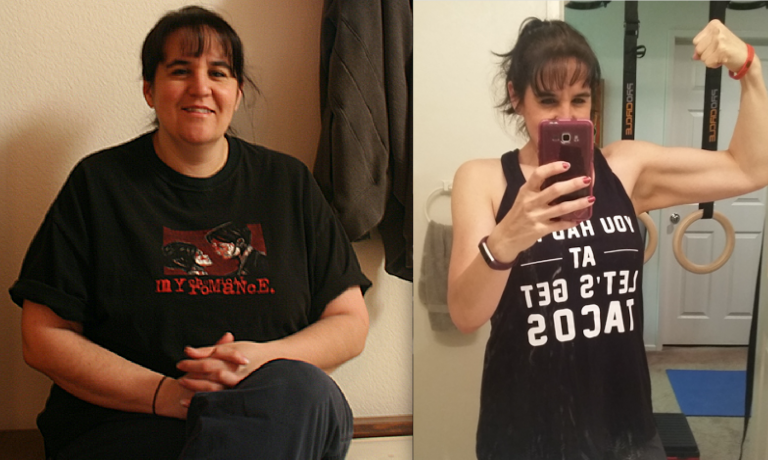
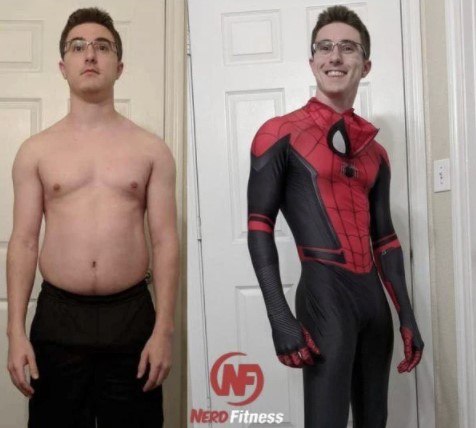
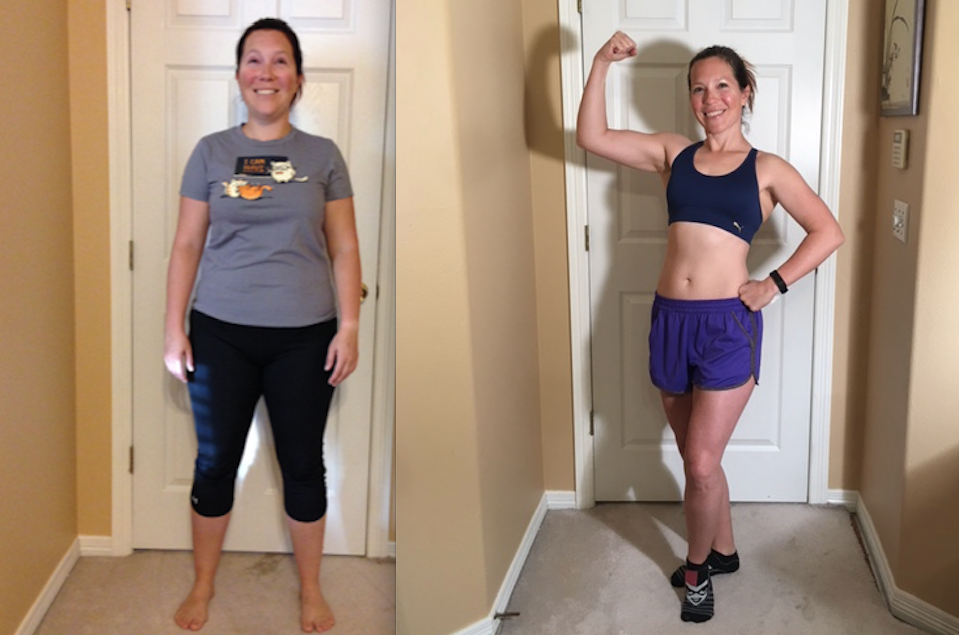
In addition to having a good reason, many people get inspired by reading success stories of folks like them.
Luckily for you, we have lots of those stories on Nerd Fitness with many more to come. These are real people who love video games and books and work desk jobs (click on each to hear their full story):
If you want to get in shape quickly, start making slightly better food choices!
80% of your success when it comes to getting healthy will depend on your diet – unless you are running marathons on a daily basis, you cannot outrun your fork, and you can’t out-train a bad diet.
So, if you can work on making SLIGHTLY better food choices, and filling up your plate with plenty of protein and vegetables, you’re less likely to overeat calories!
Whether you want to count calories, cut out certain foods, or attempt a new diet altogether, this is the most important step you can take:
Start here: How to Eat Healthy – yes, it’s a long read. But it covers the basics and teaches you what to eat and not to eat.
The 5 Rules of Weight Loss – This guide will help you lose weight without having to go on “yet another diet.”
“How to Lose Weight: Pick the Right Diet“ – Speaking of diets, here’s an explanation of all the popular diets and how to pick the one that’s right for you.”
Now, most people can’t stick with nutritional changes because they try to make TOO many changes at once, their stomach freaks out and they run back to their comfort foods.
Sure, you can do things like the Keto Diet or Paleo Diet, but restrictive diets are really tough to stick with for the long term.
And temporary changes create temporary results!
My advice? Pick one food change every few weeks, and stick with it.
These small changes can lead to big successes in the long run.
I know how changing your diet can be overwhelming sometimes, and sticking with changes in the long term is really tough.
It’s why we built a 10-level NF Diet that tells you exactly how to transition your diet slowly so you can lose weight the right way and transform your physique permanently!
Download our free weight loss guide
THE NERD FITNESS DIET: 10 Levels to Change Your Life
Follow our 10-level nutrition system at your own pace
What you need to know about weight loss and healthy eating
3 Simple rules we follow every day to stay on target
Step 3: What to do For exercise (Move!)
Okay, so now you should be all fired up and inspired and thinking,
“Hey Steve, this Nerd Fitness stuff is cool. I’m ready to get in shape.”
Let’s get started.
A) Pick goals that are SMART (specific, measurable, achievable, relevant, and timely). Be incredibly specific with your goals so that you can actively plan what steps are needed to achieve those goals:
“I’m going to lose 25 pounds this year by going to the gym 3 times per week for the next 6 months.”
That’s a good goal.
Alternatively, you could also work on a reoccurring habit that will indirectly help your goal.
EXAMPLE: “I’m going to walk to Mordor by walking a mile every day for a month. If I go for a walk, I win.”
This allows you to review your day/week with a simple question: “Did I do what I set out to do?”
Whichever method you decide, it’s important to be deliberate in your actions:
If you are setting goals – be SUPER SPECIFIC, write them down, and plan them out.
If you are building new habits – add them to your calendar, set phone alarms or alerts, and do them EVERY DAY.
Understand that Rome wasn’t built in a day, and Optimus Prime didn’t transform in one move. This is NOT a diet, or a quick fix, but a LIFESTYLE CHANGE. Don’t expect results overnight, or abs in two weeks. Slow, steady progress.
We’re genetically designed to be active, so find something you enjoy doing.
So if you “don’t like exercise,” it’s time to try new things until you find something that you DO like.
Sign up for a new class, join your company’s running club for a day, try out something in your basement or living room, just keep trying new stuff until you find something that you like.
And then do it as often as you can. As long as you’re consistently under your daily caloric energy expenditure, you will lose weight.
If you’re overwhelmed at the very idea of how to get in shape, I hear ya.
From bootcamps to “What is CrossFit” to Weight Watchers to paleo to vegan to Klingon, how are you supposed to make sense of all this information to find the right path?
The truth is that there is no ONE path that works for everybody.
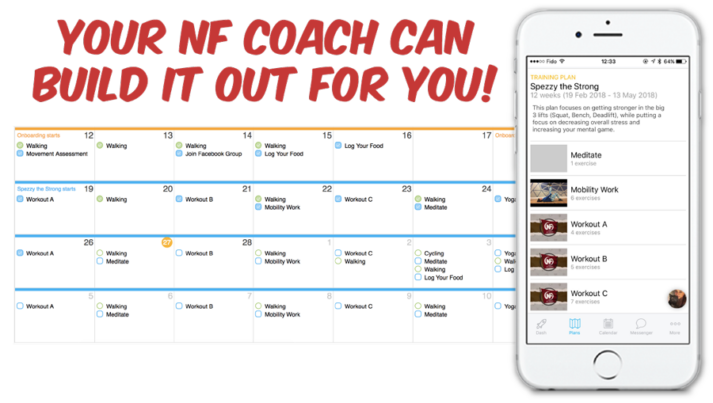
So, if you want a coach to build a workout program and diet plan that’s specific to YOUR unique situation, check out our 1-on-1 Online Coaching Program.
Step 4: Who is On Your Squad? (Support)
Last but not least, you need support.
Yes, I understand it’s kind of fun to be an army of one: the lone ranger trying to succeed against insurmountable odds….but it’s not necessary.
Once you decide to get in shape, want to know the best way to guarantee success?
Here are 5 ways to find support while getting in shape:
#1) Consider making it public.
Tell your friends, start a blog, and/or inform your co-workers and ask them to keep you accountable!
Unless you like being called a quitter, you’ll probably think twice about skipping out on your workouts.
Maybe your word isn’t your bond, and you need a different kind of motivation and support to succeed.
#2) Put your money where your mouth is.
My buddy Saint said he would pay his friends $500 if he didn’t get in absolutely incredible shape for his wedding six months down the road.
Saint didn’t have $500 to lose, so he decided instead to just get in great shape…and it worked.
There are going to be days when you want to sleep in and skip your workout. There will be afternoons following a crappy day of work where all you want to do is play Halo.
Find somebody who’s at a similar level of fitness as you, and work out with them!
He/she will push you on days when you’re dragging, and vice versa.
You can inspire and support each other, feed off of each other’s success, and offer up tough love when the complaining gets too much (and yes, there will be complaining).
Now, let’s say you’re the ONE person in your group of friends that wants to get in shape.
Or you’re the only person in your office who doesn’t stuff his face every day. Maybe you don’t have anybody to turn to for support or advice…
Welp, we’ve got you covered:
The Nerd Fitness community – a persistently amazing, always inspiring, never judgmental group of people who want nothing more than to help you succeed.
I have never been more excited and proud to be part of a community.
Or if you want to take it to the next level…
#5) Join our coaching program: If you like the cut of our jib, consider hiring one of our nerdy trainers to keep you accountable and answer any questions you have.
You can expect to lose around 1-2 pounds per week safely if you start reducing your calorie intake (80% of the equation) and moving more (20% of the equation).
Join the Rebellion – start fixing your nutrition with small changes today.
If you just finished reading these 2,500 words and you’re still overwhelmed, you’re not alone!
This stuff overwhelms the best of us. If you are looking for a bit more hands-on instruction, or you really want the peace of mind knowing that you’re doing the correct program, I got ya!
We have three options that have both helped thousands upon thousands of people like you get started:
#1) Most involved: Our 1-on-1 coaching program where a NF coach will get to learn your situation, your lifestyle, and your experience, and then build a workout program and nutritional strategy that fits into your busy life.
We get to know you better than you know yourself, and we’ve got the results to prove it! Consider checking out our coaching program if you’re looking for that next level of expert guidance and accountability.
#2) Go-At-Your-Own-Pace, Do It Yourself: Nerd Fitness Journey. This is our app that allows you to get in shape while building your own superhero..
Tons of bodyweight workout plans (no gym required), a nutritional program that won’t make any scary changes, video demonstrations exercises, boss battles, daily wins, and group challenges!
Oh, and you’ll earn XP and receive loot the whole time.
Sign up for your free trial right here:
And don’t forget to…
#3) Join the Rebellion! We need good people like you in our community, the Nerd Fitness Rebellion. You’ll meet individuals who are attempting to get in shape the 1st time or the 50th time, all who want to better themselves alongside of you.
Sign up in the box below to enlist and get our Rebel Starter Kit, which includes all of our “work out at home” guides, the Nerd Fitness Diet Cheat Sheet, and much more!
Get your Nerd Fitness Starter Kit
The 15 mistakes you don’t want to make.
Full guide to the most effective diet and why it works.
Complete and track your first workout today, no gym required.
Big things come from small beginnings, so pick the tiniest change or action you can take to get started, and then repeat that every day.
As you start to build the habit, you can increase the ‘difficulty’ and try something a bit more challenging, but it all starts with habit building.
Educate yourself, find your inspiration, and create your support group.
We create strength, balance, and flexibility workouts as part of our 1-on-1 Online Coaching Program, so you’ve come to the right place to learn about functional fitness.
Here’s what we’ll cover to answer the question: “What is Functional Fitness?”
What Is Functional Fitness and Why Is It Important?
Functional fitness means training your body for everyday activities, and to make daily motion easier and safer.
When we practice functional fitness, it’s for activities like:
Carrying groceries
Picking up small children
Walking in nature
Being mobile on the floor
Fighting off sharks
Functional fitness seeks to build strength, flexibility, and balance for navigating the physical world and the objects in it.
We do this by replicating and practicing movements necessary in the real world: squatting, pulling, pushing, bending, climbing, walking, and running.
Personally, I like to think of it as becoming “antifragile,” or being able to physically handle the chaos of life.
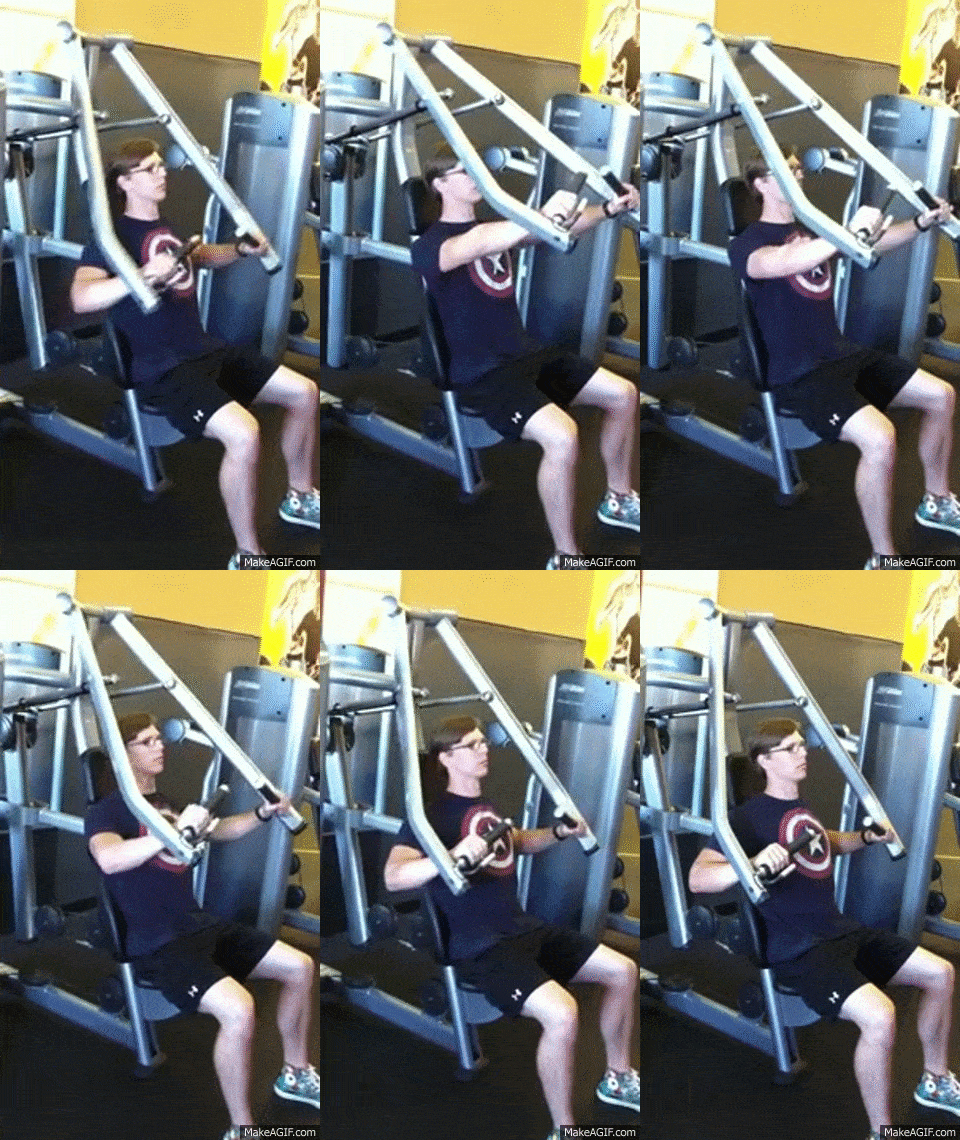
So for functional fitness, we prioritize natural movements (squats, pull-ups) over exercises that are done on a machine (leg presses, lat pulldown).
Here’s the rationale: in your everyday life, you probably won’t find yourself in a situation where you have to push weights along a guided track…while seated:
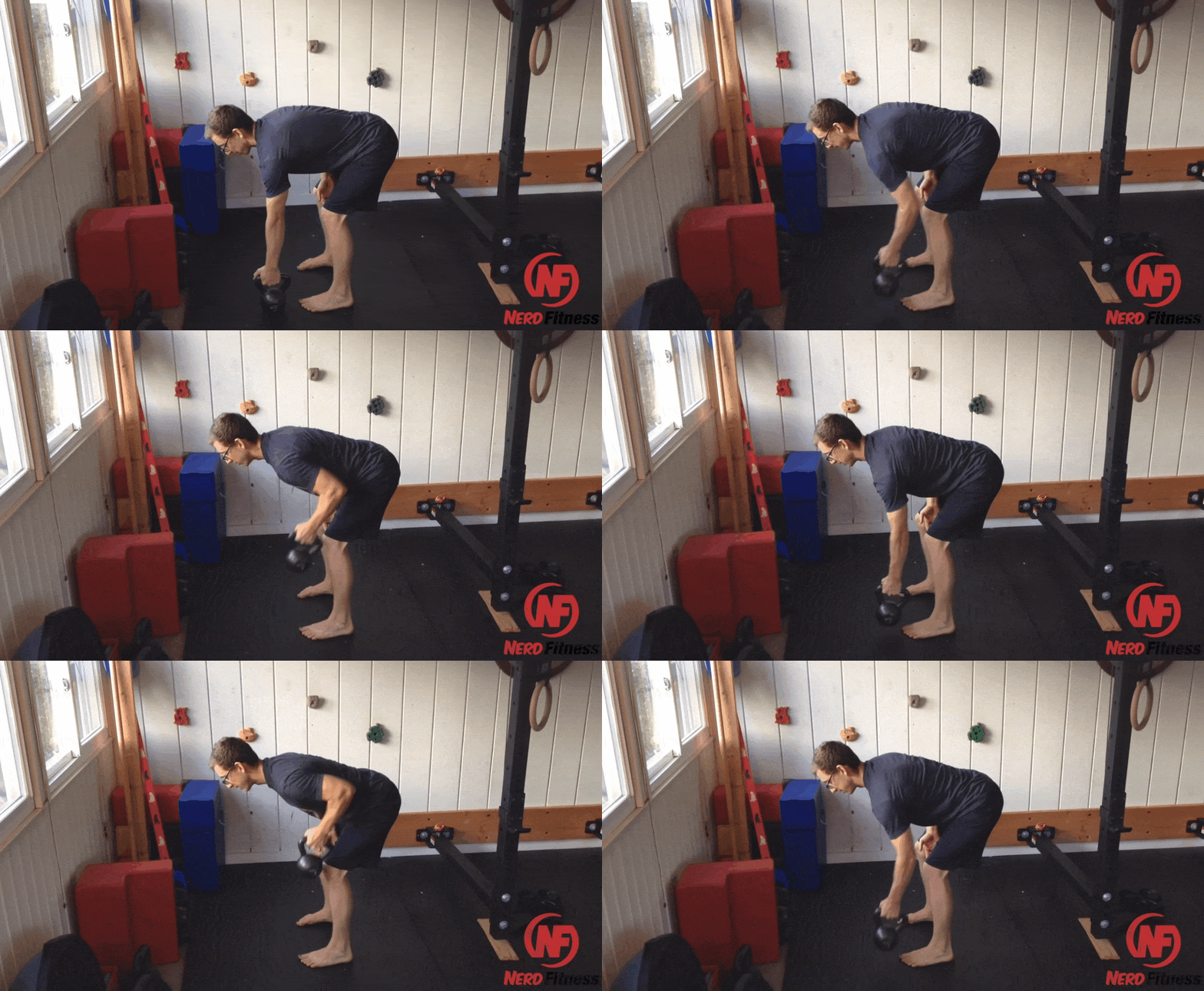
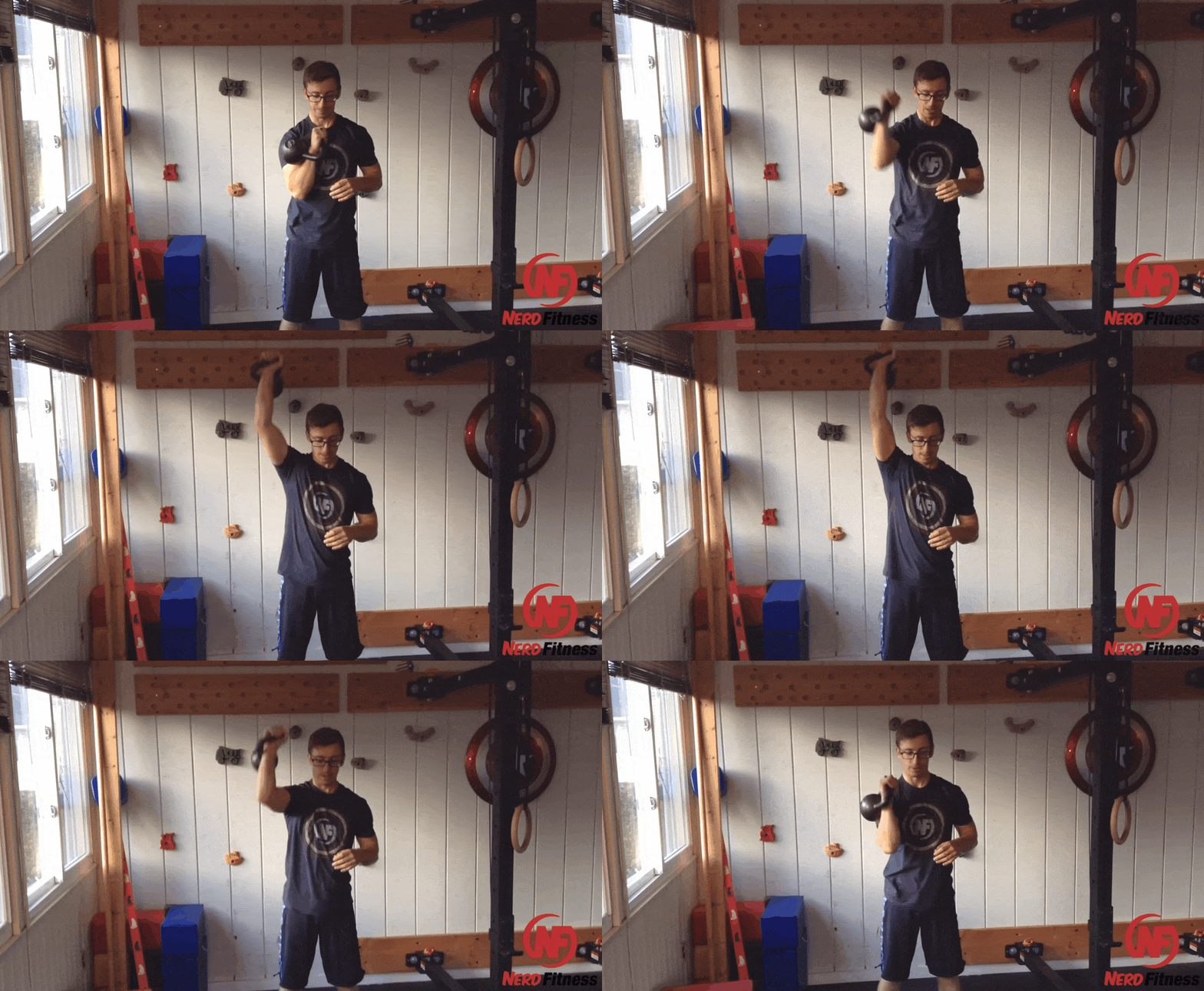
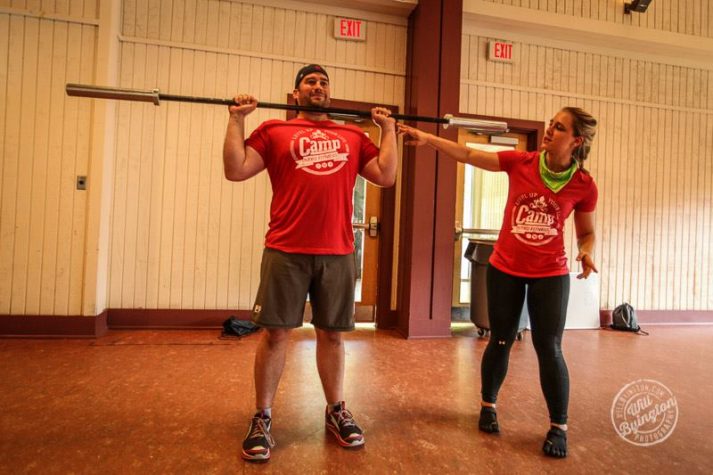
But you’ll probably find yourself in a situation where you have to lift an object from the floor, then raise it above your head, like loading your luggage into the overhead bin on a plane.
So it makes sense to practice:
And this too:
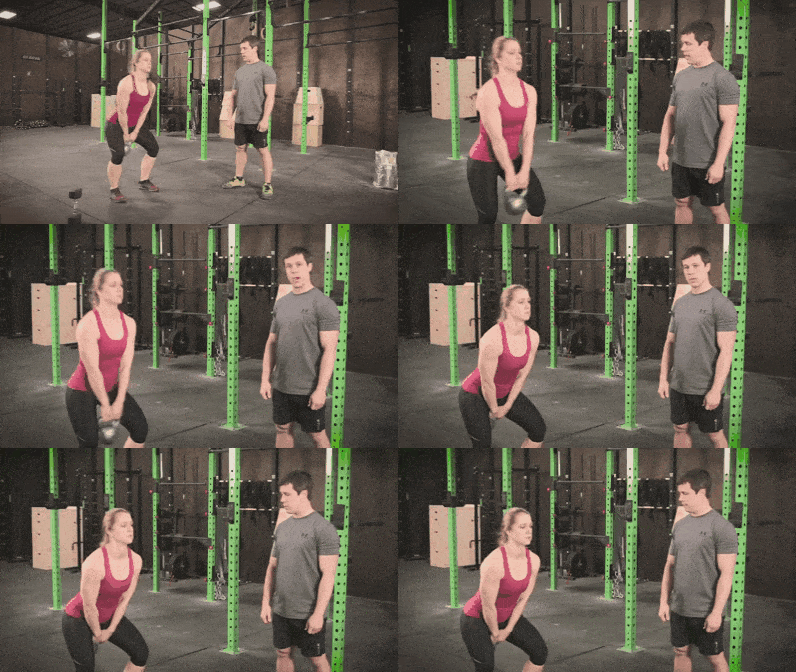
Here, the kettlebell is substituting for an object you may have to pick up and lift during your everyday life: a book, a pet rabbit, a cursed golden idol, etc.
It’s why we encourage free weights instead of machine use, because free weights force you to balance and control objects just like you have to in day-to-day life.
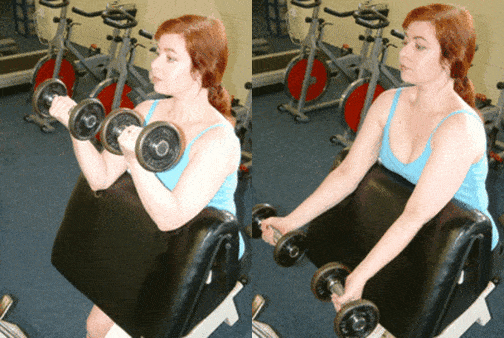
Compound exercises require more than one muscle group working together for the exercise (squats, pull-ups), so they replicate the way your body actually moves. This would be different from isolation exercises like biceps curls, which more or less train JUST your biceps muscles to move one particular way.
Since functional fitness seeks to improve your body’s ability to work as one unit, compound exercises are encouraged!
As they say, variety is the spice of life.
Let’s give you one last example of functional fitness.
Compare running on an elliptical vs going on a short hike:
Both will get your heart rate up.
But a hike will challenge your stability and balance as you move over uneven terrain. The elliptical, on the other hand, provides a repetitive motion over and over.
There is a time and a place for both, but it’s important to introduce variety and instability if your goal is to develop all-around functional fitness.
What’s that? You want exact exercises to try?
You got it!
The 10 Best Functional Fitness Exercises
A functional fitness workout prioritizes natural movements that help us conquer the obstacles and tasks faced in our everyday life.
Squats are one of the most fundamental functional movements in our lives.
Getting off the ground, moving in and out of chairs, and shoveling snow will all be easier after a regular squatting practice.
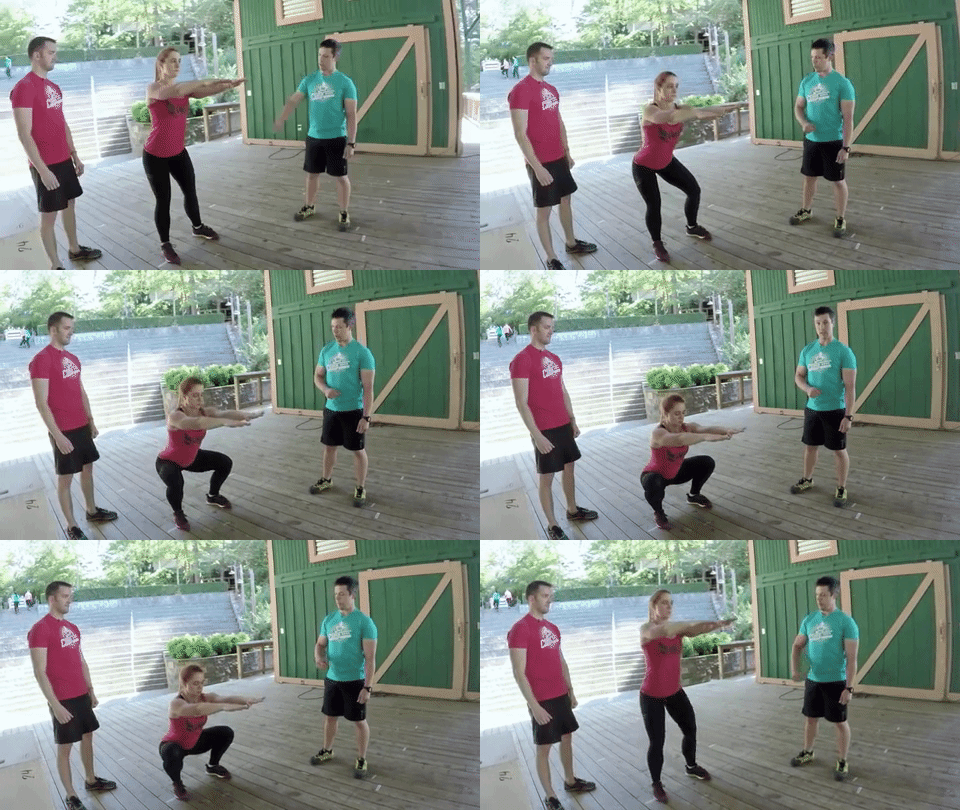
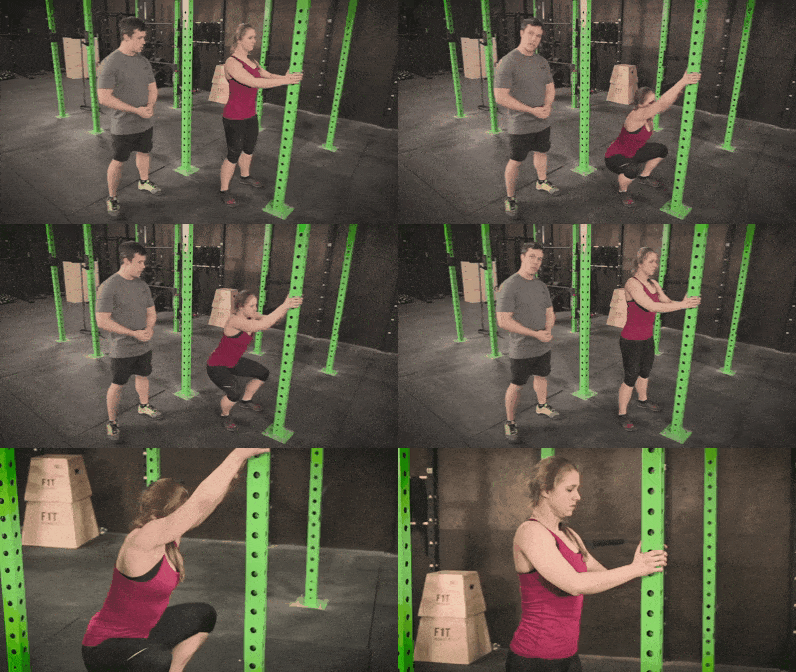
Simple bodyweight squats are a great way to get started, but if this is too tough at first, start with assisted bodyweight squats:
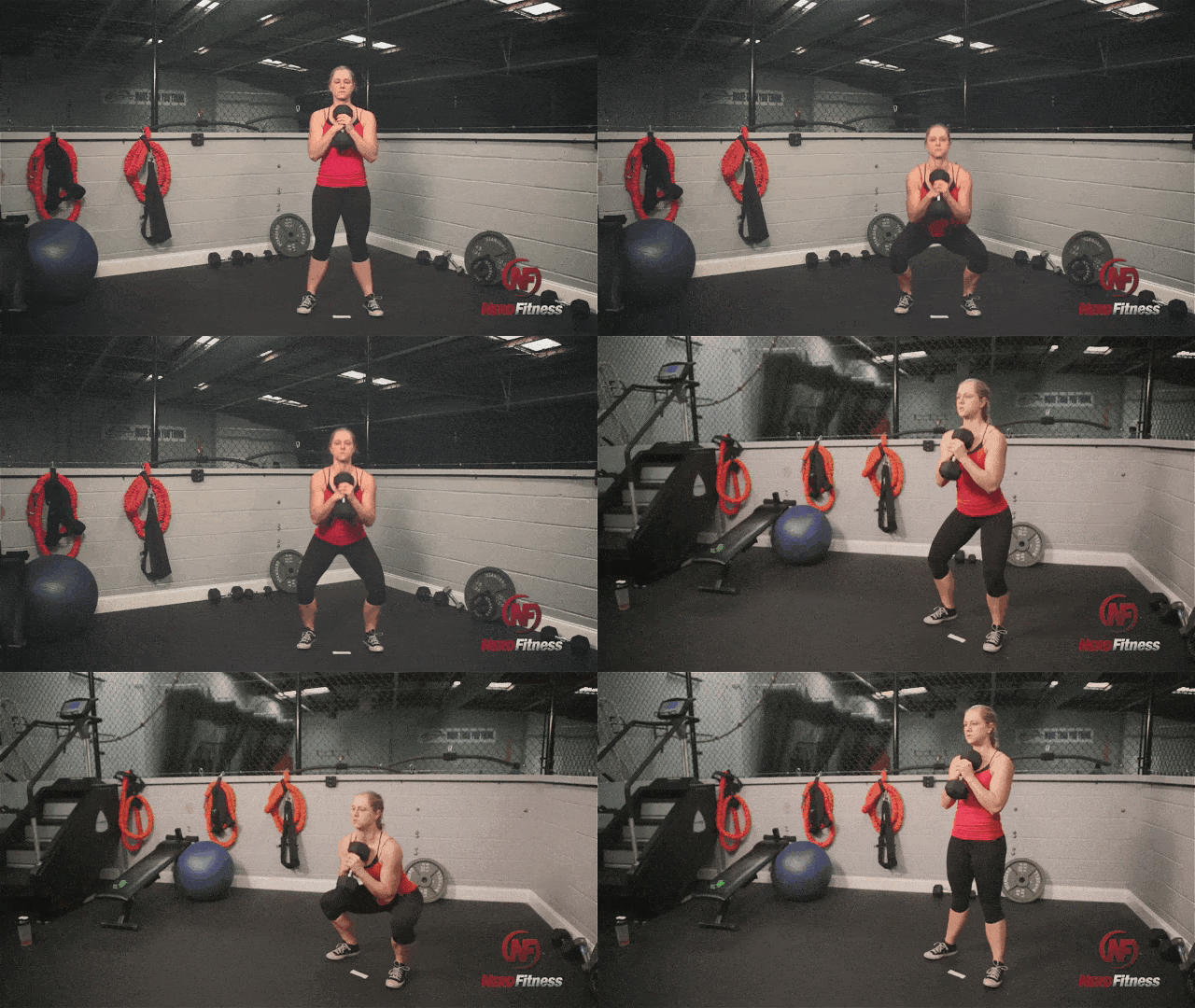
Once you get comfortable with a regular bodyweight squat, you can start incorporating weights, like with a goblet squat:
If you build up to a 30-pound dumbbell, this move can replicate picking up a small child off the ground. Practical and functional if you’re a new parent.
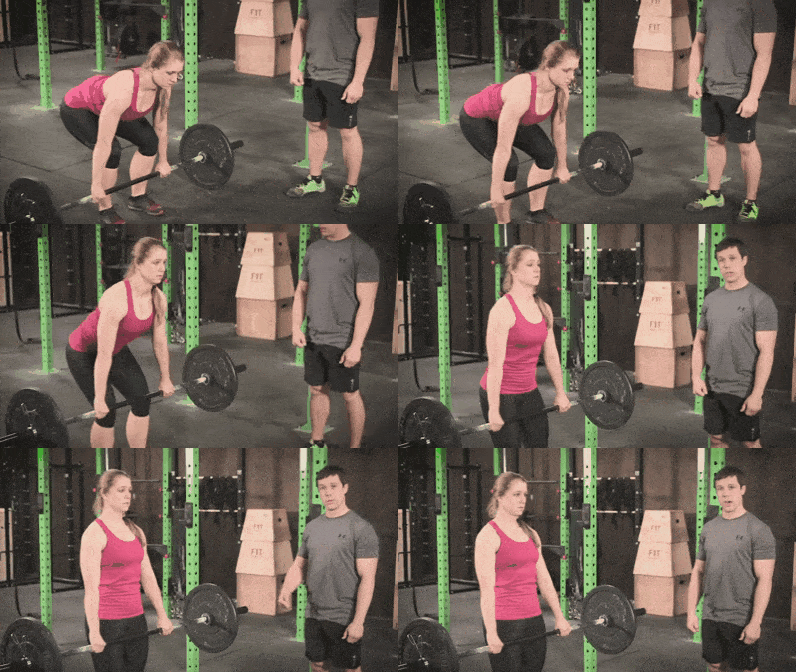
Speaking of picking up stuff off the ground, let’s talk about the deadlift as a part of functional fitness.
Moving furniture, grabbing bags of dog food, and taking a sleeping child to bed are all forms of the deadlift. When you start to incorporate the deadlift into your life, you make all these movements easier (and safer).
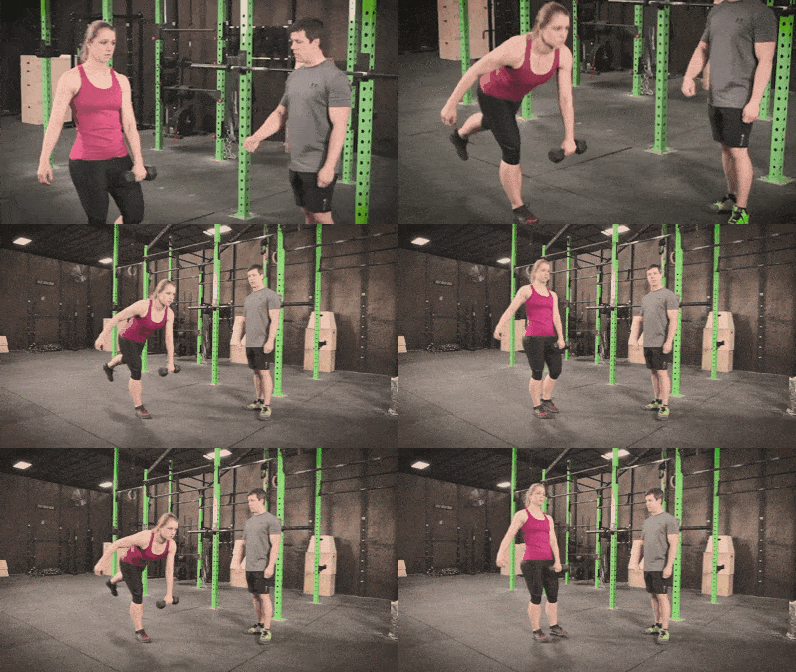
If you’ve never deadlifted before, it can be a little intimidating. A good place to start might be the Romanian Deadlift with very light dumbbells:
If you’re looking for other deadlift variations, or you want to make sure you have proper form, read our full guide with step-by-step instructions on how to deadlift safely.
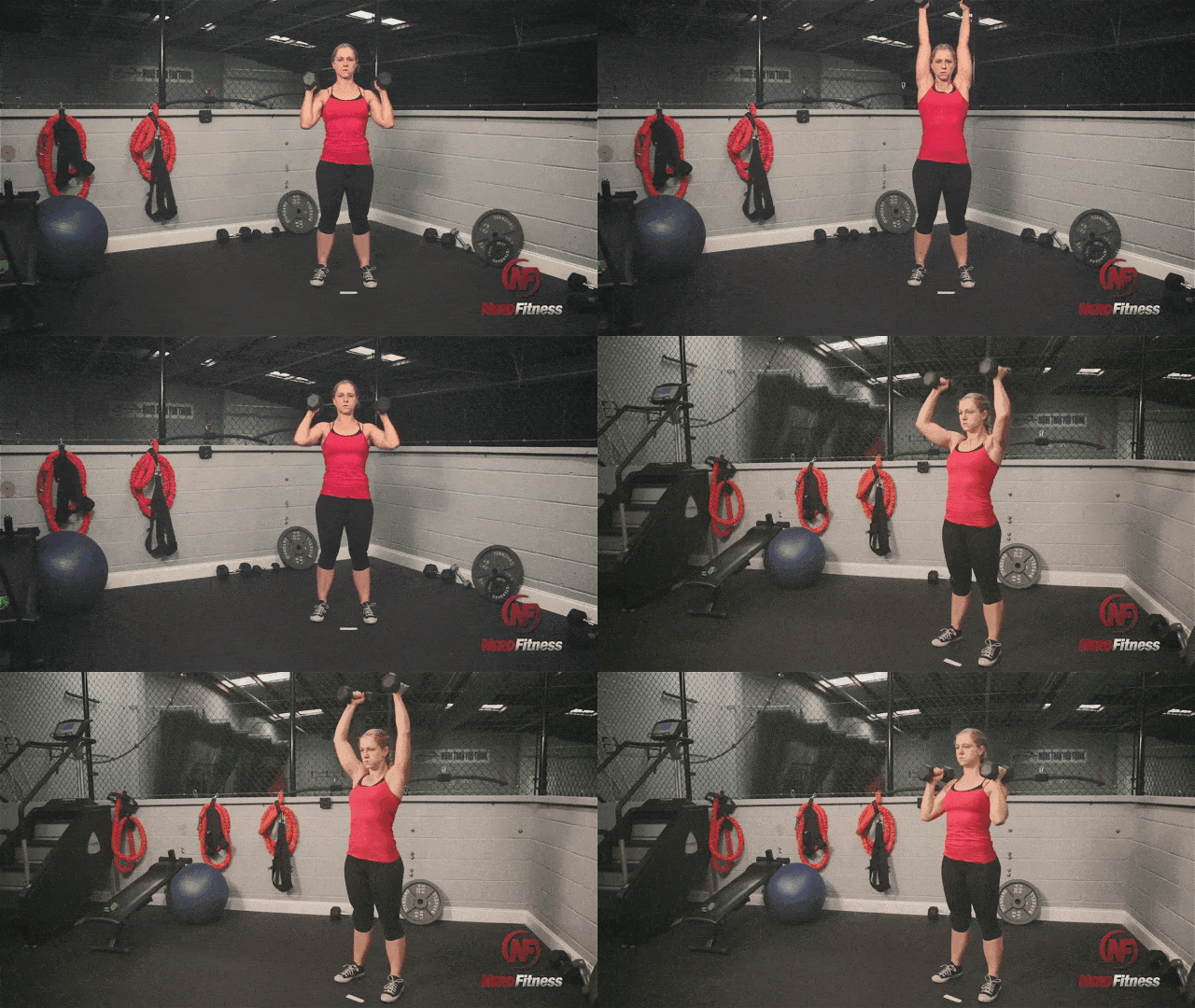
The overhead press is another exercise that will provide benefits in daily life:
Placing a cast iron skillet into a top kitchen cabinet
Hoisting luggage into the top bin when flying
Showing off the piece of the Triforce you just scored
Performing the overhead press will not only increase your upper-body strength, but it will also strengthen your core, since you balance and stabilize yourself while standing and lifting. Compare this to the bench press, where the bench itself offers support during the movement.
Again, some lightweight dumbbells are a great starting point if you’re just getting started:
The farmer’s walk is really simple: pick up a couple of weights and walk.
To up the difficulty, pick up more weight. Or walk further.
Very basic, yet very functional, because most of us carry objects from one place to another all the time.
When performing the farmer’s walk:
Pick the weight up with a good form
Keep a tight posture with your shoulders back
Take small, manageable steps
That’s it.
The farmer’s walk will challenge your arms, back, shoulders, core, and grip.
Being able to lift and carry heavy objects is about as functional as you can get.
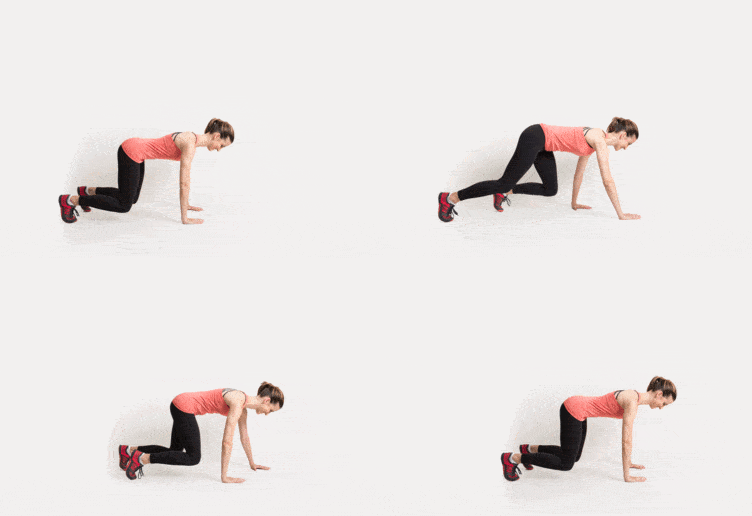
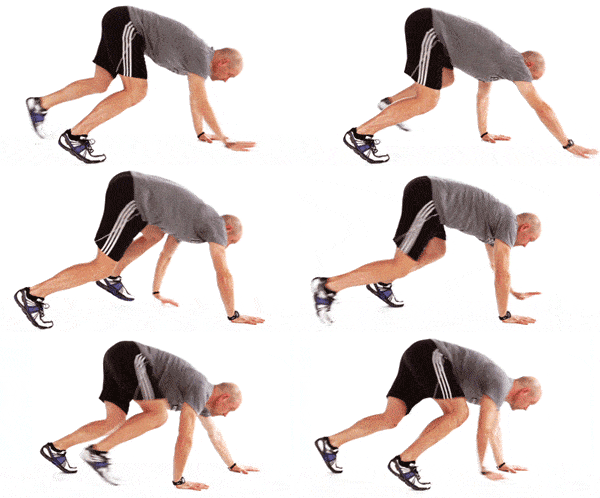
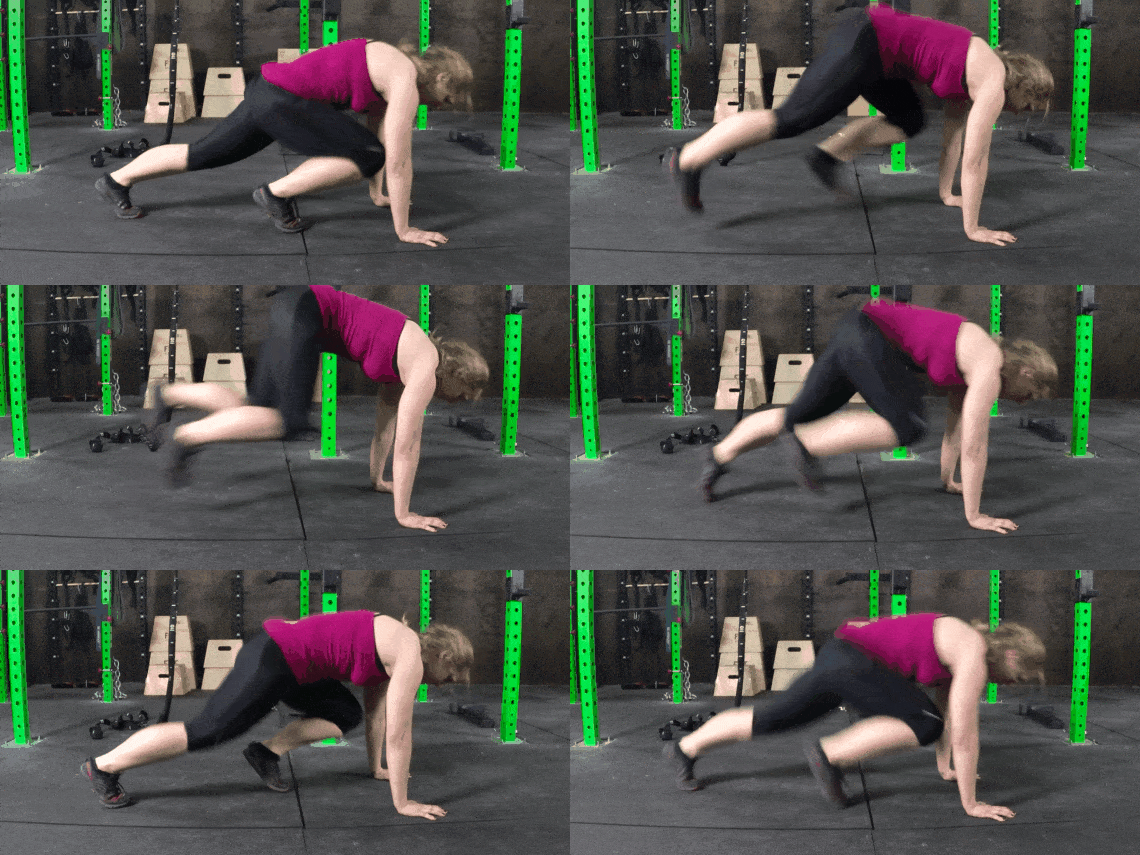
#5) Bear Crawl
When we’re young, it’s a given that we’ll be mobile on the floor.
As adults, eh, not so much. The only interaction with the floor comes from us standing on it. We won’t even sit on it without a chair helping us.
Not very functional.
Enter the bear crawl…
To perform the bear crawl:
Begin in a tabletop position.
Bring your knees up, so they hover.
Using opposing arms and legs (ex: right arm, left leg), take a small step forward with each limb. You want to use small steps so your torso is stable, instead of rocking side to side.
Repeat on the opposite side.
It’ll look like this:
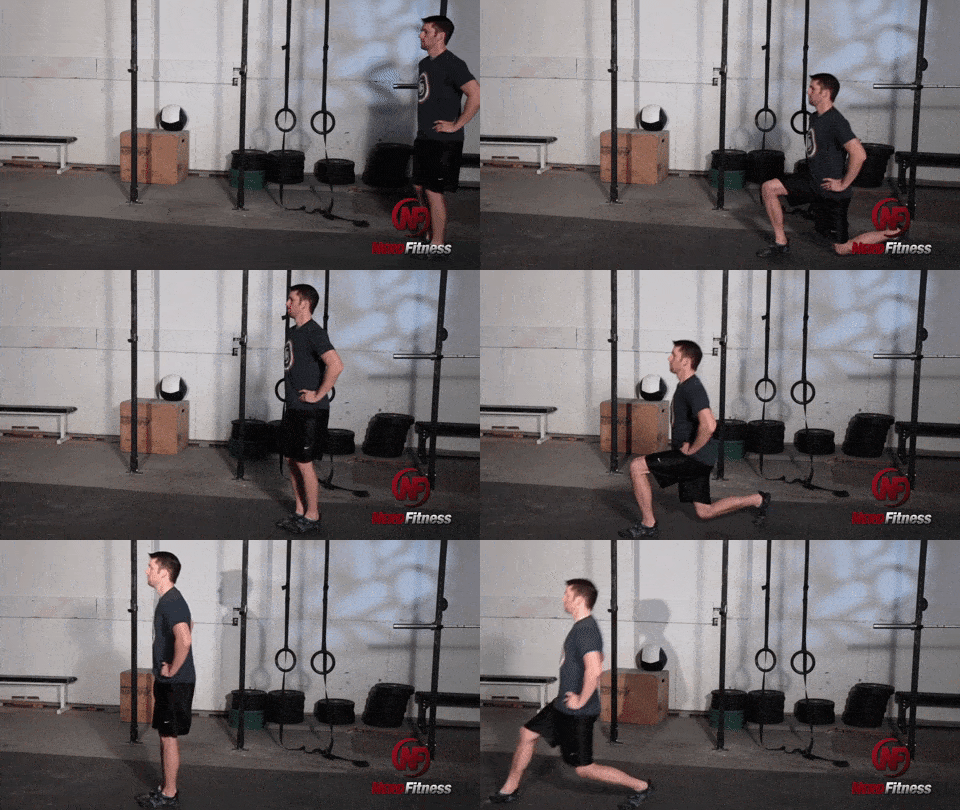
#6) Walking Lunge
The walking lunge is going to provide lower body strength, as well as balance, for when you come in and out of the movement.
To perform a walking lunge:
Stand with a shoulder-width stance.
Step out with your right leg.
Lower your hips until your back leg’s knee almost touches the ground.
If you stepped out far enough, your front knee won’t extend past your toes.
Explode forward and up by pushing off with your back leg and up with your front leg.
Bring both feet together, and then step forward with your other foot and repeat.
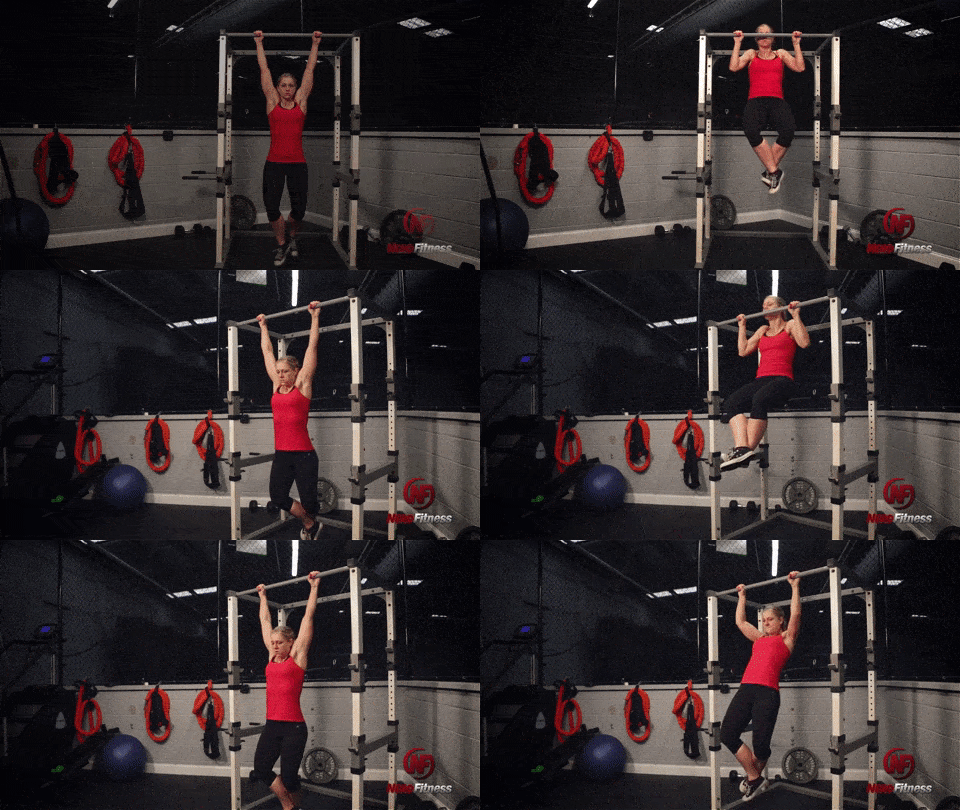
#7) Pull-Ups
When discussing the best functional fitness exercises, we can’t neglect your “pull” muscles.
Being able to lift yourself up is very functional, and may save your life if you’re being chased by velociraptors.
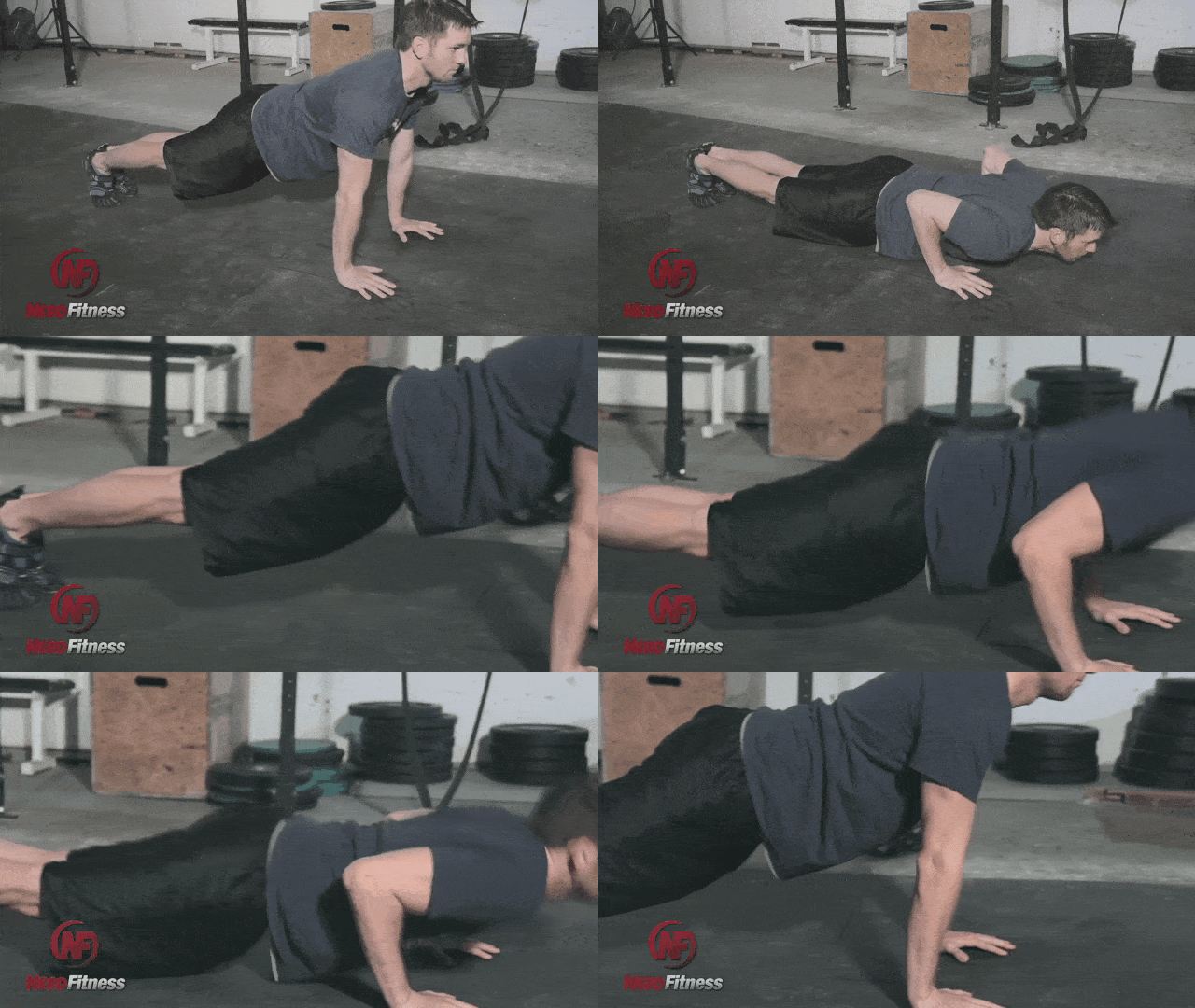
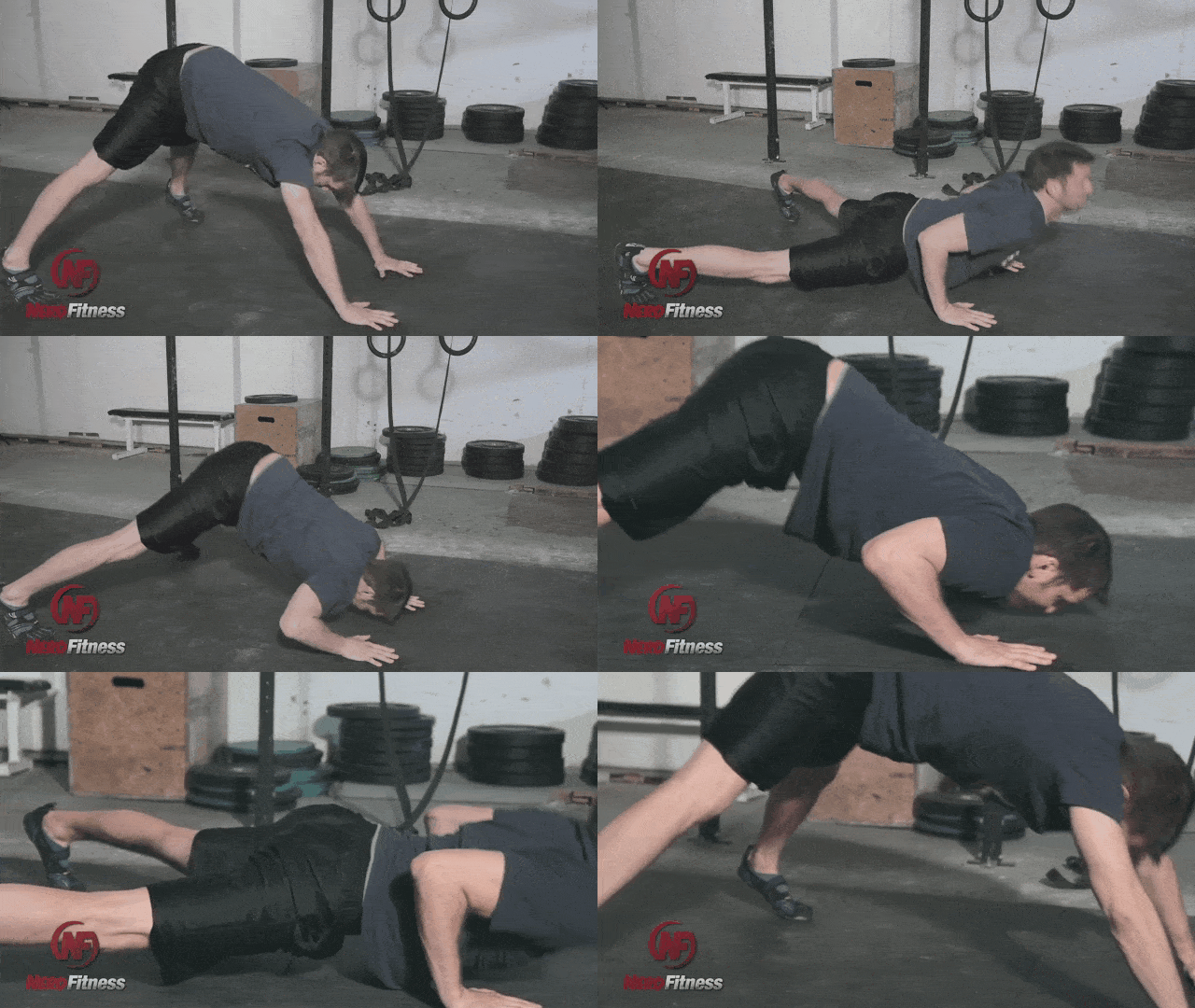
Push-ups, the ole fitness staple. But being able to hold yourself firm in a straight line (don’t sink), while pushing yourself up will create a lot of core strength. And a great functional exercise.
Plus, you can add some variation to level them up, creating a more dynamic exercise.
For example, you can do dive bomber push-ups:
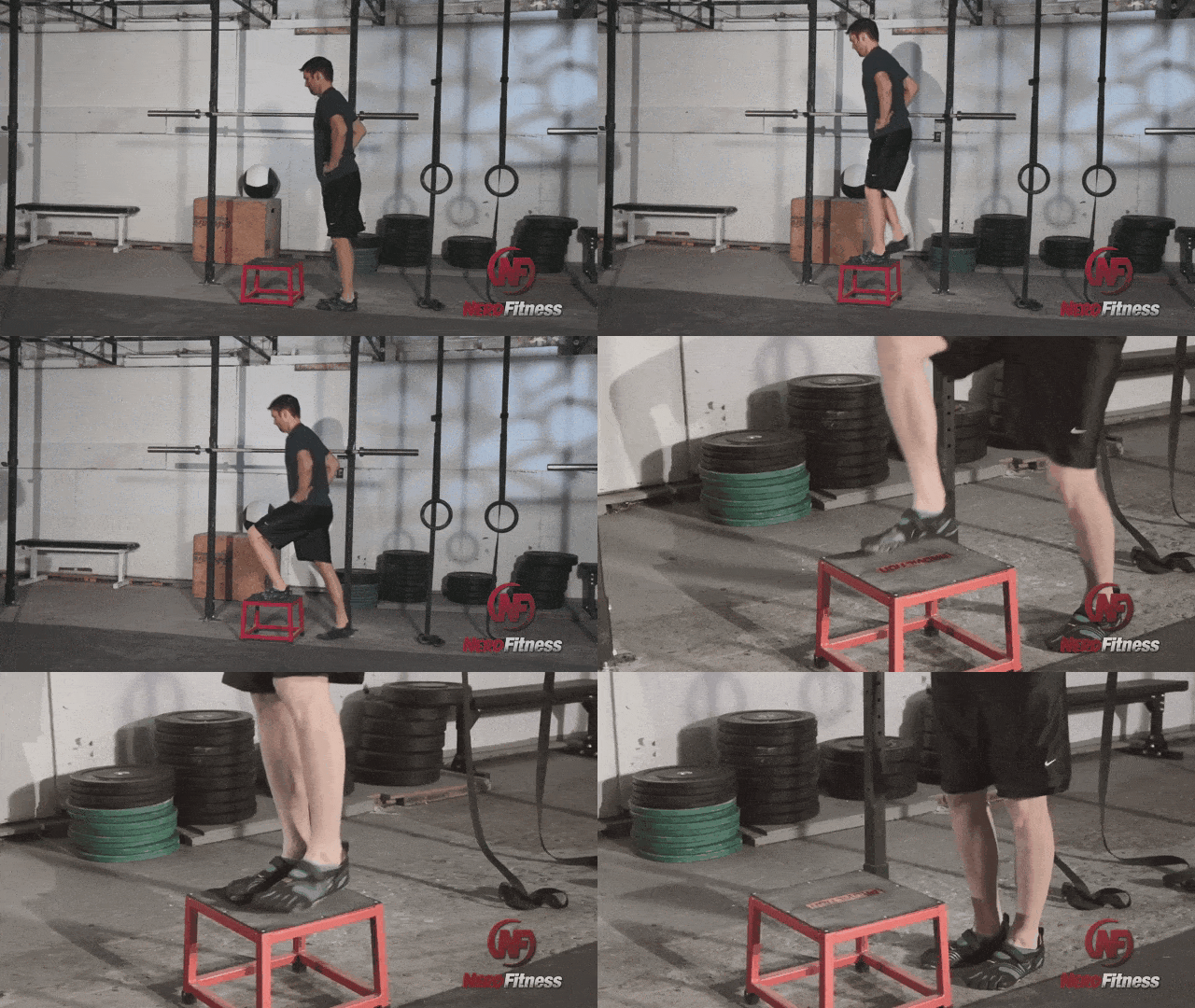
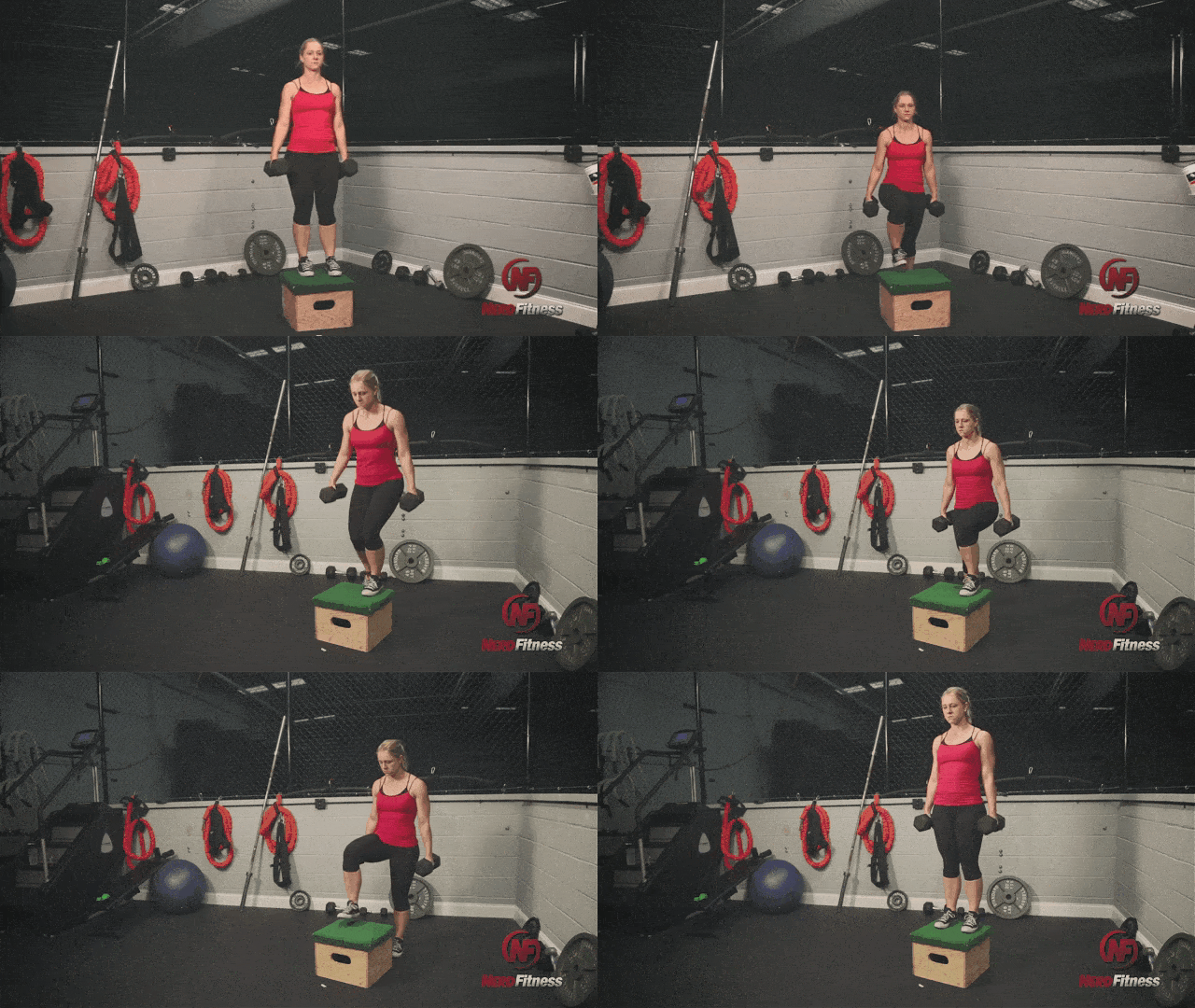
#10) Step Up
It doesn’t get much more functional than going up steps. Life doesn’t always provide us with elevators.
If this seems too easy, start mixing weights into the practice:
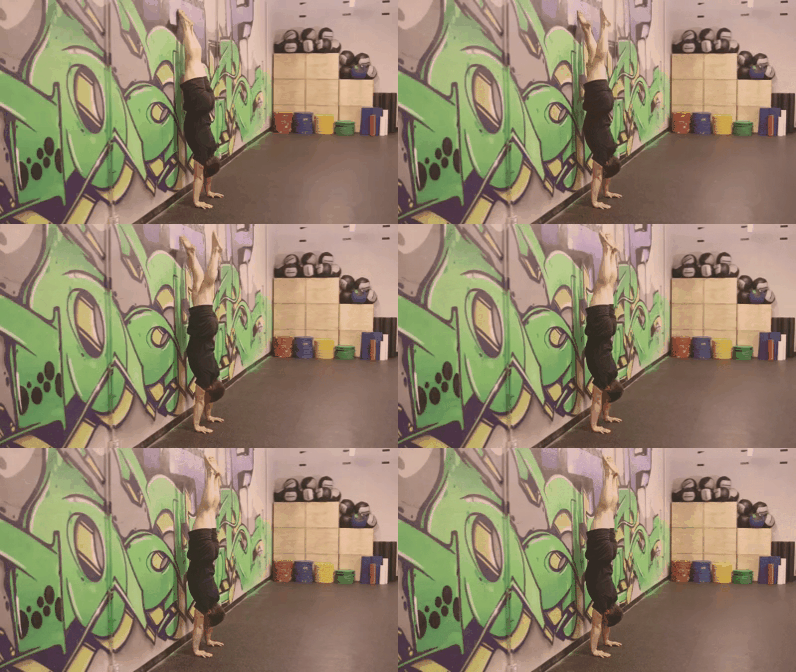
BONUS: #11) Handstands
On the one hand, handstands are really tough. On the other hand, the amount of strength and balance required to perform a handstand are central to functional fitness.
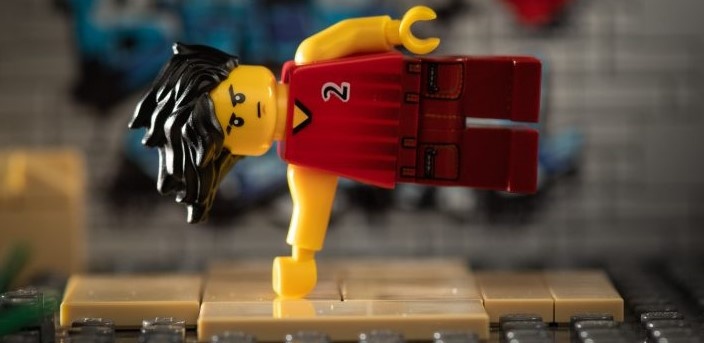
And…ah…you need both hands to do it…unless you’re Luke Skywalker:
Are you doing these moves correctly? A good way to check would be to record a video of yourself and match it against the gifs and videos here. If they look close, you’re doing great!
The other option would be to have a trained professional review your form, which we can do in our 1-on-1 Online Coaching Program!
Our spiffy mobile app lets you send a video of your training directly to your coach, who will provide feedback so you can perfect your technique.
They’ll also build a workout program that’s custom to your situation, which can improve your functional strength!
What Is a Functional Fitness Training Workout?
Now that we’ve gone over specific functional fitness exercises, let’s pull them together to build a workout routine!
For most beginners, I recommend creating a full-body practice at first, which includes:
Quads (front of your legs).
Butt and hamstrings (back of your legs).
Chest, shoulders, and triceps: (“push” muscles).
Back, biceps, and grip ( “pull” muscles).
Core (abdominals and lower back).
Since we prioritized compound exercises in today’s post (because they are more aligned with functional fitness), our muscle groups will overlap when we build our routine.
Warming up is important because we want your muscles engaged and loose before we jump right into our training. So warm-up for about 5 minutes before jumping into your workout.
As long as you include your warm-up, you now have what you need to start your training.
If you want more help building a functional fitness practice, I have a couple resources for you:
How to Build Your Own Workout Routine: our guide will walk you through building your own training practice. We’ll teach you what exercises you should do, how many sets and reps you should perform, and how often you should work out. It’ll help you start performing functional fitness exercises today.
Our 1-on-1 Online Coaching Program:if you want a more customized approach for your exact situation (kids, an old injury, you turn into a werewolf once a month), then check out NF Coaching. We’ll build you an exact plan of attack on how to become a functional fitness master.
Is CrossFit Functional Fitness?
CrossFit claims to support “functional movements” by using “safe, effective and efficient movements similar to those you use every day in life.”
So yeah, that does sound like what we’ve been talking about this whole time.
CrossFit does promote functional fitness. It’s why you’ll see people carrying sandbags, flipping tires, and wielding sledgehammers at CrossFit gyms:
But the intensity is another noteworthy aspect of CrossFit. Workouts are done in a group setting, with people cheering you on.
While this can be great for motivation, it can be less great when trying to move at your own pace and train with proper form.
Now, this is a generalization, and all CrossFit gyms will have their own characteristics and culture.
If you’re curious, it doesn’t hurt to walk through the door of your local CrossFit gym – just make sure you read our Crossfit Beginner Guide first. I’m sure they’d love to see you and show you around.
How to Build Functional Fitness (Next Steps)
We’ve covered a lot of different ways to increase and build functional fitness.
But our article barely scratched the surface:
Gymnastic rings would be a great way to promote functional fitness.
A yoga routine could also be considered as “functional.”
A hike would be a great way to prepare for traveling through natural landscapes.
Also, let’s not get close-minded here. Being strong will help you navigate the world in front of you, so in that sense, any form of strength training could be considered “functional fitness.”
So would parkour, which has you traveling through urban landscapes:
Just find something you like and get started!
The more you do, and the more variation you include (barbell training, yoga, and hiking), the more functional fit you’ll be.
Want a little help getting going? The perfect next step on how to begin your functional fitness journey?
No problemo!
Here are 3 options on how to continue with Nerd Fitness:
Option #1) If you want step-by-step guidance on how to get strong, lose weight, and level up your life, check out our killer 1-on-1 coaching program:
Option #2) If you want a daily prompt for functional fitness workouts, check out NF Journey. Our fun habit-building app helps you exercise more frequently, eat healthier, and level up your life (literally).
Try your free trial right here:
Option #3) Join the Rebellion! We need good people like you in our community, the Nerd Fitness Rebellion.
Sign-up below and receive our free guide Strength Training 101: Everything You Need to Know. It includes step-by-step instructions for the Best Functional Fitness Exercises covered in today’s guide.
Download our comprehensive guideSTRENGTH TRAINING 101!
Everything you need to know about getting strong.
Workout routines for bodyweight AND weight training.
How to find the right gym and train properly in one.
Alright, enough from me. Your turn:
Do you practice functional fitness?
Do you have any specific exercises you cover?
Any tips or tricks for someone just getting started?
Let me know in the comments!
-Steve
PS: Strength training would be a great way to promote functional fitness. If you’re not sure where to start with your strength training journey, start here.
I get multiple emails and messages per day asking:
“Steve, what should I do for a workout?”
Well, partner, today is your lucky day.
I’m gonna help build you a custom workout program, step-by-step!
After all, a workout should be developed around a person’s age, goals, nutritional strategy, free time, etc.
Not only that, but it’s easy to overcomplicate this process – there are an infinite number of exercises, sets, reps, and programs to choose from.
Now, if you’re somebody that wants to skip all of that, and JUST want to be told what exactly to do:
We build customized workouts for our Online Coaching Clients and would love to have you. We get to know your story and struggles, your goals, and your lifestyle, and develop a workout plan that fits your schedule.
Now, if you’re more of a “figure this stuff out on my own” kind of person – we’re going to dig into how to build your own workout plan today!
We’ve also created a free resource for folks who want to build their own workout but would love some more specific direction and instruction.
You can download our free guide, Strength Training 101: Everything You Need to Know, which covers all of this stuff in a single guide:
Download our comprehensive guideSTRENGTH TRAINING 101!
Everything you need to know about getting strong.
Workout routines for bodyweight AND weight training.
How to find the right gym and train properly in one.
OKAY! Are you ready to start building your own routine and want to know how it’s done?
So whether you are building muscle or looking to lose weight, a strength training workout will get you the results you’re after (when combined with the right eating strategy!)
While we’re talking about time, let me quickly mention something important:
Unless you’ve been strength training for years and know what you’re doing, we recommend that you pick a full-body routine that you can do 2-3 times a week.
You want a workout routine that has at least one exercise for your:
Quads (front of your legs).
Butt and hamstrings (back of your legs).
Chest, shoulders, and triceps: (“push” muscles).
Back, biceps, and grip ( “pull” muscles).
Core (abdominals and lower back).
By targeting compound movements that recruit multiple muscles at the same time, you can build a full-body routine that uses only four or five exercises.
How’s THAT for efficiency!
Here is a quick breakdown on which exercises will work for each of those movements:
You don’t need to make things more complicated than this!
(Not that we humans have a tendency to overcomplicate things to the point of paralysis and inaction…)
Ahem.
If you’re not sure how to do any of the movements above, click on their links for thorough write-ups and video demonstrations.
Pick one exercise from EACH category above, specifically ones that scare you the least, and that will be your workout every other day for the next week.
Get really good at these basic movements and focus on getting stronger each week (I’ll cover how below).
If you get really strong at squats, deadlifts, pull-ups, and push-ups, you will build an incredible physique to be proud of.
Then, once you get confident in those movements, feel free to add some variety.
Why?
If you do the same exact routine, three days a week, for months and months, you might get bored, and start slacking, or you might hit a workout plateau.
So if you find yourself getting bored, feel free to stick with the above ‘formula,’ but change the ingredients:
Do deadlifts every Wednesday, but change up the sets and reps you pick!
If you hit a plateau or find yourself getting bored, pick a different exercise to improve so you’ll stay challenged, and you’ll actually DO the workout!
I know it’s really easy to overcomplicate this process as there’s an infinite number of exercises, sets, reps, and programs to choose from.
And yes, we have a solution for people that JUST want to be told what exactly to do: our uber-popular 1-on-1 coaching program pairs you with your own Nerd Fitness Coach who will get to know you, your goals, and your lifestyle, and develop a workout plan that’s specific to not only your body, but also to your schedule and life:
Step #3: How Many Sets And Reps Should I Do?
SIMPLE ANSWER: Not including a warm-up set or two, I recommend:
3 to 5 sets per exercise.
8 to 10 reps per set when starting out.
LONGER ANSWER – watch this video:
As we cover in our “How Many Sets and Reps?” guide, a “set” is a series of repetitions that you complete without stopping.
For example, if you drop down and do 10 push-ups right now, you just did 1 SET of 10 REPETITIONS (or REPS) of push-ups.
Got it? Cool.
Some general rule on repetitions you can follow as you’re starting to build your workout plan:
If you can do more than 15 reps without much of a challenge, consider increasing the weight or the difficulty of the movement. This is true for things like lunges, bodyweight squats, push-ups, pull-ups, etc.
There are some other generally accepted ‘rules’ – as pointed out in Starting Strength – about how to determine how many reps you should target per set, based on your goals:
Reps in the 1-5 range build super dense muscle and strength[1]
Reps in the 6-12 range build a somewhat equal amount of muscular strength and muscular size[2]
Reps in the 12+ range build muscular endurance.
A 2015 study [3] called into question the best rep strategy for building muscle or size:
“It appears that high-intensity resistance (sets of 3-5 reps) training stimulates greater improvements in some measures of strength and hypertrophy in resistance-trained men during a short-term training period [compared to sets of 8-10 reps].”
What this means: Do not freak yourself out by worrying if you should do 4 sets or 5 sets of 8 reps or 10 reps.
Our advice would be to START with lighter weight and more reps as you learn the movement, and then decide if you want to stay at higher reps and lower weight or vice versa.
You do you, because either one will get you results!
The only thing you need to worry about: get stronger the next time you do that movement: either pick up a heavier weight, or do 1 more repetition than last time.
“JUST GIVE ME THE ANSWER!”
Keep your TOTAL (all exercises combined) workout number of sets for all exercises in the 15-25 set range, with 8-10 reps per set:
5 exercises total, each with 4 “work sets” is a good start.
Remember, the most important part is to get started – you’ll learn how your body responds and you can adapt as you go.
What you DON’T need to do: multiple exercises for each body part with 10 sets.
A BIG CAVEAT:How you eat will determine if you get bigger or stronger. Nutrition is 80-90% of the equation. So pick a range that feels good, and then focus on nutrition.
And if you don’t want to figure any of this out and just want to be told exactly how what exercises, sets, and reps to do, our online coaches can take care of that for you.
Step #4: How Long Should I Wait Between Sets?
Keep it simple, you “smart, good looking, funny, modest person” you.
Below is a basic formula for you to determine how long you should wait between sets, but this can be adjusted based on your level of health.
The goal is to wait the least amount of time you need, but still rest enough that you can perform all reps of the next set safely and properly!
Here are some guidelines for how long to rest based on how heavy you’re lifting (not rules set in stone!):
1-3 Reps (lifting heavy for strength/power): Rest for 3 to 5 minutes between sets.
4-7 Reps (lifting for strength): Rest for 2 to 3 minutes between sets.
8-12 Reps (lifting for size/strength): Rest for 1 to 2 minutes between sets.
13 Reps+ (lifting for endurance): Rest long enough to recover to allow you to do the next long-ass set!
If you need more or less rest than the above recommendations, that’s fine.
Do the best you can, record how long it takes you to rest between sets, and try to rest for shorter periods in the future.
Your body will adjust as you get stronger and healthier!
If you want more information on how much you should lift, how many reps, and when to scale certain movements or adjust your workout, check out our Strength 101: Everything You Need to Know.
It’s free when you join the Rebellion with your email in the box below:
Download our comprehensive guideSTRENGTH TRAINING 101!
Everything you need to know about getting strong.
Workout routines for bodyweight AND weight training.
How to find the right gym and train properly in one.
The simple to learn but tough to implement answer:
“Lift enough so that you can get through the set, but not too much that you have NO fuel left in the tank at the end.”
How do you determine how much that is?
Trial and error.
ALWAYS err on the side of “too light” versus “too heavy” when starting out.
It’s better to say “I bet I could have done more!” instead of “that was too much, and now I need to go to the hospital!”
If you’re doing exercises with just your body weight, you need to make each exercise more difficult as you get in shape – once you get past 20 reps for a particular exercise and you’re not gassed, it’s time to mix things up.
20 bodyweight squats too easy? Hold some weights high above your head as you do the next set. Eventually, you can scale up to do exercises like the pistol squat:
And if you’re not sure how to scale bodyweight movements, or you are interested in mixing things up and want guidance…
Step #6: How Long Should I Exercise For? How Long Should My Workout Be?
Easy answer: 45 minutes to an hour.
Longer answer: If you’re doing 15-25 sets of total exercise (3-5 sets for your 5 exercises), you should be able to get everything done within that 45-minute block.
Now, factor in a five or ten-minute warm-up, and then some stretching afterward, and the workout can go a little bit longer.
If you can go for over an hour and you’re not completely worn out, try increasing the intensity.
Less time, more intensity, better results.
What if you don’t have 45 minutes?
Do the best you can!
Maybe you want to build some cardio into your weight training.
That’s where this next section comes in.
Step #7: How to Create Supersets and Circuit Training Workouts
You’re getting a cardiovascular workout by consistently moving from exercise to exercise.
You’re exercising different muscles back to back, giving each muscle group a chance to recover, but in a condensed amount of time. Efficiency for the win!
If you’re familiar with CrossFit, many of the workouts are built on circuit principles.
This is also the most effective way to make you involuntarily swear at inanimate objects because you’re so tired and beat up.
We’re going to cover TWO things here:
Supersets (or alternating sets).
Workout circuits.
SUPERSETS:
Do a set of squats, wait one minute, then do a set of dumbbell presses, wait one minute, then do your next set of squats, and so on.
Because you’re exercising two completely different muscle groups, you can exercise one while the other is “resting.”
You’re now getting the same workout done in half the time.
Also, because you’re resting less, your body has to work harder so your heart is getting a workout too. Jackpot.
Let’s see how this would play out in a sample workout:
Lunges alternating with incline dumbbell presses, four sets each, one minute between sets.
Wait a few minutes to catch your breath and get set for your next two exercises.
Straight leg deadlifts alternating with wide-grip pull-ups, four sets each, one minute between sets.
3 Sets of planks, stretch, and get the hell out of there!
CIRCUIT TRAINING:
A circuit requires you to do one set for EVERY exercise, one after the other, without stopping.
After you’ve done one set of each exercise in succession, you then repeat the process two, or three, or four more times.
I’ve written about multiple bodyweight circuits here on the site:
And lastly, we love building circuit training routines for our Coaching Clients – and we’d love to build them for you too:
Step #8: How Many Days per Week Should I Train?
We get this question quite a bit, usually from overeager beavers who decide they are going to go from “sitting on the couch watching The Office on repeat” to “exercising 7 days per week.”
I would advise something different.
I mean you can still watch The Office…
…but you don’t need to be training 7 days a week!
We don’t want you burning out quickly and falling back to square one, a concern we mention in our guide “How Often Should I Work Out?“
Give yourself permission to mess up, learn a little, and keep improving as you train more regularly!
More often than not, when I email people back and tell them how to build their own workout, they generally respond with:
“Steve, can’t you just TELL me what to do? I’m afraid of building a crappy workout.”
Why we built THREE options for people like that:
1) If you are somebody that wants to know they are following a program that is tailor-made for their life and situation and goals, check out our Online Coaching Program.
You’ll work with our certified NF instructors who will get to know you better than you know yourself and program your workouts and nutrition for you.
2) Exercising at home and need a plan to follow? Check out Nerd Fitness Journey!
Our fun habit-building app helps you exercise more frequently, eat healthier, and level up your life (literally). Plus, NF Journey will build a workout for you!
Try your free trial right here:
3) Join the Rebellion (our free community) and I’ll send you free guides, workouts, and worksheets that you can read at your leisure.
We need good people like you!
Download our comprehensive guideSTRENGTH TRAINING 101!
Everything you need to know about getting strong.
Workout routines for bodyweight AND weight training.
How to find the right gym and train properly in one.
I certainly encourage you to try and build your own workout routine.
It can really help you develop a sense of excitement and pride when you start to get in shape based on your workout!
If you have more questions, or have a workout program you’re really proud of, share it in the comments below!
-Steve
PS: Check out the rest of our beginner content. I promise, it kicks ass 🙂
However, as I mentioned in the intro, you’ll often hear that losing fat while gaining muscle is impossible. The argument goes that you should just focus on one or the other, because doing both at once is destined to fail.
Let’s explore this claim.
LosING Fat and GainING Muscle at the Same Time (The Controversy)
To understand why losing fat while gaining muscle can be problematic, we need to explore both processes.
To gain muscle, your body needs to be in a caloric surplus. This surplus provides the energy your body requires to repair and build bigger muscles.
Given this, losing fat (caloric deficit) at the same time one is gaining muscle (caloric surplus) seems impossible.
However, if we go a few steps deeper into the science, it IS possible!
To appreciate the nuance here, let’s get into some specifics on losing fat and gaining muscle separately, and then we’ll combine them.
HOW DO YOU LOSE FAT?
There is a simple answer and a slightly less simple answer when it comes to losing body fat.
The simple answer: “consume fewer calories than you expend or burn.”
Eight words, and one or two of those could probably be thrown out.
When your body needs more calories than the amount you are eating, you are in a “caloric deficit.” Your body doesn’t have enough calories to go around, so it’ll start breaking down parts of itself for energy requirements.
The hope is that your body will mostly pull from fat stores, though depending on how you are training it will also break down muscle too.[1]
Said again: when you are eating a caloric deficit, your body will pull from both its fat stores AND existing muscle for energy.
From a physique and health standpoint, obviously we’d prefer that your body doesn’t break down muscle when in a caloric deficit, and instead really focuses on using fat stores instead.[2]
I make this point for a reason: your goal in fitness shouldn’t only be “weight loss,” despite the common vernacular used.
Who cares what the scale says, right?
The goal instead is to reduce body fat while also keeping the muscle you have (or even building more muscle).
That leads to a better physique and a healthier body.
By reducing your total fat on your body, OR increasing muscle mass, you’ll end up with a lower body fat percentage (it’s just a simple ratio of fat to everything else).
And lower body fat percentages are where “toned arms” and “6-pack abs” hang out.
We’ll talk about tips to keep and grow muscle while in a caloric deficit further down. For now, remember you need fewer calories “in” compared to calories “out” for weight loss to occur, from either fat stores or muscle.
You may be asking, “Steve, what’s easier to do? Burn more calories or consume less?”
Good question.
Numbers will help tell the story: though this is a gross oversimplification – let’s use the ‘widely accepted’ starting point of “3,500 calories equals roughly one pound of fat.”[3]
If you want to lose one pound – or half a kilogram – of body fat in a week (a worthy, sustainable goal for some), you would need to create a caloric deficit of 500 calories per day.
Your options to create this caloric deficit include:
Consuming 500 fewer calories
Burning 500 more calories
A combination of the two
Which half is easier to affect?
Here are both halves of that equation. 500 calories equals:
The number of calories found in a Big Gulp of Mountain Dew.
When it comes to maintaining a caloric deficit, it really comes down to diet.
It’s significantly more effective and time-efficient to consume 500 fewer calories than it is to burn 500 additional calories.
As Time magazine controversially pointed out – with tons of cited studies – “exercise alone won’t make you thin.” It’s too easy to add more calories in, and requires too much work to effectively influence “calories out.”
This brings us to our slightly less simple answer on getting in shape:
To lose body fat, you need to watch what you eat, and do so in a sustainable way.
Here at Nerd Fitness, we are firm believers that 80-90% of the fat-loss equation comes down to diet (check out Rule # 4).
Here’s another idea we focus on: EAT MOSTLY REAL FOOD.
Meat, fish, eggs, vegetables, fruits, nuts are all great examples of REAL food.
These foods are very nutrient-dense and often low in calories compared to their processed counterparts. Which means you get filled up without overeating.
Win-win-win.
Have you ever seen the difference between 200 calories of broccoli and 200 calories of a bagel? WiseGEEK does a great job of displaying this, so we’ll borrow a couple of their photos.
200 calories of broccoli:
200 calories of a bagel:
That’s why REAL food is the answer to creating a sustainable caloric deficit.
Most people can eat an entire bagel, no problem. Plates of broccoli, with all of the fiber, are much tougher to overeat.
We lay it all out in our Beginner’s Guide to Healthy Eating. It’ll provide tips on how to gradually create habits that get you to a “REAL food” way of eating, including proper portion sizes, tips on batch cooking, and a cameo from Winnie the Pooh.
With all of this, we advise you to take it slow, so new habits of healthy eating become permanent.
Something you can do for the rest of your life.
It’s a strategy we work closely with our coaching clients on: small nutritional adjustments they feel comfortable making. It’s how some of them have been able to lose 50-100 pounds!
Let me explain again: what you eat will be 80%-90% of the equation to lose body fat.
The other 10-20%? Exercise.
Of course it’s exercise.
That’s a pretty good segue into…
HOW DO YOU GAIN MUSCLE?
If you want to build muscle, you’re gonna have to lift heavy things and eat in a way that your body has enough calories and protein to build that muscle.
1) Lift heavy things. I will always be on Team Strength Training. If you’re looking to build muscle, you’re gonna need to lift heavy things.
When you lift an object (or your own bodyweight) enough times, your muscles reach the point of failure. This causes your muscles to tear and breakdown.
When your muscle rebuilds itself following the workout, it’ll be bigger and stronger than before. Then you do it again.
And again.
And again.
As long as you are eating enough to rebuild your muscle, you’ll get stronger!
Not sure where to start on a Strength Training practice? No problem! You can download our free guide Strength Training 101: Everything You Need to Know when you join the Rebellion (our free community) below:
Download our comprehensive guideSTRENGTH TRAINING 101!
Everything you need to know about getting strong.
Workout routines for bodyweight AND weight training.
How to find the right gym and train properly in one.
2) Eat a diet based on your goals. Because your muscle needs to be rebuilt after exercise, the calories are gonna need to come from somewhere. I’ll talk a lot about proper diet in the next section (with a Harry Potter analogy), so I won’t spend too much time on it here.
Just know that eating the right quantity of foods will be a big part of gaining muscle.
3) Rest. Your body rebuilds itself while you sleep, so make sure you get plenty of rest each night. I’m talking 7-8+ hours. This will help ensure your body has the time it needs to grow stronger.
If you’re strength training and only getting 6 hours of sleep a night or less, you’re really doing yourself a disservice. Go to bed!
That’s the short gist of how to build strength: challenge your muscles, eat well, and get some rest.
Let’s narrow in on our second point, “Eat a diet based on your goals.” It’ll become very important when balancing both losing body fat and gaining muscle.
To do that properly, grab your owl, and let’s chat about Hogwarts.
How to Lose Fat WHILE Gaining Muscle (The Science)
To answer the question of losing body fat and gaining muscle at the same time, I’d like to introduce an analogy from the world of Harry Potter.
Recall the “Sorting Hat:” The Sorting Hat’s job was to determine which of the four houses kids will call their home.
It’s almost like a traffic director: “Harry, you will go to Gryffindor! Draco, you will go to Slytherin!”
Your body operates on a VERY similar operation: every day it receives new calories (when you eat), and it needs to decide what to do with them!
For example:
You eat a chicken parm sub with fries and a 20-ounce soda. Your body then has to know where to route all those calories.
To keep things simple, it has three choices. It’ll sort those calories into one of three houses:
A. Burn for Fuel.
B. Rebuild Muscle.
C. Store as Fat.
Right now, when you eat food, your body sorts most of those calories into “Burn for Fuel.”
There’s a number of calories your body needs each day just existing: to keep your liver functioning, your heart pumping, your brain operating, to regulate your body temperature, and so on – it burns a good chunk of calories just keeping the lights on.
This is your “total daily energy expenditure” which you can calculate for yourself in our TDEE calculator.
There’s also “B. Rebuild as Muscle” and “C. Store as Fat,” which I devoted entire sections to above.
This is where the problems arise: When you overeat calories and your body doesn’t need anymore to fuel itself, it takes those extra calories and stores them as fat.
However, our goal is the OPPOSITE of this.
We want to keep the muscle we have (or grow it) while getting rid of the fat!
So let’s imagine a scenario where we pull all this together by strength training heavy AND reducing our caloric intake:
You strength train regularly, and your muscles break down and need to be rebuilt.
You don’t consume enough calories to both rebuild muscle and fuel itself. There’s not enough to go into the “Burn for Fuel” and “Rebuild Muscle” houses.
Does your body just shut down?
NOPE!
Your body has been preparing for this, by storing any excess calories over the years in the “Store as Fat” house.
This means your body can pull from “Store as Fat” to make sure all the work still gets done, including your daily functions as a human and rebuilding the muscle you tore apart.
Said another way:
If you have fat stores (and we all do), you do not need to be in a “caloric surplus” to rebuild muscle. The calories stored in your fat cells act as this required energy.
There is also evidence that muscle can even be grown while in a caloric deficit.
However, if you want to skip all the experimentation and trial and error, you can have a Nerd Fitness Coach do all the heavy lifting for you (not really, you’ll still need to work out).
TIPS TO LOSE BODY FAT WHILE GAINING MUSCLE
Let’s bring this all together and create some actionable steps to losing body fat and building muscle at the same time.
1) Sustain a caloric deficit while eating enough protein. You need your body to burn more calories than you consume, and also provide your body with enough protein to rebuild its muscle.
The only way to shed body fat is during a caloric deficit.
Remember the Sorting Hat analogy:
If you’re eating too much, your excess calories are being sent to the “Store as Fat” house.
We want to pull from this house instead. So eat less than you burn consistently.
To help here, I have 3 resources for you:
Beginner’s Guide to Healthy Eating. If you want tips and tricks to create habits based on REAL food, that guide will help get you there.
You don’t have to follow some predetermined blueprint like “low-carb.” You can create your own diet (which is what I do). Learn all about it right here.
2) Strength train. If you could sell a pill that could be prescribed to every single person on Earth to make them healthier, it would look something like a strength training routine in a bottle.
It is one of the best things you can do for your body.[5]
And really, if you’re after building muscle, you’re gonna need to lift something! Either weights or your own bodyweight.
You need to challenge your muscles in order for them to get stronger. Now, as we discuss in our article on the correct number of reps and sets, there are multiple ways to do so.
To build muscle:
Lift lighter weights for lots of reps.
Lift really heavy with fewer reps.
The important thing: pick a strategy and get started.
To recap: if you train heavy and eat a caloric deficit, your body will pull from its fat stores to both fuel itself and potentially also build muscle. This is a double whammy of AWESOME.
3) Prioritize protein. Outside of being in a caloric deficit and lifting weights (or yourself), eating enough protein is one of the key components of both losing body fat and building muscle.
Protein is the number one nutrient for creating new tissue.[6]
So when you cut out calories to create a caloric deficit, don’t cut them from protein sources.
Studies have shown that participants can gain muscle, even while in a caloric deficit, as long as they eat enough protein.[7]
It’s important enough that I’ll say it again:
If you don’t want your body cannibalizing its muscles while you are in a caloric deficit, you need to eat plenty of protein.[8]
How much protein?
As we point out in our Guide to Protein, roughly 1 gram for every pound of your weight, with an upper limit of 250 grams.[9] Or two grams for every kilogram if you are on the metric system. This means:
If you weigh 300 pounds (136 kg), eat 250g of protein.
If you weigh 250 pounds (113 kg), eat 250g of protein.
If you weigh 200 pounds (91 kg), eat 200g of protein.
If you weigh 180 pounds (82 kg), eat 180g of protein.
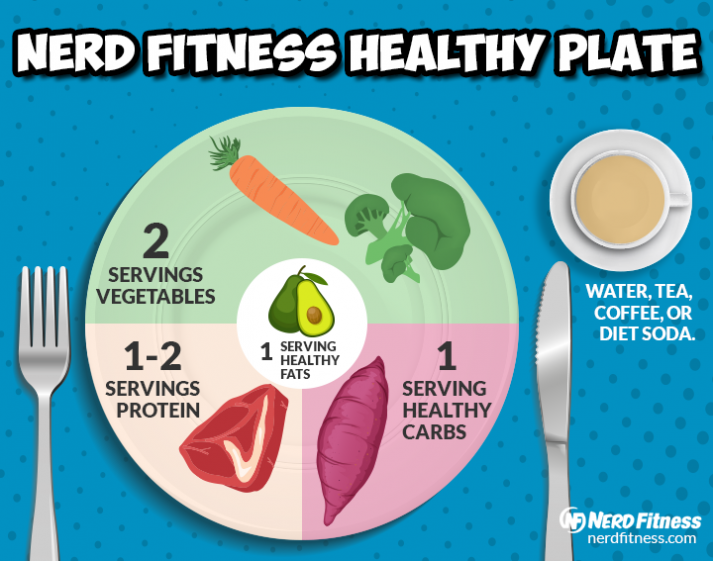
The gist: don’t skip out on protein. It should be on your plate for every meal (we’ll show you exactly how much in the next section).
If these generalized recommendations stress you out, and you want to know exactly what to do, we can help!
I’ll remind you of Nerd Fitness Coaching, where we help clients lose body fat, gain muscle, and level up their lives. We provide tailored and specific recommendations based on your body and lifestyle, plus accountability and mindset changes to help ensure your new habits stick.
WHAT SHOULD I EAT TO LOSE FAT AND GAIN MUSCLE?
Remember, your eating strategy needs to include two points to lose fat while gaining muscle:
Sustain a caloric deficit.
Prioritize protein so you can build muscle even while in a deficit.
You may be thinking, “That’s all well and good Steve, but what’s that actually look like?”
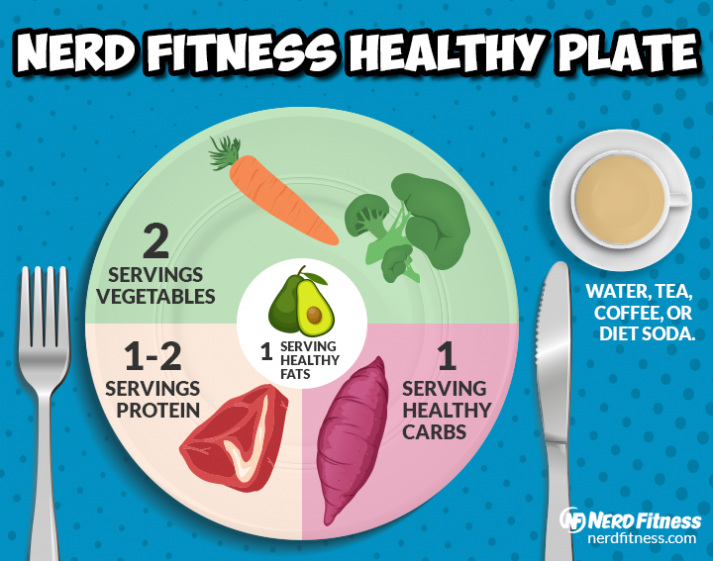
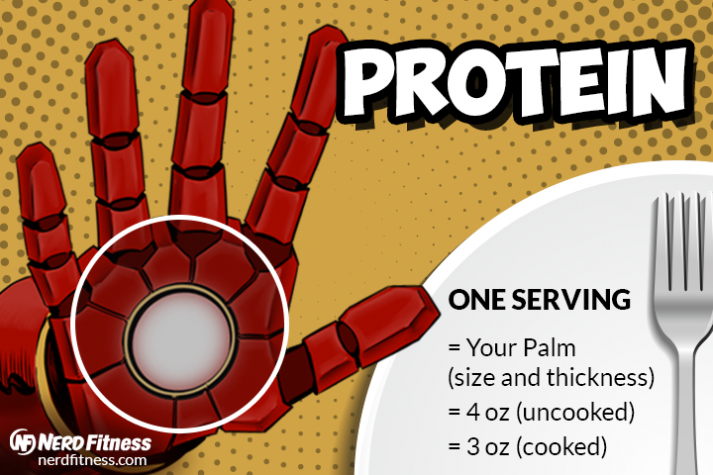
A serving of protein is about the size and thickness of your palm.
*The 4 oz serving is for an uncooked piece of meat. Cooking reduces about 25% of the weight, bringing it down to about 3 oz.
If you’re curious, here’s how much protein is in a serving of food:
4 oz (113 g) serving of chicken has around 30 g of protein.
4 oz (113 g) serving of salmon has 23 g of protein
4 oz (113 g) of steak has 28 g of protein.
While all of the Healthy Plate above is important, I want you to pay extra attention to your protein intake since we are trying to build muscle.
If you’re having trouble making your protein intake goals, check out our Guide on Protein Supplements for some tips and tricks to up your intake, including some awesome smoothie recipes.
If you are NOT losing weight, it means you are still eating too many calories. Keep your protein intake high, and reduce your fat and carbohydrate intake.
Eventually, you’ll reach a status where there just isn’t enough fat on you to help with “Rebuild Muscle.” At this stage, you can no longer stay with a caloric deficit. You’ll need to flip to a slight “caloric surplus” to build more muscle.
Which means you’ll have to eat more.
It’s debatable when this will actually occur, and we are all different. Reaching 8% body fat for men and 16% body fat for women is a good place to start.
It covers ways to increase your calories for muscle gain, from eating plentiful amounts of Paleo foods to drinking enough milk to make Santa Clause jealous.
HOW TO TELL IF IT’S ALL WORKING (Continuing to Lose Fat While Gaining Muscle)
If you’re trying to improve something, it’s important to track it. This also holds true of body composition.
Most people do this by jumping on the scale. This can be “Ok,” but it’s only going to tell part of the story.
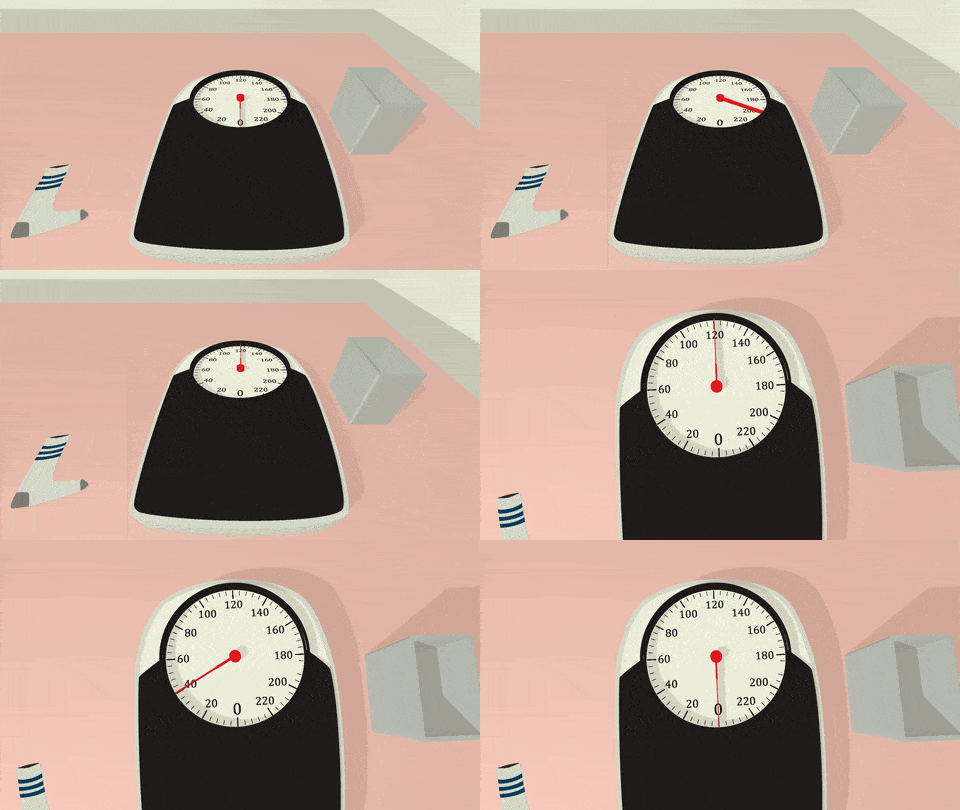
As I explained muscle weighs more than fat, so if you are losing body fat and gaining muscle at the same time, you might actually weigh the same. Or even more!
Despite weighing more, you could potentially have a better physique.
That’s why in addition to jumping on the scale, I would also encourage you to take progress photos.
Take front and side photos in your mirror, wearing underwear or a bathing suit. Each week, take new photos, and record the number on the scale under the same scenario. Two forms of tracking here allow us to get the full picture.
The scale sometimes lies!
If you eat for a caloric deficit, strength train, and prioritize protein, see what happens.
You may find yourself losing some fat and gaining muscle.
The tips outlined above will get you started losing fat while building muscle, but if you’re looking to go a bit further…
#1) If you want step-by-step guidance on how to lose weight, eat better, and get stronger, check out our killer 1-on-1 coaching program:
#2) If you want an exact blueprint for getting in shape, check out NF Journey. Our fun habit-building app helps you exercise more frequently, eat healthier, and level up your life (literally).
Try your free trial right here:
#3) Enlist in the Rebellion! We have a free email newsletter that we send out twice per week, full of tips and tricks to help you get healthy, get strong, and have fun doing so.
I’ll also send you tons of free guides that you can use to start leveling up your life too:
Download our free weight loss guide
THE NERD FITNESS DIET: 10 Levels to Change Your Life
Follow our 10-level nutrition system at your own pace
What you need to know about weight loss and healthy eating
3 Simple rules we follow every day to stay on target
Alright, I think that about does it for this guide.
Did I miss anything? Do you have any tips and tricks when it comes to shedding body fat and building muscle?
Share it with us!
-Steve,
PS: Make sure you read the rest of the articles in our “How to Lose Weight 101” Series!
Check out this study on energy deficits and fat loss and read a study on calorie deficits causing muscle loss right here and here.
Here’s a study on the importance of lean muscle right here.
3,500 calories in a pound of fat was determined in this 1958 report, although as Today’s Dietician points out, it’s likely more complicated than that. However, it’ll work for our intent and purpose.
Check out this interesting study on gaining muscle while in a caloric deficit. It should be noted that the participants drank milk. We’ll touch on macronutrient breakdown being key to muscle growth below.
A study on resistance training benefits can be read here.
You can check out this report for a look at protein intake and muscle growth.
There’s studies on protein and muscle retention right here, here, here, and here.
Here’s a systematic review on protein being critical for muscle retention.
Sometimes we need a reminder of how truly strong, capable, and beautiful we really are. In today’s episode, Robin walks through a guided meditation to help bring you to a place of relaxation, calmness, and to motivate you to feel inspired to prioritize your self-care. This episode is perfect to start off your day with positivity, or to wind down before bed. Join Robin in this peaceful and empowering meditation.
Show highlights: what you can look forward to in this episode!
Finding a comfortable place to start meditation
Breathing and awareness exercises
Noticing your mental state
Imagining the healthiest and most fulfilled version of yourself
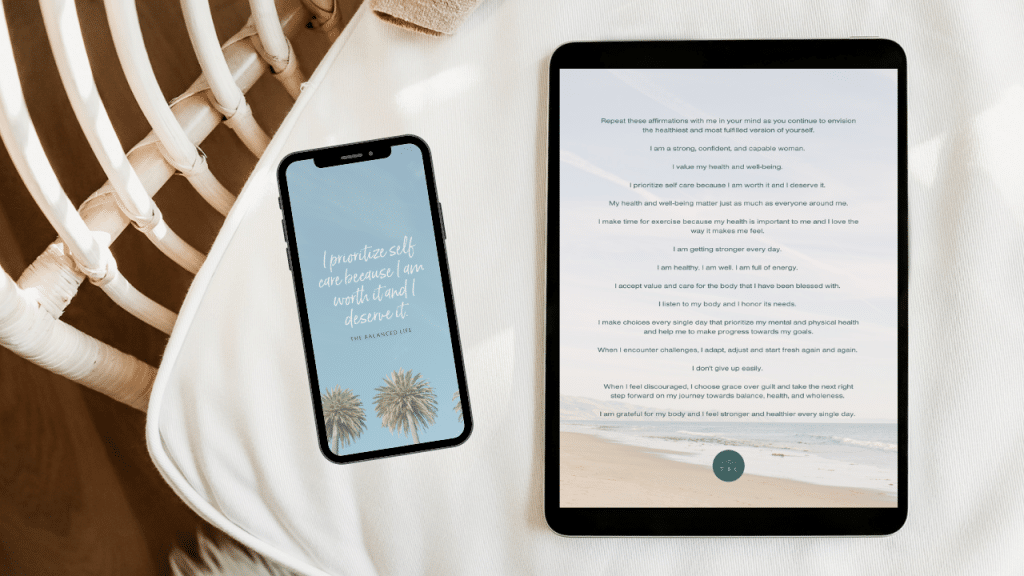
Affirmations to enhance your motivation for self-care
Taking affirmations to approach your day with positivity and self-love
Links in this episode:
If you would like a visual reminder of these affirmations or even get one as a background for your phone, click here!
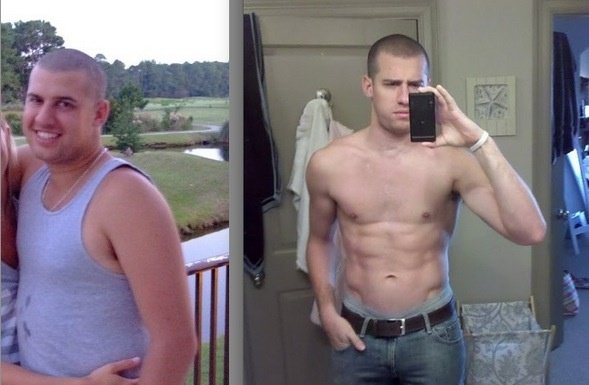
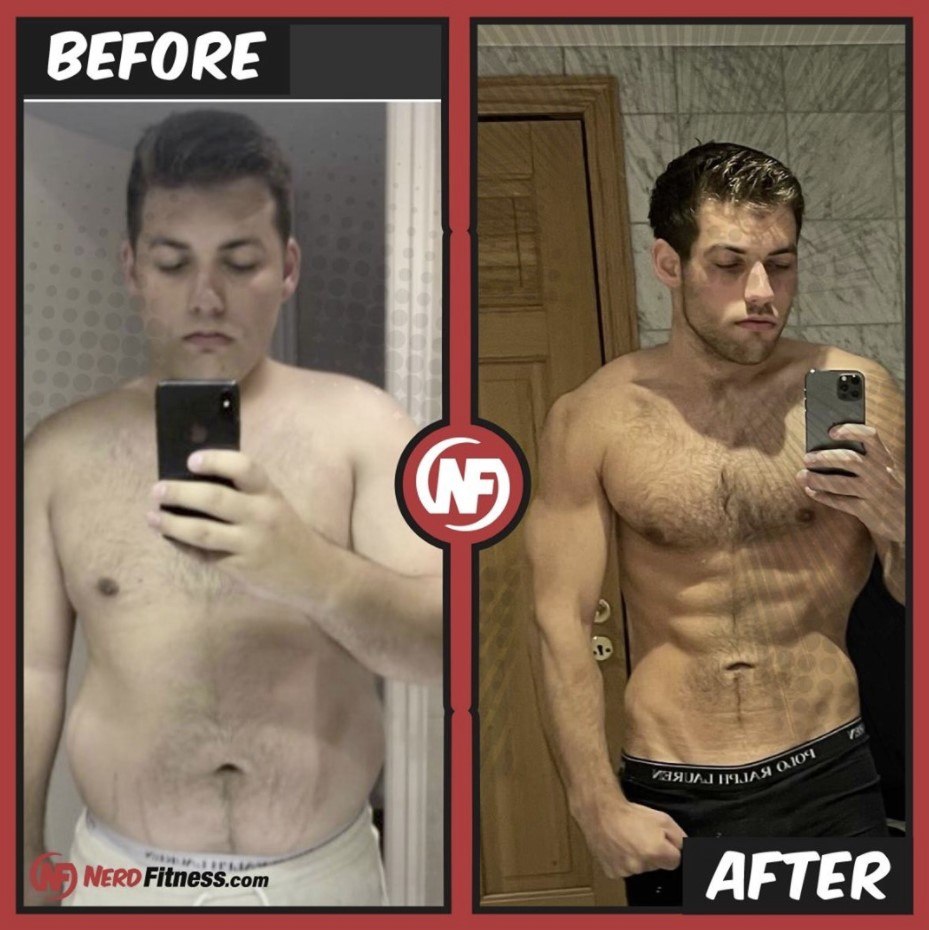
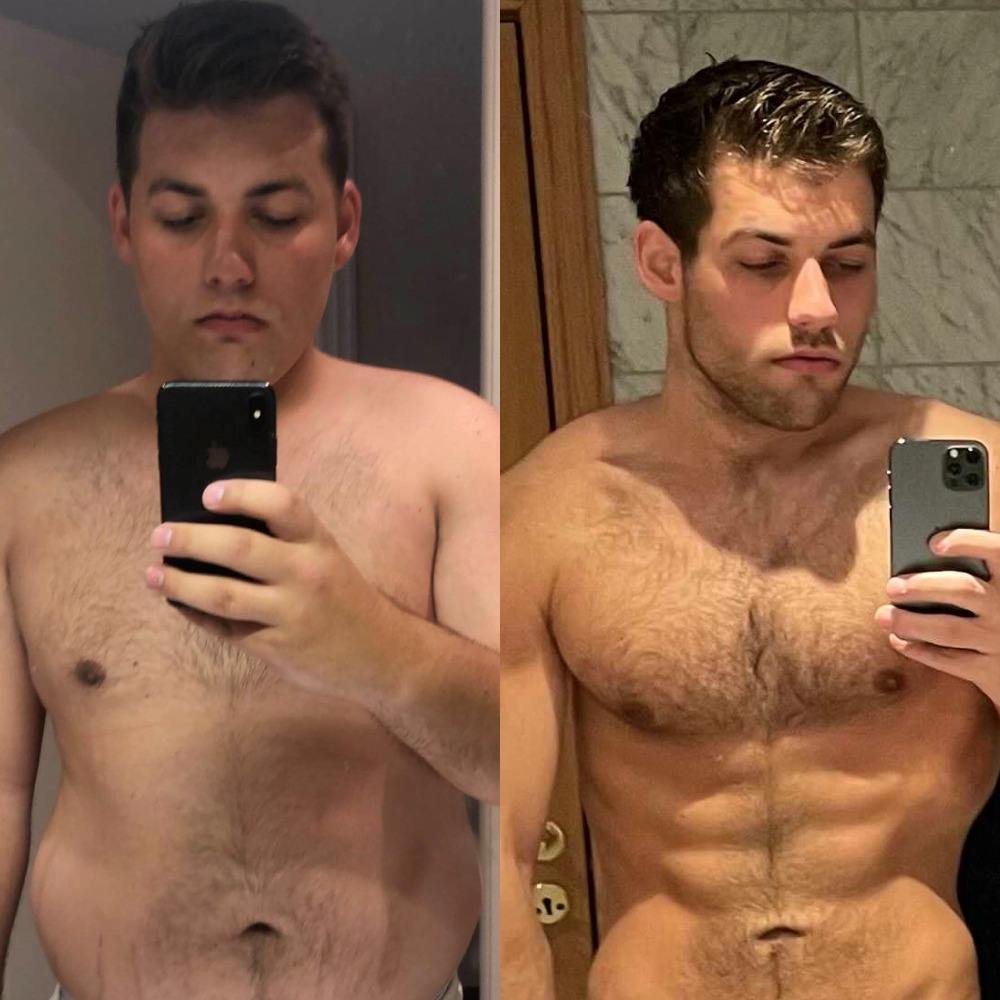
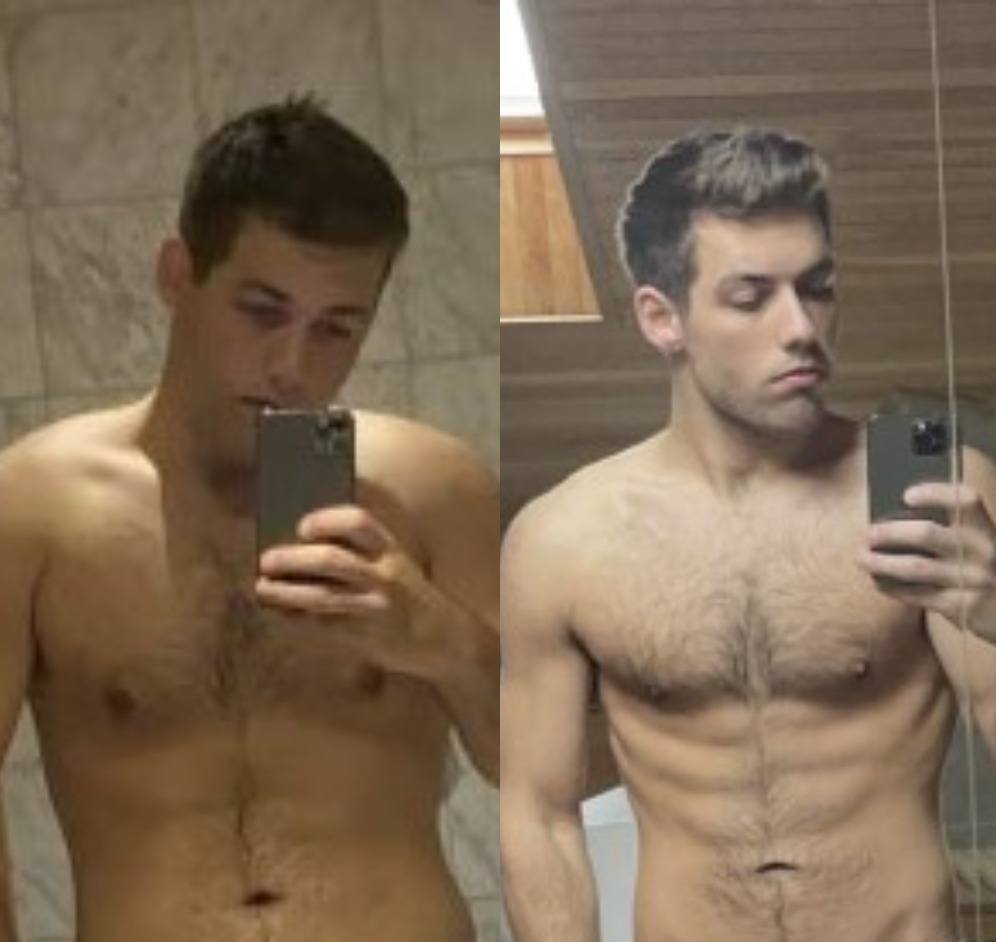
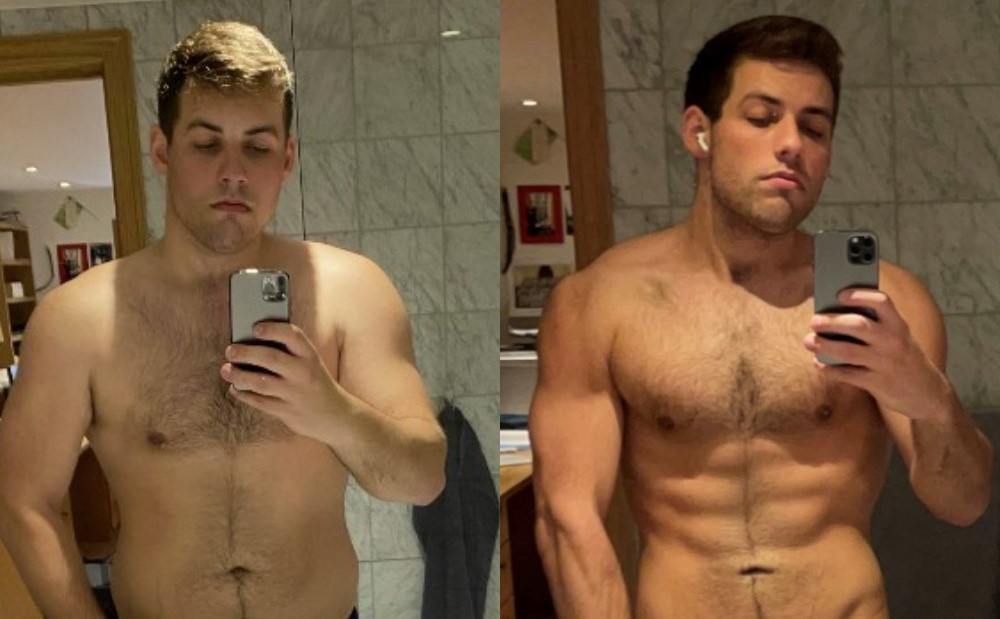
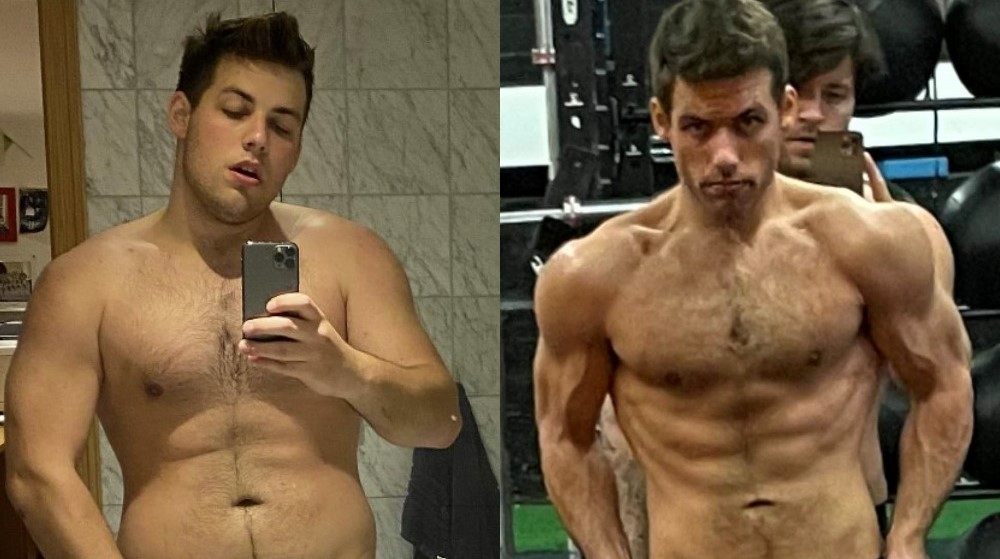
“HOW COW! He doesn’t even look like the SAME PERSON! ”
Meet Aksel, an economics student from Norway who is on a mission to turn into Wolverine.
I think you’ll agree with me in saying he’s more or less succeeded!
Aksel joined NF Coaching a year ago with the goal of losing some weight and building a lot of muscle.
So our very own Coach Taylor helped him do it.
However, pictures don’t tell the whole story.
Before joining Nerd Fitness, Aksel had hit a “rough patch” and knew something had to change in his life.
Here’s how Aksel’s journey went down.
The 4 Keys to Aksel’s Transformation
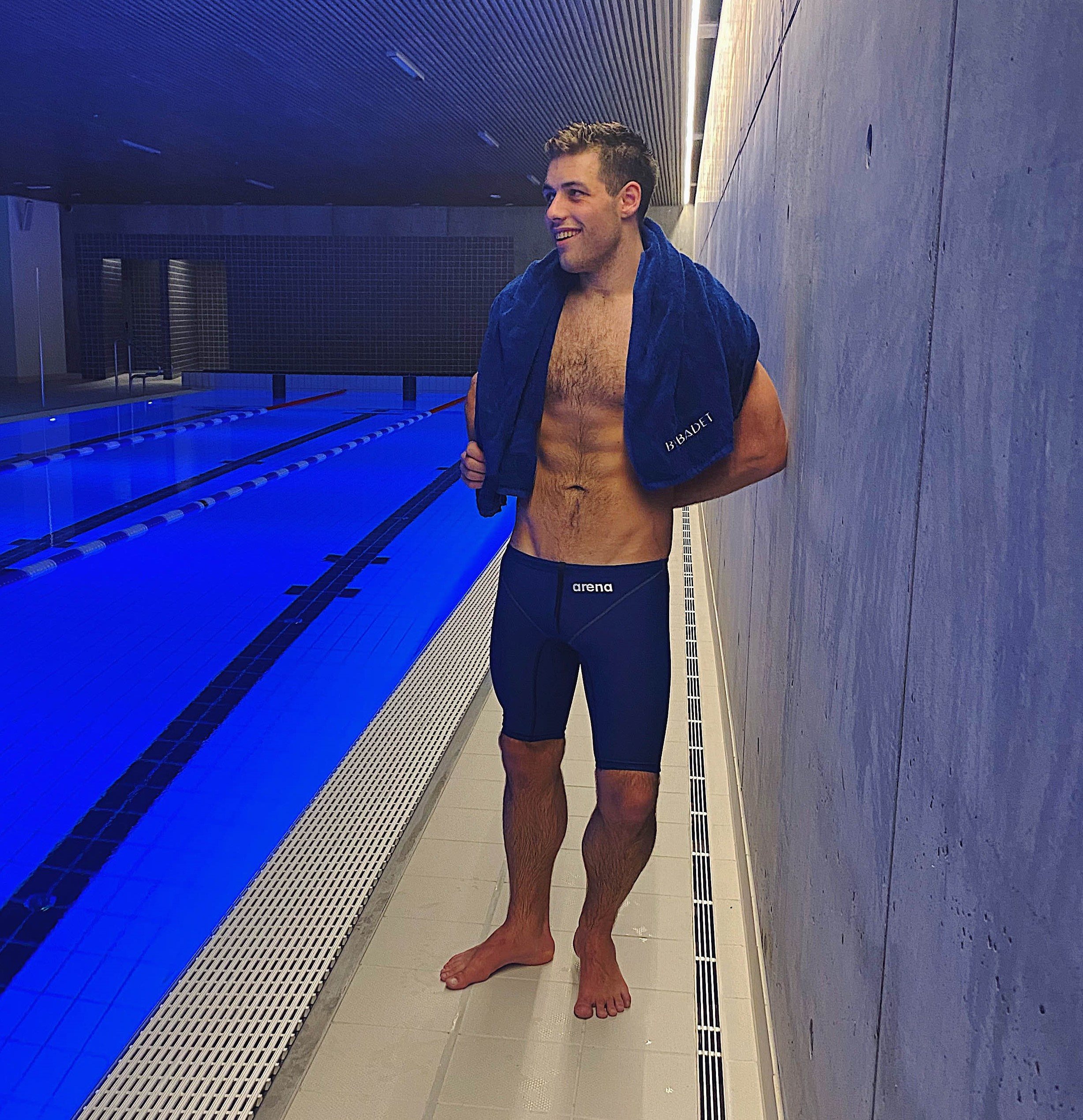
Aksel used to be an avid swimmer when he was a teenager, even competing in the national swimming championships in Norway.
Then, life happened.
Somewhere along the way, Aksel stopped swimming. Then he more or less stopped exercising. Soon alcohol and pizza began to provide him with most of his “nutrients.”
From all of this, Aksel became depressed.
This continued until one sad day, Aksel’s uncle passed away from cancer. This acted as a “reality check.” Aksel realized his lifestyle wasn’t making him a healthy person.
So he decided something had to change.
After going down a Google rabbit hole, Aksel found Nerd Fitness. He quickly decided that a coach might be exactly what he needed.
So he dived into the Rebellion.
Here are the 4 BIG changes that helped Aksel make progress:
#1) ALL CALORIES COUNT.
From Aksel, “I began getting in shape by tracking everything I ate.
I never knew how many calories were in the food I bought. Why are there so many calories in beer!?!
It was really eye-opening to analyze all the food and drinks in my life. Even ‘healthy’ food is often packed with calories.”
Once Aksel got his head around all this, he made a plan with his Coach.
Aksel still wanted to eat a diverse diet, plus he wanted to be able to have the occasional drink with his friends. However, he started to consider the amount that would help him reach his goals.
Takeaway: you don’t have to count calories, but all calories count. For the right clients, we’ll create a mission to have them track their food intake for a week. This helps to give a full picture of how they’re eating.
Many clients start to naturally behave differently after going through this exercise.
#2) STRENGTH TRAINING CHANGES EVERYTHING.
When Aksel first attempted to get in shape, he decided to start running.
But Aksel’s knees hurt from jogging. So he stopped.
When he joined NF Coaching, he mentioned to us that he wanted to build some muscle. So his coach had him start strength training immediately…since that’s how you build muscle.
It didn’t take long for Aksel to fall in love.
He started seeing results right away, losing body fat that he’d never been able to shed before.
The energy and confidence he gained from strength training propelled him to keep going.
Takeaway: strength training is one of the best things you can do for your body.
As we say around here, a strong nerd is a healthy nerd. No matter what your goals are, being strong will help them.
#3) DON’T UNDERESTIMATE THE POWER OF A GOOD NIGHT’S REST.
If you’re going to strength train, you need to recover.
That means you need to prioritize a good night’s sleep.
“I used to be a zombie before. But developing an actual sleep schedule has probably made the biggest difference in my life. Sleep helps my training. And my training helps me sleep.
I’m not sure I could do one without the other.”
Takeaway: don’t overlook your sleep habits. Proper shuteye really does make everything easier.
#4) HAVING A GUIDE WHO KNOWS THE WAY IS A GAME CHANGER.
As Aksel puts it, “Yes, you can just google most things.
But a coach adapts to you and your goals. It becomes SO MUCH easier when you have someone helping you out.
I was clueless when I started, and although I’m more knowledgeable now, I continue with my coach because I just want to be told what to do. This allows me to focus my brain power on my studies.”
Takeaway: you don’t have to figure this out alone. Yep, lots of people are able to search the interwebz for info and make a plan from that.
However, if you don’t want to go through all that trial and error, a coach can be a great way to progress at a quicker pace.
Through Hard Work, Amazing Things Are Possible
I’m gonna be real with you: what Aksel and his coach achieved is truly incredible.
If I didn’t know Aksel’s coach – and hadn’t seen the progress pictures – I might be a tad skeptical myself.
But once you start to understand all the hard work Aksel put in, you begin to see what happened:
Aksel’s coach made a plan.
Then Aksel went and executed it to a T.
In other words, Aksel put in the work and the results followed.
Here’s the most important thing about Aksel’s journey: he started.
After spending a little bit of time on the internet, Aksel found a program that seemed doable and jumped in.
Yes, he’s been working very hard the last year. But all that hard work resulted from one decision: hiring a coach.
While it might only take 20 seconds, the first step is often the most important one.
You just have to take it when the moment arrives…like Samwise Gamgee.
If you want someone to help you start your journey to leave the “Shire,” we’re here to help.
We have a team of wizards who do this stuff all day, every day:
We have kick-ass Coaches that create custom programs for our clients. For Rebels willing to put in the effort (like Aksel), we get amazing results (also like Aksel).
We offer worldwide accountability and support. If you start traveling again in 2021, your NF Coach will come with you. They’ll assess your new surroundings and build you a custom plan for your new environment.
We check-in and adapt. Your coach won’t just establish a program and walk away. They’ll actually talk to you and make sure it’s working. If it’s not, no problem. We’ll record that information like a scientist and work with you to create a new path forward.
Sound good?
IF you are ready to jump into battle with your own Gandalf in your pocket (through the NF Coaching App, not literally)…
Let’s make a plan for you to be the next Nerd Fitness success story:
For the Rebellion!
-Steve
PS: Seriously, Aksel is awesome. Holy moly.
PPS: Shoutout to Coach Taylor for showing Aksel the way!
Even if you’re stuck at home, a jump rope can provide a great cardio workout.
You just gotta know what you’re doing so you don’t keep hitting yourself in the shins.
Have no fear, even if you’ve never touched a jump rope before, we’ll get you started.
We specialize in helping people train from home, with little to no equipment whatsoever. Today, we’ll share with you a beginner jump rope workout routine that you can do anywhere.
If you’re in a hurry, sign-up for our free weekly newsletter and we’ll send you PDFs of our “Work Out at Home” guides!
Coach Matt, from our Online Coaching program, guides you through learning how to jump rope in the video above.
Matt breaks down jumping rope into three parts:
The Jump
The Arm Swing
Timing
First up…
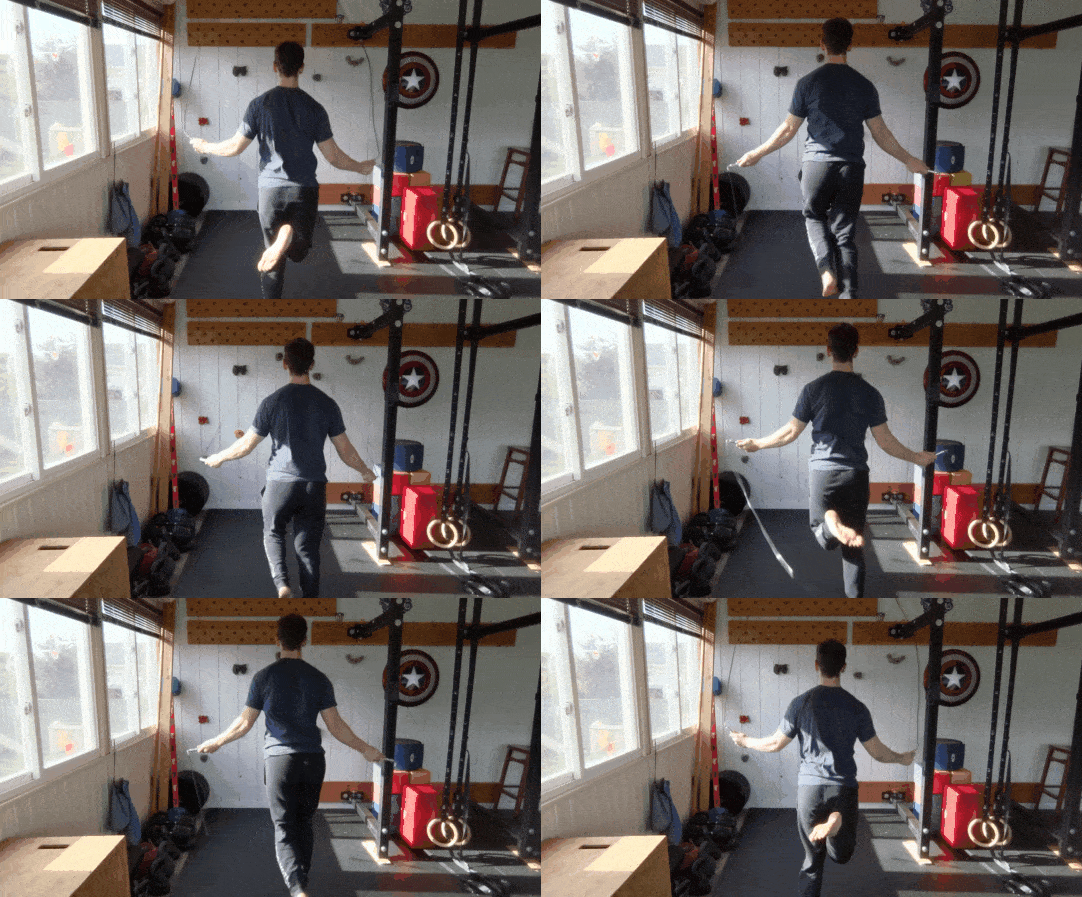
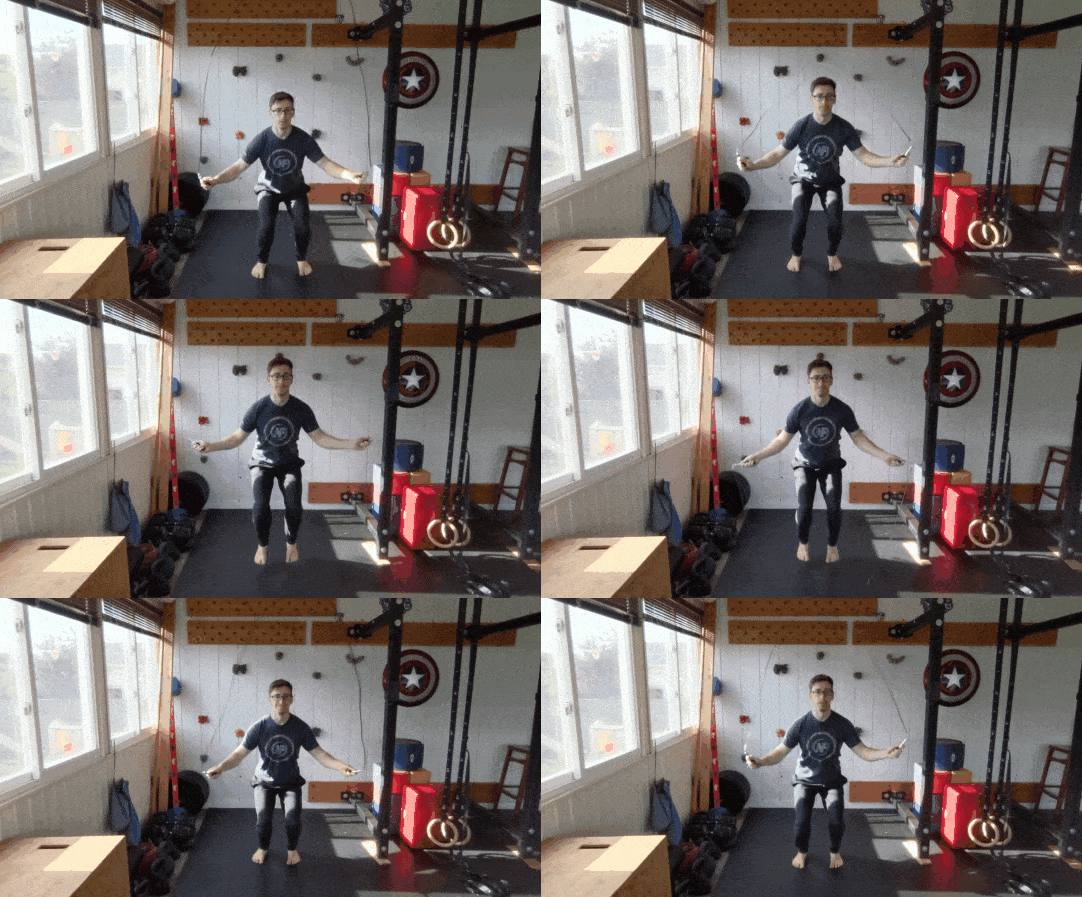
#1) The Jump
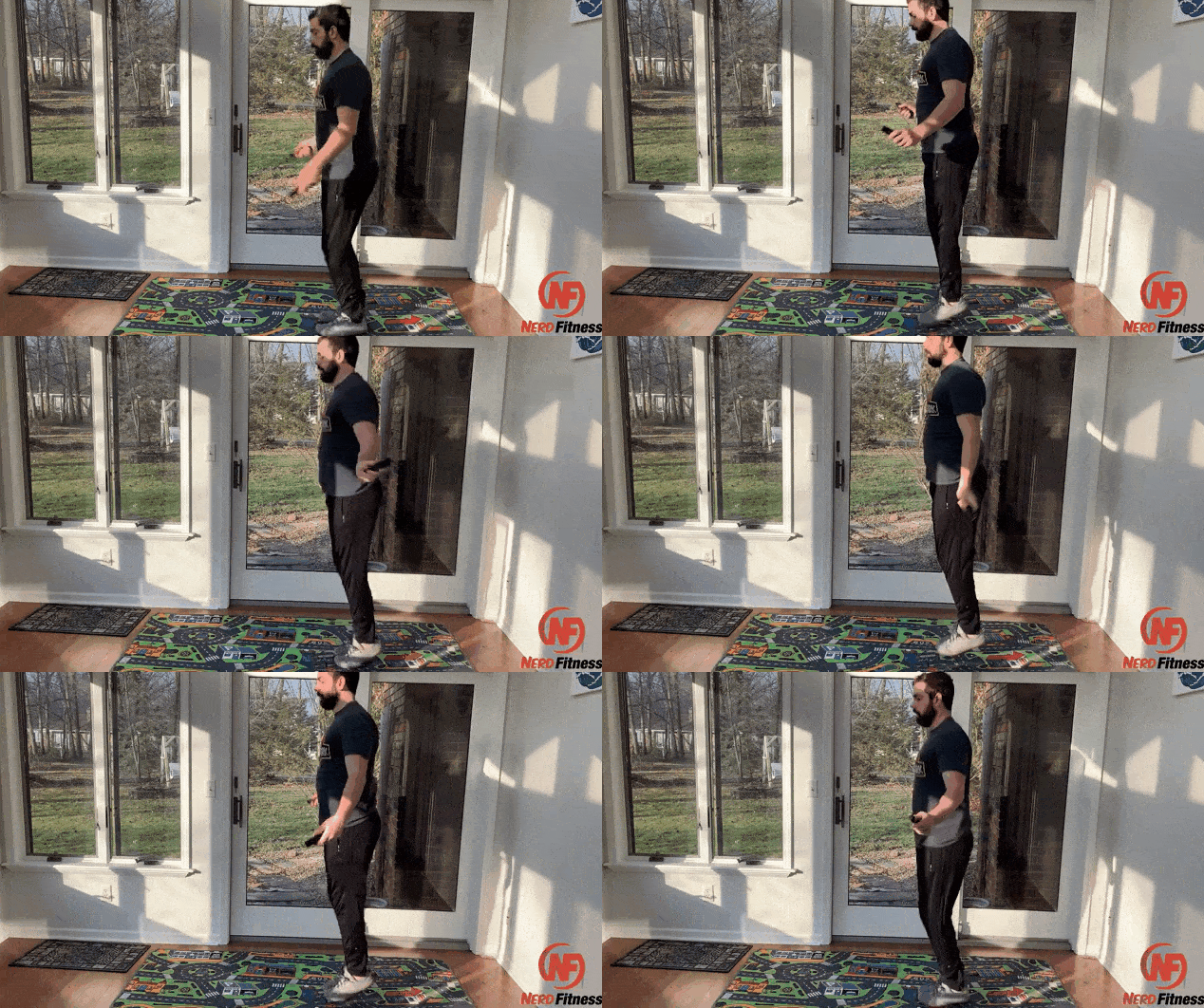
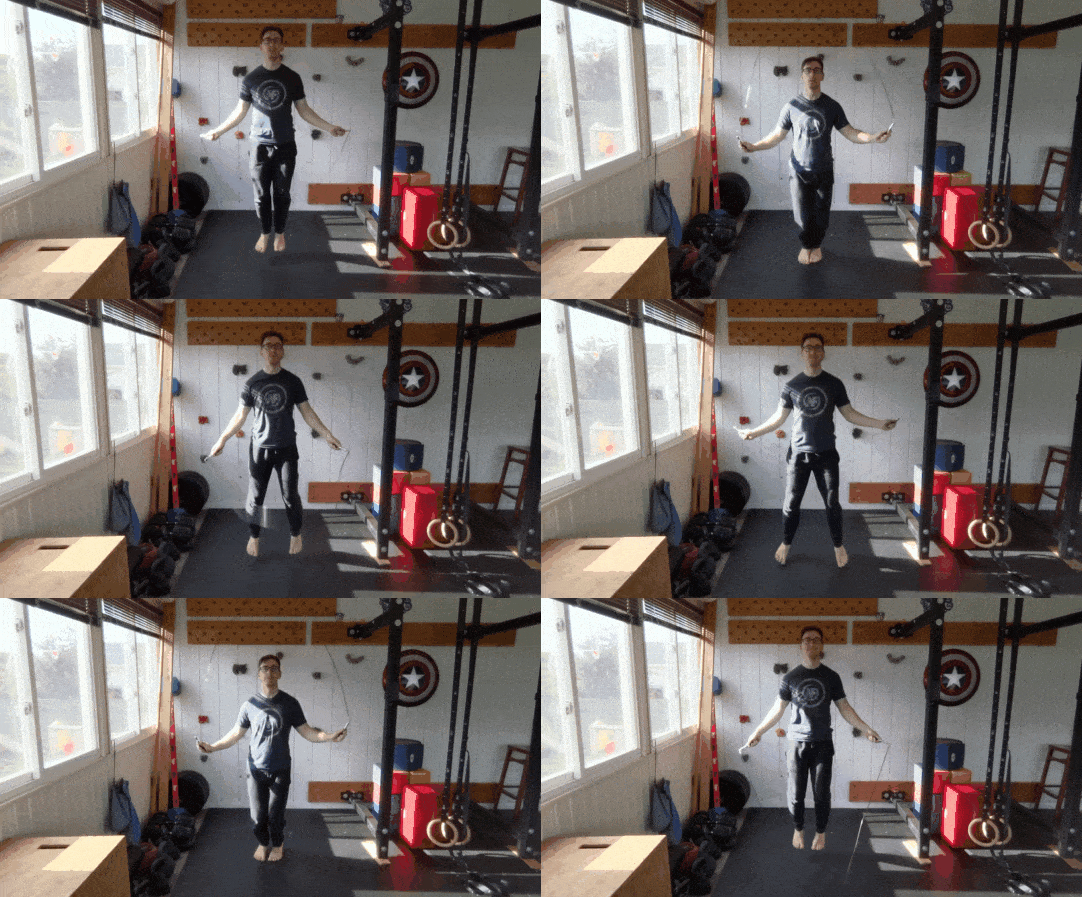
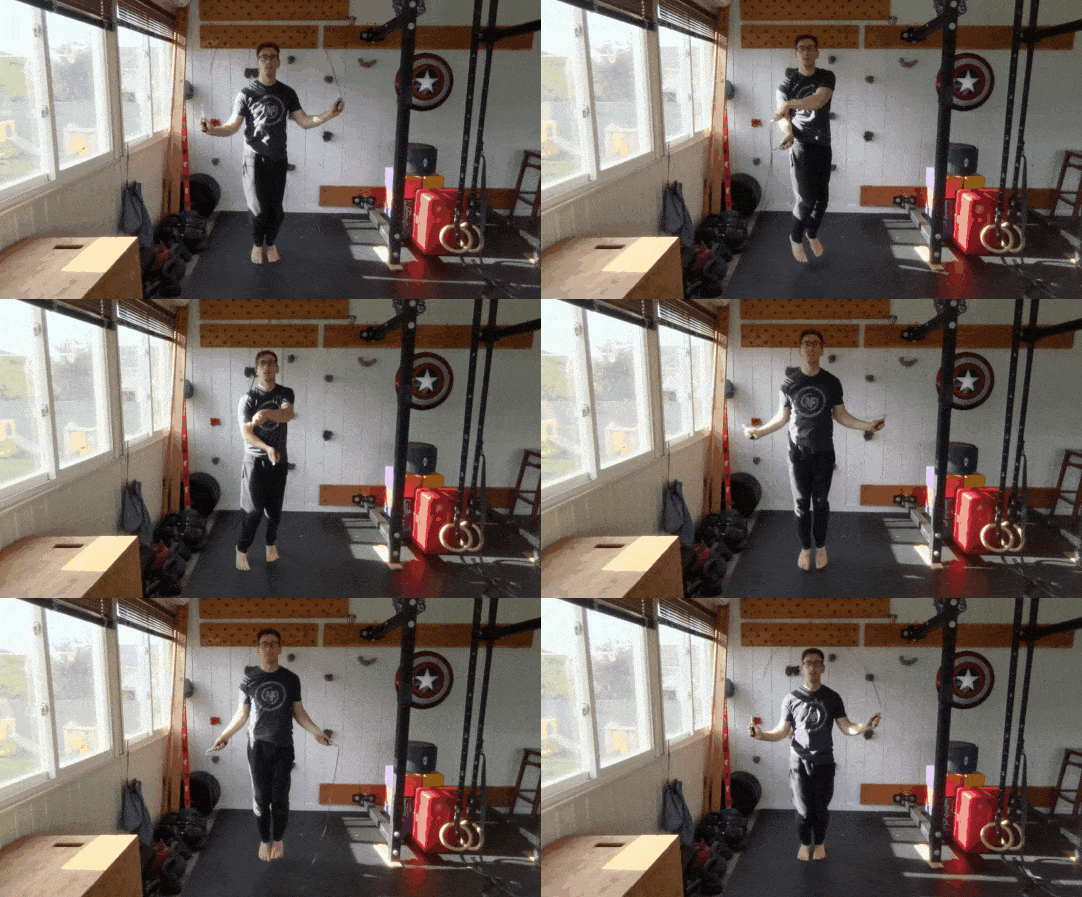
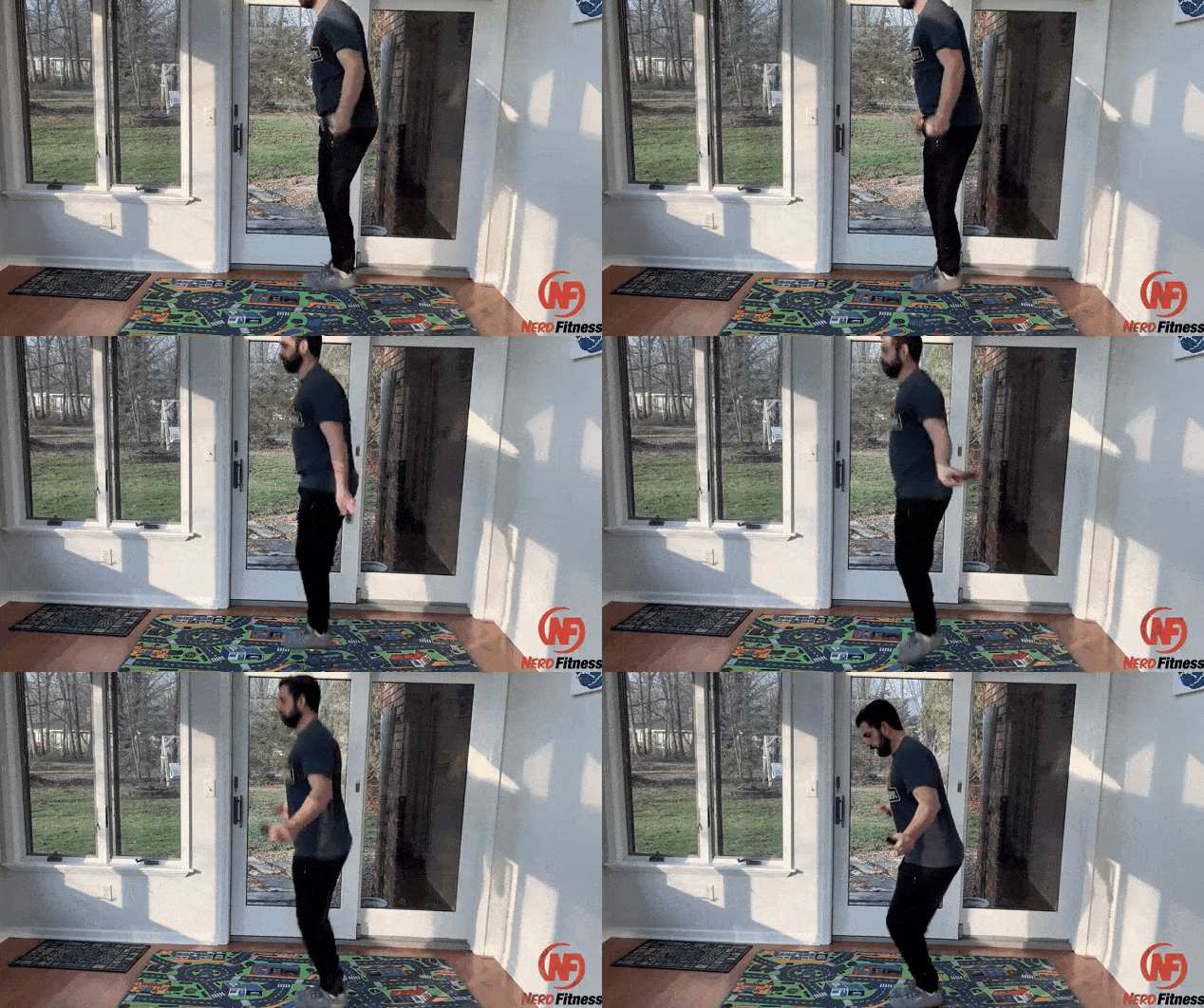
First, let’s just practice jumping.
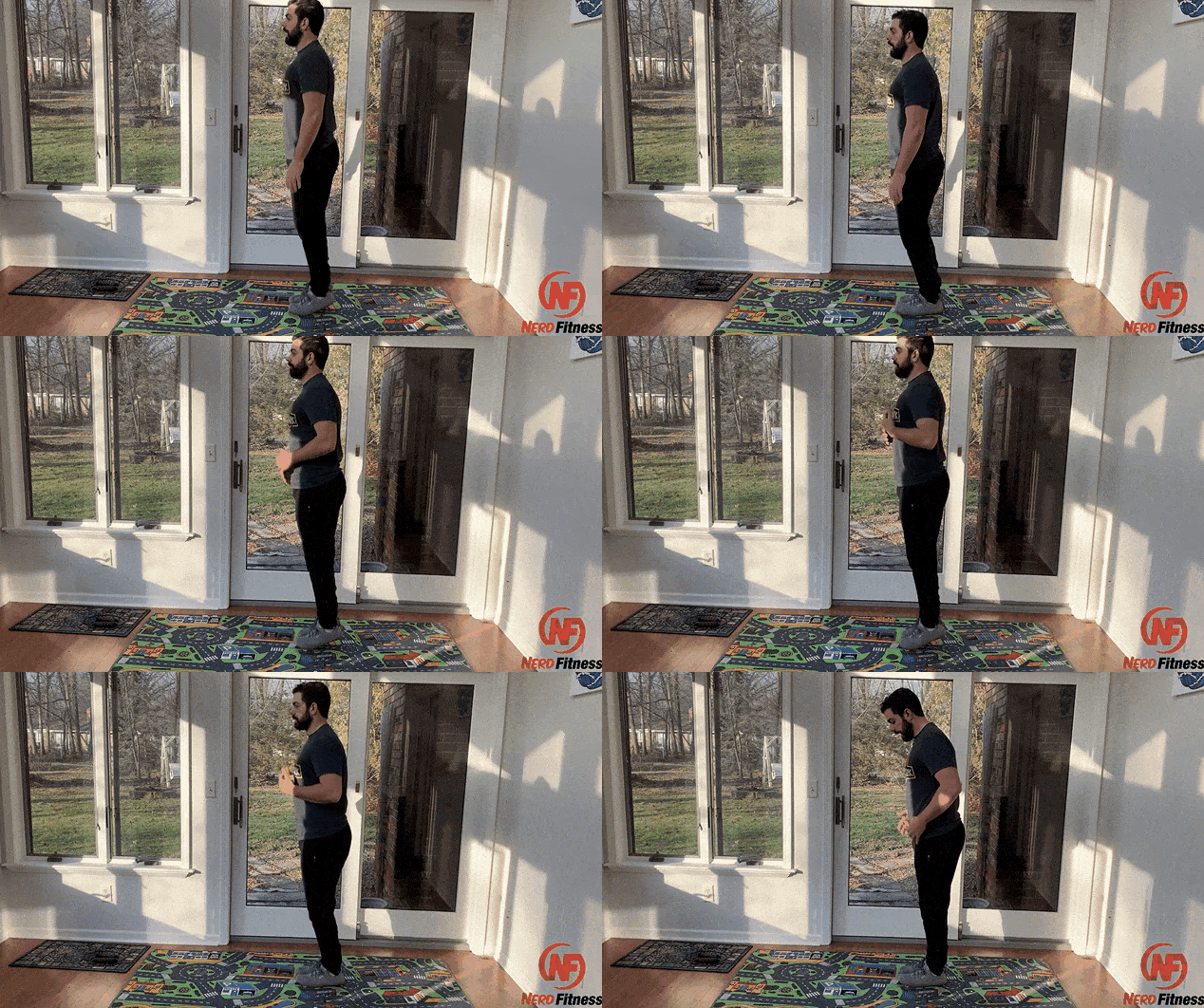
Stand tall, feet about hip-width apart.
Then, practice jumping up and down in one spot.
Most of your power will come from your ankle and toes. It’s really more of a “hop” than jump.
If you have trouble with this, Coach Matt recommends drawing some type of “X” or mark on the ground so you stay in one place.
Another tip from Coach Matt: keep a little tension throughout your body. If you’re too loose, you might flail around a bit and get off your mark.
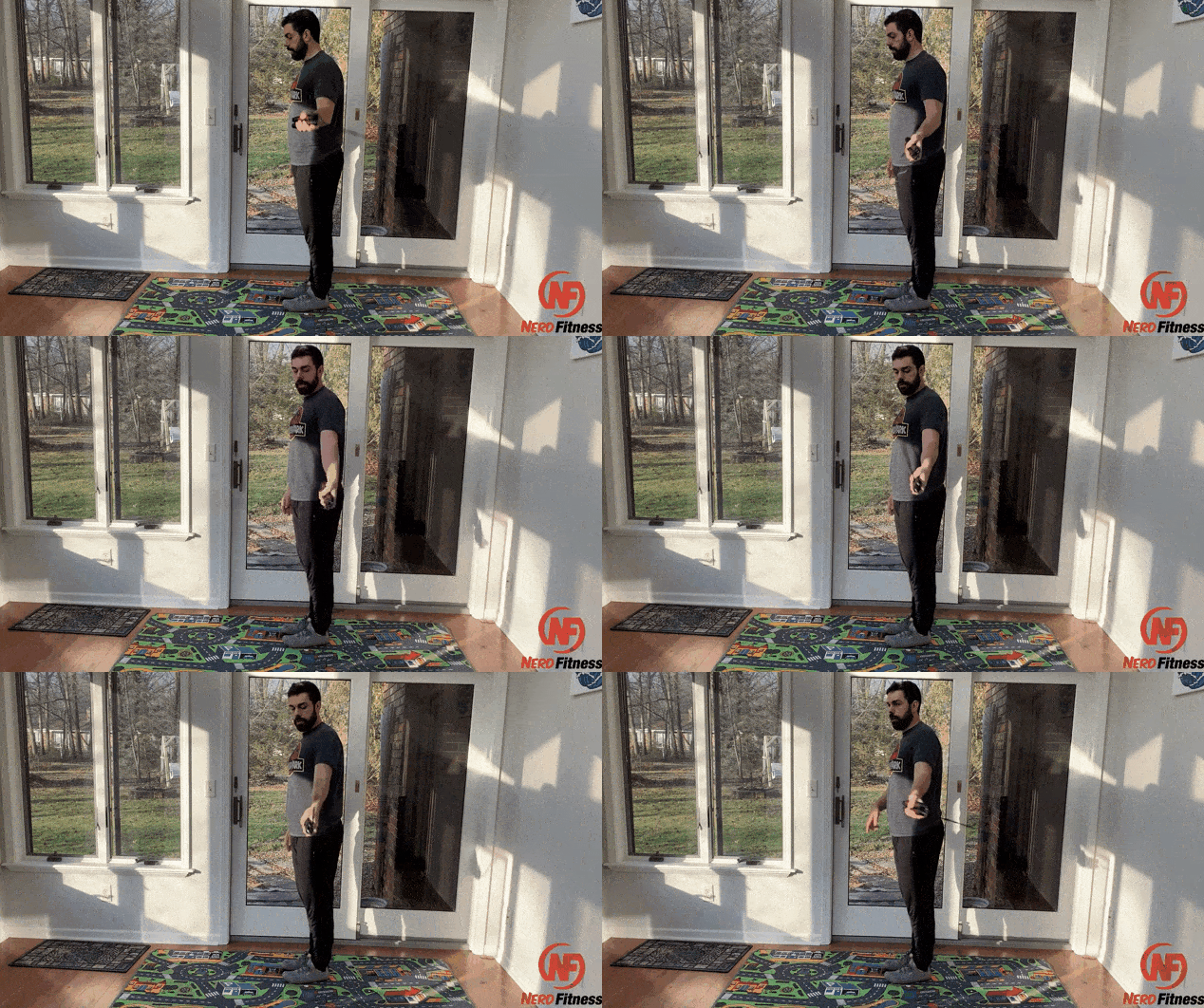
#2) The Arm Swing
Your arms will remain mostly stable when powering the rope. We want to keep the movement narrow, mostly coming from your wrists.
The name of the game with jumping rope is “in control.” Swinging from the wrists will help you maintain control of the rope.
Resist trying to rotate with a lot of elbow movement (try to keep them stable instead).
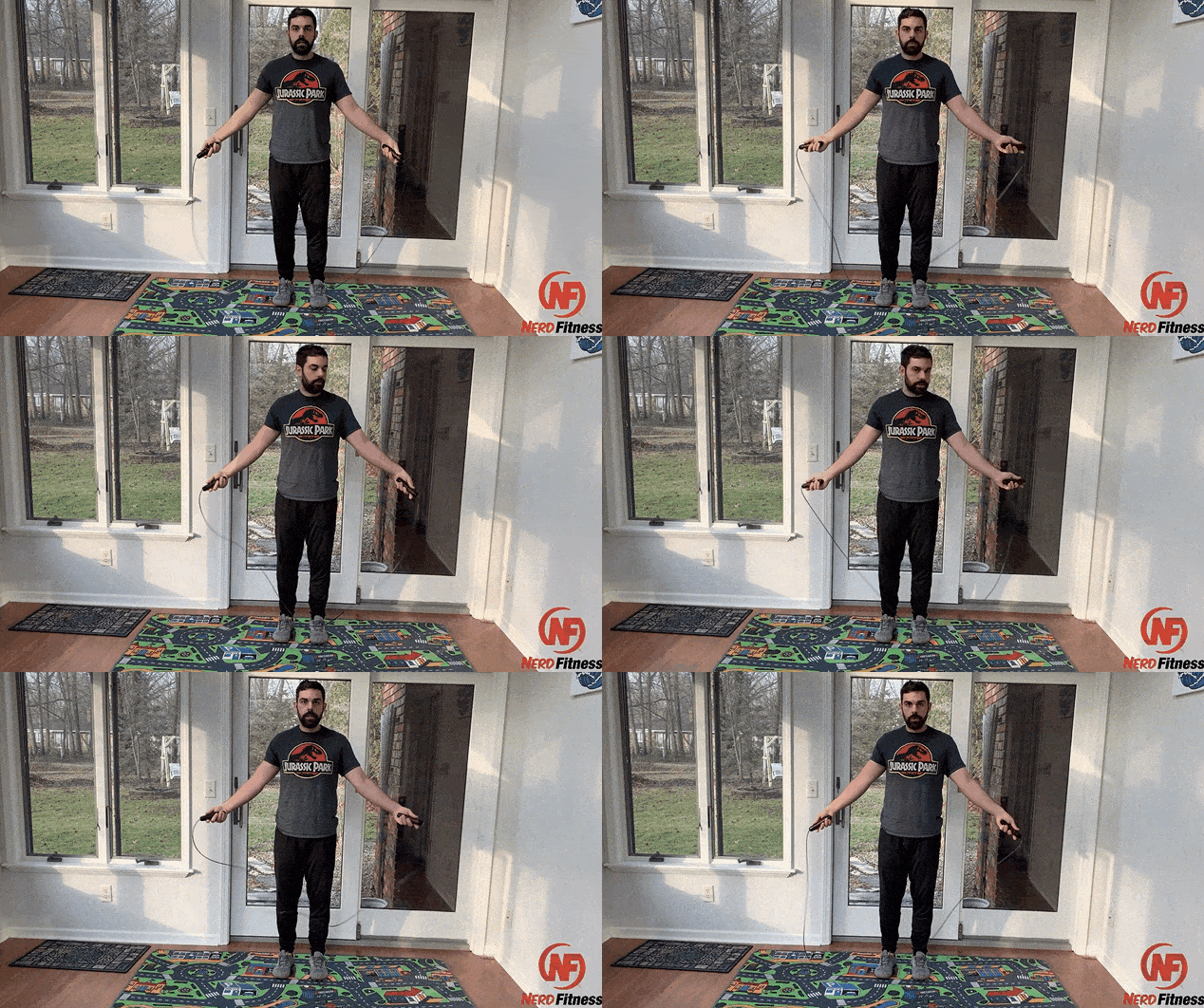
For the position of your arms, you want your hands out roughly at the height of your hips. Your arms will go downward at about a 45-degree angle.
To start, you might even just try getting the rhythm down with one hand:
Don’t even worry about jumping at first.
Once you’re comfortable swinging from both hands, it’s time to think about putting it all together.
#3) Timing
When you first get going, go slow with the arms, and do two hops per one rope revolution.
It looks like this:
When starting with this position, you might find your elbows flailing out a bit since they’re moving slow. So you’ll have less wrist control.
That’s okay.
Once you get comfortable with the rhythm, try one hope per rope revolution to tighten it all up. You may find it easier to keep your arms and elbows stable moving faster.
Here’s a great point from Coach Matt: as a beginner, the rope itself will be your coach.
If you hit your shins or toes with the rope, something went wrong. Maybe you hopped too high or your elbows went a little off.
No problem. Just accept that the rope is providing you with immediate feedback, and try again.
Getting the rhythm and timing down with a jump rope can be tricky, so hang in there and be patient.
Once you get the feel of it, it’s time to do some workouts.
The Nerd Fitness Jump Rope Workout (With Video Tutorial)
Coach Matt walks you through 5 different levels of difficulty for your jump rope workout.
If this is too much, feel free to increase your rest period. Meaning you can rest for 45 seconds, no problem.
For the next level, we’ll do the same moves, but we’ll increase your single under duration
Jump Rope Workout Level 2:
Single Unders: 45 Seconds
Rest: 15 Seconds
Single Unders: 45 Seconds
Rest: 15 Seconds
Single Unders: 45 Seconds
Rest: 15 Seconds
Single Unders: 45 Seconds
Rest: 15 Seconds
Single Unders: 45 Seconds
Rest: 15 Seconds
Total time: 5 minutes
On Level 3, it’s time to mix in double unders.
During our jump interval, you can do every other, so one single under followed by one single double under (1 jump, 2 rotations of the rope).
If this is too tricky, do a double under for every four normal jumps.
Just try to keep it consistent, as this will help your rhythm.
The mission with Level 3 is to get comfortable performing double unders.
Jump Rope Workout Level 3:
Single/Double Under Mix: 30 Seconds
Rest: 30 Seconds
Single/Double Under Mix: 30 Seconds
Rest: 30 Seconds
Single/Double Under Mix: 30 Seconds
Rest: 30 Seconds
Single/Double Under Mix: 30 Seconds
Rest: 30 Seconds
Single/Double Under Mix: 30 Seconds
Rest: 30 Seconds
Total time: 5 minutes
Now that you’re at Level 4, it’s all double unders, all the time.
We’re going to focus on building power, so we’ll do intervals for 15 seconds, then rest for 45.
Jump Rope Workout Level 4:
Double Unders: 15 Seconds
Rest: 45 Seconds
Double Unders: 15 Seconds
Rest: 45 Seconds
Double Unders: 15 Seconds
Rest: 45 Seconds
Double Unders: 15 Seconds
Rest: 45 Seconds
Double Unders: 15 Seconds
Rest: 45 Seconds
Total time: 5 minutes
With our last workout today, we’re bumping up the duration of double unders to 30 seconds, then resting for the same time.
This might be challenging.
Jump Rope Workout Level 5:
Double Unders: 30 Seconds
Rest: 30 Seconds
Double Unders: 30 Seconds
Rest: 30 Seconds
Double Unders: 30 Seconds
Rest: 30 Seconds
Double Unders: 30 Seconds
Rest: 30 Seconds
Double Unders: 30 Seconds
Rest: 30 Seconds
Total time: 5 minutes
If single and double jumps get boring, have no fear.
We’ll cover additional exercises you can do to level up your jump rope game now.
Feel free to mix and match any of the moves below into your workout.
After a while, your rest period might be normal hops, while your interval period can be one of these sweet moves.
The 13 Best Jump Rope Exercises
Now that you have the basics down on how to jump rope, let’s cover some moves so you can expand your workouts.
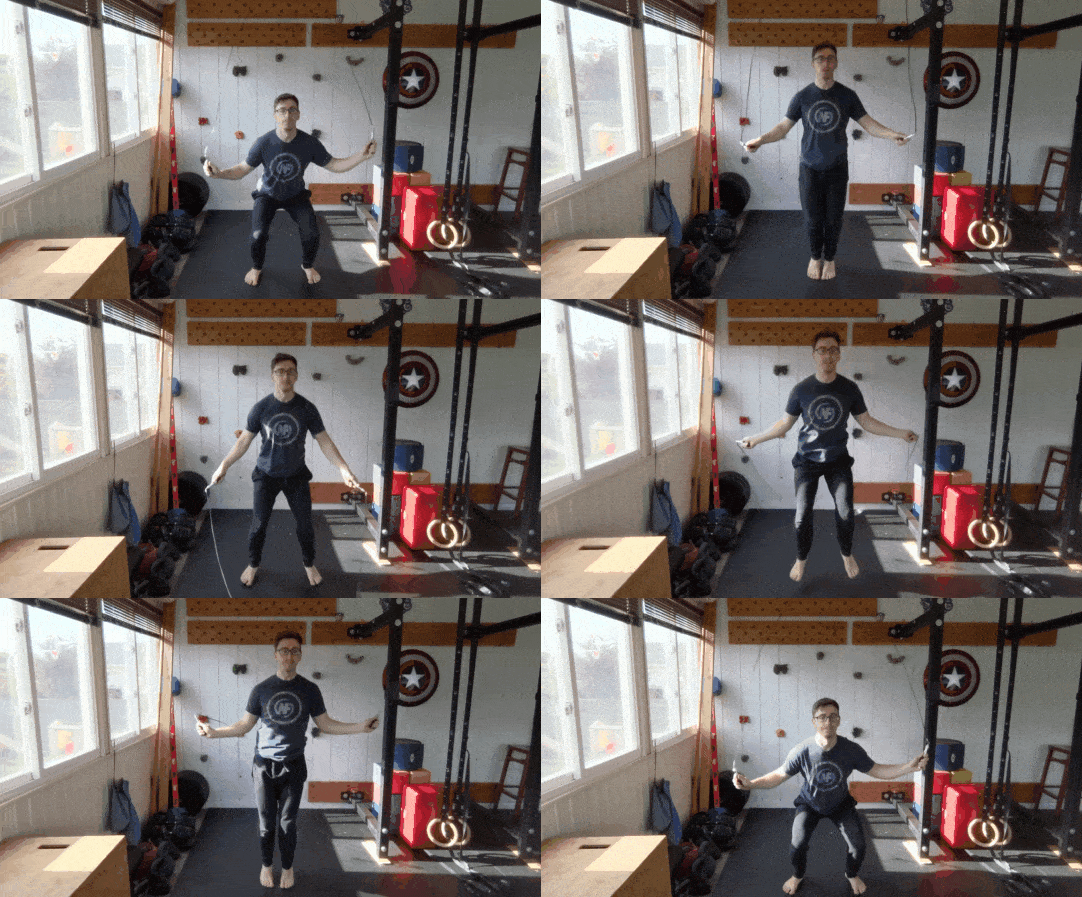
#1) The Single Under
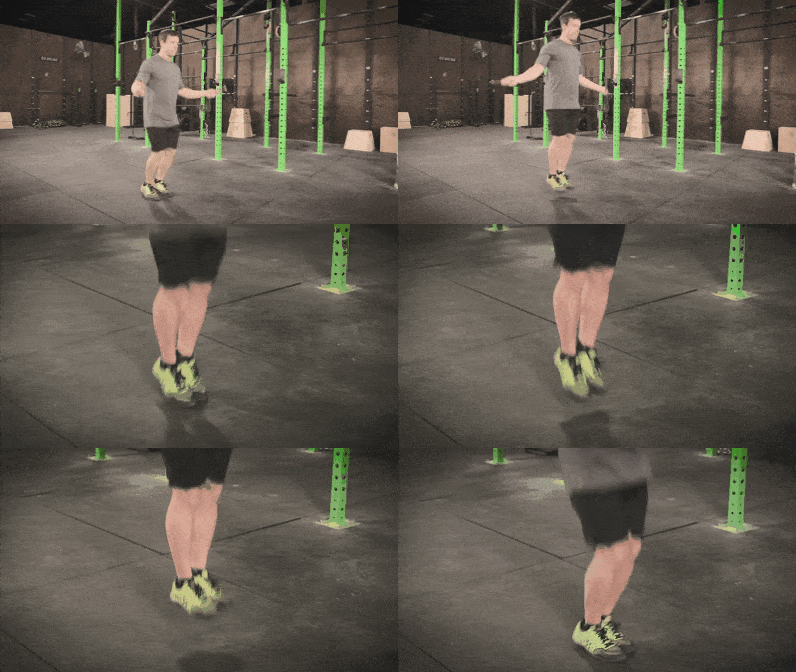
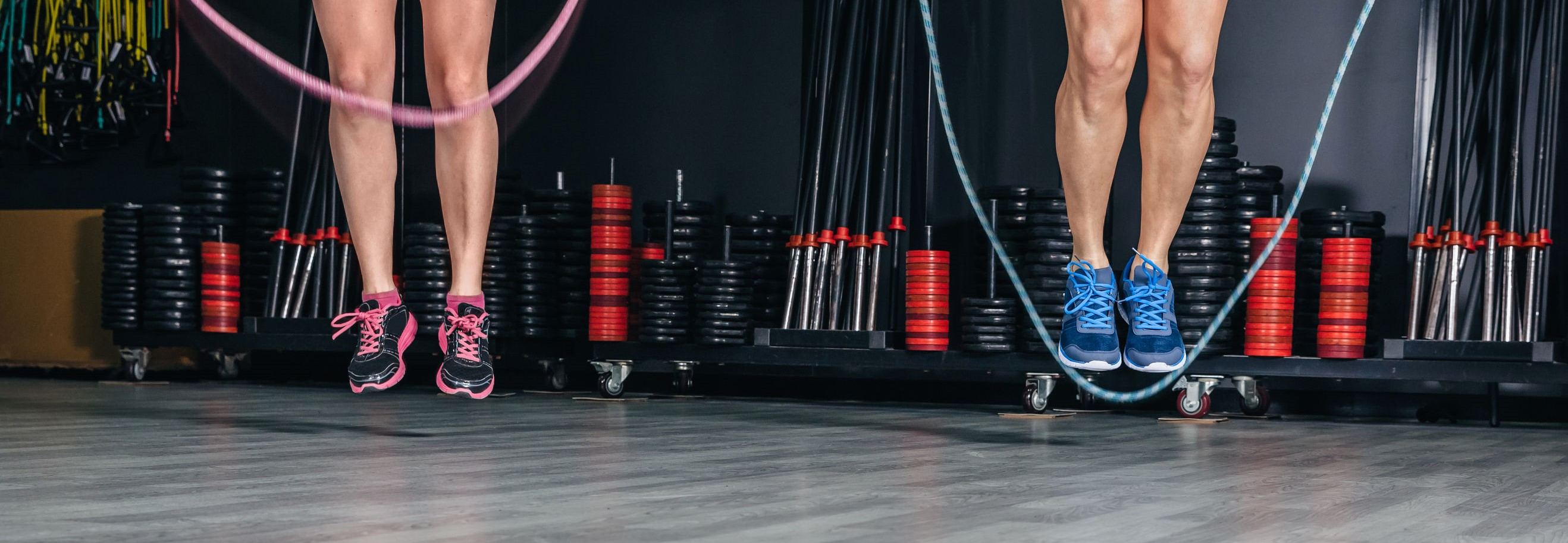
This is the most basic jump rope exercise. One hop per rope revolution, both feet together.
Get this down before you move on from here.
#2) Double Single Foot Jumps
Once you get the single under down, try hopping on one foot.
To really test your balance, jump twice from the same foot.
An example beat would go left foot, left foot, right foot, right foot, with one rope revolution between.
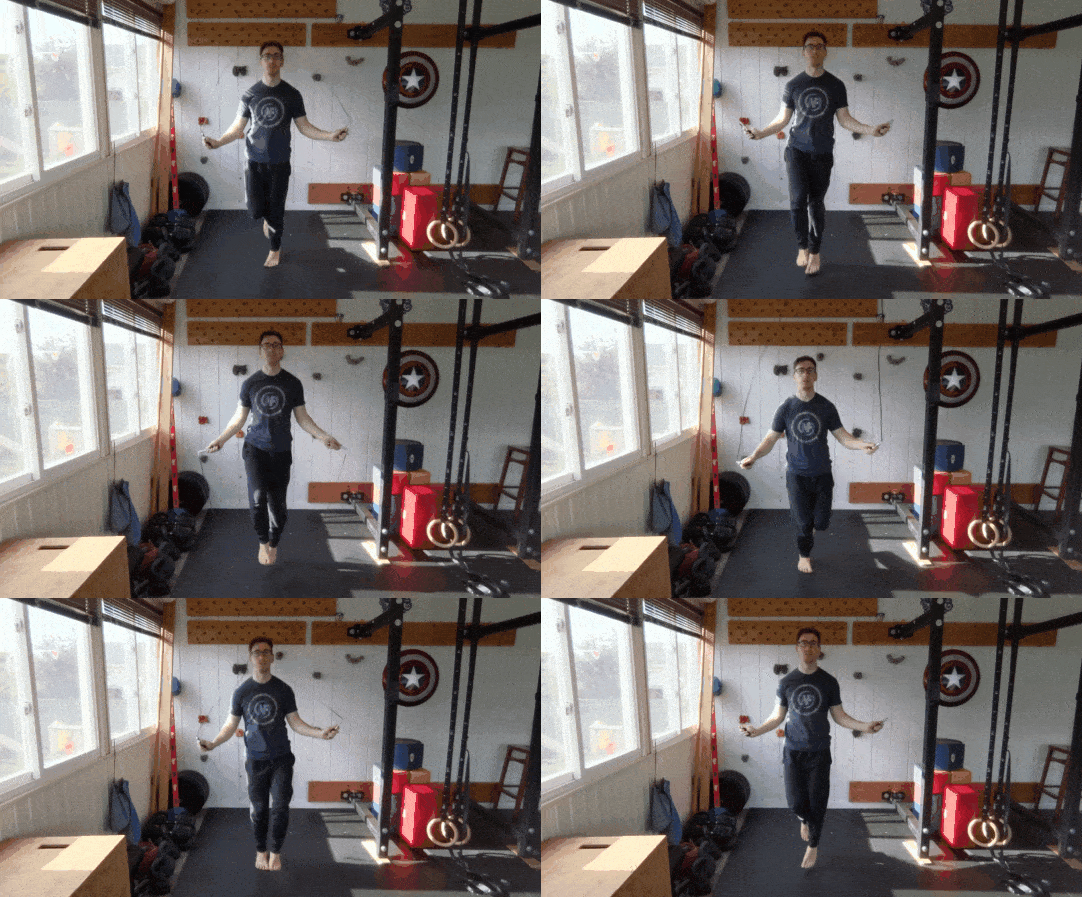
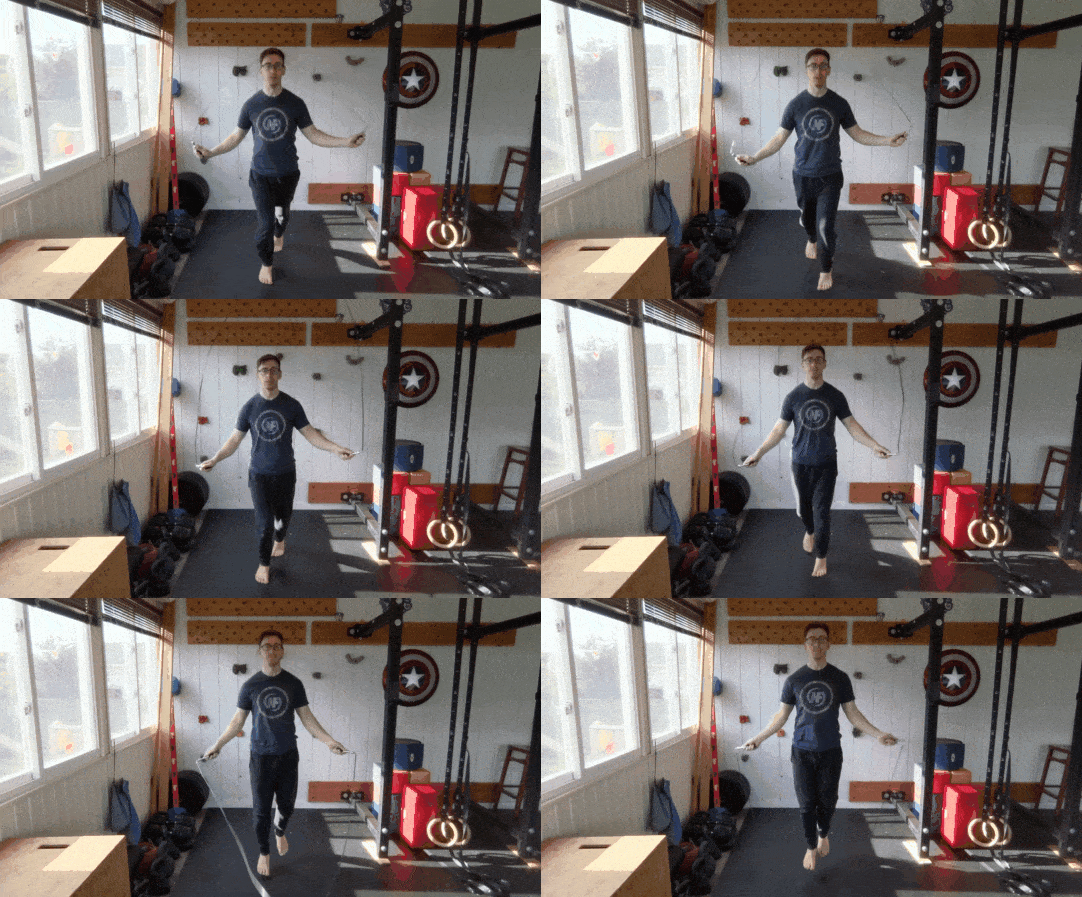
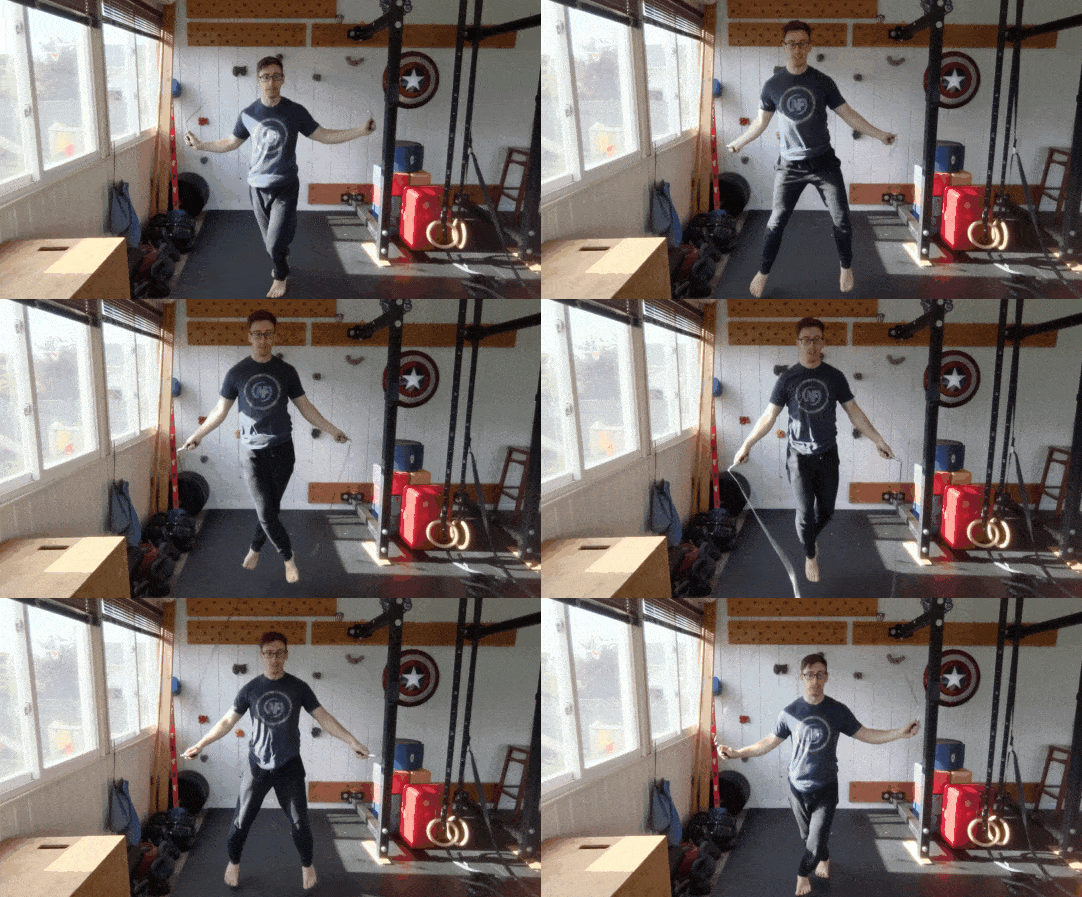
#3) Kick Out Jumps
Here, you’ll alternate taking one foot forward every jump.
So while your left is down, your right foot will be kicking out.
You’ll hop and switch feet between rope revolutions. This is trickier than it looks.
#4) Jump Rope Jacks
Your feet will act as they would in a normal jumping jack, jumping wide apart every other hop.
Your arms will stay as they would during a normal single under, so it’s more of a “half jack.”
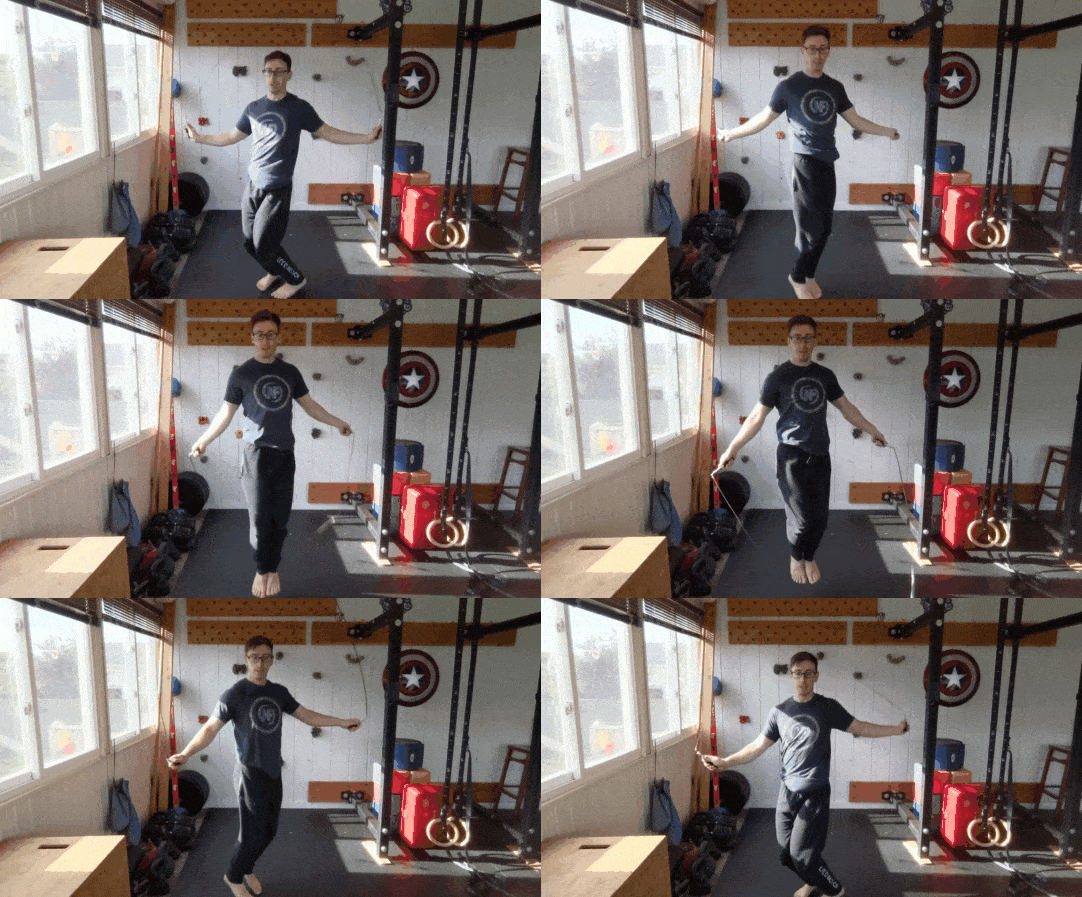
#5) Twist Jumps
This jump rope exercise is all about rotating your torso.
Your feet will jump together, but will be rotating about 180 degrees from left to right, twisting from your hip.
Your shoulders will stay firm, which will keep the rope in place.
#6) Skiers
The feet will land together for your skiers, but one leg will be in front and the other will be behind.
You’ll alternate leg positions between jumps, in a scissor like motion.
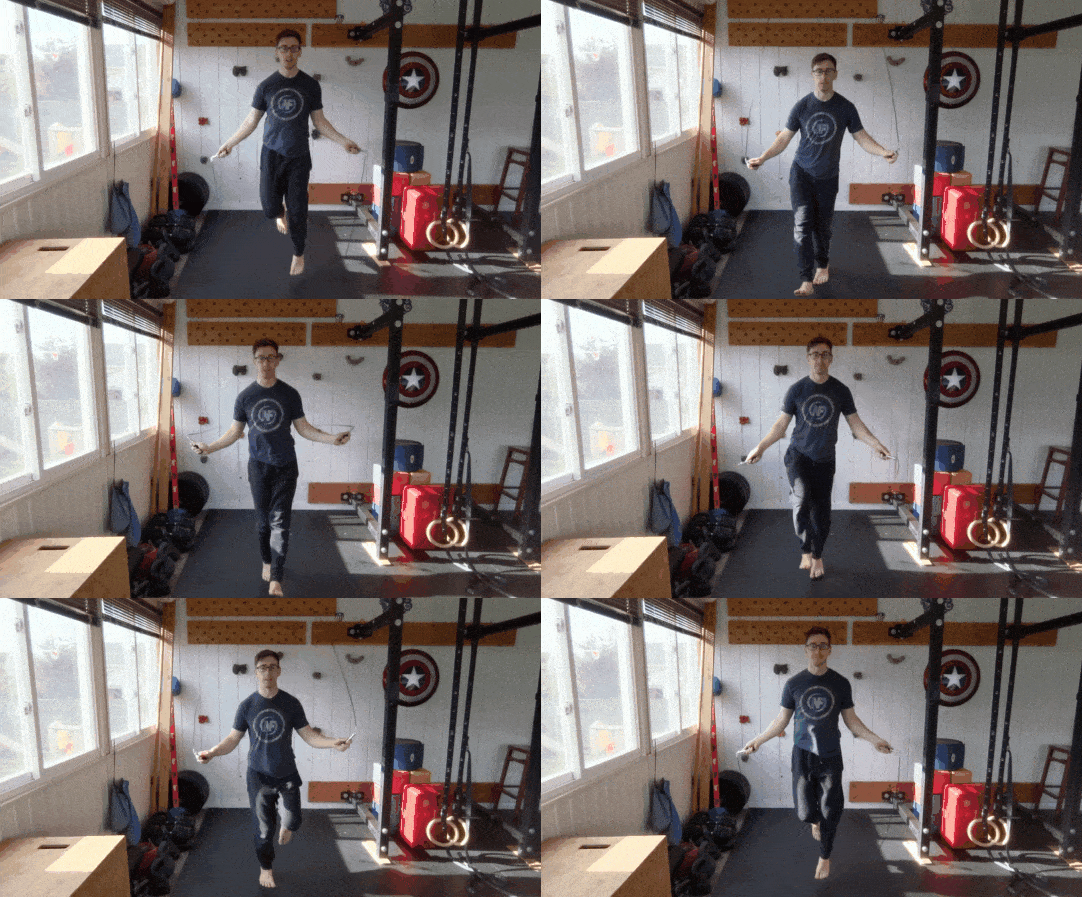
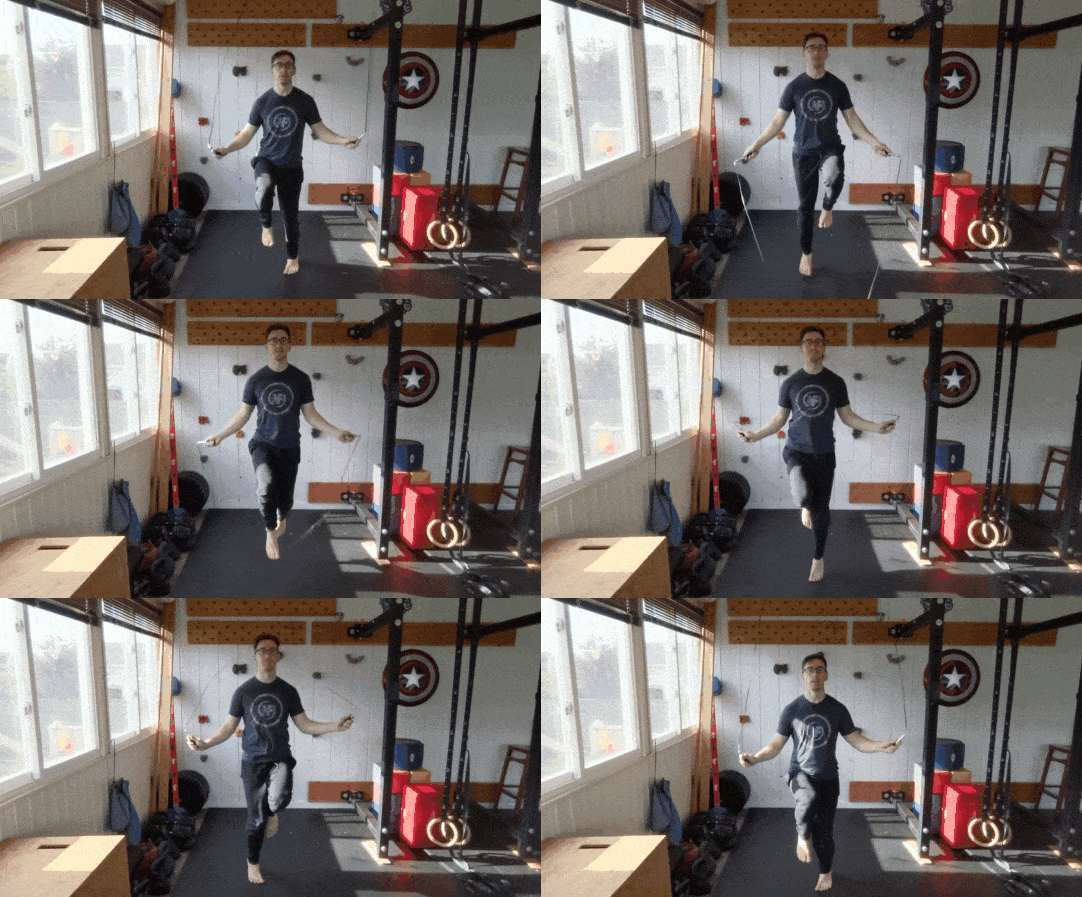
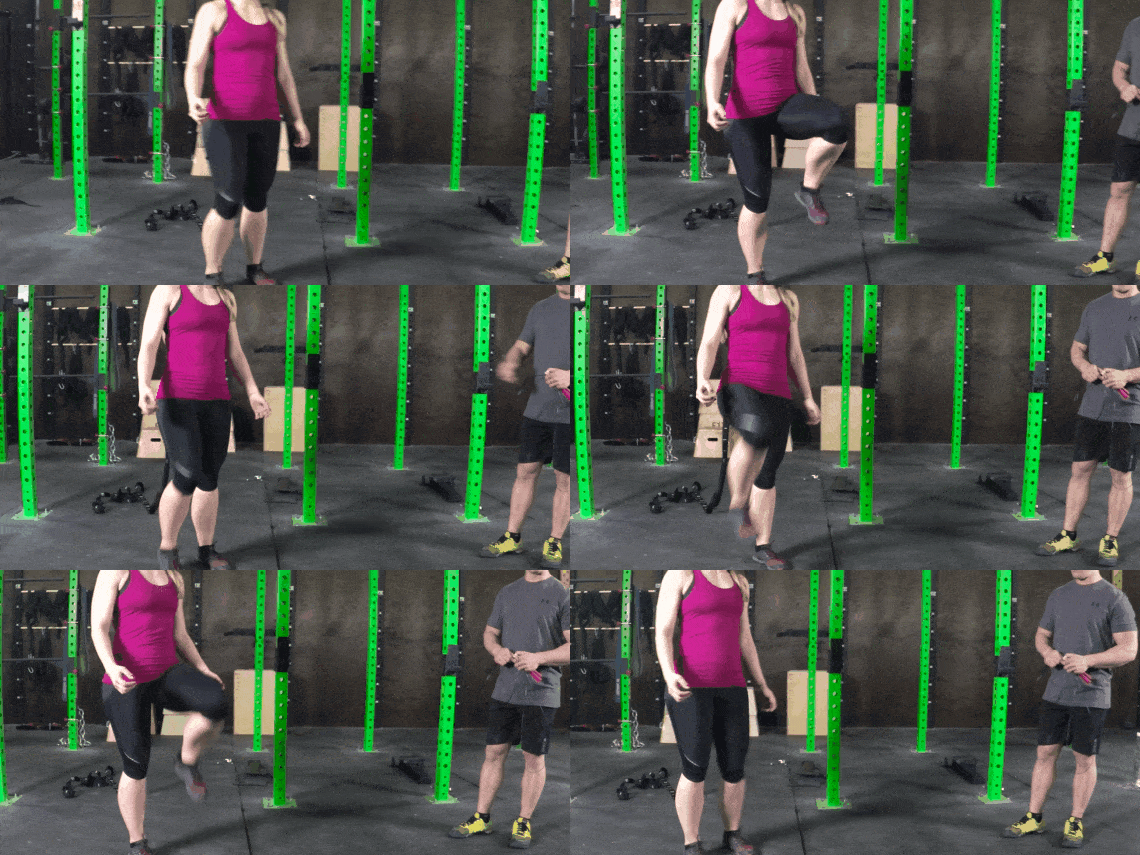
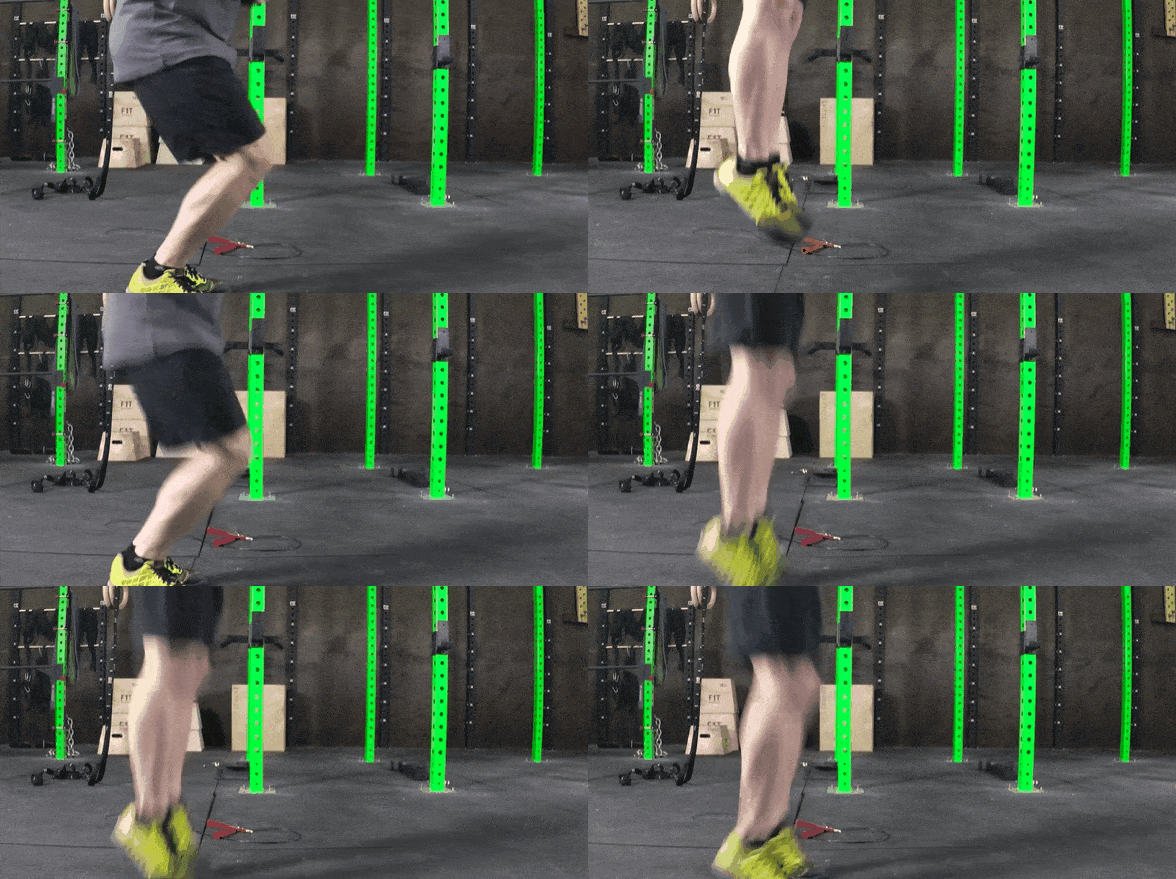
#7) High Knees
Alternate jumping from one leg to the other with your hops. The trick here is to bring your knees up high as you do so.
#8) Butt Kicks
These are much like your high knees, but in reverse, as you’re trying to bring your foot back to the point where it meets your glute (butt).
A good counter exercise for your high knees.
#9) Squat Jumps
If you want to really challenge your lower body, hold a squat position while doing your hops.
Your entire lower body will be engaged for this exercise.
#10) Squat Jacks
Just like the name would suggest, here we are combining our squat jumps with jumping jacks.
To do it, perform jump rope jacks, but land in a squat position when your legs are kicked out wide.
This will get challenging quickly.
#11) Criss Cross Jacks
These are like jumping jacks, but instead of bringing your feet together, you cross one foot in front of the other.
Your feet will go wide, then left in front of right, then wide, then right in front of left, then wide.
After some practice you’ll get the coordination down.
#12) Jump Rope Figure 8
We’re gonna have fun with this one.
This exercise has you doing four normal hops, followed by four twist jumps.
Here’s the fun part: when you rotate, bring your arms together and have the rope do a revolution on the side you’re twisting away from. Alternate to the other side, combining your twist, hop, and whip.
Don’t feel bad if this takes some practice. This is starting to get into the “jump rope tricks” territory.
#13) The Double Under
This is one of the more advanced jump rope moves, as you need to swing the rope under you twice per hop.
Coach Jim walks you through performing Double Unders in this video:
If you get the double under down consistently, you’re no longer a jump rope noob.
Want a workout that will have you doing some of these jump rope moves? If so, check out our new app!
NF Journey will match a workout for you based on your experience level, and will also show you exactly how to use your jump rope.
No guesswork needed, just grab your rope and follow along with the app.
You can sign-up for a free trial right here:
How Do I Choose a Jump Rope? (Type and Length)
There are a couple of things to consider when choosing a jump rope: type and length.
Let’s discuss both.
There are generally three types of jump ropes you’ll run into.
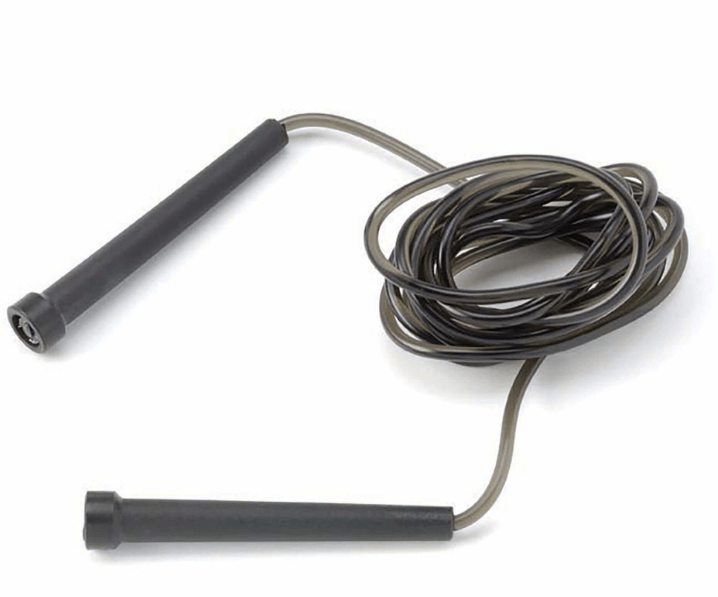
#1) Speed Ropes
This is the most common type of jump rope you’ll come across. It’s also what Coach Matt uses in his videos above.
Speed ropes are lightweight, which will help when doing certain moves like the double under.
Coach Matt’s speed rope has a plastic covering, but occasionally you’ll find these with just the wire. This makes them even lighter. The danger here is that if you hit yourself…it’s with a bare wire…
Ouch.
WOD Nation has a decent coated speed jump rope that isn’t sold out (unlike a lot of other gym equipment).
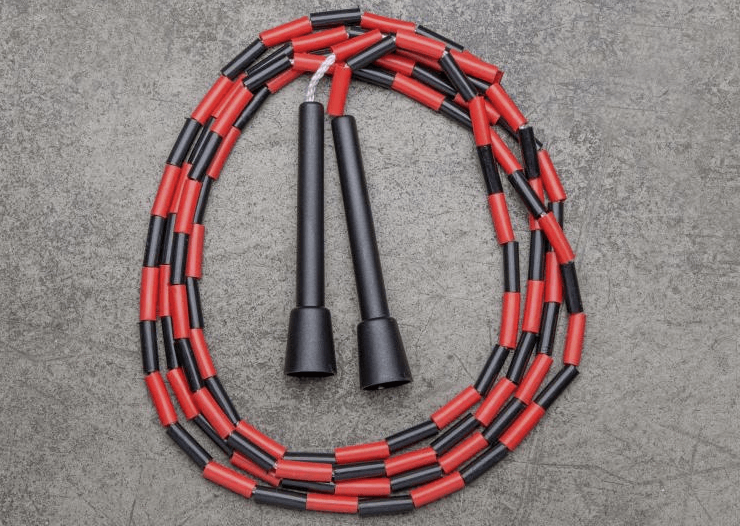
#2) Beaded Ropes
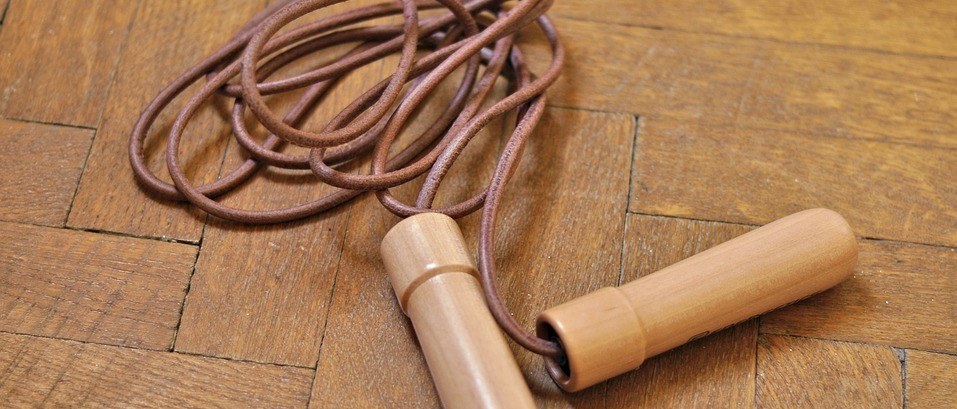
This rope is probably what you used as a kid on the playground.
Beaded jump ropes don’t tangle as easily as speed ropes and weigh a bit more.
They are also clunkier and will make double unders tougher, but the little bit of extra weight might make them easier for a beginner to handle.
Rogue Fitness has some pretty cool ones to check out.
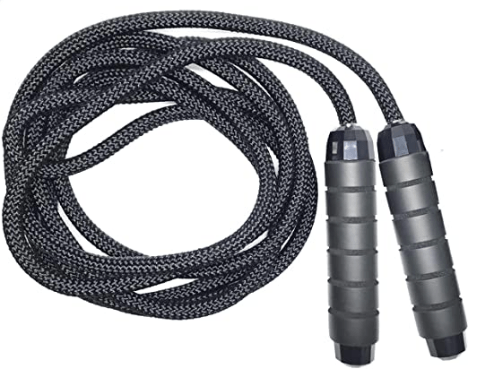
#3) Weighted Ropes
For more advanced jumpers, we have weighted ropes.
These can range from a one-pound rope to a six-pound rope.
Why the additional weight?
With extra weight added, your upper body gets a more intense workout.
If you’re a beginner, it’s probably best to skip these for now (hehe), but something to consider as you level up your jump rope skills.
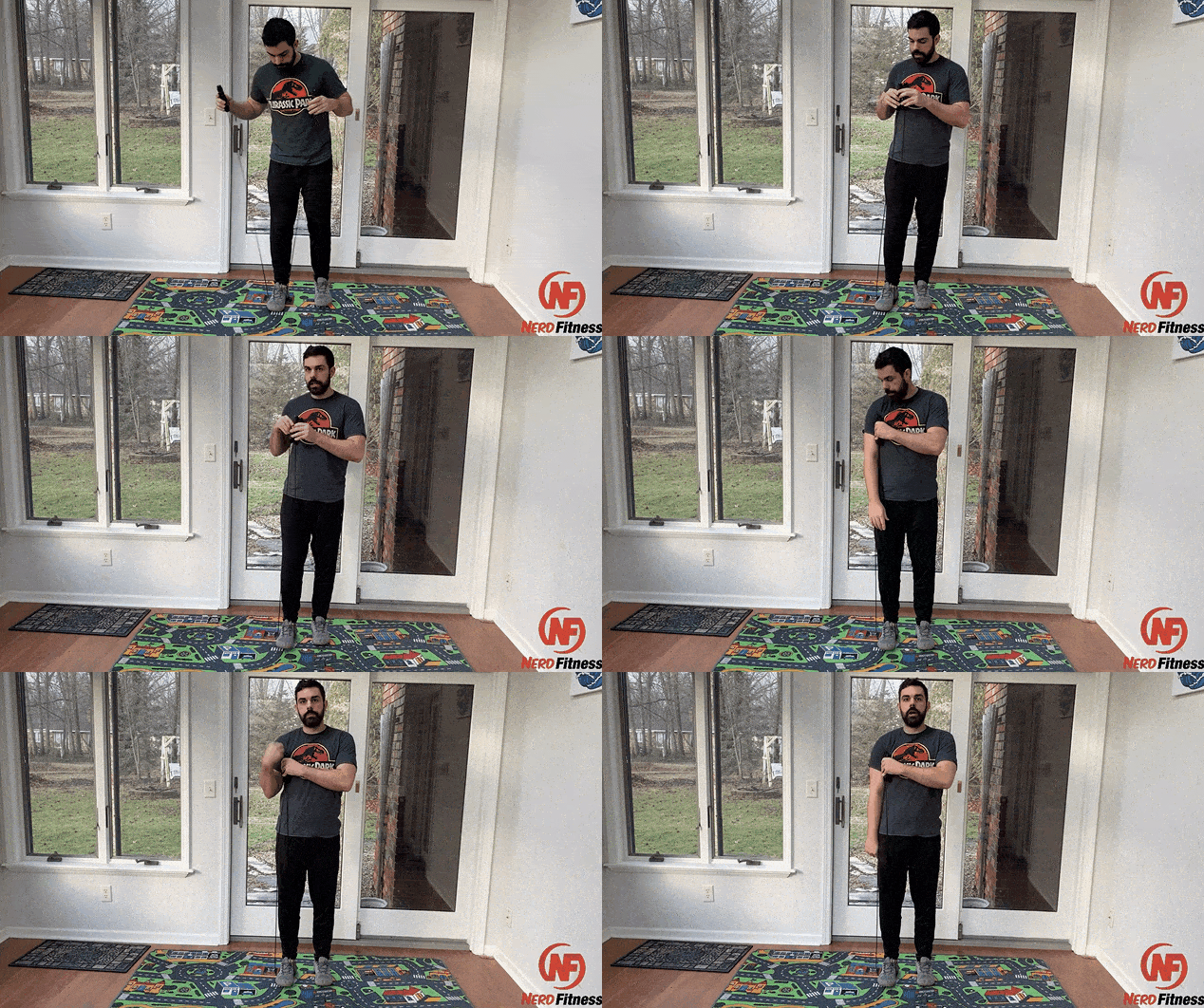
The next question we want to answer: how long should my jump rope be?
The good news here: most jump ropes you purchase will be adjustable.
When properly adjusted, step on your jump rope with one foot, and both handles should reach right around your armpit:
If it’s a little higher or lower than that, you may be okay, but you’ll likely need good jump rope technique to skip correctly.
How to Jump Rope (Without a Rope)
In the video above, Coach Jim walks you through 3 alternatives to jumping rope.
Just in case you want to get your heart rate up and you don’t have a rope around, or if you’re just getting started and haven’t quite got your rhythm dialed in.
Here are three alternatives for jumping rope:
Jump Rope Alternative #1: Marching in Place
This is as easy as it sounds, simply march in place. The higher you bring your knees, the more challenging this will become.
Jump Rope Alternative #2: Mountain Climbers
To do a mountain climber:
Place your hands and knees on the floor.
Place your right foot near your right hand, but extend your left leg behind you.
In one motion, switch your legs, keeping your arms in the same position.
Continue to switch your legs, attempting to keep your arms and back in a staple position.
Jump Rope Alternative #3: Hop in Place
And last but not least, you can simply hop in place for a jump rope alternative.
Where Should I Jump Rope?
The cool thing about a jump rope is that you can pretty much use it anywhere, as long as you have room to maneuver.
That doesn’t really mean you SHOULD jump wherever, as not all surfaces are created equal for jumping.
In the videos and gifs above, you’ll notice that both Nerd Fitness Coaches use mats for their jump rope practice.
This is a good idea.
Jumping on a mat will put less stress on your joints, lowering your chance of injury.
If you do jump on a harder surface like concrete or asphalt, it’s okay, just focus on less intense moves like single unders. You might want to save the fancy moves and double unders for when you have a more forgiving surface under you.
The other thing to consider is your footwear.
Something with good shock absorption will help as your feet make contact with the ground.
You don’t necessarily need a running shoe, since you’ll be coming up and down from your toes. But you probably don’t want to jump barefoot either, because that rope hitting unprotected toes won’t be fun.
If you fix your diet AND begin to incorporate a jump rope workout a few times per week, you’ll find yourself building muscle, losing fat, and getting stronger!
That’s because a jump rope will you train your:
Calves
Rear Deltoids
Abdominals
Quads
Hamstrings
As long as you do it correctly:
My point is jumping rope needs to be part of a larger picture for weight loss.
If your goal is weight loss, you have to eat less than you burn each day. This can be through eating less and burning more (from the resistance band workout above)
Processed foods and junk food make it really tough to lose weight: They have lots of calories and carbs, low nutritional value, don’t fill you up, and cause you to overeat.
Liquid calories are sabotaging your efforts. Soda, juice, sports drinks: they’re all pretty much high-calorie sugar water with minimal nutritional value. Get your caffeine from black coffee or tea, fizzy-drink fix from sparkling water.
Eat more protein! Protein helps rebuild muscle and can help you stay under your calorie limit because it’s satiating and filling. Here’s exactly how much protein you should be eating every day.
Those tips should get you started, but if you want more specific instruction and guidance, check out the NF Coaching Program– Your Coach will build a routine tailored to your individual needs and what equipment you have available:
How to Build a Jump Rope Workout (Next Steps)
The only question left to answer with this guide is “When should you do your jump rope workouts?”
You have a bunch of different options for that, with a few considerations.
Maybe you alternate burpees with your jump rope intervals.
Lots of HIIT workouts include jump rope sessions, so you have tons of ways to bring your jump rope into your training.
Once you get your technique nailed down, the world will become your jump rope playground:
If you need any help pulling this all together, Nerd Fitness is here for you.
We have three great options for continuing your journey with us.
Option #1) If you want a professional coach in your pocket, who can do video form checks, provide feedback, and adjust your workouts based on the equipment you have available, check out our 1-on-1 Online Coaching Program!
For example, let’s say you find yourself stuck indoors during a pandemic, and you want somebody to custom-build you a workout program based on the furniture and equipment you have (like a jump rope). That’s where an online coach is a game-changer!
Personally, I’ve been working with the same online coach since 2015 and it’s changed my life. You can learn more by clicking on the box below:
#2) If you need a trigger to “get up and jump” check out NF Journey. Our fun habit-building app helps you exercise more frequently, eat healthier, and level up your life (literally). Plus, we’ll send you on an adventure that teaches you how to jump rope!
Try your free trial right here:
Option #3) Become part of the Rebellion! We need good people like you in our community, the Nerd Fitness Rebellion.
Sign up in the box below to enlist and get our Rebel Starter Kit, which includes all of our “work out from home” guides.
Get your Nerd Fitness Starter Kit
The 15 mistakes you don’t want to make.
Full guide to the most effective diet and why it works.
Complete and track your first workout today, no gym required.
Alright, I want to hear from you and your experience with jumping rope!
Do you train with jump ropes?
Any exercises or tricks we’re missing?
Are you one of those people who hasn’t touched a jump rope since grade school?