Categories
Uncategorized

#healthyliving #holistic #nutrition 6 Strategies for Balancing Hormones Naturally and Feeling Good in Your Body

Balancing hormones naturally is not only possible, but it’s also one of the best ways to help bring your body back into balance. If you’re wondering how to do this, you’re not alone. In fact, nearly 50 percent of women in the U.S. experience hormonal imbalance, according to a recent survey from Dr. Anna Cabeca, certified OB/GYB and author of The Hormone Fix

In addition, 43 percent of women also report negative effects on their health due to hormonal imbalance, which is a reminder that resolving this issue is so important. 

My hormone diagnosis came 1.5 years ago when I discovered that adrenal insufficiency led me to have extremely low levels of estrogen, progesterone, and cortisol. My key symptoms were exhaustion, irritability, weight fluctuations, and inability to relax. 

While I’m still working to improve my levels, I feel much better than I did a year ago. I am still very much on this healing journey and have to work really hard to mitigate and reduce the stressors of daily life (even when they don’t feel like stress, they are still stressors).

For me, the natural lifestyle changes have been so impactful, which is why I want to share some of them here with you. In addition, I’m sharing a little bit about hormones and hormone imbalance because this education is so important for women.

This article is not to be substituted for medical advice. Please seek the support of a professional if you’re struggling to balance your hormones or if symptoms persist.

Hormones and Hormone Imbalance: An Overview

Hormones are chemical signals in the body that help regulate a variety of internal processes that contribute to your mental, emotional, and physical wellness. A hormonal imbalance means there is either too much or not enough of a certain hormone in your bloodstream. 

Because hormones influence such a wide scope of physiological functions, even the smallest imbalance can have serious health implications. For example, all of the following issues are commonly associated with a chronic, untreated hormonal imbalance:

  • Abnormal metabolism
  • Irregular menstruation
  • Sexual dysfunction
  • Insomnia
  • Adult acne
  • Infertility 
  • Diabetes  
  • Thyroid problems
  • Gastrointestinal issues
  • Anxiety or depression
  • Chronic fatigue
  • High cholesterol 
  • Unexplained weight fluctuations

Possible Causes of Hormonal Imbalance

If you notice one or more of the previous symptoms on a consistent basis, but can’t seem to figure out the cause, it could mean there’s a hormonal imbalance. Figuring out what’s at the root of this is key to finally finding the relief you’re craving. 

According to the journal Endotext, any stimulus that disrupts the endocrine system (the network of organs that manufacture and release hormones) could result in an imbalance. That means there are a lot of potential causes and these are some of the most common:

  • Chronic stress
  • Insufficient diet 
  • Excessive alcohol or caffeine 
  • Electronic overstimulation 
  • Viral or bacterial infections 
  • Not enough sleep 
  • Head trauma
  • Pregnancy
  • Menopause
  • Autoimmune diseases 
  • Abnormal skin growths 
  • Too much or too little exercise
  • Certain medications

Tips for Balancing Hormones Naturally

In some cases, hormone replacement therapy or other medical intervention is recommended to rebalance the hormones. While HRT can be necessary at times, here are some key lifestyle changes you can make to support the healing journey of rebalancing your hormones. 

1. Consume Enough Protein

Protein is a vital nutrient because it contains essential amino acids, which the human body cannot produce on its own. The endocrine system uses those amino acids to create peptide hormones, which are needed for:

  • Brain function
  • Physical development
  • Energy metabolism
  • Appetite
  • Mood stabilization
  • Reproduction
  • Cardiovascular health
  • Stress management

Some nutritious sources of protein include fish, lean poultry, nuts or seeds, chickpeas, lentils, eggs, and kale or spinach. My favorite ways to get more protein are quick and easy egg scrambles (sometimes I add extra egg whites to my two scrambled eggs for additional protein) and smoothies with protein powder or collagen powder that is also high in protein.

Log into the Lindywell app to find a wide variety of recipes packed with protein that can help rebalance your hormones.

2. Make Time for Regular Exercise

Insulin is a hormone that helps your cells convert sugar to burnable energy in the bloodstream. If the cells lose sensitivity to insulin, you can develop insulin resistance which puts you at risk for metabolic syndrome, diabetes, unexpected weight gain, or heart disease. Fortunately, exercise boosts insulin sensitivity for up to 72 hours, so the more often you move, the more you’ll prolong this benefit and help rebalance this hormone.

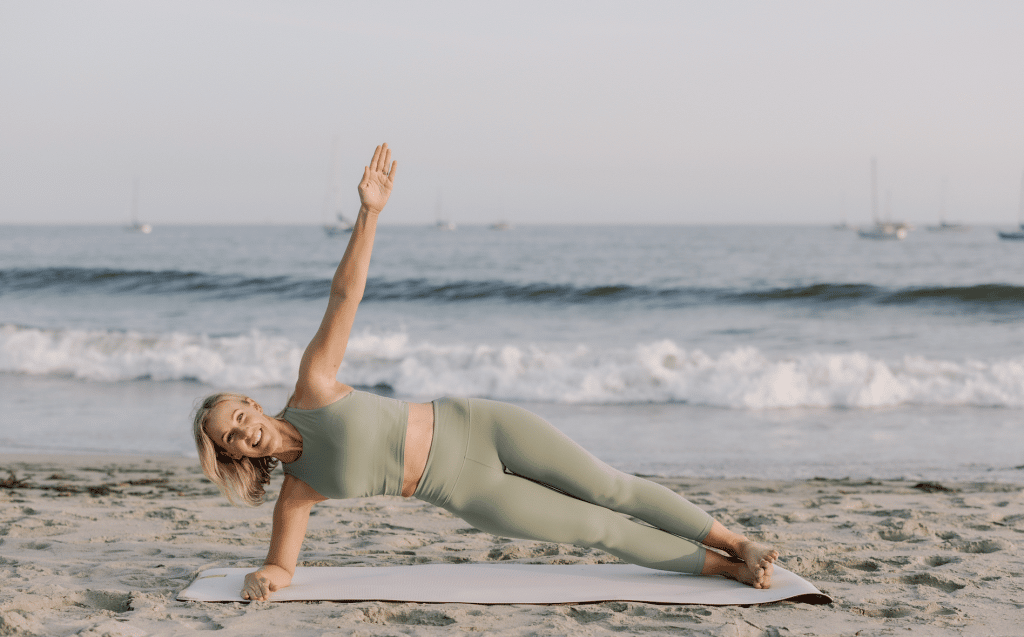
I know I’m a Pilates instructor (so just a little biased!), but Pilates truly is one form of exercise that can help you reap all of these benefits, while not over-taxing your system. This is so important if you’re in a state of hormonal imbalance. 

If you want to experience the power of Pilates, try a 14-day free trial of Lindywell. In our app, you’ll find hundreds of Pilates workouts, along with recipes and guided breathwork sessions!

3. Eat Foods That Support a Healthy Gut

Another way to regulate insulin and balance your hormones is to maintain a diverse gut microbiome. Your intestines are home to trillions of microorganisms that boost immunity and metabolism and the goal is to have a diverse and appropriate level of microbiome in the gut.

To optimize gut health, consume a diet rich in antioxidants, fiber, probiotics, and prebiotics. Think: leafy greens, berries, cacao, legumes, almonds, whole grains, or fermented foods.  

4. Integrate Mindfulness in Your Routine

When you feel stressed, the adrenal glands release cortisol, which is also known as the stress hormone. When chronic stress is present and cortisol levels stay elevated, you may experience brain fog, anxiety, depression, overeating, hypertension, or heart issues.

This is why stress management plays a crucial role in balancing hormones and was critical for the shifts I’ve experienced and how I’m feeling as well. There are many ways to reduce your stress with lifestyle changes. For me, it was important to get more intentional about my schedule and practice breathwork regularly. 

If this resonates for you, learn more about the benefits of breathwork for reducing stress in our podcast episode, Using Breathwork as a Path to Wellness.

5. Moderate Alcohol and Caffeine Intake

In most cases, it’s not problematic to consume alcohol and caffeine in moderation (unless you have an intolerance or dependence on them). In excess, however, both substances wreak havoc on your hormones, specifically the pituitary hormones estrogen, testosterone, and progesterone. 

Enjoying a moderate intake of alcohol and caffeine, or letting it go altogether, is a simple way to promote hormonal balance. Note that this is a lifestyle shift that may take time. If you’re used to multiple cups of coffee or a few glasses of wine a day, you can slowly wean yourself down to just one or none over the course of a few weeks to give your body time to adjust.

6. Get Adequate Sleep

While sleep deprivation wasn’t an issue for me, it is the culprit for many women experiencing hormonal imbalances. Here are a few reasons why this is such an important lifestyle factor to consider as you heal: 

  • Your brain requires uninterrupted sleep to release the growth hormone, which in turn promotes muscle and bone density.
  • Lack of sleep can affect ghrelin and leptin levels, both of which you need for metabolic function and energy expenditure. 
  • Sleep deprivation affects melatonin secretion, which can impair the sleep-wake cycle and cause issues such as fatigue or insomnia.

While it can be challenging to get adequate sleep for many reasons (hello hectic work schedules and parenting), it’s best to aim for at least seven hours each night as often as possible. 

For me, the challenge was calming my mind in the evening and unplugging from work to reduce stimulus and unwind. Allowing my cortisol levels to lower and my melatonin levels to rise was (and is) a very important part of my journey and something that may be supportive for you to focus on as well.

Learn More About My Experience

If you’ve been diagnosed with a hormonal imbalance, it can be supportive to hear from others who have as well. That’s why I regularly share my story and talk about hormones on the Balanced Life Podcast. Here are a few episodes to check out if you want to learn more about my experience and this topic:

Natural Hormonal Balance Is Possible

If your health feels “off,” but it’s hard to put your finger on the exact cause, consider whether there’s a hormonal imbalance at play. If so, understanding the root and then balancing hormones naturally with these simple, but important shifts can be just what you need to get back to feeling like yourself again. 

The post <strong>6 Strategies for Balancing Hormones Naturally and Feeling Good in Your Body</strong> appeared first on Lindywell.

from Blog – Lindywell https://ift.tt/A5zgyhI
via IFTTT

Categories
Uncategorized

#healthyliving #holistic #nutrition How to Help Our Kids Cultivate a Healthy Relationship with Food with Rachel Rothman, [Part 1]

We all want to help our kids cultivate a healthy relationship with food, but this can be easier said than done. Many of us are still repairing our own relationship with food. Add in changing nutrition data, emotional elements, and comments and advice from family and friends and this topic can become a minefield. 

I’ve invited Rachel Rothman to share her expertise and help us navigate this complex topic. Rachel is a registered dietitian and childhood nutrition expert with a background in food science. 

Our conversation isn’t solely focused on what to feed your kids (although we do touch on that), it encompasses navigating the challenges and stresses regarding picky eaters, mealtimes, and sugary snacks and desserts.

Since it is such an expansive topic, we split the episode into two parts so that you can take time to reflect on what you learn. Make sure that you’re subscribed to the podcast so that you’ll know when the next episode publishes.

You will want to hear this episode if you are interested in…

  • What led her to do what she is doing today [5:22]
  • What is a food scientist [8:38]
  • How to talk about food with kids to cultivate a healthy relationship [11:40]
  • How to deal with the sweets and treats [19:20]
  • Dinnertime questions [28:34]
  • Do you have to finish dinner if you want dessert? [36:00]

How Rachel Rothman Became a Pediatric dietitian

Rachel Rothman first saw her relationship with food change at age nine when she was told to go on a diet. This suggestion gave her the impression that there was something wrong with her body which led to low self-esteem, poor body image, and an unhealthy relationship with food. 

Becoming a pediatric dietitian was her way to help kids and families combat negative experiences and cultivate a healthy relationship with food from the start.

After getting a bachelor’s in food science and a master’s in nutrition education, Rachel describes the difference between the two disciplines. Food science is the science of food before we eat it and nutrition is the science of what food does for the body after we eat it.
Rachel started Nutrition in Bloom five years ago to combine her extensive training and practical experience to support families as they change their relationships with food, trust their bodies, and enjoy the food they’re eating.

Creating a Healthy Relationship with Food Starts with Conversations at Home

Many of us grew up with the negative messaging surrounding food stemming from the diet culture of the 80s and 90s. Even though we know better now it can still be a challenge to overcome our ingrained mindsets about food. 

Our relationship with food impacts our whole life. Food not only provides nourishment, but it also affects our mood, immune system, and quality of life. This is why giving our kids the best start is important by encouraging them to develop a positive relationship with food. 

Rachel recommends keeping a positive discussion around food by putting all food on a level playing field and removing the stigma of labeling food as good or bad.

Create healthy discussions around food by talking about the sensory properties of food–taste, feel, smell, and visual. Rather than looking at food and nutrition from a fixed mindset, open up and approach the subject from a growth mindset. Remember it’s never too late to change the conversation about food.

Don’t Put So Much Pressure on Yourself to Get Mealtimes ‘Right’

Under Ellen Satter’s division of responsibility, parents are responsible for the what, when, and where of eating. Children are then responsible for deciding how much and whether to eat. This gives children a say in their food choices. 

A nourishing relationship with food starts at mealtimes. We put such pressure on ourselves and our families to get dinner right, but dinner is only one meal of the day and not necessarily the most important. 

Dinner can be a challenging time–family traditions, culture, and exhaustion can all create a stressful atmosphere around the table. It may not be realistic to try and create an ideal family meal at this time. Not everyone may be hungry or ready to eat. One way to improve the atmosphere at the dinner table is to take away the pressure. 

Listen in to hear what Rachel thinks about dessert and snacks–it may be different than what you would expect from a pediatric dietitian. 

Join Lindywell to get our fantastic, family-friendly, quick, and easy recipes.

Resources & People Mentioned

Connect with Rachel

Follow Lindywell

Join Lindywell

Subscribe to The Balanced Life

The post How to Help Our Kids Cultivate a Healthy Relationship with Food with Rachel Rothman, [Part 1] appeared first on Lindywell.

from Blog – Lindywell https://ift.tt/g5r3AWj
via IFTTT

Categories
Uncategorized

#healthyliving #holistic #nutrition 5 Ways to Heal an Unhealthy Relationship with Food

unhealthy relationship with food

An unhealthy relationship with food can form for many reasons. Whether your parents or caregivers were long-term dieters or you simply took on the many messages of the $946-billion global diet industry, the relationship to food is fraught for many.

In fact, disordered eating habits are more common than you might think. For example, more than 28 million Americans will suffer from an eating disorder at some point in their lives, starting as young as five years old. Even if your behaviors don’t fall into the diagnostic criteria of an eating disorder, you can still be plagued by disordered eating patterns. 

For example, you may feel guilty about eating certain foods or not choosing the “healthy” ones. Or maybe you restrict your food intake during the week and then end up binging all weekend. This keeps you stuck in the same eating patterns and habits that lead to more stress and more anxiety.

Healing an unhealthy relationship often starts by shifting your mindset and how you approach eating as a whole. Food is nourishment and pleasure-inducing. It’s an essential part of life and an experience to savor. If it doesn’t feel this way right now, you’ve come to the right place. 

Use the following strategies to cultivate self-compassion, enjoyment, and acceptance with food.

This article is not to be substituted for medical advice. If you’re struggling with an eating disorder, we encourage you to reach out for professional support at NationalEatingDisorders.org.

Rethink Your Food Vocabulary

Words are powerful. The more you repeat a certain message to yourself, the more it will influence your thoughts, decisions, and behaviors. 

In a recent TED Talk, neuroscientist Dr. Lisa Feldman Barrett explains that consuming harmful words will overtax your bloodstream and nervous system with stress hormones. Over time, this chronic stress affects your brain wiring, which can impact how you think and act as a result. 

Words are an important part of your relationship with food. Think about the meaning you give to terms like “good” (to describe a piece of fruit) versus “bad” (to describe a bowl of chips). While one food may be nutritionally superior to another food (apple vs. potato chips) that doesn’t mean it needs to be morally superior or that it has to have a reflection on if you, as a person, are good or bad.

The demonization of certain foods through this language, and the meaning those words carry, can promote caloric restriction and other extreme forms of dieting. This only further strains your unhealthy relationship with foods, causing more stress and anxiety. 

To start healing, intentionally work to remove words that attach a moral value to food. Here’s a long list of words you might not realize have an impact, but can be harmful to your relationship with food:

  • Clean
  • Cheat/cheat day
  • Splurge
  • Guilt-free
  • Can’t/shouldn’t
  • Bad
  • Fattening
  • Off-limits

Instead, bring new words into your vocabulary that promote a relationship with food filled with enjoyment and pleasure:

  • Satisfying
  • Tasty
  • Flavorful
  • Nourishing
  • Delicious
  • Refreshing

Focus on the Mind-Body Connection

The concept of intuitive eating is basic in theory: listen to your hunger and fullness cues and choose food that you want to eat. However, if you have an unhealthy relationship with food, intuitive eating can feel complicated in practice. 

For example, if you’ve learned to deny the hunger impulse in order to restrict calorie intake, you might not even notice when you’re actually hungry. Conversely, if you often reach for food that hurts your body to cope with uncomfortable emotions, you perpetuate the feeling that you cannot trust yourself.  

What’s more, it can be challenging to eat “intuitively” if certain foods affect your body in uncomfortable ways, like causing bloat or digestive discomfort. 

This is why mindful eating, and awareness of the mind-body connection, are important. Being mindful of hunger cues and your food choices allows you to honor the unique needs of your own body while still feeling satisfied. This way of eating prioritizes flexibility and satisfaction over rigidity and restriction while also ensuring your body is being cared for.

Listening to this inner wisdom with mindfulness is powerful. Your body knows what it wants, when, and how much. Part of this work is learning how to tune into that and then trusting it.

Tuning into your body may feel overwhelming and Pilates and breathwork can both be helpful with this piece of your healing. At Lindywell we offer realistic, easy starting points to practice this skill. 

Sign up for a free trial of our app or log into your account to access our calming, mini-breathwork sessions or our 14-day mind-body reset series, perfect for beginners.

Examine Your Own Food Story

Everyone has a unique set of attitudes, beliefs, customs, rituals, and preferences around food. These are shaped by many factors, from the environment you’re born into, to the culture you’re raised in and the societal messages internalized over the course of your life. 

Together, these create the script you follow when interacting with food. Certified eating psychologist and nutrition expert Elise Museles calls this your food story. As with all narratives, however, certain elements of it are simply untrue (or at least could use some re-evaluation). 

A food story is complex and multi-layered, so it’s helpful to understand where yours originated and how it continues to inform your relationship with food. Healing the parts of your food story that are no longer serving you will allow you to clear space to write a new, authentic one. 

You can start to do this by writing out your food story or sharing it with someone you trust. Think about your connection, stories, and experiences with food at age 5, age 10, age 15, and so on. At each age, ask yourself:

  • Did I learn a new belief or story related to food?
  • Can I recall a specific moment (good or bad) around food?
  • What was I being told about food? 

Use this as a starting point and seek additional professional support if it feels helpful or necessary for you. 

Create Awareness Around Stress

Stress, no matter what causes it, can impact your relationship with food. Primarily, stress can result in over-eating and under-eating. While it’s normal for your food intake to vary from day to day when it’s directly linked to stress, it becomes less about listening to your body and its needs and more about using food as a coping mechanism. 

Simply creating more awareness around what causes you stress and how you react in those times can help you replace food with coping mechanisms that can be more supportive. However, recognizing you’re stressed in the moment can be difficult. Start by setting aside time at the end of the day to reflect. When doing this, ask yourself:

  • Was I stressed or anxious at all? 
  • If so, what caused that feeling? A person? A situation?
  • How did I use food to cope, as a result, if at all? 

With this awareness, you can start to be more mindful in stressful moments in the future. You can recognize when that stress or anxiety creeps in and use a supportive strategy to ease yourself out of it, like intentional breathing or light movement.

Tune into episode 48 of The Balanced Life to learn more about managing your stress with compassion. I also shared a guided meditation for motivation and self-care that you might enjoy as you learn to connect with yourself and better manage your stress.

Use a Grace Over Guilt Mindset

Healing your relationship with food requires a shift in the way you think about and approach food, which in turn, affects your behaviors and relationship. This type of change doesn’t happen overnight. It took years, maybe even decades, to cultivate your unhealthy relationship with food, which means it will take time to heal it as well. 

There will be moments when you fall back into old toxic patterns of relating to food. It’s normal to gravitate toward what feels comfortable or familiar, even when it’s hurtful or stressful. When this happens, focus on grace and release the guilt. Not only will this help you connect with more self-compassion, but it can also help ease the stress and anxiety that can impact your relationship with food. 

Change is a nonlinear process. Embrace the beauty of the journey to create a new reality for yourself.

You Can Rebuild Your Unhealthy Relationship With Food

It can feel impossible to let go of the habits and thoughts you have around food, and in many cases, this requires deep healing and time. This is why it can be helpful to reach out for support. Here’s a great resource on how to get started with your relationship with food. 

As you move through the process of healing your unhealthy relationship with food, use these strategies to help you nurture a new, loving, guilt-free relationship with food. You deserve that and it’s absolutely within your reach!

The post 5 Ways to Heal an Unhealthy Relationship with Food appeared first on Lindywell.

from Blog – Lindywell https://ift.tt/p3OCXJV
via IFTTT

Categories
Uncategorized

#healthyliving #holistic #nutrition How to Make Goal Setting Work for You

As we wrap up another year around the sun, many of us become reflective of the year that has passed while also looking forward to what lies ahead. 

Setting goals may be something that you are intuitively drawn to, or maybe it’s something that has you running the other way. Regardless of how you feel about goal setting, I encourage you to have a listen for actionable tips. 

In this episode, you’ll learn how to achieve a thriving mindset, how to set goals for each part of your life, how to break goals down into actionable steps, and how to keep your goals realistic and achievable.

You will want to hear this episode if you are interested in…

  • Achieving a thriving mindset [2:32]
  • My goal setting process [5:37]
  • How I plan my year [6:42]
  • Setting goals for total wellness [11:03]
  • Keeping your goals realistic [17:56]
  • Choosing a theme for the year [19:25]

Setting Goals Can Help You Achieve a Thriving Mindset

Humans are designed to grow. Without growth, we won’t be fulfilled. Having goals helps us to learn new things, enjoy new experiences, and have purpose. 

However, many people shy away from goals because they feel that setting goals can lead to perfectionism and disappointment. But this doesn’t have to be the case. If you sprinkle in a bit of grace with your goals you’ll achieve a thriving mindset.

Goals+Grace=Growth

Having Grace Leads to Forgiveness

Having grace allows you to accept things the way they are as you continue to grow. There are several goals that I set last year that I did not achieve. Rather than wallow in guilt for not achieving my goals, I give myself grace and understand that not achieving some goals is a part of the process. 

Life happens and things change, so if I didn’t achieve a goal it could have been due to things that I didn’t expect to happen. Having grace allows me to accept life the way it is. Not achieving a goal doesn’t say anything about me; it shows that sometimes life gets in the way.

I go into goal setting mode knowing I have grace in the process. As you look toward the new year, have the powerful combination of goals+grace.

How to Start Planning Your Goals

Start goal planning with intentionality and vision. Have a vision for what you want to achieve because without vision you won’t know where you are going. One of my favorite bible verses speaks of vision: without vision, the people perish.

Each month I plan a day of reflection so that I can understand where I am going and how far I have come in my process. This step is critical since reflection allows for more growth.

Each December, my husband and I block off an entire morning to brainstorm and set goals for the upcoming year. I grab my favorite journal and pen and we take ourselves somewhere away from our daily lives. Listen in to get some ideas to help you find a great place to plan your goals. 

Think back on the past year to reflect on what worked for you and what didn’t. Remember to give yourself grace for the things that didn’t work out the way you planned. This also gives you an opportunity to adjust your plans for the new year. 

Make sure to listen in to hear how to set goals and intentions for total wellness, how not to fall into the trap of perfectionism, and innovative ideas for choosing a theme for your year. When you know your theme of the year, share it with me on Instagram @wearelindywell.

Resources & People Mentioned

Follow Lindywell

Join Lindywell

Subscribe to The Balanced Life

The post How to Make Goal Setting Work for You appeared first on Lindywell.

from Blog – Lindywell https://ift.tt/QPAzF3b
via IFTTT

Categories
Uncategorized

#healthyliving #holistic #nutrition How to Embrace Progress Over Perfection With the Six Principles of Pilates

progress over perfection

Progress over perfection has become a popular saying in the health and wellness space, but at Lindywell, it’s been a core value since the very beginning. One thing we’ve learned over the years, however, is that it can be hard to let go of self-criticism in our modern world, where everyone’s successes are made public. Hello, comparison, shame, and judgment. 

Striving for that false perception of perfection, however, slows you down, pulls you away from your most authentic self, and leaves you feeling defeated more often than not. When you can shift your focus instead to progress, the experience and journey become more enjoyable. 

What’s more, the idea of perfection, well, it becomes less important.

If you’re still struggling to smooth those sharp, critical edges, we have a simple but powerful framework for you to embrace progress over perfection. 

The Six Principles of Pilates

While there are a lot of ways to embrace the journey, at Lindywell, we find that Pilates is the best teacher. Specifically, the six guiding principles, which break down as follows:

  • Concentration
  • Control
  • Breath
  • Precision
  • Center
  • Flow

Rather than striving for perfection, we focus on doing it well, feeling good, and staying connected. This progress-over-perfection approach is not always the norm in the fitness industry, particularly in the world of Pilates. 

Here, we take a more grace-filled and progress-focused approach to Pilates and fitness as a whole, and you can do the same, on and off the mat. Now, let’s see how we can apply these six principles to the idea of progress over perfection.

Embrace Progress Over Perfection With the Six Principles

Here’s how you can use these six principles to truly embrace progress over perfection, and experience all the goodness that this shift can bring. As always, take what resonates and implement what feels good. Not all of these will feel relevant to your life, but one or two may be just what you need.

Concentration

Commit fully but remain flexible.

Your desires and needs ebb and flow and so your approach to achieving goals should follow suit. To embrace progress over perfection, you need to commit to what you desire, but remember that the way you get there can evolve along with you.

In this way, what “perfection” looks like shifts as well. At one time, perfection may have been going to the gym five days a week before work. Now, with two kids at home, it looks like 10 minutes of Pilates two days a week with the Lindywell app. 

In both cases, you were committed fully to what you desired, to feel great in your body, but how you got there changed as your circumstances shifted. That’s embracing progress over perfection. 

Control

Be conscious, deliberate, and intentional.

In Pilates, we refer to controlling your movement. Being intentional and deliberate, moving slowly and consciously. The same goes for embracing the progress over perfection mindset. When you focus on progress, you focus less on “getting it right” and more on being deliberate as you move toward what we desire. 

Instead of wishing that what you want would just be here already, and getting frustrated when it’s not, you become more aware and in tune with yourself. Ask yourself questions like, Why am I frustrated? What could I change to make this feel easier or less stressful? Then take intentional action based on your honest and authentic answers.  

Breath

Leverage the breath-body connection.

Think about a moment when you were trying to get everything just right. You may have been rushing around. Your mind was probably racing. You may have felt frantic and anxious. You were focused solely on getting it perfect. 

Though you may not have realized it at the time, your breath was also likely shallow and fast. This is how we breathe when we’re anxious and stressed. This type of breathing then feeds that same state of anxious being. 

The good news is, simply slowing and deepening your breathing can immediately shift you into a more calm and centered state of being. It’s in this state that you can let go of that idea of perfection, and instead, see that being “good enough” is in fact, perfect.

Precision

Do it well, but at your own pace and in your own way.

Perfection is a driving force when you feel the need to get something right according to someone else’s standards or because of what someone else might think. The idea of precision can be applied to progress over perfection as a reminder that you can do it well, but at your own pace and in your own way. 

For example, if your goal is to make movement a part of your regular routine to feel stronger in your body, doing it well looks like:

  • Figuring out what type of movement feels good for you and focusing on that. 
  • Adding it into your schedule when it’s feasible, rather than forcing it during a time that doesn’t work for you, like early in the morning.
  • Trusting that your body will build strength if you commit—and it may not happen right away, but in the time that’s right for you.

Doing it your way, and doing it well based on your own standards, is what progress over perfection is all about.

Center

Seek alignment above all else.

At Lindywell, we start every workout with centering. This is important when you’re on your mat, but I would argue it’s even more important off your mat. In life, you’re surrounded by people, experiences, and circumstances that can easily throw you off-center. 

When you get out of alignment, you lose sight of what’s right for you. Then it becomes easy to start focusing on perfection according to someone or something else. When you stay in alignment, it’s easier for you to come back to your center, check in, let go of “perfection,” and focus back in on what feels good for you in each and every moment.

You may still veer off course, or get distracted by “perfection. When you practice coming back to your center, however, like with Pilates, you will always be able to get back into your own alignment.

Flow

Find yours and let it guide you.

Pilates always feels incredible, but if you’ve practiced even just a few times, you know how truly juicy it feels when you get into the flow. In that space, perfection doesn’t matter—what matters is staying connected to that movement and that experience. 

Finding this flow in your life, and letting it be your guiding force, is key to embracing progress over perfection. The journey feels best when we create our own current and flow with that, rather than letting someone else define it for us. 

Let’s Love the Journey

Striving for perfection is tiring. It also keeps us disconnected from ourselves and what we truly desire, creating anxiety and stress along the way. Use these strategies and ideas to connect back to you, find your flow, and focus on the journey that’s meant for you. When the journey feels amazing, reaching perfection doesn’t matter, because it’s already great where you are.

The post How to Embrace Progress Over Perfection With the Six Principles of Pilates appeared first on Lindywell.

from Blog – Lindywell https://ift.tt/AoMzmVb
via IFTTT

Categories
Uncategorized

#healthyliving #holistic #nutrition Pilates: The Ultimate Travel Workout to Balance Fitness and Fun

travel workout pilates

A great travel workout is helpful for staying connected to your body when you’re not at home. While more than 50 percent of Americans reporting scheduling fitness time into their vacations or business trips, the hard part is often making time for this much-needed movement. It can feel like it gets in the way of family activities, exploring your destination, or enjoying yourself.

At Lindywell, however, we believe you can always create balance, and in this case, Pilates makes that possible. 

Staying consistent with Pilates while traveling helps you show up even stronger for your family, keeps you energized for busy sightseeing, eases the aches and pains of travel, and gives your mental clarity a boost.

Whether you’re new to this style of movement or already love it, here’s why you shouldn’t overlook Pilates for your travel workouts. Be sure to check out the standing Pilates workout below for you to try on your next trip too.

Why Pilates and Travel Go Hand-in-Hand

If you want to make time for intentional movement during travel, Pilates is a great option—and here are a few of the many reasons why:

  • Pilates rejuvenates your body and mind. With a focus on the mind-body connection, this type of movement works your body while giving you a chance to nourish your mental health, which we often need most during travel. 
  • You don’t need to find a local Pilates studio or re-arrange your day around a studio schedule to enjoy this form of movement for your travel workouts. Instead, do Pilates in your hotel room or rental! You’ll still get a great workout and energize your mind for a full day of fun.
  • No equipment is needed to strengthen and stretch your entire body, from arms and legs to neck and core. (Or to support that stiff neck after a night of sleeping on a lumpy hotel pillow!) You can even use a hotel towel for your mat if it’s all you have available.
  • It’s easy to access hundreds of workouts that can be done nearly anywhere right within the Lindywell app. Our Travel Day Workout and Quick Energizing Travel Workout are member favorites and all of our standing workouts are perfect for on-the-go movement. Start your free trial or log into your account to get access to them! 
  • Workouts can be done for as few as 10 minutes while still being effective. You don’t need to spend an hour doing Pilates to give your mind and body what it needs.

A Standing Pilates Travel Workout for Any Destination 

Standing workouts are perfect for travel because you don’t need a lot of space—or any equipment—to do them. Use this Pilates workout to connect with your mind and energize your body in just 10 minutes so you can spend the rest of your day exploring, relaxing, and having fun.

Start With the Breath

Take a few beats to deeply inhale and exhale, find your balance, and root your feet on the ground. Use this time to activate your core muscles, straighten your posture, and focus on the present moment. These few moments of intentional mindfulness help you connect to yourself and the practice which, in turn, makes it more enjoyable and effective. 

From this standing position, you’ll ease into 4 to 5 Roll Downs to warm up the body. To do so, bend your torso forward as far as you can, allowing the arms to stretch toward your feet, then return to standing with your spine tall, shoulders back, core tight, and pelvis lifted. 

Once completed, transition into 6 to 7 calf raises, or what we call in Pilates, prancing. Shift your weight from your heels up onto the balls of your feet while still maintaining that firm core and straight posture. 

Now, Move Your Body

In Pilates, we bring strength, balance, and flexibility together into one. This travel workout will incorporate movements that destabilize the body, forcing the muscles to work harder, so you remain upright. Feel free to grab a chair for extra balance or make any other modifications to feel comfortable and safe in each movement. Remember, this is your practice and I want it to feel good for you. 

Marching

Draw your belly button toward your spine to stabilize your core. Flex at the hip crease raise your left knee up in front of you, lower back to the ground and repeat on the other side maintaining your balance as you slowly march the legs up and down.

Standing Hip Circles

Stand with your feet about hip-width apart. Draw your belly button toward your spine to stabilize your core. Flex at the hip crease raise your left knee up in front of you, rotate it out to the side, circle down, across mid-line, and back up to center. Draw 10 circles and repeat on the other side.

Cross it in front of the body again to complete one rotation. Repeat this motion with the same leg for three more rotations, then lower it down. Repeat this series of motions with the other leg. 

Standing Leg Work + Swimming

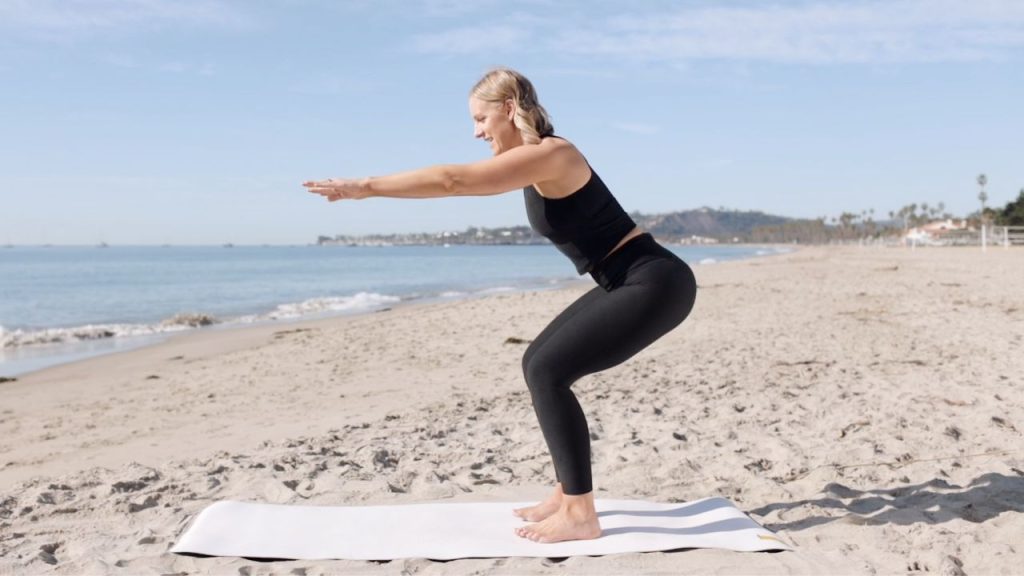
Stand with your feet about hip-width apart. Bend the knees to lower yourself into a deep squat as if you’re about to sit down in a chair. In the squat position, tilt your torso forward, raise your arms up by your ears, draw your shoulders down your back and activate the core by drawing your belly button toward your spine. 

Hold this position for a few seconds, then pulse the thighs downward for a count of 10. Return to a standing position, then lower back down to repeat this motion three more times.  On the last one, hold the squat position with your arms raised up by your ears and pulse the arms in a swimming motion for 10 repetitions. Keep your core strong, your shoulders down and back, and remember to breathe!

Plié Squat with Side Bends

Stand with your legs a little bit wider than your shoulders, with a slight external rotation in the hips, knees and feet. Bend your knees coming into a deep plié. Lengthen your spine, draw your belly button in toward your spine, and place both hands behind your head with fingers interlaced for support. Relax your shoulders down the back. 

As you inhale, tilt your torso over to one side, imagining that you’re moving between two panes of glass. As you exhale, use the obliques to return to an upright position. Repeat for a total of 10 repetitions. 

Plie Squat with Spine Twist

Stand with your legs a little bit wider than your shoulders, with a slight external rotation in the hips, knees and feet. Bend your knees coming into a deep plié. Lengthen your spine, draw your belly button in toward your spine, and place both hands behind your head with fingers interlaced for support. Relax your shoulders down the back. 

As you inhale, rotate the rib cage to the left, while keeping your hip bones facing forward. Exhale return to center. Repeat on the other side for a total of 10 repetitions. 

Find Balance During Travel With Pilates

No more waking up extra early to hit the gym or spending an hour away from family or friends to move your body. This Pilates travel workout, and many others in the Lindywell app, give you an opportunity to move, connect, and strengthen in less than 10 minutes so you can get back to having fun on your trip! Even better, you’ll finish the workout feeling more connected and rejuvenated than before, making your time away that much more enjoyable. 

The post Pilates: The Ultimate Travel Workout to Balance Fitness and Fun appeared first on Lindywell.

from Blog – Lindywell https://ift.tt/5CJxcMu
via IFTTT

Categories
Uncategorized

#healthyliving #holistic #nutrition Redefining Happiness with Stephanie Harrison

So many of us are on the happiness treadmill. We believe we’ll be happy once we achieve our next goal since the traditional way of thinking about happiness is wrapped up in our accomplishments. This means we don’t make room for happiness while we’re on the journey of life or we get caught up in the day to day whirlwind of feelings and emotions.

Stephanie Harrison from The New Happy has made it her life’s work to study the science of happiness and has created a new science backed philosophy of happiness. Today she’ll share the difference between the emotion of happiness and creating a truly happy life, how caregivers can achieve happiness for themselves, and how she redefined happiness. 

You will want to hear this episode if you are interested in…

  • How Stephanie got started [2:32]
  • How Stephanie has redefined happy [6:16]
  • The difference between the emotion of happiness and a happy life [13:40]
  • How caregivers can be happy [16:00]
  • How to pursue your own happiness as a caregiver [25:30]
  • How she expresses her new happy [30:50]
  • The rapid fire questions [41:45]

Like many of us, Stephanie Harrison grew up feeling that happiness was just beyond her reach. She was surprised to find that often after achieving a once coveted goal the spark of happiness was fleeting. That’s why she decided to study the science of happiness in college. Her goal was to explore why happiness is so elusive and understand the impact of culture on happiness. 

Happiness Includes a Broad Range of Emotions

Stephanie learned that we will always feel a wide range of emotions. Experiencing difficult emotions is a part of life. The good comes with the bad. A happy person not only experiences these emotions but acknowledges them as well. The important thing is to shift the way you treat these emotions. 

What Stephanie discovered is that we don’t have to feel happy all the time to be happy. There is a difference between the emotion of happiness and leading a happy life. True, lasting happiness comes with a variety of feelings and emotions.

The New Happy

She created a new definition of happiness. The old version of happiness was impossible to achieve since there is no way to be happy all the time. The New Happy allows for a wide range of feelings and emotions and is not only achievable, it’s empowering. 

True happiness comes when you use your gifts to serve the world. Helping others makes for a happy life. This doesn’t mean that one must take on a service oriented career; what it means is that every moment is an opportunity for happiness. You can help others in many ways. Kindness is who you are, not what you do. This means acting with kindness and compassion.

Discover Stephanie’s Creative Ways to Share the Latest Happiness Data

Stephanie has discovered a creative way to share her knowledge and experience. She is a fantastic follow on Instagram with her creative representation of data. She has found beautiful ways to represent the science behind happiness studies. She translates actionable takeaways into a simple visual design. Check out her website and sign up for her weekly newsletter which contains tips, tools, and research on the latest happiness studies. 

We all know someone who needs to find happiness in their life. Please take a moment and share this episode with them.

Resources & People Mentioned

Follow Lindywell

Join Lindywell

Subscribe to The Balanced Life

The post Redefining Happiness with Stephanie Harrison appeared first on Lindywell.

from Blog – Lindywell https://ift.tt/0vEwCxF
via IFTTT

Categories
Uncategorized

#healthyliving #holistic #nutrition Could Your Phone be Impacting Neck Mobility? (Plus: Pilates Exercises for Tech Neck)

Neck mobility may not be something you think about often, yet we use (and abuse) our necks more than we might realize. Think about this scenario: your phone buzzes with a new text message, and you look down at the screen, open the notification, and begin to scroll. Before you know it, 20 minutes have passed, you’re still caught in a scroll hole and now your neck hurts. 

The feeling of soreness, tension, or stiffness is not in your head. It’s called “tech neck,” a modern-day issue that can lead to chronic pain, limited range of motion, or even spinal-related injuries.     

While this is incredibly common, it doesn’t have to be your reality. If you’ve noticed aches, pains, or restricted mobility in your neck, here’s what you need to know—and how you can start finding relief.

Tech Neck: The Science

Tech neck is the forward pronation of your cervical spine (neck region) where it connects to the brain stem. This causes an unnatural posture in which the spinal vertebrae round, the shoulders slump, and the chin tucks into the chest. While you’re in this position, the tendons, ligaments, and muscles of your neck and shoulders can become tight, strained, or compressed. 

Not only does this exert pressure on the neck itself, but it can also provoke tension headaches or musculoskeletal pain in other areas of the body. Researchers from Harvard Medical School estimate that seven in 10 people will deal with this issue at some point in their lives, and while mobile device usage is not the sole culprit, it is a frequent cause. 

In fact, a recent study in the PLOS One Journal found a strong correlation between the amount of time someone spends looking at a phone and the severity of their neck or spinal discomfort. 

If tech neck persists untreated over a long period of time, your risk of certain injuries and other health concerns could also escalate. According to the International Journal of Environmental Research and Public Health, neck pain is the eighth most common source of disability among 15–19-year-olds who, uncoincidentally, have grown up in a world of ubiquitous smartphone use. 

Continual damage to the cervical spine as a result of tech neck can eventually lead to one or more of the following complications: 

  • Disc protrusion 
  • Chronic misalignment
  • Acute jaw pain
  • Dizziness or vertigo
  • Ear or vision problems 
  • Hand or foot tingles 
  • Joint inflammation
  • Ataxia (lack of motor control)
  • Cardiac or lung issues  

Here’s the good news: you don’t have to live in pain, or be at risk for these complications. Pilates is a powerful tool for soothing your discomfort and strengthening your neck mobility. 

Neck Mobility Stretches to Ease Pain and Tightness

Pilates is one of the best ways to build strength, improve mobility, and ease any tension you experience in your neck. These gentle but effective exercises will stabilize the muscles, improve alignment and posture, alleviate stiffness or soreness, and protect against injuries. 

Chin Tucks

Sit comfortably on your mat or in a chair. Take your fingers to your chin and do a little push on the chin to tuck the chin toward the neck and bring it back up. Notice how the skull slides back and up at the top of the spine and then back down. This helps you shift out of the forward neck posture.

Pilates Chest Lift

Lay on your back, knees bent, and feet flat on the ground. Interlace your fingers and place your hands behind your head to support your neck. Bring your elbows into your peripheral vision and slide your shoulders away from your ears. Take an inhale, and as you exhale, create a slight tuck of your chin and curl up off the ground. Imagine that you’re folding in the middle of your rib cage as you move up. Lengthen your spine with control back down to starting position.

Swan Prep

Lie on your stomach, forehead gently resting on the mat, hands under your shoulders, and toes flat on the ground. Imagine there’s an ice cube under the belly button. Tighten your core by raising your belly button above the ice cube so it doesn’t melt. Inhale, lengthen your spine toward the end of your mat and lift just slightly into the upper back. Imagine that you have an orange or apple between your chin and your chest as you slide your shoulders down away from your ears. 

Remember to use your upper back muscles, sliding your shoulder blades down into your back pockets and opening up across your collarbone. 

Gentle Neck Movements

Sitting straight up and down, gently shift your gaze from side to side. Afterward, gently nod your head forward and backward as well. You can easily do this movement throughout the day in your chair to help ease any unwanted tension or straining.

Boost Neck Mobility and Reduce Pain 

Chronic pain doesn’t have to be a normal part of life. You can ease soreness, tightness, and pain, in your neck and otherwise, with Pilates. In the Lindwell app, you’ll find a variety of workouts that target neck pain. All of these allow you to create relief and strengthen to avoid future discomfort. Work these stretches into your daily and weekly movement routine to prioritize neck mobility that supports the habits of your daily life.

The post <strong>Could Your Phone be Impacting Neck Mobility? (Plus: Pilates Exercises for Tech Neck)</strong> appeared first on Lindywell.

from Blog – Lindywell https://ift.tt/ecV2Zu7
via IFTTT

Categories
Uncategorized

#healthyliving #holistic #nutrition 3 Ways Pilates Teaches Us Healthy Balance and Self-Compassion

First things first: yes, healthy balance does exist and yes, you can tap into self-compassion, even in your hardest moments. While different seasons bring new challenges, there’s always a way you can center, focus, and reconnect with self-compassion if only for a few moments each day. 

Our approach to Pilates at Lindywell reminds us of this. If we simply show up to our mat, we can move our bodies in a way that invites balance and self-compassion. The same is true in life, but the first step is making it possible to show up for ourselves no matter the season.

Let’s take the mindset that we incorporate into our Pilates workouts off the mat and into life to create a healthy balance and tap into your self-compassion.

healthy balance

1. Create Healthful Healing Spaces

One of the most beautiful things about coming to your mat is that the time you spend there allows for connection with yourself, your mind, and your body. It also presents an opportunity to leave judgment at the door and let your body (not your mind) do the talking. Finally, being on the mat is a chance to move your body in a way that strengthens, stretches, nourishes, and connects. 

You can create spaces that invite these same experiences off the mat in your home. This doesn’t mean you need to re-design your living room as a peaceful, yogic, Ashram or get rid of all things technology. 

Instead, use the following ideas to create spaces in your home that allow you to access balance, connection, and self-love more consistently:

  • Repaint your bedroom. Turn your bedroom into a space that encourages calm and relaxation by painting your walls with colors that promote ease and help you feel cozy. Benjamin Moore recommends Palest Pistachio, Simply White, Porcelain, Yarmouth Blue, Natural Cream, Black Pepper, or Silver Fox. Check out some low-VOC paint products to promote an even healthier space.
  • Leave your phone charger in the kitchen. Don’t take your phone into the bedroom with you at night. If you can, leave it charging in the kitchen so you’re not tempted to pick it up first thing in the morning, which activates your stress hormones. Instead, use those first moments of the morning to focus on what you’re grateful for or take a few deep, centering breaths.
  • Ditch the mirrors. While mirrors can help make a space feel bigger, they’re also a temptation to self-objectify every time you walk by one. Consider removing unnecessary mirrors throughout your home so you can focus on being in and loving your body, rather than trying to make sure it looks “good enough.”

2. Simplify More to Stress Less

Pilates is a simple movement practice. While we can use balls, a Reformer, a trapeze table and so much more, we don’t have to. In fact, many of our workouts in the Lindywell app don’t require any equipment at all, which makes it more accessible and easier to commit to consistently.

For example, if you have a hectic week because you have an important deadline coming up (focus) you can use one-sheet meals or crockpots (modify) so you can still take care of your mind and body but save the large, more extensive grocery shop for next week (create compassion). 

Use this simple framework to find balance and self-compassion no matter what’s happening in your life.

3. Get Intimately Familiar With What Your Body Needs

Here’s the thing about balance: it’s different for everyone. What feels good and balanced to you  may not feel great for someone else. The same goes for Pilates, which is why we always offer modifications and options for a wide variety of needs, abilities, and fitness levels. 

You can take this practice into your own life by becoming an expert on what your body needs and then giving it the modification or option it needs to feel nourished and taken care of. 

In our modern world, however, it’s easy to disconnect from our body (and stay that way) as we rush through life, focus on the next thing, and then sleep and do it all over again. To get familiar with what your body needs, and use that to create more balance and self-compassion, bring these practices into your routine:

  • Breathwork: Your breath is an immediate gateway to connection with the body because it takes you out of your head to the physical sensation of breathing. We have a variety of breathwork sessions in the Lindywell app. Use this resource to get familiar with intentional breathing, find practices that fit your schedule and desires, and connect deeper with yourself and your body.
  • Mindful movement: I love how Mindful.org explains mindful movement: “Mindful movement allows us to check in with our bodies and get moving in a way that can help us lower stress, release stagnant energy, and strengthen our mind-body connection.” With this in mind, don’t just take a walk or do a Pilates class—be mindful as your foot hits the sidewalk or your weight shifts between your hands on the mat. The goal is to feel the sensations of your body to connect, listen and get familiar with how it communicates with you. Your body has its own unique language, you just have to learn it. 
  • 3 minutes of centering: Take three minutes to simply be with yourself and center at least once each day. During this time: Sense into your muscles; do you feel any tension or pain? Notice your breathing; is it shallow and fast or slow and deep? Tune into your emotions; are you feeling sad or overwhelmed? Happy or fulfilled?

Bring these practices into your daily routine and remember that developing this connection with your body takes time. As you tune in, however, and hone the skill, you can start to know exactly what you need, when you need it. This allows you to create more balance and practice more self-compassion at any moment.

You Can Cultivate Healthy Balance and Self-Compassion

Life is always ebbing and flowing, and each season brings with it its own unique challenges. This is both the beauty and struggle of life, but it doesn’t mean we can’t create balance and love ourselves through it all. Use these ideas, tips, and strategies to cultivate a greater healthy balance and tap into your store of self-compassion so you can feel good no matter what’s going on.

The post 3 Ways Pilates Teaches Us Healthy Balance and Self-Compassion appeared first on Lindywell.

from Blog – Lindywell https://ift.tt/MFKGJ8y
via IFTTT

Categories
Uncategorized

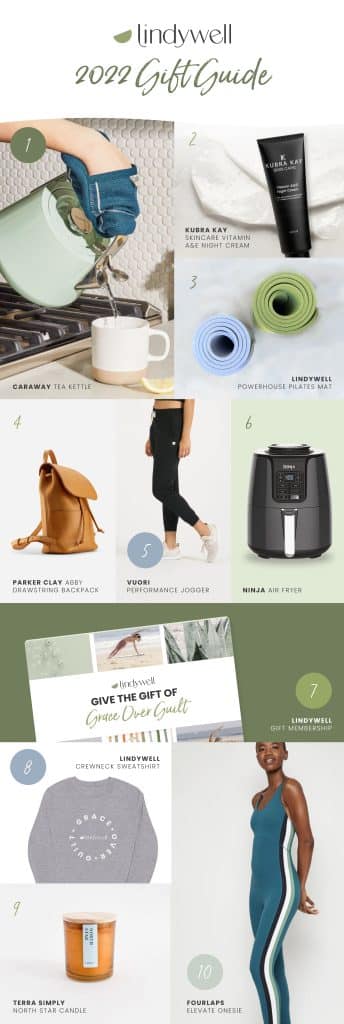
#healthyliving #holistic #nutrition Lindywell 2022 Gift Guide

The Lindywell Gift Guide is finally here! We’re so excited to share this you all and hope that it’s helpful with your shopping this season. Check out our top 10 gift ideas that empower self-care so you and your loved ones feel healthy and happy.

And let us know in the comments what you’re getting!

This post includes affiliate links, which means Lindywell may receive a commission, at no cost to you, if you make a purchase through the link!

  1. Caraway Tea Kettle (easy on the ears and compatible with electric, gas, and induction cooktops)
  2. Kubra Kay Skincare Vitamin A&E Night Cream (a rich and creamy moisturizer great for improving the texture and health of your skin)
  3. The Lindywell Pilates Powerhouse Mat (it’s eco-friendly, supportive, easy-to-clean and comes in two beautiful colors – aloe and sky blue)
  4. Parker Clay Abby Drawstring Backpack (ethically, crafted sustainable leather suited for adventures and everything in between)
  5. Vuori Performance Jogger (comfy, stylish and perfect for home or travel)
  6. Ninja Air Fryer (get meals on the table quickly with your new favorite kitchen gadget)
  7. Lindywell Gift Membership (for a limited time only, get a three month gift membership for only $54)
  8. Lindywell Crewneck Sweatshirt (a member favorite with fabrics that are soft-to-the-touch)
  9. Terra Simply North Star Candle (hand-poured in the USA with soy wax and lead-free cotton wicks for a long lasting candle with a clean burn)
  10. FourLaps Elevate Onesie (take comfort with you in this supportive, figure-flattering all-in one outfit)

The post Lindywell 2022 Gift Guide appeared first on Lindywell.

from Blog – Lindywell https://ift.tt/VJrSeW9
via IFTTT