Whether you are looking for a delicious and simple recipe to make with the kiddos, a baked good to take to your neighbor, or a sweet treat to leave for the mail carrier, I have just the recipe for you!
These peppermint chocolate chunk brownie cookies are so delicious and full of festive flavor this holiday season – perfect to enjoy yourself or for your gifting needs! 🙂
INGREDIENTS:
2 eggs
½ cup pure maple syrup
½ cup ghee, melted
½ tsp peppermint extract
1 tsp pure vanilla extract
2 cups gluten-free all-purpose flour (like Bob’s Red Mills)
½ cup cocoa powder
½ tsp sea salt
¼ cup chocolate chips (like Enjoy Life Brand)
Crushed naturally flavored peppermint candy canes for topping (optional: like Whole Foods 365 Brand)
INSTRUCTIONS:
Start by preheating the oven to 350 degrees F and line a cookie tray with parchment paper.
Add the eggs, pure maple syrup, melted ghee, peppermint, and vanilla extract to a large mixing bowl and mix well.
Fold in the flour, cocoa powder, sea salt, and chocolate chips.
Drop the cookie dough by the rounded tablespoon onto the parchment-lined baking sheet and bake for 12-15 minutes.
Allow to cool and sprinkle with the peppermint candy, if using.
Enjoy!
xo,
PS – Looking for some more gift ideas? Check out our 2020 gift guide – full of ideas from TBL favorites to budget friendly options!
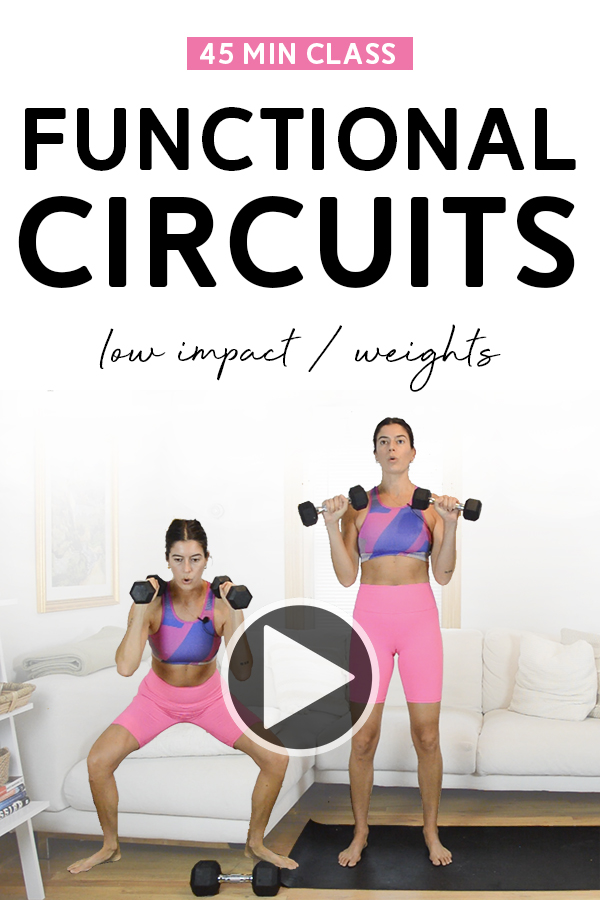
This Functional Circuits total body class is low impact and uses weights (with a mix of bodyweight exercises as well). The 45-minute class includes guided warm up and cool down. Some other Functional Circuits classes I’ve shared:
If you enjoy class, I have a bunch more available to Patreon members! For $9.99/month, you get 8-10 additional workout videos every month plus a workout calendar.
Functional Circuits Total Body Class
EQUIPMENT FOR CLASS:
Set of medium weights, I’m using 8 lbs
Single heavy weight, I’m using 20 lbs
In this class, we start with a guided warm up, focusing on mobility and dynamic movement. We then move onto our functional circuit work. In each of the three circuits, you’ll preform four exercises, back to back, for 30 seconds each. You then rest 30 seconds before repeating. So that’s 2 mins of work, 30 sec rest.
In Circuits 2 & 3, we’ll do some unilateral work so we’ll complete 4 sets of the circuits, alternating right and left. In Circuit 1, we’ll complete 3 sets.
Between circuits, you get about a minute to recover, but pause the video and take more time if needed. Always listen to your body, modifying or stopping as needed.
We finish class with a guided cool down and stretch.
Workout Breakdown
01:30 Warm Up & Mobility
09:38 Functional Circuits Workout
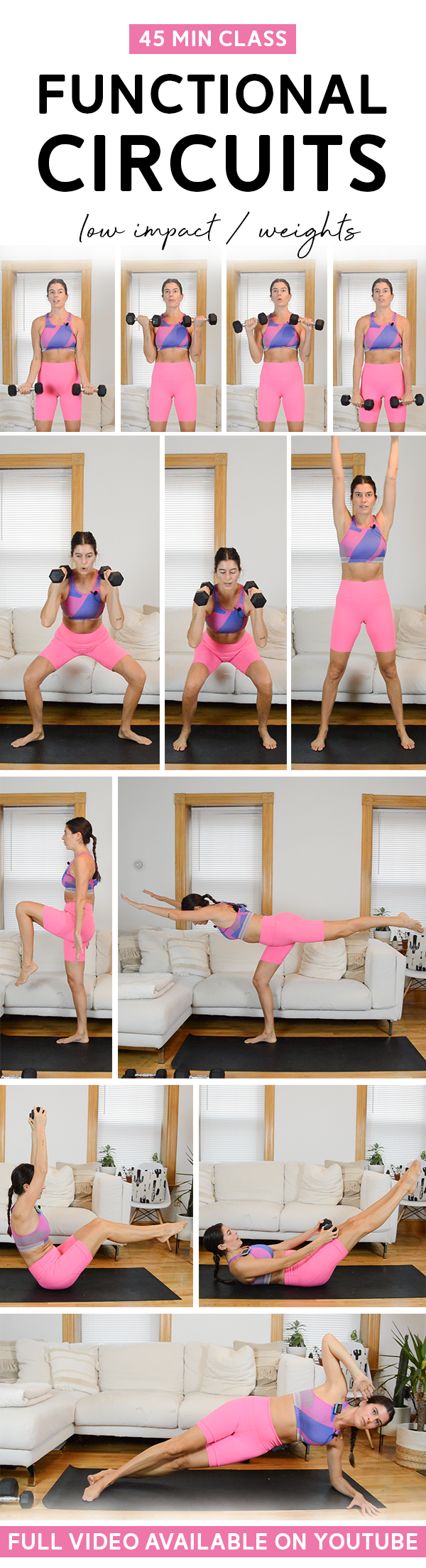
Circuit 1, medium weights
Rotating Biceps Curls
Hammer Curls with Lunge – Squat Step
Squat Thrust with External Rotation at the Bottom
Shoulder Press, Shaper, Press Up
Circuit 2, heavy weight
Staggered DL – SL DL
Lunge Row x2 – Pulse x2
Lizard to Low Squat to Knee Drive (bodyweight)
SL DL with Arm Reach (bodyweight)
Circuit 3, single medium weight
Boat Sit Up to Balance
Boat Pose Shoulder Press – Twist
Side Plank Rotation – Top Knee Crunch (bodyweight)
Holiday season is just round the corner. There will be parties, celebrations, food and champagne. Ahhhh….that irresistible succulent Christmas turkey and sumptious pudding. That mouth watering New Year’s buffet table and the countdown champagne are so tempting. Your spirit is willing but your flesh is weak. You binge.
So what is price you pay for your hoilday binge ? Well, you stepped onto the bathroom scale on January 2nd and horror of horrors, you have gained 10 pounds !! Aaaaaaaaarrrrgghhh!! You pulled your hair and gnash your teeth wondering how you can lose the holiday weight you have gained. You even contemplate hiring a personal trainer to put you on a weight loss program. But wait. With a little thought and planning, you can avoid holiday weight gain in the first place.
Here are some tips on how to avoid holiday weight gain so that you don’t have to lose weight post holiday season.
1) Just remember that the holiday season is only temporary and will soon pass.
So that the days you squeal , “I will gain weight around the holidays,” or “I know I will gain 5 pounds during holiday season” or “I’ll start a weight loss program after holiday season is over.” are over. Why ? Well, since you know that there are only a few days that you will eat more than usual, then you just eat more on those days and no more. Don’t let the binge continue for a week or more by taking home all the leftovers or storing more sweets and pastries than you need for that particular holiday. It is usually what people find in the fridge and on the kitchen shelf after the holiday that they continue to binge. Empty the fridge and the shelves. This will help you not to put on too much weight so you need not lose weight post holiday season.
2) Turn Off Your TV Set
Hey! Instead of watching all those holiday special programs on your goggle box, get moving! Instead of watching a soccer game on TV, get a ball and go to the nearest park for a kick around. Instead of lying on your couch snacking to a packet of chips, go lie by the poolside, then do a few laps. Better still, get your family and friends to join you. Go for a jog instead. If it is winter where you live, be innovative, think of some indoor activities or exercises you can do.While others gain weight, you may even lose weight. Afterall its a holiday. Have fun!
3) Avoid Acohol To Avoid Weight Gain
One gram of alcohol packs a whalloping 7 calories. In contrast, carbs and protein have only 4 calories per gram. Calories from alcohol are just, well, calories with zero nutritional value. They will rapidly convert into fat fast when you do not burn them off quickly. Avoid high-calorie mixed drinks like cocktails that are full of sugar or beer which are high in carbohydrates which translate into even more calories. You will definitely need to be on a weight loss program if you indulge in too much alcohol.
4) Drink Plenty Of Water
Juices, soft drinks and coffee don’t count! Just good ole plain water. Water flushes out toxins in the body, helps the body recover from dehydration caused by alcohol consumption. You will also feel full so that you will not over eat resulting in gaining weight.
5) Skip Dessert To Lose Weight
Do you need those sweet and calorie laden thingies? If you must have them, choose those that are not that sweet or even better, just have some fibrous fruits and nuts. Do this to keep your weight in check.
If you can keep to these tips this coming holiday season, then you will not gain weight and thus may not need to lose weight post holiday nor embark on a weight loss program.
Personally, I live to eat and I believe in having your chocolate and eat it as long as you eat all things in moderation. Secondly, I do not see the point of simply giving you a generic weight loss diet plan which maybe unsuitable for you. Rather, here are some diet tips to supplement your existing diet that you may need as you go through the day.
For breakfast, my parents swear by only having fruits or juices until noon. This habit arose from the health book Fit for Life. Its weight loss diet plan dictates that when your body is free from heavy food stuffs in the morning, it can do its job of digesting more efficiently for the rest of the day. Studies have also shown that having lots of fibre in the morning helps one to eat less for the entire day. I guess this method works for them as they still maintain enviable figures despite behind in their mid fifties.
Secondly, there is no point in watching what you eat for your weight loss diet plan when you are guzzling down calorie in your drinks! Need a coffee to jumpstart your morning. Find out how much weight you have been putting on, indulging in your habit and that is sufficient to jolt you awake. The calories in Starbucks Café Latte fattens you up with 180 calories. A serving of Coke lends you about 150 calories whilst a canned drink sets you back about 130 calories, Substitute all other kinds of drinks to water and you cut down a substantial part of your calorie intake.
What if you absolutely will die without having junk food? Allow yourself a daily but small quota of junk so that you do not go cold turkey. This allows for desserts, but it entails sticking to low fat alternatives for your main meal: a soupy dish over a deep-fried ones. It will also help to simply keep temptations away! Who can resist a bag of cookies or a tub of ice cream seating in your freezer screaming ‘ Eat me!’ Thus go through the food in your house and thrash the junk (hmm.. no.. give it to the neighbors as a sign of goodwill) and of course, remember not to get even more fattening treats when you go grocery shopping.
What you consume and drink outside your usual meals is extremely important in reaching your weight loss goal. Avoid processed food whenever possible. Go for unprocessed healthy foods such as fruits and vegetables that are the best in any diet.
Millions of people struggle with weight issues every year, and despite claims that a wonder diet can “work for everybody”, the fact is that each of those individuals have a medical history, a personality, or a lifestyle issue that affects whether or not that weight control technique will help them shed those pounds.
But while nothing works for everybody, there is something that will work for you…and the challenge is to find it, identify it, and stick to it.
For some people, appetite control is extremely difficult. Some weight loss programs try to tackle that problem by delving into the psychological issues behind food (these are the total lifestyle body makeovers, whose techniques include keeping a food journal and coming to terms with one’s body image). Others address the problem through metabolism, introducing or removing certain foods in one’s diet that are said to either trigger appetite. Still others, like diet pills, act as appetite suppressants. Other programs rely on nutritional substitutes, like heavy shakes that make one feel full and provide adequate vitamins and minerals, while reducing calories.
For others, it’s not appetite that’s problematic, it’s the kind of food they eat. Certain diet programs give very strict diet regimens that promote weight loss, because of the way the body digests the food. Some are short-term, meant to shed pounds over a limited period of time; others are long-term lifestyle changes. The success of these diet programs depend largely on the person’s weight loss goals and level of commitment. Needless to say, if you just want to drop a dress size for your wedding, you may not be ready to go into something long-term. But if you have health problems, and need to control cholesterol levels, then a short-term solution would not be very effective.
Other weight loss programs are closely tied with exercise routines. Of course, not all exercise regimens will appeal to an individual; some would find yoga interesting, while others would prefer something like belly dancing. The idea is that one picks what is most interesting to them—the more fun and enjoyment they derive from a routine, the more likely they will stick to it.
The mistake that many people make is that they don’t consider their own lifestyle or personality when they try a diet or exercise regimen; they go with what everyone else is doing, or jump on the weight loss bandwagon on the premise that it worked for so-and-so. While it’s okay to experiment with different regimens (wouldn’t hurt to try anything once), ultimately it is a search to find what is personally appealing.
Another secret to maintaining a diet or exercise regimen is to have very clear and realistic goals. “Be thin” is too general to be meaningful; pinpoint a number, and a date: “Lose 15 pounds by September.” And to avoid discouragement, that goal must be humanly achievable and should never compromise with one’s health. If a diet makes one dizzy, or radically affects one’s ability to be fully alert and functional, then stop immediately.
Luckily there is a wide variety of weight loss regimens. There’s bound to be one that will help one meet one’s goals and match one’s lifestyle.
Why is our society so focused on losing body fat ? Have you ever thought about it ? Well let’s do that in the next couple of paragraphs.
Let’s try to break it down to reveal both the healthy and the not so healthy aspects of this fat phobic craze.
Excess body fat is viewed in our society in a negative light and for many different reasons. Excess body fat is looked down upon in the social arena as unattractive in both a sexual way and lack of athleticism. These are two of the most glorified things in our culture that is sex and sports. Case in point, you don’t find fat ladies in bikinis adorning the covers of all the big name magazines including what might be the best example the Sports Illustrated Swimsuit Issue. You don’t find fat actors though the people and events they are portraying are anything but thin and sexy. If you want to be sexy you have to experience fat loss.
Excess body fat is also viewed as unproductive in the areas of work and health which often coexist. You obviously wouldn’t find fat people in physically demanding jobs for one because if they were in those jobs they wouldn’t be fat and for the other as fat people they won’t do as well as thin and in-shape people would. You don’t see fat soldiers, fat construction workers, fat cowboys, etc. The only way you can have success in these areas is fat loss!
Fat people are also not as productive, even in jobs that aren’t as physically demanding. They are typically more unhealthy and find themselves taking more sick days. Obese people die younger of things like cancer and heart disease and diabetes and stroke. This all adds up to less years of productivity. Fat people are also less mentally and emotionally healthy which is just as important in your career (no matter what it is) as your physical health. The fact is that people would rather be bossed by, work with, buy from, and be served by people who are at least healthier appealing. This gets at both the social perception as well as the actual productivity. Fat people are on the whole less fun to be around and less productive to be around too. So fat loss is also more productive in monetary terms too.
The sad part about all of this is that often it is less the fat person’s fault than us skinny people want to think. We want to think that we are thin and healthy appearing because we work harder and are addicted to food less than the obese. What scientists are finding is that this is far from the truth. Fact is that fat loss is harder for some than for others because of genes, not work-ethic, or mental health, or any of that. So fat people are victims of discrimination based on something they can’t help much like the color of skin for instance.
It seems lately that I have come across an abundance of information on the benefits of consuming green tea. Because of this, I have been inspired to compile some of the information – specifically regarding green tea and weight loss.
Green tea contains a number of things that are reported to be very healthful for you. Among these are:
Tannins, phenols, polyphenols, and flavanoid compounds, the amino acid theanine, and catechins of which egcg seems to be the most beneficial.
Some of the reported benefits you will see when researching green tea are:
• Protecting skin from ultraviolet radiation
• Protection against a number of different cancers
• Increased life span
• Protection of the brain
• Increased antioxidant levels
• Theanine has been reported to negate the jittery effect of caffeine, and heighten mental acuity and some have even said give a relaxed but aware state.
• Last but not least are increased fat metabolism
This increased fat metabolism is what is of most interest to people wanting to lose weight. It simply means the rate at which you burn calories and the body’s ability to burn fat. The studies seem to point to a connection between the caffeine in green tea and the epigallocatechin gallate (EGCG) which causes a boost in noradrenaline. Noradrenaline helps your body boost your metabolism and suppress your appetite.
Some experts recommend that you take a standardized green tea supplement which contains 90mg of EGCG and 50mg caffeine. Of course you should always consult your physician before taking any supplement, especially one with caffeine.
Drinking green tea can be a pleasurable experience. I have tasted some very good green teas and I have tasted some that taste like what I imagine blended grass would taste like. My favorites seem to be the mixture of green tea and lemongrass. The best tasting ones I have found have been in health food stores or online. Don’t give up on your first taste. Experiment around and try different flavors of green tea. You may find one or more that you just absolutely love. I generally microwave my green tea and drink it warm. I have brewed several bags at a time using boiling water and then place in the refrigerator for a nice cool beverage as well.
Drinking green tea can also be an aid to weight loss if it takes place of another habit such as coffee with sugar or cola. I know many people who start the day with a sugar filled caffeine cola or sweetened iced tea. This is how they get their morning caffeine. Why not substitute green tea for this and enjoy the feeling and health benefits? Replace that after lunch cup of coffee with a cup of green tea. You will be doing something healthy for your body and you won’t experience the “drop” that coffee can leave you with an hour or so later. Also enjoy a cup of green tea before your exercise routine, just be careful and do not consume it late in the afternoon.
A cup of green tea contains about half as much caffeine as a cup of coffee. If you are sensitive to caffeine – use caution or avoid all together.
I am a believer in a healthy lifestyle to achieve your desired weight. If you know me or read any of my articles you also know that I am a believer in supplements – Only as an aid to a healthy lifestyle. Not a magic solution. I see green tea as an effective tool in your weight loss arsenal.
Green tea seems like a wonderful addition to your daily life which may help you boost your metabolism, ward of sickness, and give you a gentle caffeine lift.
Please share this post on Facebook, Twitter or Pinterest. Thanks !
We’ve helped thousands of people run injury-free and train for their first 5k or marathon, and we’ve put together everything you need to know below too!
If you’re interested in starting a proper running practice (which you are, ’cause you’re here), you may want to try our new app! It contains a fun adventure that will take you from sitting on your couch to running a full 5k – with plenty of benchmarks in between for you to find your groove. No guesswork needed, just tie your shows and follow along with the app.
You can sign-up for a free trial right here:
How to Run Properly Stage 1: Initial Conditioning
Before you even THINK about strapping on a new pair of Nike shoes and going for a run around your neighborhood, we need to get a few things straight:
Your body needs to have a base level of fitness before running becomes a viable option.
Here’s why running too early can be harmful:
Every time you run, every time you take a step, you put the pressure of your entire body weight on the muscles, tendons, and joints in your legs, knees, ankles, feet, and toes.
If you are overweight and have improper running technique, that means your joints and tendons are taking an absolute POUNDING for however many steps you take during your run: around 6,200 steps in a 5k, 12,200 steps in a 10k, or 50,000+ steps in a marathon.
Your initial conditioning for running will center on three points:
#2) Strength Train.We have coaching clients who repeatedly injured themselves running until they started a strength training practice. After lifting some weights their ligaments grew strong and allowed them to run injury-free.
Swimming – very low impact as the water holds you up.
Elliptical – although I’m not a fan of spending all afternoon in a gym on a treadmill, this is the better option as it removes the opportunity for joint impact.
To Recap: strength train, reduce your calorie consumption, and begin a low impact activity – build up your foundation to prep your body for running. The less weight your body has to carry around, the less work your legs and joints have to do, the less likely you’ll be to damage your joints and/or injure yourself.
Now that you have a solid foundation and you’re ready to start running, you can move on to the next step.
If you don’t know where to start on changing your diet, or have had trouble with it in the past, I got you.
We created the Nerd Fitness Diet cheat sheet to help you get going. It’s a level up system designed for you to adopt new healthy habits, that will stick, by slowly progressing you from a newbie to an expert.
If you’ve had trouble previously, perhaps it’s because you changed too much too quickly.
Want to check it out? You can grab it for free when you join the Rebellion in the box below!
Download our free weight loss guide
THE NERD FITNESS DIET: 10 Levels to Change Your Life
Follow our 10-level nutrition system at your own pace
What you need to know about weight loss and healthy eating
3 Simple rules we follow every day to stay on target
How to Run Properly Stage 2: Warm-Ups for Running
Before you take your first stride as a runner, you need to be properly warmed up.
When most people think of warming up, they probably think of standing there and doing some static stretching for 10 minutes…you know, to make sure you don’t get injured!
Wrong! Fail! Stretching before running can actually increase your risk of injury.[3]
Instead, try a dynamic warm-up – get your body properly warmed up and prepared for the rigors of running.
Here’s a running specific warm-up video from my friend Jason over at Strength Running, who you’ll see in more videos below:
Here’s Staci, our Senior Coach, providing you with a quick sequence to try out:
Just like with strength training, if you don’t have time to warm up, you don’t have time to run.
Cut the run short if you need to, but not the warm-up!
How to Run Properly Stage 3: Correct Running Technique
If you don’t learn how to run correctly, you’re doomed to develop an overuse injury and that’s going to negate the whole reason you started running in the first place!
This is why your running form is so damn crucial: when you run, you’re putting hundreds of pounds of pressure on your joints and ligaments with each bounding step down the road. This is then repeated thousands of times over the course of training and a race.
No wonder nearly every runner has tons of stories of injuries they’ve had to deal with. It can be a brutal activity that can wreak havoc even with good running mechanics.
With poor running mechanics, the results are compounded.
Not the GOOD kind of “compounded” like compound interest, which you learned in 2nd grade with the story about starting with 1 penny a day and doubling it for 30 days.
The BAD kind of “compounded” like plantar fasciitis and stress fractures and sore IT bands and torn ligaments and crazy soreness all the time.
We don’t want that.
Make sure you follow the below five steps:
1) LEAN FROM YOUR ANKLES:
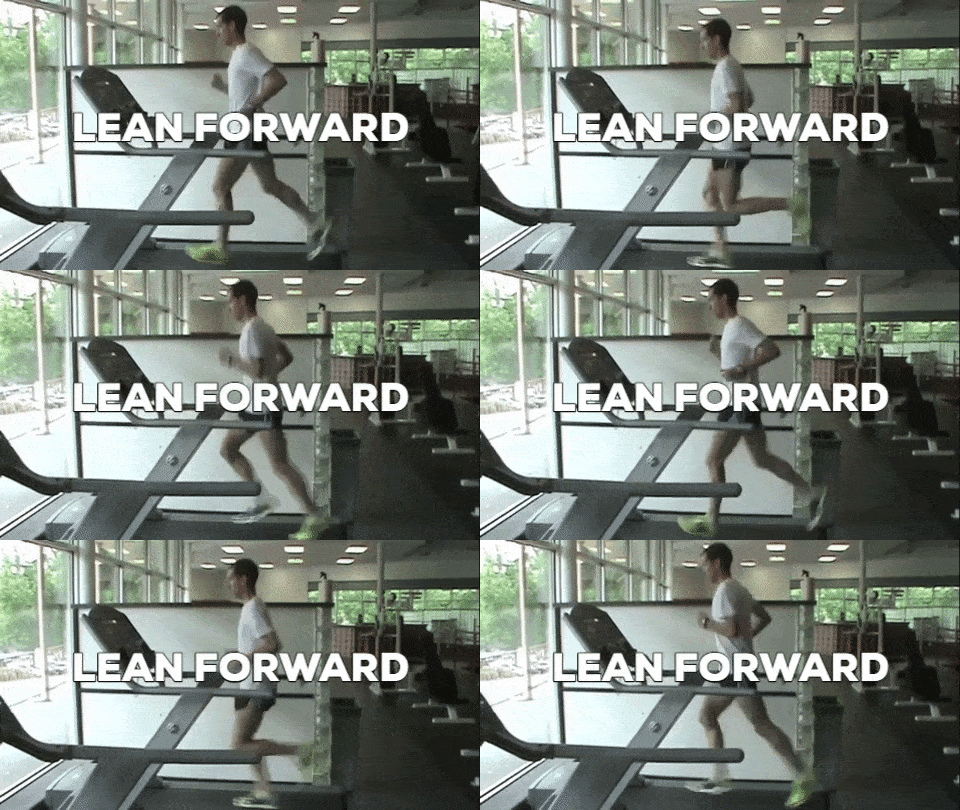
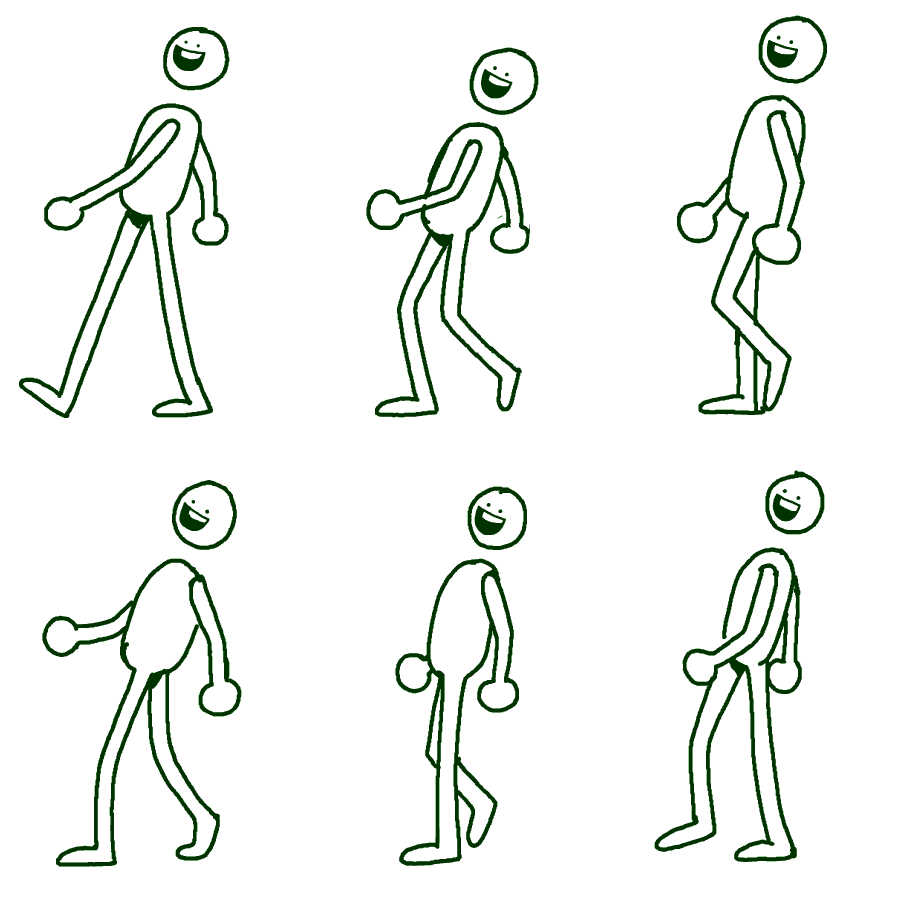
Lean from your ankles, and keep a straight line from your ankle, through your butt, and up to your head. If you’re standing still with this slight forward lean, you should feel like you’re about to fall forward.
Just don’t actually fall forward.
When you start running, gravity will help keep you progressing forward. A proper lean from the ankles keeps your body in alignment and loads your muscles properly and efficiently.
2) INCREASE YOUR CADENCE: Cadence is your stride rate, or the number of steps you take per minute. It will probably seem weird at first, but you’re putting less stress on your legs with shorter foot strikes.
Your cadence should be at least 170-190 steps per minute when you’re running at an easy, conversational pace. It will probably increase once you start running faster—that’s normal.
“Steve, what the hell do I do with “170-190 steps per minute?”
Great question. Go to Spotify and look for 170-190BPM playlists, like these which I found here:
Not on Spotify? Cool. (But like, why?) To get a cadence, try running to Outkast’s “Hey Ya” and time your strides to match the beat. That’s the cadence you’re looking for:
Research has shown[4] that increasing your cadence and taking more steps (around 180 per minute) provides many of the same benefits of barefoot running:
Less impact shock that goes up your legs.
Improved running economy (or your efficiency, which means you’ll run faster with less effort!).
Reduced chance of injury.
You’ll feel like you’re taking way more steps than normal – that means you probably had poor form before and now you’re fixing it!
If your legs get to the point where they’re going this fast, let me know:
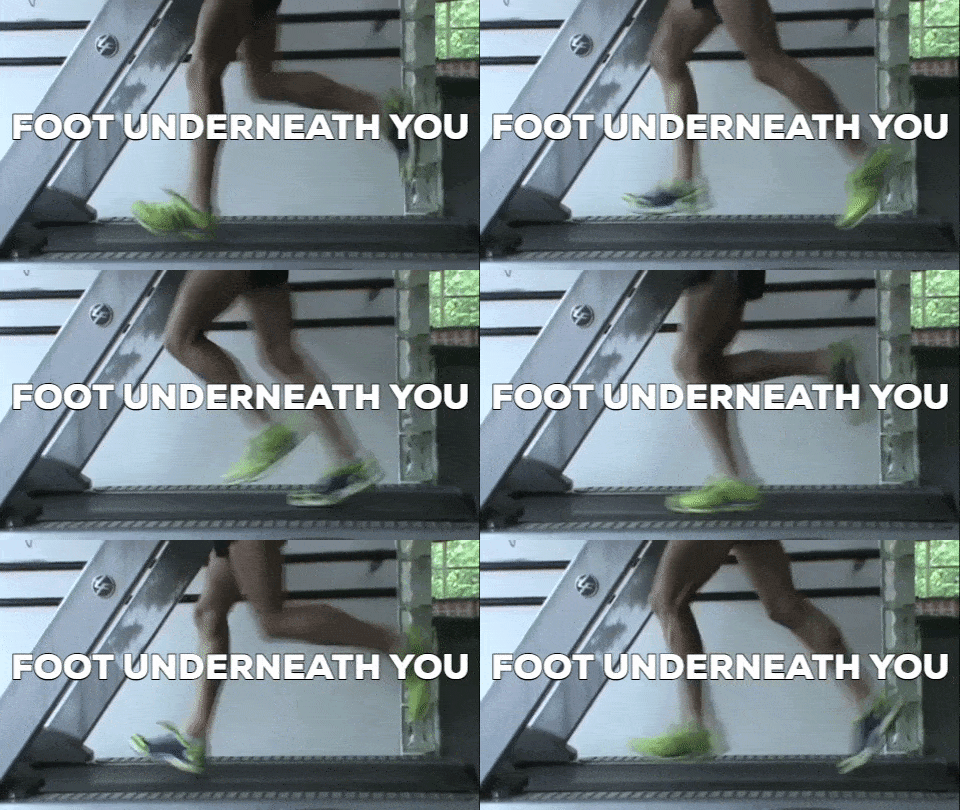
3) FOOT STRIKE AT THE RIGHT TIME: When your foot comes down and makes contact with the ground, it should be underneath your body, not in front of it.
Combined with a quick cadence and a slight forward lean from your ankles, you’ll be distributing impact shock evenly—and efficiently.
This aspect of running form is often skipped over by beginning runners.
Instead of focusing on where the foot is landing in relation to the rest of the body, they focus too much on running on their forefoot. If you don’t first land in the right place, a midfoot or forefoot strike will only do more damage.
As you’re running, a good mental cue is to think that you’re just “putting your foot down” in a straight line underneath your body.
There’s no reaching or stretching your leg out in front of you.
Practicing this mental cue will have your leg touching down almost exactly underneath your center of mass, distributing your weight evenly and safely.
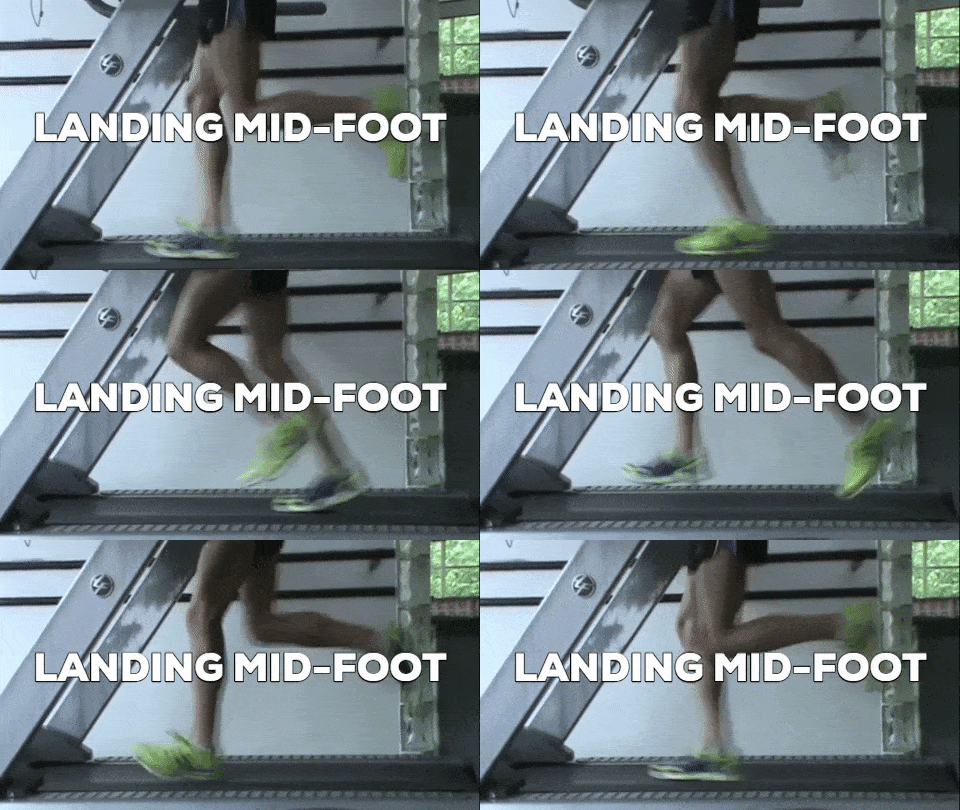
4) LAND ON YOUR MIDFOOT: While not as important as landing underneath your center of mass, becoming a mid-foot striker has a host of benefits.
It can help you avoid a lot of injuries by absorbing impact shock and preventing a severe heel striking running stride.
Heel-striking can’t be entirely blamed for injuries and labeled “bad.”
Even elite athletes heel strike when they run races! It’s not entirely bad— especially if you’re putting weight down on your foot just after you heel strike, instead of directly on the heel.[5]
What you should focus on is having a higher cadence, landing underneath your body, and not aggressively heel striking.
Try to land with your foot flat on the ground, instead of with your toes angled upwards.[6]
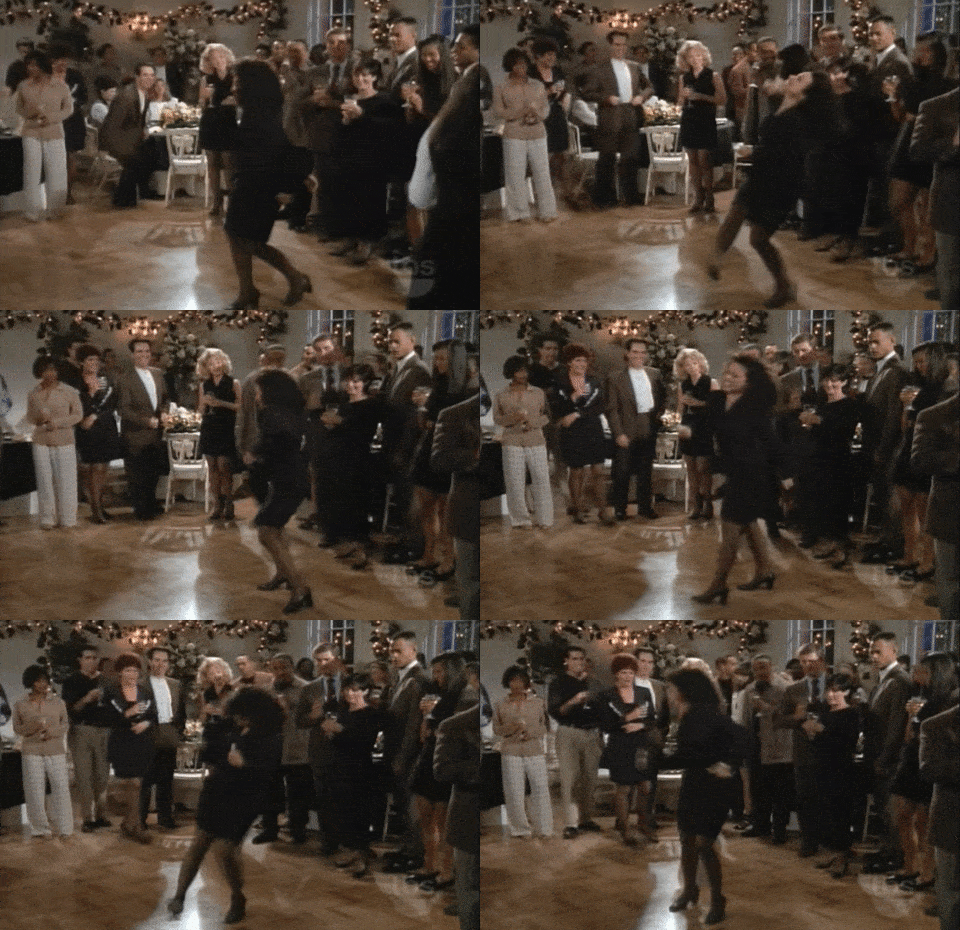
5) SYMMETRICAL ARM SWINGS: Nobody wants to look at you running if you’re flailing your arms wildly all over the place like Elaine dancing from Seinfeld.
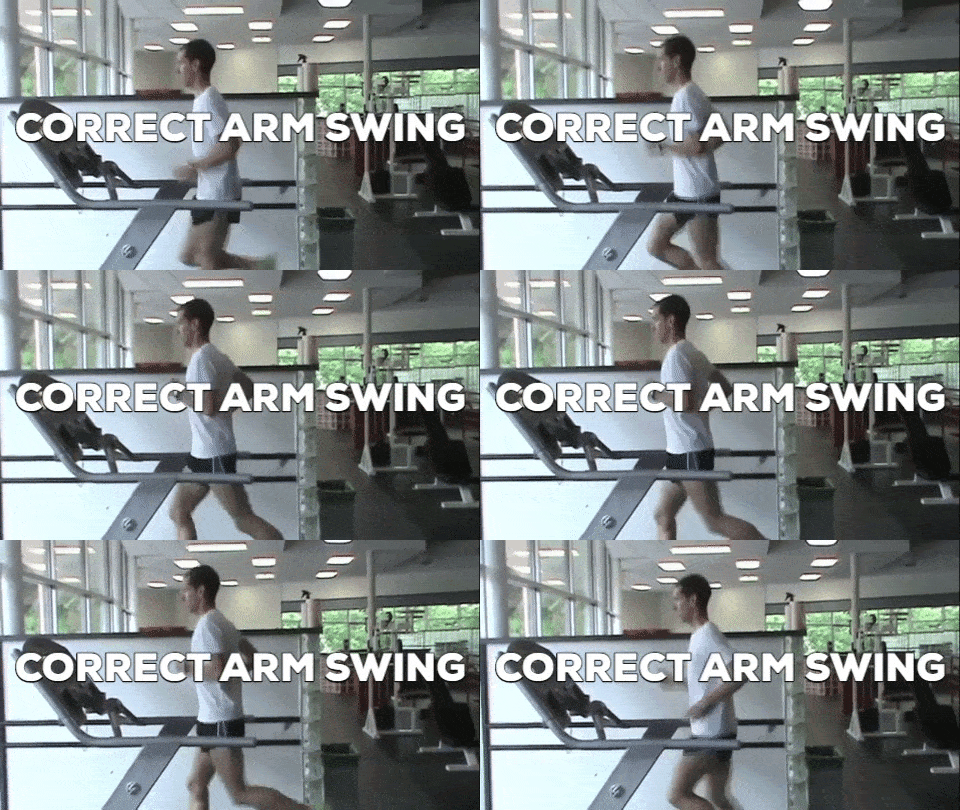
An ideal arm swing has your arm bent at about 90 degrees and a front to back swing (not side-to-side).
Imagine a pretend line that goes down your mid-line or center of your body. When you run, your hands should not cross over this imaginary line.
Cup your hands loosely together (no clenched fists!) and if you want to use your arms for momentum, pump your elbows, not your hands.
Once you incorporate these changes into your running form, you’ll feel a lot more comfortable and your injury risk is going to plummet.
For extra credit, learn to run softly and quietly.
Foot stomping isn’t allowed and gets increasingly more difficult as you approach 180 steps per minute.
A few other things you want to keep in mind:
Keep a tall back, chest up. No slouching.
Look 30-50 meters in front of you – not head down looking at your toes.
Both are easy cues to keep an athletic posture and good running form.
Go back through and read this section a few more times. We know it’s a LOT to think about while running, but it is incredibly important.
If you get a chance, have somebody film you running, and then watch your tape back to see how you’re doing.
I should note that we provide form checks to our coaching clients. Through our awesome app, you can record a video of your running form or exercise technique and send it right to your coach! That way you can know your running and training safely and correctly!
How to Run Properly Stage 4: Walk Before You Run
Starting a running practice can be daunting.
That’s why I actually recommend walking first. I mentioned earlier that walking can help build the foundation of a great running practice.
Once you’re comfortable moving a little bit, an ideal way to actually start running is to alternate between a brisk walk and a jog. This can help you build up some strength so you can run at a more constant pace.
Try the following five steps to start your running practice:
Get comfortable walking for 20 minutes. That’s it. Stroll around your neighborhood a few times a week, until this is a cake-walk.[7]
Bump it up to 30 minutes. After 20 minutes is no problem, take it to the next level for a 30-minute walk. Once you can handle this fine, we can start picking up the pace.
Start run/walking. Walk as you have been for 10 minutes. Then, pick up the pace for a light jog for a minute (or 30 seconds if this is too tough). Give yourself a couple more minutes of walking (or longer) before you start jogging again. Do this for about 10 minutes, then walk normally for the last 10 minutes. You’ll still come in at 30 minutes for your exercise.
Now, run for longer. Once you’re comfortable holding a one minute jog, let’s take it up a notch. We’ll still have you warm up for 10 minutes of walking, but when you jog, try going for a minute and a half. If this seems easy, go for 2 minutes! Alternate to a slower walk whenever you need to catch your breath.
Before you know it, you will be a runner. As you expand your jogging time, lower the amount of time you walk. At this point, you’re basically running with some short walking breaks. Which is fine! This is how people start to run and many continue to alternate between walking and jogging forever. Even if you get to the point of running races, there’s nothing wrong with taking some walking breaks. You do you.
Alright, we’ve talked about technique, plus some tips for getting up and running.[8]
However, I know you’re gonna ask, so let’s talk about what kicks you should rock.
Which Shoes Are Best for Running?
There are four components to look for in any shoe.
If the shoe doesn’t meet these four criteria, then your foot is going to be compromised.
A good shoe has:
Minimal “heel drop:” a lower heel-toe height difference.
A wide toe box that allows your foot to spread as it lands on the ground with each step.
A pliable bottom that allows your toes to bend to a full ninety degrees of flexion as you step.
Something to attach it to your ankle area.
Let’s look at each in a bit more detail:
1. Minimal heel-toe height difference (aka “drop”). When your shoe raises your heel higher than your forefoot (aka “heel lift”), your ankle and lower leg are being positioned in a slightly shortened position for the duration that you’re wearing the shoes.
When your leg muscles are thrown into a slightly unnatural position, it means the mobility of your ankle will suffer… and this will limit all sorts of things including your running gait.[9]
This doesn’t just mean high-heels either, although running in heels is ridiculous.
This includes most regular shoes that have a bulky heel and lower toe. In many shoes, you’ll see this difference between heel and forefoot referred to as a “drop,” so “zero-drop” shoes are shoes where heel and forefoot are at the same height.
Check to see what your current shoes weigh, and each time you buy a new pair of shoes, work your way towards more and more minimal shoes – down to 10 oz or so (which would qualify them as “minimalist shoe” in our book).
Our advice would be to not go too far below 7-8 ounces.
The big question: “Should I be doing barefoot running?” – Occasionally, and with proper form, SURE. But don’t just put on a pair of Vibram 5 Finger toe shoes and go run a 5k on concrete tomorrow. That’s a recipe for disaster.
2. A wide toe box that allows your foot to spread as it lands on the ground with each step. With each step you take, your foot actually spreads wider upon landing. This is impossible for your foot to do when it’s in a shoe that is too narrow.
If the toe box is not at least as wide as your foot when you’re standing on your foot, while it’s bearing your weight, that’s a problem for your foot. Know that as your foot becomes more ‘natural’ it’s possible it will it may widen further, as the muscles and bones reposition themselves.
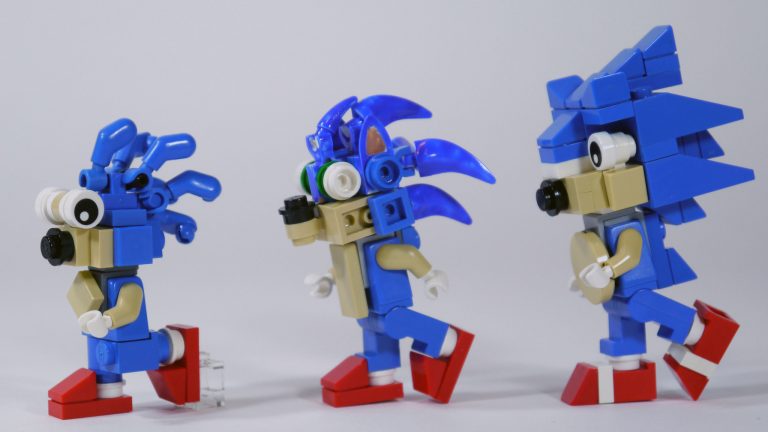
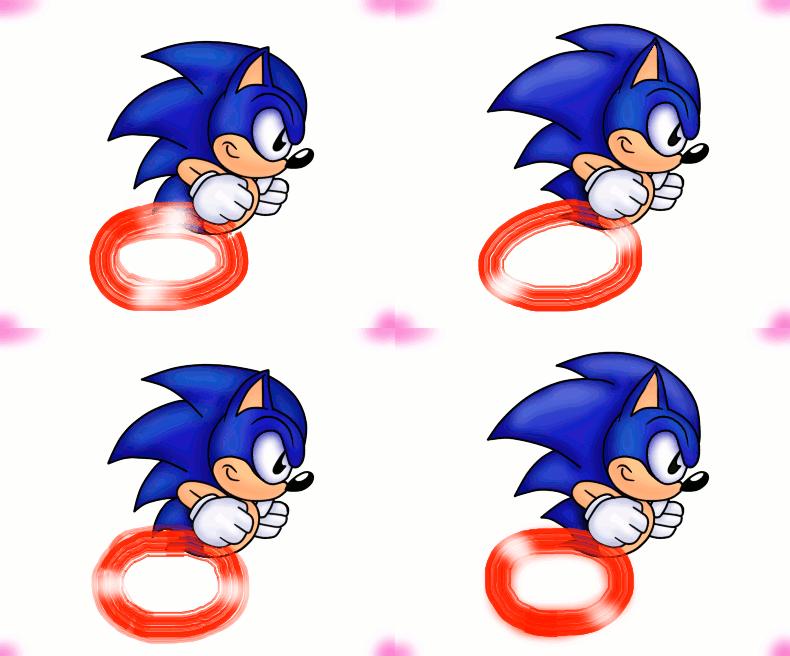
Feet crammed into a shoe is like putting a leash on Sonic the Hedgehog: they want to be free!
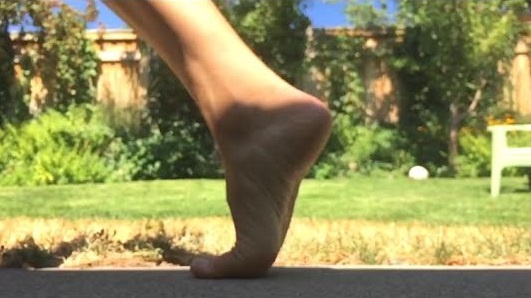
3. A pliable bottom that allows your toes to bend fully as you step. Your great toe is meant to flex to ninety degrees as you move through the gait cycle. See below:
If your shoe does not allow this due to a hard sole, your feet won’t be able to move as well, and the soft tissues of your foot will get weaker from not being used fully.
PLUS, when you aren’t flexing your big toe regularly, your body will start to lose the ability to use that joint fully. This can lead to all sorts of problems. Doh!
4. It’s strapped to your foot. If the shoe isn’t strapped around your ankle, your toes are going to grab at the shoe to keep it on with every step you take. This makes some of your foot bones push down and some of your foot bones lift up.
That shift means you change the amount of forces on each bone. Over time, this can lead to stress fractures and tissue injuries.
Check out the video below from movement specialist Kelly Starrett:
For each point above, this isn’t an “all or nothing” scenario. Similar to your nutrition, do the best you can when you can, and work your way into running with a minimalist shoe.
If you want to learn more about proper footwear, make sure you check out “A Nerd’s Guide to Healthy Feet,” written by Kate Galliett of FitForRealLife.com.
Where can I go for a run? What’s the best surface to run on?
For the most part, it doesn’t really matter what surface you run on if your form is good and you’re resting enough to recover between your workouts.
But each surface does affect your body in different ways, so you should know the pros and cons of each one.
#1) Asphalt (road):
People have been running on the roads since they were first paved over 100 years ago. Most people run exclusively on the roads since they’re the most common surface that’s available for running.
There’s nothing inherently wrong with road running. It’s stable and has a relatively predictable surface so you probably won’t twist an ankle.[10]
As long as you’re avoiding cars and running AGAINST the flow of traffic (so you can see approaching cars) you’ll be safe.
The danger of roads comes when you run on the same side of the road all the time.
The problem lies with the road’s slope.
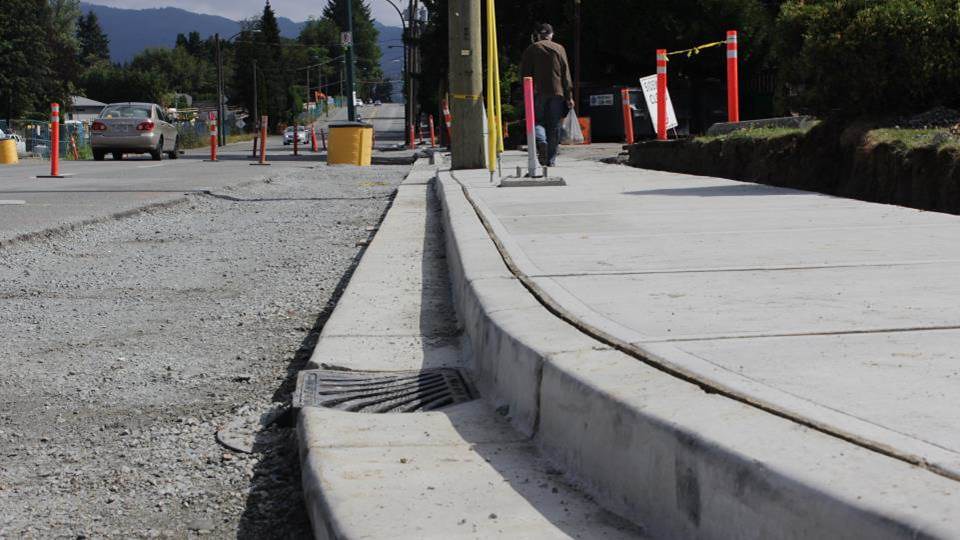
For drainage reasons, every road has a slight slope toward the curb. If you’re always running against the flow of traffic your left leg is going to be slightly lower than your right. The solution is to switch sides of the road, but only if traffic conditions allow.
#2)Concrete (most sidewalks):
Most sidewalks are made of concrete, not asphalt, and are actually a lot harder than the road itself. This isn’t necessarily a drawback, but you will be experiencing more impact forces on concrete than the road. If you do a lot of running on the sidewalk, make sure your form is as good as it can be![11]
#3) Grass (fields):
Unless the grass is very hard-packed and smooth, I don’t recommend running on it for a long period of time. Grass is very soft so you won’t be sending jarring impact forces up through your legs like concrete, but the uneven surface is going to break up your stride and you could tweak your ankle or a muscle in your foot.
Some grass is great to run on, though. The harder and smoother it is, the better it is for running…like a golf course.[12]
#4) Dirt or crushed gravel trails:
Smooth dirt or crushed gravel (very fine— not big chunks of gravel you find in some driveways!) are some of the best running surfaces. Like the hard grass surface of a golf course, dirt and crushed gravel trails offer the same impact-dissipating qualities while still retaining firm footing. It’s the best of both worlds.
You’ll find these types of trails at larger parks with walking paths or in national/state parks with well-maintained trails.
#5) Single-track trails:
Think sharp turns, rocks, roots, stream crossings, hills, and anything else Mother Nature can throw at you. In a word: FUN.
These trails are usually narrow and filled with obstacles. The hills, direction changes, and irregular surface will force you to use a lot of stabilizing muscles in your lower legs. This could be good for building strength.
#6) Track:
Found at most local high schools and colleges, a 400-meter outdoor track provides a great training place for workouts.[13] But that’s what they’re for: workouts. Not every day running!
The surface is forgiving like hard-packed dirt or a very firm golf course. But while the surface is great, the turns are what makes a track not ideal for everyday training. By doing all of your running on a track, you’re constantly turning left and setting yourself up for muscle imbalances.
You’re better off running somewhere where the turns are varied so you expose yourself to different stresses instead of the same thing over and over again. That’s how overuse injuries happen. Tracks are for faster workouts, not easy distance runs.
WHAT SURFACE SHOULD YOU RUN ON?
Your training would ideally be a combination of all of the surfaces that are available to you. Exposing your body to as much variety as possible will give you a better chance at preventing injury since you’re not doing the same thing over and over again.
The few types of running surfaces that lend themselves to more frequent training are:
Smooth dirt trails
Crushed gravel paths
Hard packed grass (like a golf fairway).
The footing is sure and the surface isn’t too soft or firm.
Limit your running on concrete and technical trails because of the injury risk. Most sidewalks are made from concrete and are incredibly hard. Throw a tennis ball on one to see for yourself—it’ll shoot right up into the air because of the returned energy. Those same forces are being returned into your legs when you run on them.
Technical trails present a different challenge: roots, streams, rocks, and uneven terrain.
Run sparingly!
A good strategy to use when deciding where to run is to figure out how your body feels.
If you’re sore or have a tender muscle, run on a softer surface. A dirt trail or well-manicured field will help you recover better than the roads.
But if you’re doing a workout, you want to avoid technical trails or a concrete sidewalk. Pick the track, a clear dirt trail, or a road without a severe camber.
Will Running Help Me Lose Weight? (Make Sure You Like Running!)
When people tell me they’re going to start a running routine, I always ask: “Great! Do you enjoy running?”
If the answer is “No, not really” then I’d say, “Interesting. Then….why running?”
Most people think running = weight loss. If you’re brand new to health and fitness, and you’re trying to lose weight, you’re most likely overwhelmed at what you should start with and how you should train.
So let’s answer the question “will running help me lose weight?”
Maybe!
Running will help you lose weight if you do two things:
Running won’t help you lose weight if you do two things:
You run consistently.
You don’t fix your diet.
As sexy as it is to think that just going for a run will help you lose weight, the data doesn’t back it up. Time Magazine rightly pointed this out years ago, and got yelled at for telling the truth, that exercise alone won’t make you lose weight.[2]
This is a common mistake: not fixing your nutrition if you’re running for weight loss!
If this were a movie, nutrition would be Tom Cruise in Mission: Impossible and exercise is that funny sidekick who helps Tom. Let’s be real here, Tom is doing all of the heavy lifting to make that movie what it is.
While exercise is important for health, it doesn’t have to be running. It can come from activities you DO enjoy:
“I don’t love it, but I need to complete it for a fitness test.”
“I’m running a 5k for charity/work and want to do well.”
“Not yet, but I think I could…”
“I like how I feel AFTER a run.”
…then we can continue the conversation!
The perfect place to continue the conversation?
Our new app! We have an adventure that takes all the information in this guide and provides it with actionable steps (hehe) for you to get up and running. No more “am I doing it right?” just follow the app and know you’re training correctly.
You can sign-up for a free trial right here:
How Do I Start Running? (Next Steps)
Once you get comfortable running around your neighborhood or park, you can start thinking about taking it to the next level.
Have you ever thought about running a race? They can be a lot of fun!
Here’s a clip from a race years ago where I dressed up like a Caveman with 20 of my friends and raised thousands of dollars for kids with cancer to go to summer camp!
If you want to learn how to get started, make sure you check out our article “Couch to 5K.” We cover the popular program and give our take on running your first race.
If you want even more guidance on long-distance running, I’ll point you again to my buddy Jason Fitzgerald’s wonderful site Strength Running. I reach out to Jason whenever I need advice on proper running (including the tips found in this post).
Alright, I think you’re ready to lace up and head out the door!
Want a little more help getting going? A slight nudge to get you out of the door?
Here are my top recommendations for next steps:
#1) We have a bunch of NF Coaching clients that love to get outside and run! If you want step-by-step guidance on how to lose weight, eat better, and learn to run properly, check out our killer 1-on-1 coaching program:
#2) If you need a trigger to “get up and run” check out NF Journey. Our fun habit-building app helps you exercise more frequently, eat healthier, and level up your life (literally).
Try your free trial right here:
#3) Join the Rebellion! We need good people like you in our community, the Nerd Fitness Rebellion.
Sign up in the box below to enlist and get the Nerd Fitness Starter Kit, including the 15 fitness mistakes you don’t want to make and our guide to the most effective diet and why it works
Get Your FREE Nerd Fitness Resource Kit
15 Fitness traps you should avoid
Comprehensive beginner’s guide to Paleo diet
BONUS: How to level up your life and be the hero of your own story
Now, your turn!
Are you an avid runner?
Do you have any tips for Rebels just lacing up?
Or are you like me, and only run when something is chasing you?
Let us know in the comments!
-Steve
PS: don’t forget to check out the rest of our running content!
You can read the review if you want to science out about running strides.
This is called a “proprioceptive heel strike” and is done just to get a sense of where the ground is.
When your toes are angled up, this is called “dorsiflexion” – nerd alert!)
Giggle.
I really do crack myself up while doing this.
Gait means the locomotion of limbs, more or less. Check out this Wikipedia article for more, which also has a sweet gif of an elephant in it.
Just watch out for potholes.
Heel-striking is going to bite you in the ass if you’re smashing your heels against one of the hardest surfaces you can run on.
I’m not recommending you sneak onto a golf course to run… but if you do, you’ll experience my favorite running surface. Many high school cross country meets are held on golf courses for this reason: they’re soft enough to be easy on your joints and muscles, but hard enough to give you enough spring to let you do some fast running.
Since they’re perfectly measured at 400 meters to a lap, you can run intervals precisely and get a lot of great data on how fast you’re running. You can use that information to predict how fast you’ll race in your 5K. Run by your local track and take note of the markings on each turn. Get familiar with the starting line, 200m mark (on the opposite side, at the next turn), and how to run a mile there. Note that a mile on a track is not 4 laps! You need to find the mile marker line, which is about 9 meters behind the starting line. It should gradually curve closer to the starting line as you reach the outside lanes.
So you’ve hit a workout or weight loss plateau the size of a…well, actual plateau, eh?
Have no fear, our step-by-step guide will get you back on track! (Plus, the most badass Bruce Lee quote you’ll ever read).
Whether you’ve stalled in your weight loss journey, strength training, or some other fitness benchmark, today we’ll tell you exactly how to keep progressing by sharing with you the exact tools we use with our coaching clients.
I know how demoralizing plateaus can be, especially when it comes to strength training and weight loss – they can be a total momentum killer!
It’s actually why we built our newest app, Nerd Fitness Journey! It’s designed so when you wake up in the morning, you know the exact next step to help you reach your goals.
You can try it for free right here, so this plateau can be a thing of the past:
Our bodies go from losing weight consistently to getting stuck at a certain number. Or we go from building muscle and getting stronger, to having a week or two where we can’t seem to lift anything heavier.
We call this point in our training “The Plateau,” and we don’t like being stuck on them.
When we work hard for something and don’t see progress, we get unhappy.
How Do I Know If I’ve Hit a Plateau?
I get a lot of emails from people who tell me they’re stuck in a plateau.
They talk about how they’ve been eating right, exercising, and getting enough rest and they can’t seem to make progress!
They throw their hands in the air, freak out, get discouraged, and give up or quickly move onto the next plan that they hope will work.
When somebody comes to me saying they’ve plateaued, my first response is always:
“Have you REALLLLLLLLY plateaued? REALLY?”
In a strong majority of the cases, plateaus are really just issues with concentration, tracking, and discipline in disguise. Before you think you have plateaued, consider the following:
1) HOW IS YOUR NUTRITION…REALLY? Oftentimes we think we are being diligent, until we realize that after a few weeks of eating great we’ve started slacking. “Oh I’ve been good, just this one time…” and “Hmmm, sure why not” become more commonplace as we start to fall back into old habits. Track your calories for the next week and check your numbers.
There’s simply LESS of you that your body needs to maintain.
Here is the estimated daily resting calorie burn (“sit on your ass all day”) of a 35-year old male nerd at 3 very different weights:
300 lbs: 2,600 calories.
250 lbs: 2,300 calories.
200 lbs: 2,000 calories.
You might have hit a plateau simply because you’ve reached an equilibrium of calories consumed to calories burned! Which means what need to adjust your calorie intake to continue losing weight.
If you are trying to bulk up, are you eating ENOUGH calories to promote muscle growth? Rededicate yourself for two weeks, track your meals, and see if progress picks back up!
2) HOW ARE YOUR WORKOUTS…REALLY?If you are weeks or months into a workout plan, I bet the initial luster of “NEW! PROGRESS! WINNING!” has worn off.
Have you been skipping that last rep, cutting out an exercise here or there, getting bored and wanting to go home?
I know when I hit a plateau at the gym, it’s generally because I haven’t been pushing myself as hard as I had been previously. Track your workouts diligently for two weeks and see if these changes kick you back on track.
3) HOW iS YOUR SLEEP?…REALLY? This is one that most people skip out on. They are exercising, eating right, but for whatever reason they’ve been slacking on their sleep.
We all know sleep is important; lack of sleep leads to increased levels of stress, less time for our bodies to rebuild muscle, to recover from strenuous activity, and more.
I know that if I didn’t get a good night’s sleep, then my performance in the gym the next day will suffer.
Can you honestly say you’ve spent two weeks with quality sleep, nutrition, and exercise?
In many cases we think we’re stuck, in need of some sort of drastic change or adjustment to kickstart progress again. Now, there are definitely instances where we ARE stuck or stalled, and that’s when things need to change.
However, before we get to covered the dreaded plateau, let’s get a few things clear.
Why Am I Plateauing?
To start, linear progress cannot continue indefinitely:
If you are learning to squat and you start with just the bar, adding 5 lbs a week (which is how you should learn to squat!), you will eventually reach a point where your body cannot build the strength/muscle fast enough to continually add 5 lbs a week. If it DID work that way, in three years everybody would be squatting 1,000 pounds.
You will run into the same issues with weight loss. For example, it’s easier for you to lose 3 pounds a week when you are at 300 lbs than it is to lose 3 pounds a week when you are 150 pounds….there’s more of you to “lose” when you’re bigger and thus progress will be easier. If you could lose 2-3 pounds a week every week forever, at some point you’d disappear, and we don’t want that. Weight loss might slow to 1 pound every other week.
Your margin for error gets smaller. When you are at a higher body fat percentage, or just getting starting with training, you can make a lot of progress quickly due to there being MORE of you to lose, or MORE gains to make quickly. As you start to make progress, you can’t keep making big progress without making more and more dedicated effort.
Adaptive thermogensis. Our bodies WANT to maintain the extra body fat we have (“I don’t know when I’ll need this, better save”), and are actively working in unison to preserve it – so even after a few pounds, it’s going to be a persistent challenge to keep progressing. It’s a subject a dive in deep in the article “Why can’t I lose weight?” If you’ve stalled on your weight loss journey, this might be the problem, as your body is adapting to the body fat being lost.
Your progress at a consistent pace will definitely slow down, which can FEEL like a plateau.
If you’ve been training for more than a few months, you might need to slightly adjust your expectations. Maybe this week you can only add 2.5 lbs to the bar. Or 1lb. Maybe your muscle-building will crawl to 1 lb gained a month.
It happens to all of us.
Now, if your progress stalls out COMPLETELY or you actually regress, AND you are doing all of the right things, then congrats!
You MAY have plateaued.
Like in games like World of Warcraft, at some point you will stop gaining experience from killing rats – you could spend all day doing so but because you’ve hit a certain level they no longer provide you with value.
It’s time to move onto attacking spiders, then orcs, then dragons.
When you started out, just doing 5 push-ups might have felt like a full workout. Now you can do 50 push-ups for a warm-up and not break a sweat.
Our bodies are constantly adapting and learning to manage the stresses we put on it, seeking the path of least resistance.
Back to our gaming analogy:
If it’s something worth doing, there will most likely be grinding involved, and that’s why I need to talk to you about The Dip.
No not a strength training type of ‘dip’, though those are good to help bust through a plateau too!
You can learn more about how we help build plateau-less workouts at Nerd Fitness by downloading our free Strength Training 101 ebook when you sign up in the box below:
Download our comprehensive guideSTRENGTH TRAINING 101!
Everything you need to know about getting strong.
Workout routines for bodyweight AND weight training.
How to find the right gym and train properly in one.
Is a Plateau Normal? (The Dip)
I want to introduce you to Seth Godin, author of The Dip.
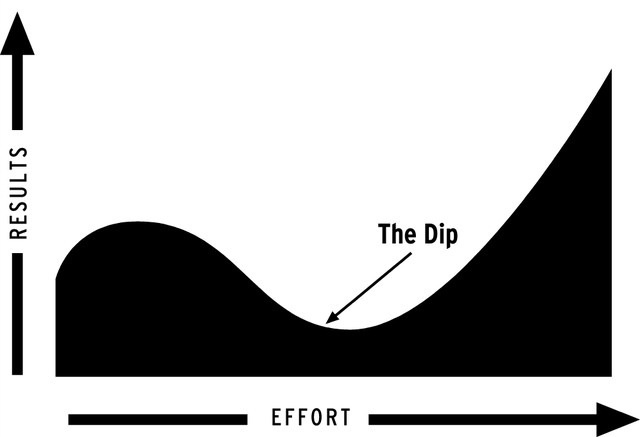
We all hit plateaus in our lives and quests for health and happiness. In order to be successful at the task at hand, we need to grind our way through that low point (or flat point) until we can climb out and continue progress.
Here’s a visualization of the dip:
When you first start something new, you can make quick progress and everything rocks because you see big changes.
However, after a few months, the reward you get from your effort decreases and it seems like you’re rapidly slowing down:
In the first few weeks of weight loss, everything is GREAT! The scale is moving, your clothes are getting looser, progress is exciting because it’s coming so quickly. Then, you might have a few weeks where you’re really trying hard and yet the scale stalls or increases.
When building a new running habit, each new run is exhilarating – you rapidly progress from wheezing and coughing after two blocks to now being able to run a whole mile! A few months later, that progress slows, and you find yourself struggling with the same distances and speeds even though you’re doing all of the right things.
When lifting weights, the first few months can be life changing.Squats, deadlifts, pull ups,push ups. Every session in the gym is an opportunity to see massive progress compared to the time before, except for that week or two when you walk in and you have to lift less than before! What gives!?
When we hit that dip/plateau where our hard work seems like it goes unrewarded, it’s easy to give up and say, “I’m a failure.”
Not true.
We will all experience a dip when it comes to progress on things that are important to us.
If we want to TRULY be successful, we need to anticipate the dip’s arrival and plan for it so that it doesn’t completely derail us.
Much like grinding out experience points in an RPG, sometimes we need to grind out practice in life, workouts, nutrition, and more…until we can hit that sweet spot for progress again.
So, how do we stay dedicated, focused, and motivated through the dip?
How do we progress during the plateau when we feel like our hard work is a waste of time?
We focus on small wins, and find a way to get a teeny tiny bit better.
What Should I Do When I Hit a Plateau? (Setting Personal Records)
In order for us to crawl out of a dip or off a plateau, we need to find a way to make a small win every day.
Think of these small wins like “a light to you in dark places, when all other lights go out.”
The longer we’ve been training, the older we get, and/or the more advanced we get in our training, the more likely we’ll be to hit plateaus and the more necessary it will be to grind out small victories, prepare for dips, and power through them.
Here’s how you can grind out your own small wins and prove to yourself that you are still progressing when you are in the dip:
1) TRACK EVERY SET, REP, AND WORKOUT. Find a way to be better today in SOME WAY than you were yesterday, and prove to yourself that you are still making progress – even if it’s progress in a different way that you were progressing before.
If you are stuck at 3 sets of 5 reps of 150 pounds on the bench press and haven’t been able to go up to 155 lbs for a few weeks, try 3 sets of 6 reps of 150 pounds.
Or 4 sets of 5 reps of 150 pounds.
Then come back to 3 sets of 5 reps of 155 a few weeks from now, and see if you can do that.
If you wait 60 seconds between sets, try waiting 90 seconds instead and lift a different amount
As long as SOMETHING has progressed in some way – your total amount of weight lifted, decreased time between sets, one extra rep, or one more pound lifted – it proves to yourself that you made progress. Remember, progress makes us happy.
We are transformers (Joe especially), and our small changes add up too.
It’s these tiny, small victories that can push us over the edge. Enough small victories and we can reach that tipping point, that end of the dip where progress continues again.
Find a way to set a tiny win in SOME WAY each day that shows you that you are getting better/faster/stronger.
Here’s an example: I have been working on handstand balancing for probably 18 months. For the past few months, my progress has stagnated and even gone in reverse on some days (helloooo Dip!).
I continued to work on building the habit of handstands for five minutes a day (Hard Hat challenge for the win!). Progress felt nonexistent, but I knew that my continued dedicated practice was adding up in ways that didn’t make themselves readily apparent.
I had “stalled,” so I focused on getting tiny wins: increasing flexibility in my wrists, staying against the wall as long as I could, practicing my kick ups, tightening my core, etc.
Despite not being able to balance for longer than 10 seconds at any point in the past, I kicked up into a handstand, without even touching the wall (something else that had never happened before), and I held my handstand for 24 seconds!
I still have a ways to go before I’m holding perfectly vertical handstands for 60+ seconds, but months spent grinding out practice in the dip have paid off.
I made it through the plateau, and my progress has continued rapidly after struggling for months. Those months of struggle were teeny tiny wins in different ways that added up until I hit that tipping point where progress exploded.
3) TRACK OTHER METRICS OTHER THAN THE SCALE. The scale can lie. The scale will DEFINITELY slow down even if you are making progress in healthier ways, simply due to the fact that you have less weight to lose than you did before! You might also be dealing with extra water weight, or bloat, or menstruation, or anything in between.
So, track other things! Here’s what you can track to help keep you motivated while pleateaued:
Take biweekly photos. Who cares if the scale isn’t moving. Are you looking better? Are you FEELING better? Do your clothes fit better? That is progress.
Take measurements. Spend 5 bucks on a cloth tape measure (or one of these), and measure the important parts of your body. Maybe the scale isn’t moving, but you took half an inch off of your waist. Or maybe you added a quarter of an inch to your arms.
Track your body fat percentage.A simple caliper is enough to show trends. Remember Saint? His weight went UP but his body fat percentage dropped. Had he only been tracking the scale, he might have panicked during his ‘dip.’ Fortunately, he was tracking more metrics and used that momentum to catapult himself to victory.
The goal is to consistently prove to ourselves that we are moving one step closer towards our goal.
This is exactly the system we used when we built Nerd Fitness Journey.
When you’re working through the app, not only are you doing fun missions, but you’ll see how tasks build up to your larger goal. There’s no getting stuck or frustrated, just log in and work on the next adventure.
If you want, you can sign-up for a free trial right here:
5 Tips and Tricks for Overcoming a Plateau
The above is just the beginning. This will also help you make progress and get out of that dip:
1) Shock your workout. Our bodies crave efficiency, and love to be as lazy as possible, but we truly thrive on chaos. So introduce some chaos into your system!
Note: This is NOT the same as “muscle confusion” (which is a made up marketing term to sell DVDs). We’re still progressing, lifting more, and doing the same exercises – we’re just throwing in some variation occasionally to help stimulate progress.
If you do the exact same thing over and over and over, your body becomes more efficient at that activity.
In fact, your body can learn and adapt after doing the same thing enough times so that it burns fewer calories to carry out the process. So mix it up!
Trying to increase your deadlift? Rather than just doing a 1-rep max, do a day of higher volume, or train the deadlift twice a week.
Want to squat better? Squat with higher frequency. NF Lead female coach Staci followed an advanced Smolov Squat program for 13 weeks (Warning: not for beginners). Your body can adapt and overcompensate by getting stronger.
Want to improve your upper body strength/size? I’m currently doing a PLP program along with my regular workouts. Starting with 10 total reps of Pull-ups, Lunges, and Push-ups, and every day add a rep, for 50 days.
2) Adjust your diet. Your body can also become quite efficient with calories (not to mention the oft-mentioned but controversial “starvation mode” theory), and can sometimes struggle to progress.
As we lay out in “Why can’t I lose weight?,” if you’ve lost a decent amount of weight, your body now burns significantly fewer calories each day (there’s less of you to manage! This means you need to adjust your calorie intake!
ONLY after that doesn’t work would I recommend the following:
Consider throwing in one day a week of OVER eating, along with days where you are intermittent fasting. Keep your body guessing and see if that shocks your system back into weight loss mode.
Consider adjusting your macronutrient breakdown. Keep your protein intake high, and adjust your carbs and fats. Some people feel better or worse with high fat or low fat, high carb or low carb.
3) REST! I’ve heard it said “there’s no such thing as “overtraining, just under-recovering.” Are you getting enough sleep?
Maybe you’re a new parent and trying to maintain your old workout routine on 2 hours of sleep a night.
Or work has you stressed like crazy and it’s causing you to eat like crap.
Rest is such an important part of a healthy lifestyle that it needs to be prioritized too. In the book Essentialism, this is referred to as “Protecting the Asset.”
You are the asset.
If you are trying to do too much, or you’re caught in a plateau, consider a week off, refocusing on sleep and recovery, and come back refreshed.
Again, nature loves chaos. If you are focused solely on weight loss, you might feel like you have stalled out. So shift your focus. Work on handstands. Or running faster.
Try something different. Give your body a chance to recover and then come back to it.
If you’re solely focused on the scale and it stalls out, it can be depressing. So put the scale away for a month, and instead focus on the process of getting stronger and eating better. Stop stressing and remember to enjoy the game you’re playing.
5) Accept that we have bad weeks. We are complex pieces of machinery.
We just have bad weeks and can’t lift enough or we GAIN weight when we expected to lose weight. It doesn’t make you a bad person, it doesn’t make you a failure, it makes you human.
So on days when you feel great, PUSH yourself harder. On days when you feel like crap, scale back the heavy lifting and focus on more reps or better technique.
The greatest predictor of success in our lives is grit (which can be developed). Grit is what you need to slog through these slow weeks. These dips are where we find out who’s truly dedicated. I know you are, and you know you are.
Remember, look for any sign of progress in any way to reveal that “light” at the end of the tunnel.
If you are stuck on a plateau when it comes to strength training, consider working with one of our Yodas in the 1-on-1 Online Training Program at Nerd Fitness! No guilt, no shame. Just somebody to keep you accountable, expert guidance from somebody that knows you, and peace of mind knowing you’re doing the right thing!
How did you break through your plateau?
“If you always put limits on everything you do, physical or anything else, it will spread into your work and into your life. There are no limits. There are only plateaus, and you must not stay there. You must go beyond them.” -Bruce Lee
Hopefully I’ve covered everything you need to know about plateaus. What’s that? You were expecting some lame joke about plateaus somewhere?
You know me too well. Okay, how bout this one:
Did you know that a plateau is the highest form of flattery?
Get it?
Thank you, I’ll be here all week.
I want to hear your story:
Have you successfully busted through a plateau? Leave a comment with how you got out of it.
Are you currently stuck? If so, what’s ONE SPECIFIC piece of advice you’re taking from today’s article to apply to what you’re going to do this afternoon?
Let’s hear it! I’m excited to hear how I can help.
-Steve
PS: We know starting with this stuff can be intimidating. If you’re looking to take it to the next level:
1-on-1 Online Coaching: A coach from Team NF gets to know you better than you know yourself and builds a workout program and nutritional strategy that fits your busy life, your body type, and your goals.
Nerd Fitness Journey: a fun app that will show you the path for overcoming any plateau. Sign up for a free trial below:
There has been a great deal of information and misinformation about Hoodia Gordonii circulating, sometimes educating, sometimes baffling and creating all sorts of avoidable frustrations and false starts in someone’s diet plan.
In order to throw new light and chase away the countless pieces of fiction on Hoodia Gordonii that are flying around offline and online, I decided to present the essential facts of this amazing plant which has captured the world’s attention.
FAQs of Hoodia Gordonii:
Q: What is Hoodia Gordonii?
A: Hoodia Gordonii is a spiny, bitter, and succulent aloe plant that resembles a cactus which grows in the Kalahari Desert of Southern Africa.
Q: Does Hoodia Gordonii really help to suppress one’s appetite?
A: Yes! For centuries Hoodia Gordonii has been used to reduce hunger by the Bushmen while on extended long travels through the desert or on hunting trips. It is also quenches one’s thirst and cures a case of severe abdominal cramps, indigestion, tuberculosis, diabetes, hemorrhoids, hypertension, and is a mood-enhancer and improves energy levels.
Q: Realistically, how much weight can I lose by taking Hoodia Gordonii?
A: That depends on each individual’s daily diet, metabolism, the frequency of exercise, and the bio-chemistry of the person’s body. Keep in mind that Hoodia Gordonii works to effectively suppress your appetite. If you indulge in late snacks and in between meals, hoodia can help you reduce those cravings, and together with regular exercise and a healthy diet, you can expect to experience significant weight loss in the long run.
Q: How does Hoodia Gordonii prevent me from wanting to eat?
A: Hoodia Gordonii fools your brain by making it believe that you have already eaten when you haven’t. In addition, you will feel full.
Q: About how fast will I experience results?
A: Hoodia Gordonii may work immediately or it may take days. As demonstrated in tests in Leicester, England, when volunteers consumed 400mg of a pure brand of Hoodia 3-4 times a day, it helped cut daily caloric consumption by 1,000 calories. Know that everyone’s body is different, and thus, some people will require more time in order for their body to build up the active ingredient in Hoodia. It’s a good idea to continue taking Hoodia for no less than two weeks in order to experience positive results. Also, it absolutely helps to use a trusted brand that offers the purest form of Hoodia Gordonii. Otherwise, you will not have favorable experiences using an inferior brand of Hoodia. Do a little research and you can find a brand you can trust.
Q: How should I take Hoodia Gordonii?
A: For absolute best results, drink an eight-ounce glass of water when taking Hoodia, one capsule, 30 minutes before meals.
Q: How much Hoodia Gordonii should I take to experience sure success?
A: Most people are finding success with Hoodia when they take 2 capsules of 400mg daily, 30 minutes prior to meals with 8 ounces of water. It’s highly recommended to take either one 750mg in the morning and another one in the afternoon, or two 400mg capsules in the morning and another two 400mg capsules in the afternoon prior to the dinner meal. These dosages guarantee you a higher possibility of successful results when taking pure 100% Hoodia, eating a healthy diet, and exercising regularly.
Q: How safe is Hoodia Gordonii? What are the side effects?
A: Hoodia Gordonii is 100% natural. Both the San people (who have been using the plant for thousands of years) and scientists have confirmed that there are no side effects associated with Hoodia Gordonii. In fact, in South Africa, Hoodia is identified as a food, not as a drug.
Q: What are some of the most noticeable results when taking Hoodia Gordonii?
A: High on the list of results are: a diminished interest in food, a longer delay in the normal time frame after eating before hunger sets in once more, feeling of fullness for a longer period, and an overall feeling of optimal health.
Q: Is Hoodia Gordonii a stimulant?
A: Hoodia Gordonii is not a stimulant like caffeine.
Q: What about those ads boasting of selling pure Hoodia at bargain prices?
A: Today there are literally hundreds of Hoodia Gordonii resellers claiming to have the 100% pure stuff, when in reality, most of them are selling inferior or adulterated brands from 40 to 70% less than resellers who are selling the genuine Hoodia. It’s little wonder how such resellers can afford to sell the “pure Hoodia” at those low prices! Why? They’re usually not the pure stuff! Many resellers are selling brands that not only contain an inferior Hoodia, but other ingredients like Aloe. Beware! Choose very wisely from which vendor you buy your next or first order of Hoodia.
Please share this post on Facebook, Twitter or Pinterest. Thanks !


 Holiday season is just round the corner. There will be parties, celebrations, food and champagne. Ahhhh….that irresistible succulent Christmas turkey and sumptious pudding. That mouth watering New Year’s buffet table and the countdown champagne are so tempting. Your spirit is willing but your flesh is weak. You binge.
 Personally, I live to eat and I believe in having your chocolate and eat it as long as you eat all things in moderation. Secondly, I do not see the point of simply giving you a generic weight loss diet plan which maybe unsuitable for you. Rather, here are some diet tips to supplement your existing diet that you may need as you go through the day.
 Millions of people struggle with weight issues every year, and despite claims that a wonder diet can “work for everybody”, the fact is that each of those individuals have a medical history, a personality, or a lifestyle issue that affects whether or not that weight control technique will help them
  Why is our society so focused on
  It seems lately that I have come across an abundance of information on the benefits of consuming green tea. Because of this, I have been inspired to compile some of the information – specifically regarding green tea and weight loss.




























 In order to throw new light and chase away the countless pieces of fiction on Hoodia Gordonii that are flying around offline and online, I decided to present the essential facts of this amazing plant which has captured the world’s attention.