Changing seasons in life call for different kinds of workouts and adjustments to wellness routines. At Lindywell, we’re all about honoring the season you’re in, meeting your body where it is, and adjusting as necessary.
My season of life is changing which is why I want to share what I’m currently doing in my workouts, what has changed, what I’m loving, what I’m struggling with, and everything in between.
If you would like an honest look at where I am in my wellness journey, press play.
You will want to hear this episode if you are interested in…
Where my life has been over the past ten years [2:02]
How my morning routine has shifted in the last six months [6:10]
How I strive to challenge myself [9:40]
What we just released in the Lindywell app [12:30]
Adjusting workouts during the changing seasons of life
Our workouts change throughout the seasons of life. If you have been following me for a while, you know that I’ve spent the past ten years with small children at home. If you are a busy mom like me, you know exactly what that means for my self-care routine.
While I haven’t been able to revolve my life around my workouts, I have been able to consistently incorporate short workouts into my daily routine. My goal has been to work out 15 minutes each day. Anything more has been icing on the cake.
Now that my twins are almost five, I can carve out a bit more time to focus on self-care and I can actually leave the room without being called back five minutes later!
Finding quality strength training workouts on the internet is a challenge
Pilates has transformed my body and my life. While the past ten years have been challenging for exercise they have been the inspiration behind Lindywell.
I recognized just how hard it was to fit in a quality workout which is why our workouts are so efficient and effective. If I only have ten or fifteen minutes to devote to working out, I’d better make it count.
Now that I have a bit more energy and time, I decided that I wanted to add a bit of strength training to my wellness routine. Over the past six months, I have searched the internet for quality strength training workouts, but I haven’t found any guided workouts with cues that would help me prevent injury while gaining strength.
This is why I decided to make my own. My strength training videos use the philosophy of Pilates and focus on alignment and moving with precision and control so that you can add more strength training to your wellness routine.
How to access Lindywell’s new strength training videos
In addition to an introductory video, there is a series of five strength training videos now available in the Lindywell app.
If you are over 30 that means that you are losing muscle mass each year. Pilates uses your body weight to incorporate strength training, and you can use props like our hand weights and resistance bands to add more of a strength workout to your Pilates routine.
However, like me, you may be looking to add a bit more. If so, head on over to the app to check out the new strength training series. Lindywell is your wellness companion. The app provides everything you need to support your goals to live a healthy, balanced life. If you still aren’t a Lindywell member, you can try it out free for 14 days.
If you’ve been playing the Pilates vs. weight training game (Which one is better? Which one should I choose?)—I have good news: you don’t have to choose. Even better, when you combine Mat Pilates (Pilates without a reformer, which is what we do at Lindywell) with weight training, you reap the benefits of both.
When you look closely, it’s easy to see how the two are very similar: both target the musculoskeletal system to develop strong, resilient muscles, joints, tissues, and bones. In addition, both forms of exercise can be classified as resistance training:
Weight workouts utilize weights for added resistance
Pilates mat workouts primarily utilize body weight for resistance
This means that combining the two can provide a well-rounded workout routine that not only builds strength but also improves mobility, reduces stress, and increases mindfulness.
I’m often asked, “Which is better?” and I’m here to tell you that they both have benefits.
What I’ve seen, however, is that not all weight training programs are created equal. It’s imperative to bring what we know about Pilates in terms of proper movement mechanics into our weights workouts to reduce the risk of injury and actually benefit from the workouts.
Let’s ditch the Pilates vs. weight training mindset. Here’s what you need to know to get started with both!
Pilates vs. Weight Training: Let’s Break it Down
Traditional weight training relies on lifting weights as the primary form of resistance to increase muscle strength. Progressively increasing load is what leads to gains in strength, stamina, and endurance. Weight training is an important and effective way to maintain muscle mass and bone density as we age.
Mat Pilates, on the other hand, can be done with or without light weights (1-3 lbs), or other equipment to increase resistance. Whether you’re using body weight or added weight, the Pilates principles remain the same, keeping the movement focused on alignment, control, and intention.
And this is what’s often left out of weight training programs or may be missed if you’re lifting on your own: the focus on form, alignment, and breath. However, applying these Pilates principles to weight training workouts not only reduces your risk of injury but also increases the effectiveness of your weight training workout so you see better results.
Pilates and Your Core
There is one more distinction that sets all Pilates (Mat and otherwise!) apart from traditional weight training: the core. Pilates focuses on engaging the core in every movement to create stability, protect your back and build strength in your spine. It’s imperative that we add this focus to weight-training workouts for the best results.
Your body relies on this strength for nearly everything you do in life, from reaching for a glass to bending down to tie your shoes. This means weight training can be more impactful when combined with Pilates because you’re also getting that core focus.
How to Choose Your Workout
First and foremost, you don’t need weights to experience the benefits of Mat Pilates. These bodyweight workouts allow you to build strength using your own body weight as resistance. This has even been shown to increase bone density as well.
This is incredibly important as we age, considering we begin to lose muscle and bone as early as age 30. Adding additional resistance to your Mat Pilates workouts (through light weights, bands, or even equipment like the Reformer) or lifting heavier weights with traditional strength training, can help you continually challenge your body.
Challenging your body, in whatever way is best for you, is important in maintaining your muscle mass and strength as you get older. And how you create that challenge will change from season to season. Sometimes this might mean using weights and sometimes it may not.
With that in mind, the workouts you choose from day to day depend upon the following:
How much do you want to challenge yourself?
What is your body is craving in this season?
Can you maintain your form as your weight increases?
Here’s what you need to know and how I recommend making this choice for yourself.
Weighted Pilates Workouts
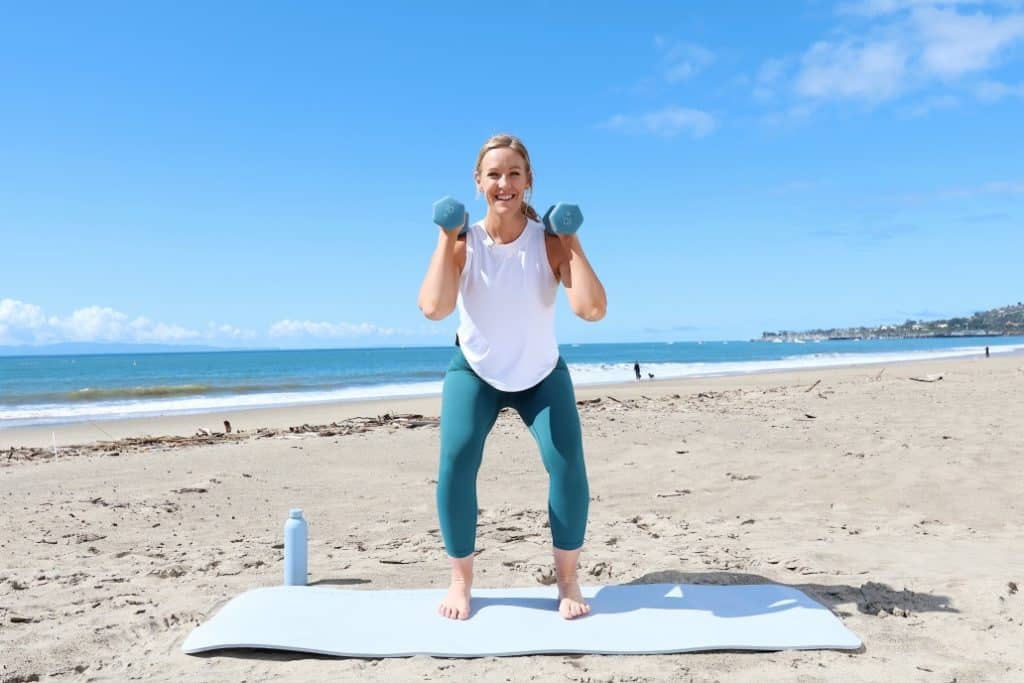
Adding light weights to your Mat Pilates workouts can be a great way to add an extra challenge. In this case, I typically reach for our Lindywell hand weights, which are just 2.2 lbs each. They’re built as a no-slip capsule so they’re easy to use and look as good as they feel in your hand.
If you want to switch it up with your resistance-based Pilates workout, here are some additional ways to do that:
If your body feels ready for the added challenge of heavy weights, strength training is a great choice. But I encourage you to do it with the Pilates Principles in mind. The tricky thing is, not many workout programs focus on this.
I’ve noticed that most programs include little to no cueing and there’s also no guidance on how to activate the proper muscle groups or where you should be feeling the movement.
If you want to learn how to strength train in a way that focuses on form, breath, alignment, and mindfulness, we have something for you: our new series, Pilates-Inspired Weight Training, inside the Lindywell app!
With this series, you’ll do traditional strength training exercises like squats, lunges, bicep curls, and flies. How much weight you use will be up to you. Tthe program is designed to focus on working your muscles to fatigue. This helps you progress in your strength training in a way that is safe, effective, and tailored to your personal needs and goals.
Each movement is slow, controlled, and supported by our core, which is likely very different from how you’ve learned to lift weights.
Inside the Lindywell app, you’ll find a variety of strength workouts. You can integrate these into your routine, including full body, lower, upper, arms, and shoulders. Each workout is 10-20 minutes so you can choose what’s best for your body and day.
Start your 14-day free trial to get instant access to all of Pilates-Inspired Weight Training, along with 275+ Pilates workouts, hundreds of anti-inflammatory recipes, and guided breathwork sessions.
Don’t Choose Between the Two: Combine Them!
You can amplify the power of Pilates by adding external weights safely and with intention. If you want to build more strength and challenge yourself, this is a perfect way to do that. Remember to tune into what your body needs in each workout. Sometimes weights will be the perfect addition while other times, your body may be asking for less intensity.
Don’t forget that as you add strength training you will need to do Pilates all the more to make sure you don’t add tension or tightness to your body. This will help you stay strong in your core to support your strength and weight-training workouts.
The bottom line is it’s not Pilates vs. weight training. It’s: how can I bring these together to see even more progress in my practice?
If you’re ready to bring weights into your Pilates workouts or try Pilates-inspired strength training, sign up for a 14-day trial of Lindywell and get instant access. If you’re already a member, just open your app and choose your workout!
Mindful movement changed the fitness game for me. I spent years exercising without any sense of what my body needed or how it actually felt. Coincidentally, I could also never stay consistent with any program or routine.
I’d be invested and excited for a few months and then life would get busy and all of a sudden, lifting weights or going to the gym felt like the last thing I wanted to do. So I’d stop and then eventually, start again at some point in the distant future.
You may be familiar with this off-and-on relationship with your fitness routine. One of the things that made it possible for me to stay consistent once and for all was mindful movement.
Pilates brought this style of exercise to my attention and in the last 10 years, it’s created a powerful shift, not just in my fitness routine but in my life as well.
If you struggle with stopping and starting your fitness routine but want to be consistent enough to experience both the mental and physical benefits, this may be the missing piece. Mindful movement reminds us that exercise is about so much more than simply showing up. It’s about slowing down, being in your body, and taking even just 10 minutes for you to focus on yourself.
Let’s talk about what mindful movement is and how it can help your fitness routine stick once and for all.
What Is Mindful Movement?
Do you pay attention to the sensation of your muscles contracting as you lift weights?
Are you able to breathe slowly and intentionally as you move your body through your workout?
How often do you listen to the needs of your body when choosing your workout each day?
All of these ways of thinking about and approaching exercise are part of mindful movement. This is the integration of mental awareness and physical exertion. It helps you focus on what your body is doing—and how it feels—from one exercise to the next.
This style of movement helped me stick with my workout routine once and for all. I started choosing exercises that my body was craving rather than forcing something I didn’t want. I also started noticing the mental benefits of consistent mindful movement, like less stress and better sleep.
All of this showed me that simply showing up to my workouts wasn’t enough. To stick with it, I needed to slow down, tune into my body, and take note of how each workout was impacting my life, not just during but after.
How to Incorporate Mindful Movement
A few of the most common examples of mindful movement include yoga, tai chi, and, of course, Pilates. This is the basis for our workouts here at Lindywell, but all types of movement can be done with a mindful approach using these basic principles:
Slow down and breathe: Slow down each movement and use your breath to connect with your body as you do it. For example, breathe out as you roll your body down to touch your toes, breathe in at the bottom, and breathe out as you roll back up.
Focus on what your body needs: Some days you may want to lift heavy weights but other days you may want to stretch gently. This is especially true for women who have a monthly cycle. Choose the movement that your body is craving each day rather than forcing something that doesn’t feel good.
Set an intention: Your workout does so much more than build muscle. It can help you tap into your creativity, let go of anxiety, or cultivate energy for your day. What do you want to get out of your workout? Set that intention and keep it front of mind as you go through the movements so it becomes not only about the movement itself but how you feel as a result.
How Mindful Movement Creates Consistency
If your idea of a workout is to rush through a series of intense exercises as quickly as possible, then mindful movement may be far outside your comfort zone. That’s okay, I’ve been there! But, trust me, if you’re willing to give it a try, this will change the way you experience movement.
It may also be the missing piece to creating more consistency in your workout routine. On that note, here are eight science-backed reasons mindful movement will make your fitness routine (finally!) stick.
1. Stress Management
The combination of being mindful while also moving your body is impactful, according to researchers at Penn State University. This state of being can help relieve stress, anxiety, or depression because mindfulness trains you to take deep breaths and concentrate on physical sensations, rather than what’s happening in your mind.
Both of these actions reduce cortisol (stress hormone) levels, creating a relaxing effect on the body—even when it’s in motion.
When do you most often bail on your workouts? When you have a stressful day. Yet that’s when you need it most. Consistent mindful movement with Pilates is one of the main ways I show up as the best version of myself for my kids, my husband, and my business because it helps me manage and reduce my stress.
Without it, I would definitely struggle more to juggle everything that life throws my way so I always prioritize it.
2. Fewer Injuries
When you slow down to focus on the correct form, cadence, and technique of an exercise, you’re less likely to injure yourself. This is important to consider because, when you injure yourself, you’re more likely to get out of your workout rhythm to take time for rest and healing.
Slow down with mindful movement to avoid injury in the first place. This way you have one less reason to get out of your fitness routine. Let’s be honest, we all have enough reasons already, right?!
3. Better Sleep
Mindful movement can boost sleep quality and alleviate insomnia by regulating your nervous system. A regulated nervous system can stimulate the natural sleep-wake cycle, in addition to helping you manage inflammation, increase oxygenation, and lower your resting heart rate, all of which promote better sleep. Lindywell member, Kristen, experienced this after starting Pilates:
“I have also noticed that I am getting more deep sleep than I was before starting Pilates, and there is a noticeable increase in my core strength, which is definitely encouraging and motivating.”
Take note of your sleep patterns and habits. When you slow down your workout, do you notice you sleep better at night? This benefit might just be enough to help you stick with your routine because we all feel so much better when we get quality sleep!
4. Mood Regulation
Physical activity releases mood-lifting hormones (cue that post-workout glow) like dopamine, serotonin, and endorphins. When you integrate mindfulness into the exercise routine, those benefits are amplified.
That’s because mindfulness training improves emotional regulation, self-esteem resilience, and satisfaction in life. Being mindful during workouts can strengthen your mental health as a whole. This makes your fitness routine so much more impactful in every area of your life, giving you just another reason to stick with it consistently.
5. Athletic Endurance
Stamina is important not just in your workout, but in life. If you want to go hiking with friends or run around your yard with a pup or grandkids, you need stamina. According to the Neural Plasticity Journal mindfulness optimizes aerobic endurance (stamina). In other words, you can enjoy your favorite physical activities for longer periods of time when you stick with a mindful movement practice. Yes, please!
6. Improved Energy Levels
Diaphragm-based breathwork (deep, slow breathing) is an essential part of mindful movement that brings big benefits. It’s been found to boost respiratory function, which helps circulate more oxygen to the brain and body and, in turn, can boost your energy levels.
Research from the Health Promotion Perspectives Journal also found that combining exercise with meditation curbs fatigue. This means you feel both alert and invigorated, which is another great reason to stick with it. I mean, does anyone else always want more energy, or is that just me?
Here’s how Lindywell member, Lori, experienced this boost of energy after she joined:
“I joined Lindywell in 2017 and I was hooked. I was able to be more consistent with exercise because of the shorter workouts at any time of day. I quickly built strength and tone and more energy and less stress!”
Experience this yourself with Lindywell’s guided breathwork! Join our 14-day free trial to get access to all the breathwork sessions plus 275+ workouts!
7. Better Concentration
Mindful movement requires a different level of concentration than simply doing a workout. The benefit of tuning into each muscle contraction and physical sensation is that you’re grounded in the present. Consistently doing this enhances your brain function.
In fact, a new study from Frontiers in Psychology found that mindfulness-based exercises strengthen the neural networks that increase focus, memory attention span, informational processing, and other key executive functions. Stick with your mindful movement routine and you may notice you focus better in every other area of life!
8. More Enjoyable Workouts
When you’re connected to the sensory experience of a workout, it’s easier to intuit how your body feels and what it might need. This makes the fitness program itself more enjoyable which promotes well-being and makes it easier to turn it into a habit.
It makes sense when you think about it: why would you keep doing something that doesn’t feel good or that you don’t enjoy? Choosing workouts that you do enjoy—the format of which may change from day to day—makes you want to do it, rather than feeling like you need to force it.
Tap into Mindful Movement with Lindywell
Mindful movement might just be the missing piece in creating a fitness routine that sticks. You can bring mindfulness into any movement format, and at Lindywell, we help you do that through Pilates. With more than 275 workouts ranging from 10 to 30 minutes, plus breathwork sessions, anti-inflammatory recipes, and more, you’ll stress less, feel amazing, and strengthen your mind-body connection. Start your 14-day free trial to access your workouts instantly!
The benefits of wall sits go much further than just getting you through the dreaded middle school PE tests! While not all fitness challenges have stood the test of time, wall sits are still one of the most effective ways to build strength in your core and lower body.
That’s why I love this movement. At Lindywell, we love efficiency and a wall sit is exactly that. It’s also simple, requiring no equipment or space (just an empty wall!), and can help tone your body, challenge your endurance, and boost your confidence. Yup, all of that!
Plus, it only takes one minute each day to see these results. If this exercise isn’t part of your movement routine already, allow me to convert you. Here are five undeniable benefits you can experience from doing a wall sit for just one minute per day. Make it a consistent habit, and I’m confident you’ll notice the difference, both mind and body.
How to Do a Wall Sit
As with all exercises in Pilates, I want you to be intentional with form so you can maximize the benefits and avoid injury. Here are five steps for getting in and out of your wall sit while protecting your spine and building strength and endurance.
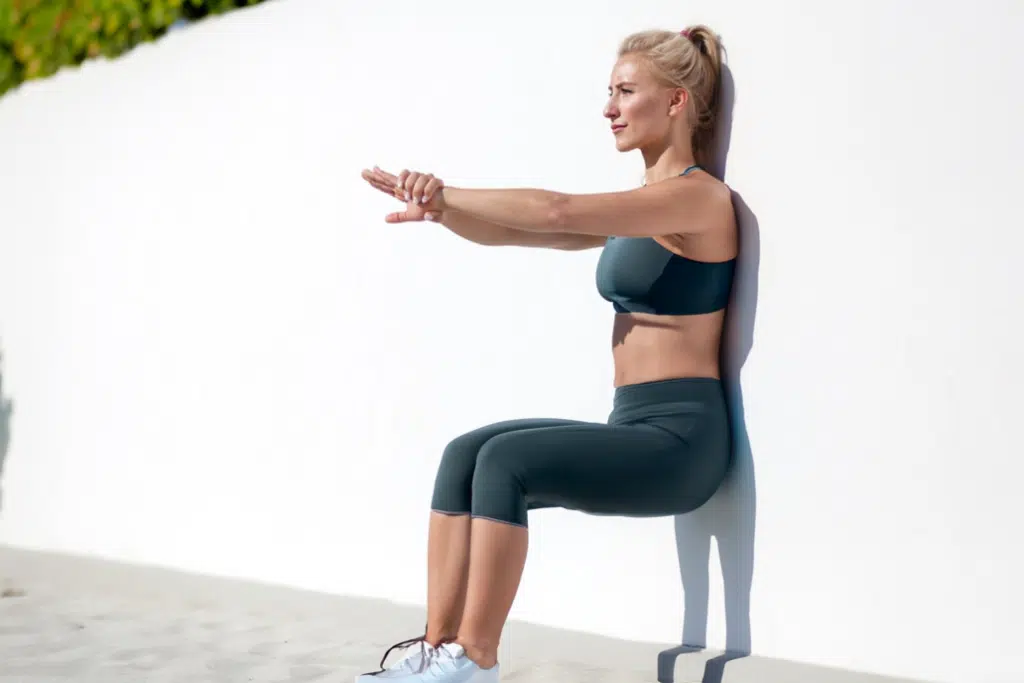
1. Position your back flush against the wall, pull your belly button toward your spine, and place your feet hip-width apart.
2. Walk your feet away from the wall and slide your back down until your knees are bent at 90 degrees. You can reduce this angle by not sliding down to a full 90 degrees, if you’re new to the exercise or concerned about balance.
3. Relax your shoulders away from your ears and push your feet into the floor to activate your glutes and keep your core activated (belly button pulled toward the spine).
4. Breathe in and out slow and controlled, sending energy down into your body which will help you hold the motion and sustain the burning sensations you might be feeling in your muscles.
5. Hold the stance for one minute and then slowly slide your back up as you step your feet back toward the wall to return to standing.
The Mind-Body Benefits of Wall Sits
The beauty of a wall sit is you don’t need to unroll your mat or pick up your weights to build strength. Simply holding this position for one minute can impact your mind and body in ways you may not realize. Here are a few of the benefits of wall sits that I can’t get enough of.
1. Boost Core Strength
At Lindywell, your core is always at the heart of ours so I love this move to help you (and me!) continue building core strength. When performing a wall sit, it’s common to feel the most work in your lower body. However, your core is firing on all cylinders too.
Holding an isometric contraction—which is when your muscles are flexed and strong, but don’t actually move—takes a lot of work. In a wall sit, your abdominals (as well as surrounding muscles in your back and hips) have to work hard to hold your entire body in this isometric contraction for a whole minute.
Your abdominal muscles maintain stability and support the spine, in other words: keep you upright. Your lower back muscles help counterbalance your natural inclination to lean forward. Finally, your pelvic floor muscles help your body stay in pelvic alignment and provide stability.
All of this leads to a stronger core that supports your body in nearly any movement, from bending over to reaching over ahead.
I also want to add that if you’re healing from Diastasis Recti and looking for safe ab exercises to recover your strength and repair connective tissue, wall sits can be great for you! Just focus on drawing the belly button to the spine and lifting the pelvic floor as you hold the contraction. Learn more about this, your core and pelvic floor in episode 90 of The Balanced Life!
Nearly every workout you’ll find within the Lindywell app helps you build core strength. Sign up for your 14-day trial and get access to all 250+ workouts, plus breathwork, recipes and more!
2. Build Muscle and Improve Circulation and Metabolism
Wall sits activate your hamstrings, quadriceps, calves, and glutes. The isometric contraction increases tension on these muscle groups which, in turn, stimulates hypertrophy (muscle cell growth). In other words, holding the squat position for even just a minute helps you build muscle.
Not only does this contribute to muscle mass in your legs and core, but hypertrophy can also boost your metabolism and circulation. This can lead to reduced inflammation, better digestion, and an overall greater sense of mental and physical well-being. A win-win-win!
3. Improve Alignment and Posture
We care a lot about posture here at Lindywell because a healthy mobile spine helps you move throughout your day with ease and freedom. Part of maintaining great posture is having awareness of it as you go about your day.
Maybe you’ve had a moment where you finished a meeting on your computer or had been watching TV on the couch and realized you were hunched over the whole time. You didn’t even have awareness of it, but then, as you straightened back up, you felt that familiar discomfort or stiffness.
Wall sits can help you increase postural awareness (and limit that discomfort) because, as you hold your back up against a wall, you’re creating muscle memory that helps your muscles recognize and remember what it feels like to maintain a tall posture. The more you do it, the more you can train yourself (and your muscles) to be conscious of your posture on a day-to-day basis.
This improved posture not only helps reduce back and neck pain but can also boost your confidence. You stand taller and walk stronger, which can leave you feeling more empowered in every area of your life!
4. Boost Your Endurance
Muscular endurance refers to how long a muscle can keep working (I.E. pushing or holding something) without getting tired. Isometric exercises (like the wall sit) boost this endurance because your body has to hold that resistance (in this case, your body weight) for a specific length of time without releasing the tension.
As you build this endurance, you may find that you can do more of the activities you love, like hiking, biking, gardening or just running around the yard with your pets. This ultimately improves not just your physical body, but overall quality of life. This is one of the most important aspects of movement for us at Lindywell!
5. Keep Your Joints Mobile and Flexible
The wall sit is considered a functional exercise. This means it can optimize the range of motion in your joints, making it easier to perform normal daily movements. When doing a wall sit, your hip, knee, and ankle joints are all in a state of flexion (bending), which in turn promotes that joint mobility.
Plus, the activation of your quadricep muscles reduces the amount of pressure or load on your joints. If you struggle with joint pain in your ankles, knees, or hips, wall sits can be a low-impact way to build strength without causing further discomfort. As a bonus, you’re also moving lymphatic fluid in those areas each time you gently flex them, which supports healing, immune health and detoxification.
It’s Simple and Beneficial to Do a Wall Sit for One Minute Each Day
You might only notice the feeling of your legs screaming to stand up (been there!), but the benefits of wall sits extend far beyond what you can feel or even see. If you’re searching for a convenient, low-maintenance exercise that delivers maximum results in a short amount of time, this one is for you. You’ll build core strength, support posture and alignment, and more—all in just one minute, with no equipment at all.
Joyful aging can seem like an oxymoron if you’re struggling with the experience of aging. And hey, I get it—as the messages to continually look younger and stay young in order to be relevant take a toll on me too.
My body has certainly changed since having my four children. If you’re a Lindywell member, you may have heard me refer to what I call my “Twin Skin,” a part of my body that I lovingly embrace. Keeping my hormones balanced and finding time to take care of myself has become more difficult as my responsibilities continue to increase.
As I look ahead, envisioning the years to come, I want to continue embracing a joyful aging mentality and love each and every step of the way. At Lindywell, we see aging as a gift, which is why I solicited some advice from our team.
We’re lucky to have many incredible women who have embraced the experience of aging and were willing to share their tips and advice with us. Keep reading to hear what they had to say about joyful aging. You’ll pick up a few ideas and words of encouragement along the way, I know I did!
Look for the Opportunity
With each age, change, and shift, comes an opportunity. Kayleen W., Lindywell Member Resources Coordinator said what she loves most about aging is “the opportunity for growth and joy at every stage. While I do have some insecurities still (who doesn’t), as I’ve aged I’ve grown more grateful and less self-focused, therefore much less insecure, which is wonderful!”
This can be hard to see when you’re frustrated with changing hormones or struggling to manage unexpected physical or emotional changes. When you embrace the natural unfolding of age, this new perspective can help make the experience more enjoyable and interesting.
To stay in this mindset, Kayleen said her number one tip for joyful aging is: “Never stop growing, challenge yourself always! Learn new skills and subjects that interest you. Followed very closely by living a life of gratitude. Every passing day and year really is a gift.”
Feed Your Soul
As you get older, you may find you have more and more responsibilities and obligations, from taking care of children or aging parents to managing your career. Jen M., Lindywell Member Support Lead, reminds us to embrace joyful aging by not forgetting who you are and what you love:
“Stay active, keep moving. Feed your soul by taking time to do the things that make you happy. Don’t be afraid to try new things.” By doing this, Jen has found an unexpected sense of body love and appreciation, despite the challenges of letting go of societal expectations.
When I asked what her favorite part of aging is, she said: “Feeling so much better in my body than what I anticipated it would feel like in my 50s. I have come to feel proud of my wrinkles and that I’ve earned them all by a life lived being outdoors (my favorite way to spend time), being adventurous, and living a full life.”
Nourish and Nurture (And Love!) Your Body
Your mind and body may be different now than in your 20s, but that doesn’t mean it deserves any less love and attention. One way to embrace joyful aging is to give your body the love it needs.
This suggestion comes from Julia K., Lindywell Member Support Coordinator, who said her number one tip for joyful aging is: “Take care of your body by eating nourishing foods, getting in healthy movement, and feeding your skin with clean skin care products.”
The ability to learn what your body needs takes time, which is another beautiful aspect of aging if you choose to embrace it. As Emma T., Lindywell Executive Assistant said:
“The best part of aging is every year I become more familiar with my body, its unique needs, and how to take care of it. I think learning what foods, exercises, and practices feel good for you only comes with time. Getting to know yourself emotionally takes time too. I look forward to continuing to age as I continue to get to know myself and am more in tune with my best self!”
Surround Yourself With A Diverse Community
Staying curious is one way to embrace aging and the many changes you experience as you go through it. One of the best ways to do that is to surround yourself with a diverse group of people. This is the number one tip for aging joyfully from Donna Y., Lindywell Member Support Lead. She said:
“Surround yourself with diverse people, not just of different cultures but also of different ages, experiences, backgrounds, etc. We learn so much from each other, whether it is the wisdom of someone 20 years older or the technical know-how of someone 20 years younger. Continually being curious and wanting to learn keeps us young!”
While this can apply to staying curious about life, I also see this as a reminder to stay curious about what you’re moving through. Rather than getting stuck in the frustration of a shifting metabolism or changing life circumstances, we can always come back to curiosity.
For example, when I get frustrated that I don’t feel the way I used to, I recognize it as an opportunity to get curious. What could be going on in my body, or in my routine, that is causing these feelings? Could I need more rest? Should I reach out to my counselor? Am I eating foods that provide the nourishment I truly need? Do I need to change something about how I’m spending my time?
The curiosity allows me to stay present in my current experience and avoid complacency.
Shift Your Perspective From Curse to Gift
It can be hard to see the gifts in changes that you don’t necessarily want. A perspective shift, from curse vs. gift, however, is the number one tip for joyful aging from Kasey M., Lindywell’s Social Media Manager.
She said, “It is a gift to wake up each day and I’m grateful for each day I get to grow older. The experiences and moments I’ve witnessed in my lifetime [are what I’ve loved most about aging], the wisdom I’ve gained from these experiences, and the lessons I’ve learned.”
There’s so much to gain with each passing year. We can embrace the beauty of this every step of the way, especially when we’re frustrated or disappointed with the changes we’re experiencing.
You Can Embrace Joyful Aging
It can feel impossible to embrace joyful aging in a culture that doesn’t seem to honor the beauty and power of getting older. At Lindywell, we believe women can live a full life at any age. Does this mean we won’t experience challenges and changes? No. But it does mean that when we have a positive mindset around this truth and work with our bodies instead of against them, we open ourselves up to embrace and enjoy our whole lives, every season, every age. And that is the power of joyful aging.
By Jessica Thiefels, Lindywell member & Marketing Consultant
My Pilates transformation was unexpected. I’m a former personal trainer, ex-gym rat, and long-time “clean eating” advocate. I’m also in the depths of disordered eating recovery and body image healing.
I always exercised to change the way I look. Get more toned, keep my belly flat, and feel like I was good enough, or in many cases, better than everyone else. Running parallel to my fitness journey, was my food journey, which included intense elimination diets to heal a variety of mysterious body issues, like extreme bloating and a rash all over my chest, shoulders, and back.
For a Type-A, perfectionist who thinks in black and white, this was a recipe for disorder.
However, nearly a decade after I started my body healing journey, in the fall of 2022, I said to my husband, “I’m walking a fine line between disordered eating and conscious eating.”
At that moment, though, I knew which side of the line I was on. I was also more obsessed with how my body looked than ever before. I was doing intense workouts, eating with strict rules—and feeling anxious and stressed.
The realization that I needed to make a change came clear and sharp. I was exhausted. I felt like I was running on a hamster wheel and could not, no matter how hard I tried, get off. So, I did what I do best: went all in.
I listened to stories of eating disorders and recovery through podcasts, started reading books on Intuitive Eating, and most importantly, started working with a professional for body image and disordered eating recovery.
And this is where my story with Pilates begins. Just two months after starting this work I began working with Lindywell as their SEO and content marketing consultant. Part of my job was to try the app, try the workouts, and get familiar with what they do and how they do it.
I resisted logging in and trying a workout until January 1, 2023. But on Day 1, my Pilates transformation began.
Week 1 Transformation
Setting non-body intentions and loving quick and easy workouts that energize and ground me.
I can honestly say, the moment I stepped on the mat, I felt a shift. As someone who had always lifted heavy weights and sprinted hard on the treadmill, this was different in so many ways. The slow-down, the moments of grounding, the gentle movement. It was all exactly what I needed.
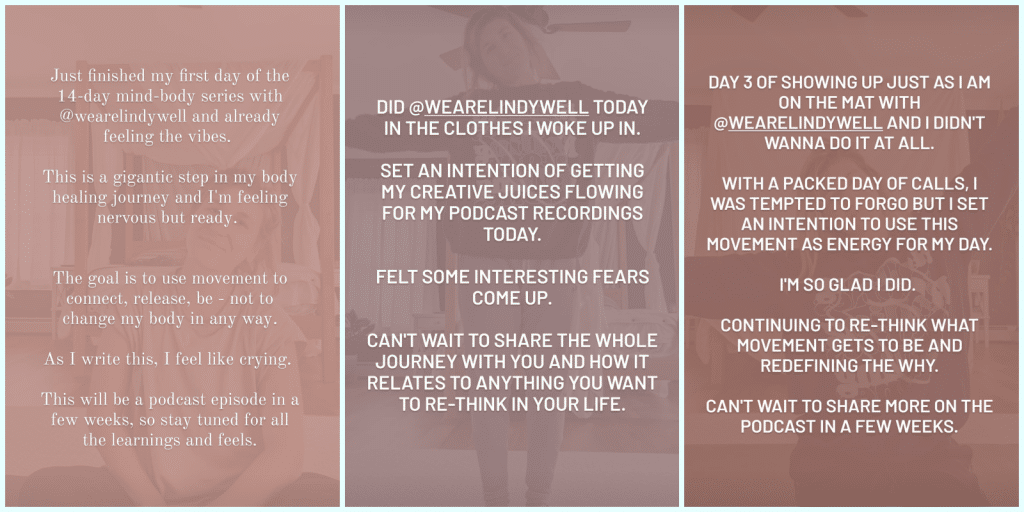
As a natural content creator and 12-year marketer, I decided to share my experience on Instagram Stories for the first 14 days with Lindywell. I posted each day, right after the workout, so rather than telling you how I felt in week 1, I’ll let those posts do the talking.
Within the first few days, I also realized that this was the perfect way to move my body as a busy mama who also runs a business and has an active social life. On Day 4, I posted:
“Day 4 with @Wearelindywell, and my intention was energy. Weston was up real early today and mama is tired!”
If you notice I said, “my intention was…” This was another big part of my Pilates transformation. I wanted to make this time on the mat about more than my body. So each day, I set a clear intention that’s focused on something other than my body, like energy, creativity, or peace.
Almost four months later, I’m still setting an intention before each workout. Shifting my focus from how my body looks or “performs” to how I am feeling from the movement has been incredibly powerful.
Turning Pilates into a daily part of my routine and noticing my physical strength.
As week two rolled in, the calm of the movement became one of my favorite things about it. On Day 8, I posted: “Day 8 with @wearelindywell and feeling so grateful for the slow, powerful pace of Pilates and the calm I always feel when I come onto the mat.”
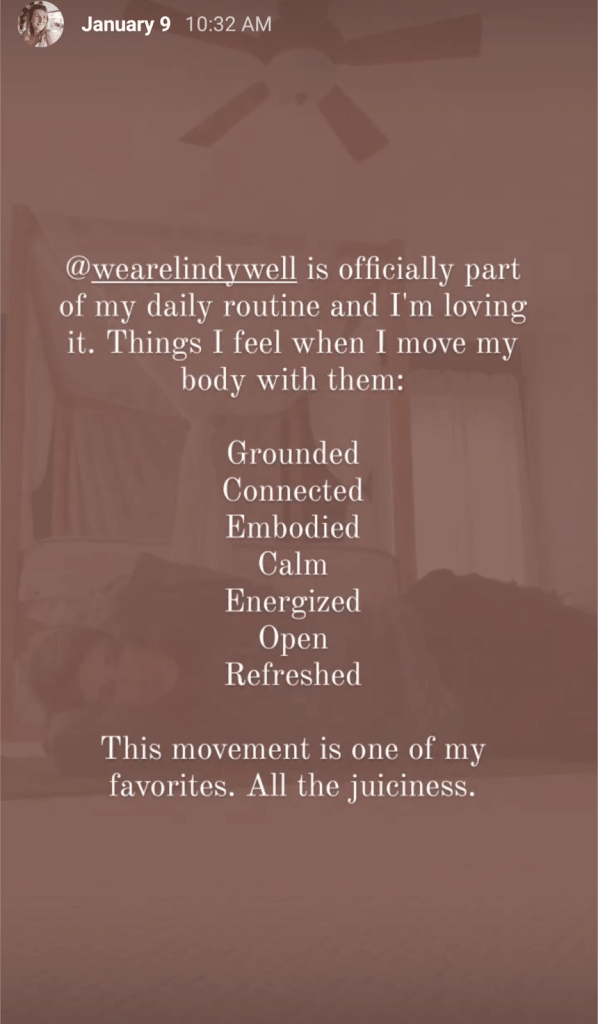
It was at this point that I also realized this was now part of my daily routine. On day 9, I posted:
During week two, I also started noticing how strong my body was becoming. In just 10 days, I could see an increase in strength, especially in my core. After one of my workouts, I was playing around with doing a headstand, something I’ve been able to do for many years. Getting up into the pose had never felt as easy as it did that day.
I was also noticing certain movements—like Rolling Like a Ball—that were challenging on day one already felt so much easier to do. My body was changing, but so was my mind. They were syncing, connecting, and supporting me in every area of my life.
Showing up on my mat without question and loving the variety of options.
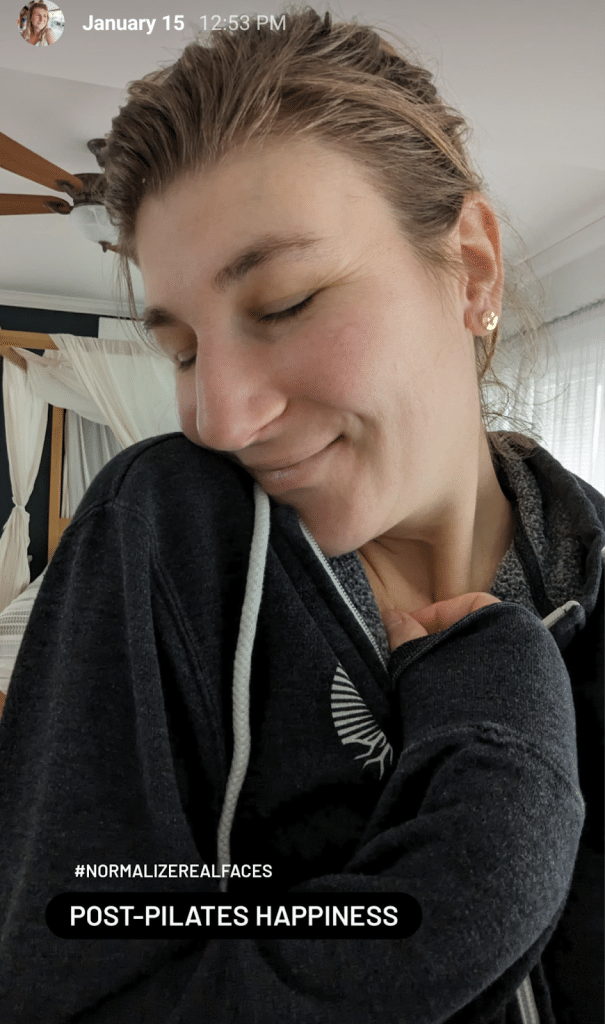
On Day 15, I posted this photo with greasy hair and no make-up, full of those post-movement feels:
This sums up how week 3 felt for me. My Pilates transformation was always about so much more than my body, and during week 3, I began to simply love the process, the experience, and how I was feeling after every single workout.
I also started digging into the different workout options, even doing two a day—one that challenged me in the morning and one that helped me wind down and stretch in the evening. It didn’t feel like I needed to do two to change my body. I was just craving being back on the mat.
Most importantly, I loved that I could choose a long or short workout and, no matter which it was that day, it was always enough. This mindset is the direct result of what Robin, the founder and lead instructor of Lindywell, reminds us every time we step on the mat:
Being here is enough
Meet your body where it’s at
Do what feels good for you today
For me, that translated into total bliss. All the pressure I used to carry around working out disappeared.
In addition to all of that, the mindfulness I was practicing on the mat was also translating into my disordered eating recovery. I was eating foods I love (that I’d sworn off for years), listening to what my body really wanted, and so much more.
Leaning into ease off the mat and feeling beyond grateful for Lindywell.
On Day 23, I posted a Reel titled, “Pilates Lessons for an Easeful Week” and this is the perfect example of how I was feeling as my first month of Pilates closed out. While I was noticing clear strength gains and was able to commit to daily workouts in a way I never had before, the greatest Pilates transformation I experienced wasn’t felt so much on the mat, but off the mat.
As I shared at the beginning, I’ve always had a Type-A, black-and-white, perfectionist personality. Pilates brought a calm and groundedness that I was resisting as I moved through this incredibly challenging healing journey. As Stephen Pressfield, the author of The War of Art (if you haven’t read it, pick it up now), says:
“The more resistance you experience, the more important your unmanifested art/project/enterprise is to you—and the more gratification you will feel when you finally do it.”
This was so true for me. I knew Pilates, specifically from Lindywell, would change me, but I was resisting slowing down and grounding. I was resisting finding a new way to move. On the other side of that resistance, however, was something that will impact me forever.
My Pilates transformation was so much more than I could have ever imagined it would be. It came at a time when I needed it most and has now become a regular part of my routine that I truly love. Whether I get on the mat for 10 minutes or 25, I always feel strong and energized—and somehow also calm and grounded. It changed so many aspects of my life and I know it will do the same for you.
If you haven’t tried Lindywell yet, I highly recommend signing up for their 14-day trial. I have a feeling at the end of the 14 days, you’re going to wonder how you ever got through your days without it!
By Kiesha Yonkers, Head of Breathwork + Somatic Programs
The connection between breathwork and hormone health and wellness cannot be ignored. My experience, from the very start of exploring this practice, is the perfect example.
In mid-2020, my stress hormones (cortisol) were at an all-time high. As was the case for so many of us. I was chronically in fight or flight, and as a result, I was feeling anxious, worried, and far from connected to myself.
When I started doing breathwork, I felt the stress start to melt away. This meant that I was shifting into my parasympathetic system, which is the “rest and digest” system. It’s also the opposite of fight or flight, which is when you’re in the sympathetic system.
Shifting into this parasympathetic state allowed my body to activate the “happy” hormones, like dopamine, serotonin, and oxytocin. In this state, I felt safe and that allowed me to connect with my loved ones and myself more effectively. I was also able to release some of the anxiety and feel all the goodness that those happy hormones were sending my way.
As you know, we strive to keep our discussions here at Lindywell rooted in evidence while keeping things simple and approachable. So let’s bring some science to this scenario with a few practical tips on how to use breathwork for your hormone health and wellness.
First: Why Do Hormones Matter?
Let’s break down the key hormones that impact us as women and what they do.
Estrogen: Estrogen keeps us on our toes! It’s a multi-purpose hormone that supports everything from your menstrual cycle to bone health and that glowing skin we’re all trying to achieve. This hormone naturally fluctuates throughout your life as a woman, all the way through menopause.
Progesterone: Progesterone (sometimes called the feel-good hormone because it can make us feel calm—yes, please) varies throughout your cycle each month. Its main role is to prepare your body for pregnancy and support fetal development.
Testosterone: Testosterone is not just a hormone in men! This hormone supports muscle growth, bone health, and libido for women.
Thyroid hormones: Your thyroid hormones are the unsung heroes of health and wellness. They come from the thyroid gland and regulate many of the most popularly discussed aspects of our health, like metabolism and energy levels.
When I talk about supporting hormone health and wellness, I’m referring to the steps we can take to keep these hormones (and all the others that are at play in our bodies) in balance. This means we feel good and our body can function.
If any of these hormones are out of balance or not being produced, you may notice a wide range of symptoms. These symptoms, which depend on the type of hormone imbalance and underlying cause, can include fatigue, mood changes, weight gain, hot flashes, acne, low sex drive, depression and so much more.
How to Breathe Your Way to Healthier Hormones
Breathwork activates the parasympathetic system, and when your body is in this state, it is better able to produce and activate the hormones you need to feel safe, loved, connected, and happy. This is also when your metabolism improves, digestion works well, and your body can function exactly as it should.
While it’s not necessary to always be in one of those states to keep your hormones happy (that’s not even possible!), breathwork helps you come back to that place of “rest and digest” regularly, rather than staying in fight or flight.
The good news is, you don’t need to be experienced in the art of meditation to reap the hormone benefits of breathwork. Even better, you don’t need to spend hours each day doing it! Here’s what you need to know about using breathwork as a tool for your hormone health and wellness.
Start Slow and Simple
Breathwork can be intimidating (I get it, I’ve been there!) so I encourage you to start slow and simple with box breathing. Breathe in slowly and deeply for four seconds, hold for four seconds, breathe out for four seconds, hold for another four, and start again. You may be surprised by how at ease you feel after doing this just 4 or 5 times.
You can try a guided breathwork session from yours truly in the Lindywell app! If you’re not a member, start your 14-day trial and get instant access to a variety of breathwork sessions and techniques.
Make it a Part of Your Routine
As with anything, consistency is key to success. A single breathwork session is helpful. Still, the goal is to continually bring ourselves back into the parasympathetic system over and over. This is what activates those happy hormones needed to help us thrive.
Remember that taking even just 2 or 3 minutes for breathwork can have benefits like less stress and anxiety, better focus and mental clarity, and boosted energy levels (yes, please!). Longer sessions can offer even more benefits, like better lung capacity and sleep, and the ability to release blocked emotions that are making you feel stuck or anxious.
Short daily breathing exercises are important and effective. However, longer sessions guided by an expert can increase the benefits and provide an opportunity for significant transformation. If you want to experience the power of these longer, guided breathwork sessions, reserve your spot for Exhale Hour. Join me for live breathwork sessions that deeply support you, both mind and body.
Pair Breathwork With Pilates
There are many ways to support your hormones. Breathwork is one of them and exercise is another, specifically Pilates. Research has found that this form of movement is especially beneficial for women’s hormone balance. One study saw a significant decrease in participants’ menopausal symptoms, which are directly impacted by hormone health, after practicing Pilates.
The best way to pair these two powerful hormone helpers is to join Lindywell.Sign up today and you’ll get your first 14 days for free!
Once signed up, you get immediate access to 250+ Pilates workouts, multiple guided breathwork sessions, and hundreds of recipes created to support hormone health and reduce inflammation.
Breathwork is a Powerful Partner in Hormone Health and Wellness
Our hormones want to support us, but if we’re constantly in fight or flight, we inhibit their ability to do so. This is why breathwork is so important and can’t be overlooked for your hormone health and wellness.
Deep breathing gets us into that all-important parasympathetic state, which in turn supports our hormones. When we commit to breathwork (and Pilates!), we feel happier and less stressed. In the process, we also feel more connected and our bodies can function exactly as they’re supposed to. A win-win!
Cycle syncing is a powerful way for you, as a woman, to choose food, movement, and tasks that support where you are in your cycle. In this case, we’re talking about syncing your Pilates routine to your cycle, in other words: choosing the workouts that best suit your mood, energy, and body as they naturally fluctuate throughout the month.
Tuning into your body’s unique needs at each phase can make it easier to choose a workout that helps you meet your body where it’s at, which is a key factor in the way we move here at Lindywell.
Choosing your workouts based on your cycle can also eliminate the guilt associated with choosing a shorter or “easier” workout. It’s not about pushing yourself every single time you step on the mat, but listening to your body’s needs.
With that in mind, let’s dive into what you need to know about cycle syncing and Pilates—and how simple it is to get started.
For those of you who have shifted into menopause, please know that we see you! Stay tuned for some similar tips and strategies to work with your body coming soon!
My Cycle Syncing and Pilates Experience
Cycle syncing with your Pilates routine helps reduce burnout, fatigue and stress that might happen when you do more than your body is ready for. I pushed my mind and body to the brink for many years. But ever since my conversation with Berrion Berry on this subject, I’ve been more mindful of how my cycle impacts which workouts I choose and how I schedule my work.
Let me just say, this shift has been a game-changer for me so I had to share it with you! It’s important to remember, though, that this should not be a reason to pressure yourself into exercising “perfectly” or pushing yourself to exercise every single day.
Instead, I hope this serves as a guideline for you to tune into your body and choose what your body needs. For example, I took a day off from my workouts this week and chose a more gentle routine today knowing that other areas of my life were demanding more from me.
Like we always say here at Lindywell, it’s about progress over perfection.
The Four Phases of Your Cycle
Cycle syncing is a term coined by functional nutritionist and hormone balance expert Alisa Vitti. Adjusting your Pilates workouts (or diet or other lifestyle habits) with each phase of the menstrual cycle will help you align your routines and activities with your shifting hormonal needs.
Women’s cycles last 28-32 days, on average, and there are four distinct phases of this cycle: Menstruation, Follicular, Ovulation, and Luteal. While each body is unique, here is a basic rundown of how the reproductive hormones typically fluctuate from one phase to the next.
Menstruation (Days 1-5): This phase occurs when your uterus sheds its lining (your period starts) and both the estrogen and progesterone levels dip. You know what this one feels like: fatigue, lower energy, and a greater sense of introspection and slowing down.
Follicular (Days 6-14): This phase occurs right when your period ends but before your ovaries release an egg. It causes both estrogen and progesterone levels to rise. In other words, you’re feeling energized and confident.
Ovulation (Day 15-17): This phase occurs when an egg is released from your ovaries. It causes the estrogen levels to peak, while progesterone continues to rise. This can cause a continued increase in energy levels, along with a higher sex drive.
Luteal (Days 18-28): This phase occurs when the egg is fertilized for pregnancy, or hormone levels start to decline for menstruation to begin. During this phase, the longest of your cycle, you might feel a drop in energy and greater mood fluctuations.
Note that the days for each phase of your cycle mentioned here represent the average. Your phases may last longer or shorter, and likely change over time as well.
Syncing Pilates With Your Cycle
At Lindywell, we encourage members to move at their own pace and always offer modifications. This means, no matter what you choose, most of our workouts can support the cycle you’re in.
However, learning how to navigate our 250+ workouts based on what you’re feeling each day can help you dial in on exactly what you need each and every time you step on the mat.
Let’s break down what to look for at each phase of the cycle. I’ll also share some Lindywell workouts that would be great for each phase.
If you’re already a Lindywell member, just click the workout to open it in your app. If you’re not, sign up for a 14-day free trial and you’ll get immediate access to every workout in our library.
Pilates Workouts for the Menstruation Phase
Days 1-5
It’s common for the body to crave gentle movement during this phase. Try some of our recovery workouts and stretching workouts that promote circulation and stretch your muscles without too much exertion. This is also a great time to slow down with breathwork, if movement doesn’t feel good or in addition to your workout. Check out our guided Breathwork Sessions.
For many women, this is the best time for a short cardiovascular workout. Right now you can take advantage of your increased energy levels without totally burning yourself out. While most Lindywell workouts will support this phase very well, this is a good time to explore our standing workouts and Barre workouts to give your body an extra challenge without overdoing it.
If you want to incorporate more high-intensity exercises into your routine, this is typically a good time to do it! You’ll be able to capitalize on your body’s increase in hormones and energy levels. This is a good time to push yourself with harder and longer workouts, like those in our 35+ minute section. These will help you challenge your body during a time when you have the energy to complete a longer workout.
Now is a great opportunity to enjoy moderate exercises that use resistance to build strength without draining your lower energy levels. Make the most of this phase by heading to our Props section, where you’ll find lots of workouts that allow you to boost the resistance. If you need props for your Pilates workouts, head to the Lindywell Store to get your mat, hand weights or even resistance bands!
Cycle syncing makes it easier to align withyour body instead of pushing against or even ignoring the changes happening within. This feel better during your workout and support your body’s specific needs, so you can maintain your energy and support your mood. All while still building mind-body strength! A win-win, right?!
PS: As Dr. Aviva Romm shared on The Balanced Life podcast (Part 1 and Part 2), our cycles are an important signal of our health as women. If you’re noticing changes in your cycle or are concerned about irregularity or lack of menstruation, make it a goal to reach out to your doctor to share your concerns. Listen to Part 1 and Part 2 of our conversation.
Women’s hormone health is a hot topic in the wellness world—and for good reason. Our hormones impact every area of our life, as I’ve learned in the last few years after being diagnosed with a hormonal imbalance.
My doctor was surprised I was even functioning when I was first diagnosed with hormone imbalance! I attribute this resilience of my body to the Pilates routine and our Lindywell approach to wellness, both of which had been a part of my life for many years before my diagnosis.
Over the course of this journey (that I’m still on), I’ve learned so much about women’s hormone health and how to find even more balance in my body. Along the way, Pilates has continued to be a key tool, and I want to share why and how.
My hope is that this article—and a membership with Lindywell, if you choose to join us!—will help you find greater balance, ease, and strength in your body.
Why Hormone Balance is So Important for Women
Experiences that impact our stress levels, sleep habits, eating or exercise patterns, and autoimmune function can lead to hormone dysfunction. For some women, this is caused by major life transitions like puberty, childbirth, peri-menopause, and menopause. For me, this was a result of the demands on my life, including having four kids in five years (including twins!), a miscarriage, and exposure to toxic mold. All of that added stress to my system because of how taxing it was to my endocrine system.
This hormonal imbalance is temporary and can be treated with conventional medicine or basic lifestyle shifts for many women. If you don’t come back into balance, however, you may start to experience uncomfortable symptoms and chronic health problems.
Because hormones regulate several important systems and functions in the body, from mood and appetite to sleep and stress, it’s so important to for women to find that balance once again. While there are different ways to do this through diet, lifestyle, and supplementation, one of our favorite tools for supporting women’s hormone balance is Pilates.
Pilates and Women’s Hormone Health
While we may seem biased—we love Pilates here at Lindywell!—it’s true that this form of movement can be extremely supportive of your hormone health and help you come back into balance. Here’s why:
Pilates Strengthens the Mind-Body Connection
Pilates teaches you how to be mindful of the present, as you bring awareness to each and every movement. This Pilates method combines precise, controlled movements with a focus on intentional, conscious breathing to strengthen the mind-body connection.
Mind-body exercise has been shown to support the production of Serotonin (the “happy hormone”) and the reduction of Cortisol (known as the “stress hormone). This means that doing Pilates can support your ability to deal with life’s everyday obstacles. And our thousands of members around the globe can attest to this!
Pilates Supports Weight Management
If the hormones that control energy metabolism and blood sugar levels are out of balance, you can experience insulin resistance. Over time, this causes inflammation, weight fluctuations, and chronic health issues like diabetes.
Researchers at the University of Mohaghegh Ardabil in Iran monitored the effect of Pilates on women with excess weight. They saw that this particular Pilates routine, which included mat and ball workouts, reduced three hormones (chemerin, visfatin, and resistin) that can impact your body’s ability to manage weight, insulin, and metabolism when elevated.
In other words, Pilates helped balance these three important hormones. One of the results of that re-balancing was weight loss. If you want to experience a similar workout as the study participants, try this free workout, which includes ball and mat exercises!
Pilates Keeps Oxygen Flowing Through Your Systems
Endocrine glands create and release hormones into your bloodstream. These glands need oxygen to perform their critical function. If they don’t get this, you risk disrupting the endocrine system as a whole. This can escalate into diabetes, infertility, endometriosis, or even some forms of cancer.
Because Pilates combines rhythmic breath and full-body movement, you naturally stimulate oxygenation and circulation, which can lead to greater hormone balance, head to toe. I want to exhale just thinking about how good that feels!
Pilates Boosts Brain Health
The low-impact movement and a continuous pattern of breathing that supports oxygen flow through your body are also linked to a well-functioning brain. Both of these things help regulate three of the brain’s primary hormone groups (metabolic, stress, and sex). This means getting on your Pilates mat regularly helps boost brain health and even reduce cognitive decline.
At Lindywell, we make it easy to commit to this daily brain-boosting movement with a wide variety of short, 15-20 minute workouts that help you build strength too! Lindywell member, Catherine, experienced this and so much more:
“I’m stronger, have better balance, have lost several inches all over, and just look better. On an emotional and mental level, I have more confidence, am less stressed – or better able to handle it, and just feel more joy.”
If you’ve experienced hormonal imbalance—or you’re in a life transition that might cause those hormones to fluctuate—bring Pilates into your routine. This mindful movement is a powerful tool for women’s hormone balance and one that’s been critical on my journey as well.
Not only can it help you restore balance in your body (yes, please!), but it will also help regulate your mind. This helps you You may be surprised by how great you feel if you commit even just 10 minutes a day to a Pilates workout.
Have you ever considered Pilates for scoliosis relief? I discovered how supportive this type of movement can be more than a decade ago when I took my first Pilates class, well before I ever became a teacher or created Lindywell!
I was diagnosed with scoliosis in high school. We discovered that I have an S-curve in my mid-thoracic spine—the mid-upper section of my back. While it didn’t significantly worsen over the years, I did develop a lot of pain in my shoulder, neck, and jaw as a result of muscular and postural imbalances from one side to the other and TMJ from my jaw being out of alignment.
Pilates has greatly (greatly!) reduced my pain. The consistent practice of getting back into alignment and rebalancing my body has been key to living with this diagnosis with less pain.
If you’re struggling with pain or discomfort from a curvature in your back, you’ve come to the right place. Let’s dig into how you can lean on Pilates for scoliosis relief.
Please note the information provided in this article should not be used for diagnosing or treating scoliosis. Always seek the advice of your doctor or another qualified health provider regarding a medical condition.
What You Need to Know About Scoliosis
Scoliosis is an abnormal rotation and curvature of the spine. It can manifest in the cervical (neck), thoracic (upper back), or lumbar (lower back) regions. As I shared earlier, my scoliosis created an S curve in my spine but was luckily not severe enough for surgery or a brace.
Although posture does not cause scoliosis, this condition can affect how you stand or move. For example, a few common signs include:
Uneven hips or shoulders
A significant curve in the back
Forward jutting ribs
Bump in the lumbar area
Sideways lean
Trouble walking
If you feel pain, numbness, and a lack of balance or coordination in your legs, this could point to scoliosis as well.
It’s important to note that mild forms of scoliosis are easy to overlook. In fact, some of my past clients had scoliosis without realizing it. As they did a Roll-Down, I noticed a hunch or lift on one side of their back, indicating they might have a curve in their spine. Sure enough, they were diagnosed after seeing a doctor.
If you notice any of the signs and symptoms mentioned above, we encourage you to see a doctor. With a diagnosis, you can understand how to best manage the pain and find support.
How Pilates Can Alleviate Scoliosis Pain
I’ve experienced pain from my scoliosis ever since I was diagnosed in high school. Mild and serious cases of scoliosis can exert pressure on the nerves and muscles which connect to your spine. This can be uncomfortable or disruptive to your life. In fact, those with scoliosis are highly prone to suffer from chronic musculoskeletal low-back pain.
Orthotic treatments, such as braces, can relieve some of that pressure, but another intervention can also support, in addition to, or in some cases, instead of, a brace. It’s effective, low-impact, and gentle on the body. I’m talking (of, course!) about Pilates, which has been a game-changer for my diagnosis.
Here are a few of the ways Pilates can provide pain relief for you as it has for me:
Pilates uses intentional and controlled movements to lengthen the muscles, bring flexibility into the spine, and stabilize the core. Not only does this promote balance, strength, and flexibility, but a strong, stable core reduces pressure on the spine. This can help alleviate back pain and increase mobility.
Muscle elongation plays a role in scoliosis relief too. Performing an exercise that stretches and lengthens your muscles (and fascia) can ease stiffness or compression in the vertebrae joints. This, in turn, can help relieve any chronic or acute neck, shoulder, back, and pelvic tension you might experience.
Pilates has been found to gently correct balance and postural alignment issues, which is just one more way to alleviate pain and support your body through scoliosis.
I have more rotation in one direction compared to the other and one of my shoulders is higher than the other. The rotational and side-strengthening movements in Pilates help to balance that out.
In extreme cases, there’s only so much relief that Pilates can provide, but if your scoliosis is either mild or moderate, Pilates for scoliosis relief can be a great option. This type of movement can help you build and maintain a functional range of motion while relieving pain, tension, and discomfort.
How to Practice Pilates with scoliosis
I know what you’re thinking: I’m ready for relief now. I get it, I’ve been there—and some days, I’m still there. That’s why I want to share a few strategies you can use to make the most of Pilates for scoliosis whenever you step on your mat.
Remember that doing Pilates once or twice will likely not give you the relief you’re looking for. While I still have occasional discomfort, it’s mild, and that’s only because I continually do Pilates to balance my body and build strength on both sides.
This is why a Lindywell membership can be so powerful. With workouts that range from 10 to 30 minutes, it’s easier to make time for your movement each day. If you’re not a member, sign up for your free 14-day trial and start with a workout like Total Body Alignment. If you’re already a member log in to push play on your next workout!
Here are a few ways to make your Pilates workouts most effective for reducing pain and supporting your scoliosis.
Don’t force a painful movement—allow for modifications.
Move gently through your Pilates session and listen to your own body. We always say this at Lindywell, but it’s even more important for you. If a certain movement causes pain, a joint or muscle group is tense, or you notice restriction in a particular area, be mindful of this.
It’s your practice. This means I want you to listen to your body and scale back on the resistance or modify an exercise so that it feels more comfortable. In most Lindywell workouts, we offer modifications to make this easier for you.
Stay connected to your core.
We always say your core is at the heart of ours. That’s because the connection to your core is so important, in life and Pilates. This is especially true if you’re struggling with back pain or discomfort. This helps take the pressure off your spine and allows your core to support your body exactly the way it’s supposed to. This also helps you build greater core strength, which will support your scoliosis off the mat too.
Pilates and breathwork are closely intertwined. Each movement can be made more effective (and in some cases, easier!) when you coordinate with the rhythmic flow of breathing. We start most Lindywell workouts with a moment to connect to the body and breath.
If you can hold this awareness throughout the entire workout, you’ll not only make it more effective, but you’ll also help your body relieve even more stress and tension.
A Routine to Support Your Body
Get a sense of how Pilates can provide relief for your scoliosis with this restorative workout. In just 10 minutes, you’ll stretch your body, practice intentional breathing, and build strength. It’s a perfect example of what you can expect from every Pilates workout with Lindywell.
Try Pilates for scoliosis Relief
If you’re ready to get the full experience, start your free trial of Lindywell today! We have more than 250 online Pilates workouts for all fitness and experience levels, taught by certified instructors, and founded by me, Robin, someone who’s managed a scoliosis diagnosis for nearly 25 years.
Each routine is built to develop strength, increase mobility, restore balance, realign posture, and boost flexibility—often in just 15 minutes or less. This means you can use Pilates for scoliosis relief without adding a time-consuming task to your to-do list—a win-win!